


Dear Dave,
The city water smelled heavily of sulfur for almost two days after hookup. We thought it was the campground water but after approximately 48 hours, the smell disappeared. That leads me to believe it was an internal problem. Any ideas? —Della, 2011 Fleetwood South Wind
Dear Della,
There are several variables that could cause a sulfur or sewer-like smell, which we should be able to isolate with a little more information. Since you have a Class A motorhome, the city water connection most likely is in the service center on the driver side of the rig. I do not have an actual photo of a Southwind but this one of a 2016 Thor Challenger would be very similar.
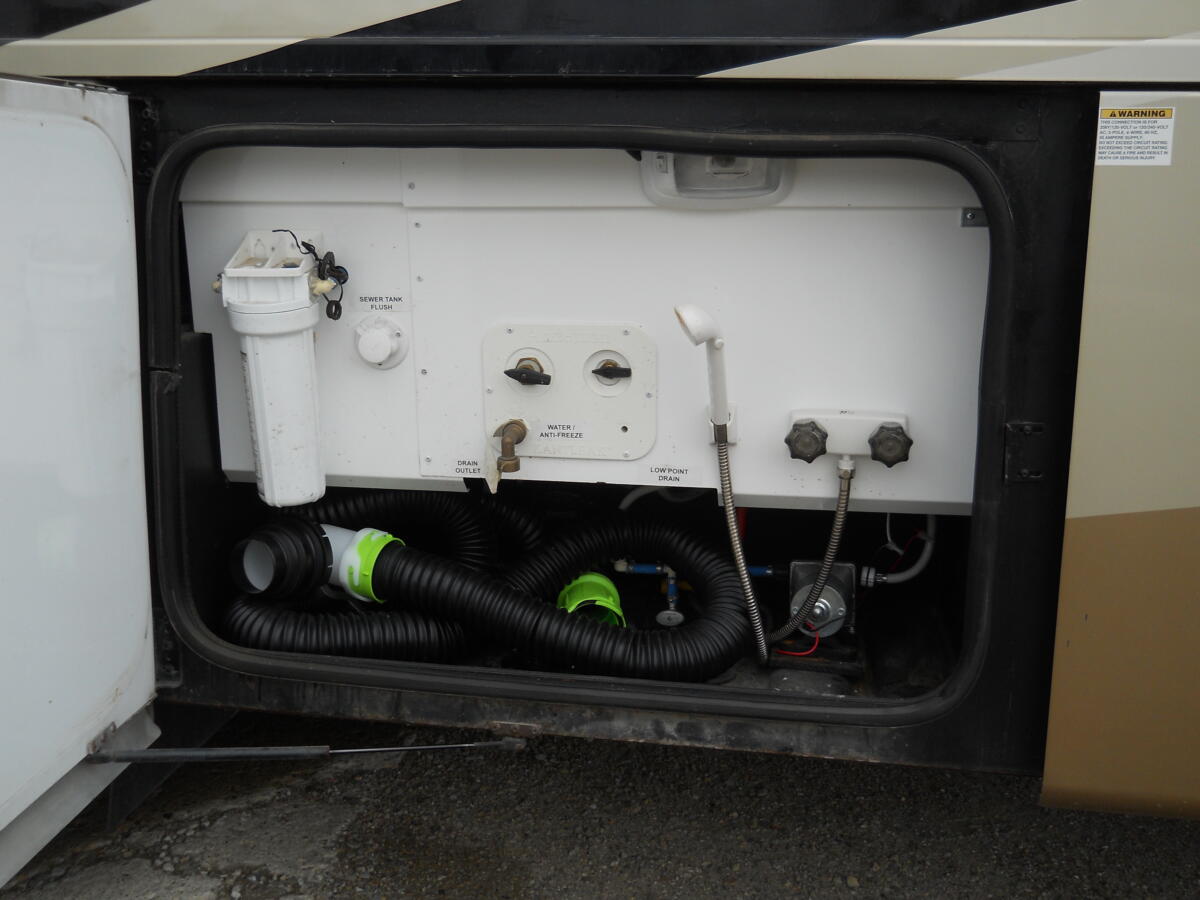
The city water fill is in the center of the picture with the brass elbow. The hose is connected to this and pressurized water from the campground source flows to the plumbing and interior fixtures. It also goes to the water heater tank, which could be one of the culprits.
Just draining the tank does not get all the water and sediment out as the drain hole is approximately 1–2” above the actual bottom of the tank. The longer this mixture sits in the tank, the skunkier it gets and would smell like sulfur or sewage. It may be that the new water mixed with this and it smelled until it flushed out.
It could be an inline filter
Another issue could be a filter that did not get drained. If you have an inline filter that connects to the campground source and then the hose, the water inside can get stale and smell. And, if you have a permanently mounted one, like the picture, it’s easy to forget about it and have water sitting. It is a good idea to remove the filter between camping trips and let it dry out.
Other issues could be water left in the hose or even skunky water from the campground source. I don’t know of anything internally with the plumbing or fixtures that would cause this and would suggest when you do get a smell, try to identify if it is coming from one faucet or all of them.
Other possibilities
Also, is it cold, hot, or both? It might not be the water at all, but rather the drain as the “P” trap has water sitting in it, or a leak in the black water tank or piping. Sometimes a “cheater” valve under the sink allows vapors from the tank to escape into the rig.
If you can identify a specific location, you can probably narrow down the culprit. I would also run the water for a long time to see if it clears up with volume, which would also help identify the location and cause.
You might also enjoy these posts from Dave
- Best way to clean and sanitize RV fresh water tank
- Your RV’s fresh water system: What you should know
- How to fix RV’s leaky black tank dump valve
- Where is RV fresh water tank’s low-point drain? I can’t find it
- How to get excessive mold out of RV’s freshwater tank
- How long can fresh water be stored in the RV’s tank?
Dave Solberg is a leading expert in the RV industry and the author of the “RV Handbook.”
Read more from Dave here.
HAVE A QUESTION FOR DAVE?
Send your inquiries to him using the form below.
RVDT2683

I had a faint skunky smell in the water in a bathroom faucet that reoccurred on a regular basis. We scratched our heads over this and then discovered open T-connections below the sink to an unused washing machine hookup. I installed a valve in the connections to solve the problem. I was horrified when I flushed out the unused line and saw the contents. I sanitized and blew out the unused line and sealed it.
Thank you for the trouble-shooting tips, Dave! Have a great day and safe travels!
I had a similar problem where the smell would come & go over time, but only occurred rarely in certain campgrounds as we traveled around the country. There was no smell from the water sources, but once in my tank, the smell arose. The problem turned out to be the magnesium anode rod. Something in those particular water supplies caused a reaction with the magnesium anode rod & created the smell. I switched to aluminum anode rods & no problem since then.