


Answer: Fiction
I suspect most of you reading this know electrical resistance is the nemesis of 12-volt RV house batteries and answered the question as fiction.
While portable heaters that operate off a 12-volt battery exist, their primary purpose is to aid in defrosting/defogging a vehicle’s windshield, a far cry from heating the interior of an RV. This 200-watt model from Amazon claims “Quick Heating: Experience rapid heating in just 60 seconds, ensuring your car space reaches a comfortable temperature in no time. Say goodbye to chilly rides!” Even if true, the cubic feet contained in the interior of a car is not even close to the cubic feet contained in the interior of an RV.
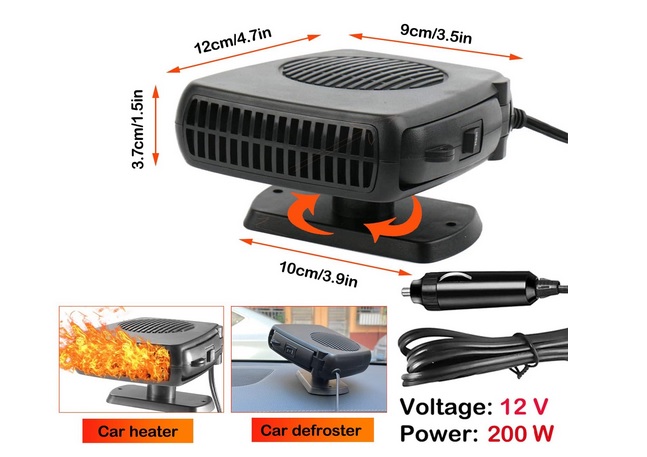
Just for fun, let’s say a 200-watt portable electric heater could heat your RV via the house batteries. Just how long would your house batteries last?
Ohms law tells us 200-watt hours/12 volts equals 16.67 amp hours. The typical RV has two lead acid deep cycle batteries providing a reserve capacity of 100 amp hours. 100 amp hours/16.67 amp hours equals six hours of run time, without powering lights, TV, or anything else in the RV.
How much heat is 200 watts?
Let’s convert watts to a unit of energy we are more familiar with when it comes to heating. 1 watt equals 3.41 BTUs. Using the 200-watt heater again, let’s assume the full 200 watts is converted to heat (some would be used to power the fan). This would equal 682 BTUs/hour.
A typical RV furnace is 30,000 BTU
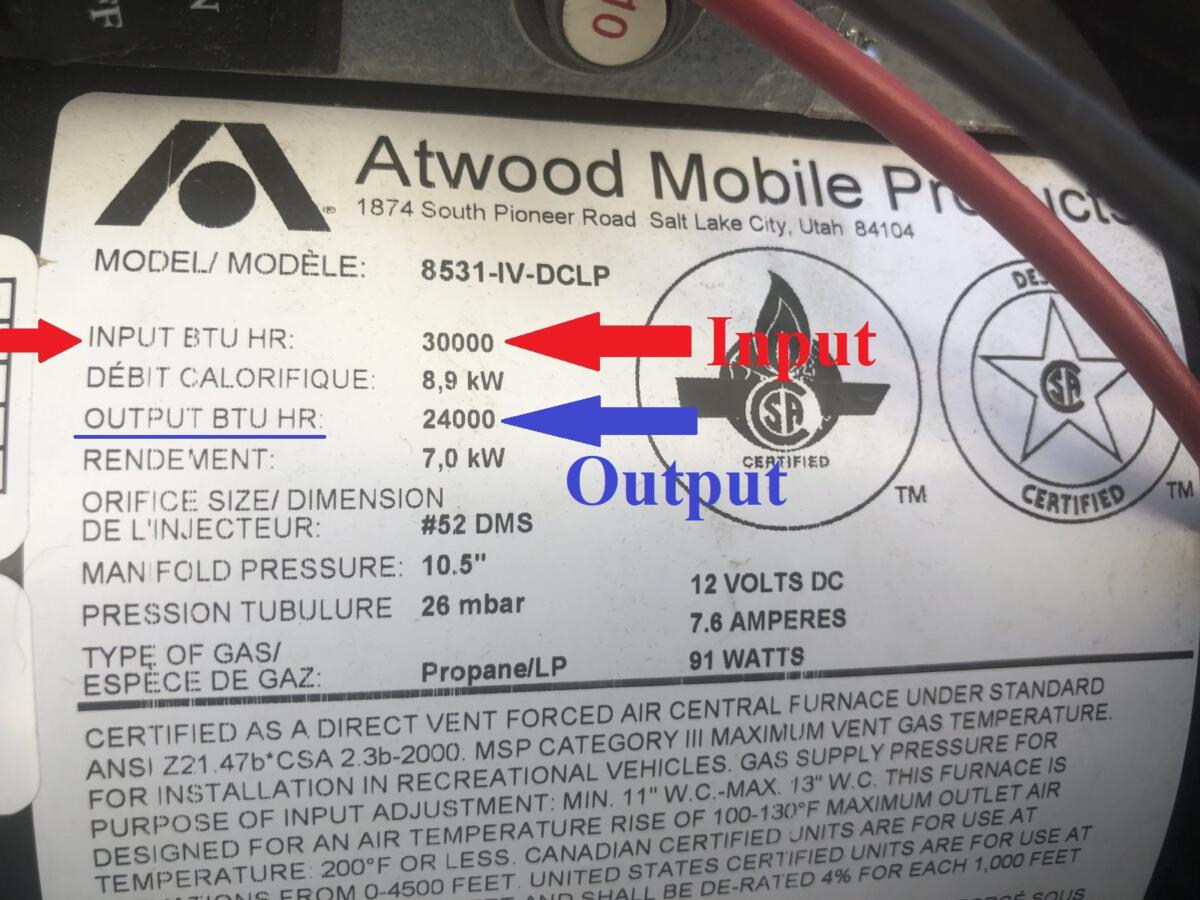
A 30,000 BTU furnace is common to many RVs. A 30,000 BTU Atwood (Suburban) furnace has an output of 24,000 BTUs—see photo below. Let’s assume this furnace is sufficient to heat an RV while winter camping at a ski resort. So let’s do the math to see how many 200-watt portable electric heaters would be needed to produce the same output.
24,000 BTU/h/682 BTU/h equals 35 portable 200-watt electric heaters, each pulling 16.67 amp hours or 583 amp hours! Again, using the example of the 100 amp hour battery bank contained in many RVs, this would equate to just over 10 minutes of run time before your house batteries went dead—or the wiring went up in smoke, whichever came first! Hardly enough time to heat the interior of the RV. Definitely not practical!
Say you used a 1,500-watt (5,115 BTU) portable electric heater that operates off of shore power, like most of us carry in our RVs, and ran it off an inverter hooked to your house batteries. You would need nearly five heaters to produce the same amount of heat as the 30,000 BTU RV furnace! Assuming the inverter is 100 percent efficient, which they aren’t, you would need 7,500 watts to operate the five heaters. That equates to over 600 amp hours. This equates to less than 10 minutes of run time from a 100 amp hour house battery bank.
AI’s answer to this question about electric RV heaters
Just for fun, I asked AI about this. It responded, “As of my last knowledge update in January 2022, portable electric heaters designed to run directly off RV batteries are not common. Most electric heaters, even portable ones, tend to draw a significant amount of power and relying on RV batteries alone might not be practical for extended use due to the limited capacity of typical RV battery systems.
“RVs typically use one or more batteries as part of their electrical systems to power lights, appliances, and other devices when not connected to shore power. Running a heater directly off the RV batteries could deplete the battery quickly, especially considering that heating demands are relatively high.”
Now, some questions for you:
- Is there a recurring half-truth you keep seeing online that you would like to see addressed?
- Were you taught something by other RVers that turned out to be bad advice?
- Have you recently read something that left you wondering, is that true?
- Do you know something to be true, but none of your RVing friends believe you?
Please share your comments using the comment box below and we will do our best to provide the facts in a future Fact or Fiction entry.
Test your knowledge some more with these previous Fact or Fiction questions:
- A propane furnace emits lots of moisture
- Your RV’s tank covers should never be removed
- If you see these on your RV, do not use it in winter!
- Outside temperatures can be too cold for an RV refrigerator to cool
- Never plug in with a 20-amp extension cord
- Doing THIS is the number one cause of RV fires on highways
- Propane gas has no odor
- New RV refrigerators are not designed to operate on propane above 5,500 ft altitude.
- RV tires tend to lose pressure at high altitudes
- Liquid propane expands 270 times when released into the atmosphere
- Deep-cycle lead acid batteries are designed to be discharged until almost empty
- Are Santa’s reindeer strong enough to pull a travel trailer?
##RVT1139


Thank you, Dave! Ha! I got this one right. 🙂 Of course, I’m not sure that anyone got it wrong. 😉
Have you dealt with the common (?) advice to leave the gray-tank valve open if at a campground site with sewer for several days? We use a macerator, so leaving the valve open does nothing unless the macerator is operating..
Neal, As along as you leave a “P” trap in your sewer hose, you can leave it open or closed. My only advice is to close the gray valve a day or two before you are ready to dump your black tank, so you can flush the hose with a good rush of gray water. Read more here
Thank you, Dave!
I think the right answer is it depends. For most folks, no. But I have run a 700W heater from my batteries (via an inverter) for a few hours. A larger bank could get you through quiet hours.
You’re still right, in that someone who is reading an article like that wouldn’t realize the large requirements needed to pull it off.
“1 watt equals 3.41 BTUs”……????…….wait, what is that, some sort of “law”? What if the electric heater was filled with oil, made of quartz, or what if Amish craftsman working in a barn built the cabinet? Thanks for this. Very basic and correct info.
Yeah, you can’t beat the laws of physics or thermal dynamics regardless of what the “Seen on TV” people claim or how nice of cabinet you build around it. Thanks for sharing.