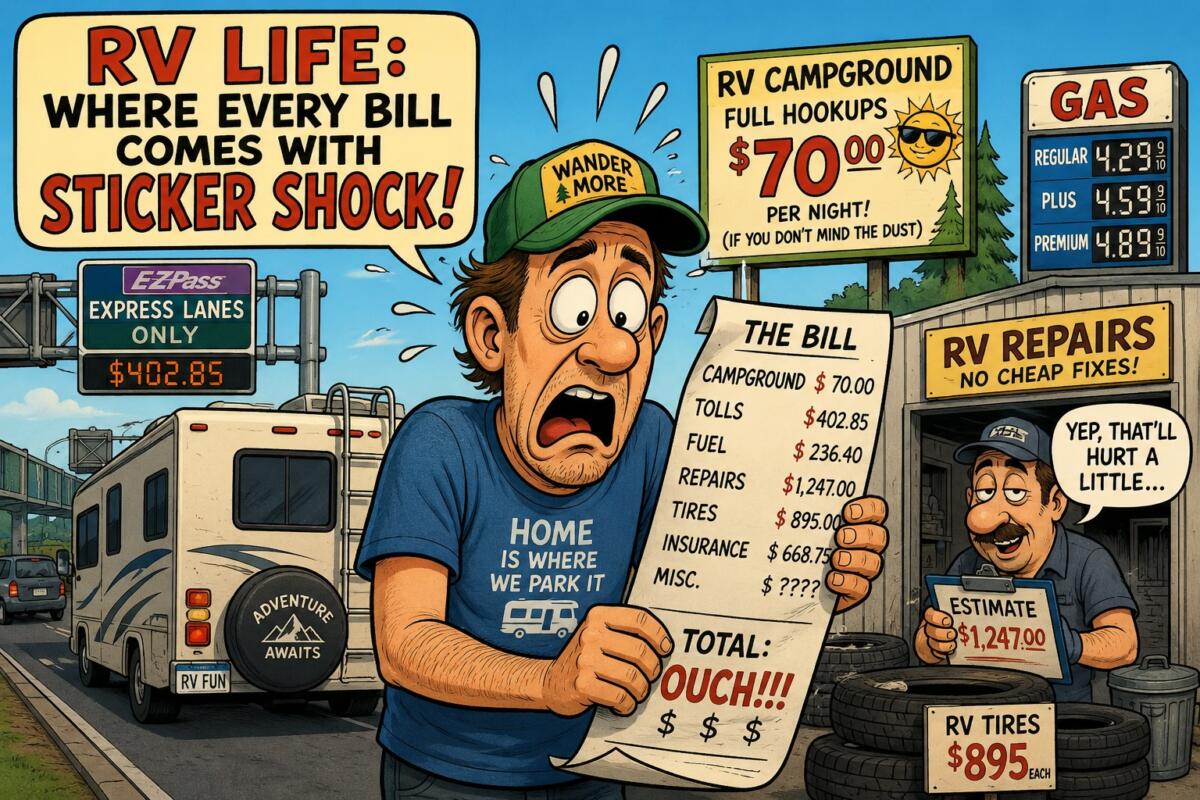
Not too many years ago, one of the biggest selling points of RV travel was affordability. Sure, there were fuel costs and campground fees, but many RVers felt they could travel comfortably without breaking the bank. These days, however, it seems like nearly everything associated with RVing costs more than it used to. And it is certainly not the cheapest way to travel anymore!
Of course, tolls and campground fees aren’t the only expenses causing sticker shock. Fuel prices continue to fluctuate. RV repairs can quickly climb into the thousands. Insurance premiums have risen for many owners. Even routine maintenance items like tires, batteries, and roof repairs seem to cost more every year.
Yet, despite the rising costs, most RVers keep rolling down the road. For many, the freedom, flexibility, and memories created while traveling are still worth the expense.
The question is: Which cost makes you shake your head the most when you see the bill?
So, we’re curious. In today’s RV world, what causes the biggest sticker shock for you? Is it campground fees? Fuel prices? Tolls? RV repairs? Or perhaps something else entirely?
Vote in our poll below. And if your answer isn’t listed, leave a comment and tell us what’s hitting your wallet the hardest these days. Thank you!
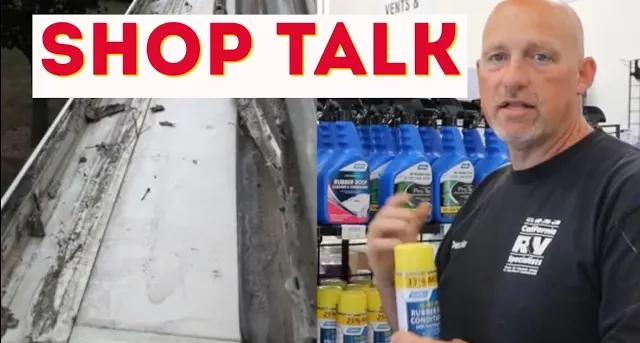
Did you know that proper slide-out maintenance can save you thousands of dollars in costly repairs? In this article and video, we’ll explain how the Camco RV rubber seal conditioner protects your RV slide-outs and keeps them in top working condition.
Regular maintenance of these seals prevents damage and extends the lifespan of your slide-out mechanism.
Why RV slide-out seals are important
The rubber bulb seals around your RV slide-out are essential components that help prevent water, dirt, and air from entering your RV. They create a seal when the slide-out is retracted, protecting your RV from environmental elements. Over time, these seals can become brittle, cracked, or damaged, which can lead to leaks, drafts, or even mold inside the RV.
How Camco RV rubber seal conditioner helps
Camco RV rubber seal conditioner is designed to protect and maintain the rubber seals around your RV slide-out. Here’s how it can help:
Prevents cracking and dry rot
Exposure to UV rays, weather, and temperature changes can cause the rubber seals to dry out and crack, leading to compromised sealing performance. The Camco treatment restores moisture to the rubber, keeping it flexible and preventing cracks.
Extends seal lifespan
Regular use of this treatment extends the lifespan of your slide-out seals. By keeping them conditioned and in good condition, you’ll delay the need for expensive seal replacement.
Reduces friction and wear
The treatment provides a slippery coating that reduces friction when the slide-out moves. This can help prevent unnecessary wear and tear on both the seals and the slide-out mechanism.
Improves water resistance
Applying the seal treatment helps to enhance the waterproofing properties of the rubber seals, ensuring they effectively protect your RV from leaks and moisture.
Enhances overall slide-out performance
A well-maintained seal ensures your slide-out functions smoothly and efficiently. The treatment helps maintain a good seal, reducing air and water infiltration that can lead to mold, mildew, and other costly damage.
How to use Camco RV rubber seal conditioner
Clean the slide-out seals
Before applying the treatment, it’s essential to clean the rubber seals thoroughly. Use a mild soap or RV-safe cleaner to remove dirt, grime, and any old residue. Let the seals dry completely.
Apply the treatment
Shake the Camco treatment bottle well before use. Apply a generous amount to the rubber seals using a clean cloth or sponge. Ensure the entire seal is covered, paying special attention to areas that may show signs of wear.
Wipe off excess
After applying, use a dry cloth to wipe off any excess product. Be sure the seals are evenly coated but not overly saturated, as excess product can attract dirt.
Inspect the seals
While applying the treatment, take the time to inspect the seals for any damage, cracks, or signs of deterioration. If the seals are compromised, it might be time to replace them.
Allow to dry and set
Allow the treatment to fully dry and set before operating the slide-out. This ensures that the seal is in optimal condition for protection.
Prevent costly damage with regular maintenance
Inspect seals
Regularly check the condition of your slide-out seals for signs of wear, cracking, or dry rot. Make it a part of your routine RV maintenance to ensure your seals are always in top condition.
Apply treatment seasonally
For maximum protection, apply the Camco treatment at the start of each season. This will keep the seals conditioned and ready to withstand the elements throughout the year.
Clean seals after use
After traveling or extended use, clean the seals to remove any dirt, dust, or debris that could wear them down. Keeping them clean helps maintain their sealing power.
Conclusion
Taking care of your RV slide-out seals is a simple and cost-effective way to protect your investment and prevent major repairs. With Camco RV rubber seal conditioner, you can keep your seals in excellent condition, preventing water damage, air leaks, and costly repairs. Regular maintenance will help your RV slide-out function smoothly and ensure your RV stays in top shape.
For more expert RV maintenance tips and to keep your RV in perfect condition, don’t forget to subscribe to our channel. With the right care, your RV will stay protected and ready for your next adventure!
The Camco RV rubber seal conditioner is available here on Amazon.
By Greg Illes Standard vinyl electrical tape has been around for a long time—too long, some would say. The problem with this commonly used product is its adhesive. It doesn’t really stick very well and after awhile it starts to peel loose, leaving a gooey mess behind. But now there’s a self-fusing silicone rubber tape for weatherproof connections which works great.
A better alternative
Some years ago, a worthy alternative to standard vinyl electrical tape appeared—a silicone rubber tape that was self-fusing. It bonded to itself with enthusiasm and had no adhesive to age or create a mess. Furthermore, it was impervious to many chemicals, ozone and UV, which age and deteriorate lesser products.
This self-vulcanizing tape has seen a surge in popularity. It’s now sold in many colors and widths, all at affordable prices (although much more expensive than its cheaper brother). Sold by everyone from Ace Hardware to Amazon, a roll will run you anywhere from about $10-$30.
How do you use self-fusing silicone rubber tape?
You apply the tape by peeling off its backing (being careful not to let it touch itself because it bonds instantly). Wrap the tape around the object to be covered and make the first wrap go over itself. Then stretch the tape in the direction you want and continue wrapping.
It’s easiest to cut off a piece in advance rather than applying it from the roll. A little experience will show you how much to use, and it takes very little: Two to three inches will weatherproof most electrical joints.
Notice that the tape doesn’t actually stick to anything but itself. This means that it’s easy to remove, but it also means that it can’t be used for any application that requires a sticky seal. The best way to think of this “tool” is as a rubber-molding process. Once the tape is applied and wrapped around the object, it is literally as if the object were cast inside a mold. In fact, I’ve cut open 5-year-old wrappings, and they still looked as if they were just one solid piece of rubber.
What can you use it for?
Due to its stretchy nature, the tape is fabulously conforming. It will create a solid rubber sleeve around the most odd-shaped joints and other objects. In addition to electrical uses, the tape can be used for any purpose where a rubber coating is desired. For example, my flagpole gave up its rattle after I rubber-taped the base. Your imagination is your only limit.
Greg Illes is a retired systems engineer who loves thinking up RV upgrades and modifications. When he’s not working on his motorhome, he’s traveling in it.
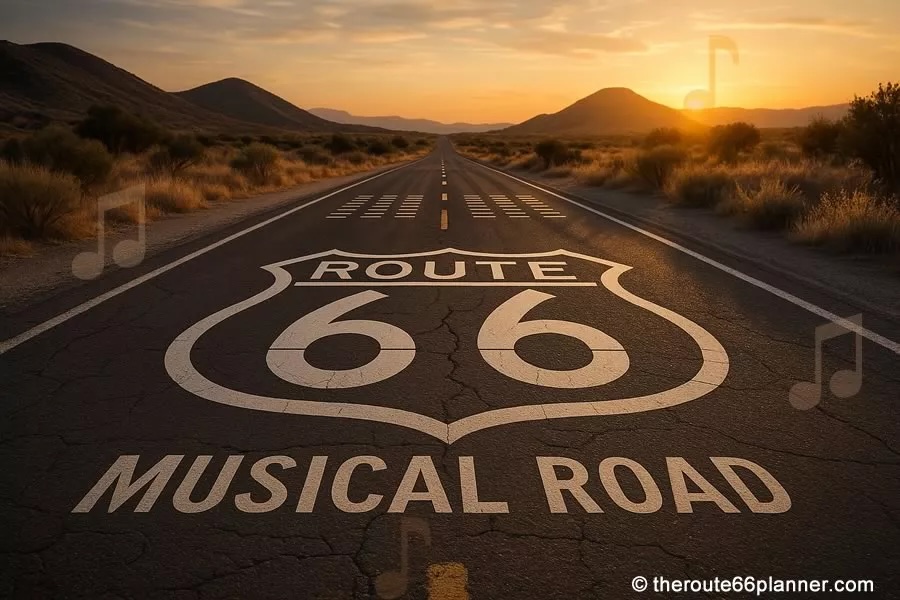
Route 66 is pulling out all the stops to celebrate its centennial. RVers won’t want to miss the Mother Road’s new musical roads!
What is a musical or singing road?
A musical road is the kind of roadside surprise that turns an ordinary drive into a delightful memory. (I previously wrote an article about singing roads, which you can read here.)
The engineering for a musical road is complex, and the planning is time-consuming. However, the “singing road” idea itself is actually quite simple. It’s based on sounds (vibrations) we hear in everyday life. When a vibration occurs at a certain rate per second, it produces a distinct sound. The vibration or note comes from the spacing of the grooves, which is why speed matters so much. If you go too fast or too slow, the melody changes.
In simple terms, a musical road is a stretch of pavement with carefully spaced grooves or rumble strips. The strips make your tires vibrate in a way that produces a tune—as long as you travel at the right speed.
Route 66
To mark Route 66’s centennial, new musical roads have been added along the historic route. Each stretch will play music inspired by the local culture and surroundings. Watch a fascinating 3-minute video from National Geographic of a singing roadway installation below.
When drivers keep to the posted speed, the road plays a melody, creating a fun, shareable way to celebrate Route 66 while encouraging safe, attentive driving. (I doubt you can drive over one and not smile!)
The two men leading Route 66’s musical road effort are Chris Hill and Pete Thompson. They are the co-founders of Route 66 Musical Roads LLC. The company says local crews have been hired in each state to do the actual installation work.
Locate a Route 66 singing road
Missouri
The best place to start is Springfield, Missouri. You’ll find this Musical Road on St. Louis Street near Queen’s Gate 66. This Route 66 attraction is designed as a drive-through experience with no tickets or lines. By holding a steady 30 mph, you’ll hear the road play “America the Beautiful.” Listen to it here.
This singing road is part of Springfield’s effort to deepen its Route 66 identity. It’s an easy drive to combine with other Springfield Mother Road sights. See a map and discover additional sights and Springfield area experiences here.
Oklahoma
Tulsa, Oklahoma, also has a Route 66 musical road. The city says the route runs on the Southwest Boulevard Bridge, parallel to the Cyrus Avery Memorial Bridge. It sits near several other Route 66 landmarks, including Cyrus Avery Centennial Plaza, the East Meets West sculpture, and the Route 66 skybridge. Travelers can expect to hear Woody Guthrie’s “This Land Is Your Land” when cruising at about 35 mph. Learn about additional area attractions here.
Arizona
Winslow, Arizona, is singing too. This musical road attraction is at the east end of Third Street near the 9/11 Memorial. It plays the melody from the Eagles’ “Take It Easy” when drivers travel over it at about 35 mph. That makes it a very natural RV stop for anyone who wants to pair Route 66 music with a quick visit to Standin’ on the Corner Park. Look here for other area sights in the area.
New Mexico
Santa Rosa, New Mexico, is the one to watch next. It’s expected to be completed by June 15, 2026. Here, the city is planning two sets of musical rumble strips on the west side of Historic Route 66. The eastbound traffic is set to hear “Get Your Kicks on Route 66.” Westbound traffic will hear the Santa Rosa Lions fight song. Find more to see and do in the Santa Rosa area here.
Also check out Tijeras, New Mexico. It’s where the original classic Route 66 musical road installation helped make the idea famous. Originally installed just east of Albuquerque as a traffic-calming project, it was built in 2014. To hear it play “America the Beautiful,” drivers should maintain a 45 mph speed. To find it, travelers typically leave I-40 at Exit 170 to take NM 333. Look eastbound between mile markers 4 and 5. Discover other amazing things to see and do while in the area here. (Note that this singing highway has faded with age and weathering.)
Celebrate!
The Route 66 centennial is a good excuse to visit a musical road on the Mother Road. The official Route 66 Centennial website is promoting kick-off events, caravans, exhibits, monuments, and other celebration projects across the corridor. Springfield and Tulsa are already pairing their musical roads with nearby Route 66 landmarks and public art stops. That means RVers can treat each musical road as much more than a quick detour. Instead, take time to enjoy museums, sculptures, festivals, and local history along the way.
You should go!
So, if you are road-tripping the Mother Road in 2026, pick the musical road nearest you and roll over it at the right speed. Each singing roadway gives RVers a different kind of “get your kicks” moment. Every location is a fun reason to listen, then stop, and celebrate the centennial one mile at a time.
Have you ever driven over a musical road? Tell us using the comments below.
When you see a vehicle stopped on the shoulder with lights flashing, what do you do?
A recent AAA Foundation study found lots of drivers know the phrase “slow down and move over” but are unsure what it actually requires. This helps explain why roadside workers and stranded motorists remain at risk.
RVers should know and appropriately respond
Every state has some form of the slow down, move over law. They require drivers to either move over one lane away from a stopped vehicle with flashing lights or, if you can’t safely change lanes, slow down to a reasonable speed. Those two options, to create distance or reduce speed, are the basic safety choices demanded by law.
So why the confusion?
The slow down, move over law is confusing because states don’t all use the same wording. Some laws say the law applies only to emergency vehicles. Other states add tow trucks, DOT crews, utility trucks, or any disabled vehicle. A few states specify an exact speed reduction while others say simply “slow down.”
This patchwork of definitions and penalties makes it hard for drivers to remember exactly what to do in every state. To date, 19 states and Washington, D.C., require motorists to slow down and move over for all vehicles with activated hazard lights. That means police, EMS, road workers, trash vehicles, fire trucks, highway maintenance, construction vehicles, utility trucks, and private disabled vehicles, as well.
Photo credit: NHTSA
Varying highway configurations
Adding more confusion are questions like these: How does the law apply to multiple lanes of traffic? What about interstate highways? One-way thoroughfares?
Here’s what the National Highway Traffic Safety Administration advises:
• Four-lane roads (two lanes each direction): If you’re in the right-hand lane and see an incident on the shoulder ahead, move one lane left if it’s safe and clear. If traffic or road markings make that maneuver unsafe, reduce your RV’s speed and pass with caution. Create as much lateral space away from the incident as you can.
• Divided highways and medians: When a physical median separates directions of travel, and you can’t move away from a stopped vehicle on your side, the law typically still expects you to slow down and proceed with extra caution. Don’t assume the median removes responsibility. You must slow down and watch carefully for people who may be standing on or near the roadway.
• Other real-world situations RVers may face: As you travel, you’ll likely see police, ambulances, tow trucks, state DOT trucks, utility crews, and sometimes private vehicles with hazard lights along the road. It’s best to treat any stopped vehicle with active lights as a call to move over or slow down or both.
Why it matters especially for RVers
RVs have bigger blind spots, wider turning radius, and longer stopping distances. This makes last-second lane changes and speed adjustments riskier for you and others. Creating space early reduces the chance of a multi-vehicle scramble and keeps roadside crews out of harm’s way.
The AAA research also points out that many drivers fail to both move over and slow down, leaving responders or others at risk.
Practical RV tips
Make the following behaviors a habit as you drive.
Scan early for warning lights on the shoulder ahead.
Check mirrors and signal before changing lanes.
Don’t attempt to squeeze between other vehicles that are also changing lanes. Instead, wait for a safe gap in traffic and then make your move.
If traffic prevents a lane change, lift off the throttle and pass the emergency situation slowly.
If you must stop because of an emergency of your own, pull your RV well onto the shoulder (as far as safely possible). Activate your RV’s hazard lights and set reflective triangles behind your rig as an early warning to other motorists.
Enforcement and penalties
It’s important to know that some states impose steep fines or criminal charges when noncompliance injures or kills a responder. Other states focus on education and high-visibility enforcement campaigns.
Knowing that penalties differ from state to state is another reason to default to the most protective behavior. That is, move over and slow down when safely possible, and always slow down if safely moving over isn’t possible.
Have you witnessed confusion or noncompliance with the move over, slow down law while RVing? Tell us using the comments below.
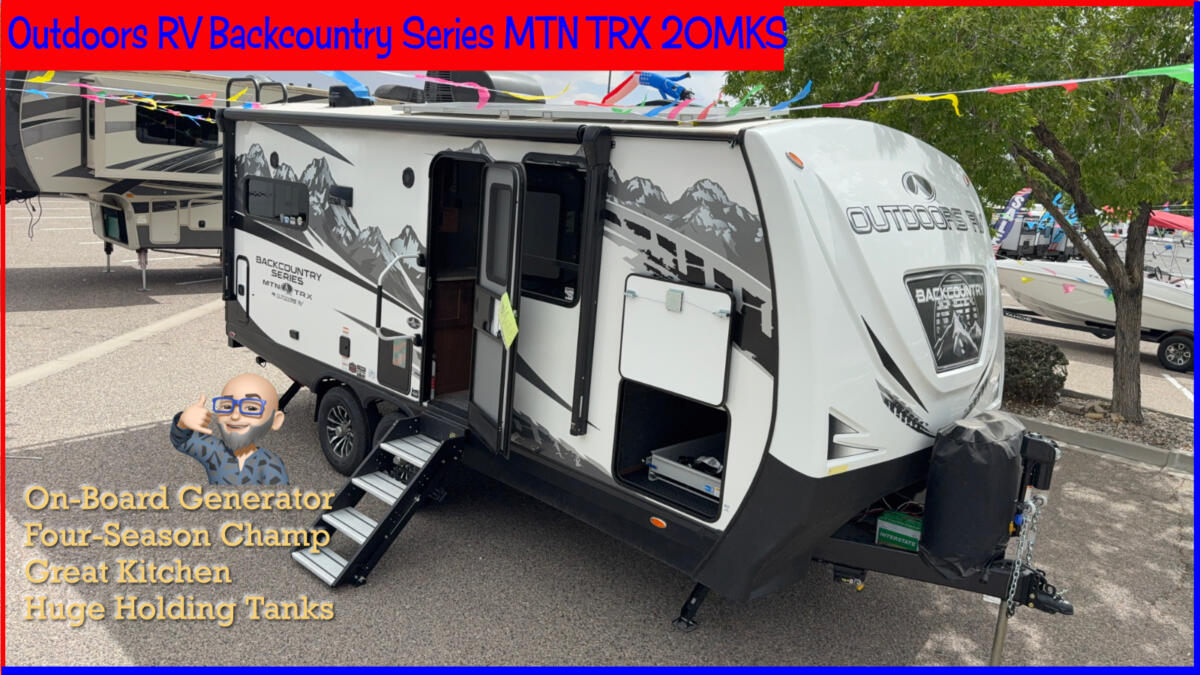
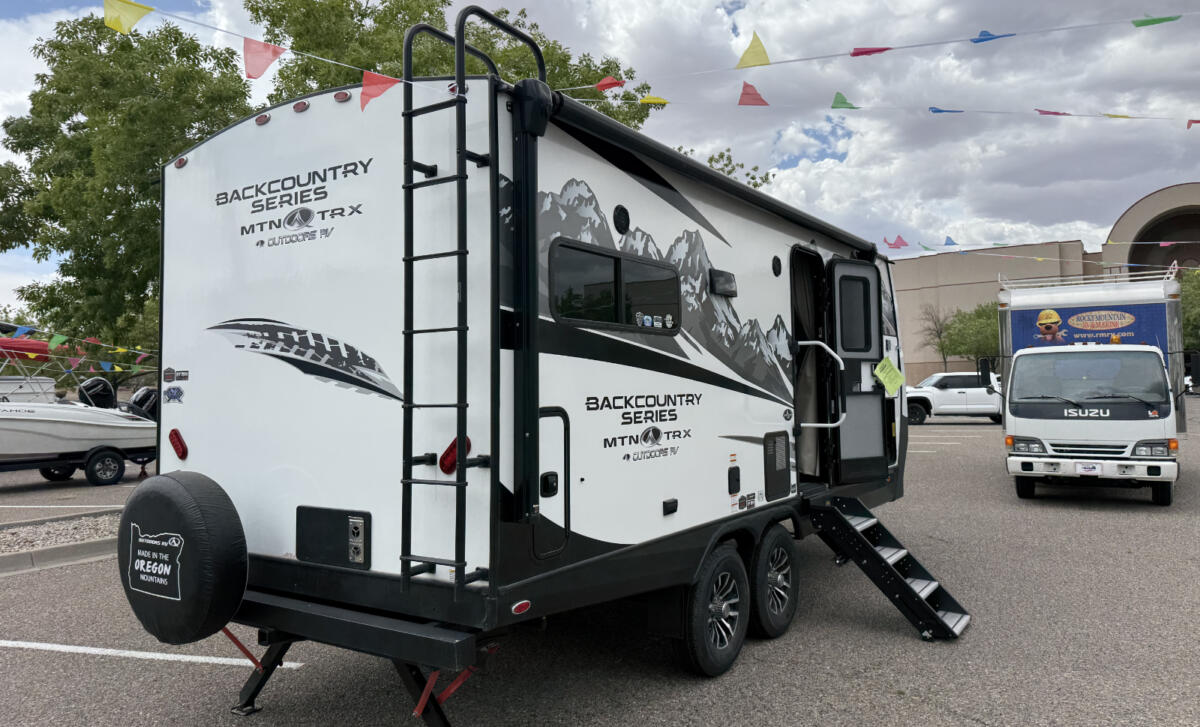
Today’s RV review is of the 2027 Outdoors RV Backcountry Series MTN TRX 20MKS travel trailer. Outdoors RV is unusual in that it is located in La Grande, Oregon, and specializes in travel trailers and fifth wheels that are truly ready for more extreme climate conditions. The company also builds its own chassis and states that they are off-road ready.
The company has created a very loyal following and has quite the reputation for building a very high-quality and substantial product. These are not inexpensive, nor are they light, but many RV owners are looking for just this type of build quality.
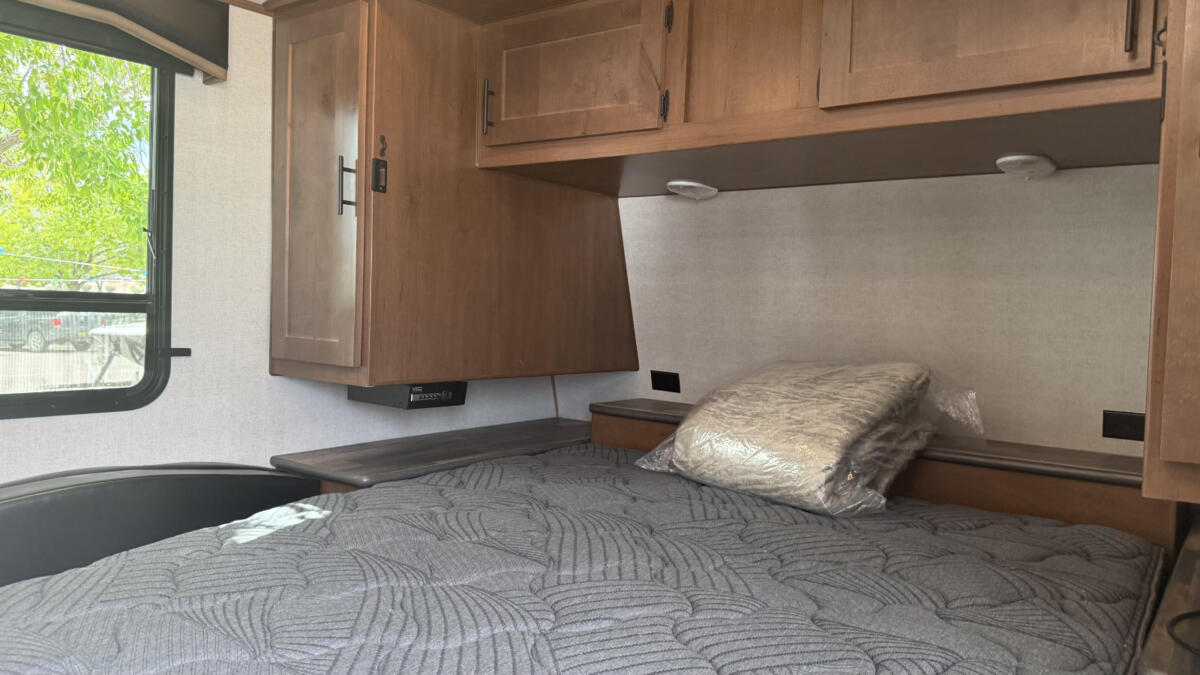
Some other unusual things about these trailers include the fact that there is a built-in safe by the bed that the company describes as a “quick-access home defense bed safe.” There are wild things near where the company builds these.
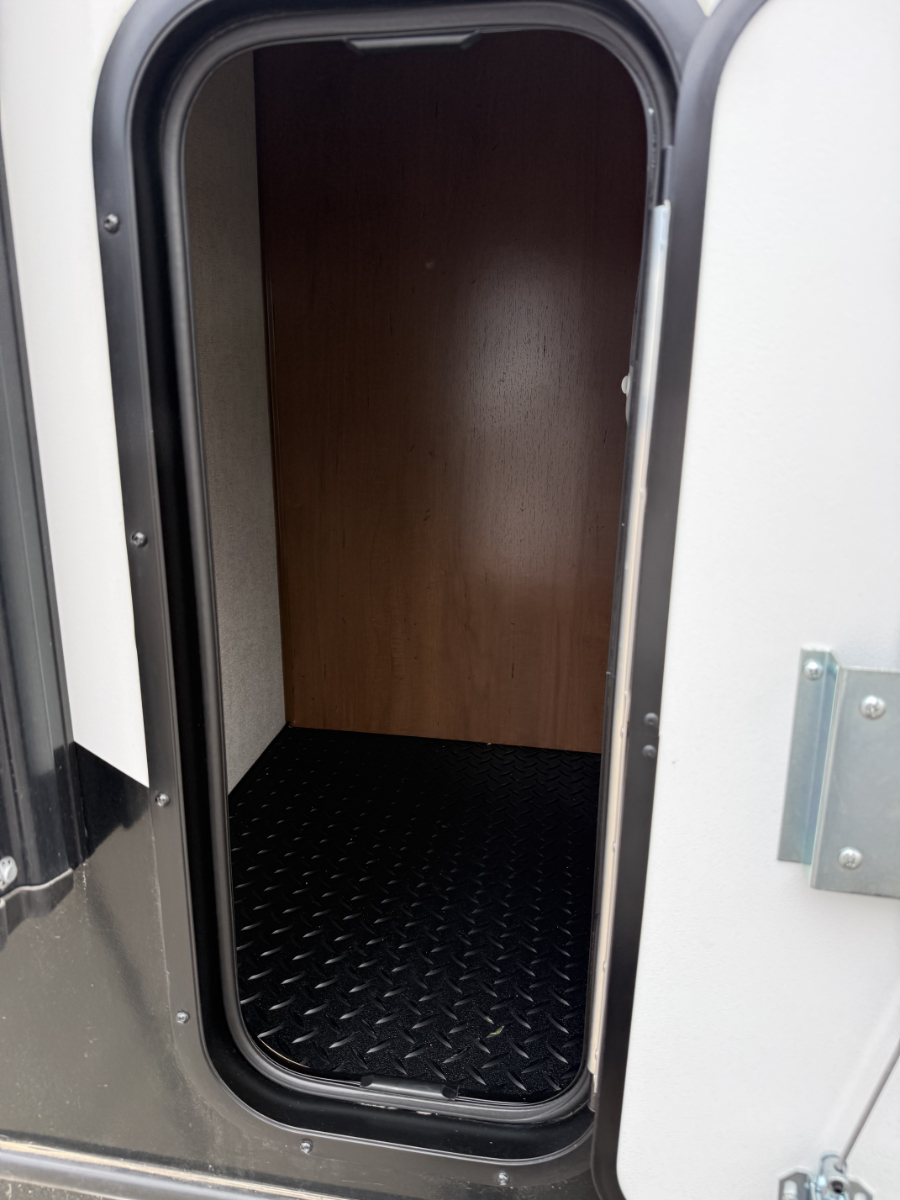
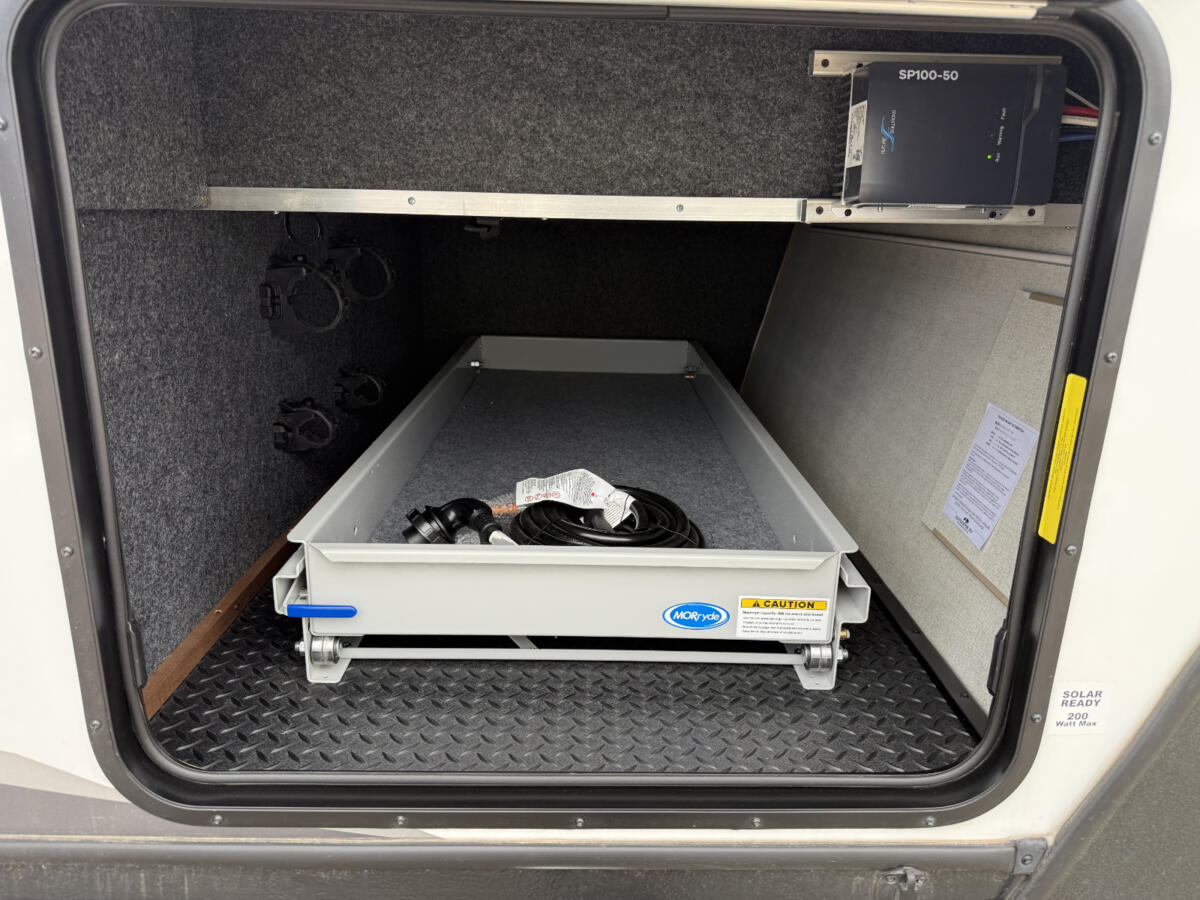
There are also provisions for an axe and a shovel in the front pass-through compartment, which also features a nice metal sliding tray. You know you always want whatever’s the least convenient to reach in any storage situation, and this drawer helps to alleviate that.
The company really focuses on off-grid camping with their insulation and build practices.
How the Outdoors RV Backcountry Series MTN TRX 20MKS is built
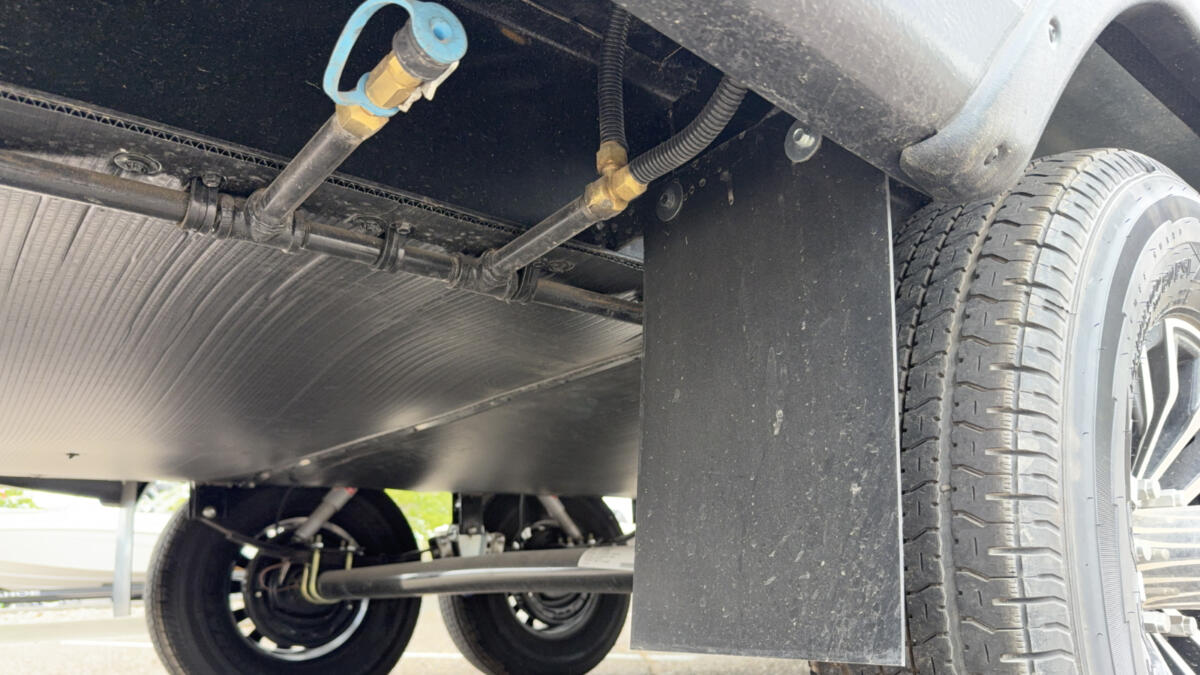
At the base of it all is a chassis built by Outdoors RV that the company states is off-road certified. That includes 5,200-pound axles with KYB shock absorbers and eight-lug wheels shod with 16” Goodyear Endurance 235 E-range ten-ply tires. I couldn’t find a reference to a tire pressure monitoring system, which is unfortunate. But that is something you could add after the fact. And should with any trailer.
Something that Outdoors RV does that’s different than almost any other RV company that I am aware of is the thickness of the compartment doors on things like showers and such. I always scratch my head (maybe that’s where the hair went) seeing RVs that make the claim that they’re winter-ready, but then have a thin plastic door on the outdoor shower compartment. These are very different, with a 1”-thick and gasketed compartment door for the outdoor shower.
While much of this RV is really well made, a couple of things made me say, “Hmm.” One of those was the use of a Schwintek slide. Those are fine if you maintain them properly and don’t ask people on social media how to maintain them. As always, Lippert has a great video about maintaining your Schwintek slide. That’s where I’d get my answers.
Countertop in the bathroom
One thing that I saw that was a super-bummer is the countertop in the bathroom. It is a laminated T-mold-type countertop. It is truly unfortunate to use this in a bathroom where water can get between the plastic edge and the particleboard underneath and destroy the counter. This is counter to so many other things in this RV that point to a better quality of construction.
One thing I noticed was that there were furnace vents in the floor of this rig. What I don’t like about these is that things can fall into the vents throughout the year (like pet hair if you have pets). Those things then get heated up for the special smell when you first kick on the furnace as the weather gets colder. I believe there are magnetic sheets you can put over these vents, though.
Outdoors RV 20MKS - 2027
1 of 13
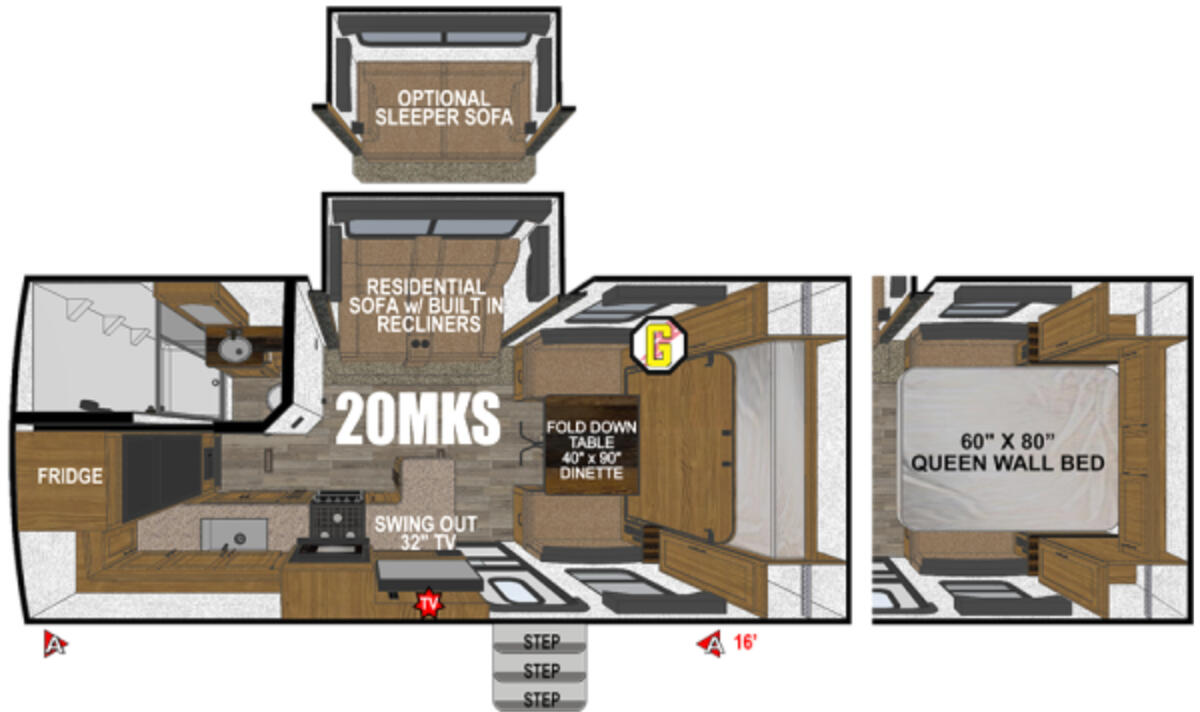
Outdoors RV Backcountry Series MTN TRX 20MKS floor plan
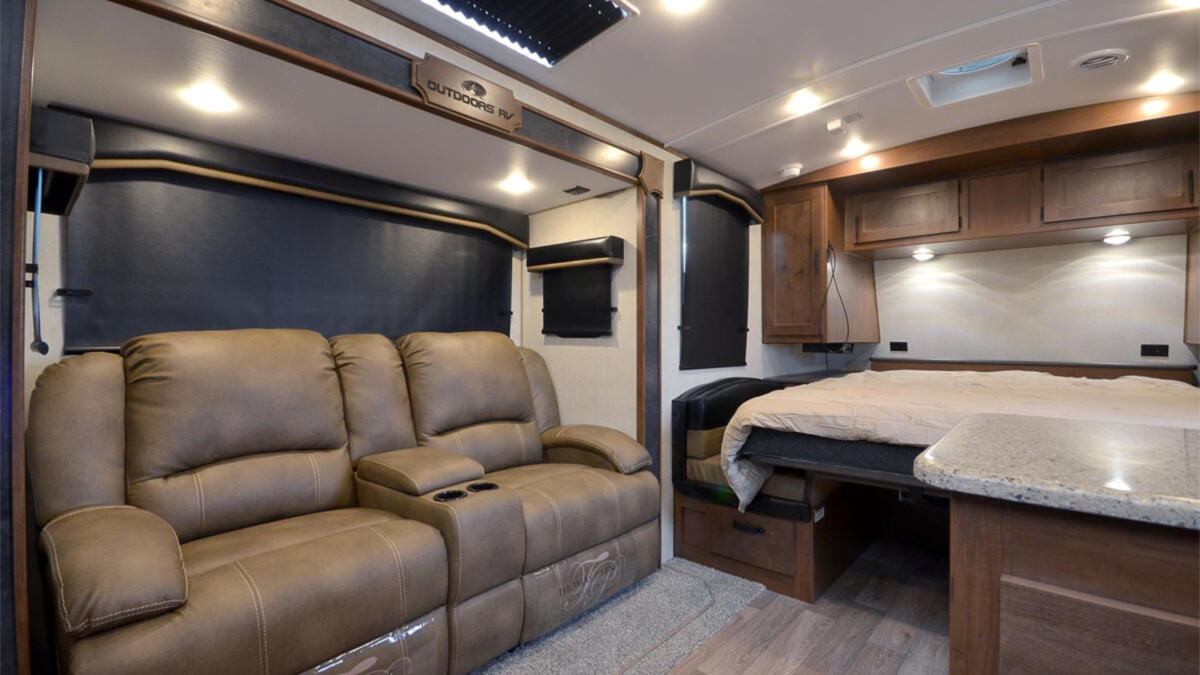
Theater seats and an overhead skylight
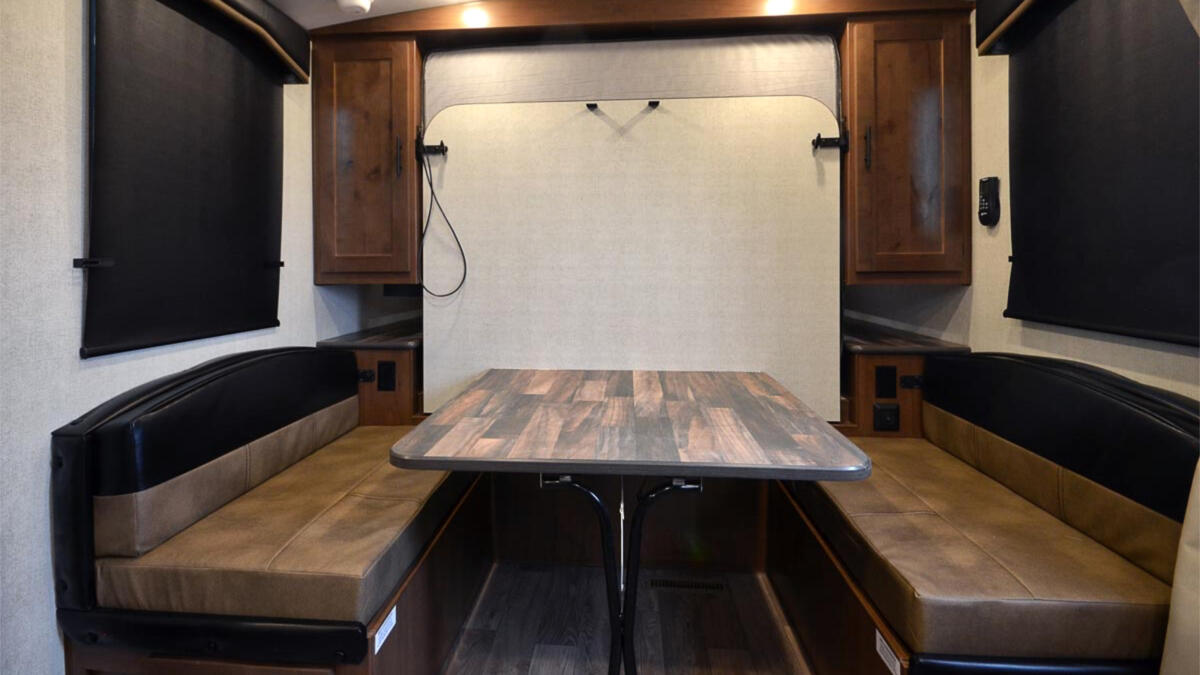
With the bed up you get a dinette with good windows on either side
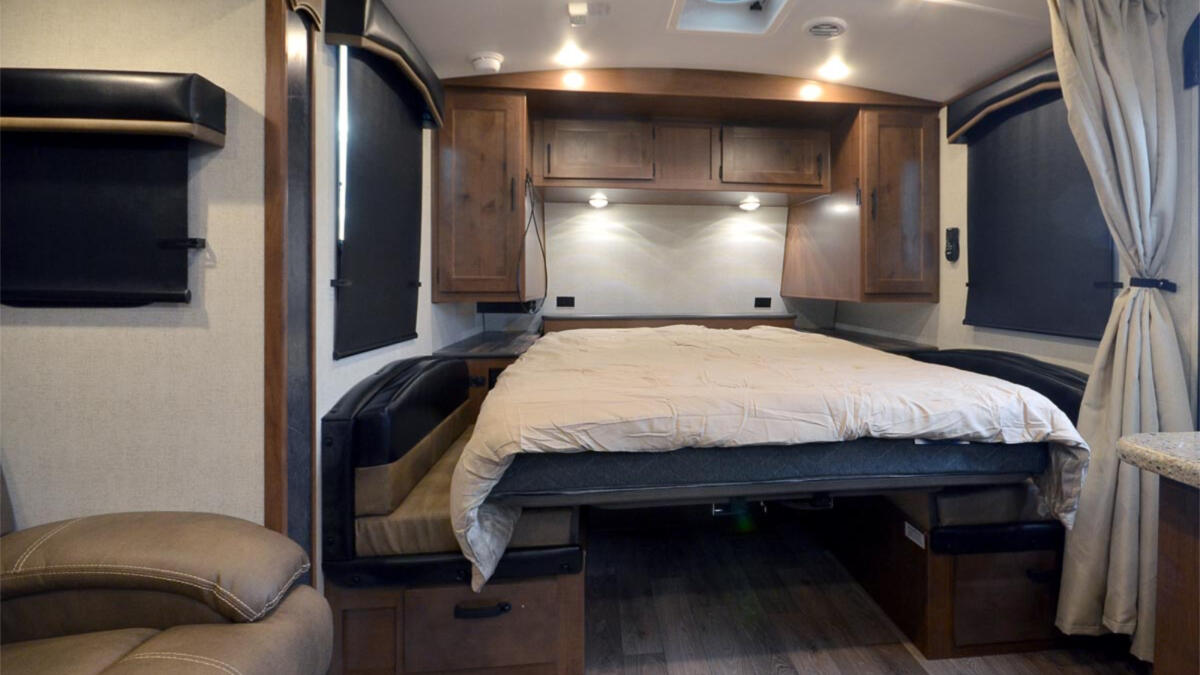
A well-designed Murphy bed offers a true queen-sized mattress
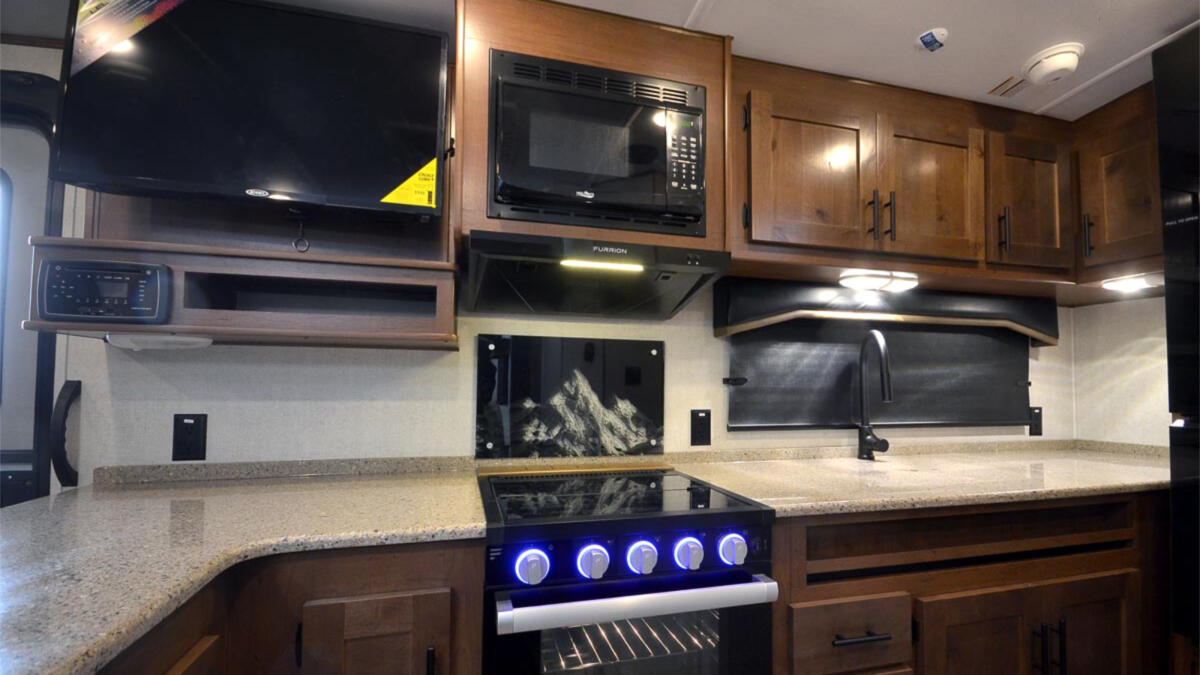
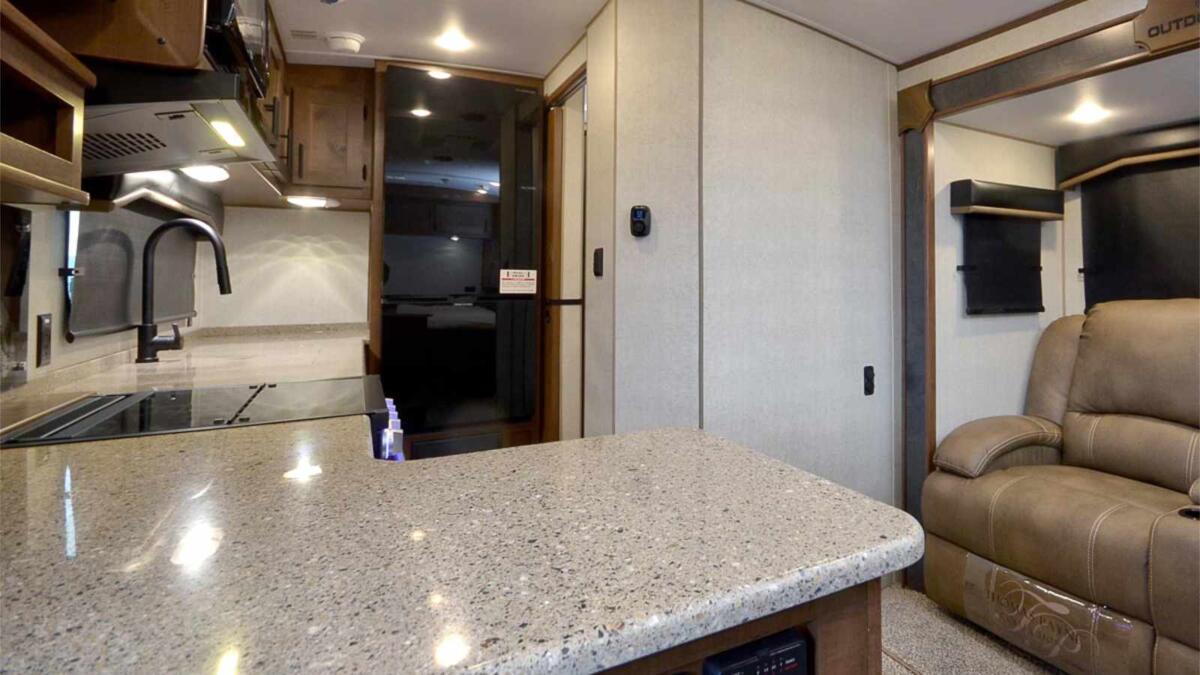
A lot of counter space and full-sized appliances make for a good kitchen
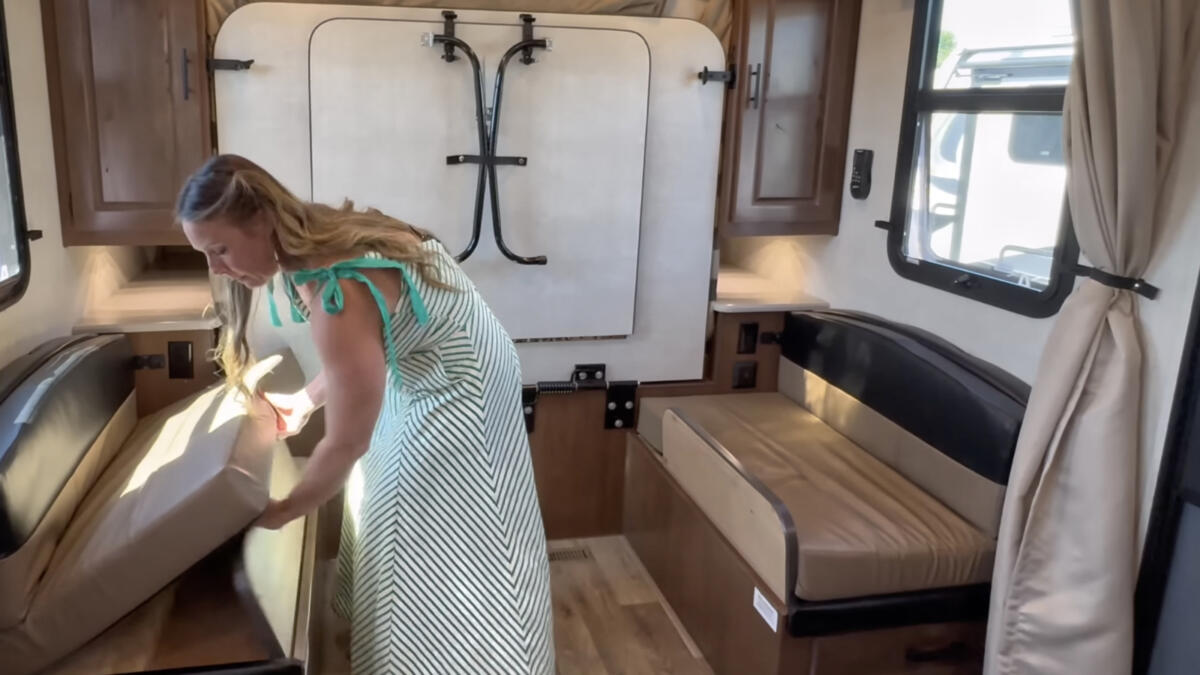
flip-up bolsters provide support for the Murphy bed
A lot of counter space despite a smaller RV size make for good use of space
A small safe by the bed
A vertical cabinet at the outside back
A very sturdy-looking ladder follows suit with the rest of how this RV is built
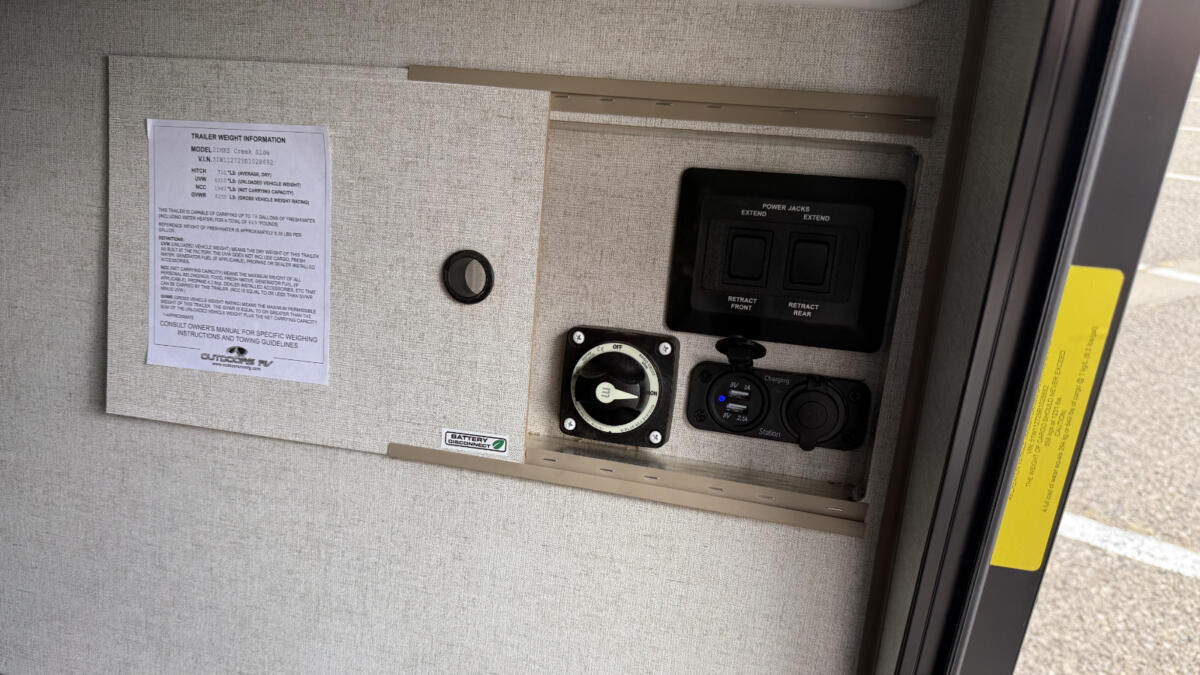
A sliding panel protects the jack controls and power outlets plus power disconnect in the front pass-through
The sliding drawer in the front pass-through is a very nice touch
The suspension is intended to be off-road capable and includes KYD shocks and upgraded shackles
Inside the Outdoors RV Backcountry Series MTN TRX 20MKS
This is the first time I have seen an Outdoors RV with a Murphy bed, and it’s done differently than some. The bed platform itself is hinged and utilizes a mattress that is forced to bend in the middle, though that mattress seemed to be pretty comfortable.
In front of the bed platform is a dinette. The dinette table also swings down from the pretty clever bed platform. This gives you a dinette, but there were also theater seats in the slide of this RV, so you have decent options here.
Something you’ll notice in the video is that we thought the latches that hold the mattress up sat on the dinette cushions. However, we didn’t see little “wings” that swing up from under the dinette cushions that are intended to hold the bed platform in place. It’s one of those things where if you know, you know—and we didn’t know. I learned this in a video from Thompson RV, which is a big seller of these units and the closest dealer to the factory.
Kitchen in the Outdoors RV Backcountry Series MTN TRX 20MKS
In addition to good seating and decent space, this has a really top-notch kitchen where there are solid surface countertops and plenty of them. There’s also a three-burner propane stove with a 21” oven (you know I loved seeing this!) along with a typical RV microwave and decently sized sink. There’s also a nice backsplash behind the stove with a mountain scene on it.
Since there’s a plentiful amount of counter space, there are also good drawers and overhead cabinets.
This also uses the dual-swing 12-volt fridge where you can access it from either side. I have this same fridge and wrote an article about how efficiently it operates. I like this fridge.
Bathroom in the Outdoors RV Backcountry Series MTN TRX 20MKS
The bathroom in here is pretty spacious for being a corner bathroom. It has a porcelain foot-flush toilet and an oval stainless steel sink. The countertop material is truly a disappointment, as I wrote before, considering how nice the rest of the camper is.
The shower is quite decent and has plenty of headroom. I like the Nautilus-style retracting shower door/curtain thingamabobber.
While I see that this is an option, there was a Maxxair high-performance vent fan both in the bathroom and main living space of this RV. That’s how I would equip this RV if it were mine.
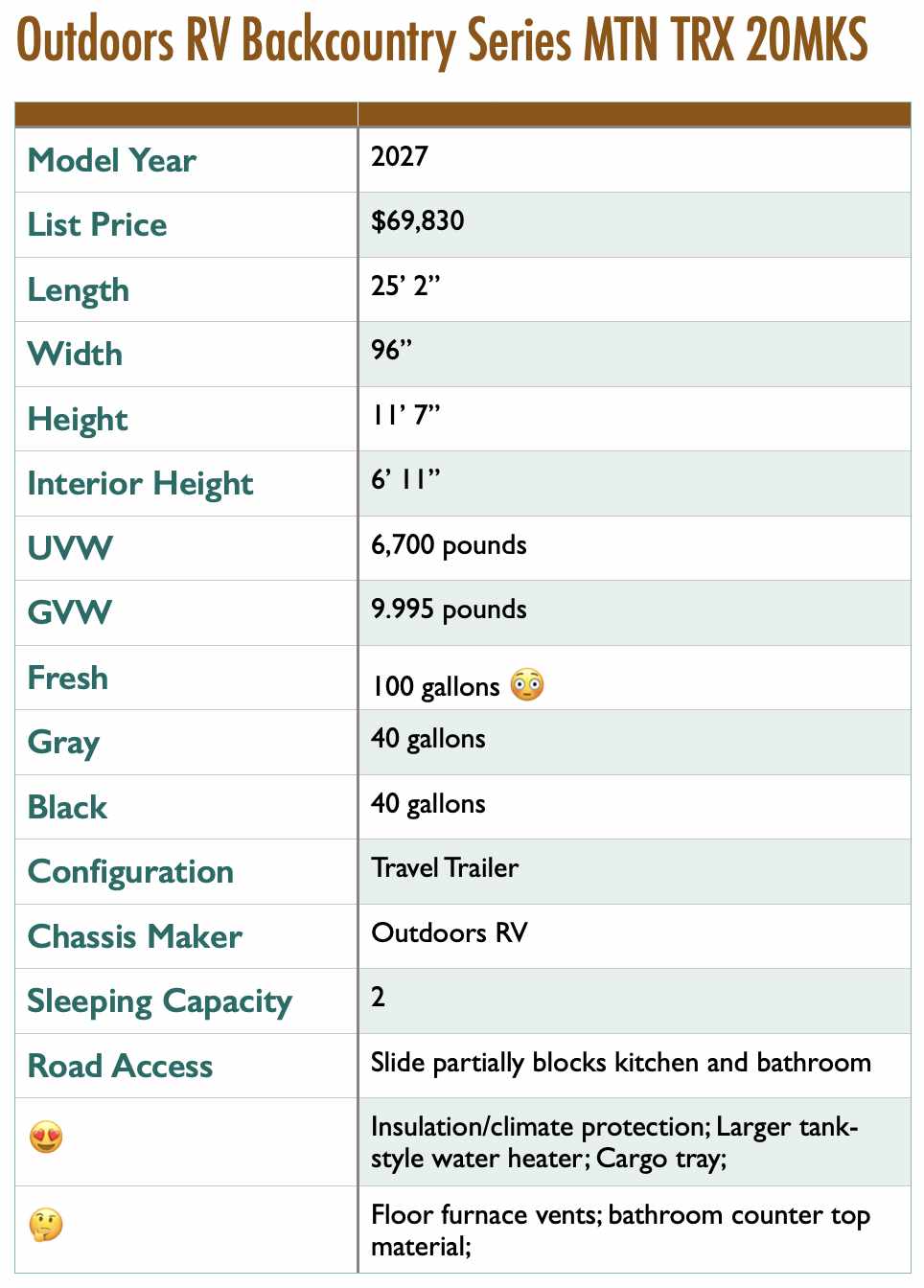
2027 Outdoors RV Backcountry Series 20MKS specifications
Boondocking and off-grid camping with the Outdoors RV Backcountry Series MTN TRX 20MKS
Outdoors RV has a lot of focus on off-grid and backcountry camping in their messaging. Fortunately, their RVs are an integral part of that story.
An example of this is the 3,600-watt propane-fueled generator that is standard on this trailer. Well, except in California. No generators there any longer.
There are 400 watts of solar standard, as well, with the option to bump that up to 600 watts or even 1,000 watts.
A while back I shared an article about why I’m not a big fan of tankless water heaters. Apparently, neither is Outdoors RV, with this model featuring a 10-gallon gas-electric traditional water heater. This is four gallons larger than is customary in RVs with tank-style water heaters.
This trailer also has really large holding tanks. They are supported so that you can travel with water in them.
As for travel access, the model I saw didn’t have much battery to it so I couldn’t bring in the slide. But I would guess that you might be able to squeeze by it to get to the kitchen and bathroom when it’s closed.
Final thoughts on the Outdoors RV Backcountry Series MTN TRX 20MKS
I am a big, big fan of this company’s products for the build quality and ability to withstand temperature extremes. Most of this RV also shows an attention to detail and quality build.
I had mentioned the handy drawer slide in the front pass-through compartment. Another piece of detail is that the controls for the optional power stabilizer jacks and the battery disconnect, along with several USB power outlets, are here in the pass-through. They are protected by a sliding door—a nice touch. I could imagine using these 12-volt power outlets to power a small cooler, for example, or an air compressor.
Another thing that attracts people to these RVs is a higher-than-average interior ceiling height at 6’11”.
I know I keep harping on that countertop in the bathroom but, again, it’s like smashing your thumb with a hammer. The rest of you feels fine, but you can’t stop thinking about your dad-blamed-thumb.
I think this could serve couples really well with both theater seating and a dinette along with a true queen-sized bed, on-board generator plus solar, and huge holding tanks.
These RV reviews are written based on information provided by the manufacturers along with our writer’s own research. They are based on information from a single unit and may not reflect your actual experience. Shop your RV and dealership carefully before making a buying decision. They are intended only as a brief overview of the vehicle, not a comprehensive critique, which would require a thorough inspection and/or test drive.
Tony comes to RVtravel.com having worked at an RV dealership and been a lifelong RV enthusiast. He also has written the syndicated Curbside column about cars.
You can also check out Tony and Peggy’s RV podcast.
Recently, I wrote about Slowjamastan, believing it to be the only micronation within the U.S. Turns out, I was wrong!
Reader James Starling commented that another (older) spot also claimed to be its own micronation. It’s located near Dayton, Nevada. I just had to find out more.
The Republic of Molossia
If you like offbeat roadside stops, The Republic of Molossia is one of those places you’ll certainly talk about later. This self-styled micronation near Dayton is best treated as a planned stop rather than a drop-in detour.
History
Molossia’s story goes back to 1977. That’s when Kevin Baugh and James Spielman founded it as the Grand Republic of Vuldstein. The official history regards May 26, 1977, as the founding date of this micronation.
Photo credit: The Republic of Molossia
Baugh said the idea came after watching the movie The Mouse That Roared, when the two decided to create a tiny nation of their own.
Today, Baugh is still the president and the head of government. That makes Molossia nearly 49 years old and still going strong.
What you’ll see
Photo credit: The Republic of Molossia
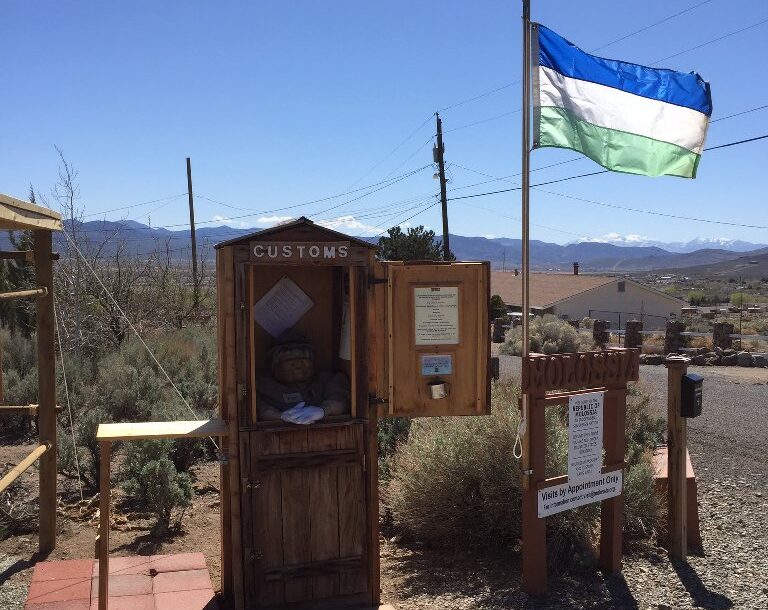
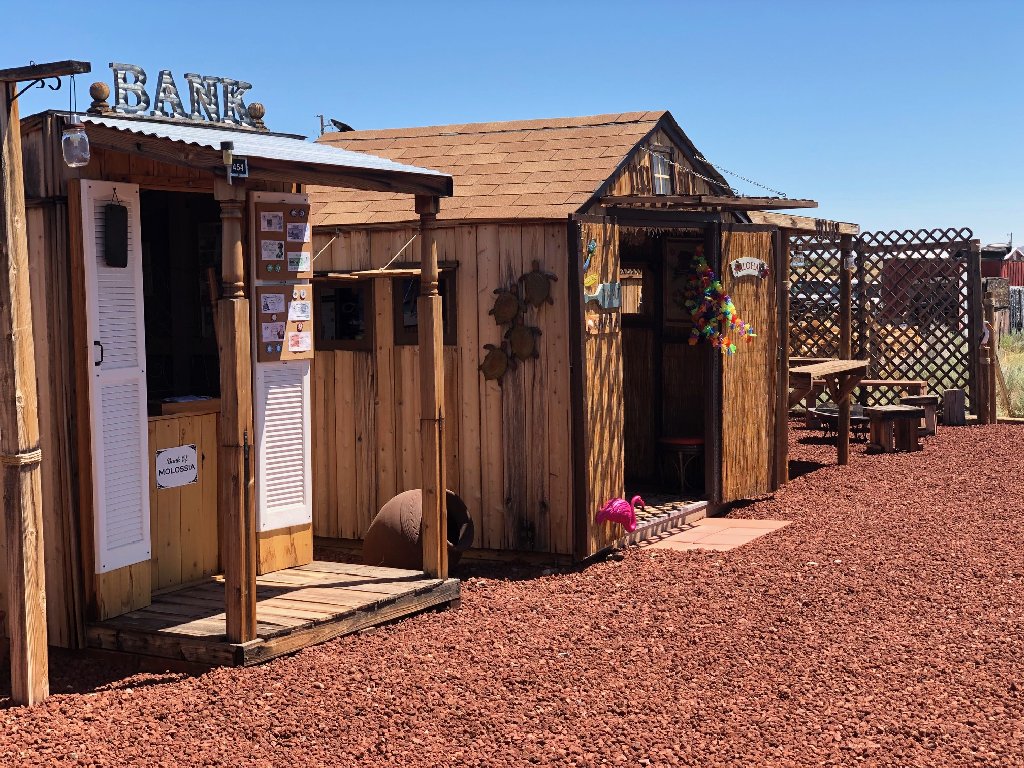
For visitors, the fun is in the details. Molossia’s Red Square is the public face of the nation and includes several sites. Once there, you’ll see the post office, trading company, presidential office, bank, Tiki Hut Bar and Grill, Peace Pole, Pineapple Fountain, Heroes Monument, and more.
Where to stay
RVers looking for a place to stay have a few nearby choices:
• Dayton RV Park sits right in Dayton and offers nightly stays with 30- to 50-amp service in 50 spaces.
• Dayton State Park has 10 campsites that can handle RVs up to 34 feet, plus a dump station, flush toilets, picnic tables, and barbecues.
• Silver City RV Resort is a bigger full-service option, with more than 200 pull-through and back-in sites, full hookups, 30- to 50-amp service, free WiFi, a pool and spa, and a convenience store on site.
Getting there
Set your GPS for 226 Mary Lane, Dayton, Nevada. That is the official address listed by Molossia, and the site says visitors should check in at the customs office before touring. RVers should note that visits are by permission only.
If you want to visit, The Republic of Molossia asks that you contact them with the date, time, and number of people in your group by sending them an email at mininfo@molossia.org.
Here are the remaining dates/times in 2026 to visit:
• Saturday, June 27, 2026, 9:00 a.m. PST
• Saturday, July 25, 2026, 9:00 a.m. PST
• Saturday, August 29, 2026, 9:00 a.m. PST
• Saturday, September 26, 2026, 10:00 a.m. PST
• Saturday, October 17, 2026, 10:00 a.m. PST (last tour of the year)
Note: Tours are subject to change.
In the area
If you want to keep exploring within roughly a 50-mile radius of Dayton, there is a lot to add onto the same trip. About 20 minutes east in Carson City, you can visit the Nevada State Railroad Museum and take the Carson River Aquatic Trail.
Dayton State Park gives you river access, mining ruins, and short hikes, while Fort Churchill State Historic Park is about a half-hour away. It preserves Nevada’s first, largest, and most elaborate military outpost.
For RVers, Molossia works best as a fun half-day add-on to a Dayton, Carson City, or Virginia City loop. It is small, strange, and deliberately playful, which is exactly why it makes such a memorable stop in Western Nevada.
Have you visited The Republic of Molossia? Tell us about quirky stops you’ve experienced while RVing. Use the comments below.
Sometimes people apparently think tires “fail” because of “magic.” Or, at least “magic” seems to be the only explanation if you do not understand tire design, materials and engineering.
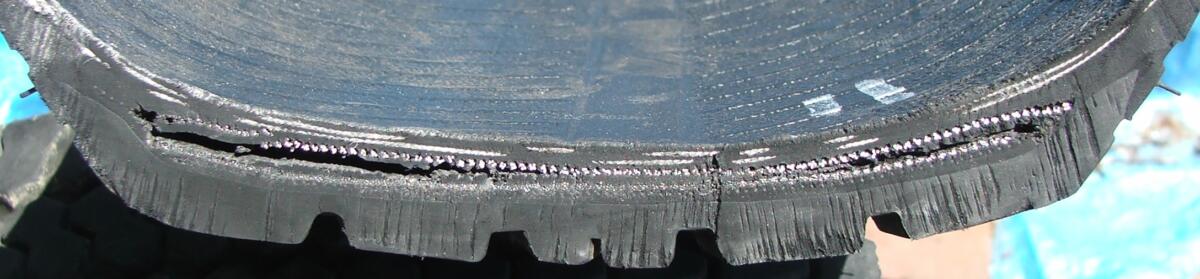
The real reason for tire failures can many times be traced to a force we Tire Engineers call “interply shear.” Here is a picture of a radial tire that is in the process of coming apart as it fails.
This particular tire was discovered while we were doing a “free-spin” inspection. You can clearly see the steel belts were in the process of coming apart.
Do a “free-spin” inspection on your tires
You can find out if your tires have started to come apart by doing a “free-spin” inspection, as shown in this video. Doing a free-spin inspection would be part of what I would consider a BASICannual tire inspection of your tires after they are two years old.
You can do this inspection by blocking the tires on your vehicle and applying the parking brake. Jack up one tire and slowly rotate the tire, and watch for “out of round” or “side to side” movement, as seen in the video. Do one tire at a time.
If you see any significant movement, I would consider that tire suspect. I would have it dismounted to confirm and/or replaced, if there was additional evidence of the tire in the process of failing.
It is true that “run-low-sidewall” failure can occur when the load is greater than what the tire can tolerate at the inflation pressure being used. “Interply shear” can occur even when the tire is properly inflated for the measured load.
Rubber in tires loses strength
Rubber in the tire structure loses strength. The RATE the tire loses strength is a function of TIME and temperature, with higher temperature causing faster degradation of the rubber strength. The “shear” or rubber tearing starts at the molecular level and NEVER repairs itself. This tearing will continue to grow until the tire is removed from service.
I have been able to confirm the above, in laboratory testing, by subjecting tires to 100°F with higher than normal inflation. Two tires failed after a few weeks. The failures occurred within hours of each other. It is very rare to get that level of repeatability in tire testing.
Why do tires fail this way
So, the next part is: “Why do tires fail in this manner?” People need to remember that rubber is an “organic” material, so its level of strength includes a “time” function, unlike steel.
Here(pdf) is a reference for how to calculate the strength of an inorganic item like steel. If you look at any of the formulas, you will not see a “T” or Time function. Most materials, like metals or stone, do not change or lose strength as the item gets older, unless we see other degradation or damage being done to the item.
Organics, like wood, plastic or rubber, do lose strength over time. This is part of the reason we see old wood structures falling down, while stone or metal structures can still be used when they are hundreds of years old.
Rubber, as used in tires, is only good for a few years. The time limit gets shorter as we increase the temperature.
I hope this post hasn’t been too technical for you
Father’s Day is just a week away, and it got us thinking about the lessons that stay with us long after childhood. Some fathers taught us practical skills—how to change a tire, cast a fishing line, balance a checkbook, or work with our hands. Others taught us something less tangible but just as important: patience, kindness, perseverance, or how to treat people with respect.
The older many of us get, the more we realize how often those lessons show up in everyday life. Maybe it’s a phrase your father repeated so many times that you can still hear it today. Maybe it’s advice you didn’t fully appreciate until years later. Or perhaps it’s an example he set through his actions rather than his words.
Of course, fathers come in many forms. For some, it was a stepfather, grandfather, uncle, mentor, coach, or another father figure who made a lasting impact. Whoever filled that role, chances are they left you with a lesson you’ll never forget.
So we’d love to hear from you: What did your father—or father figure—teach you? Tell us in a few sentences below by filling out the form. We’ll publish a selection of your responses in next week’s issue as we celebrate the fathers and father figures who helped shape our lives. Thank you!
America’s Original RV Newsletter. Since 2001 Issue 1265
Today’s thought
“And what is so rare as a day in June? Then, if ever, come perfect days.” —John Keats
Need an excuse to celebrate? Today is National Golf Cart Day! Reminder: Make sure you read the fine print before bringing your golf cart to the campground.
On this day in history: 1895 – Émile Levassor wins the world’s first real automobile race. Levassor completed the 732-mile course, from Paris to Bordeaux and back, in just under 49 hours, at a then-impressive speed of about 15 miles per hour.
When RVers may start seeing the new power interrupter devices
Last year, RVers debated whether grounding monitor interrupters (GMIs) would improve safety or create headaches at campground power pedestals. Now the RV industry has put a date on when the devices are expected to become standard equipment in new RVs. Continue reading.
Thinking about Starlink? New pricing changes could affect your decision
Starlink RV internet remains one of the most popular connectivity options for RVers. But recent price changes mean it’s worth taking another look before you sign up. Read more.
Love’s introduces mechanical services for RVers This seems like good news. Love’s Travel Stops is helping RVers stay road-ready this summer by introducing light mechanical work and oil and lube services at select Love’s Truck Care locations, building on its recent addition of RV tires and batteries. Read more.
Iowa campers squeezed out as data center workers fill RV parks year-round
Campgrounds across eastern Iowa are filling up faster than ever as thousands of out-of-state workers arrive to help build data centers across the region. What was once a weekend getaway is now home away from home for many workers who say finding an affordable place to stay has become difficult. Here’s the story.
California county may allow RVers to live full time on private property. Will others follow?
For years, RVers who wanted to live full-time on their own property have often run into the same obstacle: local zoning rules. Now, one California county is considering a change that could make long-term RV living legal on private property. The proposal could create a legal path for some residents to use RVs as permanent dwellings.
RV market outlook 2026: Thinking about buying an RV? Dealers may stay motivated
The RV market outlook for 2026 may be better news for shoppers than manufacturers. Thinking about buying an RV? The latest numbers from RV makers suggest you may not want to rush. RV makers still expect to sell plenty of RVs, but they’re becoming more cautious about how quickly the market will grow over the next year. Learn more.
New RV trailer claims it can help electric trucks tow farther
Towing an RV can dramatically cut an electric car’s driving range. Evotrex says it may have found a way to help. Its new PG5 travel trailer combines a large battery system with an onboard generator, which can provide substantial off-grid power and help electric tow vehicles travel farther between charges. If it works as advertised, it could address one of the biggest questions surrounding EV towing today.
Many travelers booking ahead to avoid price increases
Fullstory, a leading behavioral data company, has released the results of its 2026 Travel & Hospitality Survey, which explored shifting travel behaviors, booking preferences, and experience expectations among U.S. consumers. Despite economic pressure, travel demand remains resilient, with 70% of respondents indicating recent or planned travel activity. Here’s the rest of the story.
Glamping News from across the USA
Here is news about glamping from the last 30 days. Glamping, a term derived from “glamorous” and “camping,” refers to an outdoor travel style that pairs the immersive, natural setting of traditional camping with modern comforts of a luxury hotel.
The sweetheart camping chair
OK, it’s not really called the “sweetheart chair,” but that’s what we’re calling it because it’s a two-seater for you and your special someone, or, heck, even you and your dog! Comfy, sturdy and foldable for easy packing. Plus, it’s the highest-rated! Learn more or order.
RV review 2026 Holiday Rambler Vacationer 35K—America’s #1 gas motorhome
The Vacationer 35K is Holiday Rambler’s top gas Class A and a close sister to the Fleetwood Bounder. It offers bath-and-a-half comfort, solid towing, and upscale features without diesel pusher pricing. At 36’3″, it’s manageable for a Class A with a roomy layout. It rides on the Ford F53 chassis with the 7.3L V8 “Godzilla” engine. Continue reading.
Beyond the headlines with Tony Barthel Go RVing, reservations down, service comes to you
In this week’s RVing news roundup, Tony explains why you may be feeling like going RVing more than usual; discusses findings that slightly fewer RVers are making campground reservations than last year; reports that RV component company Lippert is providing upgrades and other services on-the-spot at a few national events; and, no surprise here, explains why money spent on domestic travel is continuing to grow but people aren’t traveling as far. Oh… and wait until you see the huge OOPS in a very short video. YIKES! All that and more here.
News briefs
On June 3, an 18-year-old male was reported experiencing heat-related symptoms on the Bright Angel Trail in the Grand Canyon. National Park Service rangers responded and located the individual approximately 30 feet below the trail in a remote area. Despite rapid response efforts including a helicopter rescue, the man died.
Yellowstone National Park recorded more than 570,000 visitors last month, the busiest May ever. Visits were up 1% from 2025, the previous record for May, and a whopping 20% higher than May of 2021, which was Yellowstone’s record-breaking year with more than 4.8 million visitors.
Stay away from them snakes!Yosemite National Park is home to the northern Pacific rattlesnake. It uses its venomous bite to capture prey, which helps control the park’s rodent populations. But, if agitated or startled by humans, it will bite. So far this year in California, three people have died from rattlesnake bites. Rangers offer a warning and advice.
The Ver-El RV Park in Concord, NC, is largely vacant after residents evacuated due to a power outage. The Cabarrus County Sheriff’s Office has accused the park owners, both former Duke Energy workers, of stealing more than $591,000 of power from the company. Enough is enough, so the utility pulled the plug.
Great Smoky Mountains National Park is asking visitors not to stack rocks (cairns) in streams after an Eastern Hellbender (salamander) was found crushed beneath one. With 100–300 eggs often laid under a rock, an entire generation can be lost instantly.
Watch out!!A woman has died after being hit by a loose umbrella while eating at a South Carolina restaurant. According to the Clarendon County coroner, the umbrella hit 56-year-old Dana Weinger in the neck, severing her carotid artery. She died at the scene. Officials said the umbrella came loose during high winds.
Love’s Travel Stops has opened a new location in Gretna, Florida, at exit 174 of I-10 in the Florida Panhandle. It will include four full-hookup RV sites (coming in July), three additional dedicated RV sites, a dump station and dog park.
The 36-year-old woman accused of setting multiple fires inside an RV park has been found not competent to stand trial and must be hospitalized until further notice. Stephanie Marie Pauli was accused of setting two fires inside Arizona Charlie’s RV Park, including one beneath an RV with two persons sleeping inside.
Free visits to more than 200 California state parks through a library program could soon end after the state Assembly’s budget plan rejected funding for the program. Without it, parks will need to scramble to keep accessibility open to all.
Rising gasoline prices, fueled by the U.S. war with Iran, have driven inflation to its highest level in more than three years. A report released Tuesday by the Labor Department showed consumer prices in May were up 4.2% from a year ago, the largest annual increase since April 2023…
… but some encouraging news: The national average for a gallon of regular unleaded has fallen for three straight weeks. Since May 21, the national average has dropped from $4.56 to $4.12. Pump prices remain at four-year highs, but the national average is currently far from the record set on June 11, 2022, of $5 per gallon.
The Redwood Parks Conservancy is seeking volunteers to help remove invasive plants at three California North Coast redwood parks on June 14, 21, and 28. Info.
Human remains discovered inside a sleeping bag in a remote area of Washington state’s Olympic National Park in 2000 have been identified through advanced DNA testing. The remains belonged to Joseph Louis Serrao Jr., whose family last heard from him in 1998.
A black bear entered a tent at Montana’s Beavertail Hill State Park campground on Tuesday morning. Montana Fish, Wildlife & Parks (FWP) said people were camping inside the tent, but fortunately nobody was injured. FWP located and euthanized the bear; the agency says it had become habituated to people and was staying in the area.
Speaking of bears in tents…The U.S. Forest Service has issued new rules for a campground near Vail, Colorado, due to bear activity. The order requires all campers at Gore Creek Campground to use hard-sided campers or trailers. Soft-sided shelters such as tents, pop-up tent trailers, and truck-bed tent campers are not allowed at the campground.
(Click to enlarge.)
Always check your… motorcycle? A Washington police department announced two birds had hatched in the storage compartment of a not-in-service motorcycle used for traffic officer training. The department named the mama Traffic Birdie.
Update: Pennsylvania State Police reported that Jared Callahan has been located. No further details were released as of late Fri. night. Pennsylvania State Police are searching for Jared Callahan, 43, who disappeared June 9 while working at Yogi Bear Campground in Springfield Township. He’s 6′ tall, weighs about 170 pounds with brown hair and green eyes. Know anything? Call 724-439-7111 regarding incident number PA26-753223… Meanwhile, Capitol Reef National Park police are searching for Richard Discipio, 77, last seen June 6 at the Days Inn in Torrey, Utah. He may have been hiking in the Chimney Rock area of the national park between June 6 and 8. He’s 5’8” tall, 155 pounds with green eyes. Have info? Call the Wayne County Sheriff’s Office at 1-800-356-8757.
DON’T WAIT FOR THE NEWS: Did you know you can receive a daily roundup of the latest news for RVers? Delivered to your inbox Monday-Friday, we’ll send you the biggest headlines. Stay up to date, learn about important closures, recalls, and much more. Click here and subscribe to “Breaking RV News.”
Run your air conditioner with only 20 amps or a small generator
Running an RV air conditioner on a 20-amp household outlet sounds impossible—unless you have a SoftStartRV™. This small device reduces startup current dramatically, helping many RVers cool their rig at home, while visiting friends, or during off-grid camping. Learn more and/or order at a discount.
Tanner Toons With Tanner Woods
You may share this Tanner Toon, unaltered, on your website, blog or social media with our compliments. The musings from Tanner Woods’ creative mind appear in this newsletter every Saturday and Sunday and in many RV Daily Tips newsletters through the week. Sign up for our RV Daily Tips Newsletter so you don’t miss them.
Stupid tourist question
Asked to rangers at Yosemite National Park: “Where are the heads?” A visitor was actually looking for Mount Rushmore and thought it was in Yosemite.
Extreme weather
🔥 Hottest this weekend: The deserts of southeastern California, southern Arizona, and far West Texas are expected to be the hottest places in the U.S. this weekend. Areas near Death Valley, California, could reach 112–116°F, while Yuma, Arizona, may hit 106–109°F, and Phoenix is expected to top out around 104–108°F. Parts of the Rio Grande Valley and Pecos River region of Texas could also flirt with 110°F.
🥶 Coldest this weekend: Mountain valleys in western Montana, central Idaho, and especially the higher elevations of Wyoming’s Yellowstone region are expected to wake up to temperatures in the 30s and low 40s, with some of the coldest spots dipping into the upper 20s. Alaska will be colder, of course, but among popular Lower 48 travel destinations, the Northern Rockies will be the coolest place to be this weekend.
Reader poll Have you ever had to change RV plans because of extreme heat?
Chrysler is recalling more than one million 2021-2025 Jeep Wrangler and Jeep Gladiator vehicles. The electric hydraulic power steering pump wiring may overheat and cause a vehicle fire, even when the vehicle is parked with the ignition in the “Off” position. Recall number: 21D. Info: 800-853-140.
? MYSTERY PRODUCT OF THE DAY ? Yes, today’s poll inspired this product, but we just HAD to share it with you. We’ve seen other versions of these (you surely have, too), but this is a whole new game-changer. If this works, boy, it could really save you this summer.
How many creatures do you see besides the elephant? There are many, but we won’t tell you how many until you’ve finished your search. Most readers, we assume, will see the elephant and donkey. But what else? Study the image carefully to see how many animals you can see.
Salt water taffy is a variety of soft taffy originally from the Atlantic City area of the Jersey Shore in the 1880s. Candy store owner David Bradley’s shop was flooded during a major storm in 1883 and his entire stock of taffy was soaked with salty Atlantic Ocean water. When a young girl later asked if he had any taffy, he is said to have offered her some “salt water taffy.” (Or, so the tale goes…)
Laugh of the week
Top scams RVers should watch for right now
Summer travel is in full swing, and scammers are targeting people who are booking trips, driving long distances, and spending time outdoors. In addition, watch out for a Medicare scam. Here are four scams to watch for this week:
Fake campground cancellation notices: Emails and texts claim your reservation has been canceled due to weather, maintenance, or a booking error. The message urges you to click a link to rebook or receive a refund, but it’s designed to steal your information.
Counterfeit National Park passes: Scammers are advertising discounted annual park passes on social media and online marketplaces. The passes may be fake, expired, or never arrive at all.
Vacation rental bait-and-switch scams: Travelers booking cabins, campsites, or RV spaces online are finding that the advertised property doesn’t exist—or looks nothing like the photos. The scammer disappears after collecting a deposit.
Medicare fraud scheme: The FBI is warning Medicare recipients about a scheme in which scammers enroll people in hospice care who do not need hospice services. Some victims are enrolled without their knowledge, allowing fraudsters to bill Medicare for services never provided. Learn more.
Miss The Perfect Scam? Listen to the most recent episode here.
Today in history
Take an extra 10% off a GhostBed luxury RV mattress!
The GhostBed RV mattress is 10” deep, crafted with gel memory foam for coolness, has 3 layers of luxurious comfort and is perfectly sized for your RV! Ahhhh… Wake up relaxed and rejuvenated. RVtravel.com readers now get an EXTRA 10% OFF a GhostBed Luxury RV Mattress! CLICK HERE and use code RVTRAVEL10. Watch RVtravel.com’s Tony Barthel’s RV mattress review here.
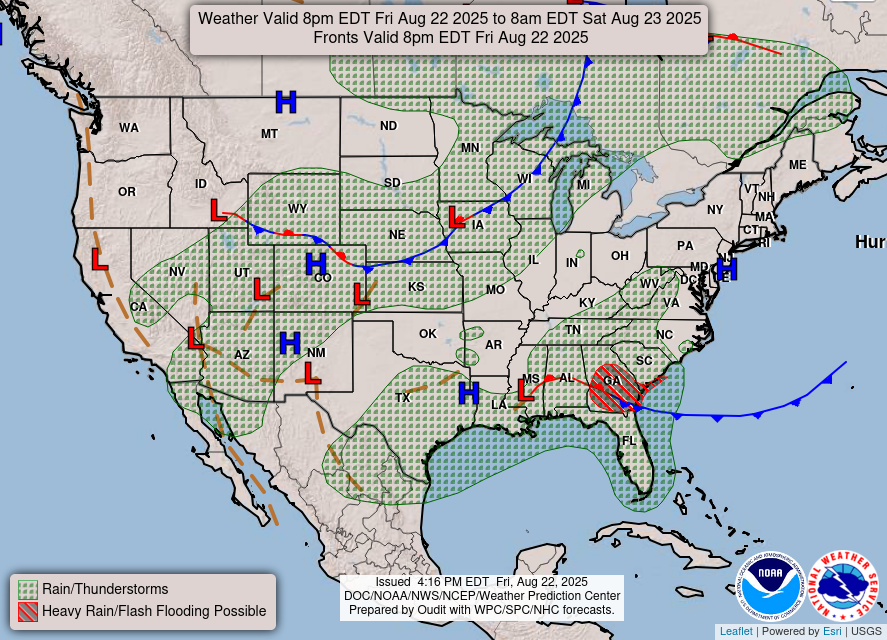
Today’s weather forecast across the nation THIS MAP UPDATES TWICE A DAY
If you suddenly are feeling overwhelmed with the desire to go RVing, there’s a good reason. The RV Industry Association has empowered influencers, manufacturers and campgrounds to share the message that RVing rocks the house. They’re doing this through the Go RVing website and encouraging participants to share the message about how RVing is super awesome.
The first wave of these campaigns is supposed to have started June 12 and go through the weekend. So, if you’re seeing a lot of Go RVing-related stories and content and all of that, well, now you know why.
Let me do my part here… Go RVing.
RV parks show fewer reservations
According to an article in RVBusiness, RV parks are reporting weaker sales over Memorial Day weekend compared to last year’s figures. They go on to predict lighter sales over the summer, too.
“Across the Campspot platform, we’re seeing a clear softening in campground demand year-over-year through May 2026,” said Lucas Greenberg, the chief revenue officer for the Grand Rapids, Mich.-based company, which tracks reservation data from its customer base of more than 2,600 parks.
Comparing same park performance year-over-year, Greenberg said overall site nights are running about 1.2% below last year’s pace.
Kampgrounds of America, Inc. (KOA), which has more than 500 campgrounds across the U.S. and Canada, is also seeing a softening demand for overnight campsites, although KOA attributes the decline to changes in consumer booking patterns.
“After a steady first quarter, we’ve seen short-term reservation activity moderate over the past month compared to last year,” Kimberly Wootteon, KOA’s vice president of commercial strategy, said in a written statement. Like Campspot, KOA saw fewer reservations over the Memorial Day weekend.
“Memorial Day serves as an important indicator of summer travel demand. Holiday occupancy across the KOA system was modestly lower than 2025, finishing just under 5% compared to last year’s occupancy,” she said.
Lippert service comes to you
RV component company Lippert has taken to the road with some of its service team and is providing upgrades and other services on-the-spot at a few national events, including having done so at the DLM Dream Races in New Weston, Ohio, last weekend, June 5-7.
Lippert’s Director of Marketing, Rachel Yessa, was quoted in an article on RV News as saying “A lot of people are out there boondocking; they are out there for the entire weekend. If something happens with their awning or their air conditioner, or whatever the case is, we want to be able to support them.”
Overall the company stated that this initial event was an incredible success with people approaching Lippert’s team members as they arrived.
According to RV News, the next such event will be at the 42nd King’s Royal, July 16-18. The third such event will be the World 100 race, September 10-12.
“NASCAR is a great venue for our viewers, and we will continue to be very selective on making sure that whatever sponsorship partnership we select is going to be meeting as many RVers where they are as possible, and not just sponsoring for the sake of sponsorship,” Jarod Lippert, Chief Marketing officer for Lippert, said. “It is about getting in front of actual users of the product, which in this industry is very difficult. It can be very fragmented.”
Another way the company is bringing service out to the customers is with three certified factory service locations in Howe, Indiana; Red Bay, Alabama; and Hemet, California.
“The worst thing in the world for us is when customers cannot use the RV as it was intended,” Jarod Lippert continued. “Our goal is to always just keep people enjoying that investment, and not have an unfortunate occurrence disrupt their vacation.”
Are you part of the latest RV trends?
According to a study by the U.S. Travel Association, money spent on domestic travel is continuing to grow but people aren’t traveling as far due to rising costs. Well, duh.
In another nod to the Go RVing day, campgrounds, dealers and other such businesses were encouraged to “Come up with creative campaign taglines such as, ‘You don’t have to go far to escape’ or ‘Local go-getter traveler’ and cross-promote them on targeted social media posts, blog posts and email newsletters,” Go RVing said. “Have ambassadors and customers share their favorite close-to-home RV adventures or itineraries and turn this into social, blog and email content or series.”
While many people have analogized Congress as being the opposite of progress (not just this one, but generally speaking: pro is to con as progress is to congress), it seems that they may be able to move forward a bipartisan bill to consider the Great American Outdoors Act (GAOA) 250.
The legislation, introduced by Chairman Bruce Westerman (R-AR) and Ranking Member Jared Huffman (D-CA) and 93 bipartisan original cosponsors, modernizes and updates public land and water infrastructure, increases outdoor access and safety, and supports the outdoor recreation economy.
The GAOA 250 invests $1.9 billion annually in America’s national parks and public lands over each of the next five years. So, who’s writing this big check? They are hoping for private donations, onshore energy revenue and new foreign visitor fees.
That same committee said that the bill would streamline contracting processes, expedite environmental reviews and require regular reports on the progress of infrastructure.
I believe that many of us who are RVtravel.com readers and writers have looked at those new EV trailers with a great deal of skepticism. However, according to The EV Report, EV trailer maker Evotrex has raised an additional $30 million, bringing the total raised to $46 million.
While the skeptic in me is still not sure about those EV trailers, and I own an EV, I was curious when I saw that another company, Lightship, has found a customer for their EV trailer chassis in Exedy Drones, a maker of agricultural drones.
By having a big 240,000 watt-hour battery on board and a cargo carrying capacity of 8,700 pounds, the chassis used in their trailers could make sense for a number of commercial applications. Now, that actually makes sense to me.
Scott Binder, Vice President of Engineering, Operations, and Technology at Exedy, said, “For end users, PowerSled means all-day power without the constant noise, exhaust fumes, or compromises that have historically come with mobile energy. It is a cleaner, quieter and more capable solution built to support how modern fleets, like ours, operate.”
Quite honestly I could see some construction company owning a cargo trailer with one of these chassis and using it to power the tools they need to build houses before the local power company comes to bring on the power.
That’ll leave a mark
Finally, I often have encouraged people to regularly walk around their RVs when they stop for whatever reason—fuel, bathroom break—whatever. Apparently the owner of the RV in this video may not have followed this advice.
Warning: If you’re offended by bad language (it’s very brief, but sort of amusing), maybe watch this on mute.
Here is news about glamping from the last 30 days. Glamping, a term derived from “glamorous” and “camping,” refers to an outdoor travel style that pairs the immersive, natural setting of traditional camping with modern comforts of a luxury hotel including beds with real linens, air conditioning, fire pits, saunas and hot tubs.
Accommodations include cabins, yurts, safari tents, tree houses, covered wagons and glass domes. “Glampgrounds” may include facilities for high-end RVs, but often do not.
Here’s the latest news
Yosemite gets major new glamping resort
A new 71-unit safari-style glamping resort has opened near the west entrance of Yosemite National Park. Operated by Under Canvas, the property offers furnished canvas tents with private bathrooms, wood floors, and porches. Rates start around $314 a night. The resort is also certified as a DarkSky destination for stargazing.
Utah resort named nation’s top glamping destination
The Dyrt’s 2026 Glampy Awards named Zion Glamping Adventures in Utah the best glamping destination in America for the second year in a row. The annual rankings are based on guest nominations and focus on unique design, amenities, and overall experience.
West Texas glamping retreat earns national recognition
Space Cowboys, a glamping resort near Big Bend National Park, was ranked No. 2 in the United States by The Dyrt. The property features mirrored “space pods,” yurts, and luxury tents designed for dark-sky stargazing.
Under Canvas continues rapid expansion
Luxury glamping company Under Canvas is expanding its national footprint. Industry reports note the company recently added Yosemite and Columbia River Gorge locations and is preparing to open a White Mountains, New Hampshire, resort this month.
Glamping market nears $1 billion in North America
A new industry report estimates the North American glamping market will approach $1 billion in annual revenue this year. Analysts cite growing demand for outdoor vacations that combine nature with hotel-like comfort.
Family travelers drive glamping growth
Market researchers report that family travelers now account for about half of all glamping demand. Larger accommodations, private bathrooms, and resort-style amenities continue to attract families seeking alternatives to hotels and traditional campgrounds.
Dark-sky glamping becomes major trend
New glamping developments increasingly promote dark-sky experiences and stargazing. The newly opened Yosemite Under Canvas resort highlights its DarkSky certification as a key selling point, reflecting growing consumer interest in night-sky tourism.
Luxury camping moves further into the mainstream
The 2026 State of Glamping Report found that glamping is no longer a niche travel option. Travelers increasingly expect upscale amenities, private accommodations, wellness features, and environmentally conscious operations.
Investors pour more money into glamping
Industry analysts report increasing institutional investment in U.S. glamping properties. Larger hospitality companies and investment firms are funding expansions as glamping continues to outperform many traditional outdoor lodging segments.
Sustainability becomes a selling point
Many new glamping developments are emphasizing solar power, eco-friendly construction, and low-impact tourism. Industry forecasts suggest environmentally focused amenities are becoming increasingly important in attracting guests.
RV parks increasingly adding glamping facilities
RV park operators are adding glamping tents, yurts, and cabins to boost revenue. Industry observers say the trend is likely to continue, meaning RVers will likely see more mixed-use facilities that combine RV sites with luxury camping accommodations.
We use cookies to ensure that we give you the best experience on our website. By continuing to use our site, you consent to accepting cookies. We NEVER have or will sell reader's data. For more info, please see our privacy policy page.



 Some years ago, a worthy alternative to standard vinyl electrical tape appeared—a silicone rubber tape that was self-fusing. It bonded to itself with enthusiasm and had no adhesive to age or create a mess. Furthermore, it was impervious to many chemicals, ozone and UV, which age and deteriorate lesser products.