Home Blog Page 354

Should e-bikes be allowed on traditional bike trails?

50

By Gail Marsh
I wrote an article last year about some RVers’ gripes that I’d never heard before. One of the complaints was about electrical bicycles or e-bikes. I received so many comments about riding e-bikes on biking trails that I wanted to poll you about this. I’ll summarize the comments from my previous article for you so that you understand the issue. Read, see what you think, and then vote: Should e-bikes be allowed on trails?

E-bikes

First of all, let’s consider a quick overview of e-bikes. E-bikes are typically categorized into three main classes based on their capabilities and motor assistance:

Class 1 e-bikes: These e-bikes are equipped with a motor that assists the rider only when pedaling, providing assistance up to a certain speed limit, often around 20 mph. Class 1 e-bikes are quite similar to traditional bicycles but with added electric support.

Class 2 e-bikes: Similar to Class 1, these e-bikes also assist the rider when pedaling but come with an additional feature of throttle control. This means riders can propel the bike without pedaling, relying solely on the electric motor.

Class 3 e-bikes: These e-bikes offer pedal-assist like Class 1 and 2, but with support up to higher speeds, typically around 28 mph. (It should be noted that the 12,000W Enduro e-bike is promoted as the fastest in its class, with a maximum speed of 65 mph. To me, this e-bike is more like a motorcycle than a bicycle. This “superbike” should not be considered when completing the poll.)

Pros (allow e-bikes on biking trails)

Accessibility: E-bikes make cycling accessible to a wider range of people, including those with physical limitations or those who may struggle with traditional biking over longer distances or difficult trailways.

Eco-friendly transportation: By encouraging the use of e-bikes, especially for commuting, cities can reduce carbon emissions and alleviate traffic congestion, contributing to a more sustainable environment.

Health benefits: While e-bikes provide motor assistance, riders still engage in physical activity, though at varying levels depending on the class of the e-bike. This can promote cardiovascular health and overall well-being.

Cons (do not allow e-bikes on biking trails)

Safety concerns: The increased speed capabilities of some ebikes, especially Class 3 models, raise safety concerns, particularly on crowded bike trails where cyclists and pedestrians share the space.

Trail wear and tear: E-bikes, especially those with more powerful motors, may cause increased wear and tear on bike trails compared to traditional bicycles, potentially leading to trailways’ maintenance issues and environmental degradation.

Confusion and regulation: The classification of e-bikes and their integration into existing cycling regulations can be confusing. Determining where e-bikes are allowed to ride, especially on bike trails designated for non-motorized vehicles, can lead to confusion and conflicts among trail users.

Are e-bikes considered motorized?

At the crux of this conflict is the question: Are e-bikes considered motorized vehicles? This is a big question, and one not yet uniformly addressed across the USA. The classification of e-bikes as motorized vehicles varies depending on local regulations.

In many jurisdictions, e-bikes are treated like bicycles rather than motorized vehicles, primarily because they do not require licensing and registration like traditional motorized vehicles. However, the distinction between motorized and non-motorized vehicles remains a point of contention in some areas, particularly regarding where e-bikes are permitted to ride.

State-by-state regulations

This website will help you determine how your state (or the states you plan to visit) approaches the debate about e-bikes riding bicycle pathways and trails. Keep in mind that these rules may be updated or revised at any time. Call the local park service or city hall for up-to-date information.

Your turn

E-bikes represent a true innovation in the world of cycling because they offer a blend of human-powered and electric-assisted propulsion. While they provide numerous benefits in terms of accessibility, sustainability, and health, the debate over their integration into traditional cycling trails and pathways underscores the need for careful regulation and consideration of safety concerns.

As e-bikes’ popularity continues to grow, finding a balance between promoting their use and preserving the integrity of bike trails will help shape the future of both rural and urban mobility.

After considering both the pros and cons of allowing e-bikes to ride on traditional bicycle paths and trailways, what do you think? Please vote in our poll. If you wish, explain your reasoning and offer suggestions for potential trail rule changes in the comments below.

You will enjoy these other popular polls:

Do you see yourself still RVing in five years?
Do you still enjoy RVing as much as when you first started?
Have you ever had a problem with a slide-out that delayed your travel?
Have you ever stayed at a nudist resort with your RV? Would you?
Have you spent a free night in a parking lot with your RV in the last year?

##RVT1199

Gas vs. diesel: Which is better?

Looking to buy a motorhome? Before you do, there’s a big question: gas or diesel? In the video below, Izzy and MJ of Endless RVing take a deep dive into each to help you make the best choice.

Before we begin, know that there is no one “right” answer. What works for your neighbor might not work for you. It all boils down to your specific needs, travel style, and budget. So, forget about blindly following recommendations. Use the advice in the video to figure out what fits your RV lifestyle.

Izzy and MJ focus on Class A motorhomes, but many of the points also apply to Class B and C RVs too.

Gas vs. diesel motorhome considerations

What’s your budget?: Let’s face it, price is a huge deal. Gas motorhomes are generally the more budget-friendly option right off the bat. Entry-level gas models can be found in the $150,000 to $200,000 range. Diesel models? Expect to shell out considerably more, easily climbing well over $200,000. If you’re mainly a weekend warrior or only RVing for a couple of weeks each year, that extra upfront cost for a diesel might not make sense.

Resale value: Diesel RVs typically hold their value better than gas models. RVers often upgrade down the road. Keeping that resale value in mind is always a smart idea.

Financing: Of course, that higher price tag of a diesel RV means bigger loans and higher monthly payments.

Fuel costs: Usually, diesel is more expensive per gallon than gasoline. Some folks swear that diesel engines are always more fuel-efficient. While that can be true for smaller RVs, like Class B’s, it’s not always the case with larger Class A motorhomes. Aerodynamics play a bigger role in fuel efficiency (or lack thereof) for these behemoths.

Fuel tank size and range: Diesel motorhomes often come with much larger fuel tanks. We’re talking 100 to 200 gallons, compared to the 80-gallon tanks you might find in gas models. What does that mean for you? Longer stretches between fill-ups! If you crave those long hauls without constant pit stops, diesel might be your jam.

DEF (Diesel Exhaust Fluid): Don’t forget about DEF! Diesel engines need Diesel Exhaust Fluid, which is another cost to factor into your budget.

Servicing: When it comes to maintenance, gas motorhomes might require more frequent servicing (mileage-wise). On the flip side, diesel service tends to be pricier, even if it’s less frequent. It’s a bit of a trade-off.

Engine life: Here’s where diesel engines can really shine. A gas engine in a Class A RV might last for 150,000 to 200,000 miles. A diesel? You could potentially reach 400,000+ miles! However, let’s be real: Very few RVs, even diesels, actually rack up those crazy high mileage numbers before their owners decide to upgrade. Just something to keep in mind.

Emissions restrictions: Keep an eye on those emissions restrictions! They’re getting stricter all the time. So far, gas motorhomes haven’t been affected, but that could change down the road.

Engine placement and noise: Diesel pushers (that’s what they call diesel motorhomes with the engine in the rear) offer a quieter ride for the driver and passengers. Gas motorhomes have the engine up front. This leads to more noise in the cabin.

Ride quality: Diesel pushers typically boast air ride suspension and air brakes, which translate to a smoother, more comfortable ride. Gas motorhomes usually don’t have this feature, but you can find aftermarket upgrades like liquid spring suspension.

Capabilities: Gas motorhomes are usually the Ford F-53, and have up to a 26,000 lb. chassis. Gas motorhomes usually tow up to 5,000 pounds. Diesel motorhomes have up to a 50,000 lb. chassis, and can tow up to 20,000 pounds.

Storage space: Gas motorhomes offer a decent amount of storage. But diesel pushers? They take it to the next level! Expect significantly more storage space, including pass-through storage and those super-handy slideout trays.

Interior finishes: Here’s another area where you’ll see a difference. Gas motorhomes tend to have more basic interiors, while diesel pushers often feature more luxurious finishes like porcelain tile, solid surface countertops, and detailed woodwork. It’s all about that price difference—you generally get what you pay for.

Ultimately, the best RV is the one that fits your unique needs and lifestyle. So, do your research, weigh the pros and cons, and choose the motorhome that will help you create unforgettable memories on the open road!

RELATED

More articles you might really like

##RVT1199

Easy leaking toilet fix: Replace the ‘ball seal’ on your RV’s toilet

By Dustin Simpson
Welcome to “In the RV Shop with Dustin”. We recently had a customer in the shop with a toilet that was leaking water from the bowl into the holding tank. After performing a simple operation and visual inspection, we narrowed down the culprit to the “ball seal.” Did you know this replacement is so easy that just about anyone can do it?

Dometic Toilet bowl seal on a 310 model.

Here is a simple, step-by-step installation guide to help you with this repair

Dometic 300/310/320 Flush Ball Seal Installation

NO TOOLS REQUIRED.

  1. Turn off water supply before working on the unit.
  2. Hold flush pedal down to keep flush ball open and to release the water pressure in system.
  3. Grasp inside edge of seal and pull upward to remove from toilet. Remember to use rubber gloves.
  4. Thoroughly clean lower bowl rim area where seal was located; you can even use an old toothbrush.
  5. Release flush pedal to close flush ball. Thoroughly clean surface of flush ball.
  6. Insert new seal in base, making sure seal is firmly pressed outward against lower bowl rim.
  7. Press flush pedal to open flush ball, and spread thin layer of silicone grease or petroleum jelly under the seal where it will contact flush ball. Release flush pedal.
  8. Lightly press down around circumference of seal to insure seal is in proper position.
  9. Turn on water supply.
  10. Add water to bowl and check for leaks.
Steps 1-4
Click to enlarge.

Here is the Dometic Flush Ball Seal Replacement for 300 310 320 RV toilets. In addition, if you want to extend the life of your toilet bowl seal, I recommend that you use a toilet bowl lubricant and seal conditioner.

More from Dustin

Make sure you check out my website, California RV Specialists, and our YouTube channel for more helpful information, and see our published articles on RVtravel.com and other social media pages.

RELATED

More articles you might really like

• Alternative to Quartzsite: Low-cost AZ desert boondocking at Imperial Dam
• A new take on the offensive neighbor in the RV park
• How to protect your RV’s decals from fading and sun damage
• RV Tire Types 101: Selecting the correct tire for your RV or other vehicle
• Be careful how you wash your rubber RV roof
• A step-by-step guide to applying self-leveling sealant on your RV’s roof

##RVT1199

The problem with RV manufacturers’ warranties on new RVs

The debate between new versus used RVs is as old as RVing itself. Sure, there is depreciation to consider, as well as the price. However, one of the biggest reasons people go with a new RV is often the manufacturer’s warranty. But is it really worth it? 

A new RV manufacturer’s warranty is not like a car warranty

Sure, the concept of having everything fixed on your RV for the first year is tempting. Just like when purchasing a new car, having this peace of mind is a helpful benefit. However, a new RV warranty is not at all like a new car warranty!

When you purchase a new car, you know that your new car may receive service at the dealership you purchased the car from or any other dealership that carries that brand. The car manufacturer has arranged with dealerships that carry their product to provide vehicle service across locations. 

The process of new car warranties is somewhat streamlined regardless of location. It’s as easy as calling and making an appointment to take the car in. You often can even receive a loaner car if your vehicle is in the shop for an extended period of time. If you have never purchased a new RV, you may be shocked to learn that the manufacturer warranty doesn’t work quite so smoothly.

So why is an RV manufacturer’s warranty different than a new car warranty? In a nutshell, each RV dealership does what it desires as far as servicing warranties. There is no accountability to the manufacturer to service units in a streamlined way or specific time frame.

The big problem with an RV manufacturer’s warranty

The biggest issue with an RV manufacturer’s warranty is actually trying to use it. When you contact an RV dealership for a service appointment, it can honestly be shocking how long it takes to an appointment to get in. Even more surprising is how long it sometimes takes the dealership to get the parts required to perform the repair. 

We learned the hard way never to leave your RV with a dealership until you verify they have the needed parts in stock and are ready to begin working on your RV. Otherwise, your appointment time may arrive, and then your RV could sit there waiting even longer to begin repairs until the parts arrive. We have even tried to speed up the process by contacting the manufacturer directly for the parts to get the ball rolling. It’s extremely frustrating!

It’s nothing to be told you need to wait 3-6 months to get in for service. We once waited seven months to get our RV in for repair. Then, when your appointment date arrives, don’t expect to get your RV back quickly. Our experience has been that it always takes much longer than the dealership says it will. It can be an even slower process if you don’t check in on the progress every day. Meanwhile, you have lost the use of your new RV throughout this process. Unlike with car warranties, there aren’t usually loaners to use in the RV world.

The dreaded question: Did you buy your RV from us?

If you have tried using your RV manufacturer’s warranty at a different dealership than you purchased it from, you may get this dreaded question: Did you buy your RV from us? Unlike with car warranties, the dealerships call the shots on how they service RVs. Most of the ones we have dealt with over the years put you on an even longer waiting list if you didn’t purchase your RV from them. 

As an example, we are full-time RVers from Kansas City, MO. We purchased our first new fifth wheel in Duluth, MN. By the time we needed to first use our RV manufacturer’s warranty, we were out in California. We called a local dealership that sold our brand and were instantly asked if we bought it from them. When we said no, we were told we couldn’t bring it in for a warranty service appointment for 11 months! 

This wasn’t a one-time issue, either. During our years on the road, we purchased a second new fifth wheel from a different manufacturer and have discovered this same issue across the country. Dealerships seem to focus on the sale, and without service oversite by the manufacturer, servicing RV warranties doesn’t appear to be a priority. 

What is the solution?

There appears to be a higher demand for RV technicians than the current supply. Since part of the issue is finding qualified help at RV dealerships, manufacturers should also cover certified RV mobile repair services to provide warranty work. This would speed up the service backlog while also allowing RVers to remain in and keep using their RV throughout the process for most repairs. Customers would appreciate the convenience, making this solution a win-win for everyone. 

As full-time RVers, we use mobile repair constantly. We simply can’t interrupt our travels every time a repair is needed. Plus, when we are without our RV, we have the added expense of hotels or rentals, which is never ideal. We have always received excellent and fast service through mobile repair.

RV manufacturers should never allow a dealership to sell their product without abiding by a service standard. If they are serving as a brand dealer, then they must also be a service provider regardless of where the customer purchased the RV. Until the manufacturers hold the dealerships that sell their products accountable to a service standard, this will continue to be an issue.

What about you?

We would love to hear about your experiences with getting service for your RV or using an RV manufacturer’s warranty. Have you ever gotten the dreaded question regarding where you purchased the RV? Have you ever used mobile repair? What is the longest you have ever waited for a service appointment? Please leave us a comment!

RELATED

##RVT1199

RVer gets hilarious lesson in ‘porta-potty pressure dynamics’

4

We received this letter and hilarious story from reader Steve Comstock. Steve wrote, “I am sending this in response to Chuck’s ‘RVers are like Kindergarteners‘ story in the newsletter. I hope he will find it to be entertaining. Regards, Steve”. Well, Steve, we all find this story entertaining!

Here it is:

Normally, I would say this subject is relatively simple for most folks to understand on a basic level. The weather lady tells us that a big high-pressure airmass is headed our way, followed by a low-pressure storm system. We all know how our ears pop when we change altitudes in a plane. When you can your tomatoes and the mason jar cools, the pressure decreases inside, sealing the top closed tight. However, there are ways that one can be fooled, especially into an unwary sense of security.

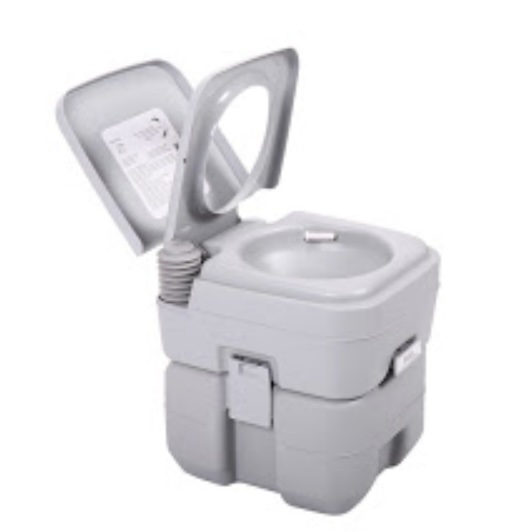
That’s where this story starts—with the item sealed tight. Show of hands: How many have ever serviced and used a porta-potty?

In the late ’80s when we lived in Arizona, we needed our summertime getaways from the oppressive heat. In a little more than two hours, we could leave our home at 1,500 feet elevation and set up camp at 7,500 feet in the tall pines, enjoying a much cooler temperature.

Many times for us, it was the Mogollon Rim, a spectacular place with rustic camping everywhere and incredible views down into the lower valley.

In preparation for our forays into the forest, we gathered up everything that would fit into the car and the Coleman pop-up tent trailer, including the previously mentioned potty. The potty required servicing with water and chemicals before being used, so of course, that was accomplished during trip preparation, too. And… the unit was then completely sealed up.

Upon reaching our campsite, the trailer was set up, the campfire lit, food prepared and a few adult beverages were consumed. As I recall, this was a Boy’s Campout, so the womenfolk were spared the comedy of this next event.

Yours truly was the first to admit the need to answer nature’s call. When I was finished, the potty needed to be “flushed,” which occurs by turning a valve handle on the front that allows the contents to flush into the holding tank.

Can you say “sh*t-faced,” boys and girls? Imagine my surprise when the waste headed in the opposite direction I expected it to, instead of down the drain hole!

Remember our discussion of pressure differentials? Serviced at 1,500 feet (read “high” pressure), and operated at 7,500 feet (read “low” pressure), caused the contents to be blasted upwards instead of being flushed down into the drain!

After cleaning up and joining my fellow campers, the story took on an indelible status, never to be forgotten. Needless to say, more beers were then consumed in front of our bonfire, which I’m pretty sure was large enough to have been seen from space!

I now consider myself to have acquired a PhD in pressure dynamics as it relates to porta-potties. This may also be applicable to RV toilet setups; however, the black tanks may act as a buffer. I don’t know for sure because we haven’t challenged that theory by camping with our 25-foot trailer in varying altitudes yet. Feel free to comment if you can verify this theory with your own experiences.

YOU MIGHT ALSO ENJOY:

##RVT1199

What are RV ‘4 corner weights’ and why are they important?

The idea of “4 corner weight” is usually talking about Class A and C motorhomes longer than 27 feet. The data shows that probably more than half of those larger units can be significantly (1,000 lbs. or more) unbalanced side to side on an axle.

Smaller RVs can probably get away with just learning the weight on each axle with the RV and tow vehicle loaded to its heaviest and hooked up ready to travel; then calculating 51% or 52% for each axle; and then using that calculated weight number to confirm you are not exceeding the load capacity of the tires.

Heaviest tire weight

For towables, including fifth wheels, your calculated heaviest tire weight should be no more than 90% of the tire capacity when inflated per the Load & Inflation tables. I covered the technical reason for this 90% limit in my blog posts on Interply Shear. Please note the RV Industry Association (RVIA) (see that Gold sticker near the door on the RV) has a requirement that tire capacity should be equal to 110% of GAWR (Gross Axle Weight Rating).

The max load capacity for a tire is the load in pounds shown on the tire. The only time it has that capacity is when it is inflated to the PSI number that is also on the tire sidewall. This post on my blog should clear up the confusion on “Max PSI”

Your dry weight is not important when we are talking about tire loading. The GAWR is just a number for all the tires on any one axle. The tire on the passenger side has no idea what the load on the driver side is, so you can’t average the axle weight to learn the max weight on the heavier loaded tire.

“Dual” loading

“Dual” loading is when two tires are mounted side by side on one end of an axle. We see those on the rear of most Class A and C motorhomes. They are also on “dually” pickup trucks like an F450. Dual does not apply to RV trailers. LT (light truck) tires do have different load capacities if mounted on the front (single) or mounted on the rear (dual).

You do not need both freshwater and holding tanks full. Think of your loading when you start a trip. Fresh water is normally full, so is propane, gas or diesel and food pantry, but holding tanks are empty. Don’t forget your tool box. That would be what I would call “heaviest expected weight”.

This is when you get on a truck scale and get readings with just one axle on a scale pad. You may need a couple of readings depending on pad spacing and your axle locations. Get both trailer and truck weights, as you should also confirm you are not overloading your tow vehicle tires, either.

Example:

Suppose you have tires that say 3,900# @ 80 PSI. Your GAWR on the certification label is 7,000#. RVIA requires the tires have a capacity of 110% of the 7,000# or 7,700# total, or 3,850# each, so you might think you are OK. But if your RV axle is “out of balance” side to side by 1%, or 3,885# on the heavy end, you would have a tire in overload. Not a great deal but it is in overload even assuming the scale is accurate +/- 1% and you have a 100% accurate pressure gauge. What if your axle is unbalanced by 200# or 300#? Tow vehicles are normally more balanced, so just take the axle load and divide by the number of tires on that axle.

BUT the RVIA 110% requirement went into effect in November 2018. There are many RVs out there that only require that tires be capable of supporting 100% of GAWR, so that 10% “cushion” is gone.

110% load capacity recommended

I strongly support the RVIA’s 110% load capacity. In fact, my Interply Shear data suggests that something closer to 125% would be desirable. But many of the RV companies simply have not designed their vehicles with large enough wheel wells to allow that large of a tire even if the cost penalty was less than $200 an RV.

Bottom line: You do not need to learn the individual loads on each tire position. BUT I do suggest you assume at least a 4% out-of-balance and apply that to the weight reading you can get at truck scales. (Just be sure to pay attention to where each axle is on which scale pad.)

Note: All mentions of PSI is when the tire is “Cold”.

Roger Marble

*****

If you have tire questions, check out Roger’s Blog as well as his posts on RVtravel.com. There are hundreds of posts covering everything to do with tires.

If you still have a question for Roger after searching the above posts, send your inquiries to him using the form below.

Name
Drag & Drop Files, Choose Files to Upload

More articles you might really like

##RVT1199

What do snowbirds do when they can’t flee south?

4

By Rod Andrew
As I write, I’m a snowbound snowbird, sitting at my dining room table, looking over a frozen river at a snow-covered hillside.

The view could be a Christmas card scene and, until New Year, we enjoy it.

But it is cold and we prefer warmth.

Normally, in about a week, my wife and I would start packing our trailer for our annual trek down to Southern California, but this year, we’ve reluctantly decided, once again, to stay put.

What do snowbirds do when they can’t flee south?

Since I don’t skate and my knees don’t like skiing anymore, my appreciation of winter is mostly aesthetic. Snow really is beautiful, but it can limit one, especially when it is accompanied by extreme cold.

Here‘s an account of a few days in the frozen north, specifically the interior of British Columbia.

We’ve had an extended cold spell, with temperatures sinking to minus 20F in our area. Minus anything is cold. We’ve also had snow, so instead of biking and hiking in the desert, we get our exercise shoveling.

We have a cabin about 2,500 feet higher than our house, which we will spend time in when it’s a little warmer. Of course, it’s even colder up there. The cabin is not heated, with the exception of a room underneath, which protects our pump and water system. In case of a power outage freezing the pump house, we have a monitor that sends us the pump house temperature by Wi-Fi. If the electricity goes out, we will also know, as the monitor will go offline.

Something’s not right…

One day soon after Christmas, the monitor began to indicate that something was not right. When it showed a temperature of 40F, I realized that the heater we had used for years was no longer adequate. We headed up the mountain. Water starts to expand as it begins to freeze and pumps don’t like that.

When we reached our cabin, we realized that we would not be able to make it up the driveway, as the snow was too deep, so we parked on the plowed access road and walked up to our gate. This is secured by a chain and combination lock. The lock was frozen. Back to the truck to get a couple of butane firelighters, which we carried for this eventuality.

Neither lighter would work. Probably too cold.

The gate is a typical aluminum farm gate, so we tried sliding between the horizontal rails. No luck. We’re both a little too chubby. Even if we stripped and oiled our bodies we wouldn’t slip through. Plan B was climbing over, but our snow boots and the slippery gate made that very risky.

Plan C. I took off my gloves and cupped the lock in my hands. Then I blew a series of blasts of my fetid morning breath over the lock. In just a couple of minutes, it was unfrozen. My bad breath was a superpower!

Now, anyone who has lived in frozen climes knows that this procedure was not without risks. If my damp lips had contacted the padlock, the two would have been welded together. I had seen “A Christmas Story”, so I was very careful.

The cabin looked inviting, but we were there to work

We trudged down the hill and made our way into the pump house, where 37F felt positively balmy. The problem was the heater, which was quickly replaced. We waited until the temperature was 50F, then headed back to the truck, leaving the padlock attached, but not closed. I can learn.

As we walked back to the truck, I began to take a few winter photos.

My iPhone went blank. My wife took hers out and after a couple of minutes, hers also closed down. We suspect that the air was too cold for them to function. Attention NASA: They’d be useless on Mars.

That night, the monitor went offline. By morning, it was still off. I checked online for power outages, as snow-laden trees frequently fall on power lines, but there were no outages in our area. I had one other avenue to explore: I would contact the cabin Wi-Fi provider, an enormously large company, and see if the Wi-Fi could be checked.

It is NOT this cold in Guatemala

After being transferred several times by a realistic-sounding Robo voice, then listening to music, none of which appealed to me, I finally reached a human being. We went through the process to establish that she could give me information and advice, then I began to explain the issue.

I told her that last night we had temperatures of minus 30 Celsius at the cabin, which was not my current location. She didn’t make any comments, so I thought she was gone.

“Are you there?”

“Yes. Minus 30?“

“Yes. That’s right.”

Silence.

Then I realized what might be happening. “Where are you working from?”

“I am working in Guatemala.”

Okay, we might have had a communication problem, but once I explained that I had to drive a fair way on icy roads to get to the cabin, and what would happen if my pump froze, she was really helpful. It took about 15 minutes for her to find her way to the input to my cabin, but she eventually was able to assure me that the service was up and still operating.

“Now I can reboot your router, but you need to be there to watch.”

Run, Rod, run!

I have to tell you that I was impressed. This young techie, working in Guatemala, was going to reboot my router in B.C. Wow! I gave her the cabin number and my cell phone number and arranged to be phoned in 90 minutes, at the cabin.

I made it with 10 minutes to spare. As you may remember, I had not locked the gate padlock, so getting in was easy. I checked the router and the modem in the cabin and both were working. I couldn’t check the TV, because it was in the pump house, as extreme cold can be hard on LEDs. Then down to the pump house.

The temperature in there, on my wall thermometer was 68F. Great. The heater was doing its job, but I still hadn’t received an update from my monitor, which was now in front of me. I’m no techie, but I know one technique: Unplug, wait, plug back in.

A miracle. I was back online! Problem solved.

Then, I waited. After an hour, I gave up on my promised return phone call and headed back home. I did, finally, receive a call, which went to voicemail. I was driving. No message was left.

I would prefer to be somewhere warmer, but I’m finding life here full of surprises, so I’m not bored. Every day I check the pump house temperature on my iPhone several times.

I watch the icicles grow outside my kitchen window.

I’m also cultivating my morning breath superpower.

I wonder what my name would be if I joined the pantheon of Marvel superheroes.

Perhaps “Hotlips.”

MORE YOU’LL ENJOY BY ROD:

##RVT1199

How to find the perfect dog-friendly RV park

When Ron RVed with his dear wife, Lois, he was never lonely. “We made a good team,” Ron recently confided to me.

Ron will continue RVing even though Lois passed away last year. However, he recently adopted a dog. “I’ve never RVed with a dog before—or any pet for that matter. How can I find a good RV park? One that’s good for me and my dog?'”

I was happy to share a few tips for choosing the perfect park with our friend Ron. Here are key factors to keep in mind when choosing a pet-friendly RV park:

Proximity to pet supply stores

Having a pet supply store nearby is invaluable for restocking essentials like food, treats, toys, and other necessities. Before settling on an RV park, check the vicinity for reputable pet stores to ensure you have easy access to supplies during your stay. This is especially true if you plan an extended stay at one campground, like Ron.

Access to quality veterinary care

In case of emergencies or routine checkups, it’s crucial to know the location of the nearest veterinary clinic. Research veterinary services close to the campground to ensure prompt medical attention is available, if needed.

Here’s how to find a vet while on the road.

Availability of dog boarding facilities

If you plan to explore attractions where pets aren’t permitted, nearby dog boarding options can be a lifesaver. Look for RV parks that are in proximity to reputable boarding facilities, allowing you peace of mind while you’re away.

On-site or nearby off-leash areas

A designated off-leash area, such as a fenced dog park, allows your dog to exercise and socialize freely. Many RV parks now offer on-site dog parks with amenities like agility equipment and bathing stations.

Pet policies regarding size and breed restrictions

RV parks often have specific pet policies, including restrictions on the number of pets, their size, or certain breeds. It’s essential to review these policies in advance to ensure your dog is welcome.

Leash and supervision requirements

Most RV parks require dogs to be leashed when outside the RV and may have rules regarding unattended pets. Familiarize yourself with these regulations to ensure compliance and maintain a harmonious environment for all guests. Typically, leashes are limited to a maximum length, often around 6 feet.

Availability of pet waste stations

Convenient access to pet waste stations equipped with bags and disposal bins encourages responsible pet ownership and helps keep the campground clean. Many pet-friendly campgrounds provide these stations throughout their facilities.

Nearby pet-friendly activities

Consider the availability of pet-friendly hiking trails, swimming areas, or other recreational activities that you and your dog can enjoy together. Some campgrounds are located near such amenities, enhancing your overall experience.

Noise and behavior policies

Be aware of the park’s policies regarding pet noise and behavior. Continuous barking or aggressive behavior may not be tolerated and could result in being asked to leave the park. Ensuring your dog is well-behaved and adheres to park rules is crucial for a pleasant stay.

By considering these factors, you can select an RV park that caters to the needs of both you and your furry friend, ensuring a memorable and enjoyable adventure on the road. Safe travels everyone! (You, too, Ron.)

RELATED

More articles you might really like

##RVT1199

Billy and Milly, a love story, part two

3

Here’s Part Two of the story of Billy and Milly.
Read part one here, then come back.

As the sun dipped below the horizon, casting long shadows over the RV park, Billy and Milly’s conversation grew deeper. Milly learned about Billy’s early years, his dreams of being a famous comedian, and the challenges he faced along the way. Billy discovered that Milly was an artist who traveled to find inspiration for her paintings.

The night grew darker, and the stars began to twinkle above. Billy, feeling more comfortable, decided to share a bit more about his beloved but battered Tioga motorhome. “You know, Milly, this old girl has been with me through thick and thin. She’s not much to look at, but she’s home.”

Milly smiled warmly. “I think she’s charming in her own way. There’s something special about a place that’s been loved and lived in.”

Billy’s heart swelled. He felt a connection with Milly that he hadn’t felt in a long time. For once, it seemed like someone saw beyond his jokes and recognized the person he truly was.

The evening turned into night, and the two continued to share stories. Billy even found himself laughing at some of Milly’s humorous anecdotes about her art adventures. It was refreshing for him to be on the receiving end of the jokes for a change.

Finally, as the hour grew late, Milly yawned and stretched. “I should probably get some rest. It’s been a long day, but I’m really glad we had this chance to talk, Billy.”

Billy nodded, a bit reluctant to see the conversation end. “Me too, Milly. It was nice to talk without relying on my old routine.”

Milly chuckled softly. “Maybe there’s more to you than just jokes, Billy Bob Bodine.”

As Milly walked back to her RV, Billy felt a sense of contentment he hadn’t experienced in years. He watched her until she disappeared inside, then turned back to his own motorhome. The words “Wandering Jokester” still loomed above the cab, but they didn’t seem as daunting anymore.

The next day, Billy woke up with a renewed sense of purpose. He decided to make some improvements to his motorhome. He started by cleaning up the interior, fixing what he could, and even patching up some of the water-damaged floor. It wasn’t perfect, but it was a start.

Over the next few days, Billy and Milly spent more time together. They shared meals, explored the nearby town, and continued to exchange stories. Milly even convinced Billy to try his hand at painting, much to his surprise and amusement.

One evening, as they were sitting by a campfire, Milly brought out a small canvas and some paints. “Here, Billy. Give it a try. You might find it relaxing.”

Billy hesitated but then decided to give it a shot. He dipped the brush into the paint and started to make broad, unsure strokes on the canvas. As he painted, he found himself relaxing and enjoying the process.

Milly watched him with a smile. “See? You’re a natural.”

Billy laughed. “I wouldn’t go that far, but it is kinda fun.”

As the weeks went by, Billy and Milly’s bond grew stronger. They became a fixture at the RV park, known for their lively conversations and shared laughter. The other residents often joined in, enjoying the newfound sense of community.

One day, as they were sitting together, Milly turned to Billy with a thoughtful expression. “You know, Billy, I’ve been thinking. Maybe we could combine our talents. You with your jokes and me with my art. We could put on little shows and exhibitions at different RV parks. What do you think?”

Billy’s eyes lit up. “Milly, that sounds like a fantastic idea! We could bring joy and laughter to people all over.”

And so, the Wandering Jokester found a new purpose. Billy and Milly became a team, traveling from park to park, sharing their unique blend of humor and art. Billy’s jokes found a new audience, and Milly’s paintings brought beauty to their travels.

As they journeyed together, Billy realized that he had finally found what he had been searching for all along. Not just love, but a true companion who appreciated him for who he was, corny jokes and all. The old Tioga motorhome, once a symbol of his solitary wandering, now represented a shared adventure and a new beginning.

Billy Bob Bodine was no longer just a wandering jokester. He was a man in love, with a heart full of joy and a future full of promise. And every time he looked at Milly, he knew that he had finally found his punchline.

Again, RVtravel.com readers, every single word here was written by A.I. Not a single word, sentence or paragraph was altered.

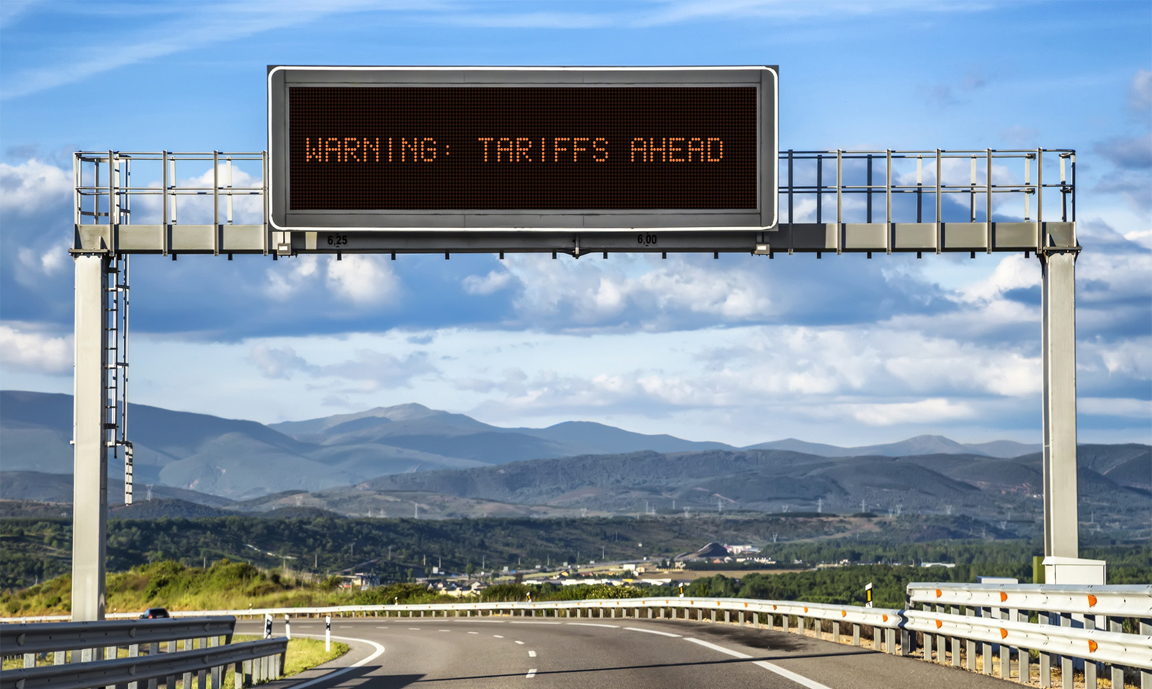
Dear RVer: Brace yourself – Tariffs may hit your wallet harder than expected

It’s been a hectic week for news outlets. The on again/off again situation regarding import tariffs on products from Mexico and Canada has left reporters—including us—dizzy. While some tariffs are on hold, others are still in place. And if those presently on hold actually go into place, just how will RVers be affected? It’s a good time to look closely, as your wallet may be in danger. Tariffs and RVers—It may be time to take what action you can to save money.

RVers have particular areas of concern. As travelers, we need fuel. As RV owners, we know that repairs (and parts for them) are inevitable. And wherever we go, “we gotta eat.” Today we’ll talk about these three main concerns.

Tariffs and RVers—Hitting you at the fuel pump

Tariffs and RVersWhile the U.S. does produce a huge amount of vehicle fuel, oil imports are very much on the table. In the north, Canadian oil imports have a direct bearing on fuel prices, particularly in New England. You might think that the “push off” of tariffs on Canadian products for a month (according to the most recent White House announcement) should stave off price increases. But it isn’t necessarily so.


As of Friday, March 7, 2025, the United States had imposed a 10% tariff on Canadian energy products, including oil, that do not comply with the U.S.–Mexico–Canada Agreement (USMCA) rules of origin. This tariff was announced on January 31, 2025, alongside a 25% tariff on non–USMCA–compliant goods from Canada and Mexico. Only oil imports that meet those USMCA standards are able to duck the 10% tariff. So does oil from Canada go tariff-free, or not?

It’s not an easy question. While 38% of Canadian exports were still duty-free on March 7, oil may not be part of that. One source tells us that specific data detailing the percentage of Canadian oil exports that meet USMCA rules of origin is not readily available. The rules of origin are intricate, and businesses often face challenges in determining compliance, leading some to opt for paying tariffs rather than navigating the complexities of compliance.

Putting it in perspective, as of last Tuesday, a major New England oil refiner, Irving Oil, jacked up its wholesale diesel prices by 20 cents a gallon. That ran contrary to the rest of the market, which was actually down, according to Patrick De Haan, the head of petroleum analysis at retail fuel price cruncher company GasBuddy.

Fuel price jumps—Not just for the Northeast

So that’s New England. Will tariffs affect pump prices elsewhere in the country? If your travels take you through the Upper Midwest, you can expect to see higher pump prices. Canada sources 100% of all fuel imported to the region. The fact that Midwest pump prices haven’t jumped already is not an indicator that change isn’t coming.

GasBuddy’s De Haan thinks it will take time for tariffs to show up in wholesale or refined prices. “It will take a couple of weeks to get to refiners to be processed,” he said. “So I would expect a vastly different impact and speed than the Northeast, where you’re talking about tariffs on refined products, which is very much a just-in-time product.” His analysis was covered in a Yahoo News report.

And what about south-of-the-border oil? Mexico pushed 517,000 barrels of oil per day into the U.S. last December. To avoid the tariffs, Mexican oil companies, which ship their oil in by water, can simply send it somewhere other than the U.S. to avoid the tariffs. That in itself will reduce the supply of oil to the U.S., and the result could mean increased domestic prices. Just how much remains to be seen. And while we’ve commented on diesel specifically, gasoline—based on oil—will likely see similar changes.

RV running gear—Higher prices are likely

Tariffs and RVersFixing and maintaining your RV can take a huge bite out of your budget. While tariffs don’t apply to labor, shop owners will likely pass on the increased costs they pay for tariffed items to customers. Many RVers try to avoid labor costs by doing as much as they can on their own.

But RV parts aren’t something we can avoid buying. Tariffs and RVers are real. With tariffs already in place on Chinese imports, the impact could be hefty. Specific data on the percentage of RV parts imported from China isn’t readily available. However, China plays a significant role in the global automotive parts market. The country supplies a wide range of components used in both original equipment manufacturer (OEM) and aftermarket applications. In 2018, China was a major exporter of motor vehicle parts and accessories, with the U.S. as one of its largest customers, says statista.com, one of the world’s largest statistics providers.

That alone could have a big impact on motorhome owners. If the running gear portion of your rig needs help, look to see part prices head up. But what about the coach section of your rig? Say your water pump needs replacing? One of the most popular brands is Shurflo. Produced in Mexico. How about competitor SEAFLO? Imported from China. And Flojet? Again, a Mexican product. Of the top manufacturers, only Remco claims to be made in the USA.

Other RV parts and accessories—Tariffs could sneak up on you

As to other RV parts? It’s often hard to tell just where a given product comes from. Of course, it may be “Made in the USA,” but at the same time contain parts from countries on the tariffs list. We can’t track down the exact origin of Norcold’s electric compressor refrigerators, but users report at least their compressors come from China. Tariffs will apply to parts used in U.S.-built RV equipment; whether the manufacturer “eats” the tariff is up to them.

For RVers who want to get away from RV parks and electrical hookups, one thing is sure. Look to see higher prices in solar panels and lithium batteries. China is the principal source of solar panels. To try and shift tariff issues, many panels are now being manufactured in non-tariff countries, like Vietnam. But like other RV products, if a Vietnamese manufacturer uses Chinese-produced “ingredients,” like semiconductors, the tariff on those components sticks.

Tariffs and RVersLithium iron phosphate (LiFePO₄) batteries are increasingly popular among RVers due to their cost-effectiveness and safety advantages. However, the majority of these batteries and their components are currently produced in China. There will be a definite price jump in Chinese batteries. Tariffs and RVers mix when it comes to battery power.

Tariffs on your plate—On the road or not

Finally, wherever we are, RVing or not, “we gotta eat.” The impact of tariffs on what you eat could be big. Here’s a list of many of the foods (and beverages) imported into the U.S. that will be affected by tariffs.

Food tariffs that could hit your wallet

  • Avocados: Mexico is the dominant supplier, providing approximately 80% of all U.S. avocado shipments and 90% of imported avocados over the past five years.
  • Strawberries: 85% of U.S. strawberries sold are imported from Mexico.
  • Bell peppers: 76% of U.S.-sold bell peppers are grown in Mexico.
  • Nuts: In 2023, the U.S. imported approximately $869 million worth of “Other Nuts,” with Mexico accounting for about 70% of these imports, totaling $610 million. One source says pistachios, walnuts, and peanuts will see price increases.
  • Beer: Mexico-brewed Modelo is the top-selling beer brand in the U.S.
  • Cooking oil: Canada is a major supplier of cooking oils to the U.S. In 2022, Canadian exports of cooking oils to the U.S. were valued at approximately $4.2 billion (U.S.), representing 81.5% of Canada’s cooking oil exports.
  • Seafood: The U.S. imported more than 79% of its seafood in 2020. Canada provides large amounts of seafood, from cod, to tuna, to snow crab.
  • Maple syrup: Canada produces 71% of the world’s pure maple syrup. In 2023, the U.S. imported approximately $279 million (about 88.8 million pounds) of maple sugar and maple syrup, with Canada accounting for the vast majority of these imports.
  • Dairy: Harder to pin down, the exact percentage of U.S. dairy consumption supplied by Canadian imports varies across different product categories. In 2023, the trade value of dairy and egg products exported from Canada to the U.S. amounted to approximately $278.11 million.
  • Beef: In 2023, Canada’s beef exports to the U.S. were valued at approximately $2.2 billion. That amounted to 75% of Canada’s beef exports. For perspective, in 2024, U.S. consumers chowed down on $30 billion+ of fresh beef.

Tariffs and RVers—What can you do to protect yourself?

Tariffs and RVers
401(K) 2013 on flickr.com

While you can only stock up on so much food, if the tariffs look like they might affect your favorite eats, add 25%. Adjust your budget to see how much the overall impact might be. If it’s just a small increase, that’s one thing. If it’s more, you might need to find other areas of your budget to trim to account for the increased expenses. And if you eat out while traveling, check for restaurants raising their prices—and they might not limit those increases to just the menu items affected by tariffs.

As to fuel to roll your RV down the highway? If you’re not already taking advantage of fuel discount programs, it might be a good time to look into them. Tariffs and RVers: When traveling, use apps like GasBuddy to spy out the best prices along your route. If you “burn diesel” here’s a program we use that’s saved us BIG money. For some, the tariffs might create mapping changes—avoiding areas where fuel prices are just too much.

And your view?

What do you think? We’d like to hear from you about your views on the tariffs that are said to be coming—and in some cases have already come. We know this is a sensitive subject, but we’d like to know what our readers think. Please keep your comments civil, and treat the other guys’ views with kindness. But let us know in the comments section below.

RELATED

##RVT1199b

Are motorhomes headed to extinction? Your thoughts wanted

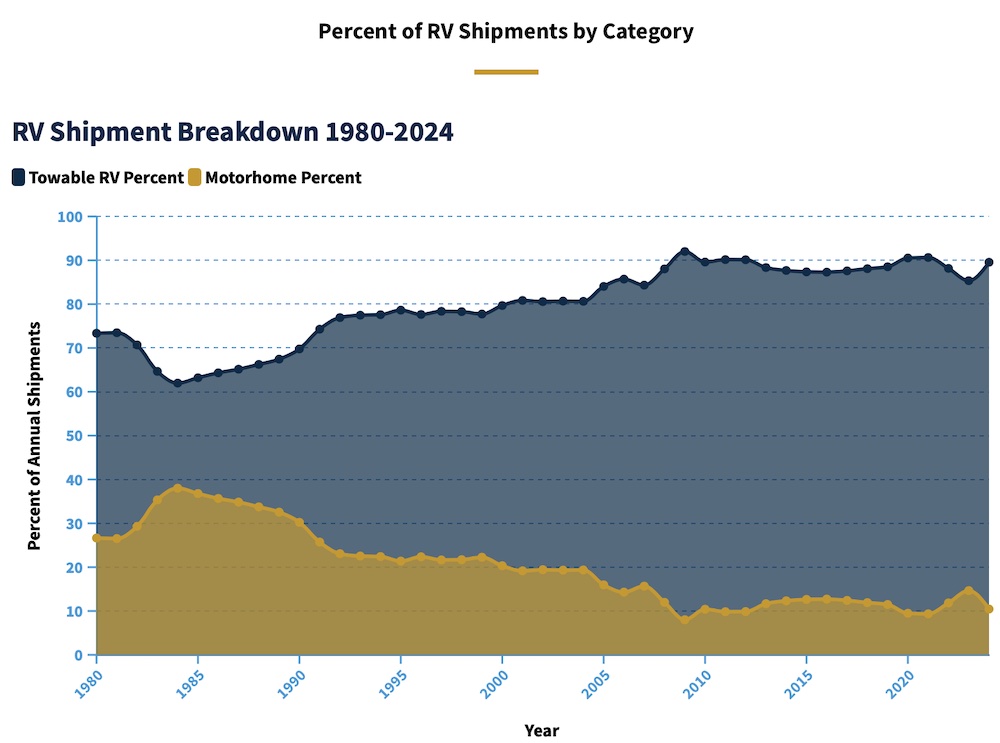
Like our headline suggests, the sale of motorhomes is declining. Shipments from manufacturers, with rare exceptions, have dropped annually for the past 4 decades in percentage of total RVs shipped. What happened? RVtravel.com would like your thoughts about this. Please leave them in the comments below or if too long to fit there then email them to editor@rvtravel.com.

The chart above from the RVIA tells the tale. In 2024, only about 10 percent of all RVs shipped to dealers were motorhomes. Go back 40 years to 1984, and 38 percent were motorhomes — nearly four out of ten. What a difference!

In January 2025, a total of 27,629 RVs of all types were shipped by U.S. dealers. Of those, only 2,723 were motorhomes. That’s a mere 88 motorhomes per day, less than 2 per state per day on average.

Our editors have their thoughts about reasons for the decline, but we thought we’d ask you what you think. So, have motorhomes had their day? Or do you think they will make a comeback? Please let us know. We’ll use some of your comments in an upcoming article.

Oh, before you leave, please take a moment to respond to the poll below:

More articles you might really like

• Buying an RV: What is the markup on an RV? What should you offer the dealer?
• 6-volt or 12-volt batteries for RVs: Which is better?
• Ex-RV salesman offers shopping tips for new rig
• RVelectricity: Does your RV use 120 or 240 volts?
• What is the best house battery for your RV?
• Everything you need to know about charging RV batteries

##RVT1199b