The Escapees RV Club is raising its dues from $39.95 a year to $49.95 a year beginning November 1.
“Since 1978 we have worked hard to be a total support network for RVers,” the club explained Wednesday to the media and members. “Escapees RV Club membership dues have remained at a very low $39.95 for many years. For us to continue to offer the quality of service that Escapees RV club is known for we need to make a small increase in the dues — our first since 2015 — from $39.95 to $49.95.
“This increase will help us ensure that we can continue to provide members with the service, benefits, advocacy, and community that they have come to expect from Escapees RV Club. In appreciation for the support RVers have shown to Escapees RV Club over the club’s 42 year history, current members as well as new members are welcome to lock in the current rate by renewing or signing up for 1-3 years at the current rate of $39.95 before the new rate takes effect November 1.
“We at Escapees RV Club appreciate your continued support through this time of growth and change. If you have any further questions or concerns regarding this price increase, please do not hesitate to reach out. Our team is more than happy to discuss this situation with you.”
The Ford Bronco Sport has a tough job. It needs to live up to its Bronco nameplate, and be the most off-road capable crossover in the segment. If the Sport can do that, it will surely inject some much-needed interest into the otherwise boring compact crossover class. But Motor1 has just uncovered a drawback to choosing the Sport over the regular Bronco, and it’s the inability to flat tow the vehicle. RV owners, we are sorry.
For those unfamiliar, flat towing is when you pull a vehicle behind another vehicle with all four wheels on the ground. If you’ve seen an RV pulling a Jeep on the highway, that’s flat towing. Many people love to tow their off-road vehicle behind an RV, so they can park the motorhome on the campsite and use the off-roader to venture further into the wilderness. Motor1 asked Ford if this is possible in the Bronco Sport, and they responded with a “no” in the following statement:
“We did not engineer Bronco Sport for flat towing, as our research shows relatively few customers plan to tow Bronco Sports versus Bronco owners. However, we are always listening to our customers and are open to their feedback on desired future capabilities.”
Forest River, Inc. (Forest River) is recalling certain 2018-2020 Coachmen Sportscoach and Forest River Legacy and 2018-2021 Berkshire motorhomes built on a Daimler Trucks (DTNA) chassis. The tire valve stem extension for the inner wheel may come in contact with the outer wheel rim opening and become damaged.
Extensive damage to the valve stem extension may result in a loss of tire pressure of the inner wheel, increasing the risk of a crash.
Remedy Forest River will notify owners, and DTNA will make repairs as necessary. The remedy for this recall is still under development. The recall is expected to begin October 28, 2020. Owners may contact Forest River customer service at 1-800-547-0712 or DTNA customer service at 1-800-547-0712. Forest River’s number for this recall is 51-1228. DTNA’s number for this recall is FL-861.
Owners may also contact the National Highway Traffic Safety Administration Vehicle Safety Hotline at 1-888-327-4236 (TTY 1-800-424-9153).
* * *
While you may not own one of these RVs, if you know someone who does be sure to tell them. RVtravel.com posts recall notices like this as they are issued. Read all recent ones by clicking here.
Not signed up for the free RVtravel.com weekend newsletters? Published online since 2001.Sign up here.
This newsletter is for intelligent, open-minded RVers. If you comment on an article, do it with respect for others. If not, you will be denied posting privileges.
Issue 1439
Welcome to another edition of RV Travel’s Daily Tips newsletter. Here you’ll find helpful RV-related and living tips from the pros, travel advice, a handy website of the day, tips on our favorite RVing-related products and, of course, a good laugh. Thanks for joining us. We appreciate you. Please tell your friends about us.
In case you missed this on Sunday…
Do we have a treat for you — a free copy of the 2021 RV Model Year Guide. If you’re in the market for a new RV or simply curious about the latest developments in recreational vehicles then this will provide good reading. The fact that it’s free, with no strings attached, makes it an especially outstanding (and rare) offer. Click here to learn more and begin reading this excellent resource.
[activecampaign form=34]
Today’s thought
“It is important from time to time to slow down, to go away by yourself, and simply be.” —Eileen Caddy
Need an excuse to celebrate? Today is National Chewing Gum Day! Scroll down to today’s trivia section to read an interesting fact about gum.
On this day in history: 1939 – NBC broadcasts the first televised American football game.
To help supplement heat from the RV furnace, we take a couple small thermostatically controlled electric heaters with us. Make sure you purchase heaters that pose no threat of a fire, and that will turn off automatically if they accidentally tip over. These small heaters work great and help save on LP gas when you are plugged into a 120-volt electrical source, or using a generator.
Caution: Never use the range top burners, the oven, or a portable fuel fired heater (propane, kerosene) inside the RV for heat. Carbon monoxide gas is colorless, tasteless, invisible and deadly. Any source of heat not vented outside is extremely dangerous and should never be used in an RV.
Full-time RVer Deanna Tolliver writes: “As a vertically challenged person (i.e., short), and the owner of a fifth wheel, it’s difficult for me to reach over the bed of the truck to either hitch up or unhitch. I’ve carried a step stool and I’ve also had small side steps attached to the side of the truck. But I’ve found another, better option: the HitchMate TireStep, by Heininger.” Learn more.
Quit struggling with hose and cable hookups at the campsite
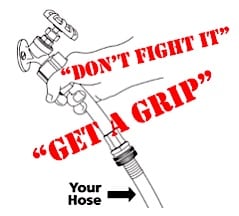
Are you tired of struggling to hook up your coax cables, water hoses and other connections when you arrive at your campsite? It’s a snap with Cable and Hose Grips from J Wright Concepts. Save time and frustration! Life is too short to hassle with the little stuff! Learn more or order.
If you are towing a trailer on icy roads, go slowly, especially downhill. Use the lower gears. You may be able to gain additional traction for the tow vehicle by moderately releasing the tension of the load equalizing hitch. Always readjust the hitch after the icy road condition has passed because vehicle stability may be affected during normal driving conditions. From California DMV
Website of the day
The most beautiful golf courses in the U.S.
This one is for the golfers out there. If you’re not already a golfer, you may become one after you see this list of beautiful courses. Wow!
SWELL CONTEST OF THE DAY
How would you like to win this Happy Camper Coffee Mug? Well, this might be your lucky day! In one of this past week’s Beginner’s Guide to RVing Newsletters, we published a secret phrase. Simply email the phrase to us at RVcontests@gmail.com . We’ll select a winner at random out of all entries we receive today (September 30, 2020) by 11 a.m. Pacific time. Remember, you can only enter once and after we notify you by email that you won, you have 24 hours to respond or we’ll give the prize to someone else.
Having trouble concentrating? Try chewing gum. A study in the British Journal of Psychology found that the subjects who chewed gum while taking part in a memory challenge were able to stay more focused for longer periods of time than those who did not chew gum.
*Ever wonder what the all-time best-selling item is at Walmart? We bet you can’t guess. We told you yesterday.
Readers’ Pet of the Day
“Sadie, our adventure pup! She loves looking out the window at other RVs and watching people set up. Because you never know, they might have a friend to play with…” —Debbie Jantz
Send us a photo of your pet with a short description. We publish one each weekday in RV Daily Tips and in our Saturday RV Travel newsletter.
3-in-1 NOAA radio, flashlight and charger must-have for RVers This emergency hand-crank radio is a necessity for RVers. Keep it somewhere safe, you never know when it will come in handy. The 3-in-1 radio is also a bright LED flashlight and a smartphone charger. The radio can be charged via solar charging, hand cranking or a USB plug. You’ll want to buy one here.
Leave here with a laugh
Over the last few years, people have been posting videos of their pets’ reactions when their owners disappear behind a blanket. Here’s a hilarious compilation of the best animal reactions. Click to play.
This newsletter is brought to you Monday through Friday by RVtravel.com and is funded primarily through voluntary subscription contributions from our readers. Thank you! IF YOU APPRECIATE THIS NEWSLETTER and others from RVtravel.com, will you please consider pledging your support? Learn more or contribute.
Publisher: Chuck Woodbury. Editor: Emily Woodbury. Senior editor: Diane McGovern. Social media and special projects director: Jessica Sarvis. Financial affairs director: Gail Meyring. IT wrangler: Kim Christiansen.
This website utilizes some advertising services. As an Amazon Associate, we earn from qualifying purchases. Regardless of this potential revenue, unless stated otherwise, we only recommend products or services we believe provide value to our readers.
Everything in this newsletter is true to the best of our knowledge. But we occasionally get something wrong. We’re just human! So don’t go spending $10,000 on something we said was good simply because we said so, or fixing something according to what we suggested (check with your own technician first). Maybe we made a mistake. Tips and/or comments in this newsletter are those of the authors and may not reflect the views of RVtravel.com or this newsletter.
Mail us at 9792 Edmonds Way, #265, Edmonds, WA 98020.
Do you put additives in your black water holding tank? Many RVers do, and many RVers don’t. Which side are you on?
In case you’re wondering why you’d put additives in your black tank (or, on the other hand, why you wouldn’t), check out all these articles we’ve published over the years about black tanks.
After you’re done checking out the articles above, vote in our poll below here and tell us if you do, or don’t, put additives in. If the poll takes a moment to load, please be patient. Thanks!
Forest River, Inc. (Forest River) is recalling 4,397 model year 2018-2021 Wildwood, Salem, and 2020 Sonoma travel trailers. The break-away safety switch may not be wired to constant power, which can cause the trailer brakes to not activate in the event of a trailer separation from the tow vehicle.
If the brakes of the trailer do not engage, it can result in a loss of vehicle control, increasing the risk of a crash.
Remedy Forest River will notify owners, and dealers will rewire the break-away switch, free of charge. The manufacturer has not yet provided a schedule for recall notification. Owners may contact Forest customer service at 1-909-873-3777. Forest River’s number for this recall is 67A-1230.
Owners may also contact the National Highway Traffic Safety Administration Vehicle Safety Hotline at 1-888-327-4236 (TTY 1-800-424-9153).
* * *
While you may not own one of these RVs, if you know someone who does be sure to tell them. RVtravel.com posts recall notices like this as they are issued. Read all recent ones by clicking here.
Not signed up for the free RVtravel.com weekend newsletters? Published online since 2001.Sign up here.
This newsletter is for intelligent, open-minded RVers. If you comment on an article, do it with respect for others. If not, you will be denied posting privileges.
Issue 1438
Welcome to another edition of RV Travel’s Daily Tips newsletter. Here you’ll find helpful RV-related and living tips from the pros, travel advice, a handy website of the day, tips on our favorite RVing-related products and, of course, a good laugh. Thanks for joining us. We appreciate you. Please tell your friends about us.
“It’s the beauty within us that makes it possible for us to recognize the beauty around us. The question is not what you look at but what you see.” —Henry David Thoreau
Need an excuse to celebrate? Today is National Coffee Day!
On this day in history: 1789 – The United States Department of War first establishes a regular army with a strength of several hundred men.
Tip of the Day
Where do you hitch your breakaway cable?
By Dave Helgeson Travel trailer owners have debated on where to attach the breakaway cable to the tow vehicle as long as they have debated on tow vehicles themselves. For starters, most everyone agrees that it should not be attached to any part of the hitch head itself. If the hitch head were to fail it would most likely stay coupled to the trailer, failing to activate the breakaway switch.
The second “no-no” is to weave the breakaway cable through one of the safety chains to keep it from dragging on the road. While this keeps things nice and tidy, the extra friction of the cable being woven through the safety chain may prevent the cable from pulling the pin from the breakaway switch in an emergency. Continue reading.
If you keep your eyes open as you drive around the USA, you’ll notice an automobile junkyard here and there. If you look closely, you’ll usually see a few junked RVs, too. But, wow! Wait until you watch this drone video from Arizona RV Salvage in Phoenix showing its massive RV junkyard! Watch this short video.
Do you plan to buy an RV in 2020 or 2021?
Think about it, then vote in our poll here.
Quick Tip
Fifth wheel hitching tip
Mike Feldman sends along this thought for fifth wheel owners: “I painted the edge of the hitch latch white when it was in the locked position. After hitching up, if I see the white paint I know it is latched correctly.” Thanks, Mike!
Website of the day
America’s coolest hotels
Feel like taking a break from the RV for a night? Here’s a list of America’s most unique hotels and, we gotta say, they’re pretty dang cool.
SECRET PHRASE: Ohio Was Not Officially Admitted as a State Until 1953
And the Survey Says…
We’ve polled RVtravel.com readers more than 1,500 times in recent years. Here are a few things we’ve learned about them:
• 24 percent have had a DNA test to learn something about their family history
• 69 percent said if they received the wrong change back from a clerk, they’d be honest and give it back or correct them (they wouldn’t keep it)
• 22 percent drink their coffee with milk/creamer and sugar
Ever wonder what the best-selling item is at Walmart? Bananas. Yup, it’s bananas all right!
*What has happened to the world’s population since 1965? We told you yesterday.
Readers’ Pet of the Day
“Chloe, our Tonkinese cutie, is a real pal. Wherever we are so is she. Many times she has come quietly to sit at my feet and is stepped on or kicked accidentally because I don’t know she is there. If I’m sitting down she is on my lap. Snoozing on my chest is where she spends much of the night. Chloe chases tin foil balls (but doesn’t bring them back as our first Tonk did), tosses a soft feather ball in the air, jumps into any open box, drawer or large enough bag and always greets guests. We are never lonely since she talks to us. Her blue eyes contrast with her silvery beige coat and charcoal points. A real prize.” —Sally Weigand
Send us a photo of your pet with a short description. We publish one each weekday in RV Daily Tips and in our Saturday RV Travel newsletter.
Leave here with a laugh
At what point can we just start using 2020 as a swear word? As in:
“That’s a load of 2020!”
“What in the 2020?”
“Absa-2020-lutely!”
This newsletter is brought to you Monday through Friday by RVtravel.com and is funded primarily through voluntary subscription contributions from our readers. Thank you! IF YOU APPRECIATE THIS NEWSLETTER and others from RVtravel.com, will you please consider pledging your support? Learn more or contribute.
Publisher: Chuck Woodbury. Editor: Emily Woodbury. Senior editor: Diane McGovern. Social media and special projects director: Jessica Sarvis. Financial affairs director: Gail Meyring. IT wrangler: Kim Christiansen.
This website utilizes some advertising services. As an Amazon Associate, we earn from qualifying purchases. Regardless of this potential revenue, unless stated otherwise, we only recommend products or services we believe provide value to our readers.
Everything in this newsletter is true to the best of our knowledge. But we occasionally get something wrong. We’re just human! So don’t go spending $10,000 on something we said was good simply because we said so, or fixing something according to what we suggested (check with your own technician first). Maybe we made a mistake. Tips and/or comments in this newsletter are those of the authors and may not reflect the views of RVtravel.com or this newsletter.
Mail us at 9792 Edmonds Way, #265, Edmonds, WA 98020.
Ah, the million-dollar question: Do you plan to buy an RV in 2020 or 2021? Perhaps you’ve already bought an RV this year, or perhaps you said “No more!” to RV travel, and sold yours.
If you are planning on buying an RV soon, a quick search on our website will give you tons of articles to read through before making the final offer. Check out those articles here, and make sure you’re prepared for what buying an RV really means.
Will you vote in our poll below and let us know? As always, feel free to leave a comment too with your thoughts. If you’re a Facebook user, join our Facebook group RV Advice. If you have any questions about the make/model/type, etc., of an RV, you’ll get your questions answered there by other RVers.
By Dave Helgeson (updated Nov. 4, 2020) Travel trailer owners have debated on where to attach the breakaway cable to the tow vehicle as long as they have debated on tow vehicles themselves. For starters, most everyone agrees that it should not be attached to any part of the hitch head itself. If the hitch head were to fail it would most likely stay coupled to the trailer, failing to activate the breakaway switch.
The second “no-no” is to weave the breakaway cable through one of the safety chains to keep it from dragging on the road. While this keeps things nice and tidy, the extra friction of the cable being woven through the safety chain may prevent the cable from pulling the pin from the breakaway switch in an emergency.
Finally, never use the same safety chain attachment item (S-hook, rapid link, etc.) to attach both your breakaway cable and safety chain to your tow vehicle. If the attachment item were to fail, you lose two safety backups (the chain and breakaway) at once.
My suggestion is to attach the breakaway cable to the tow vehicle itself separate from any part of the equalizing hitch or receiver. If the hitch and/or receiver were to fail, the breakaway cable would still be connected to the tow vehicle, in turn activating the breakaway switch – keeping a bad situation from becoming much worse.
Places to consider connecting your breakaway cable to the tow vehicle:
1. The rear bumper via a hole drilled in the lower edge of the bumper or an eye bolt bolted to the bumper.
2. The undercarriage via a hole in the frame, an eye bolt mounted to the frame or a loop of cable around the frame.
Additional tips:
When attaching your breakaway cable to the tow vehicle, prior to departure make it a habit of checking to make sure the hitch pin is in place. As we age we become more forgetful and this is one step we don’t want to miss. It also assures that no troublemakers have pulled the pin in hopes of viewing the resulting carnage.
Equalizing bar retainer pin
While we are on the subject of pins: Do your equalizing bars utilize pins to keep the bars attached to the hitch head? If so, when you are not towing, clip the pins to the snap-up brackets on the travel trailer rather than putting them back in the hitch head. Without the tension of the bars in place, the pins can bounce out of the hitch head while traveling and become lost. By leaving them attached to the trailer they will be right where you left them when you go to hitch up the next time.
This newsletter is for intelligent, open-minded RVers. If you comment on an article, do it with respect for others. If not, you will be denied posting privileges.
Issue 1437
Welcome to another edition of RV Travel’s Daily Tips newsletter. Here you’ll find helpful RV-related and living tips from the pros, travel advice, a handy website of the day, tips on our favorite RVing-related products and, of course, a good laugh. Thanks for joining us. We appreciate you. Please tell your friends about us.
“The time to relax is when you don’t have time for it.” —Sydney J. Harris
Need an excuse to celebrate? Today is National Good Neighbor Day!
On this day in history: 1928 – Alexander Fleming notices a bacteria-killing mold growing in his laboratory, discovering what later became known as penicillin.
Did you see the news?Click here to read the latest issue of the Sunday News for RVers.
Tip of the Day
Tips for Interstate highway RV driving
By Ray Burr, Love Your RV
The right lane is your friend. There are many advantages to staying in the far right lane: It’s where the slower traffic like your RV is expected to be; you can see better behind you using the driver’s side mirror; in an emergency the shoulder is right there for a pull-over. Here are several great tips to keep you safe on the Interstate. Maybe you’ll learn something new; otherwise, these will be good reminders.
RV Electricity – This week’s J.A.M. (Just Ask Mike) Session
Dogbone adapter confusion cleared up – Part 1
Dear Readers,
I’ve had several postings this week over on my RVelectricity Facebook group about dogbone adapters. No, these are not the bones that you actually feed your dog. But you’ll see below that they sort of resemble the cartoon version of a big juicy bone any cartoon dog would love.
In the RV world these are AC power adapters that allow you to plug your 50-amp shore power RV into a 30- or 15-amp pedestal outlet. Or you can go the other way ’round and plug your 30-amp shore power RV into a 50-amp pedestal outlet. Continue reading.
• Join Mike’s Facebook group, RV Electricity.
• Read more of Mike’s articles here.
RVer’s campsite railroad keeps passersby smiling
Jim Crowhurst’s garden railroad at the Thousand Trails preserve in La Conner, Washington, always puts a smile on the faces of other campers who pass by. Here’s a three-minute video tourof his layout, as told in Jim’s words.
Do you yearn to take a road trip on Route 66? Much of the historic highway is still there and can be driven with any size RV. If the Mother Road is on your bucket list, you might want to join our Facebook Group, RVing Route 66. You might also like RVing the Back Roads.
Merging onto a freeway or passing other vehicles with an RV
You will have slower acceleration when you enter a freeway, so you will need more space. Remember that freeway traffic has the right-of-way, so you must look for gaps large enough to accommodate your vehicle(s). You also need more space when passing other vehicles. Judging how much space you will need takes practice. If you don’t allow enough space and time to complete a pass, you may need to swerve quickly into another lane. This could result in a skidding, over-steering, swaying, or fishtailing trailer. —From California DMV
Website of the day
Hydration Calculator
Camelbak has put together this easy-to-use calculator to tell you how much water you should be drinking while active. The calculator uses your height, weight, age and gender to determine how much water you’ll need.
Popular articles you may have missed at RVtravel.com
The world’s population has more than doubled since John F. Kennedy was president. Back when he was president between 1961–1963, the world population was between 3 billion and 3.3 billion. As of May 2019, the world population was estimated to be 7.6 billion. That means the world’s population has more than doubled in about 60 years. The United Nations says that by 2050, the population will reach 9.8 billion.
Be like Mike: Don’t forget the fuse!
Mike Sokol says: Your RV has both 120-volt AC electrical systems (like your house), plus 12-volt DC battery systems (like your car). If the power goes out, it could be a circuit breaker (like in your house) or a blown fuse (like in your car). Always carry spare fuses that fit your RV’s battery system. Confirm the exact type and size of fuses your RV needs, then get a set of replacements. Here’s one pack, but be sure to check what your RV actually uses before ordering it.
Readers’ Pet of the Day
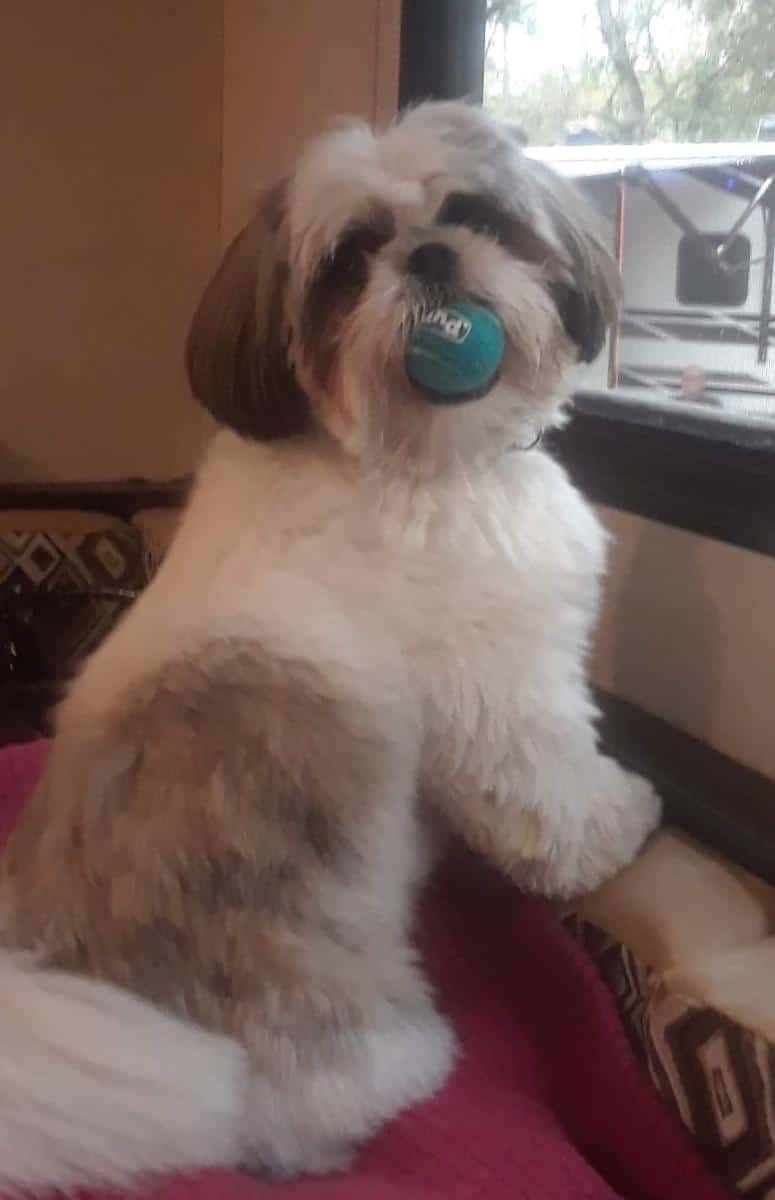
“Our 2 yr. old Shih Tzu on guard duty at the camper window with her favorite ball.” —Alan Householder
Send us a photo of your pet with a short description. We publish one each weekday in RV Daily Tips and in our Saturday RV Travel newsletter.
This newsletter is brought to you Monday through Friday by RVtravel.com and is funded primarily through voluntary subscription contributions from our readers. Thank you! IF YOU APPRECIATE THIS NEWSLETTER and others from RVtravel.com, will you please consider pledging your support? Learn more or contribute.
Publisher: Chuck Woodbury. Editor: Emily Woodbury. Senior editor: Diane McGovern. Social media and special projects director: Jessica Sarvis. Financial affairs director: Gail Meyring. IT wrangler: Kim Christiansen.
This website utilizes some advertising services. As an Amazon Associate, we earn from qualifying purchases. Regardless of this potential revenue, unless stated otherwise, we only recommend products or services we believe provide value to our readers.
Everything in this newsletter is true to the best of our knowledge. But we occasionally get something wrong. We’re just human! So don’t go spending $10,000 on something we said was good simply because we said so, or fixing something according to what we suggested (check with your own technician first). Maybe we made a mistake. Tips and/or comments in this newsletter are those of the authors and may not reflect the views of RVtravel.com or this newsletter.
Mail us at 9792 Edmonds Way, #265, Edmonds, WA 98020.
There’s a good chance the coronavirus pandemic has done one of two things for you regarding exercise. Either 1.) You’re in better shape than you were pre-pandemic because you’ve been walking or exercising often, or 2.) You’re in worse shape now because, well, everyone told you to stay inside!
Which is true for you? Or are you somewhere in between? In normal times, do you walk or jog on a regular basis for exercise? Do you exercise in any other forms? Or do you tend to not exercise at all?
Please tell us in the poll below. Leave a comment too if your exercise routine includes something other than walking or jogging. Maybe you’ll inspire others!
By Ray Burr, loveyourrv.com
The right lane is your friend. There are many advantages to staying in the far right lane: it’s where the slower traffic like your RV is expected to be; you can see better behind you using the driver’s side mirror; in an emergency the shoulder is right there for a pull-over.
Learn to anticipate: Driving a heavy rig is a disadvantage when braking and accelerating. Most other drivers are unaware of our limitations and will perform the most stupid maneuvers with blissful ignorance. RV drivers need to constantly anticipate the traffic all around to take action as soon as possible. Leave a fair distance in front of the rig for braking, but keep on the lookout for those who will use that space for a quick darting maneuver. Anticipate traffic slowdowns by keeping an eye out far ahead and watch for brake lights. If you see a bunch light up, expect to be needing to brake soon yourself.
Watch the truckers: Truckers often have some of the best and most experience on the Interstate. It’s handy in large cities to notice which lanes the bulk of the truck traffic is taking when navigating their way through. Having driven through many times, they usually know what is the best lane to be in to move through in the safest and most efficient manner. If you have a CB radio, listen to the truckers chatter and pick up information on the road ahead. If there is an accident or construction, they relay it back to other truckers on the CB channels.
Watch your rear: Take into account that there may be someone right behind you. With the length of your RV, the blind spot behind can be fairly large and it’s easy for a car to hide back there. Many RVs are equipped with rear cameras, which is great — but if you don’t have one, always remember that at anytime someone may dart out from behind you.
Make slow, deliberate movements: Have your turn signal on well in advance and move over slowly. This gives the other drivers a chance to correct themselves if they are darting out from behind you or coming upon you at a high rate of speed. Brake well in advance and slowly, giving tailgaters a chance to see you’re slowing down.
Plot your course, especially when navigating through large metropolitan areas. Know your turns, the exit numbers, and which lane is best to be in well before you get there. The worst thing to do is try and force yourself across several lanes of traffic to get to an exit. Have a look at the roadway from a satellite view. We are able to use our iPad to see a bird’s eye view of the highway and know ahead of time what the road pattern is for exits, and from that information we know the best lane to be in. This comes in real handy when there is a left-hand lane exit versus the standard right-hand variety.
Be well rested: Interstates are a demanding environment for RVers. You need to have all your wits about you and it takes sustained concentration to make your travels safe. It’s just not worth saving time if you’re starting to get tired. Take a break! It may save your or another’s life. Bad things always seem to happen when you’re tired and not paying full attention. This is why they have those things called Rest Stops.
Watch for debris: A common threat is pieces of tires from blowouts on the big rigs. Another is stuff like chairs and mattresses which have fallen off vehicles. This is another reason it pays to be always anticipating and scanning far ahead. It’s also another good reason to travel in the right lane next to the shoulder because then you have somewhere to go if you quickly need to avoid an object.
Avoid bad weather: Poor weather while traveling increases your risks dramatically. Why push through during a driving rainstorm, snow, ice or fog when you can pull over and wait it out? When something goes wrong on an Interstate during poor weather, it usually is bad.
Have a well-maintained rig: Rig failures on the Interstate have consequences that magnify. A blowout on a two-lane rural road is a lot less concerning than on a packed eight-lane Interstate. Anything you can do to decrease the likelihood of mechanical failure is worth it. Make sure your tires are in excellent shape and properly inflated and that the lug nuts are tight. Make sure your brakes are in perfect shape. It’s also extremely important that all signal and marker lights are functioning properly.
We use cookies to ensure that we give you the best experience on our website. By continuing to use our site, you consent to accepting cookies. We NEVER have or will sell reader's data. For more info, please see our privacy policy page.









 Learn to anticipate: Driving a heavy rig is a disadvantage when braking and accelerating. Most other drivers are unaware of our limitations and will perform the most stupid maneuvers with blissful ignorance. RV drivers need to constantly anticipate the traffic all around to take action as soon as possible. Leave a fair distance in front of the rig for braking, but keep on the lookout for those who will use that space for a quick darting maneuver. Anticipate traffic slowdowns by keeping an eye out far ahead and watch for brake lights. If you see a bunch light up, expect to be needing to brake soon yourself.