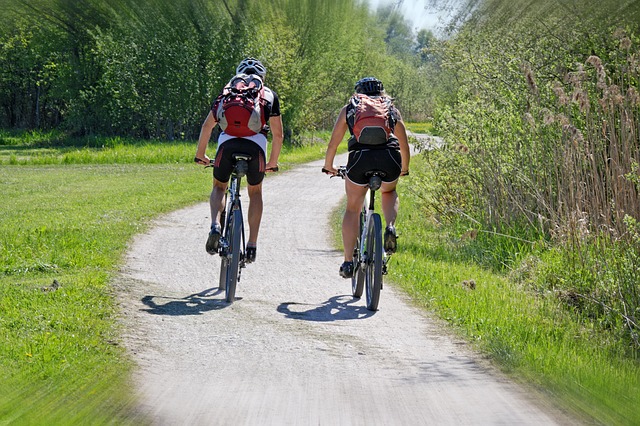
It was a RVing bicyclist’s dream: level terrain, clear skies with 73-degree weather, and little to no wind. Breathtaking scenery. Perfect! That is, until we happened to ride over a mass of goathead!
Read on and I’ll explain.
Goathead?
Also called devil’s thorn, cat’s head, and puncturevine, this weed is a menace! The goathead are hard, sharp seed pods that can painfully penetrate your pet’s paws, stick to clothing and, yes, even flatten bicycle tires!
What is it?
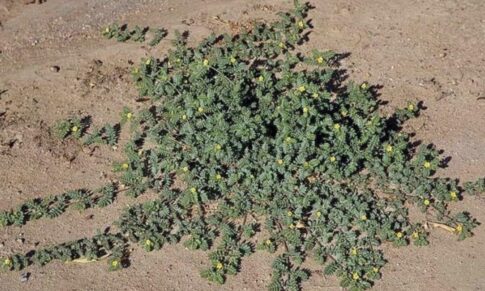
Tribulus terrestris is the scientific name for the goathead weed. It’s a low-growing invasive plant that thrives in dry, sandy, and/or disturbed soils. Its tough seed pods, called “goatheads” for their spiky appearance, readily attach to passing animals, vehicles, and human shoes and clothing. This helps to spread the menace far and wide.
Where does it grow?
Goatheads are found in many states, including California, Colorado, Montana, Idaho, New Mexico, Texas, Arizona, and Utah.
Be aware
If you enjoy biking during your RV travels, you should know about this weed and use caution. Here’s why the goathead weed matters:
• Pet and foot safety: The rigid seed pods can cause discomfort or minor injuries if stepped on—this applies to RVers as well as their pets.
• Widespread presence: Invasive species like goathead weed are quick to dominate open areas—from busy campgrounds to bike trails—making vigilance key wherever you travel.
Identifying goathead weed
Photo credit: Joseph M. DiTomaso, University of California Davis
Being able to spot goathead weed can help you take the necessary precautions and alert the campground manager. (Horticulturists recommend prompt treatment to eradicate the fast-spreading weed.) Here are some tips:
• Low-lying growth habit: This plant tends to spread along the ground, making it a common sight in campsites, parking areas, and along trails.
• Spiky seed pods: The most telling feature is the weed’s distinctive, jagged seed pods that resemble miniature “goat heads.”
• Rapid spread: Once established, goathead weeds can quickly take over open spaces, meaning routine checks are essential.
Management and prevention
Dealing with goathead weed is easier when you know what to do. Here are some strategies for preventing this menace from interfering with your travels:
• Regular site inspections: Whether you’re parking your RV or taking your bike out for a spin, a quick look around your setup can help you spot goathead weeds. Avoid these areas, especially when walking your dog or bicycling.
• Clean as you go: After driving or riding through open areas, give your clothing, bike, and any pets a quick check to remove any attached seed pods.
• Tell campground managers: Alert local management if you notice goathead weed infestations so that they can immediately address the problem.
I’d never heard of goathead weed until experiencing punctured bicycle tires. I know about them now—and I’ll likely never forget! How about you?
You can enjoy this penne with roasted asparagus as a side dish or spring dinner. Besides sprinkling with pine nuts or almonds, you could also add grilled chicken. Roasting the asparagus brings out its savory flavor and helps to keep it still slightly crunchy. The roasted asparagus and penne pasta is tossed in lemon juice, chicken stock, and Parmesan cheese to create a lovely light sauce. Simple and delicious. Click here for the recipe.
Asparagus Casserole
by Erin Kirkland from Topeka, KS
Creamy and full of textures, this asparagus casserole recipe is a great way to jazz up canned asparagus. Thick and rich, the homemade cream sauce holds the casserole together. Chopped hard-boiled eggs aren’t an expected ingredient, but they work nicely and add another layer of texture to the casserole. You can’t go wrong with a layer of melted cheese on top! Easy enough to have every day but fancy enough to make for a holiday side dish. Here’s the recipe.
Roasted Asparagus With Tomatoes and Gorgonzola
by Marjorie Koslow from North Wales, PA
Love asparagus and feeling adventurous? Give this roasted asparagus recipe a try. Gorgonzola cheese tastes similar to blue cheese. The tomatoes are sweet and that’s a nice contrast to the tangy cheese. Roasted perfectly, the asparagus is tender with a slight crunch. It’s very easy to prepare and would be delicious alongside steak or chicken. Get the recipe here.
Asparagus & Mushroom Chicken
by Shawn Lansing from Nolanville, TX
A quick and easy chicken recipe for when you’re looking to lighten up dinner. We love mushrooms and asparagus together. Combined with sliced chicken breasts, it reminds us of stir-fry and tastes like spring. With hints of garlic and lemon, we enjoyed this dish. Depending on how you serve it, this can be a low-carb meal. If you’re not watching carbs, it would be delicious served over rice. Click here for the recipe.
Crispy Garlic Parmesan Asparagus Pillows
by Lisa ‘Gayle’ Goff from Chula Vista, CA
We love creative ways to prepare vegetables and these asparagus pillows are really delicious. The asparagus roasted in the phyllo dough is such a treat. Especially with the freshly grated Parmesan for saltiness and garlic powder for extra flavor. These will definitely be a highlight on your table and are a great way to get kiddos to eat their vegetables. Here’s the recipe.
Asparagus and Mushroom Quiche
by Dana Ramsey from Somewhere in, PA
Creamy and savory, this asparagus and mushroom quiche is delicious. It’s not your typical quiche recipe that uses a lot of eggs. The filling in this recipe is loaded with chunks of asparagus and mushroom along with gooey cheese. It’s a classic flavor combination that goes perfectly with the sweet crescent roll dough. This is the perfect dish to serve for a special occasion, breakfast, brunch or even dinner! Get the recipe here.
I never ever thought I would paint a rock, but here I am, elbow deep in rocks, acrylic paints, markers, and spray sealer. At least they don’t take up a lot of room. As park hosts a few years ago, one of our assigned missions was to remove the painted rocks in the park, and there were many. Some of them were very creative and cute, but not for a natural desert hiking trail. I noticed as we turned them into the office, many found their way to desks, shelves, and even the large ladybug became a door stop.
Now, we have our own rocks in a simulated dry stream bed and no end to the painting possibilities. So, for a mere $9.99 on Amazon, I got a set of acrylic markers and another $2.50 for a set of partly used acrylic paints at a garage sale.
With an old tablecloth, several ideas from Facebook reels, internet Pennsylvania Dutch designs and a cup of coffee, I have started a morning ritual of painting a rock or two. It is wonderfully relaxing—no stress and no pressure. The great thing is that it does not matter how they turn out! I can paint over them, turn them over, and try again, or just put them under other rocks if I don’t like them.
I have found that the smoother the rock, the easier to paint, and painting them with a base color makes them even smoother. The markers make details so easy! While I could just leave them with paint and marker, I wanted a little shine and more durability. I spray with a semi-gloss acrylic finish when done.
While I promise not to put any rocks on trails or in parks, I have been known to slip a few in hiding at my sister’s and neighbors’.
I’m already planning to have family paint a few rocks when we go north this summer to bring back and grace our yard.
Next, I may just try rock tying. We are in the desert after all, and there seems to be no end to a mountain of rocks.
Have you ever painted any rocks? Do you enjoy seeing painted rocks at campgrounds or in parks? Please leave your comments below.
I recently received this comment/message/question about tire sidewall info:
A material list on the tire sidewall? I’ve never seen this. It sounds like FDA package list of: flour, corn syrup. Reading black bumps on black might work in ideal lighting, but I have trouble finding the max PSI.
I replied with this:
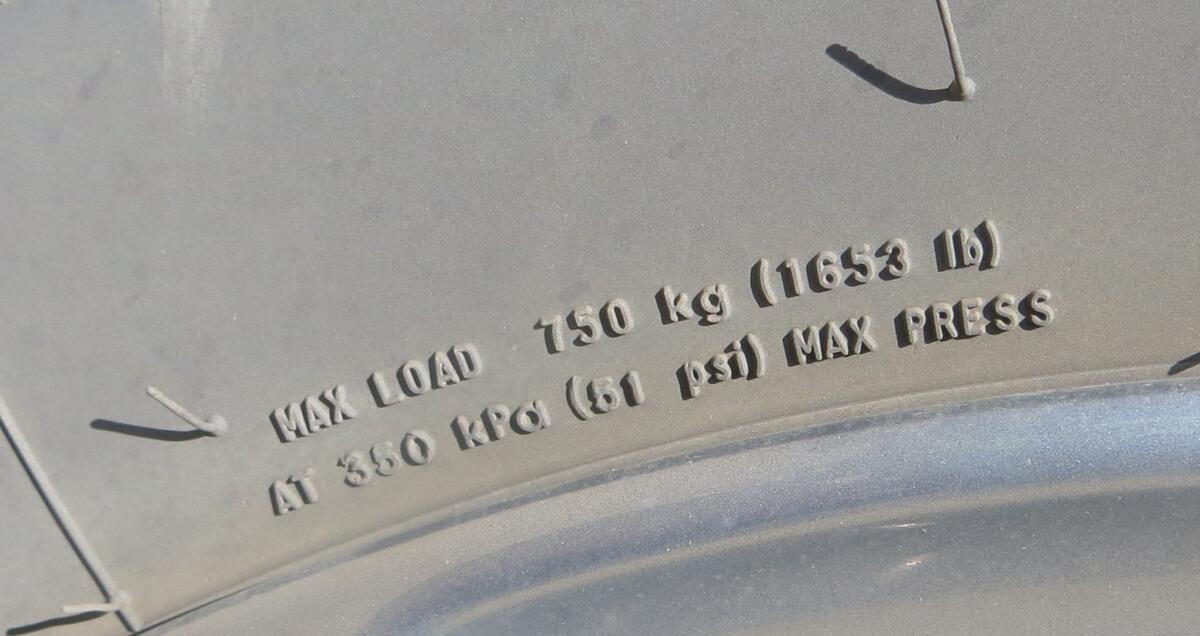
The list of materials and the max load numbers are easily seen molded on the sidewall of all tires per Federal Regulation for the last 30 years. The US-DOT specified size, location and content are as seen in the attached examples. These pictures were taken with natural lighting and not even in direct sunlight.
To read letters molded on your tire sidewall, you might find it easier if you get out your phone aka camera and snap a couple of pictures of this important information.
I suggest you wash your tire sidewall with soap and water and snap pictures of three areas with the tire in full sunlight. Here are examples from three different tires:
1. The complete DOT serial
NOTE: You should confirm all your tires have the same serial number. If not, get a picture of each serial number.
DOT serial number
2. The tire max load information
Tire max load information
3. The tire material list
Tire material list
Note on “Max psi”: You should focus on the “Max Load” and understand that the tire is only rated for that load when the tire is inflated to the stated PSI, and the inflation is checked at ambient temperature. The “Max psi” IS NOT the highest level of inflation a tire can tolerate. Undamaged tires can tolerate much higher PSI when warm from running.
Keep in mind, if you have the tire sidewall info handy in a photo or on your phone, it will be much easier for you than if you have tire problems in the middle of the night and don’t know what tire you need for a replacement.
If you have tire questions, check out Roger’s Blog as well as his posts on RVtravel.com. There are hundreds of posts covering everything to do with tires.
If you still have a question for Roger after searching the above posts, send your inquiries to him using the form below.
Did you know that Walmart stores typically carry a lot of RV gear and parts? As I rarely shop at Walmart, I didn’t, until a recent campground neighbor enlightened me.
In the video below, the Grateful Glamper lets the world in on the secret of Walmart RV gear, and she has lots of great finds. I’ll break it down for you below, too, if you don’t want to watch the video.
In addition to it being a great place to find RV gear, Walmart is a super convenient stop for RVers who need to grab supplies while on the road.
Why Walmart?
Walmart is more than just a place to buy groceries; it’s a surprisingly useful resource for RVers and campers. With stores practically everywhere, Walmart offers unmatched convenience. RVers can easily find a Walmart to restock supplies while traveling, which is especially helpful if they’re in a bind. Imagine a sewer hose emergency—Walmart can be a lifesaver in such situations.
Many Walmart locations still allow overnight RV parking. Of course, it’s always a good idea to double-check local rules and regulations before settling in for the night. Overnight parking provides a great opportunity to rest and restock before hitting the road again. Resources like apps, websites, or a quick phone call can confirm whether a particular Walmart allows overnight stays.
Walmart’s camping section is full of must-have items. Here are some essential things to keep on your shopping list:
• Propane canisters: Incredibly versatile, these can hook up to Blackstone grills and portable camp stoves. Propane canisters are great in a pinch, especially when space is limited.
• Camp chairs: A camping staple! At around $9 each, it never hurts to have extras.
• Tents and shade canopies: Even if you have an RV, a tent or shade canopy can be nice to have. It gives extra space for relaxing outside. Maybe even a place for teenagers to sleep!
• Air mattresses: As kids get older, or if grandkids visit, an air mattress is a lifesaver.
• Privacy shelter: Walmart sells a “privacy shelter.” While it could be for a bucket toilet situation, it could also be a changing room for the campsite.
• Blackstone accessories: Walmart has a surprisingly large selection of Blackstone products, both grills and accessories. These accessories can really enhance your campsite cooking. From egg rings to taco racks, Walmart has a Blackstone accessory for every need.
Walmart RV gear essentials
Most Walmarts have an RV section. This is usually located in the automotive area, and it’s a convenient place to grab essential items.
• Sewer hose kits: A must-have for any RVer.
• Water filters: Stock up on water filters while doing your grocery shopping.
• EvoFlex 2 hose: The Camco EvoFlex 2 hose is a flexible and compact option for RVers.
• Black tank flush alternative: For RVs without a built-in black tank flush, Walmart has an adapter. This allows back-flushing of the black tank.
• Black tank treatments: Walmart has a variety.
• Water pressure regulators: There are different types of water pressure regulators, both adjustable and non-adjustable.
What Walmart RV gear to skip
Not everything in the RV section is a winner. Here’s what to avoid:
• Step covers: Skip the step covers at Walmart. SeaDek RV Step Treads are a much better alternative.
• Show heads: Walmart carries Oxygenics shower heads for $43.97. But you might find it cheaper elsewhere.
Walmart is a surprisingly great resource for RVers and campers. The next time you’re on the road, don’t overlook the RV and camping sections. You might just find some hidden gems that will make your next adventure even better.
Strike up the band! The theme for this year’s National Park Week (happening now!) celebrates musical connections to our national parks. You can read more about it here.
On its website, the National Park Service challenges visitors to create a national parks musical playlist. The list should include music inspired by your favorite trips or park memories.
A head start
When you remember visiting a specific national park, does a song or melody come to mind? That’s what the NPS challenge is all about: connecting music to national parks.
Below is my list of eight well-known songs and an occasional symphony selection. (Yep, something for everyone—just like our national parks!)
Yellowstone National Park
“Home on the Range” (Traditional American Folk Song)
Why it fits: Known for its wide-open spaces and an iconic piece of Americana, “Home on the Range” evokes the spirit of the American frontier. It captures the untamed wilderness that Yellowstone represents.
Beethoven’s Symphony No. 5
Why it fits: The instantly recognizable four-note beginning to Beethoven’s Fifth seems to mimic the explosive energy of Yellowstone’s geysers and the park’s rugged geothermal landscapes.
Yosemite National Park
“California Dreamin’” by The Mamas & The Papas
Why it fits: With Yosemite located in California, the dreamy, reflective quality of “California Dreamin’” mirrors the park’s majestic landscapes. The song brings to my mind the picture of Yosemite’s towering cliffs and waterfalls.
Grand Canyon National Park
“I Still Haven’t Found What I’m Looking For” by U2
Why it fits: The grand scale of the canyon suggests both mystery and ongoing discovery. It pairs well with U2’s anthem of searching the vast natural wonders.
Everglades National Park
“Riders on the Storm” by The Doors
Why it fits: The atmospheric, mysterious vibe of “Riders on the Storm” conjures images of the Everglades’ winding waterways, unpredictable weather, and the sense of adventure in a unique swamp environment.
Grieg’s “Morning Mood”
Why it fits: The gentle awakening portrayed in “Morning Mood” captures the early light over misty wetlands. In my mind, this serene piece pairs perfectly with the tranquil waterways of the Everglades.
Acadia National Park
“Sailing” by Christopher Cross
Why it fits: Acadia’s rugged coastal beauty and maritime heritage are reflected in the gentle, breezy sentiments of “Sailing.” I think it’s a fitting soundtrack for exploring rocky shores and ocean scenes.
Zion National Park
“Ain’t No Mountain High Enough” by Marvin Gaye & Tammi Terrell
Why it fits: Though originally a soulful love song, its title and uplifting message resonate with Zion’s striking red rock formations and deep canyons—symbolizing that no natural barrier is too great.
Dvořák’s Symphony No. 9 “From the New World”
Why it fits: Dvořák’s work offers a sense of discovery. Its vibrant movements bring to my mind Zion’s dramatic red-rock canyons and the feeling of venturing into an awe-inspiring, untamed frontier.
Glacier National Park
“Ramble On” by Led Zeppelin
Why it fits: With lyrical allusions to travel, mystical landscapes, and the ruggedness of nature, “Ramble On” fits the adventurous spirit and the icy beauty of Glacier’s valleys and peaks.
Joshua Tree National Park
“Hotel California” by The Eagles
Why it fits: The desert mystique and open vistas of Joshua Tree pair well with the mysterious “Hotel California.” The song evokes the surreal, otherworldly vibe of the park’s iconic landscape.
Richard Strauss’s “Also sprach Zarathustra”
Why it fits: The opening fanfare of this work is famously associated with amazing revelations. I think the music’s sense of mystery and grandeur pairs perfectly with Joshua Tree National Park.
Your turn
Now it’s your turn. Can you pair a musical piece with a particular national park? Try it and be sure to tell us how you think they “fit together.” Use the comments below to share your suggestions. We can’t wait to hear.
“Never throughout history has a man who lived a life of ease left a name worth remembering.” —Theodore Roosevelt
Need an excuse to celebrate? Today is National Garlic Day!
On this day in history: On April 19, 1775, the American Revolutionary War began with the Battles of Lexington and Concord—the start of an eight-year armed conflict between American colonists and the British Army.
Affiliate program for influencer$ Do you have a popular blog, social media or YouTube channel? If so, and you would like to promote free signups to the Sunday RV Travel Newsletter, let us know. Good money possible (paid monthly) for simply referring new RVT readers. No selling involved and very little time investment. Learn more: contact publisher Chuck Woodbury at chuck@rvtravel.com .
Featured news
Is Cracker Barrel banning “overnight camping”?
While cruising across America, having an overnight spot while transiting between destinations is great. Cracker Barrel Restaurants offer good food at reasonable prices, and many have designated parking spots for RVers. Now, “news” is circulating on the internet that RV overnighting at Cracker Barrel is being shut down. Is that the truth? What’s going on?
Dilapidated, graffiti-tagged trailers moved again: Locals afraid, angry
New RV storage area. Local residents angry
Wildomar, California, is facing backlash after 70 dilapidated, graffiti-covered Black Series trailers appeared on a city vacant lot, months after being removed from the City of Industry. Residents of the Southern California city are raising concerns about safety, fire hazards, and neighborhood impact as these RVs cluster near homes and businesses. Read more and watch a TV news segment.
Tire dealers speak out: Tariffs are where the rubber hits your budget
It doesn’t matter if you’re a motorhomer or flavor your RV as a towable, we all have something in common: We have to buy tires. There’s a certain amount of anxious suspense as to just where, when, and how tariffs will affect us. So are we going to pay more? Find out here.
RV business leaders explain why Canadians are canceling travel plans
Earlier this month, RVtravel.com ran a story by Gail Marsh, Canadian RVers rethink U.S. travel plans. Judging from the volume—and volatility—of readers’ comments, the story struck a nerve. Some readers suggested this was a “much ado about nothing” story. The cause of Canadian RVers staying home—if they even do stay home—was questioned. Is it true that Canadians are canceling travel plans? If so, what is the cause? RV business people who stand to be hit the most now give their side of the story.
Campground crowding, comments & concerns Ways to connect to the internet while traveling, and the pros and cons of each option
Last week in this column, we asked how, or if, our readers get internet connections while RVing. A lot of people commented and emailed in, too. This week Nanci Dixon shares some of your comments on how you connect, with recommendations, and why some intentionally don’t connect. (Remember the good ol’ days?) Get some good tips here.
News briefs
There are plenty of apps RVers can use to find campgrounds. Trouble is, they’ll tell you “how far” it is to a campground, but when it comes to how long it takes to get there, forget it. Now, an RV-familiar app, The Dyrt, says plug in how much time you want to spend on the road, and it will tell you all the campgrounds within that time frame. It’s the new Drive Time app, and it’s pretty neat.
Want to catch a ride on a piece of American history? It’s possible, as Love’s newest travel stop that offers RVers full hookups is just up the road from one of the last Mississippi river boat crossings—and you can take your rig across to Kentucky on a riverboat ferry. How cool!
It’s officially National Park Week! This year, National Park Week is from April 19–27. The coming days provide RVers the perfect opportunity to appreciate the great outdoors along with its natural wonders. Here’s what to expect and how you can plan your visit.
Yellowstone National Park has reopened its West entrance after being closed for the season.
Speaking of openings… After a four‑year hiatus, the marble‑lined passages of Sequoia National Park’s Crystal Cave will open again on May 23, 2025. Visitors can take advantage of the 50‑minute guided tours through a half‑mile loop of glittering stalactites and rugged corridors. Learn more.
The National Park Service is getting real with a photo guide to wildlife poop. Think you know bear poo from cougar poo? Know what fox poo looks like? Bison? What about Ringtail Cat? Well, take our quiz and see how well you know the poo!
Colorado’s Black Canyon of the Gunnison National Park has transitioned to a fully cashless fee system and only accepts mobile or electronic payments for entrance, camping, and permit fees. Credit and debit sales already represent as much as 95% of in-person sales in the park.
President Trump claimed on Thursday that some states saw gas prices fall to just $1.98 on Wednesday. AAA disagreed, saying the lowest price in the U.S. on Wednesday was far higher, at $2.70 a gallon in Mississippi and Tennessee.
Cortes Campers has announced the release of the Cortes 18 RV travel trailer with two interior floorplans and featuring a licensed integrated composite chassis.
New Mexico’s Bandelier National Monument will resume its free summer shuttle service to Frijoles Canyon on May 14.
A solid majority of people believe the current trade war will have a major negative impact on the RV industry in general and their business in particular. In an impromptu poll this week, 55.6% of the respondents think the flurry of tariff activity will increase retail RV prices by at least 20%. Another 14.8% said it would raise retail prices between 10% and 19%, and the same percentage said it was simply too soon to tell.
Terminix announced this week its annual list of the Top 50 Most Mosquito-Infested Cities in the U.S. based on 2024 service data from more than 300 branches nationwide. California and Texas lead the rankings, with Los Angeles taking the top spot, followed by Dallas (#2), New York City (#3), Atlanta (#4), and Houston (#5).
California’s State Parks are celebrating the fourth annual California State Parks Week from June 11-15. The weeklong celebration includes more than 170 events highlighting the people, places and programs at the state’s 280 parks. Here’s a list of all the special events.
Record flooding that swept down the Green River in Mammoth Cave National Park in Kentucky knocked the park’s ferry out of service. Traditionally in April, the water level at the Green River Ferry crossing averages between 15 feet to 22 feet with a water flow just under 5,000 cubic feet per second. During the recent flood, the river reached 59.54 feet with a water flow of just over 55,000 cubic feet per second.
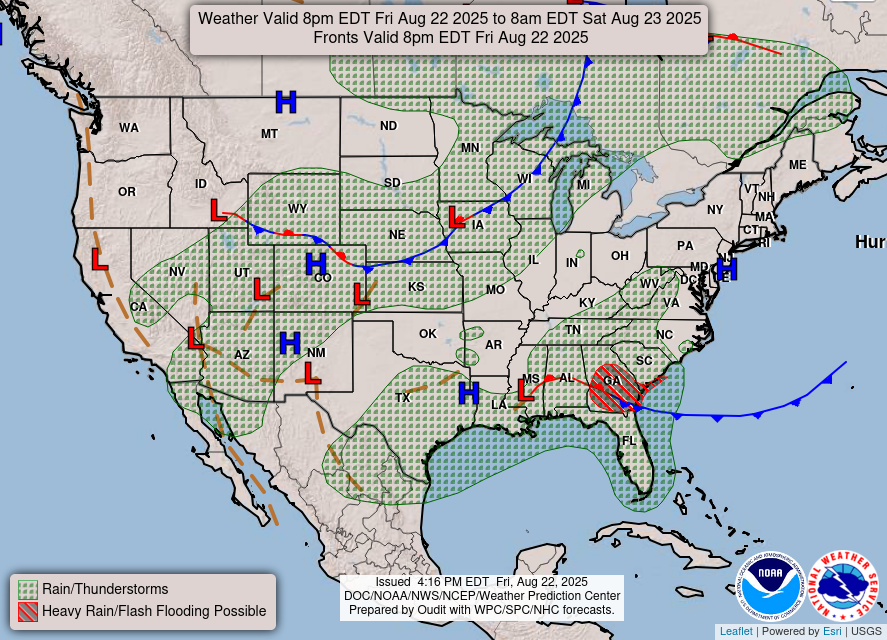
Severe thunderstorms are forecast through this weekend along a slow-moving cold front and secondary storm system that will impact areas from the Southern Plains to the Great Lakes. Large hail and isolated damaging wind gusts are the main threats with these storms, along with a risk for heavy to excessive rainfall which could bring flooding.
There’s a lot happening in Acadia National Park! Yesterday, park staff reopened many park roads, including Park Loop Road and Cadillac Summit Road, for the season. The park also released Cadillac Summit Road reservations on recreation.gov. Vehicle reservations are required to drive on Cadillac Summit Road May 21 – October 26, 2025.
KEEP OUR CAMPGROUNDS OPEN! Reader Randy G. commented, “This newsletter has a lot of readers. If you’ve been paying attention, many COE and Forest Service campgrounds will not open this year due to budget cuts. I have written to my congressman, one senator, and the president. I don’t believe they realize that these campgrounds bring in revenue for the government through campground fees. They also bring in revenue for local businesses. If we start an email or letter-writing campaign, maybe we can get these campgrounds back open. I don’t want this to be a gripe session about the president or anyone else. I want it to start a movement and use our numbers to get something done.”
?? MYSTERY PRODUCT OF THE DAY ?? These have become very popular, and not just with kids! Adults across the world have rediscovered their love for these. Have you?
Latest fuel prices
The latest U.S. average prices per gallon of fuel as of April 14, 2025: Regular unleaded gasoline: $3.17. Down 8 cents from last week; down 46 cents from last year. Diesel: $3.58. Down 6 cents from last week; down 44 cents from last year.
RANDOM RV THOUGHT: Never transport a propane tank inside your RV. Never operate a propane space heater inside your RV. Be safe, not dead.
Anyone who spends any time on the internet knows about the website Yahoo. But do you know how it got its name? Its founders, Jerry Yang and David Filo, then Stanford engineering graduate students, named it “Yet Another Hierarchical Officious Oracle.” But that was quite a mouthful. “Yahoo” was better!
Laugh of the week
Today in history
Today’s weather forecast across the nation THIS MAP UPDATES TWICE A DAY
RV sales have slowed and fewer people are buying RVs. Most costs across the board have risen. RVing is evolving. Has that changed how people are RVing? Are there still some areas that are crowded with campers? Are people more or less content with RVing?
RV Travel readers discuss their experiences and offer tips to help other campers find that perfect spot.
Here are a few observations from our readers. These do not necessarily represent the views of RVtravel.com.
Last week, we asked how, or if, our readers are getting internet connections. A lot of people commented, and a number emailed in, too.
As I mentioned last week, my husband and I use cell data and Starlink when traveling for an extended time. I have been unwilling to pay the monthly fee of a whopping $165 a month for a few days’ use in between our six months of travel. I don’t like paying that much when traveling, either. Starlink has just come out with a $10 short-term option that we will try this weekend.
A couple of our readers mentioned that when camping, they don’t need connections. I remember the days camping before cell phones, too. I know I am overly hooked on my iPhone, iPad, and computer. I have finally turned off the “ding” that tells me there is a new email or text. I am trying to break the habit of reaching for my phone as if it is an extension of my arm. Wish me luck!
Are others grappling with too much screen time, too?
Below is how some of our readers connect… or intentionally don’t.
T-Mobile
Leo D. favors his T-Mobile connection and writes, “Regarding streaming and Wi-Fi, we are customers of T-Mobile 5G internet. It’s a $55/month auto credit card charge. We take it in our camper when camping. We can stream Netflix with no issues and we use it for work emails, Zoom calls, Teams meetings, etc.”
Jim J. is happy with his T-Mobile line, too. He writes, “When we started RVing seasonally, Starlink did not exist. However, I was still working remotely from home (RV) office, and my job depended on very good Wi-Fi and reasonable access to a commercial airport. The park’s Wi-Fi was terrible. Not even the fixed-base wireless internet operator with a tower a mile away would offer service due to the terrain. I paid for an ‘acceptable’ cellular data connection. Then T-Mobile Home Internet (THI) came online, just before Starlink. We had to have a fixed address, but could change the address easily. Like Starlink, THI access has grown tremendously. As T-Mobile phone customers, we get a nearly 50% discount on THI. We are still THI customers. In fact, I dumped the cable company at our house and added a second THI line.
“We have since retired and still have both THI lines. We can stream TV, hold video calls, and keep tabs on our snow-encrusted house remotely for about 1/3 the cost of a single Starlink connection.”
Verizon
Denny K. uses cell data and prefers Verizon. He wrote: “We stopped using Dish for TV, as well, to save $100+ per month. My wife and I both have phones on the Verizon network. With two TVs, we can connect each of our phones to a TV using the hotspot (without a cord) with unlimited data. As long as we have good cell coverage, it works great. We have had AT&T and T-Mobile, and so far, Verizon seems to work the best up and down the East Coast. Too much poor (slow) reception with the others.”
AT&T
Elaine W. relies on cell data, too, but doesn’t stream. She wrote, “I travel extensively throughout the Northern states and have done so for the past 20 years. Many of the parks that I camp in have weak or no Wi-Fi. I rely on data and my cell phone. Satellite Wi-Fi is more than my budget allows. I recommend (for those who do not need streaming) to use Verizon/AT&T for coverage. I am currently on Boost (which is AT&T), planning to add Verizon if so needed on this journey into the SE this coming fall. The key factor here is, I don’t stream.”
Starlink
David commented, “We’ve switched to Starlink exclusively and used it for the last year all over North America and Canada. We mounted ours on the roof and only had one campsite where we couldn’t use it. We put ours in a removable mount, though, so I can easily take it down from the roof if needed. No more fussing with boosters and hoping for a decent cell signal. The major bonus of having it on the roof is that we now have internet all the time while traveling down the road. Since our cell phones can use Wi-Fi for calling/texting, we have cell service all the time, no dead spots for us!”
Vince S. also likes Starlink. He wrote, “We tried to rely on cellular data, but even with signal boosters, it’s too hit-and-miss where we boondock. RV park Wi-Fi is just as sporadic and uncertain, but worse and less secure. Because of that, we went with Starlink and never looked back. We set up the antenna wherever we park, even if the site says they have Wi-Fi.
“When we’re not traveling, we suspend the service. At $165 a month, it isn’t cheap, but neither is our fiber optic sticks-and-bricks internet. Having the ability to do finances, monitor our house, plan routes, and do online reservations from anywhere is a nice convenience. Sure, we could use a road atlas, pay with checks, and do shadow puppets for entertainment, but why?”
Dana D. keeps her costs down while using Starlink. She wrote, “My Starlink Mini is $50 a month for 50 gigs. I can pay by the gig if I go over 50, or $165 a month for unlimited. I don’t spend a lot of time streaming, so $50 works. I still have Dish at home and my Winegard Pathway. $5 a month for the Pathway. Starlink does provide an easier connection to satellites. I have the Starlink magnetic mount. I put the antenna on the hitch of my 5th wheel. Easy setup.”
Amazon Fire Stick
Gary B. does not rely on campground Wi-Fi for streaming and tells how he downloads media before leaving home. “We have found Verizon to be the most reliable cell service all over the country. We rarely, if ever, use or depend on Wi-Fi from a paid resort or RV park. We download shows and movies onto our phones. We also have a DVD player and about 50 DVDs that we have never had a cause to watch. We can stream to our TV using an Amazon Fire Stick even without Wi-Fi or cell coverage. I have found that this is preferable to having a Smart TV, as the Fire Stick does a better job of streaming and connectivity. Unfortunately, when we don’t have a cell signal, we have no ability to monitor the weather or look up where we could travel to or stay next. However, you either preplan or wait till you’re on the road and get reception.
“We stream content we have previously downloaded from Netflix, Prime Video, YouTube, etc., onto our phones. Turn on your TV and Fire Stick, go to home or your profile pic, then settings-display-mirror screen, select yes, and then your mirror screen setting on your phone. We have Samsung phones; it’s at the top, drag down menu (twice) called Smart View. Regarding connection, sometimes I have to back out of the mirror screen on the Fire Stick (back) and select it again in order for my phone to find it. So you don’t need Wi-Fi or cell phone reception to link your phone (screen mirror) to the Fire Stick. Not sure if it works or not with an iPhone?”
Campground Wi-Fi
Paula S. wrote that the campgrounds need to step it up. “Wi-Fi and cable TV is very important to our RV camp experience. Most campgrounds lack in these areas. THEY NEED TO STEP IT UP. We are paying higher and higher prices and not getting anything back. The campsites are getting smaller, and most are seasonal now. If seasonal wasn’t in the thousands, we would probably partake. We are retired and enjoy the Wi-Fi and cable TV amenities.”
Why connect at all?
Steve H. wrote about how times have changed. “Isn’t it amazing that we were able to raise our sons to adults with NO cell phones or Wi-Fi? When we took the boys tent camping (which was what ‘camping’ was for most parents our age), they hiked, fished, boated, explored, and played with no connection whatsoever to their friends back in the city. But they couldn’t miss what they didn’t have and never even heard of!
“Amazing how everyone now seems to need uninterrupted access to phones, Wi-Fi, and TV, no matter where they are, even when boondocking miles from the nearest paved road. How times have changed! And not necessarily for the better.”
Scott H. is not in favor of 24/7 connectivity either. He wrote, “Heaven forbid Facebook or TikTok cannot be checked on…. However, if work needs require the connectivity, I guess that I would give the party in question a pass. When we camp, the phone is available but not in use unless there is an emergency.”
Now, some questions for you:
Are you finding campgrounds booked up or is finding a site not a problem?
What do you like best about RVing?
What are your pet peeves?
Are you seeing more permanent and seasonal RV parks?
Are rising costs affecting your camping style?
Do you have favorite campgrounds or RV parks?
What is the most memorable experience you have had RVing?
Do you have any tips or secrets you’d like to share?
Please use the form below to answer one or more of these questions, or tell us what you’ve experienced with campground crowding in general.
Wildomar, California, is facing backlash after 70 Black Series trailers appeared in the city, months after being removed from the City of Industry. Residents of the Southern California city are raising concerns about safety, fire hazards, and neighborhood impact as these dilapidated, graffiti-covered RVs cluster on a vacant lot near homes and businesses.
KTLA 5’s Omar Lewis reported on April 17 that city officials have issued final abatement notices to individuals linked to the trailers, including a person associated with Black Series. The city declared the trailers a public nuisance, giving 48 hours for removal before potential enforcement. That deadline has now passed.
This vacant lot is next to homes and businesses. The trailers are in poor condition, many covered in graffiti, some with missing windows and flat tires. The RVs are crammed together, creating an unsightly and potentially hazardous environment.
This situation follows a similar incident in the City of Industry. Previously, a massive encampment of more than 80 Black Series trailers became an unauthorized RV camp. Unhoused individuals moved into the campers, sparking concerns after repeated fires and reports of violence.
A court order forced the property in the City of Industry to be cleared. Now, trailers matching that same description have appeared in Wildomar. Some arrived as early as December, but many more appeared after the sweep in the City of Industry.
Local officials cite zoning and fire code violations, and the city is now seeking a court-issued abatement warrant to forcibly clear the lot, if needed. Residents, especially with fire season approaching, are anxious for a swift resolution as the 48-hour deadline has now passed.
Social media post causing confusion
Residents are also worried about security issues. According to the Los Angeles NBC TV affiliate, a social media post is making the rounds that claims the RVs are available for free for anyone who comes by. The post, of course, is false, but it isn’t stopping visitors from stopping by, hoping to drive away with one of the trailers.
To add to the drama, tires on some of the trailers have been removed. For whatever the reasons, it makes it much more difficult to tow the RVs away.
The owner of Black Series says he is trying his best to move the trailers to a new location.
Most grocery stores these days, unless you’re maybe in a tiny town, employ “robots.” We’re talking about those self-checkout machine “robots” where you do all the work! You walk up, scan your groceries, bag them, swipe your card, and walk out the door. No human interaction needed.
Most people have a strong preference: They either like using the self-checkout or they hate it. “Get me a real human!” they’ll say.
Sure, sometimes the self-checkout can be much quicker. Robots are faster than humans, after all. But sometimes they’re not practical. If you have a lot of produce, it may take you forever to find, look up, and search for the proper code for your Brussels sprouts. In this case, it may be quicker for you to wait and go through a “real human” line.
Which do you prefer? Will you always do self-checkout? Most often do self-checkout? Or do you hate those dang robot machines so much that you’ll always or almost always go through the traditional “real human” line?
After you vote, please leave a comment. Thank you!
It doesn’t matter if you’re a motorhomer or flavor your RV as a towable, we all have something in common: We have to buy tires. There’s a certain amount of anxious suspense as to just where, when, and how tariffs will affect us. Forget where the rubber meets the road—think about how the rubber may hit your budget with tire tariffs.
Tire tariffs the topic of industry survey
A trade magazine for tire dealers, Modern Tire Dealer, wanted to get a pulse from its readers as to their thinking about how tariffs may affect their industry and, by extension, tire buyers. You may find the results interesting—if not downright dreadful.
Modern Tire Dealer’s survey was conducted on April 3. Six days later, President Trump surprised the nation by pausing tariffs on most nations for 90 days. But that same day, the U.S. Treasury Secretary, Scott Bessent, came out with information. Forget the 90-day pause on most countries—automobile and auto parts tariffs were still going forward. Tire tariffs are a reality.
The survey results are based on the participation of more than 300 readers in the tire industry. Their “votes” speak for themselves.
Are you going to pay more?
Perhaps affecting RVers the most is this: How will tire dealers deal with the higher costs brought on by tire tariffs?
Click/tap to enlarge.
How do tire dealers feel about tariffs?
Other survey questions dug into the mood of business retailers.
Click/tap to enlarge.
Tire tariffs crystal ball gazing
The survey also put tire dealers into the position of doing a little future forecasting.
Click/tap to enlarge.Click/tap to enlarge.
At first blush, we didn’t think much about the effects of all of this. After all, we don’t drive a motorhome with those giant “rubber donuts.” But, hey. Guess we should have thought harder. Our travel trailer is a dually. Six wheels!
Earlier this month RVtravel.com ran a story by Gail Marsh, Canadian RVers rethink U.S. travel plans. Judging from the volume—and volatility—of readers’ comments, the story struck a nerve. Some readers suggested this was a “much ado about nothing” story. The cause of Canadian RVers staying home—if they even do stay home—was questioned. Is it true that Canadians are canceling travel plans? If so, what really is the cause? RV business people who stand to be hit the most now give their side of the story.
Mike Gast
Newsman Mike Gast recently queried U.S. businesses that have a big stake in the Canadian snowbird migration. You may recognize his name, as Mike has written a number of pieces appearing in RVtravel.com, and is a respected journalist. His story appeared recently in RVbusiness.com. We’ve boiled down his piece, but you can see the full story here.
Campground owners say Canadians are canceling travel plans
Houlton Canadian Border KOA Journey, Houlton, Maine
Gast points out that many campgrounds in the Lower 48 are already seeing a major drop in their reservations for summer visits. He quotes Toby O’Rourke, “Year to date, we’ve already seen a 23% decline in reservation stays from Canadians on (Kampgrounds of America) U.S. campgrounds.” O’Rourke is president and CEO of Kampgrounds of America, Inc.
“Looking ahead, reservations on the books for KOA parks in the U.S. by Canadians are down 49%,” O’Rourke said. “We’ve had 4,300 cancellations on 2025 reservations on U.S. parks.” KOA’s fall-off is highlighted in Florida, Tennessee, Arizona, and Montana. But it’s not just KOA feeling the bite.
The story notes, “The Maine Campground Owners Association (MECOA) recently attended the Montreal RV Show, which was certainly a challenge this year,” said Kathy Dyer, executive director of MECOA. “The distribution of the Maine Camping Guide was down approximately 84% compared to last year.”
“It’s the economy, stupid”
XYZ Kid on flickr.om
To borrow a 1990’s phrase, as some RVtravel.com readers pointed out, “It’s the economy, stupid.” The poor Canadian dollar exchange rate, from the perspective of our Northern neighbors, is playing a part in the Canadians canceling travel plans scenario. At the time of the article, a Canadian Looney was only worth 72 cents on the U.S. side.
Gast’s story notes, “We found that 20% of Canadian campers report they plan to camp in the U.S. this year, while 23% of Canadian campers who have camped in the U.S. before said they do not plan to this year,” KOA’s O’Rourke summed up. Those figures were not just for KOA customers, but from a survey of all Canadian campers.
It’s not just KOA that sees a decided dimming in Canadian intentions for U.S. travel. The RVBusiness story cited Campspot statistics. It’s a firm that produces campground management software, used by nearly 3,000 U.S. campgrounds. Mike Gast’s story relates, “In looking at bookings made in January and February for future stays, in 2024 Canadian travelers represented 2.9% of all U.S. campground bookings,” said Casey Cochran, vice president of partnerships and business development for Campspot. “In 2025 it was 1.9% – a 35% decline in mix.”
Chiming in with a similar note is a firm called Advanced Outdoor Management. The Gast story quotes the company’s COO: “So far, our New York, Utah and Minnesota parks have seen a decline in Canadian bookings,” said Rachel Godbout, COO for Advanced Outdoor Management. “They (Canadian bookings) are normally about 8% of our market.” Will that drop-off hold?
“As of this moment in time, we are seeing as low as 38% and as high as 50% of our Canadian guests that have not rebooked for this year,” she said. “The hard part of that statistic is that it is too early to tell if they will book just with a shorter lead time, or if they will not book at all.”
Is there more than just money involved?
While the weak Canadian dollar certainly accounts for some of the fall-off in travel by Canadians, Mike Gast’s story digs deeper. It notes, “After President Trump first announced his tariff plans for Canada in February, border crossings by Canadians fell by 24% compared to the same period in 2024.”
It’s not all money. Earlier this week, as Gast points out, the Canadian dollar was only worth 72 cents U.S. On February 28 of last year, it was worth more—but only two cents more—coming in at 74 cents on the U.S. dollar. Obviously, more than money is involved here.
“A bit frightened–and angry”
Gast’s RVBusiness story looks into it. He questioned U.S. business people on the topic. His story relates: “‘The Canadians are a bit frightened, and frankly they are angry,’ said Daniel Wright, assistant manager of The Springs of Borrego RV Resort in Borrego Springs, Calif.” Wright summed it up in the story, “‘This is terrible for our business and our friendships with so many of our polite and gentile neighbors,’ he said.”
Other businesses that rely on Canadian visitors were also quoted in the story. Here’s how the RVBusiness story relates the view from another RV resort:
“‘I am losing at least six Canadian guests who have come here every year for the last 5 to 10 years,’ said Nancy Schreiber, property manager at the Paradise Island RV Resort in Oakland Park, Fla. ‘They are not returning because of the exchange rate, and they are telling me it is (also) because of the politics of the Republican Party that is keeping them from coming back next year.’
“Schreiber also said she’s losing at least two more Canadian campers who plan to take their business all of the way to Mexico.
“‘They say that even with the gas from Quebec to Mexico, that it is cheaper for them,’ Schreiber said. ‘We started booking for next year on April 1. Normally I fill all of my sites on that day and have up to 25 people on the waiting list. Yesterday (April 1) was totally quiet, and I still have several sites open for next winter. I have been the manager here since 2012, and I have never had an open winter site on April 2. They (Canadians) are angry. This is definitely affecting my occupancy.’”
Foreign money exchange rates. Trade war tariffs. And as we reported earlier, the U.S. is now requiring Canadians to register with Homeland Security. It’s a mix of factors, indeed. It definitely looks like Canadians are canceling travel plans. And from the looks of things, American business owners will be the ones who take a direct hit. And the ripple effect will undoubtedly reach others, too.
We use cookies to ensure that we give you the best experience on our website. By continuing to use our site, you consent to accepting cookies. We NEVER have or will sell reader's data. For more info, please see our privacy policy page.

















 Gast’s RVBusiness story looks into it. He questioned U.S. business people on the topic. His story relates: “‘The Canadians are a bit frightened, and frankly they are angry,’ said Daniel Wright, assistant manager of The Springs of Borrego RV Resort in Borrego Springs, Calif.” Wright summed it up in the story, “‘This is terrible for our business and our friendships with so many of our polite and gentile neighbors,’ he said.”