Home Blog Page 1454

Can snowbirds get shots? A vaccine controversy

63

By Russ and Tiña De Maris
We’ve all been agonizing for months with the COVID-19 pandemic. Locked away in homes. Stuck behind masks. Worried that we or our loved ones will come down with this dreadful disease. Then we got a glimmer of hope – workable vaccinations that may finally put an end to the curse of COVID. It’s been a month since the rollout, and now comes a new crisis: Can snowbirds get shots?

Get herd immunity

The stated goal of the world-wide vaccination campaign is to achieve herd immunity. Get enough people vaccinated, the virus won’t find suitable human hosts, and without a host, won’t be able to live and multiply. Eventually, the thinking is, the virus will simply whimper away. With a “million vaccinations per day,” the present mantra, it’s a matter of time before that herd immunity becomes a reality, right?

As we’ve witnessed, there are a few snags in the affair. Whatever the cause, it seems that there’s not enough vaccine where we want it to get everyone vaccinated as fast as the masses want. That’s led to plenty of trouble, particularly in the warm winter states and, most in the news of late, Florida. Initially we were told everyone could get the vaccine. Can snowbirds get shots? Sure!

Florida call to arms

But a couple of weeks ago, things got ugly. Some vociferous Floridians started yelling that the snowbirds were edging them out, and that the natives should go first. A study showed that only about 4 percent of the vaccines were ending up in the arms of non-Floridians, but that news seemed to get buried. Evidently the call to arms hit the ears of state-level government. New eligibility rules have rolled out. Can snowbirds get shots? Sure! IF. And yes, it’s a BIG IF. If you’re a snowbird and want the jab, you’ll need the proper documentation. That means:

  • A Florida driver license or ID card;
  • Or a combination of other official documents, such as a deed, mortgage or rental lease agreement;
  • Or a utility bill or bank account statement in the person’s name.

It’s highly unlikely your average snowbird will have a Florida driver license or ID card. OK, what about those “official documents”? If Florida snowbirds are anything like Arizona snowbirds, we can tell you from experience, for many snowbirds it just isn’t going to happen. Granted, there aren’t a lot of free public lands to park an RV on down there in gator-land. But still, if you’re a snowbird who has friends or relatives who are willing to “put you up” on their property, you certainly won’t have anything like a deed, mortgage or rental lease agreement. The same will certainly be true for utility bills and bank accounts.

Some leave Florida

Can snowbirds get shots? Given those limitations, as far as many RVers are concerned it’s a no-go situation. Since a “combination” of documents is called for, an RVer may have a copy of a rental agreement with an RV park but, hey, utilities are included. The average RVer won’t have a receipt from Florida Power and Light. These RVers are, as they say, “fresh out of luck.”

As a result, the news is carrying stories of Florida snowbirds who say they’ll be pulling up stakes and heading out of the Sunshine State. Evidently, that’s just fine by some vocal vaccine zealots. “Let ‘em go elsewhere.”

But is there a flaw in the logic here? The idea of herd immunity is to immunize the masses to protect the masses. Last we checked, COVID-19 didn’t ask to see a driver’s license, nor a combination of documents prior to taking up residence in a human body. OK, so a bonafide Florida resident gets their vaccination but, say, next week rubs elbows with a non-vaccinated snowbird who just happens to be a COVID carrier. That already-jabbed Floridian stands a good chance of catching COVID from the carrier, as their immunity still hasn’t kicked in. Just sayin’.

What about other snowbird states?

What about other popular snowbird states? At last check, the Grand Canyon State, while way behind on getting vaccines out of vials and into arms, has a wide-open policy toward who can get the jab. Can snowbirds get shots in Arizona? Yes, and so can folks from “elsewhere.” “Vaccine is one of those things that we make available no matter if you’re a winter visitor, if you’re here visiting from another country,” says Dr. Cara M. Christ, the state’s health director. “Because of the impact that the diseases that you vaccinate against have on the community, we want to make sure that we’re protecting everybody.”

As far as California goes, things aren’t so expansive. In Riverside County, if you want a COVID-19 vaccination you’ll need to do just as the folks in Florida. Show an ID, or provide suitable documentation. We weren’t able to track down anything official on how things are for Winter Texans. If you’ve heard, drop us a line.

Can snowbirds get shots? It depends. Do you have the paperwork? Or are you in a state that figures getting as many folks vaccinated is more important than your point of origin? Wear your mask. Keep up physical distancing. Wash your hands. For some, washing their hands means more than getting under the tap – it means getting out of Florida.

Related

Have you had your first COVID-19 vaccination yet?
COVID-19 scammers are after you! Here’s how to protect yourself

##RVT985b

COVID-sniffing dogs: The future of public gatherings?

9

By Gail Marsh
Yes, you read that headline correctly. As if we didn’t need another reason to love dogs more than we already do, COVID-sniffing dogs are a thing of 2021. Are they here to save the day?

Specially trained sniffer dogs will welcome fans this weekend to Tampa, Florida’s American Airlines Arena. The Miami Heat will play the Sacramento Kings in basketball, and because of the special canine support, many eager fans will be able to enjoy the game in person. These dogs will be positioned at the entrance gates to detect if any fan has COVID-19. The dogs will walk past the line of people as they queue up to enter. If the dog sits down beside a person, it indicates that COVID is detected and the fan will not be able to enter.

Detection and sniffer dogs have sniffed out trouble for years

While the human nose has approximately six million olfactory receptors, dogs have 300 million. And while our brain is amazing in its ability to differentiate between odors, the area of a dog’s brain devoted to smell is 40 percent larger than yours or mine. Man’s (and woman’s) best friend can detect some odors in parts per trillion! No wonder why chicken smells so good…

Law enforcement has used sniffer dogs to identify things like illegal drugs, currency, and even electronic contraband like illicit cell phones. Detection dogs have helped the medical field by indicating cancer, migraines, heart attacks, and problematic issues with diabetics. Specially trained dogs can sniff out toxic mold, peanut dust (dangerous allergen for many), and even bed bugs!

Specially trained COVID-sniffing dogs

For the past several months, dogs have undergone training to sniff out COVID. Study results have determined that COVID-sniffing dogs can identify people infected by the virus before any symptoms appear. A trial at the Helsinki Airport in Finland showed that these trained detection dogs can identify COVID in less than ten seconds with nearly 100 percent accuracy.

So how does this work? What is it about the virus that dogs are able to detect? The coronavirus changes an infected person’s tissue. This change affects the person’s sweat scent signature, which is easily detected by the specially trained dogs.

Could COVID-sniffing dogs be an important tool in our arsenal to fight the spread of this virus? Is the Florida basketball game this weekend a sign of what’s to come? If getting tested for COVID means we’re able to get sniffed by a bunch of adorable pups, we’ll go get tested often…

Related:

Help! Can my pet get COVID-19?

##RVT985

Cargo trailer RV conversions: What spurs the trend?

8

By Tony Barthel
While the RV industry creates an ever-increasing number of unique floor plans, there is a whole community of people who just don’t find what they’re looking for on the floor of an RV showroom. There is a large community of people who have converted cargo trailers to RVs for a variety of reasons. We find out why.

“I think it is safe to say the main two objectives of converting a cargo trailer are quality and cost. Many of us can convert a cargo trailer for less than going out and buying a brand-new camper. The biggest factor being the quality of our conversion will be better built, insulated better, set up exactly how we want and will outlast many of the standard campers being sold today,” wrote Nate Dettmer in a forum for cargo trailer camper conversions. “It takes time and dedication to convert, and some basic skills, so it isn’t for everyone, and those who want a trailer ready to go can buy the manufactured campers.”

This was echoed by a number of people in the group, who happily shared pictures of their conversions. And the conversions range from elaborate rigs that almost completely hid their cargo trailer roots to rigs that were almost more cargo trailer than RV. 

According to many, that’s the point. You can create a cargo trailer conversion that absolutely fits your needs, given that you have the skills to do so. 

What are they like?

You might envision a cargo trailer conversion to be basically a workshop with cots and, sure, some fall into that description. In fact, some of the folks who have converted cargo trailers to RVs do so specifically to be able to take their work with them. They want to have some provision of converting the trailer to optimize work or camping configuration depending on how it’s being used at the time. 

But there are also some that are very elaborate with beautiful cabinetry, innovative layouts, masterfully clever convertible surfaces and much more. Everybody has that one friend who can look at a piece of wood and a box of screws and turn them into jaw-dropping art. That’s true in cargo trailer conversions as well. Some people are really good at this and the workmanship shows. 

Quality workmanship

Many of the respondents also cited quality issues with commercially built RVs. Many of these comments could be summed up by a response from David Johnson, who wrote, “We love showing our style of quality, the way we built our rigs to last, take a beating, outlast typical mass-produced travel trailer or RV, and we love the process…”

Size matters

Another factor is size. Many of the cargo trailer conversions I was shown were much smaller than the typical toy haulers produced by RV companies. 

Ryan Macke highlighted this by writing, “Quality and wants. I looked at toy haulers and if I was going to get everything that I wanted, I would have had to buy a 24- to 30-plus-foot-long toy hauler. I did not want to have to store and tow something that large. I have a 7×16 enclosed trailer that I’ve converted that has everything I want, exactly how I want it, and great quality because I built it using real wood.”

Cargo hauling was mentioned by a solid number of the people who indicated that they were bringing some sort of recreational toys, from side-by-side vehicles to motorcycles to bicycles and kayaks. Carrying adventure gear was a priority for some, but not nearly as many as one might assume. In fact, many of the trailers I was shown had almost completely disguised their cargo-carrying roots in favor of having more elaborate living quarters. 

But there were also converters who started with large car haulers and other larger trailers. Indeed, some even converted gooseneck car haulers and work trailers so, for some, size mattered and they went big. 

Flexibility

In writing daily RV reviews, I see a lot of opportunities for flexible quarters. I also see plenty of space in RVs that seems to go unnoticed by RV manufacturers. While there are a few who provide something closer to an empty box that you can then make to fit your needs, the only one I can think of that almost completely embraces this is the inTech Flyer Discover, which is essentially more cargo hauler than travel trailer. But that trailer also carries an MSRP of $25,902, and many of the people who have converted trailers say they can do so for far, far less than this. 

Some of the typical ways to do more with less included the fact that some parts came from trailers that had been scrapped or abandoned. Stoves, refrigerators and other components often outlast the shells of RVs that are destined for the scrap heap. Picking up these items for cents-on-the-dollar can be one way of creating a masterpiece for less. 

But there are a significant number of converters who create trailers specifically to not have the standard RV components. 

Innovation

Many of the converted trailers I have seen are vastly different from anything commercially available. Plenty of the conversions seem to be far ahead of what’s commercially available in terms of power usage and management. I do believe the RV industry needs to get on board by offering more of the forward-thinking power and water management systems available in some Class B RVs. 

For example, the Winnebago Revel has a long customer waiting list. Part of the appeal of this model is the fact that its built-in Xantrex power system can actually run the air conditioner and microwave. It also features an induction cooktop that ultimately eliminates having propane aboard at all. 

I have yet to see any travel trailer from any company that is anywhere close to this innovative. 

From pricey Airstreams to everything else, commercially built travel trailers feature two propane bottles and a space for lead-acid batteries on the tongue. A few manufacturers do provide solar and power management options, should you choose lithium batteries. But Lance seems the most progressive about doing something different – but not earth-shockingly so in the way that Winnebago has outfitted the Travato. 

Meanwhile, many cargo trailer conversions that I’ve seen feature very efficient climate control systems that can operate on lithium batteries charged by solar panels. If I’d have to guess, I’d say that many, many cargo trailer conversions don’t have any propane aboard at all. 

Color

Another thing I noticed looking through the pictures is a complete and total lack of brown upholstery. In other words, when people were given the choice, the choice they made was exactly not what the RV industry favors. 

Furthermore, not even one single conversion trailer had swoopy swishes and swirls emblazoned on the outside. Not one. 

It ain’t easy

To be honest, converting a blank canvas into a workable RV is not an easy task. In fact, the reason I started looking into this is the same inspiration that others have cited – nothing built by the RV industry really does everything I want it to. 

But there is a lot of craftsmanship that goes into building an RV. Woodworking, plumbing, climate control systems and more are all skills that a converter should have some basic understanding of. Furthermore, you have to have the knowledge of building things that will survive trips down the highway of life. 

“There’s a lot that goes into planning a successful conversion, especially when you start talking power, plumbing, electrical, awnings, weight distribution, hitch setups, towing capacity, water capacity, heating, waste water, toilets, 12, 24, 48v systems, batteries, lights, A/Cs, propane vs. diesel heaters, Victron or Renology, panel systems that can tilt, vs over paneling because you can’t. How many different gauge wires will be needed to completely wire a 110 and 12v trailer. Which switch is the right one. Awning or no awning, mini-split with heat strips or RV style furnace…” wrote David Johnson in a lengthy insight into conversions. “There is nothing small or simple about doing a conversion. It takes time, dedication, some knowledge and a whole lot of ‘Can-do Attitude’.”

RVing the U.S. Civil Rights Trail: Top destinations

11

By Nanci Dixon
Expand a National Parks bucket list by traveling the United States Civil Rights Trail. The past year or so has been unprecedented with regards to social and political unrest. It was a year where the lessons learned should not be forgotten, and one of the best ways to not forget is to learn more. There are more than 100 sites to visit on the Civil Rights Trail in 15 states, mainly across the South.

My husband is Black and grew up in Mississippi under Jim Crow segregation. Sometimes visiting the museums was just too much for him, and sometimes he would pause and reflect on the past versus the present. As we traveled and visited some of the sites, we did so with a heavy heart.

The Civil Rights Trail follows the course of the Civil Rights Movement, where segregation was challenged across America from Kansas to the Deep South, all the way to Washington, D.C.

If you’ve never followed the Civil Rights Trail, think about doing so for an upcoming trip. There are so many beautiful, historic places to see along the way.

Here are the top 10 Civil Rights Trail destinations

MEMPHIS, TENNESSEE

National Civil Rights Museum at the Lorraine Motel
Visit the site where Dr. King was assassinated while in town to support black sanitation workers’ demands for fair wages. Exhibits range from the arrest of Rosa Parks and other major events during the civil rights period to contemporary topics. It is the most-visited civil rights museum in America.

Among the many things that stood out for me, was the unaltered hotel room where Dr. King stayed, and the balcony where he stood. There is also a true-to-size-replica of a slave ship holding area with men, women and children crammed together.

ATLANTA, GEORGIA

Martin Luther King Jr. National Historic Site
This site includes Ebenezer Baptist Church and the birth home of Dr. King.

National Center for Civil and Human Rights
This multicultural center contains exhibits on both the Civil Rights Movement and modern human rights movements.

BIRMINGHAM, ALABAMA

Birmingham Civil Rights Institute
Take a self-guided tour of this multimedia museum that features 58,000 square feet of exhibits, archives, galleries and community rooms.

16th Street Baptist Church
16th Street Baptist Church is still an active church in the Birmingham community despite its tragic past. In 1963, the church was bombed, resulting in the death of four young Black girls. This event galvanized the federal government to take action on civil rights legislation.

SELMA, ALABAMA

Edmund Pettus Bridge/Selma to Montgomery National Historic Trail
This National Historic Landmark was the site of the brutal Bloody Sunday beatings of civil rights marchers during the first march for voting rights.

MONTGOMERY, ALABAMA

Civil Rights Memorial
Visit a moving tribute to those who died in the civil rights struggle between 1954 and 1968.

Dexter Avenue King Memorial Baptist Church
The first church where Dr. King was a pastor, Dexter Avenue Church, hosted meetings to organize the Montgomery Bus Boycott, which the U.S. Supreme Court eventually supported.

WASHINGTON, D.C.

National Museum of African American History and Culture
The latest museum of the Smithsonian Institution. It houses more than 36,000 artifacts and features exhibits dedicated entirely to the African-American experience.

Supreme Court of the United States
Visit the site of the landmark ruling in Brown v. Board of Education, which made it illegal to segregate public educational facilities.

GREENSBORO, NORTH CAROLINA

International Civil Rights Center & Museum (Woolworth’s)
This museum commemorates the Greensboro Four and their role in launching the sit-in movement that inspired peaceful demonstrations across the country.

JACKSON, MISSISSIPPI

Mississippi Civil Rights Museum
The Mississippi Civil Rights Museum, the only state-sponsored civil rights museum in the nation, and the adjoining Museum of Mississippi History, opened to celebrate the state’s bicentennial.

Medgar Evers Home Museum
Visit the home and assassination site of the first NAACP field secretary and prominent civil rights activist and organizer.

LITTLE ROCK, ARKANSAS

Little Rock Central High School National Historic Site
This National Historic Site and still-functioning school houses a civil rights museum and offers ranger-led tours that commemorate the Little Rock Nine, who were symbols of courage in the fight against segregation.

NASHVILLE, TENNESSEE

Griggs Hall at American Baptist College
Erected in 1923, Griggs Hall preserves the legacy of Sutton E. Griggs, the first president of the college and a minister, novelist and civil rights activist.

Davidson County Courthouse
This was the site of the civil rights march that motivated Mayor Ben West to concede that segregation was immoral and that lunch counters in the city should be integrated.

RV sites are relatively easy to find near most of these major cities along the Civil Rights Trail, allowing you time to explore, go through the museums and walk around. I suggest taking your tow car or tow vehicle to visit the sites, as parking can be difficult if you do not have a very small RV.

Visit the Civil Rights Trail website to plan your trip or learn more.

##RVT985

How happy are you with your present RV?

66

Did you make a great buying decision on your present RV? Or did you buy the wrong RV, at least for you, and now regret your decision?

We all know there is no “perfect” RV. But then what’s “perfect” for one RVer may be far from perfect for another. And, of course, there are RVs that have great floor plans and appearance that are mechanical disasters.

How about you? How happy are you with your present RV? Remember, it can take a few moments for the poll to load, so stand by. Your comments, of course, are welcome.

These February stargazing events are out of this world!

3

By Gail Marsh
RVing presents so many benefits, but one of the best, for me, is stargazing. If you’re lucky enough to snag an RV spot away from campground lights or boondock on secluded BLM lands, stargazing is a snap! Shortly before dusk get settled in your favorite outdoor chair. Then look up!

If you’re parked beside the RV campground’s office lights, you can still enjoy the sky’s show. You just need to walk to a darker part of the camp, park your chair, and get comfortable. (Bring along a buddy if you feel safer.) If you want an even darker spot, jump in your vehicle and head out of town to a darker place to stargaze. You don’t even need a telescope! You can see plenty through your binoculars. And on a clear, moonless night, away from cities and ambient lights, you don’t even need the binoculars. The naked eye can see about 3,000 stars!

February is a particularly great time for stargazing and to see events in the sky. Who says live shows are canceled? Here are a few things to look for in February’s nighttime sky (northern hemisphere.) Hint: a night sky phone app can help orientate your position. 

February stargazing events

February 2 – Try spotting an asteroid cluster. Look in the sky opposite the moon. Or, if you have a constellation map, use it to locate the Cancer constellation. Then watch for the asteroids with your binoculars.

February 14 – Get up early and see if you and your valentine can spot the planet Jupiter in the lowest part of the east-southeastern sky’s horizon. Then use your binoculars to find Saturn, a dimmer light positioned to the upper right of Jupiter.

February 26 – Around sunset look to the eastern sky where the “Snow Moon” will rise from the horizon. (It’s called the Snow Moon because February is the snowiest month in the United States.)

February may lack the pizazz of the nighttime sky shows featured in other months, but that just means you can use this month to spot planets, satellites, and maybe even the International Space Station.

Here’s how: For planet gazing, remember that stars twinkle – planets don’t. The orange/yellowish planet Mars can be seen high in the southeastern sky at nightfall. The International Space Station (ISS) always approaches from a westerly direction. It will appear as a bright white light as it moves across the nighttime sky. You can watch the ISS approach shortly after sunset. As the third brightest object in the sky (after the sun and moon) the International Space Station is easily visible with the naked eye. (Always use eye protection and wait until the sun has completely set before viewing the sky.)

A variety of satellites are also visible in the nighttime sky. They will appear as steady spots of light, smoothly making their way across the heavens. (Any blinking lights you see are most likely airplanes.) Because satellites reflect the sun’s rays, as soon as they enter the shadow of Earth, they disappear from view.

So … what are you doing tonight? How about turning off the television and see real stars along with other amazing things in the sky? See you out there!

Related:

How to find a dark sky location for spectacular stargazing

10 Best National Parks in the U.S. For Stargazing

##RVT985

RVelectricity – Watering flooded cell batteries; comparing RV batteries

14

By Mike Sokol

Dear Readers,

Deep-cycle batteries
Deep cycle batteries from U.S. Battery

For those of you who think I’m fixated on Lithium batteries, let me assure you that I’m an equal opportunity instructor. I now have representative samples of Lithium, AGM and Lead-Acid Flooded Cell batteries in my shop. In fact, thanks to my friends at Tri-State Battery, I now have a pair of U.S. Battery 6-volt deep cycle batteries in my possession for testing.

Why did I ask for old-school flooded-cell batteries? While Lithium batteries are great, there are many RV owners who either don’t want or need, or can’t afford to upgrade to the newest battery technology.

Do I need to spend big bucks on RV batteries?

Battery cycle life chart
Expected battery cycle life vs. DOD, from U.S. Battery

In fact, for casual RVing families who might only take their camper out a few times a year, spending big dollars on a Lithium battery that can do 3,000 to 5,000 charge/discharge cycles doesn’t make economic sense. A pair of 6-volt lead/acid batteries should have a life in excess of 1,000 charge/discharge cycles, as long as you properly maintain their electrolyte levels and don’t discharge them below 50% SOC (State of Charge). Take a look at this chart from U.S. Battery that tells the story.

Why do good RV batteries die young?

I firmly believe the primary reason many flooded cell batteries die an early death is a lack of water. That’s right, you really should be checking your RV battery electrolyte level every month. However, some RV manufacturers locate the house batteries under the steps or in a hidden compartment, which makes checking the water/electrolyte level in your batteries difficult, if not impossible, without removing them first. In their defense, flooded cell batteries can’t be located in your living quarters without some sort of venting system, due to their outgassing during charging.

Cool concept alert!

battery watering system
Flow-Rite battery watering system

When I saw this cool battery watering system from Flow-Rite, I contacted their marketing group and was quickly put in contact with Flow-Rite proper.

Of course they offered to send me a sample product to review, but I thought it would be a better idea to test the concept on a pair of 6-volt deep cycle batteries, which I didn’t have in my lab yet.

So I asked if they could find me a pair of batteries for the review, and voila, yesterday a pair of 6-volt, deep cycle batteries arrived, courtesy of U.S. Battery and Tri-State Battery. Thanks very much, guys. You know how much I love to test stuff!

Coming soon to a media player near you…

Flow-Rite battery watering system

In the next few weeks I’ll do a formal review of the Flow-Rite battery watering system, which looks like it would solve a lot of battery low-water issues for RVers.

In addition to discussing electrolyte level in flooded cell batteries, this now gives me the opportunity to directly compare Lithium, AGM and Flooded-Cell batteries for things like charging speed, solar panels, DC-to-DC chargers, air conditioner operation from batteries, 3-stage converter/chargers, hybrid inverters, etc.

Stay tuned to this bat channel…

I’m not sure what all I’m going to learn yet, but I’ll be sure to keep you informed on whatever I do find out. So Please Stand By for more knowledge.

So a special thanks to Flow-Rite Controls™, U.S. Battery and Tri-State Battery for providing the test samples. It’s like Christmas in February for me.

Let’s play and stay safe out there….

Mike Sokol is an electrical and professional sound expert with 50+ years in the industry. His excellent book RV Electrical Safety is available at Amazon.com. For more info on Mike’s qualifications as an electrical expert, click here.

For information on how to support RVelectricity and No~Shock~Zone articles, seminars and videos, please click the I Like Mike Campaign.

##RVT985

RV Tire Safety: Why don’t RV tires get recalled?

By Roger Marble
I read this question – Why don’t RV tires get recalled? – on an RV forum. It was asked by someone complaining that there were no recalls of what he considered “crappy” RV tires. Other posts in the thread went on to say that complaints to the BBB or the tire importer won’t accomplish much. I posted a reply pointing out that expecting the National Highway Traffic Safety Administration (NHTSA) to recall tires when there had not been any usable complaints filed, was simply unrealistic.

NHTSA is the government agency charged with the responsibility of writing and enforcing the regulations necessary to achieve improved safety of vehicle systems and equipment. However, they cannot order or even suggest that a vehicle or component be recalled without facts and data being collected and analyzed.

A while ago I worked with a reader of this blog, John B., who understood the necessity of providing the information NHTSA needs. He had suffered three tire failures. Luckily he discovered the failures before the tires suffered a detachment. In his case there was no loss of air and no flailing of tire pieces. What he did have was a tire that was no longer round or having a uniform tread contour.

Now let’s be sure we all have the same understanding of the terms. In this case a “detachment” would be when a part of the tread or tread and belt package came apart from the rest of the tire. This type of failure can result in damage to the RV as pieces flail around, hitting fenders and the side and undercarriage of the RV.

John wanted to file a complaint with NHTSA and he wanted to be sure his complaints would be useful to the engineers. He understood that partial or incorrect information would result in no investigation, and with no investigation there was no possibility of any action being taken to remove “crappy” tires from use. So John contacted me and I walked him through the process of collecting all the details needed. He also wanted to dissect his tire so he could ship the important parts to me for further examination.

When I received the sample I first cut the tread in the locations John had identified but found no serious issues.

I then called upon my 40 years of experience and took the time needed to visually examine and take measurements with special tools to identify a location that was more probably of interest. After cutting the section at the location of interest, I found the separation between the belts that was almost all the way across. This separation allowed the tread area to bulge out to the shape seen in the picture of the tire at the top of this blog.

For those interested, these tires were not made in China, as we decoded the serial number and learned they were made in Mexico.

With the physical examination complete, John was able to file the three complaints with NHTSA. It is important to remember that NHTSA has budget constraints so investigations need to be prioritized. Obvious defects that result in physical injury would receive top priority. Also, a single or small number of complaints will be of lower priority than a large number, so if the only complaints NHTSA receives on these tires are the three from John there may not be any action regarding an RV tire recall.

The same situation would apply to any complaint you might file, BUT it is important to remember that if the majority of people with tire problems only post to RV forums or grouse to others around the campfire, nothing will ever happen or result in the quality of tires improving.

Here are Links to John’s information: Link 1  Link 2

A quick review of the complaint on file will show that the majority are of little or no value to NHTSA as the owner didn’t provide the crucial information of a correct and complete DOT serial number. Many complaints don’t even provide the tire size or even the correct tire brand. I believe that if people spent half the time they do on RV forums instead providing complete and accurate information to NHTSA, we might all end up with better quality tires on our RVs.

I am working on another post on the topic on how to provide meaningful information to NHTSA.

BOTTOM LINE
If you have a tire problem, you need to collect the facts: size, brand, and the complete DOT serial number. Also collect some good, sharp pictures in case NHTSA needs them. Then make the effort to file a complaint. Who knows, you might just be able to grab the interest of the engineers and have an investigation started.

Have a tire question? Sign up for Roger Marble’s new Facebook Group: RV tire news, information and discussion, hosted by RVtravel.com and moderated by Roger. He’ll be happy to help you.

Read more from Roger Marble on his blog at RVtiresafety.net or on RVtravel.com.

 ##RVT985

Bear and wasp spray: Good or bad idea for self-defense?

52

By Tony Barthel
If you want to start a controversy in any RV social media group, bring up the topic of self-defense. You will get passionate responses from all sides about what’s best and why. Recently I had a chance to speak with several people about the use of bear and pepper sprays for self-defense, as well as firearms. 

What are they?

Bear spray, pepper spray and muzzle spray are all essentially created from oleoresin capsicum, which is the “hot” in things like cayenne pepper.  

Because pepper spray is a product derived from hot peppers, it is nonlethal but it certainly can disable a predator without killing them. The effects of pepper spray wear off in about half an hour. It is legal to use in all 50 states, although the specifics of its use vary by jurisdiction. 

With the recent conflicts across the U.S., we’ve seen the effects of pepper spray on humans. It causes temporary blindness, nausea, burning sensations, inability to breathe temporarily and other bothersome symptoms. 

Human pepper sprays come in a very wide number of forms and concentrations. They are essentially unregulated, so purchasing them from a reputable company is wise. There are gels, sprays and streams. The form factor for the sprayer itself varies tremendously.

While human pepper spray is powerful, bear spray is even more so. It is designed to give you more space between yourself and the bear, so it can spray further. While human pepper spray is about 1.33 percent capsaicin and related capsaicinoids, bear spray is 2 percent.

Bear spray for self-defense?

Are we advocating the use of bear spray? Not at all. In fact, several readers brought up the question of being charged with an assault for using bear spray on a human. But in searching the Internet for this, there was no evidence of that. 

Another important aspect of bear spray is that it is an agricultural product; in this case, a pesticide. It is regulated by the EPA and every product that calls itself bear spray needs to go through their regulatory processes. Every can of bear spray must have an EPA registration number displayed on the container.

But since it’s a pesticide, it is not intended for use for personal protection.

Yet, according to attorney Vitaliy Kertchen of Tacoma, Washington, via the website AVVO.com, “Regarding use of pepper spray, you can use it so long as its use is reasonable and necessary (like all use of force in self-defense). Once you raise self-defense, the prosecutor must disprove it beyond a reasonable doubt.”

Still, cans of bear spray do protect their manufacturer by advising to use the product for its “intended purposes only.”

I spoke with bear expert Steve Searles for my own podcast about bear safety and bear spray. He recommends carrying bear spray for the people in his inner circle. 

Is it legal to carry bear spray?

It is legal to carry bear spray, particularly if you’re going to be traveling where you might encounter bears. There are no rules about crossing state lines with bear spray. It can be purchased even in Hawaii, New York, or Massachusetts, where standard pepper sprays are illegal unless bought locally by certified firearms dealers or pharmacists. In Canada, while legal for use against bears, bear spray is a prohibited weapon if intended to be used against humans.

And what about wasp spray for self-defense?

Another tool we’ve heard advocated is wasp spray. According to Nicole Robbins, SABRE Quality Assurance and Safety Manager: “The amount of active ingredients in the spray (according to the label) are 0.04% to 0.06%; the compound is typically ‘pyrethrin or pyrethroids, which come from a species of chrysanthemum plant.” This active ingredient is meant to disrupt a wasp’s nervous system.

“Independent testing concludes that wasp spray is ‘minimally’ irritating to human eyes, so how could it be expected to incapacitate a goal-oriented attacker?” 

Okay, guns

In a previous article, Do You Hate Guns, we heard from Mike Sherman, a retired law enforcement officer, on the use of firearms for self-protection. In speaking further with Mike for this article, he said, “As a retired cop, I always defer to my training and knowledge…. I became proficient in the use of a firearm, and I know it has a conclusion that is absolute. But my training and experience is not applicable to the general public, so trying to get them to understand the need for training and practice can be difficult.

“One thing I know to be a fact is that a handgun is just about the best defense over anything else because if one is lucky enough to get off a couple of shots to the upper torso and/or skull, the threat is eliminated. The results are usually immediate. So I advocate most people learn to shoot a gun….become familiar with it, use it as a last resort.”

However, there are significant laws about carrying firearms that an owner should be familiar with. The book “Traveler’s Guide to the Firearm Laws of the 50 States” is also a good reference.

Furthermore, for anyone who does choose to carry, and I am someone who does, one of the most important things to do is to become proficient in the use of that firearm through training and education. It can indeed be a permanent solution to a problem but one that can lead to significant legal ramifications. If you shoot someone you’re going to deal with the courts almost invariably and it can get expensive if it’s not clearly self-defense.

Remember, too, that RVs are very flimsy, wobbly boxes and even a small-caliber bullet can travel through several RVs before it ultimately stops. 

How do you stay safe, then?

There is no single answer to this. But a podcast interview with former law enforcement officer Ginny Craven leaves you with these thoughts:

  • Be vigilant – be aware of alternate routes.
  • Know where you are – be able to describe your exact location to a dispatcher.
  • Have a place where you write the name of the place you are camping including the address and site number. Also, know what county you are in. 
  • Evaluate your surroundings when you arrive and be aware of what’s going on and what’s around you.
  • Pay attention to your instincts.
  • Use the buddy system – know where your fellow campers are. 
    • Perhaps find out the channel a campground is using on their own walkie-talkies and be able to contact them in an emergency.
  • Don’t be isolated. But if you’re alone – don’t invite others into your RV.

In summary regarding self-defense

Occasionally we read about tragedies that our fellow RVers experience at the hands of another individual or even due to an unfortunate interaction with wildlife. 

Being aware and cognizant of your surroundings is always good advice. Whether you choose to carry some form of protection with you and what that form of protection is, is totally your decision. Whatever you choose, it’s best to be aware of rules and regulations regarding its use and be aware of how to operate it properly so that the effects you desire are the ones you achieve. 

Perhaps it’s best to stick with pepper spray for humans, bear spray for bears, and wasp spray for, well, wasps…

Your polite and respectful comments are welcome.

##RVT985

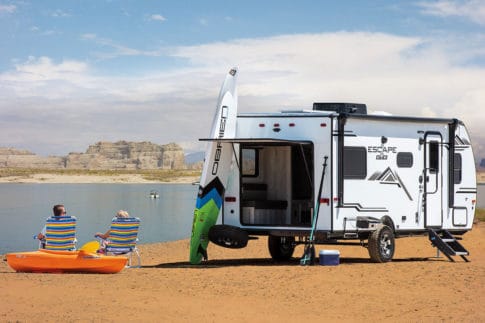
RV Review: KZ Escape E20 Hatch

3

By Tony Barthel
It used to be that the most popular vehicle in the U.S. was the sedan, first coupes and then four doors. Now our favorite is the pickup truck but, if you’re not buying a pickup you’re buying an SUV. Why? Flexibility. While RVs and trailers do have models that offer flexible floor plans, they don’t seem as common. However, KZ RV has created one that really intrigues me in their KZ Escape Hatch line, particularly the E20 model.

Three sizes of the KZ Escape Hatch

Available in three sizes, the KZ Escape Hatch is basically a smaller, single-axle trailer that has a large, 60-inch-wide by 66-inch-tall rear hatch door that flips up like the hatch of an SUV. This provides access to a cargo area in the back that can accommodate things like bicycles, kayaks and other adventure gear that many of us are taking with us. 

The obvious comparison would be to a smaller toy hauler like the Rockwood GeoPro 19FBTH. Like that model, the Hatch line are all single axle and narrower than some travel trailers. They’re only 90” wide, six inches less than a full eight-foot-wide travel trailer. 

The plus of this is that you may not need towing mirrors with some vehicles. Also, the narrower size can mean less wind resistance. 

The KZ Escape Hatch comes in three lengths, but I like the 20’ model the best. In fact, it’s very, very close to what my wife and I have been looking for as our own next rig. 

Up front there are two twin-sized mattresses with a space in the middle. But KZ includes a board, and it’s literally just that, which can go between the mattresses to turn them into one giant king-sized bed. Not bad for a 20’ travel trailer. 

Touring the interior

There is a hanging wardrobe at the entrance to the bedroom which has a ward (closet) at the top and two cubbies below – which would be perfect for the totes my wife and I use to transfer our clothes in and out of our existing trailer. There’s also storage above the bed area, so it seems that there’s certainly enough space for clothing. Furthermore, there is storage under the twin beds as well. 

The bath, which is opposite the entry door, is a dry bath consisting of a toilet and a shower… but that’s it. No sink nor any storage in there. In fact, in the images I saw of this trailer there isn’t even a vent fan in the bathroom, although there is a vent hatch. The lack of a sink doesn’t bother me nearly as much as the lack of a vent fan in the bathroom, although I do like that KZ’s shower enclosure goes all the way up to the ceiling of the trailer. 

The kitchen consists of a large round sink and a two-burner cooktop. There is enough counter space next to the sink, but what I would do, if this were my own trailer, is remove the gas cooktop altogether and replace that with a couple of induction cooktops. Then you have the whole kitchen countertop for prep and can break out those induction burners for the actual business of cooking. There is a microwave too. 

There’s good cabinet and drawer space, especially for a trailer this size. I like that there’s a cabinet that essentially contains what amounts to a sliding basket holder and you can remove those baskets and take them outside.

There is a decent pantry next to the kitchen, and next to that is a vertical space that holds three boards/platforms. You would use these between the benches in the back to turn them into one large bed across the rear of the coach. 

What’s in the back of the KZ Escape Hatch

But, when not a bed, the back is comprised of two benches that face one another. There are included free-standing folding tables that can go outside or be used between the benches. These tables fold down and can be stored in those benches. 

In the Rockwood model, the benches flip up but here they’re stationary. Still, there is plenty of space between them for kayaks or bicycles and that sort of thing.

That big hatch in the back is supported by gas props, just like in the hatch of an SUV. There’s a screen that goes over the opening so you could sit on the benches in the back playing a game of cards while enjoying a nice breeze, courtesy of that huge door with the screen keeping the bugs at bay. Slide open the windows above each of those benches and you have a nice open space. 

There are also cabinets above the benches for more storage. The last place you’ll find even more storage is in a pass-through storage compartment along the front of the trailer. 

There’s an optional package that I would get, which is the Off-Grid/Off-Road package which includes better tires and larger wheels. It also comes with 100 watts of solar on the roof and a 1,000-watt inverter wired into some of the trailer’s plugs. That package also includes a solar controller and a Furrion portable Bluetooth speaker and flashlight, tongue-mounted bicycle rack, griddle, and wiring for additional solar on the side (think a portable solar panel). This package also includes heated holding tanks. 

What I like – what I don’t

There are things I love about this trailer enough that I want to see one in person as a potential replacement for my own trailer. The floor plan and the fact that it’s lightweight yet able to carry cargo are huge pluses for me. I’m also surprised by the amount of storage in a trailer of this length – and the logical configuration of that storage, to boot. 

I also like that there are no slides, so it would be a great rig for stealth camping along the way to your actual destination. 

But there are a few things that dislike about this trailer, as well. For example, the fresh water tank is just 20 gallons but the gray water tank is 30. I’d love to see them swap fresh and gray tanks and use the gray tank to feed the black tank by letting you pump gray water through the toilet rather than using fresh water. Of course, this would be the first change I would make if I bought this trailer. I’ve modified the heck out of my own trailer, so there you go. 

I can’t believe there is no ventilation fan whatsoever in the trailer. Even a lousy fan is better than nothing, as you can replace a lousy fan with a high-performance one in a few minutes. 

Also, the water heater is only propane – no electric.

You can see how features cost money comparing this to the Rockwood, which is almost $8,000 more but features frameless windows, Azdel substrate in the walls, a Dexter Torflex suspension system, high-performance vent fans, gas and electric water heater, a three-burner stove and 22″ oven and more. Obviously, your own shopping priorities will dictate where your preference might be between these two rigs.

Still, this is a trailer even some mid-size pickups and SUVs can tow and has enough good features and smart packaging to really be a good adventure-seeking vehicle. I really like the design of this and, with about a day’s worth of modification time, could potentially see this occupying a space in my own driveway. 

These RV reviews are written based on information provided by the manufacturers along with our writer’s own research. We receive no money or other financial benefits from these reviews. They are intended only as a brief overview of the vehicle, not a comprehensive critique, which would require a thorough inspection and/or test drive.

-form broken-

Is the Good Sam Club reneging on a promise to some members?

By Dave Helgeson
Several months ago RV Travel ran an article announcing Good Sam Club CEO Marcus Lemonis would be launching a newly titled RV Magazine to replace its Trailer Life and MotorHome magazines for Good Sam members.

My wife and I have been members of the Good Sam Club since 1990. We converted to lifetime members in 2006, which has included a lifetime subscription to a Good Sam magazine. Like others, we have been awaiting our copy of the new RV Magazine. Having recently received a “Happy New Year” email from Good Sam with an offer to subscribe (for a fee) to the new RV Magazine, I figured it was time to reach out to Good Sam. I wanted to remind them that my wife and I were lifetime members and should be receiving a free quarterly edition of the new RV Magazine.

Lifetime magazine subscription included with lifetime membership

Free magazines for lifetime Good Sam members

Why a free quarterly edition, you ask? Most lifetime Good Sam members already know the answer, but here is the explanation for the rest of you.

For years, one of the major benefits of paying to become a lifetime Good Sam member was a lifetime subscription to Highways Magazine, which was published quarterly. When Highways Magazine was discontinued in 2014, Lemonis himself extended the lifetime subscription by offering lifetime members “four free” (quarterly) issues of Trailer Life or MotorHome Magazine. As a travel trailer owner, I chose Trailer Life, which I have been receiving quarterly free of charge since.

2013 Woodalls Press Release

When do we get the new magazine?

To find out when to expect our new magazine, I first reached out to “Marcus” via the “email me” at the MarcusVIP@goodsam.com “If You Are Not Happy, I’m Not Happy” link. The following response arrived – surprisingly not from Marcus: “Thank you for your time and email. I do apologize, because the subscription was tailored for the MotorHome/Trailer Life magazines, this has been discontinued for the new magazine. I apologize for this inconvenience.”

In responding, I pointed out that my lifetime subscription had been honored from Highways to Trailer Life magazines. I questioned why it should not be continued with the latest replacement, RV Magazine. I mentioned that surely it cost Good Sam no more to produce and mail the new magazine than the past magazines. In response, I was referred to the disclaimer on the Good Sam website that states “Benefits are subject to change.” Wow, dismissed without responding to my question!

Would a Good Sam member get respect on Facebook?

Next, I reached out on the Good Sam Facebook page, thinking lifetime members might get a little more respect there. I wrote, “As a Good Sam lifetime member will I receive the new RV Magazine in place of the discontinued Trailer Life Magazine I received in the past as part of my membership?” Good Sam replied, “Hi Dave! Go ahead and give us a call at 866-205-7451, we can help with that!”

Feeling a bit more hopeful that Good Sam was willing to honor its commitment, I called the number provided. A nice lady (who I will not name to avoid jeopardizing her job) promptly answered. After explaining my situation, she clearly understood and agreed with my line of reasoning. Placing me on hold while she checked with her supervisor, she quickly came back on the line. She was surprised and disappointed to learn Good Sam would not honor its lifetime subscription with the new magazine. She suggested I call the Marcus VIP help line, which she referred to as the “complaint line”!

Another less than truthful reply from the people at Good Sam

More online research on Good Sam members

Further online research revealed questions raised by paid annual subscribers to Trailer Life or MotorHome Magazine about the replacement magazine. Following are responses from Logan Zoot, presumably employed by Good Sam:

  • “RV Magazine will replace our legacy publications, Trailer Life & MotorHome”
  • “As a loyal subscriber, beginning January 2021, you will receive RV Magazine in place of Trailer Life/MotorHome for the length of your remaining subscription.”
  • “You’ll receive the same number of issues you would have with the previous publication.”

I did reach out to Logan Zoot, asking if my lifetime subscription to the magazine would be honored. I haven’t heard back.

My take on the whole situation

My wife and I became a lifetime Good Sam member when we were offered to upgrade to a lifetime membership. I recall it was many times the cost of an annual membership, but we figured it was worth it. So we signed up. I reasoned the club needed quick cash to make an acquisition. Where better to raise it than from your members. (This was 10 years before Camping World went public.)

After signing up, we received our lifetime membership card and a lifetime member decal for our RV. Like clockwork, we began receiving quarterly magazines.

Fast forward to today, when there’s another change in magazine names – a “replacement” magazine, according to Good Sam’s Logan Zoot. And with the change, it appears to me that CEO Lemonis has discontinued the magazine subscription to lifetime members as promised when I joined. By the way, a lifetime membership to the Good Sam Club now costs $399.

What does Good Sam Club get out of this?

How much does Good Sam stand to net out of this? I reached out to multiple sources at Good Sam to determine how many lifetime members are no longer being mailed their lifetime magazine subscription. When I asked how large of a windfall this would be for the company, they sent the following response: “That is not something I or anyone would know.” Funny! I felt like responding with, “Then how do you know which members to send membership renewals to or not?” But I figured, why bother.

Since Good Sam is unwilling to share, that leaves you and me to speculate.

As you have likely deduced by now, for me it’s no longer about the magazine at this point, but being sacrificed to Lemonis’ obsession to become “The Profit” at the expense of club members. Sadly, this is a far cry from the selflessness shown by the Biblical Good Samaritan that Good Sam was founded on.

Thank you for reading and letting me vent.

EDITOR’S NOTE: RVtravel.com editor Chuck Woodbury reached out to Marcus Lemonis at his personal email address, asking for an explanation about this. Lemonis did not respond.