By James Raia It comes as no surprise. Pickup trucks remained the country’s most popular new vehicles in 2020.
The Ford F-150 and Chevrolet Silverado 1500 ranked first and second among the top-10 best-selling vehicles last year, according to the search engine iSeeCars.com.
The Ford F-150 retains its status as the country’s most popular new truck for 2020.
The study looked at more than 12.9 million vehicle sales in 2020 to determine the most popular vehicles throughout the United States. The data was tabulated nationally, by state and in metro areas.
The Ford F-150 was the most popular new vehicle in 2020 in 25 of the largest metro areas and in 22 states.
Ford-150 retains top status
“The Ford F-150 has been America’s undisputed best-selling new vehicle for over 40 years, and the popularity of pickup trucks help contribute to its high volume of sales,” said Karl Brauer, iSeeCars Executive Analyst.
Four pickup trucks were among the top-10 most popular vehicles last year.
Four compact SUVs make the list, including the third-ranked Toyota RAV4, the fourth-ranked Honda CR-V, the sixth-ranked Hyundai Tucson, and the ninth-ranked Chevrolet Equinox.
“These compact SUVs are all reliable and affordable vehicles that stand out among their competition in this competitive segment,” said Brauer.
Rounding out the list are the seventh-ranked compact Honda Civic and eighth-ranked midsize Toyota Camry.
“The Honda Civic and the Toyota Camry have been among the best-selling cars in America for decades,” said Brauer. “These passenger cars have excellent long-term reliability, which is why they remain popular even as the popularity of the sedan segment declines.”
Here’s the list of the most popular new vehicles in the United States in 2020:
1. Ford F-150; 2. Chevrolet Silverado 1500; 3. Toyota RAV4; 4. Honda CR-V; 5. Ram Pickup 1500; 6. Hyundai Tucson; 7. Honda Civic, 8; Toyota Camry, 9; Chevrolet Equinox; 10. Toyota Tacoma.
James Raia, a syndicated columnist in Sacramento, California, publishes a free weekly automotive podcast and electronic newsletter. Sign-ups are available on his website, www.theweeklydriver.com. He can be reached via email: james@jamesraia.com.
Welcome to RVtravel.com, the newsletter for intelligent, open-minded RVers. Learn about RV camping, RV travel, RV news and much more.
This free edition of the RVtravel.com newsletter is posted at 9 a.m. (Pacific) every Saturday (that’s noon in the East). The member edition is published seven hours earlier, at 2 a.m. (Pacific). Readers who make even a one-time financial contribution to this website and newsletter automatically receive a permanent subscription to the member edition, ready for reading first thing with their morning coffee (or other beverage).
[activecampaign form=38]
Editor’s Corner
with Chuck Woodbury
Like most of you, I am sad about the violence at our nation’s capitol on Wednesday. But, no, I am more than sad. I am disgusted. It’s now noon Friday. I have been so upset by what happened that I have been unable to write until now.
I spent virtually all day Wednesday watching and reading the news. And I know many of you did, too, as traffic at RVtravel.com was half of normal. It picked up a little on Thursday, but was still way down.
The terrible incident was the result of an ongoing campaign of misinformation, gladly promoted by news media and in social media because it attracted big audiences and lots of dollars.
Those of you who know how the media works today understands that the easiest way to make money is to be controversial. “Fair and Balanced” is a joke: few online media outlets, right or left, even try to be unbiased anymore because it’s far easier to make tons of money by lying, bending the truth or exaggerating.
I can tell you, with my above-average writing skills, if I were unethical, I could triple my income by sensationalizing what we publish on this website. It would be so easy! I’d just rag on Marcus Lemonis over and over about his business practices – that always attracts big traffic!
When we go back through our traffic statistics, the topics where we stuck our necks out drew ten times the views (views = $$$) of tamer topics. Before the Internet, the slogan “If it bleeds it leads” was the mantra of many news outlets, especially local television. “Good News” stories were always shown at the end of the program.
We recently introduced a feature in our Sunday newsletter called “Good News.” And guess how popular it is? It’s not! Nobody wants to read good news. We post it anyway. If I wanted to make big money I wouldn’t mess with “good news.” I’d just make up an article with this headline: “Rat bites woman as she sits on her RV’s toilet.”
RVtravel.com, and the 500 newsletters about RVing we publish every year, would not be possible without the financial support of our voluntary contributors. Their support helps us avoid relying on advertising, and keeps our resource-rich work unbiased and free for all RVers to enjoy. Every contribution makes a difference. A donation of $20 a year comes out to 4 cents for each issue we publish. That’s all! And when you contribute, you receive a special member-only ad-free version of this newsletter as one way for us to say thank you. Learn more or donate.
Last week’s Tip of the Day in RV Daily Tips Newsletters
Today, industry insider Tony Barthel reviews the new 2021 Little Guy MyPod Travel Trailer. He writes, “The MyPod is a solid answer to folks who have very small vehicles but still want a trailer they can easily tow. How small a vehicle are we talkin’? The MyPod can actually be towed by some touring bikes and many trikes. Throw in things like the Prius or Mini Cooper and you’ve got a very, very towable machine.” Read more and take a tour.
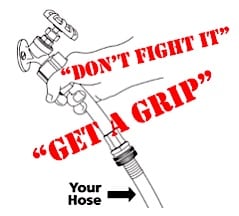
Quit struggling with hose and cable hookups at the campsite
Are you tired of struggling to hook up your coax cables, water hoses and other connections when you arrive at your campsite? It’s a snap with Cable and Hose Grips from J Wright Concepts. Save time and frustration! Life is too short to hassle with the little stuff! Learn more or order.
He bought an RV with $20,000 worth of damage. His warning to you…
By Randall Brink
I couldn’t have been happier on the day I took delivery of my Foretravel Grand Villa U300. I had done a lot of research and had decided on a Foretravel for its legendary quality and build. The Grand Villa had everything that a Class A RV owner could want and more (who really needs two ice makers?). I was also fortunate enough to find a Grand Villa within 100 miles of my home – another big plus. … I was soon to realize the danger in failing to look at all facets of an RV brand’s history. Read more.
Campground Crowding: Which state has highest cancellation fees?
More people than ever are taking up RVing. The result is campground crowding like never before. In this weekly blog, RV Travel readers discuss their experiences. This week our readers weighed in on when campsites are booked but no one shows up – how frustrating! We also compare park cancellation fees across several states (Yikes!), share some advice to snag a site, and then end on a positive note from Eric R. Read it all here.
New coast-to-coast trail lets you bike or walk across the U.S.
Forget RVing across the country – what about biking or walking cross-country? If that sounds like something you’d want to do, you’re in luck. The Rails-to-Trails Conservancy began working on the Great American Rail-Trail™ in 2019. Once completed, the trail will stretch more than 3,700 miles from Washington, D.C. to the state of Washington. Now that’s one way to sightsee! Continue reading.
Last year at this time, these were the most popular articles
Would you buy an RV made in China if the quality was equal to one made in the USA, but priced significantly less?
Please let us know. After you click your response, you’ll see how others have responded. Feel free to leave a comment. CLICK HERE.
The most popular poll in this past week’s RV Daily Tips newsletters:
Have you ever worked for one employer continuously for 20 years or more? See how almost 3,000 other RVers responded.
Are all RV ovens created equal? Do you use yours?
By Tony Barthel We recently posted a question on our RV Advice Facebook Group. I asked, “Some of you have been reading my RV reviews over on RV Travel, and one of the things I’ve kvetched about are the small 17″ ovens in so many RVs. But I wonder – if you do have an RV with this small oven, do you use it at all and what do you use it for?” Your responses to the questions were enlightening so I thought I’d share. Continue reading for what our readers said, including some great tips.
What is it? “World’s longest truck camper” or Class C motorhome?
We stumbled upon this photo. There was no explanation of what it is, where it is, or anything else. So we’ll ask you a couple of questions: Do you know anything about this RV? If so, please tell us by leaving a comment. And how would you classify it? Check this out then vote in our poll below the post.
Excellent resource about work camping
Some RVers depend on earning income while on the RV road. This can mean working at an RV park in the office or doing maintenance or working the holiday season in an Amazon warehouse. There are literally thousands of jobs available. This guidebook will help you get started, or help you brush up your present skills and/or learn about new work opportunities.
Is this your RV?
If it’s yours and you can prove it to us (send a photo for comparison), tell us here by 9 p.m. Pacific Standard time today, Jan. 9, 2021. If it’s yours you’ll win a $25 Amazon gift certificate.
If this isn’t your RV, send us a photo of your RV (if you haven’t already) for a chance to win in future issues.
In this past week two readers claimed their $25 gift card: Karen K. of Richfield, MN, and Frank H. of California.
We’ll have another photo in tomorrow’s newsletter (sign up to receive an email alert so you don’t miss the issue or those that follow). Some of these photos are submitted by readers while others were taken by our editors and writers on their travels around the USA.
Cars to flat tow: Buick Encore GX AWD review
Last week Nanci Dixon wrote that she was still looking for a tow car to “wow!” her. If you’ve been following along, you know her requirements and what she’s looking for. This week, she decided to take a look at the Buick Encore GX AWD. Read her in-depth review here.
Wacky mailboxes
We’ve got another installment of mailbox photos that our readers spotted in their travels. Wow! How do people come up with these? If you’re ready to laugh a little, and/or simply be impressed at the creativity of these mailboxes, then you need to click here.
Fruity fact or fiction: $20 bill with a banana sticker
By Russ and Tiña De Maris Critics both outside and inside the United States have plenty to say about the country. Recently, more than one disparager has described the U.S. as “acting like a banana republic.” Could it be due to a genuine U.S. $20 bill with a banana sticker that came out of a Texas U.S. Treasury printing plant? Sound like one of those great internet fakes? Nope, it actually happened – and it’s proved to send “bill collectors” bananas. (Any numismatists reading this?) Read more.
We’ll select a winner at random out of all entries we receive today (January 9, 2021) by 7:00 p.m. Pacific Standard time. Remember, you can only enter once and after we notify you by email via RVcontests@gmail.com that you won, you have 24 hours to respond or we’ll give the prize to someone else.
JUST PUBLISHED Firearms laws guide updated for 2021
The 2021 updated edition of the Traveler’s Guide to the Firearm Laws of the Fifty Stateshas just been published. The book is always a best-seller among RVers, many of whom carry a firearm. The annual guidebook helps ensure they stay out of trouble when crossing state lines. What’s legal in one state may be a felony in another. More than 100 updates from last year. Learn more or order.
Brain Teaser
Fill in the middle word. This word should correspond with the first and last word.
1) Street _____ Jack
2) Bird _____ Bed
3) Shopping _____ Lady
4) Orange _____ Stump
5) Stamp _____ Lock
6) Wet _____ Fill
7) Air _____ Pad
8) Pocket _____ Keeper
9) Life _____ Company
10) Wish _____ Fragment
(Answers in tomorrow’s Sunday newsletter.)
Resources
Stolen RVs — Help us recover these stolen RVs. The more eyes we have searching for them, the better chance of getting them back to their rightful owners, and maybe putting the crooks who stole them in the slammer! See the stolen RVs.
Where to complain about bad RVs, dealers, service, RV parks. This is an ever-expanding list of resources where you can report, share or discuss your problems with RV manufacturers or dealers.
Directory of RV parks with storm shelters
In case you’re on the road with your RV and the weather report is showing a tornado headed your way, have this list handy.
What does financing an RV for 20 years REALLY mean?
In case you missed this article the first time around, here it is again. Important! Click here.
Stuck with a lemon RV?Contact Ron Burdge, America’s premier RV lemon law attorney.
RV Gadgets and Gizmos
Nifty device tells you if your RV is dangerously overweight
The CURT BetterWeigh™ is a device that hooks to your vehicle’s OBD II port and reads a combination of factors to deliver readings on vehicle weight, tongue weight, pin weight, payload and weight distribution. It appears to use sensors in the device itself to measure the vehicle’s angle (how much the springs deflect when you hook up your trailer) and combines that with information from the vehicle’s computer to achieve other measurements. All of this is delivered via Bluetooth to your smartphone or tablet via a proprietary app. Learn more.
Featured video
John Lennon’s RV gift to his son, Julian
In 1967, the Beatles’ John Lennon gave his 4-year-old son, Julian, a caravan (the British word for travel trailer). This is hardly a typical RV, and you have to wonder why Lennon would give something like this to his small child. Too bad this video is not in color.
This is one cool puzzle!
If you’re like a majority of people, you’ve done a puzzle or two (or 10) during quarantine. If you’re in need of a new one, check this one out. A vintage car with an Airstream on the beach. Puzzles don’t get much cooler – plus the sunset is beautiful! Get one for yourself here. It’s the perfect winter activity!
RV Electricity
What is a GFCI nuisance trip?
Dear Readers, I’ve been posting a number of short articles on my RVelectricity Facebook Group about GFCI “nuisance” tripping when your RV’s shore power cord is plugged into a 20-amp outlet at your house. And one astute reader asked the most basic of questions: “What is a nuisance trip?” Of course, there are all kinds of possible jokes about using myself as an example of what a nuisance really is, but it is a real thing in GFCI circuits. Read more.
Last call – Mike needs your assistance
If you didn’t already answer the poll regarding “Have you ever plugged your RV shore power cord into a GFCI outlet and had it nuisance trip?” would you please vote now. Mike is gathering information for a research project he’s working on (possible correlation between the GFCI and potential hot-skin condition) aimed at RVers’ safety. The poll is included in the above post. Thank you!
This week’s J.A.M. (Just Ask Mike) Session:
Don’t let your connections corrode
Dear Readers,
I’ve received a number of emails and Facebook comments this week about 30-amp RV extension cord plugs overheating and melting. Now, these particular failures aren’t where the shore power cordset is plugged into the pedestal or the RV itself. These meltdowns seem to occur where a 25-ft. extension cord is plugged into the RV’s shore power cordset. And, yes, many times it’s the connector that’s laying on the ground. Continue reading.
?????? MYSTERY PRODUCT OF THE DAY ?????? This is one of those things you’d probably love to give to someone you don’t really like… Their reaction would be hilarious! Check it out.
RV Tire Safety
Can a “sealant” to prevent flat tires cause problems?
By Roger Marble I just read a tale of woe about from a motorhome owner who appears to have been sold a tire sealant that caused nothing but problems. Names have been changed to protect the “innocent.” Read what the problems were, and please let us know if you’ve encountered similar problems with your tires.
RV Short Stop
‘Ma’ Rainey House & Blues Museum Columbus, Georgia
With the recent premiere of the film “Ma Rainey’s Black Bottom,” the legendary blues singer Ma Rainey is introduced to a new generation. Often referred to as the “Mother of the Blues,” she was a musical revolutionary, incorporating various styles of blues, jazz, and her own personal flair. Continue reading about this exceptional woman.
Check back here next week for the latest regarding Building an RV Park. You won’t believe Machelle James’ terrible news! (Good thing she’s a self-proclaimed “Warrior.”)
Reader letter
Dear editor,
If I go to a dealer and order my new 5th wheel, do I lose my bargaining power? —Rick M.
Dear Rick,
I guess if you sign on the dotted line that you will accept the RV, then I think yes, you would lose some bargaining power. My advice, though, is to never buy an RV sight-unseen. For many buyers who do it, things work out. For others it can have ugly consequences. So are you a gambler? My advice is talk to a lawyer before signing any paperwork if you’ll be buying sight-unseen. —Chuck Woodbury, editor
Don’t let winter keep you in the dark!
This 6-pack of tiny, battery-powered LED “Button Lamps” is just what you need for your RV’s closets and storage spaces. The tiny lamp is ultra-bright and has all the power of a normal-sized lamp. Backed with a strong adhesive, these little lamps will stick to any surface. They’re waterproof and good to have in case of an emergency. Learn more or order.
RV Fire Safety
An emergency fire plan that can save your life – Part 7 of 13
Having a solid fire escape plan may help you replace panic with logical, life-saving actions if a fire occurs. Knowing exactly what to do and doing it quickly can make a big difference in an emergency situation.
For your fire drill, start by rolling out of bed and crawling low on the floor where the air is clearer. Proceed immediately to your pre-determined safe meeting place and make sure no one is missing. If you are worried about a pet, know your animal’s instinct will be to escape the fire. Although it may seem callous to think through how you’d react if your pet were trapped inside your burning coach, make a decision now whether your pet’s life is worth risking your own.
Courtesy:Mac “The Fire Guy” McCoy
Make sure to have this Fire Extinguishing Aerosol in your RV The First Alert Tundra Fire Extinguishing Aerosol Spray is easier to use and discharges 4 times longer than traditional fire extinguishers. With an aerosol nozzle and portable size, it’s suited for the kitchen, car, garage, boat or RV. The formula wipes away with a damp cloth & is biodegradable. Learn more or order.
Museum of the Week
Centers for Disease Control Museum
Atlanta, Georgia
If you want to visit the CDC in Atlanta, GA, you might as well visit their museum, at their headquarters, as well. Fun fact: The CDC is headquartered in Atlanta because their original job, in 1946, was to fight malaria. Atlanta had a terrible malaria problem at the time, so that’s where they placed their headquarters. The CDC’s museum isn’t exactly one of the most pleasant museums – you’ll learn about every outbreak and public health horror that has happened throughout the last several decades. However, it sure is fascinating. It’s currently closed due to COVID, but as soon as it opens again, we suggest you check it out. In the meantime, they have online exhibitions for you to enjoy.
Make your phone screen quadruple in size!
This phone screen magnifier amplifies your phone screen 3 to 4 times its size. Using HD zoom optical technology, this lightweight projector is perfect for when you don’t have access to a TV and want to watch videos on your phone. It doesn’t need a power supply, so you never have to charge it. Check it out here.
Readers’ Pet of the Day
“This is Tinker Belle. She loves to sit on the dash of the motorhome and see the highway sites. Sometimes we refer to her as ‘Stinker Belle’ as she permeates the atmosphere.” —David Ozanne
Hungry for a sandwich? You’re not the only one! About 49 percent of American adults eat a sandwich every day.
Laugh of the Week
Have you ever seen the 2006 comedy “RV”? There’s one scene in it that is utterly disgusting, but laugh-out-loud hilarious. We hope this never happens to any of you! Watch the short clip here.
Editor and Publisher: Chuck Woodbury. Editor: Emily Woodbury. Managing editor: Diane McGovern. Senior editors: Russ and Tiña De Maris. Senior writers: Nanci Dixon, Tony Barthel. Contributors: Mike Sokol, Roger Marble, Dave Helgeson, Janet Groene, Julianne Crane, Chris Guld, Machelle James, James Raia, Barry and Monique Zander, J.M. Montigel, Clint Norrell, and Andrew Robinson. Social media and special projects director: Jessica Sarvis. Moderators: Gary Gilmore, Linda Brady. Financial affairs director: Gail Meyring. IT wrangler: Kim Christiansen.
FOREVER IN OUR MEMORIES — OUR STAFF MEMBER IN HEAVEN, Gary Bunzer, the RV Doctor, who was taken from us by the coronavirus.
Honorary Correspondents: Loyal readers who regularly email us leads about news stories and other information and resources that aid our own news-gathering efforts. • Mike Sherman • George Bliss • Tom and Lois Speirs • Steve Barnes • Tom Hart + others who we will add later.
REGIONAL AND LOCAL ADVERTISING: We can now run banners on RVtravel.com in your town or in a designated area near you, for example to readers within 100, 200, etc., miles of your business. For information contact advertising@rvtravel.com .
Everything in this newsletter is true to the best of our knowledge. But we occasionally get something wrong. We’re just human! So don’t go spending $10,000 on something we said was good simply because we said so, or fixing something according to what we suggested (check with your own technician first). Maybe we made a mistake.Tips and/or comments in this newsletter are those of the authors and may not reflect the views of RVtravel.com or this newsletter.
RVtravel.com is a participant in the Amazon Services LLC Associates Program, an affiliate advertising program designed to provide a means for sites to earn advertising fees by advertising and linking to Amazon.com. As an Amazon Associate we earn from qualifying purchases. Regardless of this potential revenue, unless stated otherwise, we only recommend products or services we believe provide value to our readers.
By Chuck Woodbury CONTINUED FROM RVTRAVEL NEWSLETTER ISSUE 982
Like most of you, I am sad about the violence at our nation’s capitol on Wednesday. But, no, I am more than sad. I am disgusted. It’s now noon Friday. I have been so upset by what happened that I have been unable to write until now.
I spent virtually all day Wednesday watching and reading the news. And I know many of you did, too, as traffic at RVtravel.com was half of normal. It picked up a little on Thursday, but was still way down.
The terrible incident was the result of an ongoing campaign of misinformation, gladly promoted by news media and in social media because it attracted big audiences and lots of dollars.
Those of you who know how the media works today understand that the easiest way to make money is to be controversial. “Fair and Balanced” is a joke: few online media outlets, right or left, even try to be unbiased anymore because it’s far easier to make tons of money by lying, bending the truth or exaggerating.
I can tell you, with my above-average writing skills, if I were unethical I could triple my income by sensationalizing what we publish on this website. It would be so easy! I’d just rag on Marcus Lemonis over and over about his business practices – that always attracts big traffic!
When we go back through our traffic statistics, the topics where we stuck our necks out drew ten times the views (views = $$$) of tamer topics. Before the Internet, the slogan “If it bleeds it leads” was the mantra of many news outlets, especially local television. “Good News” stories were always shown at the end of the program.
We recently introduced a feature in our Sunday newsletter called “Good News.” And guess how popular it is? It’s not! Nobody wants to read good news. We post it anyway. If I wanted to make big money I wouldn’t mess with “good news.” I’d just make up an article with this headline: “Rat bites woman as she sits on her RV’s toilet.”
Actually, I will write such a fake story for you right now to show you how convincing a 100% fake story can be. You can read it here. The fake story I will write will be about how the woman left her RV’s black tank valve open and a sewer rat climbed up through the hose into the holding tank and then somehow got into the toilet bowl. The story will further state that the woman sat on the pot and then “ouch!” – the rat took a big old bite of her butt! You know me well enough to know I would never write such a story (except for my fake story here). But I am telling you, unethical, money-hungry publishers do it all the time.
Remember the story of the guy who put his Winnebago on cruise control so he could go into the back of the RV to make coffee, and the RV crashed, and then he sued Winnebago and won $1,750,000? That now-urban myth has been viewed millions of times over a decade – but it’s 100% fake!
Fox News will never say, “You know, we think Joe Biden is a decent guy and we should give him a chance.” It would lose half its audience and couldn’t continue to pay its hosts millions of dollars a year.
Rush Limbaugh is quoted as saying this: “Never be ‘down the middle’ on anything. Nothing is worse for the ratings than ‘well, on the other hand,’ or ‘both sides have a point.’ If you are against something, be against it 100%. Anyone who feels other than you do on the issue is wrong.”
Rush would be out of business if he had a change of heart and quit bashing Biden and his cronies. The same is true for other talk show hosts, websites, cable TV channels, and for social media stars. This goes for liberal and conservative media.
As a purveyor of fake news you take your stand, promote lies and conspiracy theories as often as possible, and watch your readership and income soar. After 20 years of publishing online, I know this principle well, and I know that unethical publishers can make huge incomes spewing lies and even hate. And just like with advertising, the more times a message is delivered, the more people believe it. Is Tide really the best detergent? Some people think so because commercial after commercial tells them so. And one day, someone who has heard the message 50 times believes it without question — “Yes, Tide is better!” The same goes for political messages.
I will receive angry mail over what I write here. I will be called every name in the book. Some will write, “I read this newsletter to read about RVing! This does not belong here!” Well, I agree that most of what we write here SHOULD be about RVing (and that is what we do 99% of the time). But sometimes I feel strongly about something and choose to write about it. Most readers are fine with this.
After reading this essay, dozens of readers will write me and say they unsubscribing. “I will never read another thing you write.” But I can tell you, most will return anyway out of curiosity.
But I’m not stupid when I write something that I know will stir the pot and cost this website subscribers. When I write honestly and without fear of losing a hundred or even a thousand readers, open-minded readers appreciate this website even more. We almost always end up gaining more subscribers than we lose. Some of those who appreciate our honesty will be motivated to contribute financially to our efforts because we dare to take a stand, unlike 99% of all other RV websites which are so scared of offending an advertiser that they keep their mouths shut!
For the record, only a small part of our income comes from advertising. Every week, more readers support us financially, which provides our financial foundation. So I don’t tell our writers to avoid writing something that might offend a particular manufacturer or other RV-related business. “No, write honestly,” I say.
I hope the following happens in 2021: I hope the pandemic ends and our lives can return to normal. I hope all those people who lost their jobs due to no fault of their own will get them back. And I hope that our elected officials tone down their rhetoric. As a proud member of the news media for 40 years, I am thankful that our incoming president views the media of vital importance to a democracy and not as its enemy. Take a Journalism 1A course at your local community college and you will understand.
Your comments welcome. But keep them civil. I reserve the right to remove rants or those that are disrespectful.
This article is fake. It is totally made up. I did not have to tell you that. I could have just passed it off as true. The names of the people and places are made up.
So again, this is truly “fake news” and as such it is among millions of other stories on the Web that are also totally fabricated. Sensational stories like this are almost always shared on social media, often for years, earning those who publish the lies lots of money.
So is here is my fake story:
Rat bites woman as she sits on her RV’s toilet
A Lexington, Kentucky, woman got a big surprise last Wednesday when she sat down on her motorhome’s toilet and got bitten by a sewer rat. “Who would ever imagine something like that could happen?” she said later.
Susan Smith and husband, Henry, retired last March, sold their suburban home and bought a 2014 Winnebago Adventurer motorhome to see the USA. “We’d dreamed about doing this for years,” Susan explained.
It was the couple’s first RV. “Looking back, we were clueless about how to operate everything,” said Henry. “I guess that lack of knowledge came back to bite us in the butt,” he said, laughing.
“We had no idea that we should have kept our sewer tank closed when we had a sewer hookup in a campground,” he said. “We just assumed it was best to keep it open. I know now, of course, that wasn’t a good idea.”
No, this is not Susan and Henry. It’s a free, stock photo. But we didn’t need to tell you that and you would assume this was the RVing couple.
AS MOST RVers KNOW, both the black and gray water tanks should remain closed until they are nearly full, and then dumped. Many RVers who have not done so have reported that sewer flies have ended up in their toilet bowl. But until now, no one has ever reported a rat in their commode.
The bizarre rat incident came on the Smith’s final night of a 7-day stay at a Tennessee State Park.
“I just sat on the toilet as I always do,” Susan explained. “I didn’t look at the toilet before sitting down.”
She said it was only seconds after she did that she felt the bite. “I jumped up immediately,” she said. “It was very painful.”
It was only when she looked into the toilet bowl that she realized what had happened. “This large rat was just standing there, staring a me! It was covered with waste. It was the ugliest creature I have ever seen in my life.”
Meanwhile, blood was dripping onto the bathroom floor. Henry helped clean Susan’s wound and capture the rodent, which they took with them to the hospital to be sure it did not have rabies (it did not).
Nobody has yet determined exactly how the rat ended up in the toilet bowl. “All I can tell you is to keep your sewer tank valve closed unless you are actually dumping,” Susan said.
EDITOR’S NOTE: This is an example of fake news. It never happened. Susan and Henry are not real people. If we would have tried to pass this off as a true incident, we are sure it would have attracted a huge audience, and those views would have earned us a tidy amount of money.
Have you seen the movie “RV”? It’s a 2006 comedy starring Robin Williams, who plays Bob Munro. Bob and his dysfunctional family rent an RV (from a shady rental dealer) to road trip from LA to the Rockies, where they meet an unusual group of campers. The movie is hilarious and shows many scenes RVers can relate to.
The best scene in the movie “RV”? It may be the one below, when it’s time to dump the tanks. You can only imagine what happens…
Watch the scene below. It’s disgusting, but we know you’ll laugh. And if you want to watch the whole movie, you can find it to stream on Amazon.
This is our review of the 2021 Little Guy MyPod travel trailer, which should resume production about the time you read this.
ByTony Barthel What is the definition of a travel trailer? Well, for some it’s a place to sleep that keeps you off the ground at night with some provision for managing temperature. In that case, the MyPod trailer by Little Guy Trailers qualifies.
The MyPod is a solid answer to folks who have very small vehicles but still want a trailer they can easily tow. How small a vehicle are we talkin’? The MyPod can actually be towed by some touring bikes and many trikes. Throw in things like the Prius or Mini Cooper and you’ve got a very, very towable machine.
Big things in little packages
The MyPod’s total dry weight is just 760 pounds with a tongue weight of just 110 pounds. That’s probably less weight than the driver in the vehicle or whatever junk is in the trunk.
What you get in this small package is a completely enclosed fiberglass “egg” that incorporates a mattress, TV, air conditioner and some storage. Furthermore, there’s a platform on the tongue if you want to bring a small generator. It’s a nifty little package that may be right for some campers.
Competitors
One of the things that may make this a good alternative to the Time Out Deluxe trailer is that it’s all enclosed in fiberglass. Some parks where there are bears don’t allow folding trailers. So if you’re a motorcycle enthusiast who also wants a trailer, this may make more sense if that’s where you want to venture.
While this has a similar shape to the Aliner Ascape, you’ll find that that trailer is much larger and incorporates more amenities. The RV industry is really terrific – there truly is something for everyone and it’s great to have these choices!
Amenities in the 2021 Little Guy MyPod
Inside the MyPod it’s a pretty simple affair. On the far wall, in the nose of the trailer, is a small air conditioner, a stereo system with Bluetooth, a single cabinet that runs the width of the nose and then a 12-volt television.
All around you, the entire interior shell has been covered with carpet to deaden sound and provide some insulation. Since there is no propane system, there is also no heater – so this could be a fair-weather camper. However, it does have a 30-amp connection and a 110vac electric plug, so you could consider bringing a small electric heater. It wouldn’t take a lot to make the interior of this very cozy.
There is also a high-performance fan on the roof and a large window in the rear access door. The fan can blow in or out, so you can use this to create some significant airflow in this small space.
The floor is where you’ll find a folding mattress that’s 52” X 76” – so slightly smaller than a full-sized mattress. That mattress folds in half so you can sit on it during the day and sleep on it during the night.
The blinds on the two side windows are interesting in that they’re alternating rows. Essentially you just sort of swipe them open and closed. The two side windows don’t open.
The downside
Clearly, in something this small and light there’s no standing room, and also absent are any water systems whatsoever. There’s also no toilet. The plus side of this is that winterization is not something you’ll ever have to think about.
Furthermore, this will fit into almost any garage so that slick egg-shaped shell will stay new-looking for years. In fact, there is a whole fan club for these things with lots of enthusiastic owners.
Speaking with Joe Kicos from Little Guy, he indicated that the MyPod production for 2021 will resume soon. For those who might want a very lightweight trailer that offers the benefits of being hard-sided, this could be a great choice.
These RV reviews are written based on information provided by the manufacturers along with our writer’s own research. We receive no money or other financial benefits from these reviews. They are intended only as a brief overview of the vehicle, not a comprehensive critique, which would require a thorough inspection and/or test drive.
Got an RV we need to look at? Contact us today and let us know – thank you!
By Tony Barthel The CURT BetterWeigh™ is a device that helps vehicle owners determine tow weight, cargo weight and other factors in their vehicle’s towing through the use of the OBD II system and a smartphone app via Bluetooth.
CURT, a manufacturer of hitches of all sorts as well as other components, sent me a BetterWeigh device to test out. CURT is a member of the Lippert Family – you probably recognize that name as they are a manufacturer of all sorts of RV components.
So what is it?
The CURT Better Weigh screen on my iPhone
The Curt BetterWeigh™ is a device that hooks to your vehicle’s OBD II port and reads a combination of factors to deliver readings on vehicle weight, tongue weight, pin weight, payload and weight distribution.
It appears to use sensors in the device itself to measure the vehicle’s angle (how much the springs deflect when you hook up your trailer) and combines that with information from the vehicle’s computer to achieve other measurements. All of this is delivered via Bluetooth to your smartphone or tablet via a proprietary app.
The CURT BetterWeigh uses what the company calls “TowSense™” technology. From the manufacturer: “TowSense technology is a digital towing scale system. Using an accelerometer circuit, TowSense measures changes in the velocity and pitch of your vehicle. It uses this data to calculate weights associated with towing and hauling.
“The BetterWeigh tongue weight scale wirelessly connects to your Apple or Android phone to display the weight of the vehicle, trailer, cargo/payload, tongue weight, pin weight, weight distribution and trailer brake gain.”
Setting it up
I plugged the CURT BetterWeigh™ into my 2015 Ram 1500’s OBD II port and went through the setup. This means telling the system what kind of vehicle I have and, by inputting the serial number, it knows the year, make and model along with which engine, transmission and gear ratios are on the truck.
From there, you drive the vehicle on a straight, flat road several times to get the calibration. This determines how much accelerator pedal input is used to achieve certain vehicle speeds so you have a benchmark.
The setup process is pretty specific but is necessary so the BetterWeigh system establishes a benchmark for your vehicle and then whatever you’re towing or have as cargo in the bed.
Does the CURT BetterWeigh™ work?
After calibrating the BetterWeigh with an empty truck, I added my travel trailer, a 2017 Rockwood Mini Lite 1905s – a relatively small and light trailer. The BetterWeigh estimated that I had over 550 lbs. of weight on the tongue of that thing. Considering that the trailer’s dry weight is about 2800 lbs. and it was full of water and supplies for a week’s worth of camping at the beach, I believe it was fairly accurate.
The calibration phase also has an idea of what the truck weighs unloaded, so I gave it a test to see what it thought my trailer weighed. It was closer to 4,200 lbs. Let’s see – cast iron cookware, a week’s worth of beer, winter clothing and blankets and 30 gallons of water. I believe it was pretty close to accurate, considering this was like lying to yourself that the holidays didn’t pack on many pounds even though that lousy scale reads otherwise. In other words, I would have guessed that the trailer was lighter than this but, in actuality, it wasn’t. While I didn’t drag it to a CAT scale to verify the numbers, I don’t have reason to think it was tremendously inaccurate.
I also ran the tests on the way home and the tongue weight did drop (no more fresh water but a full tank of black water, which is in the back of my trailer). Furthermore, it estimated that the trailer was about 3,800 lbs. which, again, seems accurate. I drank all the beer.
Is the CURT BetterWeigh™ worth it?
I’ve seen a few reviews of this device online and some folks are really happy with it, others not. It seems the difference may be in the vehicle itself. The Ram pickup line seems to work very well with this, but I can’t speak to the other brands of vehicles.
I think this is a decent way to get some idea of what’s going on with your weights, but still no substitution for a CAT scale or equivalent. From my own experience, I think the numbers it provides are reasonably accurate but certainly not certified, as you’d get from a true scale.
According to Steve Kass from RV WeighSM, who has weighed hundreds of RVs at FMCA rallies and other events, the number of RVs that are overweight is significant. Honestly, it’s wise to have some idea of what you’re towing back there and how close you are to the capacity of your tow vehicle.
Considering how easy this device is to use and how handy it is, for $99 on Amazon it seems well worth it, especially for anyone who might be even moderately close to the maximum towing capability of their vehicle.
What is OBD II?
As part of the overwhelming regulation in the auto industry, all vehicles sold in 1996 and beyond need to have an On-Board Diagnostics (OBD) port. This is a second-generation system so is labeled OBD II.
Essentially this gives anyone access to much of the technological functionality going on in the vehicle computer systems. Using a standardized connector, the idea was that technicians can read what’s going on internally, which helps them diagnose vehicles as they become ever more computerized.
Today, a modern vehicle uses computer technology to manage the engine, transmission and often much more. Emissions sensors, oxygen sensors and so much more are the key to why our vehicles have more power and are more efficient at burning fuel when all systems are go. Yaw sensors, sway sensors, braking input, throttle input and other digital babysitters are the key to why cars are safer today. Basically, technology can replace a lot of the knowledge we used to have to keep our vehicles on the straight and narrow.
In fact, my own truck utilizes some of these vehicle dynamic sensors to help eliminate trailer sway by applying braking to the trailer if it senses sway. This is what a smart driver would do but, let’s face it, we’ve all seen others who aren’t smart drivers.
Any complex technological system can also fail, and does, especially when combined with the tremendous heat and unforgiving realities under the hood of a vehicle.
What I do with my truck’s OBD II
Furthermore, idiots like me can access the various functions in their vehicles and actually modify or hack them. My own Ram pickup has all sorts of computer subsystems for the body (lighting controllers, etc.), emissions, and more. The list of computers that appears when I get into the OBD II system is incredible.
These systems allow the Ram to shut off four of its eight cylinders to improve fuel economy when cruising. But the level of computerization and sophistication can also be an issue when something goes haywire.
So when these systems go haywire, the OBD II system was designed to allow a technician to peek into what’s going on and use the system’s reporting to make a change in less time.
Or, just modify the heck out of your truck’s electronics and then wonder why it runs funny.
I need your assistance
If you didn’t participate in this poll (from last Saturday) previously, would you please vote now to help me gather information for a research project I’m working on (possible correlation between the GFCI and potential hot-skin condition) aimed at RVers’ safety. It may take a moment for the poll to load. Thank you!
By Mike Sokol
Dear Readers, I’ve been posting a number of short articles on my RVelectricity Facebook Group about GFCI “nuisance” tripping when your RV’s shore power cord is plugged into a 20-amp outlet at your house. And one astute reader asked the most basic of questions: “What is a nuisance trip?”
Of course, there are all kinds of possible jokes about using myself as an example of what a nuisance really is, but it is a real thing in GFCI circuits. However, to understand what a nuisance trip is, you first need a short lesson on what a nuisance ground fault current is. And it’s not that complicated (even though it even confuses electrical engineers at times).
Stop being such a nuisance (trip)…
As I’ve often noted in my technical papers, everything you plug into an electrical outlet leaks a little AC current to its chassis. It really does…. Now, it’s not necessarily a dangerous amount of leakage current, but it is real and it is measurable. For example, if you plug in your iPhone to a wall charger and measure the metal case of the phone with respect to ground you will find it hovering between 60 and 80 volts AC.
WHAT???? Yes, with a high-impedance meter you can measure that it really does measure that kind of voltage when plugged into a 5-volt DC charger. That’s because there’s a small amount of line-to-chassis leakage current inside of your wall charger.
Is that dangerous?
The vast majority of these ground leakage currents are very small, on the order of 0.0001 amperes (that’s a few hundred microamps or a fraction of a milliamp). So they are not dangerous at all. In fact, you’ll never even feel the slightest tingle from a 100-microamp shock. But it is measurable, and it is a real thing.
Note that there are specific tests run by Underwriters Laboratories setting the maximum leakage current of most appliances in the USA to less than 0.8 mA (that’s 0.0008 amperes of current).
However, if that leakage current exceeds 10mA or so, it can be very dangerous to your heart. So the job of the GFCI circuit is to monitor a branch circuit for any leakage currents that exceed 5mA, and shut off the power if it reaches that threshold. Pretty simple, isn’t it?
What’s a GFCI nuisance trip?
Well, let’s define a “nuisance trip” first. Note that a GFCI (Ground Fault Circuit Interrupter) is there to monitor ground fault currents, and will trip off the power if the leakage exceeds 5mA (that’s 5 milliamps or 0.005 amps) of current. And, of course, that’s what shuts off the power. But most people don’t understand that the leakage currents of ALL of the appliances in your RV add together.
So a fraction of an mA leakage current here, a couple of mA leakage current there, can quickly add up to around 5mA when several appliances are all on. Yes, these leakages are all additive, so you may never have a GFCI trip until two high-leakage things are turned on at the same time.
Note that one of the more leaky gadgets in your RV is the humble surge protector strip. Another one is the battery charger/converter on your RV’s incoming power. Both are allowed to leak up to 3mA of fault current and still pass UL testing. Yikes!!!
So is that 5mA leakage actually dangerous?
Not really, especially if your shore power cord (and RV) is properly grounded through the pedestal. That 5 or 10 or even a few hundred mA of leakage currents will be harmlessly drained away by your safety ground (specifically called your EGC for Equipment Grounding Conductor). That means it can never create a hot-skin voltage on your RV, nor can it shock you.
Then why does it trip if it’s not dangerous?
Well, the GFCI circuit doesn’t know the difference between a human being getting shocked, and the safety ground wire getting rid of these leakage currents. It just knows that more than 5mA of leakage currents are occurring, so it shuts down the power to save you from getting seriously shocked, and possibly even killed. That’s why it’s a bad idea (and a code violation) to replace any GFCI outlet with a non-GFCI outlet.
Why is this a nuisance for your RV?
Because the GFCI often seems to trip when you’re not around to know it even happened, you can come back to your RV after a long day away and find that your residential refrigerator is off and the contents have melted. Or your battery charger/maintainer that you plugged in for the winter isn’t keeping your battery charged over the winter months, or the air conditioner you had running for your pets is no longer keeping it cool. And that’s a real nuisance that can be expensive and/or heartbreaking when it happens.
What to do about a GFCI nuisance trip?
That’s too much to cover in this column, but I’ll be writing about this phenomenon more in my RVelectricity Facebook group in the next few weeks. I’ll also be posting videos here about how to measure RV leakage currents that are too small to trip your shore power GFCI but which can lead to nuisance tripping. Stay tuned, because this is going to be a LOT of fun.
Let’s play safe out there….
Mike Sokol is an electrical and professional sound expert with 50+ years in the industry. His excellent bookRV Electrical Safety is available at Amazon.com. For more info on Mike’s qualifications as an electrical expert, click here.
For information on how to support RVelectricity and No~Shock~Zone articles, seminars and videos, please click the I Like Mike Campaign.
Say a new RV company came onto the market. The RVs they’re making are absolutely gorgeous! They have a great floorplan, unique design, high-end appliances, and the interior is classy yet modern. The quality is the same as U.S.-made RVs. It’s exactly what you’ve been looking for and it’s even a bit cheaper! The catch? It’s made in China. Would you still want to buy it?
Or, another scenario: Say Winnebago (or insert your favorite RV manufacturer here) shuts down their U.S. factories and begins making their RVs in China. Nothing is different except the pricetag is lower. Would you still want to buy a Winnebago?
Please answer in the poll below, and leave a comment, too, explaining your answer. We’re curious to hear your thoughts. Thanks!
Here is another installment of Mailboxes along the Road – unique, funny, outrageous and/or otherwise creative mailboxes the readers of RVtravel.com have spotted while traveling North America in their RVs (and sometimes without their RVs).
Keep the photos coming! Submit them at the bottom of this page.
Marie Beschen took this in Beverly Hills, California, while she was walking around the neighborhood with friends. “I love taking pictures of unusual mailboxes and this one struck my fancy,” she wrote. Thanks for sending, Marie! Now send us some more mailbox photos!
Barry Haitt spotted this unusual creation – a motorcycle gas tank recycled as a mailbox. “I saw it while bicycling in a neighborhood in Marathon,” he wrote. Thanks for sharing this with us, Barry!
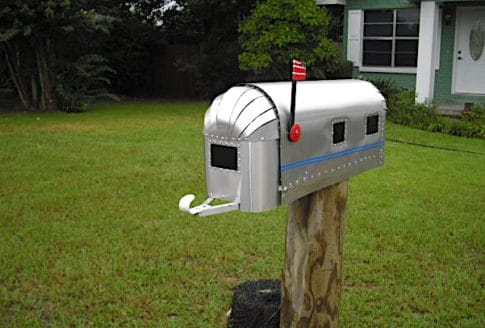
We don’t know who sent this, but we have a good idea the mailbox is owned by Airstream fans!
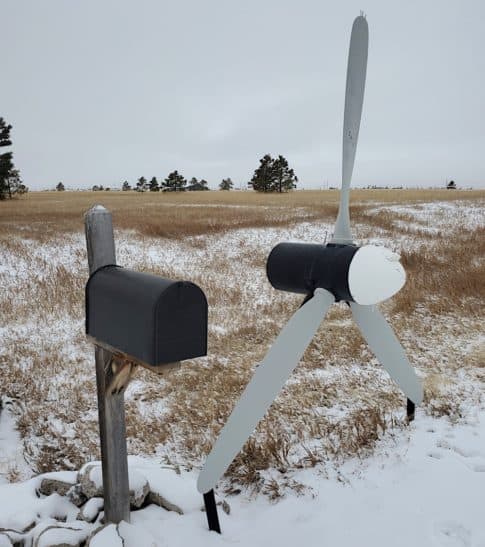
Frank Niehus sent us this photo. “We live in an air park so this is with the theme of the air park,” he wrote. “If you’re not familiar with an air park it’s like a golf community but we have a community runway with our small airplanes in a hanger attached to or next to our house.”
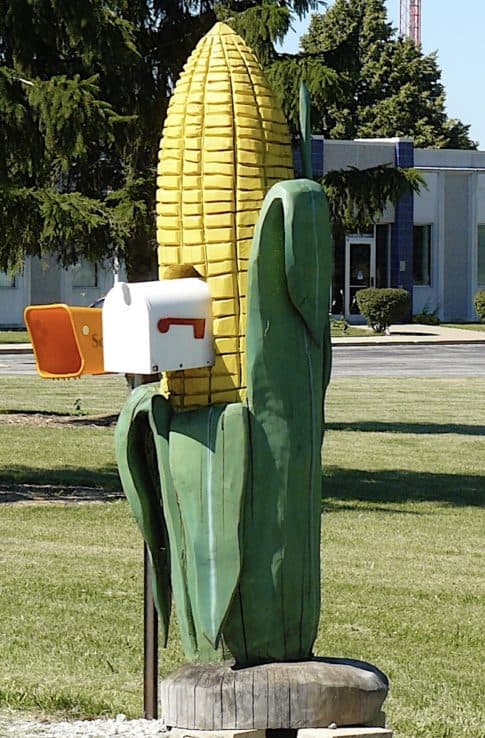
Rick Davidson snapped this photo in Brenland(?), Indiana – “corn country,” he said. Well, that makes sense!
This mailbox arrived without any information. We can only guess that the person who lives here owns a Winnebago.
If you sent a mailbox photo but don’t see it here, stay tuned. We couldn’t fit them all in this issue.
By Tony Barthel We recently posted a question on our RV Advice Facebook Group. I asked, “Some of you have been reading my RV reviews over on RV Travel, and one of the things I’ve kvetched about are the small 17″ ovens in so many RVs. But I wonder – if you do have an RV with this small oven, do you use it at all and what do you use it for?”
Your responses to the questions were enlightening so I thought I’d share.
In most RVs, you’ll find them equipped with either a Suburban, Atwood or Furrion range, typically with three burners on top and potentially an oven down below. While some premium RVs come with much larger ovens, the typical RV generally comes with one of these smaller ones.
Do you use the oven?
Many of the respondents on the post indicated that they do, in fact, use the ovens in their RVs… for storage.
For example, Facebook user Nancy S. wrote, “I use my oven for storage now. Bought a good countertop oven which I use daily. Miss the counter space but enjoy cooking again.”
Roy B. wrote, “I removed my oven (because) we never used it. We installed a cooktop. We use the convection part of the microwave oven. Had (drawers) installed where the oven used to be.” Editor’s Note: This is what RVtravel.com staff member Gail did to her and Chuck’s motorhome too!
Lauren B. E. added, “We have one of those silly too-small-to-bake-anything-in-it ovens. We use it to store our induction hot plate, which we use more than the gas burners.”
It seems that a good number of the respondents paid for something they’re not using and would prefer the additional drawer or storage space.
But those who do use the oven almost invariably talk about a pizza stone in the oven to even out the heat. And many of the respondents said that they make pizza, cookies or cakes in their ovens. But that’s about it.
More complaints about typical RV ovens
The other complaints about the typical RV oven were well put by Vicki L. C., who wrote, “My oven has been used once. It was so hard to light, never again. I had to twist like a pretzel and my old knees had a heck of a time getting up off the floor. Now it’s full of breads and snacks.”
To light most RV ovens you have to get down where you can see the pilot light and then, while holding in the knob on the range, use a lighter to light the pilot light. While it might be bad for your back, it’s certainly entertaining to take a photo of someone doing that. I want to stay married so I won’t share my photos with you.
Oh. And then you have to get back up from this odd position on the floor of your RV.
RV oven tricks
Meet my friend Manya. I met Manya when I worked at Redwood Empire RVs. Manya may be one of the most well-suited RV enthusiasts I know. Not only does she go RVing every chance she gets, but she also builds campfires that astound and uses both pie irons and her RV’s oven to prepare some wonderful meals. You won’t starve if you’re camping with Manya.
Incidentally, she also is a whiz with RV finance, which is her primary job at the dealership to this day.
Manya showed my wife and me that you can actually roast pork in the RV oven by buying a small oven thermometer. She discovered that her 21” oven will maintain 225°F temperature, but since that number is not written on the dial, that’s where having that thermometer comes in handy.
The pulled pork she made, as well as a Christmas ham just a couple of weeks ago, were as good as any I’ve had in a restaurant and better than some. The real secret is even heating and knowing the actual temperature your oven is delivering.
What we use our oven for
My wife and I also use our 21” RV oven to make breakfast casseroles, and my wife often will bake cookies to invite other campers in to tell their camping stories – when it’s not COVID times, of course.
I like to make drop biscuits in the oven as a component of biscuits and gravy, and we’ve also used our former bed and breakfast ownership experience to use our oven for quiches.
An essential component of using these is also an oven thermometer. You can go very simple and inexpensive such as this one and that’s plenty. I also carry a wireless laser thermometer so you can measure the hot spots in the oven. Note that I also use this for measuring the wheel temperatures outside the trailer.
Evening out the heat in the oven is another important aspect of using them successfully. Almost invariably everybody who said that they do use their oven also mentions putting a pizza stone or other baking stone in the oven. This helps to even out the heat for sure, though you’ll want to protect it from breaking as your RV rattles down the highway.
Some of the newer RV ovens feature a simpler lighting procedure where your past life as a gymnast doesn’t come into play. In fact, some of the newer ones can be lit while you’re standing up in front of the oven!
In my RV reviews, I have often complained about the smaller RV oven as being worthless – which prompted my question on the RV Advice Facebook Group. It turns out that I’m not just a complainer, but the smaller oven really is considered worthless – at least to the respondents of the post.
More people than ever are taking up RVing. These newbies have determined that RVing is the safest way to travel in our pandemic times. The result is campground crowding like never before. In this weekly blog, RV Travel readers discuss their experiences. Maybe we can make some sense of this and find ways to work around the problem.
Here are a few observations from our readers.
NO-SHOWS… NO GO?
This has been a common complaint amongst our readers. Reservation systems show a site is booked, but nobody shows up to stay. This is especially frustrating at a time when campgrounds are already so crowded that it is almost impossible to book a site, months, sometimes even a year in advance. We know we’ve discussed this a lot in previous installments of this column, but week after week we receive more complaints. Here are a few of those:
Mark writes, “I hate it when I show up to find most sites are vacant and I had to take a less than nice site when on Reserve America it shows all sites full. If people book a site for a week and don’t show for half they should be put back on the site as open.”
And Tom C. says, “All of the campgrounds that we have used (state, federal, and private) require full payment in advance for the duration of the stay. If a person doesn’t cancel and doesn’t show up, there is no incentive for the campground to rent the reserved space, as it is already paid for, and there is really no maintenance cost to an empty site,so there is clearly more profit. I guess if they went ahead and rented the reserved site to another party, and the original party eventually showed up, it could create problems that the park would have to deal with, so it is just simpler not to re-rent a reserved site. I like the first-come, first-served approach covers all the bases.”
“There have been many complaints about empty sites in Florida state parks. Sites that have been reserved but not used. The Florida park service is 75-80% self-funding and many want it to be fully self-funding. The revenue from campgrounds helps fund the non-camping parks which generally don’t generate enough revenue to cover their expenses. Florida reservations require payment in full at the time of the reservation. The result is that there is no incentive for the park service to institute a system to free up these unused sites. The sites have been paid for and the park service has the revenue. That is what is important to them,” writes James D.
Jack P. has a bold suggestion to penalize no-shows. “The individual state park does not have the ability to change or modify reservations, if, for example, the rangers see an empty spot that has been reserved. To correct this the park rangers should have access to the reservation system for their park and cancel any spots unoccupied or without a person occupying the site. Also perhaps a fix would be to prevent anyone from using the reservation system for a month or so if they reserve a spot and don’t cancel.”
Michael G. likes the way things are and as an RVer knows that things can come up. “In response to those concerned about empty sites. Anyone who has owned an RV for any amount of time knows that things can happen. If I am delayed due to bad weather, mechanical issues or a traffic accident, I don’t want to arrive only to find that my camping spot for which I fully paid for months in advance is occupied by someone else. If I fully pay for a site it should be mine even if I arrive a day or two days late. I prefer the system the way it is. Reservations are the best way to afford equal access for all. Leave the system the way it currently exists.”
CANCELLATION FEES BY STATE
One reason many people don’t cancel their site reservations is because of high cancellation fees (another thing we’ve continually discussed). There is little incentive to cancel and that can result in the number of no-shows and empty spots even when listing full online.
We looked at a small sampling of cancellation fees across the country and found that, yikes, the fees are HIGH! People may need to cancel out of the goodness of their heart for their fellow RVers rather than any monetary refund. Below are the state’s policies on cancellations:
Arizona
Arizona was clearest on its cancellation policy: “If the reservation is cancelled less than 24 hours in advance one night’s fees are forfeited. Campers who do not show up by 12 noon the day following the first night’s reservation will forfeit all payments and campsite will become available for first-come, first-served.”
California
“Customers will be charged a $7.99 cancellation fee if cancelled before 6:00 p.m. the day before arrival and forfeit the $7.99 reservation fee. Your original $7.50 reservation fee is nonrefundable. If you cancel your reservation after 5 p.m. the day before your arrival date, the first night’s campsite fee is forfeited. A campsite will be held for you until 12 p.m. the day after your arrival date. If you do not call the park before that time, you will be considered a ‘no-show,’ and the park will cancel your reservation. You will be refunded the amount paid for the campsite, less the non-refundable $7.50 reservation fee, the $7.00 cancellation fee, and one night’s camping use fee.”
Kansas
“Campsites may be reserved anytime during the current calendar year up to two days in advance of a planned stay. Transaction fees are non-refundable. Cancellation 15 days or more prior to arrival date results in a refund minus the transaction fee. Cancellation 14 to three days prior to arrival results in a refund minus one camping night and transaction fee. Cancellation less than three days prior to arrival results in a forfeiture of all fees. Cancellation within the minimum window of stay results in a forfeiture of all fees. If you notify the park office to shorten your stay within 14 to three days of arrival, this will result in a forfeiture of fees for one-night camping.”
New York
“If you cancel your reservation you will be assessed the following fees. It’s important to know the closer to your arrival date you cancel, the less money you will receive back as a refund. Cancelling 8 days or more prior to arrival – $7.25 Reservation Fee + $7.25 Cancellation Fee. Cancelling 7 days or less prior to arrival – $7.25 Reservation Fee + $7.25 Cancellation Fee + the cost of the first night’s stay. All fees are retained if you fail to arrive and do not inform the park of a cancellation in advance.”
Florida
“A $17.75 cancellation fee will be assessed for each reservation being cancelled. Visitors canceling on the day of arrival will be assessed a $17.75 cancellation fee and the first night’s use fee.”
Washington state
Washington wants you to plan carefully and well ahead of time. “If you cancel your reservation 29 or more days before your scheduled arrival date, the cancel fee is $8 online or $10 by calling the Reservation Center. If you cancel 28 or fewer days before your scheduled arrival date, you must pay for up to two nights or days regardless of when the reservation was made.”
SOME ADVICE FOR YOU…
Eric R. has some helpful tips and advice to snag a campsite. He writes, “A few tips for finding campgrounds that aren’t crowded. 1. Go local and avoid the big national chains. 2. When searching for sites near a particular destination look past the 1st or 2nd option that pops up. 3. Look at the reviews… if a place has a 1 star rating because it’s near a railroad track and you actually enjoy the sound of trains…then you are golden. One of the many lessons learned from the surge in RVers and the dwindling supply of places to stay is that I need to be more agile and expand my travel destination wish list.”
AND ON A POSITIVE NOTE…
Michael C. points out the positive about full campgrounds, particularly State and Federal ones: “It’s nice seeing full campgrounds. The money goes back into the state and federal parks. Better than being less than half full with a chance to be closed. Just my two cents.”
Now, some questions for you:
• Are you finding more and more campgrounds booked up? Or are you having no problem finding places to stay?
• If campgrounds continue to be crowded and RVing continues to become more popular, will it affect how or when you RV?
• Do you have any tips or secrets you’d like to share about finding campgrounds that aren’t as crowded?
Please use the form below to answer one or more of these questions, or tell us what you’ve experienced with campground crowding in general.
We use cookies to ensure that we give you the best experience on our website. By continuing to use our site, you consent to accepting cookies. We NEVER have or will sell reader's data. For more info, please see our privacy policy page.



 Excellent resource about work camping
 Wacky mailboxes

 Stolen RVs — Help us recover these stolen RVs. The more eyes we have searching for them, the better chance of getting them back to their rightful owners, and maybe putting the crooks who stole them in the slammer!









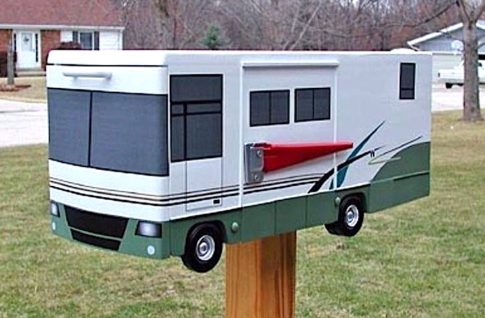 This mailbox arrived without any information. We can only guess that the person who lives here owns a Winnebago.
