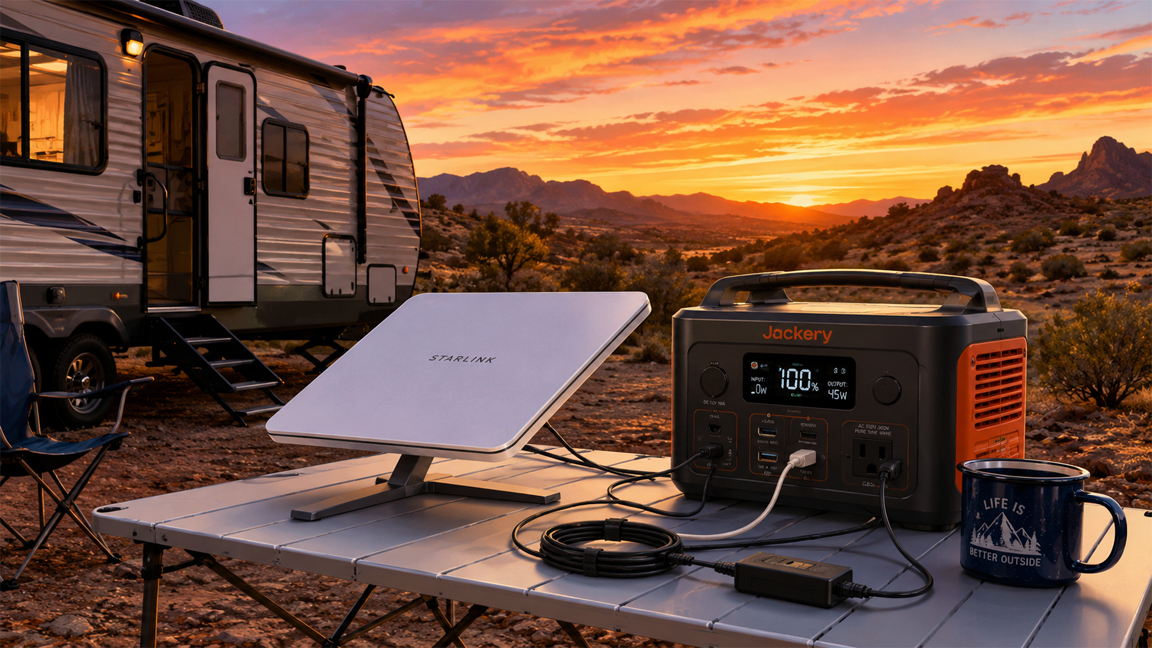
The Starlink Mini has become a popular piece of gear among RVers who need internet where cell coverage is spotty or nonexistent. It’s small, relatively easy on power and easy to tuck away when it’s time to move on.
But there’s still one thing most users have to bring along: a battery.
Now there’s a hint that SpaceX may be working on a way around that. According to a report by The Verge, references discovered in Starlink software appear to point to a version of the Starlink Mini with an integrated battery. SpaceX hasn’t announced such a product, and there’s no indication when—or even if—it might reach the market. Still, the possibility has plenty of RVers paying attention.
So why would RVers care?
One less thing to pack
One of the Mini’s biggest selling points is portability. Compared with the larger Starlink dishes, it’s easy to carry, quick to set up and doesn’t demand much power.
The catch is that “portable” usually still means carrying a power bank, charging cable and assorted accessories.
That’s not a huge burden, but it’s another collection of gadgets to keep charged, organized and ready to go.
A built-in battery could make the whole setup simpler. Instead of grabbing the dish and a separate power source, you would simply grab the dish.
For RVers who move often, that may sound like a small change. In practice, small conveniences are often the ones you appreciate most after a few hundred campsite setups.
Think beyond the campsite
A battery-powered Mini wouldn’t just be useful around camp.
It would be good for picture-stopping at a scenic overlook and wanting to upload photos before moving on. Or pulling into a rest area and needing a reliable connection to check email, pay bills, or join a video meeting. Maybe you’re spending the afternoon at a picnic area where there isn’t an electrical outlet within sight.
Today, that usually means carrying along some type of external battery solution. A self-powered Mini could turn those situations into a simple matter of setting the dish outside and connecting.
The same idea could appeal to RVers who keep Starlink available for emergencies. During a power outage, having both internet service and a built-in power source in one package could eliminate a few extra steps when communications matter most.
The details are still a mystery
Of course, nobody outside SpaceX knows exactly what such a product would look like.
Battery size may be the biggest question. A small battery would keep weight down but might only provide a few hours of operation. A larger battery could extend runtime but would make the unit heavier and more expensive.
Charging options will matter, too. RVers often recharge electronics from solar panels, portable power stations, vehicle outlets or campground hookups. Any built-in battery would need to fit smoothly into those existing routines.
Then there’s the price tag
Adding a battery almost certainly wouldn’t make the Mini cheaper. Some RVers may decide they’re perfectly happy with the battery packs they already own and see little reason to pay extra for an integrated solution.
What about current Mini owners?
That’s another unanswered question.
The software references don’t reveal whether SpaceX is developing an entirely new Mini or perhaps some type of battery accessory for existing units.
If the battery ends up built into the hardware itself, current owners would likely need to buy new equipment to get the feature. If SpaceX takes a more modular approach, an upgrade path might be possible.
At this point, nobody knows.
For now, it’s still just a rumor… that’s worth emphasizing.
SpaceX has not announced a battery-powered Starlink Mini. The speculation comes entirely from software references discovered by researchers examining Starlink firmware.
Still, the idea isn’t hard to believe. The Mini was designed around portability from the beginning, and removing the need for a separate battery seems like a logical next step.
RVers shouldn’t start shopping for a replacement dish just yet. But if SpaceX really is working on a battery-powered Mini, it would address one of the few remaining annoyances of an otherwise remarkably portable internet system.
And for RVers, one less gadget to carry is usually a welcome upgrade.
RELATED
- The $299 Starlink Mini deal is back—and RVers may want to look again
- New Starlink Mini RV charger powers Starlink Mini and other devices at once
- The perfect Starlink Mini setup: No-drill roof mount, cost, speeds
- Starlink shuts down cheap internet workaround used by RVers
RVT1263b












 Vera Lynn was beloved by British and American troops during World War II, mostly in Europe, where she had widespread radio exposure. Her signature tracks, “We’ll Meet Again” and “The White Cliffs of Dover,” became anthems of resilience for the Allied war effort in Europe. If your father or grandfather fought in World War II in Europe, they almost certainly loved this woman and her inspirational songs. Here she is singing “We’ll Meet Again.”