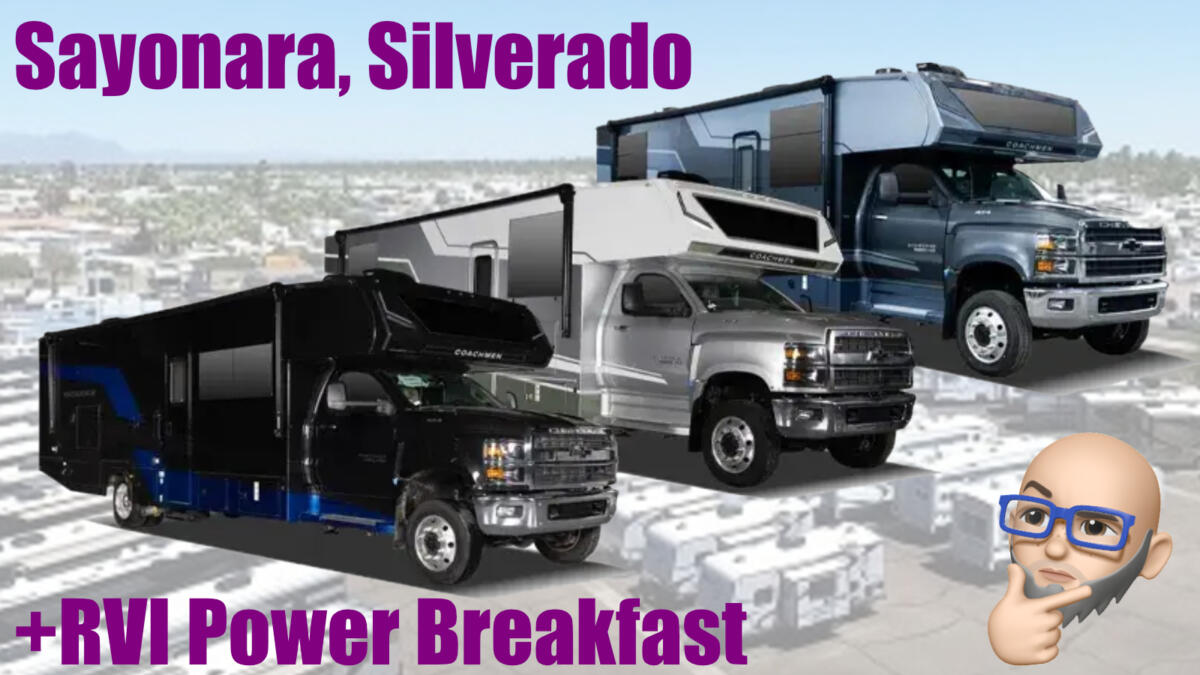
This week, we look at how the decision by GM to dump the Silverado medium-duty trucks will affect the RV industry. Then we also sit in on the RV Industry Power Breakfast and review the conversation.
More bad news for poor Coachmen
Coachmen, one of the many divisions of Forest River, does some pretty cool stuff, and one of the cool things they did was work with GM to create the first-ever legitimate EV motorhome—the RVEX. In fact, they were justifiably proud of the rig at last year’s Open House and had plans to move forward.
But GM pulled the rug out from under them and dropped the BrightDrop van that it was based on, so all that effort Coachmen put into the RVEX got sent to the black tank.
Well, it seems that we’re about to see a repeat of that offense as GM has announced the discontinuation of their medium-duty platform on which the Coachmen Entourage Super C is based. Of course, Coachmen isn’t the only brand facing this, but GM claims sales of the model have been very disappointing, with the numbers dropping 37% over the same period last year. Yikes.
These things wear the Silverado badge, but are actually produced in a joint venture with Navistar (you know, International) and are dubbed Silverado 4500HD, 5500HD, and 6500HD. Production is scheduled to end when the agreement with International comes to a close on September 30.
Motorhome sales, in general, are tanking, so don’t expect this to be the last you hear of this kind of thing. However, GM likely planned to sell these things more to construction and other industries. In the grander scheme of things, RVs aren’t a big part of most chassis builders’ pictures.
What’s for breakfast?
The RV industry has a big event every year called the Power Breakfast, where everybody who’s anybody in the RV space gathers to compare how shiny their shoes are and hear speakers. This year, Toby O’Rourke, president and CEO of KOA, was one of those speakers.
 If you haven’t read it yet, KOA does a remarkable job surveying us camping types in their Hospitality Report, and it’s a fun look into the general state of camping and campers.
O’Rourke stated that we’re getting out there even more with 52 million people camping, a 24% increase over 2019. But we’re not doing it as much, with frequency down.
In 2019, 12% of camping households camped just once a year; this rose to 34% in 2025.
“Two-thirds of all people who are camping are doing so just once or twice a year compared to 55% in 2019,” she said. “That’s a significant loss in camper nights at campgrounds.”
So, the whole idea is that if people camp more infrequently, they’re not going to buy RVs (again, this was the RV industry’s breakfast gathering), and campgrounds are going to feel it, as well. The core of the issue: affordability.
Campgrounds are getting expensive
Let’s be honest, shall we? Campgrounds are getting expensive, and while Russ and Tiña shared in this article that many continue to add amenities, do we really want that?
According to what I could find, more than 250,000 of us are part of Harvest Hosts, which is a matchmaker that puts us in touch with almost 10,000 locations that allow overnight camping.
While you could argue that these overnight experiences aren’t free, they’re usually very experiential. A campground might have a pool, but some Harvest Hosts have alpacas or are farms or even drive-in theaters now.
Newer RV batteries and efficiency technology have made camping without hookups less and less of a compromise. Maybe we are still camping, we’re just not going to campgrounds. But this is pure speculation on my part.
What’s happening in the RV industry
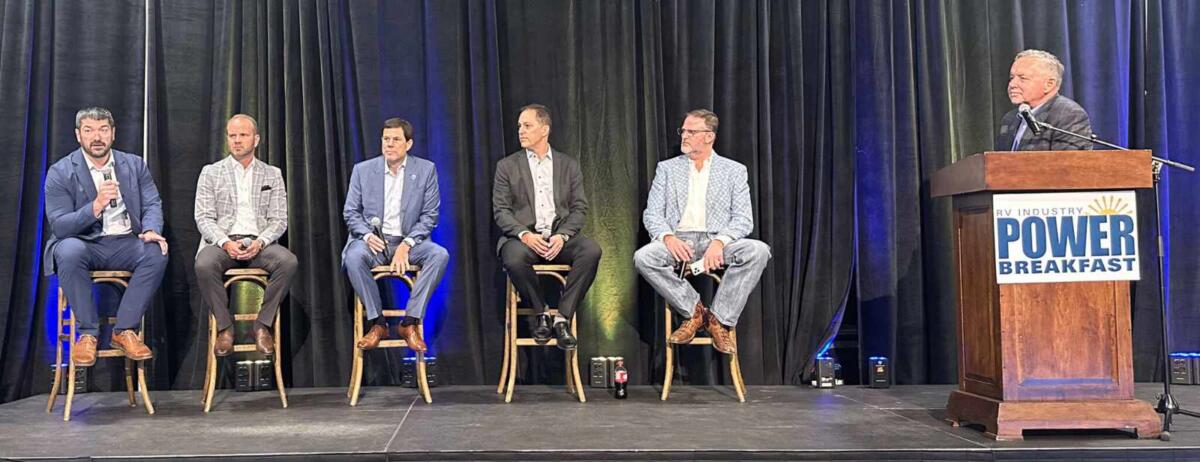
Funny thing: At that same Power Breakfast, five RV dealership execs took to the stage to discuss things happening in the industry.
Moderator Bob Parish of Wells Fargo was joined onstage for the panel discussion by Ben Hirsch, COO of Campers Inn RV; Nathan Hart, partner, Walnut Ridge RV; Loren Baidas, CEO of General RV Centers; Jon Ferrando, CEO and president of Blue Compass RV; and Jarrod McGhee, president of Fun Town RV.
One of the most telling things shared was from Ben Hirsch of Campers Inn RV: “The reality is that we’re facing a very real structural change. Artificial intelligence is leveling the playing field for information. It costs almost nothing for a consumer at the flip of their phone to find out what real information is, what real quality is…
“That’s going to drive a difference in our industry. Our industry right now is very sales-focused; it’s going to have to become very service-focused and ownership-focused. If we as an industry don’t actually look at what’s happening under our feet right now and start adapting to the ownership experience economy, some of us won’t be in this room in a few years.”
So, in other words, they’re finally realizing that mistreating customers and building RVs that constantly need repairs isn’t such a great idea for the industry long term? Shocker.
Poor quality RVs
Quite honestly, the drumbeat of frustration is palpable on social media. So many new owners step into the ring only to feel like it’s a TKO by all the things that don’t function as expected and all the repairs necessary.
That used to be the case with cars, too. In fact, when you go back a century, it wasn’t unusual to have to be very mechanically inclined to drive a car; today, they’re very reliable. Well, until they get recalled because the technology isn’t working as hoped.
But affordability, too, was cited, with Ferrando stating, “I looked at our invoices on our most popular RVs in each segment from 2020 and today, and they’ve gone up.” He continued, “The lowest was by 24%. The next one was 36% and then 60%. So, for a customer walking into our showrooms today, it’s 24% to 60% more expensive for the product that they’re coming in to trade in for. How do we figure out a way to stop the product inflation or find a way to bring it down?”
The group repeated things I’ve heard within the industry—demand is there, with used units accounting for sales increases.
Manufacturers listen to dealerships
But the other thing that kinda bugs me about the industry is that manufacturers mostly listen to dealerships. Do you remember the telephone game? You sit in a circle and tell your neighbor you want a bologna sandwich, and by the time it gets back around to you from one telling the next, it’s a ham and Swiss on rye. With Miracle Whip. Disgusting.
That’s part of what I see as the problem within the RV industry. If you’ve ever asked, “Who thought this would be a good idea?” it’s that telephone game. You mention something to a salesperson, who tells their sales manager, who ultimately tells the dealer, and then they tell the RV industry.
Except the dealership owners are rich white guys, for the most part, and generally also aren’t RVers or campers. I guess this is why Overland Expo is so refreshing to me. It’s more the real deal, at least to me, and not the polish of corporate America. Although you’d better have your savings in place to buy a lot of what’s at the Overland Expo. (More on that tomorrow.)
One last thing
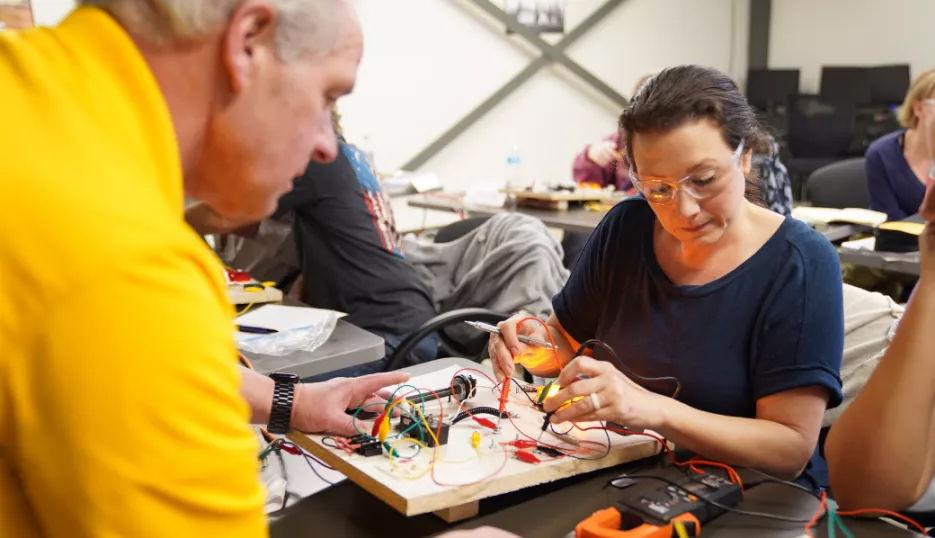
If you’re not aware, there is a shortage of RV techs out there. There are also a lot of younger folks looking for a great career. If you know of someone who’s looking for a job, perhaps direct them to the RV Technical Institute. There are some great programs to help people learn to be certified RV techs.
That will help them, help the industry, and also might help you with your next RV repair.
Catch up on all the latest news for RVers here.
RVT1262b