By Dustin Simpson
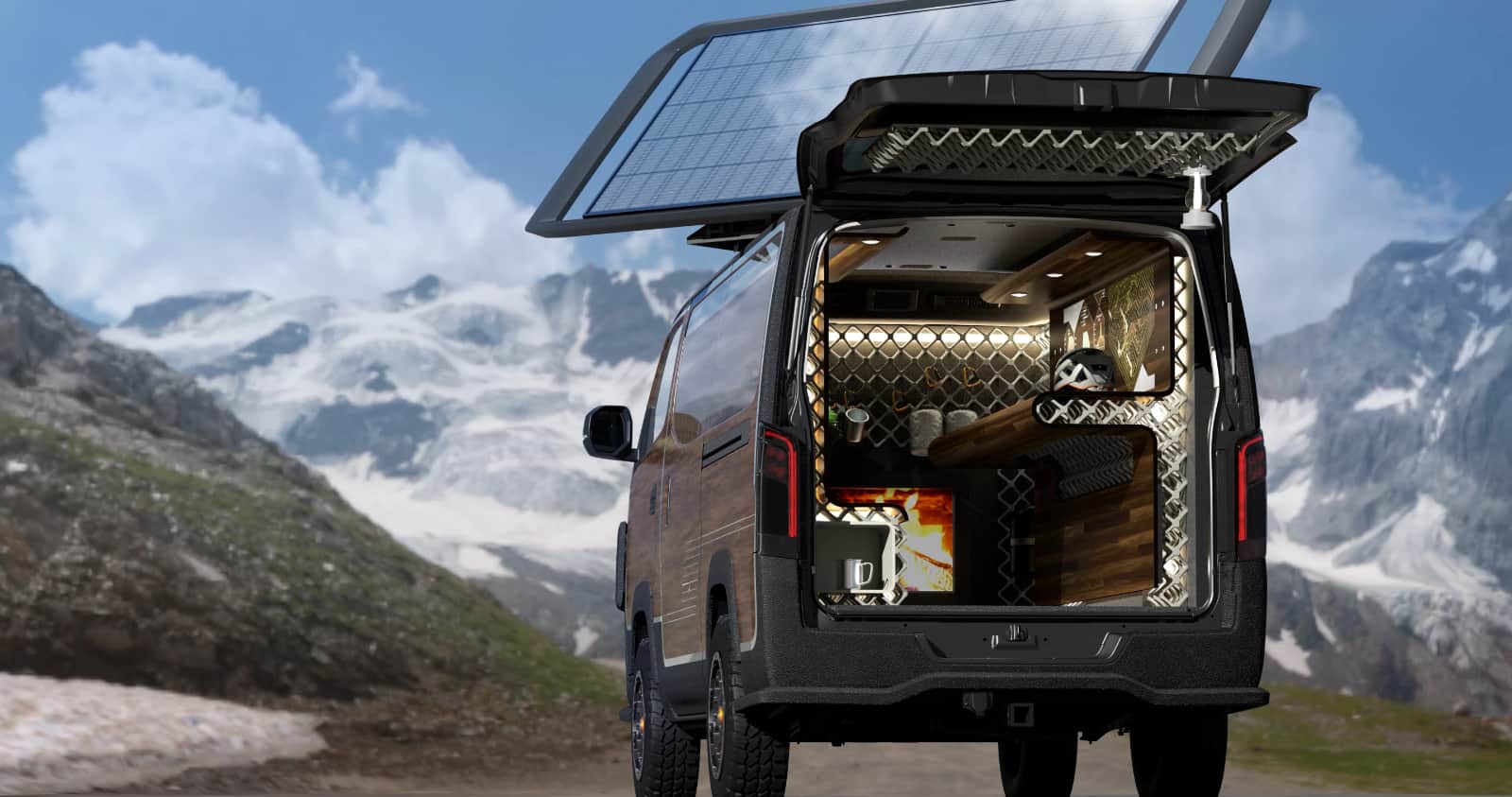
Solar panels are the backbone of your RV solar system. Choosing the right panels for your needs will maximize your solar system’s efficiency, performance, and return on investment. Solar panels consist of multiple individual solar cells that convert sunlight into energy. Several panels can be joined together to create a “solar array” that generates more power. The solar panels generate direct current (DC) electricity used to recharge the RV batteries.
This is always a misconception when talking with RV owners. We end up having to explain that solar panels do not make alternating current (AC) electricity, known as shore power. Solar panels are only used to charge the batteries; so besides choosing the right solar panel, it is equally important to have the right batteries.
Types of solar panels for RVs
There are three types of solar panels commonly used in RV applications, each with its own benefits and drawbacks:
• Amorphous panels are older solar panels and are often found in first–generation RV installations. While inexpensive, they are fragile, inefficient, and take up the most room. They also degrade quickly when exposed to sunlight and can lose up to 30 percent of their power–generating capabilities in their first year of service. Today, amorphous panels are not widely used in new RV applications.
• Polycrystalline panels are more robust than their amorphous counterparts. They require half the space to produce the same power; however, polycrystalline panels can vary widely in quality and performance.
• Monocrystalline panels are considered the most efficient RV solar panels, with energy efficiency rates typically in the 15–20 percent range. They perform better in high-heat and low-light environments, making them more versatile for RV operators. While more expensive than polycrystalline options, monocrystalline panels are more durable and typically last longer.
Rigid vs. flexible panels
Rigid solar panels, built using a frame surrounding tempered glass covering the solar cells, are the most common option for RVs. Flexible panels, in contrast, have the collecting material embedded into a thin mylar film affixed to an aluminum substrate. Rigid panels are very durable and typically have longer warranty periods than flexible panels. While flexible versions may be up to 80 percent lighter, they are much more susceptible to damage. Flexible panels are usually reserved for specialty applications, for example, when panels need to be molded to curved surfaces or accommodate height or weight constraints.
RV solar panel buying tips
• Cheap solar panels are usually constructed with a lot of cut cells—they may be less expensive, but they’re also less efficient. Full, complete solar cells perform better and are worth the additional cost.
• Look for panels with the highest-rated wattage for their size. A smaller footprint means a more efficient panel.
• Watch out for manufacturer claims of wattage output. The best manufacturers will provide a minimum output for their panels, as opposed to a maximum. Always ask your seller to document their panel output range (plus/minus percent).
We hope you find this information helpful and look forward to helping you with all your RV solar needs.
“Roads were made for journeys, not destinations.” —Confucius
HELP WANTED: If you know RVing inside-out, have lots of industry knowledge and contacts, a strong news writing background, and high ethical standards, RVtravel.com may have a well-paid freelance opportunity for you. Contact editor@rvtravel.com to learn more.
Essays and opinions How Google has turned against us
By Chuck Woodbury
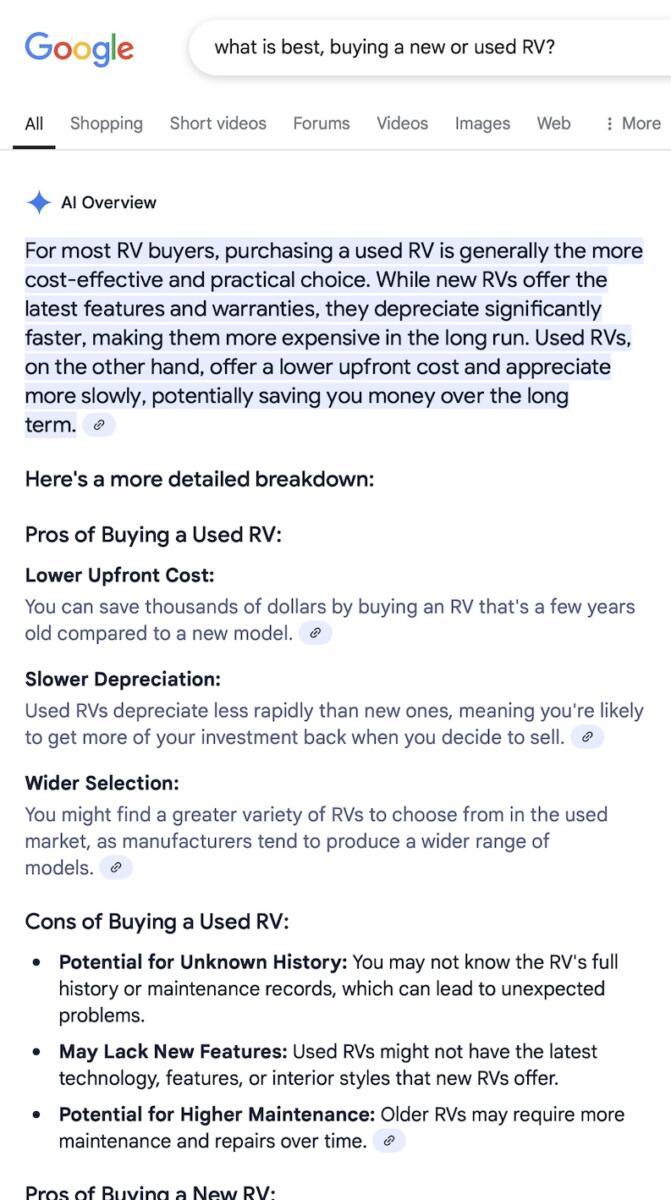
Google is messing with us in a bad way. Oh, not just Rvtravel.com, but every independent website and blog, and that includes millions like this one. You may have noticed, when doing a Google search, that the result of your query will now be displayed instantly, right on the search page: no need to scroll down and choose a website for your answer. If you should ask Google, for example, “What is best, buying a new RV or a used RV?” it will return a complete article, written using artificial intelligence (A.I.). No need to visit RVtravel.com or any other website for your answer. So what does this mean? It means life or death for many websites, this one included. Read more.
HARVEST HOSTS: Unlimited overnight RV stays at 9,476+ locations. Save 15%.
How we got a big discount on new RV tires, and how you can, too
By Nanci Dixon
This week, we had all six tires replaced on our RV. Not a small investment. We knew this was the year to replace them, and as much as I did not want to drop that much money at once, I did not want to have a blowout. I also knew that there were discounts available if I just looked for them…
Electrical plugs: Where are you?
By Emily Woodbury
There’s something we can’t stop thinking about: RV electrical outlets. More specifically, RV outlet placement. Some RVs have plenty of outlets and a few may even have too many! But some RVs don’t have enough… or any, at least in the right places. Continue reading and tell us what you think.
The RV window awning mistake that’s stealing your view (and how to fix it)
By Russ & Tiña De Maris
We love our RV window awnings—sort of. They’re great for shading out excess light, and a real blessing on hot Southwest days. But the trouble is, there are only two positions for RV window awnings—rolled up for travel, or pulled down, with almost no view of the outdoors. Here’s a quick, simple, and inexpensive way to keep your shade—and your view!
Today’s RV review… Keystone Bullet two-fer—271KBS with porch and 265FKS without
By Tony Barthel
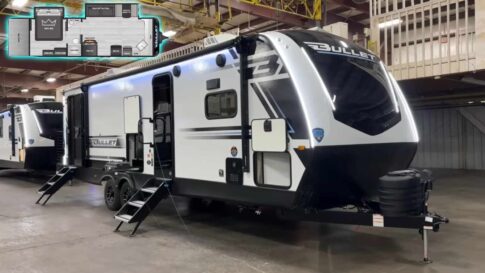
Today’s RV review is of two trailers that are the same, with one big exception. They are the Keystone Bullet 271KBS and the Keystone Bullet 265FKS. The big difference between these is a back wall in the 271 that can drop down and be a porch.. Let’s talk about it.
RANDOM RV THOUGHT: In most cases, when you see a sign at a rest area that says “No Camping,” it means no pitching a tent or sleeping on the ground. It does not mean you can’t grab some shut-eye in your RV. Time limits may apply, but who’s watching the clock? It’s called a “rest” area for a reason.
Do you have a Random RV Thought? Send it to editor@rvtravel.com. Please keep it under 75 words.
How to pick the ideal power inverter for your RV adventures
By Russ & Tiña De Maris
Planning on boondocking away from shore power but still need that essential shore-power-driven equipment? You know you need an inverter. There’s a market full of power inverters available, and sifting through them can be difficult. Need some help with the options? Here is power inverter shopping made easy.
The story behind America’s beloved Cracker Barrel Old Country Store
By Gail Marsh
Chances are you’ve eaten there or perhaps parked your RV overnight in their parking lot. Cracker Barrel Old Country Store is a favorite restaurant for folks who love homestyle comfort food. It’s also a fun place to shop for toys, clothing, snacks, and more! Have you ever wondered how this iconic business started?
Study shows drinking beer attracts mosquitoes
By Nanci Dixon
Beer and mosquitoes go together on lazy summer days even more than I ever knew! If you’ve ever cracked open a cold beer at a barbecue only to find yourself swatting away mosquitoes while your friends remain untouched, you’re not imagining things. Research suggests that drinking beer can indeed make you more attractive to mosquitoes.
CHERI WROTE A BOOK! If you’re a reader of RVtravel.com, then you know Cheri Sicard, who has been writing for us for a few years. You know her from her daily video posts, her Great RV Accessories Newsletter, her tips and cooking recipes, and now you know her as an author! Cheri’s newest book, Moving to Mexico the Easy Way: A No-Nonsense Guide to Northern Baja for Expats, Digital Nomads, and Retirees is here. If you’ve ever been curious about moving to or RVing around Northern Baja, this guide is for you. It details EVERYTHING you need to know. (Here’s the e-book version if you prefer a digital copy.) Congratulations, Cheri!
Reader poll Did your parents take you camping as a child?
Letter to the Editor Reader writes, “I can’t sleep! Are campgrounds getting louder?”
Reader Ron M. sent us the following message. Ron’s a newer RVer, but spent the last couple of years learning the ropes. Maybe you can help him out: “I don’t know if it’s just me, but I swear I haven’t had a good night’s sleep at a campground in a long time… Here’s why.
How to win We’ll select a winner at random out of all entries we receive today by 7 p.m. Pacific time. You can only enter once and after we notify you by email that you won, you have 24 hours to respond.
How 43 towering president heads ended up weathering away in a Virginia field
This offbeat exhibit—once part of a now-defunct park—features colossal (and I mean huge) busts of U.S. presidents. The sculptures have weathered through time but they now stand ready for your visit. This is totally bizarre…
Visiting Elkhart’s RV/MH Hall of Fame—the ultimate RV museum
Whether you’re a seasoned RVer or just curious about recreational vehicles, a trip to the RV/MH Hall of Fame in Elkhart, Indiana, is a must-visit. Learn more here.
?? MYSTERY PRODUCT OF THE DAY ?? We typed into the Amazon search bar “a helpful gadget,” and this is the first thing that came up. We’re not kidding. But you know… it really might actually be helpful…
Highlights from this week’s RV Daily Tips Newsletter
WE’RE SHOCKED! 74,816 readers of this Sunday newsletter are not subscribed to our RV Daily Tips Newsletter! Boy, are they missing out! It’s our readers’ best-read newsletter for a reason—it’s filled with tons of information and is very entertaining! Sign up here (easy unsubscribe if you don’t like it).
In the RV shop with Dustin Video offers owners blueprint for inspecting their own fifth wheel RV
Join me at my shop, California RV Specialists, as I conduct a thorough inspection of a Grand Design RV fifth wheel for potential frame damage. In this video, I’ll walk you through the entire inspection process, highlighting the key areas to check when you’re concerned about frame issues.
RV tire safety Can you really tow your trailer at almost 90 mph?
In September 2024 I wrote about the operational limits on ST-type tires. I suggested that the published 65 mph speed limit was a realistic compromise. But apparently many people think they can get tires with some “magic” rubber in them so they can safely drive faster. Therefore, I am again writing about the “speed rating” of ST-type tires. Continue reading this important information from Roger Marble.
No new gadget reviews this week, but there is a brand-new issue of our Great RV Accessories Newsletter that you MUST read!
BUMPER SNICKER: “Money isn’t everything, but it sure keeps the kids in touch.”
Recipes of the day 10 delicious Easter recipes: Mains, sides and desserts
Easter is a week from today. Are you prepared? We’ve compiled a list of 10 delicious Easter recipes, everything from ham and cheese scalloped potatoes to Cherry Coke-glazed ham to carrot casserole and traditional Easter cookies. Try something new this year and make one (or more) of these.
Readers’ pet of the day
“Murphy (breed: a potpourri of canine genetics; age unknown) enjoying his first trip to the ocean. Wind, water, smells, sand, and things to chase. The perfect environment for a dog to experience.” —John McGrew
Want to see your pet in this newsletter? Please send us a photo of your pet with a short description. No blurry photos and please do not submit your photo more than once.
Trivia
Palm Springs has more pools per capita than anywhere else in the United States.
Today’s RV review is of two trailers that are the same, with one big exception. They are the Keystone Bullet 271KBS and the Keystone Bullet 265FKS. The big difference between these is a back wall in the 271 that can drop down and be a porch. Let’s talk about it.
The back wall porch
When I was in Indiana at the RV Open House, I saw this porch contraption and thought it was a great idea. Actually, the first place I saw it was on a Keystone Bullet, but that model had a rear kitchen, which made a lot of sense.
Obviously, you be the judge on the placement in this model, and, of course, I am looking forward to your input.
Essentially, when the porch is closed, you get a big window the width of the porch. There are integrated shades that also have reflective backs to keep the sun’s rays at bay.
Flip two handles and drop the porch and now you have, well, a porch. The window becomes the back wall and there are wire sides on the porch. You can still block off the entire opening with those blackout shades and there are also screens that can cover the open space. I like the idea, as I think people have been buying toy haulers to accomplish a porch for years without really wanting a toy hauler. Now you don’t have to.
This is the same porch mechanism they put on the side of the Forest River Sabre 37RVMILES that we looked at a while ago, except this one’s on the back of the RV. They put the one on the Sabre on the side.
And that’s something to think about. As mentioned, I saw this porch gizmo on a Bullet at Open House and that model had a rear kitchen. This one has a front kitchen so that porch is right off the bedroom. That may or may not work for everybody.
And that’s why we’re also looking at the Keystone Bullet 265FKS—it’s essentially the same floor plan but without the porch.
I’ve seen people use toy hauler porches for hanging out, but having the porch right off the bedroom… that’s sort of upside-down pineapple territory. And, if you know, you know.
Of course, there’s something to be said about crawling out of bed and stepping out onto the back porch and surveying the beautiful place you’ve chosen for the night, but if you sleep in the same outfit that you were born in, a robe would be a good stop on your way out to do your surveying.
Keystone Bullet 271KBS - 2025
1 of 8
A good kitchen and dining space in the Keystone Bullet 271KBS
A nice kitchen in the Keystone Bullet 271KBS
Bedroom of the Keystone Bullet 271FKS
Floor plan of the Keystone Bullet 271FKS
The back porch on the Keystone Bullet 271KBS drops down and opens things up in the bedroom.
Seating and dining options include theater seats and a free-standing table
The back porch of the Keystone Bullet 271KBS closed-up
Start at the road with Keystone Bullet
Keystone has really upgraded the Bullet line. The tires are now Goodyear Endurance and ride on a torsion axle suspension—the same suspension used in things like Rockwood, Flagstaff, and Airstream.
The one thing missing is a tire pressure monitoring system, but this is outfitted for an aftermarket unit. I can’t imagine towing without one.
You will find two dump connections and they’re essentially right under the main slide, which is a bit of a bummer. This is also how my own trailer is configured. What I’ve done is put a Valterra sewer cap with a garden hose attachment on the front connection, which is just the kitchen gray tank. I just run a garden hose from that so I can dump the kitchen gray when I need to.
It actually makes this much less inconvenient and, what I’ve found is that with the two gray tanks, I can go longer between dumps since the kitchen has its own tank.
The slides in this RV are cable slides. There are two types of cable slides; these are not the ones you can occupy when they’re closed.
The grand tour
Whether you get the fancy porch model or not, there is a bedroom slide in this and that facilitates a larger 70” X 80” bed. As mentioned, there is that back porch, should you choose that model. There is also a standard entry door into the bedroom, as well. So you can access the bedroom even with the slide closed.
The bathroom in here splits the RV in half, which means a larger shower and more space. But I know how some of you feel about this type of arrangement.
The kitchen occupies the front of the rig, which means pretty decent counter space and plenty of drawers. The three-burner propane cooktop features a 17” oven—bummer. But there is a convection air fryer microwave, so that makes up for the small, worthless propane oven.
As for the kitchen, there is also a second one outside that features a flat-top griddle and a small fridge. So, really, you can do pretty well here by combining inside and outside kitchens.
There are choices for the seating in this: you can have a traditional booth, dinette or a table and free-standing chairs. There are also theater seats or a hide-a-bed sofa.
Boondocking and travel access
As mentioned, the front and rear slides conspire to completely block access to the bathroom. This is the same floor plan as my own new trailer (a Rockwood Mini Lite 2506FK), but there is no second slide, so I can get to the bathroom mid-trip through the back door. Though I don’t have a bed this large either, so there’s that.
Keystone was really ahead of the game in solar with their SolarFlex packages. This trailer comes with 220 watts of solar on the roof and is prewired for an inverter. You can also opt for a second panel and inverter with the SolarFlex 440i package, which also has an inverter and smart shunt. It’s a pretty nice setup if you want to grow the system, too, with provisions for that growth.
And Keystone also partnered with battery maker Battle Born/Dragonfly, so you can opt in high-quality lithium batteries. In my not-so-humble opinion, any RV that has a 12-volt fridge should just be outfitted with a lithium battery already. These antiquated lead acid units just don’t serve RVers as well as the lithium units do. Yeah, they’re more expensive, but better stuff always is. Like that torsion axle suspension.
Keystone Bullet – 265FKS and 271KBS specifications
My thoughts about the Keystone Bullet
I like that Keystone kept the model without the porch and offers the one with. Keystone has also done a number of things through their Innovation Lab, including the intentional coloring of the wiring. That means there is less likelihood of a wiring issue and, if there is a wiring issue, it’s easier to diagnose.
Interestingly, when you look at the specs for these models, the model with the porch has greater cargo carrying capacity and a higher GVW. That higher GVW makes sense to me— the porch isn’t that light, and it also adds to the price of the rig, naturally.
Overall, I like this floor plan. As mentioned, my own new RV is this same floor plan, except without the bedroom slide. Oh, and the back porch. And, quite honestly, if I were to buy this, I’m not sure I would want the back porch. If this were the rear kitchen model, I would probably feel differently, but it’s not.
But, overall, Bullet has come a long way since the models I was selling just a few years ago. I think the value and features really do make this a compelling brand. Plus, if you need time to make a decision, you could drop down the porch and go out there and sit on it. The decision, that is.
My thanks to Josh from Bish’s RV for the photos and video.
More about these RV reviews
These RV reviews are written based on information provided by the manufacturers along with our writer’s own research. They are based on information from a single unit and may not reflect your actual experience. Shop your RV and dealership carefully before making a buying decision. They are intended only as a brief overview of the vehicle, not a comprehensive critique, which would require a thorough inspection and/or test drive.
Tony comes to RVtravel.com having worked at an RV dealership and been a lifelong RV enthusiast. He also has written the syndicated Curbside column about cars.
By Chuck Woodbury
Google is messing with us in a bad way. Oh, not just RVtravel.com, but every independent website and blog, and that includes millions like this one. You may have noticed, when doing a Google search, that the result of your query will be displayed instantly, right on the search page: no need to scroll down and choose a website for your answer. If you should ask Google, for example, “What is best, buying a new RV or a used RV?” it will immediately return a complete article, written using artificial intelligence (A.I.). No need to visit RVtravel.com or any other website for your answer. Click the image below to see what I mean.
Click to enlarge
It’s a long story why Google is doing this: but, in essence, it was forced to by ChatGPT and others that were morphing into search engines on their own, delivering full articles to queries, not just a list of web resources to visit.
A year ago, in a month’s time, if we were to receive one million page views at RVtravel.com from readers who came via our email reminder alerts, we would predictably receive in that same period twice that amount from Google — 2 million page views. So that’s 3 million total views — from our email alerts and Google. Additional traffic would arrive from other sources, but it was nothing compared to Google and our own email list.
Today, with Google’s new way of answering queries right on its website, if we receive that same one million views from our email alerts, we only receive 20% of that amount from Google searches, or 200,000 — down 90% from a year ago.
A warning from the trade media.
Our total monthly traffic from Google and our email alerts now totals only 1,200,000. So we’ve dropped from 3 million page views a month to 1.2 million! Imagine you owned a grocery store and your foot traffic dropped by about two-thirds! That’s our situation, and our challenge.
We are lucky
Thankfully, it’s not as bad for us as it sounds because the readers who come to RVtravel.com from our 100,000+ mailing list read about three times as many pages per visit as visitors from Google. And lucky for us, our email list continues to grow, as does our readership. So we are hanging in there quite well, although our work is far more challenging all the time.
Websites and blogs that rely primarily on Google for their traffic are going belly up. Others, to survive, have slashed their budgets, which includes using dirt cheap artificial intelligence to write their articles (instead of real human writers). Those A.I. stories, alas, often contain inaccurate information.
I have a huge interest in all this, and want to write more about it. But this newsletter cannot be the place: it must be primarily about RVing. If you are interested in receiving one or two emails a month from me about how artificial intelligence and other technology is affecting this website (as well as all other online media), please email me at chuck@rvtravel.com and request to be included on this special mailing list. We will also hold regular Zoom meetings that I hope you will attend. And if you have not yet contributed financially to our increasingly challenging efforts to maintain this website, would you please consider doing so?
There’s something we can’t stop thinking about: RV electrical outlets. More specifically, RV outlet placement. Some RVs have plenty of outlets and a few may even have too many! But some RVs don’t have enough… or any, at least in the right places.
Last weekend, we attended the small Evergreen Spring RV Show in Monroe, Washington. We put our theory to the test and checked inside dozens of RVs, and we came to the conclusion: The placement of some plugs are in inconvenient locations, or missing entirely in important locations.
In the bedrooms, we noticed that RV outlets were often on only one side of the bed. So if you need to run a CPAP machine, you have to sleep on the plug side of the bed. And, if the other person also needs to plug in a CPAP machine (as nearly half of RVtravel.com readers do), ya got a problem!
And another place we noticed a lack of outlets: the kitchen. Many (and we mean many!) of the RVs we saw didn’t have a single outlet, or just one in an awkward position (like too close to the stovetop where a cord could get too close to a flame. Where are you supposed to plug in your coffee maker? Or your blender? Or your handheld mixer? Or… anything?!
In the photo above, there isn’t a single outlet in that kitchen. Even with all that extra counter space! No, they weren’t hiding on the sides, under the cabinets, or in any pop-up-outlet gadget either. We checked everywhere. Nothing. Maybe they were there somewhere but… we couldn’t find ’em.
Insider information
RV manufacturers are required to place a certain number of plugs based on the size of an RV. But if they want to save money on wiring, they can gang up plugs close to each other. Forget about all the wire it would take to stretch to the rear bedroom.
So now we want to hear from you…
Are you satisfied with the number of plugs in your RV and where they are positioned? Respond in the poll below and then please leave a comment. We may use it in a future story. Thanks a bunch.
This week, we had all six tires replaced on our RV. Not a small investment. We knew this was the year to replace them, and as much as I did not want to drop that much money at once, I did not want to have a blowout. I also knew that there were discounts available if I just looked for them. The two programs I knew about were the FMCA and Tiffin Allegro Club discounts for our Michelin tires.
Get a membership
I hadn’t intended to renew our Tiffin membership, but I figured that with a $20-a-year membership, I should get at least that much back on a tire discount. Boy, was I right!
I contacted the Allegro Club to find out how to get the discount, and they sent me a two-page document of rather convoluted directions. They involved going to the Michelin website and contacting various dealers that accept the discount and work on RVs.
It took four places until I found one in the Phoenix area that worked with discounts and RVs. They were very familiar with discounts, particularly the FMCA one. I did have her give me a quote, and even though I knew we would be paying less through Michelin, I wanted to get a ballpark figure on our 275/80R 22.5 16 ply Z line energy series tires.
Find a shop
After slightly choking at the $830-a-tire price without the balancing, tax, or install, I called Michelin and set up payment by credit card. The tire company bills Michelin, and Michelin bills me by credit card. I am assuming I would get some sort of factory discount.
I needed to show my club member number when at the tire company and give them the last four digits of my credit card number. I had printed out the directions from Tiffin, and it was helpful both for us and for them. They called Michelin, and the purchase was approved.
I still wasn’t sure what everything was going to cost, but I estimated it would be more than $6,000. But with the discount, I came in a thousand dollars less. Still, a huge amount of money, but really worth the $20 membership fee and extra time to research and register!
Install
We stayed with the RV rather than dropping it off, and it only took a couple of hours to replace them. I was so impressed with Purcell Tire and Service Center, Phoenix, and their installation. They made sure the tire pressure monitors went back on the correct tires and filled the tires with the pressure we requested.
The installer did hem and haw when I asked if changing the tires was really necessary. I did get the impression that we might have been able to go longer, or at least only replace the tire with the slash. But, the ride is so much smoother with the new tires and we are glad we changed them now before our thousands of miles of upcoming summer travel.
RV clubs offering tire discounts
In addition to the Tiffin Allegro Club, several other organizations offer discounts on RV tire purchases through membership programs. Here are some options:
Members can access discounts on Michelin, BFGoodrich, and Uniroyal tires through the Michelin Advantage Program. The process involves determining your tire size, finding a participating dealer, registering your credit card with Michelin, and scheduling an appointment. Click here to learn more.
Family RV Association (FRVA)
Family RV Association (formerly FMCA) offers its members savings on Michelin, Continental, and Goodyear tires. The program provides consistent pricing across the U.S. at participating dealers. Members need to show their FRVA membership card to receive the discount.Learn more.
Winnebago’s GoLife Perks
Winnebago owners with a GoLife Perks membership can access the Michelin Advantage Program, offering discounted pricing on Michelin and select BFGoodrich tires. The process includes obtaining the account number from Winnebago, finding a participating dealer, and scheduling an appointment. Click here to learn more.
Good Sam Club
While primarily known for other RV-related services, Good Sam Club offers tire and wheel protection plans, which may include discounts or coverage for tire-related issues.Learn more.
Take advantage of RV tire discounts and deals
To take advantage of these discounts, you’ll typically need to be a member of the respective organization and follow their specified procedures for purchasing tires through their discount programs.
If you know of additional RV tire discounts or have thoughts on ones you have used, please leave a comment below. Thank you!
By Cheri Sicard
In the video below, we join our readers’ favorite RV travel vlogger, Traveling Robert, as he tours the wild parts of Maine, including a visit to Mount Katahdin, an exploration of ghost trains abandoned for more than 100 years, and much more. Watch the video to travel along vicariously.
Sometimes the best spots are found last-minute. Robert says Big Moose Inn, Cabins & Campground was one of those places. The folks running the place were super-friendly, and having a restaurant with live music right there was a huge plus. Also, the campground was right on a lake. The only minor downside? A bigger RV might’ve had some trouble with the tight turns.
Baxter State Park: Katahdin and Appalachian Trail dreams
The drive to Baxter State Park was all about the views. Mount Katahdin dominated the horizon. Stopping along the way to snap some photos was a must. Did you know “Katahdin” means “Great Mountain” in the Penobscot language?
The visitor center was a bit of a surprise—self-service. It did offer a map, but that was about it. Turns out, Baxter State Park has some serious rules and regulations. Parking reservations are needed for some trails, entrance fees are $16 a day, and season passes are available. These reservation systems can put a damper on spontaneous adventures.
Katahdin Stream Campground is a popular spot for hikers tackling the Appalachian Trail (AT). It’s mostly for tent camping, so RVs might have a tough time. The Hunt Trail, which is part of the AT, stretches an incredible 2,155 miles to Springer Mountain, Georgia. One thing to note: Baxter State Park is a pack-in/pack-out park, so there are no garbage facilities available.
Since hiking the AT wasn’t in the cards, a drive to Daisy Pond was the next best thing. The view of Mount Katahdin from there was stunning. The water was crystal clear, and it seemed like a perfect spot for camping.
Ghost Trains: A deep dive into Maine’s wilderness
An early start was needed for this adventure to see the Ghost Locomotives deep in the Maine woods.
Driving towards Baxter State Park, then onto Golden Road, Robert says it started to feel like the Dalton Highway in Alaska—remote and rugged. The Abol Bridge Campground was a nice spot, marking a crossing of the Appalachian Trail. Further on, a logging truck on a one-lane bridge added to the adventure. Finally, the Telos checkpoint was reached. This is where you register and pay a fee to access the North Maine Woods.
The North Maine Woods is managed by a private non-profit organization that balances logging with wilderness preservation. The roads got narrower and rougher, with no cell service.
Finally, the trailhead was reached. The hike was just under a mile to the tram and the ghost trains. The trail was well-marked with ribbons and blue blazes, winding through a dense forest. The boardwalk sections were muddy and a bit treacherous.
These relics of the Eagle Lake and West Branch Railroad, which operated from 1927 to 1933, were built to transfer pulpwood. The Great Depression led to their abandonment. Exploring the site, with its old boilers and decaying machinery, was like stepping back in time. A walk down to Eagle Lake offered a scenic view.
Knife’s Edge Brewing: A well-deserved reward
After a long day of exploring, a stop at Knife Edge Brewing was a must. The wood-fired oven promised great pizza. Cold IPAs and a delicious meal were the perfect way to end the day.
The next day, it was time to say goodbye to northern Maine, but not before a few quick stops, including Bangor, a viewing of Stephen King’s house, Dolby Pond, Augusta, and more.
By Cheri Sicard
Let’s face it, one of the least glamorous parts of camping is dealing with the toilet situation. Many people have tried various camping toilets, only to be disappointed by lingering odors and messy cleanup. There is a better way. Check out the video below by the team at Playing with Sticks that compares the two best portable composting toilets.
Why do traditional camp toilets smell so bad? It all boils down to what happens when you mix liquids and solids. Here’s a breakdown:
• A breeding ground for odors: Combining urine and feces creates an environment where bacteria thrive, leading to unpleasant smells.
• Lack of proper drying: When solid waste can’t dry out, the smells intensify.
• Messy transportation: Transporting a mixture of liquids and solids can be a messy and unpleasant experience.
The secret to a less smelly camping toilet is separating the number one and number two from the start. This involves:
• Separate containers: Using a toilet with designated areas for pee and poop.
• Dry environment: Ensuring the solid waste stays dry to minimize odors.
• Easier waste disposal: Making the disposal process cleaner and simpler.
To take odor control a step further, it’s helpful to add a drying material to the solid waste container. This absorbent, biodegradable material helps to eliminate odors. What’s the perfect drying material? That seems to be an ongoing quest.
Trelino® vs. Joolca GottaGo portable composting toilets comparison
Two popular options for portable composting toilets are the Trelino® and the Joolca GottaGo. Here’s a detailed comparison of these two models:
• Trelino Composting Toilet: The Trelino has a reputation for German engineering and has earned many accolades. However, some users have experienced a significant odor problem. Despite trying different bedding materials and addressing condensation issues by leaving the lid open, the smell persisted. The lack of proper seals may contribute to odor leakage.
• Joolca GottaGo Toilet: The Joolca GottaGo addresses some of the shortcomings of other camping toilets. It features sealed compartments to contain odors and the ability to open and close the solid waste compartment to control airflow and the composting process. After a two-week test, the Joolca GottaGo exhibited excellent odor control.
The Joolca also offers the versatility of being used as a traditional or chemical toilet. The separate containers make dumping waste easier and more discreet compared to carrying a large, sloshing tank to a public restroom.
Key differences
Here’s a closer look at the key differences between the Trelino and the Joolca GottaGo:
Trelino
• Size matters: Choosing the right size Trelino is crucial.
• Storage problems: The Trelino has limited storage space for drying material and toilet paper.
• The “stick”: A stick is used to spread and compact waste, extending the time between bag changes to about a week if used.
Joolca GottaGo
• One size fits all: The Joolca GottaGo comes in one size.
• Comfort: It offers a comfortable, home-toilet feel.
• Lid design: There may be durability issues with the detachable lid over time.
• Spray bottle: It includes a spray bottle for… well, spraying.
• Easy waste removal: The design ensures that the waste inside the bag will not be visible when taking out the bag.
• Level indicators: Indicators show how full the pee and poop sections are.
• Cleaning: The Joolca GottaGo has nooks and crannies that can make cleaning a bit more time-consuming compared to the Trelino’s simpler design.
Price comparison
• Trelino: The medium-sized Trelino is around $475 (or $520 on Amazon), and the small version is about $375.
• Joolca GottaGo: The Joolca GottaGo has a pre-sale price of $211 and will retail for $279.
Both options are relatively affordable compared to high-end composting toilets that can cost around $1,000.
Final verdict: Neither!
After comparing these two popular options, the decision was made to stick with flat-pack toilets due to size and odor retention issues.
The Trelino and Joolca are great options for larger trailers or cabins, but they can be too bulky for smaller setups. The plastic materials also tend to retain odors, which can be a problem when transporting the toilet in a car or tow vehicle.
Instead, the Thunderbox Folding Camp Toilet and the Deuces Wild Bamboo Toilet were chosen by the team.
With the right approach, anyone can enjoy a cleaner, easier, and less smelly camping experience. Whether it’s investing in a composting toilet or upgrading an existing setup, separating liquids and solids is a game-changer.
Here’s to cleaner, easier, and less smelly camping adventures!
Nope, I’m not talking about Mount Rushmore. If you’re an RVer with a taste for history and a penchant for quirky roadside attractions, you won’t want to miss The Presidents Heads.
This offbeat exhibit—once part of a now-defunct park—features colossal (and I mean huge) busts of U.S. presidents. The sculptures have weathered through time and have gone through a relocation move, but they now stand ready for your visit.
Want to learn more? Read on.
Glimpse into history
Artist David Adickes, inspired by Mount Rushmore, sculpted and installed larger-than-life busts of 43 United States presidents.
Adickes’ project helped establish the Presidents Park in Williamsburg, Virginia. At a cost of almost $10 million, Adickes and landowner Everette “Haley” Newman II hoped the undertaking would become a well-visited destination. However, the park failed to draw sufficient crowds and subsequently closed in 2010.
Now what?
Once the park officially closed, landowner Newman hired Howard Hankins to destroy the oversized sculptures. However, Hankins decided instead to move the President’s heads to his 400-acre farm in Croaker, Virginia.
Relocating such large and unwieldy structures was quite difficult, seeing as each one weighs between 11,000 and 20,000 pounds! Some sculptures were damaged in the move, but Hankins determinedly set the heads in neat rows in one of his farm fields—even the damaged ones.
Since their relocation, the busts have weathered naturally and continue to tell a story of the inevitable passage of time.
Credit: https://thepresidentsheads.com/
Upcoming events
Although the 43 busts currently sit on the Hankins’ private property, they’re not entirely off-limits to visitors. RVers can see The Presidents Heads sculptures during specified days when Hankins opens the area to visitors.
In fact, guided tours and art workshops will be available in the upcoming weeks. These events offer a rare opportunity to explore the site up close. Visitors are welcome to participate in themed activities like scavenger hunts and presidential trivia, and capture unique nighttime shots under the stars.
If you plan to be in the area, here are some upcoming dates and events you might consider. Note that tickets are required.
• April 19-20, 2025: The April event continues the theme of historical exploration and photography. It provides another chance to experience the site’s unique ambiance with guided tours and creative photo sessions.
• May 24-25, 2025: Held during the Memorial Day weekend, this special event is designed to capitalize on the long weekend. It typically offers extended tour hours and a range of themed activities that blend history with fun challenges for families and photography enthusiasts.
These events allow RVers and history lovers to experience the intriguing blend of art and historic Americana that The Presidents Heads represent.
After exploring this unique historical site, you’ll want a comfortable spot to rest. Fortunately, several excellent RV parks in the Williamsburg area offer a range of amenities to suit every travel style.
American Heritage RV Park (Williamsburg, VA)
• Amenities. Full RV hookups, modern restrooms, laundry facilities, cable TV, and pet-friendly sites.
• Highlights. Located just minutes from Colonial Williamsburg, thispark provides a blend of historic charm and modern conveniences.
Williamsburg Campground (Williamsburg, VA)
• Amenities. On-site activities include a heated swimming pool, jumping pillow, fire pits, hiking trails, and a pet park.
• Highlights. Family-run for more than five decades, this campground is perfect for those looking to combine historical exploration with fun outdoor recreation.
Thousand Trails Williamsburg (Williamsburg, VA)
• Amenities. Indoor and outdoor pools, game rooms, mini golf, playgrounds, and spacious RV sites with full hookups.
• Highlights. This is ideally situated near historical attractions as well as modern leisure facilities, making it a great base for RVers wanting to experience both culture and comfort.
Each of these RV parks offers a welcoming atmosphere and plenty of amenities to recharge after your adventure among The Presidents Heads.
You should go!
If you plan to visit the area in your RV, consider adding The Presidents Heads to your itinerary. It’s a one-of-a-kind experience that you’ll likely never forget.
Reader Ron M. sent us the following message. Ron’s a newer RVer, but spent the last couple of years learning the ropes. Maybe you can help him out:
I don’t know if it’s just me, but I swear I haven’t had a good night’s sleep at a campground in a long time.
Seems like every time we finally start to doze off, someone’s dog starts barking, or a neighbor slams their door ten times, or I get blasted by headlights from a late arrival backing in. Then there are the folks who run their generators all night like it’s no big deal. Aren’t there supposed to be quiet hours?
I’ve tried earplugs, parked as far from the bathrooms as I can, and I’ve even run a little fan for noise.
We try to stay away from crowded RV parks as much as possible, but we do have to stay occasionally and because we’re all so packed in, it’s loud!
It’s not just at night, either. The same thing happens early in the mornings, too. Dogs, generators, doors, engines…
I’m just wondering if anyone else is having this problem too? Is there something I’m missing? A trick to getting some sleep? Has anyone found places that are actually quiet at night? Or maybe this is just how it is now?
Help!
Do you have any advice for Ron? Do you also experience sleepless nights and mornings while RVing? What do you do about loud neighbors, dogs, and generators? Do you have a trick to finding quieter campgrounds/RV parks or picking a quieter location within a park? Please share your thoughts below. Ron needs help!
Have something you’d like to get off your chest? Write to us at editor@rvtravel.com
Think about your parents, your grandparents, your great-grandparents, their parents, their grandparents, their great-grandparents, your uncles, aunts, great aunts… Good. Now are/were any of those people famous? What about that second cousin of yours? Or is your niece a now-famous TikTok influencer?
It’s always fun to discover connections to well-known figures, whether they were historical leaders, famous entertainers, or even internet celebrities.
Maybe you’ve always known about a distant relative who made a mark in history, or perhaps a recent genealogy search uncovered a surprising link to someone well-known.
Some families have long-standing stories about being distantly related to presidents, inventors, or even Wild West outlaws. Others might have a modern-day claim to fame—like a cousin who starred in a hit TV show or a sibling who went viral overnight.
Even if you don’t have a celebrity relative, family history is full of fascinating characters. Maybe your great-grandfather wasn’t famous worldwide, but he was a local legend in his small town. Perhaps your grandmother was a groundbreaking scientist in her field, even if her name never made the headlines.
And who knows—maybe your own adventures on the road will make you the famous one someday!
Are you related to someone famous, past or present? If you answer yes, make sure you leave a comment and tell us about them! We can’t wait to hear.
Planning on boondocking away from shore power but still need that essential shore-power-driven equipment? You know you need an inverter. There’s a market full of power inverters available, and sifting through them can be difficult. Need some help with the options? Here is power inverter shopping made easy.
What follows is a story carried by Xantrex on its RV blog. You might think this could be a “puff piece” for Xantrex inverters. But while the writer, Edward Yuen, does make mention of some of his company’s equipment, overall we think you’ll find the story to be extremely helpful, particularly if you’re new to the inverter game.
Power inverter shopping simplified
Choosing the right inverter for your RV or camper van is crucial for powering your appliances on the road and ensuring a smooth experience. Whether you’re looking to add an inverter or looking to replace a stock model inverter for one that fits your power needs, there’s no one-size-fits-all inverter and some consideration must be made when choosing what to install.
Since an inverter converts DC power from your RV’s batteries into AC power to run your household electronics and appliances, it’s important to select a unit that will handle the power needs you will put on it. But with so many options available, what should you consider before making your purchase? Here are some key factors to keep in mind when selecting an inverter for your RV.
Power capacity and surge capacity
One of the most important factors to consider when choosing an inverter is its power capacity, often measured in watts. Power capacity determines how much continuous power the inverter can supply, while surge capacity refers to the short bursts of higher power it can provide for appliances with high start-up demands.
For example, a 2,000-watt inverter can handle a continuous load of up to 2,000 watts, but it might have a surge capacity of 4,000 watts for a few seconds, which is ideal for starting appliances like refrigerators or water pumps. When selecting an inverter, it is important to tally and create different scenarios of the total wattage of the appliances you plan to use simultaneously and then make sure the inverter you choose has enough capacity to handle the combined load.
Storage location and size
It is important to know where you will store your inverter so that it is protected, doesn’t get in the way of everyday activities, and is easy to access. Popular storage places include everything from “basement” storage compartments near power distribution panels for large RVs to simply placing it under a couch in a one-room campervan. It is important to note that inverters will make a bit of a humming sound when running, so proper sound control and ventilation is recommended.
Pure sine wave vs. modified sine wave
Pure sine wave. Waveforms svg: Omegatron Derivative work by MrLejinad on wikimedia.org
Choosing between a pure sine wave and a modified sine wave inverter is another critical decision.
• Pure sine wave inverters produce power that closely matches the smooth, continuous wave provided by grid electricity. This makes them suitable for sensitive electronics like laptops, microwaves, and newer appliances with variable speed motors. Pure sine wave inverters ensure that your devices run efficiently and without risk of damage.
• Modified sine wave inverters, on the other hand, create a more stepped or blocky wave. They are generally more affordable, but may cause humming, reduced efficiency, or even damage to certain sensitive appliances. These are best suited for simpler devices like lights, older appliances, and power tools.
For RVers with a variety of electronics, investing in a pure sine wave inverter will provide a smoother and safer power experience. To learn more about choosing the right type of inverter for your RV, read this article on How to Choose Between Pure Sine and Modified Sine Wave Inverters.
Inverter features
Inverters come with a large variety of different features. One of your major considerations should be whether the inverter can integrate with your RV’s onboard power system or if it is simply a stand-alone unit with a couple of AC outlets. The main features to consider these days are:
• Onboard integration: Some inverters can be integrated into your RV’s electrical system, allowing for seamless power distribution throughout the vehicle. This setup can simplify installation and provide a cleaner look by minimizing extra wiring.
• Bluetooth connectivity: Modern inverters often come with Bluetooth connectivity, allowing you to monitor and control the inverter through a smartphone app. This feature provides real-time data on power usage, battery status, and inverter performance, enabling you to make adjustments on the fly.
• Built-in charging ability: Newer inverter models, such as the Freedom XC series from Xantrex, have integrated chargers that can charge onboard house batteries from shore power or solar power. This two-in-one functionality not only saves space in your RV, but also simplifies your setup by reducing the number of devices needed to manage your power.
• Advanced safety features: Safety is paramount when using electrical devices. Many inverters come equipped with built-in protection against overload, over-voltage, and short circuits. Features like automatic shutdown help safeguard both the inverter and connected devices, giving you peace of mind during your travels.
When selecting your inverter, consider how you plan to use it and whether you want a more permanent solution or a versatile, portable option.
Compatibility with other power systems: lithium and solar
For those with advanced RV setups, it’s crucial to consider how the inverter will integrate with lithium batteries and solar panels.
• Lithium batteries: Lithium batteries have become a popular choice among RVers due to their longer lifespan, higher efficiency, and ability to maintain a steady voltage. When pairing a lithium battery with an inverter, it’s essential to ensure that the inverter is compatible with the battery’s voltage and charging characteristics.
• Solar power: If you have a solar setup on your RV, look for an inverter that can easily integrate with solar charge controllers and the overall solar power system. This will allow you to maximize the benefits of solar energy while still providing reliable power during cloudy days or when parked in shaded areas.
A well-integrated system ensures that all components work together efficiently, reducing energy loss and providing a more seamless power experience on the road.
Making the right choice
Selecting the right RV inverter requires balancing power needs, compatibility, and budget. By considering the power capacity and surge requirements of your appliances, deciding between pure sine and modified sine options, evaluating integration capabilities, and ensuring compatibility with lithium batteries and solar systems, you can choose an inverter that will keep you powered up wherever your travels take you.
Our thanks to Xantrex for permission to reprint this story. May your power inverter shopping be easy!
We use cookies to ensure that we give you the best experience on our website. By continuing to use our site, you consent to accepting cookies. We NEVER have or will sell reader's data. For more info, please see our privacy policy page.