Home Blog Page 15

Beyond the headlines with Tony Barthel: Lippert retires, RVers’ economic impact, deaths in NPS

11

Jason Lippert, CEO of LCI Industries, retires

I was very surprised to find out that the CEO of LCI Industries, known to you and me as Lippert, has announced that he will be retiring. Jason Lippert is stepping down from the company that bears his last name after 32 years in the business. In his place, the Board of Directors has appointed Independent Director Johnny Sirpilla to serve as interim Chief Executive Officer effective immediately. 

“We want to thank Jason for his leadership and his deep commitment to LCI Industries over many decades. Under his leadership, LCI Industries grew from a company with $125M in annual revenue to a company with annual revenue in excess of $4B. His contributions have helped shape this great company and will be important drivers of our future growth,” read a statement from the Board. 

“It has been the privilege of my career to lead this company and the extraordinary people who make it what it is,” said Jason Lippert. “The Lippert family has been and will continue to be an important part of LCI Industries’ story and a supporter of its continued success. LCI Industries is a stronger business today than when I took the helm, and I am proud of what we have built together. At this important moment in the Company’s journey, this is the right time for this change, and I look forward to working with—and cheering on—our team members and leaders as they take LCI Industries into its next chapter.”

I know that a lot of people might harbor some feelings for the company that wouldn’t make a good Yelp review, but Lippert will build whatever the customer ultimately demands. If you want a gold-plated frame that weighs 10 tons, they’ll build it. But I have often written that more customers demand low price and minimal specifications based on their buying patterns, and any good manager will build what the customer demands. 

I went to Lippert headquarters when I did the video about their Chill Cube, and Jason Lippert saw me from his upstairs office and made it a point to come down and share some of the history of the Chill Cube. I have also had him as a guest on my podcast. 

I have also seen that Lippert tends to work to empower team members and give them a voice in the processes and procedures. While any big company has issues, I think the policies under Jason Lippert really do create a positive work environment for the most part, which does result in better products. 

So, I am sad and surprised to see him go. 

What causes most RV fires
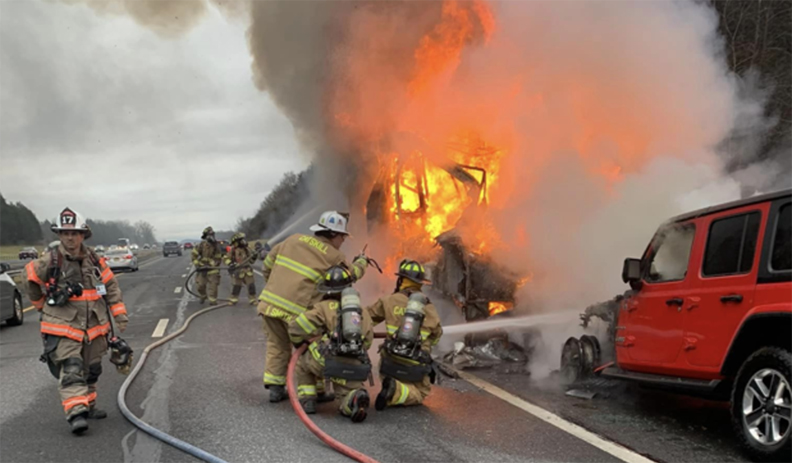
A burning RV quickly becomes a major emergency for firefighters. Federal data shows the most common origin point of an RV fire isn’t the kitchen—it’s the engine, wheel and running-gear area. Photo: Catskill Fire Company

RV fires

Now that fewer and fewer RVs have gas absorption refrigerators, I was interested in reading Russ and Tiña De Maris’ article about where RV fires tend to originate. 

I also reported recently that tire pressure monitoring systems (TPMS) are going to be a standard feature on towables moving forward. I hope these TPMS systems incorporate temperature as well as tire pressure. Again, I stated that one of the big reasons my wife and I chose the brand of RV that we did is that it has a banded tire pressure monitoring system that incorporates temperature readings. 

I keep going back to the fact that we have a choice as buyers. The more we show the RV industry that we value quality, safety, and the inclusion of features that will make a difference, the sooner those things will become the norm. 

RVs Move America

Last week we looked at some positive changes that the RV Industry Association is working toward in terms of new features. But they also revealed their study about the economic impact of the RV industry in their RVs Move America Economic Impact Study. 

The study revealed that the RV industry has an overall annual economic impact on the U.S. economy of $159 billion, supporting 643,238 jobs, and paying more than $46.4 billion in wages.

The $159 billion total annual RV industry economic impact includes:

  • $70 billion generated by RV manufacturers and suppliers
  • $50 billion by RV campgrounds and related travel
  • $38 billion by RV sales and service activities

In addition to the economic impact, the RV industry pays $19.6 billion in federal, state, and local taxes.

A few RV folks are in Washington, D.C., reminding elected officials of the importance of the RV industry to the overall economy and, you know, twisting arms and kissing babies and all of that. 

In a social media post, the RVIA recounted a day in D.C. with:

Passionate RV Industry Association members and partners took to Capitol Hill, holding 142 meetings with federal legislators and decision-makers. Together, we championed the RV sector’s vital economic role and advocated for three key priorities:
      1. Fairness and certainty for American businesses and manufacturers
      2. Protecting consumers: No tax on car loan interest
      3. Reauthorizing the Legacy Restoration Fund to preserve our public lands

More information was posted in this blog post on the RVIA website.

To their credit, I will say the RV industry does tend to favor products made in America when there’s a choice. I recently got to tour Airxcel’s Coleman-Mach A/C factory where many of the A/C units that we have are made. It was a rather impressive experience. I love these factory tours, and some, like the Coleman-Mach experience, are rather impressive. 

I have also toured a Lippert chassis factory, which I was also impressed by. But, then again, I’ve also been to places that make me understand why you’re having issues with your RV. As always, shop carefully. 

national park crowds RVers
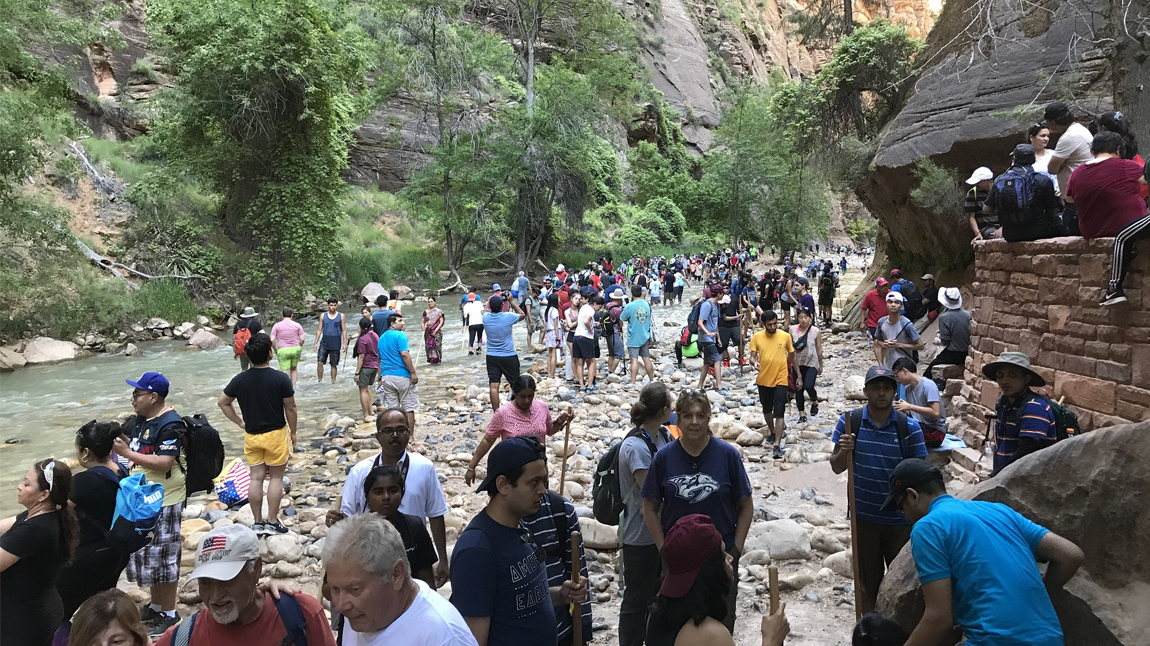
Visitors crowd a popular section of Zion National Park. As spring travel season ramps up, a caution. Some RVers hoping to avoid peak-season congestion are finding that even the traditional “shoulder season” is getting busier. Photo: NPS

Dying to visit national parks

A recent study revealed that the number of deaths in national parks has gone down, with 198 taking their vacation to the great beyond in 2025 compared to 374 during 2021. You know, when COVID shut down much of the services, and people ran wild. 

In a study reported on the website OutsideOnline.com, it was shown that most of us are pretty safe from meeting our maker during a fun day in the park. But, if you’re a young man, you’re less likely to be safe. 

If you’re surprised by this, I’ll bake you a cake or something. 

“Men are more likely to take risks and also make up a higher proportion of those engaged in high-risk activities such as solo backpacking or off-trail climbing, according to Dan Whitten, a search-and-rescue expert. Now retired, Whitten spent 26 years leading search and rescue operations in California’s rugged San Bernardino Mountains.”

There was no telling if many of the deaths happened immediately following someone saying, “Hey, you guys, watch this,” or the ever-popular, “Hold my beer.”

“In my experience coordinating rescue operations, I’ve seen that men seem to inherently think they can do certain things that may traditionally fall into ‘masculine’ roles,” Whitten said. “Some people think that because they’re male, they have some advantage in the wilderness. That’s just not true.”

The NPS sites with the most deaths, in order, are:

  • Lake Mead National Recreation Area: 11 deaths
  • Natchez Trace Scenic Byway: 11 deaths
  • Great Smoky Mountains National Park: nine deaths
  • Blue Ridge Parkway: nine deaths
  • Yosemite National Park: nine deaths
2026-06-05 Lippert retires – RVs move America – deaths in NPS

Final thoughts

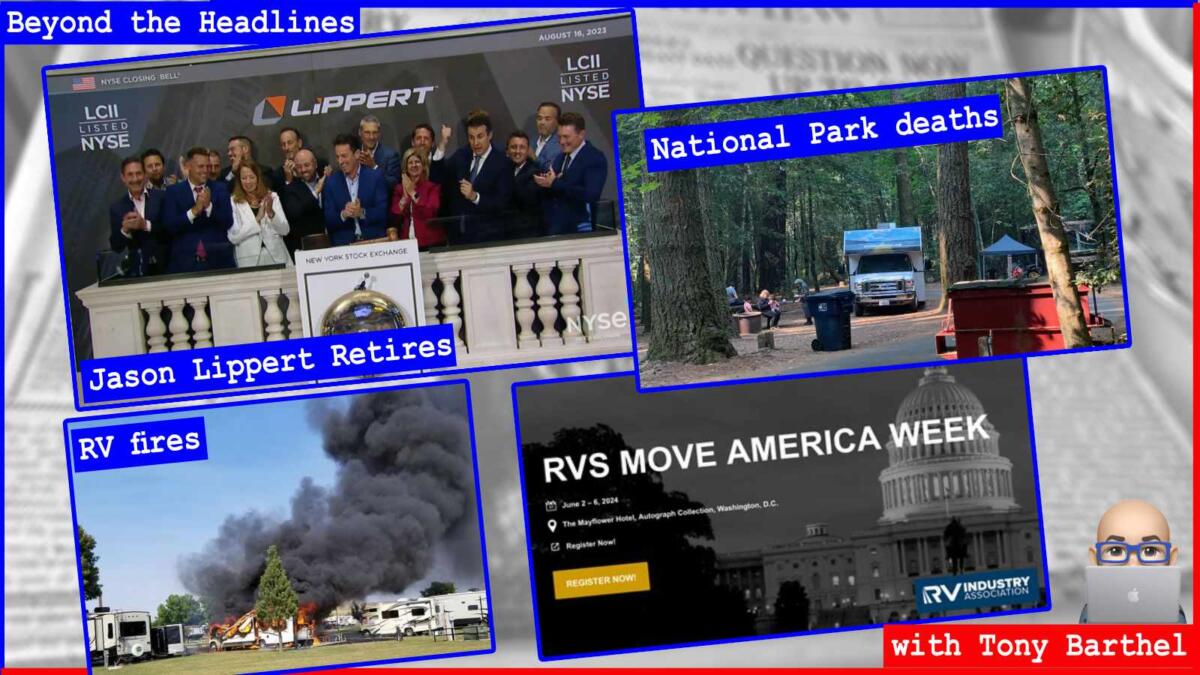
Apparently a lot of you have been enjoying this weekly look at the news that affects us RVers, so I decided to create a more distinctive hero (top) image for the stories. I do enjoy fiddling around in photo editing software, so this is what I’ve come up with as a theme. 

I appreciate all of you and your comments, which I truly look forward to reading. I hope this summer takes you on some great adventures, with the precaution to discourage you from uttering the phrase, “Hold my beer and watch this.” Although that temptation will also be something I’ll work to avoid. 

Catch up on all the latest news for RVers here

RVT1264b

Have you ever encountered a bear while hiking or camping?

24

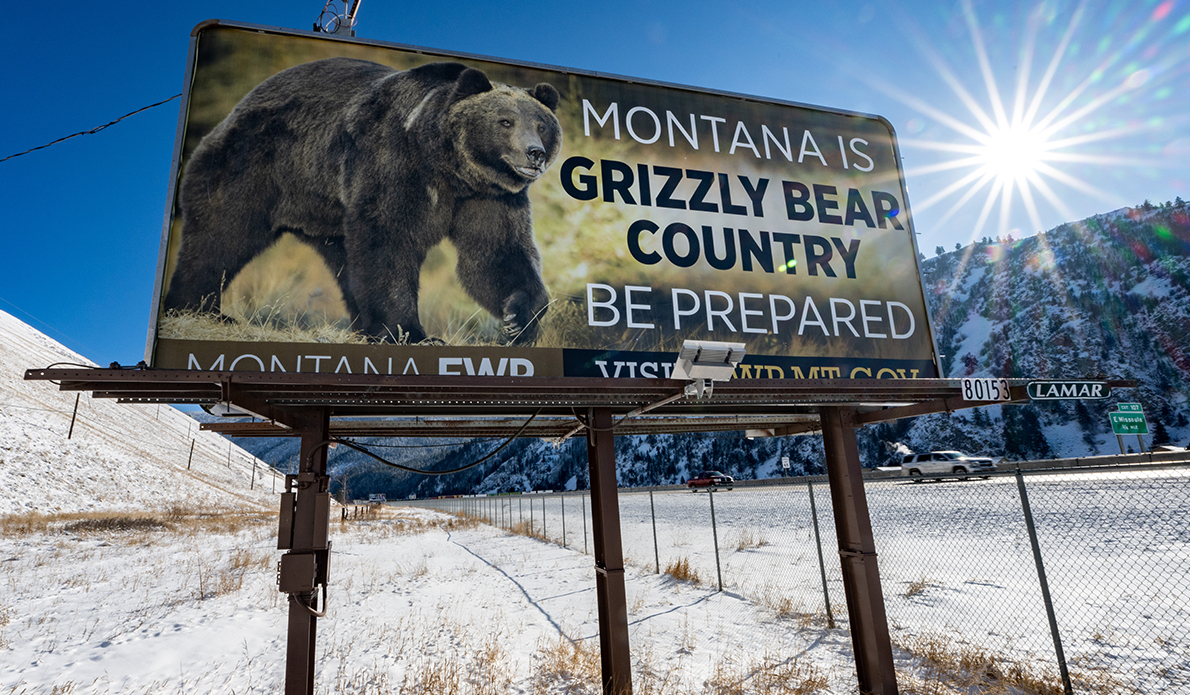
It seems like bear encounters have been making the news more frequently lately. Just this week, a hiker in Glacier National Park suffered a broken arm after a surprise encounter with a grizzly bear on a popular trail. Earlier this season, several campgrounds and trails across North America reported temporary closures or warnings due to increased bear activity.

Of course, that’s not necessarily because bears are becoming more aggressive. Summer is when both people and bears are spending more time outdoors. More RVers are heading into national parks, national forests, and remote camping areas, and that means more opportunities for humans and bears to cross paths.

Most bear encounters end peacefully. A bear may wander through a campground looking for food, cross a trail ahead of hikers, or disappear into the woods before anyone gets more than a quick glimpse. Still, seeing a 300- to 600-pound animal up close tends to be the kind of experience people don’t forget.

Many RVers have a bear story. Maybe you’ve watched one stroll through your campsite at dawn. Perhaps you’ve spotted a mother bear with cubs from the safety of your vehicle. Some of you may have had a much closer encounter—one that got your heart pounding and left you checking over your shoulder for the rest of the day.

Then again, maybe you’ve spent decades camping and hiking and have never seen a bear at all. If that’s the case, there are probably plenty of readers who envy your luck!

We’re curious: Have you ever had a close encounter with a bear while RVing or camping?

After you vote, please leave a comment and tell us your story. What happened? Where was it? And did it make you more cautious—or just give you a great tale to tell around the campfire?

RELATED

RVT1264b

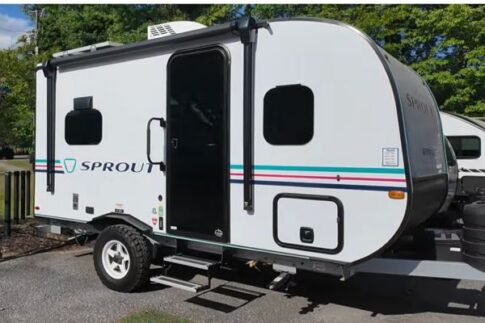
2026 Keystone Sprout 13RKS—the Class B of travel trailers

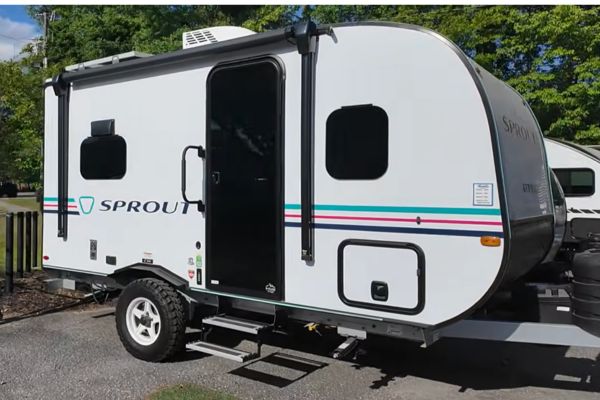
The 2026 Keystone Sprout 13RKS packs a lot into a small footprint. During a stop at family-owned Coastal RV Center in Ravenel, South Carolina, Field & Sports Report looked at a trailer that feels more automotive than most compact campers.

They give us a tour in the video at the end of this post.

Why the Sprout 13RKS feels different

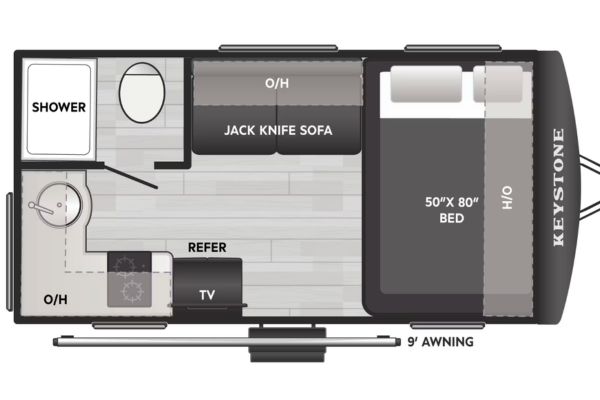
Keystone Sprout 13 RKS travel trailer floorplan

Keystone calls the Sprout the “Class B of travel trailers,” and the reason starts outside. The 13RKS uses painted aluminum instead of typical Filon® fiberglass, backed by HyperCore™ composite that resists mold, mildew, rot, and water swelling. That setup lowers the risk of delamination, the bubbling and warping that can show up in traditional walls.

Below it, an American-made BAL® Huck®-bolt frame gets paint and powder coating to help fight rust, which matters near the coast and on salted winter roads.

This is the smallest Sprout, with a 13′ box, 17’4″ overall length, and 2,950-pound dry weight. Many SUVs should be able to handle it. A Dexter Torflex torsion axle and 15-inch all-terrain tires should also tow smoother than a leaf-spring setup.

Off-grid gear is strong for the size, including an enclosed underbelly, power awning, LP quick connect, 220 watts of roof solar, pass-through storage, inverter and lithium prep, a spare tire, backup camera prep, and red and blue edge lighting.

A small trailer with real camping space

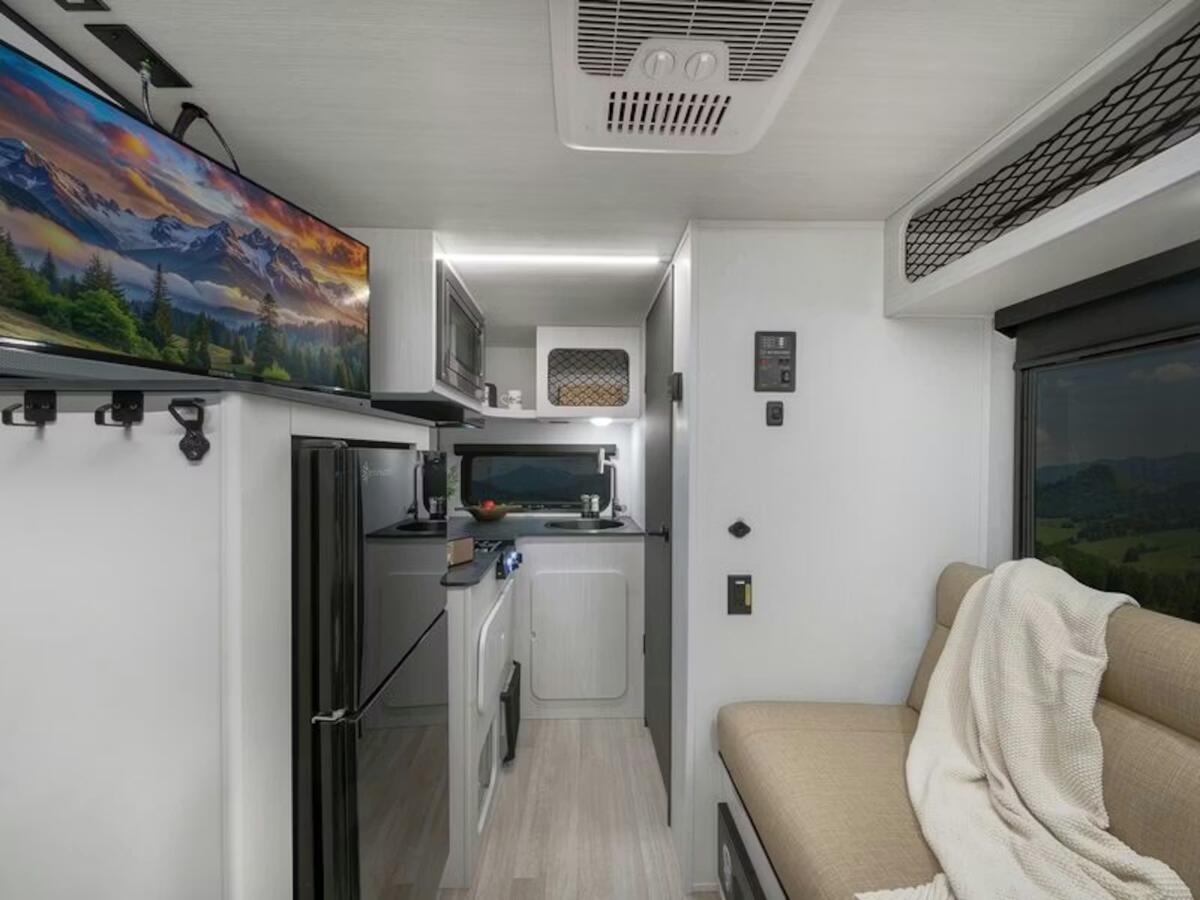
Inside, the 7-foot-wide body uses space well. The front bed measures 80 by 50 inches, so it gives queen-length sleep. There are overhead cabinets, side windows, lit storage below, and a hidden under-bed compartment. A jackknife sofa adds extra sleeping space and more storage.

The rear kitchen is the big surprise. It includes a 12-volt split fridge and freezer, a 32-inch 12-volt smart TV, USB-C ports, outlets, a two-burner cooktop, a microwave/convection/air fryer combo, and a deep stainless sink with a multi-function faucet. The Thinscape® countertop is built to handle high heat while keeping weight down.

The bathroom is better than expected in a trailer this short. It has a hard door, 6’2″ headroom, a side-mounted fan with intake and exhaust, a skylight, built-in soap storage, and a self-squeegee shower door. Most importantly, this is a dry bath with the toilet sitting outside the shower, and there is a tankless water heater.

Abfu Fxvizenjkme Web Sprout 13rks 021625 Main

Factory specs:

  • Dry weight: 2,950 lb.
  • Cargo capacity: 1,250 lb.
  • Hitch weight: 345 lb.
  • Length and height: 17’4″, 10’5″
  • Tanks: 37 gal. fresh, 27 gal. gray, 27 gal. black

Final thoughts

The Sprout 13RKS doesn’t feel stripped down. It brings tougher materials, better off-grid gear, and a usable bathroom into a trailer that stays compact and towable. The walkthrough unit wears the white exterior, and Keystone also offers a titanium package.

Learn more about the Keystone Sprout 13RKS here.

MORE KEYSTONE TRAILER REVIEWS

RVT1264b

The Forest Service’s new app is helpful. So, why do RVers still need Recreation.gov?

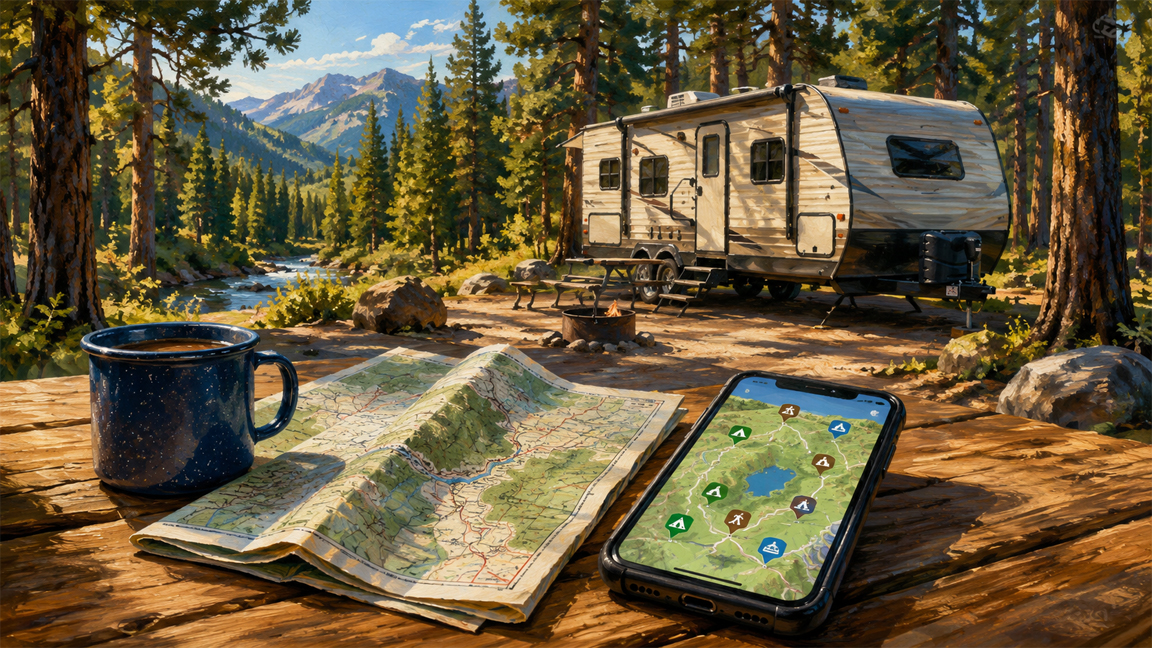
The U.S. Forest Service has launched a new mobile app designed to make recreation planning easier. After spending some time with it, we found plenty to like. But we wouldn’t call it a one-stop solution.

That’s because even after downloading the new app, many RVers will still find themselves opening Recreation.gov whenever it’s time to reserve a campsite.

The new National Forests and Grasslands app aims to bring together information that has long been scattered across dozens of forest websites, PDFs, and local recreation pages. In that sense, it addresses a real problem. Finding reliable information about a national forest campground, trail, road closure, or recreation site hasn’t always been easy.

What the app does well

The app provides access to information on thousands of recreation sites across the National Forest System. Users can search for campgrounds, trails, visitor centers, and other destinations. The app also includes alerts, closures, maps, and site details.

One feature that should appeal to RVers is offline access. Users can download maps and information before leaving cellular coverage. That’s a practical benefit for anyone who has arrived at a remote campground only to discover there’s not enough signal left to look up road conditions or campground details.

The app also offers a cleaner, more consistent experience than jumping between individual forest websites, each with its own layout and navigation quirks.

For dispersed campers or boondockers who spend time in national forests, that alone may justify installing it.

How easy is it to use?

One pleasant surprise is that the app appears fairly intuitive.

Users start by selecting an activity category. Options include camping, hiking, hunting, horseback riding, bicycling, OHV riding, picnicking, water activities, winter sports, scenic drives, climbing, and even caving.

Next, enter a nearby city or destination. The app then returns an illustrated list of recreation opportunities that match the search.

During our testing, the process took only a few taps. In our case, finding nearby campgrounds and recreation opportunities took less time than figuring out which forest website to visit.

For first-time users, the app’s simplicity may be one of its biggest strengths.

Where it falls short

The biggest limitation becomes apparent almost immediately.

You can’t use the app to reserve most campsites.

Instead, campground reservations still route through Recreation.gov, the federal reservation system that handles bookings for many Forest Service, National Park Service, Bureau of Land Management, and other federal recreation sites.

As a result, many RVers may find themselves using one app to research a campground and another app to actually book it.

In some locations, the need for Recreation.gov goes even further. The Forest Service increasingly uses cashless payment systems at certain developed recreation sites. In those areas, visitors may need the Recreation.gov app already installed on their phones to pay for a campsite.

The agency advises visitors to download the Recreation.gov app before arriving, noting that users may need it “before your trip to have the ability to scan & pay digitally on site.”

It’s not a deal-breaker. Most of us already juggle multiple apps while planning a trip. Still, it raises an obvious question: Why not put planning and reservations in the same place?

“The Forest Service app helps us find places to go. Recreation.gov still helps us get there.”

Another app in an already crowded toolbox

The federal recreation landscape is becoming increasingly app-heavy.

Many RVers already carry the Recreation.gov app for reservations. Some also use the National Park Service app when visiting national parks. Now the Forest Service has introduced a separate app focused on national forests and grasslands.

Each serves a purpose. The challenge is remembering which one does what.

A traveler planning a summer trip through Western public lands could easily find themselves switching among all three.

That may make sense from an agency perspective. From a user perspective, it can feel like another login, another download, and another icon on the phone.

A few practical observations

Our download occupied about 173 MB of storage on one device. That’s not excessive by today’s standards, although travelers who download large offline map packages will likely use more space.

Some readers may also wonder about privacy. According to the app’s listing, the Forest Service says the app does not collect user data and does not share information with third parties. That may reassure travelers who keep a close eye on digital privacy.

The bottom line

The Forest Service deserves credit for addressing a long-standing problem. Recreation information across the agency’s vast system has often been difficult to find and inconsistent from one forest to another.

The new app makes that information easier to access, and the offline features are genuinely useful.

Still, it doesn’t eliminate the need for Recreation.gov. At least for now, RVers who want both campground information and reservations will likely need both apps.

After spending some time with the app, we can see ourselves opening it when we’re looking for places to go. But when it’s time to reserve a campsite—or pay for one at a cashless recreation site—we’ll still be opening Recreation.gov.

For now, the Forest Service app helps us find places to go. Recreation.gov still helps us get there.

Until those functions come together, most RVers will probably need both.

RELATED

RVT1264b

Prime Day RV deals: Here’s the RV gear worth watching now

Amazon Prime Day RV deals are still a few weeks away, but RVers who wait until the sale starts may already be behind. If you’ve been thinking about a new power station, tire pressure monitor, Starlink accessory or some other RV gadget, now is the time to start watching prices.

Amazon has announced that Prime Day 2026 will run June 23-26, making this year’s event a four-day sale. That gives RVers a few weeks to do something many shoppers skip: Figure out what they actually want before the discounts start flying.

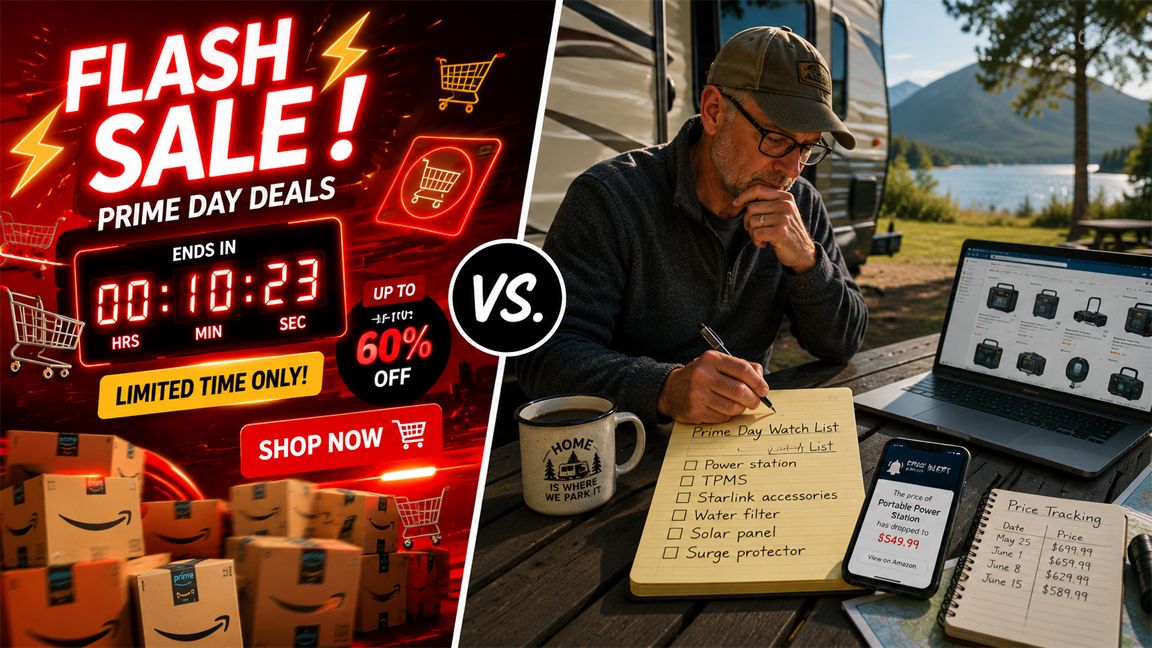
The biggest Prime Day savings often don’t come from impulse purchases. They come from knowing what a product normally costs and recognizing a real bargain when you see one.

That’s why now is the time to build a watch list. The items you want might already be on sale…

Price tracking comes first

Before adding anything to your cart, start tracking prices. That kind of simple tracking can help you separate real Prime Day RV deals from ordinary prices dressed up with sale banners.

The easiest method is to create an Amazon wish list on your account and add products you’re considering. Check those prices occasionally between now and Prime Day.

For a more detailed approach, many shoppers use free services such as CamelCamelCamel, which tracks Amazon pricing history and shows whether today’s “sale” price is actually lower than normal. Some browser extensions offer similar tools.

You can also keep it simple. If you’re considering a $700 power station, write down today’s price and check it every few days. By the time Prime Day arrives, you’ll know whether the advertised discount is truly worth your attention.

Pay attention to bundles, too. Some of the better Prime Day values come from packages that include solar panels, extra batteries or accessories rather than discounts on the main product itself.

Portable power gear usually sees deals

Portable power stations have become the modern RV equivalent of duct tape. RVers use them for everything from charging electronics during lunch stops to providing backup power at campsites.

Prime Day has frequently included discounts on power stations from major brands such as Jackery, EcoFlow, Bluetti, and Anker. Solar panels and solar-generator bundles often follow.

The biggest discounts tend to appear on older models or larger-capacity units. That doesn’t necessarily make them bad buys. In some cases, last year’s model can be a better value than the newest version.

Connectivity products are worth watching

Reliable internet has become almost as important as electricity for many RV travelers.

Prime Day often brings deals on routers, antennas, signal boosters, networking equipment and accessories used with satellite internet systems.

That doesn’t mean every deal is worthwhile. Some accessories solve real problems. Others solve “problems” that don’t actually exist.

If you’ve been considering an internet upgrade, now is a good time to decide exactly what you’re trying to improve. Faster speeds? Better campground coverage? More reliable remote-work connectivity? Knowing the answer can save more money than any sale.

Safety equipment often delivers the best value

Some of the most useful Prime Day purchases aren’t the flashy ones.

RV safety products frequently appearing in Prime Day promotions include tire pressure monitoring systems, backup cameras, surge protectors, water pressure regulators, carbon monoxide detectors and fire extinguishers.

These products rarely generate excitement around the campfire, but many RVers would argue they provide more value than the latest gadget.

When safety equipment goes on sale, it may be worth taking a serious look.

Don’t forget the everyday RV supplies

Prime Day discounts often show up on products many RVers eventually need anyway.

Think water filters, sewer hoses, leveling blocks, wheel chocks, storage organizers, LED bulbs, extension cords and basic tool kits.

None of those items will transform your camping experience. But if they’re already on your shopping list, a sale is a sale.

Kitchen and campsite gadgets can be hit or miss

Air fryers, induction cooktops, portable ice makers, outdoor lighting and similar campsite gadgets frequently appear during Prime Day.

Some discounts are substantial. Others look impressive until you discover the product sold for the same price a few months earlier.

That’s where the price tracking you started today becomes valuable. Instead of trusting a sale banner, you’ll know whether the discount is real.

The goal isn’t buying more stuff

Prime Day will generate plenty of excitement, countdown timers and claims of huge savings. Some of those deals will be genuine. Some won’t.

If you spend a few minutes building a watch list now, you’ll be in a much better position to tell the difference when the sale begins.

And if you end up buying that power station, Starlink accessory or tire monitor you’ve been eyeing for months at a truly discounted price, that’s a lot more satisfying than discovering you paid a “sale” price for something that wasn’t really on sale at all.

The best Prime Day RV deals are not always the loudest ones. They are the ones you already researched before the countdown timers started.

RELATED

RVT1264b

RV Daily Tips. Friday, June 5, 2026

America’s Original RV Newsletter. Since 2001
Issue 2920 • New issue every weekday


Today’s thought

“You can’t depend on your eyes when your imagination is out of focus.” ―Mark Twain


Need an excuse to celebrate? Today is National Doughnut Day! We love doughnuts, and we love the sound of this! [Get a free doughnut at Krispy Kreme today only. No purchase necessary. Some types excluded.]

On this day in history: 1956 – Elvis Presley introduces his new single, “Hound Dog”, on The Milton Berle Show, scandalizing the audience with his suggestive hip movements.


Tip of the day
RV tanks dumping tips and helpful accessories

By Gail Marsh
It’s a job that many RVers dread—especially as newbies. I’m here to tell you that you need not dread this necessary job. You just might need a few tips and tricks to make dumping your RV tanks easier!

To start, let’s look at using a Y-valve water connector on the campground’s water supply. This allows us to use separate hoses, one for drinking, cooking, etc., and the other for flushing the black tank or washing the RV or truck. Continue reading.


ALINER Switchback folding truck camperRV review
2026 Aliner Switchback—an attention-grabbing, folding truck camper

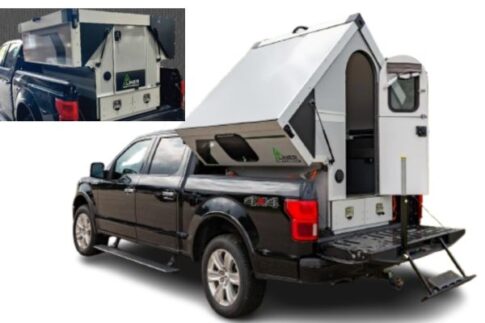
A hard-sided truck camper that weighs about 400 pounds is rare. The 2026 Aliner Switchback goes further because it is built for smaller pickups and still folds low enough to stay practical day to day. That mix of low weight, quick setup, and hard-wall security is why the early reaction has been so strong. This is pretty cool. Check it out.


IT’S TRUE! SORT OF… Coffee somehow tastes 37% better when you’re holding the mug outside your RV. (This statistic was not reviewed by scientists, but most RVers would probably agree.)


Trusted by Full-Time RVers
Americas Mailbox offers secure mail forwarding, scanning, and residency services tailored to life on the road, plus tax savings. Learn more.


In the RV shop with Dustin
Are the most common RV issues covered under warranty?

Join me as I delve into some of the most common RV issues plaguing the industry today. In an interview with Wholesale Warranties, I chatted with Staci and discussed these top issues and whether they are covered claims under warranty.


Small blind spot mirror good for all vehicles
If you don’t have one of these on your RV or tow vehicle, you need one! These small 2″ round glass blind spot mirrors easily stick onto your current mirror; no hard work is needed! They’re waterproof and rust-resistant and can rotate and sway to be adjusted for the best visibility. They could save you from an accident. Learn more or order.


Article and video
The pros and cons of volunteer camp hosting

After four months as volunteer camp hosts on Arizona’s Mogollon Rim, Kim and Pete of RV Life with Kim Hanna came away with a clear answer: Camp hosting can be great, but it is not an easy free campsite. Most campers were kind, respectful, and fun to meet. The hard part came from the small number who left messes, ignored rules, or created safety problems. Here’s a full look at both sides of the job.


CAMP HOSTS WANTED in Louisiana State Park. Get the scoop.


IN TOMORROW’S ISSUE

New World Screwworm
Oh, what beautiful eyes you have! But please, do not invade the USA.

Featured article
OMG! This RV is for camping? Really?

That RV you see right above these words (well, in the article), guess what is it — motorhome, trailer, fifth wheel? Nope. None of those. It’s a truck camper! Do you believe it? You won’t…


Our readers favorite products at Amazon
For 25 years, RVtravel.com has recommended products at Amazon that we believe RVers would love. Here are those that are consistently reader favorites. Just reading through this list is fun! So many good things!


Ask Dave
Do I need a trickle charger for engine battery when connected to shoreline power?

Read Dave’s answer.


You may have missed these recent popular stories…


SUMMER ESSENTIALS? Say no more! As usual, Amazon has a whole category for that, and soooo many items are on sale.


Reader poll
How many nights in a row do you wear the same pajamas (or sleepwear)?

Respond here.


Quick tip
Dinette cushions sliding around? Here are some solutions

Here are some possible solutions if your dinette cushions are sliding around: Apply “lines” of silicone caulk in a pattern across the “back” of the sliding cushy. Let the caulk dry before setting back into place – the dry caulk acts as a snubber. Or attach sticky-back hook-and-loop tape to both the cushion and the surface it should “stick” to. Bob added this tip: “Instead of putting the caulk on the cushion, apply it to the wood under the cushion. Has the same effect and can be removed and reapplied when needed.” Thanks, Bob! And Ran added this: “Quick Tip – Add on. I use the rubber shelf liner open weave mat under my cushions to keep them from sliding around.” Thanks, Ran!


Website of the day

7 of the Quirkiest Road Stops in the U.S.
This list from dailypassport will have you planning a trip to one of these quirky roadside stops in no time. We love stuff like this! How many of these have you visited?


Trivia

Reno is farther west than Los Angeles. It may seem hard to believe, but it’s true. Reno is located at 119°49’ West and Los Angeles is located at 118°14’ West.


? MYSTERY PRODUCT OF THE DAY ?
You and your sweetheart (or even your dog!) need this for a “snug-as-a-bug” camping season! Or maybe you just want to keep it all to yourself… Or maybe your dog wants it all to themself…


Readers’ pets of the day

20260419 081105 1fe67dc1751d0ef2534ee372cb5d2130“Gracie & Buddy (Maltese/Shih Tzu, ages 4 and 9) go with us everywhere. They especially love traveling with us when we take our RV camping. We have a smaller Class C so seating is limited. They usually get first dibs!” —Steve Mitchell

HELP! WE’RE RUNNING LOW ON PET PHOTOS! Send us a photo of your pet with a short description. No blurry photos, and please do not submit your photo more than once. Thanks!

RVing with Dogs group on Facebook. You’ll love it.


FINISHED READING THIS NEWSLETTER? Great job! Now you can move over to yesterday’s brand-new Great RV Accessories newsletter. It’s fun to read!


Leave here with a laugh


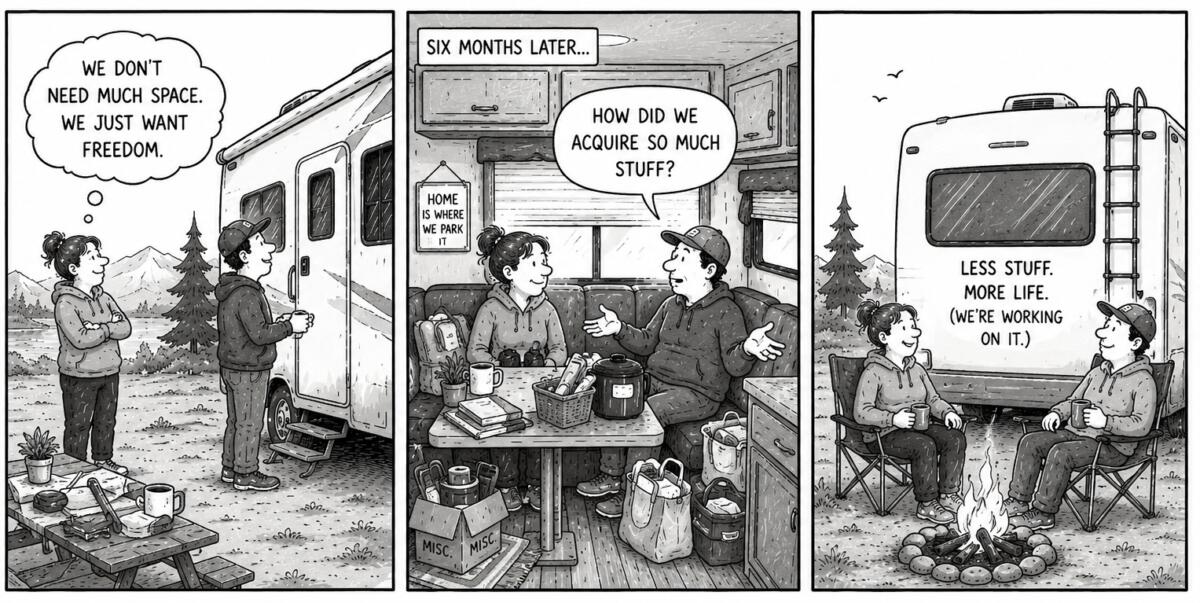
Lessstuff


Today’s weather forecast across the nation
THIS MAP UPDATES TWICE A DAY
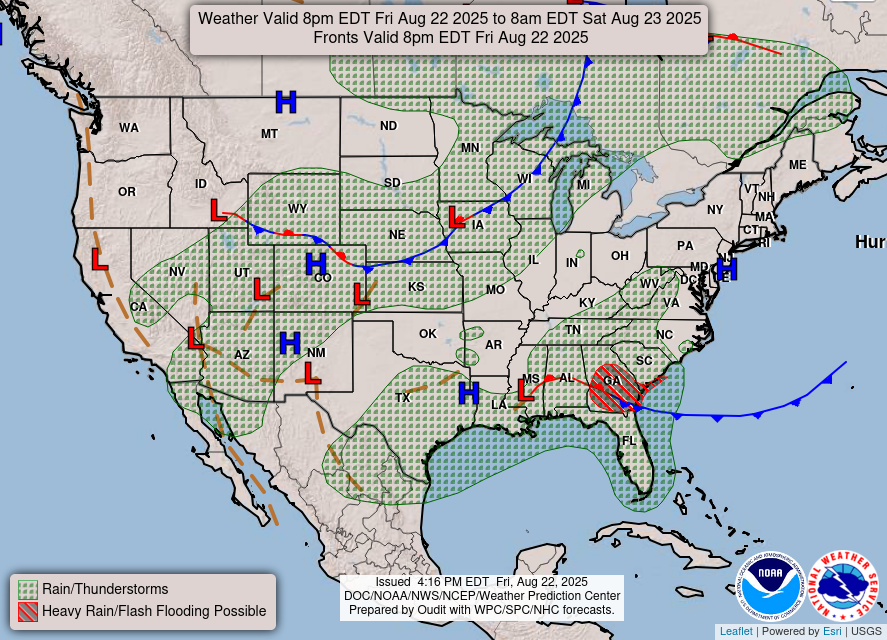
Visit Current National Radar Weather Map


Did you miss the latest RV Travel Newsletter? If so, read it here.
Oh, and if you missed the Latest News for RVers, make sure to catch up here.


If you shop at Amazon.com we’d appreciate you using this link. We get an itty bitty commission if you buy something, but they add up and help us pay our bills (most importantly our hard-working writers!). 


RVtravel.com All-Star Staff

Click here for information about our staff and how to contact us.
WHY WE ASK FOR DONATIONS INSTEAD OF SELLING SUBSCRIPTIONS.

Our policy on using artificial intelligence.

Do I need a trickle charger for my engine battery when I have shoreline power?

Dear Dave,
We are full-time RVers. I’m wondering if I need to use a trickle charger on my 12v starter batteries to maintain them. If so, how do I do it? We are usually plugged into shore power at parks. —David, 2000 Fleetwood Bounder 39Z

Dear David,
The engine battery will have a slight drain from some of the automotive components such as the engine computer and radio with preset stations. However, this typically takes several weeks to drain an engine battery if it is in good condition, as the draw is very small.

You can actually test the draw with a multimeter by removing the negative cable on the engine battery, set the multimeter to DC amps, place the red probe on the empty battery post and the black probe on the cable end. Any draw or drain that is coming through will show there, and it is common to see a 1- to 2-amp draw. Anything more than that would indicate something else drawing power.

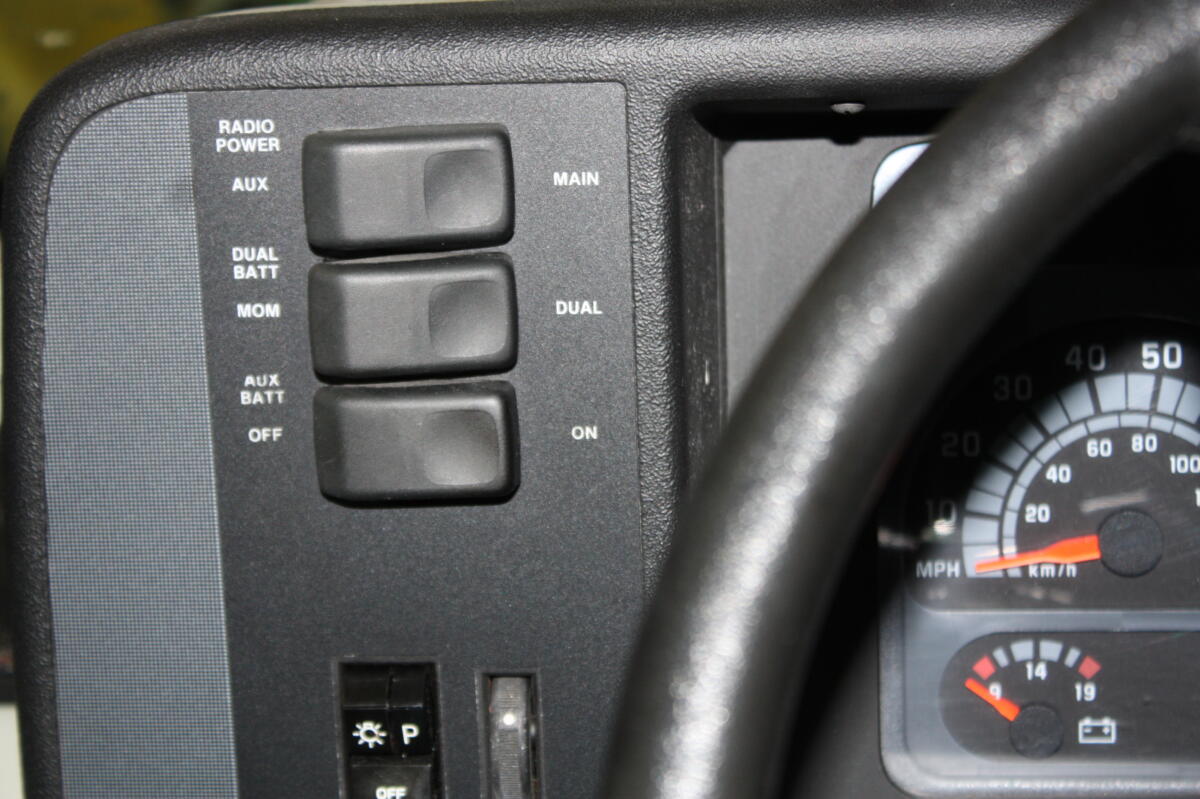
Newer motorhomes have a battery isolation management (BIM) system. It is a solenoid installed between the engine battery and the house battery bank. When the engine is running, the alternator provides a charge to the engine battery and the house batteries through the BIM. It also allows a jump from the house batteries if the engine battery is dead by using the spring loaded switch typically on the dash.

Momentary Switch
Momentary switch (click to enlarge)

Newer models have an engine battery charging feature through the BIM. When you are connected to a campground source, 120-volt power is supplied to the distribution center, which supplies power to the converter/battery charger. If your Bounder has a large inverter such as the Freedom 2000 version, it will have the battery charger as part of the inverter.

Either way, whatever charger you have will provide a charge to the house batteries and also the engine battery through the BIM. Depending on your battery’s charge profile and the converter, it will be at least 13.2-volts.

You can verify if your engine battery is receiving a charge from the converter/inverter with a multimeter, as well. With the rig unplugged from shoreline power, set the multimeter to DC volts and place the red probe on the positive terminal and the black probe on the negative terminal. It should read 12.6 volts without a charge coming from the charger. Plug the shoreline cord in and retest for voltage and you should see at least 13.2 volts. This will verify the BIM is allowing a charge to the engine battery while you are plugged into shoreline power.

BIM
Battery isolation manager

 You might also enjoy these posts from Dave 

DAVE HAS ANSWERED MORE THAN 1,000 readers’ maintenance and repair questions. Read a directory here. There is so much to learn!


Dave Solberg is a leading expert in the RV industry and the author of the “RV Handbook.”

HAVE A QUESTION FOR DAVE?

Send your inquiries to him using the form below.

Name
Drag & Drop Files, Choose Files to Upload

RVDT2920

RV tanks dumping tips and helpful accessories

By Gail Marsh
It’s a job that many RVers dread—especially as newbies. I’m here to tell you that you need not dread this necessary job. You just might need a few tips and tricks to make dumping your RV tanks easier!

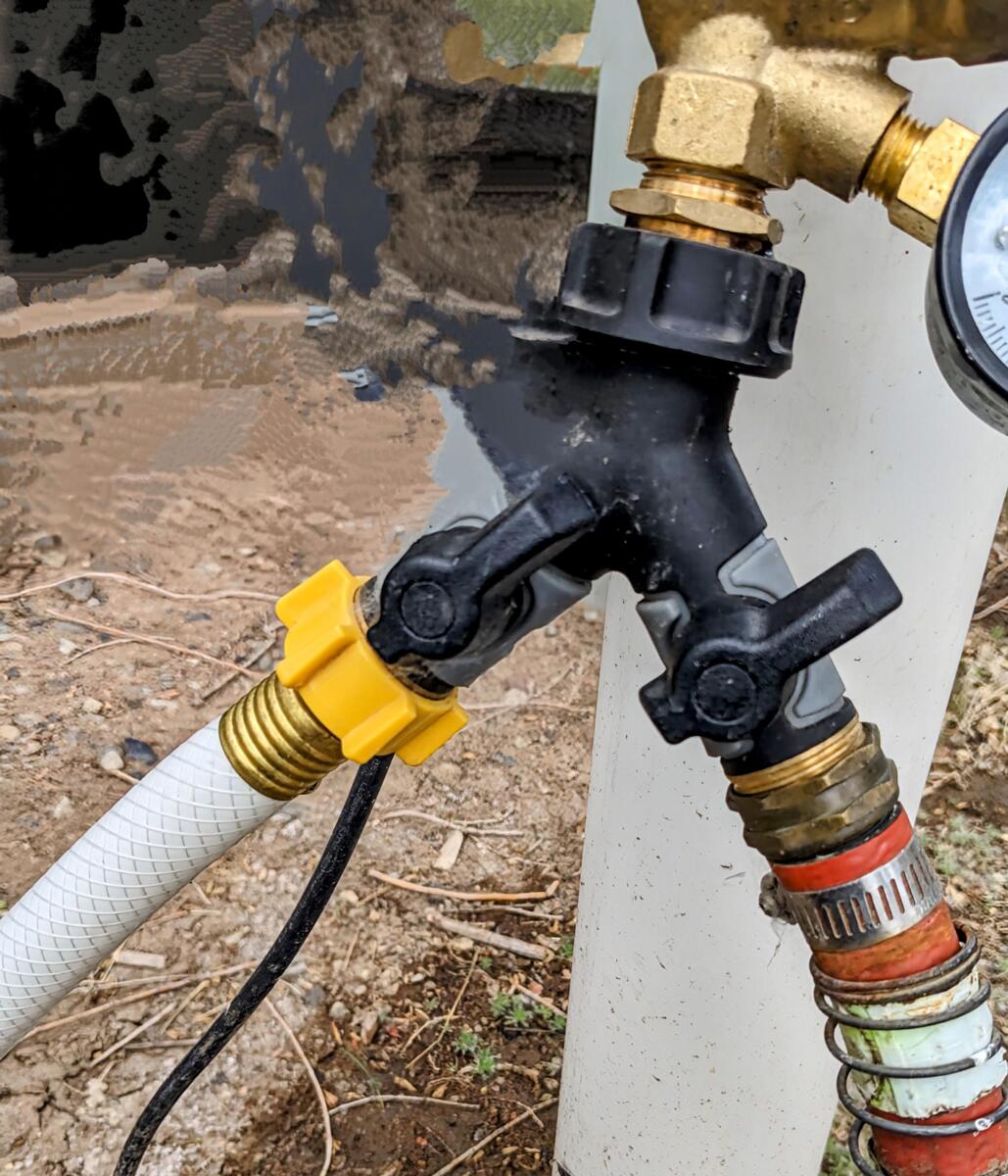
Y-connector

Water spigot y-connector photo by Gail Marsh

We use a Y-valve water connector on the campground’s water supply. This allows us to use separate hoses, one for drinking, cooking, etc., and the other for flushing the black tank or washing the RV or truck.

This Y-connector makes it easy to switch from one hose to the other, using the toggle to close off one hose before opening the other.

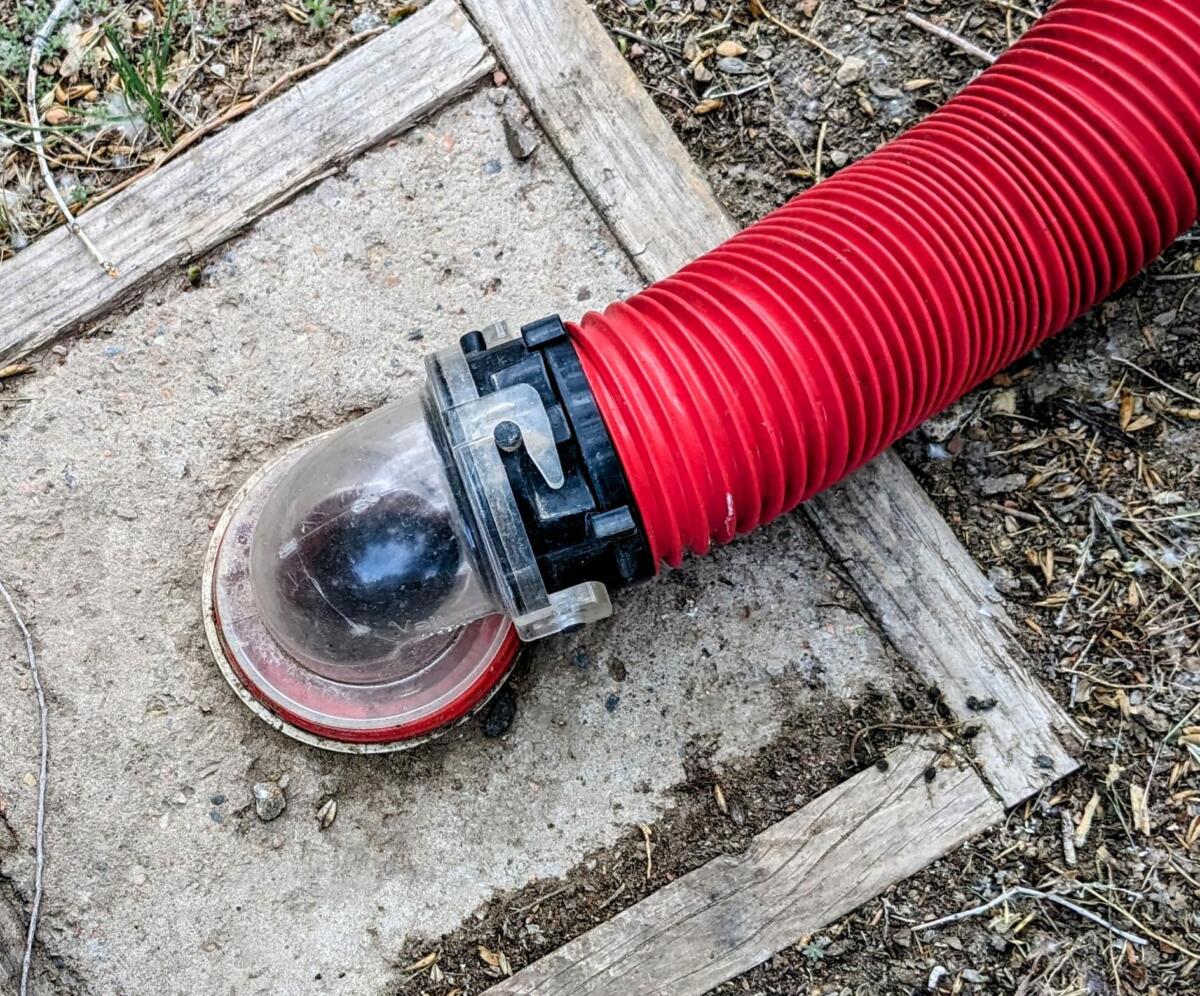
Clear connectors

clear sewer connector photo by G. Marsh

Use a clear connector at each end of the sewer hose. That way you can see what’s happening as the tanks are flushed.

A clear, elbow connector at the end of the sewer tank allows you to securely attach your sewer hose to the campground’s sewer with no mess or odors.

Open the gray tank

Before opening the black tank valve, open the gray tank for just a few seconds. The gray water will lubricate the sewer hose, helping the contents in the black tank to flow smoothly. Close the gray tank valve.

Plenty of water

Open the black tank valve to empty the black tank. Depending on the size of your black holding tank, this could take several minutes.

If you observe (by watching the clear connectors) that the black tank is not completely flushed, close the black tank. Add water to fill the tank, then open the valve and watch the clear connectors to see that the sewage has been completely washed out.

Repeat the black tank refill/empty process until you’re satisfied that the black tank is empty and clean.

Gray tank

Make sure your gray tank is full or nearly full, then empty. This will allow the most water to flush out the sewer hose.

Lubricate tank handles

If your RV has manual tank levers rather than electronic ones, you’ll want to keep the tank levers in tip-top operating condition by lubricating the tank valves regularly.

With the holding tanks empty, pull out the black tank lever. Apply a dry lubricant to the lever mechanism and open and close the valve a few times to work the lube into the mechanism. Repeat the process for the gray tank lever.

Your tips

You may have additional tips to offer. Please share your tips and tricks for dumping your RV tanks using the comments section below.

RELATED

RVDT2920

The pros and cons of volunteer camp hosting

By Cheri Sicard
After four months as volunteer camp hosts on Arizona’s Mogollon Rim, Kim and Pete of RV Life with Kim Hanna came away with a clear answer: Camp hosting can be great, but it is not an easy free campsite. Most campers were kind, respectful, and fun to meet. The hard part came from the small number who left messes, ignored rules, or created safety problems.

Their season in the Apache-Sitgreaves National Forests gave them a full look at both sides of the job.

In the video at the end of this post, Kim and Pete share their honest assessment.

The parts of camp hosting they loved most

The best part was the people, at least most of them. Kim and Pete said about 95% of campers were great. They cleaned up, followed the rules, and often shared stories, travel tips, and favorite destinations. A few even became friends they planned to see again in Quartzsite.

Wildlife added a lot of fun, too. Campers loved hearing about Bradley, the resident elk, then stepping out of a tent one morning and finding him sleeping nearby. Those moments gave the campground some personality.

Volunteer hosting also gave them a major perk: They could stay in a favorite boondocking site all summer instead of leaving after the usual 14-day limit.

The hard truth about dogs, trash, and waste

Camping was dog-friendly, which sounds great until owners ignored leash rules. Loose dogs chased wildlife, stirred up other dogs, got into fights, and often got lost. Kim and Pete spent part of the summer helping people find missing pets that should never have been off leash in the first place.

The biggest downside was worse than that. It was trash and human waste.

People left food scraps, dirty diapers, bags of poop, and even buckets of waste behind. In free camping areas, the rule is simple: Pack it in, pack it out. When people refuse to do that, volunteers end up handling it, and some public lands end up closed because staff can’t keep up.

What a camp host can do, and what they can’t

Kim and Pete saw their role as the welcoming committee. They checked campers in, explained stay limits, and reminded people about rules such as no speeding, no shooting, and no fires during restrictions. If campers ignored those rules, the hosts could report it, but they had no authority to enforce anything.

That limit mattered. Poor leadership made some situations more frustrating, especially when obvious safety issues were brushed off. Their takeaway was simple: Anyone taking a hosting job should know the duties, perks, and support ahead of time, and paid positions should be spelled out in writing.

Why the volunteer setup worked for them

Their location checked a lot of boxes. It had cooler summer weather, enough solar, room for their Grand Design fifth wheel, and access to Phoenix when family medical issues came up.

They also had weekly water delivery, paid to have their tanks pumped without moving the trailer, and worked a flexible volunteer schedule of about 32 hours a month.

Still, the job did cost them in other ways. They used their own truck on rough roads, got no mileage reimbursement, and stayed tied to one place for the season.

Final thoughts

Camp hosting worked for Kim and Pete because the good outweighed the bad. They got a beautiful site, met solid people, caught plenty of fish, and enjoyed a summer that fit their life at that moment.

They would do it again, but not every year. It can be rewarding, as long as expectations are realistic and it is understood that the messy parts are part of the deal from day one.

RELATED

RVDT2920

How many nights in a row do you wear the same pajamas (or sleepwear)?

4

You can tell a lot of our poll questions come to us when we’re doing everyday things. Like this one, which came to us as we pulled a clean pair of pajamas out of our drawer. (See, we’re real humans!)

How many nights in a row do you wear the same pair of pajamas? (If you wear a nightgown, or sweatpants, or anything, just change “that” for “pajamas” here and in the poll.)

Do you wear a new pair every night? Every other night? Do you wear the same pair for three nights before changing? Do you wear the same pair for a week? More than a week?

Now, we know your answer to this may change depending on whether you’re in your RV versus your sticks-and-bricks house, but try and answer the best you can, even if it’s your average between the two.

And if you’re suddenly thinking you may need another pair of pajamas, click here for tons of camping and RVing-themed PJs. They are so fun!

Oh, and remember, we can’t see how you vote. So if you say you don’t change your pajamas for a month at a time, well, we can’t judge you! Same goes for if you don’t sleep in pajamas at all. You do you!

MORE POLLS YOU MIGHT ENJOY:

RVDT2920

Are the most common RV issues covered under warranty?

By Dustin Simpson
Join me in the video below as I delve into some of the most common RV issues plaguing the industry today. In an interview with Wholesale Warranties, I chatted with Staci and discussed these top issues and whether they are covered claims under warranty.

Are the most common RV issues covered under warranty?

Throughout the video, we shed light on the challenges faced by RV owners and how warranty coverage can help mitigate the financial burden associated with repairs. From mechanical failures to electrical issues and beyond, we explore the wide range of problems that RVers may encounter on the road.

By identifying these common issues and understanding whether they fall under warranty coverage, RV owners can make informed decisions to protect their investments and ensure peace of mind during their travels.

EDITOR’S NOTE: This article is from Dustin Simpson of California RV Specialists. While Wholesale Warranties is an advertiser with RVtravel.com, Dustin submitted this article without any direction from us.

More from Dustin

Make sure you check out my website, California RV Specialists, and our YouTube channel for more helpful information, and see our published articles on RVtravel.com and other social media pages.

RELATED

RVDT2920