Unexpected highway closures can quickly disrupt an RV journey. Staying one step ahead of these closures enables you to adjust your route with confidence.
Year-round
Highway closures happen year-round but seem to cause the most trouble during the summer months. That’s because the volume of folks traveling increases. Students are out of school. Summer weather is more easily predictable, and attractions are more likely to be available to visitors.
With more travelers on the road and more construction and highway repair scheduled for the summer months, it’s important for RVers to understand and use some tips for highway closures.
Types of delays
• Highway maintenance like pothole patching repairs often mean brief delays as one lane may be closed for a short period of time. Larger projects like bridge replacement often demand that a detour route be established.
• Special terrain like mountain landscapes often offer no alternative routes and extended traffic holds are common. You may choose to reroute your trip to avoid extended closures.
• Natural disasters also cause closures. Fires and flooding can close a roadway with little to no prior warning.
Any or all of these causes for highway closures can quickly derail an RV trip.
Navigating the closures
There are several ways that RVers can safely navigate road closures.
Sign up for WEA messages. Wireless Emergency Alerts send emergency messages to your cell phone. These may include weather warnings, AMBER alerts, national emergency notifications, and more. This service is free. You will find more information here.
GovOneStop. This service is in partnership with the Department of Homeland Security (DHS) and the Federal Emergency Management Agency (FEMA). They broadcast public safety alerts, emergency alerts, and weather warnings to American citizens. Learn more here.
511 traffic system. This system is a source provided by the Department of Transportation’s Federal Highway Administration. By dialing 511 on your cell phone, you’ll receive real-time traffic information (highway closures, accidents, and more). This service is free, and you can find out more here. (pdf)
Natural disaster closures
Fires, floods, and other natural disasters cause road closures, often with little to no warning. RVers can stay updated on these closures via the following:
National: Check FEMA’s Road Closure Portal for federal disaster zones. Or see the Federal Highway Information page.
Local: Check local radio and/or television stations.
Navigate closures smoothly
Here are some ways to safely manage road closures and alerts.
• Bookmark 511 sites: Save each state’s 511 page to your phone and enable push notifications where available.
• Use dedicated apps: Waze and Google Maps often integrate official DOT feeds and will auto‑reroute based on live closures.
• Plan fuel stops early: Extended detours can add mileage—identify fueling stations along alternate routes ahead of time.
• Check local news: Regional outlets (e.g., St. Louis Public Radio for eastern Missouri and Illinois, CBS Colorado for I‑70) often provide context on project delays and weather impacts.
• Flexible itinerary: Build buffer days around known closures so that your travel plans aren’t derailed by unexpected holds.
By keeping these closures—and your go‑to info sources—in mind, you’ll be ready to pivot routes, stay safe, and keep your RV adventure rolling. Happy trails!
By Cheri Sicard
Compact travel trailers continue to get more impressive, and the Puma 121RKCE takes that idea to the next level. Built by Palomino, part of Forest River, this pint-sized RV packs a surprising punch in features and space. Aimed at those looking for a budget-friendly start in RV travel, it’s a good pick for anyone wanting camping comfort without overspending or sacrificing mobility.
In the video at the end of this post, we get a tour from the team at Big Truck Big RV.
Colonia Delray RV in Corpus Christi, Texas, served as the testing ground for this review. The busy, noisy lot couldn’t hide just how practical a compact camper like this is in real-world situations. Being able to squeeze into smaller spaces with all your essentials makes these micro RVs a smart choice, especially for spontaneous adventures.
Let’s get right to the numbers. Here are the key specs of the Puma 121RKCE:
• GVWR: 3,840 lbs.
• Dry weight: 2,514 lbs.
• Cargo capacity: 1,297 lbs.
• Overall length: 16 feet
• Axle: Single 3,500 lb. unit
Weighing so little, this model is ideal for smaller trucks and even many SUVs.
Despite its tiny frame, the Puma squeezes in some clever exterior features:
• 30 lb. propane tank mounted up front
• Room for dual batteries and a handy power disconnect
• Off-road-ready Westlake tires
• Stabilizer jacks on both ends for solid footing
• Unique frosted matte finish
• Electric awning with LED lights for evening relaxation
Upgrade potential
Owners interested in improvements have plenty to consider. The manual tongue jack can be upgraded (just three bolts), and the utility connections are laid out for easy tweaking or adding accessories. This leaves room for personalizing without having to start from scratch.
With an MSRP of $28,698 and a real-world sale price near $14,480, the Puma 121RKCE is hard to beat for value. Compared to building out a cargo trailer with similar amenities, most people would spend a lot more, not counting their own time. For anyone without advanced DIY skills, this camper offers a hassle-free route to weekend exploring.
Step inside, and the modest exterior gives way to unexpectedly usable space. There’s a functional kitchen and enough room to move around comfortably. Highlights include:
• Refrigerator and freezer combo
• Two-burner cooktop
• Plastic undermount sink
• Thermofoil countertops
• Jackknife sofa that converts into a spare bed
• Friction hinge entry door
• Folding entry steps
• Storage above and below counter
Natural light is nice, though some may wish for a bigger window. Still, usability and comfort rank high for a trailer this size.
The Furrion microwave, two-burner cooktop, and modest countertop work together for basic meal prep. There’s no drawer space, but given the camper’s size, the available cupboards get the job done. It’s enough to handle coffee, breakfast, and easy camping dinners without struggle.
One air conditioning unit handles cooling, with vents placed to keep air flowing where it’s needed. Built-in speakers and a spot for a TV add a touch of convenience on rainy days or late nights. The setup covers both comfort and basic entertainment needs without cluttering up space.
The bathroom makes the most of its square footage. It’s not a luxury bath, but it covers every need after a day outdoors.
Towing benefits
Pulling a compact unit like this makes a noticeable difference on the road. Less weight equals reduced wind drag and better fuel economy. Lightweight and short body allow easy maneuvering, even at packed campgrounds or uneven parking spots. The off-road tires add peace of mind when roads get rough.
Storage surprises again with a truly large pass-through compartment. That’s rare in a trailer of this length, rivaling even bigger siblings. A stick-and-tin body (wooden frame with aluminum siding) on a steel base keeps things steady and reliable. Features like LED outdoor lighting and a water heater compartment round out the exterior.
What’s your take on the Puma 121RKCE? Leave your thoughts in the comments below.
A situation of missing hardware could land you on the ground. Keystone RV Company (Keystone) is recalling certain 2025 Carbon, Fuzion, and Raptor toy hauler recreational trailers. The rear gate pins and/or leg support bracket may be missing, allowing the gate to shift during operation.
A rear gate that shifts or patio stairs that becomes unstable increase the risk of injury. The missing Keystone hardware affects 491 RVs.
Missing Keystone hardware remedy
Dealers will install the gate pins and/or leg support brackets free of charge. Notification schedule has not been provided yet. Owners may contact Keystone customer service at 1-866-425-4369. Keystone’s number for this recall is 25-470.
RVers are accustomed to keeping an eye on the sky as they travel. Weather plays a critical role in RV travels. Recent evidence suggests we may need to adjust our thinking a bit.
Why? The heart of tornado activity appears to be creeping east and southward. This could reshape the map of risk for RVers across the country.
Tornado Alley?
“Tornado Alley” has long referred to the corridor of the central Great Plains where the greatest number of tornadoes occur each year. Here, warm, moist air from the Gulf of Mexico collides with cool, dry air from the Rockies, creating ideal conditions for supercell thunderstorms and twisters.
For decades, RVers traveling I-35, I-70 and I-40 in states like Oklahoma, Kansas and Nebraska have monitored weather radios and Doppler radar apps to remain aware or even steer clear of these high-risk zones.
Eastward shift
Meteorological analyses over the past several decades have documented a gradual uptick in tornado frequency in the Southeast and Mid-South. This area of the United States has been dubbed “Dixie Alley” and includes states like Mississippi, Tennessee, and Kentucky in the high-risk zone.
What’s causing the shift? Studies conducted by NOAA and others say that variations in the jet stream, increasing dew points, and increased instability in the atmosphere are to blame. Local news investigations also point to factors like prolonged Southwest drought and warmer Gulf waters as key contributors to the changing storm patterns.
Stats don’t lie
The 2025 spring storm season has been especially active. According to the NOAA Storm Prediction Center (SPC), there were 1,010 local tornado storm reports (LSRs) logged through May 26, 2025. This is nearly 40% above the 727-storm average for this period, and among the highest totals since 2010.
Meanwhile, the National Weather Service reported more than 500 tornadoes by mid-April of this year alone, making it one of the most furious starts to a tornado season in more than a decade. RVers should take note: The risk window is widening, both in time and geography.
Theories
While there’s still active debate in the research community, several leading theories have emerged:
• Warmer global temperatures are influencing the position and strength of the jet stream. This affects where thunderstorms can tap into the wind shear needed for tornado formation.
• Higher sea-surface temperatures in the Gulf of Mexico boost low-level moisture and instability. This provides more fuel for powerful spring storms farther east than before.
• Ongoing drought in parts of the Southern Plains can suppress tornado formation in that area. In contrast, the moisture-rich areas in the Mid-South and Southeast provide energy for tornado and severe storm formation.
What RVers should do
• Reevaluate your routes: If your travels take you through Arkansas, Tennessee or northern Alabama in spring, treat those states with the same vigilance once reserved for Oklahoma.
• Locate shelters: Identify campground shelters or lower-lying terrain as part of your RV setup in a Dixie Alley campground. Remember that hills and trees can complicate tornado spotting.
• Stay informed: Even outside peak season, unexpected cold fronts can spawn severe outbreaks. Monitor both national SPC outlooks and local National Weather Service forecasts. Many RV parks have storm shelters.
• Active alerts: Plan to see or stay in a national park? Check this website for information like road closures due to storm damage.
Stay safe!
As tornado hot spots shift and seasons grow more volatile, adapt your travel plans, gear, and emergency protocols. By staying alert, informed and flexible, you’ll keep your home on wheels—and the memories you make—safe, no matter where you travel.
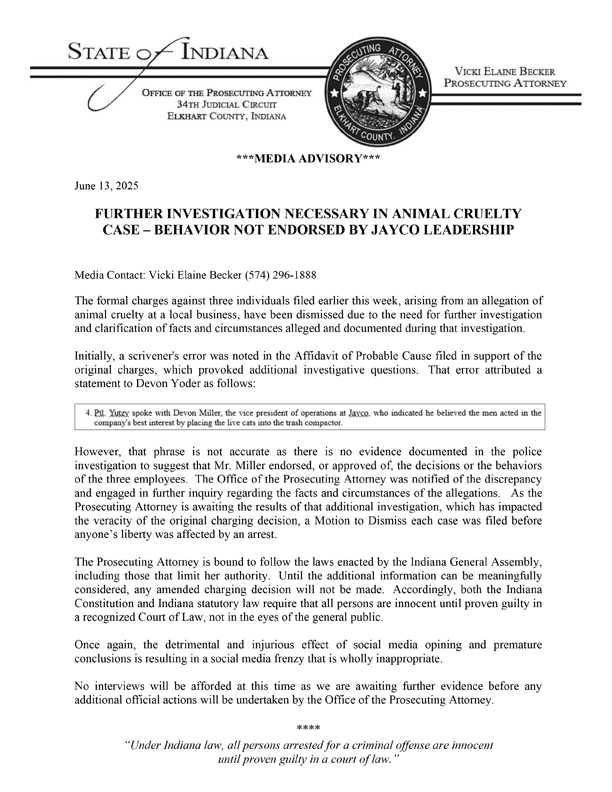
RV manufacturer Jayco says a “false statement” in a charging document against three of its former employees made the company look bad. The case involving the three RV workers stemmed from a horrific incident earlier this year when two stray cats were deliberately killed in a Jayco plant trash compactor. The cats in the compactor case raises more questions.
The case drew public attention in February when reports surfaced that three Jayco employees—John Lipscomb, Travis McKay, and Arlin Hochstetler—had placed two live cats into a trash compactor. The incident happened on February 27. Police were called to the scene that day, and later, all three men were formally charged with two counts each of torturing or mutilating a vertebrate animal, a Level 6 felony under Indiana law.
Cats in the compactor probable cause document paints Jayco in bad light
According to the probable cause documents, the three workers were dealing with a problem of stray cats on the company’s property. John Lipscomb told police he placed two cats into a microwave box and taped it shut. Travis McKay and Arlin Hochstetler then allegedly put the box—with the cats still alive—into a trash compactor.
McKay later told police that local animal shelters were full and that he believed he could “take care of” the problem himself. Hochstetler said he and Lipscomb did not want the cats to suffer but felt the animals were a nuisance that needed to be removed.
Despite the claims of good intentions, both cats were still alive when placed in the compactor.
According to an affidavit to show probable cause, Middlebury police Patrolman Yutzy swore under oath that he responded to the Jayco plant in Middlebury on February 24. After outlining his contacts with the three defendants, Yutzy then makes this statement:
“Ptl. Yutzy spoke with Devon Miller, the vice president of operations at Jayco, who indicated he believed the men acted in the company’s best interest by placing the live cats into the trash compactor.”
Copies of the charging affidavits can be seen here, here, and here. (pdf documents)
Prosecutor does a double-take
The initial police report identifies the man as Devon Yoder. That error was considered minor, and was corrected to show Devon Miller. But it caught the attention of the prosecutor, who dug a little deeper.
If a Jayco management team member really did suggest that compacting cats was “in the company’s best interest,” it would cast a serious pall on Jayco’s reputation. Jayco reacted strongly to the suggestion.
Jayco’s strong reaction
An official statement on the matter from Jayco has been released. “After investigating the quote attributed to Devon Miller, Vice President of Operations in the charging materials filed against the three former Jayco employees, it is apparent that Mr. Miller has been misquoted. Mr. Miller adamantly denies making the statement attributed to him in the affidavit. Jayco has requested the original file materials from the Middlebury Police Department in the hopes to better understand how Mr. Miller’s words were twisted so grotesquely between the time he cooperated with authorities in February to the time the false quote was included in the charging affidavit in June.”
Prosecutors now side with Jayco. In a public statement, they clarified that “no evidence documented in the police investigation suggests that Mr. Miller endorsed, or approved of, the decisions or the behaviors of the three employees.”
Just how the statement that a Jayco manager supported the cats in the compactor action got into the affidavit was never clarified.
Case dropped—but could be reopened
In any event, the prosecutor has now dropped the case against the three men originally charged with the crime. Although the charges were dropped, that doesn’t mean the men are cleared of wrongdoing. Because the case was dismissed “without prejudice,” prosecutors can refile charges after additional investigation. The motion to dismiss was filed before any of the three were arrested.
(click/tap to enlarge)
The case remains open, and prosecutors are continuing to review the situation. The focus now seems to be on clearing up the confusion around what Jayco’s leadership did or did not say and whether any company officials supported the incident.
The outcome of that review will likely determine whether the charges will be brought back.
For now, the public and animal welfare advocates will have to wait to see how the the cats in the compactor case develops. While the facts of what happened are deeply upsetting to many, the legal system must be sure it has its details straight—especially when it comes to statements made by witnesses or company leaders.
The Elkhart County Prosecutor’s Office has not given a timeline for when a decision might be made about refiling the charges.
Colorado’s Loveland Pass (U.S. 6) was shut down at 5:25 a.m. on Sunday, June 15, 2025. A massive landslide struck near mile marker 226. The landslide measures approximately 100 feet wide and 15–20 feet deep. The slide buried both traffic lanes under mud and rock.
Cleanup? Not yet
CDOT reports that the slide zone is “still actively moving.” It is too dangerous to begin efforts to clear the debris. CDOT spokesperson Austyn Dineen cautions that this is likely to be an “extended closure.”
RVers can expect traffic holds at the Eisenhower-Johnson Memorial Tunnels. Traffic will be stopped at the top of each hour to allow hazmat vehicles to pass through.
While no firm timetable has been released, officials describe the delay as prolonged, and no reopening date has been set.
What the Loveland Pass landslide means for RVers
Since Loveland Pass is a key travel route, its closure most certainly will disrupt many plans. Here are safe, practical alternatives:
• Take I‑70 through the Eisenhower–Johnson Tunnels. The tunnels now handle all vehicular traffic. RVs are allowed, and trucks with hazardous materials may pass during scheduled window times. CDOT will manage tunnel flow accordingly.
• Stay on I‑70 East/West and enter the tunnel near Silverthorne or Idaho Springs depending on your direction of travel.
• Arapahoe Basin access. The ski area remains accessible from the western side via I‑70 and U.S. 6 west of the slide zone. Note that access is completely cut off from the east (Loveland Ski Area side).
Travel tips
• Monitor CDOT alerts (social media, highway cams, web updates) for signs of movement or reopening.
• Expect delays and rerouting. The tunnel route might face heavier than normal traffic as all vehicles converge there.
• Plan alternate stops: With Loveland Pass closed, popular trails and picnic spots along the route aren’t accessible. Check with your campground to see if access remains available.
• Be patient and adjust your itinerary accordingly.
On this day in history: 1903 – The Ford Motor Company is incorporated.
Tip of the day Simple strap hack makes propane cylinder transport easy
By Russ and Tiña De Maris
Lugging propane cylinders in the back of the pickup for a refill can be risky. Left on their own, they tend to tip over, and can get into mischief. Federal regulations tell us that transported cylinders need to be secured. Here’s an RVtravel.com reader’s suggestion for fifth wheel owners. This propane tie-down hack is simple! (Plus, we share a tip for non-fifth wheel owners, too.)
Ask Dave My RV’s roof air conditioner smells like mildew. What should I look for?
Hi Dave,
I’m wondering if you have any ideas on why, when my A/C is on, it smells like mildew in our 2018 Fox Mountain. This is the first time it has happened. I took a look at the air conditioner itself, but I don’t really see anything. I wonder if you can help. Thanks, Dave. —Andrew, 2018 Fox Mountain Read Dave’s answer.
No more house flies, fruit flies, mosquitoes, or any other flying insects in your RV again!
RVer Shay Matthews writes, “If you don’t have one of these Zevo insect traps yet, go get one! This photo was after four days of camping in our trailer.” The Zevo flying insect traps plug into any electrical outlet in your home or RV and attract all flying insects like house flies, fruit flies or gnats, and mosquitoes. It works 24/7 by using a powerful adhesive, which discreetly catches bugs. 54,000+ reviews! Learn more or order here.
In the RV shop with Dustin RV slide-outs: Important tips and maintenance
In this RV slide-out tips and maintenance video, we’ll show you how to keep your RV slide-out in good condition. From cleaning to inspecting to fixing, we’ll cover everything you need to know to keep your slide-out working as it should.
Article and video More awesome IKEA RV gear
By Cheri Sicard
RV life can mean getting creative with small spaces, especially when it comes to storage and staying organized. The Grateful Glamper loves IKEA. We published another video of hers on IKEA RV finds a few months back, but in the video today, she is back with even more great RV finds from IKEA that she used for RV upgrades.
Essay by Emily Woodbury A few days ago, I was working on my laptop outside at my backyard picnic table getting this newsletter ready for you. I saw something jumping around out of the corner of my eye. An itsy, bitsy spider was bouncing back and forth from my computer cords to the table. I’ve never seen a jumping spider in person before, but I recognized it immediately from the photos I’ve seen online of the “world’s cutest spiders.” Continue reading about the spider who wanted to be my friend.
RANDOM RV THOUGHT: When getting somewhere quickly is not necessary, drive back roads rather than the interstate. There is so much more to see and do and plenty of room to pull off the road on a whim. Interstates are boring; back roads are interesting.
Reader poll How many miles will you put on your RV this summer compared to last?
Quick tip Using the roof air while driving serves two purposes
Most big motorhome owners realize that using the dashboard air often doesn’t cut it to keep cool while driving. Firing up the generator and using the roof air keeps the rig cool easily—with an added benefit: Since generators need to be “exercised” regularly, running the roof air while underway is a great way to get in that generator maintenance time.
? MYSTERY PRODUCT OF THE DAY ? This takes the meaning of internet cookies to a whole new level! No, your computer doesn’t log your data when you use this, but your stomach is going to grumble every time you hop online!
Trivia
In Syracuse, New York, at the intersection of Tompkins Street and Milton Avenue, you’ll find an upside down traffic light. Why? When the first traffic light was installed in 1925, a band of Irish immigrant boys took it upon themselves to put the Irish color (green) over the British color (red). The local alderman allowed for the change but, eventually, the state of New York stepped in and had it reversed to standard conventions. However, by 1928 the light was reversed again and still, to this day, remains upside down.
Readers’ pet of the day
“Riley captured our hearts in 2011 and crossed the Rainbow Bridge recently on May 9, 2025. Riley loved to walk, camp, tease us with his toys, and of course loved his treats. Riley enjoyed the sights and sounds of camping; he never missed a chance to explore or bark when needed. Riley, we will miss those cow eyes and your wagging tail, but having you for 14 years was the greatest joy of all.” —Andrew Kapusta Jr.
What a sweet tribute to your friend, Andrew. Riley looks like he had the best life of all. Thank you for giving him so much joy. We’re so sorry for your loss.
Send us a photo of your pet with a short description. No blurry photos and please do not submit your photo more than once. Thanks!
Leave here with a laugh
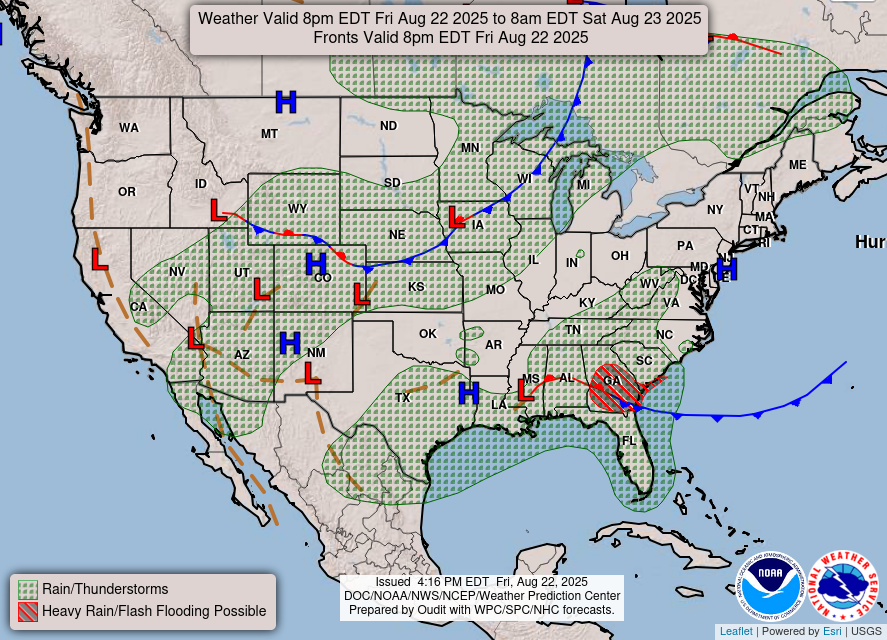
Today’s weather forecast across the nation THIS MAP UPDATES TWICE A DAY
If you shop at Amazon.com we’d appreciate you using this link. We get an itty bitty commission if you buy something, but they add up and help us pay our bills (most importantly our hard-working writers!).
By Dave Solberg Hi Dave,
I’m wondering if you have any ideas on why, when my A/C is on, it smells like mildew in our 2018 Fox Mountain. This is the first time it has happened. I took a look at the air conditioner itself, but I don’t really see anything. I wonder if you can help. Thanks, Dave. —Andrew, 2018 Fox Mountain
Hi Andrew, From what I can find online, it looks like your Fox Mountain 5th wheel has an Airxcel™ Coleman-Mach 13.5 BTU ducted roof air conditioner that was standard, and a 15 BTU as an option.
From the photos I find online, it looks like the unit is mounted in the living room and ducted through the roof to the bathroom. I can’t tell if the bedroom has vents. However, it does not look as though there is a second air conditioner option for the bedroom.
How the air conditioner works
The air conditioner is designed to draw in warm, moist air from the inside of your rig through the air return on the ceiling. The fan pulls the air up and through the evaporator coil. It has the coolant flowing through it that actually “flashes” hot, drawing out heat and moisture.
The moisture is designed to drip down into the front pan and drain out through the drain holes on each side.
Air conditioner evaporator coil
What causes the mildew smell
If you have a mildew smell, it most likely is water that has been trapped somewhere in the system—either at the drip pan, in the return air chamber, or even the ductwork. According to the brochure, the ducting is “condensation-resistant,” which typically means it is not metal, but rather a thin insulation preformed and sandwiched into the roof construction. That doesn’t mean you can’t still get some moisture in the ductwork.
The first place I would look is the drip pan. Take the return air cover off and you should be able to see the opening that looks like this.
Air conditioner drain
The left side is the return air and the right is the conditioned air flowing back into the rig. Check this area to see if there is any standing water or mold. That would indicate the drain holes are plugged and need to be cleaned. This can only be done by removing the exterior cover and the evaporator metal cover. This will also allow you to clean the drip pan and the evaporator coils. I have used a very light bleach solution of just a few tablespoons in a quart of water.
Clean off evaporator coils
If there is a buildup on the evaporator coils, you will want to clean them off. This can be done by spraying evaporator cleaner on and letting it sit. I have also use a portable vacuum but it is not good to spray them down as the water will most likely get into the rig through the air returns.
Caked evaporator coil
Here is a unit that is caked with body powder and the restricted air flow ruined the compressor. This is an extreme, but you will get some dust on the coils and moisture can accumulate, as well. You can find the evaporator cleaner on Amazon here.
Another area to look at is the chamber that the conditioned air flows through. Since you have a ducted roof system, there should be a diverter that redirects the airflow from straight down to the ducts. This entire area has metal components and several gaps that could not only limit the airflow but also collect moisture and be part of the problem. A good visual inspection and cleaning would be good. You can do a little gap prevention with some HVAC tape.
The last place I would look is the ductwork itself—which is difficult to do. You could use an endoscope and fish it down the ductwork. Typically, there would not be much condensation in the ductwork. However, if there is a roof leak somewhere in the area, moisture and resulting mildew could get into the ducts.
My guess is the smell is coming from the metal components in the return air chambers. A good cleaning should get rid of the problem.
You might also enjoy this from Dave
What maintenance does my RV roof air conditioner require?
Dear Dave,
What is involved with maintaining my RV’s roof air conditioning unit? Thank you! —Randy
By Cheri Sicard
RV life can mean getting creative with small spaces, especially when it comes to storage and staying organized. The Grateful Glamper loves IKEA.
Prepping for IKEA RV gear shopping: Measurements lead the way
Before heading to IKEA, the Glampers measured the usable wall space in their bathroom. With these numbers in mind, finding the perfect shelves and organizers became much easier.
Back wall: 28 inches
Side wall (to window): 32 inches
Setting clear goals meant no guessing while shopping—only solutions that would actually fit and function. You should do the same.
Walking into IKEA on a busy afternoon, the Grateful Glamper crew discovered a few gems right out of the gate.
Some favorites:
• SKUBB drawer organizers
• Collapsible “DRöNA” bins
• Assorted mirrors (from the LINDBYN line and others)
• Affordable kitchen caddies and dish brushes
Each item brought ideas for multiple uses, encouraging flexibility, whether for clothes, bathroom items, or kitchen tools.
Spice racks as bathroom shelves
One clever idea: using IKEA spice racks as sleek bathroom shelves. These racks offer enough width for more than small toiletries or book-sized items, making them a good fit for wider bottles and containers.
The team also checked out IKEA’s rail and bucket system. This setup is great for storing kids’ items but comes with travel day concerns—some shelves and buckets need to be stowed so things don’t tumble during bumpy rides.
Drawer organization: What worked, what didn’t
Trying out the organizers in the RV’s unusually shaped drawers led to mixed results. Some pieces didn’t fit as hoped, but the overall concept paid off for items like socks, underwear, and shorts. A few quick drawer tips:
Measure drawers before buying inserts.
Only use what fits—skip the rest.
Stack items vertically to maximize space.
Upgrading the sink area
A big win came from the AVSTEG dish caddy with a drainage tray. Compared to older setups that hogged counter space and often rusted, this upgrade saved space and made cleanups faster. Easy-to-clean dish tools are a must for anyone doing hand-washing in a small space.
Budget storage
For bigger storage jobs, Grateful Glamper grabbed durable plastic nesting bins with clear lids, only $5 each—a fraction of what similar bins cost at major hardware stores. These bins stack, nest, and let users see what’s inside at a glance, helping keep clutter under control.
Mirror makeover
The search for a new bathroom mirror led to several options, but not all hit the sweet spot for price or style. In the end, removing the frame from a larger mirror allowed a better fit directly on the wall, proving that sometimes the simplest tweaks make the biggest impact.
Final results
The new dish caddy and drawer inserts transformed storage from cluttered and cramped to sleek and functional. With everything in its place and the mirror sized just right, daily routines have never been easier or more organized.
What RV gear have you found at IKEA? Be sure to share them in the comments below.
Summer officially kicks off this Friday—are you ready to hit the road? Think about your upcoming RV plans. Will you be traveling more or less than last summer? Going farther? Hitting the road more often?
How many miles do you expect to put on your RV this summer compared to last?
Maybe you’re chasing cooler temps up north or finally checking a big national park off your bucket list. Or perhaps you’re sticking closer to home this time.
Some RVers tell us they’re traveling less due to fuel prices or campground costs, while others say they’re going all in and going farther than ever.
Whatever your plans, we’d love to hear what your summer looks like on the road.
Cast your vote, then leave us a comment with the details. We’re always curious to hear where the road is taking you!
By Dustin Simpson
In this RV slide-out tips and maintenance video, we’ll show you how to keep your RV slide-out in good condition. From cleaning to inspecting to fixing, we’ll cover everything you need to know to keep your slide-out working as it should.
Join me during this 2019 Grand Design Momentum’s exterior evaluation series, where each video concentrates on different areas of the unit. I will share my tips and tricks on maintenance and repairs.
Also, don’t forget to treat the wiper seals with a slide-out wiper seal treatment and make sure the wheels underneath the slide are clean and lubed as well.
Make sure to check all the hardware, sealants, seams, moldings, joints, corners, rails, flanges, rollers, and ramps, for anything lost or separated. Water is the number one killer on the slide-outs!
We recommend that you service your RV’s slide-outs at least once every 12 months.
When servicing your slide-outs, a trick I like is to take my 12-volt/18-volt blower and a long Swiffer sweeper and blow out/dust underneath them. I do this by running the room about 95% out and blowing from inside out.
“It is good to have an end to journey toward; but it is the journey that matters, in the end.” ―Ursula K. Le Guin
Where to RV for 70-degree weather every month of the year
By Emily Woodbury
Wouldn’t it be nice if every stop on your RV journey came with mild days, cool nights, and little need for the A/C or furnace? That’s the goal of chasing 70 degrees. Traveling this way helps you avoid wild weather swings, reduce energy use, and enjoy nature at its best. Here’s how to follow the 70-degree sweet spot around the U.S.
Comparing the top five best campervans for seniors
By Cheri Sicard
For many seniors, traditional motorhomes come with hassles: heavy lifting, tricky setups, and deep cleaning. Campervans turn those challenges into distant memories, replacing hard work with ease of use and real comfort. Smart layouts, tech upgrades, and thoughtful touches make life on the go feel just like home. Here, the team from Motorhome Luxury compiled their picks of the best five luxury campervans for seniors.
A truck stop makes the perfect stop, even overnight
By Gail Marsh We’ve all been there—everyone’s hungry, cranky, and cramped after too many miles in one day. Do you grab food, hunt for an RV park, or pull over for a nap? Before things get worse, head to the nearest truck stop. Yes, really! Truck stops—like Love’s or Pilot Flying J—offer RV-friendly amenities that make them a perfect stop. Here’s everything you’ll find at truck stops.
Today’s RV review…
Winnebago Thrive 18FBS—new new or just warmed over?
By Tony Barthel
Today’s RV review is of the new Winnebago Thrive 18FBS. Thrive is a new line of travel trailers from Winnebago that will ultimately encompass nine floor plans. The purpose of the brand is to freshen the image of Winnebago towables in a “half-ton towable” range of models. Ahem. So let’s get our BS-O-meter out and see what the company has nailed and what they’ve failed.
WANT TO ENJOY THIS NEWSLETTER WITHOUT ADS? You can! Here’s how.
Test ‘driving’ the new Lectric XP4 eBike—big improvements and upgrades
By Nanci Dixon
A couple of weeks ago, I visited the Lectric eBike Headquarters in Phoenix. I was suitably impressed, so when they offered me the new Lectric XP4 750 eBike to test drive, even before the shipping date, I jumped at the chance. I am a big fan of Lectric eBikes and have been ardently riding the Lectric XP2 for about four years. Here are my thoughts on its newest model.
How to quickly clean up an oil-on-concrete spill
By Russ & Tiña De Maris
A lot of RVers are DIYers, do-it-yourselfers. With the build quality and reliability of today’s RVs, you have to defend yourself somehow! Part of the DIY process may include an oil change for the motorhome or tow vehicle. But what happens when, yikes!, oil spills on your concrete driveway or garage floor? Here are some winning tips for oil-on-concrete cleanup.
Navigating road rage in an RV
By Gail Marsh
My husband and I recently faced a potential road rage entanglement. We were driving in the far right lane in preparation for our upcoming exit. One by one, other drivers sped around our RV and immediately cut in front of us. My husband was getting frustrated because he feared rear-ending a quick-cutting vehicle. I could tell his blood pressure was escalating, and so was mine! We needed some help…
Reader poll Did you buy your present RV new or used?
This is an RV.
No, we’re not kidding. To see how it’s possible (it is), click here.
Happy Father’s Day!
The father who turned his boy into a pickle
By Chuck Woodbury ROADSIDE JOURNAL
I would like to tell you the tale of pickled Willie. I learned about Willie while passing through Raymond, Washington. Willie’s claim to fame is that back in the mid-1800s, he came west as a pickle. Yes, that’s right, a pickle.
The fascinating history of Father’s Day
By Gail Marsh
Pops, Daddy, Papa, Dad, Father… No matter what you call him, today is the day we celebrate our fathers and the important father figures in our lives. Dads deserve to be recognized, but did you ever wonder about how Father’s Day came to be? I’ll tell you.
RANDOM RV THOUGHT: One of the very best things about traveling in a motorhome is that a restroom is always just a few steps away.
How to win We’ll select a winner at random out of all entries we receive today by 7 p.m. Pacific time. You can only enter once and after we notify you by email that you won, you have 24 hours to respond.
Explore America’s new 308-mile National Water Trail
By Gail Marsh
This week, the Ohio River Way was recognized as a National Water Trail. This designation marks it as one of the country’s premier paddling routes for 2025. Spanning 308 miles, the Ohio River Way includes the states of Indiana, Kentucky, and Ohio. Learn more and plan a trip (or a paddle!).
A visit to the Cloud Museum—a private collection of vintage machinery
By Gail Marsh
It’s not what you think. When I first read about the Cloud Museum, my mind immediately harkened back to my third-grade science class of “cloudy” variations. But that’s not what this museum is about. In fact, it’s far from it. So, if the Cloud Museum isn’t about clouds, what is it? Read on!
?? MYSTERY PRODUCT OF THE DAY ?? This would save a lot of dirty butts! All RVers should have these. See what we mean.
Highlights from this week’s RV Daily Tips Newsletter
NOT SIGNED UP FOR OUR RV DAILY TIPS NEWSLETTER? You’re missing out! It’s the best, and we mean the very best, newsletter of all time! No, we’re not exaggerating! Sign up and see for yourself!
In the RV shop with Dustin Using a flush valve prop makes cleaning your tanks easy
The Camco Toilet Flush Valve Prop easily installs around the body of your RV waste tank rinser and props open the toilet waste valve while you clean. Using a Flush Valve Prop makes it easier to clean the waste tank without having to hold down on a foot pedal, and also helps prevent damage to the waste valve. Continue reading to learn more.
RV tire safety If I upsize my RV’s tires, can I lower their inflation?
By Roger Marble
I recently received this question from an RVtravel.com reader regarding using larger tires with lower inflation to get a more comfortable ride while maintaining safety and not overheating the tires. Continue reading for Jeff’s question and Roger’s answer.
RV gadgets and gizmos Essential road atlas for Baja California travel
By Cheri Sicard
When I first moved to Baja, Mexico, part-time a number of years back (see this book for more details), I was searching for a good Baja California Road Atlas. I found that a popular choice had gone out of print when I discovered the Baja California Road & Recreation Atlas, and I am glad I did!
BUMPER SNICKER:“The more people I meet, the more I love my dog.”
Want to see your pet in this newsletter? Please send us a photo of your pet with a short description. No blurry photos and please do not submit your photo more than once.
Trivia
Want your kids or grandkids to do a better job at their chores? Put ’em in a Batman costume! A study from the University of Minnesota shows that kids aged 4-6 performed better during boring tasks and chores when dressed as Batman.
And finally… A song from the past to tickle your funny bone
The Streak!
Do you remember “streaking” — running bare-naked in public places (including a few big-time sporting events)? Well, here’s the song that helped fuel the fad, sung by the one and only Ray Stevens. Enjoy the song — and the laughs!
We use cookies to ensure that we give you the best experience on our website. By continuing to use our site, you consent to accepting cookies. We NEVER have or will sell reader's data. For more info, please see our privacy policy page.