Anyone who has a shedding dog or cat (or several dogs and/or cats) knows the struggle of pet hair. If you RV with pets, you know the problem is even worse in a small space. Heck, I’m still finding hair from a dog who passed away two years ago, and my current companion, Bodie, is doing his part every day to add to it.
Fortunately, I recently discovered two products from the innovative company FurZapper that are helping me tame the mess.
Two ways to tackle pet hair in your RV
• Original FurZapper: Use in the washer and dryer to remove pet hair from clothing, bedding, and other laundry.
• FurZapper Glove: Remove loose pet hair before it ever enters your RV while giving your pet a relaxing massage.
These colorful, whimsical silicone discs have a semi-tacky surface that attracts pet hair, dander, lint, and other debris during both the wash and dry cycles. Simply toss one or two FurZappers into the washer with your laundry, then transfer them to the dryer along with your clothes.
The FurZapper doesn’t permanently trap or store pet hair. Instead, it loosens hair so it can be captured in your dryer’s lint trap.
Does it work? Yes. It definitely helps reduce the amount of pet hair left behind after laundry day. Does it eliminate every last hair? No—but it does make a noticeable difference.
FurZapper notes that results depend on several factors, including the type and amount of pet hair, fabric type, load size, washer and dryer design, and the laundry products you use. For heavily fur-covered items, a second wash and dry cycle may improve results.
Use one FurZapper per pet, or add an extra one if you have a heavy shedder (they come in two-packs).
Use one FurZapper for small-to-medium loads with light to moderate pet hair. Use two for larger loads, bedding, blankets, heavier pet hair, or multiple shedding pets.
Don’t overload your washer or dryer. The laundry and FurZappers need room to move freely. (That’s good advice even when you’re not using a FurZapper.)
Avoid fabric softeners and dryer sheets, which can coat the FurZapper and reduce its tackiness.
If needed, clean the FurZapper with a small amount of dish soap, rinse thoroughly, and allow it to dry to restore its tacky surface.
I keep mine in my laundry bag between washes so they’re always handy when I head to the laundromat.
The best way to keep pet hair out of your RV is to stop it before it gets inside. The FurZapper Glove can definitely help with that.
Slip the silicone glove onto either hand and use the gentle bristles to remove loose hair while giving your pet a relaxing massage. Bodie gets excited whenever he sees the glove come out because he knows attention and pampering are on the way.
The glove features more than 2,000 soft silicone bristles covering both sides. Even the inside is textured, making it comfortable to wear.
In addition to removing excess hair from dogs, cats, and even horses, the waterproof glove is especially useful during bath time. It helps work shampoo into a rich lather while removing loose hair and massaging your pet at the same time.
When you’re done, simply rinse the glove under running water.
One more tip:
The FurZapper Glove isn’t just for pets. It also works great for removing pet hair from carpets, upholstery, bedding, car seats, and other surfaces around your home or RV.
Many of us reach a point in our life when we realize just how fragile it can be.
Perhaps it was a serious illness — cancer, a heart attack, stroke, or another medical crisis that left doctors, family members, or even you wondering what would happen next. Or maybe it was a terrible accident: a highway collision, a fall, a close call in the wilderness, or another event that could easily have ended very badly.
For those who survive such experiences, life often takes on a different meaning. Some people say they appreciate each day more. Others rethink their priorities, spend more time with loved ones or maybe even buy an RV to pursue a long-postponed dream.
Among RVers, stories of resilience are common. Many readers have faced challenges that would have stopped others in their tracks. Yet here they are, still exploring the country, meeting new friends, and making memories.
Today’s poll asks a simple question: Have you ever survived a life-threatening disease or accident?
If you’d like, after voting, share a few details in the comments. Your story may inspire fellow readers who are facing their own difficult journeys.
America’s Original RV Newsletter. Since 2001 Issue 1266
Today’s thought
“I never considered a difference of opinion in politics, in religion, in philosophy, as cause for withdrawing from a friend.” —Thomas Jefferson
Need an excuse to celebrate? Today is National Ugly Dog Day! We love ugly dogs!
On this day in history: 1787 – Oliver Ellsworth moves at the Federal Convention to call the government the “United States”.
Featured news
RVers in their 70s aren’t slowing down. They’re changing how they travel
Spend time in RV parks, snowbird destinations, or popular retirement travel areas and you’ll find plenty of RVers in their 70s who are still traveling extensively. For many, the biggest change isn’t whether they travel, but how they travel.
Gas prices just dropped below $4. Why RVers shouldn’t celebrate yet
For the first time since April, the national average gasoline price has slipped below $4 a gallon. That’s welcome news for RVers heading into summer travel season. But before travelers start revising their budgets, there’s a catch: Nobody knows how long the relief will last.
RV makers are pulling back. What that could mean for RV buyers
The RV market outlook for 2026 looked much brighter a few months ago. Now, some of that optimism is fading as manufacturers lower forecasts and reduce production schedules. The slowdown could create opportunities for buyers. If dealers see traffic slowing and inventory building, they may be more willing to negotiate than they were during the post-pandemic RV boom.
National parks could get billions for roads, campgrounds and other overdue repairs
National park visitors could eventually see improvements to roads, campgrounds, water systems and other aging infrastructure if Congress approves legislation that just cleared a key Senate committee. The projects funded through the program have included campground upgrades, road repairs, water and wastewater systems, visitor facilities, trails, and other infrastructure. Learn more.
License plate readers may soon do more than just read plates
For years, automatic license plate readers have done exactly what their name suggests: capture license plate numbers and compare them against databases used by law enforcement and other agencies. But some companies are now trying to do more than just read license plates.
Beyond the headlines with Tony Barthel
How tariffs have affected Elkhart, van rental demand, and future RVers
Tariffs, rental trends, and some unexpected RV-industry insight—Tony Barthel reports from Indiana on how shifting tariffs are affecting RV prices, why Class B camper vans continue to dominate the rental market, and what those trends could mean for buyers. Plus, a heartwarming story from RV country as local kids get a behind-the-scenes look at how RVs are built. Read this week’s column here.
Forget neck fans, you need a neck A/C!
Yep, that’s right! This is an air conditioner… for your neck! If you run hot, this might really help you survive the warm months. It’s not cheap, but it is worth it! Learn more about it here.
RV review 2026 Brinkley Model G 4150: Separate office, huge garage, lots o’ luxury
The 2026 Brinkley Model G 4150 is the kind of toy hauler that aims at buyers who want their RV to do more than simply carry toys. Brinkley’s Model G line has everything you need plus luxury features you don’t usually find in today’s toy haulers. The first impression inside is that Brinkley really wanted this to feel like a small luxury apartment with a garage attached. It’s not your typical toy hauler.
News briefs
Campspot’s Ready, Set, Summer Sale is on, and RVers can get up to 40 percent off at participating top campgrounds across North America. Check out all the campground bookings on sale here, then use the code READY26 by June 21 to get your discount. The sale ends tomorrow!
The full length of Glacier National Park’s Going-to-the-Sun Road is expected to open to motorized vehicles Monday, June 22, for the 2026 summer season. Rockfalls or other natural events may delay this opening, as conditions can change quickly.
Love’s has opened a new travel stop in Gretna, Florida, off I-10 (Exit 174), giving RVers another convenient stop in the Florida Panhandle. The location features RV parking, an RV dump station, a dog park, laundry facilities, showers, and a CAT Scale, with four RV hookups expected to open in July.
Minnesota’s Gooseberry Falls State Park has been named the best state park in America in USA Today’s 10BEST Readers’ Choice Awards. The popular North Shore destination topped nine other finalists nationwide, earning recognition for its scenic waterfalls, hiking trails, and Lake Superior views. Park officials say the honor highlights what visitors have known for years—Gooseberry Falls is one of the Midwest’s premier outdoor destinations.
Joshua Tree National Park has implemented fire restrictions beginning June 15, due to hot, dry weather conditions and increasing fire danger. The restrictions will remain in effect through October 1, 2026, unless the California’s park leadership determines otherwise.
Outdoor hospitality company Open Road Resorts has announced the acquisition of Raccoon Mountain Campground and Caverns near downtown Chattanooga, Tennessee.
New York state has designated a new highway route directing drivers to Underground Railroad landmarks connecting Auburn to Niagara Falls to honor abolitionist Harriet Tubman and those who escaped slavery. The state will install highway signs along the route, directing drivers to historical locations.
California residents can get into some California State Parks for free the rest of the year. On Tuesday, Governor Gavin Newsom announced that California State Parks will offer a special free version of its Historian Passports in honor of Juneteenth and to celebrate the nation’s 250th anniversary. The pass, which normally costs $50, will provide free admission for up to four people at more than 30 historic state parks across the Golden State. California residents can claim their free passes until July 6th.
Campers heading to Colorado this summer may want to pack extra water. Several campgrounds in the White River and Pike-San Isabel National Forests have little or no water available due to severe drought conditions and low or dry wells. Sylvan Lake State Park is also warning visitors that its spring-fed water supply is critically low, so campers are encouraged to fill tanks before arriving and check with local ranger districts for the latest conditions.
White Sands National Park will host its first Full Moon Night event of the year on Monday, June 29, at 8 p.m., in celebration of the 250th anniversary of the Declaration of Independence. The 1st Armored Division Rock Band will perform at the park’s amphitheater.
Since May, South Dakota’s Wind Cave National Park has identified three bats with rabies, one of which was in the park’s campground. If you are in the area, keep your eyes open.
A California hiker is recovering after a grizzly bear attack in Glacier National Park that left him with serious arm injuries. Daniel Crago, 32, was hiking the Grinnell Glacier Trail on May 28 when he unexpectedly encountered a grizzly bear. Officials believe rushing water masked the sounds of both the hiker and bear before the encounter. The bear charged, bit Crago’s arm and dragged him a short distance before letting him go. Nearby hikers provided first aid until rescuers arrived. Crago is okay, but has undergone multiple surgeries.
Another bear attack!A teenage hiker was scratched by a black bear after a mother bear with cubs charged a group of teens on the Mount Si Trail near Seattle, WA. Another teen injured an ankle while fleeing. Officials temporarily closed the trail following the incident but it has been reopened. The bear has not been located.
Season 7 of “The RVers“, an RV lifestyle-oriented television series, is back on Destination America, Discovery’s travel-oriented network, with episodes every Sunday at 8:30 a.m. ET.
Las Cruces KOA in southern New Mexico has been upgraded from a KOA Journey to a KOA Holiday after years of campground improvements. Since 2020, owners have added upgraded RV sites, paved roads, improved Wi-Fi, a bathhouse, dog park, camp store, community spaces, and new recreation amenities.
SoftStartRV™ will help keep you cool Weak campground power and hot weather are a bad combination. SoftStartRV™ helps your RV air conditioner start with less electrical demand, reducing breaker trips and enabling 20- and 30-amp hookups to power one or two A/Cs in the hot summer. Read why RVtravel.com publisher Chuck Woodbury endorses this product.
Extreme weather
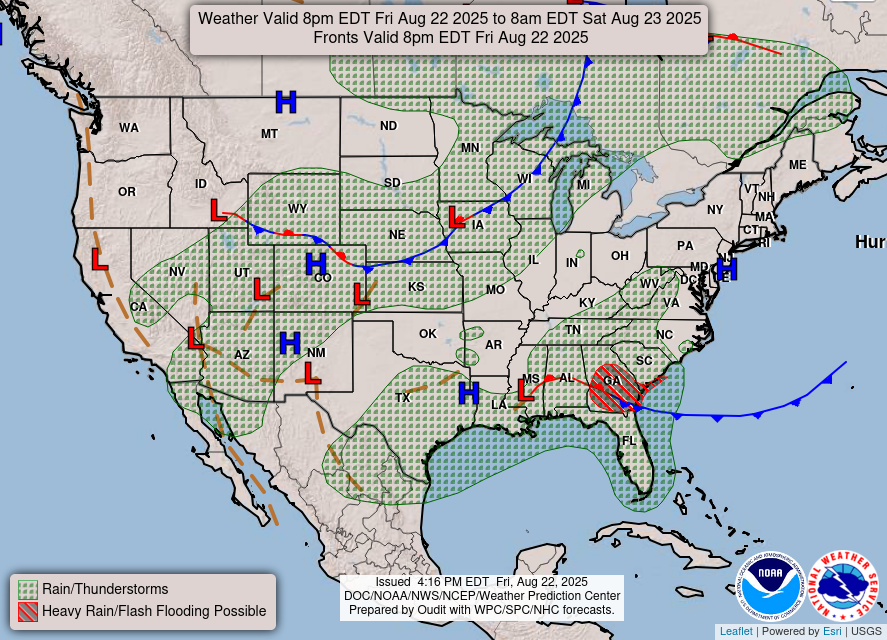
🔥 Hottest this weekend: The desert Southwest will once again be America’s furnace. Death Valley, California, is expected to peak around 118–121°F, making it the hottest spot in the nation. Nearby desert communities along the Colorado River, including Bullhead City, Arizona, and Lake Havasu City, Arizona, could reach 110–115°F, while Phoenix is forecast to hit 108–112°F. Even overnight temperatures may stay above 90°F in some locations.
🥶 Coldest this weekend: Among popular Lower 48 destinations, the coolest weather is expected in the high country of the Northern Rockies. Mountain valleys near West Yellowstone, Montana, and Yellowstone National Park, Wyoming, could see overnight lows in the upper 20s to low 30s, with daytime highs struggling to get out of the upper 50s and low 60s. Campers there may need jackets, hats, and an extra blanket while much of the country swelters.
Message from the Publisher
Offensive ads? Hello, all you wonderful fellow RVers. We are still receiving complaints from readers that they are encountering obnoxious pop-up ads on this website. We have tried to eliminate such ads, and our staff does not see them. How about you? Please take this very brief poll and let me know what you are experiencing. I will respond next week about the findings and how we will move forward. —Chuck Woodbury/founder and publisher
Tanner Toons With Tanner Woods
You may share this Tanner Toon, unaltered, on your website, blog or social media with our compliments. The musings from Tanner Woods’ creative mind appear in this newsletter every Saturday and Sunday and in many RV Daily Tips newsletters through the week. Sign up for our RV Daily Tips Newsletter so you don’t miss them.
Reader poll Have you survived a life-threatening disease or accident?
? MYSTERY PRODUCT OF THE DAY ? You know how the people who shop at Walmarts are an, um, interesting crowd? (Not you, of course.) Well, that crowd has created a viral sensation… and this is it. Hilarious!
Health news
Bad news for McDonald’s?
A large study tracking more than 205,000 people for nearly 40 years found that eating three servings of French fries per week was linked to a 20% higher risk of developing type 2 diabetes, while baked, boiled or mashed potatoes showed no significant increase in risk. The research also found that swapping potatoes for whole grains lowered diabetes risk, while replacing them with white rice had the opposite effect.
RV and RV-related recalls
Alliance RV is recalling as many as 1,354 model year 2020-2026 Midwest Automotive Design Luxe Cruisers, 2021-2026 Ultimate Coach, G-55, 2022 Ultimate Entertainer, 2022-2024 Revolution, 2022-2025 Professional Series, 2022-2026 Ultimate Cruiser, Ultimate Limo, Patriot Cruiser, Ultimate Traveler, 2023 Signature, 2023-2024 Athletic Series, 2023-2026 Day Cruiser, Freedom, G-45, 2024-2026 Business Class, and Ultimate Weekender recreational vehicles for wiring fire danger. Learn more.
Winnebago Industries is recalling certain 2026-2027 Revel and Revel Sport motorhomes. The tire information label states an incorrect tire. Recall number: 207. Info: (641) 585-6939 or (800) 537-1885
Ford is recalling certain 2018 F-150 vehicles previously repaired incorrectly under recall number 17V669. Quickly moving the shift lever from Park to Drive may cause a loss of gear indication on the instrument cluster display and a momentary selection of an unintended gear, such as Reverse or Neutral. Recall number: 26S42. Info: (866) 436-7332.
DON’T WAIT FOR THE NEWS: Did you know you can receive a daily roundup of the latest news for RVers? Delivered to your inbox Monday-Friday, we’ll send you the biggest headlines. Stay up to date, learn about important closures, recalls, and much more. Click here and subscribe to “Breaking RV News.”
Hailed as an engineering marvel when it opened to traffic in 1940, the Pennsylvania Turnpike was the first superhighway. The Interstate Highway System didn’t open until 1956, and when it did, it took many cues from the turnpike. Its initial 160 miles featured smoothed curves, reduced grades, standardized rights of way and lack of cross-traffic, which set the standard for what’s today defined as a “normal” travel experience.
Our highest-trending products on Amazon this month (so far):
Summer travel is in full swing, and scammers are taking advantage of busy campgrounds, packed highways, and distracted travelers. Here are three scams RVers should watch for this week:
Unpaid toll text scams: These continue to explode nationwide. A text claims you owe a small toll balance and need to pay immediately to avoid penalties. The link leads to a fake payment site designed to steal your credit card information.
Fake campground Facebook pages: Scammers are creating pages that mimic real campgrounds and responding to reservation inquiries before the campground can. They collect deposits through payment apps, then disappear.
Roadside assistance impersonation scams: After a breakdown or service request is posted online, scammers contact drivers pretending to be a tow company or roadside service provider and demand payment upfront before help arrives.
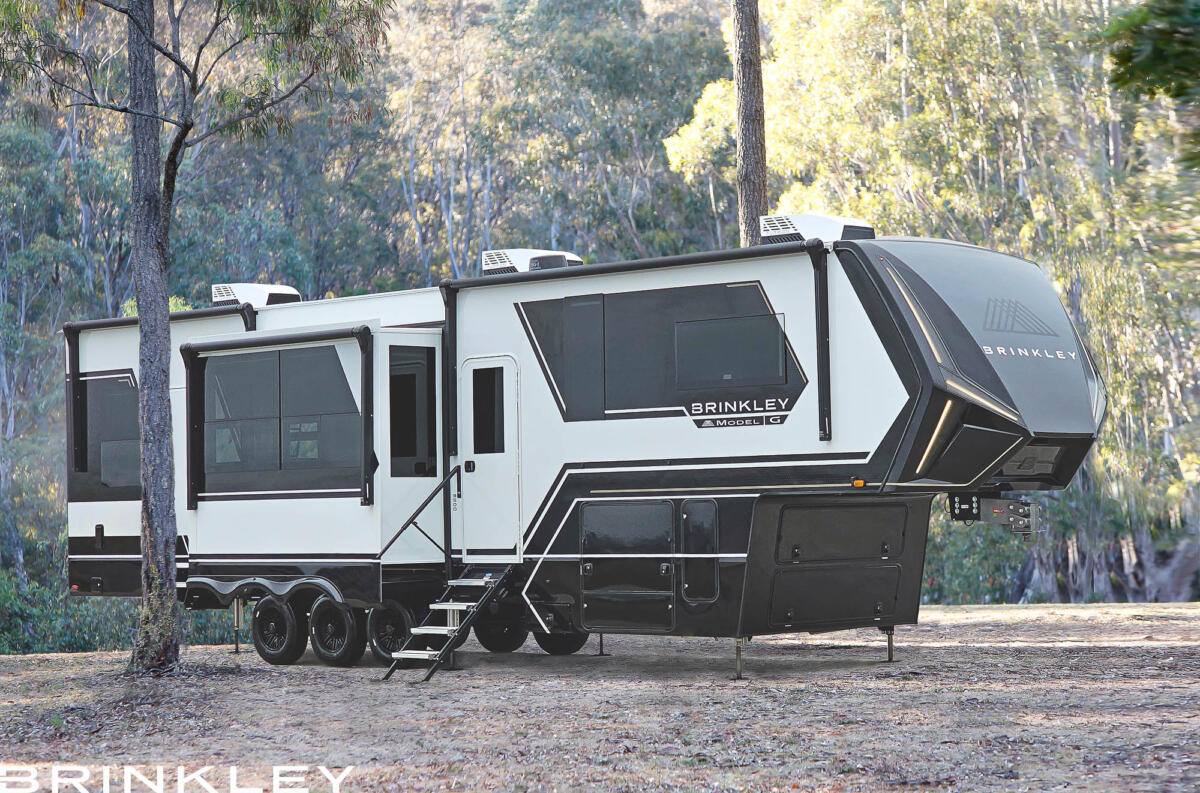
The 2026 Brinkley Model G 4150 is the kind of toy hauler that aims at buyers who want their RV to do more than simply carry toys.
Brinkley’s Model G line has everything you need plus luxury features you don’t usually find in today’s toy haulers. Read on and see.
Behind the walls
Brinkley builds the Model G 4150 with an automotive-style exterior. It features a fiber-reinforced Impact Guard poly roof, triple-axle running gear, hydraulic disc brakes, and heavy-duty 7k axles.
RVers will take note of the three-way pass-through storage system, under-I-beam storage, and a full-body paint package option.
All this comes at a hefty cost, of course. Upscale finishes and thoughtful features are included in the G 4150, as you’ll soon learn.
Key specs
Length: 46’5″
Height: 13’4″
Width: 101″
UVW: 19,200 lbs.
GVWR: 23,500 lbs.
Hitch weight: 3,600 lbs.
Garage length: 11′
Garage door capacity: 3,000 lbs.
Garage patio capacity: 1,500 lbs.
Fresh water capacity: 150 gal.
Gray water capacity: 156 gal.
Black water capacity: 85 gal.
Fuel station tank: 60 gal. (30+30)
Standard MSRP: $241,932; dealer’s price at $191,900
Interior and living space
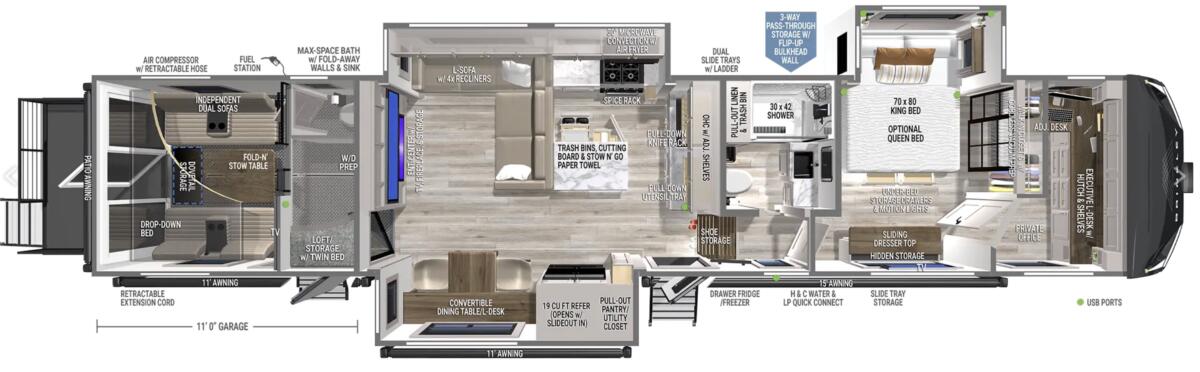
The first impression inside is that Brinkley really wanted this to feel like a small luxury apartment with a garage attached. It’s not your typical toy hauler. This layout features purposeful zones instead of one big open room. That intentional separation helps the G 4150 to feel more like a road-ready live-in coach than a weekend toy box.
The dovetailed drawers and self-closing cabinets speak to the solid construction that Brinkley is known for. I also like that there are no visible nails or staples on the trim work throughout this RV. It truly looks and feels luxurious.
Kitchen
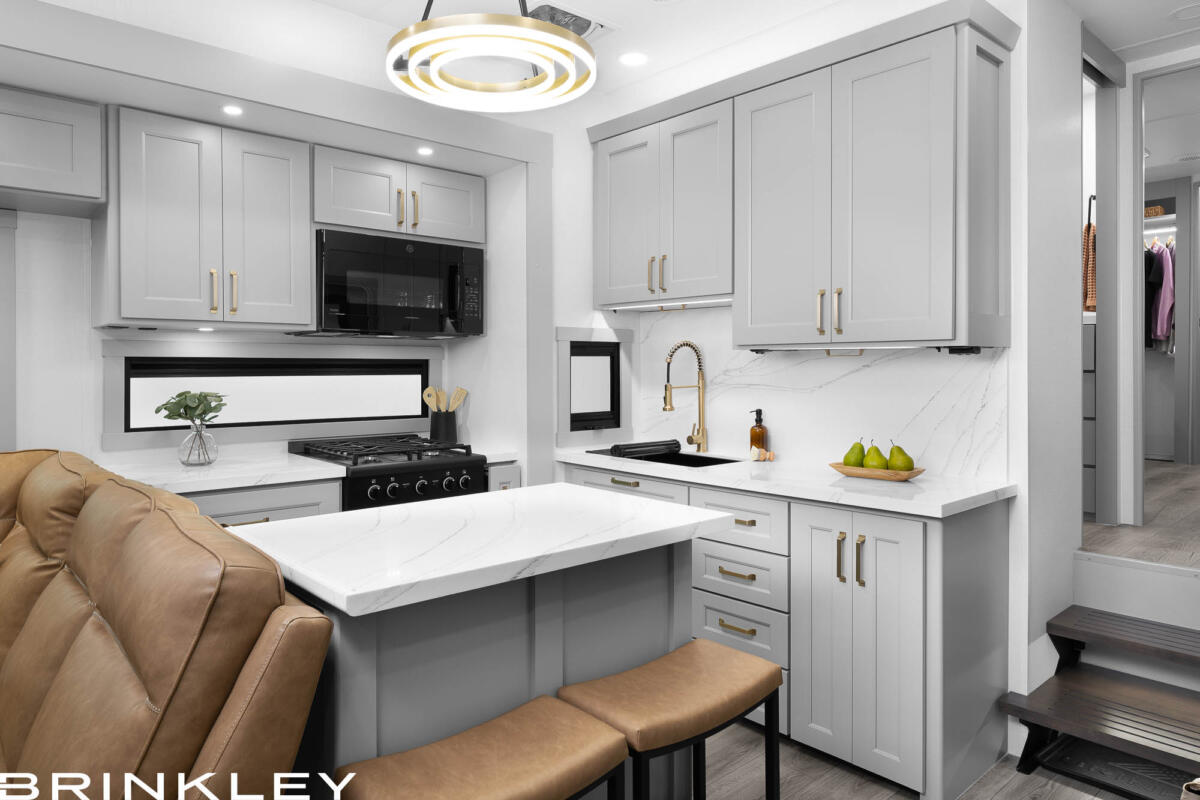
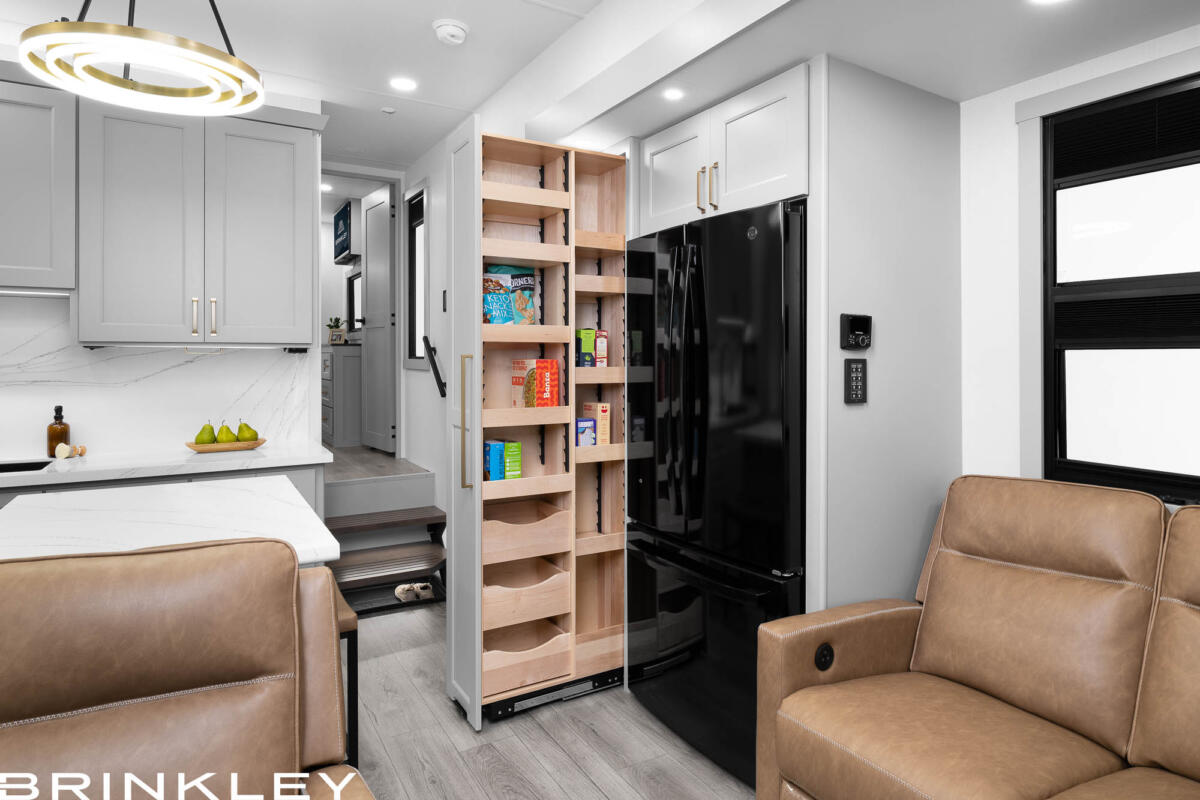
The kitchen is one of the strongest parts of the 4150. Brinkley loads it up with high-end features. These include a huge pull-out pantry, pull-down utensil tray, magnetic knife rack, spice rack, pull-out trash and recycling bins, and solid-surface countertops and backsplash. (I’m not a big fan of the overhead island light and would probably switch it out to something more my style.) I do appreciate that shelves are adjustable, as are drawer inserts.
The built-in cutting board is also handy and space-saving, and pet owners will like the pull-out and removable food bowls.
You’ll also find a 19-cubic-foot, three-door GE fridge with ice maker and filtered water; a 24-inch GE Profile oven with a four-burner range; and a microwave that has convection/air fryer features. All of these appliances give the kitchen a much more residential feel than you usually get in a toy hauler.
Living/dining room
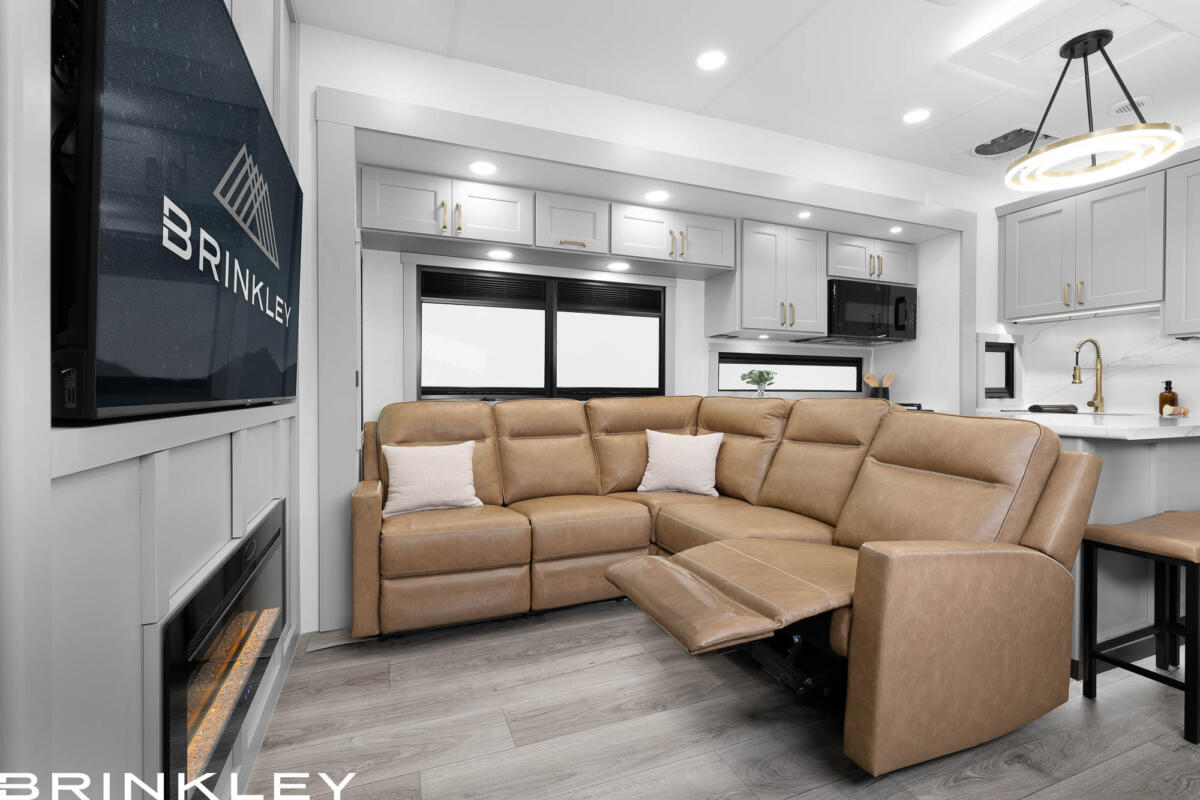
The living area is built for lounging and hanging out without feeling cramped. The Brinkley G 4150 includes an L-shaped sofa with four reclining seats. In this area you’ll also enjoy a large TV, fireplace, and innovative hidden storage space.
The convertible dining table also works as a desk or hobby spot. The table has six different configurations to provide the space you need without intruding into the living area.
Bath
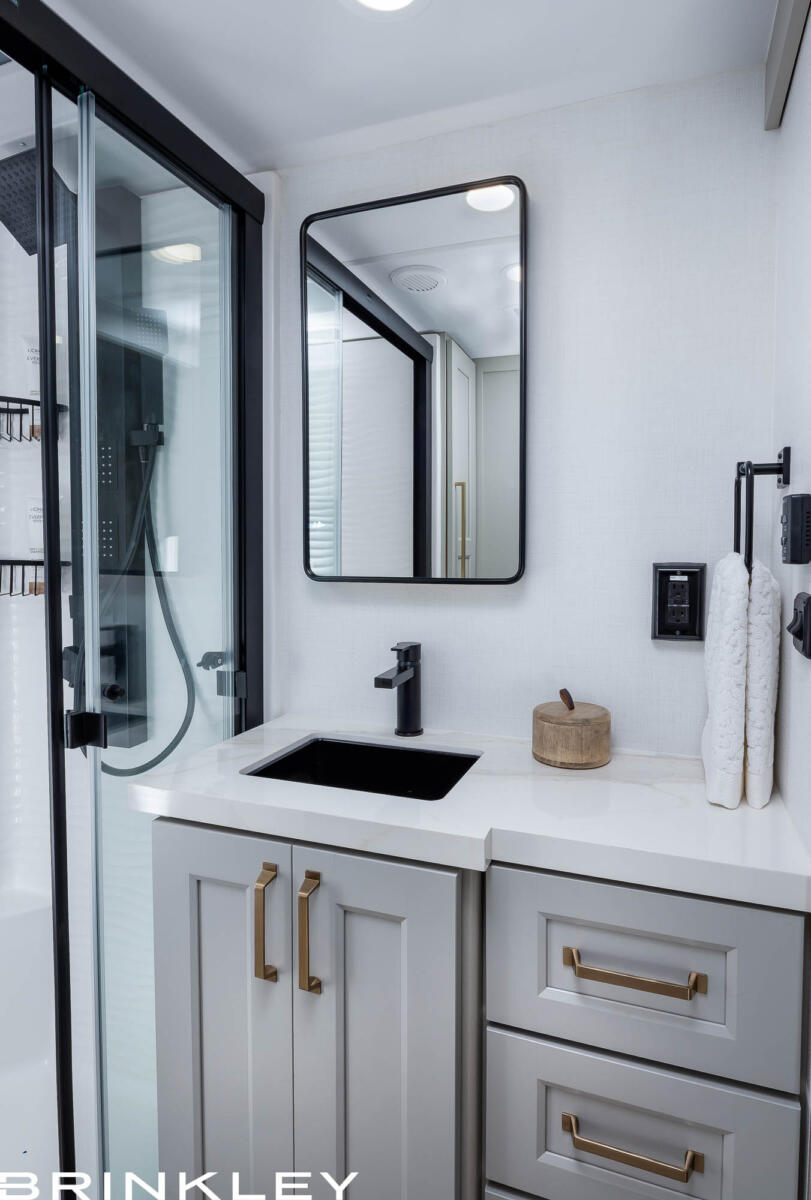
The main bath keeps the luxury theme going with a 30″-by-42″ shower, a backlit medicine cabinet, and a pull-out linen closet. Brinkley also equips the coach with a residential shower system and tankless water heater. It’s a nice touch for longer stays as well as weekend use.
The bath uses PEX and features brass fittings with shut-off valves, just like in the kitchen. A tankless water heater provides endless hot water. These residential features add real value plus peace of mind for the owner of the G 4150.
Bedroom
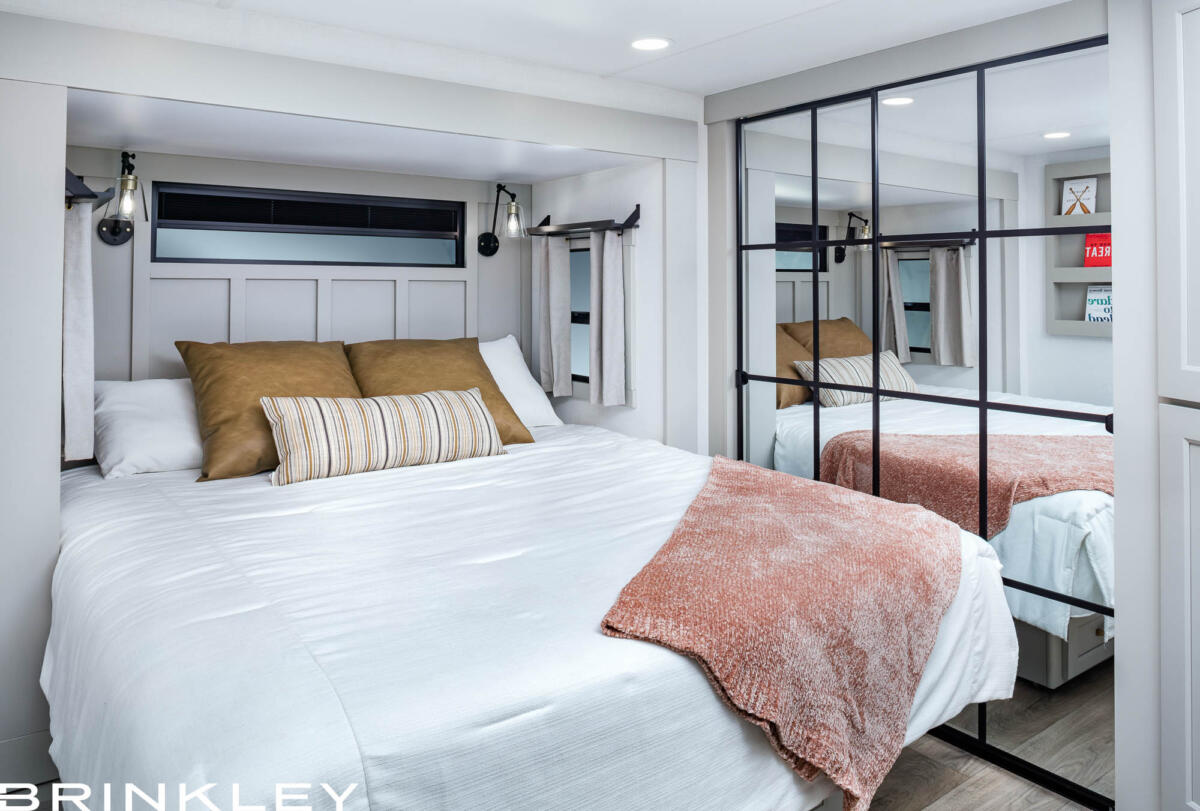
The bedroom feels both practical and polished at the same time. A king mattress is standard, with a queen option available. Brinkley includes under-bed storage drawers that make access under the bed so much easier. You’ll also find hidden dresser-top storage, dual bedside outlets with USB and USB-C, and motion-activated bed lighting. (The only downside for me is the lack of actual nightstands, which would necessitate floor placement for a CPAP.)
Office
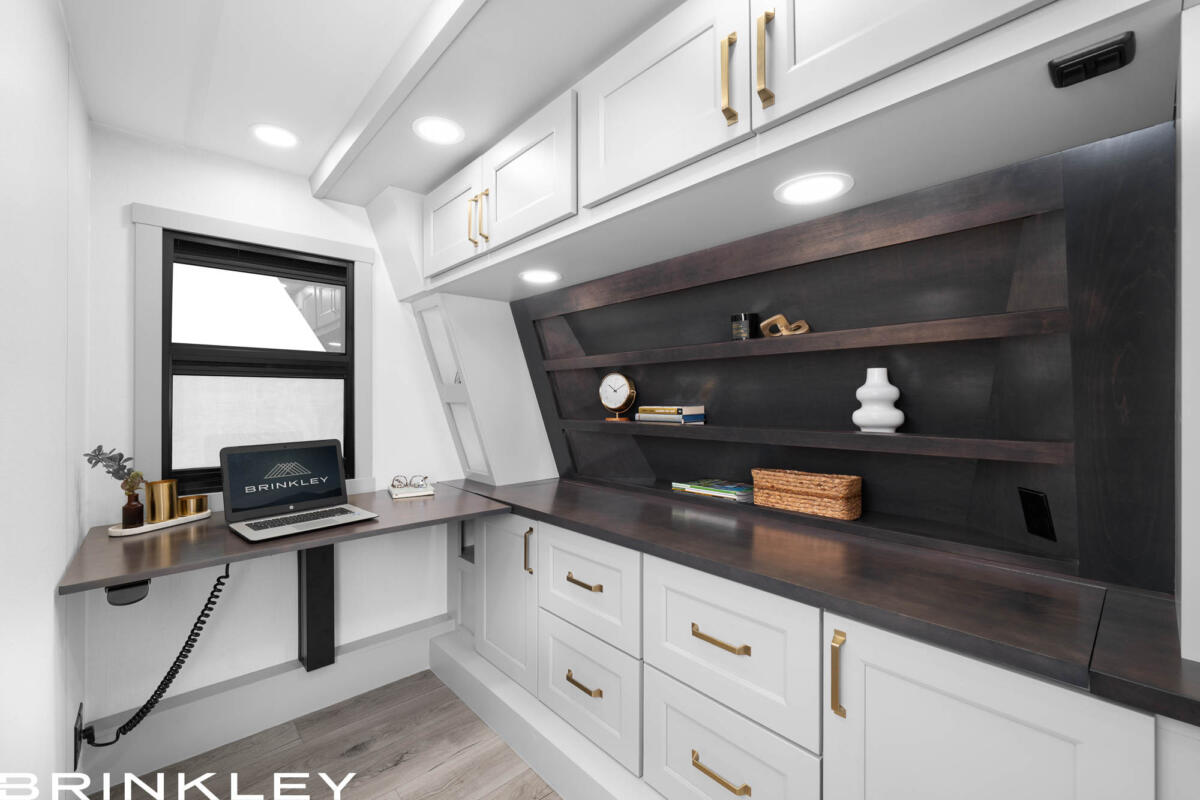
Yes, there’s a separate, dedicated office room in the Brinkley G 4150. It’s positioned beyond the bedroom with a door for work privacy and sound-dampening. The office offers the remote worker plenty of storage and two windows for natural light and outside air. The desk is adjustable for sitting or standing, and you’ll discover plenty of space for a printer and other office essentials.
Garage
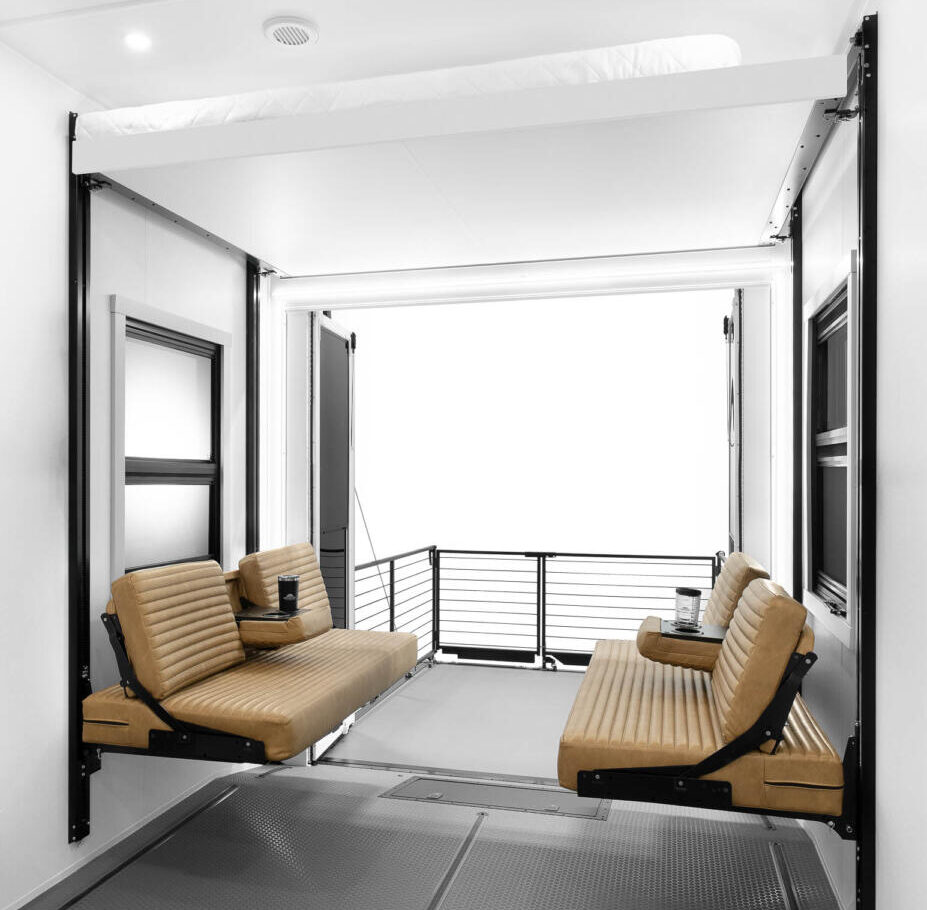
At the opposite end of this large RV is an 11-foot garage. This space easily transports a motorcycle, golf cart, or other “toys” depending on their size. Elevated, dual sofas flank each side of the garage and can be stowed up and out of the way when necessary. There is also a bed to accommodate extra quests.
The loft/storage area above the garage is a versatile space. Brinkley gives it a twin mattress and ladder, so it can work as extra sleeping space or overflow storage depending on how you travel.
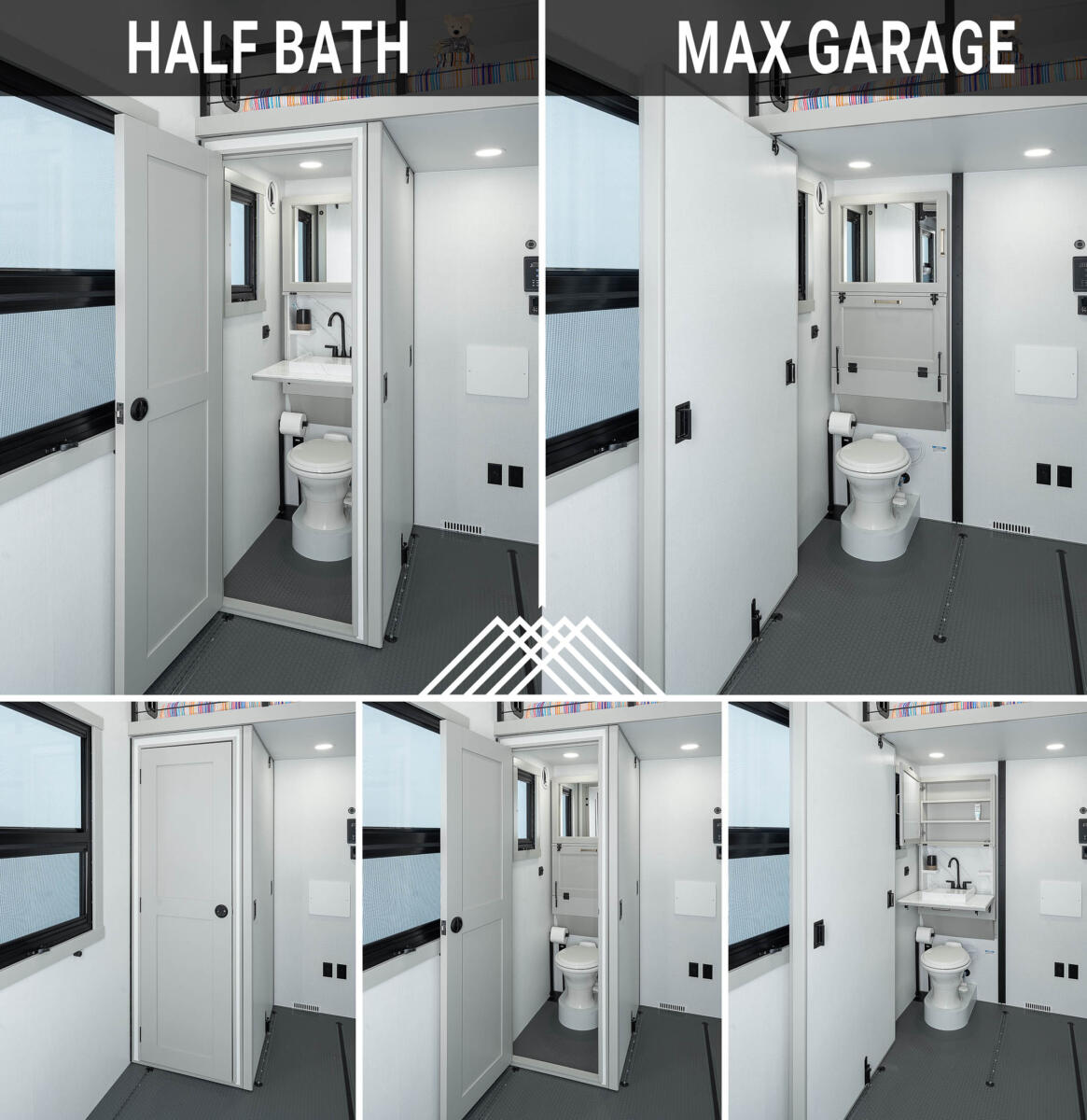
A half bath, complete with sink and medicine cabinet, is made private with a movable wall and solid door. There’s also a spot for your washer/dryer in the garage area.
Once toys are removed, the garage functions as a bonus room—ready to become whatever you need the space to be. A window wall separates this room from the rear back deck.
Many Brinkley G 4150 owners have transformed their garage areas to suit their personal needs. You can view the special spaces here and perhaps get some inspiration.
Overall take
The 2026 Brinkley Model G 4150 is a premium fifth wheel toy hauler. It gives RVers a true residential experience without giving up cargo flexibility. It is expensive, long, and unapologetically upscale. However, the design makes sense if you want a rig that can double as a mobile office and still feel like a high-end home on wheels.
Watch a video walkthrough by Myles RVs below.
Would Brinkley’s Model G 4150 work for you? Tell us in the comments.
America’s Original RV Newsletter. Since 2001
Issue 2930 • New issue every weekday
Today’s thought
“I travel not to go anywhere, but to go. I travel for travel’s sake. The great affair is to move.” —Robert Louis Stevenson
Today is Juneteenth. Juneteenth marks the day—June 19, 1865—when Union troops arrived in Galveston, Texas, to announce that all enslaved people were free, more than two years after the Emancipation Proclamation. The news sparked a mass exodus known as the “Scatter,” and Juneteenth has since been celebrated under names like Freedom Day, Jubilee Day, and Second Independence Day.
Tip of the day How to choose a cool campsite in the hot summer
By Nanci Dixon Whew! It seems that the last several campgrounds my husband and I have stayed at have been closer to solar ovens than cool, shady campsites. It has been so blistering hot under the sun that we haven’t even bothered taking the chairs out.
RV review
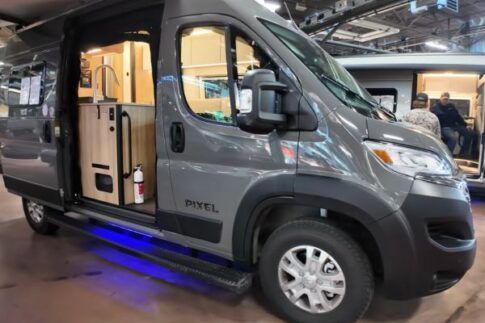
2026 Coachmen Pixel P1.8RB—Tiny van, BIG value
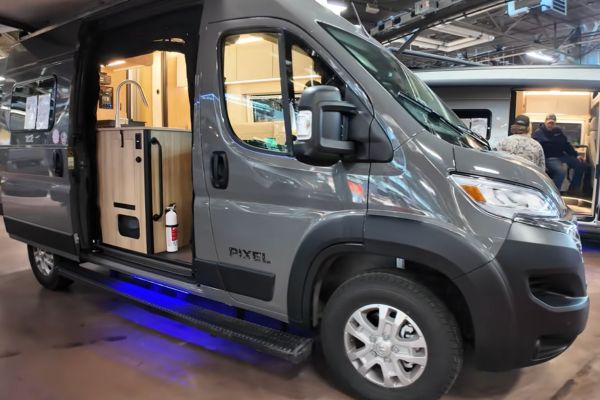
For buyers who want a camper van that feels easy to handle on the road, the 2026 Coachmen Pixel P1.8RB makes a strong case. At 17’9″ long, it stays small enough for a standard parking spot, yet it still brings a rear bath, flexible lounge, and a usable kitchen. That mix makes it a solid fit for a solo traveler, a weekend camper, or someone moving down from a bigger RV. Check it out.
TAKE A GUESS:The most popular RV bed size among RVtravel.com readers is… what? Find out below.
Article and video Horse trailer RV conversion: Incredible off-grid equine tiny home
Most horse trailers don’t hide a solar-powered tiny home inside. The Sterling Coach build in the video at the end of this post does, and it still keeps room for three horses! Shane and Kelsey of LoveHut4Life shared a conversion that turns a former tack room into a compact living space with real off-grid systems, custom storage, and a layout built for travel. This is absolutely amazing!
Tiny, portable air purifier is RV-sized
If your RV ever smells too much like last night’s dinner, this compact USB-powered air purifier is a quiet hero. It uses a true HEPA filter to trap dust, pollen, smoke, pet dander and odors, and runs whisper-quiet in sleep mode. Keep the air fresh wherever you are. Check it out.
Featured article A wanderin’ widower lives out his RVing dream
By Gail Marsh One of the best things about RVing is the people you meet along the way. Today, I’d like to introduce you to Willie. I first met Willie while on a walk around the campground. Later that evening, Willie joined the community campfire. He sat right next to me. Willie lost his wife and decided to put off retirement and RVing for a few years while he continued working… until it was finally time to live out their dream.
Ask Dave I want to switch to lithium batteries, but I have some questions
Bugs making suicide runs on your windshield? Get a container ofRain-X washer fluid additive and just add it to your windshield wiper fluid—works great without all that work! There’s alsoRain-X Bug Remover (not concentrated) that does the job. Driving down the road and collecting bugs? Don’t wait for the next fuel stop—just use the windshield wipers! —Thanks to A. Fisher for the tip.
Heavy-duty Wrap-It® storage straps are a must-have for RVers
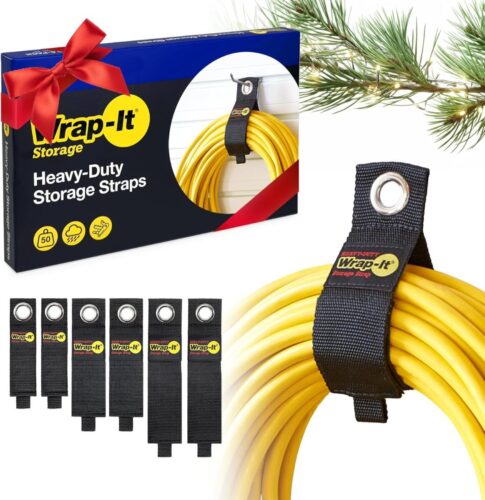
Tired of all your cords getting tangled? That shouldn’t happen, and it won’t if you use these Wrap-It® storage straps! Family-owned and made in the USA, these polypropylene straps hold up to 50 lbs.—perfect for RV hoses, extension cords, tools, and garage gear. One simple solution for a clean, pro-level organization. Comes in a 6-pack! Learn more or order.
ANSWER: The majority of RVtravel.com readers, 61 percent, have a queen bed in their RV. See the results of our poll here.
PopPhoto
Whether you’re an experienced photographer or not, this website has a little something photography-related for everyone. Lots of good articles and information here.
Trivia
Earlier this year, a Singapore teenager parlayed his speedy Rubik’s cube-solving skills into breaking the Guinness World Record for the fastest time to assemble Mr. Potato Head. Calen Seah said he spent about a year practicing with the toy before successfully beating the record with a time of 4.63 seconds.
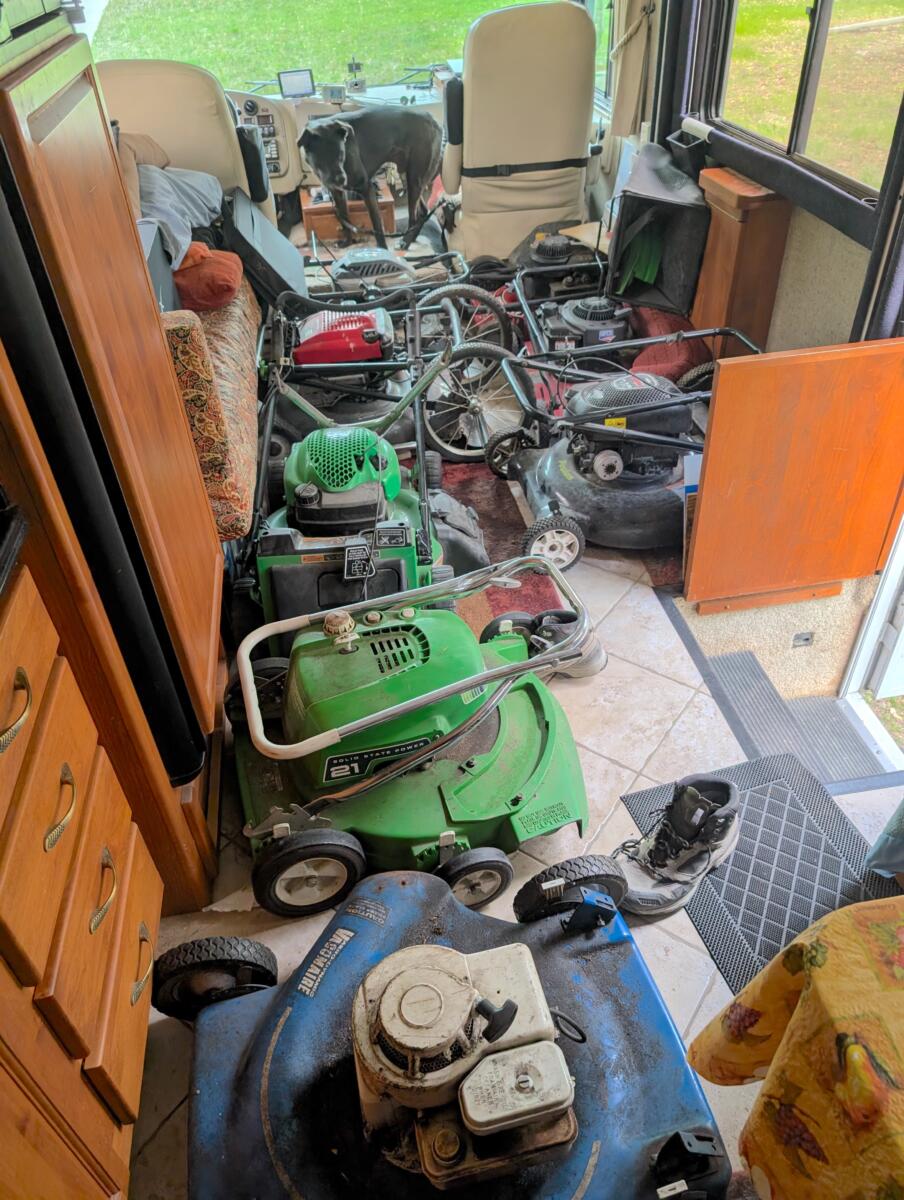
“We fostered Lewy (Pit mix) for 3 months. During that time, I took a load of 8 non-running lawn mowers to a friend who repairs/sells them for some added income. After a few tries, Lewy became adept at crossing the maze.” —Brad Teubner
Send us a photo of your pet with a short description. No blurry photos and please do not submit your photo more than once. Thanks!
If you shop at Amazon.com we’d appreciate you using this link. We get an itty bitty commission if you buy something, but they add up and help us pay our bills (most importantly our hard-working writers!).
REMEMBER: You do not need to receive an email alert from us to read our newsletters. Just visit our homepage, www.rvtravel.com, at any time of day, and the latest issues and articles will be there.
Dear Dave,
I’m thinking of replacing my lead acid 100Ah battery with LiFePO4 batteries for longer off-grid capacity. The biggest draw is from the 12V refrigerator, which consumes about 60W and runs most of the time (or so it seems). I understand that I will need to replace the converter/charger to one that is LiFePO4 compatible.
My question concerns the tow vehicle. What happens if I don’t install a DC/DC converter? Also, it seems I would need to add new heavy-duty wiring and connectors between the alternator and the new batteries, correct? Will the tow vehicle trickle-charge the batteries while they run the refrigerator during travel?
Finally, am I correct in calculating that 200Ah LiFePO4 supply will run 100 watts of load for only about 24 hours? Thank you. —Wayne, 2021 Puma 20RLC
Dear Wayne, For the past year, I have been conducting seminars for the Ford Towing Bootcamp. One of the items we discuss is the voltage that will come back from the larger alternators or two alternators in some of the tow vehicles. I’ve always sent them to Battle Born® to look at the DC-to-DC charger you are referring to.
You are correct in the fact that the lighter gauge wiring will limit what charge goes to and from the trailer and only provide a trickle charge. So, I sent your question to my contact at Battle Born for clarification and got the following response.
From Battle Born technical support
Most trailers receive charging power through the 7-pin connector while towing. You can continue using the factory’s 7-pin connection with lithium batteries, but it will typically function more like a maintenance or trickle charge. The factory wiring between the alternator, truck, 7-pin connector, and trailer batteries is usually relatively small gauge wire, which limits the amount of current that can flow to the batteries. This helps prevent excessive charging current and also limits the amount of power that could potentially flow back toward the tow vehicle.
With a lithium battery upgrade, many owners find that the 7-pin connection will help offset loads such as the refrigerator while traveling, but it generally will not provide enough charging current to quickly recharge a depleted lithium battery bank.
If you want to optimize charging from the tow vehicle, we recommend installing a DC-to-DC charger. A DC-to-DC charger regulates the charging profile for lithium batteries and allows you to run larger gauge wiring from the truck to the trailer for significantly improved charging performance. In most installations, an Anderson connector is added at the rear of the truck and front of the trailer to provide a secure high-current connection between the two vehicles.
For many RV owners, the factory’s 7-pin connection is sufficient to help maintain the batteries and offset some refrigerator consumption during travel. However, if you’re regularly boondocking, running large battery banks, or want meaningful charging while driving, a properly sized DC-to-DC charger with dedicated heavy-gauge wiring is the preferred solution.
As for his battery capacity question, a 200Ah lithium battery bank provides approximately:
200Ah × 12V = 2,400 watt-hours of usable energy
Assuming a continuous 100-watt load: 2,400Wh ÷ 100W = approximately 24 hours.
So, your estimate of about 24 hours is correct. In real-world use, loads cycle on and off, and factors such as temperature, charging sources, and battery age can affect runtime, but that’s a good planning estimate.
By Nanci Dixon Whew! It seems that the last several campgrounds my husband and I have stayed at have been closer to solar ovens than cool, shady campsites. It has been so blistering hot under the sun that we haven’t even bothered taking the chairs out.
If you think there’s no way to get cool in hot weather, think again. I’ll show you a quick, easy way to make sure your RV stays cool at the next campsite.
Today, before moving campgrounds, I checked out the upcoming campsite map and looked at our spot via Google Earth. Peak temperatures usually hit around late afternoon, so I wanted to be in the shade.
More importantly, I wanted to make sure that our RV’s refrigerator was on the shady side too. At 90-plus degrees, the ice maker balks and starts melting the cubes and refreezes overnight into one lump. Not good.
I figured out ahead of time which direction the sun would set and which side would be shaded in the afternoon.
Just to double-check when arriving, I pulled out a compass to find true west. Without getting too scientific, I was assured that we were oriented west. That meant there would be no direct sun on the windshield or the passenger side (refrigerator side) so that the RV stays cool.
So, now I am writing this outside with a cool drink in my favorite camping rocker… even at 91 degrees and sunny.
It pays to use Google Earth and put a little effort into orienting yourself and your RV away from the sun, even when shade is hard to come by.
By Cheri Sicard
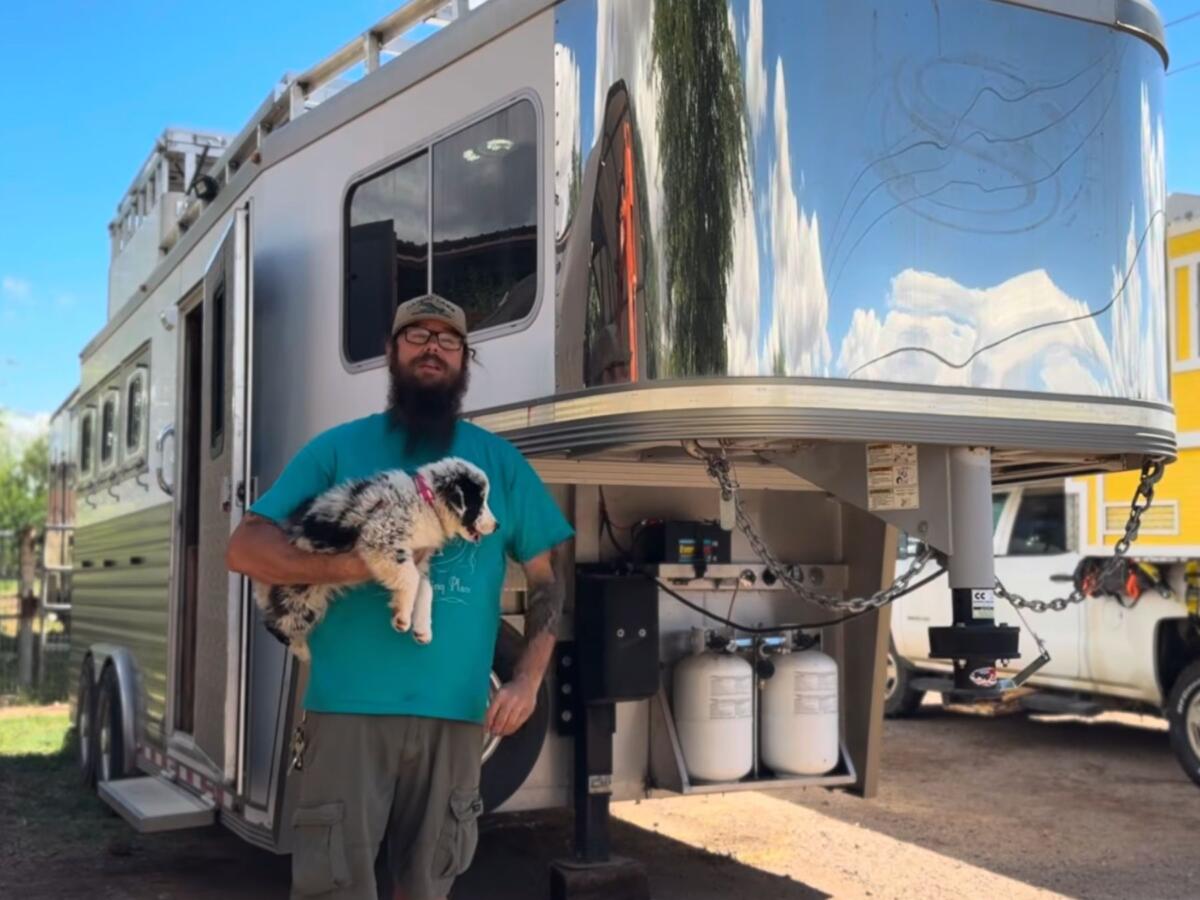
Most horse trailers don’t hide a solar-powered tiny home inside. The Sterling Coach build in the video at the end of this post does, and it still keeps room for three horses!
Shane and Kelsey of LoveHut4Life shared a conversion that turns a former tack room into a compact living space with real off-grid systems, custom storage, and a layout built for travel. This is amazing!
The base trailer is a Sterling Coach horse trailer, a model that was discontinued in the early 2000s. Shane describes it as one of the best trailers a person could get. This one is a 3-horse slant [three horses stand diagonally (at an angle) rather than facing straight forward] with a 4-foot short wall. [Per Double D Trailers, because the front wall of a slant load trailer is angled, the room it creates has one longer wall and one shorter wall. The “short wall” measurement refers specifically to the shortest vertical wall in the front compartment.] That area became the living quarters after about two-and-a-half months of work.
Because the space started as a saddle room, it already had an extra-large door. Shane kept that advantage, then added a Lippert thin-shade window so the owners could see outside without climbing into bed. Faux leather on the door panels helps the space feel less like a trailer and more like a home.
Shane has built out buses, ambulances, vans, cargo trailers, and old campers. Here, that same custom approach shows up in every cabinet, drawer, and finish.
How the trailer runs off-grid
The roof already had a rack, and Shane reworked it to hold more than 2,700 watts of solar. Two panels sit over an articulating hay rack, and the system supports a rooftop RV-style air conditioner. A 4,000-watt generator rides on top as backup.
Inside, a dedicated cabinet holds four 200-amp, 24-volt server-rack batteries, two charge controllers, an inverter/converter, and the 12-volt and 120-volt breaker setup. The trailer can switch between 30-amp shore power and the rooftop generator.
Fuel and water were planned with the same care. One LP system is reserved for the generator in the rear tack area. A second two-tank LP setup runs the two-burner stove and water heater. Outside, the trailer has 30-amp and 20-amp hookups, city water, gravity fill, and a gray water drain for sink runoff. The build also includes two 75-gallon water tanks, one for the living space and one for the horses.
A tiny home layout built around storage
Storage drives the whole interior. Under the refrigerator, a split drawer keeps lids up top and pots and pans below. A custom shelf adds room for art and memorabilia, while the kitchen packs in a deep bar sink, retractable faucet, oversized stove drawer, pantry storage, and upper cabinets sized for glassware.
That same no-dead-space mindset carries into the utility cabinet. It hides batteries, breaker boxes, transfer switches, drawers, and a closet, while removable screen panels help with cooling. Under the sink, a removable face gives access to the 75-gallon freshwater tank, plumbing, and pump. Everything sits over a waterproof basin with an exterior drain, so a leak goes outside instead of into the finished interior.
Still ready to haul horses
The horse area stayed mostly intact, which is the point of the build. It still works as a 3-horse slant trailer, but one section can also double as a wash bay or shower area thanks to the LP water heater and rear shower setup. Water and gas lines run high along the roofline so horses can’t damage them in transit.
Up front, a flip-up step leads to the bed. A mud box stores boots and gear, and it also works as the only seating area. The bedroom adds more built-in storage, including a headboard with large doors, while the faux ostrich-skin ceiling gives the small sleeping area a distinct look.
Final thoughts
This build works because it doesn’t give up the trailer’s original job. It is still a horse trailer, but it is also a well-planned off-grid living space.
The best part is how practical the details are. The power system, leak protection, storage, and maintenance access all feel thought-through, and that makes the whole conversion feel usable, not flashy.
Some people loooove having their photos taken. You probably know at least one person who always says, “Oooh, take my picture here!” Or who always wants to take a picture with you—especially in today’s day and age of the “influencer.”
But there are also people who loathe having their photos taken. Which are you?
Some folks don’t mind being in the photo—as long as they’re not the only one. Group photos? No problem. Selfies? Maybe. But ask them to stand alone in front of a camera and suddenly they feel like they’re on stage. There’s something about being the center of attention that makes some people freeze up.
Then there are others who fall somewhere in the middle. Maybe they’re not thrilled about how they look in photos, or they get awkward in front of the camera, but they also know how nice it is to look back later and remember a certain place, a certain trip, or a certain feeling. Sometimes, the moment is worth capturing—even if the smile feels a little forced at the time.
We know your answer could differ depending on where you are. You may like having your photos taken around the country (or world) on your RV travels in front of famous views and monuments, but maybe you hate having your photo taken when you’re at home or things are more mundane than when you’re out traveling.
But, generally speaking, if someone goes to take your photo, how do you react? Do you immediately pose or do you shy away and say, “No photos, please!” Tell us why you do or why you don’t like having your photo taken in the comments below the poll. Thanks!
If you enjoyed this RVtravel.com reader poll, keep in mind that we have polled our readers more than 5,000 times through the years. It’s fascinating to see how they have responded, sometimes very surprisingly. You’ll find an archive of thousands of our polls here. So what are you waiting for? Check ’em out.
For buyers who want a camper van that feels easy to handle on the road, the 2026 Coachmen Pixel P1.8RB makes a strong case. At 17’9″ long, it stays small enough for a standard parking spot, yet it still brings a rear bath, flexible lounge, and a usable kitchen. That mix makes it a solid fit for a solo traveler, a weekend camper, or someone moving down from a bigger RV.
In the video at the end of this post, we get a tour from the team at Where RV Going?.
A compact Ram ProMaster with smart outside details
The Pixel rides on a Ram ProMaster 2500 chassis with a 136-inch wheelbase, so it keeps the easy-driving appeal many Class B shoppers want. Coachmen didn’t leave the exterior bare, either. It gets a blue-lit entry step, a sturdy grab handle, and a small cubby for loose gear. There’s a drop-down outside table that works for coffee, a grill, or the portable induction cooktop.
There are also outside power options, including AC, USB-A, and USB-C ports, which make quick campsite tasks easier.
The kitchen and storage feel better than expected
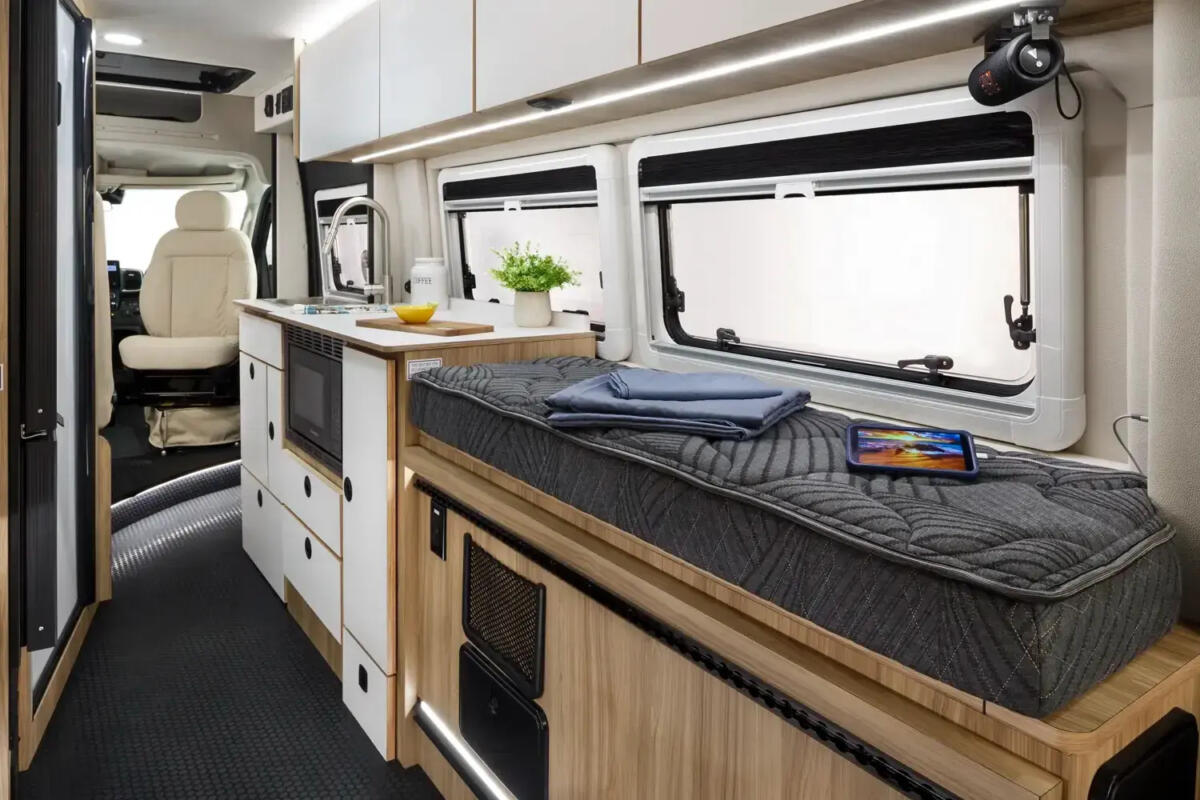
Inside, the kitchen is small but well thought out. The sink is large for this size van, and the faucet includes a spray head that can extend outside for rinsing off gear or even a quick wash.
The induction cooktop is portable, which adds a lot of flexibility.
Coachmen also raised the refrigerator to chest height, and that small move makes daily use much easier. Above it sits a convection microwave with air fryer.
Storage is another strong point, with upper cabinets, four main drawers, a larger lower drawer, a built-in trash bin, and a six-section pantry. The dovetail drawer construction also gives the van a more finished feel.
A lounge up front, a real bath in back
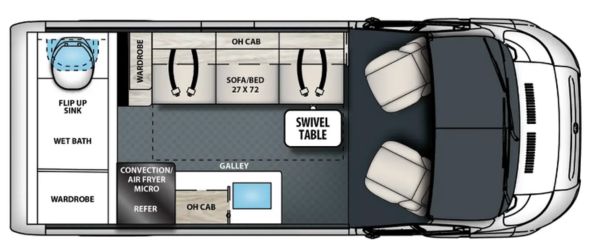
The main seating area is a large sofa with a Lagun table, swivel front seats, overhead cabinets, and the usual “pizza oven” shelf over the cab. Dual-pane awning-style windows, bug screens, privacy shades, extra outlets, a detachable Bluetooth speaker, and a Wi-Fi booster help the van feel ready for longer stays.
Control panels above the door and in the kitchen handle solar, inverter, Truma heat, lights, fan, water, tank heaters, and power systems.
In the back, the wet bath is the standout. It has a folding sink, shower controls, a medicine cabinet with toothbrush slots, a cassette toilet, adjustable shelves, deep drawers, an exhaust fan, and a wraparound curtain that keeps the room dry.
The bed system is simple, and the utilities are ready to go
The rear sofa changes shape without much fuss. It can stay a twin-size lounge, stretch into a chaise facing the open side door, or open into a larger bed with room for two.
1. Pull out the metal extensions.
2. Move the separate cushions into place.
3. Flatten the sleeping surface.
The reviewer, at 5’9″, still had foot room on the made bed. Outside, the van adds a rearview camera, spare tire, roof ladder, cassette access, gray tank dump, Truma exhaust, outside sprayer, city and fresh water hookups, and prep for portable solar kits.
Why the Pixel stands out
At the Pennsylvania RV SuperShow, the Pixel was shown at $99,997, and that price helped it stand out. It doesn’t feel stripped down. It feels carefully designed and packed with everything you need.
For shoppers comparing small vans, the Pixel P1.8RB looks like one of the better values in the class.
For years, automatic license plate readers have done exactly what their name suggests: capture license plate numbers and compare them against databases used by law enforcement and other agencies. But some companies are now trying to do more than just read license plates.
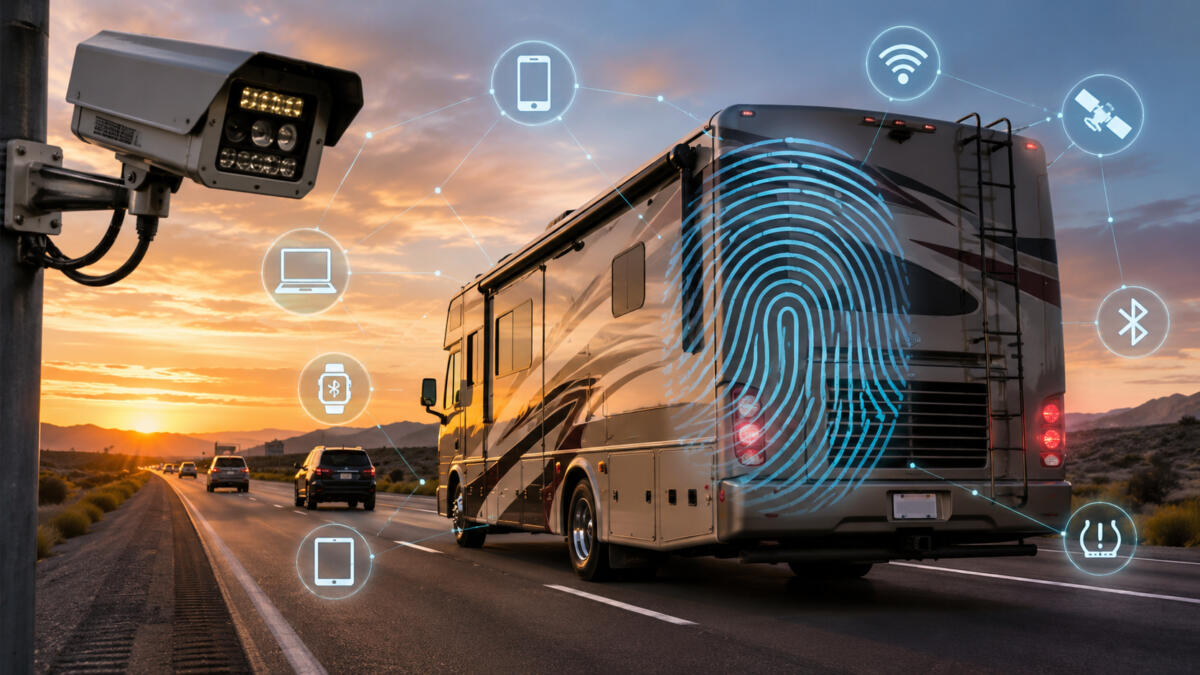
But tech company Leonardo says its SignalTrace™ can connect a vehicle to the collection of phones, tablets and other electronic devices traveling with it, creating what the company calls an “electronic fingerprint.”
That’s one reason some RVers are paying attention.
Leonardo, a company known for license plate reader technology, says its SignalTrace™ system collects identifiers associated with Bluetooth, Wi-Fi, RFID and other wireless technologies and correlates that information with license plate reader data. It says the process creates what it calls an “electronic fingerprint” that can help distinguish one vehicle from another.
Leonardo says SignalTrace can operate alongside license plate readers or independently at collection sites. The company also says the system captures device signals but does not decrypt or read the contents of devices or their communications.
For RVers, it raises an obvious question: How much information is your rig broadcasting as it rolls down the highway?
Why RVs may stand out
A typical passenger vehicle may carry a phone or two and perhaps a smartwatch. An RV often carries far more connected equipment.
Many RVs travel with multiple smartphones, tablets, laptops, smartwatches, and tire pressure monitoring systems. Add on Wi-Fi hotspots, Starlink equipment, streaming devices, smart televisions and connected infotainment systems.
Leonardo’s product literature specifically references signals from smartphones, Bluetooth devices, RFID tags, vehicle components and Wi-Fi equipment.
“Many RVs travel with multiple smartphones, tablets, laptops, smartwatches, tire pressure monitoring systems, Wi-Fi hotspots, Starlink equipment and other connected devices that may create a distinctive electronic profile.”
Taken together, those devices may create a distinctive collection of electronic signals moving with the vehicle. Leonardo says SignalTrace can recognize groups of devices that frequently travel together, identify recurring movement patterns and use those patterns to create what the company calls an “electronic fingerprint.” The company says that information may help investigators recognize vehicles or individuals of interest even when a license plate number is unavailable.
According to Leonardo’s marketing materials, SignalTrace is designed to identify patterns among those signals and connect them with license plate reader information. Leonardo says the technology can help investigators associate vehicles with recurring electronic identifiers, potentially providing additional leads when license plate information is unavailable or incomplete.
What we know—and what we don’t
The existence of SignalTrace is not in dispute. Leonardo publicly markets the product and describes its capabilities in company literature.
Leonardo’s public materials describe the technology’s capabilities, but they do not identify agencies currently using SignalTrace or provide information on how widely it has been deployed. Independent reporting has likewise noted that deployment details remain unclear.
It’s also important to separate manufacturer claims from demonstrated results.
The available information does not show that law enforcement agencies can track every phone, tablet, or connected device. Nor does it establish that all vehicles are being monitored through this type of system.
Instead, the technology appears to represent a new direction in vehicle identification—one that attempts to supplement license plate information with electronic data collected from devices near a vehicle.
Privacy questions are likely to grow
Privacy advocates have long raised concerns about automatic license plate reader networks because they can document where vehicles have traveled over time.
Systems that attempt to connect vehicles with electronic identifiers are likely to generate additional debate.
Supporters argue that such tools can help investigators locate stolen vehicles, identify suspects and solve crimes. Critics question how much information should be collected about people who are not suspected of wrongdoing and how long that information should be retained.
Those debates are likely to continue as vehicle technology becomes increasingly connected.
Why RVers should care
Nobody knows yet whether SignalTrace will become a common law enforcement tool or remain a specialized technology.
The bigger story may be what it says about where vehicle technology is headed.
Modern RVs are carrying more connected technology than ever before. As vehicles become rolling networks of phones, hotspots, sensors, and internet-connected devices, new technologies are emerging that attempt to use those signals as investigative tools.
For now, SignalTrace appears to be less a story about what law enforcement can already do everywhere and more a glimpse of where vehicle-tracking technology may be headed next.
National park visitors could eventually see improvements to roads, campgrounds, water systems and other aging infrastructure if Congress approves legislation that just cleared a key Senate committee.
On Wednesday, the Senate Energy and Natural Resources Committee advanced the bipartisan America the Beautiful Act. It moved the bill one step closer to consideration by the full Senate. The legislation would reauthorize the National Parks and Public Land Legacy Restoration Fund, a program that helped pay for major repair projects across national parks and other federal public lands from 2021 through 2025.
For RVers, the issue is more than another piece of legislation moving through Washington. The projects funded through the program have included campground upgrades, road repairs, water and wastewater systems, visitor facilities, trails, and other infrastructure that millions of visitors rely on every year.
What RVers are likely to notice
Most RVers won’t notice a congressional funding bill. They will notice when a campground loop reopens after repairs, a dump station gets upgraded, a failing water system is replaced or a rough park road finally gets resurfaced.
“Most RVers won’t notice a congressional funding bill. They will notice when a campground loop reopens after repairs, a dump station gets upgraded, a failing water system is replaced or a rough park road finally gets resurfaced.”
Many national parks are still dealing with aging roads, campgrounds, utility systems and visitor facilities that need repair after decades of heavy use. According to supporters of the legislation, the Park Service faces a deferred-maintenance backlog estimated at more than $23 billion.
Backers of the bill say the previous Legacy Restoration Fund helped pay for hundreds of projects nationwide. That included campground improvements, road work, utility upgrades and repairs to visitor facilities.
Building on an existing program
The original Legacy Restoration Fund was created under the Great American Outdoors Act of 2020. According to the Park Service, the fund provided up to $1.3 billion annually from fiscal years 2021 through 2025 for infrastructure projects across the park system.
Supporters of the America the Beautiful Act say the new legislation would extend the program through 2033 and increase available funding to as much as $2 billion annually. The goal is to continue reducing maintenance backlogs not only in national parks, but on other federal public lands as well.
The bill has attracted support from both Republicans and Democrats. Outdoor recreation groups, conservation organizations and park advocates have argued that visitors benefit when long-delayed infrastructure projects finally move forward.
Still several steps to go
The committee vote does not make the legislation law. The bill must still advance through the Senate, pass the House and be signed by the president.
But supporters see the committee’s action as an important step toward keeping repair funding available for some of the most visible infrastructure problems visitors encounter.
For RVers, that could eventually mean improvements to some of the roads, campgrounds, utility systems and visitor facilities they use during trips to national parks across the country.
We use cookies to ensure that we give you the best experience on our website. By continuing to use our site, you consent to accepting cookies. We NEVER have or will sell reader's data. For more info, please see our privacy policy page.














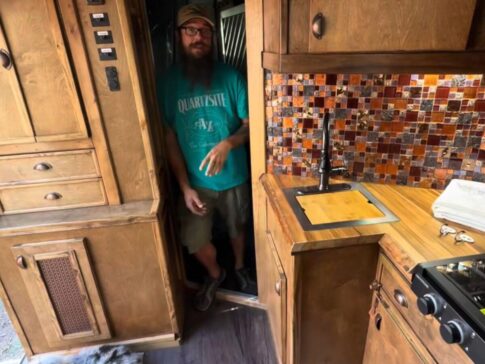 Storage drives the whole interior. Under the refrigerator, a split drawer keeps lids up top and pots and pans below. A custom shelf adds room for art and memorabilia, while the kitchen packs in a deep bar sink, retractable faucet, oversized stove drawer, pantry storage, and upper cabinets sized for glassware.