Home Blog Page 50

Switching to 600Ah lithium batteries. Is 200W solar panel sufficient?

Dear Dave,
I’m changing to lithium phosphate batteries, two 12V 300Ah, in parallel. Is that enough power for off-grid? Will that run everything? I have a 200W solar system. —Christopher, 2006 Winnebago Sightseer R29

Dear Christopher,
There are several variables when it comes to calculating the battery bank you will require and ultimately the solar panel array. Several boondocking experts have stated that the “average” RV uses 75-150 amp hours of battery power when boondocking. However, I have found that there typically is no average RVer.

Information from Winnebago

According to the information listed on the Winnebago website, your Sightseer came originally with an absorption refrigerator. That means it will run on 120-volt AC or LP mode, which is boondocking. However, since your unit is just shy of 20 years old, it might not have the original refrigerator, so you need to look at your appliances and calculate the power needed.

If the refrigerator has been replaced with a residential model, that would require a larger inverter and much more battery power and solar charging than you are planning to have.

The challenge when it comes to calculating how much battery power you need is determining how many items you are going to use, how often, and how long you are going to be off-grid.

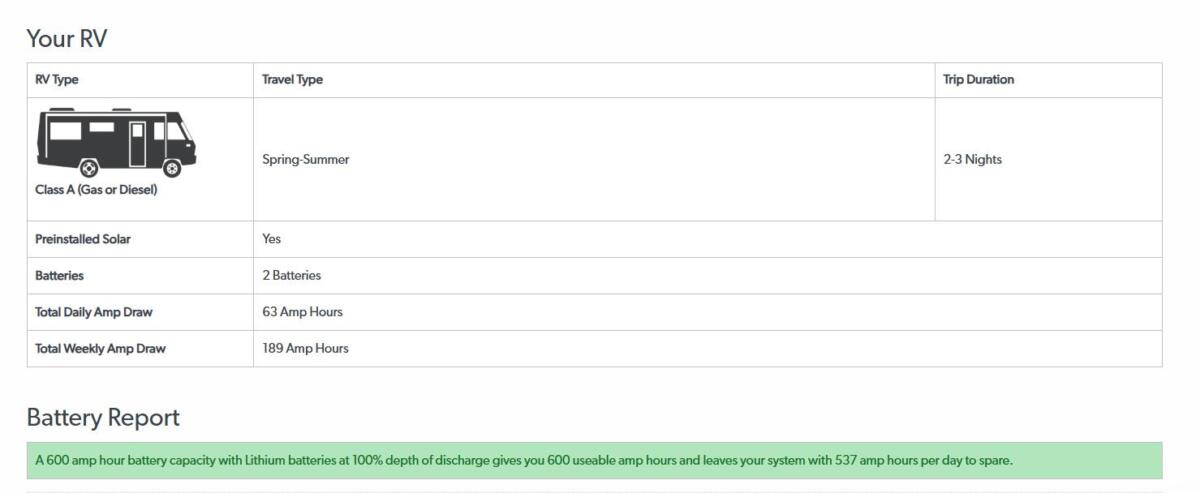
First, I do think 600Ah of lithium battery power is enough to run for several days before needing to recharge. However, a 200-watt solar panel will not be able to do much of anything for sustaining the batteries longer than 2-3 days.

A general rule of thumb is 200 watts of solar charging capacity for every 100Ah battery, so you are way short in charging capacity. I’m not saying you need 1200 watts of solar panel capacity, as it also depends on how long you plan to stay off grid.

Calculating power needs

One of the best tools I have found for calculating power needs for boondocking or dry camping is the Go Power! Solar Calculator on their website here.

So, if I run through the steps of your rig and components, it looks like this:

Motorhome, 600Ah lithium batteries, roof-mounted solar panels, expand a current system.

Spring/summer travel for 2-3 days.

Now, I need to calculate what components will be running and how long. This is the challenging part, as who really knows how often the refrigerator cycles or how many lights and how long they are on. However, it does give us a starting point, so here is what I chose:

  • Refrigerator running for 10 hours
  • 3 lights on for 2 hours
  • Ceiling fan on for 2 hours
  • Water pump running for 30 minutes
  • LP leak detector on full time

The next page lists all the comforts of home such as blender, air pot, microwave, and even a wine cooler. We will leave all these off for this example. However, there are a few other items we need to consider:

  • Cell phone charge – 1 hour x 2 phones
  • Flat screen TV – 1 hour
  • Laptop charge – 1 hour
Sightseer Amp Hour
Sightseer amp hour (click to enlarge)

According to the calculation, this setup will only use 63Ah of battery power, and you can get by with the 200-watt panel for 2-3 days, IF you get good sun for at least 6 hours AND you are not running anything else.

Plus, keep in mind that to get a solar charge from your panels, you need to be in direct line of sight to the sun, which means raising the interior temperature 20–30 degrees. Since you are dry camping, that generally means no air conditioning. And if you go under shade to cool it down, no solar charging.

I would recommend supplementing your 200-watt panel with a 200-watt portable panel from Go Power!, which can be positioned early in the morning and out in direct sunlight while your rig sits cool and comfortable under shade.

Portable Solar
Portable solar

 You might also enjoy these posts from Dave 

DAVE HAS ANSWERED MORE THAN 1,000 readers’ maintenance and repair questions. Read a directory here. There is so much to learn!


Dave Solberg is a leading expert in the RV industry and the author of the “RV Handbook.”

HAVE A QUESTION FOR DAVE?

Send your inquiries to him using the form below.

Name
Drag & Drop Files, Choose Files to Upload

RVDT2889

Don’t throw out your Pringles can! Use it these 11 ways in your RV

1

By Gail Marsh
They are a favorite for campers: Pringles® crisps. You know what they look like and how they taste, but did you ever wonder how Pringles were invented? Read on!

What was the problem with other potato chips? Broken and greasy chips. That’s why, in 1956, Procter & Gamble enlisted the help of Fredric Baur. Baur, a trained chemist, just also happened to be a guy with great mathematical skills. Baur used a geometric formula to create a saddle-shaped chip that would not break when individually stacked inside a cardboard cylinder. Pringles were invented along with their iconic container. Problem solved? Nope! The chips tasted terrible.

Looking for solutions

Procter & Gamble continued to work on better-tasting chips and finally came up with a mixture of dehydrated potatoes, corn, rice, and wheat. Perfectly shaped chips (now called crisps) were stamped out of the mix, and then the crisps were packaged inside Baur’s chip container invention. Problem solved? Yes!

Buried inside his Pringles invention

Fredric Baur was understandably proud of his chips-in-a-can invention. So proud, in fact, that he wanted to take his invention to the grave. Sort of… Baur actually requested that his cremated ashes be placed inside a Pringles can for burial. So when Baur died at the age of 89, his children honored their father’s wish.

According to the family, the Baur children discussed what flavor Pringles can to use for their father’s ashes. (By the time of his death, Pringles crisps were sold all over the world and came in a wide variety of flavors.) Larry, the eldest of the Baur clan suggested, “We need to use the original.” His siblings agreed, and that’s how Fredric Baur, the inventor, came to be buried inside his Pringles can invention.

11 Pringles can hacks for RVing

Inside the RV

• Store other foods inside. Chips aren’t the only food that will travel safely inside a Pringles container. You can also safely pack a sleeve of crackers, some spaghetti or other noodles, dried beans, and more inside this handy can. Flour, sugar, and breadcrumbs are other products that can be transported via the Pringles container. The sturdy cardboard will protect the food, and you won’t have punctured bags or spilled products inside the RV.

• Make a cell phone speaker. Cut a slit near the bottom of the Pringles can. Make the slit large enough for your cell phone to sit inside. Remove the lid. The can will amplify your cell phone’s speaker. Really!

• Store plastic bags. Cut a small (one-inch diameter) hole in the Pringles lid. When you need a plastic bag, simply reach into the hole, and pull one out.

• Office or hobby supplies. A Pringles can will also corral those office supplies like pens, scissors, paper clips, and glue sticks. Hobby supplies like beads, wire, artists’ paintbrushes and more will also fit inside.

• Hair accessories holder. Use a Pringles can to keep hair ties and elastic bands together. Just put them around the outside of the can. Clips, ribbons, and bows can be stored inside the can, as well.

• Makeup organizer. You can cut down Pringles cans so that your makeup brushes, comb/brush, and other tools are easily at hand. Tape a series of cans together so they’ll stay securely upright.

• Necklace holder. Put weights in the bottom of a Pringles can. Then wind a rubber band around the can, near the top. Hang necklaces and bracelets from the rubber band. Simple! And handy, too!

Outside the RV

• Bird feeder. Use a darning needle to poke and thread a string through the top of the Pringles can. Tie the ends of the string together. Then use a spatula or butter knife to smear peanut butter all over the exterior of the Pringles can. Then roll the prepared can in birdseed. Hang the bird feeder from a nearby tree. Or hang the feeder from a garden flag holder outside your RV window.

See underwater. Kids love doing this. Remove the bottom of the Pringles can. Use a waterproof tape to securely fasten the lid onto the can. Gently place the lid end of the can into the water. Look through the bottom of the can to see what’s underneath the water’s surface.

Keep paint rollers fresh. When painting, you can slip a Pringles container over the paint roller at the end of the day. The next day, the paint in the roller will be ready to go.

Store tools. We use a few select tools when traveling in our RV: a channel lock, screwdrivers, pliers, and the like. An easy way to keep these few, but necessary, tools together and within reach is to store the tools inside a Pringles can. The can stays in the RV basement, where the tools are always available.

Decorating the Pringles can

If using a Pringles hack inside your RV, you may want to decorate it. You can cover the exterior of the Pringles can with paint, decoupage, or by wrapping paper around the can and then securely taping the edges. Crafters have also glued shells, stones, sequins, ribbons, and other objects to the Pringles can exterior.

Have you reused Pringles cans in additional ways? Share with us, please, in the comments below.

RELATED

RVDT2889

How to clean an RV awning

By Cheri Sicard
If you have wondered how to clean an RV awning, you have come to the right place. In the video below, Kevin from Kevin and Kim Outdoor Adventures shares a simple and effective way to clean your RV’s awning and keep it in tip-top shape.

Why bother to clean your RV’s awning? Because water is the enemy of awning longevity, and a clean awning repels water more effectively than a dirty one.

Of course, step one is to pull out the awning. Kevin’s awning was LONG overdue for a cleaning. It was not only dirty, it was filthy!

Kevin chose to use La’s Totally Awesome All-Purpose Cleaner for the job.

Pick up a brush to help you scrub, and some eye protection while doing the job is a good idea, too. You don’t want any of the caustic cleaner to get in your eyes. While Kevin started the job with a spray bottle of the diluted concentrated cleaner, this was slow going. He decided to work smarter and not harder and used a pump sprayer bottle instead. But know that you can definitely clean the awning without it.

Once you have the awning soaked in the diluted cleaner, it’s time to roll it back up and let the solution do its magic. In theory, after about 30 to 45 minutes, most of the dirt should just spray right off.

After unrolling, Kevin took a long-handled brush and soapy water to get any stubborn dirt off.

After rinsing it all off, the results were astounding. The awning looked almost brand-new!

It was so dirty when he started, it did not seem possible, but it definitely worked. Watch the video and see for yourself.

RELATED

RVDT2889

Which do you most often prefer: a well-lighted campground or a dark one?

12

Picture your perfect campground: You have a nice, quiet, shaded spot away from others under beautiful trees, a nice space for your dog, Fido, to explore, perhaps water or mountain views… Ah, it’s beautiful!

Now think about that same campground at night. In your dream world, is that campground pretty dark or is it very well lit? Would you prefer to walk around with a flashlight at night, or would you rather not have to use a flashlight to see at all?

Some RVers love and appreciate that deep, quiet darkness—the kind where you can look up and actually see the Milky Way stretching across the sky. It feels more like “real camping,” doesn’t it? Peaceful, calm, and a little removed from the everyday glow of streetlights and city life.

Others prefer a bit more visibility after the sun goes down. Maybe it’s about safety, easier footing, or just not wanting to fumble around in the dark on a late-night walk to the bathhouse. A softly lit campground can feel more comfortable—and a whole lot more convenient, especially when it comes to letting the dog out for its final potty break of the evening.

We understand you can’t control all your light surroundings—some people have outdoor lights that they leave on all night, others have color-changing LED lights on their RV. But we’re just talking about the campground itself here.

Tell us your answer in the poll below, and please leave a comment, too, if you feel so inclined.

MORE RECENT POLLS:

RVDT2889

RVers aren’t immune to ‘rookie’ national park mistakes

It’s easy to assume experience counts for everything. Many of us have rolled into dozens of parks over the years, know the drill, and figure the “rookie mistakes” don’t apply anymore. But national park mistakes RVers make still show up every season—and rangers say some of them can turn serious faster than people expect.

A former ranger speaking with Business Insider laid out a familiar pattern: visitors arrive unprepared, underestimate conditions, and forget that parks aren’t controlled environments. That may sound like it’s aimed at first-time tent campers. But look a little closer, and you’ll see how often it applies to RVers, too.

That hard-sided RV doesn’t make you wildlife-proof

There’s a quiet assumption out there: If you’re in an RV, wildlife is someone else’s problem. Rangers would tell you otherwise.

Bears don’t distinguish between a tent and a trailer if there’s food inside. Bison don’t care that you’re in a Class A. And smaller critters—raccoons, rodents—can make a mess of things if food is left out or compartments aren’t secured.

In many parks, the same rules apply across the board:

  • Store food properly.
  • Don’t leave trash accessible.
  • Keep distance from animals.

The mistake isn’t ignorance. It’s familiarity. The more often people visit parks, the easier it is to relax the rules, and that’s when trouble starts.

“We’ll have service”—until you don’t

Another one that trips up RVers: assuming connectivity.

Cell service in national parks can be spotty at best and nonexistent at worst. That’s not new. What’s changed is how much we rely on it. Navigation, campground updates, weather alerts—many of those now live on your phone.

When service drops out, the consequences can pile up:

  • Missing a closure notice
  • Taking a wrong turn with no easy turnaround
  • Arriving at a full campground with no backup plan

For RVers—especially those in larger rigs—that last one can turn into a real headache in a hurry.

Closures and conditions hit RVers differently

Rangers often warn visitors to check conditions before heading out. For RVers, that advice carries extra weight.

A hiker can turn around on a narrow trail. A 36-foot trailer? Not so much.

Seasonal closures, road construction, rockslides, and even temporary restrictions can leave big rigs with limited options. And in some parks, there’s simply no good place to turn around once you’re committed.

That’s where a quick check before you roll in can save a long, stressful afternoon.

“Unprepared” doesn’t always look like you think it will

When rangers talk about unprepared visitors, they usually mean hikers without water or proper gear. But RVers have their own version of that problem.

Running low on fuel in a remote park. Assuming dump stations will be open. Forgetting how limited propane or generator use can be in certain campgrounds.

None of these feel like big mistakes—until they stack up. Then they become the kind of problem that can cut a trip short.

Familiar places can still surprise you

The thread running through all of this is simple: Experience doesn’t make you immune.

If anything, it can make it easier to skip the basics. You’ve been there before. You know how it works. Until something changes—and in national parks, something always does.

Even seasoned visitors slip into the same habits: assuming conditions haven’t changed, or that the rules don’t quite apply this time.

That’s the moment where “rookie mistakes” stop being rookie.

What this means for RVers

None of this is complicated. It’s just easy to overlook.

  • Check conditions before you arrive.
  • Plan for no service.
  • Treat wildlife like wildlife, not scenery.

And remember that driving a bigger rig doesn’t just change how you camp—it changes how small mistakes play out. Because in the end, the difference isn’t whether you’ve been to a national park before. It’s whether you’re still paying attention.

RELATED

RVT1258

Carrying a gun in national parks? The rules change when you step inside a building

If you’re carrying a firearm in a national park, the rules can change faster than you might expect. Guns in national park buildings are treated very differently than guns out on the trail—and that’s where many RVers can get tripped up.

Right now, federal law allows visitors to carry firearms in national parks as long as they follow the laws of the state the park sits in. That’s been the case since 2010, and for many RV travelers, it’s become part of routine trip planning.

But there’s a catch—and it’s a big one.

The moment you step into certain buildings inside the park, that legal carry can turn into a violation.

Where you can—and can’t—carry today

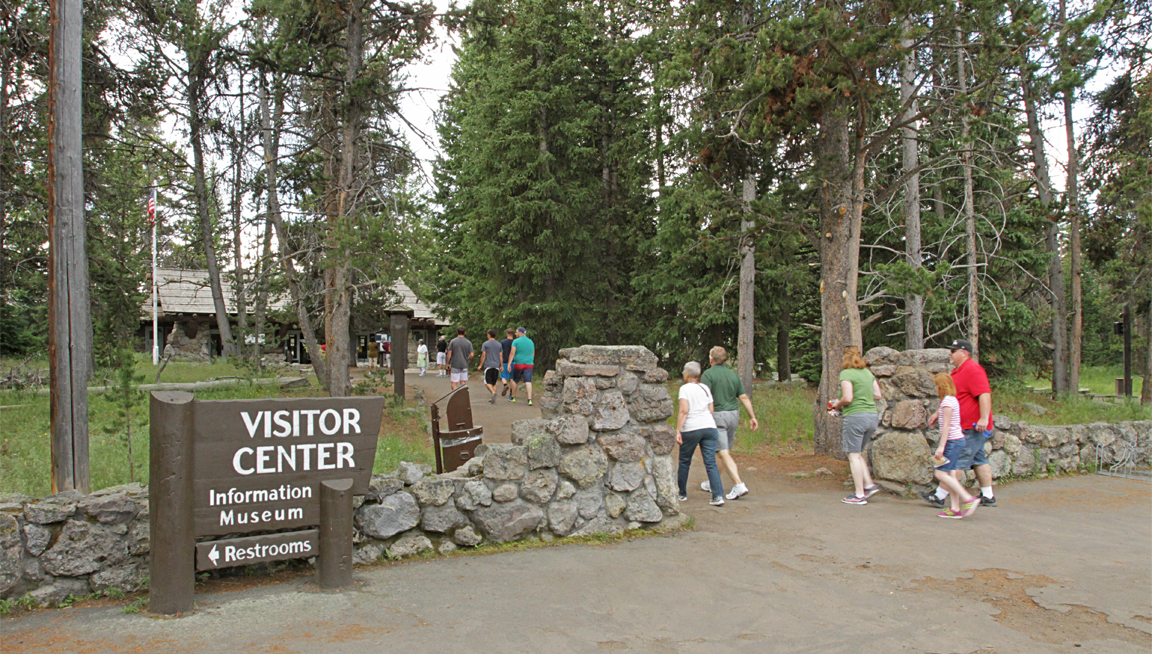
Under current federal law, firearms are generally prohibited inside what are classified as “federal facilities.” In a national park, that typically includes visitor centers, ranger stations, administrative offices, and many gift shops.

In practical terms, that means you might be perfectly legal while walking a trail, sitting at your campsite, or even fueling up nearby—but not when you walk into the visitor center to ask about road conditions or pick up a map.

For RVers, it’s an easy line to cross without thinking. You park, step out, head inside—and suddenly the rules have changed.

There’s usually signage posted at entrances to these buildings, but it’s not always something folks notice until after the fact.

A legal fight now underway

That patchwork of rules is now at the center of a new legal challenge.

Gun-rights organizations, including the Second Amendment Foundation and Firearms Policy Coalition, have filed suit arguing that the federal ban on firearms inside park buildings violates the Second Amendment.

They contend that law-abiding visitors shouldn’t have to disarm simply to enter a government building, especially in remote areas where help may be far away.

On the other side, federal officials and some public safety advocates argue that these buildings fall into a long-recognized category of “sensitive places,” where firearm restrictions have historically been allowed.

They say visitor centers and ranger stations are high-traffic areas where limits are meant to protect both staff and the public.

So far, the case is just getting started. No court has issued a ruling, and the current rules remain in place.

“You may be legal on the trail—but not when you step inside the visitor center.”

What this means for RVers right now

For the time being, nothing has changed, but the situation is worth watching.

If you’re traveling with a firearm in a national park, the safest approach is straightforward: Know that the rules outside don’t necessarily apply inside.

That means thinking ahead before you step into a building. Some RVers choose to secure a firearm in their vehicle before going inside. Others plan stops to minimize in-and-out transitions. Either way, it’s a detail that can catch even experienced travelers off guard.

It’s also important to remember that state laws still apply across the park itself. What’s legal in one state may not be in another, even within the same park system.

Why this issue keeps coming up

This isn’t the first time the question has surfaced, and it likely won’t be the last.

National parks sit at the intersection of federal authority, state law, and individual rights. That can make for rules that feel inconsistent on the ground, especially for RVers who move frequently from place to place.

The current lawsuit could eventually bring more clarity—or it could reinforce the status quo. For now, though, the takeaway is simple:

You may be legal to carry in a national park, but that doesn’t automatically follow you through the front door.

RELATED

RVT1258b

Gas prices may have peaked, but RVers shouldn’t expect relief anytime soon

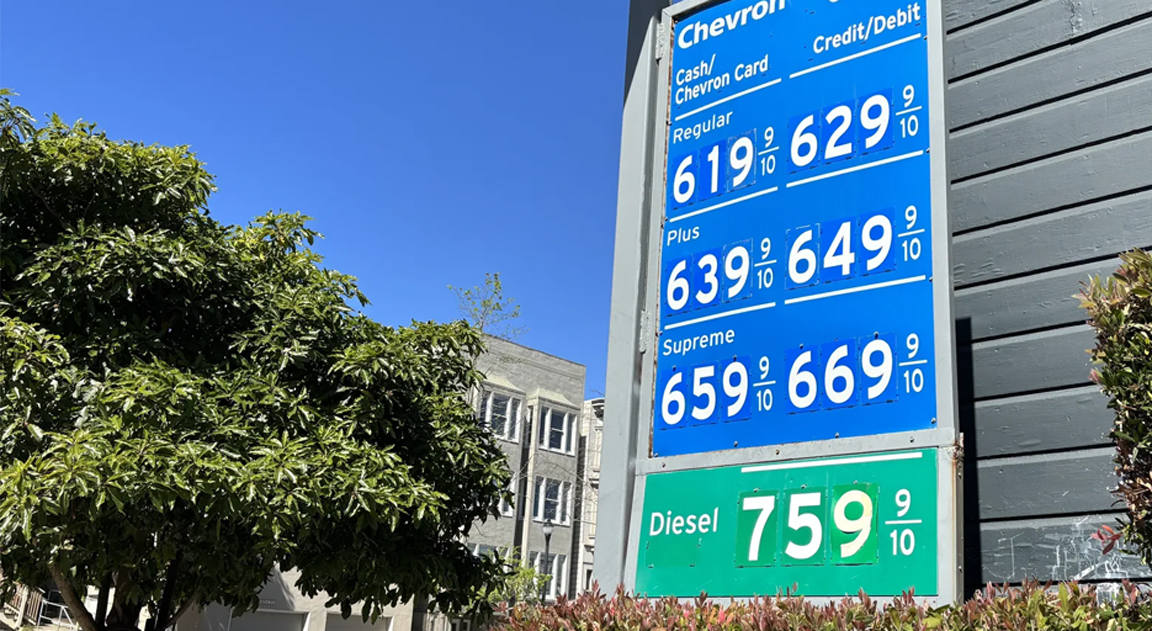
Gas prices RVers are watching may have finally stopped climbing—but don’t mistake that for good news.

After weeks of volatility tied to tensions in the Middle East, there are signs the worst of the spike may be behind us. But between global oil risks, political crossfire, and long-term forecasts, the road ahead still looks expensive—and uncertain.

That uncertainty may matter more to RVers than the price itself.

Prices may have peaked—but not dropped

Gas prices RVers are seeing today may be leveling off, but they’re not falling in any meaningful way.

Recent signals from Washington, D.C., suggest fuel prices could be near their high point for now. Even so, officials are warning that prices are unlikely to fall below about $3 a gallon before 2027.

In other words, even the “good news” comes with a catch: The low prices may stay higher than what many RVers got used to in past years.

At the same time, national averages are still hovering well above that mark, meaning most drivers—and especially RVers—are still paying a premium every time they pull up to the pump.

The wildcard: Global tensions

If there’s one thing keeping fuel markets on edge, it’s geopolitics.

The ongoing conflict involving Iran has already pushed oil prices sharply higher, with concerns focused on supply routes like the Strait of Hormuz. That’s a narrow choke point where a disruption can ripple through global fuel markets in a hurry.

Even the hint of escalation can move prices quickly. And that’s the problem: It’s not just how high prices go—it’s how fast they can change.

Why this hits RVers differently

For the average commuter, a few cents swing at the pump is annoying. For RVers, it can reshape an entire trip.

Long distances, lower fuel economy, and larger tanks mean every price bump multiplies fast. A difference of even 50 cents per gallon can add hundreds of dollars to a long haul.

But more than that, unpredictability makes planning harder.

Prices may have peaked—but they’re not going back to what RVers used to call normal.

What a price swing really costs on the road

Let’s put some real numbers to this.

If you’re running a “gasser”

Say you’re driving a gas Class A or towing a fifth wheel and averaging about 8 miles per gallon. On a 1,000-mile trip, you’ll burn roughly 125 gallons.

Now look at the difference fuel prices make:

At $3.50 a gallon → about $437
At $4.00 a gallon → about $500
At $4.50 a gallon → about $562

That’s a $125 swing on the same trip—just based on price.

If you’re burning diesel

Diesel rigs often do a bit better on mileage—call it 7 to 9 mpg—but diesel usually costs more per gallon.

Using the same 1,000-mile trip:

At 7 mpg → about 143 gallons
At 8 mpg → about 125 gallons

Now apply diesel pricing:

At $4.00 a gallon → about $500 to $572
At $4.50 a gallon → about $562 to $643

That’s roughly an $80 to $140 difference, depending on your rig and fuel price.

Why this matters more now

In the past, RVers could plan around a general price range and be close enough. Now, with prices swinging on global events, that same trip could cost noticeably more, or less, depending on timing.

That’s the real shift. It’s not just that fuel is expensive. It’s that you don’t always know what it’ll cost when you go. Same rig. Same trip. Very different bill.

The bottom line

Gas prices may have peaked, but for RVers, that doesn’t mean relief, it just means a new phase.

And that phase looks like higher baseline costs, more volatility, and a need to plan a little smarter before turning the key.

Sources
Fortune — Energy secretary says gas prices may not fall below $3 until 2027
TheStreet — AAA gas price data shows emerging trend for U.S. drivers
CBS News — Iran tensions and oil markets push fuel price volatility

RELATED

RVT1258b

Two RV parts giants may merge— and RVers could pay the price

A potential merger between RV suppliers Patrick Industries and LCI Industries has folks in the industry talking—and not always in a comfortable tone.

If those two names don’t ring a bell, their handiwork probably does. Between them, these companies supply a huge share of the parts that make an RV, an RV. Frames, slide systems, leveling gear, windows, doors, furniture—much of what you live with every day rolls out of their factories, even if their logos never show up on the sidewall.

What’s being discussed

Now the two are talking about a possible “merger of equals.” Nothing is signed, and it could still fall apart. But the idea alone points to something bigger that’s been building for a while: fewer companies controlling more of the RV supply chain.

That’s where the concern about less competition comes in—and it’s not hard to see why.

Fewer suppliers, more leverage

When manufacturers have fewer suppliers to choose from, the balance of power shifts. RV builders have less room to shop around, and the companies making the parts gain more say in pricing and availability. That doesn’t mean the sticker on your next rig jumps overnight. But over time, it can subtly narrow the number of “good deal” options that used to keep things in check.

Where RVers feel it

Where RVers tend to feel this most isn’t on the sales lot—it’s when something breaks.

A lot of rigs on the road today already rely on a relatively small pool of suppliers. If two of the biggest become one, that pool gets smaller still. When everything is working, you’d never notice. But when a part fails or goes on backorder, having fewer alternative sources can stretch out repair times and limit what a shop can do to get you moving again.

When the companies behind your RV get fewer and bigger, it often shows up later—in your wallet and your repair timeline.

The warranty and repair angle

There’s also the less visible side of things: warranties and repairs. Larger suppliers often come with more standardized policies, and sometimes less flexibility. If you’ve ever run into a situation where a dealer says, “That’s up to the component manufacturer,” you already know how that can play out.

Not all downside

To be fair, it’s not all downside. A combined company could do a better job integrating systems that are supposed to work together. In theory, that means fewer compatibility headaches and less finger-pointing when something doesn’t work. Whether that actually shows up in day-to-day ownership is another question, but it’s part of the argument for getting bigger.

The bigger trend

Step back a bit, and this potential deal fits a pattern RVers have been watching for years. The industry has been steadily consolidating—with fewer, larger players supplying more of what goes into each unit. This would just be one of the biggest moves yet.

For now, nothing changes at your campsite. But it’s the kind of behind-the-scenes shift that tends to surface later. Like when you’re pricing a new rig, waiting on a part, or trying to get something fixed before the next trip.

And that’s why it’s worth keeping an eye on.

RELATED

RVT1258b

RV Daily Tips. Wednesday, April 22, 2026

America’s Original RV Newsletter. Since 2001
Issue 2888 • New issue every weekday
If you find this newsletter helpful, please consider supporting our work with a donation of your choice. Thank you!


Today’s thought

“Housework can’t kill you, but why take a chance?” —Phyllis Diller


Need an excuse to celebrate? Today is Earth Day! We love this big, beautiful planet of ours!

On this day in history: 1876 – The first National League baseball game is played at the Jefferson Street Grounds in Philadelphia.


Tip of the day
Detailed tips on how to plan for an RV trip when you’re not a planner

By Nanci Dixon
We often get suggestions, comments and requests from our readers. We received this email from one of those readers, Walter B., asking for help with RV trip planning.

Walter wrote, ”I so enjoy reading the various RVtravel.com articles but would greatly appreciate an article (or series) on trip planning for dummies. Maybe trip planning examples for part-time RVers, full-time RVers, boondockers, etc. …” Continue reading.


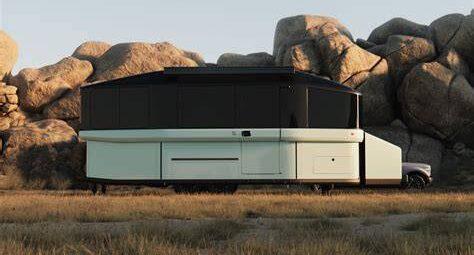
exterior of Lightship's AE.1 Atmos Image: Lightship's websiteRV review
2026 Lightship AE.1 Atmos—a real science-fiction RV

By Gail Marsh
“Meet George Jetson!” Well, not really. However, this electric, pop-up travel trailer by Lightship does remind me of science fiction cartoons from the 1970s-’80s. The 2026 Lightship AE.1 Atmos is built for couples or small families who want electric towing without sacrificing range, comfort, or capability. This is not just another camper. It’s a redesign from the ground up of what an RV can be in an electric era. Check it out and see what you think.


STAY COOL ALL SUMMER LONG!
Now, run your RV’s air conditioner when you normally could not! Learn why our publisher, Chuck Woodbury, raves about this.


Article and video
22 essential dry camping tips for boondockers

By Cheri Sicard
Chris and Lindsay, from the Called to Wander YouTube channel, share their best dry camping tips and tricks in this video. The video title says there are 20 tips, but I counted 22. If you’re an experienced boondocker, you probably know many of these tips already. But so many people are hesitant to try RV off-grid living, and these tips can help get them started.


Featured article
The top 5 RV-friendly national parks

By Nanci Dixon
There are many great National Parks to visit in an RV, but the best one for you will depend on your interests, the type of RV and the type of experience you’re looking for. Here are a few of the most popular options. My husband and I have visited all of the ones below and loved each one, all for different reasons. Have you visited these parks?


Ask Dave
Is Top Tier gasoline really necessary?

Learn all about Top Tier here.


Reader poll
Have you ever taken a scenic helicopter ride?

Respond here.

LIKE TAKING POLLS? So do we! Did you know we’ve run more than 5,000 polls on our website over the years? Check ’em out! Have fun!


Lilguybumper
We do, too! Get this [bumper] sticker for yourself here.

Quick tip
RV storage ideas? Think outside the cabinet

The folks at Home Is Where We Take It came up with this unusual but fascinating idea. When looking for RV storage ideas, think outside the box. “We added this can storage to the side of our cabinet near our stove. We got ours from Walmart and it is perfect for cans in an otherwise unused space. If you don’t use cans, I could easily see using this space for shoe storage or maybe a great place for kitchen wraps/Ziplocs. If you have small kids, this would be a great place for activity containers. There’s no need to waste space when you don’t have it to waste!”


On this day last year…


Website of the day

Earth Day
The official website for Earth Day, which has been celebrated since April 22, 1970.


RANDOM RV THOUGHT: In our society where virtually everything we eat is purchased from a supermarket, a campsite by a stream may provide a child with the realization that what we eat needn’t always come from a store. It can be a great thrill for Junior, when fishing with Dad, to land a small trout, clean it, and then eat it for dinner. To a child, such an occasion can be an eye opener that the food that nourishes us was actually once alive, and not just manufactured to be sold at the market.


? MYSTERY PRODUCT OF THE DAY ?
The man reached in his wallet and suddenly he could see again! What was in the wallet? Find out.


Trivia

A 2015 study estimated that there are roughly 3 trillion trees on Earth, give or take a few million. Since there are around 8 billion people currently living on the planet, that means there are about 400 trees per person on Earth.


Readers’ pets of the day

Screenshot 20250610 060439 One Ui Home C00c0ca4a0725808f20d1780db2547a6“Sparkles and Angel (Pomsky—Pomeranian/Husky, ages 3 and 5) love camping and boat rides.” —Terrance McKenzie

Send us a photo of your pet with a short description. No blurry photos and please do not submit your photo more than once. Thanks!

Pet Food and all pet products at Amazon
RVing with Dogs group on Facebook. You’ll love it.


Leave here with a laugh


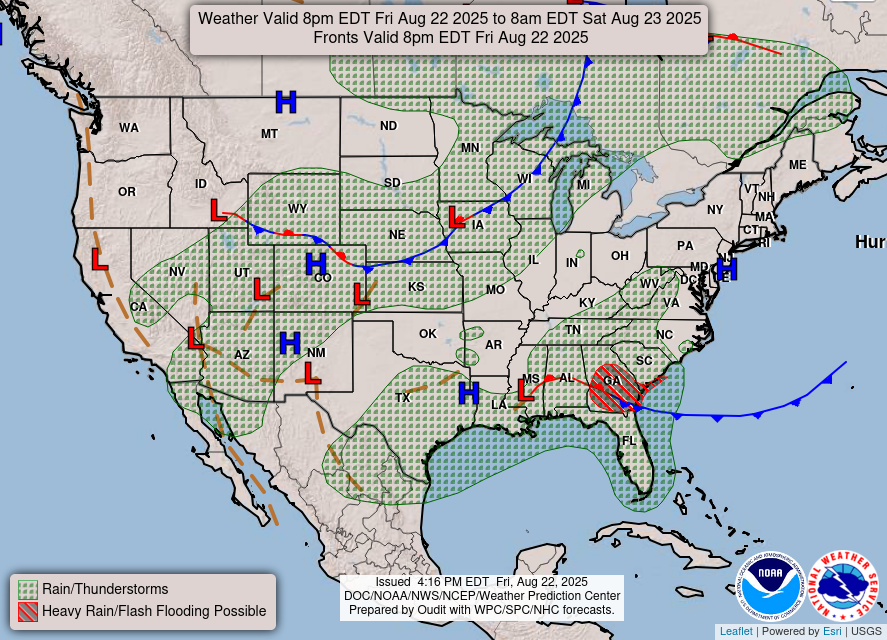
Today’s weather forecast across the nation
THIS MAP UPDATES TWICE A DAY

Visit Current National Radar Weather Map


Did you miss the latest RV Travel Newsletter? If so, read it here.
Oh, and if you missed the Latest News for RVers, make sure to catch up here.


If you shop at Amazon.com we’d appreciate you using this link. We get an itty bitty commission if you buy something, but they add up and help us pay our bills (most importantly our hard-working writers!). 


RVtravel.com All-Star Staff

Click here for information about our staff and how to contact us.

WHY WE ASK FOR DONATIONS INSTEAD OF SELLING SUBSCRIPTIONS.

Our policy on using artificial intelligence.

Is Top Tier gasoline really necessary?

Dear Dave,
Do I really need to use Top Tier Premium Gasoline in my car? —Diane, 2024 Audi Q5

Dear Diane,
This actually has been a situation that occurred twice now with my wife’s car. It displayed an error code that indicated “Drive System: Malfunction! Please contact Service.” Unfortunately, the nearest Audi Service Department is 120 miles away and, yes, we knew that when we bought the car. We were also reassured by the salesman that, “It’s an Audi. It doesn’t need service!” I think he might have sold RVs at one time?

Audi Error
Audi error code

So, last year when the warning first came on we risked the 120-mile drive to take it to the Audi dealer. They hooked up the “special” On Board Diagnostic (OBD) reader and the code indicated fuel system contamination. The owner’s manual states that only Top Tier, Premium Gasoline should be used in the vehicle for the higher levels of detergents that keep the engine cleaner and creates less carbon deposits.

A recent AAA article posted that non-top tier gasoline left 19 times more engine deposits—which I find hard to believe. However, after spending an entire day just to have the error code reset and a quarter of the tank drained, we decided not to risk using “dirty gas”.

According to www.toptiergas.com:

TOP TIER™ Approved Fuels clean harmful carbon deposits left over in your engine from low-quality gas, restoring performance, fuel economy and drivability—all at no extra cost, in every octane, at stations you already trust.

I disagree with the statement “all at no extra cost”. The only station that sells Top Tier Premium in our area is Kwik Star. It is now $6+ per gallon, while regular 10% ethanol is $3.30 per gallon.

What makes TOP TIER™+ Approved Gasoline different?

Here is the description from toptiergas.com:

The new TOP TIER™+ fuel standards are designed for today’s state-of-the-art spark ignited engine technologies, especially high-efficiency GDI (Gasoline Direct Injection) fuel systems coupled with down-sized boosted engines. Modern GDI engines deliver maximum performance when operating cleanly. The new TOP TIER™+ Approved Gasoline standards add three new engine tests to help ensure cleaner fuel injectors, optimal emissions and more efficient combustion.

It goes on to state that 73% of new cars and trucks have the GDI fuel systems. It states that automobile manufacturers such as BMW, General Motors, Stellantis, Ford, Honda, Daimler Truck, Toyota, Volkswagen, Mercedes-Benz, International and Audi all recommend and sponsor the Top Tier program.

Also, TOP TIER™ prohibits the use of organometallic additives (what?) that are known to damage emissions after-treatment systems. Some of the emissions issues it lists are hard starting and stalling, which I think is ironic. This Audi has the feature that shuts the engine down when you come to a stop—which I hate—and then magically starts up a few times during a red light.

Another error message

Fast forward 8 months later and, once again, we have an error message. However, our local O’Reilly Auto Parts store has an OBD II that will read an Audi error message. Once again, it shows we have “bad gas”. I’ve had “bad gas” and wish we could just throw in a Beano and be done with it.

I assure you that we, meaning my wife, as I don’t get to drive the Audi, only purchases the Top Tier Premium non-ethanol at the only station in a 50-mile radius that has it. So why the error code?

We finally got a call back from the service technician at the Audi dealership and they suggested we tell Kwik Star that they have bad gas! Nope. He also suggested checking the fuel cap, as a loose cap could affect the pressure and give a false signal. WHAT? A thousand sensors, regulators, computers, and whatyamacallits, and a loose cap can put your car into limp mode?! Not buying it.

Not an uncommon situation

Then we got a call from another technician at the selling dealership as I had left a very direct message concerning the legitimacy of the bad gas/loose cap situation. I found that this is not an uncommon situation and there is a possible firmware update that is being considered. He suggested running the tank down to below 1/8th level, filling with known Top Tier fuel, and unhooking the negative cable on the battery for one minute to reset the code. I think he might have previously worked for Microsoft and pulled the “Have you tried restarting your computer?” diagnosis.

My 2016 Chevy Silverado has no problem with any type of fuel, although using E85 seems to be like flushing a toilet when it comes to fuel economy. I have also been told that running even 10% ethanol in small engines such as lawn mowers, weed eaters, and even generators is not good as it burns hotter.

However, I know hundreds of RV owners that have been running 10% or more in their rigs for years and running the generators with no heat issues. The only issue I know of is that not “exercising” the generator once a month to clean out the varnish will cause it to not start. However, I think that is with any type of gasoline.

Good ol’ days

I worked at a full-service gas station in high school and college and even owned my own for a few years with a friend and we actually pumped the gas, washed the windows, checked the oil and tires, and made change by counting back the money! We didn’t have those fancy registers that told you what change to give, remember getting a $20 for $10.50 in gas and counting back “50 cents is $11, one two three four dollars makes $15, and a five makes $20!” Of course, with Top Tier gas that would be less than two gallons today. OUCH.

I also have been secretly testing gasoline for years, leaving it in my lawn mower year-round without any stabilizer. Yes, it fires off every spring. And I have had the same oil in it for three years and, yes, there is a little “blue smoke” at the startup—but we have no mosquitoes.


 You might also enjoy these posts from Dave 

DAVE HAS ANSWERED MORE THAN 1,000 readers’ maintenance and repair questions. Read a directory here. There is so much to learn!


Dave Solberg is a leading expert in the RV industry and the author of the “RV Handbook.”

HAVE A QUESTION FOR DAVE?

Send your inquiries to him using the form below.

Name
Drag & Drop Files, Choose Files to Upload

RVDT2888

Detailed tips on how to plan for an RV trip when you’re not a planner

4

By Nanci Dixon
We often get suggestions, comments and requests from our readers. We received this email from one of those readers, Walter B., asking for help with RV trip planning.

Walter wrote, ”I so enjoy reading the various RVtravel.com articles but would greatly appreciate an article (or series) on trip planning for dummies. Maybe trip planning examples for part-time RVers, full-time RVers, boondockers, etc. In my case, I am married. We are both retired with a 38-year-old mentally disabled, but functioning, son at home with us and have aging parents living behind us who, though they are physically/mentally good and independent, need help every once in a while.

“Planning has never been a strength of mine; however, I would like to learn from those who are [planners]. A bucket list trip objective for us would be a month-long trip out West in our ’99 Foretravel Class A motorhome to show my wife and son the beauty of Yellowstone, the Grand Tetons, Bryce Canyon and the Grand Canyon.

“Has anyone planned memorable trips similar to this in the past that they could share in terms of places visited, time of year, duration per location, anything special to visit or see while there?”

RV trip planning 101

Well, Walter, I am glad to go through some of the things that I do to plan our trips. RVtravel.com readers are all such a well-informed group of RVers that I think all of them could provide some great advice on RV trip planning.

Planning steps

Being full-time RVers, we always need a campsite. Here are some of my suggestions:

1. It seems obvious but, first, you need to be clear about where ALL of you want to go. No use planning a trip to the Great Smoky Mountains when your spouse is counting on finally seeing the Redwood National Park.

2. Plan early! Reserve campsites early! The earlier the better.

3. Most states have visitor and camping info available online or by mail. Request by mail or check the info out online (the quicker of the two options).

4. Take out an atlas or map to get the overall idea of the trip, where you want to end up and the general route. It is at this point I sometimes realize that I am thinking about doing a two-month trip in two weeks and need to scale back.

5. There are several websites that can plot routes between major destinations of a trip and show a rough route. When we did the “Big Five” in Utah—Zion, Capitol Reef, Canyonland, Bryce, and Arches national parks—it was pretty easy to plan a loop stopping at each park and then locating camping areas in or around the destination. If you can’t actually camp in one of the national parks, consider finding a site within 50-60 miles of the attraction.

6. Do the math and figure out the total days/weeks needed. Divide the number of miles of the trip by the number of miles you prefer to drive per day to get the total number of travel days. Add in the number of days staying at campgrounds and then add in a few “emergency” days. Those emergency days can cover breakdowns, minor repairs, weather days, or I-just-need-to-relax days. We have needed to wait out the wind in Oklahoma several times and having built in a few extra days meant still keeping reservations at major destinations.

7. I use a distance app to figure out the approximate distances between stops. Some apps figure out the distance between campsites, but I generally want to find out where 200 to 250 miles takes us and then look for campsites in that area. (Or, The Dyrt’s app has a feature where you can find campsites within driving time, not distance. More info here.)

8. There are a variety of apps and websites to locate campgrounds both on the way and near the destination. Some are free and some have a nominal charge. These are a few of the apps I use to find sites:

9. Read the reviews but do so with a grain of salt. Someone’s negative review of the spa and pool may not be a factor when you are not going to step foot in a pool. Pull-through sites may be important for one- or two-night stops, but not as scenic for a week’s stay. Decide what is important when evaluating the campsites. The most important thing for me is usually the space between sites, working utilities, upkeep, and the park owner’s attitude.

10. Decide if you want to make sure a site is available while traveling or if you’re comfortable winging it. Winging it used to be much easier a few years ago than it is now, particularly on weekends and near urban or destination spots.

11. If winging it, decide how far you plan to go for a few days and check out campsites near the area. Call a couple of days before to check availability. If they have lots of room, I don’t commit until I know how far we will be driving. In the past, though, that method has sometimes meant that there were no sites available when we really needed it.

12. Warning! Weekends are crowded! Lots of retired folks book weekdays and let the weekend warriors have Friday and Saturday. If you need a weekend, book ahead.

13. When looking for a site online and all the sites are booked for the week or two weeks, break up the days and see if you can find a site for a day or two. It will usually require moving sites but you may be able to get into the park you like.

14. If arriving at a site early in the day and have some time, Google “Things to do near me now” and see what is available. We discovered the Buffalo Soldiers Museum, a butterfly house, art exhibits, and a restored Western jail.

Booking windows

National parks, state parks and some county and Corps of Engineers parks have a booking window. Check the websites to see when that window opens. The booking window could be taking reservations three months or up to a year ahead of the desired camping date. I put those booking dates on my calendar.

These are some tips to snag that sought-after, popular spot when the booking time opens:

1. Be ready to book the minute that window opens.

2. Know the site or sites you want and make sure your RV will fit. Parks will turn you away if your RV is over the limit.

3. Sign up for an account ahead of time. Remember your password!

4. Have your credit card available.

5. Be signed in when the site opens.

6. Be prepared to pick an alternative site or date.

Good luck with your RV trip planning!

Those are a few of the things we have learned over the years. I know our readers have lots more helpful info and tips. So, if you’re reading this, please leave your thoughts in the comments below.

  • What are your steps when planning a trip?
  • What has worked for you; what hasn’t?
  • What advice do you have for a newbie?
  • What are some of your most memorable trips or sights?

MORE POSTS ON TRIP PLANNING

RVDT2888

22 essential dry camping tips for boondockers

By Cheri Sicard
Chris and Lindsay, from the Called To Wander YouTube channel, share their best dry camping tips and tricks in the video below. The video title says there are 20 tips, but I counted 22.

If you’re an experienced boondocker, you probably know many of these tips already. But so many people are hesitant to try RV off-grid living, and these tips can help get them started.

Before they get into the dry camping tips, the video begins by defining dry camping so that everyone is on the same page. So, to be clear, dry camping is camping without hookups. You are self-contained with everything you need in your RV.

Boondocking is also dry camping, although we tend to think of boondocking as being out in the middle of nowhere, such as on BLM land. Dry camping can be done anywhere such as at a Harvest Hosts location, or in your friend’s driveway when moochdocking, or even in an overnight rest area.

Dry camping tips

#1 Water: You always want to make sure you are carrying as much water as you can before heading out to a dry camping location. Fill your tanks, carry extra, and even fill your water bottles.

#2 Empty tanks: Make sure you start dry camping with empty black and gray water tanks.

#3 Make sure your propane is filled: You will probably rely on propane for a lot while dry camping, so make sure you have plenty.

#4 Stock up on food: A well-stocked fridge and pantry will serve you well while boondocking.

#5 Prep food where practical: If you can prep food ahead of time, it will cut down on dishwashing and water use while dry camping.

#6 Water conservation: You will want to conserve water while dry camping. Watch the video for suggestions of how to use less and keep more out of your gray tank, too.

#7 Showers: You may not shower every day while dry camping, but wet wipes can help in between showers. If your rig has an outdoor shower, use this to keep water from going into your gray tank. Lastly, carrying an outdoor solar shower like this one can also make sense.

#8 Conserve power: In order to get as much use out of your batteries as possible, you will want to conserve power. Turn off things you aren’t using. Consider alternative lighting like lanterns and headlamps, use USB rechargeable fans, and take advantage of the shade and outdoor surroundings.

#9 Minimize waste: Be responsible with trash. Cart out everything and try to cut down on trash while dry camping as much as possible. The video shares some good tips on how to do this at about 8 minutes in.

11 things to bring when dry camping

The rest of the tips concern things you will want to bring along while dry camping.

#1 A cute, adorable puppy: Everyone might not agree with this tip, but it’s important to our host, and I personally can’t argue.

#2 Solar power: If you plan on dry camping for a day or two, you can get away without solar power as your batteries should suffice. Beyond that, whether it’s rooftop solar or a portable power station like I wrote about here, solar power will vastly improve your dry camping experiences.

#3 Generator: Again, if you are only dry camping for a day or two, you won’t need this either. Otherwise, being able to generate your own power while boondocking will prove invaluable, even if you do nothing more than recharge your batteries.

#4 Inverter: This allows you to run AC appliances from your generator or solar power.

#5 Cell booster: Some gadgets boost your cell signal so you can get farther off-grid.

#6 Jerry cans: Jerry cans carry extra water.

#7 Solar shower: As mentioned above, this helps you shower outside and keeps your gray water tank from filling up.

#8 Collapsible tub: Use in your sink when washing dishes to conserve water.

#9 Body wipes: Also mentioned above, these can help you stay clean and fresh between showers.

#10 Headlamp: Provides low-energy bright light at night.

#11 Small USB fans: These small fans increase ventilation and coolness while not depleting your RV’s batteries.

#12: LED lights: If your rig doesn’t have them, consider switching all your lights to LED lights. You will save HUGE amounts of battery power by doing so.

#13: Battery monitor: This will give you peace of mind as you will always know exactly how much battery power you have left. This was my favorite part of the lithium battery upgrade I did.

Do you have other dry camping tips or items you consider essential? Drop your thoughts in the comments below.

MORE LIKE THIS:

RVDT2888