Home Blog Page 58

The weirdest national park sites in the United States

2

By Cheri Sicard
After years of researching the National Park System, National Park Diaries keeps running into places that break the usual rules, and they share them in the video at the end of this post. These are the parks that feel out of place, ignore neat categories, or make the map look a little absurd. That oddness is what makes them fun.

From a site no one can step on to a park the federal government rents, these units show how strange national park administration can get. In the video at the end of this post, they reveal them all.

St. Croix Island is the only international historic site

Maine is home to one of the strangest titles in the system, St. Croix Island International Historic Site. There are dozens of national historic sites, but this is the only international historic site in the entire system.

The park tells the story of early French settlement in North America. St. Croix Island sits in the St. Croix River on the U.S. side of the border, while Parks Canada manages a matching site across the water. Both countries work together to interpret the same history.

The odd part does not stop there. Visitors can go to viewing areas on both sides of the border, but the island itself is off-limits to protect its historic resources.

Washington, D.C., might be the capital of park weirdness

In Washington, D.C., many famous memorials are separate National Park System units on paper. The Washington Monument, Lincoln Memorial, and Jefferson Memorial each count on their own. Yet in day-to-day practice, they are managed together as the National Mall and Memorial Parks.

Then there are the tiny scraps of land created by D.C.’s diagonal street grid. Those odd triangles and slivers of grass at strange intersections often fall under National Park Service control, too. In other words, a small city park in an obscure corner of D.C. might also be a national park site.

Nearby, Catoctin Mountain Park adds another twist. It does not carry a “national” label at all, and Camp David sits inside it. So, when the president is there, parts of the park can close and security tightens. National Park Diaries also points to a deeper history in its video on why Camp David is located in a national park.

Some park units barely fit the map

Virgin Islands Coral Reef National Monument is the only unit in the system with no land at all inside its borders. Even water-heavy parks like Biscayne and Dry Tortugas include some land. This one is pure marine space, acting as a protective buffer around St. John.

Manhattan Project National Historical Park is one park split among Oak Ridge, Tennessee, Los Alamos, New Mexico, and Hanford, Washington. Oak Ridge enriched uranium, Hanford produced plutonium, and Los Alamos built the bombs. That is one park, spread across three states and three major pieces of atomic history.

Theodore Roosevelt National Park offers a different kind of weird. Its North Unit and South Unit are only about 50 miles apart in a straight line, but they sit in different time zones. So a fast enough drive could, at least on the clock, make someone arrive before leaving.

American Samoa has the strangest setup of all

The National Park of American Samoa may be the wildest case. The federal government does not own the land. Instead, it leases the park from Samoan villages, which makes it the only park in the system with that arrangement. The lease runs for 50 years from the park’s 1988 creation, so 2038 becomes an important date if renewals ever come up.

That is the bigger takeaway here. National parks are not only landscapes. They are also legal and administrative creations, and sometimes those rules get wonderfully strange.

RELATED

RVDT2879

How often do you go out to dinner?

12

Mmm… dinner! We’re getting hungry just thinking about it.

How often do you go out to dinner? We’re talking about sit-down restaurants here—not take-out, not delivery, and not grabbing something quick at the drive-through (although sitting inside a fast-food place still counts).

So, what’s your routine? Do you eat out nearly every night? Maybe once a week? Once a month? Hardly ever? Never? And do your habits change when you’re out RVing compared to when you’re at home in your sticks-and-bricks house?

Some RVers say they go out more when they’re on the road—it’s part of the adventure, after all. Others say they cook when traveling more often than not, either to save money or because they just love grilling at the campsite.

We’d love to hear from you. After you vote, leave a comment to tell us why you eat out as often—or as rarely—as you do. And if you’ve had a standout meal lately, tell us where it was! We’re always up for a good recommendation.

Who knows? Your favorite little roadside café might just become someone else’s new favorite stop, too.

MORE POLLS YOU MIGHT LIKE:

RVDT2879

Health: Scientists turn plastic bottles into Parkinson’s drug

0

Scientists have found a surprising new use for discarded plastic bottles: turning them into a key medication used to treat Parkinson’s disease.

Researchers at the University of Edinburgh developed a process that converts a common plastic used in water and food containers into L-DOPA, the most widely prescribed drug for managing Parkinson’s symptoms.

Parkinson’s disease affects movement, often causing tremors, stiffness and slowed motion. It occurs when brain cells that produce dopamine gradually die. L-DOPA helps restore dopamine levels, easing symptoms and improving quality of life.

How it works

The new method begins with polyethylene terephthalate, or PET, a plastic found in many beverage bottles. Scientists break it down into basic chemical components, then use genetically engineered bacteria to convert those materials into L-DOPA through a series of biological reactions.

Researchers say this is the first time a biological process has turned plastic waste into a medication for a neurological disease.

The discovery could also help address plastic pollution. PET is one of the most widely used plastics, yet much of it ends up in landfills or the environment. Traditional recycling can be inefficient and often produces lower-quality materials.

This approach, which is sometimes called “bio-upcycling,” turns waste into something more valuable. Scientists say it could reduce reliance on fossil fuels while giving new purpose to discarded plastics.

“This feels like just the beginning,” said Professor Stephen Wallace, who led the research. He said plastic waste can be viewed not just as a problem, but as a resource.

More research ahead

The research is still in early stages, and more work is needed before the process can be used widely. Scientists must ensure it is safe, reliable and cost-effective.

Still, the potential impact is significant. Parkinson’s disease is becoming more common as the population ages, increasing demand for treatment.

If successful, the method could offer a more sustainable way to produce an essential medication while helping reduce plastic waste.

MORE HEALTH-RELATED POSTS

RVT1256

That ‘pause’ on Starlink could cost you hundreds—or more

For RVers using Starlink standby mode, the idea is simple: Pause your home internet while you’re on the road, then turn it back on when you return. On paper, it fits the RV lifestyle like a glove, especially for snowbirds or anyone splitting time between home base and the highway.

But there’s a catch—and it’s not the one most folks expect. You’re probably not going to lose your service slot when you go on standby. Instead, you may come back to a higher price than you left.

Standby doesn’t lock in what you were paying

When you put Starlink on standby, your account and service address stay active in the system. You’re not starting from scratch when you come back online, and you’re not reapplying as a brand-new customer. That part works pretty much the way people assume it does.

What doesn’t stay the same is pricing. Starlink has shifted to demand-based pricing in busier areas, and you may already be paying more back home—or come back to a higher price. If your home region fills up during that time, the cost of reactivating service may not look anything like what you were paying before you left.

The part that’s catching people off guard

Here’s where things get a little tricky—and where a PCMag report really shines a light. Earlier versions of Starlink’s terms of service led many users to believe that pausing service was a no-risk move. You could step away for a while, come back, and resume service under essentially the same conditions.

But newer terms spell out capacity limits and demand-based fees when you reactivate service. In some areas, Starlink already applies those fees—even if you haven’t had to pay them.

That means you can pause service at your current price, then come back and face the newer pricing rules. Nothing changed while you were gone—but you changed your status when you stepped out of the active billing cycle.

It’s not a penalty so much as how Starlink now handles reactivation—but if you weren’t expecting it, it can feel like one.

A real-world example that raised eyebrows

In the case highlighted by PCMag, a customer who paused service found that returning wasn’t as simple as flipping a switch. Their area already carried a high-demand designation, but as an active customer they hadn’t paid the surcharge.

Once they went on standby and later tried to reactivate, that changed. Getting service turned back on came with a hefty one-time fee—reportedly $1,500.

Same dish, same house, same account—but a very different price to come back online. It’s not something every user will run into, but it shows how quickly the ground can shift if demand in your area tightens up.

How this can happen—even if you were “grandfathered” in

Picture a scenario a lot of RVers will recognize. You signed up for Starlink in a place like Seattle a few years ago, before any demand surcharge existed, and you’ve been cruising along just fine at your regular monthly rate. Then Starlink rolls out congestion pricing in your area, but because you’re already an active customer, it doesn’t affect you. You’re essentially grandfathered in.

Now you head out on the road and put your service on standby for a couple of months. While you’re gone, nothing changes on your end—but your area remains a high-demand market under the newer pricing model. When you come back and reactivate service, you’re no longer that continuously active customer. You’re stepping back in under current conditions, and that’s when the surcharge can apply.

Why RVers are more exposed than most

This hits RVers a little differently than the average home user, simply because of how often service gets paused and restarted. A lot of folks use Starlink as their home base internet, then pause it while traveling for weeks or months at a time. That creates a window where local demand—and pricing—can shift without you ever seeing it happen.

If your home base sits in a seasonal hotspot—Arizona, Florida, the Pacific Northwest—capacity can tighten up while you’re gone. You leave under one set of conditions and come back under another, and the difference between those two can show up on your bill.

Bottom line

Starlink standby mode still does what it promises: It lets you stop paying when you’re not using the service, and for many RVers that flexibility is exactly what makes it appealing. But it no longer comes with the same assumptions it once did, especially as demand-based pricing becomes more common.

For RVers, the real caution isn’t losing your place in line—it’s discovering that “pause” didn’t freeze the deal you thought you had.

RELATED

RVT1256b

Montana fifth wheel RVs recalled: underbelly may detach, cause crash

2

Keystone RV is recalling certain 2026 Montana fifth wheel trailers. Under certain conditions during travel, the underbelly may come loose or detach from the vehicle, leading to an increased risk of a vehicle crash.

The underbelly may not be secured sufficiently enough to prevent separation from the frame. An indication that the underbelly may detach may be that it appears loose or show signs of separation from the frame.

Remedy

Dealers will install C-channels and I-beams to secure the underbelly, free of charge. Owner notification letters are expected to be mailed May 28. Owners may contact Keystone customer service at 1-866-425-4369.

Keystone’s number for this recall is 26-482. Vehicle Identification Numbers (VINs) involved in this recall will be searchable on NHTSA.gov beginning May 28, 2026.

* * *
More articles you might really like

The 7 red flags of potential bad RV neighbors
Campground worker explains the 10-year rule and why campgrounds enforce it
RVers saying goodbye to RVing; ‘Who wants to spend $100 a night to stay at crowded park?’
Reserved but empty campsites: The campground’s side of the story
RVer says ‘the kind of folks camping has really gone downhill’
Why I canceled my Thousand Trails membership after just using it once

RVT1256b

Ford recalls 422,613 vehicles including many F-series trucks

6

Ford Motor Company (Ford) is recalling certain 2021-2023 Lincoln Navigator, Expedition, and 2022-2023 F-250 SD, F-350 SD, F-450 SD, F-550 SD, and F-600 SD vehicles.  The windshield wiper arms may break, causing the wipers to fail. Windshield wiper failure can reduce visibility, increasing the risk of a crash and injury.

As many as 422,613 vehicles may be involved in the recall, which was issued March 31.

The windshield wiper arm’s latch retention plate may have been incorrectly staked at the supplier. The latch retention plate keeps the arm head properly seated to the wiper arm. Additionally, the engagement between the knurl and wiper arm head may be reduced due to dimensional variability. Proper knurl-to-arm head teeth engagement ensures robust wiper arm operation.

Identification of any warning that can occur:

Drivers may experience erratic wipe speed of the driver or passenger wiper arm.

Remedy

Dealers will inspect and replace the wiper arms, as necessary, free of charge. Interim letters, notifying owners of the safety risk, are expected to be mailed April 13. Additional letters will be sent once the remedy is available.

Owners may contact Ford customer service at 1-866-436-7332. Ford’s number for this recall is 26S24. Vehicle Identification Numbers (VINs) involved in this recall became searchable on NHTSA.gov on April 1.

RELATED

RVT1256b

RV Daily Tips. Wednesday, April 8, 2026

America’s Original RV Newsletter. Since 2001
Issue 2878 • New issue every weekday
If you find this newsletter helpful, please consider supporting our work with a donation of your choice. Thank you!


Today’s thought

“I’m a big cockeyed optimist. I try to accentuate the positive as opposed to the negative.” —Betty White


Need an excuse to celebrate? Today is National Empanada Day!

On this day in history: 1918 – World War I: Actors Douglas Fairbanks and Charlie Chaplin sell war bonds on the streets of New York City’s financial district.


Tip of the day
10 smart ways to repurpose empty tissue boxes

By Gail Marsh
RVers are always on the lookout for clever storage solutions and creative hacks. Before you take your boxes to be recycled, consider these ten unique ideas to give your tissue boxes a second life. These are really smart!


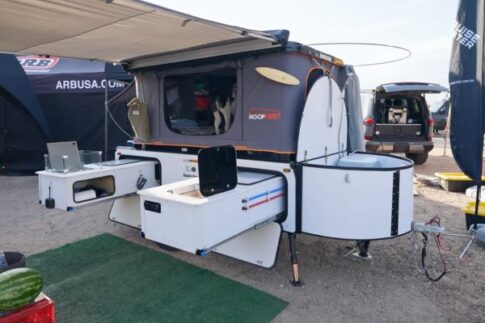
Earth First Tagalong camperRV review
Earth First Campers Tag-Along—The $5,000 “Swiss Army Knife” of pop-up campers

Most budget campers cut out extra features to hit a low price, but Earth First Campers Tag-Along goes the other way. It stays small, light, and garage-friendly, yet still packs in a bathroom, hot water, storage, a sink, a cooler, and even a propane fire pit. That mix is why the Tag-Along gets called the “Swiss Army Knife” of campers. Check it out.


BUMPER SNICKER: “If it’s not broke, we haven’t used it enough yet.”


In the RV shop with Dustin
How an RV suspension works, plus upgrade tips

In this “What’s In The Shop?” video, Zach takes you along to inspect a typical fifth wheel RV suspension system. He explains the typical suspension system and gives examples of suspension upgrades and the benefits of having them. During this inspection, he found a worn shackle link that was almost broken. If this were to come loose during travel, it could cause serious damage to the unit and those behind you. You do not want this to happen to your RV!


81rmoxoupps Ac Sl1500
This is our favorite campsite flag. It makes us laugh every time! You can order it here

Article and video
How to safely connect an RV at home—power, water, and sewer

An RV gets a lot more useful when it has full hookups at home. Here, Jared Gillis from All About RVs shows how power, sewer, and water can turn a parked rig into a guest space, a trip-prep station, or an easy place for extra living or office space. Jared’s at-home RV setup looks a lot like a small RV site, but he also points out lower-cost options that still cover the basics. This is a great hookup “starter kit”.


Featured article
Has your RV refrigerator cooling unit gone bad?

High on the list of RVer nightmares is this one: Opening the refrigerator door to grab a “cool one,” and coming back with something warm. An RV refrigerator that’s lost its cool just isn’t funny. While some fridge problems aren’t too difficult to fix, a bad cooling unit is decidedly a “bad news” situation. How do you know if your cooling unit is shot? Read all about fridge cooling units here.


THE MORE YOU KNOW Lobsters can still die from disease or predators, but aging itself doesn’t increase their risk of death. That’s because they produce an enzyme called telomerase, which helps protect their DNA from damage as their cells divide—allowing them to keep growing and potentially live indefinitely.


Ask Dave
What tools are still made in America?

Find out here.


Reader poll
When RVing, do you collect souvenirs?

Respond here.


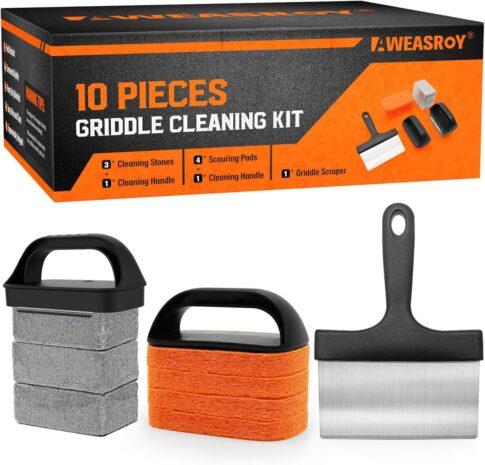
GriddlekitKeep your Blackstone/griddle good-as-new
This simple griddle cleaning kit helps RVers keep their flat-top grills in great shape trip after trip. With scrapers, scouring pads, and a pumice grill stone, it quickly removes grease, burnt bits, and buildup without scratching the surface. Clean before and after cooking, and your griddle will last longer—and be ready for the next campsite breakfast. Learn more about cleaning your Blackstone in Gail Marsh’s article here, or buy this griddle kit here.


Quick tip
Check the wiring behind your refrigerator

Linda posted this in our Comments: “I just want to give everyone a heads up on a safety issue. Our fridge died after 11 years in our 2011 Bighorn. We decided to replace it with a residential fridge. When we pulled it out, we found two electrical lines, one for the microwave and the other for the kitchen counter outlet, running behind the fridge. Both lines had been leaning on something hot at the back of the fridge, as they were both burnt through to the copper. The fridge had never been run on propane. Given that fridge fires seem to be a concern in RVs, maybe it’s not the fridge, per se, but the electrical wiring. It would be worth it to check out what’s going on back there.” Thank you, Linda!


On this day last year…


EVER WONDER… what would happen if you got into an accident, needed medical help, or both while on the road? Here’s a tough look at that reality when you’re far from “help”.


Website of the day

50 Best Motorcycle Roads in America
Did you know that about 22 percent of our readers own a motorcycle? That’s quite a few of you! If you own one, check out these incredible drives to take with yours.


Trivia

In pioneer times, if an arm or leg was seriously wounded or badly broken, it would have to be cut off. There were no serious painkillers for the operation, so patients were given a bullet to bite on so they wouldn’t scream. Today, “bite the bullet” means to accept an unpleasant situation with courage.


? MYSTERY PRODUCT OF THE DAY ?
We couldn’t pick just one (you’ll see why), but these will really come in handy! Ooooh, boy. These things really make us excited to hit the road! And there are so many to choose from!


Readers’ pet of the day

Plum 9cb55e485c4de97cc83adfe19eb07300“This is Plum (Jack Russell Terrier Mix, age 5), my daughter’s dog. Plum is always dressed for the occasion. This is at a ‘Pup Crawl’ in Boston leading up to this year’s St. Patrick’s Day.” —David Plummer

Send us a photo of your pet with a short description. No blurry photos, and please do not submit your photo more than once. Thanks!


LIVE: Mission to the Moon
As bandwidth allows, this stream will feature live views from Artemis II’s Orion spacecraft, without commentary, as it makes its journey around the Moon. You will see a blue screen if there is a loss of signal, or if the bandwidth is needed for mission activities. You may see what appears to be a black screen when the vehicle is in darkness.


Leave here with a laugh

Screenshot


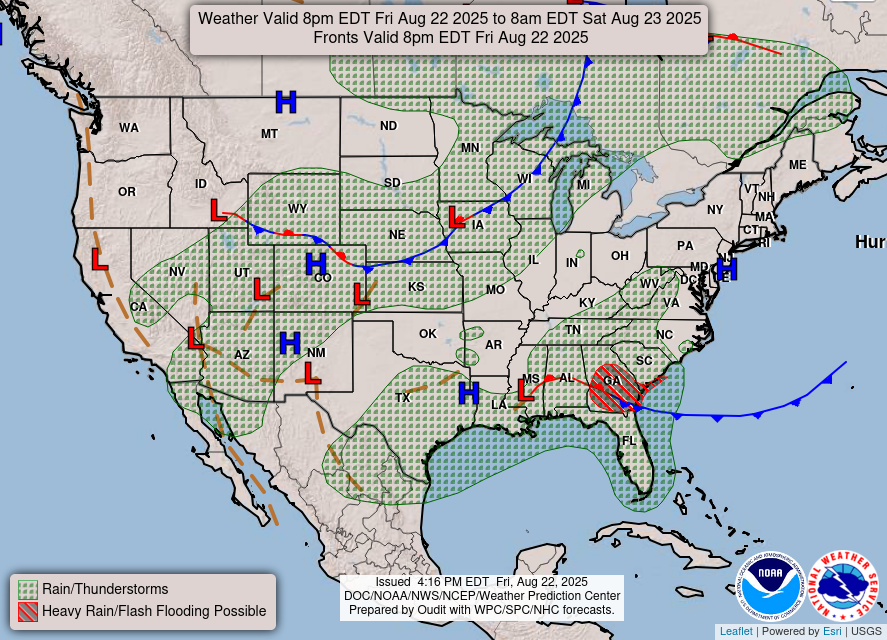
Today’s weather forecast across the nation
THIS MAP UPDATES TWICE A DAY

Visit Current National Radar Weather Map


Did you miss the latest RV Travel Newsletter? If so, read it here.
Oh, and if you missed the Latest News for RVers, make sure to catch up here.


If you shop at Amazon.com we’d appreciate you using this link. We get an itty bitty commission if you buy something, but they add up and help us pay our bills (most importantly our hard-working writers!). 


RVtravel.com All-Star Team

Click here for information about our staff and how to contact us.

What tools are still made in America?

With all the recent press and publicity surrounding tariffs on imported goods, it raises an important question: What is actually made in America?

Several companies I’ve worked with manufacture certain components in the United States, but ship them overseas for assembly and painting because—even with shipping costs—it can be significantly less expensive. Others manufacture parts overseas, ship them to the U.S. for final assembly, and market their products as “Assembled in America.”

Rules governing labeling

So what are the actual rules governing “Made in America” labeling?

The Federal Trade Commission (FTC) addressed this with a Made in USA (MUSA) Labeling Rule proposed in June 2020. According to the FTC, an unqualified “Made in USA” claim is only allowed if:

  • Final assembly or processing occurs in the United States;
  • All significant processing takes place in the United States; and
  • All, or virtually all, components and ingredients are sourced in the United States.

In short, some components can be outsourced and still qualify.

Some tools Made in America

Here is a brief list of some common tools that are MUSA.

Southwire

Southwire began producing wire and cable in the late 1950s and later expanded into tools and electrical testing equipment. While many of their products were once made in the U.S., their website now features a “Proudly Made in America” section covering categories like wire, cable, and some hand tools (pliers, screwdrivers, wire cutters). However, electronic testing equipment—such as multimeters and voltage testers—is not included, suggesting those products do not meet MUSA standards.

Klein

This company has been manufacturing tools and test equipment in the United States since 1857 and now has fifth- and sixth-generation family members running the company. According to their history section of the website, a vast majority of products are manufactured here in the U.S., but states the following:

The vast majority of the products we sell are made in the USA. The exact percentage changes frequently as we insource some products to our USA plants and add new products to our lineup. Klein has introduced many new US-manufactured products in recent years (hole-making, screwdrivers, fish tapes, utility wrenches, buckets, bags, etc.). We have invested in four new US manufacturing facilities in the past decade, and have invested heavily in new equipment and tooling in our plants to expand our capacity and quality.

Klein also states that it has never shut down an American plant and sent jobs overseas. It manufactures 14 times more products here in the United States than in any other country. Also, it plans to invest more than $100 million in U.S. facilities.

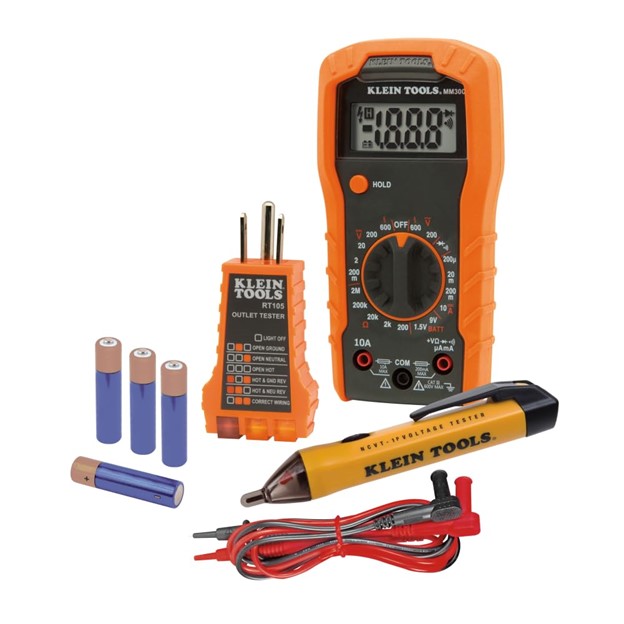
I like the Klein tools, especially this kit which contains the multi-meter, non-contact voltage tester, and GFCI tester. You can find it on Amazon here.

Klein Kit
Klein kit

I did notice the description states it is an American company and makes products as close to home as possible, but does not say anything about the meters being MUSA.

Stanley Black & Decker

Stanley Black & Decker (SBD) is headquartered in New Britain, CT, and was founded in 1843 by Fredrick T Stanley. It generates more than 1,000 new products each year through brands you may not know are part of SBD, such as Craftsman, DeWalt, Bostitch, and many others.

Their website claims to have more than 100 manufacturing facilities, 50 of which are located in the US. However, their website lists “Select Products Are ‘Made In The USA’ With Global Products”, so it is hard to tell what is actually MUSA compliant. Most Craftsman tools are made in China or Taiwan, while Bostitch, which was founded in Rhode Island, is manufactured primarily in China.

Snap-on

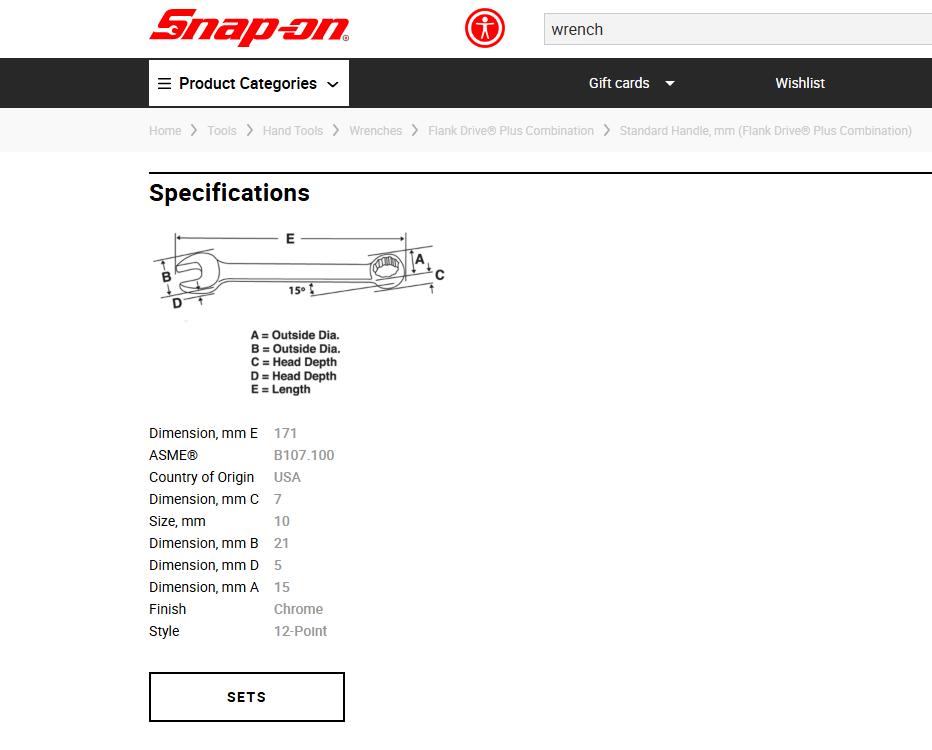
Known as the “Cadillac” of wrenches and other tools, Snap-on was founded in 1920 in Wisconsin and pioneered the first detachable ratchet. Most of its hand tools are still made in the U.S. in ten factories, including the one in Algona, IA, just 30 miles from my home. However, most of its power tools and gauges are made overseas. The president does claim that more than 80% of their tools are MUSA. Snap-on lists the country of origin on the individual product catalog page. Here is an example of a 10 mm wrench

Snap-on MUSA
Snap-on MUSA (click to enlarge)

Crescent

Yes, the generic name for every adjustable wrench known to handymen is an MUSA company based in South Carolina. It was the first to invent and patent the adjustable wrench for Henry Ford and the Model T. It is now owned by Apex Tool Group and advertises “Designed and Engineered” right here in America, but are not MUSA.

Ideal

Started in Syracuse, IL, in 1916, Ideal now has more than 6,000 SKUs. Its MUSA products include Wire-Nut Wire Connectors, Yellow 77 Wire Pulling Lubricant, and T-Stripper Wire Strippers, which are all still made in Syracuse. Other MUSA products are made in Colorado, including pliers, wrenches and a heavy duty screwdriver, as well with other locations in Illinois and Pennsylvania.

Leatherman

I like to call this the “Swiss Army Knife” of the tool world. It all started with an order from Cabela’s for 500 units back in 1983. While a few components are sourced overseas such as sheaths and accessories, the majority of production is in Portland, OR. Leatherman won a legal battle as the court ruled 83% of the steel used in their product was sourced in the U.S.

Other manufacturers

According to the website www.allamerican.org, there are more than 100 companies listed that make tools in America, including these well-known brand names:

  • Briggs & Stratton
  • Snap-on
  • DeWalt
  • Generac
  • Klein
  • Leatherman
  • Purdy
  • Red Line Tools
  • Rigid
  • SK Tools

Final thoughts

“Made in America” is not always as straightforward as it sounds. While many companies maintain some level of domestic manufacturing, relatively few products are completely manufactured in the United States.

As with most things in the RV and tool industries, pricing ultimately drives the market—and manufacturers tend to follow that trend.


 You might also enjoy these posts from Dave 

DAVE HAS ANSWERED MORE THAN 1,000 readers’ maintenance and repair questions. Read a directory here. There is so much to learn!


Dave Solberg is a leading expert in the RV industry and the author of the “RV Handbook.”

HAVE A QUESTION FOR DAVE?

Send your inquiries to him using the form below.

Name
Drag & Drop Files, Choose Files to Upload

RVDT2878

10 smart ways to repurpose empty tissue boxes

3

By Gail Marsh
RVers are always on the lookout for clever storage solutions and creative hacks. Here are some unusual ways to repurpose empty tissue boxes.

Before you take your boxes to be recycled, consider these ten unique ideas to give your tissue boxes a second life.

Plastic bag dispenser

repurpose tissue box for plastic bags
Gail Marsh photo

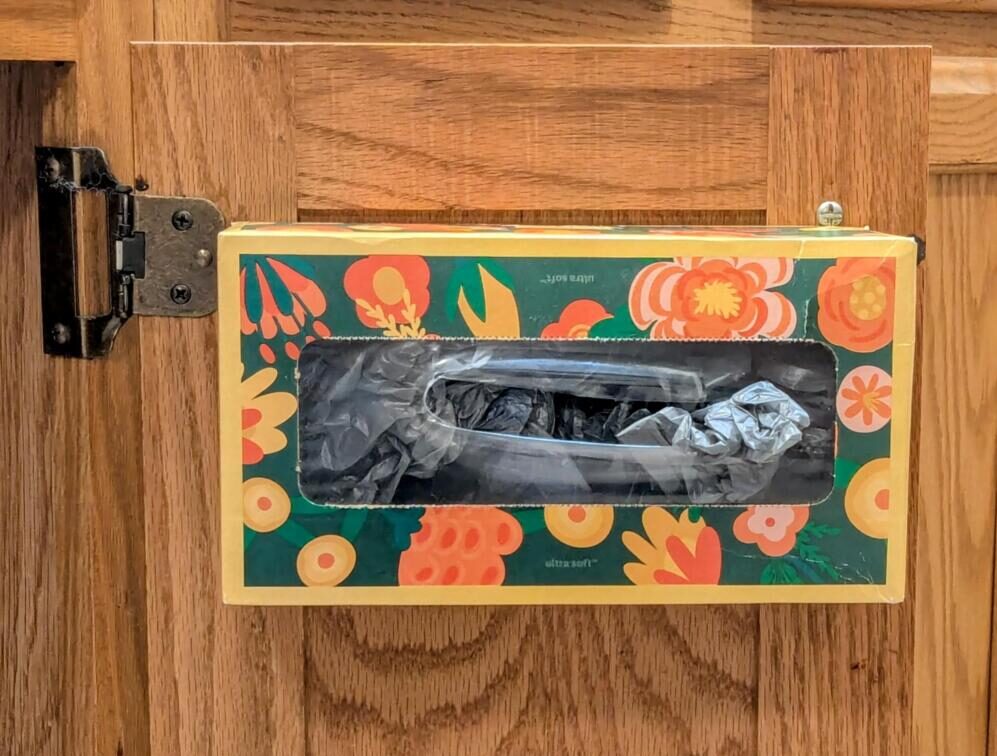
Tired of the clutter from loose reusable grocery bags? Use your empty tissue box to neatly store and dispense plastic or reusable bags. Add a bit of Velcro to the bottom of the box and its companion piece to the inside of a kitchen cabinet. The bags will be easily available as needed.

Drawer organizer

RV kitchen and bathroom cabinets, as well as drawers, can quickly become cluttered. Trim off the top of one or two empty tissue boxes and use the remaining pieces for drawer dividers. Keep utensils, office supplies, or small toiletries organized in place to minimize clutter.

Mini trash can for the road

When you’re driving, use an empty tissue box to collect travel trash like gum, candy/snack wrappers, and tissues. Dump the entire box in a trash can upon arrival at the RV park. No need to clean out travel trash from the truck or driving compartment. You can skip that chore and get things set up at the campground instead.

Multi-purpose storage bin

Cut the top off an empty tissue box. Use contact paper, cloth, or scrapbook paper to decorate the outside of the box to fit your RV décor. Then use the box to contain small RV essentials—think spare keys, batteries, or spare change (for the laundromat).

Dynamic duo

repurposed tissue box
Gail Marsh photo

If you are sick and stuck inside your RV with a raging cold or allergies, use this tip. Rubber band two tissue boxes together—one full box of tissues and an empty box. Use the empty box as a convenient trash receptacle for your used tissues. (Hint: Especially handy when traveling with grandchildren.)

Craft and hobby station organizer

For the creative RVers among us, a repurposed tissue box can be an ideal way to keep craft supplies organized. Use it to store markers, scissors, glue sticks, or even small scrapbooking materials. It’s a quick and inexpensive way to set up your mobile crafting station.

Laundry helper

Ever struggle to keep track of those dryer sheets, laundry pods, or other wash day essentials? An empty tissue box can serve as a dedicated holder for dryer sheets and more, ensuring you always have the necessities handy when it’s time to do laundry at the campground.

Tool organizer

Small tools and gadgets often end up scattered in your RV. Repurpose a tissue box to create a portable organizer for screwdrivers, pliers, or spare batteries. Remove the top of the box, then customize the area inside the box by adding cardboard “partitions” and your essential tools can stay neatly stored and easily accessible.

Traveling snack station

Transform an old tissue box into a mini snack holder. Fill it with small packets of nuts, granola bars, or dried fruit, and keep it in your RV’s pantry or in your cab for quick access during long drives. It’s an inventive way to reduce waste and keep your snacks organized.

Cable keeper

repurpose tissue box as cable keeper Photo by Gail Marsh (need not credit)

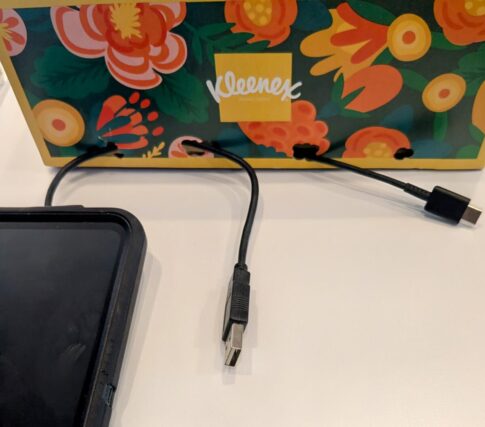
Cords and cables can quickly become a tangled mess in tight RV spaces. With a few modifications, a tissue box can act as a cable organizer. Punch small holes on the sides of the box and feed your charging cables through. This will allow them to unwind neatly and stay tangle-free. This simple hack keeps your electronic essentials ready to go for your next adventure. (Hint: Our cable keeper is fastened to the countertop with Velcro. Everything stays in place on travel days!)

Do you have a convenient tip for using tissue boxes? Please share your ideas in the comments below. Thanks!

RELATED

RVDT2878

How to safely connect an RV at home—power, water, and sewer

By Cheri Sicard
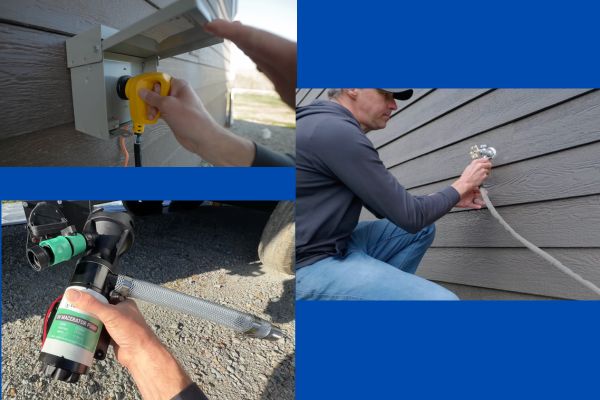
An RV gets a lot more useful when it has full hookups at home. In the video at the end of this post, Jared Gillis from All About RVs shows how power, sewer, and water can turn a parked rig into a guest space, a trip-prep station, or an easy place for extra living or office space. Jared’s at-home RV setup looks a lot like a small RV site, but he also points out lower-cost options that still cover the basics.

Full hookups start with the right power setup

At-home RV hookup usually comes down to three parts: power, sewer, and water. Power often matters most because it keeps the RV usable day to day. Jared’s pedestal-style setup includes 50-amp, 30-amp, and 20-amp service with breakers in one spot, much like a campground pedestal. That makes plugging in and shutting breakers off a lot easier. His panel is similar to this RV pedestal panel with 50-, 30-, and 20-amp service.

For 50-amp service, the outlet uses two hot wires, black and red, plus a white neutral and green or bare ground. In the panel, those hot wires land on a two-pole breaker. A 30-amp outlet is simpler, with one hot, one neutral, and one ground on a single breaker. He also likes this deeper 50-amp RV box because the lid can still close with a cord or surge protector plugged in.

A lot of owners still choose 30-amp, even with a 50-amp RV, because wire cost climbs fast on long runs. His shorter run used 6-gauge wire, while his longer pedestal run used 4-gauge to help avoid voltage drop. That low voltage can damage RV equipment, which is the same issue many campers worry about in bad parks. For reference, he linked 50-amp 6/3 wire, 30-amp 10/2 wire, a 30-amp panel, and a small 30-amp panel with breaker.

Sewer hookups can be simple or park-style

Jared’s home sewer hookup ties into a septic or sewer line with a 3-inch pipe, though he said he would switch to a 4-inch pipe if doing it again. That matches what most RV parks use and works better with common threaded adapters.

The more common budget option is using a home cleanout. That can work well, but only after checking the plumbing layout. Some cleanouts include backflow preventers, so the dump point needs to be verified first. He also notes that a macerator pump can help when the dump spot is uphill or farther away than a normal hose run can handle.

Water is the easy part, if year-round use matters

For water, Jared installed a frost-free hydrant with the shutoff below ground. That keeps water available year-round and feels much more like a campground setup.

His one layout change would be moving the hydrant behind the electric pedestal so the area feels less crowded near the RV door.

The main takeaway from all of this is simple: A home RV hookup does not have to be fancy to be useful. When power is sized right, sewer is verified, and water is easy to reach, the RV becomes a lot easier to use between trips.

RELATED

RVDT2878

When RVing, do you collect souvenirs?

28

By Gail Marsh
RVing friends recently discussed a somewhat sensitive topic: souvenirs. What makes collecting souvenirs a sensitive topic? Because as my husband frequently reminds me, souvenirs can “complicate an RVing lifestyle.”

To his way of thinking, “Souvenirs take up valuable space and can eventually add significant weight to the RV! The time it takes to find that ‘just right’ souvenir is time that might be better spent doing other things. Almost any other thing.” (Yes, I’m a very slow and deliberate shopper.)

I understand the concern about the lack of storage space within our RV, and I don’t want to overload our rig either. (Remember the Lucy movie, “The Long, Long Trailer”? In the movie, Lucille Ball collects rocks during her RV trip. Big rocks. Talk about trouble!)

Keepsake conundrum

My husband and I have come to a mutual understanding: Any souvenir or keepsake item must be small and cannot weigh very much. It’s a bonus if the souvenir is useful in some way or can be displayed somehow in our RV or in our stix-n-brix home.

Souvenir suggestions

Working within the parameters of small, lightweight, and potentially useful, I’ve generated a list of items that fit my guidelines.

Plastic cups. Several mid-range restaurants allow patrons to take their plastic drink cups home. These cups usually feature the restaurant’s logo and location. When we use one of our souvenir cups, just seeing the logo will bring a smile to our faces or a memory to our minds. Plus, the cups stack to conserve space and they’re also lightweight.

Playing cards. We have collected a few decks of playing cards during our travels—the ones with a local attraction displayed on the back of the cards. The pictures always prompt lively conversations about a specific trip.

Ticket stubs. One year, I saved every ticket stub from our RV trip. When we returned home, I arranged the stubs in a photo frame. Now when I walk past the framed collection, I remember the baseball game, rodeo, movie, and airboat tour. Great memories!

Pressed pennies. Our grandchildren prompted this idea. Souvenir shops have brown copper coins featuring the imprint of local landmarks or attractions. Or you can make your own, using your own penny. The children love to squish these coins in the machine, so we started to collect them! Our collection now almost fills a small jar! Sometimes someone will randomly choose a squeezed coin from the jar, and we’ll try to remember everything about that particular trip. It’s fun!

Bumper or window stickers. You can purchase a sticker with the name or initials of the cities/landmarks you visit. You can put the stickers on your vehicle or RV, of course. Or keep the adhesive intact and mount them in a small photo book or scrapbook for a longer-lasting memento.

Miniatures. I like to buy miniatures from places we’ve visited. For example, while in Florida recently, I found a small, glass alligator for $2. It’s no bigger than my pinkie finger and I’ll put it in my kitchen window when we return to our stix-n-brix home.

Best places to look

I’ve discovered great souvenirs at many different places. For example, I once found a cute, handmade bracelet at a small arts and crafts fair. Local farmers’ markets will sometimes feature locally made collectible craft items, as well. Don’t forget to check out secondhand shops or garage sales, too. I bought two Pike’s Peak drink coasters at a nearby flea market. Often, you can score a great souvenir for very little money at these non-traditional places. Of course, traditional souvenir shops will also provide keepsake purchase opportunities.

And another thing…

You need not limit yourself to collecting the same type of item on each trip. Once I realized this, I was free to find any souvenir that held to the parameters: small size, little weight, and bonus if it’s somehow useful. For example, refrigerator magnets are fun, but so are key chains. I mean how many magnets or key chains does one family need? I can collect any kind of souvenir that evokes fond memories of a special place. And that’s perfectly OK.

Your turn

So… when you travel, do you purchase souvenirs? Tell us in the poll below and then use the comments to share your thoughts about souvenirs or tell us about the most unique souvenir you’ve ever purchased.

MORE FUN/INTERESTING POLLS:

RVDT2878

How an RV suspension works, plus upgrade tips

With Dustin Simpson, California RV Specialists
In this “What’s In The Shop?” video, Zach takes you along to inspect a typical fifth wheel RV suspension system. He explains the typical suspension system and gives examples of suspension upgrades and the benefits of having them.

During this inspection, he found a worn shackle link that was almost broken. If this were to come loose during travel, it could cause serious damage to the unit and those behind you. You do not want this to happen to your RV!

The reason for the video is to show the vibration, shaking, bouncing and G-forces that come out on the typical RV’s suspension, frame and slide-outs.

When we originally posted this video, five different owners messaged me after checking their suspension and had found major problems.

Let this be your reminder to check your suspension systems!

Please help share this video so that others don’t end up on the side of the road or cause further damage to their rig.

More from Dustin

Make sure you check out my website, California RV Specialists, and our YouTube channel for more helpful information, and see our published articles on RVtravel.com and other social media pages.

RELATED

RVDT2878