Home Blog Page 57

10 smart ways to repurpose empty tissue boxes

3

By Gail Marsh
RVers are always on the lookout for clever storage solutions and creative hacks. Here are some unusual ways to repurpose empty tissue boxes.

Before you take your boxes to be recycled, consider these ten unique ideas to give your tissue boxes a second life.

Plastic bag dispenser
repurpose tissue box for plastic bags
Gail Marsh photo

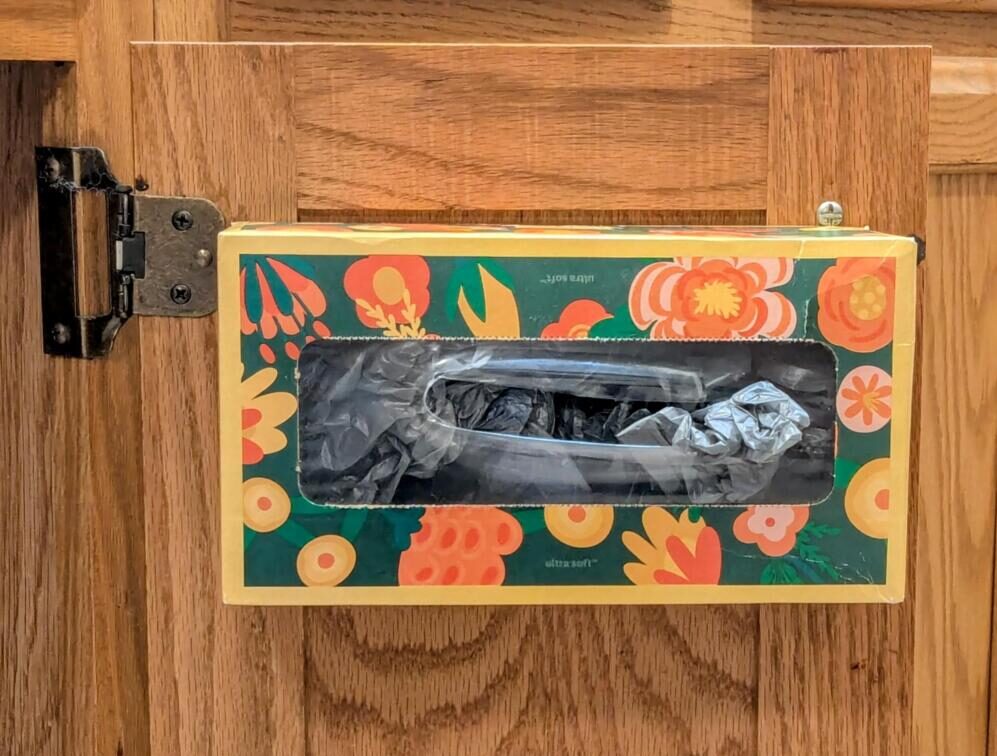
Tired of the clutter from loose reusable grocery bags? Use your empty tissue box to neatly store and dispense plastic or reusable bags. Add a bit of Velcro to the bottom of the box and its companion piece to the inside of a kitchen cabinet. The bags will be easily available as needed.

Drawer organizer

RV kitchen and bathroom cabinets, as well as drawers, can quickly become cluttered. Trim off the top of one or two empty tissue boxes and use the remaining pieces for drawer dividers. Keep utensils, office supplies, or small toiletries organized in place to minimize clutter.

Mini trash can for the road

When you’re driving, use an empty tissue box to collect travel trash like gum, candy/snack wrappers, and tissues. Dump the entire box in a trash can upon arrival at the RV park. No need to clean out travel trash from the truck or driving compartment. You can skip that chore and get things set up at the campground instead.

Multi-purpose storage bin

Cut the top off an empty tissue box. Use contact paper, cloth, or scrapbook paper to decorate the outside of the box to fit your RV décor. Then use the box to contain small RV essentials—think spare keys, batteries, or spare change (for the laundromat).

Dynamic duo

repurposed tissue box
Gail Marsh photo

If you are sick and stuck inside your RV with a raging cold or allergies, use this tip. Rubber band two tissue boxes together—one full box of tissues and an empty box. Use the empty box as a convenient trash receptacle for your used tissues. (Hint: Especially handy when traveling with grandchildren.)

Craft and hobby station organizer

For the creative RVers among us, a repurposed tissue box can be an ideal way to keep craft supplies organized. Use it to store markers, scissors, glue sticks, or even small scrapbooking materials. It’s a quick and inexpensive way to set up your mobile crafting station.

Laundry helper

Ever struggle to keep track of those dryer sheets, laundry pods, or other wash day essentials? An empty tissue box can serve as a dedicated holder for dryer sheets and more, ensuring you always have the necessities handy when it’s time to do laundry at the campground.

Tool organizer

Small tools and gadgets often end up scattered in your RV. Repurpose a tissue box to create a portable organizer for screwdrivers, pliers, or spare batteries. Remove the top of the box, then customize the area inside the box by adding cardboard “partitions” and your essential tools can stay neatly stored and easily accessible.

Traveling snack station

Transform an old tissue box into a mini snack holder. Fill it with small packets of nuts, granola bars, or dried fruit, and keep it in your RV’s pantry or in your cab for quick access during long drives. It’s an inventive way to reduce waste and keep your snacks organized.

Cable keeper
repurpose tissue box as cable keeper Photo by Gail Marsh (need not credit)

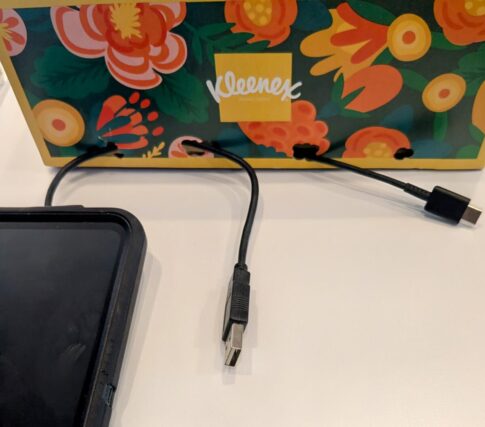
Cords and cables can quickly become a tangled mess in tight RV spaces. With a few modifications, a tissue box can act as a cable organizer. Punch small holes on the sides of the box and feed your charging cables through. This will allow them to unwind neatly and stay tangle-free. This simple hack keeps your electronic essentials ready to go for your next adventure. (Hint: Our cable keeper is fastened to the countertop with Velcro. Everything stays in place on travel days!)

Do you have a convenient tip for using tissue boxes? Please share your ideas in the comments below. Thanks!

RELATED

RVDT2878

How to safely connect an RV at home—power, water, and sewer

By Cheri Sicard
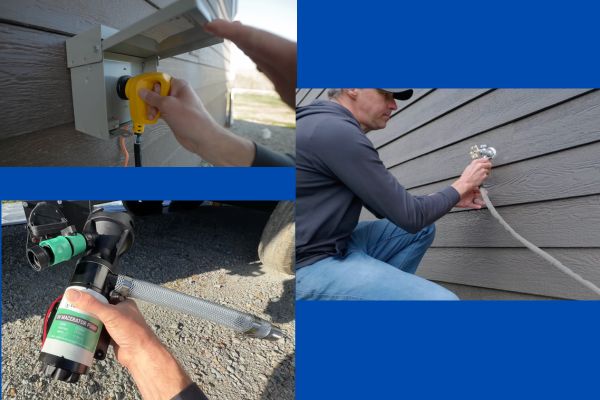
An RV gets a lot more useful when it has full hookups at home. In the video at the end of this post, Jared Gillis from All About RVs shows how power, sewer, and water can turn a parked rig into a guest space, a trip-prep station, or an easy place for extra living or office space. Jared’s at-home RV setup looks a lot like a small RV site, but he also points out lower-cost options that still cover the basics.

Full hookups start with the right power setup

At-home RV hookup usually comes down to three parts: power, sewer, and water. Power often matters most because it keeps the RV usable day to day. Jared’s pedestal-style setup includes 50-amp, 30-amp, and 20-amp service with breakers in one spot, much like a campground pedestal. That makes plugging in and shutting breakers off a lot easier. His panel is similar to this RV pedestal panel with 50-, 30-, and 20-amp service.

For 50-amp service, the outlet uses two hot wires, black and red, plus a white neutral and green or bare ground. In the panel, those hot wires land on a two-pole breaker. A 30-amp outlet is simpler, with one hot, one neutral, and one ground on a single breaker. He also likes this deeper 50-amp RV box because the lid can still close with a cord or surge protector plugged in.

A lot of owners still choose 30-amp, even with a 50-amp RV, because wire cost climbs fast on long runs. His shorter run used 6-gauge wire, while his longer pedestal run used 4-gauge to help avoid voltage drop. That low voltage can damage RV equipment, which is the same issue many campers worry about in bad parks. For reference, he linked 50-amp 6/3 wire, 30-amp 10/2 wire, a 30-amp panel, and a small 30-amp panel with breaker.

Sewer hookups can be simple or park-style

Jared’s home sewer hookup ties into a septic or sewer line with a 3-inch pipe, though he said he would switch to a 4-inch pipe if doing it again. That matches what most RV parks use and works better with common threaded adapters.

The more common budget option is using a home cleanout. That can work well, but only after checking the plumbing layout. Some cleanouts include backflow preventers, so the dump point needs to be verified first. He also notes that a macerator pump can help when the dump spot is uphill or farther away than a normal hose run can handle.

Water is the easy part, if year-round use matters

For water, Jared installed a frost-free hydrant with the shutoff below ground. That keeps water available year-round and feels much more like a campground setup.

His one layout change would be moving the hydrant behind the electric pedestal so the area feels less crowded near the RV door.

The main takeaway from all of this is simple: A home RV hookup does not have to be fancy to be useful. When power is sized right, sewer is verified, and water is easy to reach, the RV becomes a lot easier to use between trips.

RELATED

RVDT2878

When RVing, do you collect souvenirs?

28

By Gail Marsh
RVing friends recently discussed a somewhat sensitive topic: souvenirs. What makes collecting souvenirs a sensitive topic? Because as my husband frequently reminds me, souvenirs can “complicate an RVing lifestyle.”

To his way of thinking, “Souvenirs take up valuable space and can eventually add significant weight to the RV! The time it takes to find that ‘just right’ souvenir is time that might be better spent doing other things. Almost any other thing.” (Yes, I’m a very slow and deliberate shopper.)

I understand the concern about the lack of storage space within our RV, and I don’t want to overload our rig either. (Remember the Lucy movie, “The Long, Long Trailer”? In the movie, Lucille Ball collects rocks during her RV trip. Big rocks. Talk about trouble!)

Keepsake conundrum

My husband and I have come to a mutual understanding: Any souvenir or keepsake item must be small and cannot weigh very much. It’s a bonus if the souvenir is useful in some way or can be displayed somehow in our RV or in our stix-n-brix home.

Souvenir suggestions

Working within the parameters of small, lightweight, and potentially useful, I’ve generated a list of items that fit my guidelines.

Plastic cups. Several mid-range restaurants allow patrons to take their plastic drink cups home. These cups usually feature the restaurant’s logo and location. When we use one of our souvenir cups, just seeing the logo will bring a smile to our faces or a memory to our minds. Plus, the cups stack to conserve space and they’re also lightweight.

Playing cards. We have collected a few decks of playing cards during our travels—the ones with a local attraction displayed on the back of the cards. The pictures always prompt lively conversations about a specific trip.

Ticket stubs. One year, I saved every ticket stub from our RV trip. When we returned home, I arranged the stubs in a photo frame. Now when I walk past the framed collection, I remember the baseball game, rodeo, movie, and airboat tour. Great memories!

Pressed pennies. Our grandchildren prompted this idea. Souvenir shops have brown copper coins featuring the imprint of local landmarks or attractions. Or you can make your own, using your own penny. The children love to squish these coins in the machine, so we started to collect them! Our collection now almost fills a small jar! Sometimes someone will randomly choose a squeezed coin from the jar, and we’ll try to remember everything about that particular trip. It’s fun!

Bumper or window stickers. You can purchase a sticker with the name or initials of the cities/landmarks you visit. You can put the stickers on your vehicle or RV, of course. Or keep the adhesive intact and mount them in a small photo book or scrapbook for a longer-lasting memento.

Miniatures. I like to buy miniatures from places we’ve visited. For example, while in Florida recently, I found a small, glass alligator for $2. It’s no bigger than my pinkie finger and I’ll put it in my kitchen window when we return to our stix-n-brix home.

Best places to look

I’ve discovered great souvenirs at many different places. For example, I once found a cute, handmade bracelet at a small arts and crafts fair. Local farmers’ markets will sometimes feature locally made collectible craft items, as well. Don’t forget to check out secondhand shops or garage sales, too. I bought two Pike’s Peak drink coasters at a nearby flea market. Often, you can score a great souvenir for very little money at these non-traditional places. Of course, traditional souvenir shops will also provide keepsake purchase opportunities.

And another thing…

You need not limit yourself to collecting the same type of item on each trip. Once I realized this, I was free to find any souvenir that held to the parameters: small size, little weight, and bonus if it’s somehow useful. For example, refrigerator magnets are fun, but so are key chains. I mean how many magnets or key chains does one family need? I can collect any kind of souvenir that evokes fond memories of a special place. And that’s perfectly OK.

Your turn

So… when you travel, do you purchase souvenirs? Tell us in the poll below and then use the comments to share your thoughts about souvenirs or tell us about the most unique souvenir you’ve ever purchased.

MORE FUN/INTERESTING POLLS:

RVDT2878

How an RV suspension works, plus upgrade tips

With Dustin Simpson, California RV Specialists
In this “What’s In The Shop?” video, Zach takes you along to inspect a typical fifth wheel RV suspension system. He explains the typical suspension system and gives examples of suspension upgrades and the benefits of having them.

During this inspection, he found a worn shackle link that was almost broken. If this were to come loose during travel, it could cause serious damage to the unit and those behind you. You do not want this to happen to your RV!

The reason for the video is to show the vibration, shaking, bouncing and G-forces that come out on the typical RV’s suspension, frame and slide-outs.

When we originally posted this video, five different owners messaged me after checking their suspension and had found major problems.

Let this be your reminder to check your suspension systems!

Please help share this video so that others don’t end up on the side of the road or cause further damage to their rig.

More from Dustin

Make sure you check out my website, California RV Specialists, and our YouTube channel for more helpful information, and see our published articles on RVtravel.com and other social media pages.

RELATED

RVDT2878

Earth First Campers Tag-Along— The $5,000 ‘Swiss Army Knife’ of pop-up campers

Most budget campers cut out extra features to hit a low price, but Earth First Campers Tag-Along goes the other way. It stays small, light, and garage-friendly, yet still packs in a bathroom, hot water, storage, a sink, a cooler, and even a propane fire pit. That mix is why the Tag-Along gets called the “Swiss Army Knife” of campers.

In the video at the end of this post, the team from Playing with Sticks covers what makes it stand out, where it cuts corners, and why it may be a good fit for campers who want more functionality without a $30,000 price tag.

Why the Earth First Campers Tag-Along feels bigger than it looks

Joseph Carpentier of Earth First Campers built the Tag-Along around a steel frame with composite sides, not wood. That matters because it avoids the usual rot and mold worries that follow many small trailers. It also helps keep weight low, with a dry weight of about 600 to 850 pounds and tongue weight around 65 to 85 pounds.

That matters here because the trailer’s appeal is simple. It fits in a garage, tows behind almost any vehicle, and still opens into a setup that covers the basics most campers add later with separate gear.

The bathroom and utility layout are the clever parts

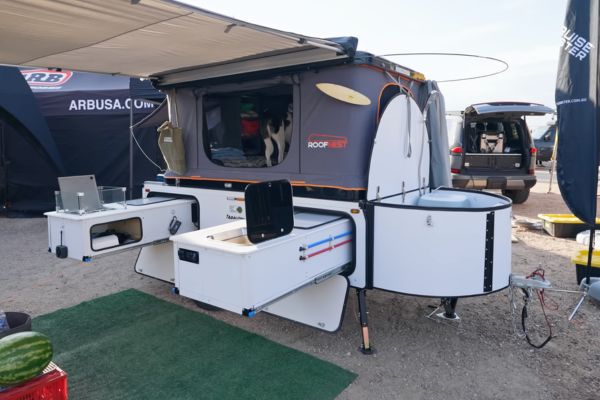
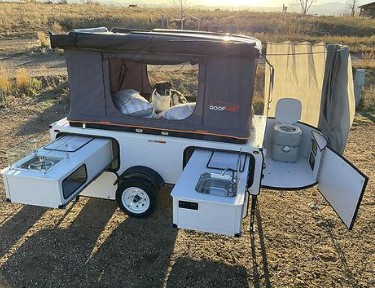
The front bathroom is the most unusual feature. A flexible door and fold-out steps open to an elevated shower and toilet area, with a curtain for privacy, a light, and a USB port. Hot and cold water come from a 13-gallon tank and feeds both the shower and the sink.

That setup solves a real problem. It keeps the toilet and shower attached to the trailer, off muddy ground, and ready at night. Up front, there is also room for gear storage. On the side, the trailer carries battery access, an AC/DC converter, a master switch, shore power, solar input, and low-draw LED lighting. Power demand stays modest, with the system pulling only a few amps even when the pump and lights are running.

The rear kitchen packs a lot into a small space

Earth First Campers Kitchen Rvdt 2878
Earth First Campers Tag-Along Kitchen

At the back, the Tag-Along opens into a compact outdoor kitchen. One side slides out a propane fire pit with a quick disconnect and built-in safety. Nearby, there is dry storage, USB ports, and 110 power when plugged into shore power.

The other side holds a sink with hot and cold water, a removable gray tank, trays for soap and small items, and a large cooler drawer with a drain. Above it all, a 6’x8′ awning adds a lot of covered space.

Pros, cons, and final thoughts

It’s important to note that the actual sleeping tent is not included with this rig, so budget accordingly. The trailer shown used a hard-shell Roofnest Sparrow, though the platform can also take options like the Yakima SkyRise rooftop tent.

The biggest win is how much the Tag-Along does without getting heavy or complex. The bathroom, storage, kitchen, and tent platform all feel modular, but not fussy. Since the tent stays on the trailer, camp can stay set while the tow vehicle heads into town or out on trails.

The trade-offs are smaller. The finish looks more builder-grade than premium. The rear doors could work better as tables with simple supports. Also, the tongue-mounted bathroom means no normal tongue jack, and some rooftop tents may be harder to close depending on the fold direction.

Base pricing was said to start at $5,000, or $5,500 fully equipped minus the tent. Paired with a budget rooftop tent, it can still come in under $6,000. For campers shopping light and cheap, that is the point. The Tag-Along is not fancy, but it is smart and that is what makes it memorable.

Learn more about this unusual camper here.

RELATED

RVDT2878

Love’s rolls out RV tire and battery service across 27 states

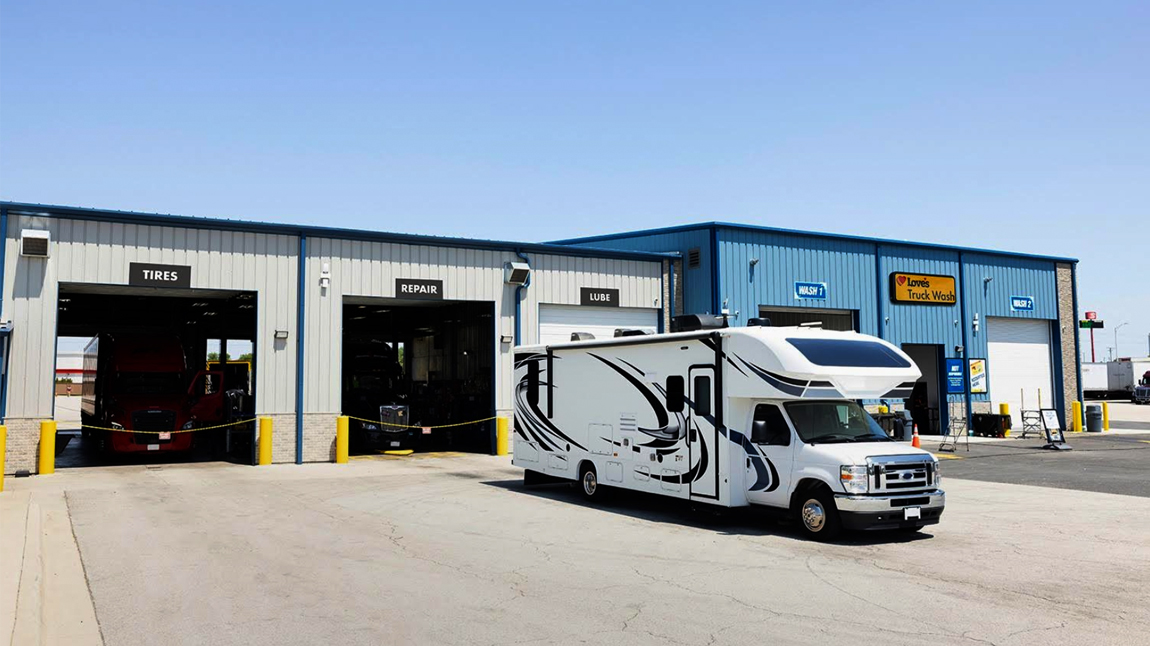
If you’ve ever rolled into a travel stop with a soft tire or a fading battery, you already know the drill. Fuel up, grab a coffee… and then go hunting somewhere else for the actual fix. Now, Love’s RV tire and battery service is starting to change that.

The company says RV tires and batteries are now available—with installation—at 76 locations across 27 states, with more sites expected to come online.

A little less running around

What Love’s is aiming for here is pretty straightforward: Turn a stop you’re already making into a place where you can actually solve a problem.

At participating locations, RVers can buy trailer tires and deep-cycle batteries and have them installed on-site. Depending on the setup, that might happen in a service bay or right at a nearby RV hookup.

That last part matters. Anyone who’s had to limp into a parking lot and then figure out how to get somewhere else for repairs knows how quickly a small problem can turn into a day-eater.

Tires ready to go, not waiting to be built

On the tire side, Love’s is working with Lionshead and stocking pre-mounted, balanced trailer tires. That may not sound like a big deal until you’ve spent half a day waiting for a shop to assemble and mount one. We won’t speak to the cost; but for some, convenience matters more than dollars.

The goal here is speed—Get you in, get it swapped, and get you moving.

Power when you need it

Batteries come from Interstate, and they’re the kind designed for RV use—built to handle the steady draw of things like fridges, lights, and cooktops.

In other words, it’s not just a quick-start battery, but something meant to live with the daily demands of RV life.

Where this really helps

This isn’t about replacing your favorite RV shop back home. It’s about those moments on the road when something quits and you don’t have the luxury of planning.

You’re in an unfamiliar town. You’re on a schedule. Or you’re just trying not to lose a travel day chasing parts.

If Love’s can deliver what it’s promising, Love’s RV tire and battery service could turn a “Now what?” situation into a reasonably quick fix.

Not everywhere—yet

There’s still a bit of “check before you go” built into all this. Not every Love’s location offers tires, batteries, or installation, and availability will vary.

The company says it’s expanding, but for now, it’s worth confirming ahead of time rather than assuming.

The takeaway

Love’s has been building out its RV footprint for a while now, and this is another step in that direction. Tires and batteries are two of the most common trip killers—and two of the hardest things to deal with on short notice.

If this rollout sticks, it could make those roadside headaches a little less painful, and a lot shorter.

And out there on the road, that’s about as good as it gets.

RELATED

RVT1256b

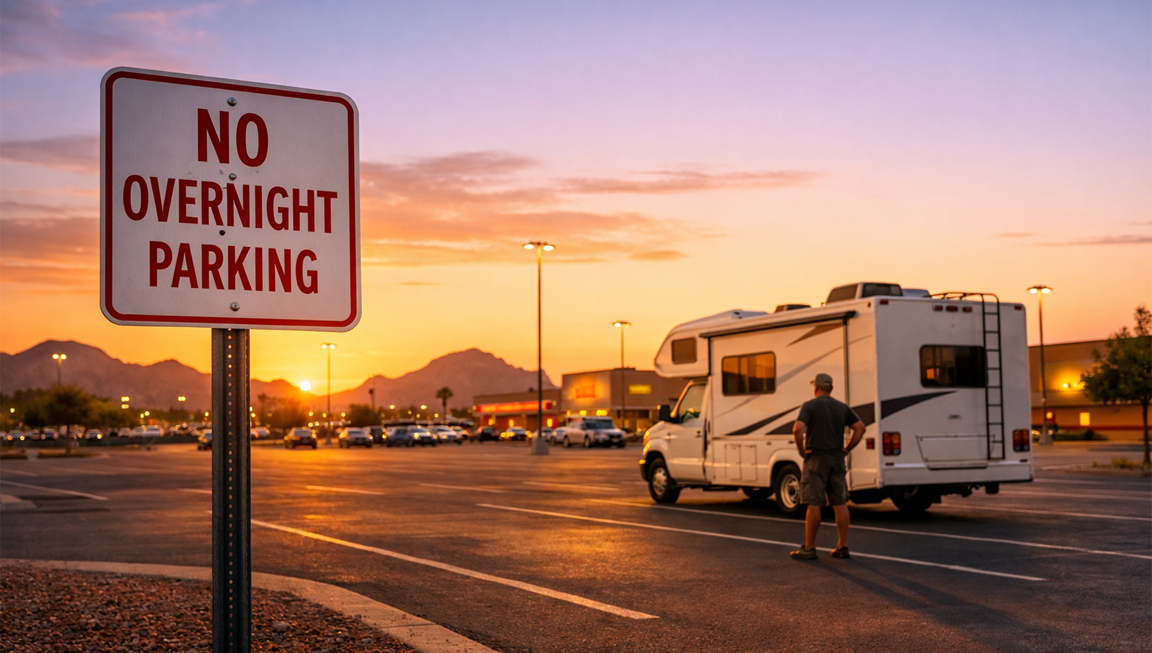
Why more U.S. towns are tightening RV parking rules

More RVers are running into the same problem: a familiar stop, a quick pull-in—and then a sign banning overnight parking. What used to be an easy place to stay now means circling town to find a legal spot for the night.

The trend isn’t limited to the U.S. In the United Kingdom, some local councils have gone further, installing height barriers, banning motorhomes from entire areas, and issuing fines to enforce the rules. Officials cite crowding, complaints, and limited infrastructure, but tourism groups warn the impact is already showing, with motorhome travelers avoiding those destinations.

Back in the U.S., the approach is less aggressive—for now—but the direction is becoming harder to ignore.

What’s changing, and why now

This isn’t a single policy coming down from on high. It’s a slow shift happening town by town, often without much notice unless you happen to be there when enforcement starts. One community updates its ordinance. Another begins enforcing a rule that sat idle for years. In many cases, it starts with local complaints or concerns about long-term street camping, and officials respond by tightening the language or stepping up patrols.

Most local leaders will tell you this isn’t aimed at RV travelers passing through, and in many cases that’s true. They’re trying to deal with congestion, neighborhood concerns, and situations where vehicles aren’t moving for days or weeks at a time. But once the rules change, they apply to everyone the same way. The RVer looking for a quiet overnight stop gets treated no differently than someone parked long-term, and that’s where the friction begins.

Where you’re most likely to run into it

If your travels take you toward popular destinations, your odds of running into tighter rules go up. Gateway towns near national parks, coastal communities, and high-traffic recreation areas have been some of the first to clamp down, and the changes show up in practical ways. You’ll find fewer places to stage near park entrances, more clearly posted “no overnight parking” zones, and a noticeable increase in late-night police door knocks where there used to be a bit of leeway.

Even those longtime fallback options aren’t as reliable as they once were. Big-box stores and similar stops may still be open to overnight RVs, but only where local ordinances allow it. In a growing number of towns, those ordinances now say otherwise, which means the decision is out of the store manager’s hands before you ever pull into the lot.

From welcome mat to “figure it out”

For years, RV travel came with an unspoken understanding that if you weren’t causing problems, you could usually find a place to settle in for the night. It wasn’t always pretty, and it wasn’t always official, but it worked. That understanding is fading, replaced by a more formal—and less flexible—set of expectations about where you can and can’t be.

You can still travel the same roads and reach the same destinations, but the way you plan your stops has to change. More RVers are lining up campgrounds ahead of time instead of winging it, or building in extra driving time in case a familiar stop is no longer available. It’s not that the door has slammed shut, it’s that it doesn’t swing open quite as easily as it used to.

Why it matters

This is where the U.S. situation starts to echo what’s happening in the U.K. Communities want the economic benefits that come with travelers: fuel sales, restaurant stops, a night or two in town. But they also want to manage the impacts that come with larger vehicles and overnight stays. When the balance tips too far toward restriction, travelers notice, and some of them simply move on.

In the U.K., that tension is already showing up as broader motorhome bans and visible pushback from the tourism sector. In the U.S., the shift is quieter and more fragmented, but the end result can look similar from the driver’s seat. If it’s harder to park, it’s harder to justify stopping, and that can turn into fewer visits and shorter stays over time. It’s not a sudden drop-off. It’s more of a slow leak that adds up.

What to do before you roll in

A little advance planning goes further than it used to. It helps to check local rules before you arrive instead of assuming a spot that worked last year is still fair game. If there’s any doubt, a quick call can save you from circling in the dark looking for a backup. And speaking of backups, having one in mind before you need it can make the difference between an easy evening and a frustrating one.

Once you’re on the ground, pay attention to signage and the general tone of the place. If a town has decided to enforce its rules, that usually becomes clear pretty quickly. The old days of slipping in quietly and leaving early without anyone noticing are, in many places, becoming just that—old days.

The bottom line

The U.K. may be a few steps further down this road, with broader and more visible motorhome restrictions already in place. Here in the U.S., the change is happening more gradually, shaped by local decisions rather than national policy. But the direction is hard to miss. RV parking rules are tightening, one town at a time, and RVers are feeling the squeeze.

You can still go just about anywhere you want to go. Staying there, at least without planning ahead, is the part that’s getting harder.

We’d like to hear about your experiences. Please leave a comment below.

RELATED

RVT1256b

RV park domestic dispute ends in bizarre twist

An RV park domestic dispute in Ocean Park, Washington, is drawing attention for one unusual detail: Despite police involvement and an alleged pepper-spray attack, the couple at the center of it say they’re still in love.

Police were called to an RV park after a reported argument between two people living there. According to a local blotter report, the situation escalated when the woman allegedly used pepper spray on her partner.

That alone would normally be the story. But this one took a turn.

Even after the incident, the couple reportedly told authorities they remain together—and in love.

When there’s nowhere to go

Anyone who’s spent time in an RV park knows how tight the living space can be. A few hundred square feet doesn’t leave much room to cool off when tempers rise. There’s no extra bedroom to retreat to, no upstairs to escape to. You’re right there, face-to-face.

And if you step outside, chances are someone’s within earshot.

The whole park hears it

In a traditional home, arguments can stay behind walls. In an RV park, sound travels. What starts as a private disagreement can quickly become public, whether anyone intends it or not.

By the time law enforcement arrives, neighbors may already know something has gone wrong.

That’s part of RV life that rarely gets talked about. The way close quarters can amplify not just community, but conflict.

Love doesn’t always make sense

Then there’s the human side of it.

Relationships don’t always follow a straight line, and they don’t always make sense from the outside. The same couple that draws a police response one moment may insist everything is still intact the next.

Pepper spray and romance don’t usually belong in the same sentence. But in this case, they do. It’s a reminder that RV living doesn’t change who people are. In a few hundred square feet, even love can get a little… intense.

RELATED

RVT1256b

Gas prices are climbing, but diesel is jumping faster. Here’s why it matters

If it feels like diesel prices versus gas prices are moving at different speeds, you’re not imagining it. Gasoline is going up, but diesel is climbing faster. The difference is starting to show up in dollars at the pump.

The gap is getting hard to ignore

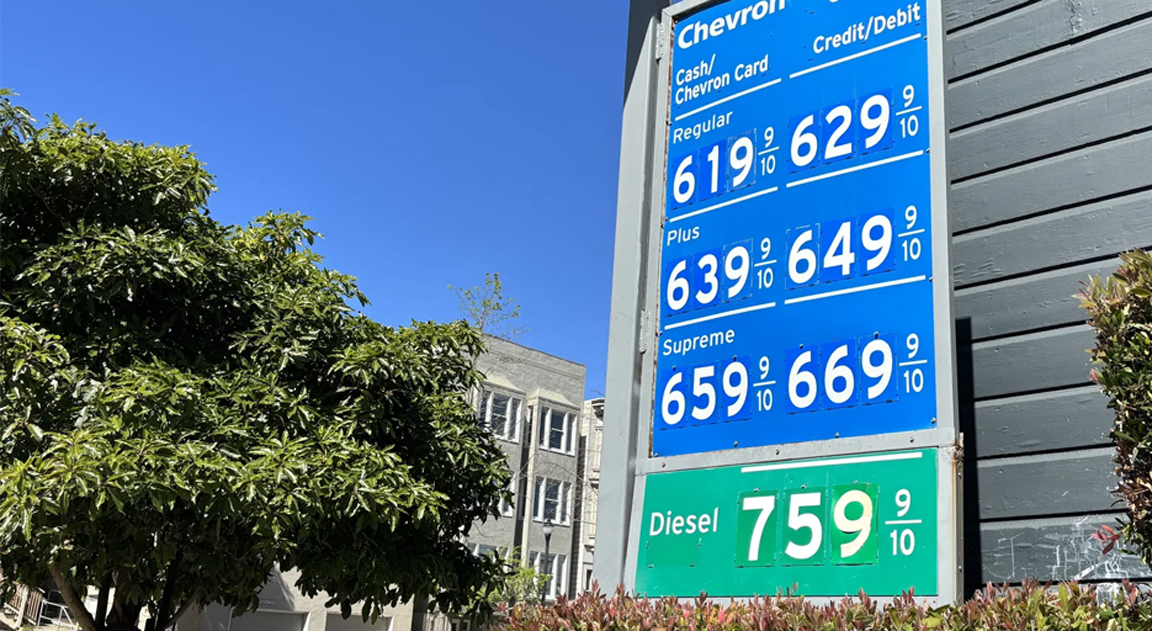
Right now, national averages from AAA put gasoline at about $4.16 a gallon. Diesel sits closer to $5.68. That spread is now well over a dollar and growing.

What really catches your eye, though, is how fast it happened. Over roughly the past month, gas went up about 79 cents. Diesel jumped closer to $1.29. Same stretch of time, very different pace.

Even in the short term, diesel keeps edging ahead. Weekly numbers from the U.S. Energy Information Administration show diesel posting bigger gains than gasoline. And if you’re watching prices in places like Arizona, you’ve seen it firsthand. Diesel there jumped nearly 50 cents in a single week. And when we drove over into California, we were flabbergasted to see diesel at one Love’s posting at more than $8 a gallon!

Why diesel is moving faster

Part of it comes down to where things stood before prices started climbing. Gasoline supplies were in decent shape. Diesel, not so much. When supply is already tight, it doesn’t take much to push prices higher.

Then you layer on global pressures. Diesel is traded more heavily on the world market than gasoline, so when shipping routes get shaky, diesel tends to react first. Trouble spots like the Strait of Hormuz matter here. If fuel can’t move smoothly, diesel feels it quickly.

There’s also the simple fact that diesel demand doesn’t let up. People might cut back on weekend driving when gas spikes. The economy doesn’t get that option. Freight still moves. Crops still get harvested. Construction keeps going. Diesel keeps getting burned.

And there’s a seasonal wrinkle many folks don’t think about. Heating oil and diesel come from the same family. A colder stretch pulls from that shared supply, leaving less cushion when prices start to rise.

Finally, refineries can’t just flip a switch and make more diesel overnight. It takes time to adjust output, and diesel is harder to ramp up than gasoline. When demand jumps, supply lags behind.

What it means when diesel jumps

Put it all together and you get what we’re seeing now. Diesel isn’t just higher. It’s moving up faster.

Diesel tends to act as an early signal for the rest of the economy. When it rises this quickly, it often points to higher costs working their way through the system.

Why RVers feel it even if they use gas

Even if your rig runs on gasoline, diesel still reaches into your wallet. It’s the fuel that moves goods across the country. When it spikes, shipping costs rise, and those costs show up in campground fees, groceries, parts, and just about everything else tied to travel. A friend of ours who is a mobile mechanic is now charging customers a mileage surcharge. His repair rigs burn diesel.

If you’re running a diesel pusher or a tow vehicle that drinks the stuff, the impact is more direct. Fill-ups hurt more, and they hurt sooner.

Diesel isn’t just another fuel price. When it rises this fast, it tends to pull everything else up with it.

RELATED

RVT1255b

RV Daily Tips. Tuesday, April 7, 2026

America’s Original RV Newsletter. Since 2001
Issue 2877 • New issue every weekday
If you find this newsletter helpful, please consider supporting our work with a donation of your choice. Thank you!


Today’s thought

“Courage isn’t having the strength to go on – it is going on when you don’t have strength.” ―Napoleon Bonaparte


Need an excuse to celebrate? Today is National Coffee Cake Day! And if you’d rather celebrate in the evening, it’s also National Beer Day!

On this day in history: 1933 – Prohibition in the United States is repealed for beer of no more than 3.2% alcohol by weight, eight months before the ratification of the Twenty-first Amendment to the United States Constitution. (Hence, why we celebrate National Beer Day today!)


Tip of the day
The best apps to use to find RV dump stations

By Cheri Sicard
A question I see come up frequently in RVtravel.com’s Facebook groups is: “How do I find RV dump stations when on the road?” If you, too, have wondered how to find RV dump stations, this video and article breakdown is for you!

You could just search for RV dump stations using your GPS. However, this often yields inaccurate results. You are far better off using an RV-specific resource like the ones here.


Article and video
Exploring a 1960s abandoned RV park

By Cheri Sicard
In the video below, the team from Travels with Lucky stumbled upon a place that felt frozen in time. A little time capsule into Apache Junction, Arizona’s past, where the echoes of the 1960s linger—an odd, abandoned RV park. Check this out.


DO YOU USE A KEURIG COFFEE MAKER? If you do, you’ll want to take a look at this. We think it’s the best way to organize Keurig pods. Brilliant!


Featured article
Incredible 1937 Packard motorhome in mint condition, worth six figures

By Paul Lacitinola
In 1937 you could buy a new house for $4,100, or you could rent a home for $26. Hamburger was 12 cents per pound, and a loaf of bread was only 9 cents. You could drive a new car home for $760, and gas was only 10 cents per gallon. The downside was that your annual income was only around $1,780. This Packard motorhome was not in every driveway. This is pretty amazing.


Ask Dave
Does anyone offer an LP/120-volt RV refrigerator anymore?

Find out here.


Reader poll
When RVing, do you rely on income from employment to afford to travel?

Respond here.


Quick tip
Campground etiquette: Tie it down!

Some say, “It’s my site, I’ll do whatever I want with it.” But, seriously, this is a safety issue. Stow and secure your gear, especially if you leave for the day or before turning in for the night. Storms can pop up, leaving your gear a wind storm’s craving. Canopies and camp chairs become projectiles that can damage RVs or hurt fellow RVers.

Same bar, different note—No one wants to live next to the site that looks like a Walmart toy aisle at Christmas. Keep your site picked up and tidy…or try to.From the folks at alwaysonliberty.com.


50states500campgrounds500 campgrounds worth the drive
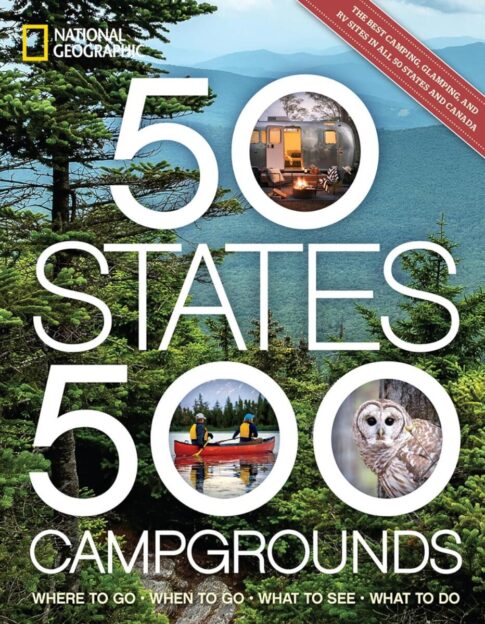
In this comprehensive sequel to National Geographic’s best-selling 50 States, 5,000 Ideas, you’ll discover the 500 best camping destinations across the United States and Canada. You’ll find 10 featured campgrounds in every state, plus tips on what to do, where to eat, and must-see attractions nearby—from national parks to local gems. Learn more or order.


On this day last year…


Website of the day

The Best Camping in Oregon, From Crater Lake to the Oregon Dunes
If you’ve never camped in Oregon, there’s no way you won’t plan a trip after reading this and seeing these photos. It sure is a beautiful state…


And the survey says…

We’ve polled RVtravel.com readers more than 5,000 times in recent years. Here are a few things we’ve learned about them:

• 60 percent think drivers with RVs 40 feet or longer should have a special driver’s license.
• 17 percent say they never snack while driving.
• 33 percent say they don’t get a lot of thinking done while they drive; they’re just focused on driving.


QUICK TIP: If your RV fridge is struggling, check airflow behind it—blocked vents can reduce cooling by up to 30%.


Trivia

A snake at England’s City of Portsmouth College has again given birth without a mate. Ronaldo, a Brazilian rainbow boa, produced 12 babies through parthenogenesis, a rare form of asexual reproduction. The snake first made headlines in 2024 after a similar “virgin birth.” Experts say repeat cases in the same snake are exceptionally rare.


Readers’ pet of the day

Img 4117 9899f12216074479c890b364136ec381“Jimmy was one of our best camping companions ever. He crossed the Bridge a couple of years ago when we were staying at an Elk’s Lodge in Colorado.”  —Gary Smith

Send us a photo of your pet with a short description. We publish one each weekday in RV Daily Tips and in our Sunday RV Travel newsletter. No blurry photos, please! Please do not submit your photo more than once. Thanks!


? MYSTERY PRODUCT OF THE DAY ?
Will you win a million dollars next year? Will you lose those 50 pounds? Will you finally discover the Fountain of Youth? Will you finally get that golden retriever puppy you’ve always longed for? Well, here’s how to find out…


FREE IS GOOD! Museums on Us®  is available to Bank of America, Merrill or Bank of America Private Bank credit or debit cardholders to receive one free general admission to hundreds of cultural institutions across the U.S. during the first full weekend of every month.


LIVE: Mission to the Moon
As bandwidth allows, this stream will feature live views from Artemis II’s Orion spacecraft, without commentary, as it makes its journey around the Moon. You will see a blue screen if there is a loss of signal, or if the bandwidth is needed for mission activities. You may see what appears to be a black screen when the vehicle is in darkness.


Leave here with a laugh

Click to enlarge.

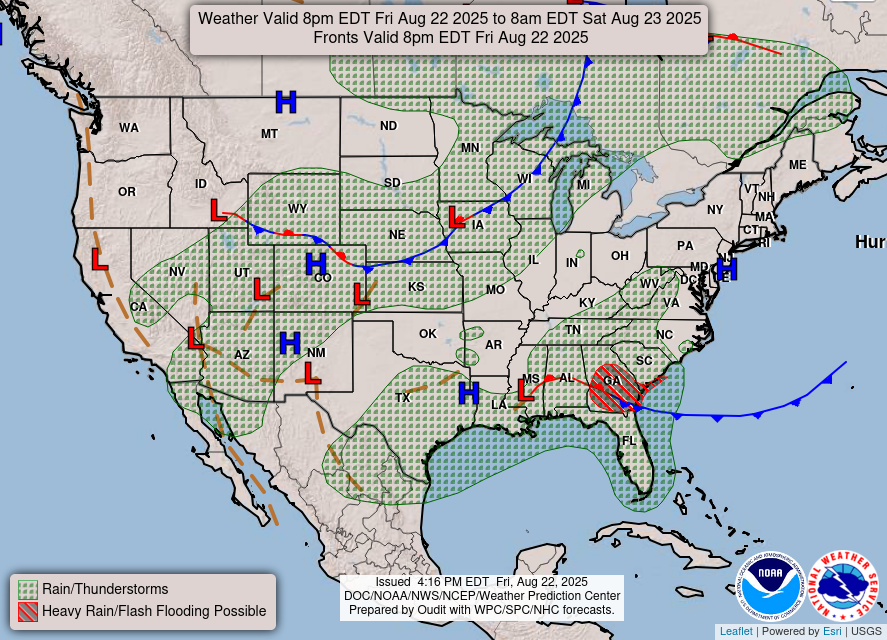
Today’s weather forecast across the nation
THIS MAP UPDATES TWICE A DAY

Visit Current National Radar Weather Map


Did you miss the latest RV Travel Newsletter? If so, read it here.
Oh, and if you missed the Latest News for RVers, make sure to catch up here.


If you shop at Amazon.com we’d appreciate you using this link. We get an itty bitty commission if you buy something, but they add up and help us pay our bills (most importantly our hard-working writers!). 


RVtravel.com All-Star Team

Click here for information about our staff and how to contact us.

WHY WE ASK FOR DONATIONS INSTEAD OF SELLING SUBSCRIPTIONS.

Our policy on using artificial intelligence.

Does anyone offer an LP/120-volt RV refrigerator anymore?

Dear Dave,
Our current RV has propane/electric operating systems for the refrigerator and freezer. We enjoy the flexibility to go boondocking as much as possible. What companies still provide the propane/electricity option to run the fridge/freezer? We are starting to look for a replacement hybrid for our future needs. —Bob, 2008 Jayco Jay Feather Hybrid, 19 ft.

Dear Bob,
I recently conducted seminars at several RV shows across the country and this has been a very popular subject, especially in the Boondocking seminar.

In my opinion, the LP mode of the old absorption refrigerators is much more efficient for boondocking or dry camping, but most manufacturers have gone to the 12-volt DC compressor-driven models.

Everchill ref
Everchill refrigerator

Several dealers stated that with the new battery technology and solar panel options, it makes more sense to use the 12-volt models even for boondocking. However, I have read hundreds of forums and posts claiming the absorption refrigerators have the potential to catch on fire and are dangerous. That means the dealers are “adding fuel to that flame.”

How absorption refrigerators work

I believe the absorption refrigerator has gotten a bad reputation and that the internet has driven the market away from them. Absorption refrigerators have a liquid vessel that contains ammonia, hydrogen, sodium chromate, and water. This mixture is heated either by a flame in LP mode or by a heating element on 120-volt AC.

The heat creates a vapor, which rises to the evaporator coil and “flashes,” removing heat from the freezer and refrigerator compartments, thus creating cold temperatures. There are additional chemical reactions involved, but ultimately the vapor turns back into liquid and zigzags down the cooling unit to repeat the cycle.

Ref Coil
Refrigerator coil

Refrigerator needs to be level

The refrigerator needs to be level within about 3 degrees side to side and 6 degrees front to back so the liquid can move down through the cooling unit by gravity. If the unit is not level, the liquid can pool in a corner and begin to overheat, eventually flaking and reducing cooling efficiency. It ultimately becomes solid and stops the cooling process altogether.

When owners park the rig in a driveway while preparing for a trip, they often do not level the rig since they are not staying in it. Running the refrigerator for a day or two in this condition can start the damage process. When a dealer later removes the refrigerator for repair or replacement, there is often a dark spot on the wood framework because the blocked cooling unit operated at a much higher temperature. Owners sometimes believe a fire had started, when in reality it was overheating from a blocked cooling unit.

Previous refrigerator fires

There were some early refrigerators that did have cracks in the cooling units and fires did occur. However, both Norcold and Dometic have stated that this represented a very small percentage several years ago and that the issue has since been addressed. Even a small percentage is concerning, which is why many buyers hesitate to purchase an absorption refrigerator, especially with the internet sometimes escalating the issue into a widespread catastrophe.

As with almost everything in the RV industry, the buying public drives the market and RV manufacturers tend to follow that trend. Norcold still makes the Polar 8-cubic-foot refrigerator that runs on LP or 120-volt power. There’s a similar model from RecPro. However, I have not been able to find any manufacturers offering it at the shows I recently attended without installing it as a custom option. That usually means paying for the standard refrigerator plus the cost of replacement and labor at the dealership.

More possible drawbacks from absorption refrigerators

Some people also argue that absorption refrigerators take longer to cool, are less efficient at high altitudes, and do not perform as well in very hot weather compared to the newer 12-volt models. In addition, LP mode generally should not be used while traveling because there is an open flame, which makes it more difficult to keep the refrigerator cold during travel.

I also checked with Brinkley, Alliance, Keystone, and Winnebago, and none offer the absorption refrigerator, either standard or as an option.


 You might also enjoy these posts from Dave 

DAVE HAS ANSWERED MORE THAN 1,000 readers’ maintenance and repair questions. Read a directory here. There is so much to learn!


Dave Solberg is a leading expert in the RV industry and the author of the “RV Handbook.”

HAVE A QUESTION FOR DAVE?

Send your inquiries to him using the form below.

Name
Drag & Drop Files, Choose Files to Upload

RVDT2877

The best apps to use to find RV dump stations

By Cheri Sicard
A question I see come up frequently in RVtravel.com’s Facebook groups is: “How do I find RV dump stations when on the road?”

If you, too, have wondered how to find RV dump stations, the video below from Mike and Jennifer Wendland at RV Lifestyle is for you!

Dumping is never fun, but it’s particularly frustrating when you can’t find a dump station. While many campgrounds have dump stations, many don’t. Furthermore, there can sometimes be long lines and/or high fees to use them.

You could just search for RV dump stations using your GPS. However, Mike says this often yields inaccurate results. I can attest to that, too.

He says you are far better off using an RV-specific resource like the ones below.

How to find an RV dump station: Top five resources

Mike’s first three resources are free. He says they are a little clunkier to use than the paid resources and they can get inundated with ads, but they work. The last two paid resources streamline the process.

1) RVingLife (formerly Sanidumps.com)

2) RV Dump Stations

3) RVshare.com/RV Dump Stations

4) Campendium.com: You can use Campendium’s map feature to search, for free, for dump stations. The video shows you how. If you want to upgrade, Campendium and several other great RV resources have been bundled together under Road Pass Pro.

5) AllStays Pro: A paid service with lots of great features, including dump stations. Its only downside is it is NOT an app but rather a browser-based service, which in this day and age, sounds insane to me. But Mike says they use this service for trip planning constantly.

RELATED

RVDT2877