Home Blog Page 81

How far do you travel in a day? One RVer’s perspective

15

By Gary Jefferson
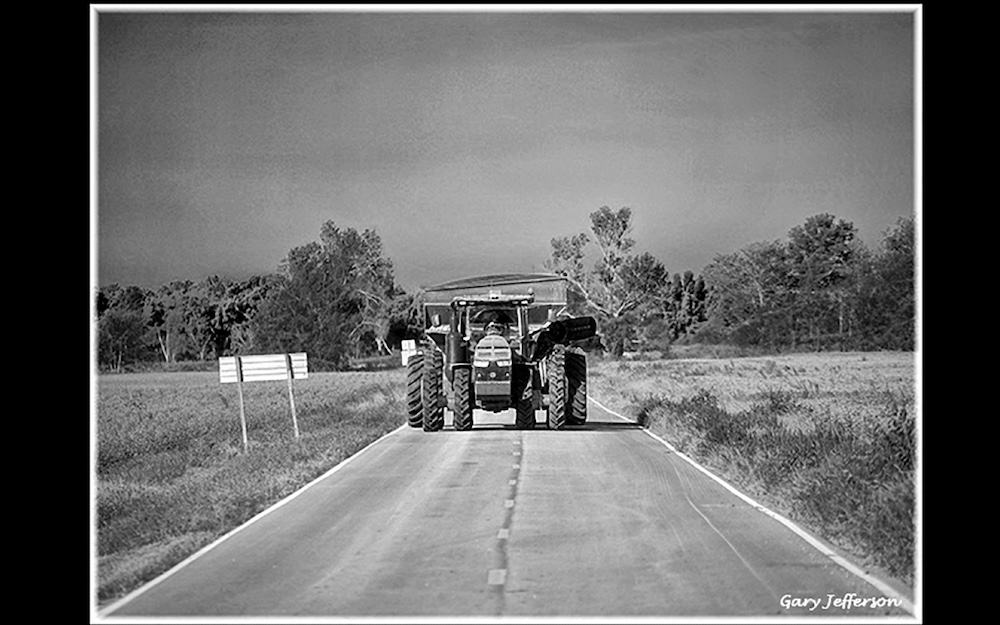
I have three modes when it comes to traveling in our Sprinter. When we traveled in our SUV, I didn’t do it like I do today in the van. In our SUV, the location of a good motel usually determined how far we were going that day. I knew we’d be stopping for photographs, meals, and before dark, so I’d factor all that in when I looked at the map for a probable destination. It was usually between 125 and 250 miles; more often closer to the 125 number.

In the Sprinter, we don’t think about motels anymore. We already have one with us. So, when we are in travel mode, I’m moseying down the highway looking for good things to photograph. My wife is usually on her phone looking for interesting things nearby.

We stop, we look around, I take a photo or two and we continue on. However, if a location warrants it, we will sleep nearby and visit again the next day. Regardless, sometime early in the afternoon, we start to think about where our traveling motel is going to stop. By late afternoon, we’re parked and relaxing at the end of our driving day. The interesting thing is that it’s usually after 125 to 250 miles. Our daily distance hasn’t changed much.

When we stayed in motels, it was expensive to stay in one place for more than one night. I know you’re thinking, “You’d be in a motel anyway,” but we were not enjoying any new places as those dollars were spent.

Multi-night motel stays were for bad weather and a change of pace for a day or two. Now we can just park and enjoy one place for a while and we’re saving money on fuel. With the van we can enjoy a location for as long as we want. Our tendency is to enjoy sunsets (not sunrises, they are way too early for me) and beautiful views with the van. We didn’t do that as much in the SUV. The van allows us a much more leisurely travel experience.

At some point, maybe after a week, a month, or longer, we decide it’s time to be back in our fifth-wheel in Southern California. We usually have an idea of approximately how long we will be gone when we leave home. Since both of us are seniors, there are medications and vitamins that keep us alive—we are sure to take the right number of pills to keep us going during the trip. I know many of you know nothing about that, but getting old isn’t for sissies (or people who can’t plan ahead).

Before the meds are gone, we head home. Our longest travel days have been coming home—sometimes 700 miles or more. I’m even driving the speed limit (maybe faster) on that part of our trip. It’s great to leave on a trip, enjoy the journey, and it’s great to head for home. That’s how we know it was a good trip.

From “The Story of RVing: Van Living Explained”

Gary Jefferson is the author of The Story of RVing: Van Living Explained, available at Amazon. When he’s not on the road, he lives in a fifth wheel trailer in Redlands, Calif., where he has photographed the downtown residents for five years, which he posts to a delightful Facebook page called Redlands People.

RELATED

RVT1252

RV humor: 9 signs you are in a bad RV park

According to the team at The Camping Loop, there’s a moment at every campground when the weekend’s mood shows up early. The rig hasn’t even parked, and nobody’s checked in, but the brain starts doing math.

While rolling past the entrance at about 5 mph, little details start to clash with those sunny online photos. At that point, turning around would mean admitting the booking was judged wrong, so most people keep going and learn the truth in real time.

The team shares 9 early signs you might be in a bad RV park in the tongue-in-cheek video at the end of this post.

The entrance tells the story in the first minute

A good campground eases vehicles in. A rough one challenges the suspension right away. If the first stretch is potholes deep enough to feel like fishing spots, that’s a preview of the maintenance standards everywhere else.

Before the office even appears, the full-time crowd often does. A few long-term setups usually line the road, and at least one person pauses to watch the new arrival like an air traffic controller. By the time check-in happens, someone already knows the truck brand, trailer length, and whether backing skills look confident or shaky.

If the campground feels like a small town that just spotted a visitor, it probably is.

The office sets expectations, and not always in a good way

Organized places keep check-ins simple. Chaotic places try to sell everything at once: snacks, propane, shirts, fishing worms, plus a dusty board game missing pieces. There’s often a refrigerator humming in the corner like it’s working overtime, even though it looks like it hasn’t moved a drink in years.

Then comes the time warp. Even with online reservations, the process can feel stuck in 1990, with stacks of paperwork behind the counter. The reservation “can’t be found” until the confirmation gets studied like evidence, followed by the classic line about moving people around. It’s a fun way to learn that the site assignment has already changed.

Confusing maps and strange landmarks

Bad directions usually arrive on a hand-drawn map, with landmarks that shouldn’t be landmarks. The instructions lean on stuff that no longer exists, and every sentence ends with “you can’t miss it,” right before it gets missed.

Common examples sound like this:

  1. Turn where the old playground used to be.
  2. Go past the thing that looks like a shed (but isn’t labeled).
  3. Keep going until it feels right, then you’re basically there.

That confusion gets worse when towing something big enough to block the road during a wrong turn.

The site, the audience, and the photo-to-reality crash

The drive to the site often reveals how many people live there. DIY decks, sheds, and outdoor kitchens pop up everywhere, along with wind chimes loud enough to track the weather. Add street signs, mailboxes, and old political signs, and it’s clear the campground has permanent residents.

Then the back-in audience appears. Nobody announces it. One person holds a drink, another pretends to adjust something nearby, and there’s always an expert who nods like a judge. Help rarely arrives, but evaluation always does. If applause breaks out at the end, the first attempts probably weren’t smooth.

Once parked, the online photos lose the argument. The picnic table might sit uncomfortably close to the neighbor’s sewer connection. Slide-outs can face a shared zone, and the fire pit may look placed with optimism instead of physics.

The amenity walk, bathhouse reality, golf cart patrols, and the final night test

Most campers do a hopeful amenity walk. The pool shows up first, sometimes with one lonely chair, no shade, and a rule sign longer than anyone wants to read. Next comes the playground, where one swing moves slightly in still air. The nature trail may start strong, then end behind the RV storage, forcing a quiet turnaround.

The bathhouse visit sets the weekend strategy. Flickering lights, missing wall hooks, and experimental water pressure change plans fast. There’s also that one shower nobody uses, and nobody explains why.

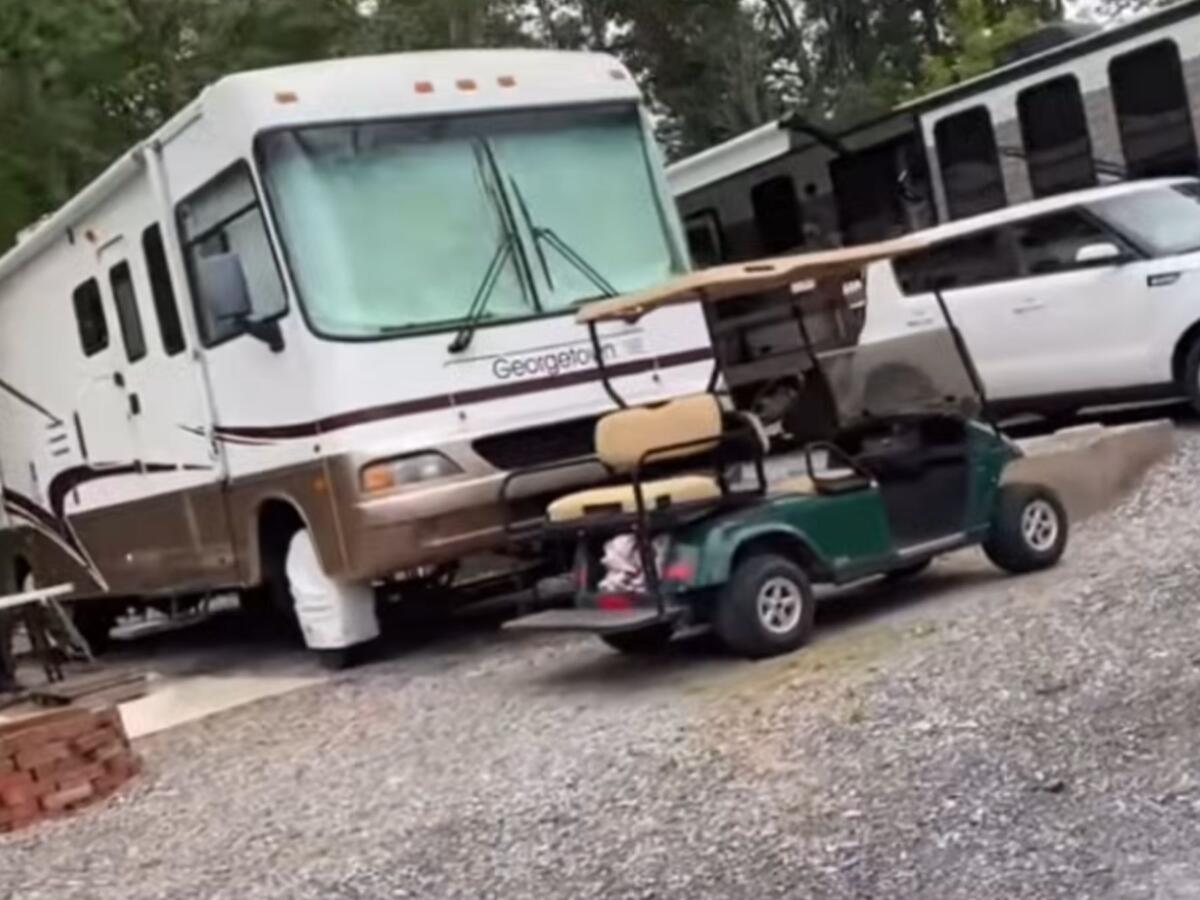
Golf carts add another clue. They loop like patrol units, slow passes, repeated routes, and a driver who seems to clock every newcomer.

At night, the campground reveals its final form: stadium-bright flood lights, generators arguing in the background, mystery food smells drifting across sites, and dogs debating something across several loops of barking. Around 10:47 p.m., someone always tries to set up using only headlights and determination, while metal clanks echo through the whole place.

Morning after: Why the “bad” campground becomes the best story

The next morning feels calmer. Coffee tastes better after a rough night, neighbors seem friendlier, and routines become familiar. After expectations are reset, the chaos turns into entertainment.

Bad campgrounds usually aren’t disasters; they’re just places where reality shows up faster than advertised. And later on, those are the weekends people actually talk about.

The best question to leave behind is simple: Which campground sign shows up first—the potholes, the map, or the golf carts?

Watch the video below for a good laugh and leave your thoughts in the comments below.

RELATED

RVT1252

RVers say these are the two biggest factors when choosing a campsite

8

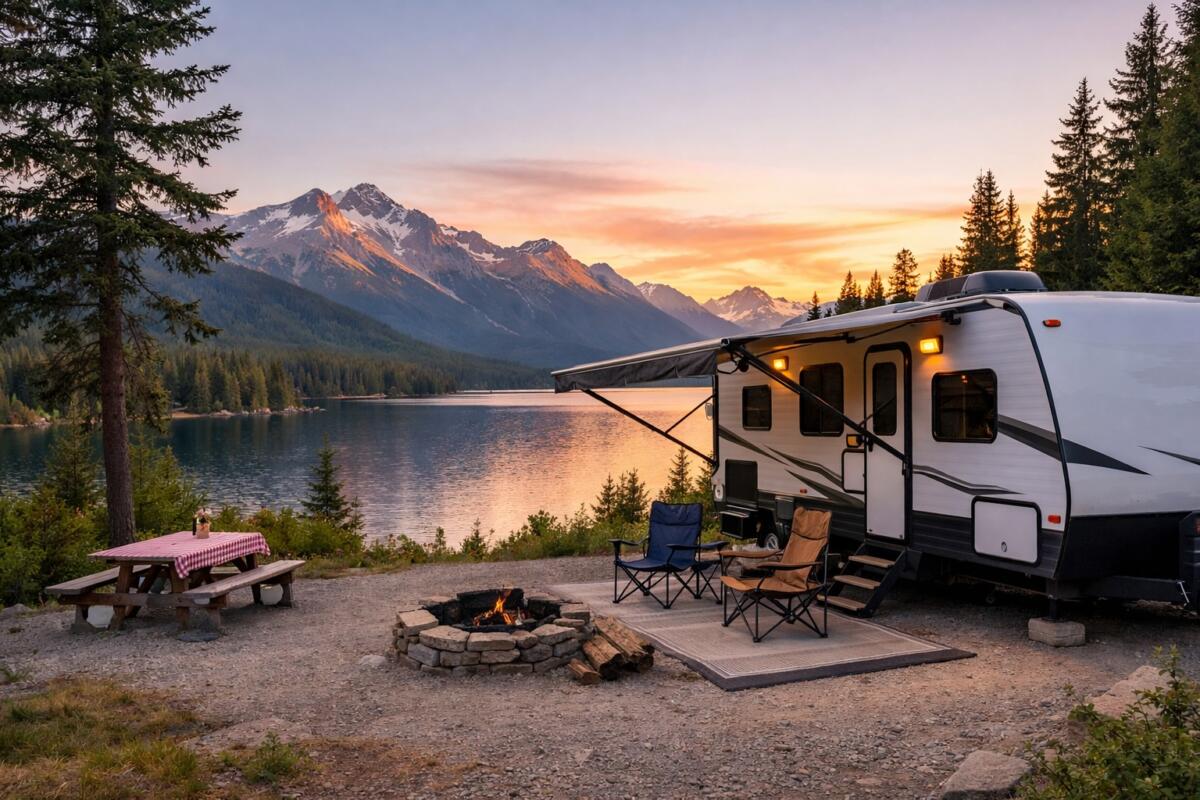
When you pull into a campground after a long day on the road, you want that site to feel right. Maybe it’s the view of a lake through the trees, a quiet corner away from the crowd, or simply a spot that doesn’t require stacking a mountain of leveling blocks. Yep…

Last week, we asked RVtravel.com readers: What are your top two main considerations when choosing a campsite?

Nearly 1,500 RVers weighed in, and two priorities clearly rose to the top.

It’s all about the view—and the price

Location and scenery dominated the results, with 67% of respondents choosing it as one of their top considerations.

That likely won’t surprise many RVers. The chance to wake up beside a river, overlook a canyon, or sit under tall pines is one of the main reasons people travel with an RV.

Coming in second was cost, selected by 43% of respondents. With campground prices climbing in many places, affordability is clearly on RVers’ minds.

After those two, other factors followed closely:

• Privacy or distance from other campers — 40%
• Amenities like showers, pools, hookups, etc. — 24%
• Pet-friendly facilities — 14%
• Other considerations — 6%

But the comments reveal something interesting: Many RVers say the real-world decision often comes down to practical details you might not notice on a reservation website.

Level sites matter more than you might think

One of the most common themes in reader comments was simple: The site has to be level. These are just a few of the many comments about level sites:

“My first priority would be that the site is level.” —David P.

“A level site is my second priority after scenery and location.” —Terry W.

For RVers with large rigs or automatic leveling systems, slope can quickly turn a relaxing evening into a frustrating setup session.

“The two biggest considerations are what utilities are present, and how level is it? The second has grown in importance as the leveling system on RV #2 seems far more likely to respond to ‘excess slope’ and refuse to auto-level than was true with RV #1. This is especially puzzling in that #2 is seven feet shorter than #1. Thus, I would expect the opposite result. In any case, we care much more about how level a site is now than we did three years ago and earlier.” —Neal D.

And sometimes a campsite looks fine on the map… until you actually pull into it.

“For us, it’s two L’s: Level and Length. Our 5th wheel is 46 feet long. Will we fit in that site? And how much of a bank is there? Those stabilizers have to come down and connect solidly to something.

“Last summer, we went to a campground in the Berkshire Hills of Massachusetts. When I got into the site, there was not enough height under the front to put my tripod, and the rear bumper was at eye level! I had to go to the nearby Home Depot and make a small investment in cinder blocks to ‘reach’ the jacks!” —Jef B.

Big rigs bring big considerations

Another major factor mentioned repeatedly was access and size, especially for RVers with longer rigs. These are just a few of the big-rig comments:

“Our ‘other’ is ease of backing into the site with our 41’ toy hauler.” —Karla

“Our ‘other’ is: ease of getting into the site. That is number one. When backing in a huge 5th wheel or any other rig, and ‘backing’ is not your best skill set, it really is nice to not have a big tree or boulder right where the front wheel of your truck needs to be. Having some maneuverability really helps.” —Leslie S.

“My ‘other’ is size and access. We are approx. 75′ hitched. A big site is nice, but if I can’t get to it, it is kinda useless.” —Rob

Some readers pointed out that choosing a campground and choosing a specific campsite can involve very different priorities.

“There is a difference between choosing a campground and a campsite, and I think the question got them confused. I have a different priority when choosing a site. That’s why I clicked on privacy and other. For me, it’s site size, both length and width, and accessibility. By accessibility, I mean ease of getting in and out. When choosing a campground, I want amenities and privacy, but that doesn’t mean a thing if you can’t get into the site.” —Roy D.

Quiet, privacy, and a little breathing room

Even though privacy ranked third overall in the poll, it was clearly important to many readers.

“I look for sites that have some seclusion, either by distance or vegetation. Preferably having a larger distance on the camp side of the site, I also look for a site that has no sites behind me.” —Mike G.

“My dog and I like to camp far out in the woods in a campground with few people and almost no amenities” —Matt

“Quiet site, no trains, and minimal highway noise.” —K M

Many RVers said escaping the chaos of everyday life is exactly why they go camping.

“Take your barking kids and your screaming dogs to a KOA, or a place similar. Let us enjoy the peace and quiet. Level is always a great thing.” —David

“Regarding what we look for, we definitely want campgrounds that prohibit political signs, political flags, or any other display, regardless of party. We go camping to get away from all that crap. We also appreciate property managers who actually enforce rules like quiet times.” —Sheila

The little details can make a big difference

Beyond the main poll choices, readers shared plenty of smaller details that matter once you’re actually parked.

“For us, the ‘other’ important campground/site considerations include: Pull though sites, level sites, paved or concrete sites with well drained solid grassy areas between sites, easy off and on interstate highways, clean grassy areas for our Labs to do their business, clear view of the sky for good connection to Starlink.” —John R. W.

“A site with SHADE! Clean restroom and shower! SPACE!!!!!” —Chuck

“We always make sure the site is LEVEL and long enough to accommodate our truck and trailer. Then we check the pictures of the site, plus its location on the map, and what is adjacent. In addition, we try not to book sites by the main entrance of the campground to avoid all the incoming and outgoing traffic.” —Barb S.

The takeaway

While RVers clearly love beautiful locations, the comments show that practical considerations—like level ground, access, and space—often end up deciding whether a campsite works or not.

A stunning view is great. But if the rig won’t fit, the jacks won’t reach the ground, or the site slopes like a ski hill, that view can lose some of its charm pretty quickly.

And if the site happens to have both a beautiful view and a level pad? Well, that might just be the perfect campsite. Because they do exist, right?

Please feel free to continue the conversation in the comments below.

RELATED

RVT1252

Man builds incredible minivan camper

1

By Cheri Sicard
Barry is a 78-year-old DIYer with a penchant for creating RV van conversions. In the video below, we explore an amazing minivan camper he created in a Toyota Sienna XLE van.

According to Carol, our host from Glorious Life on Wheels, Barry’s DIY minivan camper has everything he needs, including:

  • A tri-fold custom bed
  • A shower
  • Lithium batteries for off-grid power
  • A solar water heater
  • Hot and cold running water
  • And much, MUCH more.

When Barry began his build, he ripped out everything from the front seat to the rear door and started with a clean slate. He started by installing sound-deadening materials to the entire surface and covering the floor with 3/4-inch plywood and covering that with vinyl flooring, giving him a well-insulated 3-layer floor throughout the minivan camper.

Pure genius bed design

Barry custom-designed his convertible bed. When not being used for sleeping, the bed folds up into a sofa that faces out from the rear of the van, making it a perfect place to sit and relax and enjoy the view. A huge drawer underneath provides a massive amount of storage.

But wait, there’s more! Fold up the bed from the backside, and it reveals a portable toilet and a shower. Barry has it configured such that you can opt to shower outside the van or, should you choose, inside with privacy. In a minivan!

Check out the amazing rooftop-mounted off-road solar shower tube that allows Barry to shower in comfort while off-grid. It can also be used to provide hot water for washing dishes.

Absolutely everything about the bed design is pure genius and squeezes the maximum amount of function from the teeny tiny space.

Barry also has a kitchen that features a refrigerator-freezer, sink, and induction stovetop. Water comes from two 5-gallon water bottles mounted under the sink.

Two 100-amp-hour lithium batteries and 200 watts of rooftop solar provide plenty of power to Barry’s minivan camper.

There are lots of other innovative features this creative builder incorporated into the DIY minivan camper conversion, so be sure to watch the video and check them all out. You’ll be amazed!

Even if you never intend to build your own camper, RVers of all types could use Barry’s rear bumper-mounted storage system. He also discusses temperature control and maintaining privacy in the van.

RELATED

RVT1252
These collapsible water bottles are an awesome camping accessory

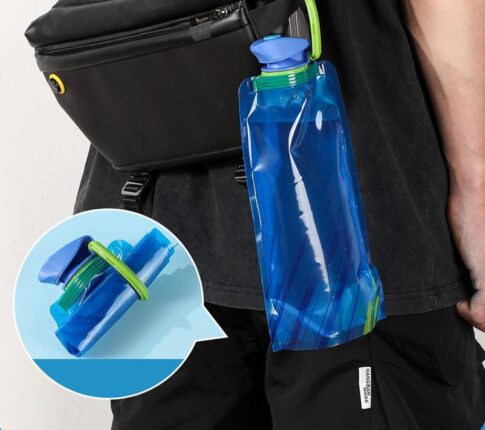
I was recently gifted a set of these collapsible water bottles, and after using them for the last month, I am sorry I had not discovered them sooner.

Water bottles can take up a lot of prime real estate in small RV or camper cabinets (or small homes, for that matter). Yet if you do any kind of hiking or even sightseeing away from your RV, you need them. And if, like me, you are carrying water for both yourself and your dog, you really need them.

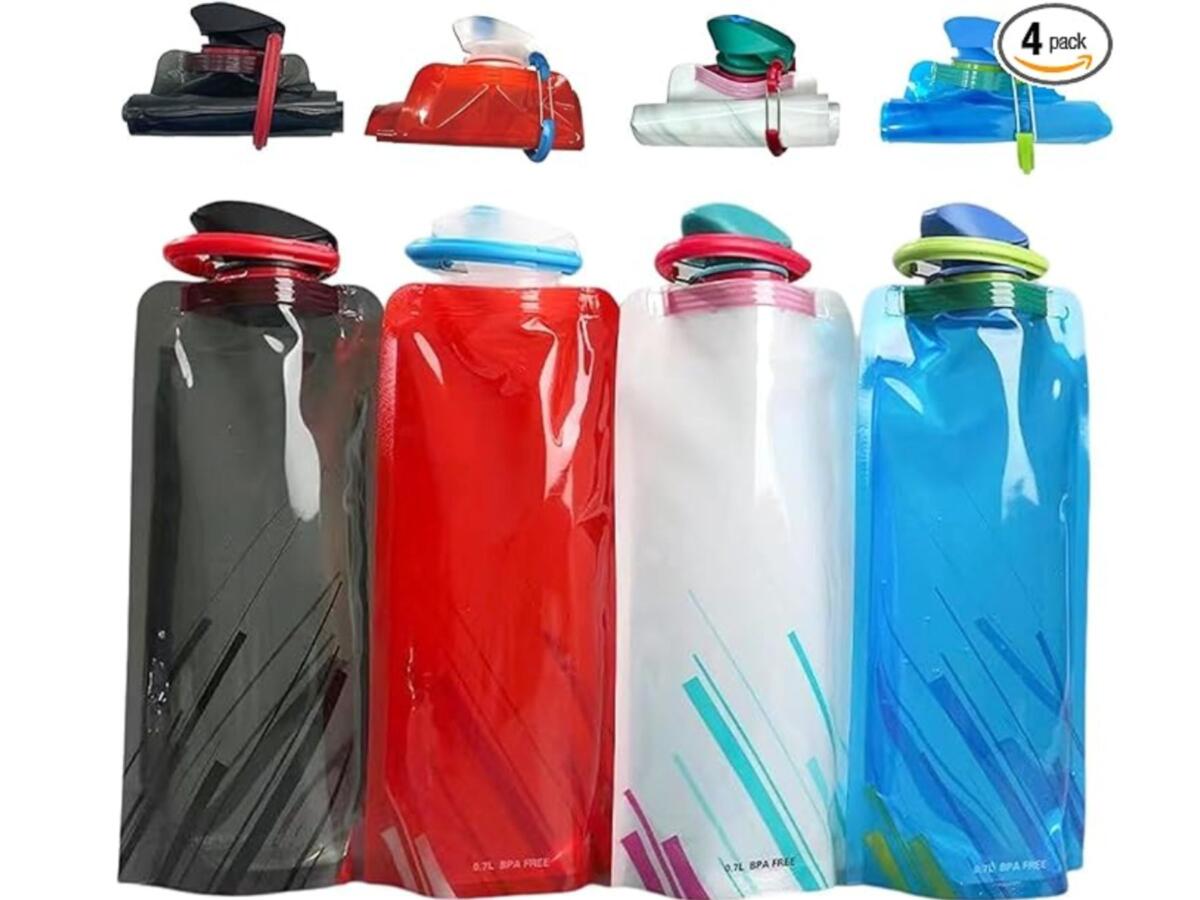
LuLuya’s collapsible water bottles provide a practical solution. Until you fill them with water, they hardly take up any space at all! That’s because once empty and dry, you simply roll them up to store, and an attached strap secures everything in place. Alternatively, you can store them flat. Not to mention they hardly weigh anything, unlike heavy metal water bottles or thermoses, so they don’t add any weight to your RV, backpack, purse, etc.

Waterbottle

What I especially like about LuLuya collapsible water bottles

• Made of PET+PE material, which is environmentally friendly, safe, and non-toxic.

• BPA-free, and therefore free of any strange plasticky odors.

• Leakproof—Despite their flexibility, the foldable water bottles are absolutely leakproof. When filled, the container is stable and safe.

• They weigh hardly anything when not filled.

• Suitable for temperatures between – 4° F (-20° C) and 122° F (50° C).

• Can be flattened or rolled up when empty.

• Can be hung up, even when full.

• They are durable and washable, and can be reused again and again.

Can anything be improved?

I really can’t think of anything. These are some of my handiest and most-used RV and camping accessories.

Order from Amazon.

MORE RECENT GADGET REVIEWS:

RVT1252

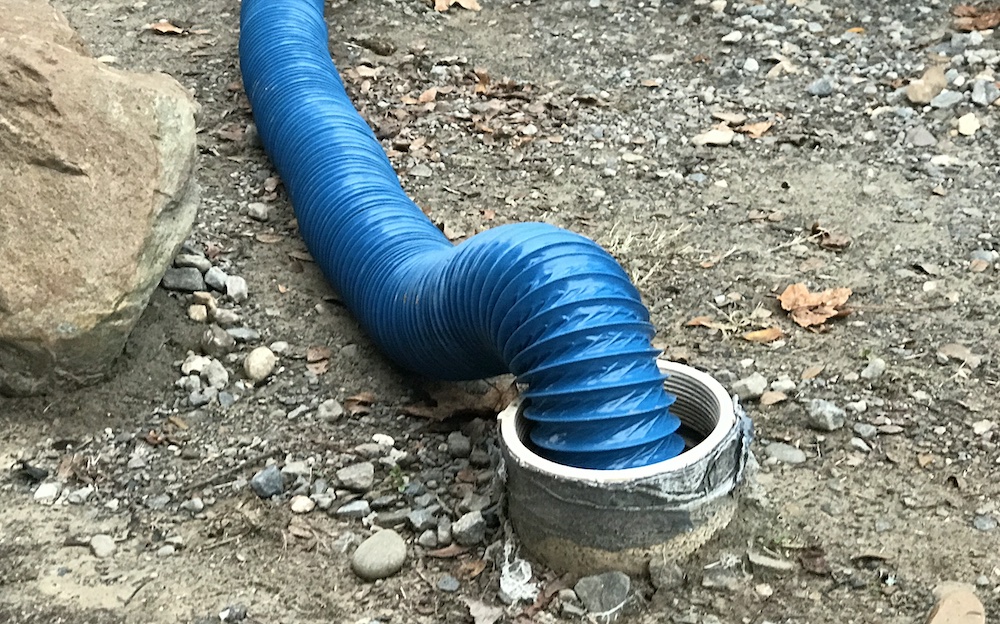
Has a sewer valve or hose ever broken or malfunctioned while you were dumping?

17

Oh, horror of horrors! This surely must be the worst nightmare of any RVer short of a serious traffic accident. We sincerely hope you have never experienced a sewer dumping failure, but it does happen.

We saw a video once where a man told of how his black tank valve had malfunctioned, and as he drove down the highway the sewage backed up against the cap covering the valve. When he arrived at his campsite and removed the cap to attach his dumping hose, the crap (literally) gushed. “I was knee deep in it,” he said, although we are pretty sure he was exaggerating at least a little.

Anyone who has spent time around an RV dump station has probably witnessed at least one small disaster. A loose connection, a forgotten valve, or a hose that decides to pop free at exactly the wrong moment can turn a routine chore into something unforgettable. It’s the kind of situation where nearby campers suddenly find something very important to do… somewhere else.

Most holding tank mishaps are not so serious or dramatic, but whether they are only a wee little drip or an eruption, they are not fun.

So our messy poll question of the day is about whether something like this has happened to you. We’re hoping most of you say no. But if you answer yes, please take a moment to fill us in on the details in the comments below.

MORE POLL QUESTIONS YOU MIGHT LIKE:

RVT1252

Your RV warranty is about to run out: What to do next?

By Dustin Simpson
If your RV is experiencing issues and your warranty is about to expire, it’s crucial to act quickly to ensure your RV is covered for any necessary repairs. Here’s a guide to help you navigate this critical period and take advantage of any remaining warranty coverage.

Step 1: Understand your warranty coverage

Review your warranty terms

Carefully read through your RV’s warranty documentation to understand what is covered and what is excluded. This will help you identify potential issues that need to be addressed before the warranty expires.

Check for extended warranties

If you have an extended warranty, confirm the coverage details. Extended warranties often cover a broader range of issues and may provide additional peace of mind.

Step 2: Schedule a warranty inspection

Importance of a warranty inspection

A professional RV warranty inspection can help identify any existing issues that should be addressed while your warranty is still active. This proactive step can save you from costly repairs later on.

California RV Specialists

At California RV Specialists, we understand the complexities involved in warranty work. Although we only accept extended warranties due to the varied procedures of different manufacturers, we offer RV warranty inspections to assist you.

Step 3: Know your rights as a consumer

Manufacturer requirements

Most RV manufacturers require dealerships that carry their brand to complete warranty work. If your RV is still under the original manufacturer’s warranty, contact the dealership where you purchased the RV or any authorized dealership for your brand.

Consumer rights

As a consumer, you have the right to have warranty work performed by an authorized service provider. Ensure you advocate for timely and thorough repairs before your warranty expires.

Step 4: Schedule repairs promptly

Immediate action

Once issues are identified, schedule repairs immediately to ensure they are completed under warranty. Delaying repairs could result in missing the warranty coverage window.

Authorized dealerships

Work with authorized dealerships or service centers to ensure that repairs are recognized and covered by your warranty.

Step 5: Keep detailed records

Documentation

Keep detailed records of all inspections, repairs, and communications with service providers and manufacturers. This documentation can be crucial if there are any disputes about warranty coverage.

Conclusion

If your RV warranty is about to run out and your vehicle needs repairs, taking immediate action is essential. Schedule an RV warranty inspection with a trusted provider like California RV Specialists to identify any issues and ensure they are addressed while your warranty is still active. Understanding your rights and working with authorized service providers can help you navigate this process smoothly and protect your investment.

For more information or to schedule a warranty inspection, contact California RV Specialists today. We’re here to help you make the most of your warranty coverage and ensure your RV remains in top condition.

More from Dustin

Make sure you check out my website, California RV Specialists, and our YouTube channel for more helpful information, and see our published articles on RVtravel.com and other social media pages.

RELATED

RVT1252
How to turn on emergency response settings on your cell phone

3

When you RV, learning tips that actually work can mean the difference between a smooth excursion and a devastating experience.

Read on to discover the advice one RVer recently shared with me. He and his wife were involved in an accident while RVing. Learn how one simple tip, put into practice, made all the difference.

Lifeline

Did you know that your phone can be a lifeline? It’s true! Modern cell phones can be programmed to call emergency services automatically after a crash. They can also share your location with responders and instantly pass medical details and emergency contacts to first responders. This is especially important if you can’t speak for yourself.

iPhone emergency features

On iPhone models that support Crash Detection, the phone can detect a severe crash and start the emergency process for you. Pairing Crash Detection with completed Medical ID and Emergency SOS settings makes that feature especially useful.

If your device detects a crash or you trigger Emergency SOS, your phone will attempt to contact local emergency services. It will also notify the emergency contacts you’ve listed. Your Medical ID can be accessed by responders even from the lock screen so they can see allergies, medications, and key medical info.

How to set it up (iPhone)

Here’s how to add emergency contacts and medical info on an iPhone:

  • Open the Health app and tap your profile picture to get to Medical ID.
  • Choose Edit and fill in any medical conditions, allergies, and blood type.
  • Add Emergency Contacts by tapping Add Emergency Contact. Choose people from your address book. Be sure to label their relationship.
  • Check Settings, then Emergency SOS to confirm your preferred trigger method (hold side button plus a volume button, or the rapid press option).
  • Confirm that Call After Severe Crash is enabled if you want automatic calling after Crash Detection.

Note: Practice the trigger motion once or twice to avoid accidental presses later.

How to add emergency contacts (Android)

Here’s how to set up the emergency contact information on an Android phone:

  • Open your phone’s Personal Safety app or search Settings for Emergency SOS or safety and emergency.
  • In the Personal Safety setup you can choose emergency contacts, allow the phone to share your location during an emergency, and turn on assisted calling where available.
  • Some Android vendors (e.g., Pixel phones) also have crash detection and auto-call behavior you can enable and test.
  • Follow the on-screen setup prompts so your phone has permission to use location and to send updates to contacts.

An alternative

If you are unable to set up the emergency notification feature on your cell phone, ask an expert for assistance. Visit your local phone carrier’s place of business, explain what you want to do, and let them help.

The RVers?

As for the RVers who were in the accident? Emergency personnel were on the scene before either RVer located their phones in the accident aftermath. They are convinced that the phone’s emergency setting made all the difference!

How about you?

Have you received important advice from other RVers? Share that road-tested advice in the comments that follow. Thanks!

RELATED

RVT1252
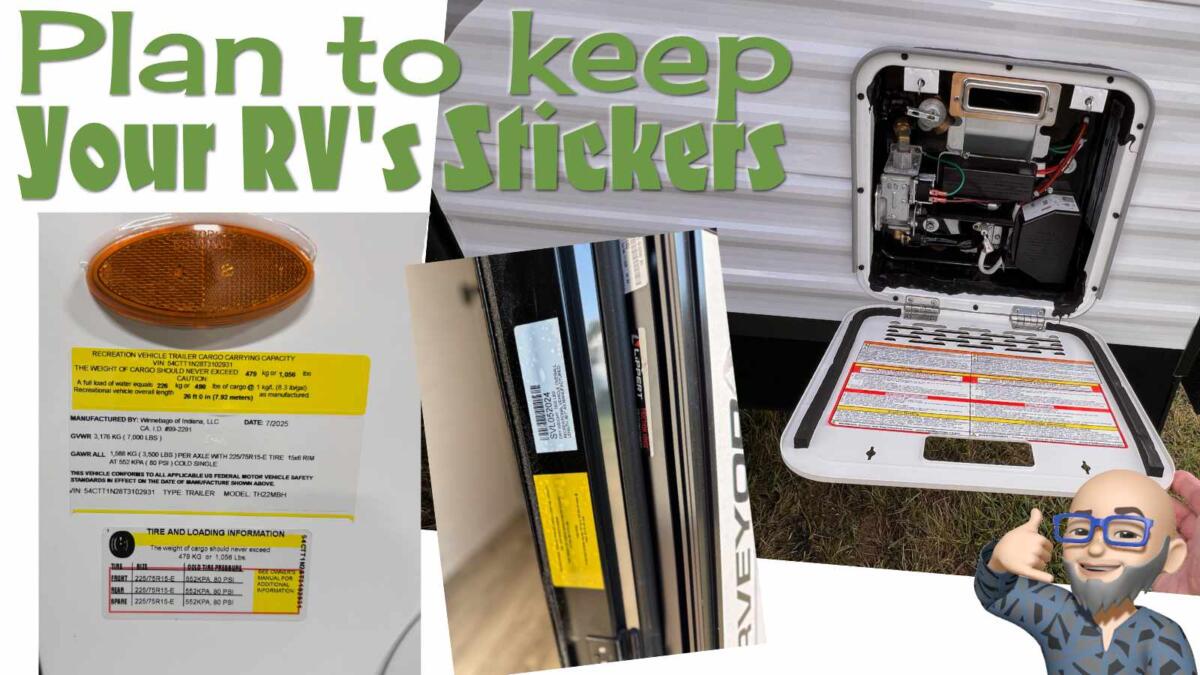
Why it’s important that you take photos of your RV’s serial number stickers

As some of you know, I used to work at a small, locally-owned RV dealership. In fact, it’s still there today serving customers well. (Shout out to Redwood Empire RVs!) But something that was unique about the dealership was that our foot traffic was such that I was able to do both sales and oversee some of the warranty claims there. 

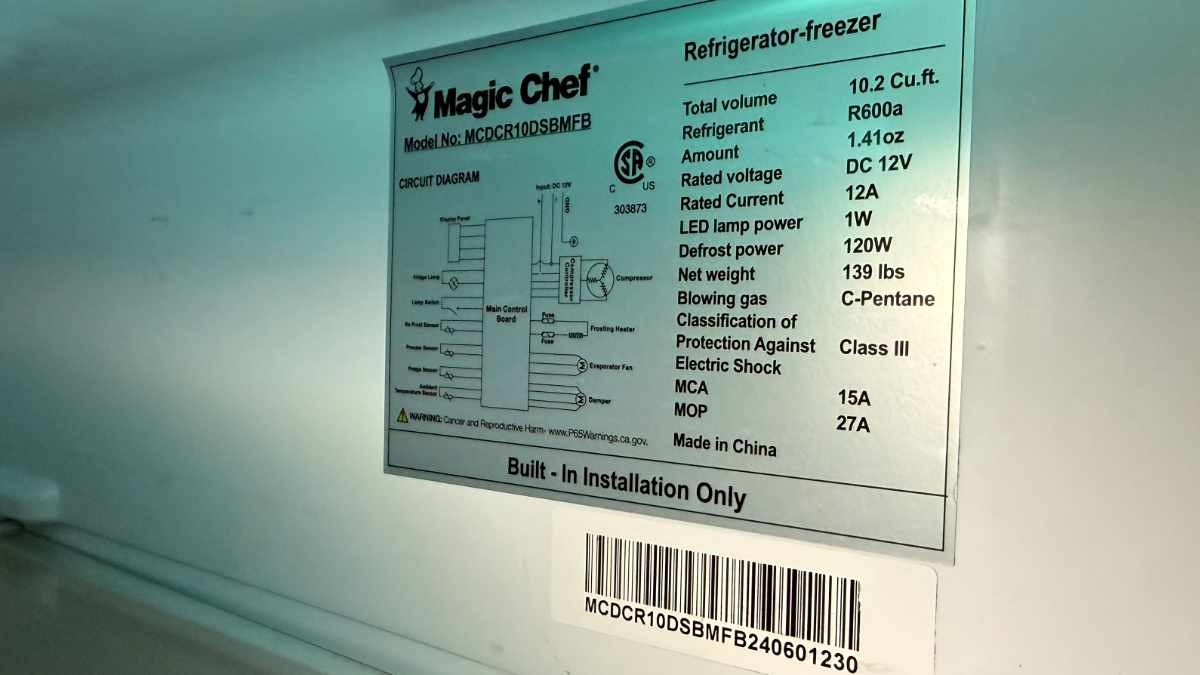
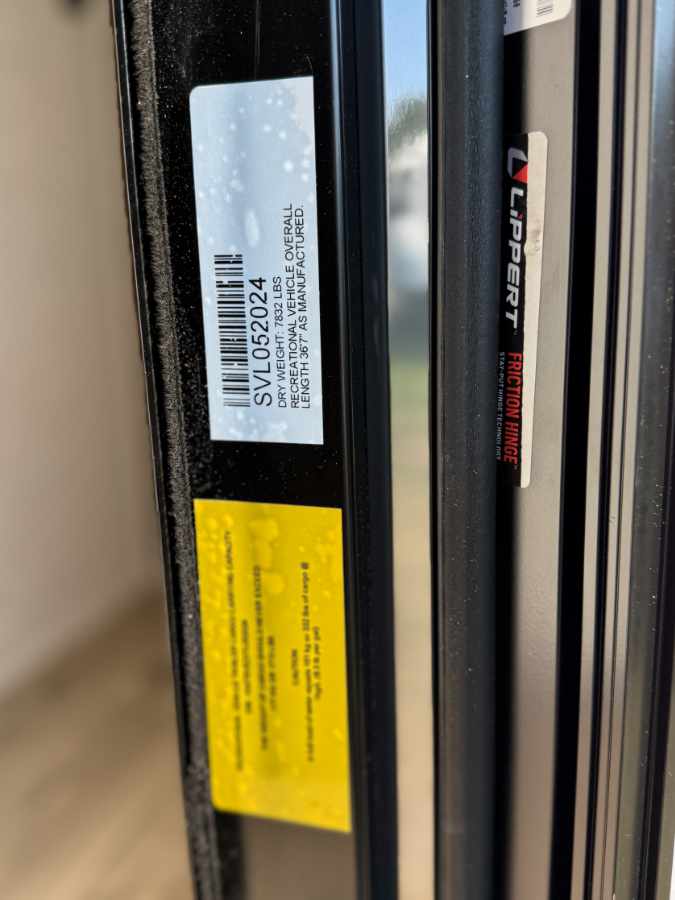
Something I learned early on is that the stickers with serial numbers on many RV components tend to fade and wear out quickly—sometimes even before the warranty expires.

While you may know about the general warranty on your RV, did you know there may be many warranties that cover components in your RV? In fact, did you know that some of the more expensive items in your RV may actually have a longer warranty than the general warranty on the RV itself? Yup!

For example, I work a lot with Rockwood/Flagstaff and host a Facebook group for owners and those interested in a Rockwood or Flagstaff. As such, I see every once in a while that someone finds that their axles are damaged. 

The axles on Rockwood Mini Lites and Flagstaff Micro Lites are Dexter torsion axles. In fact, this suspension/axle system is one of the reasons I bought my first new Rockwood 10 years ago. (I have now had four!) 

Like any human-made component, many last seemingly forever, and others fail early on. 

Dexter has a ten-year warranty on these axles. Even if your RV is well beyond the general warranty, you can still work with Dexter if you discover an axle problem. And this is just one of the components in these RVs. But more than one person has reported that Dexter shipped them a whole new axle when they discovered an issue with theirs. Nice. 

Make the warranty process easier

The point of all this is to make the warranty process a little easier. What I suggest doing is taking photographs of every serial number and build plate you can find on your RV as early as possible. Some of these stickers seem to last forever, but not all. 

So, if you did have an axle issue, or a problem with the furnace, or the A/C unit has challenges, if you have photographs of all the serial number plates on these, it’s much, much easier to file a warranty claim with the company. 

Oh, yeah. Some of those appliances, like certain air conditioners, furnaces, and other appliances, have two-year warranties. Nice, eh? 

And you don’t necessarily have to go to the RV builder to file a warranty claim. Some of these companies will work directly with you to solve a warranty claim. 

Of course, having a great locally owned dealership as your ally is always a good idea. This is why I strongly suggest buying from an independent locally-owned RV dealership. Of course, some locally-owned dealers are as lousy as some of the big chains. But typically it’s much easier to determine if a locally owned dealership is worth a darn. 

Ask about Repair Event Cycle Time

One of the questions you might ask the service manager at the dealership is about their Repair Event Cycle Time (RECT). We’ll talk more about this in a future column, but this is a reference point that’s a core item at RV dealerships. 

Basically, this is how long, on average, a repair takes from the time you notify the dealership to the time you are back to camping. There are aspects of the warranty process that are unnecessarily long, depending on the type of claim. But the lower the RECT, the faster the dealership is at getting you back to camping. 

So, this is one thing you might ask as you’re shopping at a dealership. 

And start collecting photos of serial number stickers soon. They do fade and get road grime on them. 

RELATED

RVT1252
RV review: Alliance Paradigm 388SP—They did this one right

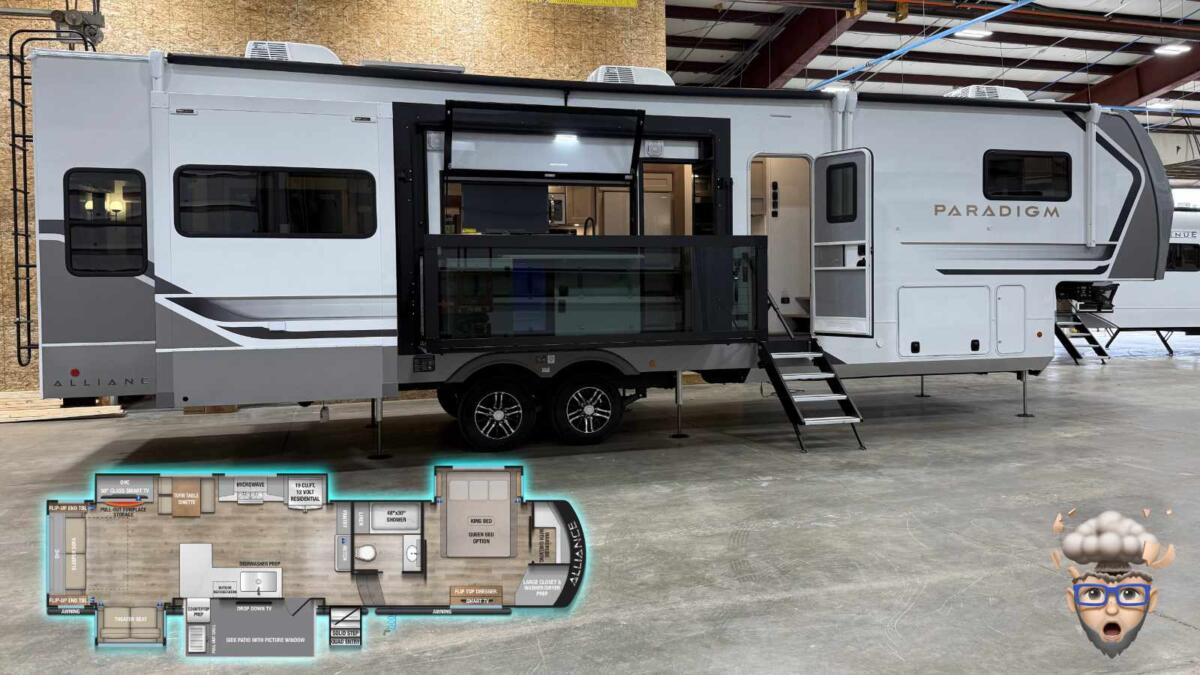
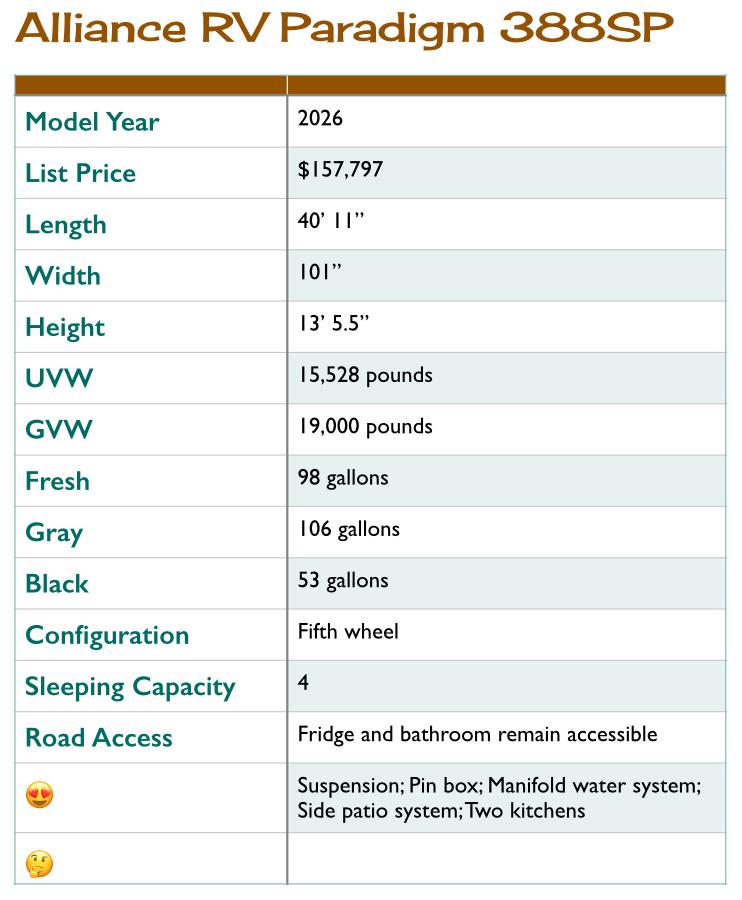
Today’s RV review is of the 2026 Alliance Paradigm 388SP fifth wheel. This is a very large fifth wheel that I got to see a prototype of (now they’re in regular production) that is very polarizing—you’re either going to like it or not. But so many of the core structural and design features in this show what Alliance is up to, and I would suggest reading on, even if the floor plan doesn’t strike your fancy. 

Yep, this wins in the “start at the road and work your way up” evaluation. 

From the road up with the Alliance Paradigm 388SP

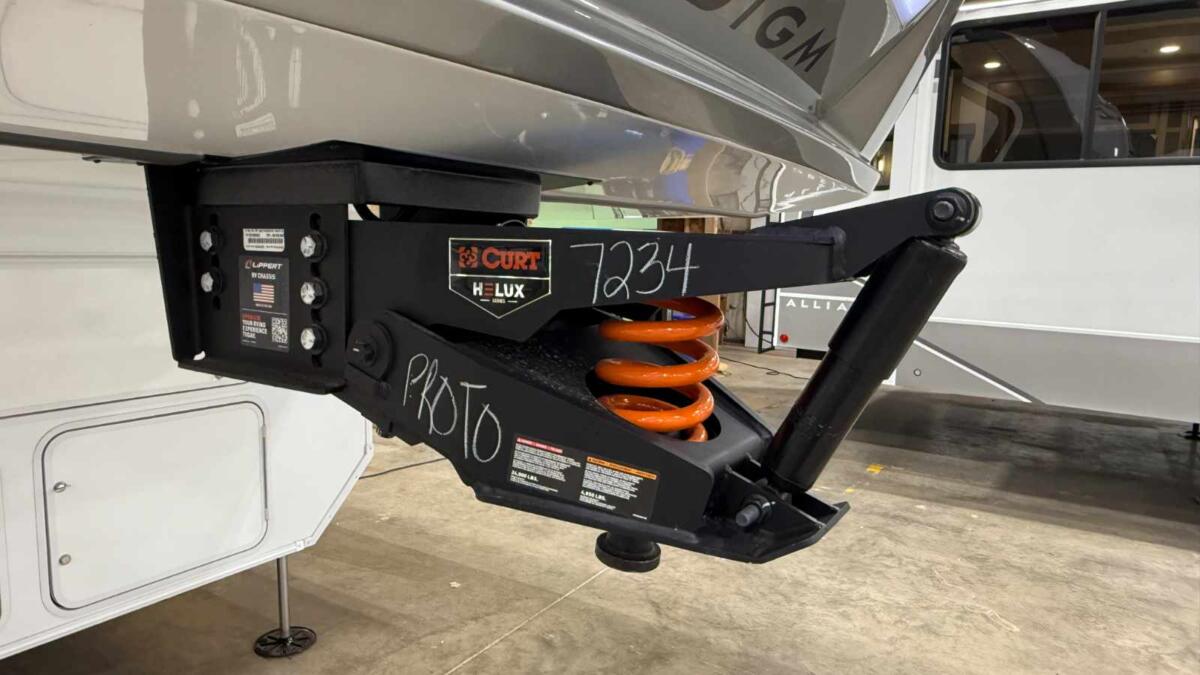
I was pleased to see some of the features of the 2026 Alliance fifth wheels when I went to visit them, starting with the suspension on these 2026 Paradigm fifth wheels. Alliance has moved to the CURT Touring Coil suspension, which, in my opinion, is the best suspension system for fifth wheels on the market, period. 

This coil suspension system incorporates coil springs and shock absorbers as a real suspension should. But this also translates into less vibration and harshness getting into the body of the fifth wheel itself. Add to that the Helux pin box, which also incorporates a coil spring and shock absorber, and you have a great combination. I think I’ve shared with you a story about riding in fifth wheels on a test track and experiencing just how much better this suspension is. 

Add to that the anti-lock brakes and tire pressure monitoring system and balancing beads inside the tires, and you have the ideal chassis for a fifth wheel. The anti-lock braking system also incorporates a degree of sway control and has a provision to track mileage for maintenance. 

Water system

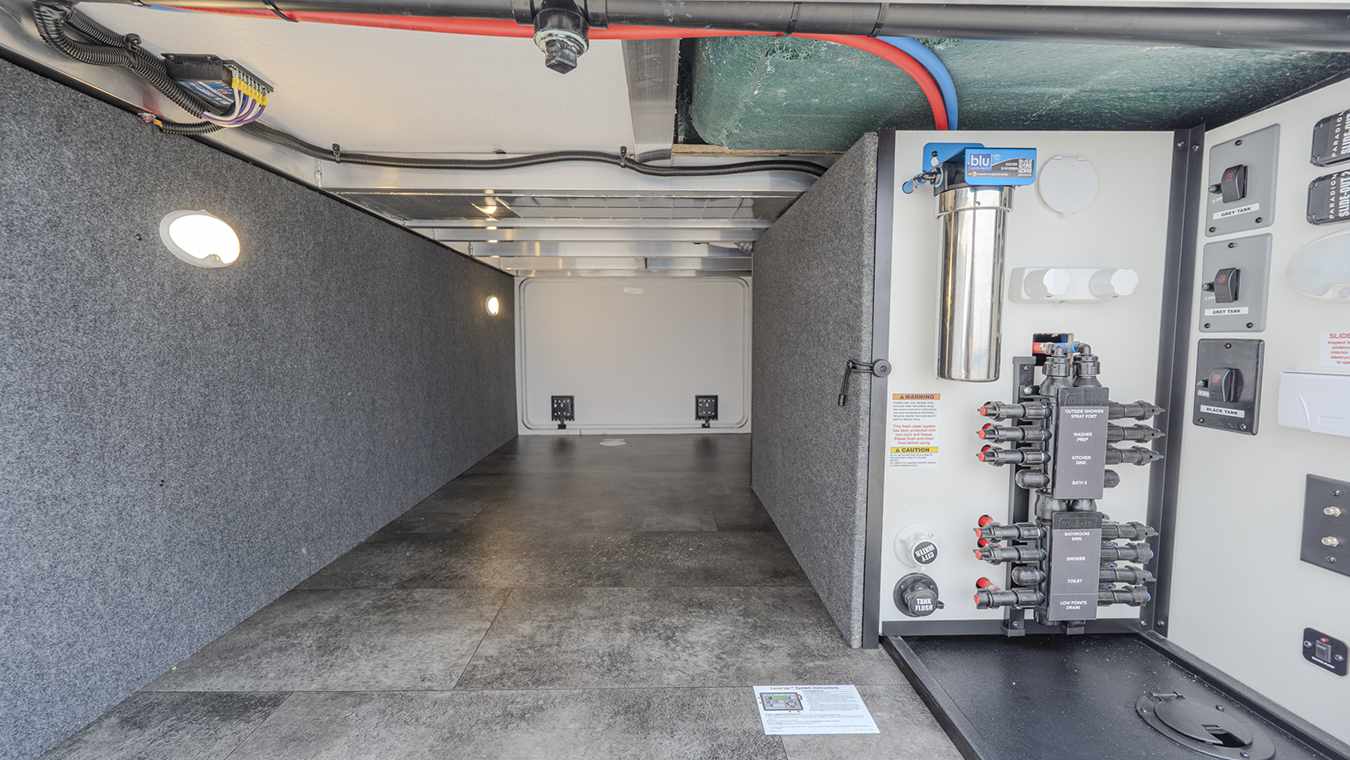
Moving up a bit, Alliance has switched to a manifold water system inside the trailer, where every fixture features a home run to this manifold. If there is ever a leak at one fixture, you can simply and easily disable that fixture and keep on camping. 

Speaking of plumbing, this features a 12-gallon water heater that’s gas and electric. With all the RVs moving to the lousy tankless water heaters that are only gas-fired, I like that Alliance has remained with this type of system. To me, it’s better for boondocking and better for park camping. 

Another thing I absolutely love is that the gate valves in this fifth wheel are power-operated rather than being cable-operated, which has been a source of poorly timed misfortune in so many fifth wheels. 

Atop this rig is an Alpha-Ply roofing system, which tends to need less maintenance and last longer than other types of membrane systems. 

Why you might love the Alliance Paradigm 388SP

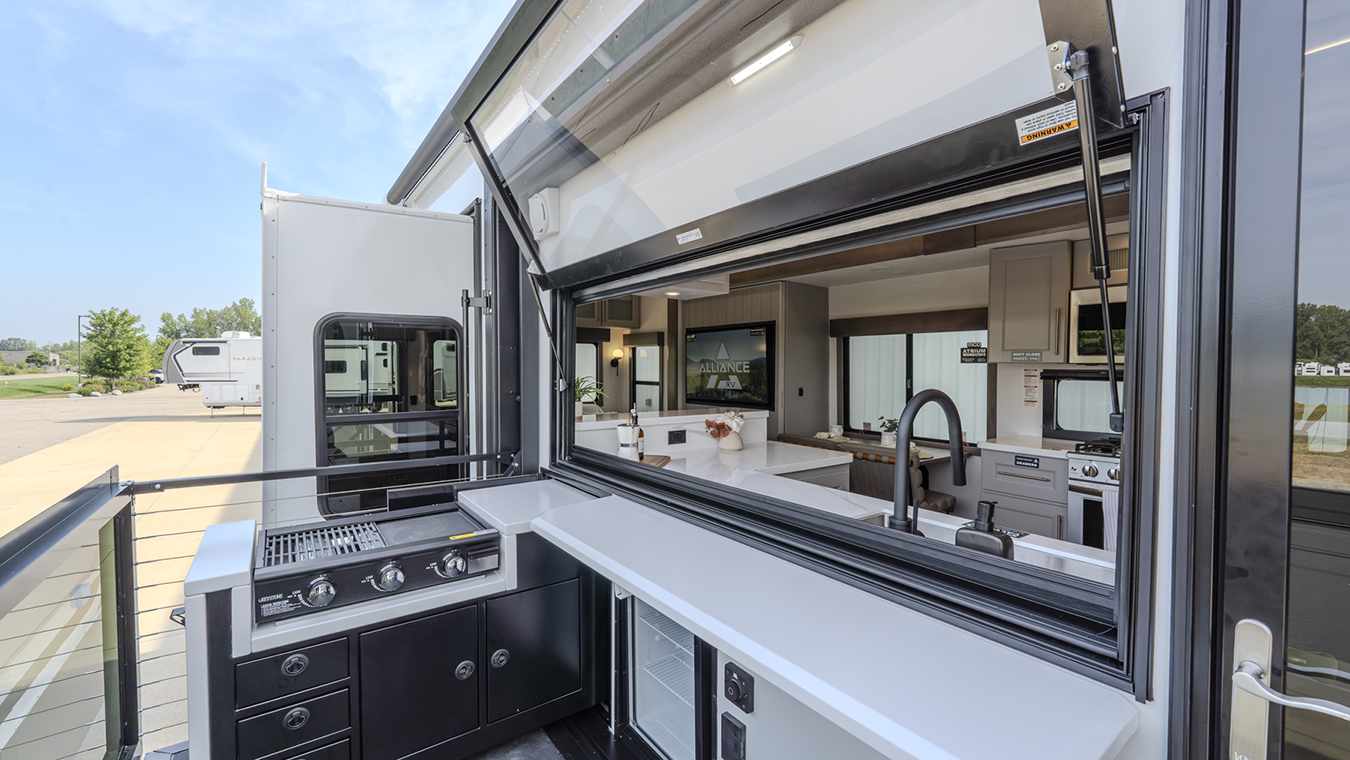
I had mentioned that this could be a polarizing RV, and what would make it so is a big patio on the side of the rig. Lippert has come out with a unique side patio system that provides a large window when closed but is a patio when opened. This is one of the RVs that has stepped up to offer this feature. 

The mechanism to open/close this is pretty nifty. When opened, you have direct access from the central kitchen of this rig to a second outside kitchen. But there’s also a very large window here with the sink on one side and that open patio on the other. 

On that patio is also a pull-out kitchen arrangement that incorporates a griddle and a small refrigerator. This would be the place that I’d be making bacon if this were my own rig. 

The window between the indoor and outdoor kitchen incorporates shades with a reflective backing on them. You can completely close off the outside world, but you can flip the window up and almost offer food truck-like service between indoors and out. 

Further, there’s a TV that can flip down so you could watch RV reviews while standing outside on the patio. (What else is there?) Making margaritas and watching RV and train videos—now that sounds like a great camping adventure. 

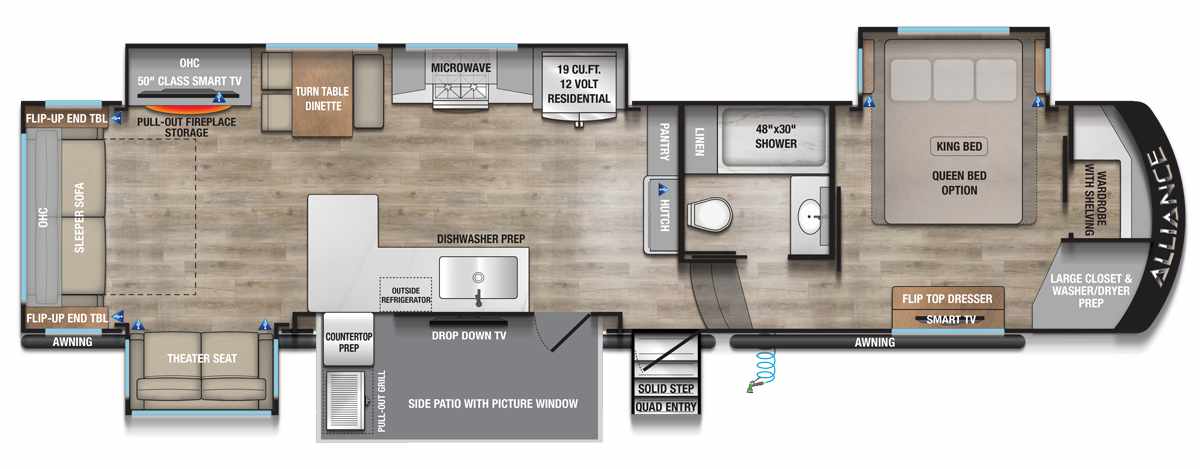
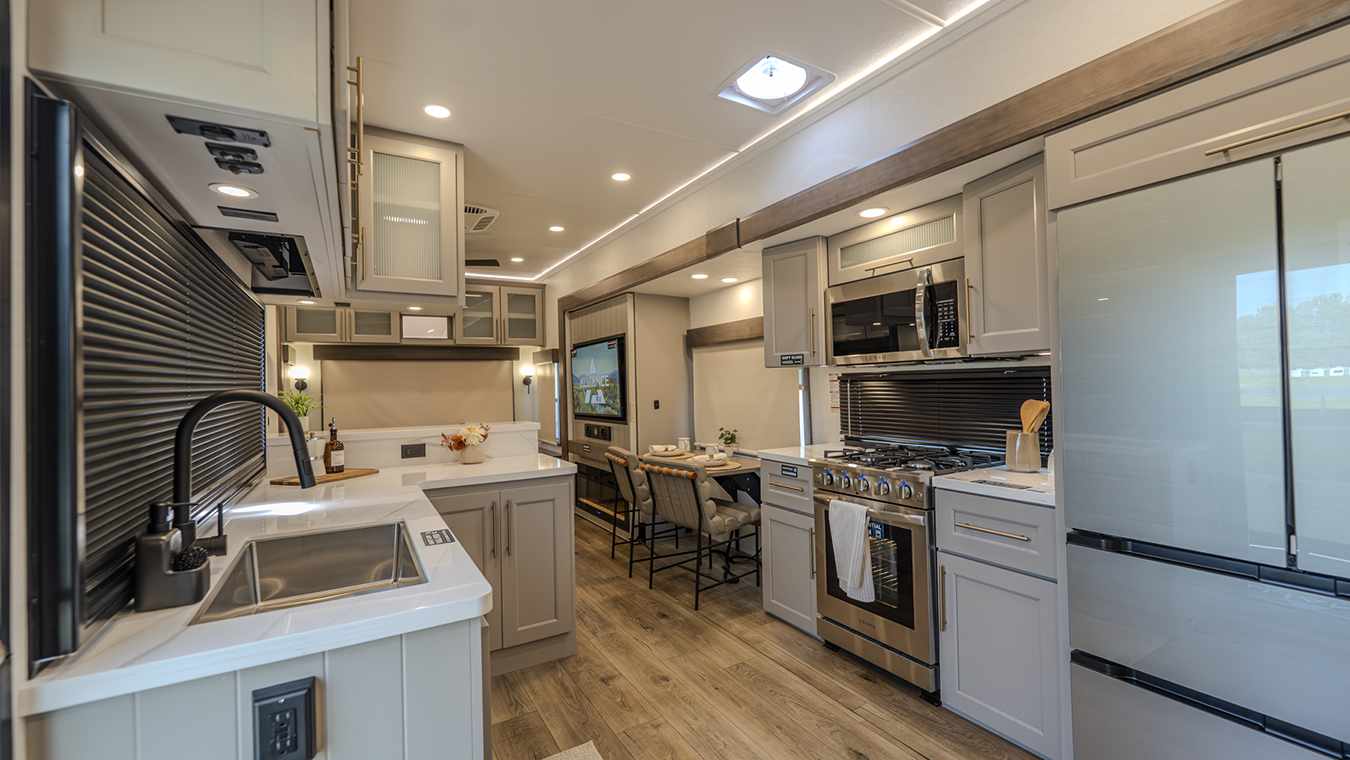
The indoor kitchen is nicer than the one in my home. It has a huge four-burner range and proper residential-sized oven, a large 12-volt refrigerator, and a substantial pantry including a pull-out secondary pantry. Even without that secondary outdoor kitchen, this is a great meal-prep place. 

I also like how Alliance’s dining table can be rotated so you can either seat four on the included chairs or have two seated facing the large window. Nice. 

Living space in the Alliance Paradigm 388SP

In the back of this trailer is a traditional couch that can become a bed, plus theater seats that face the large TV on the opposite side of the trailer. This is the second TV we’ve noticed; there’s a third one up in the bedroom. I mean, honestly, how many RV reviews and videos of the StressLess Camping RV podcast can you watch? 

Sleeping in the Alliance Paradigm 388SP

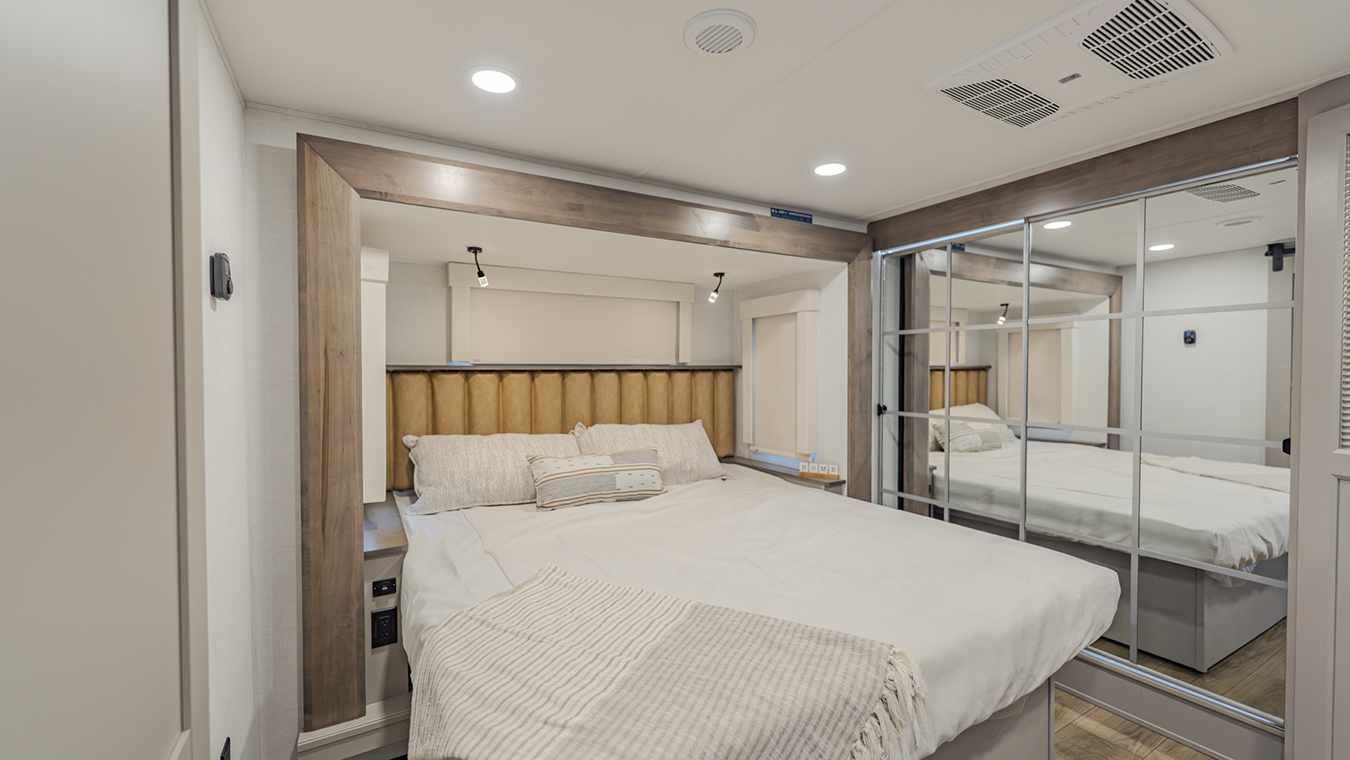
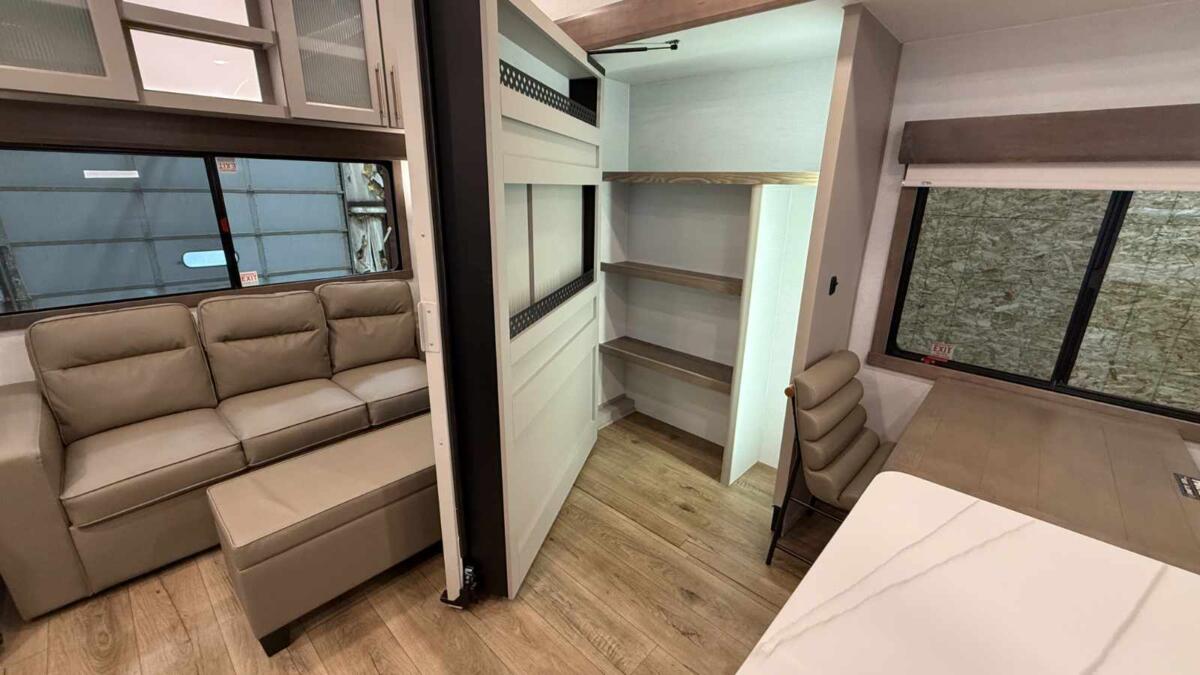
Upstairs, you’ll find a king-sized bed is standard, although you can also have this fitted with a queen. That bed is in a slide room, so that leaves the nose of this space available for a rather large closet. Of course, there are washer-dryer hookups here, too. Across from the bed is a dresser with a flip-up top for storing little stuff, and several drawers. 

Boondocking and travel access in the Alliance Paradigm 388SP

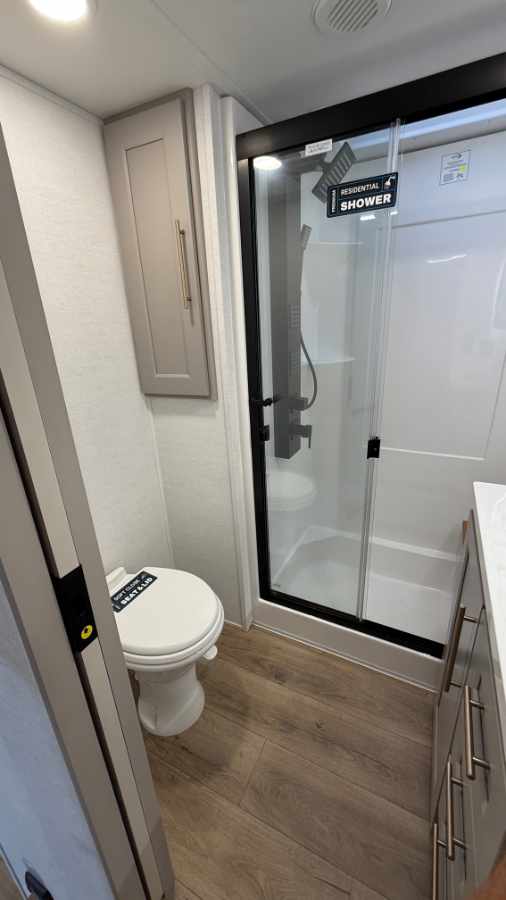
Let’s face it, all larger fifth wheels aren’t great when the slides are brought in when it comes to travel access. But you can still get to the fridge of this trailer. Of course, the upper bathroom, too, is fully accessible, so it would work for mid-adventure stops.

Once you get where you’re going, the large holding tanks in this rig, plus the optional solar, might make this a really good choice for camping off the grid. There is up to 1,200 watts of solar available from the factory, along with a 400 amp-hour battery and a 3,000-watt inverter. If the sun don’t shine, there’s also an optional 5,500-watt generator available.

Quite honestly, with all this available power in various forms, you could spend a great deal of time off the grid.

Final thoughts

I have written this before, but it’s worth mentioning again: Alliance may have one of the best websites of any RV company, period. They have the best videos of any RV company, period. I really, really like what I see with this company’s products, but they also know how to tell the story of the products quite well. 

When I have a question, they respond immediately, and they’re run the way a company should be run. I like Alliance and the people there quite a bit. 

The addition of the new Touring Coil suspension, Helux pin box, and manifold water system are all super pluses to me. 

I fully get that this specific floor plan might not be everyone’s cup of tea. But I think that if you’re shopping for a larger fifth wheel, you’re doing yourself a big disservice not having an Alliance on your shopping list. 

*****

More about these RV reviews

These RV reviews are written based on information provided by the manufacturers along with our writer’s own research. They are based on information from a single unit and may not reflect your actual experience. Shop your RV and dealership carefully before making a buying decision. They are intended only as a brief overview of the vehicle, not a comprehensive critique, which would require a thorough inspection and/or test drive.

Tony comes to RVtravel.com having worked at an RV dealership and been a lifelong RV enthusiast. He also has written the syndicated Curbside column about cars. 

You can also check out Tony and Peggy’s RV podcast.

RELATED

RVT1252
RV Tire Safety: The DOT requires info be posted on your RV. Do you know what it says?

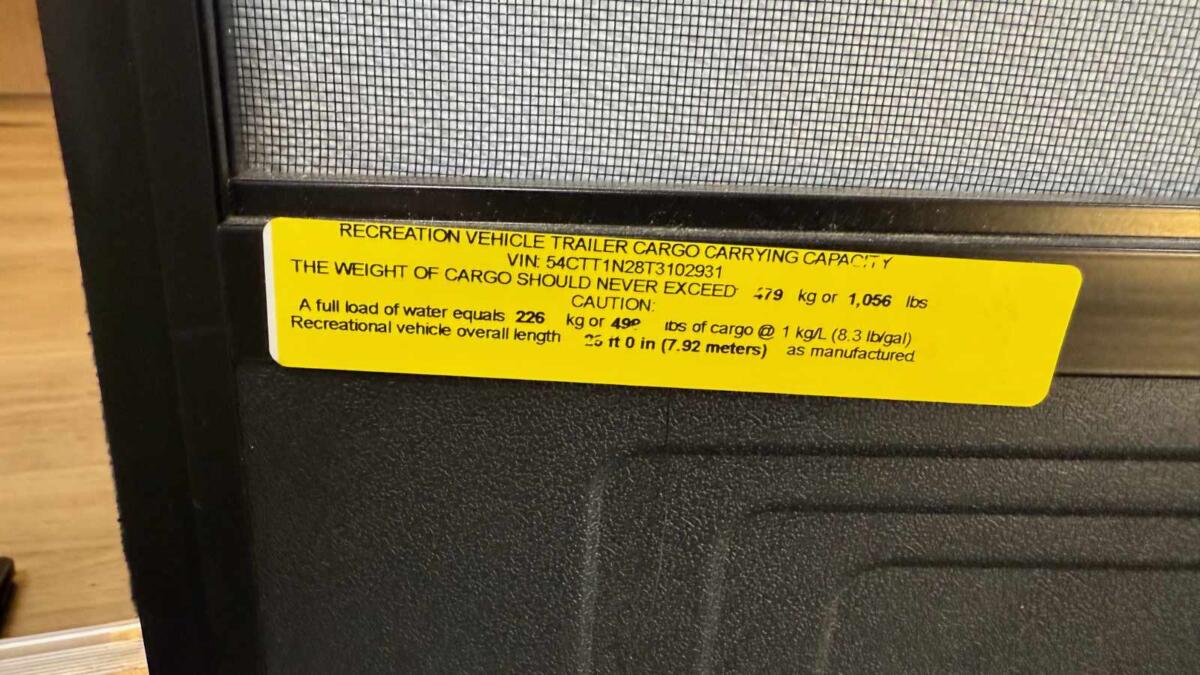
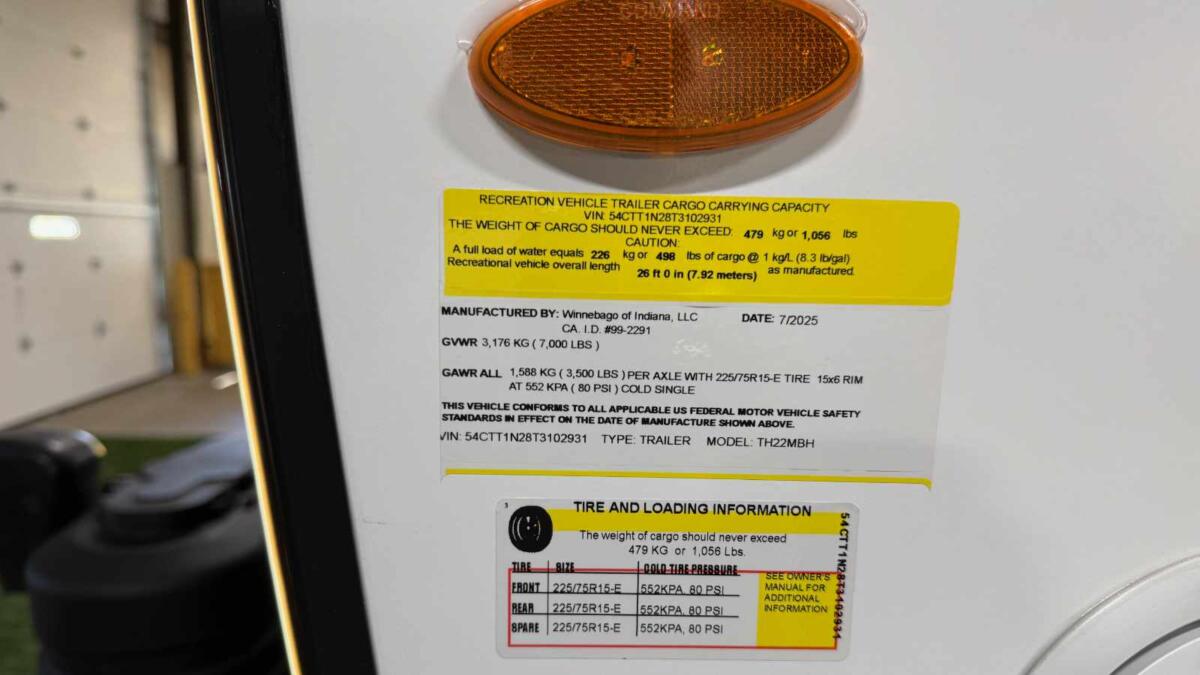
It is a FACT that, by federal law, all new RVs sold must have a “Certification Label”. The law specifies the information that must be on the label. It also specifies where the label is to be located, with different types of RVs having unique locations.

It is also a fact, confirmed by numerous studies, that more than half of the tires in use on RVs are run underinflated.

Another fact is that almost every week, I read a post or receive a question asking whether a certain size, type, or load range tire can be used on a specific RV.

The above suggests that RV owners were never told about the important SAFETY information on the Certificate, or that they chose to ignore this information.

Here is a poll to see how many readers of RVtravel.com know or have ever even read this safety information.

In case you do not know what the label looks like, here are a couple of examples.

Roger Marble

RELATED

*****

If you have tire questions, check out Roger’s posts on RVtravel.com. There are hundreds of posts covering everything to do with tires.

If you still have a question for Roger after searching the above posts, send your inquiries to him using the form below.

Name
Drag & Drop Files, Choose Files to Upload

RVT1252

Small towns go big for St. Patrick’s Day celebrations

5

If you love a lively St. Patrick’s Day but don’t want the chaos of a huge city, the U.S. has several smaller places that pack big personality into a one-day or weekend event.

Here are just a few small places throughout the U.S. that go big on St. Patrick’s Day. Why not break out your RV for a wee bit o’ Irish celebration done in big time fashion?

Note: Plan to arrive a few days early or stay after the St. Patrick’s Day festivities to see nearby sights.

Jonesborough, Tennessee

Jonesborough brings Irish spirit to Tennessee’s oldest town with its annual St. Paddy’s Festival. This lively celebration transforms historic Main Street into a Celtic-themed gathering spot.

This year, the festival takes place on March 14 from 11 a.m. to 6 p.m. A colorful St. Paddy’s Day parade kicks off the event and will feature floats, marching bands, and participants decked out in green. One highlight of the 2026 parade is the appearance of a six-horse Clydesdale team pulling a wagon, adding a memorable touch to the procession.

Throughout the day, visitors can experience a variety of Irish-inspired activities. Demonstrations of traditional Highland Games include events like stone throws and other Celtic athletic challenges. Local musicians perform Irish tunes during the popular “Shamrockin’ on the Plaza.” A craft village features regional artists, and food vendors serve Irish favorites such as bangers and mash along with local beer and drinks.

Visitors can take guided history tours during the festival, too. It’s a great chance to explore the town’s preserved architecture and rich Appalachian heritage.

Nearby RV campgrounds

Riverview Campground. Located just a few minutes from downtown Jonesborough, this quiet campground sits along the Nolichucky River. It offers a relaxed setting close to the town’s historic district. RV sites include full hookups with water, sewer, and electric service. Amenities include restrooms with hot showers, Wi-Fi, picnic tables, and river access for fishing or relaxing by the water. The shaded sites and proximity to hiking and biking trails make it a convenient base for exploring northeast Tennessee.

Lazy Llama Campground. About 15 minutes from Jonesborough, this unique family-owned campground sits on a llama farm surrounded by pasture and wooded walking trails. The park has around 30 RV sites with electric and water hookups, plus shaded areas under mature maple trees. Guests can enjoy on-site trails, animal encounters, picnic areas, and a peaceful rural atmosphere. The campground also hosts educational programs and events centered around the farm’s llamas and fiber arts.

Dublin, Ohio

Dublin embraces its Irish identity in a big way each March with one of the largest St. Patrick’s Day celebrations in the Midwest. Located just northwest of Columbus, Dublin hosts its annual St. Patrick’s Day celebration in its historic downtown. The main event is the Greenest Grandest Parade, a lively procession featuring marching bands, colorful floats, Irish dancers, bagpipers, and community organizations that wind through the streets of the historic district.

The celebration typically begins early in the morning with pancake breakfasts and community gatherings before the parade steps off. As the day continues, the streets fill with live entertainment, including traditional Irish music, step dancing, and cultural performances. Restaurants and pubs throughout the downtown area serve classic Irish dishes and festive drinks while outdoor stages host musicians and family-friendly activities.

Visitors can also explore several Irish-themed landmarks around the city while attending the festivities. One of the most famous is the nearby Field of Corn public art installation, a whimsical display of giant concrete corn sculptures that has become a popular photo stop.

With its walkable historic district, organized events, and welcoming atmosphere, Dublin offers RV travelers and festivalgoers a spirited yet manageable place to celebrate St. Patrick’s Day.

Nearby RV parks

Alton RV Park. This small, family-run RV park near Galloway is about 20 minutes from Dublin and offers easy access to Columbus attractions. The park features around 35 level gravel sites with full hookups, including water, sewer, and 30/50-amp electric service. Amenities include Wi-Fi, clean restrooms, and a quiet setting just off historic U.S. Route 40. Because of its compact size and long history dating back to the 1960s, the park is known for its friendly atmosphere and convenient location.

Alum Creek State Park Campground. Located roughly 25 minutes from Dublin, this large campground sits within Alum Creek State Park and offers hundreds of RV campsites with electric hookups. The park provides modern shower houses, dump stations, picnic tables, and fire rings. Visitors also have access to a large reservoir for boating and fishing, a public beach, hiking trails, playgrounds, and nature programs. State park campgrounds like this typically offer a blend of outdoor recreation and comfortable RV facilities.

Murphys, California

Murphys offers a charming Gold Rush-era backdrop for one of Northern California’s most beloved St. Patrick’s celebrations. Known as Murphys Irish Day, the festival takes place each year on the third Saturday in March. The celebration fills the town’s historic Main Street with thousands of visitors celebrating Irish heritage.

The 2026 event is scheduled for March 21 from 10 a.m. to 5 p.m., transforming the normally quiet Sierra foothill town into a lively street festival.

The celebration usually begins with a community pancake breakfast before the parade steps off late morning. Bagpipers, marching bands, vintage cars, equestrian groups, and local organizations wind their way parade-style down Main Street.

Throughout the day, several stages host live entertainment ranging from Irish music and Celtic rock to traditional dancers and street performers. More than 100 vendors typically fill the downtown corridor with handmade crafts, artwork, clothing, and Irish-themed goods. Food stands and local restaurants serve festival favorites such as corned beef sandwiches, shepherd’s pie, and sweet treats alongside regional wine and craft beer.

Beyond the festival itself, the surrounding area offers plenty for visitors to explore. Murphys sits in the heart of California’s Sierra foothill wine country, and the compact downtown features more than two dozen tasting rooms within easy walking distance. Wine lovers can sample varietals from local producers while strolling past historic buildings that date back to the 1800s Gold Rush era.

Just outside town, outdoor enthusiasts will find scenic places to explore. Calaveras Big Trees State Park is about 20 minutes away and is famous for its towering giant sequoias, some of the largest trees on Earth. The park offers hiking trails, picnic areas, and interpretive exhibits that highlight the region’s natural history. Another nearby attraction is Mercer Caverns, where guided tours take visitors deep underground to see dramatic limestone formations.

Nearby RV campgrounds

Angels Camp RV Camping Resort. About 15 minutes from Murphys, this popular resort-style campground offers spacious RV sites with full hookups, including water, sewer, and 30/50-amp electric service. Amenities include a swimming pool, laundry facilities, showers, a clubhouse, and shaded picnic areas. The resort sits near the historic Gold Rush town of Angels Camp, making it a convenient base for exploring Calaveras County wineries, caves, and historic sites.

Glory Hole Recreation Area Campground. Located about 30 minutes from Murphys along New Melones Lake, this campground is run by the Bureau of Reclamation and offers scenic lakeside RV camping. Many sites include picnic tables, fire rings, and access to restrooms and drinking water, while nearby dump stations serve RV travelers. The recreation area features boating ramps, fishing spots, hiking trails, and wildlife viewing opportunities, making it a great option for RVers who want to combine festival travel with outdoor adventure.

What to expect

Many of these St. Patrick’s Day celebrations use downtown streets and small public lots for the bulk of their activities. Arrive early if you want a good viewing spot. Smaller towns often have important local rules about alcohol in public spaces, family-friendly zones, and parade routes that can change year to year, so check the event website or local tourism office before you roll in.

Practical tips for RVers

Bring layers. March weather varies, and early mornings can still be chilly. Pack small comforts for crowded days, like a folding chair, refillable water bottle, snacks, and a compact rain shell. Call ahead to see if shuttle services are available and where to catch them.

Are you Irish? Do you enjoy Irish celebrations? Tell us in the comments below.

RELATED

RVT1252