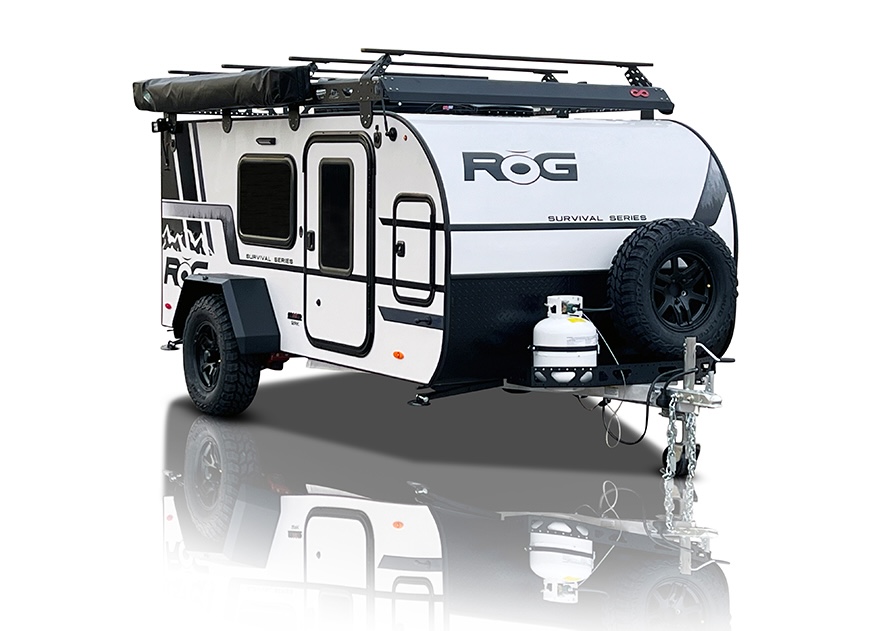
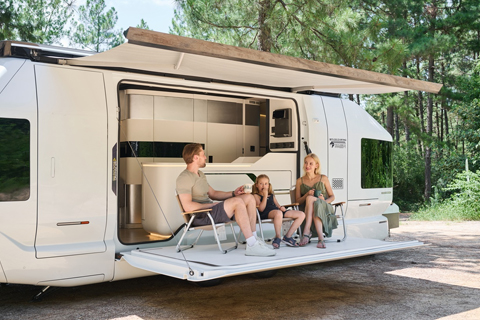
At first glance, this is genius! A pint-sized trailer, less than 4 feet high, that manages to include a wet bath with a stand-up shower. How is that possible? Actually, it’s surprisingly easy. It just took some creative thinking to make it happen.
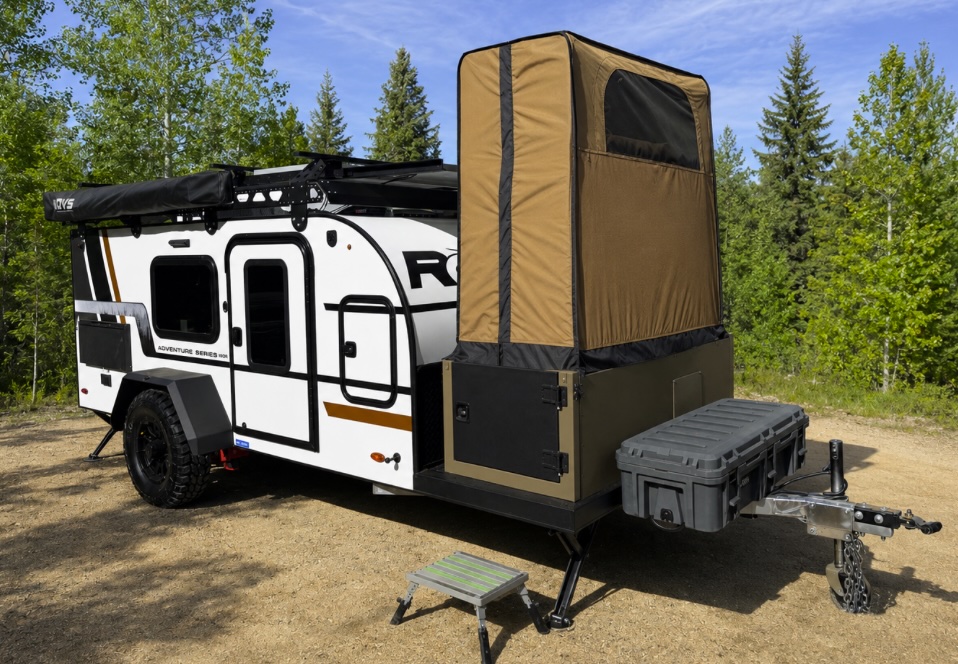
The bathroom, you see, rides on the tongue of the trailer, folded down for travel, then easily raised at the campsite.
Encore RV calls it an adventure trailer, which it could be. But I think this would be great for a couple who wanted to get away for a weekend, or even a week, and stay in a primitive campground—BLM, Forest Service, or even in the middle of nowhere on government lands — to enjoy the outdoors and sleep protected from the weather, and have a private commode and a standard-sized shower to freshen up.
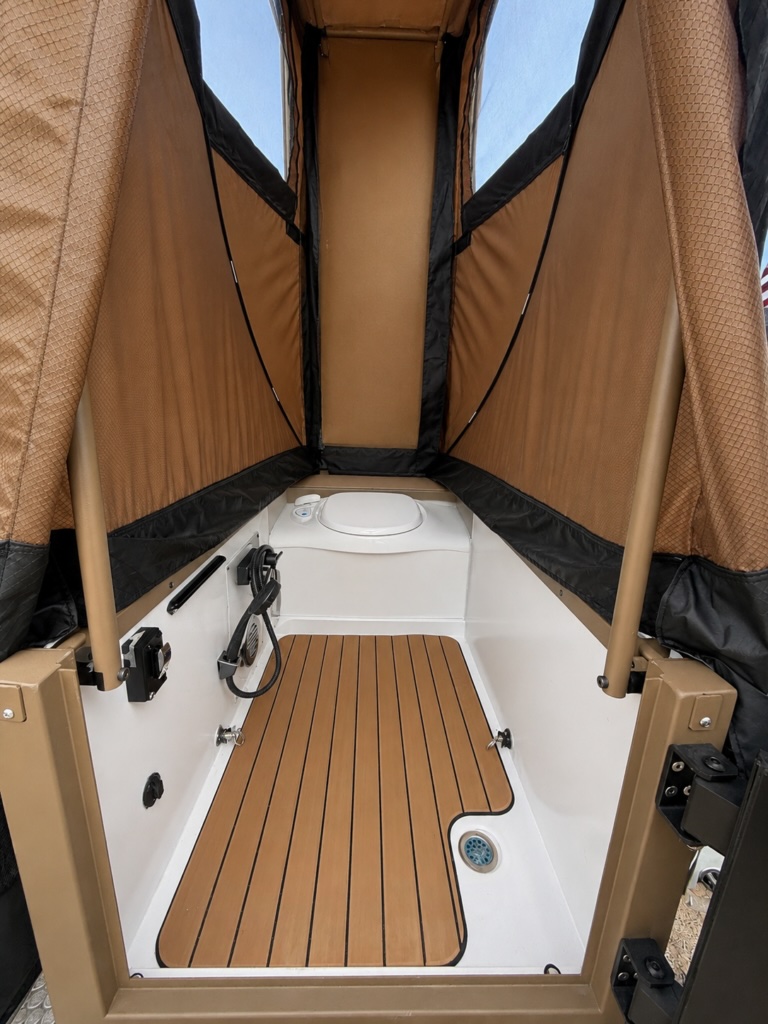
Toilet and shower are easy to set up in a minute or so.
The new RŎG 12RK-FB and 12BH-FB models include a front-mounted bath module that rides on the trailer tongue and folds down when not needed. When closed, it resembles a storage box. Deployed, it becomes a wet bath with a shower and cassette toilet.
Bath module
The trailer is built on Encore’s lightweight RŎG platforms, aimed at campers who want off-grid capability without moving to a larger RV. The aluminum bath module uses a pop-up tent enclosure with screened windows for airflow and magnetic closures intended to simplify setup. Heat from the trailer’s 18,000-BTU furnace can warm the bath area during cooler weather.
Rog Shower
The trailer carries 43 gallons of fresh water and includes an on-demand hot water system designed to support extended dry camping. When folded for travel, the top of the bath module doubles as cargo space and can carry gear or up to two bicycles.
Encore says the trailer uses wood-free construction with an all-aluminum frame and chassis to reduce weight and improve durability. The unloaded weight is about 2,800 pounds, with a low tongue weight intended to keep it towable by many midsize SUVs and trucks. The compact design also allows storage in most standard garages, potentially avoiding paying for storage.
The walk-around video below from Encore RV highlights the trailer’s compact footprint and the easy set up of the bathroom. You can learn more about the trailer at the company’s website.
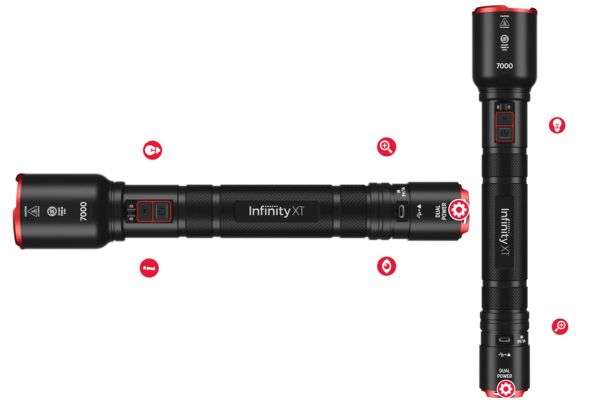
A strong, reliable flashlight is essential gear for any RVer. If you’re in the market for a new one—or your old flashlight is due for an upgrade—you’d be hard-pressed to find a more versatile option than the Infinity X1 7,000-lumen dual-power rechargeable flashlight. Yes, it’s a powerful flashlight, but what really sets it apart is its flexibility.
What I especially like about the Infinity X1 dual power rechargeable flashlight
• Dual power means you will NEVER be without light. It comes with a rechargeable lithium-ion battery as well as nine Duracell AA batteries, so if one power source runs out, you have a backup ready to go. I haven’t had to use the Duracells yet since the flashlight recharges easily via USB. But it’s reassuring to know they’re there if needed.
• The exterior is made of durable aircraft-grade aluminum.
• It has a USB output charging port you can use to charge your phone and other small devices.
• It has low, medium, and high light intensity settings.
• At 7,000 lumens, it is SUPER BRIGHT!!! Seriously, almost blindingly bright—which could be a real advantage in a self-defense situation. At full power, it also throws light up to 250 meters (about 820 feet).
• Speaking of self-defense, this is a sturdy, heavy-duty flashlight that could double as a club if necessary in an emergency situation.
What can be improved?
At the highest power setting especially, the lens can get quite hot if used for extended periods. That’s something to keep in mind. One reviewer suggested this might have been avoided with LED technology, though it’s possible the company’s hybrid power system influenced the design choice. Either way, heat buildup is the one notable downside I found.
You also need to exercise care, as this light is so bright, you would not want to shine it directly in someone’s eyes (unless it was a self-defense situation).
More information or to order
If you are a Costco member, you can pick up one of these flashlights at the store or order directly online from Costco. It is also available on Amazon.
I received this question on uneven tire tread wear:
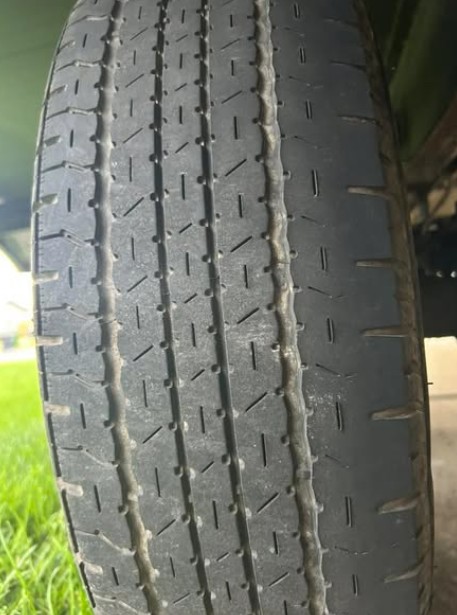
“Goodyear Endurance tires, rear axle. My left rear tire has wear only on the inside. The right side is also wearing on the inside, but not as badly. The front axle is fine. About 6500 miles on them.“
Uneven tire tread wear
My answer
As a Tire Design and Forensic Engineer with 50 years of experience, including some design patents, I can tell you that uneven wear, as you are describing, is almost certainly caused by the wheels being out of alignment. You can confirm with a tool you can use yourself.
This is a tire camber gauge.
Tire camber gauge
This tool is available from many on-line companies for less than $12, including Amazon. You could spend a lot more, but for your purposes, I would suggest that would be a waste of money. You can confirm the most likely cause if the camber is more than 1.5° Negative Camber with your tire having the top tilted inward.
Trailer axles are seldom adjustable, so you will need to find a shop that can “bend” the axle or replace it. If BOTH tires are “out of spec,” then it may be easiest to replace the axle.
“It is better to travel well than to arrive.” —Buddha
Need an excuse to celebrate?Today is National Creativity Day! We love being creative!
On this day in history: 1911 – At the Indianapolis Motor Speedway, the first Indianapolis 500 ends with Ray Harroun in his Marmon Wasp becoming the first winner of the 500-mile auto race.
Featured news
Your next RV may have a much more complicated electrical system than your old one
As RVs add larger lithium battery banks, solar systems, and powerful inverters, the industry is updating safety standards to keep pace. Engineers recently met in Elkhart to discuss new electrical-system rules aimed at addressing the growing complexity behind today’s RVs. Here are the details.
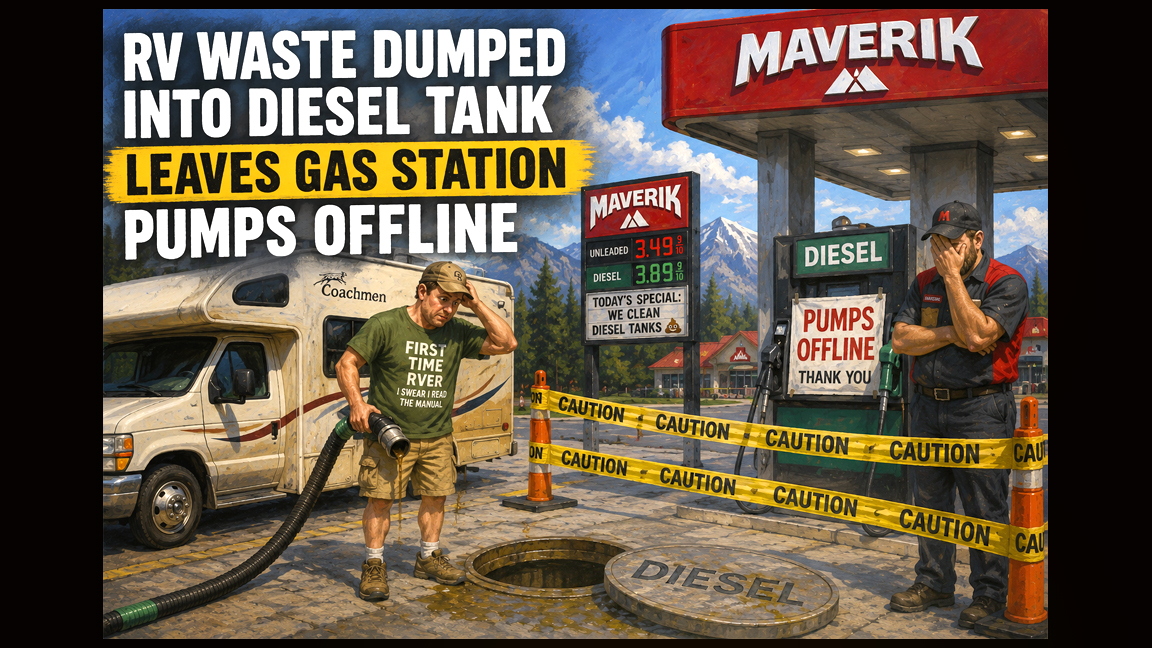
RVer dumps sewer tank into gas station’s diesel tank. Big time bad news! Most RVers worry about putting gasoline into a diesel truck. One Colorado RV driver apparently managed something far worse. A bizarre mishap at a Maverik gas station near Colorado Springs left diesel pumps shut down after an RV driver reportedly emptied black tank waste into an underground diesel storage tank instead of a proper dump station.
$67 million in National Park visitor fees redirected to Trump’s D.C. projects
RVers who buy national park entrance passes or pay gate fees often assume that money stays close to the parks they visit. But that’s only partly true. The National Park Service is using at least $67 million in park entrance fee revenue to help pay for projects in the nation’s capital. That includes repairs to ornamental fountains and work on the Lincoln Memorial Reflecting Pool. Here’s the story.
Lawsuits keep piling up at one Camping World dealership
Camping World dealership lawsuits don’t usually make national news, but a growing number of cases filed against one South Carolina location are attracting attention from RV owners around the country. Customers allege a variety of problems involving RV defects, repairs and service after purchase. Yikes…
Starlink Mini may be getting a built-in battery
The Starlink Mini has become a popular piece of gear among RVers who need internet where cell coverage is spotty or nonexistent. It’s small, relatively easy on power, and easy to tuck away when it’s time to move on. But there’s still one thing most users have to bring along: a battery. Now, SpaceX may be working on a way around that.
Homeless veteran gives up his dog to get help. Then an RV changes everything
Sometimes a story comes along that reminds us an RV can be more than a way to travel. After Texas veteran Brian found himself homeless, he made the painful decision to leave his dog, Jake, at a Fort Worth fire station. What happened next eventually brought RV housing, a second chance and a reunion with his four-legged companion.
This fifth wheel hitch bent badly—and somehow stayed together for 300 miles
A fifth wheel owner recently posted photos showing a fifth wheel hitch failure so severe it is hard to believe the setup stayed together for another 300 miles. The owner said they discovered the damage only after the trip was over. If this showed up in your truck bed after a travel day, your stomach would probably hit the floor.
Your tow vehicle may be hotter than your RV. Here’s how to cool it faster
Sometimes the hottest part of an RV trip isn’t the RV at all. RVers looking for ways to cool a tow vehicle faster during summer travel know how quickly a truck cab can turn into an oven. The same can be said for that toad car. A recent article from Southern Living looked at ways drivers can cool down a scorching-hot vehicle faster in summer.
The RV market just sent a mixed signal: Towables down, motorhomes up
If you’ve been hoping RV prices might soften a bit—or wondering whether the RV market is finally cooling off—the latest shipment numbers may be worth watching. But this time, they look a little different…
RV carbon monoxide alarms are changing
A new line of RV carbon monoxide and propane alarms announced this week does more than introduce new products. The alarms are built to updated safety standards, and one key change addresses a question many RVers never consider until it’s too late: What happens to the detector if the RV loses power?
Fuel prices may not stop RVers, but may change how far they go
For many RVers, the question this summer may not be whether to travel—it may be how far. A recent report from a Northern California campground suggests rising fuel prices could be influencing travel decisions. Managers at one North Bay campground say they’re seeing more visitors from nearby communities and fewer travelers arriving from longer distances. Continue reading.
Long lines, full parking lots and traffic jams: Yosemite’s no-reservation summer gets its first test
If Yosemite National Park’s first big holiday weekend without entry reservations was supposed to prove the system could handle summer crowds, many visitors left unconvinced. Long entrance lines, overflowing parking lots and traffic jams greeted thousands of Memorial Day weekend visitors as Yosemite’s new reservation-free approach faced its first major test.
FACTOID:Nearly 85% of wildfires in the United States are caused by people and are preventable.
NEW PRODUCTS FOR RVERS! Did you know Amazon has a whole section for just-released products? These are all the newest products in their automotive category. See if there’s something you want or need.
RV review USA debut: Skydream is a trailer George Jetson would love
A lot of RVs promise smart features. The 2026 Skydream Space Camping Travel Trailer is built around them. This 28-foot travel trailer mixes sci-fi styling with self-parking, huge battery capacity, and a cabin full of motors, screens, and hidden storage. The result feels less like a normal camper and more like a rolling tech lounge. Now available in the U.S., we get a tour of this unique RV.
Beyond the headlines with Tony Barthel
New RV safety standards are a good thing
New safety standards are coming to RVs, and Tony Barthel says they’re long overdue. From mandatory tire pressure monitoring systems and improved electrical protection to better communication among RV components and the growing use of anti-lock brakes, the RV industry is making changes designed to keep RVers safer on the road. Some of these features won’t be required until the 2028 model year, but Tony explains why they matter and what you should look for.
News briefs
Thursday was the 102nd anniversary of the U.S. Border Patrol.
The RV Industry Association continues to warn about supply chain disruption and higher RV manufacturing costs tied to tariffs and trade uncertainty. Manufacturers are talking about price increases on some models and components. That could mean higher prices for new RVs later this year, more expensive replacement parts and longer waits for repairs and upgrades.
A historic site in Georgia could become America’s 64th national park. The 3,000-acre Ocmulgee National Historical Park preserves ancient Muscogee lands with roots dating back 17,000 years, and legislation to redesignate it as Georgia’s first national park is currently pending in Congress.
Shenandoah National Park will conduct periodic sobriety checkpoints from June through Nov. 15 along Skyline Drive as part of a traffic safety campaign during the park’s busiest season.
The world’s only all-glass gondola ride has opened in east Tennessee. Located in the Anakeesta adventure park in the Great Smoky Mountains, the Crystal Express travels more than 600 feet above downtown Gatlinburg, ascending more than 2,000 feet up the mountainside as riders experience the sensation of floating.
An alligator was spotted and captured earlier this week at the Seven Oaks RV Resort in Mission, Texas. Nobody was eaten or even harmed. The city is trying to find a home for the trespasser.
Trail Ridge Road, the highest continuous paved road in the U.S., has reopened for the season in Rocky Mountain National Park, though drivers should still watch for possible icy conditions at higher elevations.
Better not feed any bears in Colorado. Of course, you shouldn’t feed them anywhere. But, in Colorado, the penalty for feeding Yogi or Boo Boo just got stiffer. Here are the hefty penalties.
Zion National Park has implemented Stage 2 fire restrictions due to increasing fire danger and dry conditions across Southwest Utah. Also, the park has reopened South Campground. Make reservations.
Texas is getting a new giant state park. Texas Parks and Wildlife has acquired 54,000 acres about 150 miles west of San Antonio to create Silver Lake State Park, which will become the state’s second-largest state park. The new park will surpass both the 39,000-acre Chinati Mountains State Natural Area, which remains closed to the public, and the 37,000-acre Devils River State Natural Area.
Oregon State Parks will waive day-use parking fees for residents to all its parks on June 6.
Spring is a beautiful time to RV, hike, and wander. However, it’s also birthing season for big game animals. So, watch out, RVers! The National Park Service is warning you to stay away from wildlife this time of year, as their young may be nearby, making them more aggressive than usual.
NOW OPEN: The Beartooth Highway (US-212) from Red Lodge to Cooke City, Montana, is now open for the season. Temporary travel restrictions or closures still can occur at any time without notice. Prepare for winter driving conditions, have flexible travel plans, and watch for quickly changing weather conditions.
A 6-year-old child died last Saturday after being struck by a travel trailer at Link Creek Campground near Suttle Lake in Central Oregon. Authorities said after the child had retrieved a stuffed animal, he entered the area between a slow-moving tow vehicle and trailer, where the driver likely could not see him.
The national average for a gallon of regular gasoline is down 12 cents from last week at $4.42 amid reports of peace talks with Iran. But AAA notes they could spike again if a ceasefire deal isn’t reached.
The new Northport RV Park in Northport, Alabama, is expected to open this June, after being in the works for several years.
Yosemite National Park has changed its fishing policy in Yosemite Valley from seasonal to year-round. Seasonal closures that previously restricted winter fishing access have been removed.
A hiker was attacked by a bear in Glacier National Park on May 21, just weeks after a fatal bear attack elsewhere in Montana. Witnesses near Lake Josephine reported hearing screams before a member of another hiking group ran back yelling, “Bear attack!”
The Montana Department of Transportation was expected to begin resurfacing sections of Interstate 90 between Saltese and Haugan, mile markers 11.2 to 15.7, this week through August. Motorists should expect delays, reduced speeds and single-lane traffic.
And, lastly, be grateful you’re not this woman, who, after breaking every rule about approaching wildlife in Yellowstone National Park, faceplants as she runs from a bison.
A DEET-free mosquito and tick repellent … that works! If you’re one of those people that mosquitoes love (we all know at least one person like this), this product is for you. A very impressive number of five-star reviews. This awesome DEET-free insect repellent works for mosquitoes, ticks, black flies and fleas. Keep this one handy, folks. As RVers, there’s a good chance you’ll probably need this. Learn more or order here.
BE CAREFUL ON THE WATER! Alcohol is responsible for 1 in 5 boating deaths in the United States, where the primary cause is known.
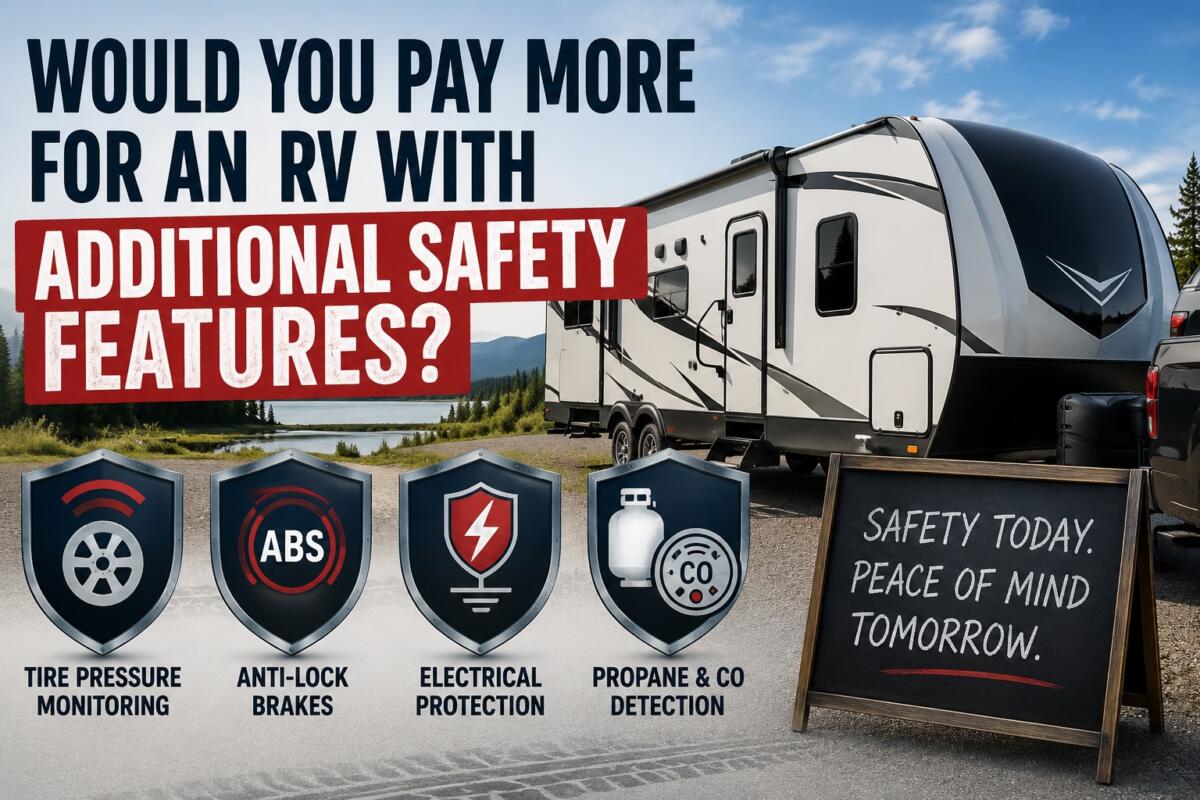
Reader poll Would you pay more for an RV with additional safety features?
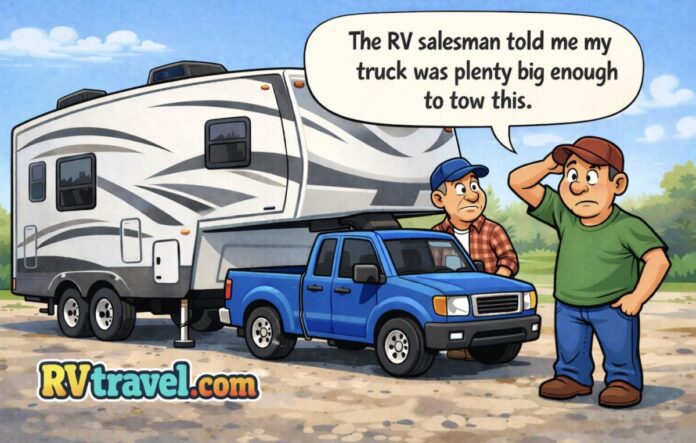
You may share this Tanner Toon, unaltered, on your website, blog or social media with our compliments. The musings from Tanner Woods’ creative mind appear in this newsletter every Saturday and Sunday and in many RV Daily Tips newsletters through the week. Sign up for our RV Daily Tips Newsletter so you don’t miss them.
RV and RV-related recalls
• Brinkley RV is recalling certain 2025-2026 Model Z trailers. The shock bolts may have been incorrectly tightened, which could become a road hazard. Recall: REC-2602. Info: 574-501-4280. •General Motors is recalling certain 2018 Chevrolet Silverado 1500, GMC Sierra 1500, 2019 Chevrolet Silverado 2500, Silverado 3500, GMC Sierra 2500, and Sierra 3500 vehicles. The left-side or right-side roof rail air bag inflator end cap may detach from the inflator or the inflator sidewall may rupture. Recall: N262557310. Info: 800-222-1020. •Tiffin is recalling certain 2025-2026 GT1, 2026 GH2, and GH1 motorhomes. A screw may have punctured the fuel tank during manufacturing, causing a fuel leak. Recall: TIF-148. Info: 256-356-8661. •Ford has recalled 16,200 model year 2021-2022 Broncos equipped with Molded-In-Color hard tops. Roof pieces may crack and become loose, and detach. More details.
Stolen RV
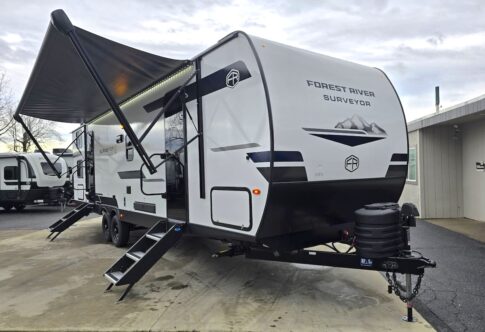
Keep your eyes out for this brand-new 2026 Surveyor Camp 29 trailer (VIN: 4X4TSVE21TL052815), which was stolen from an Anderson, Calif., RV dealership (near Redding) on May 8. It was new, unregistered, with no plates. Surveillance video shows it being towed away by a white, 4-door truck. A reward is offered for info leading to recovery and/or arrest. Know something? Contact the Anderson Police Department. Confidential tips are welcome.
? MYSTERY PRODUCT OF THE DAY ? Do you stay up later than your partner or do they stay up later than you? Whoever goes to bed earlier probably doesn’t want all the overhead lights on, right? Well, this will certainly help. This is very smart!
The circumference of the Earth at the equator is 25,000 miles. The Earth rotates in about 24 hours. Therefore, if you were to hang above the surface of the Earth at the equator without moving, you would see 25,000 miles pass by in 24 hours, at a speed of 25000/24 or just over 1000 miles per hour.
Laugh of the week
Top scams RVers should watch for right now
Summer travel is underway, and scammers are taking advantage of crowded campgrounds, busy highways, and travelers making reservations on the go. Here are three scams RVers should watch for this week:
Fake campground websites: Scammers are creating lookalike websites for popular campgrounds and RV parks. You think you’re making a reservation, but your payment goes straight to a scammer—and no reservation exists when you arrive.
Roadside assistance membership scams: Emails and texts claim your roadside assistance plan is about to expire and urge you to renew immediately. The message often includes a payment link that steals your credit card information.
Facebook Marketplace “RV accessory” scams: Deep discounts on generators, solar panels, towing gear, and other popular RV equipment continue to lure buyers. The item either never ships or isn’t what was advertised.
These scams all rely on the same tactic: creating urgency. If someone wants your money immediately, take a few extra minutes to verify before you pay.
Something wrong with your RV? To diagnose, first test the airflow
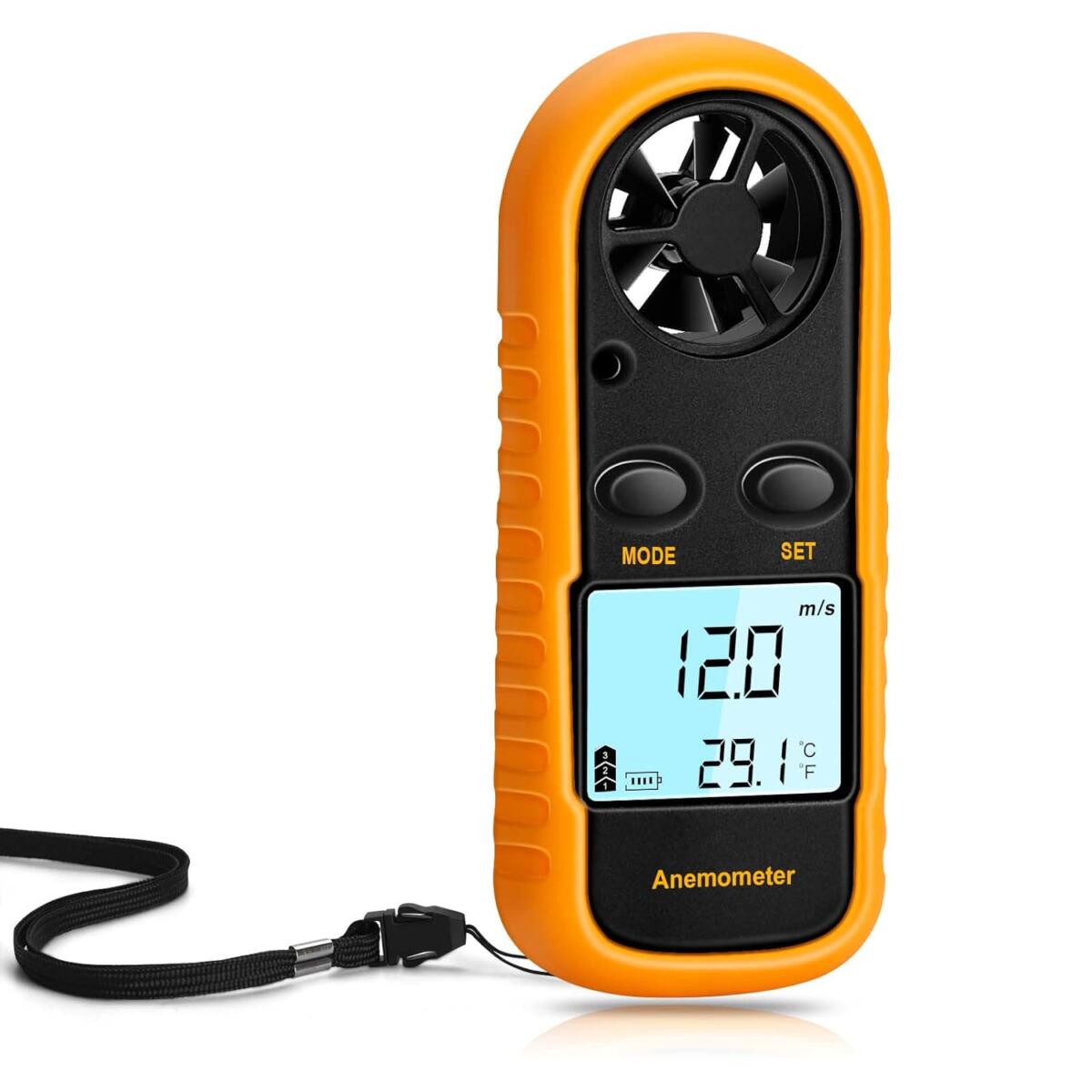
Dave Solberg writes, “To troubleshoot properly, you need to know how a component should operate and get accurate readings for temperature, voltage, airflow, and more. This airflow meter—an anemometer—measures airflow per minute and temperature.” It’s one of Dave’s top-recommended tools. Read his article or order one here.
Today in history
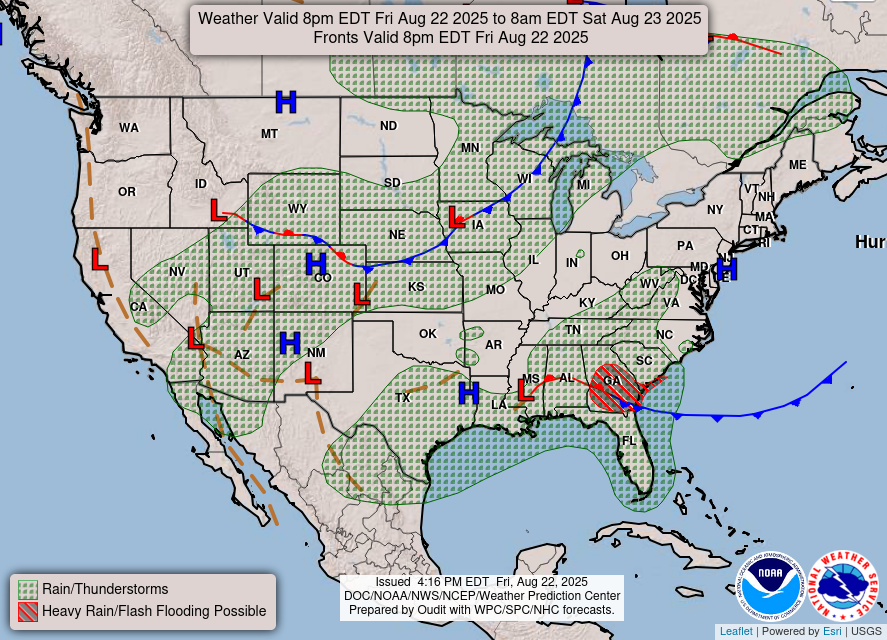
Today’s weather forecast across the nation THIS MAP UPDATES TWICE A DAY
One of the more constant things in life is change, and there are a bunch of new changes rolling out as new standards in the RV industry. To my eyes, they’re all a really good thing.
Like the auto industry of the past, RV companies will generally build a product with as few safety systems as they can get away with. That makes sense because buyers have historically shown a preference for cheaper products rather than safer ones.
Do you remember how some car dealers would cut the seat belts out of cars in the late 1960s, or tell buyers they could just stuff them under the seats? While we tend not to want to pay for new safety technologies when they first appear, we often come to demand them once we’ve seen their benefits.
Typically, though, few companies want to be the first to add something because of the added cost or resistance from some buyers. Going back to seat belts, I remember people saying they’d rather be thrown clear in an accident than be trapped inside a car.
The RV industry is, for the most part, self-regulated. While the book of regulations for the auto industry is like the New York phone book (are there any more phone books?), the RV industry is more self-regulated, and most of that is through the RV Industry Association (RVIA). This was brought up at the most recent RV Industry Power Breakfast, where several dealership principals were on stage discussing the state of the industry and customer dissatisfaction.
“If we don’t take care of things ourselves, then the regulators are going to come on us…”, said Ben Hirsch, COO of Campers Inn RV. “It is the wild west and the customers are screaming for this. This is one of the things we’re going to have to get ahead of as an industry otherwise we’re going to be regulated upon.”
A number of new things are coming within the next model year or two, and I think every one of them is a good thing.
Banded tire pressure monitor
Tire pressure monitoring
I can’t imagine ever buying a towable RV without a tire pressure monitoring system (TPMS). This type of tech has saved me from a potential disaster several times. I am so happy that the RV industry has made tire pressure monitoring technology a standard for all towables beginning with the 2028 model year.
Of course, several RV companies have offered this as standard equipment for years now, and this has been a factor in why I bought what I bought. IYKYK. [If you know, you know,]
If your RV maker doesn’t care enough about you to install this type of technology now, you can always add it after the fact. I strongly suggest that you do.
The interesting thing about this standard is that it doesn’t specify what type of system must be used. As a result, some trailers could have band-mounted systems, where the tire pressure monitor is attached to the inside of the wheel, much like on most passenger cars. Others could use valve stem-mounted systems. Or they could use something I haven’t even considered.
Your RV and how it talks to itself
The details of this are still being worked out. At present, there really isn’t a lot of control over how systems inside an RV work. For example, if you buy one brand of air conditioner, it doesn’t necessarily work with other brands of thermostats. When I upgraded my RV’s A/C to the Furrion Chill Cube, it was a big deal to figure out how the thermostat interacted with the A/C unit.
Being the nerd that I am, I recently changed A/C units again to try another new product (I keep hinting at this). Once again, we had to figure out the wiring for the thermostat.
With this kind of thing in mind, the RVIA is working on a series of standards for how things inside the RV communicate with one another.
RV-C was created by the RV Industry Association to provide a standardized, open communication protocol for recreational vehicles, built on the proven CAN (controller area network) bus framework. Its purpose is to enable seamless interoperability among multi-vendor RV components—such as lighting, HVAC, power, and chassis systems—while simplifying wiring, diagnostics, and control.
By replacing proprietary and incompatible systems, RV-C reduces manufacturing complexity, lowers costs, and allows for easier integration and maintenance across diverse RV platforms. This industry-wide recommended practice ensures that modern RVs can operate more efficiently, reliably, and intelligently through a unified data and control network.
This would be a great change and, of course, we’ll keep you in the loop as it progresses.
GMI is another good thing
Another good thing coming our way is something called Grounding Monitor Interrupters, or GMI.
Essentially, this is a protection technology that will be installed on all RVs beginning in the 2028 model year. What this does is measure the ground at the pedestal and, if the ground is no good, it shuts the power off.
At present, the technology is still being developed, but know that the GMI device will be installed in the RV and will shut the power off if it detects an issue with the ground. This is a big safety plus, and while I know it will cause a lot of confusion at first, it’s a good thing.
Unfortunately, there has been a tremendous amount of misinformation surrounding this technology, thanks to a press release written by AI. But it’s also important to know that, at present, there isn’t a great way for RV parks to test their pedestals except to make sure they’re correctly wired.
Talking to Mike Sokol, the RV electricity expert, about his involvement in this technology and some of the takeaways includes the fact that there really won’t be an aftermarket system initially, just because demand for new RVs will likely consume much of the supply. But who knows?
Anti-lock braking
In 2011, equipping your new vehicle with anti-lock braking (ABS) became the law of the land, and we’re so much better for it. Semi trucks and trailers, too, have been required to have ABS since 1997! In fact, there’s even a light on semi-trailers that indicates if a fault is detected, and you know law enforcement is keeping an eye out for those lights.
But travel trailers and fifth wheels are not required to have ABS. In fact, it wasn’t until recently that it became readily available for towables.
What ABS can do is shorten stopping distances by quickly pulsing the brake system if it detects that a loss of traction is occurring. It also helps with keeping control of the vehicle, since it helps to maintain traction on the road.
Once again, this is one of those things where I encourage you to shop from the road up for your next RV. I urge you to look for anti-lock brakes because a few manufacturers are incorporating this as a standard feature on their new RVs.
You can also have an ABS system installed if you don’t have it already. Lippert and Dexter both make really good systems.
New propane monitors
As usual, Russ and Tiña De Maris have a great, detailed article about the new standards for propane and carbon monoxide detectors. But there is a new, more common-sense technology coming out in the propane and carbon monoxide detector world that just makes a lot of sense.
Other than being very much in favor of these new monitors, I don’t have anything to add to the article on this, so I suggest you go check it out.
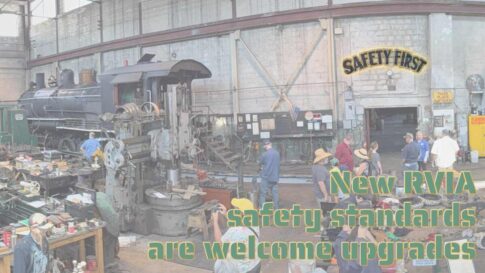
Safety First – RVIA standards making RVs better
Safety first
I’m all for logical improvements to the systems that keep us safe. I know there’s always pushback on these for a variety of reasons, including the cost, /but I’d rather be alive and have spent some money than not be alive and realize that I can’t take it with me.
I applaud the changes coming to the 2028 RVs.
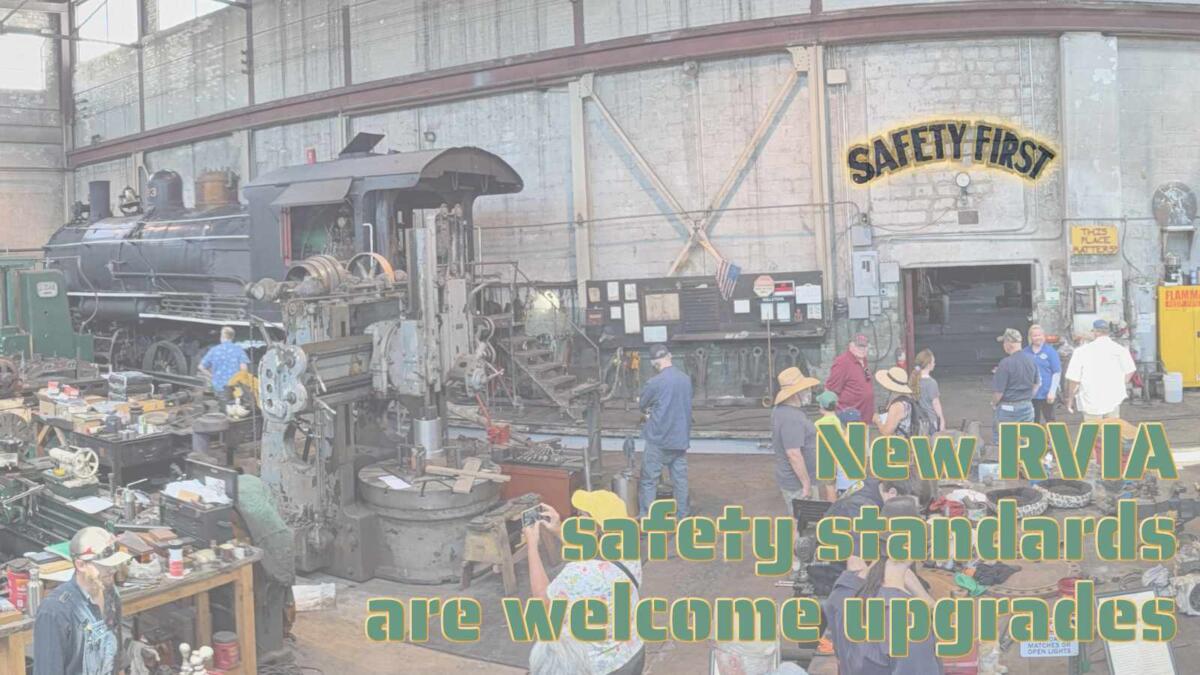
Incidentally, the photo that I used as the hero (featured) image for this came from my visit last year to the Nevada Northern Railway. This tourist train is one of many that I’ve visited. Its slogan, “Safety First”, is on everything. The photo I chose is of their extensive shops.
If you’ve shopped for an RV recently, you’ve probably noticed that manufacturers love to advertise features that make camping more comfortable. Bigger TVs, larger refrigerators, theater seating, outdoor kitchens, and giant battery banks often get top billing.
That raises an interesting question: How much do RV buyers really value safety?
Historically, consumers haven’t always rushed to pay extra for new safety technology. Seat belts, airbags, anti-lock brakes, and backup cameras all faced resistance when they first appeared. Today, most of us wouldn’t want to own a vehicle without them.
RVs may be heading down a similar path. While additional safety systems can add cost, they may also help prevent accidents, reduce damage, and provide greater peace of mind while traveling.
When you shop for an RV, do you actively look for safety features? Would a built-in tire pressure monitoring system or anti-lock brakes influence your buying decision? Or would you rather keep the purchase price lower and add only the features you feel are necessary?
We’re curious where you stand on the balance between cost and safety.
Please vote in the poll below, and if you’d like, leave a comment explaining which safety features you think every RV should have. Thank you!
A lot of RVs promise smart features. The 2026 Skydream Space Camping Travel Trailer is built around them. This 28-foot travel trailer mixes sci-fi styling with self-parking, huge battery capacity, and a cabin full of motors, screens, and hidden storage. The result feels less like a normal camper and more like a rolling tech lounge.
Now available in the U.S., we get a tour of this unique RV in the video at the end of this post from the team at Beer Run Bus.
A fiberglass camper with self-parking built in
At 28 feet long and up to 8,980 pounds, the Skydream has no slide-outs and uses a full fiberglass body. It can hitch or unhitch with a button, then park itself, so tight campsites look a lot less stressful. Sensors circle the trailer, and a 360-degree camera system works on the road and as security when parked.
Usable space is simple but smart. The front pass-through is the main storage bay, while a powered rear deck drops down and an exterior table rises out. The awning deploys by button and closes in high wind. The door pops out its handle, lowers a step, and includes small hooks for keys or a bag.
Inside, the cabin leans hard into automation
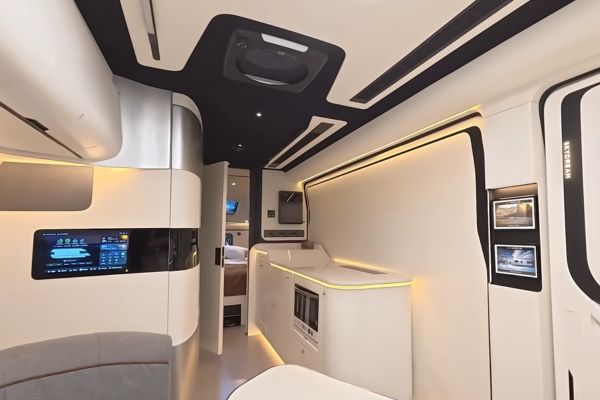
Inside, the cabin feels clean and bright, almost like a showroom. The L-shaped sofa converts to a bed, the main table moves up and down on command, and a large screen handles lights, tanks, battery status, weather, and voice control. A removable tablet repeats those controls outside, so the trailer, deck, and lighting can all be managed from outdoors.
Entertainment is heavy for a compact camper. The lounge gets a projector and ceiling screen, plus a second TV across from it. Automatic acrylic windows, powered shades and screens, airline-style overhead bins, star-like ceiling lights, and a roof fan with its own shade finish the space.
The layout makes a small trailer feel loaded
The kitchen packs in solid-surface counters, a two-burner induction cooktop, a pop-up vent, a microwave, filtered water, and smart storage. Cabinets lock shut, utensil dividers lift out for cleaning, plate shelves adjust, and the fridge/freezer hides behind sleek panels. There’s even a compact washer-dryer combo and a tall slide-out pantry with pegboard storage and a full mirror.
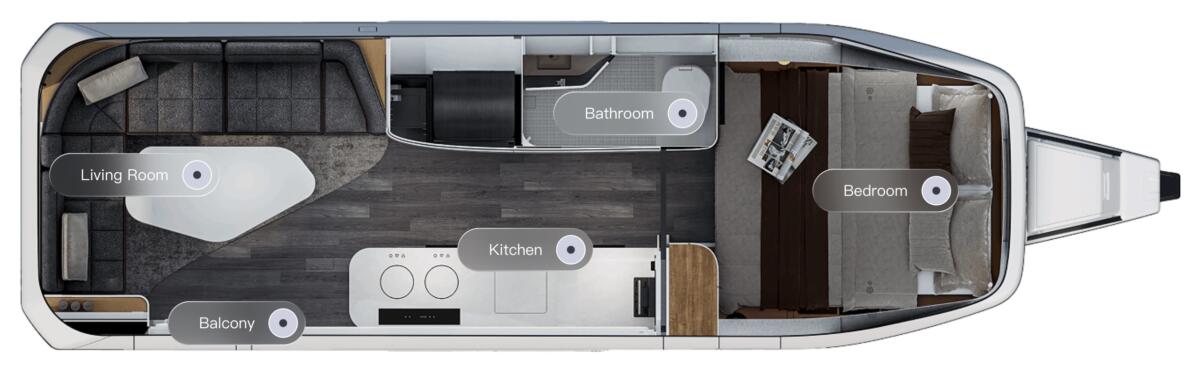
The split bath can work as a wet bath or open to a separate toilet area. It includes a retractable shower head, a lit mirror, storage, a compost toilet, a window, and an exhaust fan.
Up front, the bedroom fits a king bed, suede walls, a skylight with shades, lots of windows, charging ports, HDMI, cup holders, a TV, a projector screen, and pocket doors. The trailer even comes with a built-in robot mop!
Big battery specs push it past normal RV territory
The power setup is the headline. Skydream says the trailer can carry up to 2,000 watts of solar and up to 85 kWh of lithium batteries on a 48-volt system. Charge time from 30 percent to 80 percent is 2.5 hours, and the trailer can also back up a house during an outage or charge an EV.
It also looks ready for cold weather. A 15,000 BTU air conditioner and heat pump sit under the trailer; the underbelly is enclosed and heated, and the batteries can self-heat. Interior height is 6 feet 7 inches.
Final thoughts
This prototype is expected in the U.S. in Q3 2026, at a rumored $150,000. Some production details may change before launch, but the idea is already clear: The Skydream Space Camping Caravan is a rare RV that feels built around automation first, then camping second, and that’s why it stands out.
This trailer is definitely not for everyone. But if you are a tech-savvy, gotta-have-the-latest-in- innovation-type of person, here’s your next big purchase!
Most RVers worry about putting gasoline into a diesel truck. One Colorado RV driver apparently managed something far worse.
A bizarre mishap at a Maverik gas station near Colorado Springs left diesel pumps shut down after an RV driver reportedly emptied black tank waste into an underground diesel storage tank instead of a proper dump station. Cleanup crews had to respond while station employees blocked access to the affected pumps.
A lot of experienced RVers probably winced reading that.
Among RV owners, dumping mistakes are the sort of thing people joke about around a campfire. That’s usually right after sharing stories about sewer hoses coming loose, forgotten tank valves, or the occasional black‑tank geyser.
But this situation moved far beyond embarrassing campground stories. Once waste enters a fuel storage system, cleanup gets complicated and expensive fast. And, yes, somewhere out there, a diesel engine technician is having a very, very bad week.
Why this became a serious problem
Modern gas stations store fuel underground in large tanks connected directly to the pumps. If contamination gets in, station operators often have no choice but to shut pumps down until inspectors and cleanup crews determine what’s affected.
That means fuel deliveries may stop, tanks might need inspection, contaminated fuel could require disposal, pumps can remain offline for days, and cleanup costs climb fast.
For RVers towing large fifth wheels or motorhomes, losing diesel pumps at a busy station can turn a simple pit stop into a minor nightmare—especially during peak travel season.
Experienced RVers are baffled—but not entirely shocked
Longtime RVers will probably wonder how somebody could confuse a dump station with a diesel fill port. Most dump stations are clearly marked, with concrete pads, rinse water hookups, and sewer connections built specifically for RV waste. Fuel tank access ports, meanwhile, are typically heavy metal covers in the pavement near pump islands. In other words, they generally do not look remotely alike.
Still, campground operators and rental companies say confusion among first-time RV users is more common than many seasoned RVers realize. Rental RVs have brought thousands of newcomers into RVing. Many arrive with little understanding of black tanks, gray tanks, or dump valves.
One operator summed it up plainly: “The dump stations are very obvious.”
The mistake every experienced RVer avoids
“The dump stations are very obvious.”
Veteran RVers develop habits that become almost automatic. They slow down before dumping tanks. Double-check labels. They confirm sewer hookups before pulling valves. They keep disposable gloves nearby.
Sometimes those stories involve shoes. Sometimes they involve hoses. And apparently, once in a great while, they involve a diesel storage tank.
Many experienced RVers also say they never dump tanks at night unless the area is brightly lit. Others avoid distractions during setup and teardown because mistakes tend to happen when people are tired, hurried, or embarrassed to ask questions. And, yes—there are times when you feel like the universe is personally testing your ability to read a sign. Or, in this case, laughing behind someone’s back.
Why renters especially need walkthroughs
This incident also highlights something RV dealers and rental companies already know: New RV owners often get information overload on delivery day. Water heater bypass valves, electrical hookups, slideouts, leveling systems, propane operation, battery disconnects, and holding tanks all get explained at once. A first-time owner may nod through the orientation while retaining only half of it—if that much.
That becomes a problem when they pull into a crowded fuel station after a long day and suddenly realize the black tank needs attention. Experienced RVers recommend newcomers practice dumping at a campground before traveling, watch walkthrough videos, keep printed instructions in the RV, ask questions instead of guessing—and never assume a random ground opening is a sewer connection. Seriously, don’t do that.
The bigger takeaway for RVers
Stories like this spread fast because they combine shock value with something every RVer understands: Waste systems can go wrong in spectacular ways. But underneath the humor is a practical reminder. RV systems are different from home plumbing and fuel systems, and mistakes involving fuel, electricity, or waste disposal can become expensive very quickly.
For experienced RVers, this Colorado incident may become another legendary campfire story. For newcomers, it’s a reminder to slow down, double-check signs, and maybe avoid making national news during your dump-station learning curve.
Better not feed any bears in Colorado. Of course, you shouldn’t feed them anywhere. But, in Colorado, the penalty for feeding Yogi or Boo Boo just got stiffer.
On Wednesday, Governor Jared Polis signed House Bill 26-1342, strengthening penalties to those found knowingly feeding bears.
HB26-1342 amended Colorado Revised Statutes Section 33-6-131. It removed the requirement to prove that an individual “intentionally” lured bears through mismanagement of food or edible waste and reduced the burden of proof to “knowingly.”
The bill also removed a previous requirement that first-time offenders receive a warning, enhancing enforceability. Colorado Parks and Wildlife (CPW), along with all peace officers, now have the discretion to either provide a warning or to immediately issue a violation to individuals whose knowing actions have caused some form of human-bear interaction or conflict.
“It is not always what is in the picnic basket that lures a bear,” the Governor said. “It can also be the common food waste we dispose of. Reducing human-animal conflicts starts by doing our part to properly store our trash, and lock away food waste so we can safely share our communities with our furry friends coming out of hibernation.”
“Human-bear conflicts continue to be a major safety issue for both the public and our wildlife,” said CPW Director Laura Clellan.
“This bill strengthens our ability to address these conflicts by updating the culpable mental state tied to this offense and increasing enforcement measures for individuals who knowingly leave out attractants and trash, ultimately helping us keep both communities and bears safe.”
Under current law, a person who knowingly places food or edible waste in the open in circumstances where there is a reasonable probability of luring a wild bear to the food or edible waste commits a misdemeanor offense.
HB26-1342 raised the penalty for third or subsequent offenses of luring bears from $2,000 to $5,000.
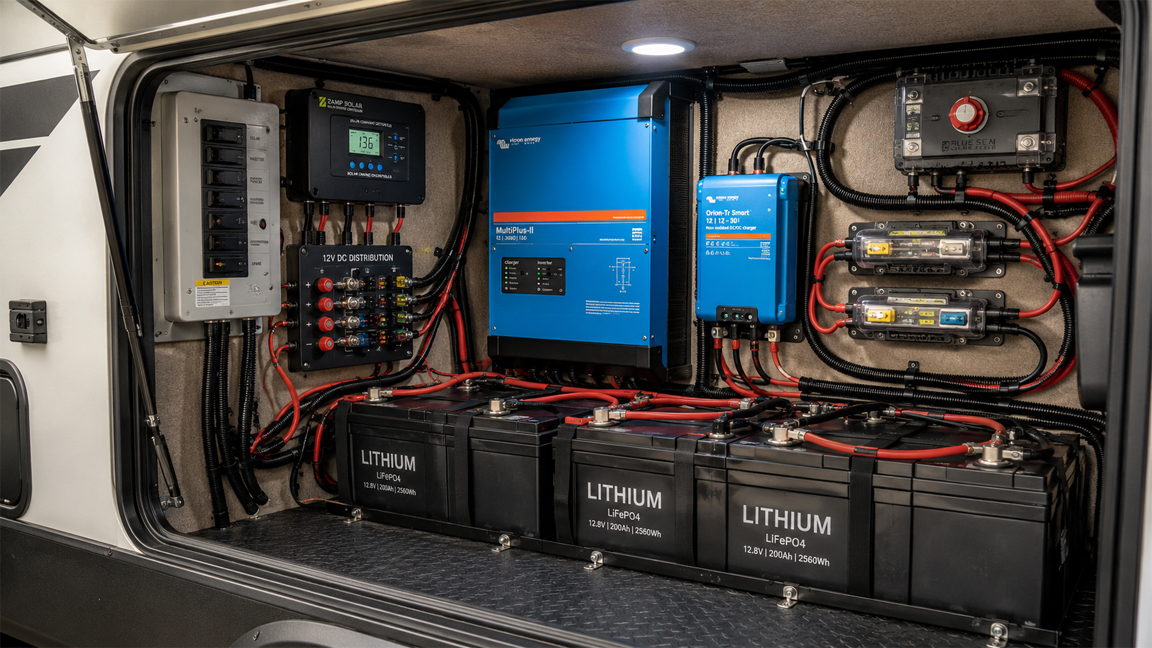
If you’ve walked through newer RVs lately, you’ve probably noticed something: big lithium battery banks, giant inverters, factory solar, residential refrigerators, and touchscreen energy monitors. Some rigs can even run an air conditioner off batteries for short periods.
And behind the scenes, the RV industry is trying to keep the safety rules caught up.
Safety rules are trying to catch up
Last week in Elkhart, Indiana, RV manufacturers and engineers gathered for a seminar on updated RV construction and electrical standards. The event covered changes to RV electrical system standards, updates to the National Electrical Code, and revisions to the main safety standards used throughout the RV industry.
That may sound like inside baseball. But it matters more than many RVers realize.
Twenty years ago, most RV electrical systems were pretty simple. A converter. A battery. A few 12-volt lights. Maybe a small inverter if somebody added one later.
Today, some RVs carry enough battery power to rival a small off-grid cabin.
Electrical systems have become far more complicated
“Some newer RVs carry enough battery power to rival a small off-grid cabin.”
As RVs add larger lithium battery banks, stronger inverters, solar systems, and higher-powered appliances, manufacturers have to think differently about wiring, battery protection, ventilation, and heat management.
That’s one reason the industry keeps updating these standards.
And, frankly, RVers have already started noticing the growing pains.
Spend enough time in owner forums and you’ll eventually see stories about overheated wiring, battery problems, tripping breakers, failing converters, or electrical systems that simply don’t behave the way owners expected. Most rigs work fine. But the systems behind the walls are far more complex than they used to be.
The RV Industry Association said the seminar included significant updates involving RV DC electrical systems. Additional materials and follow-up webinars are expected later.
What this means for RV shoppers
If you’re shopping for a newer RV, especially one with factory lithium batteries or large inverter systems, it may be worth paying a little more attention to the electrical equipment hiding behind basement panels and under beds.
Questions worth asking include:
Does the RV include proper battery management protection?
Is the inverter sized correctly for the appliances installed?
How well is the wiring supported and protected?
Was the solar system designed at the factory or added later?
Most shoppers naturally focus on floorplans, décor, and storage space. But the safest RV features today may be the ones you never see at all.
America’s Original RV Newsletter. Since 2001
Issue 2915 • New issue every weekday FREE EDITION
Today’s thought
“The secret of getting ahead is getting started.” —Mark Twain
Need an excuse to celebrate? Today is National Paperclip Day! Think a paperclip is just a paperclip? You are so wrong!
On this day in history: 1790 – Rhode Island becomes the last of North America’s original Thirteen Colonies to ratify the Constitution and become one of the United States.
Tip of the day How to keep bees away from your RV and campsite
By Gail Marsh
Nothing ruins a picnic faster for me than bees. During a recent RV trip, bees and wasps seemed to be everywhere in the campground, but especially around our campsite. We had to do something to get those bees to buzz off!
Bees and wasps are naturally drawn to sweet foods, sugary drinks, and even the scents of lotions or perfumes. Bees are usually busy pollinating and are non-aggressive unless provoked. However, wasps (including yellow jackets) can become more bothersome when buzzing around your campsite. Continue reading.
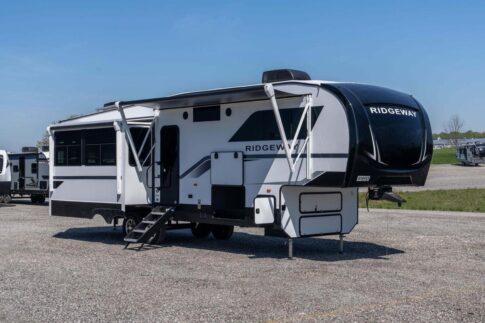
Home vibes. That’s what immediately came to my mind upon entering the 2026 KZ RV Ridgeway 32ML fifth wheel RV. This RV has plenty of space for couples and offers down-home comfort at every turn. KZ RV builds the Ridgeway on a steel powder-coated I-beam chassis. It features 5-sided aluminum framing, laminated Azdel, and composite sidewalls. You’ll also find a heated and enclosed insulated underbelly, and Dicor Tufflex™ PVC roofing. Continue reading and see what you think.
500 campgrounds worth the drive
In this comprehensive sequel to National Geographic’s best-selling 50 States, 5,000 Ideas, you’ll discover the 500 best camping destinations across the United States and Canada. You’ll find 10 featured campgrounds in every state, plus tips on what to do, where to eat, and must-see attractions nearby—from national parks to local gems. Learn more or order.
In the RV shop with Dustin Wiring tester can reassure driver that trailer lights work
Part of towing your RV responsibly is making sure your trailer lights are working properly. “Why are my running lights or brake lights not working on my travel trailer or fifth wheel?” We have all been there and asked that question one time or another, which is why you should have a tow vehicle wiring tester with you when traveling.
Article and video Are these five new RV gadgets genius or gimmicks?
Since every RV turns into a custom setup, every gadget has to earn its space. In the test in the video at the end of this post, Jared Gillis from All About RVs ran five new RV gadgets through one filter: Are they useful enough to stay in the rig? You’ll just have to find out here.
Featured article How to ask tire questions to get the answer the first time
Tire expert Roger Marble offers some general comments and requests to those posing questions about tires and specifically about how to set the inflation. As reported in more than one thread on the topic of inflation, the answers and information can be confusing to many. … It will also help when you post or email your initial question if you provide the following facts. This will save everyone time and confusion.Read more.
Ask Dave The aluminum outer skin of my 2011 Jayco is pitting. Why? How can I fix it?
Bed sheet suspenders keep your sheets in place!
We have to admit, we just recently discovered these and wondered how we didn’t know about them sooner – they’re amazing! If you have bed sheets that don’t stay in place, these easy-to-use bed sheet fasteners or “suspenders” keep them in place – no more corners that won’t stay down! Learn more or order for a great price.
FACTOID: A new study suggests older adults handle regret better than younger people. While both groups report similar numbers of regrets, older adults tend to feel less emotional distress over past mistakes and missed opportunities. Researchers said aging may help people put disappointments in perspective and focus more on acceptance and moving forward.
Quick tip Best way to park safely during strong winds
During a strong storm with high winds, try to camp with your RV pointing toward or away from the wind. The RV will be more stable than if the wind were hitting it sideways. And beware of nearby trees. If they don’t look strong and healthy, camp a distance away… just in case!
? MYSTERY PRODUCT OF THE DAY ? This is one of those things that falls under the “most random things we could ever show you.” You’re either going to laugh, groan, or buy it for yourself. Which is it?
The longest continuous road in the United States is U.S. Route 20, stretching from Boston, Massachusetts, to Newport, Oregon. It covers a whopping 3,365 miles, passing through major cities, scenic landscapes, and diverse regions. Dream road trip, anyone?
Readers’ pet of the day
“Lucy (Collie mix, age 6) is enjoying her first trip to St. Augustine.” —Emily Hulsey
Send us a photo of your pet with a short description. No blurry photos and please do not submit your photo more than once. Thanks!
If you shop at Amazon.com we’d appreciate you using this link. We get an itty bitty commission if you buy something, but they add up and help us pay our bills (most importantly our hard-working writers!).
Dear Dave,
My RV’s aluminum siding is pitted, especially at the front top and around the outline of the decals. What can I do to stop that from getting worse? Is there some kind of sealer I can apply? Thanks. —Dee, 2011 Jayco Jay Flight 28BHS
Dear Dee,
This brings back memories of when I first started working at Winnebago and worked in the Owner Relations Department. We had several calls from owners that were experiencing the pitting in the aluminum sidewall. We called it electrolysis; however, I don’t think that is the correct term.
When moisture gets inside the sidewall sandwich of aluminum and luan paneling or block foam insulation, it chemically reacts with the aluminum and deteriorates. It seemed to be enhanced by salt in the air in areas around the oceans.
There is a good explanation and example of pitting on the CHAL Aluminum Corporation site here.
Aluminum pits
How to stop the pitting
The only way to stop the pitting is to stop the moisture penetration, which most likely is coming from the roof to sidewall seam or a window. Visually inspect all seam material.
I would suggest doing a complete reseal, as the rig is now 16 years old. You can use a heat gun on a low setting and a plastic putty knife to remove most of the sealant. Then apply a quality sealant such as the Dicor brand. I have also had many owners apply a layer of RV Roof Magic over the seam and along the side by a few inches, just to make sure.
The pits should also be sealed with some type of silicone that is designed for aluminum. You should be able to find that at a home improvement store. If you don’t seal the holes of the pits, additional moisture will get in and make them worse.
I don’t see how there would be any correlation between the pitting and the decals, other than moisture coming down the sidewall and resting there. If the aluminum is corrugated, which is called Mesa siding, there will be gaps that allow moisture to migrate down the sidewall. It is evidently resting where the decals are located.
We use cookies to ensure that we give you the best experience on our website. By continuing to use our site, you consent to accepting cookies. We NEVER have or will sell reader's data. For more info, please see our privacy policy page.