Home Blog Page 348

RV review: Wildwood Heritage Glen 38VERANDA—Fifth wheel or park model?

Today’s RV review is of the 2025 Wildwood Heritage Glen 38VERANDA fifth wheel. This is an unusual beast in many ways and it bridges the gap between a park model trailer and a fifth wheel. What you have here is a relatively large fifth wheel at 43’3” in length that actually has a provision to grow even longer at the touch of a button. 

What? No, seriously. There is a large rear patio deck that has a provision to have a power-operated extension so now your rather long 5er can get even longer. It’s like those hot dogs that plump when you cook them, but only in one direction. 

And those of you firing up your typing machines to share your naughty comments about that, don’t worry, I’ve probably thought all of those already. Maturity isn’t my strong suit. 

Start at the road with the Wildwood Heritage Glen 38VERANDA

Starting at the road, what you’ll find are import tires on a very rudimentary leaf spring suspension. This is one of the reasons I see this as a good park model—I wouldn’t want to subject this to the torture that is the roads we traverse without doing some upgrades to the suspension and swapping out those tires. 

But if you’re just going to take it somewhere and park it, this is fine. 

The underbelly on this is enclosed, as you would suspect in any modern fifth wheel. There is heat into the underbelly along with 12-volt tank heating pads plus radiant foil insulation.

The star of the show: The deck

What sets this fifth wheel apart is how well-suited it is for entertaining. There is a big deck on the back that uses composite decking, and where you’ll find a larger flat-top griddle and a 12-volt mini fridge. There’s also a sink back there—so it’s really a nice place to hang out. 

But, as mentioned, that deck extends to make even more space for people. Overhead there’s a proper roof with that ribbon lighting. So, barring the presence of mosquitoes, it would be a great place to be—especially backed up to somewhere pretty. 

Of course, those who own toy haulers have been doing this sort of shenanigans for years. But this is more purpose-built for entertaining. 

The deck has a large sliding glass door to the main living space in this rig. With that open, you can really do some entertaining. 

What’s inside the Wildwood Heritage Glen 38VERANDA

Pass through that sliding glass door and the first thing you might notice is a ginormous 65” TV on the camp side wall surrounded by cabinets and storage. There’s also an electric fireplace below it. 

You can watch that TV from an L-shaped sofa over on the road side. I would imagine people who are into sports will love this—people outside eating and chatting, and those who follow sports inside screaming at the TV. 

There’s also an ottoman for the couch with a table that rises out of it like a strange phoenix. The couch itself and that ottoman offer storage. There isn’t a bed in the couch, although if your drunk uncle wants to spend the night it’s pretty sufficient for even an adult mooch-nighter. 

Hey, that’s nacho cheese

Meanwhile, whoever is in charge of the nachos and wings will love this kitchen with its residential-sized oven and large side-by-side fridge. The only dining is on an extension of the center island in the kitchen, and five bar-height chairs surround it. 

The pantry is one of those pull-out affairs. It will get people to glance away from the game for a brief moment because, well, it’s impressive. Lots of space for additional nachos and those jars of mystery cheese. 

Seriously, I can envision a big party around a sports event happening in this trailer. 

There’s also a nice countertop across the front bulkhead here, which is where that nacho buffet could be placed. There’s also one of those sinks that has multi drop-in gadgets and even a glass washer. 

Upper deck in the Wildwood Heritage Glen 38VERANDA

The upper deck in this rig has a nice bathroom with a large single-piece fiberglass shower. That shower incorporates a drop-down seat and plenty of space for any activities that are appropriate in this room. The sink is smaller, but good enough. There is decent counter space so those so inclined can leave towels on the counter folded into animals that you’re not supposed to use as towels. And forget about touching those soaps that are carved into shapes—those are decorative, too. 

The bedroom has a larger 66” x 80” “Olympic Queen” bed, which is actually a standard size. That bed is in the only Schwintek slide in this rig. All the rest are through-frame rack-and-pinion slides. 

Since the bed slides out of the road side, that means the closet spans the full width of the nose of this rig. There is space and provisions for a stacking washer and dryer—or just a lot of clothes and such. 

Wildwood Heritage Glen 38VERANDA specifications

Some concerns about the Wildwood Heritage Glen 38VERANDA

The unit in Josh’s video below is a preproduction unit, but there were two things that really caused me to be concerned, and they’re both concerning heat. 

If you open the main entry door 180°, it bumps right into the exhaust from the furnace. I don’t think it would take long for that furnace exhaust to melt the door and become a potential hazard. 

That’s also a concern on the road side where one of the compartment doors for the baggage compartment can be swung around and bumped into the tankless water heater vent. This is a powered vent, so plenty of heat comes out this hole. Again, see my comments about melting and such. 

Common sense would cause many of you who read this to just not open those doors when the appliances are running, or at least not open them the full 180°. But if you camp with kids or just people who are not always wondering what could go wrong, like me, then the potential of an unfortunate story to share on social media is absolutely there. 

Now, this may be somehow mitigated on production models—or you could just be careful. But, if you camp with teenagers, it’s their job to leave lights on and slam doors and all of that. 

My thoughts on the Wildwood Heritage Glen 38VERANDA

To my mind, this bridges the gap between a traditional destination trailer and one you’d tow around. This is really well-suited for those who like to entertain. I know a few of those people who might be very excited by this. 

In fact, my buddy Perry has a house on a lake and this might be the perfect trailer to leave up there. 

I’m not as convinced that this is ideal for those who like to travel a lot just because of the low-grade tires and suspension, although you could certainly travel around a lot. But I would make my first stop a tire store and the second somewhere like MORryde for a suspension upgrade. 

While that might prompt some to consider just shopping for a fifth wheel that’s already equipped with a better tire and suspension package, this is truly a unique floor plan. If this works well for you, this is the one company that I know of making this. 

I think if I had some resort property, I might consider this or one of Wildwood’s similar travel trailers simply because they are very well-suited for entertaining. And I know a good number of RVers who travel from occasion to occasion and, if there isn’t an occasion, they make one. 

That’s the good thing about the RV lifestyle: You can define it how you’d like, and I like how this defines a great party.


My thanks to Josh from Bish’s RV for the video and photos in this article.

More about these RV reviews

These RV reviews are written based on information provided by the manufacturers along with our writer’s own research. They are based on information from a single unit and may not reflect your actual experience. Shop your RV and dealership carefully before making a buying decision. They are intended only as a brief overview of the vehicle, not a comprehensive critique, which would require a thorough inspection and/or test drive.

Tony comes to RVtravel.com having worked at an RV dealership and been a lifelong RV enthusiast. He also has written the syndicated Curbside column about cars. 

You can also check out Tony and Peggy’s RV podcast.

MORE RV REVIEWS LIKE THIS:

##RVT1200

Fewer Canada snowbirds will hurt U.S. economy, but may ease campground crowding

By Ron Burge
OPINION
A new Trump administration rule hits the northern border on April 11 requiring Canadian snowbirds to register with U.S. Citizenship and Immigration Services (“USCIS”), Department of Homeland Security (“DHS”), before entering the United States. Predictions are that it will economically hit Florida and Arizona hardest because each year those two states host the largest number of winter snowbirds from Canada.

Last year an estimated one million Canadian snowbirds came south for the winter, with about 100,000 staying in Arizona and most others staying in Florida. They contributed $6.5 billion to the Florida economy according to the FloridaDataTrend.com., and $1.4 billion to Arizona according to the Arizona Canada Business Council. Most Canadian snowbirds stay south from October to April, according to the Canadian Snowbird Association, and spend several billion dollars in the U.S. while there.

Immigration registration for most Canadian snowbirds

The new rule was signed on “Day One” by President Trump amid a raft of other executive orders and largely went unnoticed at the time. It requires immigration registration for all Canadians who stay in the U.S. for more than 30 days, which covers virtually the entire Canadian snowbird population. Violation of the executive order is slated to be a civil and criminal law priority for law enforcement.

CityNews Montreal reports that for decades the ideal winter for retired Canadians meant heading south, many in their RVs. Others have purchased homes in Florida. But that is changing with Canadian homeowners in Florida selling out amid increasing insurance costs, devaluation of the dollar, and U.S.–Canada tensions. CTVYourMorning news noted that last year Canadians made up one quarter of Florida homebuyers.

Canadian U.S. tourists inject about $20 billion into the U.S. economy overall. The U.S. Travel Association noted that just a 10% drop in Canadian visitors to the U.S. would likely mean $2.1 billion in lost spending and a loss of 140,000 U.S. jobs.

Many RV resort owners fear more Canadians will stay shorter periods in more northern states, or make the long haul to Mexico, or opt for “plane ticket vacations” outside of the U.S. altogether.

While the economy may well take a hit, for U.S. RVers it’s uncertain if it may also mean it will be easier to find a place to stay in RV parks and resorts.

RELATED

Ron Burge is the nation’s leading expert on RV lemon law. He can be reached at RVLemonLaw.com.

##RVT1200

RVer wonders, ‘Will canceled RV orders from Canada add to RV manufacturers’ pain?’

In this column, we summarize some of your emails and comments regarding RV service centers and repairs (we asked you to submit your stories here). We’ll tell you all: the best, the good, the bad and the ugly. At the end of this article, you’ll find a place to submit your own comments. I encourage you to do so.

Keep in mind, we typically only present one side of the story in most of these. Also, any remarks about service centers and mobile techs mentioned are the opinions of our readers and not necessarily RVtravel.com. 

Here’s what you had to say:

Recommended tech moved but didn’t miss a beat

Neal D. wrote to us about his favorite RV tech. “Our favorite tech, Les Glenn, changed companies (now at Lee-Smith in Chattanooga), but has not missed a beat. Made appointment, went into shop to get annual service on chassis, engine, transmission, and generator. We also bought and provided KONI EVO shocks for Les to replace the front shocks.

“Additionally, he found a leaking pinion seal and replaced that. He also found the generator fuel pump was leaking and got replaced. All this in three days, which was his initial estimate of the time he’d need. Les’ certifications include Freightliner and Spartan, Allison, and Cummins/Onan.”

Got in on short notice

D S. wrote about a good RV repair experience with Sprang’s Truck & R.V. Center in Loudonville, Ohio: “I used a local, experienced, RV tech that has a small business and also does mobile work. It was off-season work and I was able to get an appointment in a couple of days and the work was completed in a day. Even though he was unable to complete the job at that time (the fridge part is discontinued and not available), he gave me several options and information to search on my own. We also discussed options for future upgrades on other items. I would definitely use them again.”

Two great mobile services

Steve B. writes about two mobile RV repair services. “Staying in Lake Placid, Florida, for the month of February and had two great mobile services do work for me.

Labrie’s RV changed out a bad slide motor for me. And Ryan Suliman, of Suliman Mobile Auto Repair, did a great job on a complete tuneup needed on my ’05 8.1 Workhorse. Ran great on the way home.”

Broken belt and excellent tire service in Georgia

Thomas P. writes to us about great tire service. “Recommended tire service: Wholesale Tire of Perry, GA. We showed up with a tire with a broken belt. Since the tires were about five years old, we decided to have all six replaced. It was on schedule for replacement this season. They did an excellent job with very fair prices.”

Another great recommendation for Henderson’s Line-Up RV service

Michael K. is another happy camper with the service he received. He writes, “The best RV service I have ever received in over 40 years of owning motorhomes and travel trailers is Henderson’s Line-Up in Grants Pass, Oregon.

“Their appointments and time estimates are accurate. The appointment was for bringing in the unit one day. I was told it would take about three days so I stayed in the unit on their premises overnight, and it was completed as projected, actually slightly earlier. Great service, very honest, and would recommend them 100%.”

Will canceled RV orders from Canada add to RV manufacturers’ pain?

That’s the question on Thomas E’s mind. He writes, “Just read Canada ‘canceled’ RV orders from the U.S. due to the recent tariffs. If so, that would add to the RV manufacturers’ pain.” [What do you think? Leave a comment, if you’d like.]

Editor’s note

Note from RVtravel.com: If hiring a mobile tech, a small or mega service center, make sure that they are experienced in the issue and have insurance in case something goes wrong. Also, check their warranty policy on the work they perform. Check reviews too and read between the lines—if the review sounds way too good to be true it might be. Compare with several reviews and not just the ones on their website.

Questions for you about RV service

We’ll continue to share stories of your RV service experiences. We want to know:

  • Have you had good luck with great service or not so much?
  • Did you get good service from knowledgeable technicians?
  • Are you waiting to get into a service center or have a mobile tech come out?
  • What has been the average time to get an appointment?
  • Has your RV been in a service center for a while?
  • Are you able to get any mobile techs to come out?
  • Are the service centers able to get parts?
  • When you do get the repairs done, is the price reasonable?

Please fill out the form below and tell us what your experiences have been like. It can be a horror story, an opinion about what’s going on, a positive experience, or anything else related to the topic. We want to know the great, the good, the bad, and the ugly!

Check back next week for more on RV service centers. See you then.

Name
Drag & Drop Files, Choose Files to Upload

RELATED

Last week’s Service Centers and Repairs Report:

##RVT1200

Can I ‘save’ my boondocking site?

A recent Facebook post generated lots of comments. It piqued my interest, too. If you enjoy RV boondocking, you just might have an opinion. Brian Dougher wonders how to “save” his boondocking spot. Here’s what he said:

“Let’s say you’ve been in a spot for a few days and need to pull your rig out to dump and get water but are coming right back. I understand that makes your spot open for grabs and there’s a chance someone will be in that spot when you return.

“Is this scenario pretty common and are there usually people ready to pounce? AND when having to leave to dump, etc., can you ask a neighbor to park a vehicle on your site till you get back? In other words, can you ‘hold’ the site you’re in for an hour or so without mass hysteria from the dispersible world?”

Good question!

Brian’s question is a good one. Here are the answers and opinions from a fellow boondocker:

“How am I supposed to know if you’re coming back in an hour or if you’re coming back next weekend?” John Adams asked. “Are you ok with me ‘reserving’ a great spot for the next two weeks but only using it three days out of those two weeks?

“Where do you draw the line? This is [an ongoing] issue and needs to be looked at from both perspectives.

“Nobody is going to complain if you leave your camping chairs and a table, but by the same token, you don’t get to complain if somebody comes along and decides they want your ‘abandoned’ spot.

“Bottom line, BLM is not going to enforce your squatter’s rights because they don’t exist.”

Illusionary measures

Several folks thought that some subterfuge may work. Leave behind your outdoor rug and camp chairs to show the site is “taken.”

Or, as an alternative, Steve Tilt suggested, “Put out a cheap dome tent and thrift shop camp chair with a rubber rattlesnake on it. They will think someone is in the tent and avoid the snake so the chair doesn’t get stolen.”

Timing

Timing matters. Several dispersed RVers suggested careful planning. Know how long you can go between dumping tanks and plan your trip accordingly.

Steve Eldridge chimed in. He, too, thinks timing is key: “Plan your departure to avoid problems. Make your dump and fill run on Tues. or Wed. early am. (Not on a Friday night!) You should not have any problems.”

Conservation

Several RV boondockers recommended another approach to Brian’s query: water conservation.

“You’ll need to learn about water conservation,” Daryl Hawkins said. “As you move between sites you can roll into a nearby campground to stay a night or two and dump your tanks and trash, take on water, source propane, provision up, do laundry, take a long hot shower or two. Then move on.”  

Beth G. recommended quick showers. “You’ll conserve water if you take Navy showers. That’s where you stand under the shower just long enough to get wet. Turn off the faucet. Then soap up and shampoo hair while the faucet is OFF. Then turn on the water again to quickly rinse away the soap. You’ll be surprised how much water you’ll save!”

Your thoughts on saving boondocking sites?

How might you answer Brian’s question? Is it okay to “save” a boondocking site? If so, what methods work best? Tell us in the comments below.

RELATED

##RVT1200

How a leaky milk truck changed our highways forever

11

Driving long distances seems to move my curiosity meter to overload. Watching the miles go by, my mind tends to wander. That is, when my husband is driving.

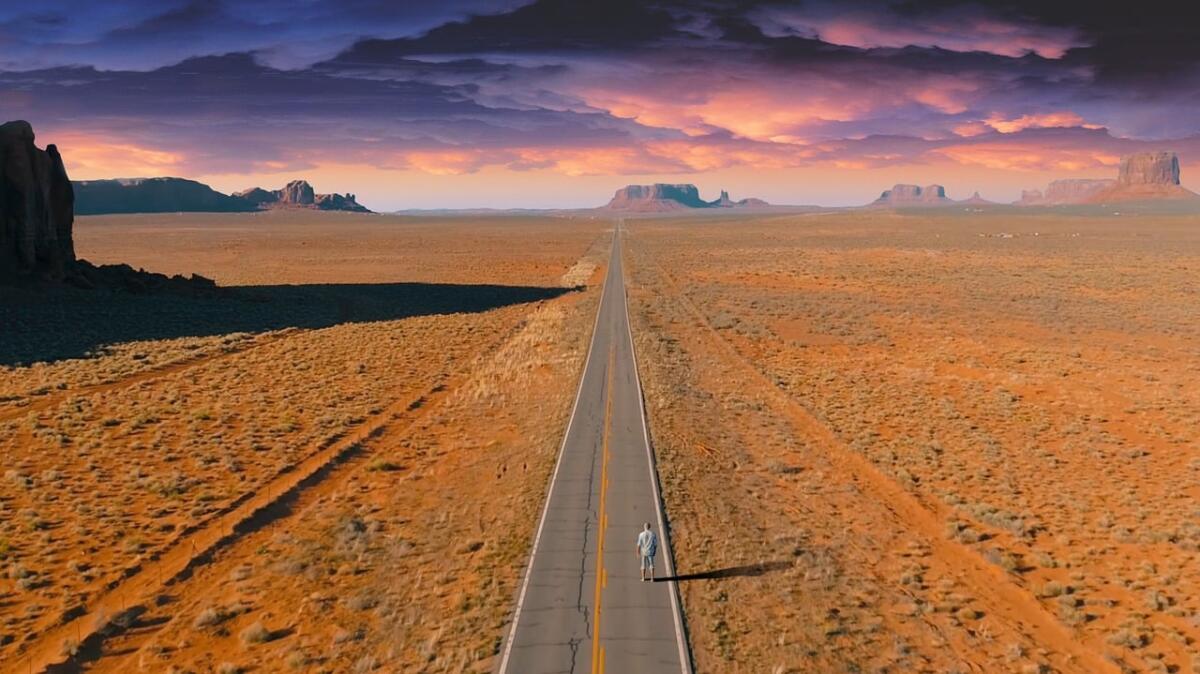
On a recent trip I began wondering about highway lines. Who came up with the idea to put stripes on our roadways? Where was the very first highway to be striped? How has highway striping evolved over time? (See what I mean by curiosity meter on overload?)

The birth of highway center lines

I did a little investigating into the origins of highway striping and here’s what I found:

The concept of painting lines on roads emerged in the early 20th century. In 1911, Edward Hines, chairman of the Wayne County Board of Roads in Michigan, observed a leaky milk truck leaving a white trail on the road. This sparked the idea of painting a centerline to separate opposing traffic and reduce head-on collisions. Hines’ innovative thinking led to the first recorded use of a painted centerline in the U.S.

Around the same time, in 1917, Dr. June McCarroll from California had a similar “a-ha” moment. After a near-collision with a truck, she hand-painted a white line down the middle of the road to delineate lanes. Her persistent advocacy led California to adopt road striping statewide by 1924.

Spreading the lines

The idea of road striping quickly gained traction. By 1917, states like Michigan, California, and Oregon had implemented painted centerlines on their main roads. This practice soon spread nationwide, significantly enhancing road safety.

Evolution of road markings

Initially, road markings were simple white lines. Over time, they evolved with different colors, broken lines, and other configurations.

The introduction of the Manual on Uniform Traffic Control Devices (MUTCD) in 1935 helped standardize these markings across the U.S., ensuring consistency and clarity for drivers.

Dashed highway lines

In order to save paint (and money), dashed center lines were established. It turned out that dashed lines didn’t just save money. When combined with a solid center line, drivers knew when it was safe to pass on the left.

Modern enhancements to highway lines

Today’s road markings have advanced beyond mere paint. The addition of tiny glass beads has made lines retroreflective, significantly improving nighttime visibility and overall road safety.

Can you guess?

Take a guess. How long are the dashed lines that separate lanes on a highway? Dashed white lines separating lanes are typically 10 feet long with 30-foot gaps between them. Surprised? I certainly am! Today’s highway striping follows standardized guidelines to ensure consistency and safety across the road network.

The Federal Highway Administration (FHWA) dictates that solid white lines mark the edges of the road and indicate areas where lane changes are discouraged. Yellow lines separate opposing traffic, with a single solid yellow line indicating no passing and a dashed yellow line allowing passing when safe.

These markings help drivers maintain lane discipline, improve visibility in low-light conditions, and enhance overall traffic safety.

Today’s highway markings do much more than keep you in your own lane. Now along with many different stripes, we see words painted on the road. All of the designs and lines instantly communicate with drivers and keep them safe. I’m especially grateful for all of these markings as we navigate our RV down unfamiliar roads.

Conclusion

Next time you’re cruising down the highway in your RV, take a moment to appreciate those highway lines. They are the result of more than a century of innovation and dedication to road safety.

MORE LIKE THIS YOU’LL ENJOY:

##RVT1200

How to build a hidden wall bed for campervans

2

By Cheri Sicard
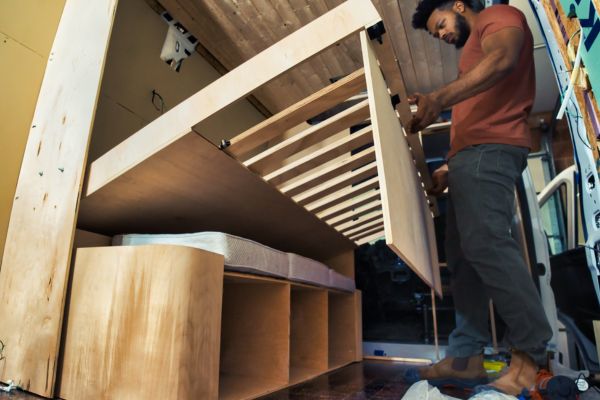
One of our favorite RV builders, DualEx (867K subscribers, almost 60M views), is back with a video of his build of a hidden bed that turns into a bench and disappears into the wall. It’s a total space saver!

The video shows you how to build your own bench with a hidden bed for campervans, complete with tons of storage and a super cool automatic leg. Although, be warned, DualEx is a man with massive skills and the tools to accomplish them at his disposal.

Van walls aren’t exactly straight. DualEx’s design accounts for that with a “false wall,” that gives you a straight wall on the inside.

This Murphy bed design is a little different. The wall itself acts as the bed’s leg when you pull it down. The downside? You’ll see a line where the leg is. But don’t worry! You can hide it with an accent wall, some cool slats, or just leave it as is.

The design includes a lip to hold the cushions in place as the bed goes up and down. So convenient!

The storage space under the bench is designed to be big and useful. You can customize it with drawers, doors, open space, or even a chest. Plus, there are curved armrests for even more storage and style.

Watch the video to see how he accomplishes all of this.

This project isn’t quite finished in the video. There’s still drawer installation, face framework, finish application, and covering the leg to do. Remember, this design is customizable. DualEx plans a full van build video in the future so you can see the completed project, but this video does show you how to build it.

In the meantime, if you want to build a similar innovative campervan bed yourself, DualEx offers free plans, although donations are appreciated. Download the build plans here.

RELATED

##RVT1200

A wanderin’ widower lives out his RVing dream

5

By Gail Marsh
One of the best things about RVing is the people you meet along the way. Today, I’d like to introduce you to Willie.

First meeting

I first met Willie while on a walk around the campground. He was walking his little black and brown dog and he was whistling. To be clear, Willie was whistling, not his dog, although both looked extremely happy. So, maybe the dog was whistling, inside his little doggie head. Anyway, I greeted both Willie and his dog with a friendly smile. Later that evening, Willie joined the community campfire. He sat right next to me.

Willie’s story

Employment. As is customary, folks new to the campfire introduce themselves to the group. Willie was asked what he did before retirement. “Well,” he said. “I was a maintenance engineer most of my life.” He leaned over and winked at me. “That’s just a highfalutin’ word for janitor,” he confided.

Retirement plans. Throughout the evening, bits and pieces of Willie’s life were slowly revealed. He lived all his life in the same place, mid-Nebraska. Widowed just two weeks before he was set to retire, Willie decided to remain on the job. “My retirement plans died with my wife of 53 years,” Willie regretfully admitted. “We always planned to get an RV and wander all over the country. Instead, I worked another four years.”

New plans. I wondered how Willie came to be camping if he’d given up his dream. So, I asked him. “Well,” Willie chuckled. “A while back my kids told me I was going to be dead within six months if I didn’t stop feeling sorry for myself. I took the money we’d saved up for an RV and bought our dream rig. It’s the little Class B. I still miss my wife. Every day. But I’m not dead yet. I’ve been traveling for two years, been in 22 different states, and I’m happy with my wanderin’ life. I think I’m gonna’ be okay.”

Grief certainly doesn’t follow a set schedule, but a nudge from his kids gave Willie the strength to live his dream. I feel confident that his wife would approve. Don’t you?

##RVT1200

If campground crowding is over, why is every site already booked?

22

I often see comments saying that there is no more campground crowding. I was so hoping that would apply to our quest for a campsite near the Twin Cities in Minnesota this July.

It is always difficult to get an RV site or campsite close to our kids and grandkids in the Minneapolis area. I knew that rising site prices, the cost of gas, and the ever-increasing number of people selling their RVs could free up sites, so I was hopeful.

We needed a few weeks booked before we start our camp host gig at a regional park just west of the Twin Cities. I’m not new to this opening reservation day rush and had accurately accounted for the two-hour time difference, written down dates along with site numbers, and had my credit card in hand. I had even signed in the day before to make sure I remembered my password. (I didn’t.)

At 5 a.m., three hours early, I tested everything out to make sure I could sign in and get to the reservation site. I waited. Tested 30 minutes early, tested 15 minutes early, and tested five minutes early.

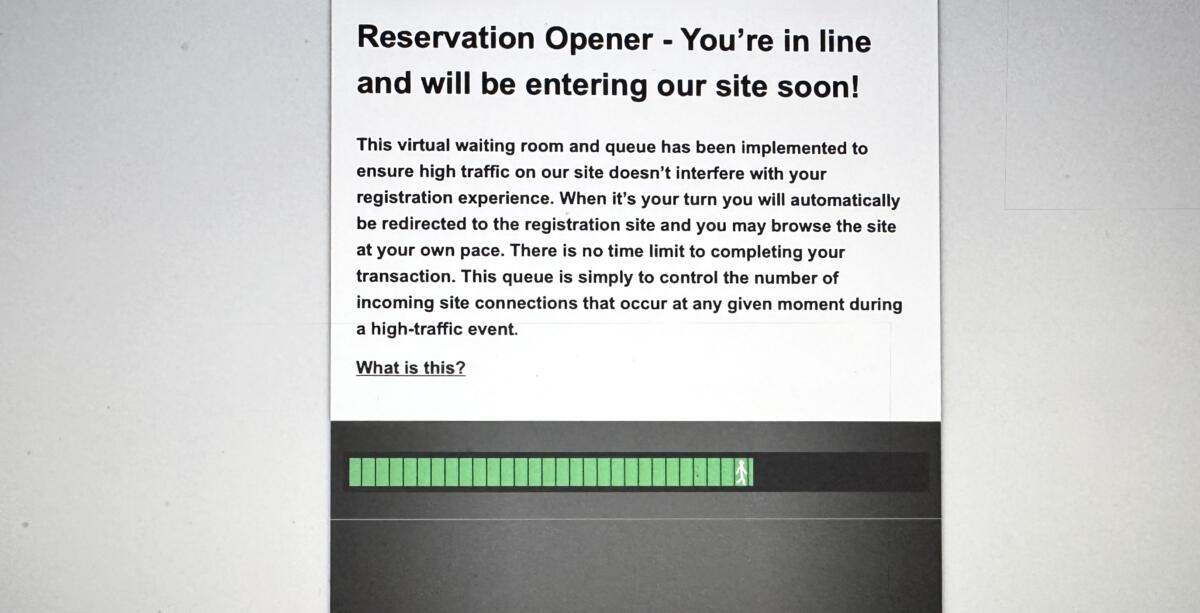
Bingo! I was in the wait queue, and I watched with great hope and anticipation as the little person slowly marched toward the time I would be let in. I was ready to make my reservation for two weeks of full hook-ups at a regional park. The queue read, “Don’t worry, you can take as long as you need to make your reservation when you are let in.”

Arrived! Success! I was in! In, but not so successfully. Dozens of people had already made their reservations and almost all the long RV sites were gone. There was only one slanted, not-level site big enough for us left. We were once hosts at this park. I know these sites. Some of them are so tight we might not get the awning out.

But there is not much left close to the cities. Our go-to Casino RV Park closed a bunch of RV sites to put in a %#@! golf something-or-other. Another private RV park doesn’t seem to need the business. They don’t answer their phone, respond to messages, or reply to emails.

So, I pressed “add to cart”. Got the necessary site and went back to bed.

This reservation stuff is not for the weak of heart. And, yes, campground crowding is still real.

Are you having similar issues with booking campsites for the months ahead? Please share your stories in the comments below.

RELATED

##RVT1200

For couples: Are you or your partner a better driver?

19

First, when you answer this question, be sure your spouse or partner is not looking over your shoulder. It’s very likely, we think, that he or she will disagree with you if you should dare say that you are the better driver of the two of you.

Now, we are not talking about driving or towing an RV. We’re talking about driving in general.

Let’s put it another way—Do you feel safer with your partner driving or doing the driving yourself?

Now, please!! Be objective! Don’t be afraid to admit that you are a lousy driver. Oh, we’re not saying you are, we’re just offering you some advice about how to respond in a way that does your spouse no disservice, or you, for that matter. Actually, that last sentence doesn’t make any sense, but we’ll leave it anyway (laziness).

Of course, we have no idea who you or your spouse are because RVtravel.com doesn’t track what you do on our website. We don’t know, for example, if you are in Chicago, Los Angeles, or aboard the International Space Station (if you are, please contact us so we can beg you to write a column!).

Okay, enough. It’s time to answer the poll.

MORE POLLS YOU MIGHT LIKE:

##RVT1200

Gadgets help with hand strength, grip on sewer connections

By Dustin Simpson
When it comes to RVing, one of the challenges we all face is when it is time to install or remove your sewer connections. Having enough hand grip and strength to twist can become a challenge.

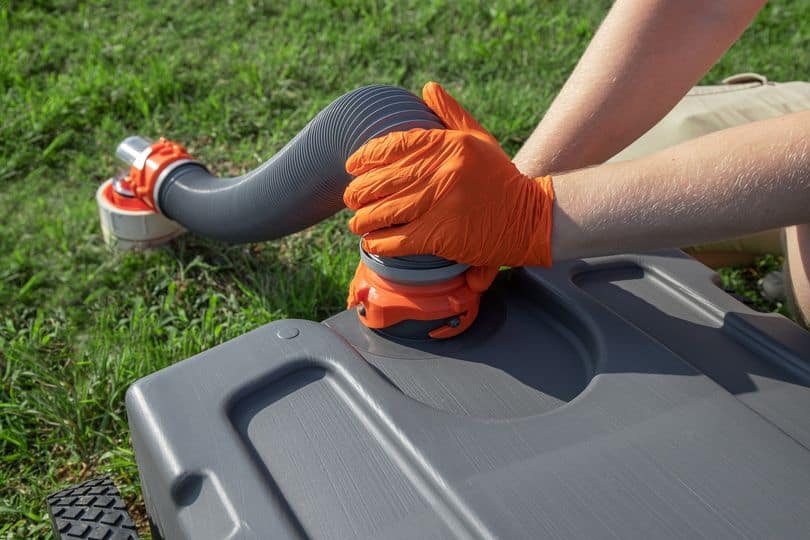
Having the leverage required to remove the sewer cap and the dump hose or stinky slinky can be difficult to remove or install at times. We all could use a drain helper, so here are two helpful tools that can make the job a little easier.

Two wrenches to help with your RV sewer connection

These wrenches are for the orange Rhino fittings and almost any connectors, caps or adapters. Using the two handles on the sewer fitting wrench, you grab the sewer hose where it comes together and use this product to lock it in place.

Camco Rhinoflex RV Sewer Fitting Wrench Set

  • Provides leverage for loosening and tightening swivel fittings
  • Fit Type: Universal Fit
  • Compatible with Rhino, Revolution, Easy Slip and many other bayonet and lug fittings
  • Lightweight and durable
  • Ergonomic design
  • Set of 2

Find it here.

WORKPRO 12″ Adjustable Pliers

If the wrenches do not fit your cap or your sewer hose, here is a different wrench that you can use:


Hope this information helps you, and please share if you found something better to use.

More from Dustin

Read more of Dustin’s articles here.

Dustin owns and operates California RV Specialists, an independent RV repair shop located in Lodi, CA. He thrives on sharing his knowledge and enthusiasm of RV repair and maintenance with his team, customers, and virtual friends.

Be sure to check out his YouTube channel where he shares what’s going on in the shop and the product offerings in the store. Dustin is also very active on Facebook. Join his group, RV Repairs and Tips – What’s in the shop!

RELATED

##RVT1200

Exploring New Mexico’s Kasha-Katuwe Tent Rocks National Monument

7

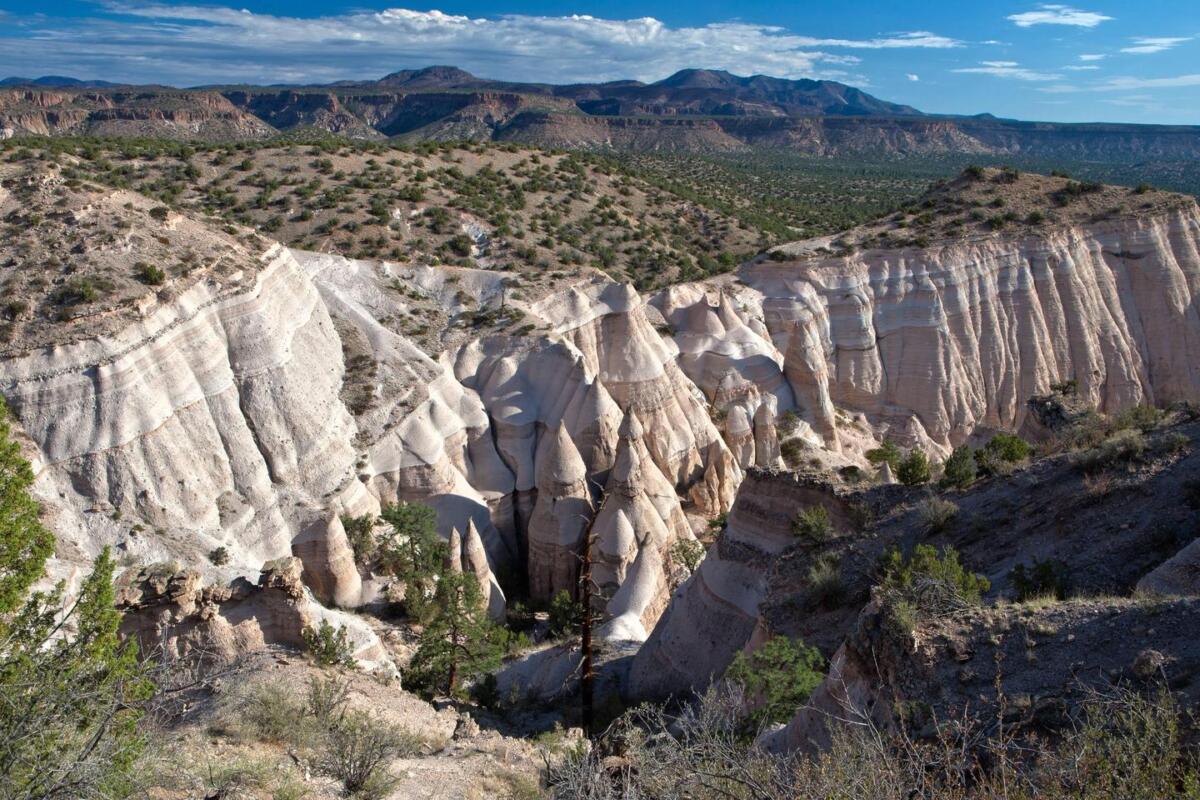
Nestled between Albuquerque and Santa Fe, New Mexico, the Kasha-Katuwe Tent Rocks National Monument offers visitors a chance to explore unique geological formations and scenic trails.

After the regular seasonal closure, the monument recently opened once again to visitors (February 1, 2025). Visitors are welcome to make reservations at recreation.gov for upcoming visits.

A brief history

New Mexico's "tent rocks" image: recreation.gov
Photo: recreation.gov

The name “Kasha-Katuwe” translates to “white cliffs” in the original language of the Cochiti Pueblo people.

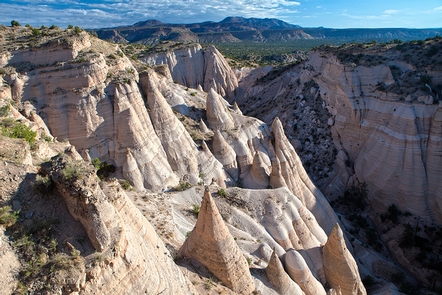
The monument’s distinctive cone-shaped formations, often called “tent rocks,” were sculpted by volcanic eruptions eons ago. Over time, erosion shaped the layers of pumice and ash into the striking structures we see today. Some tower up to 90 feet tall!

Things to see and do

The monument features a national recreation trail that ranges from 5,570 to 6,760 feet above sea level. This trail is for foot travel only and offers opportunities for hiking, birdwatching, geological observation, and plant identification.

Apache Tears

While visiting, you may see “Apache Tears.” Apache tears are small, round, black obsidian stones that hold deep cultural and historical significance. These tear-shaped rocks become exposed as the tent rocks erode and can be found in low gullies and washes.

According to Apache legend, the stones represent the sorrow of Apache women who wept for their warriors. The warriors, facing overwhelming odds in battle, chose to leap from a cliff rather than be captured. Their tears, falling to the earth, were said to have turned into these glossy black stones.

Note: It is against the law to collect these stones.

Cave Loop Trail

The 1.2-mile Cave Loop Trail is fairly level and passes by a group of cones before circling the edge of a beautiful small valley.

Slot Canyon Trail

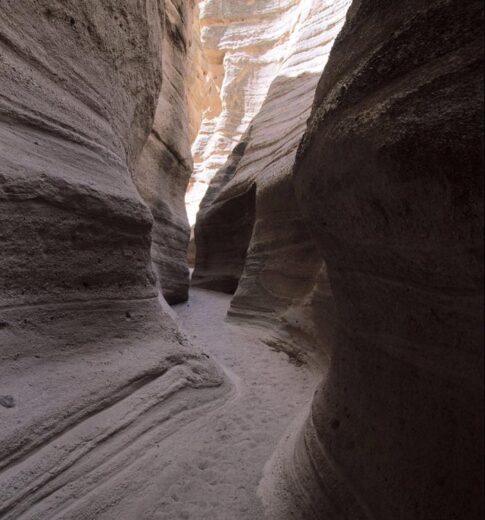
slot canyon; Kasha-Katuwe National Monument recreation.gov image
Photo: recreation.gov

This is the more popular route within the monument area. This three-mile trail follows a wash into a slot canyon which offers great opportunities for photography. Following the slot canyon, you’ll ascend onto a plateau with spectacular views of numerous rock formations. The most amazing tent rocks are located near the end of the canyon trail.

Visiting guidelines

To ensure a safe and enjoyable visit, follow these guidelines:

  • Operating hours: The Monument is open Thursday through Monday (closed Tuesday and Wednesday), with pilot vehicles leading visitors into the Monument starting at 8:00 a.m. The last pilot car leaves the Cochiti Visitor Center at 1:00 p.m. All visitors must exit the Monument by 4:00 p.m.
  • Fees: Access to the Monument is via reservation only. FIRST, there is a $5/person fee to reserve a BLM ticket, available at recreation.gov. SECOND, visitors must purchase a Cochiti Pueblo Tribal Access Pass from Cochiti Pueblo (purplepass.com/cochitikktr). The Tribal Access Pass is currently $20/person for adults. Visitors must show BOTH passes to access the monument. Different fees apply to children, which are outlined on the respective websites. Interagency passes are accepted to cover the BLM fee but do not affect the Tribal Access Pass. A limited number of passes are available each day.
  • Pets: Dogs are not permitted within the monument.
  • Camping: Overnight camping is not allowed within the monument. However, Cochiti Lake, located a few miles away, offers camping facilities.
  • Weather precautions: Be cautious of flash flooding, especially in the slot canyon areas, during rainy conditions.
  • Cell phone reception: Cell reception is hit-or-miss. You should plan accordingly.

Nearby RV campgrounds

Here are just a few nearby campgrounds to consider:

Cochiti Lake Recreation Area: Managed by the U.S. Army Corps of Engineers, this campground offers electric and water hookups, restrooms, and a dump station. It’s conveniently located near the monument.

Santa Fe Skies RV Park: Situated south of Santa Fe, this park provides full hookups, Wi-Fi, laundry facilities, and scenic views of the surrounding mountains.

Coronado Campground: Located in Bernalillo, this campground offers electric hookups, restrooms, and a cultural museum on-site.

Before visiting, it’s advisable to check the official Bureau of Land Management website for the most current information on operating hours, trail conditions, and any closures.

Exploring the Kasha-Katuwe Tent Rocks National Monument provides a unique opportunity to witness the natural beauty and geological wonders of New Mexico.

RELATED

##RVT1200

St. Patrick’s Day recipes: Classic favorites and creative twists

1

Corned Beef Gravy

by Amanda Michelle from Hebron, KY

This creamy gravy is filled with corned beef in every bite. It’s a great twist on gravy to go over toast or biscuits. Easy to make, this can be prepared in a snap. Serve for breakfast or dinner. We poured it over homemade biscuits, and it was fantastic. This budget-friendly recipe has a St. Patrick’s Day feel to it. Click here for the recipe.

Sweet and Spicy Corned Beef Sandwiches

by Susan Magness from Cleburne, TX

Take corned beef to the next level this St. Patrick’s Day with these sweet and spicy corned beef sandwiches. The corned beef is tender and juicy. On top is a sticky and tasty brown sugar glaze. The spices seep into the corned beef and enhance its flavor. We thinly sliced the corned beef and piled it on a Kaiser bun. With a nice balance of sweet and savory, these sandwiches are filling and satisfying. Here’s the recipe.

Beef in Guinness (Stout Beer)

by Michelle Sebastian from Washington, DC

The beef in this stew recipe is cooked to tender perfection. There’s robust flavor from the Guinness beer. Chunks of carrots and onions add a pop of sweetness and texture. A delicious St. Patrick’s Day meal but simple enough you can make it all winter long. This is an exceptionally tasty way to cook beef and ensure it comes out tender. Get the recipe here.

Irish Soda Bread

by Christine Reardon from Setauket, NY

Many families have their recipe for Irish soda bread and Christine’s soda bread is fantastic. It’s more tender than most loaves of soda bread with a subtle sweetness accented by caraway seeds and raisins. Besides being baked in a loaf pan (and not shaped round), this Irish soda bread is more cake-like than bread-like. Serve warm with a smear of butter alongside beef stew or corned beef. Or, enjoy with a cup of tea for an afternoon St. Patrick’s Day snack. Click here for the recipe.

Crock Pot Corned Beef and Cabbage

by Suzan Powers from San Jose, CA

A fantastic way to prepare a St. Patrick’s Day favorite. The main attraction – the corned beef – is tender and juicy. It slices like butter. The carrots and potatoes are perfectly tender, as well. Adding cabbage to the slow cooker at the end of cooking keeps it from getting mushy. Pouring the broth over the veggies and sliced corned beef keeps everything warm. Here’s the recipe.

Guinness Brownies

by Kim Cook from Victoria, B.C.

Stout beer is known to make chocolate brownies have a richer flavor, and it definitely does in this Guinness brownie recipe. They have a rich, dark chocolate flavor with a smooth and fudgy texture. These homemade brownies would make a great St. Patrick’s Day dessert. Get the recipe here.

Baileys Irish Cream Fudge

by Heather M. Baker from Grove City, PA

This chocolate fudge recipe is not for the wee leprechauns. But, the older leprechauns are sure to enjoy this recipe! The alcohol-infused fudge is easy to prepare and turns out smooth and super creamy. Click here for the recipe.

Authentic Irish Coffee

by Carolyn Haas from Whitewater, WI

Yum! We absolutely loved this authentic Irish coffee. It’s a strong cup of coffee slightly sweetened with sugar and just a bit of Irish whiskey. The best part is the frothed cream on top. As you drink the hot coffee through the cream, it magically mixes together. It will warm you up on a cold winter day. This is definitely an adult-only coffee. Here’s the recipe.

##RVT1200