Home Blog Page 300

Is your dog smelly? Read this

2

“She’s really a great companion,” one campground neighbor explained. “I just can’t stand the smell! She’s been bathed and groomed. I’ve washed her bed and replaced all of her toys with new ones. Why do I still have a stinky, smelly dog?”

Why indeed? If your RV traveling pup is odiferous—and not in a good way—maybe you need to investigate some of the common causes of dog odor; find practical tips to treat and prevent smells; and discover some RV‐specific advice to help keep your pup—and your living space—smelling great.

Why do dogs smell?

Dogs naturally produce odors that arise from their skin’s oils and the normal bacteria and yeast that live on their coats, ears, and paws. However, when you notice an unusually strong or unpleasant smell, it may be due to one (or more) of the following factors:

Skin infections and allergies: An excess of bacterial or yeast growth on inflamed skin can lead to a “funky” odor. Allergies, often triggered by environmental or dietary factors, can worsen this condition, causing your dog’s skin to produce more oils than normal.

Ear infections: Bacteria or yeast can accumulate in your dog’s ear canals. This can cause a pronounced yeasty or “sewage-like” smell. This is more common in breeds with floppy ears where moisture gets trapped.

Dental disease: Poor oral hygiene can cause the buildup of plaque and tartar. This can lead to bad breath that might carry into your dog’s overall scent.

Anal gland issues: Dogs have two anal glands that naturally secrete a smelly fluid to mark territory. If these glands become impacted or infected, they can produce an overpowering, fishy odor.

Environmental factors: Dogs love to explore—rolling in mud, water, or even less-pleasant substances like decaying matter. Ugh! For RVers, dust, pollen, and even the confined space of your mobile home can sometimes contribute to the buildup of odor.

Experts agree that bathing is the key to controlling most doggy odor. If your dog still smells after a bath, it may signal an underlying condition. Contact your (or a local) vet and have your pup checked out.

Treat and prevent odors

So, the bad news is that your doggo is stinky. The good news is that there are treatments to address the odor and prevent it in the future, too.

Black pup shampooed in green tub Pixabay image

Bathing: Bathe your dog with a gentle, dog‐specific shampoo. For breeds prone to skin allergies, therapeutic shampoos with oatmeal or aloe vera can help soothe irritation and reduce bacterial overgrowth. Be careful not to over-bathe, as this can strip natural oils and lead to further dryness or irritation.

Brushing: Regular brushing not only helps distribute natural oils but also removes loose fur and dirt that might trap odors. This is particularly helpful for long-haired breeds.

Dry thoroughly: After any exposure to water—whether from bathing, rain, or stops by a lake—use a towel or a pet-safe blow dryer to ensure your dog is completely dry. Damp fur creates an ideal environment for bacteria and yeast.

Pay attention to specific areas

Ears and teeth: Keep your dog’s ears clean with a veterinarian-approved cleanser if you notice excess wax or debris. Likewise, brushing your dog’s teeth or using dental treats helps prevent bad breath caused by plaque buildup.

Anal glands: Monitor your dog for signs like scooting or persistent licking near the rear. If these occur, it might be time to have your vet or groomer express (empty) the glands or check for infection.

Maintain a clean RV

RV living means limited space and frequent travel. It’s essential to:

Wash bedding and soft furnishings regularly: Dog odor can cling to fabrics. Use pet-safe detergents and wash blankets, cushion covers, and dog beds at least weekly.

Cleanup on the road: Keep a supply of dog wipes or damp cloths handy for spot cleaning, especially after outdoor adventures. This is a great way to manage odors before they set in.

Ventilation: Ensure your RV is well-ventilated. Open windows or use an air purifier to help reduce lingering smells.

Watch diet and overall health: A balanced, high-quality diet contributes to a healthy coat and skin. If you notice persistent odor problems, consult with your veterinarian. She can rule out food allergies or metabolic issues that might be contributing to the smell.

Extra tips

As an RVer, you face unique challenges when it comes to pet care. Here are a few additional ideas tailored for RV travelers:

• Pack a grooming kit: Include a brush and pet wipes. These can make impromptu cleanups easy at rest stops.

• Schedule regular vet checkups: Even while traveling, don’t skip routine wellness exams. Many veterinarians offer mobile services. They come right to your RV.

• Create a designated pet area: If space allows, set aside a small area in your RV for your dog’s bed and toys. Keeping this area and all of your pup’s items clean can help contain odors and keep your RV smelling fresh.

How do you deal with stinky dog odors? Tell me in the comments below.

RELATED

RVT1211

Smoke from Canadian wildfires prompts health warnings in Northern U.S.

2

Major Canadian wildfires in Manitoba and Saskatchewan sent dense smoke plumes across the U.S. Midwest late last week. The smoke triggered air quality alerts from Minnesota to Indiana and beyond.

With particulate levels spiking into “Unhealthy for Sensitive Groups” in cities like Minneapolis and Chicago, RV travelers must remain vigilant to protect their health and safety.

Current situation

Fire hotspots: Widespread blazes in Manitoba and Saskatchewan have scorched more than 1.5 million hectares (approximately 3,700,000+ acres), forcing thousands to evacuate and generating thick smoke that drifts southward.

Air quality advisories: On Friday, May 30, state health departments issued “Unhealthy for Sensitive Groups” warnings across much of Minnesota, Wisconsin, and parts of Illinois and Indiana, urging residents to limit outdoor activities.

Visibility concerns: Smoke from the Canadian wildfires reduced highway visibility to under 500 feet in some areas, increasing the risk of traffic accidents, especially critical for larger rigs that require greater stopping distances.

Monitor conditions

Monitor your current location’s air quality (AQI). You can use the EPA’s AirNow app or website to check hourly AQI. Look for color-coded alerts:

• Green (0–50): Good
• Yellow (51–100): Moderate
• Orange (101–150): Unhealthy for sensitive groups
• Red (151–200): Unhealthy

If your region hits orange or red, reduce outdoor exertion and plan to stay inside your RV.

Campgrounds

Choose campgrounds with hookups and/or indoor facilities. Sites offering electricity allow you to run HVAC systems on “recirculation” mode, filtering indoor air and keeping windows closed. If available, book campgrounds that have indoor common areas equipped with high-efficiency filters.

Actions to take

Here are some additional precautions RVers can take:

• Close all of your RV roof vents and cover the vents with vent pillows or similar insulation.

• Apply weatherstripping or foam tape around windows and doors to block leaks.

• Run your air conditioner on recirculation—never switch to fresh-air intake when smoke levels are high.

• Upgrade air filtration. Use a compact HEPA-equipped air purifier inside your RV, ideally in the bedroom where you sleep. A unit with activated carbon pre-filters will also reduce smoke odors.

• Carry N95 masks. While driving to fuel stops or during brief outdoor tasks, wear a properly fitted N95 respirator to filter at least 95% of airborne particulates. Cloth or surgical masks won’t provide adequate protection.

• Drive with caution. If visibility falls below 500 ft., slow down significantly and leave extra stopping distance (at least double your normal following gap). Use low-beam headlights—not high beams, which can reflect off smoke and worsen glare. Monitor state DOT websites for sudden closures or advisories due to smoke-related accidents.

Reroute or pause your trip

If forecasts show several days of elevated AQI, head toward areas reporting “Moderate” (51–100) or “Good” (0–50) air. This may mean you head further south or east of major smoke corridors.

Smoke forecasts

Websites like NOAA’s Smoke Forecasting System can predict plume movements up to 48 hours in advance. If a thick plume is inbound, consider delaying departure or taking an alternate route.

Some parks may close recreation areas or cancel campground reservations when smoke poses significant health risks. Respect these advisories and inquire about refund policies if needed.

Stay safe, RVers!

Smoke from the Canadian wildfires can travel hundreds of miles, turning what seems like a clear day into a health hazard. Keep in mind the safety precautions. Stay informed and remain flexible to stay safe during your RV travels.

RELATED

RVers discuss ‘entitled campers’; no regard for others at the campground

Campgrounds are changing and evolving, some for the better and some for the worse. In this weekly column, RVtravel.com readers discuss their experiences and offer tips to help other campers find that perfect spot.

Irritations

This week, we received a number of emails talking about things that irritate people when camping. My biggest campground irritation has always been an incessantly barking dog.

We just got back from a week of camping at a wonderful county park in Arizona. At 105 degrees, there were plenty of sites open. Unfortunately, right across from us was a camper with three, perhaps four, incessantly barking dogs. They barked when I stepped out of the RV, they barked when people walked by, and they raised the woof woof (pun intended) when another dog went by. Not once did the owner hush them, nor, for that matter, return our waves and greetings.

So, on top of the dogs not being friendly, he was not either. Pet peeve!

One reader, Philip, writes below about entitlement, and as a camp host, I have seen it, too—particularly during COVID. I do wonder if others feel that a lot of folks in upscale rigs can be jerks, too. In full disclosure, we have what was once considered an “upscale rig”
until it can’t pass the seven-year rule anymore!

Here are a few observations from our readers. These do not necessarily represent the views of RVtravel.com.

Entitlement

Philip W. is a park host and can deal with just about everything except “entitlement.” He shares, “I have seven years of experience as a park host, and some owners expect us to be a ‘fix-it’ guy, particularly on electrical service.

“My biggest issue is not kids (they are having fun or old people are being crabby). The greatest irritation to me is the ‘entitled’ camper who seems to think that the world revolves around them. I had one who went ballistic over a ruined outing because they found a cigarette butt in their campsite.

“I have had campers in pretty ragged rigs who were the nicest people, and some in very upscale rigs who were unsufferable jerks. As a camp host, your job is to make people’s camping experience the greatest possible. My mom had a saying, ‘You catch more flies with honey than vinegar.’

“Let’s face it, fair pricing and treating your customer like they are really appreciated is the key to any business.”

Dog poop and trash

Mary S. expects dog owners, and other RVers, to keep a clean campsite and wrote, “Our biggest pet peeves are campers who leave their sites littered with dog poop, cigarette butts, and trash.

“Plus, allowing dogs to bark incessantly, allowing children to run rampant (screaming and running through campsites, touching others’ belongings, etc.). And, also, permanent sites that look like slums.”

Sweet revenge

John M. writes to us about getting even with loud noise. “One night by a lake, we camped near a group of teenagers who were carrying on till about 3 a.m., keeping everyone awake. They would not settle down even after being approached numerous times. Well, at about 7 a.m., our kids (5-9 years of age) found revenge. The large metal garbage can stood about 5 feet from their tent. Boy, did that lid make lots of noise when it was dropped, and of course, there was lots of crying and complaining from their group.

“No, we adults didn’t scold our boys, but found more garbage for them.

“To help the noise along, the outhouse doors were fewer than 10 feet from their camp, and boy, did our group have to pee!

“The revenge was great!”

Charging more and getting less

Jim J. commented on KOA’s investment in glamping. “Pet peeve: KOAs investing in glamping using money that should be spent maintaining the traditional FHU sites. Staff are still wonderful, but these parks are charging more and giving less. Loose electric connections, worn out hose bibs or valves, untended ruts in the park streets.”

Yapping dogs and NASCAR kids

John W. is not happy with barking dogs, either, and wrote, “We don’t generally have any significant problems finding campsites if booked a couple of weeks in advance, but campgrounds are definitely more filled than in the past.

“Too many people just don’t pick up after their dogs. Too many people are leaving dogs (usually the small, yappy types) unattended in portable pens outside their RVs. You can’t walk past the RV without constant barking. The owners either don’t care or are oblivious to the barking.

“Also, kids bike like NASCAR drivers through the campgrounds.”

Anything to add?

What are your biggest camping pet peeves?

More questions for you:

  • Are you finding campgrounds booked up or is finding a site not a problem?
  • What do you like best about RVing?
  • What are your pet peeves?
  • Are you seeing more permanent and seasonal RV parks?
  • Are rising costs affecting your camping style?
  • Do you have favorite campgrounds or RV parks?
  • What is the most memorable experience you have had RVing?
  • Do you have any tips or secrets you’d like to share?

Please use the form below to answer one or more of these questions, or tell us what you’ve experienced with campground crowding in general.

Name
Drag & Drop Files, Choose Files to Upload

Read last week’s Crowded Campgrounds column: RVers discuss: Is the 10-year rule ‘snooty’?

##RVT1211b

What kind of roads do you dislike driving the most?

48

Every RVer (heck, every driver!) has a type of road they dislike driving the most. What’s yours?

Some of us can’t stand to drive through a big city, others can’t stand driving through long stretches of boring, flat road. Others of us don’t mind dirt roads, while others would rather drive out of their way to avoid them. Plenty of RVers say their least favorite roads are interstate highways, where battling trucks is often the norm.

Then there are winding mountain roads—beautiful, sure, but for some, white-knuckle terrifying. Narrow lanes, steep drop-offs, and hairpin turns can be a nightmare, especially when you’re piloting a large rig. Even seasoned RVers admit that these roads can test your nerves and your brakes.

And if you grew up driving in snow or ice, perhaps you don’t dread those roads as much as those who grew up in places like Southern California, where icy roads are about as common as igloos.

In the poll below, select up to three types of roads that you dread driving the most. If we missed one, please leave a comment and tell us what it is.

And while you’re in the comment section, make sure you tell us why that type of road is your least favorite. You know we’re always curious! Thanks!

MORE POLLS YOU MIGHT ENJOY:

RVT1211b

Harvest Hosts gets competition from new lower-cost alternative

Just this week, the group formerly known as Family Motor Coach Association (now rebranded as Family RV Association) said it cut a deal with a “free RV overnight” site, RV Overnights. It got us to wondering, just what’s the difference between the older heavyweight, Harvest Hosts, and the new upstart? Harvest Hosts or RV Overnights?

If you’re an RVer looking for unique overnight experiences beyond traditional campgrounds, both Harvest Hosts and RV Overnights offer alternatives. Each provides a network of host locations—ranging from farms and wineries to museums and breweries—where members can park overnight, often at no cost (other than membership fee). While they share a similar concept, differences in scale, pricing, and user experiences set them apart.

Harvest Hosts or RV Overnights—a lot of similarities, but differences that count

Harvest Hosts has been around for 15 years now. Over that time, the business has grown into a widely known RV membership program, boasting more than 5,000 host locations across North America. These hosts include wineries, farms, breweries, golf courses, and attractions, offering RVers unique places to stay overnight. Members are encouraged to support hosts by purchasing their products or services, fostering a mutually beneficial relationship.

The outfit offers various membership tiers, with the All Access plan providing the most comprehensive—and most expensive—benefits. The platform’s app includes features like GPS navigation, availability previews, and member reviews, enhancing trip planning. However, some users have noted that stays are typically limited to one night, and locations may be off the beaten path, requiring detours from main travel routes.

Enter RV Overnights. In a 2023 news release, the outfit said it would partner with ”small businesses, including wineries, breweries, farms, and more, to give RVers the opportunity to find unique places to park for the night. Rather than boondocking in busy parking lots of big corporate retail locations, RVOvernights.com members can stay with a local small business that has signed up as a host on the RVOvernights.com platform.”

Sounds pretty familiar to the offering Harvest Hosts was already flagging members with. However, the new startup was quick to point out its membership was $29 a year, while the big competitor, Harvest Hosts, was charging $99 a year. Well, a couple of years make a difference.

Now, RV Overnights has cranked up the membership to $49.99. Harvest Hosts’ least expensive membership now offers a discount—now fire-saled for $84.15. Of course, you can add more available locations by cranking your membership fee to $143.65. Or get even more locations, including golf courses, plus a year’s membership in the Escapees Club for just $152.15. Not sure if they’ll release a membership with “off planet” RV sites, but stay tuned.

Read the big print—and the fine print

So what’s the difference between the two, aside from price points? Here’s a chart.

Harvest Hosts or RV Overnights
Click to enlarge

In addition to the major differences, some finer points float up when combing through the internet.

Many Harvest Hosts members appreciate the unique experiences and the opportunity to support local businesses. One long-time member shared, “We have been members since 2015 and absolutely love Harvest Hosts.” However, others have expressed dissatisfaction with customer service and the value proposition, especially as the company has expanded and integrated other services.

On the other hand, RV Overnights users have given praise to the platform’s affordability and user-friendly app. One reviewer noted, “RV Overnights app is a game-changer for travelers! It’s incredibly user-friendly and packed with awesome features. Finding the perfect overnight spot has never been easier.” Nonetheless, some users have raised concerns about the accuracy of host information.

Harvest Hosts or RV Overnights
Click to enlarge

Both RV Overnights and Harvest Hosts have those pesky annual membership dues. RV Overnights claims that if you sign up and keep your membership continuously going, you’ll pay the same price right on down through the years. But there’s always a catch: Both platforms support their “hosts” by promising them that guests will pony up with purchases.

For example, stay at a winery, be sure to buy a couple of bottles of vino. Both suggest that purchases made should be no less than $30, and Harvest Hosts trumpet to potential host sites that the average is typically a lot more. Can you say, “I feel a little pressure here?”

A third alternative good for those who can be away from hookups

Let’s muddy the water just a tiny bit more. Included in Harvest Host’s middle-tier membership is an annual membership in a group called Boondockers Welcome. In this case, hosts don’t expect you to buy anything, but they’d appreciate positive reviews on the site. Some include hookups, and all those appreciate a donation toward your utility usage. If you don’t mind going without hookups, then Boondockers Welcome might be a good shot—and you can get a freestanding year’s membership for $79 a year, with nearly 3,700 listed locations to choose from.

Dropping back to RV Overnights, Family RV Association members can get this membership for just $29.99 a year. For the price freeze, sign up and maintain your membership without a drop, and the price is said to never go up. Presumably, you’ll need to keep your Family RV Association membership alive and well, too.

So many choices—How do you sort it all out?

Harvest Hosts or RV Overnights
Click to enlarge

So, you pay your money, and you take your choice. But how do you do that with such a range of options? Here’s our advice: Weigh everything and look at the maps. The sites all have maps of the Lower 48, and you can pick your way through a route and check out the offerings, without having to have a membership. You may find overlap between the offerings, or maybe one has places to stay on your route, while others don’t.

Both Harvest Hosts and RV Overnights are anxious to get their hands on your credit cards. To make their offers appealing, both promise that you can try their services out for 90 days. Don’t like what you get? Cancel the membership and get your money back.

Both Harvest Hosts and RV Overnights offer alternatives to traditional RV camping. Each has its own strengths and considerations. Harvest Hosts provides a vast network of unique locations, ideal for travelers seeking diverse experiences and willing to invest in a comprehensive membership. In contrast, RV Overnights caters to budget-conscious RVers looking for straightforward, affordable overnight options.

RELATED

RVT1211b

RV Daily Tips. Friday, May 30, 2025

Issue 2655


Today’s thought

“The press is the best instrument for enlightening the mind of man, and improving him as a rational, moral, and social being.” Thomas Jefferson


Need an excuse to celebrate? Today is National Water A Flower Day!

On this day in history: 1922 – The Lincoln Memorial is dedicated in Washington, D.C.


Tip of the day
Key features to look for when choosing an RV storage facility

By Dave Helgeson
What are the key features RVers look for in an RV storage facility? I was asked this question by a couple on Facebook looking to build an RV storage facility. Unfortunately, I butter-fingered the keys and deleted the message before I could respond. I did deem it worthy of a future article, though.

For assistance in writing this article and determining the key features of an RV storage facility, I polled the readers of the RVing Tips group on Facebook. Following is the answer to the question the couple asked and others wondering what to look for in an RV storage facility.


Ask Dave
Why does RV refrigerator trip the fuse at startup, then run fine?

Hello Dave,
I hope you can help us with an issue that just started happening. Each time we unplug the camper at home and plug it back in at the campground (and vice versa), when I push the button to start the refrigerator it blows a fuse. Nothing new has been plugged in to that circuit so we don’t think it’s overloaded. I can push the button on and off and it comes on just fine as long as the camper stays plugged in. It only happens after the camper has been unplugged. Thank you so much! —Sandy, 2015 Forest River Heritage Glen 286RLT  Read Dave’s answer.


Which U.S. national park has a rainforest within its boundaries? Scroll down for the answer.


In the RV shop with Dustin
Two good RV e-bike rack and carrier options

When it comes to transporting e-bikes with an RV, there are several options available. Two popular e-bike carrier solutions are designed specifically for RVs:
1) Hitch-Mounted Bike Racks: These racks attach to the hitch receiver on your RV and can carry multiple e-bikes. They come in various styles, including platform racks and hanging racks. Platform racks support the bikes by their wheels, while hanging racks support them by the frame. Continue reading.


Article and video
Tour a rare restored 1973 Shasta motorhome

By Cheri Sicard
Have you ever stumbled upon a vintage RV and felt instantly transported to another era? That’s exactly what happened when Patrick Botticelli from New Jersey Outdoor Adventures discovered an incredibly rare 1973 Shasta motorhome on Facebook Marketplace. This wasn’t just any old RV; it was a time capsule blending a nostalgic exterior with a beautifully renovated interior. You’ll want to see this!


Featured article
Cheap RVing at NM’s otherworldly City of Rocks State Park: Amazing campsites, wildlife, history, and more!

By Cheri Sicard
If you are looking for an unusual, borderline-otherworldly destination for your next RV trip, consider New Mexico’s City of Rocks State Park near the tiny town of Faywood. Rock formations like those at the City of Rocks State Park exist in only six other places in the entire world, so you are not likely to encounter anything else like this.


RANDOM RV THOUGHT: One way to see if your RV is level is to place a marble, golf ball or other round object on your dinette table or kitchen countertop. Watch which direction it rolls: That’s where your RV is the lowest. Of course, if your table is not level, then never mind.


You may have missed these recent popular stories…


Window or door screens damaged or torn? This helps!
If you have damaged window or door screens in your home or RV, this screen-repair tape will help. No tools or special skills required. Simply cut, peel, and stick for a fast, permanent, and hassle-free solution that anyone can complete in just minutes. You won’t be able to tell there was ever a hole or tear! Don’t let any bugs in your RV this summer! Learn more or order.


Reader poll
How many grandchildren do you have?

Respond here.


Quick tip
Don’t put anything extra down toilets

What’s safe to put down the RV toilet so as not to create damage or dumping problems? Other than toilet paper, if you didn’t eat it or drink it first, don’t put it down there. And, by the way, never put Kleenex down the toilet. It doesn’t dissolve and can cause clogging.


On this day last year…


Website of the day

Leave Las Vegas to See the Most Beautiful Places in Nevada
Visiting Las Vegas and want to explore more of beautiful Nevada? This is the list for you!


? MYSTERY PRODUCT OF THE DAY ?
Go fishing for marshmallows! We’re serious! Fine, you don’t believe us? Well, go fishing for hot dogs instead then! Here’s how. 


Trivia

Of the more than one million firefighters in the U.S., 65% are volunteers, according to data from the National Volunteer Fire Council (NVFC). Of the more than 29,000 fire departments across the country, almost 19,000 are run completely by volunteers.


Answer: Olympic National Park, in Washington state


Readers’ pet of the day

“Cashew (age 11) is a surf-and-turf dog, loving equally to hike a trail as to sail away!” —Ed Wiewall

Send us a photo of your pet with a short description. No blurry photos and please do not submit your photo more than once. Thanks!

RVing with Dogs group on Facebook. You’ll love it.


Leave here with a laugh


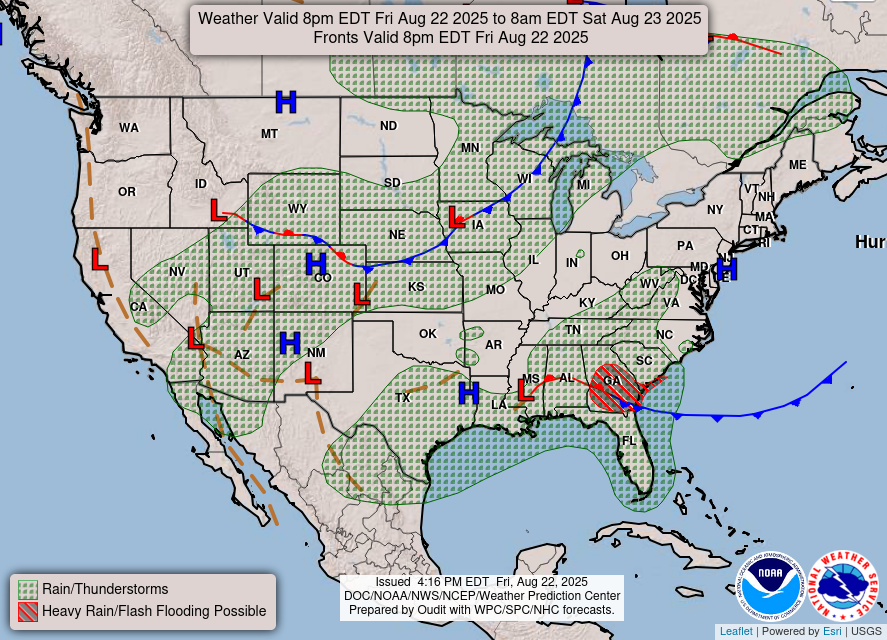
Today’s weather forecast across the nation
THIS MAP UPDATES TWICE A DAY

Visit Current National Radar Weather Map


Did you miss the latest RV Travel Newsletter? If so, read it here.
Oh, and if you missed the Latest News for RVers, make sure to catch up here.


If you shop at Amazon.com we’d appreciate you using this link. We get an itty bitty commission if you buy something, but they add up and help us pay our bills (most importantly our hard-working writers!).


RVtravel.com All-Star Team

Click here for information about our staff and how to contact us.

Our policy on using artificial intelligence.

Why does RV refrigerator trip the fuse at startup, then run fine?

Hello Dave,
I hope you can help us with an issue that just started happening. Each time we unplug the camper at home and plug it back in at the campground (and vice versa), when I push the button to start the refrigerator it blows a fuse. Nothing new has been plugged in to that circuit so we don’t think it’s overloaded. I can push the button on and off and it comes on just fine as long as the camper stays plugged in. It only happens after the camper has been unplugged. Thank you so much! —Sandy, 2015 Forest River Heritage Glen 286RLT

Hi Sandy,
First, I need a little clarification on the make and model of the refrigerator and what you are referring to as the “fuse”. Is the refrigerator an absorption model that runs on LP or 120-volt power, residential that only runs on 120 volt, or 12-volt compressor driven? Does it get power through the inverter for either 120 volt?

Another question is what power sources are you plugging into? I assume at the campground it is a 30-amp outlet at the pedestal, and most likely a 20-amp residential outlet at the house.

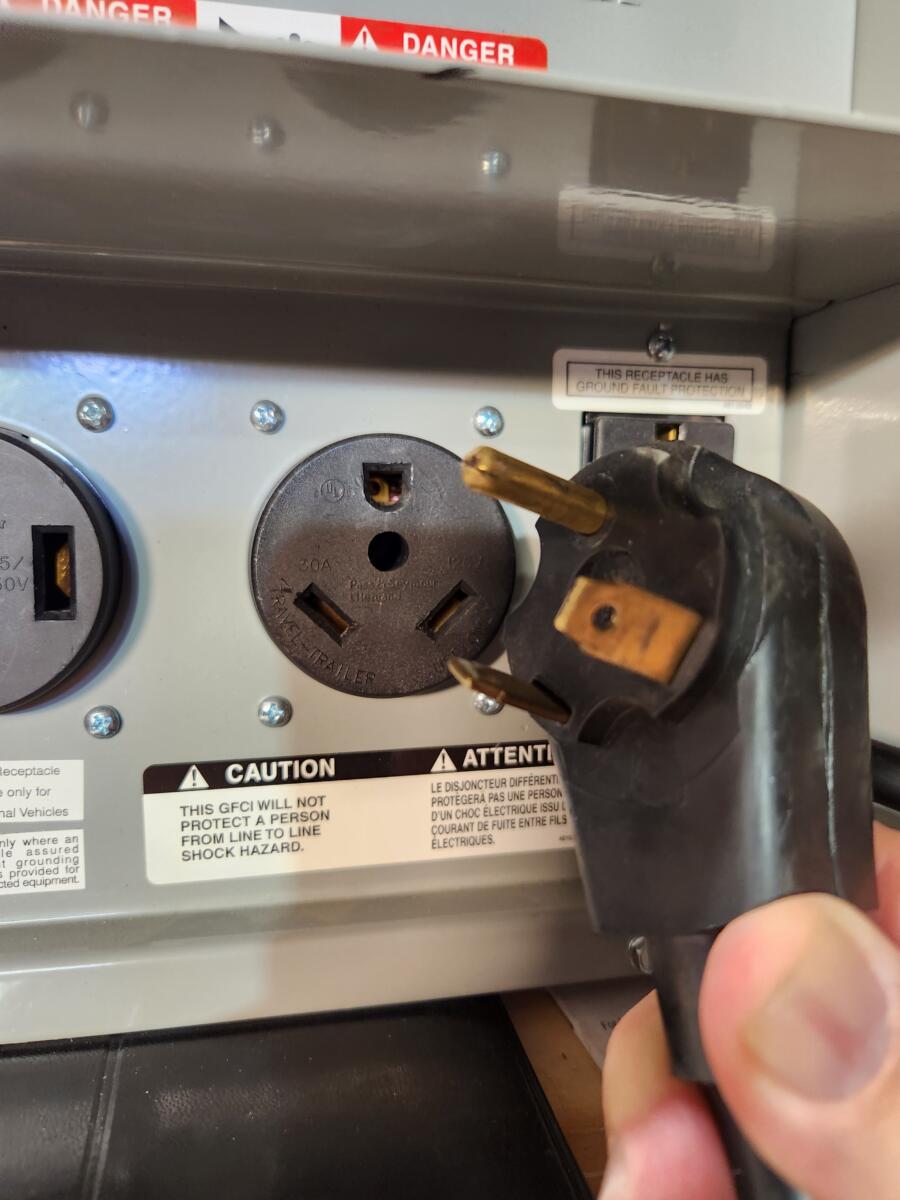
It seems the common denominator would be the shoreline cord. Check the prongs on the cord to verify they are clean and solid.

Shoreline cord
Shoreline cord

I assume the “fuse” you are referring to is the circuit breaker in the distribution center. This would be a 15- or 20-amp circuit breaker and typically dedicated to the refrigerator outlet. However, as I have stated many times, I never say never or always when it comes to what RV manufacturers do!

Verify initial amp draw

What needs to be verified is the initial amp draw your RV refrigerator is pulling. If you are using a surge protector at the pedestal, have someone watch the amp draw on the LED, if you have this model. Otherwise, you will need to have someone verify what the refrigerator is pulling.

My guess is, at some point, the refrigerator did a high amp draw or some other type of “gremlin” electrical issue which tripped the breaker and made it weak. In that case, just about any small spike will trip it.

Since your refrigerator is more than 10 years old, it might be producing a high amp draw at initial startup. That could occur with either a compressor in the case of a residential or 12-volt model, or the heating elements of an absorption type. Once the refrigerator has been operating for a while, it might not produce such a spike and, combine that with a weak circuit breaker, that could be your issue.

I am not a fan of swapping parts. However, if you don’t have the capability to measure amp draw, the first thing I would do is install a new, high-quality circuit breaker. That is typically an inexpensive test and will help eliminate one variable.

Dist Center
Distribution center

 You might also enjoy these posts from Dave 


Dave Solberg is a leading expert in the RV industry and the author of the “RV Handbook.”

Read more from Dave here

HAVE A QUESTION FOR DAVE?

Send your inquiries to him using the form below.

Name
Drag & Drop Files, Choose Files to Upload

RVDT2655

Key features to look for when choosing an RV storage facility

1

By Dave Helgeson
What are the key features RVers look for in an RV storage facility? I was asked this question by a couple on Facebook looking to build an RV storage facility. Unfortunately, I butter-fingered the keys and deleted the message before I could respond. I did deem it worthy of a future article, though.

For assistance in writing this article and determining the key features of an RV storage facility, I polled the readers of the RVing Tips group on Facebook. Following is the answer to the question the couple asked and others wondering what to look for in an RV storage facility.

What key features to look for when choosing an RV storage facility

1. Security measures

The first and foremost feature to look for in an RV storage facility is robust security. You want your RV to be safe from theft, vandalism, and other potential risks. Here are the security features to consider:

  • Fenced perimeter: A well-maintained perimeter fence is the first line of defense against unauthorized access. Look for a facility with a sturdy and properly maintained fence that encloses the storage area.
  • Gated access: Controlled access points with electronic key code entry and security personnel can significantly enhance security. This restricts entry to authorized individuals only, reducing the risk of theft and vandalism. Controlled in both directions is best.
    Note: Beware of the possibility of your RV being stolen from an RV storage facility, as this article illustrates. It wasn’t stolen just once, but twice!
  • Surveillance: Modern surveillance systems, including security cameras placed strategically throughout the facility, provide continuous monitoring (with motion alerts). These cameras act as a deterrent and can assist in investigating any incidents, provided the footage is recorded and stored.
  • Well-lit areas: Adequate lighting is crucial for security and visibility, discouraging criminal activity. A well-lit facility also makes it safer and more convenient for owners accessing their RVs during nighttime hours.

Pro tip: Consider a tracking device like a Trackem®, that will immediately inform you via a push notification if your RV moves. This will allow you to quickly dispatch law enforcement and notify the RV storage facility personnel that there is a theft in progress.

2. Access and convenience

The accessibility and convenience of an RV storage facility can greatly impact your experience as an RV owner. Consider the following aspects:

  • Access hours: Ensure the facility’s access hours align with your schedule. Some facilities offer 24/7 access, while others may have restricted hours, so choose one that fits your needs.
    Flexible drop off and pick up times/gate access”—per a Facebook group comment.
  • Wide aisles: Wide and well-maintained driving lanes between RVs are essential for maneuvering your vehicle, especially when parking or retrieving it. A lack of space can lead to frustrating and potentially damaging situations.
    Someone to actually stay on top of bad parking jobs is a plus.”—commented one reader of the Facebook group.
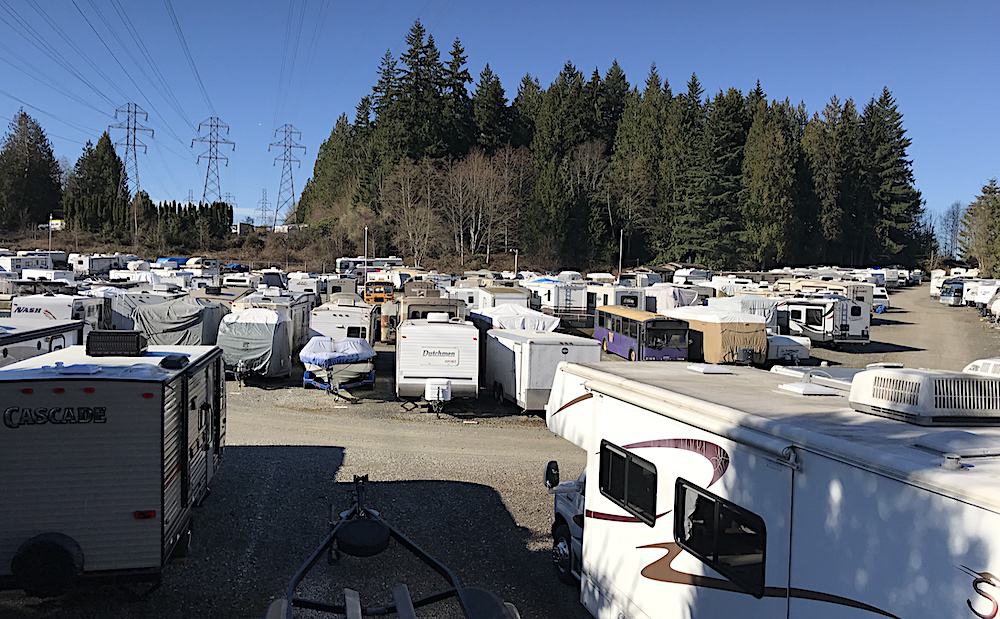
RV Storage facility
Keeping parking organized is a key feature for many – RVtravel.com photo
  • On-site management: Facilities with on-site management or personnel who can provide assistance, answer questions, and maintain a visible presence, which can be reassuring for owners.
    “Automatic gates, individual codes. Security cameras. Someone living on-site to do security.”—shared one reader of the Facebook group.

3. Weather protection

Your RV is a significant investment, and weather can be its greatest adversary. Look for storage facilities that offer protection from the elements:

  • Covered storage: Covered storage options, such as canopies, carports, or indoor storage, shield your RV from sun, rain, snow, and hail, preventing weather-related damage.
RVs in storage
Covered RV Storage – RVtravel.com photo
  • Climate-controlled storage: Some facilities offer climate-controlled storage units, maintaining a consistent temperature and humidity level. This is particularly beneficial for luxury RVs, vehicles with sensitive equipment or those RVers with mold allergies.

In some parts of the country, you can store your RV in the cavernous spaces left from underground mining, which are dry and uniform temperature year-round. Click here for such a facility beneath Louisville, Kentucky.

4. Cleanliness and maintenance

A well-maintained storage facility is not only an indicator of professionalism but also crucial for the preservation of your RV. Consider these cleanliness and maintenance factors:

  • Regular cleaning: Choose a facility that maintains paved, clean, and well-kept storage areas. This helps prevent dust, dirt, and debris from accumulating on your RV and potentially causing damage.
  • Hard surface: Many on the Facebook group commented that hard surfaces are a must. Here is one of several: “Concrete or asphalt. Grass and gravel tend to attract rodents.”
RV Storage facility
Unpaved RV storage facility lots lead to dusty and dirty RVs – RVtravel.com photo
  • Pest control: Effective pest control measures should be in place to deter rodents and insects, as they can cause extensive damage to your RV.

5. Accessibility

Consider the location and accessibility of the storage facility:

  • Proximity: The facility’s location should be convenient for you, whether it’s close to your home or along your planned travel routes. Proximity can save you time and fuel costs when accessing or retrieving your RV. Being near your favorite campground or vacation property could be a plus.
  • Availability of services: Some facilities offer additional services like dump stations, availability of compressed air and potable water, along with electrical hookups. These amenities can make it more convenient to prepare your RV for trips or maintain it while in storage.
    Dump station and wash area are plus.”—per a comment via the Facebook group.

6. Size matters

RVs come in various sizes, from compact campervans to spacious motorhomes. Ensure the facility offers storage options suitable for your specific vehicle size, including larger spaces for oversized motorhomes and fifth wheels. Make sure the spaces are marked designating your space from the neighboring space to avoid conflict.
Clearly defined lanes for parking spots.”—per a Facebook group comment.

7. Insurance and liability

While your RV is in storage, it’s important to understand the facility’s insurance and liability policies:

  • Liability coverage: Inquire about the facility’s liability coverage for potential damage or theft. This coverage can vary from one facility to another. Talk with your agent to make certain your insurance covers any gaps in what the facility fails to offer in terms of protection.
  • Insurance: Ensure your RV insurance policy covers storage or consider additional insurance if needed to protect your investment while it’s not in use. Should you cancel your RV’s insurance while storing it? Click here to learn more.

8. Accessibility for maintenance

Consider whether the facility offers amenities that make it easier to perform maintenance on your RV, such as a wash bay or designated maintenance areas.
“Allow mobile tech repairs on-site.”—chimed in one Facebook group commenter.

9. Well-designed layout

A well-organized and efficient layout within the storage facility can make a significant difference in the convenience of parking and retrieving your RV.

10. Reputation and reviews

Research and gather information on the facility’s reputation and customer reviews:

  • Read reviews: Online reviews and testimonials can provide insights into the experiences of other RV owners who have stored their vehicles at the facility.
  • If available, check crime statistics for the facility and surrounding area. If statistics aren’t available online, call local law enforcement.
  • Ask for recommendations: Seek recommendations from fellow RV enthusiasts or friends who have used storage facilities. They may offer valuable firsthand information.

A positive reputation and good customer feedback are strong indicators of a reliable storage option that takes the protection of your RV seriously.

11. RV-specific features

Some facilities offer specific features catering to the needs of RV owners:

  • Dump stations: On-site dump stations are useful for waste disposal, particularly if you’ve been on an extended trip and need to empty your RV’s tanks when returning your RV to storage.
  • Electrical hookups: Facilities with power hookups allow you to keep your RV plugged in while in storage, ensuring that your batteries stay ready for your next adventure. Keeping the batteries charged in winter is key to long life and performance.
    Power at each site would be a luxury.”—said one member of the Facebook group.

RV storage facilities: Conclusions

Selecting the right RV storage facility is a crucial decision for any RV owner. The features and amenities you prioritize will depend on your specific needs and the level of protection and convenience you desire for your recreational vehicle. Robust security measures, convenient access and hours, weather protection, cleanliness, and accessibility are key considerations. Additionally, insurance, liability coverage, and reputation are vital factors when making your choice.

Ultimately, the ideal RV storage facility should provide a safe and secure environment that not only safeguards your investment but also ensures your RV is ready to hit the road when you’re ready for your next adventure. Taking the time to research, visit, and evaluate potential facilities will help you find a secure haven for your cherished home on wheels.

Hopefully, the couple responsible for the creation of this article by asking the question “What key features do you look for in an RV storage facility?” will find it online. If so, I apologize for the delay in answering your question.

RELATED

Should you cancel your RV’s insurance while storing it?

Checklist for deep-cleaning your RV before storing it

Why storing your RV outside can be a bad idea

How long can you park an RV without causing ‘flat-spotting’ on the tires?

RVDT2655

Tour a rare restored 1973 Shasta motorhome

By Cheri Sicard
Have you ever stumbled upon a vintage RV and felt instantly transported to another era? That’s exactly what happened when Patrick Botticelli from New Jersey Outdoor Adventures discovered an incredibly rare 1973 Shasta motorhome on Facebook Marketplace. This wasn’t just any old RV; it was a time capsule blending a nostalgic exterior with a beautifully renovated interior.

The ’73 Shasta Class A RV has a certain charm. The owner, Killian, jokes that it looks like it’s straight out of the movie Cars. It’s got that undeniable ’70s vibe, with its blue exterior and original lighting. One of the most distinctive features is the shape of the windows. These rounded windows add character, although Killian shared it was tricky to redo the paneling around them due to their shape.

This Shasta has a huge awning. The rollers prevent the door from scratching or cutting it when opened. The rearview mirrors are iconic, and the front bumper is big and solid, complete with those classic lights.

Under the hood, there’s a 454 Big Block. Killian mentioned his dad’s generation loved the 454s, which sounds great when it starts up. It is also useful for towing and handling hills.

Shasta wings and original details

No Shasta is complete without its wings. These iconic wings are on the sides.

The RV still has its original gray tank, which is pretty cool to see. While the black water tank is currently disconnected, it’s still there, which offers the option to reconnect it later.

The rear of the Shasta has an angled design. This keeps it from looking like a box truck.

Other notable features include:

• A spotlight for the license plate

• An antique license plate

• A fire escape door

• A backup camera

• A fuel tank

• A dog door

• A 6,000-watt surge, 5000-watt continuous generator

Despite some weathering and water damage, the aluminum framing is solid. Killian was relieved he didn’t have to do any framework and he only had to replace the insulation.

An outdoor porch light and handle make getting up the steps easier. The step itself is reused from an Argosy.

Stepping inside the Shasta motorhome: A cozy cedar cabin

Stepping inside, you’re greeted by the inviting smell of cedar. Killian loves using cedar, so he tried to incorporate it everywhere. It smells great and is generally affordable. There was significant water damage, so all the paneling had to be replaced.

The driver’s area feels like a flight deck, offering a panoramic view. The passenger seat can fold into a bed or lounge area. The overhead dashboard has readers for the generator. The swivel seat can lock in place.

Accessing the engine is simple. The “dog house” pulls up and out of the way. Since it’s on a P30 chassis, there’s plenty of room to work on the engine.

The retro dash has a cool layout. You’ll find a lighter, too. The backup camera was built in when Killian purchased it.

The kitchen transformation

The countertops are made of teak. The shades were salvaged. The color scheme is based on the blue in the carpet and couches. The kitchen backsplash pulls in the blue from the living space.

The pull-out faucet is a fun feature. There’s a three-burner stove with an oven. Above the cabinets, there is storage for plates and glasses. Killian’s wife, Kenzie, designed the boho-style doors, cutting out, staining, and gluing them in. There is a drawer for silverware and a large cabinet for cereal (Killian really likes cereal).

Killian removed the original fridge and closet to create more countertop space and installed a new retro-themed fridge.

The flooring is a 20-mil layered waterproof, scratchproof material.

The bedroom and bathroom

There is ample storage for clothes in the bedroom. Killian removed cabinets to open up the space and installed new recessed lighting and fans. The bedroom has a cozy atmosphere.

For the king-size bed, Killian had to work around the generator and water tank. He pulls out half the bed and unfolds the other half. The stretch-fitted cushion covers and memory foam topper add comfort.

The bathroom is designed as a luxurious space. The wallpaper has a ’70s theme, and the cedar counter top with live edge adds a unique touch. There is storage under the sink for toilet paper, where you can also access the plumbing and electrical components.

Killian removed the old fiberglass shower and installed FRP (fiberglass reinforced plastic) board and a new shower pan. The dry flush toilet is also modern. The bathroom has Edison light bulbs, a dimmable shower light, a night light, and a coat rack.

The renovation journey

The Shasta came with its original advertisement. This shows the original layout and features and highlights the structural aluminum frame, steel roll bars, and aluminum skin.

Information on this model is scarce. Killian found a video from 2019 showing this motorhome in its original state. Most RVs from that time were made of wood and fell apart. This one has a steel roll cage, which leads to speculation that it could be a prototype or a limited production model.

A lot of hard work went into this renovation. Pricing such a unique vehicle was challenging.  Killian invested close to $20,000 in the renovation. While he didn’t disclose the exact selling price, he shared his initial expectations. He also considered the possibility of it being used as an Airbnb or movie set. Ultimately, his goal was to keep it affordable and make the buyer happy.

After selling this vintage rig, Killian was more than ready to move on to van conversions.

Watch his story and take a tour of the rig below.

YOU MIGHT ALSO LIKE:

RVDT2655

Are pull-through RV sites worth it? Why you might be paying more for less

Have you ever dreamed of the perfect camping trip, picturing a spacious site surrounded by nature? Then, reality hits: You’re squeezed into an RV park where you can practically hear your neighbor snoring. Is this the RV life you signed up for?

A viewer of Jason Epperson’s at RV Miles recently asked if all campgrounds are like Fishing Bridge RV Park in Yellowstone, known for its tightly packed RVs. The short answer? Thankfully, no. While Fishing Bridge is common for RV parks with full hookups, it’s not typical of all national park campgrounds.

So, why are some RV parks so cramped? In the video near the bottom of this page, Jason explores the reasons.

Location plays a huge role. Campgrounds near popular destinations, such as national parks and monuments like Devil’s Tower, often have higher demand. To accommodate more RVers, sites get packed together. It’s a simple matter of supply and demand.

Let’s be honest: Corporate greed is also a factor. Cramming more sites into a smaller space means more revenue. The more RVs they can fit, the more money they make. It’s an unfortunate reality in some RV parks.

Full hookups—electricity, water, and sewer—come at a price. Running these utilities costs money, and the closer the sites, the shorter (and cheaper) those runs will be. Sewer lines, in particular, require careful grading, adding to the expense.

The pull-through RV site paradox

Pull-through RV sites are convenient, especially for large RVs and quick overnight stays. No need to back in—just pull through, dump tanks, hook up to power, do laundry, eat and sleep, and hit the road. However, this convenience comes at a cost.

Pull-through sites take up a lot more space than back-in sites. This often leads to narrower sites and less personal space. They’re usually longer and skinnier than back-in sites with the same (or even more) square footage. And, despite being less enjoyable, pull-through sites are often the most expensive.

Imagine a 3-acre campground with 53 sites: 34 back-in and 19 pull-through. That’s almost twice the recommended density of 10 sites per acre.

Let’s break down the site dimensions:

Back-in sites:

• Dimensions: 33 ft. x 60 ft.

• Driveway: 45 ft.

• Parking pad: 12 ft.

• Total square footage: 1,980 sq. ft.

• Concrete/asphalt/gravel: 700 sq. ft.

Pull-through sites:

• Dimensions: 24 ft. x 84 ft.

• Parking pad: 12 ft. x 84 ft.

• Total square footage: 2,016 sq. ft.

• Concrete/asphalt/gravel: 1,000 sq. ft.

Even though the square footage is similar, pull-through sites feel much smaller because of their narrow width. There’s often little space for a picnic table, and you’re right next to your neighbors.

Removing the pull-through sites would allow for nine additional back-in sites. Plus, back-in sites only need a one-lane road, saving even more space.

The demand dilemma

Campgrounds are responding to demand for pull-through sites. By prioritizing pull-throughs, we sacrifice space and create less enjoyable campgrounds. Jason (RV Miles) tries to avoid pull-through sites, unless it’s a quick overnight stay or the campground forces the issue. Some campgrounds don’t allow bigger rigs to use shorter sites, even if they fit.

Jason dreams of being the “Arnold Palmer of campground design,” creating campgrounds with a more naturalistic feel, like state parks. Instead of segregating cabins, RV sites, and tent areas, imagine a campground with a mix of site types within the same area. A loop of nice back-in sites with the occasional pull-through, cabins and glamping tents mixed in. Improved landscaping could enhance privacy and create a sense of separation, even in close-quarters campgrounds.

What do you think?

What are your campground preferences? Do you only park in pull-throughs? Do you avoid crowded RV parks? Do you prefer state parks, national park campgrounds, or boondocking? What do you think about the current state of campground design? Have any suggestions?

Leave your comments below.

YOU MIGHT ALSO ENJOY:

RVT1211

Two good RV e-bike rack and carrier options

By Dustin Simpson
When it comes to transporting e-bikes with an RV, there are several options available.

Two popular e-bike carrier solutions designed specifically for RVs

Hitch-Mounted Bike Racks: These racks attach to the hitch receiver on your RV and can carry multiple e-bikes. They come in various styles, including platform racks and hanging racks. Platform racks support the bikes by their wheels, while hanging racks support them by the frame.

RV Bumper-Mounted Bike Racks: Some RVs come with a bumper-mounted bike rack option. These racks attach to the RV’s bumper and can carry one or two e-bikes.

This one is nice because it helps you lift your bike onto the rack.

A bumper-mounted e-bike rack

How to choose the right e-bike rack

When choosing an e-bike carrier for your RV, consider factors such as the weight capacity of the rack, the number of bikes you need to transport, and the ease of installation and use. It’s essential to ensure that the carrier is compatible with your specific e-bike models and RV type. Always follow the manufacturer’s guidelines for installation and use to ensure safe transportation of your e-bikes.

More from Dustin

Make sure you check out my website, California RV Specialists, and our YouTube channel for more helpful information, and see our published articles on RVtravel.com and other social media pages.

RELATED

##RVDT2655