Sometimes getting from here to there demands a stopover or two! If you’re traveling through Indiana on Interstate 74, plan to stop at this one-of-a-kind museum. Just off the interstate, on Highway 231, you’ll find Crawfordsville’s Rotary Jail Museum. Yes, the jail actually spins!
Crawfordsville’s Rotary Jail Museum offers RV travelers a one-of-a-kind detour into 19th-century ingenuity. It showcases the only operational “rotary” jail remaining in the United States.
Brief history
Built in 1881, the jail housed up to 16 prisoners safely and efficiently. The two-story iron structure features a massive gear mechanism that still turns today for guided tours.
In continuous use as the Montgomery County Jail until 1973, the Rotary Jail now serves as a living museum complete with ghost-hunting events, art classes in the attached Tannenbaum Cultural Center, and rentable spaces for private gatherings. (Who wouldn’t want to get hitched er, married here? Ball-and-chain would take on a whole new meaning! Just kidding, of course.)
Revolutionary design
In 1881, architect William H. Brown and engineer Benjamin F. Haugh set out to revolutionize incarceration. Together, they invented a revolving cell block. Yep, each of the two floors in the jail revolves. The unique jail design was housed in the red brick-and-limestone sheriff’s residence and allowed one guard to watch more inmates.
A total of eighteen revolving jails were initially built across the Midwest, but only three remain. The Crawfordsville structure is the first ever constructed and the only one still capable of rotation.
How it works
Image: rotaryjailmuseum.org
The jail contains eight wedge-shaped cells arranged on two separate floors. There is a single door on each level. A cell can only be entered or exited when it aligns precisely with this door. The 32-ton rotating mechanism is operated by hand crank or electric motor and is still turned regularly for tours.
Downtown Crawfordsville, a designated Main Street community, welcomes RVers with cozy diners, boutique shops, and fuel stops.
Nearby points of interest
• General Lew Wallace Study and Museum: Home of the Ben-Hur author.
• Wabash River Paddle Trails: Launch a canoe or kayak to explore Indiana’s heartland.
• Turkey Run State Park: A scenic 30-minute drive, perfect for hiking before you get back on the road.
You should go!
Indiana is a beautiful state and offers RVing visitors many scenic parks and trails. The Rotary Jail in Crawfordsville is certainly worth a stop along your way.
So many times, new gadgets end up not living up to expectations, which is why I get super excited when they do. Well, I got super excited about a new gadget this week. These new BBQ and meal prep collapsible food tubs from the fine folks at Drip EZ are incredibly useful, yet they take up almost no space in your RV.
The versatile meal prep tubs, available in three sizes, simplify meal prep, marinating, and cleanup. Even the small one is large, and the only folks who will probably need the largest size are BBQ aficionados marinating full racks of ribs or huge cuts of meat.
Featuring an ingenious design, when collapsed, the bottom of the tub is a built-in cutting board. Expanded, they hold huge amounts of prepped food. In fact, the large size is specifically designed to hold LARGE cuts of marinating meat before BBQing. The food tubs come with locking lids that keep everything fresh and clean until you are ready to cook or serve.
You will come up with lots of uses for them once you own some of these tubs. I know I have. For instance, the small size tub is still large enough to hold, transport, and serve a large salad at a campout potluck. Prep, store, and serve in the same container that will later pack away flat? Genius! It’s also great for bringing out a huge tub of popcorn on movie night.
I have often used the food tubs to wash dishes too. If I need to wash the tub after use, I might as well use it and the soapy water to do other dishes at the same time.
Beyond food, I find myself using these collapsible tubs for holding and transporting all kinds of items around the campsite, especially craft supplies for when we want to play and create outdoors.
Dimensions:
• Junior: 15.75″ L x 12.5″ W x 4.5″ D – Especially good for chopping and storing vegetables.
• Original: 20” L x 16.25” W x 5.5″ D – Great for applying dry rub and marinades, as well as chopping larger amounts of veggies.
• XL: 22.5″ L x 16.25″ W x 5.5″ D – Outstanding for prepping larger cuts of meat with a dry rub or marinade, or prepping and serving foods for BIG groups.
Care instructions:
• How to clean: Hand wash with mild soap or place in the dishwasher. Avoid harsh abrasives to maintain the material’s integrity.
• Storage tips: Dry thoroughly before collapsing to help preserve shape and durability.
• Safety note: Not microwave-safe, which is not a big deal; these large tubs would not fit in a microwave anyway.
What I especially like about Drip EZ collapsible BBQ and meal prep food tubs
• Keeps counters clean as you can chop on the built-in nylon cutting board.
• Four slip-proof feet keep things stable while chopping.
• Folds flat when not in use, so even though these are LARGE food-safe containers, they take up almost no cabinet space.
• The lid has locking hinges to keep everything inside. It also locks onto the tub in collapsed position for easy storage that keeps everything together.
• Adjusts to three different heights.
• Its versatility and compactness make it handy for LOTS of food prep and non-food prep uses around the RV.
• Available in a variety of colors.
What can be improved?
Much as I like this product, and I do like it a lot and use it constantly, I wish they had integrated the built-in cutting board into the lid instead of the base of the tub. That way, you could chop, then put the prepped food into the bin. As it stands, you chop with the tub in the collapsed position, so you need somewhere to put the chopped food until you finish chopping, when you can then transfer it to the bin for storage/serving.
It’s not the end of the world, but it would make this already great gadget so much better. One less thing to clean is always a good thing when camping, and the lid is just sitting there doing nothing while you prep anyway. It just seems like it would make more sense.
That “flaw” aside, I still like, use, and heartily recommend this product.
The part of RV life we love to hate: taking care of or replacing old, damaged or worn out tires. One thing is true about tires in RV application: No one likes having to replace them. Some people dislike dealing with their RV tires so much they may forget that proper care and maintenance can allow us to run our tires longer.
Different vehicle tires need different care
First, we need to understand some facts that you may not have been told or even thought about: Tires on different vehicles need different care. Some may realize that the tires on passenger cars seem to last longer and have fewer problems than the tires on their RV. But just because your car tires are round and black and the tires on your 40’ Class A diesel pusher are round and black, there are significant differences in both tire design and construction, and in the loading and service you place on your tires.
As the end user, there isn’t anything you can do about tire construction other than pay attention to the information you are provided. All tires have a short description with the number and type of reinforcement materials in the tire. You will find this on the tire sidewall. It will say something like, “Sidewall 1 layer (or ply) steel, Tread 3 layer (or ply) steel plus 1 layer Nylon”—if that was the construction in your tire.
I suggest everyone go out and “read” the material list on your tires. If you have 19.5 or 22.5 diameter tires on your RV, you probably only have steel as reinforcement. If you have LT-type or ST-type tires, the materials are most likely polyester and steel, plus possibly nylon. Your passenger-type tires will be polyester and steel plus possibly nylon. I would consider ST-type and LT-type tires that include nylon on top of the steel belts as possibly better than those without the nylon cap ply.
Reserve Load for tires
The things you, as the user, can control are load and inflation. Your passenger car tires probably have 25% to 35% “Reserve Load”. I suggest you review THIS post on “Reserve Load” in RV service. The tires provided on many RVs by the manufacturer probably provide a theoretical 10% reserve. I say “theoretical” because the reality is that half of the RVs that have had each tire load measured by RVSafety or Escapees have discovered they are overloaded and/or under-inflated. That 10% figure assumes you are always properly loaded and inflated.
You do not need to get your RV weighed every trip if, when you got it on a set of scales, you were at the heaviest you ever expected to be and confirmed your tires were no more than 95% of the tire load capacity for your inflation.
Inflation
So we are left with inflation. There are Load/Inflation tables available for all tires. If you have Michelin brand tires, you should use their tables, available HERE. All other brands can use the tables I have posted on my blog, as everyone else uses the same formula. If you look, you will see that all tire companies provide the same PSI rating for the same load on the same size and same Load Range tires.
So, how do you select the appropriate inflation? The inflation in the tables is the MINIMUM PSI required to support the stated load. Ideally, you would inflate to a level that would give you a Reserve similar to what you have with your car. However, I am not aware of any RV company selecting a tire that would allow that since it would cost them more than the minimum requirement.
Remember: you always go up to the next level PSI if you exceed the stated load, even if you only exceed that load by 1 pound. DO NOT TRY and calculate for a PSI between cells in the table.
Tire age
This topic can be confusing as we are trying to balance the cost of a set of tires against the possibility of having a tire failure. The best we can do is to first establish a maximum age based on the DOT serial date code, and that would be 10 years.
But that would be for tires with a normal 20% to 25% reserve capacity. When you reduce that capacity, it has been suggested that you have cut three to four years off the maximum tire life. We can’t be more specific as the age of your tires depends on the heat history over their life. This would include operating temperature and even the temperature when parked or stored. Remember the “rate” a tire ages doubles with every increase in temperature of 18°F.
Ensuring you always have the air pressure you want would include the use, proper programming, and annual testing of your TPMS system.
If you have tire questions, check out Roger’s Blog as well as his posts on RVtravel.com. There are hundreds of posts covering everything to do with tires.
If you still have a question for Roger after searching the above posts, send your inquiries to him using the form below.
“My dear friend, clear your mind of can’t.” —Samuel Johnson
Need an excuse to celebrate? Today is National Wyoming Day!
On this day in history: 1607 – Jamestown, the first permanent English colony in North America, is founded
Featured news
Early this week we were putting together a story regarding the potential sale of federal public lands. It appeared that it was possible that nearly a half-million acres of public lands, including some next door to one of America’s national treasures, Zion National Park, could have gone on the sale block. What a difference a few hours makes. Now, those lands are not for sale. Here’s what changed.
A brand-new Florida KOA has been slated for demolition. It was one family’s dream: Build a campground in the Sunshine State. The dream became a reality and the KOA Holiday Campground in Panama City Beach swung the gates open for guests. But in just a few months, the dream RV park will vanish under the blade of the bulldozer. Eminent domain wipes out this Florida KOA RV park, because the state wants to widen the highway.
Thinking about Starlink? Starlink and RVing for some is a “natural.” No matter where your RV takes you, you’ll be able to stay connected to the internet—even while in motion. But some have been put off by the high cost of the hardware. Starlink’s Mini dish, required for in-motion connectivity, normally retails for $599. But for a short time, VERY SHORT, you can pick up the hardware at a big discount.
BIG RECALL:Toyota is recalling certain 2022-2025 Toyota Tundra and Tundra Hybrid trucks. Moisture may enter the reverse light assemblies and cause a light failure. As many as 443,444 vehicles may be affected by the recall. More info here.
What was the number one amenity added to private campgrounds last year? Wi-Fi? Swimming pools? Tiki bars? Dog parks? Nope, none of the above. It was something much, much more popular than those. Can’t guess? Find out here.
A tractor-trailer driver’s apparent overreliance on GPS navigation led to the closure of Snake Creek Road in Great Basin National Park. Some speculate the driver was attempting to bypass a weigh station, while others believe he was seeking a shortcut across Nevada’s Snake Mountain Range. Whatever the reason, the incident highlights yet another costly misadventure caused by misguided GPS directions. (Do not do this at home, kids!)
FOR FUN: Yesterday, all six of Oscar Mayer’s iconic Wienermobiles competed in a race held just before the start of the Indy 500 at the Indianapolis Motor Speedway. This inaugural event, dubbed the “Wienie 500,” was no ordinary race. Each Wienermobile was decked out to represent a different regional hot dog style: Chicago Dog, New York Dog, Slaw Dog, Sonoran Dog, Chili Dog, and Seattle Dog. And the winner? The Slaw Dog, edging out the competition by about half a bun length. Here’s the full race video coverage (start at about 28:00 for the race).
Last month, we reported a recall affecting 600,000 GM vehicles with 6.2-liter V8 engines, found in some pickups and large SUVs. GM says defects in engine components could lead to failure, with fixes ranging from full replacements to oil changes and new caps. But a new class action suit argues the fix hurts fuel economy and resale value. Here’s what’s behind the lawsuit.
Camping at or visiting any Iowa state parks this year? With more than 759,000 campers and more than 13.5 million visitor days last year, state parks are anticipating another busy season. And with that comes big changes to the Iowa State Parks System.
IN MONTANA? Perhaps you want to attend The Old Saloon’s Testicle Festival in Emigrant, MT, tomorrow, May 25. There will be Rocky Mountain Oysters aplenty, and a portion of the proceeds will go to the Testicular Cancer Foundation.
BE SAFE THIS WEEKEND
Memorial Day weekend ranks as one of the most dangerous holidays on our nation’s roads and waterways. It marks the unofficial start of summer, a period notorious for a surge in impaired driving crashes. The National Safety Council estimates that 443 people may die on U.S. roads during the 2025 Memorial Day holiday period. Please be safe and do not drink and drive!
Campground crowding, comments & concerns RVers discuss: Is the 10-year rule ‘snooty’?
Last week in this column, readers discussed the 10-year rule (the age limit on RVs allowed to stay in some RV parks) and how, in some parks, it was even less than that. This week, we hear from more readers regarding their thoughts on that rule and some potential issues it may cause for them. Do you agree?
IT’S ON! AMAZON’S MEMORIAL DAY SALE IS BIG!
Have a few things in your cart you need to buy? Now is the time! It’s one of Amazon’s biggest sales of the year, and it’s only this weekend! Stock up on everything you need, and maybe buy that one thing you’ve been putting off… Here’s a link to the sale page. Have fun!
Reader poll Are you spending this Memorial Day weekend in your RV?
The latest U.S. average prices per gallon of fuel as of May 19, 2025: Regular unleaded gasoline: $3.17. Up 5 cents from last week; down 41 cents from last year. Diesel: $3.54. Up 6 cents from last week; down 25 cents from last year.
• The state with the most expensive gas: California, $4.88
• The state with the least expensive gas: Mississippi, $2.67
?? MYSTERY PRODUCT OF THE DAY ?? If you’re into this (many, maaaany people are), or know someone who is, this will be a big hit. Plus, things like this are perfect for long driving days (if you’re the passenger, of course) or cozy nights around the dinette.
Trivia
In 2024, the median age of first-time U.S. homebuyers hit a record 38 years—the highest since data collection began in 1981—so says the National Association of Realtors. Overall, the average age of an American homebuyer also reached an all-time high of 56 years last year, a 44% increase from two decades ago, while for repeat buyers, the trend was even more dramatic.
Laugh of the week
RV comic
The perfect scam The NFT Scam Targeting Artists
Douglas is enjoying a second career as an artist, selling his paintings online and in gallery shows. People occasionally ask about non-fungible tokens (NFTs) of his work. Still, he never gives it too much thought until a woman on LinkedIn approaches him with what seems like the opportunity of a lifetime. Her company can convert his artwork to an NFT for free and sell it for him. He signs a contract and sets up a cryptocurrency account, and within a few months, he gets the good news that the image has sold. After paying large sums in fees and taxes, Douglas learns it is all an elaborate crypto scam.
Today in history
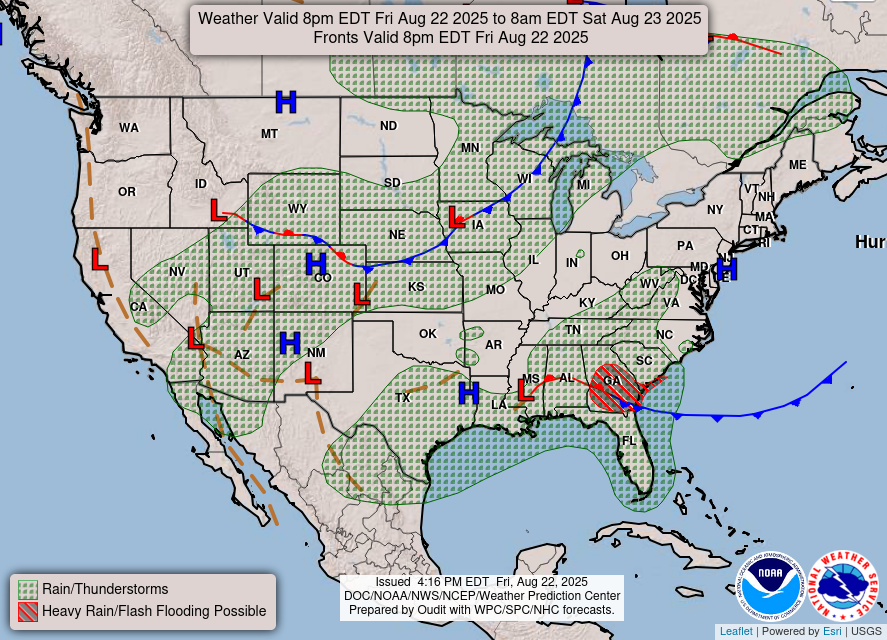
Today’s weather forecast across the nation THIS MAP UPDATES TWICE A DAY
Campgrounds are changing and evolving, some for the better and some for the worse. RVtravel.com readers discuss their experiences and offer tips to help other campers find that perfect spot.
Readers talk about the 10-year rule
Last week in this column, readers discussed the 10-year rule and how, in some parks, it was even less than that. We will be nearing the 10-year limit on our RV soon, and while it could affect us, we seldom stay in the higher-end resorts anyway.
I have sent photos in the past of an older RV we had, and I suppose I could send a picture of our well-cared-for motorhome now, but I do take offense at the restriction. I understand the desire of RV parks to eliminate broken-down, ragged RVs, but it still seems a bit snooty, at least to me.
Our readers responded with their thoughts in the comments and emails.
Here are a few observations from our readers. These do not necessarily represent the views of RVtravel.com.
Rather stay in a hotel
Randall J. would rather stay in a hotel than pay resort prices. He wrote, “The ten-year and newer rule I’ve seen, I wouldn’t be able to afford anyway. There’s a park on the Oregon coast that charges $126 a night. For that kind of money, I’d stay in a motel. State parks in Oregon only charge around $40 a night. I know it’s harder to get in them, but you just have to plan accordingly.”
Will a 7-year rule affect resale?
John M. makes the point that the 7-year rule could affect resale value. He wrote, “Our coach is four years old, but the 7-year rule will definitely and negatively affect our resale value.
“Rising costs are one of several reasons our RVing days are numbered. Our advice? Get out and see it, experience it, and taste it. You’ll be more complete for it!”
Most parks, even with the 10-year rule, are reasonable
Anthony B. worked with RV parks’ 10-year rule with his 15-year-old RV. He wrote, “We are on our ninth motorhome in the past 40 years and recently downsized from a Class A. We average 15K miles a year and have stayed in most states. While this RV is new, we’ve owned some 15+ year-old coaches. We are happy to supply pictures or answer lots of questions when we book parks.
“We usually call a park when booking. We understand why some parks have these restrictions and don’t judge the owners. As long as their rules follow the laws, I’m good! If a park says ’10 year max NO EXCEPTIONS’, maybe I look elsewhere cause they may be too snooty for me.
“We’ve also stayed in parks we WISH had more rules because some rigs ARE BAD and not MAINTAINED. Recently, while traveling with a friend who converted a motorcycle trailer into an RV, we ran into the ‘no converted trailer’ rule. But after two phone calls and emailed pictures, we got the thumbs up. Very nice park hosts. In my many years and many miles, I’ve found most parks are reasonable. Those that aren’t, I go elsewhere.”
Changed ownership, started the 10-year rule, and raised rates
Edward W. now goes to a state park. He wrote, “One of our favorite RV parks in the Montrose, CO, area changed ownership and instituted the 10-year rule and raised prices a few years ago. Now our favorite RV park in that area is a state park. Our trailer wasn’t 10 years old at the time, but now it’s 11 years old. However, the 10-year-old rule doesn’t seem to come up too often for us.”
“Lots more fish in the sea”
Tony K. doesn’t want to stay in those RV parks anyway and wrote, “I own a 1998 Bounder that’s been stored under cover and meticulously cared for. It looks nearly new. Usually, the RV parks that have such a rule aren’t the kind we are interested in staying at, so it doesn’t bother us. A private business has the right to say and do what it wants. There are lots more fish in the sea.”
Their RV is old enough to drink!
Bob S. writes about the 10-year rule and future plans. “Yes, we have been impacted by the 10-year rule. This year, our MH is old enough to drink. But it looks almost as good as the day it was built. I expect this issue, as well as the extremely high prices of RV parks in popular areas, to persist as long as the high demand persists, maybe even longer.
“We live in the beautiful state of Missouri, but the West is magnificent. What we like best is always living in a nice climate, seeing beautiful landscapes, and unusual wildlife. And, we didn’t expect to, but we have made so many good friends along the way! It is fun to meet up with them in these beautiful places.
“We have been wintering in Apache Junction, AZ, for the last several years. We had to change RV parks recently because our regular park converted to permanent housing for the houseless. We have nothing against the houseless, but we go there to recreate, so we moved to another park focused on RVers.
“Yes, we have been impacted by rising costs. Our favorite place is Yellowstone NP, but the RV park prices have become unaffordable. The only way we can afford it is to go there as workampers. But it is worth it to spend the summer in such an incredible place. Our friends and family ask us how long we will do this and my wife and I have the same answer: As long as we possibly can!”
3-year-old RV is too old! Geez!
Donna P. sent us their experience with a Florida RV park. She wrote, “We’ve been full-timing for a little over five years now. Our Class A is a 2019. When DH made a reservation at a park in FL, apparently our RV was too old, and this was about three years ago. Whaaa? Yes. It’s true. So, he sent a picture and we were ‘allowed’ in. After arriving at this ‘resort’, we laughed because it was just a regular RV park—no pool, no playground for kids, a small clubhouse that needed work, and RVs older than ours. Yep—tack on that word ‘resort’ and you can charge whatever you like.”
Now, some questions for you:
Are you finding campgrounds booked up or is finding a site not a problem?
What do you like best about RVing?
What are your pet peeves?
Are you seeing more permanent and seasonal RV parks?
Are rising costs affecting your camping style?
Do you have favorite campgrounds or RV parks?
What is the most memorable experience you have had RVing?
Do you have any tips or secrets you’d like to share?
Please use the form below to answer one or more of these questions, or tell us what you’ve experienced with campground crowding in general.
Are you reading this now in the comfort of your RV? If so, that likely means you’ll be answering “Yes” below—that you are spending this weekend in your RV. Lucky you!
It’s going to be busy out there this weekend, so be safe driving and don’t you dare drink and drive!
Maybe you’re set up at a favorite spot you’ve been to a dozen times, or maybe you’re trying out someplace new and hoping the neighbors aren’t too noisy or you’re not too close to the highway or train tracks. Either way, it’s always nice to settle in and not have to think about packing up for a few days, right?
Even a quick weekend getaway can make a big difference—a chance to reset, unplug (or not), and enjoy the slower pace that comes with RV life.
And if you’re not out this weekend, no worries—sometimes planning the next trip is almost as satisfying as hitting the road… almost. As long as you’re having a BBQ wherever you are, that’s all that matters!
So what about you? Are you in your RV this weekend? Or just staying somewhere else, like a regular home that doesn’t even have wheels (what fun is that?). As always, your comments are welcome.
Early this week we were putting together a story regarding the potential sale of federal public lands. It appeared that it was possible that nearly a half-million acres of public lands, including some next door to one of America’s national treasures, Zion National Park, could have gone on the sale block. What a difference a few hours makes. Now, those lands are not for sale.
Congress has been wrestling with the federal budget, with an aim to get a bill passed by this weekend. We’re not going to visit the brass tacks of “who wins/who loses” in terms of dollars and cents. However, we will touch on one aspect of the bill—that which would have allowed the sale of those thousands of acres.
Recreation industry happy public lands are not for sale
A statement from the Outdoor Recreation Roundtable (ORR) paints the history of this public-lands-on-the-chopping-block scenario. The roundtable is a coalition of outdoor recreation trade associations and organizations. It represents more than 40 national associations and 110,000 businesses across various sectors, including the RV industry. Here’s what showed up on our desk this morning, Thursday, May 22, as we were working on our piece.
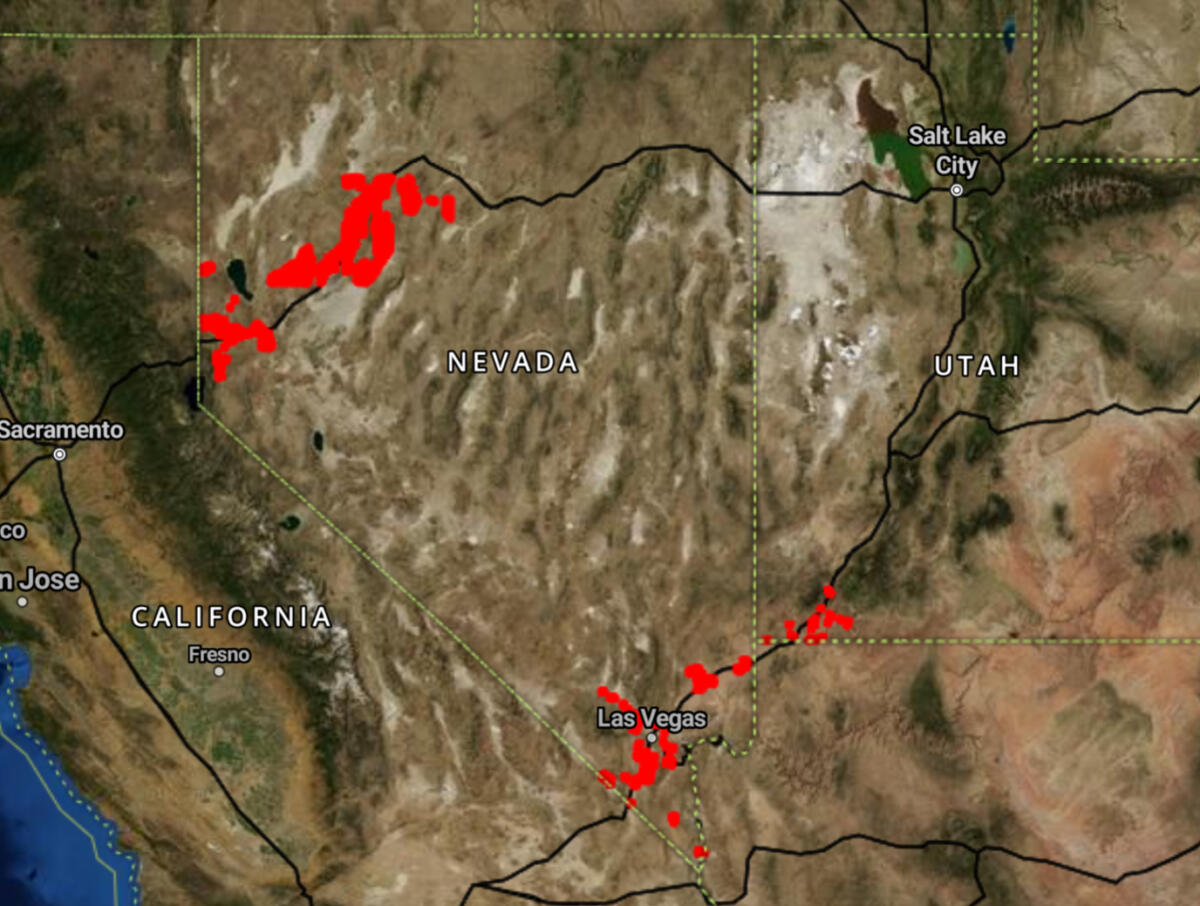
“Just before midnight on May 7, members of the House of Representatives Natural Resource Committee added an amendment to a sprawling budget bill that would have forced the sale or transfer of some 540,000 acres of public land in Utah and Nevada. The provision caused an uproar among public land advocates who said it would clear a path for more public land sell-offs during future budget negotiations.”
Red marks the spots: Public lands that could have been sold. onxmaps.com
The amendment, which was introduced by Representatives Mark Amodei (R-NV) and Celeste Maloy (R-UT), initially proposed the disposal of approximately 11,000 acres in southern Utah. That’s what it looked like on the surface. But digging deeper, the provision encompassed a much larger area, totaling more than a half-million acres, including a 311-acre tract next door to Zion National Park. The proposal’s late inclusion in the budget bill, without public consultation, sparked widespread concern among conservationists, outdoor enthusiasts, and lawmakers.
The Outdoor Recreation Roundtable wasn’t the only group opposed to the public land sell-off. At least 70 conservation groups sent a letter of opposition. In part, it read, “This bargain-basement auction of our nation’s natural heritage under the sham of paying for tax cuts to billionaires is simply reprehensible and un-American, and we therefore urge you to oppose this legislation and this pernicious amendment.”
Opposition comes from other camp, too
But conservation groups weren’t the only ones up in arms. From what many might consider “the other side of the aisle” came Ryan Zinke, the former head of the Department of the Interior, appointed by President Trump during his first administration. Now a Montana Congressman, Zinke had this to say about the sale of public lands: “I do not support the widespread sale or transfer of public lands. Once the land is sold, we will never get it back. God isn’t creating more land.”
Apparently, the voices of those opposed to selling off public lands were heard. The land sale amendment that was rolled into the budget bill was, at the last minute—pulled by the House Rules Committee. From there, the revised bill squeaked by, passing with a vote of 215 to 214.
More than just beauty—freedom
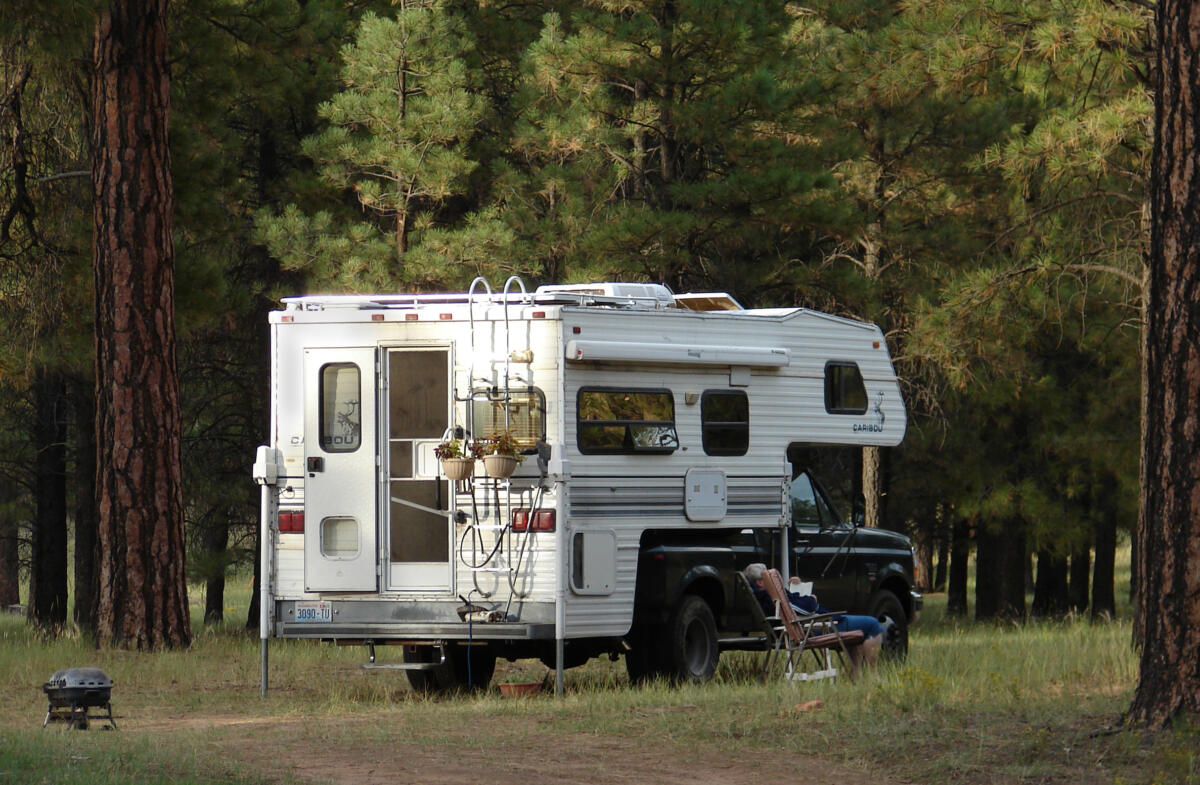
What’s it mean for RVers? Perhaps a precedent set for future land sales. Uncle Sam manages nearly 640 million acres of land, much of it in the West. These lands include national forests, BLM (Bureau of Land Management) lands, national monuments, and other public areas where we RVers routinely camp, boondock, hike, fish, and explore.
R&T De Maris photo
Public lands offer more than just scenic beauty, they also offer freedom. Freedom to travel off-grid, stay in dispersed camping areas, and enjoy extended stays without paying expensive campground fees. The potential sale or privatization of these lands could put up “No Trespassing” signs where open access once reigned. At least today, public lands are not for sale.
It was one family’s dream: Build a campground in the Sunshine State. In January 2024, the dream became a reality—the KOA Holiday Campground in Panama City Beach swung the gates open for guests. But in just a few months, the dream RV park will vanish under the blade of the bulldozer. Eminent domain wipes out this Florida KOA RV park.
Need more traffic lanes, so eminent domain wipes out RV park
Malanda Schmitz is beside herself. She and her family worked hard for years to make their dream RV park a reality. But the State of Florida has other plans.
U.S. Highway 98 is presently a four-laner outside the park. Two more lanes, says the state, are needed. So the state “bought” the land with the power of eminent domain, the legal power of the government to take private property for public use, with compensation to the owner.
While Malanda will be financially compensated, no amount of money can take away the pain of heart. Schmitz told local media outlet WJHG, “This was going to be a full resort someday,” she said. “We built everything with that in mind. It was supposed to be a big part of the community.”
Adding to the pain of loss was having to share the news. The Florida KOA had bookings into December of next year. “That was one of the hardest parts,” Malanda told reporters, “Calling guests to cancel their stays.”
For their part, state officials don’t want to look like party poopers. “We don’t want to hurt local businesses,” Florida Department of Transportation spokesperson Ian Satter told WJHG. “We work with owners to help them stay open during the transition and assist them in finding new locations.”
“I want them to be happy”
The State has given Malanda Schmitz a “new” operation time until July 15 before eminent domain wipes out the RV park. That’ll allow guests a couple of big holidays to enjoy their RVs. Despite her heartbreak, Malanda wants the best for them. “I want our guests to enjoy their time here,” Schmitz said. “Even after we’re gone, I want them to be happy.”
”The past is a place of reference, not a place of residence.” ―Roy T. Bennett
Need an excuse to celebrate? Today is National Road Trip Day!
On this day in history: 1934 – American bank robbers Bonnie and Clyde are ambushed by police and killed in Bienville Parish, Louisiana.
Tip of the day Tips for packing the RV for an extended time on the road
By Nanci Dixon
The disadvantage of having a part-time house now versus being a full-time RVer is that I am always forgetting something, or duplicating something, or just plain packing way too much! Packing the RV up for a six-month-long haul is a big job. There are a few tricks I have learned over the last few years that make it a little bit easier.
This is my “don’t forget” list. Because we haven’t duplicated a lot of items, we cart stuff into the house and cart it back out to the RV. I inevitably forget something. Last year it was my favorite salad hands, the nutcracker that I used to open those stubborn little water bottle caps, and sweatshirts.
We took a few mini-trips this winter, and I forgot my pillow, VIAIR for tire pressure, the doomed salad hands, and we also forgot to check the weather. Should have brought flannel PJs, too! Continue reading.
Ask Dave What does 50% State Of Charge (SOC) of a 12-volt battery mean?
Dave,
Love reading your answers for RVers. It is the best help I have ever seen at any website.
My question is, you always say that batteries are made to drain down to 50 percent.
What is 50 percent—12v, 11v, 10v? I think this would help RVers a lot. Also, how to monitor, when and what to do when you get to that magic number. —Louie, No RV as of today Read Dave’s answer.
In the RV shop with Dustin The importance of having an RV spare tire
Article and video Weigh Safe Flap Jack RV Stabilizer Block review
By Cheri Sicard
Have you ever struggled with wobbly RV setups? In this video, Jared Gillis from All About RVs is back with a review of a new piece of gear that might just solve that problem: the Weigh Safe Flap Jack RV Stabilizer Block. Read on.
Featured article Big-time boo-boo: RV door hits overhead light in brand-new RV
By Keith Ward
Is this the fail of all RV fails? I’m not sure, but it’s got to be up there. I was at an RV show in Pennsylvania with my wife earlier this week, and we were looking through the models when I came across something I hadn’t seen before: a storage door that hit and stuck on a nearby ceiling light. I was so incredulous that I tried it again, several more times. Yup, every time it hit the light. This was on a brand-new RV, sitting on the show floor! There are those who say that the problems with RV build quality are overblown. I invite those with that opinion to watch this 22-second video.
Keep a can or bottle of good-quality window cleaner within easy reach when you stop to fuel up. Before starting to pump fuel, spray your windshield liberally with the window cleaner. Let it sit while fueling and then use the “usually” available squeegee to easily remove the bug guts. The cleaner virtually dissolves and also releases the bug guts from the glass and it saves a whole lot of scrubbing. —Our thanks to George B.!
The Most Accessible National Parks in the U.S.
These parks have paved pathways, all-terrain wheelchairs for rent and more accessibility features that welcome mobility-challenged guests. (This article was posted in 2022 so even more updates have been made since then, but this article serves as a good guideline for visitors.)
? MYSTERY PRODUCT OF THE DAY ? What if we told you we had a solution to saving space for one of your all-time favorite items? Maybe you could even *gasp* get more of these items? Check it out.
Trivia
Las Vegas has more hotel rooms than any other city in the U.S.—over 150,000! In fact, if you stayed in a different hotel room every night, it would take you more than 400 years to sleep in them all!
Readers’ pet of the day
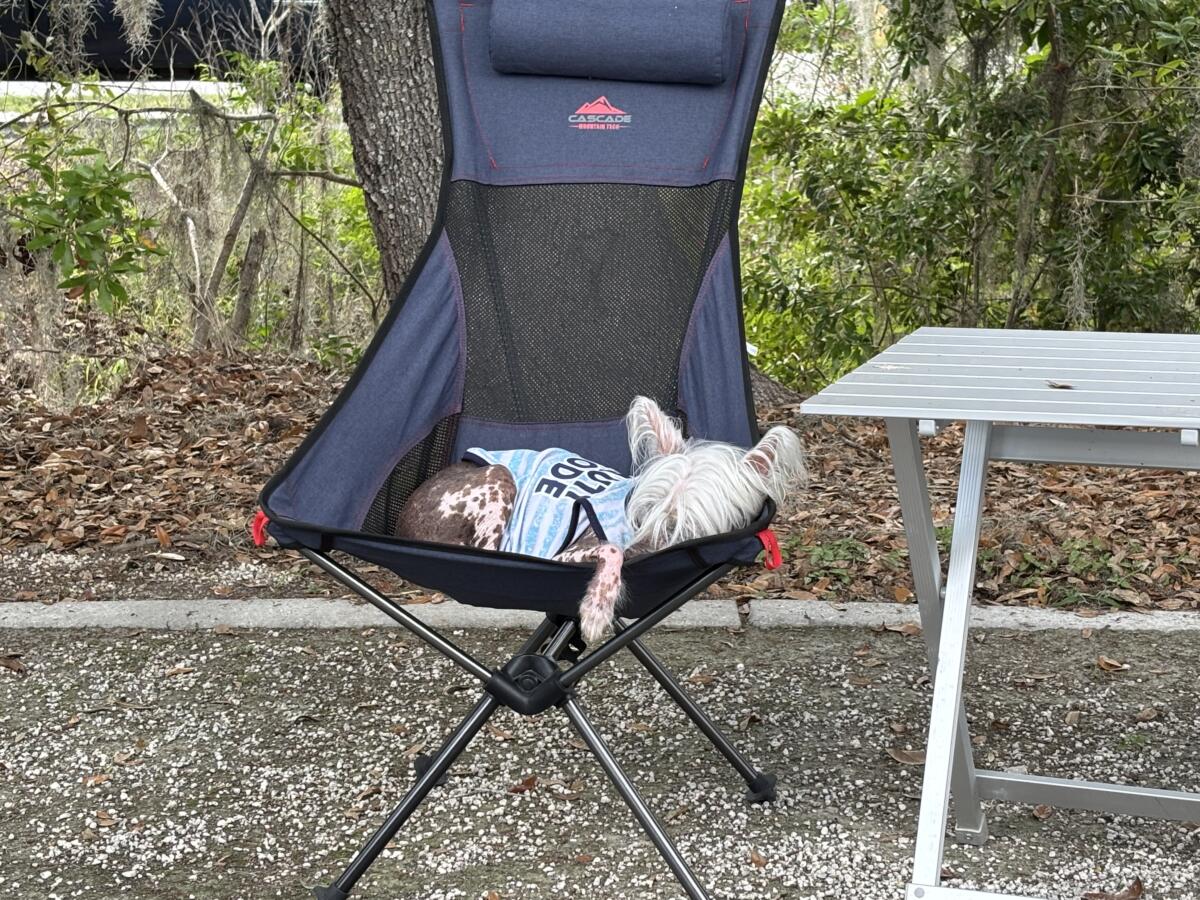
“Marty (Hairless Chinese Crested, age 11) is a rescue who was abused for his first 1-1/2 years. He is skittish around strangers and nearly always on ‘alert’ when we are camping, but he will relax on occasion, like he is in this picture!” —Susan Whitmire
Send us a photo of your pet with a short description. No blurry photos and please do not submit your photo more than once. Thanks!
If you shop at Amazon.com we’d appreciate you using this link. We get an itty bitty commission if you buy something, but they add up and help us pay our bills (most importantly our hard-working writers!).
Dave,
Love reading your answers for RVers. It is the best help I have ever seen at any website.
My question is, you always say that batteries are made to drain down to 50 percent.
What is 50 percent—12v, 11v, 10v? I think this would help RVers a lot. Also, how to monitor, when and what to do when you get to that magic number. —Louie, No RV as of today
Louie, Excellent question. Most people think that draining down to 50% State Of Charge with a 12-volt battery would be 6.3 volts (12.6 x 50% = 6.3), but it is not that simple. A fully charged 12-volt battery or two 6-volt batteries connected in series (positive to negative) is 12.6 volts. Here are the numbers for the SOC for that type of battery:
Voltage
State of Charge
(SOC)
12.6
100%
12.5
90%
12.42
80%
12.32
70%
12.20
60%
12.06
50%
11.9
40%
11.75
30%
11.58
20%
11.31
10%
10.5
0%
As you can see, a “fully charged” 12-volt battery is not 12 volts, and a “dead” 12-volt battery is not at 0 volts. Each cell in a 12-volt battery can read from 2.15–2.35 volts depending on the type of battery. So you may see a little different reading of SOC with different batteries. AGM batteries could read 12.8 volts at 100% SOC and lithium batteries could read as high as 14.6 volts at 100% SOC.
Number of cycles of a FLA battery
The number of cycles you can expect from a flooded lead acid (FLA) battery depends on several factors such as quality of the battery, temperature you are operating in, and depth of discharge (DOD). Draining your battery below the recommended 50% SOC will cause the battery to weaken and not perform well.
Price is dependent upon the perceived quality as well as the product design, processing, and manufacturing costs. This includes the amount of lead, methods of pasting and curing the plates, degree and type of inter-plate insulation, quality of the case, and the sealing method used. Generally, high quality means higher cost.
Here is their description of what I call sulfation:
Electrolyte stratification can occur in all types of flooded batteries. As the battery is discharged and charged, the concentration of acid becomes higher at the bottom of the cell and becomes lower at the top of the cell. The low acid concentration reduces capacity at the top of the plates, and the high acid concentration accelerates corrosion at the bottom of the plates and shortens the battery life. Although stratification can be minimized by raising the charging voltage so that the increased gassing agitates the electrolyte, this will accelerate the water loss and watering frequency.
Since there are so many variables that affect the number of cycles, it is not easy to calculate how many you should get from an FLA battery. Many battery manufacturers state that they can get up to 200 cycles, but that would be in a perfect world. 6-volt batteries connected in series can get 300-600 cycles and typically have higher amp hour (Ah) capacity, making them the choice of dry campers for years.
Number of cycles of AGM batteries
AGM batteries are less prone to stratification, as stated earlier, and can produce more cycles with less depth of discharge. Here is a chart from Go Power! comparing their AGM battery with their lithium batteries. Notice that the number of cycles jumps from 250 up to 2200 if the DOD is only 30%.
Battery SOC (Click/tap to enlarge)
Lithium batteries can be discharged to over 95% and can have almost 10,000 cycles if DOD is at 30%. That is why the quality lithium batteries have a 10-year warranty—and some are even lifetime!
The disadvantage of having a part-time house now versus being a full-time RVer is that I am always forgetting something, or duplicating something, or just plain packing way too much! Packing the RV up for a six-month-long haul is a big job. There are a few tricks I have learned over the last few years that make it a little bit easier.
Make a list
This is my “don’t forget” list. Because we haven’t duplicated a lot of items, we cart stuff into the house and cart it back out to the RV. I inevitably forget something. Last year it was my favorite salad hands, the nutcracker that I used to open those stubborn little water bottle caps, and sweatshirts.
We took a few mini-trips this winter and I forgot my pillow, VIAIR for tire pressure, the doomed salad hands, and we also forgot to check the weather. Should have brought flannel PJs, too!
Leading up to the BIG trip, I use my phone and keep a list of things to remember as I used them. The coffee stirrer, my pillow, the electric heater, and my favorite throw cover are not going to be forgotten. I check the items off as they go into the RV.
Pre-order
Things I know that we will need on the road or when setting up I pre-order, usually from Amazon. We have a new refrigerator water filter, a box of toilet deodorizer, grill drip pans, and a carry case just sitting and waiting to be packed.
I also stock up on available prescriptions and over-the-counter medicines. Those can be difficult to get while traveling.
Make sure the RV is ready
Maintaining the RV is of the most importance. It doesn’t matter what goes in if it isn’t going anywhere. Double-check what work needs to be done before you leave. We got all new tires this year (more on how we got a big tire discount here) and had the oil changed. We carry a list of the recommended maintenance duties and check them off as completed.
Dedicated space
I keep the items that are only used in the RV in dedicated spaces. The garage has two shelves allocated for larger RV items like the forgotten VIAIR, extension cords, a box with RV specific tools, Power box, solar panel, new sewer hose, car starter, tarp, vacuum cleaner accessories. In the house we have a shelf with the RV GPS, TireMinder, camera borescope, tripod, computer bag, battery bag, miscellaneous charging bricks and cables.
The dedicated space really cuts down on looking for stuff (and forgetting stuff, too).
Extra stuff equals added weight
I am so guilty of overpacking. I love, love, love to read and restrain myself to only paperbacks that I buy used, usually at mass library sales. However, having an entire three-foot overhead cabinet filled with a double row of books can lead to minor disaster. Hence, I’m now packing more screws and nails and fewer books.
Be aware of weight, and how necessary and how often something is used when piling more into the RV. This year, I have slimmed down my wardrobe. I can always buy more clothes!
It is a really good idea to have your rig weighed fully loaded and know what your weight limits are. Less stuff means better gas mileage and handling.
The important things
I make sure we have our important papers: passports, copies of birth certificates, insurance papers, copies of trust and wills, along with contact info, medical papers, house info, frequently called numbers, warranties, RV info, and anything that needs to be in a “go bag” is pulled from one safe in the house to the safe in the RV.
Purge
Usually, I go through everything while we are traveling or just before we get back. This year, we will be camping for a few days before we leave, so that is when I will do the big purge. We pull out everything from the bays, vacuum and wipe the bays down, and go through it all. If it’s a duplicate, not used in the last year, rusted, torn, or just about empty, it goes. This part takes dedication to resist the “I-might-need-its”.
Packing the RV with care
This is the part that I really enjoy. I like to arrange all those organized plastic containers to best fit the space. I move things around so they don’t shift in transit and figure out the things we use most so we are not knocking our heads trying to get out our often-used items. Plus, this is another chance to discard and neaten up. I have noticed that having a set spot for everything cuts down on just throwing stuff in when in a hurry.
Be kind to each other!
We have moved into a sort of rhythm when loading up. I organize, he carries. Yes, he does call himself my pack mule. Once it is there, I put it away inside. He does most of the outside. The bikes are a pain and require both of us. We have learned to NOT tell each other what or how to do something. And when tired, we take a break. It works (most of the time).
While it does take a lot of energy to pack, empty, and repack, there is always the excitement and adventure of the open road awaiting.
By Cheri Sicard
Have you ever struggled with wobbly RV setups? In this video, Jared Gillis from All About RVs is back with a review of a new piece of gear that might just solve that problem: the Weigh Safe Flap Jack RV Stabilizer Block.
A stabilizer block is a simple but effective tool for RVers. When you’re setting up camp, these blocks go under your RV’s stabilizers. This reduces how far the stabilizers need to extend, making your RV more stable and reducing rocking. Plus, they give your stabilizers a solid base, especially on uneven ground.
The Flap Jack stands out because of its unique design. It folds flat for easy storage but quickly expands into a sturdy block. The two ends pull out, and the center unfolds. Then, the ends magnetize to the center, creating a solid block.
Setting up the Flap Jack is pretty straightforward. You unfold it, magnetize the pieces together, and place it under your stabilizer. Keep in mind that the Flap Jack shouldn’t be used on slopes greater than 5 degrees. But most campsites are within that range.
The landing gear pad is eight inches. One of Flap Jack’s biggest advantages is its compact storage. When folded down, it’s only two inches tall. If you buy a pair, they often come with a case for even easier storage.
Pros and cons of the Weigh Safe Flap Jack Stabilizer Block
Like any RV accessory, the Flap Jack has its strengths and weaknesses.
Pros
• Compact: It doesn’t take up much space.
• Good height: It provides a decent lift for a block.
• Strong magnet: The magnetic connection is secure.
• Well-designed: It feels solid, not flimsy.
• Lightweight: Easy to handle and move around
Cons
• Fixed height: You can’t adjust the height.
• Low clearance issues: It might not fit under stabilizers on some RVs.
• Not stackable: You can’t stack them for extra height.
We use cookies to ensure that we give you the best experience on our website. By continuing to use our site, you consent to accepting cookies. We NEVER have or will sell reader's data. For more info, please see our privacy policy page.