I am glad to see that some of you have thought about your spare tire. You are already ahead of many other RV owners. [If you missed Part 1 of this two-parter, here’s a link.]
The comments on confirming that the tools you already have needing to fit your lug nuts are spot-on. I bet that there are many folks that think they have the correct tools and that the tools they have will fit. BUT, if you have not actually tested your tools, you do not really know.
Here is my story on lug nut tightness and testing my tools
Many, many years ago, I had a small sedan. After buying a new set of tires, I thought I should confirm the tire store did the proper job of setting the torque (tightness) of the lug nuts. Well, the nuts were plenty tight. In fact I broke the cheap nut wrench the car company provided. I then dug out a quality “Craftsman” 12-point socket and managed to break that socket.
While I had an extensive collection of tools I used on my race car, I dug out a top-of-the-line 6-point SK socket. After making an extension, I was able to break that socket when I applied an estimated 300 Ft-Lb of torque.
The next day I went to the tire store and asked for the manager. I presented him with the three broken sockets and challenged him to remove the lug nuts using any hand tools he had in the shop. He failed. He did agree that he would replace the broken sockets.
I pressed him further and pointed out that there was a good chance the wheel studs have been stretched and might fail. He really didn’t want to pay for all new wheel studs but could not defend the obvious error. I did press him on the issue. He eventually agreed that he could not guarantee, in writing, that the studs would never fail, so he would replace all the studs on the car. This was an expensive lesson for the shop mechanic.
Can you change the tire yourself?
Today most shops have “torque limiting” lug nut sockets. However, you are still confronted with the question: “Can you replace the tire with your spare if you have never confirmed that both you and your tools are up to the job?” In other words, if you are planning on changing your own tire and if you have a spare, are you 100% certain you can do the job if you have a tire failure on some back road?
I have a Class C with 16″ tires. I have probably changed tires a few hundred times when I was racing and working on cars. But I have decided that after passing the “8-decade” mark, I really do not want to do that job again unless there is no other option. So I checked around and signed up for “road service” as a form of insurance.
I suggest that you need to be honest with yourself and confirm that you can get your spare out and ready to mount. Confirm you have the strength to remove the lug nuts, and that you can get them tight enough if you have changed your tire.
Speaking of “tight enough”… Do you know the torque spec for your RV? Do you carry a torque wrench all the time? And do you understand how and why you need to check the torque after changing a tire?
Important information to consider ahead of time so you’re prepared in case of tire failure.
Roger Marble
*****
If you have tire questions, check out Roger’s Blog as well as his posts on RVtravel.com. There are hundreds of posts covering everything to do with tires.
If you still have a question for Roger after searching the above posts, send your inquiries to him using the form below.
“If you tell the truth, you don’t have to remember anything.” ―Mark Twain
Need an excuse to celebrate? Today is National Mom and Pop Business Owners Day, and it’s also National Vietnam War Veterans Day. We thank all those who fought for their service to our country.
On this day in history: 1973 – Vietnam War: The last United States combat soldiers leave South Vietnam.
Featured news
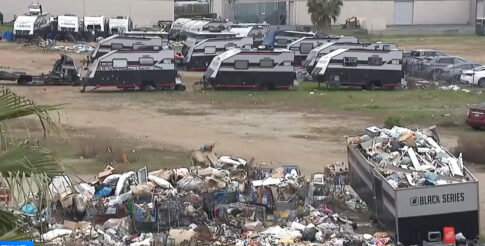
Homeless swarm RV manufacturer’s lot, move into RVs, destroy many
nbclosangeles.com
By Russ & Tiña De Maris
Nearly 50 brand-new RVs, worth more than $2.5 million, have become homes for squatters in California’s City of Industry, sparking a legal battle and a messy eviction process. Seemingly abandoned by RV manufacturer BlackSeries Campers, the trashed trailers are surrounded by mountains of garbage. What happens next for the landowner, the displaced squatters, and the damaged RVs? This story is CRAZY!Click to read.
RV park squatters in unregistered rigs. It’s bad, getting worse
By Chuck Woodbury OPINION If you are currently staying in an RV park, and there appear to be full-timers among the crowd, would you do me a favor? Please look at the license plates of the rigs in the park that appear to be there for an extended stay. Count how many are not registered — no license plate, or plates with expired tags. How many campsites in America’s 15,000 RV parks, I wonder, are occupied permanently by these “trailer park people,” making it a challenge for “recreational” RVers who want to “go where they want, when they want,” to find an available spot. Read more.
The latest news for RVers
With nearly $23 billion in deferred maintenance, America’s national parks face a funding crisis that grows each year. Could a surcharge on foreign visitors help bridge the gap? The idea isn’t far-fetched—many countries already charge international visitors more to access their parks. With 14 million international visitors annually, a $100 surcharge could generate more than $1.2 billion, keeping 80% of the funds within the parks themselves. Is this a common-sense solution or an unfair burden? Click to read the full debate (and vote in our poll).
SCAM ALERT! The scammers are back at it. Fraudsters are once again sending text messages claiming you owe unpaid tolls. They warn you to pay immediately or face penalties. These “smishing” scams have become increasingly sophisticated. They target drivers across the country, including RV enthusiasts who frequent toll roads on their journeys. Learn more and don’t fall for this!
In a significant legal decision, a Virginia jury has mandated that the owner of Lazy Cove Campground at Smith Mountain Lake pay $750,000 in damages after finding that the owner engaged in racial discrimination. The verdict, announced late last week, represents the largest fair housing jury award in the state’s history, according to the Virginia Attorney General’s Office. Here’s the story.
Looking to buy a new Ford Super Duty truck to pull your trailer? Better add some more dollars to your wallet. According to a story carried by Automotive News, Super Duty price hikes are not far off. The engines for the big tow rigs are built in Canada or Mexico, and tariffs set to start up on April 2 will likely be passed on to buyers. Learn more.
Newmar is shaking up the RV world with its first-ever compact Class C, the Freedom Aire, part of their 2026 model lineup. Built on a Mercedes-Benz 4500 chassis, this luxury coach features an industry-first convertible layout and an optional solar package for greater off-grid independence. Alongside the Freedom Aire, Newmar also unveiled the reimagined Summit Aire Super C and new design options for the King Aire. Click to learn more.
Last year, U.S. National Parks saw more visitors (331.9 million recreation visits) than ever before recorded. No doubt most came to relax and enjoy nature. Unfortunately, some never made it home. Malloy Law Offices, a personal injury firm, compiled death data from national parks running from 2014 to 2023 and produced a list of the 10 most lethal national parks. Are your favorites among them?
Is it COVID all over again? Empty toilet paper shelves might make it seem like it. Toilet paper tariffs? As President Donald Trump vows to apply tariffs on Canadian softwood, the situation could wipe out TP retailers. This, according to a global paper pulp market expert. The tissue issue doesn’t stop there—paper towels will also be caught up in the squeeze. Here’s what’s going on.
Speaking of tariffs… President Trump has announced a new 25 percent tariff on all vehicles manufactured outside the United States, beginning April 2. The move marks a significant escalation in the President’s push to drive domestic manufacturing amid broader U.S. trade tensions. The Anderson Economic Group estimates that vehicle prices could rise by $4,000 to $10,000 per unit, including “American” models assembled using foreign-sourced components. Trump said he expects the tariffs to provide $100 billion in annual income to the federal government.
THE MYSTERY IS SOLVED! It was 1983 and investigators at Utah’s Arches National Park were stumped. On a cold winter’s day, park rangers found a body in the Three Gossips area, close to the park’s south entrance. Just who the body belonged to was a mystery, and remained that way until now. The mystery of the identity of the Arches National Park victim has been solved, thanks to DNA.
With Spring Break in full swing, drivers are paying more at the pump compared to last week. The national average for a gallon of gas went up 3 cents since last Thursday, March 20, to $3.15. Here are the numbers.
RV shipments to dealers saw a 6% increase in February 2025, but retail sales remain sluggish, raising questions about consumer demand. While towable RVs saw gains, motorhomes dropped significantly. With spring bringing hopeful buyers, will the industry sustain its recovery or face more challenges?
Two Oklahoma RVers are hailed as heroes for saving Pecan Valley RV Park from a wildfire last Friday. As flames approached and most evacuated, these two stayed behind, battling the fire with garden hoses to protect the park. This is some good news!
RECORD BREAKER! Mr. Pugsley Addams, a silver Maine Coon cat from Minnesota, was awarded a Guinness World Record for having the longest tail. The feline’s tail measures 18.5 inches long.
Campground crowding, comments & concerns “RVing” or “camping”? Does it matter?
In last week’s column, we asked you for your definition of RVing and camping. We wondered: Is an RV resort still camping? Is staying in a state park in an RV, “RVing” or “camping”? This week, Nanci Dixon shares some of your interesting views on this topic, as well as her own. Read them here.
Letter to editor: Disturbing development at military campgrounds
“We recently heard about changes to access to the military campgrounds. It seems that the Air Force is restricting the sponsoring of guests for disabled veterans who have less than a 100% disability rating. What this means to you is that if you camp on a military installation and you are a disabled veteran, but you are not 100% DAV or retired from the service, you can still have access to the base, commissary, Exchange and campground but you cannot bring along your spouse/partner or adult children. Read more.
RVing work opportunities
NPS photo
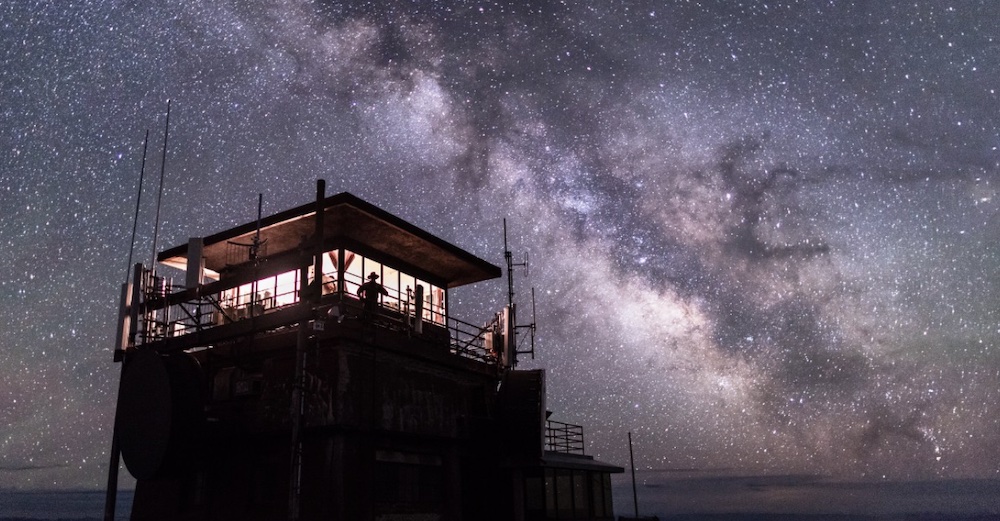
Would you like to help prevent forest fires, and get to live and work in a beautiful, remote area while serving a key role in fire detection in a National Park? Yellowstone is currently hiring a fire lookout (bring along your spouse) for the upcoming summer season. This is a full-time position ideal for someone with a background in forestry, natural resource conservation or wildland fire science. Learn more about this seasonal job and similar ones in other National Parks by visiting here.
Fond of the Big Sky Country? You could have a spot in a scenic Montana campground and get paid to stay there. The Bureau of Land Management wants campground hosts for this summer at several of its recreation areas. Not only do you get a free site, the BLM will pay for your propane—and give you a check. Montana camp host positions are open now.
Dozens of volunteer opportunities are available throughout Colorado, including many Camp Host positions. Many are perfect for RVers who want to stay active and involved. Check out all these positions by clicking here.
RANDOM RV THOUGHT: If you are headed into an unfamiliar big city and will need to get off the main freeways onto city streets, it’s a good idea to “drive” your route ahead of time using Google Street View. Pay attention to landmarks along the route for later reference, especially at intersections where you will need to turn.
RV and RV-related recalls
Thor recalls thousands of rigs: Slide-outs could extend while driving
More than 4,000 Thor-built motorhomes are being recalled out of concern that their slide-out rooms could extend while the rig is heading down the road. Click to read.
Towing Advice
Source: r/namethatcar on Reddit
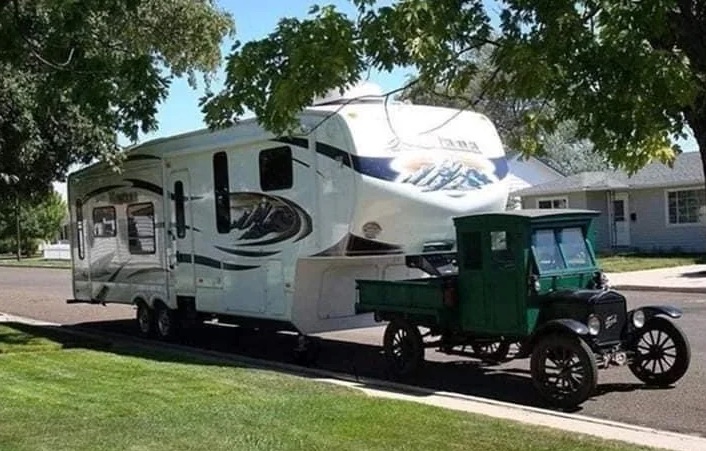
Always be sure you have the proper truck to pull your fifth wheel trailer. This one might have a problem getting over hills.
Reader poll Can you easily get into your RV’s bed with its slides in?
A POLL FROM THE PAST: Interesting results! Do you see yourself still RVing in five years? What do you think? How many of the more than 2,300 respondents answered “probably not” or “no?” Was it 11 percent, 27 percent or 46 percent? Find out.
?? MYSTERY PRODUCT OF THE DAY ?? This is one of the absolutely, positively handiest items you can hang on your keychain. And it costs less than $7 for 4 of them! Our publisher has had one of these on his keychain for more than 20 years. See what it is and/or order. We guarantee you will love this!
Latest fuel prices
The latest U.S. average prices per gallon of gasoline and diesel fuel as of March 24, 2025: Regular unleaded gasoline: $3.12
Change from week before: Up 6 cents; Change from year before: Down 41 cents. Diesel: $3.57
Change from week before: Up 2 cents; Change from year before: Down 47 cents.
For more upcoming RV shows and seminars, click here.
Trivia
You can thank potatoes the next time you’re on a flight with Wi-Fi. When Boeing needed to test Wi-Fi signals on their planes, instead of using expensive test dummies or hiring subjects to sit in the seats, Boeing filled the seats with large piles of potatoes. The dense, starchy mass in each seat absorbed the Wi-Fi signals much like a human would. With potatoes in each seat, they were able to successfully test and set up in-flight Wi-Fi.
Laugh of the week
The perfect scam Archive episode: Miami Property Scammers, Part 1
In this 2021 episode, Miami’s historic West Grove neighborhood has recently become a hot real estate market. So hot, in fact, that it has attracted the attention of scammers. It wasn’t always so. When Shirley goes to pay her taxes one day, she learns that her property has been sold without her knowledge for $230,000. When another of her properties shows up on Zillow, it becomes clear this is not a fluke but an elaborate real estate scam, targeting property owners in this historically Black neighborhood.
Today in history
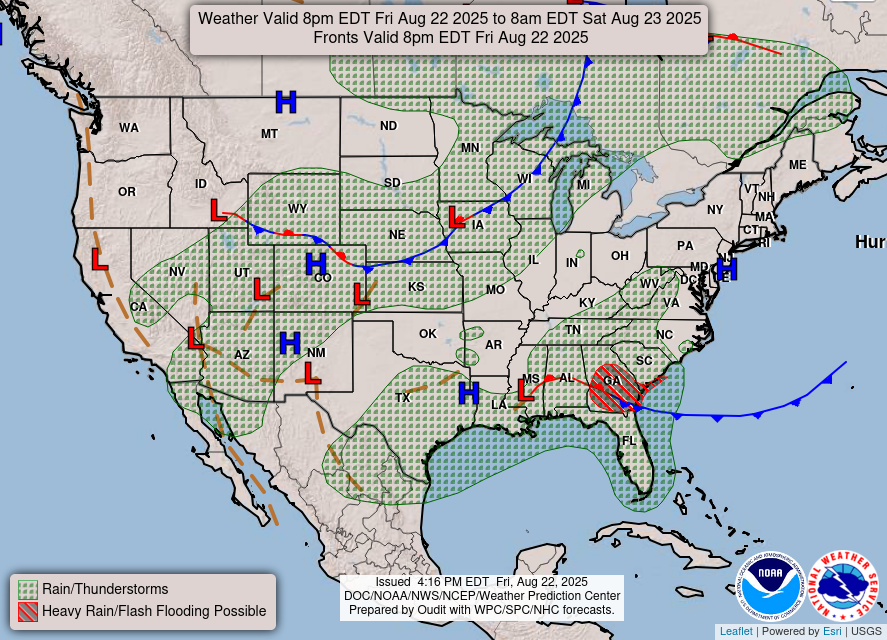
Today’s weather forecast across the nation THIS MAP UPDATES TWICE A DAY
RV sales have slowed and fewer people are buying RVs. Most costs across the board have risen. RVing is evolving. Has that changed how people are RVing? Are there still some areas that are crowded with campers? Are people more or less content with RVing?
RV Travel readers discuss their experiences and offer tips to help other campers find that perfect spot.
Definitions of RVing vs. camping
In last week’s column, we asked you for your definition of RVing and camping. We wondered: Is an RV resort still camping? Is staying in a state park in an RV, “RVing” or “camping”?
Some people sent in clear definitions but others were not as defined, and a few didn’t care as long as we did not use the terms interchangeably.
Reader Michelle T. has a very clear definition. She wrote, “Campground: Rustic amenities (pit toilets or plumbed toilets w/showers), if any at all, fire pits, picnic tables.
“RV park: Electric to FHU sites, shower/restrooms, laundry, playground, picnic tables, fire pits.
“RV resort: Has it all. Pool, courts (tennis/pickleball), planned activities, parking lots for sites (not many trees), site amenities, and anything from electric-only to FHU with patios.
“There are a lot of variables with each type, but those are the basics, to me.”
Neal D. defined the difference clearly, too. He wrote, “I’ll take a shot at this, so take it as you take all ‘free’ advice.
“Campgrounds have tenting areas, or allow tents in all sites. RV parks tend to have no tenting or only allow it in a specific area. RV resorts allow no tents and offer amenities beyond a pool, camp store, and dog park. The price for an overnight site is the lowest at a campground and highest at a resort. Safe travels!”
Cheryl B’s. comment was a bit tongue-in-cheek. She wrote, “Campgrounds have campfires, new people, are somewhat private, wooded, and rural. RV parks = trailer parks, and RV resorts = trailer parks with activities.”
Gary L’s pet peeve is using both words interchangeably. He wrote, “To answer your question… if it is advertised as a park or resort, then it is not a campground. From my experience, private equals park/resort, while public (national, state, local park, NFS, BLM, etc.) equals campground. Campgrounds don’t have pools, arcades, mini golf, etc. My peeve is with this publication… establish definitions and have your writers stick with those definitions. EASY.”
Leonard B. doesn’t see a difference at all and wrote, “Zero difference what they are called! Resort, park, or campground, they’re all the same thing. I check the amenities, reviews, and price, and make a decision from there.”
For a lot of you, it is just semantics. RVing or camping can be one and the same.
Others are clear, if it calls itself an RV park or resort, that is what it is. Campgrounds don’t have the amenities.
I camp, albeit in luxury!
I have to agree with Leonard, though. I use the words RV park, RV resort, and campground pretty much interchangeably. And I know a few people wish I wouldn’t! I love camping, traveling, RVing, starting out, and bedding down. I do have preferences on the type of places we stop at and will usually mix them up depending on need and what is available.
No matter what they are called, I have the same excitement when we are packing up the RV. And no matter where “we are going camping,” I am thrilled.
Boondocking in the desert
Last week we boondocked with friends at a wildlife reserve and then on to my absolute favorite place to camp: Quartzsite, Arizona. My great joy is just pulling out in the desert without any hookups, a mile or so from the nearest neighbor. This trip, we added lithium batteries, and boondocking was amazing. That, however, will be another article.
There were hundreds, perhaps thousands of RVs, vans, and cars staying out on the land, and each one may have had a different definition of their time there. For me, it was pure bliss.
Mikal wrote, “A rose by any other name… Call them what you want, that’s what the park owners do!”
These are a few observations from our readers. They do not necessarily represent the views of RVtravel.com.
Now, some questions for you:
Are you finding campgrounds booked up or is finding a site not a problem?
What do you like best about RVing?
What are your pet peeves?
Are you seeing more permanent and seasonal RV parks?
Are rising costs affecting your camping style?
Do you have favorite campgrounds or RV parks?
What is the most memorable experience you have had RVing?
Do you have any tips or secrets you’d like to share?
Please use the form below to answer one or more of these questions, or tell us what you’ve experienced with campground crowding in general.
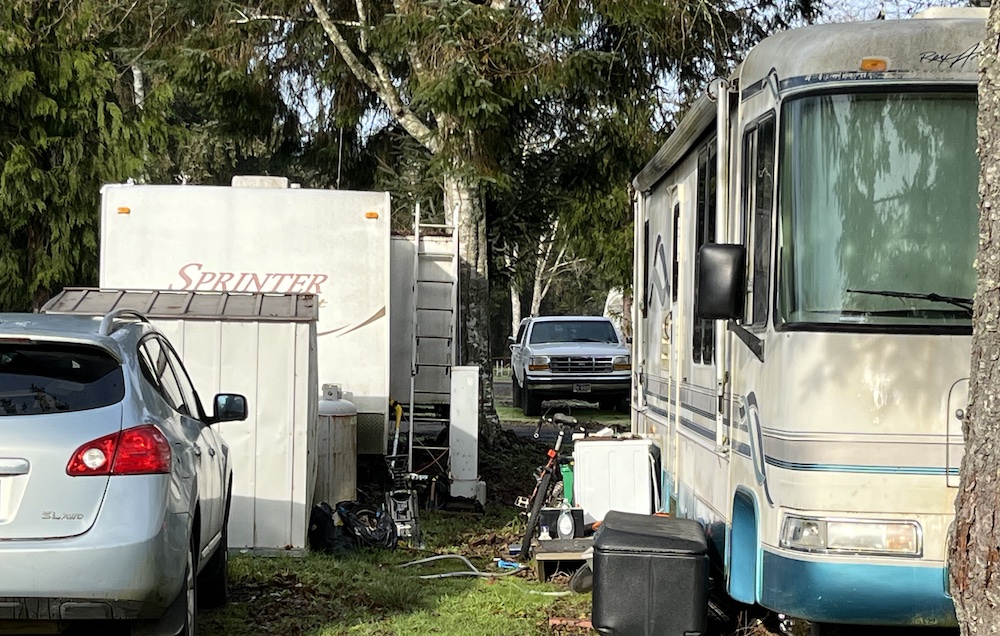
Please help me. If you are currently staying in an RV park, and there appear to be full-timers among the crowd, would you do me a favor the next time you take a stroll around the park? Please look at the license plates of the rigs that appear to be there for an extended stay. Count how many are not registered — no license plate, or plates with expired tags.
I first started doing this many years ago. Eight years ago I wrote about a KOA park in Seattle with mostly permanent residents (since then it has been sold and the land condemned). At the time, I estimated that 20 to 25 percent of the RVs were not registered. Some of their license tags had expired within the last few months, but far more had expired one, two, three years ago or earlier.
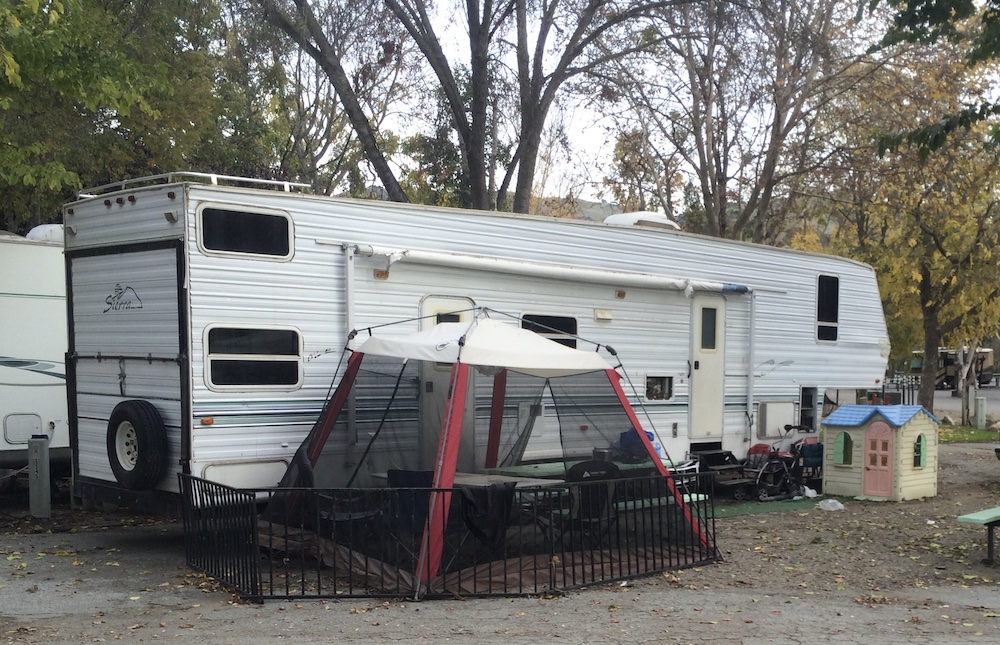
These RVs were not going anywhere. Most were in disrepair. Some were covered with blue tarps, some growing moss. The motorhomes were old and weathered; I figured if they needed to be moved, they’d need a tow truck. These are not recreational vehicles, they’re “living” vehicles.
This trailer does not even have a license plate. And from the looks of it, it’s not going anywhere soon.
Last December, I stayed in an RV park along I-5 in northern California, south of Redding. On a walk around the park, I observed that, again, about a quarter of the rigs either had no license plate or expired tags; most had expired years before.
Lots of RV parks. Really??
The RV Industry Association (RVIA), the group that promotes the sale of RVs for its manufacturer members, likes to boast that there are 15,000 campgrounds and RV parks in America. And yet, so many of us have a hard time finding a nice one to stay in. The commercial RV parks (those with hookups and other amenities) are either full or are dumps where nobody not desperate for affordable housing would stay.
There is no way this situation will improve as more people than ever buy RVs (often cheap, used ones) for their primary, permanent homes. Where does that leave those RVers who love to explore America to “go where they want, when they want?” (Most of our readers don’t believe that RVIA propaganda slogan anymore.) Among other things, it forces many avid RVers to reserve their campsites months, even a year or two ahead. That’s great for people who like to plan, but for people like me who like to travel with the freedom to spontaneously set our own schedule based on a whim, it stinks.
Please email me at chuck@rvtravel.com with your observations of the RVs in your present RV park or those you encounter in the future. Include photos. How many are not registered? We’re working on a story and your input would be a big help. Go ahead and name the park so we can call to learn its policy. We won’t identify you to them as our source.
If your slides are pulled in, is your bed easily accessible when you want to settle in for the night or grab a quick nap at a rest area?
RVs have grown significantly in size over the years, with many now featuring at least two—sometimes even three—slideouts. These slides create additional living space but often house critical areas like bedrooms, making it tricky to access certain parts of your RV when the slides are pulled in.
Imagine you’ve had a long day on the road and pull into a rest area, eager for a quick nap. If your RV’s bed is tucked away in a slideout, accessing it might mean extending the slide in a potentially tight or unsafe space. For travelers who prefer to avoid hassle or prioritize convenience, this could be a dealbreaker.
Additionally, some RVers might see slide accessibility as a matter of safety. In case of an emergency, being able to quickly get to your bed or other interior spaces without extending the slides might be critical. On the other hand, some might not mind the extra step as long as they gain spacious comfort when the slides are out.
So, how about you and your RV? Can you get to your bed when the slides are pulled in? If not, is that a dealbreaker or just a minor inconvenience for you? Share your thoughts in the comments below—we’d love to hear your perspective!
To address the changing needs and discerning tastes of today’s RVers, Newmar, a premium manufacturer of recreational vehicles that are the pinnacle of luxury, comfort, performance, and design, has unveiled its full 2026 model year lineup at the company’s annual dealer show held at The Broadmoor in Colorado Springs, Colorado.
There, dealers got their first glimpse of the all-new Freedom Aire, the company’s first entry into the compact Class C space, as well as the Summit Aire, a jewel of the company’s completely reimagined Super C coach lineup. Additionally, two new interior design expressions, Regal and Refined, were unveiled as part of the King Aire lifecycle updates for 2026.
“At the heart of these innovations is a deep understanding of and passion for the Newmar consumer,” said Newmar President Casey Tubman. “We’ve spent the last couple years connecting with Newmar owners as well as new and long-time RVers and the messages are clear: consumers are hungry for smaller footprints that enable more freedom and maneuverability, without having to compromise on the craftsmanship, quality and service they’ve come to expect from Newmar. The new Freedom Aire Compact C responds to this demand.
“Meanwhile, the Super C market is growing and Newmar has revamped our Super C line-up in response, launching the new Summit Aire Super C and completely reimagining the Supreme Aire SE and XT on the Cascadia chassis and the Super Star SE and XT models.”
Model year 2026 highlights
Freedom Aire
Consumers who refuse to compromise on quality while seeking greater freedom will revel in Newmar’s first-ever compact Class C coach built on a Mercedes-Benz 4500 chassis, as it redefines what is possible in the compact luxury space.
The Freedom Aire model introduces an industry-first convertible layout, seamlessly transitioning from a functional dinette by day to a king-sized Murphy bed for restful sleep at night. Every inch of the coach is optimized to enhance livability and offers six distinctive exterior finishes. The optional solar package includes roof-mounted panels as well as Newmar’s first-ever external and movable solar panel option, increasing solar capacity by up to three times. This advancement empowers owners to venture further off-grid with greater independence.
Super Star
Part of the reimagined Super C lineup, the 2026 Super Star, now comes with two models, SE and XT. The Super Star’s distinctive Super C architecture offers unique advantages for practical travelers. With its front engine design, consumers can enjoy easier engine access for maintenance and a driving position that puts them in control. Versatile floor plans maximize interior space while carefully selected design options reflect a sensible approach to luxury travel.
Supreme Aire
Now built on a Freightliner® Cascadia chassis, when adventure calls beyond conventional routes, the commercial-grade engineering beneath the Supreme Aire’s elegant exterior delivers. Tow up to 30,000 pounds of additional toys or equipment with ease, host gatherings that impress friends, and venture confidently into destinations that would challenge lesser coaches. Available as both the SE and XT.
Summit Aire
The all-new Summit Aire features a Freightliner® Cascadia foundation and is where raw power intersects with refined living. Owners can tackle any road condition while the industry exclusive full air-ride cab system ensures they arrive at their destination ready to enjoy the moment rather than recover from the journey. And with a remarkable 30,000 towing capacity they can bring their favorite toys along for the ride! The Summit Aire is available in two 45’ floorplans, including a bunk model perfect for families to unwind in at the end of each adventure-filled day, and include the option to lean into another Newmar first, Artisan Series custom paint process.
King Aire
For 2026, the King Aire has undergone a lifecycle update, introducing two interior design expressions. Regal is ideal for those who desire opulent and expressive interiors, while Refined is a sophisticated take on quiet luxury, with an artful blend of natural wood tones, clean lines and subtle textures that create warmth.
Artisan Series
Newmar’s new optional Artisan Series custom paint process, available on King Aire, Essex, and London Aire Class A motorcoaches and the Summit Aire and 45’ Supreme Aire Super C coaches, reflects the overwhelming desire by owners to own a truly customized coach that reflects their unique taste. Customers can select from an exclusive catalog of Artisan Series graphics that, once ordered, will be archived forever, making their coach truly a 1 of 1.
Finally, as part of the RV manufacturer’s arrangement with ATC Trailers, Newmar owners looking for additional ways to personalize their coach now can ensure a seamless expression that takes the paint and graphics available on their coach and extend them all the way to their trailer for a premium look all delivered with Newmar’s renowned Masterpiece Finish paint. It is available as part of the Artisan Series custom paint process as well.
Visit www.newmarcorp.com in May to view the full 2026 lineup, access shopping resources, or stop by your favorite Newmar dealer’s showroom today to learn more.
In a significant legal decision, a Virginia jury has mandated that the owner of Lazy Cove Campground at Smith Mountain Lake pay $750,000 in damages after finding that the owner engaged in racial discrimination.
The verdict, announced late last week, represents the largest fair housing jury award in the state’s history, according to the Virginia Attorney General’s Office.
Background
The incident began in April 2020 when two families—close friends—decided to lease adjacent lots at Lazy Cove Campground.
Angela Smith, who is white, and her husband, Damien Smith (who is Black), along with their 8-year-old son, occupied one camper. Their friends, Amanda and Mike Mills, occupied the neighboring lot.
Approximately a month into their stay, campground owner Regina Turner contacted Amanda Mills. She was unhappy upon learning of Damien Smith’s race. Turner reportedly stated, “You didn’t tell me that your friend’s husband is Black. Had I known, I wouldn’t have rented the lot to them.”
Subsequent actions
Subsequently, campground owner Turner worked to evict both families. She refused to renew their leases and imposed restrictions on selling their campers. These actions were not applied to other tenants in the campground. In August 2020, both families vacated the campground.
The Virginia Attorney General’s Office and the Virginia Fair Housing Board filed a civil lawsuit against Turner, citing violations of fair housing laws.
The jury deliberated for less than two hours before awarding $100,000 to each couple for their losses and emotional distress. An additional $550,000 in punitive damages was imposed to deter future discriminatory practices.
Reactions
Attorney General Jason Miyares lauded the jury’s decision, stating, “Housing discrimination—and discrimination of any kind—will not be tolerated in Virginia. We are pleased by the jury’s verdict, and I’m immensely proud of my Civil Rights Unit. The people of Franklin County have spoken: Smith Mountain Lake is for everyone.”
Damien Smith reflected on the ordeal, expressing a mix of relief and lingering anger, emphasizing that such discrimination should not occur in contemporary society.
Implications for the RV community
This case serves as a poignant reminder to the RV and camping community about the importance of inclusivity and adherence to fair housing laws.
Campground owners and operators are urged to ensure their policies and practices promote equality and prevent discrimination based on race or any other protected characteristic.
For RV enthusiasts, this verdict underscores the significance of supporting establishments that uphold these values, fostering a welcoming environment for everyone.
In California’s City of Industry, nearly 50 brand-new RVs meant for sale have become makeshift homes for homeless squatters. Once stored on a lot by BlackSeries Campers, the $2.5 million worth of trailers are now trashed, surrounded by garbage, and at the center of a legal and logistical nightmare. With evictions looming, questions swirl about how this situation spiraled out of control and what comes next for the landowner, the displaced residents, and the damaged RVs.
Latest Update: Sheriffs evicting squatters
RV manufacturer not far from where homeless take over stored RVs
Bird’s eye view of encampment. nbclosangeles.com
A large lot next to a car dealership has been used for a few years as a storage area for new RVs. The RV manufacturer, BlackSeries Campers, Inc. is just down the road 24 miles in Upland, California. BlackSeries doesn’t own the lot, and according to news reports, hasn’t paid its rent in more than two years.
Did BlackSeries abandon the new rigs? One count says there are close to 50 of the never-sold travel trailers on the City of Industry lot. A base-model BlackSeries rig carries a suggested retail price of more than $50,000, so the retail value of the rigs could exceed $2.5 million dollars. Why just leave them on the lot?
Won’t break into a locked RV… unless
The City of Industry lies inside Los Angeles County, which has a huge problem with homeless people. Somehow some got wind that there might be some available shelter on that lot, and they moved in. One “resident” who calls one of the BlackSeries rigs home told a news interviewer that people just move into any rigs they find open. And what of the ones that are locked? He says that folks wouldn’t break into a locked RV—only if it looked like nobody was living in it.
Mountains of garbage
Mountains of trash around–and on–trailers. nbclosangeles.com
The whole scene has turned into a nightmare for local business people. Folks who work at the auto dealership that abuts the RV storage lot say they’ve had their cars broken into, tires taken, and more. If that weren’t bad enough, there’s the garbage. Seeming mountains of garbage surround the rigs—and in some cases pile up on top of them.
And what to do with the trailers? Interior condition of one rig, presently lived in. nbclosangeles.com
The property owner figures it will cost about $80,000 just to clean up the trash. And then there’s the question of what to do with the dozens of no-longer-new (and basically trashed) RVs. The company that owns the property has filed suit against both BlackSeries Campers, and its CEO, Hongwei Qui. A judge ordered that the landowner can begin the process of cleaning up.
Landowner wants it all gone, in just a few days
The Los Angeles County Sheriff has been tasked with moving the homeless RV squatters off the land. As of this week, the agency is still trying to work out just how to do that. While the landowner hoped to have things cleared up in just a few days, that might prove to be a challenge.
And as to the legal situation for those who’ve claimed those “new” RVs? One legal analyst says that if the RVs have not been abandoned, those who broke in could face criminal charges. If the rigs prove to have been abandoned, then they could face civil action. At this point, for the landowner, none of that is probably of great interest. They just want to get their lot back, in clean, usable condition.
“No great mind has ever existed without a touch of madness.” ―Aristotle
Need an excuse to celebrate? Today is National Something On A Stick Day! (Like a corn dog! Or grilled skewers! Or roasted marshmallows for s’mores! Or a popsicle!)
On this day in history:1910 – Henri Fabre becomes the first person to fly a seaplane, the Fabre Hydravion, an aircraft he designed and built, after taking off from a water runway near Martigues, France.
Tip of the day This product prevents blisters from forming
By Gail Marsh
Hiking and walking long distances would be great if it weren’t for the blisters! If that’s been your excuse, you definitely need this! I absolutely love that this is a product for blister prevention. Yes, you read that correctly! It prevents blisters! Doesn’t that sound a whole lot better than finding a great first-aid bandage after blisters have already formed? I thought so, too. So if you’re a walker, hiker, or just need to break in a new pair of shoes, trust me, you need this!
Ask Dave RV refrigerator door has half-inch gap. How can I fix it?
Dear Dave,
A year or so ago I was in Arizona boondocking [in my r-pod] and the fridge would not cool down. It didn’t make ice, and the temp in the fridge was over 50. I always carry ice packs, so a friend would freeze them and swap them out every day so I didn’t lose any food. On examining it, I realized the door was not shutting tightly, and the latch left almost a half-inch gap… Read the rest of Ann’s question and Dave’s answer.
BUMPER SNICKER: Bigfoot doesn’t believe in you, either.
In the RV shop with Dustin Navigating RV roof replacement through insurance
A reader asks, “What are the current RV repair rates? What is involved in a roof replacement? Is it really replacing or just total epoxy covering? I see mobile roof repairs. Are they reliable and good? Or do I need to take it in? I am living in the unit full-time, so taking it in takes planning. Thanks for your time.” Read Dustin’s answer(s) here.
Video of the day 11 of the most common towing mistakes and how to avoid them
By Cheri Sicard
Towing an RV can be tricky, especially if you’re new to it. There are a lot of things that could go wrong if you aren’t careful. In this video and article, the team from Rollin’ With RVer highlights 11 common towing mistakes that can have disastrous results. Read the article and watch the (graphic) video here.
Featured article A praying GPS, a marinated possum, a few bad omens… and a wonderful story
By James Swickard
It was a day most any RVer who is worth his salt would recognize. Six hours on the road, assuming the word “road” is accepted as valid terminology for lanes, rutted trails and cow paths. We had reached the ends of our proverbial ropes, maybe even at the end of the earth as we know it. Our patience was worn to the quick and we were desperately in need of a campsite for the night… We’re sure you’ll love this crazy adventure.
RANDOM RV THOUGHT: A little publicized fact of nature is that when sitting around a campfire, the smoke will eventually blow into your face. The rule further states that in a very short time the wind will move to your new position. The rule continues that the process will repeat itself many times until you give up and accept that the smoke is okay.
Quick tip Five tips for a safer downgrade trip
DO: Pay attention to road signs. When you see a mountain grade warning sign, prepare to change your driving habits. Get into the slow lane and let other drivers pass you while you ease off the gas pedal.
DON’T: Keep your foot on the brakes. Apply firm pressure to slow down a few miles per hour, release your brakes, then move on to downshifting.
DO: Downshift. Your goal is to be at least 10 miles per hour below posted speed limits.
DON’T: Let your transmission rev up too high. Sometimes downshifting when you’re going too fast will cause your transmission to rev up too high, which can cause damage. That’s when using your RV’s brakes makes sense.
DO: Put your ego aside, look for pull-outs, and let others pass.
? MYSTERY PRODUCT OF THE DAY ? Oooooh, we jump for joy when we come across space-saving gadgets! We need this one, and there’s a very good chance you do too!
Recipes of the day Celebrate National Something-On-A-Stick Day with these recipes
Things on sticks! Woohoo! We’ve compiled some easy, yummy recipes for you for dinner this weekend and they all involve things on sticks! Corn dogs, chicken pineapple kabobs, steak and sausage kabobs, Greek yogurt popsicles… Click here and get hungry!
Trivia
The national animal of Scotland is the unicorn. The unicorn was chosen as Scotland’s national animal in the 12th century, symbolizing purity, innocence, and power. Its association with the mystical and its portrayal as a noble creature appealed to the romantic sensibilities of Scottish culture. The unicorn’s presence on royal coats of arms reflected qualities valued by the Scottish monarchy, such as strength and independence.
Readers’ pet of the day
“Bella (Chihuahua, 6 years) is the best rescue! Fun to watch her in action tricking her ‘cousins’ to get a bone or toy she wants. When I get home, I never know what toys will be out and how many toys she’s hidden.” —Janice Mansfield
Send us a photo of your pet with a short description. No blurry photos and please do not submit your photo more than once. Thanks!
If you shop at Amazon.com we’d appreciate you using this link. We get an itty bitty commission if you buy something, but they add up and help us pay our bills (most importantly our hard-working writers!).
Dear Dave,
Observation: When I first got the r-pod I tried running the fridge on battery mode, but after a day of driving the house battery was so low I had to run my truck in order to use the power jack. I tried it several times with the same result. Several years ago I replaced the single 12v battery that came with it with two 6v batteries. Wow, what a difference! Now I run the fridge on battery, and it stays cold even when the outside temp is in the 90s in the desert. It’s sad that RV manufacturers put the cheapest battery in something that customers spend thousands of dollars on, but I have heard that story many times.
A year or so ago I was in Arizona boondocking and the fridge would not cool down. It didn’t make ice, and the temp in the fridge was over 50. I always carry ice packs, so a friend would freeze them and swap them out every day so I didn’t lose any food. Then I discovered that even on electricity it wasn’t staying cold.
On examining it, I realized the door was not shutting tightly, and the latch left almost a half-inch gap. I could see the light of a flashlight inside the fridge. I was traveling so I found a 1/2″ cord at a hardware store and taped it to the edge of the door—and it worked!
Later, the dealer I bought it from said they fixed it. (Apparently, they “adjusted” it but did not replace any parts.) But after a month or so on the road it failed again. So I went back to the cord. I’m about to take it to my trusted RV repair shop. Do you have any thoughts or recommendations? Thanks! —Ann, 2017 r-pod 179; purchased new, have traveled 80k to 90k miles
Dear Ann, Wow, that is a lot of miles!
Common issue with refrigerator doors
This is a common issue I see quite often with refrigerator doors, as we tend to load them up with heavy containers of water, milk, or other beverages. Then we bounce down the road and the door settles and the seal does not align. I talk about this in my maintenance seminars and have done a few videos on RV Lifestyle & Repair.
With even the slightest gap, warm, moist air will enter the refrigerator. That not only makes it less effective, but typically causes additional frosting and freezing of the evaporator coils. And that makes things worse as the thermistor is located there.
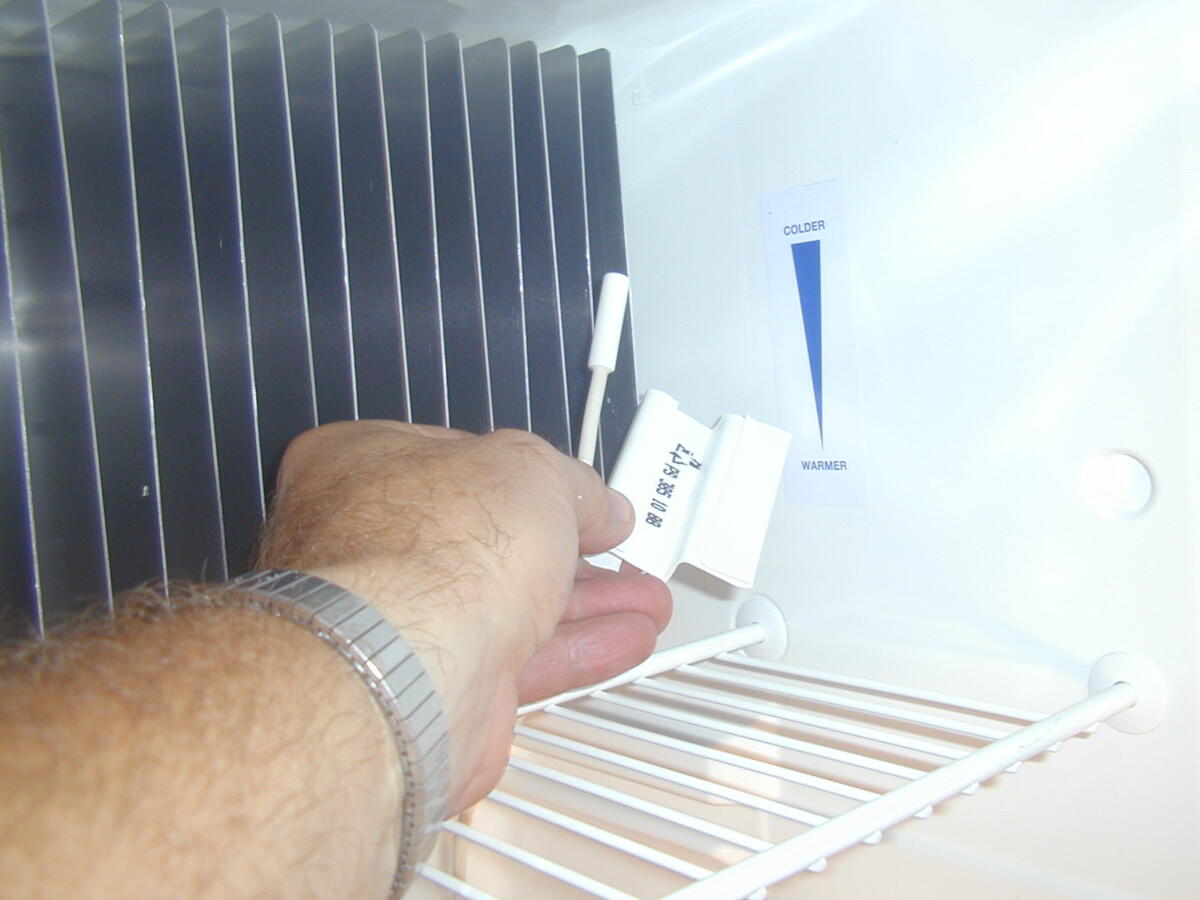
Thermistor
With frost or ice covering the evaporator fins and sometimes the thermistor, it gives a false reading that the refrigerator is cold, even freezing. Then the module board thinks it is cold enough while the rest of the refrigerator is warm.
Test refrigerator door seal
The best test that I have found is to use a dollar bill. Place it between the door and the refrigerator frame, and shut the door. Try pulling the bill out and there should be some resistance or a slight tug if the seal is aligned properly.
Refrigerator dollar test
If you have a 5th wheel or diesel pusher, you will need a $100 bill, as maintenance is much more expensive on the “big rigs”! 🤣
Usually the alignment can be fixed or adjusted by bending the lower hinge of the door or adding spacers/washers, and no parts are required. However, if the hinge pin is plastic, it might require a new part. This is an easy swap as it typically is just a couple of screws holding a flat piece with a pin or post.
You might also enjoy this from Dave
How long will an RV 12-volt refrigerator run with two batteries?
Dear Dave,
Why are trailer manufacturers moving to 12-volt refrigerators? How long will two Group 24 batteries run a 12-volt fridge? —Randy, 2015 Keystone Cougar
By Gail Marsh
Hiking and walking long distances would be great if it weren’t for the blisters! If that’s been your excuse, you definitely need this! I absolutely love that this is a product for blister prevention. Yes, you read that correctly! It prevents blisters! Doesn’t that sound a whole lot better than finding a great first-aid bandage after blisters have already formed? I thought so, too. So if you’re a walker, hiker, or just need to break in a new pair of shoes, trust me, you need this!
Tried and true
There are many tried-and-true methods that I’ve used to prevent blisters. They include:
• Wear properly fitting shoes or boots. You don’t want your hiking shoes to fit too tightly or too loosely. Any friction or hot spots can lead to blisters.
• Break in footwear. Before you try that long hike you’ve been eyeing, be sure to break in your boots. Wear them for shorter walks to allow you to pinpoint potential trouble spots that may cause blisters.
• Manage moisture. Moisture can exacerbate the likelihood of blisters. Use moisture-wicking socks made from synthetic or wool materials. These draw sweat away from your skin, unlike cotton socks.
• Opt for cushioned socks. In addition to the materials used to make the sock, you may want to try actual hiking socks. These specialized socks provide cushioning and support in areas prone to blister, like heels and toes—plus, they’re compression socks!
• Take a break. Take breaks during your hikes to remove shoes and socks. This will allow your feet to rest and air out—reducing moisture and minimizing the risk of blister formation.
Secret blister prevention product?
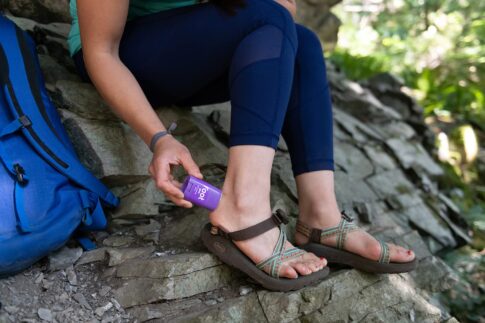
It’s not really a secret! I just can’t believe it’s taken me so long to find this Body Glide Anti-Blister Balm. After trying all of the tried-and-true hiking tips, I still was getting blisters! I ordered this product on Amazon, really as a last resort!
What I like
• Application. The best part about Body Glide’s Foot Glide Anti-Blister Balm is that it comes in a “stick,” much like deodorant. It’s so easy to apply and there’s no mess. You just rub the balm on your heels, toes, and balls of your feet—or anywhere blisters form on your foot. Your hands stay clean because they never touch the balm.
• Clean. This “blister preventer” is made from clean ingredients and is not greasy. It will not mark or ruin your hiking socks or boots.
• Long-lasting. For me, one application before hiking lasts all day long. Its compact size and stick application make it easy to pack along, too.
• Effects. Not only does Body Glide’s Foot Balm prevent blisters, but it helps restore chapped feet. It’s even helped by reducing inflammation in my feet.
• Fragrance-free. I appreciate that this foot balm is unscented. That way, both men and women can easily use it.
Where to get this blister prevention
As I mentioned, I ordered it on Amazon here, but I’ve also seen it in some hiking/outdoor specialty shops. If you’re a hiker or a walker, you need this!
By Cheri Sicard
Towing an RV can be tricky, especially if you’re new to it. There are a lot of things that could go wrong if you aren’t careful. In the (graphic) video below, the team from Rollin’ With RVer highlights 11 common towing mistakes that can have disastrous results.
Common RV towing mistakes and how to avoid them
#1 Overloading your RV
Overloading your RV is a big no-no. It’s not just about cramming too much stuff into your rig. It’s a serious safety issue that can turn your road trip into a disaster. Every vehicle has weight limits, and they’re there for a reason. When you go over these limits, you’re putting yourself and others at risk. Let’s break it down:
Gross Vehicle Weight Rating (GVWR): This is the maximum weight your vehicle can safely handle, including its own weight plus everything you load into it.
Gross Combined Weight Rating (GCWR): This includes your tow vehicle, the RV, and all the cargo in both.
Exceeding these limits is like trying to carry too many grocery bags at once. You might make it a few steps but, eventually, you’ll lose control. Know your limits and stick to them.
#2 Tongue weight tango—Finding the perfect balance
Tongue weight might sound like a term from a medical textbook, but it’s a critical factor in RV towing safety. Tongue weight is the downward force that the tongue of your trailer puts on the hitch of your tow vehicle. Get this wrong, and you’re in for a wild ride. If you’ve got too much weight at the back of your trailer, the tongue becomes too light. This can cause the trailer to sway or fishtail, especially at higher speeds or in windy conditions. It’s like trying to balance a broom on your finger—one small movement, and the whole thing goes haywire.
On the flip side, too much tongue weight isn’t good either. When the tongue is too heavy, it pushes down on the back of your tow vehicle. This lifts the front wheels, reducing traction and making steering difficult. It’s like trying to drive a wheelie—not exactly the safest way to travel.
The sweet spot for tongue weight is typically between 10% and 15% of your trailer’s total weight. So, if your trailer weighs 5,000 lbs., you’re looking at a tongue weight of 500-750 lbs.
#3 Unsecured cargo
We’ve all seen it: Debris flying off a vehicle on the highway, causing chaos for everyone behind. When you’re towing an RV, that debris could be your belongings if you haven’t secured them properly. It’s not just about keeping your stuff intact. It’s about preventing a potentially deadly situation for other drivers.
The solution is to think like a sailor preparing for a storm at sea. Use bungee cords, Velcro straps, or specialized RV organizers to keep items in place. Heavy objects should be stored low and close to the center of the RV. Lighter items can go in higher cabinets, but make sure those cabinet latches are secure.
Don’t forget about the outside of your RV. Bikes, kayaks, or any other gear strapped to the exterior need to be locked down tight. Use high-quality straps and check them regularly during your trip. A loose strap can quickly lead to a lost item or, worse, an accident.
#4 Skipping weight distribution and sway control
Towing an RV isn’t as simple as hooking it up and hitting the road. Without the right equipment, you could find yourself in a dangerous tug-of-war with your trailer. This is where weight distribution hitches and sway control devices come into play.
Think of a weight distribution hitch like a set of suspenders for your trailer. It spreads the load, keeping everything level and balanced. This improves your steering, braking, and overall stability. It’s not just about comfort. It’s about maintaining control of your rig in all conditions.
But weight distribution is only part of the equation. Sway control is equally important, especially for larger trailers. Trailer sway can be caused by crosswinds, passing trucks, or even small steering corrections. Once it starts, it can quickly escalate into a dangerous situation. Sway control devices work by creating friction between the tow vehicle and trailer, reducing the trailer’s tendency to sway. Some are built into weight distribution hitches, while others are separate components. Either way, they provide an extra layer of security and stability.
#5 Neglecting tire pressure
Get this wrong and you’re risking a blowout, poor handling, and even a rollover. Underinflated tires are a common issue. They can overheat, leading to a blowout. They also increase rolling resistance, which means worse fuel economy and more wear on your tires. Plus, underinflated tires can cause your trailer to sway more easily, compromising your control.
On the flip side, overinflated tires aren’t any better. They give you a harsher ride and can wear unevenly. More importantly, they have less contact with the road surface, reducing traction and increasing stopping distances.
Here’s a pro tip: Check your tire pressure when the tires are cold, meaning before you’ve driven for the day. Driving heats up the air in your tires, which can give you an inaccurate reading. And don’t forget to check your spare tire, too. You never know when you might need it.
#6 Inadequate braking systems
When you’re towing an RV, you’re not just doubling your vehicle’s length, you’re also significantly increasing its weight. That extra weight means you need extra stopping power. An inadequate braking system is like trying to stop a runaway train with bicycle brakes. It’s a recipe for disaster.
If your trailer weighs more than 3,000 lbs., which most RVs do, it needs its own braking system. This isn’t just a good idea, it’s the law in many states. Trailer brakes work with your tow vehicle’s brakes, providing the extra stopping power you need. You also need a brake controller in your tow vehicle. This device lets you adjust the trailer brakes’ intensity and timing. Without it, your trailer brakes are useless.
There are two main types of brake controllers: time-delayed and proportional. Time-delayed controllers apply the trailer brakes at a preset rate when you hit the brake pedal. Proportional controllers, on the other hand, sense how hard you’re braking and apply the trailer brakes accordingly. While both work, proportional controllers generally provide smoother, more responsive braking.
It’s crucial to adjust your brake controller correctly. If it’s set too light, your trailer won’t slow down enough. Set it too heavy, and you risk your trailer’s brakes locking up, potentially causing a skid or jackknife situation.
Don’t forget about maintenance. Your trailer brakes need regular checks and adjustments. Brake pads wear out, especially when carrying heavy loads. And remember, your tow vehicle brakes are working harder, too. They might need more frequent servicing when you’re regularly towing.
#7 Poor mirror setup
Standard vehicle mirrors often don’t provide adequate visibility when towing an RV. You need to be able to see the entire length of your trailer and the traffic behind you. Invest in quality towing mirrors that extend your field of view. These can be clip-on extensions or replacements for your existing mirrors.
You should be able to see the sides of your RV and the road behind you. A good rule of thumb is to adjust your mirrors so you can just see the edge of your trailer in the innermost part of the mirror.
Consider adding convex mirrors to your setup. These provide a wider field of view, though objects in them appear smaller and farther away than they actually are. Some RVs also install backup cameras for additional visibility when reversing.
#8 Tailgating
When you’re towing an RV, your vehicle’s stopping distance increases significantly. The heavier the load, the longer it takes to come to a complete stop. Many accidents occur because drivers fail to account for this increased stopping distance.
Maintain a safe following distance from the vehicle in front of you. A good rule of thumb is to allow at least 1 second of following distance for every 10 feet of your vehicle’s length, then add an extra second for speeds over 50 mph. In poor weather conditions, increase this distance even further.
Anticipate stops well in advance. Begin slowing down earlier than you would in a regular vehicle. This gives you more time to react to unexpected situations and reduces the strain on your braking system. Watch for brake lights far ahead of you, not just on the vehicle immediately in front.
Remember that your stopping distance will be even longer on wet or icy roads. In these conditions, reduce your speed and increase your following distance accordingly. If possible, avoid towing in severe weather conditions altogether.
#9 Maneuvering mishaps
Maneuvering a large RV requires a different approach to turning. Turning too sharply can result in your trailer hitting the curb, a sign, or even another vehicle. It can also lead to jackknifing, where the trailer swings around toward the tow vehicle. On the other hand, swinging too wide can put you in the path of oncoming traffic or cause you to clip objects on the outside of your turn. Finding the right balance is crucial for safe maneuvering.
The key is to start your turn later than you would in a regular vehicle, using the space to make a wider arc. Keep an eye on your trailer and your mirrors as you turn. With practice, you’ll develop a feel for how your moves go. Remember the tail swing. The rear of your trailer will swing out in the opposite direction of your turn. Be aware of objects or vehicles on the inside of your turn that could be hit by this swing.
When approaching a turn, slow down more than you think is necessary. It’s better to take a turn too slowly than too quickly. If you realize you’ve misjudged a turn, stop and back up if safe to do so. Never try to force a turn if it doesn’t feel right.
#10 Ignoring clearance heights
Many RV owners have learned the hard way that not all bridges, underpasses, or gas station canopies are tall enough for their rigs. Hitting a low clearance can cause severe damage to your RV and create hazardous situations for other drivers.
Know the exact height of your RV, including any roof-mounted equipment like air conditioners or satellite dishes. Keep this information readily available in your tow vehicle. Consider writing it on a sticky note and placing it on your dashboard.
Pay attention to clearance signs and plan your route in advance to avoid low bridges or underpasses. Use RV-specific GPS devices or apps that can alert you to low clearances along your route.
Be especially cautious in areas without posted height limits, such as tree-lined roads or older neighborhoods. Overhanging branches or low-hanging wires can cause significant damage to your RV’s roof. If you’re ever in doubt about a clearance, don’t risk it. Find an alternate route or get out and measure if necessary. It’s better to spend a few extra minutes checking than to risk a costly and dangerous collision.
#11 Skipping the pre-trip inspection
A thorough pre-trip inspection can prevent many problems before they occur on the road. Develop a checklist and go through it before every trip, no matter how short. This might seem time-consuming, but it’s far less inconvenient than dealing with a breakdown or accident on the road.
Start with a visual inspection of your entire rig. Walk around your RV and tow vehicle looking for any obvious issues like low tires, loose connections, or damage. Check all your lights, including brake lights, turn signals, and running lights. Have someone help you verify that all lights are working correctly. Don’t forget to check your electric brake connections if your trailer is so equipped.
Inspect your tires for proper inflation and signs of wear. Remember to check your spare tire, as well. Look for cracks, bulges, or objects embedded in the tread. Verify that your hitch is securely connected and all safety chains are properly attached. Double-check that your breakaway switch is connected and functioning correctly.
We use cookies to ensure that we give you the best experience on our website. By continuing to use our site, you consent to accepting cookies. We NEVER have or will sell reader's data. For more info, please see our privacy policy page.