Home Blog Page 52

CPAP placement tips for RVers

4

By Gail Marsh
At a recent RV show, I happened to overhear a wannabe RVer. As her husband began to check out the kitchen storage, she made a beeline for the bedroom. After a brief glance at the bed, she turned around and loudly announced, “Nope! Not gonna’ work!” Then the gal quickly grabbed her husband, headed for the door, and informed him, “Forget this one. It’s got no place for my CPAP machine.”

Finding a spot for your CPAP machine is sometimes challenging, especially when the RV doesn’t have a traditional nightstand. Safe and effective placement of your CPAP is crucial for a good night’s sleep. That’s why you might need some CPAP tips for RVers.

Limited space, big requirements

In RVs, every inch counts. Often, this means that there isn’t a dedicated bedside table. Or, if there happens to be one, it might be too small to safely hold your machine.

The nightstand is just the beginning. Your machine also requires a nearby outlet. Ideally, the CPAP machine should be placed a bit lower than your head. This will help to prevent condensation (commonly referred to as “rainout”) from entering the hose.

Ventilation and accessibility

But wait! There’s more. Doctors advise that CPAP machines should be placed where they can operate with proper ventilation. This helps ensure that the device doesn’t overheat, and that moisture buildup is minimized.

In confined RV spaces, ensuring optimal air flow around the machine may be problematic. (Ideally, the CPAP machine should not be crammed against a wall or mattress, which can obstruct ventilation.)

Also, most experts recommend placing your CPAP machine within arm’s reach so that you can easily adjust the settings during the night.

CPAP tips for RVers

My husband and I have enjoyed five different RVs over the years. Only one featured a usable nightstand, so we’ve had to experiment with manufactured solutions as well as try some DIY fixes to this CPAP placement challenge.

Bed-mounted CPAP solutions

BedShelfie bedside table for CPAP machine Image: Amazon

One ready-made solution is a portable bedside table. Products like the BedShelfie provide a surface that fits well within the tight confines of an RV. The BedShelfie, along with similar products, can clip to your RV bed base or extend under the mattress for support. The tables are designed to be stable and compact while offering sufficient space for your machine. (Note: Always check the usable surface dimensions and weight limitations before ordering.)

Wall-mounted brackets
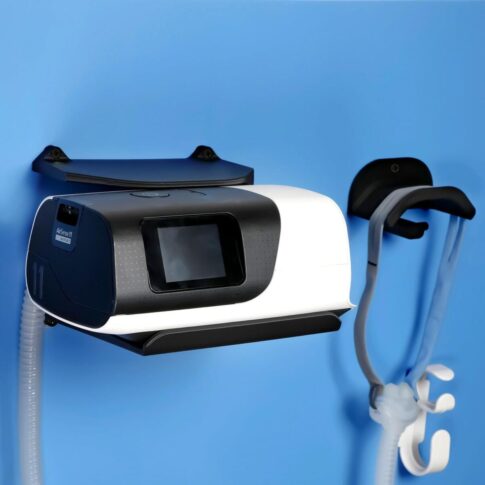
CPAP specific wall mount shelf Image: Amazon

As an alternative, consider mounting your CPAP machine on a wall bracket. Many RVers have experimented with custom brackets made specifically for their make and model of CPAP machine. Ask your provider if such a wall-mounted shelf is available for your CPAP unit.

There are also non-CPAP exclusive wall-mounted shelves that will keep your unit securely in place. Check them out on Amazon.

Portable solutions

Another option is to incorporate a small, movable shelf or a collapsible table that is multifunctional. Portable units (like a TV tray) can serve double duty in an RV. By day, they might serve as snack trays in your living area. By night, the tray moves to the bedroom as a perfect stand for your CPAP machine.

DIY projects

If you prefer to make your own CPAP shelf, here are some things a DIYer can try:

Enlarge what’s there. Currently, our RV has a 5” x 6” nightstand. (I use the term loosely!) It’s too small to hold my husband’s CPAP unit. So, he cut a larger piece of wood and stained it to match our RV’s interior trim. Then he screwed the prepared board right atop the existing nightstand. It works very well.

Borrow a design. Look at manufactured solutions to discover a design that you can duplicate.

Check online videos. For inspiration, Google “DIY solution for CPAP shelf.” When you find a plan that will work with your RV, modify the design to accommodate your particular CPAP unit.

No matter what solution you pursue, be sure that the result is a level, stable surface that allows for good ventilation and is not affected by potential vibrations or accidental dislodgement during the night or day. This is especially important if you have an excitable pet that may bump or pull on your CPAP unit.

What about you?

Do you or your travel buddy use a CPAP machine? Tell us about it in the comments that follow.

RELATED

RVDT2886

For minimalists, this little trailer fits the bill

This little RV will keep you warm in the winter and cool in the summer. It will keep you out of the rain and sun, and it will do it without the frills and electronic gizmos that so many RV manufacturers include these days to one-up their competitors.

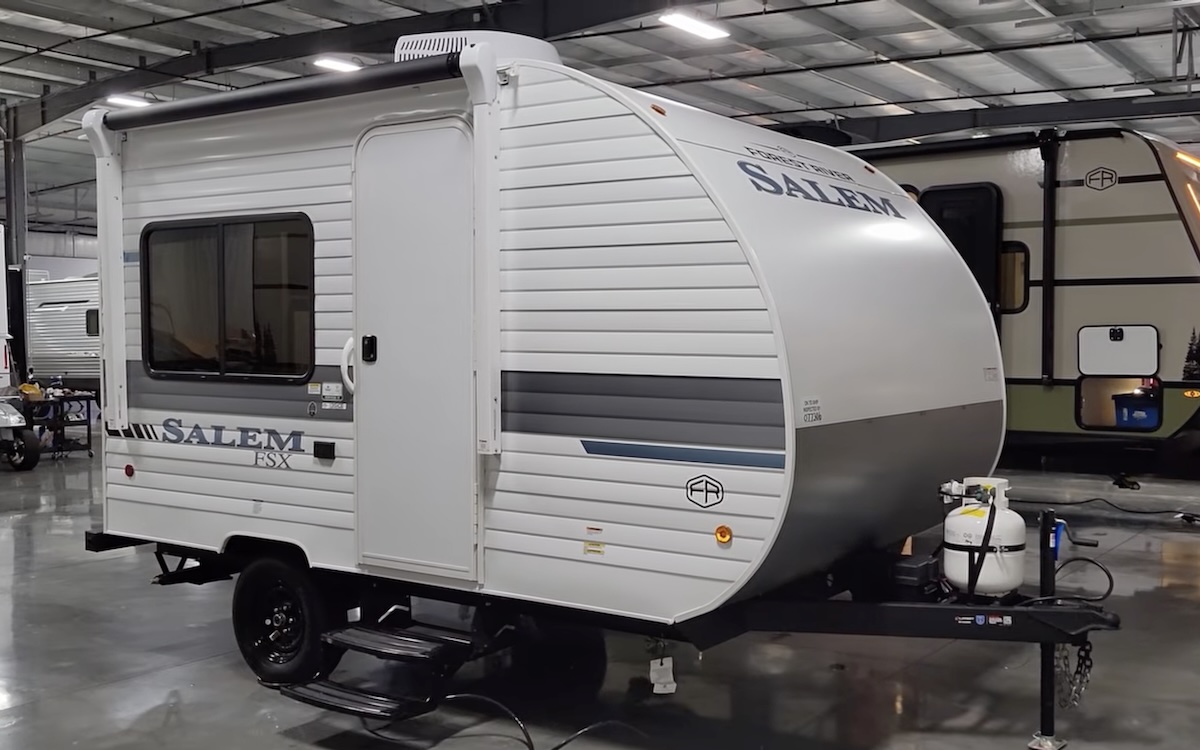
For RVers who want something simple and compact without sacrificing too much comfort, this pint-sized 2026 Salem FSX 135ICE travel trailer might be the ticket.

ScreenshotIn his walk-through video at the end of this article, reviewer Ray from “All About RVs” takes viewers inside this Forest River product. The model is positioned as one of the smallest “full-featured” campers on the market. It is aimed at solo travelers or couples, who can tow it with just about any sized passenger vehicle. Yet, despite its compact dimensions, it manages to include most of the essentials typically found in larger rigs.

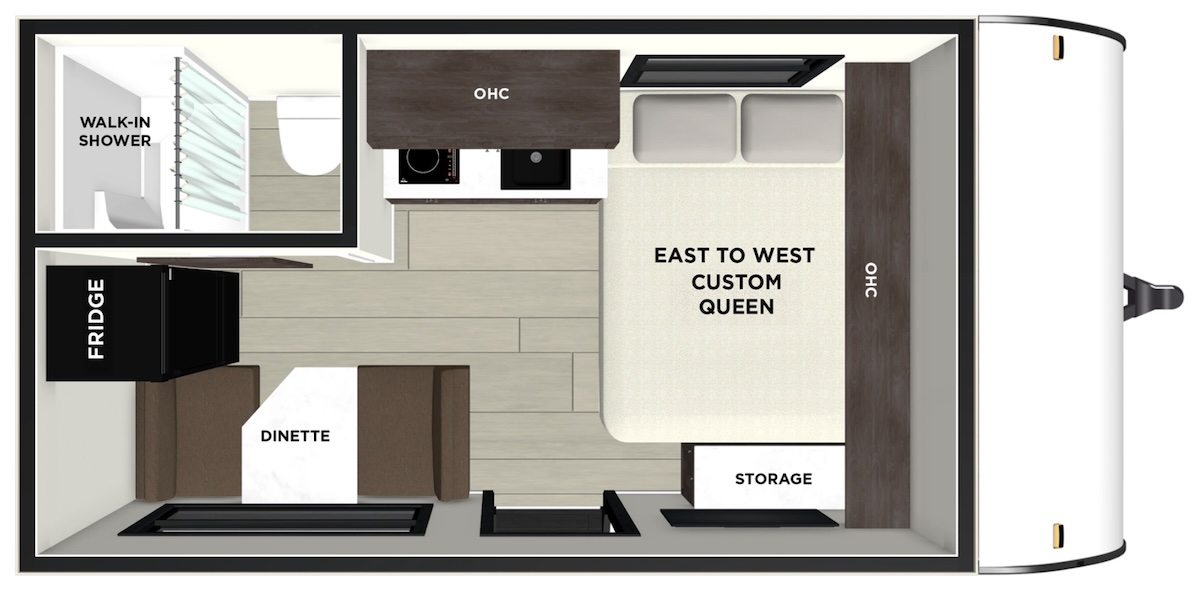
Floor plan in the Salem FSX 135ICE

Inside, the layout is straightforward. The front portion of the wood-framed trailer features a queen bed area that doubles as a seating space, maximizing functionality in a tight footprint. As expected, storage is limited.

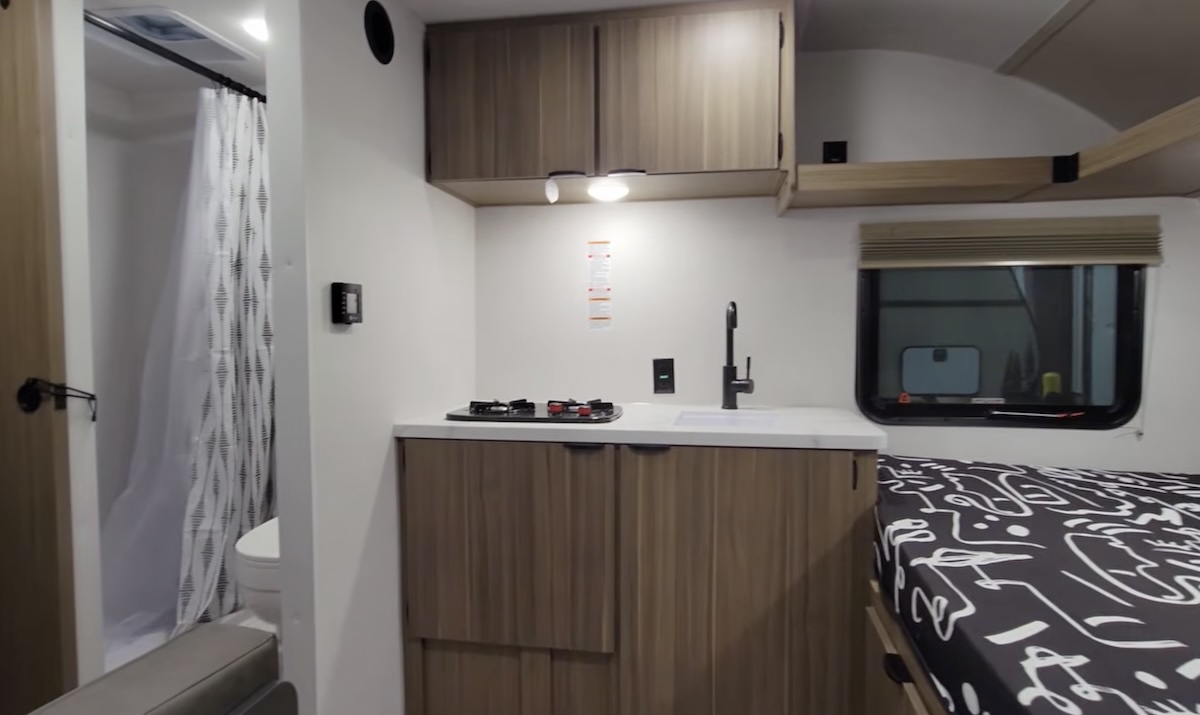
Salem FSX 135ICEThe kitchen is minimal but functional. While compact, it includes key basics such as a two-burner cooktop, 12-volt refrigerator and storage for food and cookware. It’s not designed for gourmet cooking, but it’s more than adequate for simple meals.

The bathroom is adequate, considering there is so little space to work with. Tall fellows may want to sit on the pot before buying the rig to see if their knees fit when the door is closed.

Accessibility

Another key appeal is accessibility. Smaller trailers like the Salem FSX 135ICE can open the door to RVing for those who might otherwise feel priced out or intimidated by larger units. They’re also easier to store, easier to maneuver in campgrounds, and less stressful to tow.

Of course, the trade-offs are clear. Space is tight, and there’s no room for entertaining. The RV is best suited for travelers who spend most of their time outdoors and use their RV primarily as a comfortable place to sleep, cook, recharge and as a cozy shelter when a storm rolls in. Bring a deck of cards and listen to the rain pouring down on the roof and be happy you’re not in a tent.

For weekend getaways to a nearby state park or national forest, this would be perfect. Set up the lawn chairs, take a day hike, and return for a peaceful night’s sleep out of the weather.

The MSRP is $28,282, which nobody ever pays. You can probably get it for half that (or less).

Watch the video below for Ray’s brief walk-through. This barebones RV may be all you need if you only have a few weeks a year to camp.

MORE RV REVIEWS LIKE THIS:

Tour a rare ’90s Revcon Trailblazer motorhome

By Cheri Sicard
The team from Ambition Strikes (1.09M subscribers, 201M views) bought one of the world’s rarest motorhomes, the Revcon Trailblazer. Only 67 of the beauties were ever made, and in the video below, they give us a tour.

This RV sits on a 1995 Ford F350 XLT platform. But here’s a fun fact: It has a rare 7.3L turbo diesel engine. Most Revcons came with the 460 Big Block. The engine is in great shape with only 44,000 miles. The couple even put 2,000 of those miles on during their trip home!

The engine runs smoother and has more power than any other 7.3L engine they’ve driven. What makes it so special? It has original 1990s speed parts. Revcon didn’t just build an RV. They created a hot rod. It even has original Western Diesel gauges and a programmer.

Inside, there are four aftermarket captain’s chairs. They’re super comfortable, like sitting on sofas. There’s also a Sony 10-disc CD changer and an FM modulator. Remember those? The previous owner, Tim, installed a backup camera. It’s a must-have because the mirrors don’t show much around the RV.

What’s it like to drive? In three words: “World’s biggest boss.” It grabs attention but requires focus. These old Fords have loose steering, so driving them takes work. Despite having six wheels, it’s a four-wheel-drive vehicle. More on that later. There’s a shift-on-the-floor transfer case and aftermarket stainless steps. It also features two aftermarket fuel tanks, holding about 85 gallons total.

Chassis and frame: Modified for adventure

When Revcon turned this truck into a motorhome, they modified the chassis. They added an extra frame all the way to the back. There’s also a tag axle with airbags. This helps support the extra weight.

How long is this rig? It measures 31 feet 9 inches.

There are also two 10-gallon propane tanks. One powers the stove, heater, and water heater. The other runs the generator. Other exterior features include leveling blocks and a spare tire with alloy wheel.

The spare tire swings out for access. Inside, the generator is an original propane 3600-watt model. It powers everything, including the microwave and air conditioning.

The RV also has a huge 12-volt battery that powers the water pump, lights, and furnace fan. So far, it’s working great. The house battery charges from a solar panel, the generator, shore power, or the alternator.

One cool discovery was the water heater. It’s a marine-style water heater. It runs on propane, or the engine coolant heats the water while driving.

Interior: A step back in time

Everything in here is teal.

The RV has automatic stairs. The entryway has cubbies for things like slippers, flashlights, and dog leashes. The control panel has a battery check and tank monitors. It also has switches for the water pump, TV/phone outlets, propane water heater, generator, and step. There’s even a propane level indicator. A heater near the entry is great for drying shoes.

The first dinette is used as a breakfast room. The dinette converts into a bed.

There’s a huge pass-through from the RV to the truck cab. You can easily walk into the truck without going outside. Above the truck cab is another bed.

The kitchen features a good-sized sink, a two-burner cooktop with a cover, a large fridge and freezer, and the motorhome’s original microwave and convection oven. On the downside, kitchen storage is limited due to the water heater.

The second dining room doubles as the primary bedroom and a party room. The table converts into a huge bed. There’s an extra sink in the bedroom area that allows for brushing teeth and washing up without disturbing someone sleeping in the front. The storage in the bedroom cabinets is ample, and there’s even a hanging closet for suits and pantsuits.

The RV has a wet bath with a porcelain toilet.

This Revcon Trailblazer is an incredible find. Its rare features and ’90s charm make it a unique motorhome, and the new owners are excited to hit the road and create new memories.

RELATED

RVDT2886

Have you taken an ancestry DNA test like 23andMe or AncestryDNA?

12

Think about your family history for a moment. The stories you’ve heard, the ones you haven’t, and the little mysteries that may still be unsolved. For today’s poll, we want to know if you have taken an ancestry DNA test like 23andMe or AncestryDNA.

If you have, maybe the results surprised you. Unexpected regions, distant relatives you didn’t know existed, or confirmations of stories passed down through generations. For many people, it’s been a fascinating way to connect the dots.

Others are curious but haven’t taken the plunge. Maybe you’ve thought about it, maybe it’s on your “someday” list, or maybe you’re just waiting to hear more from others before deciding if it’s worth it. (All tests are easily available on Amazon, by the way.)

Then there are those of you who prefer to stick with traditional research—or maybe not dig into it at all. Privacy concerns, cost, or simply not feeling the need to know can all play a role. Not everyone wants their DNA sitting in a database somewhere.

And, of course, for RVers especially, there’s something interesting about the connection between travel and roots. You might find yourself visiting places your ancestors came from—or wondering if a destination you love has deeper meaning than you realized.

So what about you? Have you taken an ancestry DNA test, or is it something you’d never consider? Go ahead and vote in today’s poll and if you’ve got a surprising result or story, we’d love to hear it in the comments below. Thanks!

Have you taken an ancestry DNA test like 23andMe or AncestryDNA?

MORE POLLS YOU MIGHT LIKE:

RVDT2886

Say goodbye to RV tank sensor issues with these tips

By Dustin Simpson
Struggling with inaccurate tank sensor readings in your RV? You’re not alone! Many RV owners experience false readings from their holding tank sensors, leading to confusion and frustration. In this article and video, we’ll explain how holding tank sensors work, why they sometimes fail, and how to properly clean and maintain them to ensure accurate readings every time.

How RV holding tank sensors work

Your RV’s holding tanks (fresh, gray, and black) have sensors that monitor the levels of liquid inside the tanks. These sensors are usually mounted on the sides of the tanks and detect when the liquid level reaches a certain height. The information is then sent to a gauge on your RV’s dashboard, giving you a reading on how full each tank is.

However, these sensors aren’t always perfect, and many factors can cause them to give false readings. Buildup inside the tanks, debris, or even moisture can interfere with the sensor’s ability to read accurately.

Common reasons for false tank sensor readings

Sludge and buildup

Over time, waste, soap scum, and other debris can accumulate on the sensors or the walls of the holding tanks. This sludge buildup can create false readings, making it appear as though the tanks are fuller or emptier than they are.

Corrosion or damage

Tank sensors can corrode or get damaged due to harsh chemicals or overuse, causing them to malfunction or give incorrect readings.

Improper tank treatment

Using the wrong chemicals or not cleaning your tanks regularly can lead to residue or scum that blocks the sensors.

Environmental factors

Temperature changes, exposure to moisture, and even dirt and grime on the outside of the tanks can affect the sensor’s performance.

How to clean and maintain your RV tank sensors

Empty the tanks

Before cleaning, make sure your holding tanks are empty. This will give you better access to the sensors and allow for more effective cleaning.

Use a holding tank cleaner

Invest in a holding tank cleaner that’s safe for RV systems. These cleaners are designed to break down waste, grime, and buildup inside the tanks. Some cleaners are specifically formulated to clean the sensors, as well.

Manually clean the sensors

If the buildup is severe, you may need to manually clean the sensors. You can do this by using a long, flexible brush to scrub the areas where the sensors are located. Be gentle to avoid damaging the sensors.

Use a sensor-specific cleaning product

There are products available that specifically target sensor cleaning. These are often added directly to the tank and are designed to dissolve the residue without damaging the sensors.

Flush the tanks

After cleaning, thoroughly flush your holding tanks with clean water to remove any residual cleaner or debris. This will help keep your system functioning properly and prevent future buildup.

Check for damage

While cleaning, inspect the sensors for signs of corrosion or damage. If the sensors appear damaged, you may need to replace them.

Tips for preventing future sensor issues

Use the right tank additives

Always use non-toxic and RV-safe tank chemicals that won’t harm the sensors. Avoid using harsh cleaners that can damage the sensors or corrode the tank.

Clean your tanks regularly

To prevent buildup, clean your holding tanks regularly. Depending on usage, you may want to clean them every 1–3 months.

Avoid overfilling

Overfilling your tanks can cause sludge to build up more quickly. Empty your tanks as soon as they reach about 75–80% full to prevent unnecessary buildup.

Check sensors periodically

Even if you don’t have false readings, periodically check the sensors to ensure they’re still functioning properly. Regular maintenance can help prevent issues from developing.

Install a tank sensor cleaning system

Some RV owners opt for a tank sensor cleaning system that automatically cleans the sensors while they’re using the RV. This can be a great way to ensure your sensors are always clean without needing to perform manual cleaning.

Properly maintaining your RV’s holding tank sensors is essential to avoid false readings and ensure accurate monitoring of your tanks. By following these simple cleaning tips and taking preventive steps, you can extend the life of your sensors and ensure your RV is always ready for your next adventure.

For more expert RV maintenance tips and tricks, subscribe to our channel. Keep your RV in top condition and enjoy stress-free travels!

More from Dustin

Make sure you check out my website, California RV Specialists, and our YouTube channel for more helpful information, and see our published articles on RVtravel.com and other social media pages.

RVDT2886

Helio XE— A small has-it-all travel trailer you can tow with a car

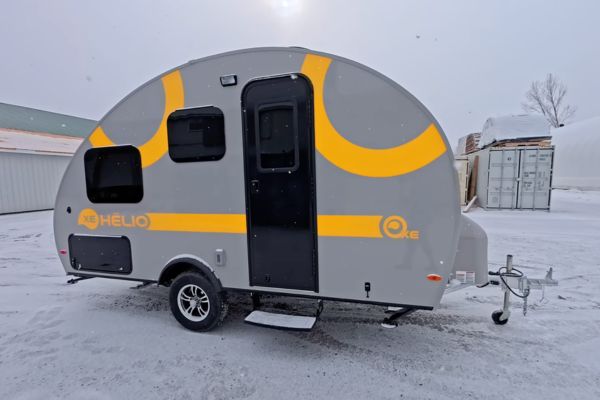
Finding a camper that stays light without feeling stripped down is tough. That is why the Hēlio XE stands out, because it packs a wet bath, kitchen, dinette, and even an optional bunk into a compact fiberglass trailer you can tow with a car.

In the video at the end of this post, we get a tour from Day Hiker From The Six. The big takeaway is simple: The Hēlio XE feels closer to a full travel trailer than a tiny teardrop or canned ham. For shoppers who want low weight and full standing room, this one deserves a close look.

The Hēlio XE makes its case with three clear points. It uses fiberglass and aluminum construction for long-term durability; it offers full standing height for tall campers; and it stays car-towable with a starting dry weight of about 2,050 pounds, a 2,700-pound GVWR, and a 210-pound tongue weight.

Inside, it doesn’t feel bare-bones. It has a bathroom; fresh, gray, and black tanks; a full kitchen; and a separate dinette. Buyers can also choose a bunk version for family use or skip the bunk for a couple-focused setup.

Exterior details and towing setup

The trailer has a bonded fiberglass body with only a small piece of plywood encased in the floor, plus an aluminum chassis. That build should help with longevity and reduce leak worries. Up front, it gets the expected 7-pin connector, safety chains, breakaway switch, manual tongue jack, and a molded cover that holds the battery and a single propane tank.

Along the utility side, the XE gets tinted awning-style windows, a torsion axle, alloy wheels, a solar port, and a separate 30-amp cord connection. Tank sizes are modest, with 13 gallons fresh and 10 gallons each for gray and black. The dump setup is easy to reach, and the sewer hose storage is placed where it is most useful. On the camp side, there is a large under-bed storage compartment, a spare tire, 120-volt outlets, a porch light, and a Maxxair fan.

Interior layout, kitchen, and sleeping space

The layout is simple and smart. The dinette sits to the right of the entry, the mid-bath is straight ahead, the kitchen is on the left, and the rear bed fills the back. That matters because the bed and dinette can stay set up at the same time, something unheard of in a trailer of this size.

The front dinette converts into a bed about 40 inches wide and 72 to 74 inches long. Storage under both bench seats adds useful space for clothes and soft gear. In the rear, the main bed spans the 74-inch trailer width, so it works well for someone around 6 feet tall, though taller sleepers may want to angle a bit.

The kitchen gets solid butcher-block-style counters, a stainless sink with pull-down faucet, and a Dometic stove mounted front to back to free up a bit more workspace. There is open cabinet space below, a shelf above, a microwave, tank monitors, water pump controls, and a rare three-way fridge that runs on 120V, DC, or gas. USB, 12V, and 120V outlets near the bed add convenience.

Helio Roulottes Seriexe Table

The bathroom and bunk option

The wet bath is one of the surprises here. It uses a fiberglass enclosure with toilet and shower, and instead of a bath fan, a duct routes moisture toward the nearby Maxxair roof fan.

The standing room is the headline. The interior height feels close to 7 feet, which is rare in a trailer this small.  The optional bunk version keeps the front dinette and adds a fold-down upper bunk rated for 150 pounds, at roughly 6 feet long.

Helio Roulottes Seriexe Lit

Final thoughts

The Hēlio XE looks like a strong fit for shoppers who want fiberglass construction, low weight, and a more open interior than most small trailers offer. Its weak spots are the smaller tanks, limited overhead storage, and a bed length that may feel tight for taller campers.

Base MSRP starts at $49,900 Canadian, or about $36,000 US, before freight, fees, and options.

Learn more about the Hēlio XE here.

RELATED

RVDT2886

How to avoid, reduce, or eliminate RV driving pain

3

By Cheri Sicard
RV driving pain—no, not the pain you feel at the pumps, but rather actual physical pain caused by prolonged driving your RV—is something rarely discussed. However, (the late) Martin from RVstreet is about to change that.

If you have ever experienced pain in your neck, back, shoulders, or rear end while driving your RV, then the video below is for you.

Martin shares his techniques and equipment to avoid and relieve his RV driving pain.

This year, Martin began to experience arm, shoulder, and neck pain while driving. The cause was a pinched nerve. It turned out that the way he was sleeping was the culprit and it was easy to fix.

Then he started to get deep tissue back pain right below the shoulders.

When he began, he found relief in, of all things, a tennis ball wrapped in a sock. Watch the video for a demo. But this was short-lived.

He also tried an electric heating pad, which might not be practical for all RVers. It also only provided temporary relief.

Ditto ibuprofen. And while CBD cream has helped his neck and shoulder pain, it did nothing for this deep back pain.

He did find a good back-stretching technique he can do while driving (see the video for a demo), but it still had limited success.

So, Martin examined what might be the cause. This leads him to research posture. That was the cause and might be the cause if you, too, are having problems.

A back support pillow he bought at Walmart helped, along with a cushion under his butt. Watch the video, as Martin will show you what to look for in order to have proper RV driving posture in order to avoid pain.

He also discusses the success he has had with a tens machine.

It took a lot of trial and experimentation, but Martin finally found a solution to his driving pain. His trial and error might help you, too, if you experience RVing driving pain.

We are sad to report that Martin has passed away since he posted this video. You can still watch all his incredibly helpful videos on his YouTube channel

RELATED

RVT1257

7-year-old girl’s video review of travel trailer is a delight

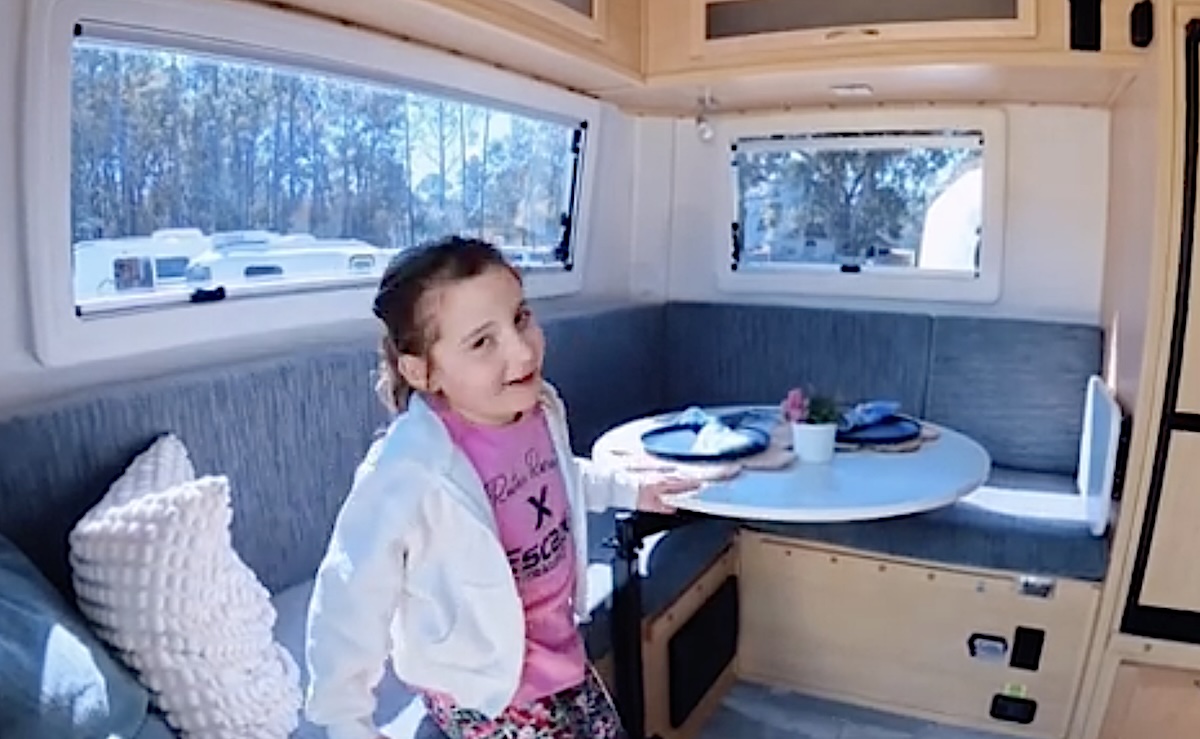
You don’t come across many video reviews of an RV conducted by a 7-year-old girl. Well, here’s the exception. The host here, an enthusiastic young lady named Maleigha, loves her 23-foot Escape travel trailer. It comes through, as you will see in the video at the end of this article.

She’s a natural in front of the camera.

Maleigha is a confident, cheerful youngster who proudly leads viewers on a highlight tour of her family’s trailer. She’s completely at ease, narrating like a seasoned YouTuber—only far more charming. She’s speaking naturally, not from a script: You can tell!

As she walks through the trailer, she points out the RV’s amenities. In the kitchen she explains you “can cook, do anything you want,” even “make cupcakes.” Now how many YouTube RV reviewers ever mention making cupcakes?

And then there’s the bed, which she explains is “amazing,” and “so soft.” We believe her.

Her personality shines through

What really shines here is Maleigha’s personality. She adds her own commentary, little opinions, and kid-sized insights that make you smile. There’s a natural enthusiasm in her voice. She’s too young to sign on anywhere as an RV salesperson, but our guess is she could probably help an adult salesperson seal a deal with a family with young children.

This video won’t win an award for the most informative, but chances are excellent you will never find a host of any other RV review as charming!

Watch the video (and smile):

* * *
QUICK TIP:

It’s wise to carry a small portable water purifier in your RV in case of an emergency. A LifeStraw is an excellent choice. It’s unlikely it will ever happen, but it’s always possible that your RV could end up as your full-time home due to a natural disaster. In that case, such a device might become essential to life.

RVT1257

Best Eastern U.S. railroad gems for RVers and where to camp nearby

5

All aboard! If you love trains, you’ll love these railroad gems! They are the best in the Eastern United States. Plan your RV railroad trip today.

Medina Railroad Museum (Medina, NY)

Train from Medina Railroad Museum Image: medinarailroadmuseum.org/train-pictures
Photo: Medina Railroad Museum

Nestled between Buffalo and Rochester, this museum features one of Western New York’s largest model-train layouts (204 ft. × 14 ft.), along with full-size locomotives and passenger cars. Seasonal train excursions are also offered, with schedules and pricing varying by event.

The museum’s living history excursions depart from 530 West Avenue, offering a firsthand glimpse of 19th and 20th century railroading in Western New York. Learn more here.

Nearby RV park: Wildwood Lake / Medina KOA Holiday

  • Location: 2711 County Line Rd., Medina, NY 14103
  • Amenities: Full hookups (water, electric, sewer), Wi-Fi, two pools, splash pad, playground, game room, fishing pond, winery on-site
  • Nearby attractions: Medina’s historic Erie Canal Lock 29, Niagara Falls (40 mi.), and local wineries

B&O Railroad Museum (Baltimore, MD)

Celebrating America’s oldest common-carrier railroad, the B&O Railroad Museum houses more than 250 historic objects. Among them is the inaugural “Tom Thumb” locomotive replica, within its landmark 1884 roundhouse.

Highlights include the “Rebuilding the Cathedral of American Railroading” tour and the restoration of the American Freedom Train.

Nearby RV park: Bar Harbor RV Park & Marina (Abingdon, MD)

  • Location: 4228 Rocky Point Road, Abingdon, MD (≈ 25 mi. south of Baltimore)
  • Amenities: Full hookups, waterfront sites, swimming pool, fishing pier, dog park, laundry, showers, free Wi-Fi
  • Nearby attractions: Baltimore Inner Harbor, National Aquarium, Fort McHenry

Adirondack Railroad (Utica – Tupper Lake, NY)

Operated by the Adirondack Railway Preservation Society, this year-round scenic line winds through the Adirondack Park. It offers a variety of themed excursions through stunning vistas. Departures from historic Union Station in Utica include narrated tours that blend history and wilderness scenery.

Nearby RV park: Adirondack Gateway Campground (Cold Brook, NY)

  • Location: 244 Burt Rd., Cold Brook, NY (≈ 25 mi. northeast of Utica)
  • Amenities: Full hookups (20/30/50 amp), Wi-Fi, hiking trails, fishing ponds, canoe/kayak rentals, cabins
  • Nearby attractions: Delta Lake State Park, Cooperstown museums, Glimmerglass State Park

Strasburg Rail Road (Lancaster, PA)

Strausburg Railroad Museum train Image: strasburgrailroad.com
Photo: Strasburg Railroad Museum

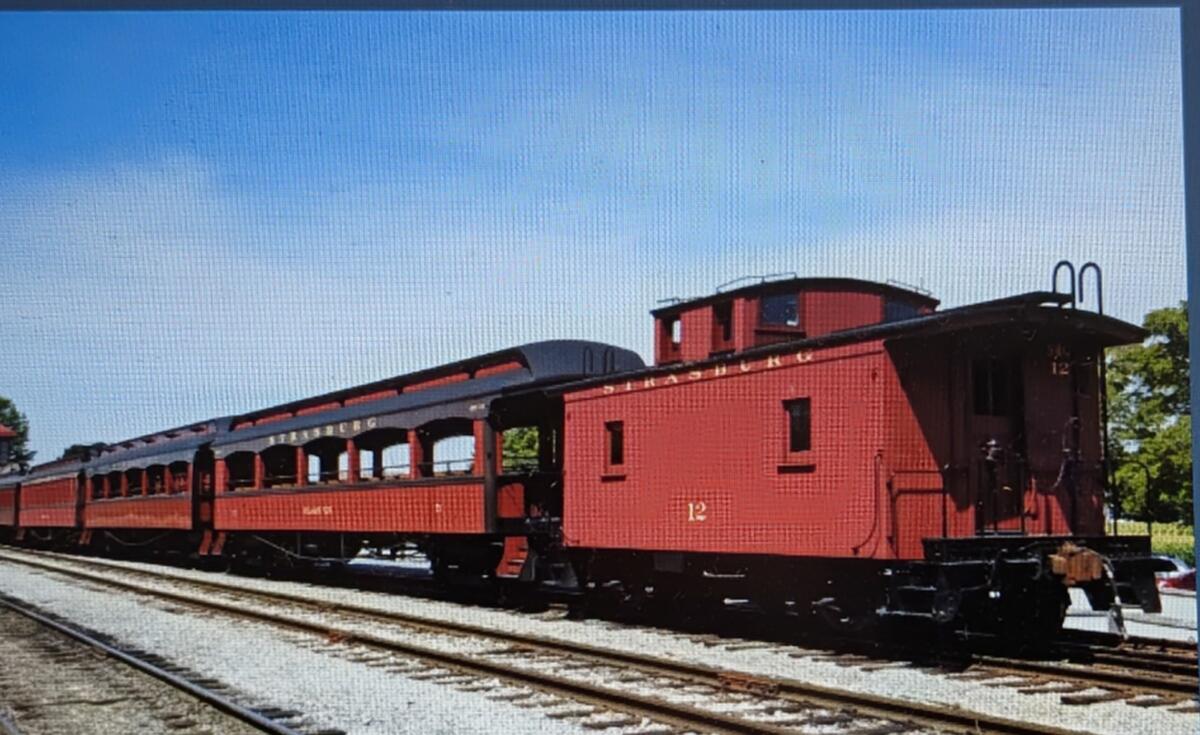
As the nation’s oldest continuously operating railroad (since 1832), Strasburg Rail Road delights with authentic steam train journeys. Visitors will ride through Amish farmlands, with first class dining and open-air coach options.

On-site exhibits display restored cabooses, passenger cars, and working shops where craftsmen maintain live-steam engines.

Nearby RV park: Lancaster County / KOA Journey (New Holland, PA)

  • Location: 354 Springville Road, New Holland, PA (≈ 6 mi. from Strasburg)
  • Amenities: Pull-through/back-in sites up to 90 ft., cabin rentals, playground, mini-golf, pool, Wi-Fi, showers, laundry
  • Nearby attractions: Sight & Sound Theatre, Railroad Museum of Pennsylvania, Amish farm tours

You should go!

Immerse yourself in railroad history and culture. Plan an RV trip to see the best Eastern U.S. railroad destinations soon.

RELATED

RVT1257

Three free RV apps for easy navigation, big rigs, free camping, more

11

Say it three times fast: three free RV apps, three free RV apps, three free RV apps! Even if you can’t say it three times fast, I know these three free apps will help you as you RV.

You may already know about and use the following apps. However, they are relatively new to me, and I’ve found them extremely helpful while RVing. Did I mention all three are free?

National Park Service app

The official NPS app is free and covers all National Park Service units across the country. This app offers searchable park pages, interactive maps, and downloadable park content for offline use. You’ll also discover ranger-curated tours and alerts for closures or hazards within this helpful app.

For RVers who bounce between parks or plan stops around national sites, the app’s downloadable park packs keep maps and points of interest available even if your cell signal fades.

Take some time to download and investigate this app.

How to download it

Follow these step-by-step directions to access the National Park Service app:

  • Open the App Store (iPhone) or Google Play (Android).
  • Search for “National Park Service” or follow the NPS website link to the store listing.
  • Install the app and open it.
  • Allow location access if you want the map to show your position.
  • Search for parks you plan to visit and tap the option to download the park content so maps and tours are stored on your device for offline use.
  • When inside a park, use the map to find visitor centers, trailheads, and self-guided tours.
  • Check the app’s alerts panel for closures or safety notices before you head out.

Trucker Path

Trucker Path is a trucker-focused app that provides a large database of truck stops, parking availability, fuel pricing, weigh station statuses, and a truck-safe GPS/routing system built around vehicle size and restrictions.

We like using Trucker Path to locate big-rig-friendly parking and to find travel centers that accommodate large rigs. This app will also check parking occupancy at travel plazas and Walmarts, and compare fuel prices, too.

The Trucker Path app offers routing profiles so you can create routes that account for vehicle dimensions, where supported.

Note: You will have to sign up for a membership to access more advanced features. 

How to download it

  • Visit truckerpath.com or search “Trucker Path” in the App Store/Google Play and install the free app.
  • Open the app and explore the map layer for truck stops, rest areas, and parking.
  • Enable GPS so the app shows nearby options.
  • Use the search filters and read recent user reviews or parking-status flags to judge whether a stop will actually have RV-friendly space.
  • Search for listed amenities like showers, pull-through lanes, and fuel types.
  • If you want tailored routing, set up a routing profile (where available) with your rig’s length/height. That way, the app avoids restricted roads or low bridges.
  • Keep an eye on user-contributed notes for tricky locations.

Park4Night app

This app is a crowd-sourced catalog of places to rest or camp. It has filtering for motorhomes, including hidden pullouts, free spots, and nearby activities. This app can be a lifesaver when you need a last-minute overnight spot.

Though geared mostly for motorhomes or other drivable RVs, we’ve used the app’s filter system to quickly find fishing spots, monuments, hiking trails, affordable restaurants, mechanics, and more.

How to download it

  • Open the App Store on an iPhone or Google Play on an Android device and search for “Park4Night.” (Look for the official app with the camper/parking-style logo to be sure you’re selecting the correct one.)
  • Download and install the free version of the app. (Note: You can create an optional account, but it’s not required just to browse locations. Creating an account does allow you to save favorites and contribute reviews later, which many RVers find helpful.)
  • Open the app and allow location access so it can show nearby overnight spots, rest areas, and campsites. The map will automatically populate with icons representing different types of locations, such as free overnight parking, paid campgrounds, or scenic pull-offs.
  • Use the filters to narrow results to places suitable for motorhomes or RVs. You can sort by overnight parking, services, price (including free), and amenities. Tapping on a location opens photos, descriptions, user comments, and notes about road access or space for larger rigs.
  • Before heading to a spot, read the most recent reviews. RVers often leave updates about local restrictions, noise levels, etc.
  • Download maps for offline use, which is especially useful when traveling through areas with limited cell service.

Practical tips

A few key tips will help you get the most from these helpful apps:

  • Each of my three free favorites has lots of features to discover. Take time to explore!
  • Keep downloaded content and screenshots of reservations or passes in case you lose signal.
  • Give apps permission to use location only while you’re using them to save battery.
  • Cross-check user reviews and recent timestamps on campground entries to avoid stale info.
  • For vehicle-specific routing, always verify whether a given app supports custom vehicle dimensions before depending on it for low-bridge avoidance.

Do you have a favorite app you use while RVing? Please tell us using the comments below.

RELATED

RVT1257

Popular RV myths seen on social media— BUSTED!

4

If you spend any time on social media, first of all, how do you recover from some of the absolutely ridiculous things people write? I was trolling through a few groups recently and noticed that a lot of the same myths keep getting spread around, so I thought I’d create some answers to those myths so that, when you come across them, you can share this article as an answer. 

In fact, this is something I do frequently: Someone asks a question, and an article I read on RVtravel.com makes a great answer. By sharing that article, it also shares RVtravel.com, thank you, so maybe they’ll have a great resource to find other answers. 

So, here are some things I read a lot and my answers to those. 

Don’t buy an RV from Forest River, Thor, or Winnebago

This might be one of the most common things I see. I wrote a story about how some of the quality issues in RVs are just the companies responding to demand from buyers. But the myth that all RVs from any company are bad just isn’t true. 

Both Forest River and Thor are more like a collective than a cohesive company. Essentially, the way they operate is by encouraging the various brand names under them to compete both inside the company and with outside competitors, too. The individual brands have a lot of autonomy to make decisions on components they use, processes they employ, who makes design and manufacturing decisions, and all of that. 

The objective of the brands is to provide what customers want, but also to provide products competitive in the marketplace. 

So, some brands, like Cherokee from Forest River, or Springdale under Keystone, or Open Range under Jayco, are very specifically designed to target the entry-level market where price is absolutely key. 

More affordable rigs sell well

By no coincidence, these more affordable rigs also sell really well—they’re affordable! Often, they sell on a combination of low monthly payments and the vision of being able to spend time in the great outdoors. 

But they also sell to people who tend to know little about RVs, as is evidenced by the questions posed on social media. So, those people have a lousy experience with the rigs through a combination of their lack of knowledge of how to optimize systems and care for the RV, and, quite frankly, sometimes awful RV dealers. 

I have very regularly written that you should always shop your RV dealer first. 

So, they blame Thor or Forest River (the ones who sell the most RVs of this type) and share that on social media. 

But Thor and Forest River have some very high-quality brands in their collection. Brands like Airstream under Thor, Rockwood/Flagstaff, and Columbus under Forest River. When you look at the components used in the higher-end brands, they absolutely do favor a better-quality experience. The processes at these brands are also indicative of greater care being exercised in the manufacturing process. But these are also at the higher end of the price spectrum. 

Even Keystone, a Thor brand, has everything from Coleman to Montana, and that’s just one Thor division.

Oh, and Airstream was there at the start of Thor Industries in 1981—they didn’t recently acquire the brand. In fact, it was flailing to a degree when it became a cornerstone of Thor and is now doing quite well, thank you. 

Shop from the ground up

If you look at the RV reviews published here, you’ll see that there are very different quality aspects of various RVs. This is why I encourage you to shop from the ground up. If I were shopping for a new towable RV (and who isn’t always shopping!?) and I saw off-brand tires, no tire pressure monitoring system, and leaf springs, I wouldn’t even consider that unless I were buying a seasonal camper. 

And that’s another thing: Not all campers are ideal for all situations. So, a seasonal buyer might have a totally different checklist than someone who plans to visit Alaska or do a lot of traveling. Which will result in a different quality experience, as well. 

By the way, even Thor realized that Heartland was lousy, as we reported here. 

So, yes, you can get a relatively high-quality RV from Thor or Forest River. But even some entry-level RVs, with the proper care, can last a very long time. Consider that I had a 1971 Aristocrat—a stick-and-tin build with pressed wood cabinets and leaf spring suspension—and it was still rocking and rolling 50 years later. How you understand and take care of things is also a factor. 

after testing positive for COVID-19
CDC photo

Don’t buy a used COVID RV

This is another thing I see all the time. The reasoning behind this is that it’s true, RV demand skyrocketed, and some RV brands (remember how autonomous they are?) brought anyone with a heartbeat, sometimes even barely detectable, on board to put together as many RVs as possible as quickly as possible. 

But, again, not all brands did. Some just kept their existing team, and everybody put in some overtime. But the quality processes and attention to detail remained. 

And, by now, how the rig was cared for is almost more important than how it was built. Almost. 

All RV builders suggest quarterly inspections of all the seals on the RV. Even if a rig were very well made at the factory, if it weren’t maintained, it likely already has water intrusion. If the appliances weren’t cared for and attention wasn’t paid to keeping the screws in, a great RV may already be ready for permanent retirement even after a few years. 

COVID was nuts for RV companies, even some of the better ones, having to swap components that they didn’t normally use into rigs. Instead of brand X refrigerator, maybe they had to choose a different brand. I remember seeing RVs sitting waiting for some major components because they just weren’t available, so they sat in a field with pieces missing or sometimes even were shipped to dealerships with the promise that those pieces would come later. 

Rather than specifically avoiding an RV built during the COVID era, I would strongly suggest hiring a certified RV inspector for any used RV and, perhaps, even a new one. But, again, this goes back to finding a great RV dealership first. 

A gavel with the words "Insurance Claim"I don’t need insurance on my towable RV

Many incorrectly assume that your towable RV is covered by the insurance of whatever is towing your RV. While there is some truth to that, consider this. 

I was at an RV park. The work campers were cutting a tree above my RV. A limb swung down and punched a hole in the sidewall. The best repair was replacing that entire sidewall—almost $5,500. Now, this was covered by the park. But if something like this happened in storage or in my own yard and the trailer wasn’t hooked to the truck, that repair would be on me. 

That’s true if the trailer is broken into or someone damages it while you’re camping. Imagine the errant football taking out a window. 

Or what if there’s hail damage? Or your pet rhino gores someone at an RV park? 

Towable RVs should be insured for the most part, and that insurance is usually pretty affordable. Interestingly, I got to speak with the underwriter for Progressive for this podcast episode, and the conversation was eye-opening. 

It’s taking forever to handle my warranty claim

I’ve seen a lot of complaints from people where an RV warranty claim is taking a very long time. There’s really no reason for this. 

We have an article about how the whole warranty process happens (I used to work at a dealership and handled warranties, if you didn’t already know). But RV warranties are generally pretty quick unless the part itself is unusually difficult to get. 

This article ought to be called “Shop Your RV Dealership First”. Yes, I’ll do that one soon, but this is one of the reasons you do that. Aside from waiting for parts, RV warranties are rather quick to handle unless the dealership is sitting on its hands or just doesn’t care. 

Now, certainly, there are times when parts are difficult to come by, and I even had one instance where it took three separate shipments to get a replacement windshield for a travel trailer. Each time the truck would show up, and the windshield was cracked, so that claim took for-two-evers. 

Also, if the RV is otherwise safe and serviceable, there’s no reason it should sit on the dealer’s lot waiting for a part. For example, if the furnace is foul but it’s summer, then just take it camping while the dealership is waiting for the replacement. 

What other myths have you seen? 

What other myths have you seen on social media or elsewhere that we can look at? I think there are easily more columns like this one, and I’m happy to use my resources within the RV industry to help find the truth of the matter. Please leave a comment below. 

MORE LIKE THIS FROM TONY:

RVT1257