South African explorer Kingsley Holgate has just turned 80 and shows no signs of slowing down. For more than three decades, he has turned adventure into a force for good. He and his team have traveled more than 2.2 million miles across Africa while improving countless lives.
In our part of the world, North America, Holgate might be called a “boondocker on steroids.” He’s that and much more.
His RV has been a series of Land Rover Defenders, which he notes are more than just transport, but lifelines and second homes.
He has often been called the most traveled man in Africa, having led more than 40 expeditions through all 54 countries on the continent. But the real story isn’t the miles, it’s the mission: using exploration to deliver meaningful aid to people in remote regions.
Since 2000, through the Kingsley Holgate Foundation, Holgate and his team’s work has been remarkable. They have distributed:
481,000+ mosquito nets, protecting an estimated 1.4 million women and children from malaria.
224,000 pairs of reading glasses provided through the “Rite to Sight” program.
36,000 LifeStraw units, supplying more than 63 million liters of safe drinking water.
2.1 million nutritional meals distributed to children in more than 20 rural care centers.
Even at 80, Holgate continues leading humanitarian expeditions into underserved regions, bringing practical help and hope to thousands.
Now, as he enters his eighth decade, Kingsley isn’t slowing down. In 2026, the team is neck-deep in the Defender Africa Traverse Expedition, a grueling three-month, west-to-east journey tracking the Tropic of Capricorn from Namibia’s Atlantic coast all the way to Mozambique.
For North American RVers who understand the pull of the open road, his life is a powerful reminder: Travel isn’t just about the journey, it’s about the difference we can make along the way. Kingsley Holgate is an inspiration, for South Africans and RVers and other adventurers throughout the world.
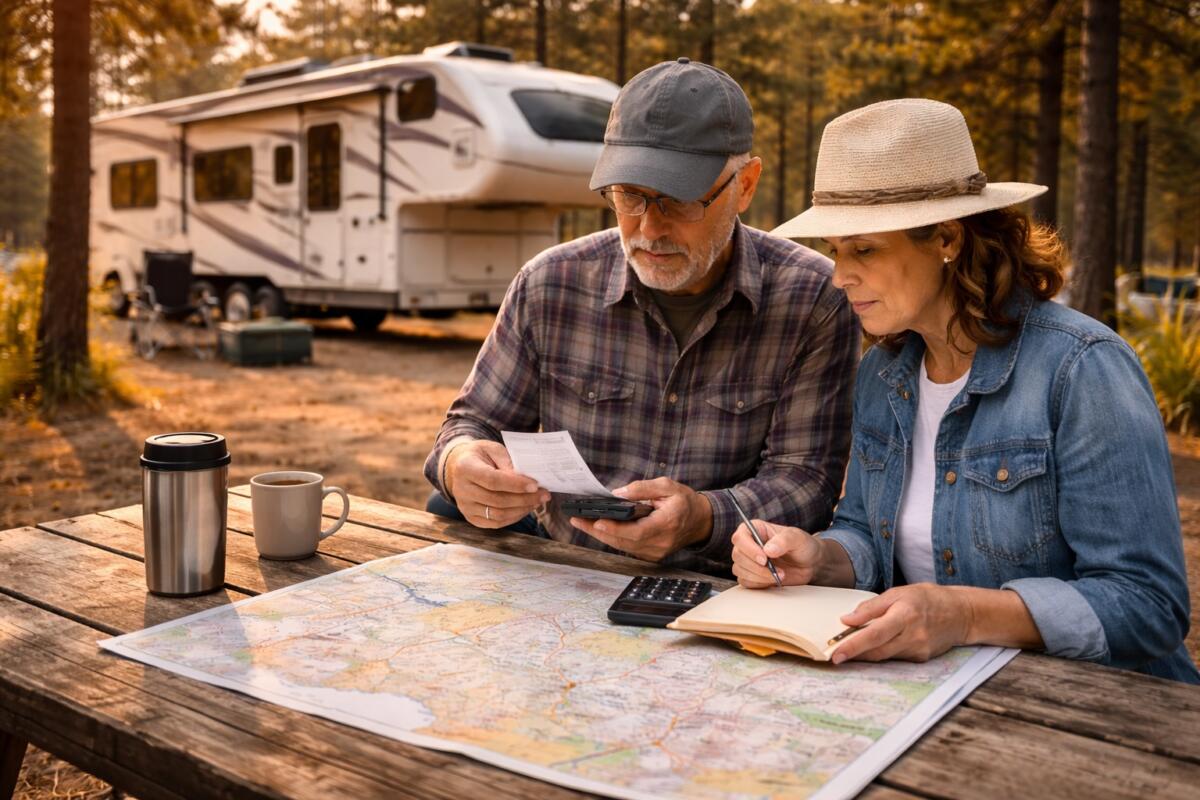
If you’ve been RVing for a long time, you already know how to stretch a dollar. But lately, many of us are pausing before turning the key. Fuel prices are unpredictable and climbing quickly, campground rates are creeping up, and those “quick getaways” don’t feel as inexpensive as they used to.
So what are RVers doing about it?
We’re not quitting just yet. We’re adapting strategically and in new, creative ways.
The ripple effect of high fuel costs
Fuel tends to get the headlines, but it’s really the combination that’s changing RVers’ behavior:
• Fuel costs eating up a larger share of trip budgets
• Campground rates rising, especially in peak season
• Fewer truly “cheap” last-minute options
• Higher costs of food (groceries and eating out) and events
• Add-ons (reservation fees, utilities, premium sites) stacking up
For many RVers, this shift is subtle, but it’s certainly enough to change how we’re planning and organizing upcoming trips.
And for some of you, it’s already affecting decisions in real time: “Yes, it already has! We canceled our 1st prescheduled trip (our normal spring shake-down). Hopefully, the prices drop by May, or we’ll cancel another. 😢” —Wayner
Others are holding steady—for now—but keeping a closer eye on spontaneous travel: “It won’t affect the two two-week trips we already have planned and reserved. It may make us rethink any spur-of-the-moment trips, though.” —Bob
Fewer miles, better trips
One of the biggest changes? Driving less on purpose.
Instead of covering 1,000+ miles on a multi-stop loop, RVers are:
• Choosing closer destinations
• Building trips around one or two locations
• Staying longer instead of hopping every night or two
Not only does this cut fuel costs, but it also often improves the experience. Less packing up = less stress. More time to actually enjoy where you are.
That shift is showing up clearly in how RVers are planning right now: “Yes, it already has us changing ours. We are changing locations and staying longer while traveling. Hoping to cut our mileage down by at least a third.” —robert
The return to slower travel
Slower travel isn’t new, but it’s making a comeback. Veteran RVers are leaning back into what used to be normal:
• Weekly rates instead of nightly stays
• Taking advantage of monthly pricing where possible
• Planning trips around shoulder seasons instead of peak demand
In many cases, staying 5–7 nights can dramatically lower your average nightly cost compared to moving frequently.
It’s not about “budget travel” in the traditional sense; it’s now about being the most efficient.
Campground strategy is getting sharper
Advanced RVers are getting more intentional about where they stay and when.
Some of the smarter moves showing up right now:
Mixing campground types
Instead of staying exclusively in private parks:
• Rotate between public parks, COE, state parks, and private campgrounds
• Use higher-cost parks sparingly (location, convenience), not by default
Booking differently
• Lock in popular spots early to avoid surge pricing
• Or go the opposite route: target less competitive locations last-minute
Being flexible on hookups
• Full hookups aren’t always necessary
• Water/electric or even dry camping can significantly cut costs
For many experienced RVers and those used to booking sites, it’s less about finding the cheapest option and more about avoiding the overpriced ones.
Fuel strategy: small changes, real savings
No one expects to “beat” fuel prices. But small adjustments are adding up:
• Slowing down—fuel economy drops fast at higher speeds
• Planning routes with fewer backtracks or detours
• Timing fill-ups in lower-cost regions
• Avoiding unnecessary day trips once parked
None of this is groundbreaking, sure, but together it can make a noticeable difference over a full season.
Boondocking isn’t just for the hardcore anymore
More RVers are revisiting the idea of off-grid camping, even if they never have before. Not full-time, not extreme, just selectively:
• A few nights between paid stays
• Using it to offset high-cost areas
• Taking advantage of upgraded solar and battery setups
Even occasional boondocking can significantly reduce overall trip costs without changing your lifestyle too much.
The mindset shift: value over volume
Here’s the real change: Many longtime RVers are moving away from, “How much ground can we cover?” …to, “How much value can we get from this trip?” That might mean:
• One memorable location instead of five rushed ones
• A scenic state park instead of a crowded resort
• Fewer miles—but better days
Of course, not everyone is changing course. Some RVers are doubling down on the reason they started traveling in the first place.
“We are not changing our plans in the least. Our attitude is instead of miles per gallon that our 2017 LTV Serenity Now! gets, it’s SMILES per gallon (plus she gets better mileage than my Rubicon…). Making memories always trumps sitting at home every time. Carpe Diem!” —Steve H.
What this means going forward
If costs stay where they are—or climb further—this kind of travel will likely become the norm for experienced RVers. Not because it has to… but because it actually works better.
Less driving. Smarter planning. Longer stays. Better experiences.
And maybe, in a roundabout way, this shift is bringing RVing back to what it was always supposed to be: slower, simpler, and a little more intentional.
What about you?
Have rising fuel and campground costs changed how you plan your trips—or are you sticking to your usual routine? Please leave a comment below and tell us what changes or adjustments you’ve made to your 2026 travel plans.
I recently read a post on an RV forum from a guy who said he wanted to prevent “blowouts,” so he was switching from ST 235/80R16 LR-E to LR-G tires. However, he would continue to run the 80 psi specified for his RV, because his wheels were only rated for 80 psi.
I pointed out that load capacity was a function of tire inflation and NOT a function of the tire construction material.
He also said that he had “tested” an LR-G tire by “sitting” on an unmounted tire. He said that the LR-G tire was clearly stiffer than his LR-E tires. I pointed out that solid rubber forklift tires were very stiff but certainly would not be appropriate for his RV.
Causes of tire blowouts
Tire blowouts are primarily the result of tire overload and underinflation. So, in my professional opinion as a tire design engineer and forensic expert with 45+ years of experience, the best defense against a tire “blowout” is running a TPMS that is properly programmed and tested each year.
Also important is checking the actual load you are placing on your tires by getting individual tire load numbers on a truck scale. This isn’t always easy, but if you are pushing the load limit, getting the facts becomes more important than just pushing on the tire sidewall.
The original poster is doing one thing correctly, and that is ensuring he is not exceeding the max inflation and load rating of his wheels.
If you have tire questions, check out Roger’s posts in the Maintenance section of RVtravel.com. There are hundreds of posts covering everything to do with tires.
If you still have a question for Roger after searching the above posts, send your inquiries to him using the form below.
It doesn’t take much to make a parked RV feel like it’s floating. Even with RV wheel chocks in place, that slow rocking can still show up.
Somebody walks from the kitchen to the bedroom. A gust of wind hits the sidewall. Maybe you just shift your weight in the recliner. And there it is—that subtle, slightly annoying motion that makes you wonder if something’s not quite right. Is it in your head—or your feet? Most folks assume it’s a leveling issue. Fair guess. But often, the rig is level.
What’s missing is control of the one kind of movement that leveling doesn’t really handle: that gentle forward-and-back creep in the tires.
What’s actually moving under you
Even when your trailer looks perfectly planted, the tires can still shift just a bit. It could be a little give in the suspension, a touch of soft ground, or just the natural play between tandem wheels.
That motion travels through the frame, and you feel it inside as that familiar wiggle.
Leveling jacks and blocks aren’t built to stop that. They’re doing their job just fine. They’re just not meant to handle this particular kind of movement.
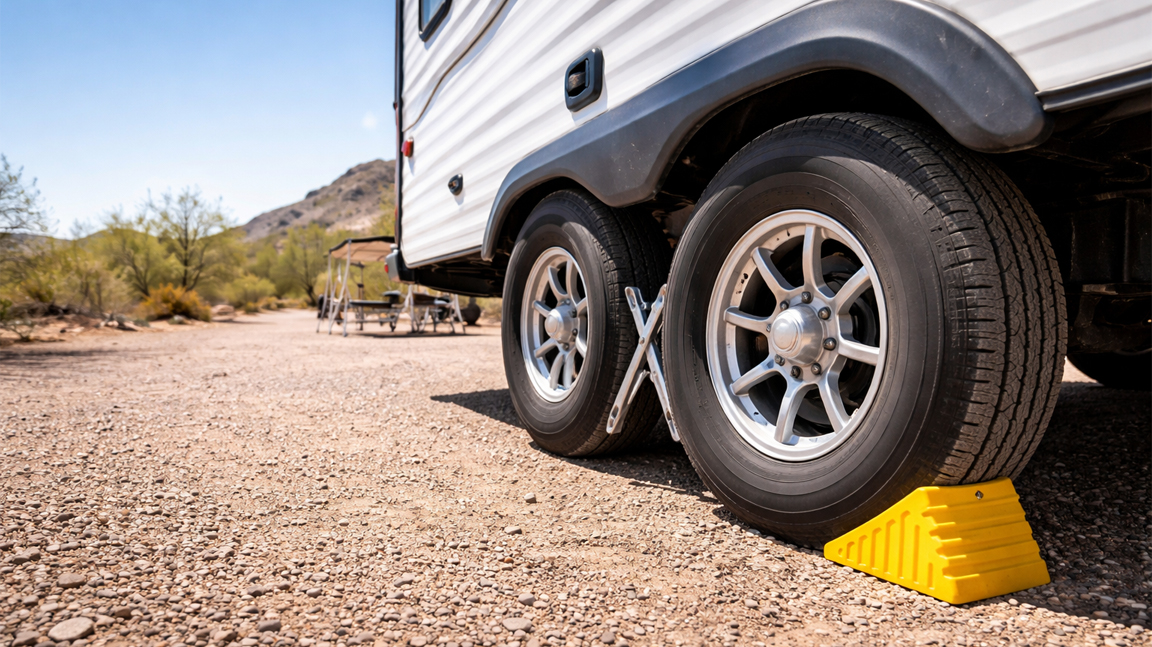
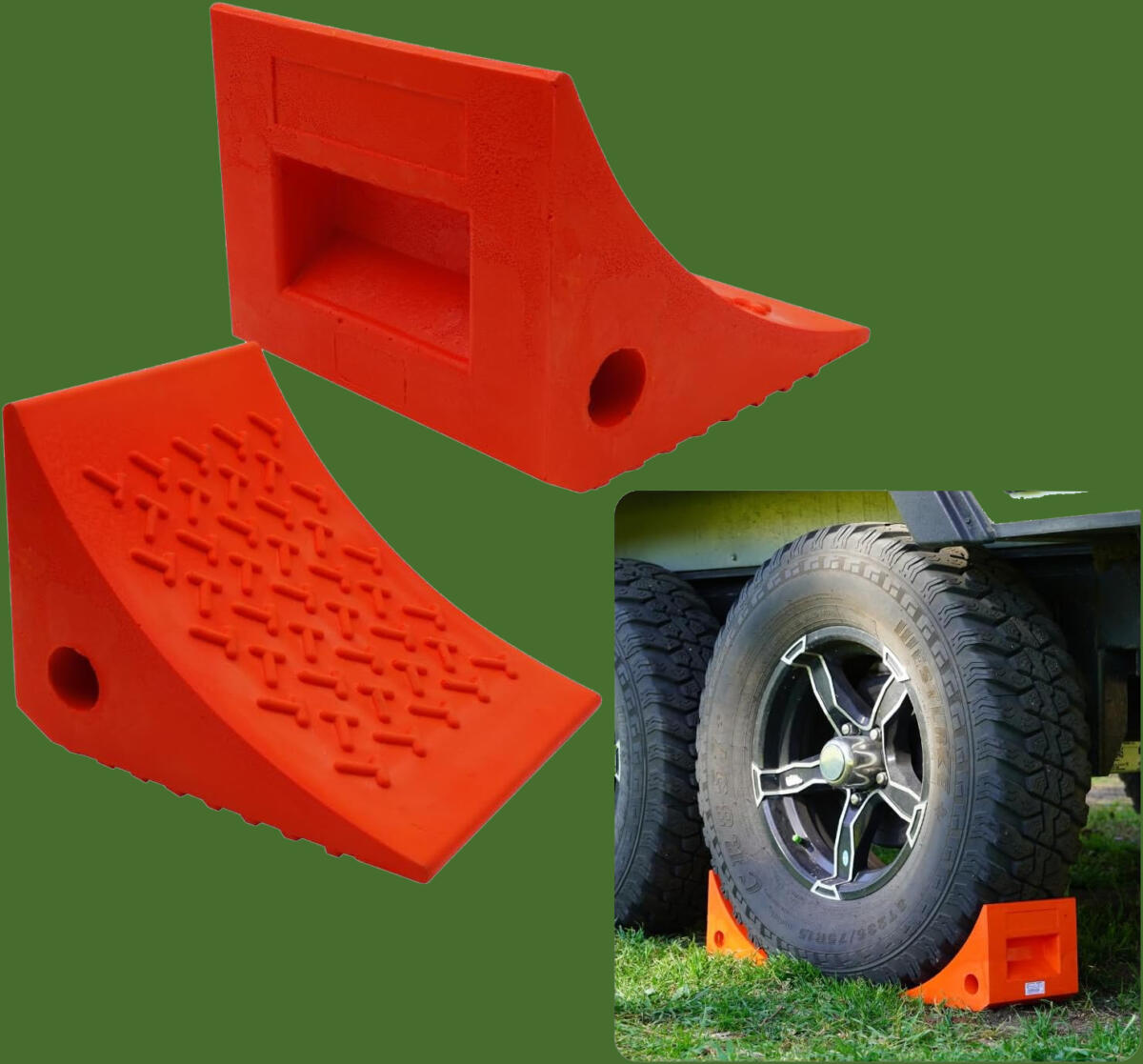
Most of us start with the basic wedge chock. You kick it under the tire, maybe front and back, and call it good. And, to be fair, those do exactly what they’re supposed to do: keep the rig from rolling.
But they don’t do much once you’re already parked.
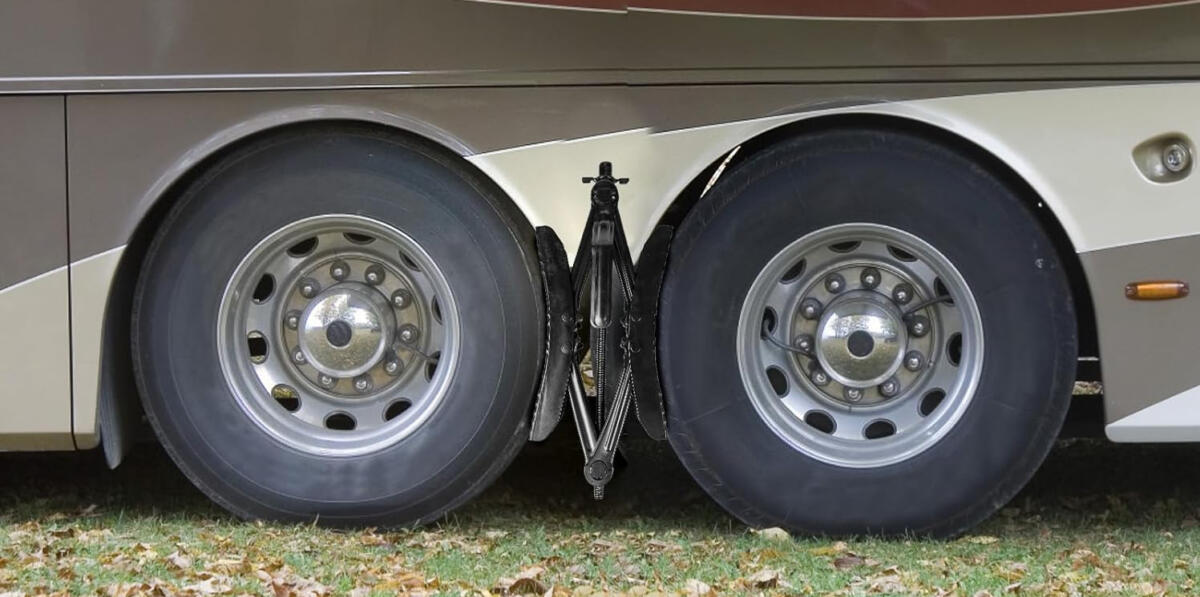
That’s where the other style of RV wheel chocks come in—the kind that fits between tandem tires and presses them apart. Instead of stopping the tire from rolling, it stops the small amount of movement between the two tires. There can be a bit of play between tires and the suspension, and that can give you those queasy feelings.
It’s a small difference in concept. Big difference in how the RV feels.
The first time you use them, you may notice it right away. That “walking around inside a rowboat” feeling settles down. The floor feels firmer. The whole rig just feels planted.
“If these work so well, why bother with wedge chocks?”
Fair question—and one a lot of folks ask after that first solid-feeling setup.
It comes down to this: They’re solving different problems.
Between-the-wheel chocks tighten things up by locking the tires against each other. That’s what gets rid of the rocking. But they don’t actually anchor the RV in place.
On level pavement, you might not notice. Everything feels solid. But introduce even a slight slope, maybe a little gravel or desert dirt, and the whole rig can still creep. Slowly, silently, but just enough to matter.
And when it does, the between-the-wheel chock goes right along with it.
That’s where wedge chocks still earn their keep. They’re what stop the RV from rolling in the first place.
“Do I really need to chock both sides?”
Another fair question—and another place where people tend to cut a corner.
If you’re on flat, hard ground, chocking one side will often seem to work just fine. The rig isn’t trying to move, so nothing does.
But that’s the catch. It works when nothing is pushing against it.
Add a slight slope, a bit of settling, or just people moving around inside, and the weight of the trailer starts working in one direction. With chocks on only one side, you’re relying on a single point of contact to hold everything in place.
Most of the time, that just means a little creep. Maybe things feel slightly different a few hours later. Maybe your setup isn’t quite as tight as it was.
Chocking both sides takes that variable out of play. It spreads the load, keeps things centered, and helps the rig stay where you put it.
Our own experience with the “chock the one side, it’ll be OK,” proved to be a bit of folly that nearly frightened us to death. We’d chocked the one side, unhitched, and as the “camp set up man” was taking care of the outside details, the trailer tried a madcap runaway down a slope. It didn’t get far, just a couple of feet on one side, but enough to give the inside woman a near heart attack. No more! Both sides go into lockdown for us now.
Picking what works without overthinking it
This doesn’t need to turn into a gear obsession.
If you have a single-axle trailer, wedge chocks are your only option. But with tandem axles, adding between-the-wheel chocks can make a noticeable difference in how the rig feels.
With RV wheel chocks, fit matters more than brand. You want something snug between the tires—not forced, not sloppy.
And if you spend time on softer ground, say, desert sites, gravel lots, places where things shift, a solid base under the tires makes everything else work better.
So how much difference does it really make?
It’s not magic. Your RV won’t suddenly feel like it’s poured in concrete. But it will feel more settled. Less sway when someone walks through. Less of that subtle shifting that keeps reminding you you’re not quite as stable as you’d like to be.
For a simple piece of gear, it’s one of those upgrades you notice every day.
A simple setup that just works
For most tandem-axle trailers, a straightforward approach does the trick. Use wedge chocks on both sides to keep the rig from rolling. Then add a locking chock between the tires on each side to take out the movement. That combination handles both jobs—safety and comfort—without much fuss.
Our new triple-axle destination trailer is solidly fixed with two wedge chocks on each side. A little more costly, but it’s a lot more stable.
Bottom line
RV wheel chocks don’t get much attention. They’re not flashy, and nobody brags about them around the campfire. But when your RV stops rocking every time someone walks across the floor, you’ll notice.
And once you do, you’ll wonder why you waited so long.
America’s Original RV Newsletter. Since 2001 Issue 1256 If you find this newsletter helpful, please consider supporting our work with a donation of your choice. Thank you!
Today’s thought
“Two roads diverged in a wood, and I—I took the one less traveled by, And that has made all the difference.” —Robert Frost
Need an excuse to celebrate? Today is National Pet Day!
On this day in history: 1970 – Apollo Program: Apollo 13 is launched.
Featured news
If you were hoping the U.S.–Iran ceasefire would bring relief at the fuel pump, you’re not alone. On paper, easing tensions should mean lower oil prices—and eventually cheaper gas and diesel. But that’s not what’s happening. Reports of a possible truce or pause in hostilities did move markets—but only briefly. The drop was real—but short-lived.
Speaking of fuel prices… If it feels like diesel prices versus gas prices are moving at different speeds, you’re not imagining it. Gasoline is going up, but diesel is climbing faster. The difference is starting to show up in dollars at the pump. Right now, national averages from AAA put gasoline at about $4.11 a gallon. Diesel sits closer to $5.62. That spread is now well over a dollar and growing. Continue reading.
For RVers using Starlink standby mode, the idea is simple: Pause your home internet while you’re on the road, then turn it back on when you return. On paper, it fits the RV lifestyle like a glove, especially for snowbirds or anyone splitting time between home base and the highway. But there’s a catch—and it’s not the one most folks expect. You’re probably not going to lose your service slot when you go on standby. Instead, you may come back to a higher price than you left.
Speaking of Starlink… For travelers juggling a phone plan, a hotspot, and a satellite dish just to stay online, the appeal is obvious. A single service that handles everything could finally simplify staying connected on the road. That’s what US Mobile is proposing with a bundled cellular and Starlink offering, starting at under $50 a month. The concept is straightforward: combine cellular and satellite so your connection doesn’t drop when cell towers disappear. Learn more.
If you’ve ever rolled into a travel stop with a soft tire or a fading battery, you already know the drill. Fuel up, grab a coffee… and then go hunting somewhere else for the actual fix. Now, Love’s RV tire and battery service is starting to change that. The company says RV tires and batteries are now available—with installation—at 76 locations across 27 states, with more sites expected to come. Nice!
BIIIIG RECALL: Ford is recalling certain 2021-2023 Lincoln Navigator, Expedition, and 2022-2023 F-250 SD, F-350 SD, F-450 SD, F-550 SD, and F-600 SD vehicles. The windshield wiper arms may break, causing the wipers to fail. Windshield wiper failure can reduce visibility, increasing the risk of a crash and injury. As many as 422,613 vehicles may be involved in the recall. Learn more here. (More RV recalls below.)
The Honda camper trailer idea didn’t fade away when the company hit the brakes on parts of its electric vehicle rollout. If anything, the latest reporting suggests the opposite—that Honda is still serious about the concept, even if the original plan around it has shifted. You might remember our earlier look at this idea. Back then, it felt like Honda was dipping a toe into the RV space. Now, it looks more like they’ve kept that toe in the water and may be wading a little deeper.
A national plaintiffs’ law firm has filed a class-action lawsuit against Camping World Holdings Inc., alleging the company misled investors about its inventory management and demand forecasting. According to the complaint, the company overstated retail demand and its ability to manage inventory using data analytics. The suit alleges Camping World failed to disclose that it would need stricter inventory controls that would hurt profit margins. Yikes…
More RVers are finding familiar overnight stops suddenly off-limits, with new “no parking” signs forcing last-minute scrambles for a place to stay. The trend is already further along in the United Kingdom, where some areas have added barriers, bans, and fines—pushing RVers to go elsewhere. In the U.S., changes are happening quietly, town by town, as local complaints lead to tighter rules and increased enforcement. What’s behind the shift—and where it’s headed—may surprise you.
California officials are cracking down on a popular tax-avoidance strategy used by some RV owners. The California Department of Tax and Fee Administration and the Department of Motor Vehicles are investigating dealers and buyers tied to the so-called “Montana loophole,” where vehicles are registered out of state to avoid California taxes and fees. In states with sales tax rates ranging from 6-10%, the purchase of an RV using the loophole could result in tens of thousands of dollars in tax obligations. Continue reading.
The U.S. Attorney’s Office recently announced that a Texas man was sentenced after pleading guilty to walking off the designated boardwalk in a thermal area in Yellowstone National Park. According to court documents, Eric Bedient, 50, of Frisco, Texas, left the boardwalk and walked directly on several fragile and dangerous hydrothermal features in the Mammoth Hot Springs area. Please do not do this!
Now this is bizarre…An RV park domestic dispute in Ocean Park, Washington, is drawing attention for one unusual detail. Police were called to an RV park after a reported argument between two people living there. According to a local blotter report, the situation escalated when the woman allegedly used pepper spray on her partner. Despite police involvement and an alleged pepper-spray attack, the couple at the center of it say they’re still in love. Wait, what?
THAT’S THE TRUTH… RV plan: Go somewhere relaxing. Reality: Fix things somewhere relaxing.
RV review 2026 Winnebago Navion 24T—on our “downsize RV” list of options
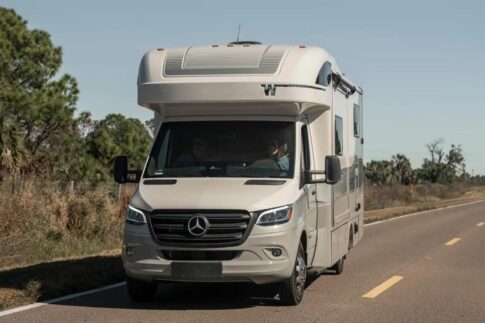
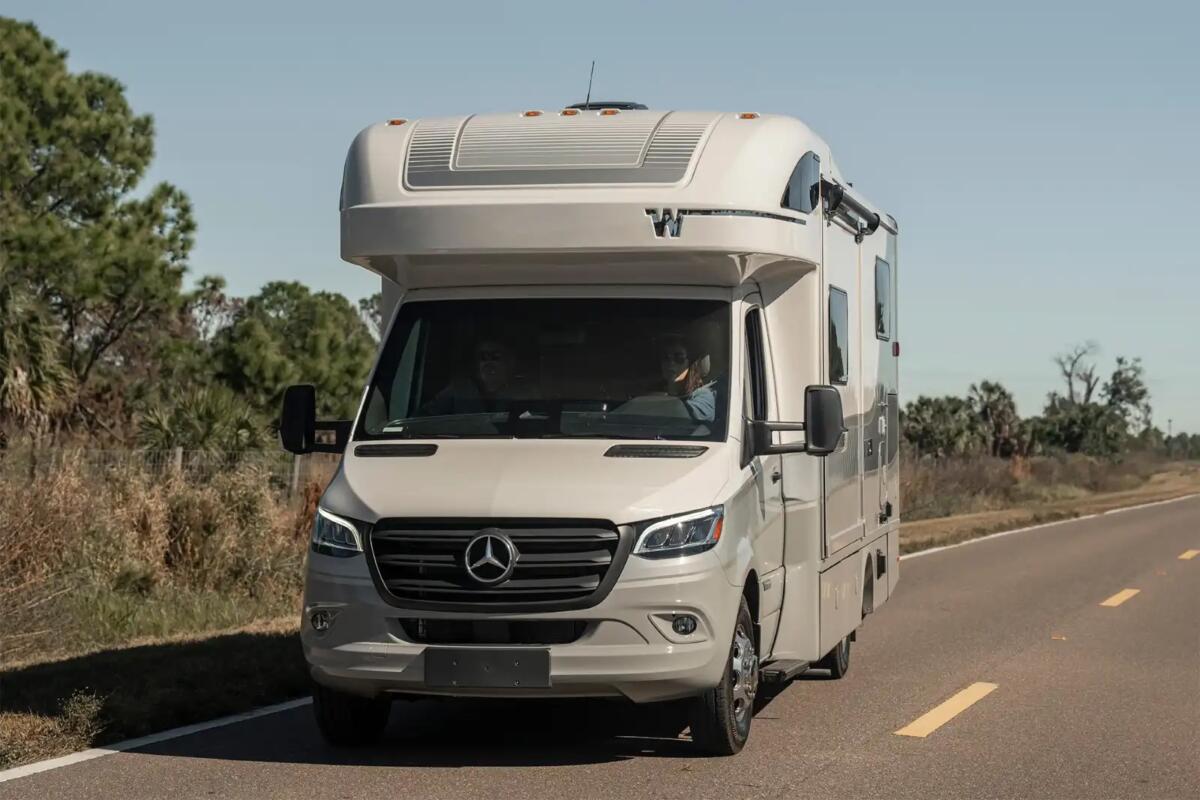
By Gail Marsh My husband and I have been thinking about “downsizing” our RV. So, I was excited to see the 2026 Winnebago Navion 24T for myself. This is a Class C diesel motorhome with one slide-out. Changing to this RV would mean downsizing from our current 40-foot fifth wheel with three slides. Could we make this work? (Gulp!) Here’s what I like and don’t like about this model.
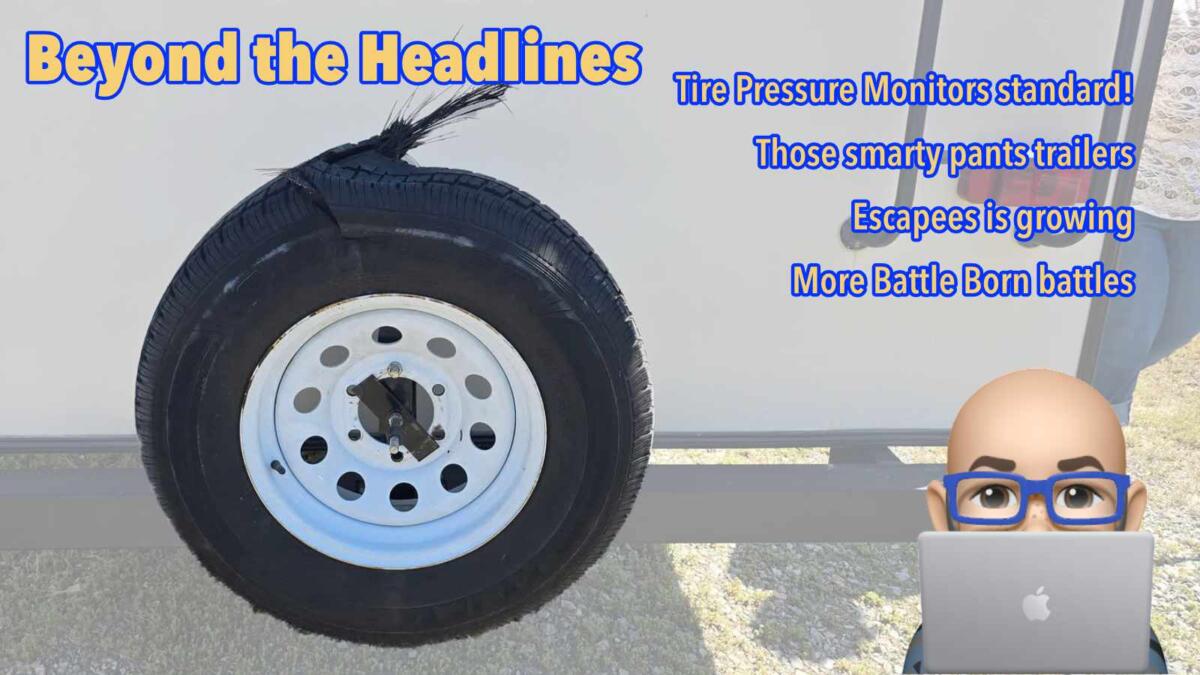
Beyond the headlines with Tony Barthel
New TPMS standard, smart trailer concerns, Battle Born update
A new TPMS standard is coming to RVs, but that’s just one of several shifts worth watching. From questions about high-tech “smart” trailers to the latest on Battle Born batteries, there’s a lot happening behind the scenes in the RV world right now. From the brilliant mind of our friend Tony Barthel, here’s what it all means—and what you should be paying attention to.
News briefs
Beginning next Friday (April 17) at 8 a.m., select entrances and roads in Yellowstone National Park will open for the summer season, weather permitting, as part of the annual spring opening. Here are the details.
Federal safety regulators are considering a permanent U.S. ban on certain Chinese-made air bag inflators after linking them to at least 10 deaths and two serious injuries in a dozen crashes. The National Highway Traffic Safety Administration says the parts, likely imported illegally, can explode instead of inflate, sending metal fragments into drivers.
Good news for Buc-ee’s fans in the Southwest: The popular travel center will open its first location in Arizona in late June along I-10 in Goodyear.
Grand Canyon National Park will implement additional water conservation measures on the South Rim starting Saturday, April 11, due to a series of significant breaks in the 12½-mile-long Transcanyon Waterline that supplies water from the inner canyon for use in the park. Since mid-March, the park has faced challenges with water supply and, currently, no water is being pumped to the South Rim.
Hurricane Ridge Road in Washington state’s Olympic National Park may either open or close through April 30, depending on road conditions and weather. Check 360-565-3131 for updates.
Hikers, bicyclists, and other park-goers can expect to see restrictions at Washington State Park trails and campgrounds as the Department of Natural Resources reviews where it will reduce recreation access across the state. The upcoming restrictions are because of state budget cuts combined with an ongoing lack of funding for maintenance and staff.
Love’s has opened yet another travel stop with RV amenities—five full-hookup sites, three sites without hookups and an RV dump. It’s off I-122 at exit 70 in Quinton, Alabama,
The Dyrt, a campsite-finder app, has found that BIPOC (Black, Indigenous, and People of Color) persons were 53% more likely than the overall population to have camped for the first time in 2025.
Kuwohi Road in Great Smoky Mountains National Park reopened April 1 for the summer season, restoring access to one of the park’s most popular scenic drives. The road leads visitors to the Kuwohi Visitor Center and the trailhead for the half-mile hike to the park’s highest peak.
British Columbia introduced a new surcharge for foreign and out-of-province campers at dozens of its most popular parks this season, citing surging demand and rising maintenance challenges. The fee applies at 59 front-country campgrounds and several high-traffic backcountry parks through Labor Day, affecting reservations and on-site stays. The move is aimed at managing crowding and the growing impact of extreme weather on park infrastructure.
Three Rhode Island State Park campgrounds opened for the season yesterday: Charlestown Breachway, Fishermen’s Memorial, and George Washington Memorial.
CAN YOU GUESS?
What year is the Ford F-1 pickup pictured above? Take your best guess and then look for the answer near the bottom of this newsletter below “Trivia.”
Tanner Toons From Tanner Woods
You may share this Tanner Toon, unaltered, on your website, blog or social media with our compliments. The musings from Tanner Woods’ creative mind appear in this newsletter every Saturday and Sunday and in many RV Daily Tips newsletters through the week.
FACTOID:The U.S. Forest Service, in partnership with the National Forest Foundation, plants an average of 5 million trees annually.
RV and RV-related recalls
• Keystone RV is recalling certain 2026 Montana fifth wheel trailers. Under certain conditions during travel, the underbelly may come loose or detach from the vehicle, leading to an increased risk of a vehicle crash. Learn more.
• Forest River is recalling certain 2026 Westbrook and Avenger travel trailers. The federal placard label may list an incorrect dry weight. Dealers will replace the label for free. The recall number: 452-2045. Info: 260-499-2100.
Reader poll Would you support surcharges for out-of-state or foreign campers at busy parks?
? MYSTERY PRODUCT OF THE DAY ? This is soooo funny. It’s a little gross, so if you don’t like kindergarten humor, you might not like this, but if you have grandkids or children-at-heart partners and want to make them laugh, this is it!
The word “taco” traces to 18th-century Mexican silver miners, who used “taco” to describe paper-wrapped gunpowder charges placed into rocks before blasting. Tacos later became associated with working-class food—soft corn tortillas called tacos de minero (miner’s tacos) that were filled with spicy, affordable ingredients. Americans encountered tacos in about 1905 from Los Angeles street vendors, including “chili queens,” whose soft, spicy tacos seemed exotic to unfamiliar palates.
FORD TRUCK? It’s a 1951 Ford F-1.
Laugh of the week
The perfect scam Avoiding Tax Scams With Michelle Singletary
It’s tax time, and that means it’s also tax scam season. The Federal Trade Commission warns about a recent surge in fake IRS calls to taxpayers. Personal finance columnist Michelle Singletary joins host Bob Sullivan to discuss how AI might be supercharging these age-old scams, how recent changes in the way the federal government issues refunds could create new opportunities for scammers, and some practical tips for protecting yourself against these and other scams.
Today in history
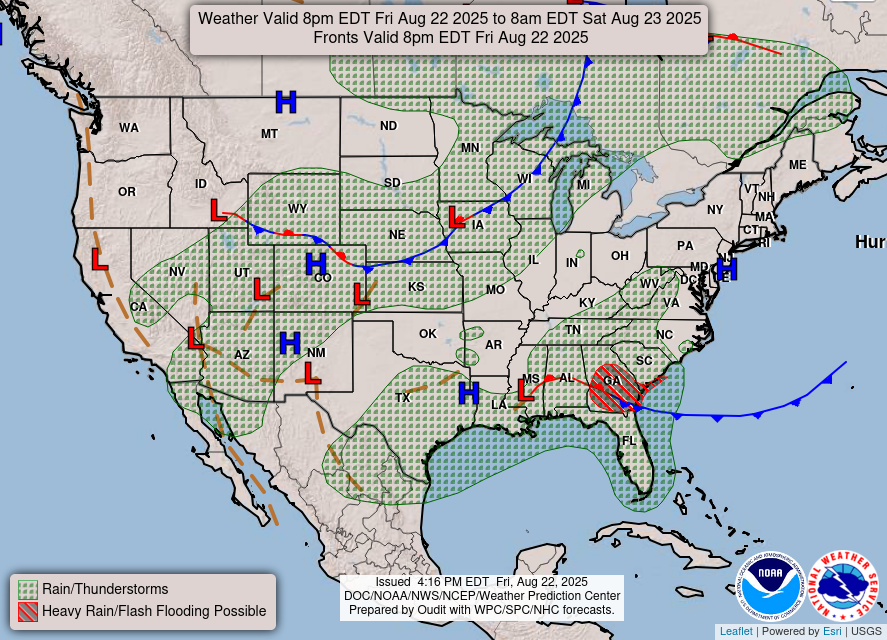
Today’s weather forecast across the nation THIS MAP UPDATES TWICE A DAY
DID YOU ENJOY THIS ISSUE? Please help us continue to bring you quality, unbiased coverage of RVing with a voluntary pledge. We work hard for you and have bills to pay to do that!
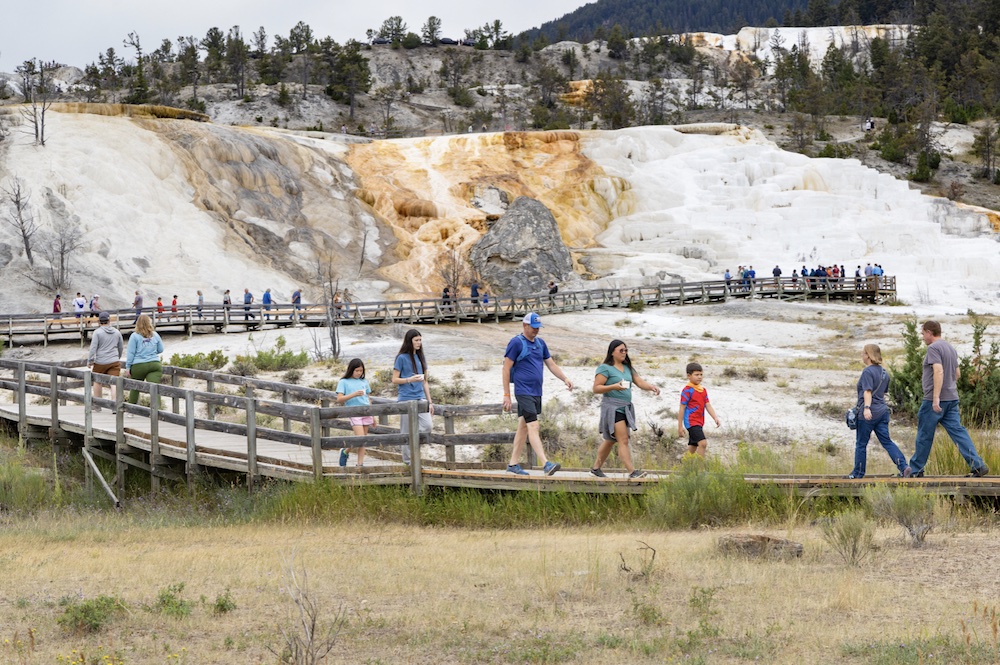
The U.S. Attorney’s Office recently announced that a Texas man was sentenced after pleading guilty to walking off the designated boardwalk in a thermal area in Yellowstone National Park.
A release from the U.S. Attorney’s Office says that Eric Bedient, 50, of Frisco, Texas, was sentenced to five days’ incarceration on March 31 by U.S. Magistrate Judge Stephanie Hambrick.
According to court documents, Bedient left the boardwalk and walked directly on several fragile and dangerous hydrothermal features in the Mammoth Hot Springs area.
Those features included Canary Spring, Mound Terrace, Palette Hot Spring and Jupiter Terrace.
The release states that the sentence reflects the extensive nature of the violation, the damage Bedient’s footprints left behind and his failure to educate himself about Yellowstone National Park’s regulations.
“Yellowstone’s thermal areas are among the most dangerous natural features in the world,” said U.S. Attorney Darin Smith. “Mr. Bedient’s disregard for the law could have cost him his life. Prosecuting crimes like this deters others from similar conduct—and from risking becoming thermal soup. We will continue to hold individuals accountable to protect lives and preserve this unique, irreplaceable landscape when their actions threaten these national treasures for future generations.”
The crime was investigated by Yellowstone National Park law enforcement officers and was prosecuted by Assistant U.S. Attorney Ariel Calmes.
For travelers planning to visit Yellowstone this year, the U.S. Attorney’s Office reminds the public to stay safe and adhere to all park regulations. In particular: Stay on boardwalks.
Big news—Tire Pressure Monitoring to become standard
If you read my RV reviews here or anywhere, you know that I feel that any towable RV should absolutely have a tire pressure monitoring system. Often, I’ve read about people happily motoring down the highway while a frantic driver pulls up next to them to let them know that the tire on their travel trailer has given up the ghost.
If you’re driving along and you don’t know that you have a problem, you still have a problem. However, if a tire blows on your towable RV and you find out because you lose control, you have a bigger problem.
Tire pressure monitoring systems typically warn you of low tire pressure, but many of these systems also warn you if one tire is much hotter than the rest. This can indicate a bad bearing or a failing tire. It’s always better to know about trouble before it becomes troublesome.
Rather than establish a single, uniform enforcement date applicable to the entire industry, the Standards Steering Committee and the Standards and Inspection Departments agree that having each manufacturer implement TPMS installation at the start of their respective model year 2028 production process will ensure that all units in that model year are so equipped.
By monitoring VIN numbers during inspections and engaging in clear communications with manufacturer members on model year changeovers, RVIA inspectors will be able to accurately review compliance with the program requirement during normal inspection visits in 2027.
TPMS will be standard in 2028 towable RVs
The English translation for this corporate gobbledygook is that you’ll see TPM systems standard in 2028 towable RVs.
Now, do know that there is no standard for these. TPM systems can be simply mounted on the valve stems of tires, and they can be mounted on bands inside the tires on the actual wheels. As with any system or technology, there are good and bad versions.
The best systems tend to be banded systems, which also measure temperature. But these also tend to be more expensive, so you can guess that some RVs will get these, but most RVs likely won’t.
Having a banded TPMS is one of the many reasons I chose the trailer that I did, but you can guess it’s not a Coleman from Camping World. I’m always disappointed in towable RV manufacturers who don’t put a TPMS as standard, but I’m also not surprised.
Again, when we demand better, the RV industry is happy to oblige. But if price is the principal thing we use to choose, we get the Coleman from Camping World, which is the best-selling brand of towable RVs. You can read my thoughts on this here.
Clearly, a lot of buyers should be reading RVtravel.com! Please tell a friend.
TST tire pressure monitor that came with my Rockwood trailer
Yeah, but will anybody buy those fancy smart trailers?
Something I’ve said and written many times is that the RV industry is absolutely ripe for foreign competition to come in, just as the domestic auto industry was in the late 1970s. There are so very many complaints from owners and prospects about RV quality, we have spotty availability of service, and an industry advocate that brags about quashing consumer-facing legislation.
I also wrote about the Chinese, in particular, with things like the Pebble Flow, Evotrex, Lightship, Aboard RV, and now the Skydream. They all have one thing in common: A lot of overcapacity of Chinese EV components are packaged in a travel trailer with the hopes that you’ll want one.
When Detroit was challenged by the imports, they were cheaper, more efficient, and better made than what we had here. These simple, very affordable, and remarkably efficient cars were a direct affront to what Detroit was up to.
These new, smarter trailers, too, are very different than what Elkhart is up to. But I’m not so sure they’re answering a question anybody is asking. My concern is that, when these companies go bust, their proprietary tech is going to become unserviceable. Now you have a very expensive paperweight in the driveway.
“This milestone is a testament to the strength of the Escapees community and the shared spirit of adventure that brings RVers together,” said Joel Holland, CEO of Harvest Hosts. “For nearly 50 years, Escapees has been dedicated to helping people explore with confidence. We’re committing to continuing Kay and Joe Peterson’s mission. We’re really happy that the club has grown to support more than 100,000 RVers on their journeys.”
Escapees was acquired by Joel Holland and the Harvest Hosts team, which has a strong marketing background. While there have been complaints from some as Escapees transitions to new ownership, there has also been growth through leveraging various membership packages.
These RV clubs can be a great resource for RVers, especially those who participate in the gatherings and events.
An RVer checks a Starlink account while traveling, only to find that reactivating service may come with higher costs in high-demand areas.
If you don’t follow the news, know that Starlink has become very popular as one of the best internet solutions for RVers (we all gotta get our RVtravel.com fix!!), with almost no competition for some.
The service was originally intended to enable people living in remote areas to have service. But now lots of you city folk are getting it, too, and the number of available slots in any given area is filling up in some cases. Hence, ol’ Elon is hitting you with a fee if you want to rejoin the party after parking your service.
There has been more noise from Amazonabout their impending satellite-based internet service, but we’re still a ways off.
Unfortunately, Starlink’s head cheese is someone who likes to change his mind and does so without notice. Do know that I found cell-based internet very effective with my own Winegard system, but that doesn’t mean I have kicked Elon to the curb totally. Just yet.
So what should you do? There are many good brands of less-expensive RV batteries nowadays, many of which have been put to the test on Prowse’s channel. I think there are enough choices that you can avoid the controversy altogether and save a bunch of money in the process.
You finally snag a campsite at a popular park. After weeks—maybe months—of trying, you’re in. You pull in, get set up, and take a look around. The campground is full. Really full. And it makes you wonder… who’s getting these sites, and is there a better way to manage the demand?
That question is popping up more lately, especially after British Columbia introduced new surcharges for out-of-province and foreign campers at some of its busiest parks. If demand is sky-high and locals are struggling to get reservations, should non-residents pay a little more?
Supporters say it makes sense. Locals already help fund these parks through taxes, and when sites are scarce, giving them a bit of an edge—or at least charging outsiders more—could help balance things out. It might also help manage overcrowding and bring in extra funds for maintenance.
But not everyone agrees. RVers, more than most, know that travel doesn’t stop at state or national borders. Many worry that fees like this could set a precedent, making it more expensive (and complicated) to explore beyond your home turf. After all, today it’s one province or state—tomorrow it could be everywhere.
So what do you think? Would you support surcharges for out-of-state or foreign campers at busy parks? Vote in the poll below, and, as always, feel free to leave a comment and share your thoughts. Thank you!
My husband and I have been thinking about “downsizing” our RV. So, I was excited to see the 2026 Winnebago Navion 24T for myself.
This is a Class C diesel motorhome with one slide-out. Changing to this RV would mean downsizing from our current 40-foot fifth wheel with three slides. Could we make this work? (Gulp!)
Why downsize?
We’ve been so happy with our fifth wheel. It’s served us well. The big, honkin’ dually 350? That’s a different story. While it easily pulls the RV wherever we choose to roam, getting in and out of the truck and attaching the fifth wheel is becoming more and more challenging. In addition, our big rig prohibits us from staying in some parks.
I figured, why not have a little look-see, right? Now that our work camping days are ending, a smaller RV may suit us better than a large truck and rig.
Behind the walls
Underneath the polished interior, the Navion 24T rides on a Mercedes-Benz RWD Sprinter chassis. It features a 2.0L high-output turbo-diesel engine and a 9-speed automatic transmission. You’ll find a convenient, heated gear garage with an L-track cargo tie-down system.
Winnebago includes a 320-amp-hour Lithionics lithium battery, a 2,000-watt inverter, solar charging, heated holding systems, and hydraulic leveling jacks.
Key specs
Exterior length: 25’8″
Exterior height: 10’7″
Exterior width: 7’6.25″
Exterior storage: 80.9 cu. ft.
Awning length: 16′
Interior height: 6’8″
Interior width: 7’3″
Freshwater capacity: 35 gal.
Black tank capacity: 47 gal.
Gray tank capacity: 46 gal.
Fuel capacity: 24.5 gal.
Wheelbase: 170 in.
Starting price: $245,000
Winnebago Navion 24T (Click to enlarge.)
Interior and living space
Stepping into Winnebago’s 2026 Navion 24T, I was surprised at how large it felt. (Well, not exactly “large” in comparison to our current fifth wheel, but still larger than I expected.)
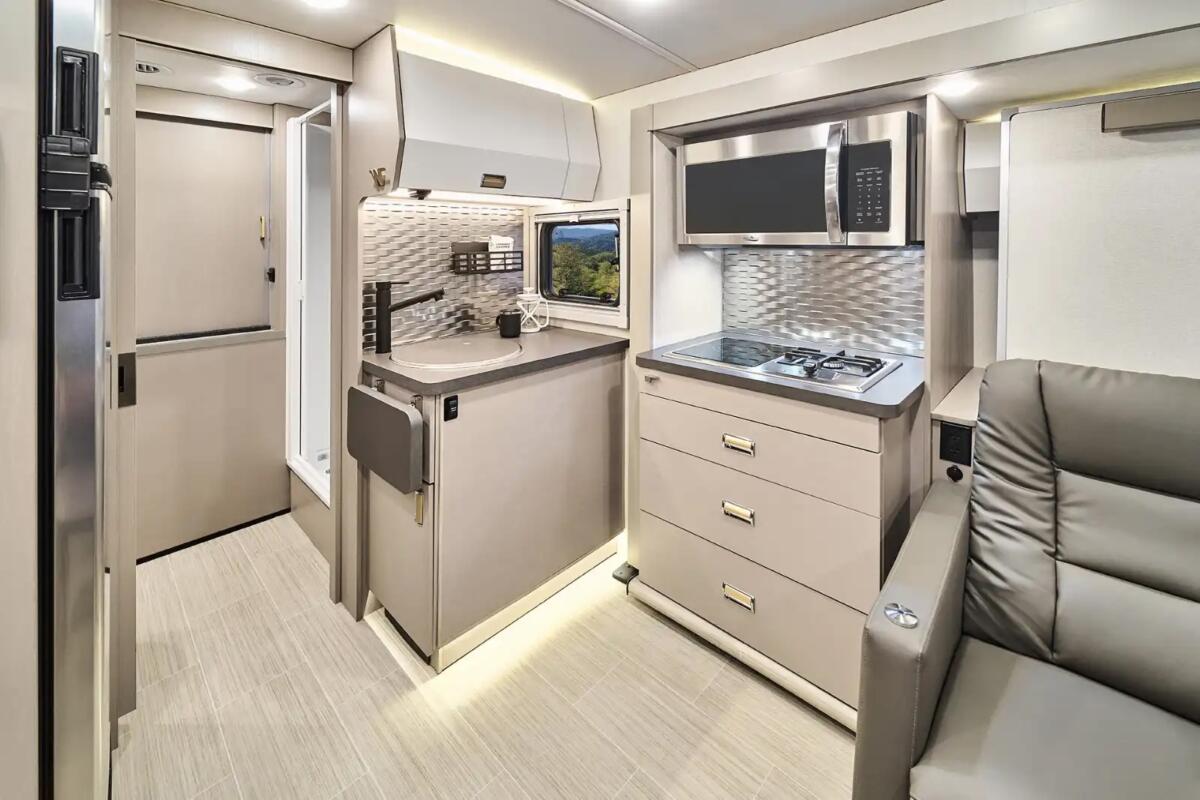
The slide-out opens up the living area into a comfortable space. The light tones on the walls and upholstery, along with a large window, keep the space feeling light and bright.
Living/dining/sleeping
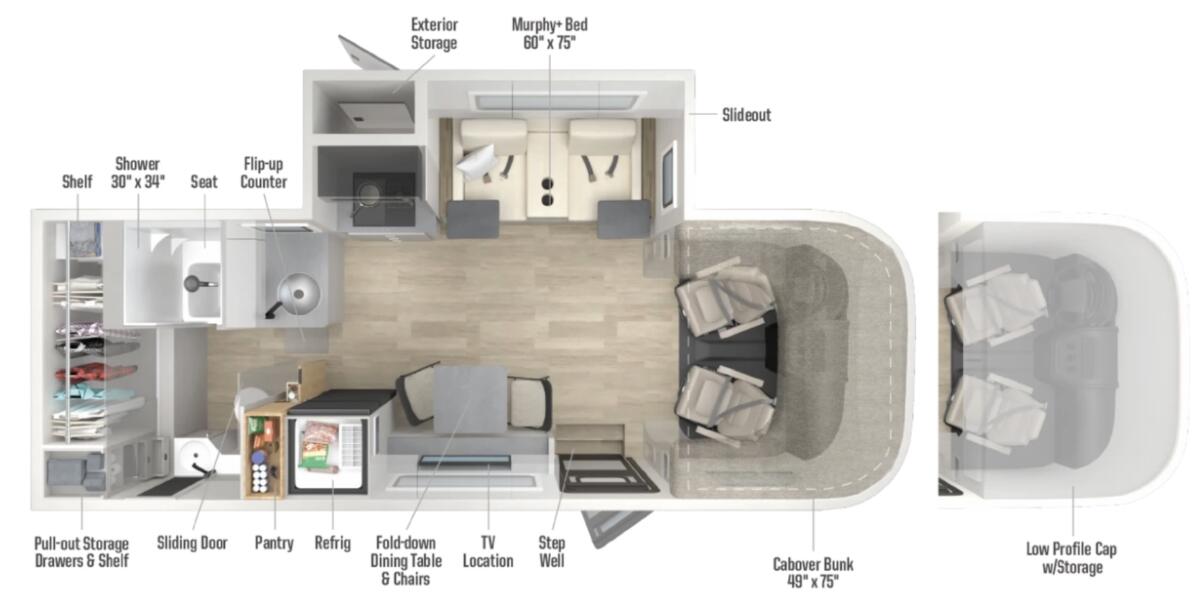
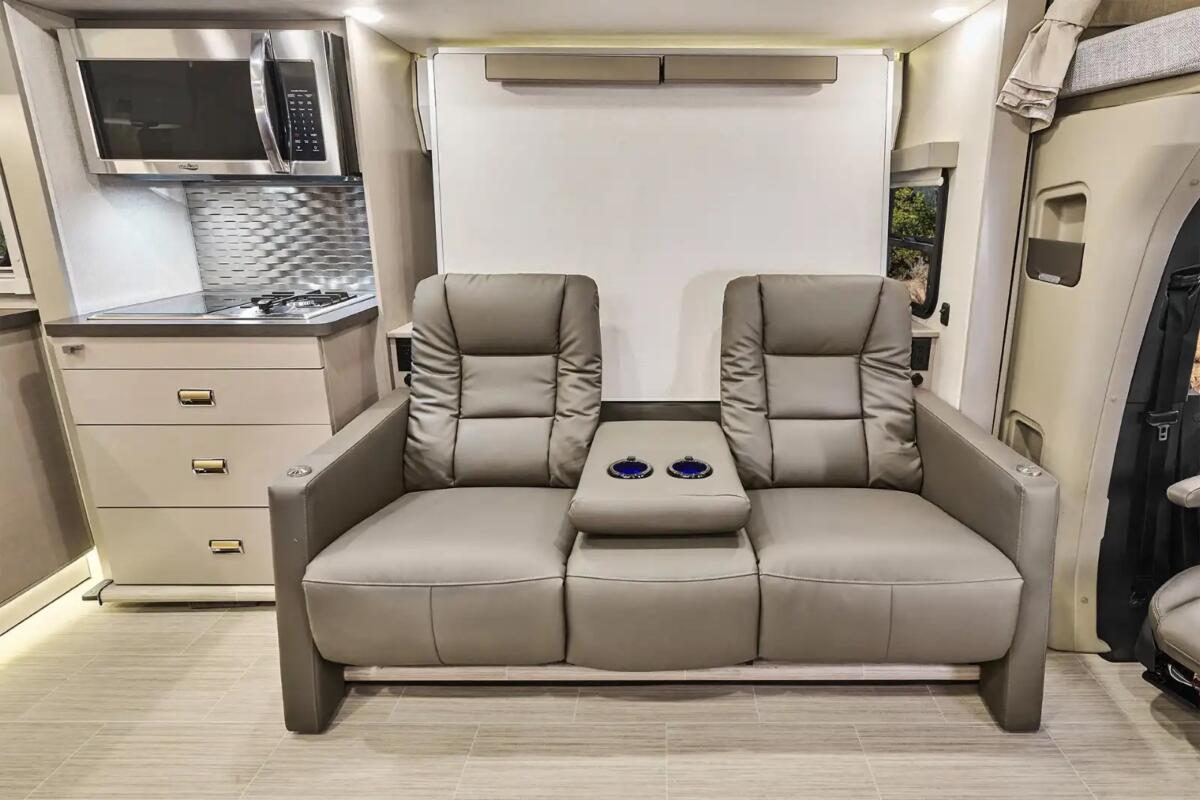
I immediately noticed the fold-down dining table/desk, along with the sleek overhead storage bays. Dual recliners with a flip-up center console sat comfortably and featured cup holders and tray tables, which we like.
The 32-inch LED HDTV is positioned directly across from the seating for easy viewing. The entertainment center also features a JBL Bluetooth soundbar, multiple charging ports, and Winnebago Connect with a 10-inch touchscreen.
For sleeping, a Murphy bed offers Winnebago’s WinnSleep system that folds out into a 60” x 75” bed. Reading lights and charging ports are also available. The bed looked to be accessible even with the slide retracted, so that’s a plus.
Kitchen
The Navion 24T kitchen features a two-burner induction and LP range cooktop. We like the flexible fuel choice Winnebago made available in this RV. There’s an over-the-range microwave/convection oven and a 10.0 cu. ft. 12V refrigerator/freezer. In addition, you’ll find two pop-up outlets that include charging ports.
While appliances were good choices, there isn’t much countertop prep space. You might use the stainless sink when it’s covered, and the flip-up counter extension adds a little bit of extra meal prep surface. Overall, there is extremely limited prep space—a serious drawback in this coach. (At least for me.)
I was happy to discover all of the kitchen storage available. The kitchen area houses a pantry, lighted soft-close drawers, and cupboard storage for pans and other cooking equipment and utensils.
Bath
The bathroom was more residential than I expected for a coach this size. Positioned at the back of the Navion 24T, the bath provides a sliding door for privacy and a porcelain toilet with adequate accessibility.
The 30″ x 34″ shower has a built-in seat, but the seat takes up too much space in a shower of this size. The shower skylight brings in natural light, which makes the rear bath feel spacious, even though the sink is quite small and the countertop is at a premium. I did appreciate the robe hooks.
You’ll be pleasantly surprised to find a full-width wardrobe cabinet in this area of the coach. The wardrobe features sliding doors, two drawers, and three shelves for linens and clothing. It’s a definite plus!
Video
You can take a quick walk through with this video.
Overall take
The 2026 Winnebago Navion 24T Class C makes a lot of sense for travelers who want comforts without jumping to a bigger rig. For us? Well, we’ll see.
What are your takeaways from Winnebago’s Navion 24T? Share your thoughts in the comments below.
To learn more about the 2026 Winnebago View/Navion 24T Class C, click here.
The Honda camper trailer idea didn’t fade away when the company hit the brakes on parts of its electric vehicle rollout. If anything, the latest reporting suggests the opposite—that Honda is still serious about the concept, even if the original plan around it has shifted.
That’s worth paying attention to, especially if you remember our earlier look at this idea in Honda makes cars, generators—testing RV waters. Back then, it felt like Honda was dipping a toe into the RV space. Now, it looks more like they’ve kept that toe in the water, and may be wading a little deeper.
What’s changed isn’t the camper itself so much as the vehicle it was meant to follow. The trailer was originally designed to pair with Honda’s upcoming EV lineup, built around the idea of a lightweight, efficient rig that an electric SUV could realistically tow. When those EV plans started to wobble, it raised a fair question: Does the camper still make sense without them?
Apparently, Honda thinks it does.
A different kind of small trailer
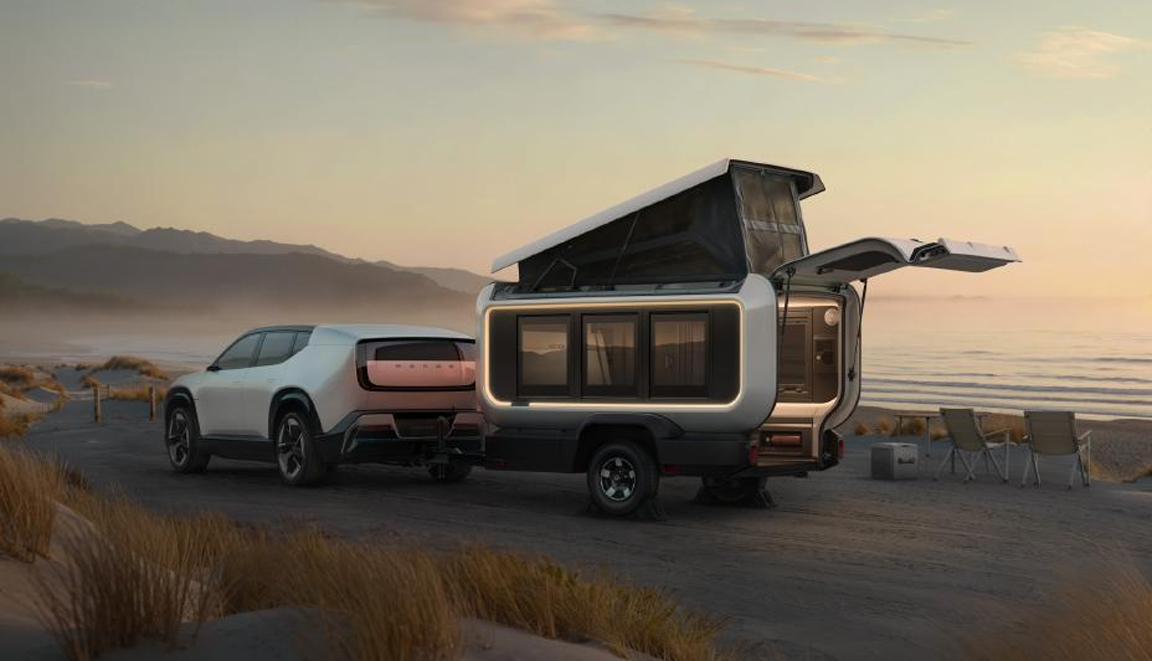
At the center of all this is Honda’s “Base Station” concept, and it doesn’t look or behave much like the small travel trailers most RVers are used to. Instead of a fixed layout and a long list of options, Honda went in a different direction—modular, lightweight, and adaptable.
The weight is what jumps out first. The target is roughly 1,500 pounds or less, which puts it within reach of a whole range of tow vehicles that normally wouldn’t be in the RV conversation. Think compact SUVs, crossovers, and, yes, eventually EVs, if and when those towing ratings catch up. That alone opens the door for people who’ve never considered RVing simply because they didn’t want, or couldn’t justify, a truck.
Inside, Honda took a similarly flexible approach. Panels can be swapped out depending on how you want to use the space. One setup might emphasize sleeping and storage, another cooking, another something closer to a mobile workspace. It’s not the traditional “pick a floorplan and live with it” model. It’s more like configuring the trailer to fit how you camp.
Then there’s the power side of things, which is where Honda’s background really shows. The concept leans on battery storage, solar, and generator compatibility in a way that feels familiar to anyone who’s wrestled with keeping an RV powered off-grid. Honda isn’t guessing here. It’s building around something it already knows.
The EV connection—and why it’s not a deal-breaker
Originally, the story was simple: electric SUV plus ultra-light camper equals a new kind of RV setup. Clean, quiet, efficient. It made sense on paper, and it still does.
But even with the EV timeline getting pushed around, the camper doesn’t lose its footing. In fact, you could argue it becomes more relevant, not less. A lightweight trailer that can be towed by smaller gas vehicles still answers a problem a lot of RVers are trying to solve right now: How to camp without stepping up to a bigger, thirstier tow rig.
That’s especially true when fuel prices keep shooting up. Every pound matters when you’re towing, and a trailer in this weight class changes the math in a hurry.
So while the EV tie-in helped shape the idea, it isn’t what makes the idea work. The appeal stands on its own.
What this could mean for RVers
Step back from the prototype for a minute and look at the bigger picture, and you start to see why this matters.
Honda isn’t an RV builder, at least not in the traditional sense. When a company like that shows up with a concept, it tends to question assumptions the rest of the industry has been working with for years. In this case, those assumptions revolve around weight, layout, and how power is handled.
A sub-1,500-pound trailer isn’t just a spec—it’s a signal. It says you don’t need a half-ton truck to get into RVing. A modular interior says maybe you don’t have to lock yourself into one way of using your rig. And a power system built around batteries and solar says the generator might not have to carry the whole load anymore.
None of those ideas are brand new on their own. But seeing them packaged together by a major automaker gives them a different kind of weight.
And it lines up neatly with what we saw in that earlier RV Travel piece. Honda wasn’t just experimenting for the sake of it. They were looking at how their existing strengths—engines, generators, compact design—could translate into the RV world. That thread hasn’t gone away.
Will it actually hit the market?
That’s still the unanswered question, and it’s a big one. Honda continues to describe the Base Station as a concept, and there’s no firm production timeline on the table.
At the same time, the fact that it keeps resurfacing, even now after the EV plans around it have shifted, suggests it hasn’t been shelved. If anything, it looks like something Honda is still actively thinking through rather than quietly walking away from.
Pricing, if it ever arrives, will matter just as much as the concept itself. If this lands anywhere in that mid-range price band people are speculating about, it could carve out a niche. Price it too high, and it becomes a curiosity. Price it right, and it could pull in a whole new group of campers.
The takeaway
Even if this exact Honda camper trailer never shows up on a dealer lot, it’s hard to ignore what it represents.
The industry has been inching toward lighter, more efficient, more flexible rigs for a while now. Honda’s concept just pushes that idea a little further—and does it in a way that’s easy to understand if you’ve ever wished your current setup were a bit simpler, a bit lighter, or a bit more adaptable.
So, no, the camper isn’t dead. Not by a long shot.
And for RVers, that means the ideas behind it are still very much in play.
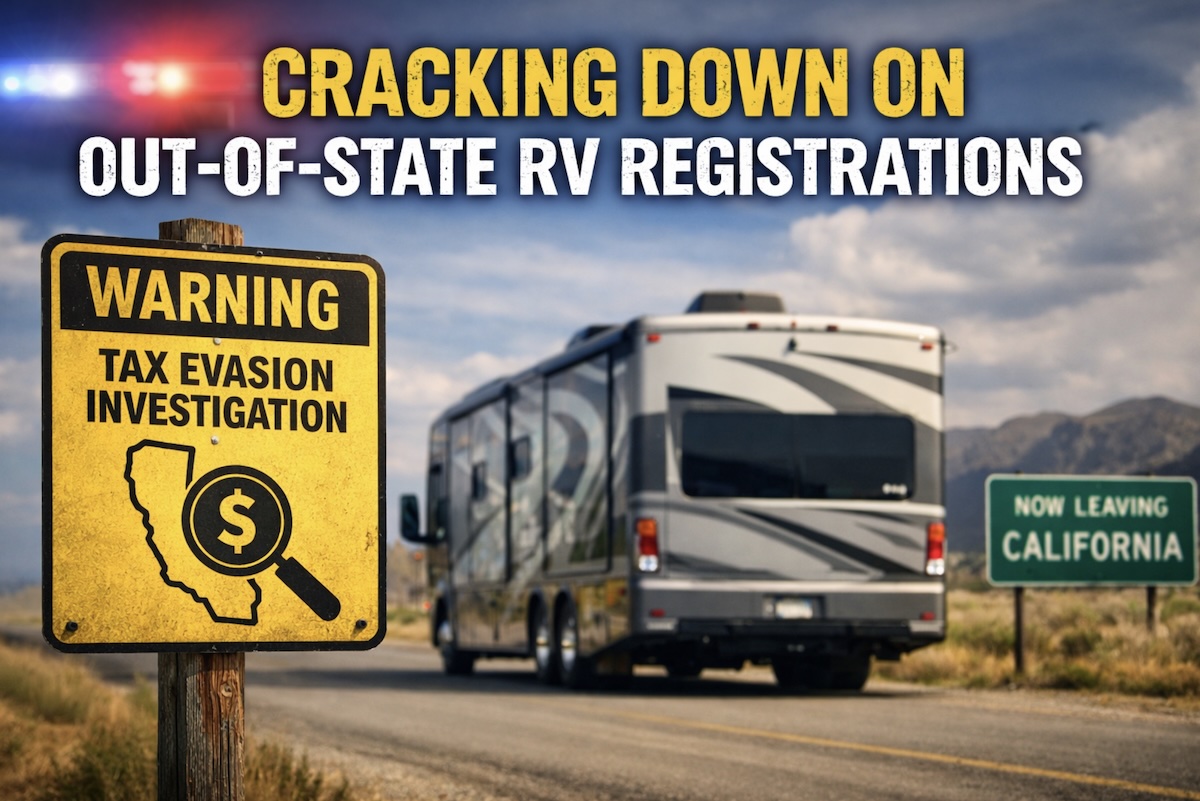
California officials are cracking down on a popular tax-avoidance strategy used by some RV and luxury vehicle owners.
The California Department of Tax and Fee Administration (CDTFA), working with the Department of Motor Vehicles (DMV), is investigating dealers and buyers tied to the so-called “Montana loophole,” where vehicles are registered out of state to avoid California taxes and fees.
In states with sales tax rates ranging from 6 to 10 percent, the purchase of a luxury RV using the loophole could result in tens of thousands of dollars in tax obligations, hence the appeal.
The state has identified about 500 dealers connected to more than 2,500 such sales since 2023, costing California more than $10 million a year in lost revenue.
SOURCE: California DMV
The tactic, often used for high-end motorhomes and exotic vehicles, relies on forming out-of-state LLCs, typically in Montana, which has no sales tax. The tactic has been going on for years and has been reported in RVtravel.com for more than a decade with warnings to avoid the tactic.
Officials say enforcement is increasing, with hundreds of investigations underway. Penalties can reach 50% of the unpaid tax.
For RVers, the message is clear: If your rig is primarily used in California or another state, registering it elsewhere could trigger audits, fines and budget-busting back taxes.
The idea of a Starlink hybrid plan for RVers sounds simple: one plan, one connection, everywhere you go. But the real question isn’t what it can do—it’s when RVers will actually be able to use it.
For travelers juggling a phone plan, a hotspot, and a satellite dish just to stay online, the appeal is obvious. A single service that handles everything could finally simplify staying connected on the road.
That’s what US Mobile is proposing with a bundled cellular and Starlink offering, starting at under $50 a month. The concept is straightforward: combine cellular and satellite so your connection doesn’t drop when cell towers disappear. For RVers, it sounds like the all-in-one solution many have been waiting for—but when it will truly be available for travelers is still unclear.
What this hybrid plan actually is
At its core, this isn’t just a cheaper version of Starlink. It combines the two systems most RVers already rely on: cellular for everyday coverage and satellite for the places cellular can’t reach. Now wrap them into a single managed service. Instead of deciding when to switch between them, the system would handle that choice, leaning on cellular when it’s available and falling back to satellite when it’s not.
That idea gets attention for good reason. RVers have built their own versions of this setup for years, often with multiple plans and plenty of trial and error. What’s new here isn’t the concept—it’s the promise that one provider handles the switching, the billing, and the integration. Whether it delivers that smoothly still needs to be proven.
When RVers could actually use it
Right now, you can’t sign up for this and take it straight on the road. The rollout appears staged, and early versions target home users more than travelers. That approach makes sense for a launch like this, but it means RVers may wait before they see the real benefit.
The likely path starts with residential-style service in early 2026. If things go as planned, more portable options would follow later in the year. Only after that would we expect something closer to true hybrid mobility, where the system switches between cellular and satellite wherever you park. That final step matters most to RVers, and it hasn’t clearly arrived yet.
How it would work on the road
If this develops the way it’s being pitched, daily use should feel familiar—just with less hands-on management. When you park in a campground with decent signal, the system would likely use cellular first because it connects quickly and costs providers less to deliver. Move out to a remote boondocking site, and once cellular drops away, Starlink would carry the load.
While you roll down the highway, cellular would handle the connection again, since standard Starlink equipment still isn’t built for motion unless you step up to more expensive in-motion hardware. In that sense, the hybrid model doesn’t replace what RVers already do; it streamlines it.
The big question: Can you actually travel with it?
Here’s where things get murky. The current bundle appears tied to residential-style Starlink service, which is designed for a fixed location. That differs from the roaming plans RVers rely on today, and it raises practical concerns that still need answers.
Will the service continue to work as you move from state to state? Will speeds or priority change outside a home area? Will providers add extra costs for travel? Until those answers come into focus, full-time RVers should treat this as a developing option rather than a ready replacement.
Why this still matters
Even with those questions, the direction deserves attention. Today, most RVers piece together multiple services, from cellular plans to hotspots to satellite subscriptions, just to stay connected. It works, but it isn’t simple, and it rarely comes cheap.
This hybrid approach points toward something different. It suggests a future where connectivity behaves more like a utility and automatically uses whatever network works best. Carriers like T-Mobile already test satellite links for basic coverage in dead zones. Add full satellite internet into that mix, and the path forward becomes easier to see.
What RVers should do now
For now, this is one option to watch, not one to jump on just yet. The idea has real promise, especially if pricing holds and mobility rules loosen, but right now it still looks better suited to folks who stay put.
The same questions keep coming up. Can you really roam with it? What does “unlimited” mean once you’re out there using it? And what does it take to make it work from an RV? If those answers fall into place, a Starlink hybrid plan RVers can rely on could make life a whole lot simpler and maybe cheaper, too. Until then, it’s a sign of where things are headed, not quite the solution many travelers are waiting for.
We use cookies to ensure that we give you the best experience on our website. By continuing to use our site, you consent to accepting cookies. We NEVER have or will sell reader's data. For more info, please see our privacy policy page.