Home Blog Page 58

You can be TOO nice of a campsite neighbor. Don’t do these four things

2

By Nanci Dixon
Be a good campsite neighbor and don’t do these four things. There are a number of simple etiquette things to do or not to do to be a good RVer that we all know … or at least should know. I recently learned some new things and these four things are now at the top of my not-to-do list. I found out you can be too nice of a campsite neighbor…
Don’t distract!

We love RV neighbors welcoming us, but, please… a simple “Hi” or wave is great until we are set up. It is too easy to get distracted and miss something like turning on the water, flipping the circuit breaker, putting pads under the jacks, or, worst for me, my husband not connecting the sewer hose!

Don’t be too neighborly!

We love to talk with folks. We have made some lifelong RV friends in our travels, some of whom were campsite neighbors. But, please, don’t be too neighborly and wander over every time you see us out. Give people a little space. Absence makes the heart grow fonder…
A sign reads, "Like a good neighbor, stay over there"

Don’t have it all about you

We love hearing about other people’s journeys, their kids, their stories—but not ALL of their life stories, problems, how much money they have or don’t have, illnesses, medicines and how much tax they pay or can avoid. Make the conversation a two-way street and don’t monopolize it.

Don’t talk politics with your new campsite neighbor!

In this climate, this should be a given. Politics are politically charged! Don’t assume you know where your campsite neighbor stands and don’t try to convert them to the “truth” if you do. You will only be met with uncomfortable silence or a heated discussion. If politics and religion can put a deep wedge in families, think how quickly they can ruin an otherwise amazing camping trip.

These four “don’ts” might seem obvious, but there are a lot of newcomers out there excited about their newfound freedom and wanting to connect with people. RVers, after all, are an amazing group of friendly folks.

And, no, before the comments swirl, I am not a Scrooge (although I am a bit of an introvert). I really like people stopping by, pulling up a chair, and chatting. But just like the in-laws visiting, I want them to go home sometime!

RELATED

RVT1256

A visit to the incredible National Museum of Military Vehicles

7

Just outside the small town of Dubois, Wyoming, you’ll discover a big surprise—The National Museum of Military Vehicles.

This 160,000-square-foot museum features an extensive collection of meticulously restored military vehicles, artifacts, and firearms. Dedicated to honoring our U.S. military forces, the National Museum of Military Vehicles makes history truly come alive.

Location

The National Museum of Military Vehicles sits on U.S. Highway 26/287, the Wyoming Centennial Scenic Byway, in western Wyoming. The address is 6419 U.S. 26, Dubois, WY, and it is just a short (2-4 hr.) drive from Yellowstone and Grand Teton National Parks. If you served in our military, love history, or are interested in combat vehicles and/or historical artifacts, the museum is definitely worth a stop!

Note: Even though the official Dubois population is just 1,000, Dubois can feel much busier in the summer. Seasonal residents, tourists, and RVers passing through on their way to places like Jackson and Yellowstone can nearly double the number of people in town during peak travel months. Keep that in mind as you plan your trip.

What to expect

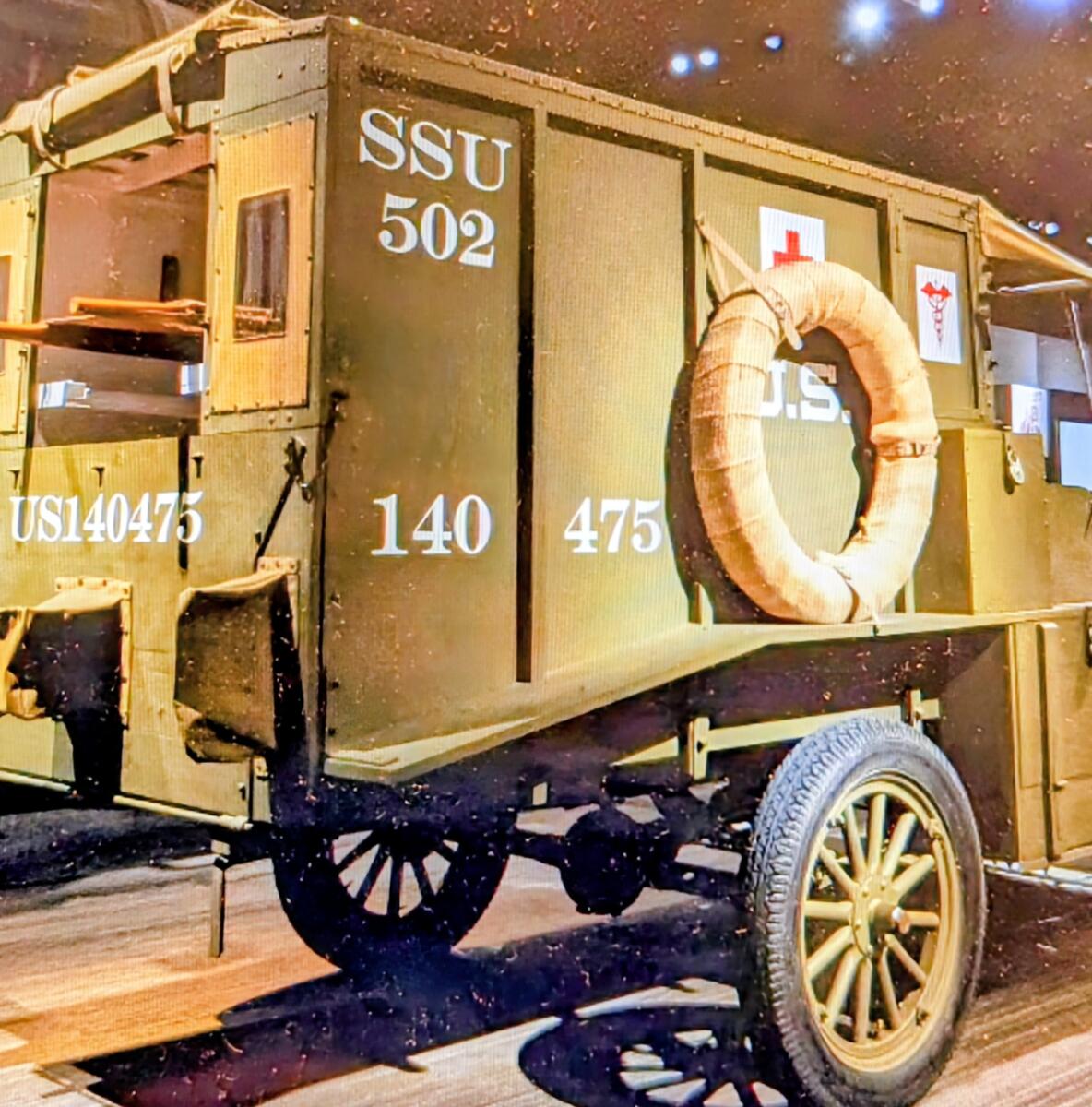
The National Museum of Military Vehicles celebrated its grand opening in phases, with full opening in August 2022, not quite four years ago. It features nearly 500 restored military vehicles, artillery, naval vessels, and aircraft from 1897 to today. The large, $100 million facility highlights American involvement in World War II, the Korean War, and the Vietnam War.

National Museum of Military Vehicles Image: museum website
Photo credit: The National Museum of Military Vehicles

Inside, visitors will experience a firsthand look at American military history rather than a quick walk past a few static displays. The galleries are designed to tell the stories behind the machines as much as the machines themselves.

Korea 11 Scaled 1
Photo credit: The National Museum of Military Vehicles

Museum admission covers two consecutive days, and the museum currently offers free public guided tours on Saturdays and Sundays when staffing allows. (Your tour cost is included with the admission fee.) Here’s the breakdown for admission:

• General Admission: $23
• U.S. Military Veterans: $18
• Children Under 10: Free
• Active U.S. Military: Free

Current museum hours are 9:30 a.m. – 5:00 p.m., Wednesday through Sunday. Summer hours for daily operation begin on May 20, 2026. The museum will be closed on July 4.

Watch some of the museum’s videos to get inspired (and excited) for your visit.

More to do

This area of Wyoming is beautiful and offers many opportunities for a variety of outdoor adventures. The Wind River, located nearby, is described by local tourism as one of the nation’s best fly-fishing spots.

You may also enjoy hiking, horseback riding, and picnicking. You can golf at Antelope Hills Golf Course, a small, public course just minutes from the museum in the Wind River Valley. The course is known for its relaxed atmosphere and beautiful mountain surroundings. (You’re likely to spot some wildlife.)

In Dubois itself, you can visit the National Bighorn Sheep Center and the Dubois Museum. If you stretch your trip west into Jackson, the Jackson Hole Winery offers tasting rooms that you’re sure to enjoy.

RV campgrounds

For RV parks, Dubois gives you several solid choices close to the museum.

Dubois/Wind River KOA Holiday is highly rated on TripAdvisor. It sits in the heart of town with RV sites, patio sites, and riverfront sites available.

Windhaven RV Resort offers full hookups, 30/50-amp service, Wi-Fi, laundry, firepits, and a walking-distance location near downtown Dubois.

Longhorn Ranch Lodge & RV Resort is located about 3 miles east of downtown and offers riverside RV sites plus the option of cabins and lodge rooms.

You should go!

For RVers who like places with a story, the National Museum of Military Vehicles is an easy choice. The museum and nearby areas offer plenty for an RVer to see, do, and enjoy.

Have you visited the museum? Tell us about it in the comments below.

RELATED

RVT1256

RVtravel.com readers discuss staying at Love’s RV Stops. Stay or pass? Worth it or not?

24

Last week, I shared my thoughts about staying overnight at Love’s RV Stops, and you all weighed in. Heavily! I was surprised how popular the story was, and there were some great comments which I’d like to address. 

I had also mentioned one of the things I really love, hehe, about Love’s is those grind-on-demand coffee machines and, apparently, I’m not alone. Reader Henry Dorn added:

I love Love’s and the big red heart in their logo and always go for the coffee machines (those are around $40,000 by the way) that grind your decaf or caf, and then you can load your cup to your heart’s content with those sweeteners and creams, and besides, the employees are quite wonderful and dedicated. If you sleep overnight in a Love’s, that might be due to your poor planning, but that said, Love’s is my go-to place, and be sure to buy one of their coffee cups since they have a heart on them. Isn’t RVing about Love?

Some customers need to share the Love’s

One of the complaints lodged by several people is one I share myself, and something I’m not sure Love’s can help with. That is the inconsiderate folks who park at the pumps and then head in for a potty break or for snacks or whatever it is. I’m 100% with you on this. 

Many’s the time that I’ve been waiting (I would say patiently, but I actually have no patience) for a pump, only to find that someone comes out of the main store after an extended period of time and then starts pumping their fuel. Other times, I’m next in line to depart after filling my truck, and the vehicle in front of me is just there. Unoccupied. 

When I’m driving just the truck, it’s easy enough to maneuver out around these inconsiderate parkers, but when I’ve got 30’ of trailer hanging off my back end, that’s not the case. 

I have no idea how Love’s, or anybody, could police this. It seems that common courtesy has gone from being a practice to an oxymoron, and those oxymorons are the ones parked where I need to be. 

Cleanliness counts

The Love’s where we stayed overnight in St. Joe, MO, was anything but clean! You could hardly walk around our site; there was so much dog poop. And, not just at our site, the dog park was a mess, too. We paid $45, I think, and unfortunately, it has soured me from ever thinking about staying at a Love’s RV Park again. —Pat

To be fair, I have been in a few Love’s where attention was needed when things were really busy, but the team that was at that Love’s usually got to things pretty quickly. I like how their bathrooms have that rating system where you can push a button to rate the restrooms. 

There have been times when I’ve pushed the yellow and even the red button, but not often. 

Unfortunately, the dog doo situation—the best I can offer is to contact their team and let them know. I suspect the people who just leave their dog’s waste behind because they think their mommy is in the area are the same group of folks who park at the pump and go inside and just leave their vehicles. 

I can’t really comment first-hand on the dog parks because I’ve had dogs and don’t want dogs or any pets any longer. Too many other people are ruining the experience for me with their off-leash dogs and other examples of poor behavior. Some folks’ mommas didn’t raise them right. 

save on RV dieselThe price for staying overnight

It seems that a lot of you have issues with the price of the Love’s RV Stops, and I can’t disagree with that. I’ve patronized a number of these, and the price is comparable to a campground, quite honestly. 

Was super excited when Love’s started their RV areas … but then the price skyrocketed from the $20ish range to now some are in the $60’s!!!!!!! Yes, they are convenient, but come on, for an overnight stop, I find it extremely overpriced. Who needs a pickleball court at a truck stop?? —Cindi

I’m sure someone with a marketing degree has researched what people want in a campground, and those people have asked for pickleball and all sorts of other things. (Pickleball did top the list of amenities being added to RV parks in 2024.)

I also know that the price of doing anything once you get the government involved escalates through the roof. You have to think that putting in a new RV park means you’re getting permits for electricity, power, water, sewer, pouring concrete, the gas distributed by patrons at Taco Bell, and who knows what else. 

All these permits and inspections and second inspections and contractors and everything else cost a lot of money, and, surprise, surprise, the only way to recoup that money is to charge the customer. 

We can all Monday-morning-quarterback anyone else’s business. But if I were doing so, I’d pare down what is offered as much as possible because I’m with you. I don’t plan my camping adventures around staying at a gas station. 

What I really like about Love’s RV Stops is that everything works the first time. I really like the digital reservation system. 

These are gas stations—not resorts

But there has to be some consideration for the fact that these places, even the ones with resort amenities, aren’t resorts. They’re gas stations. And we stop because we’re tired and we want to simply spend the night and move on. 

I’ve stayed in Love’s “RV parks” a handful of times, hoping that by using them they’d have an incentive to build more. They have, but at the same time, they’ve jacked the prices up. Sky high! One I stayed at, outside Muscle Shoals, AL, was nice, but nearly all of the others I’ve stayed at have been noisy, difficult to get in or out of, and nowhere near the price they charged. If the prices were half of what they are, or there was a discount for those who fuel (I’ve got a 100-gallon tank), I’d probably use them again. But until then, hard pass. —Chris P. Bacon (ha)

Nothing more to add other than what a great user name. 

A girl pumps diesel fuel from a green pump handle at a gas stationThe gas and diesel

We’ve stayed at many of the Love’s RV stops in the south, the latest at their newest stop in Mandeville, LA. Check in via the app worked great, and the location of the RV spots made it the quietest Love’s we’ve stayed at. All the Love’s we’ve stayed at have been clean, and the utilities have worked as expected. Yes, it’s pricey, but it’s convenient. We’re just waiting for more to be built for our annual trip to da UP! I only use Top Tier gas, so I don’t buy their gas, but the window washers have nice long handles! —Bruce

There were also a number of you who made comments about the fueling in general. More than a few made comments about the fact that the fuel at Love’s is not Top Tier, and I totally get that. 

For those who don’t know, the fuel industry has come together to offer a measure of performance in fuels called Top Tier. These fuels have greater detergent additives, no metallic additives, and are tested to other performance levels. There are vehicle manufacturers that very specifically recommend Top Tier fuels, particularly for folks who drive vehicles with turbochargers, which is an ever-increasing population. 

Unfortunately, none of the truck stop gas stations seem to offer Top Tier fuels. So, for those who have vehicles like those Ford EcoBoost trucks, this may have you shopping elsewhere if you care. 

This is one of the many, many reasons I chose the truck that I did the last time I chose a truck. Simple American gasoline V8, and I could pour almost anything into the tank and be okay. I do prefer Top Tier fuels when I have a choice, but I’m not forced to use them.

Navigating the pumps at Love’s RV Stops

There were also more than a few of you who stated that navigating the “retail” pumps at Love’s was challenging, especially for larger rigs. I get that, too. And, universally, you stated that the fuel prices for diesel at Love’s tend to be the highest in any given area. 

If I had a larger diesel vehicle, I would look into commercial fueling programs at Love’s or anywhere, for that matter. You know the truckers aren’t paying full price for their fuel, and they buy a lot. But that might be why they’re not paying full price for their fuel. 

This hasn’t been an issue for me, so I haven’t looked into it. 

more Costco's
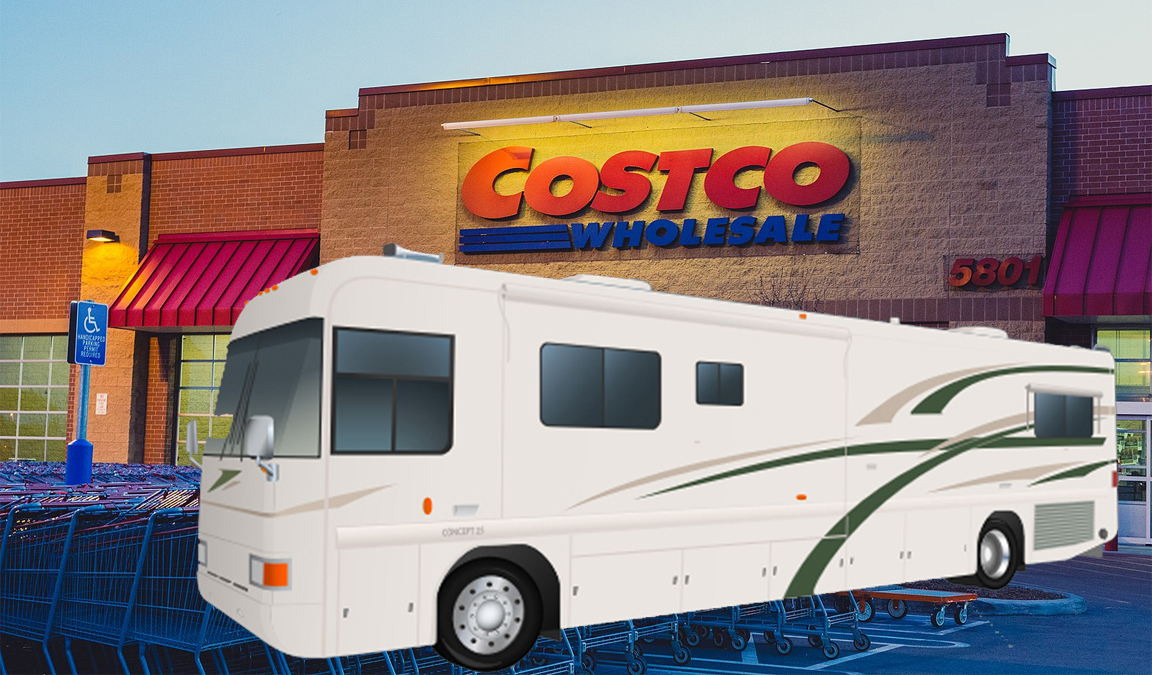
Costco image base image Tony Webster on wikimedia.org Motorhome added by editor.

Alternatives?

More than a few of you wrote that you prefer Buc-ee’s, and I get that. I don’t like Buc-ee’s only because it’s so huge and chaotic inside, but the bathrooms are spotless. But their fuel is also not Top Tier, although some of you had written that you have no problem getting your larger RVs into a Buc-ee’s. 

But one of the comments surprised me:

You can also spend the night at Costco. Ask first, of course. They ask that you park along the wall, usually near the truck docks. I’ve stayed numerous times, and it’s always quiet. No hookups though! lol. —Carol

Really? With the ludicrous solar and lithium system on my RV, this would be ideal, and Costco’s gasoline is Top Tier and usually priced lower than almost anywhere else. I gotta try this and, of course, I’ll share my experience. 

Here’s Gail Marsh’s story about legally parking overnight at Costco. It’s complicated…

Skirt smash gas station Love’s

My own stupidity

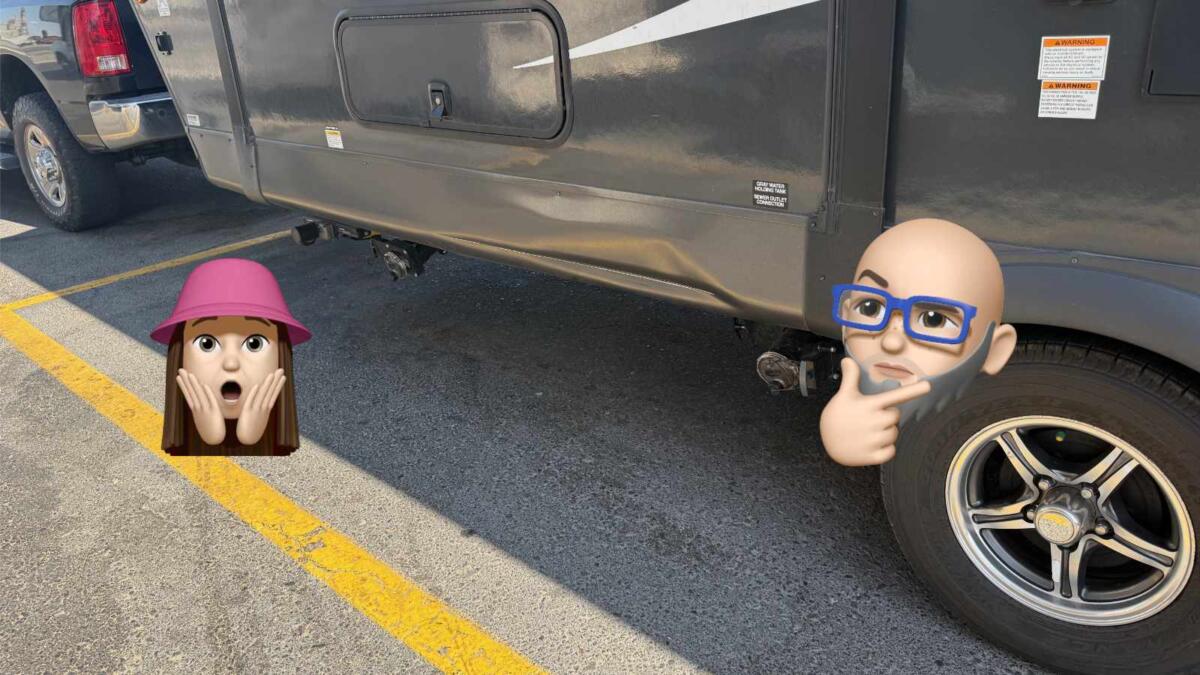
A number of you made comments about how tight the spaces are at Love’s. Yep. There was a particularly tight location, and I was fairly new to pulling my latest trailer. So my trailer and the concrete base that’s there to protect the fuel pumps from knuckleheads, like me, came into contact. The concrete base won, of course. 

I was lucky that the damage was only to the metal skirt molding on the trailer and didn’t do anything more. But I did take the trailer all the way back to Indiana and have the skirt molding replaced at the factory. 

I could blame the fact that it was near sunset and the light was in my eyes. I could also blame the fact that the bleeping concrete was painted black when yellow or another bright color would have been easier to see. 

But I’m the one who hit it. 

RELATED

RVT1256

Slide room in a van?! Tour the expanding DIY RV van build

By Cheri Sicard
In the video at the bottom of this article, Bob Wells from Cheap RV Living interviews Kelly, an engineer by trade, who created just about the most advanced DIY camper van you will ever see. He even installed a slide room on a van! As Bob says, “Everything you could want in a van is in this van!”

Kelly’s engineering mindset has allowed him to come up with many innovative ideas for his camper van, but working at a fabrication shop has given him the ability to actually turn those ideas into a tangible and practical reality.

Kelly’s goal was to build an RV that did not need to stay at RV parks and plug in (a man after my own heart). Not only did he accomplish that, but he did it without needing any propane in his rig!

It started with a Ram ProMaster 350 van, the biggest one they make. It sits on a 1-ton chassis. Kelly chose this van because it has lots of room underneath where you can hang things. For instance, your water tanks.

Kelly ordered a van with sliding doors on both sides so that he could add his slide-out room on one side. A DIY van with a slide-out—I am amazed at that alone!

The pair started the tour with this feature, as it truly sets this particular van build apart. Kelly says it was important to order the van with the slider door. Then, you can order a slide-out kit. You then basically build a box that gets fastened to the van door, and a frame for the track to mount to, before wiring it all in.

The kit Kelly used is the same type that an RV manufacturer would buy when putting slides in a trailer, 5th wheel, or motorhome.

Kelly’s slide-out on a van is a regular 12-volt-powered slider just like you might have on a larger RV. It slides in and out with the touch of a button. When closed, you might never know it slides, as his stealth van looks like every other van in the world.

When opened, it provides what looks like a huge amount of space, even though in reality it’s only about 18 inches.

Unsurprisingly, the inside of Kelly’s van is also impressive:

  • The slide room provides counter/table space on top of lots of storage drawers
  • There’s a sink, fridge, butane stove, and microwave
  • Full-size bed with lots of storage underneath
  • 780 watts of solar panels on the roof
  • Rooftop DC split system air conditioner
  • 700 amp-hour lithium batteries
  • A second inverter that charges the batteries while driving
  • Composting toilet
  • Shower
  • Two freshwater tanks and one gray water tank
  • A hydronic system that keeps the battery and water tank heated
  • In-floor radiant heat

Be sure to watch the video for the full tour. The quality of Kelly’s workmanship is impressive, and you are sure to be amazed by what he has done to this formerly humble little van.

MORE LIKE THIS:

RVT1256

How to mount RV solar panels without drilling!

In the video below, Brian from RV with Tito DIY shows how to mount large solar panels to your RV without the need to drill holes in it!

Be sure to watch the video to see how it is all done.

Brian begins by cleaning the roof well and creating the mounting hardware that he will use.

As Brian is mounting his RV solar panels to the roof of a large Class A motorhome, he wanted to use large solar panels that would maximize the space available and provide lots of energy. He sourced some used panels that set him back $175 for a 435-watt panel (plus shipping), and he bought four of the panels. This will give him a whopping 1,740 watts of solar power.

Before connecting the panels, Brian uses this multimeter to test them and make sure everything is working properly. Watch the video to learn how.

Next, Brian made a cardboard pattern the size of his solar panels. He uses it on the roof to lay out where the four panels will go. He had to move his antenna, too. Depending on the layout of your RV roof, you may or may not need to move other components as Brian did. Brian shows you how to do it, along with how to seal everything up watertight.

How to mount the panels

To mount his panels, Brian uses galvanized metal strut channels he bought at his local home improvement store. He uses these instead of the typical Z-brackets because they give you far more flexibility. The strut channels also improved the panels’ weight distribution and increased the surface used to secure the solar panels to the RV’s roof.

Instead of drilling into his RV’s roof, which would not have worked with the type of roof he has, Brian uses heavy-duty 3-M VHB tape to secure the strut channels to the RV’s roof.

Of course, he measures twice before attaching anything. You should, too. The video will show you step-by-step how to mount the hardware so it stays put, then mount your solar panels to it.

If you have any doubt about whether this system will hold up, Brian did a follow-up video almost a year later after traveling from Alaska to Mexico. Be sure to check it out here.

RELATED

RVT1256

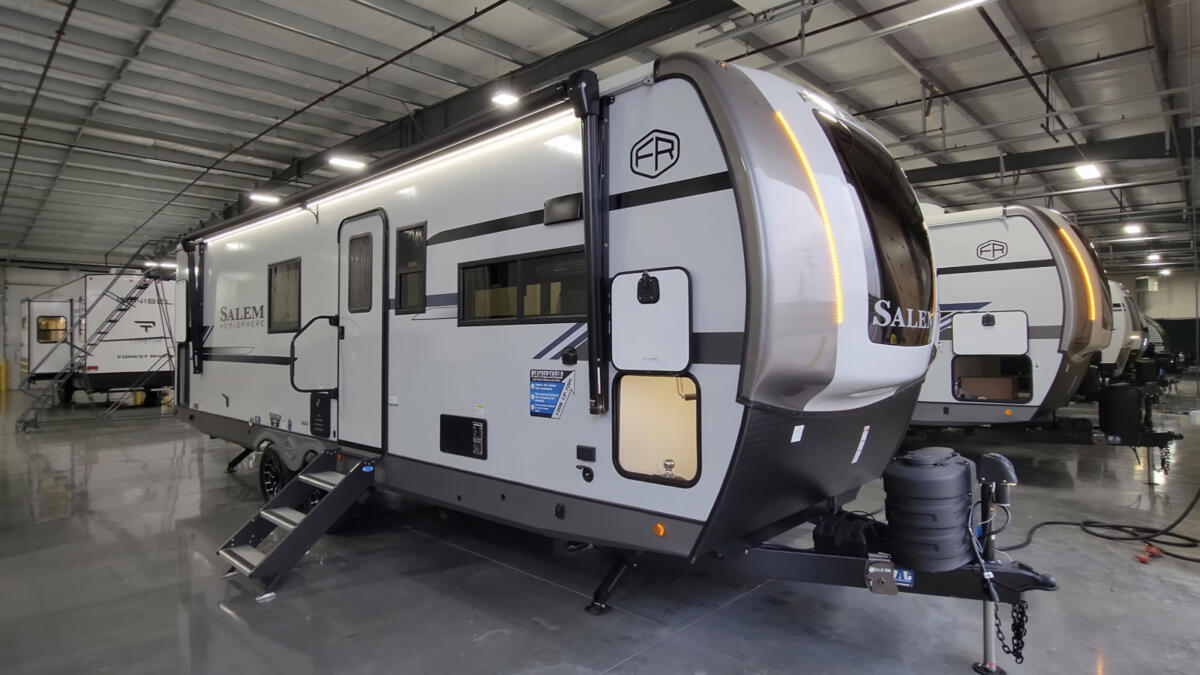
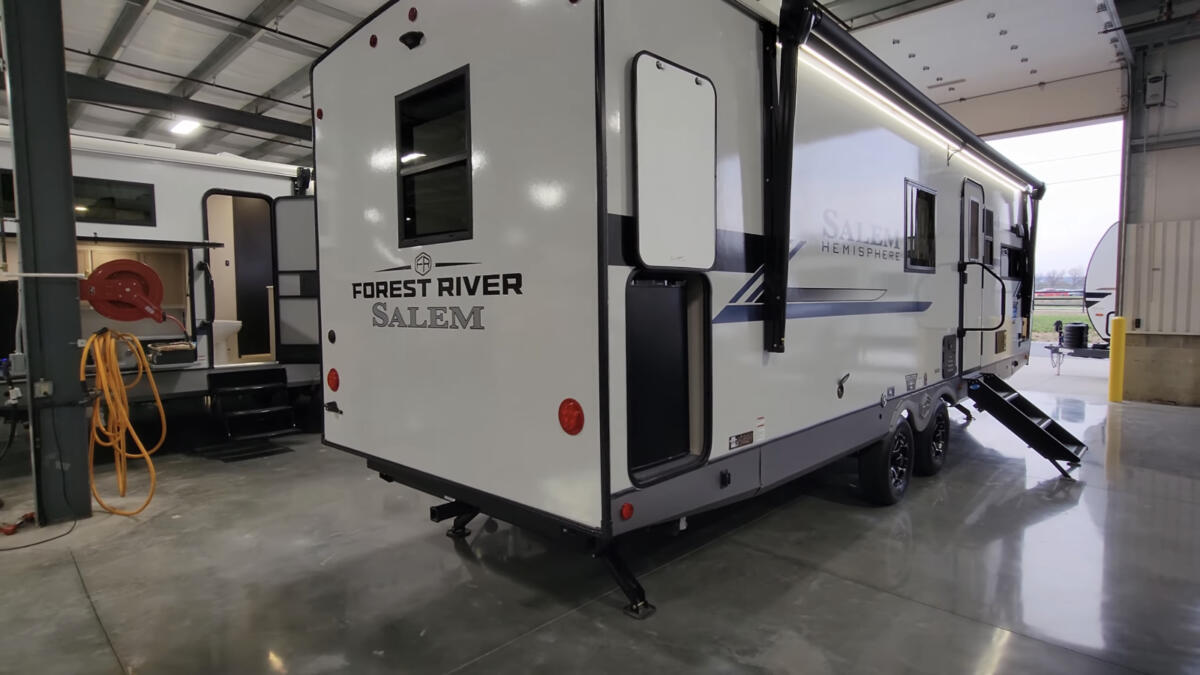
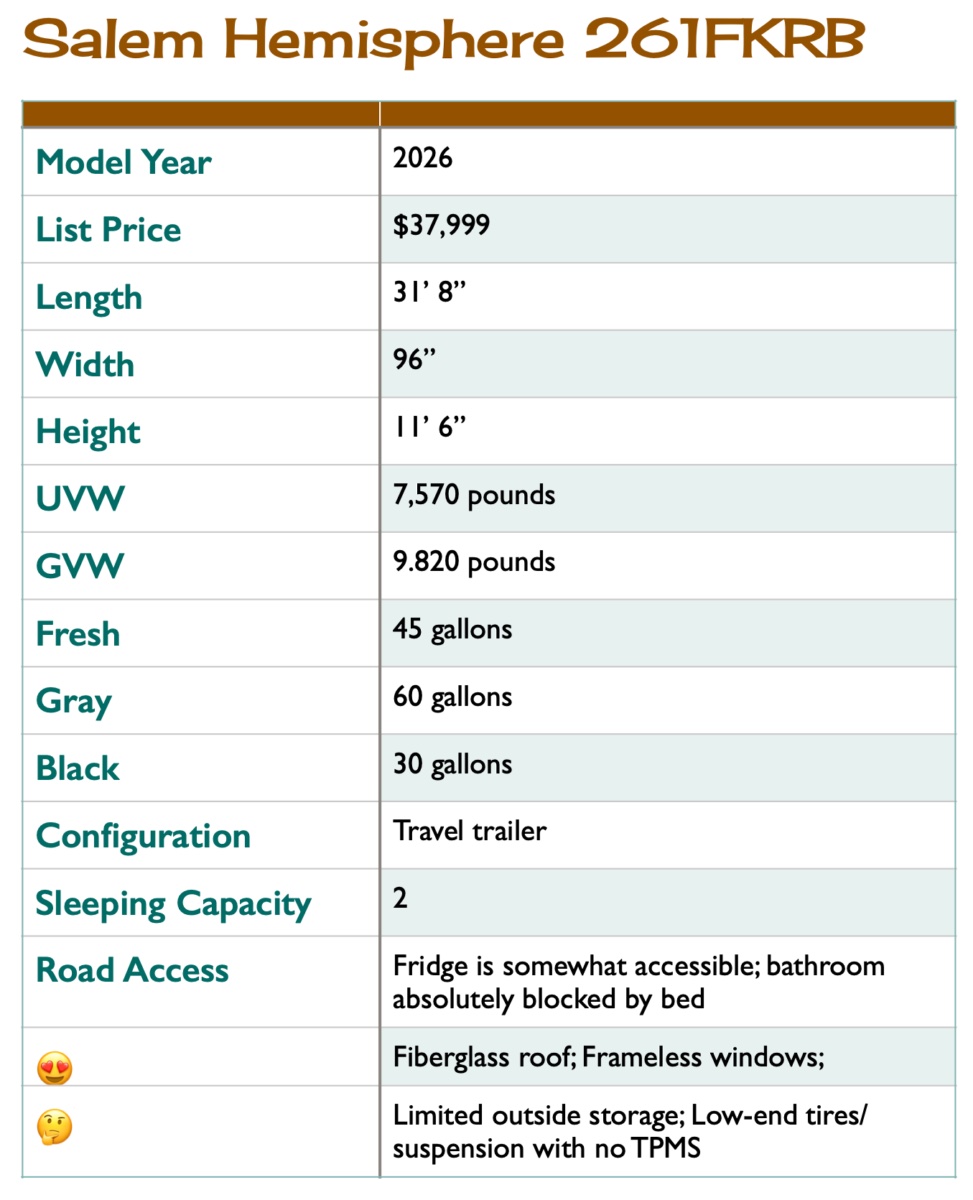
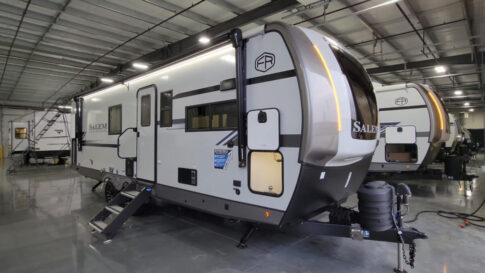
RV review: 2026 Salem Hemisphere 261FKRB—a nice long-term choice with premium features

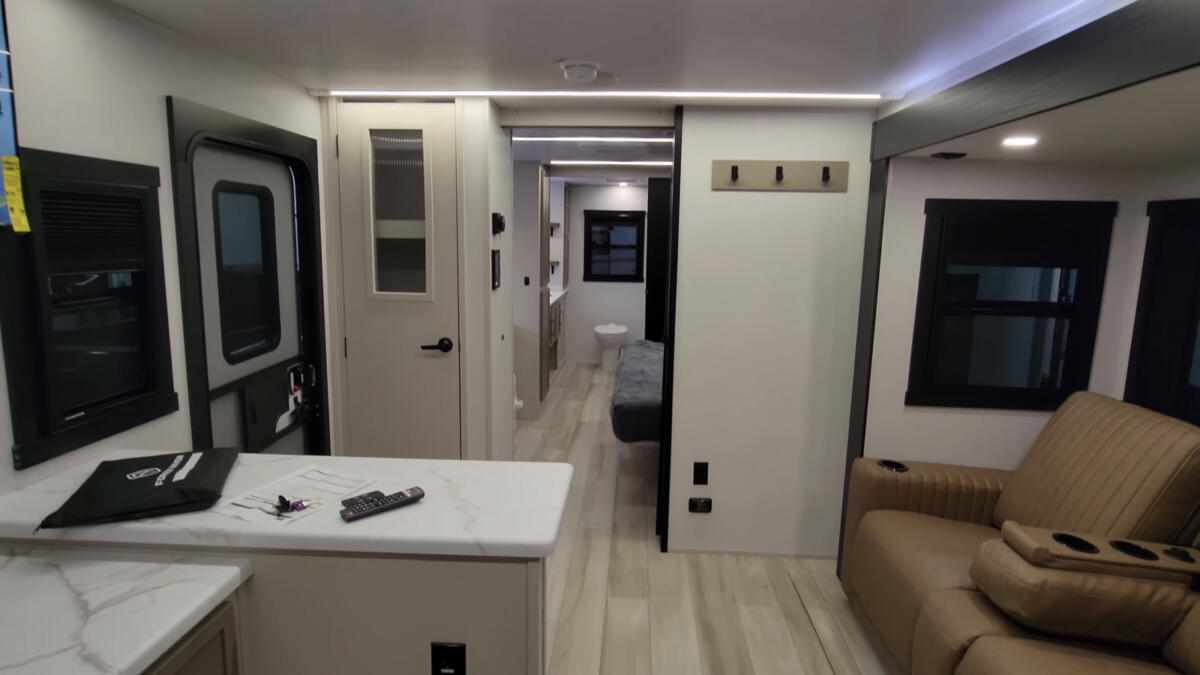
Today’s RV review is of the 2026 Salem Hemisphere 261FKRB—a couple’s trailer with an unusual floor plan. I know many of you who read this have seasonal sites, and I could see this being a great choice for that type of use. This also has some layout features I haven’t seen in a while. It hits the mark on a number of premium features without a really premium price tag. 

Something else to know about this rig is that it’s essentially the same as a Wildwood Heritage Glen 261FKRB—the same trailer, different stickers. I have an article about why RV companies make twin RVs with different stickers. 

So what are those premium features? You know where we’re going to start!

How is the Salem Hemisphere 261FKRB built?

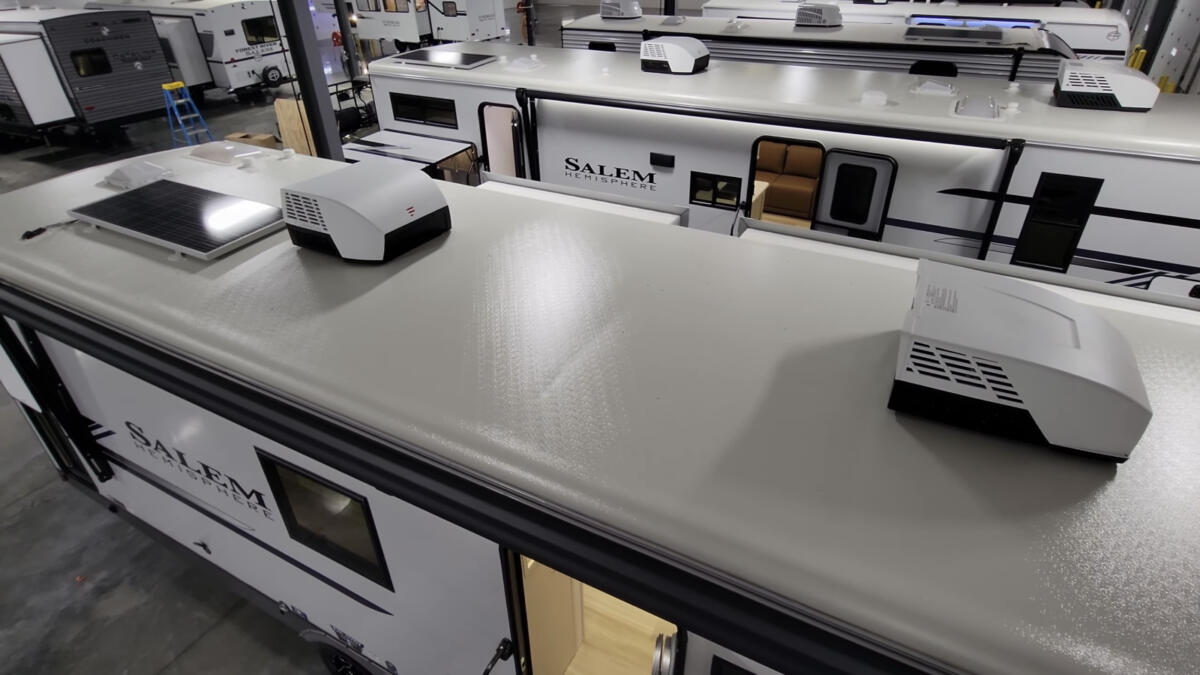
One of the things that surprised and impressed me was that this trailer uses a fiberglass roof instead of the typical membrane roof. These are arguably tougher than the membrane and might do a bit better at fending off damage from tree limbs and such. This is how many motorhomes are made, and not something you’d expect to see in a travel trailer. 

That roof also wraps partially down the side of the trailer, so there isn’t that sharp edge. That can be another failure point—another feature many motorhomes have. 

Do understand that the roof of the slide rooms themselves is still a membrane-type product. You’ll want to be cognizant of that—perhaps get an RV Slideout Sweep. I still use mine all the time, including for dusting off solar panels. I’m also not a fan of slide-topper out awnings.

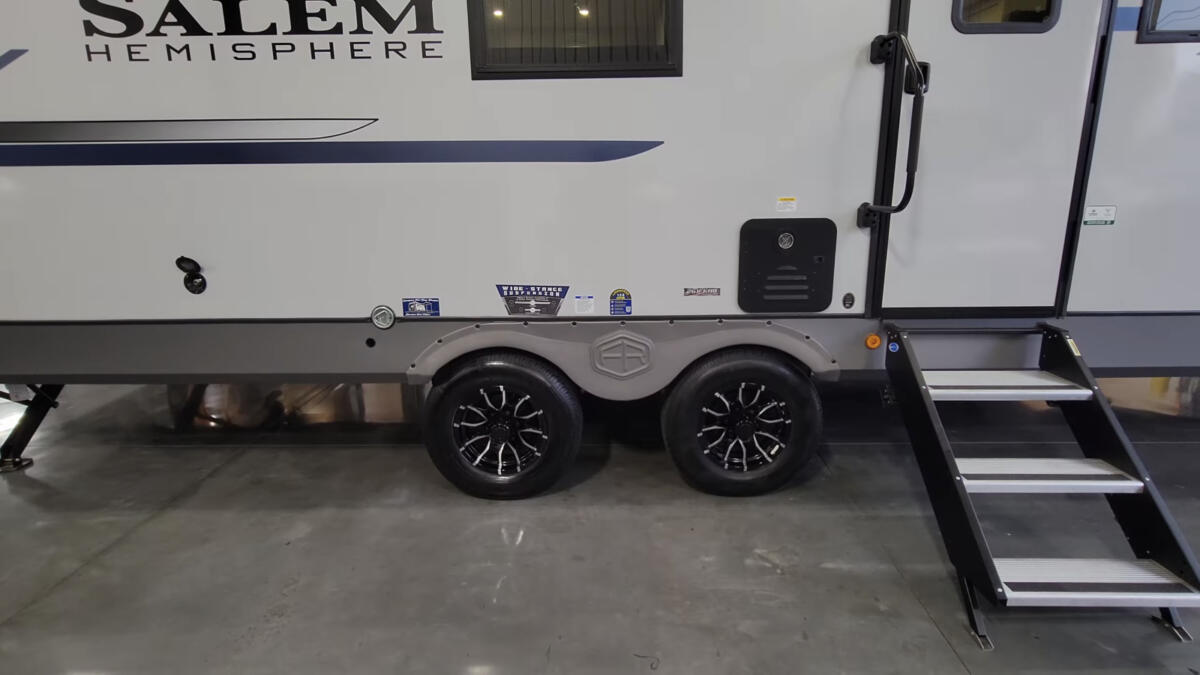
Interestingly, the axles on this trailer are spread farther apart. That purportedly offers a better towing experience by making the trailer more stable. Do you know that this is a simple leaf spring suspension and imported RV tires? There is also no tire pressure monitor. This is okay if this thing’s going to sit at a seasonal site. But if you’re roving the countryside, you’ll absolutely want a tire pressure monitoring system and, perhaps, some better rubber, too. 

There are two slide rooms on this trailer, and both use a rack-and-pinion system—my favorite. 

Another thing I really like is the windows, which incorporate the shades and bug screens right into the window assembly—a premium feature. 

The Lippert OneTouch control panel inside this RV has buttons that are simple to operate, but those who wish to can also operate it with a smartphone or tablet. This is how my own RV is configured, and I really like this system. 

What’s inside the Salem Hemisphere 261FKRB

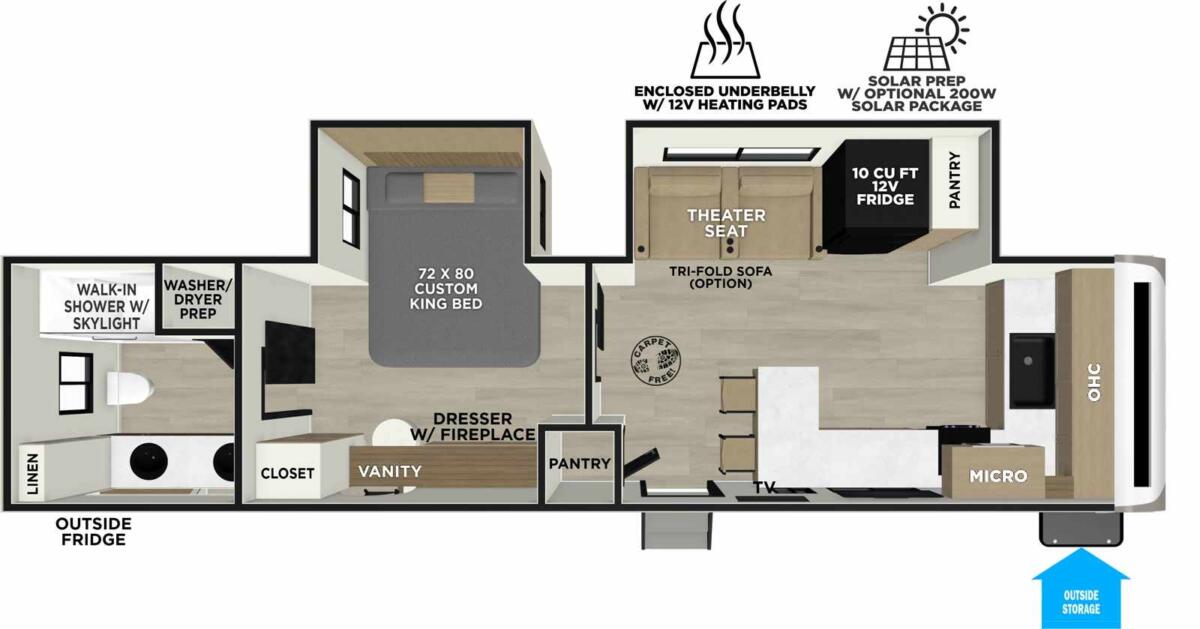
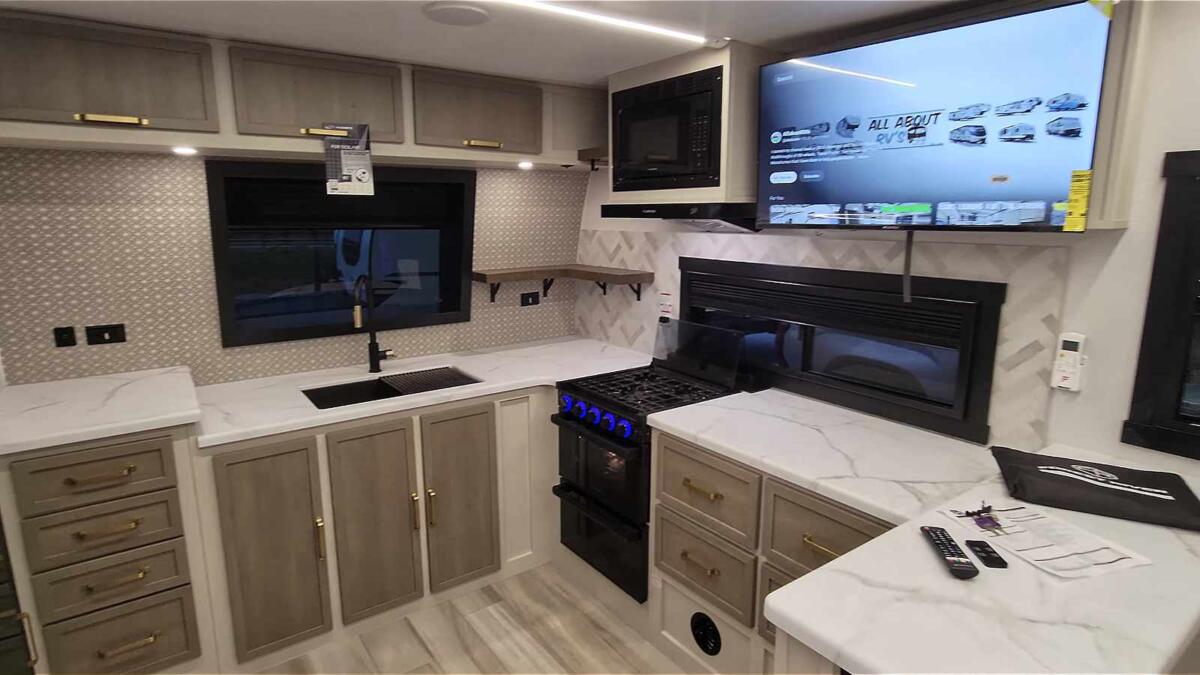
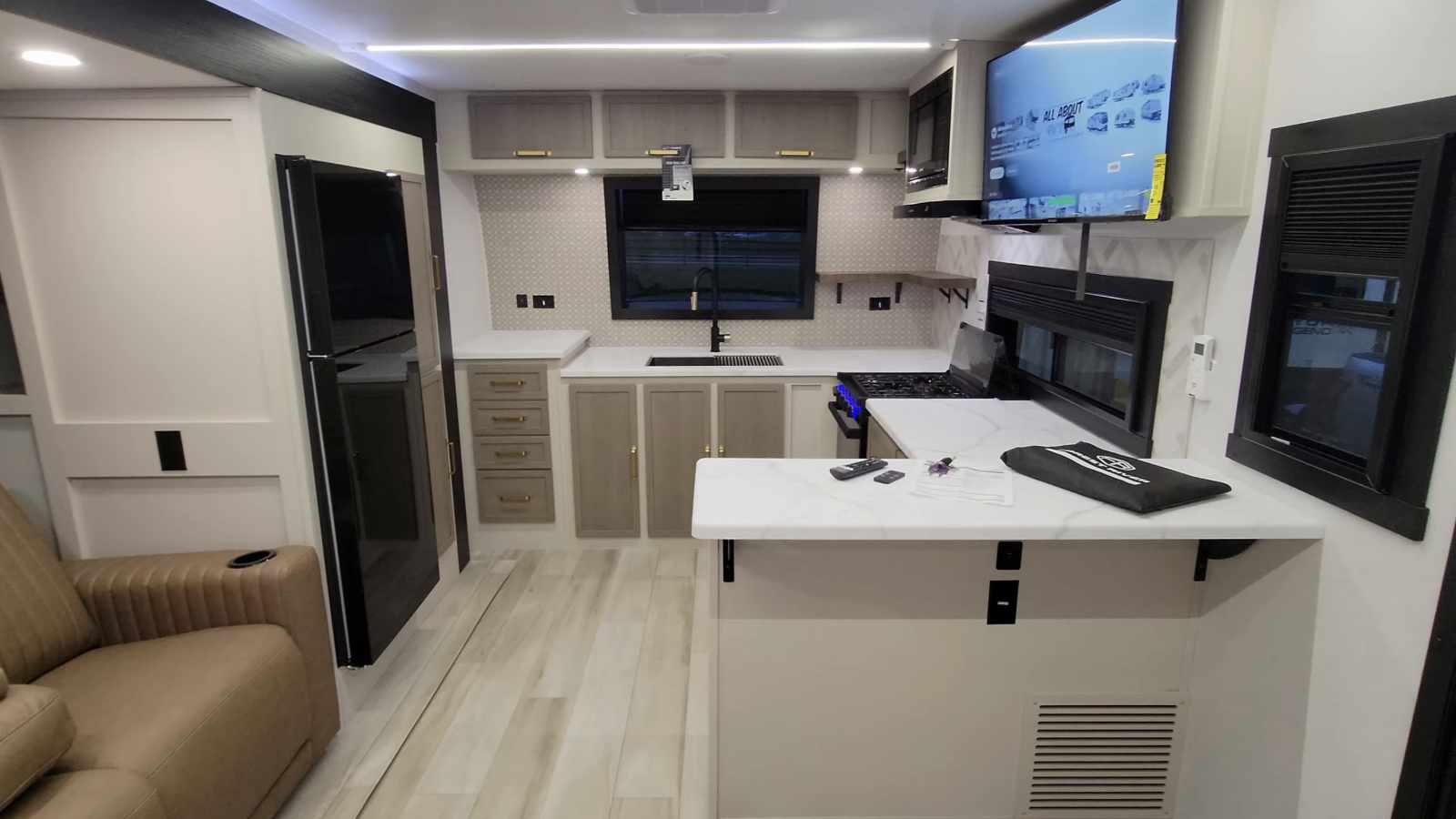
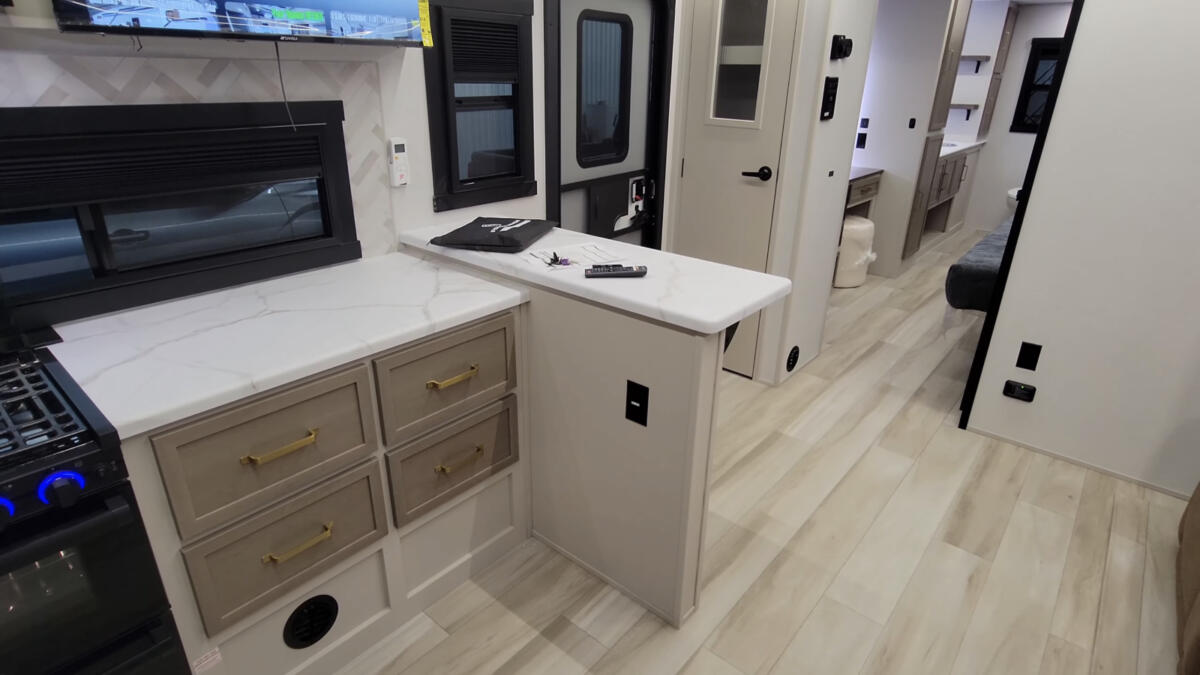
This trailer features a front kitchen, and it’s a good one. The countertop encompasses the width of the trailer along with the camp-side wall all the way to the wider-than-average entry door. There’s a decent pantry over on the road side in the slide room next to the 10-cubic-foot, 12-volt refrigerator. 

The overhead cabinetry includes a microwave above the three-burner propane stove with a 21” oven. Nice. The number of drawers and storage in this RV are something not to be missed. There are also open shelves at the front of the space, as well as hooks and a cubby. 

There’s also a breakfast bar with a couple of stools, so your significant other can sit there and rate the cooking process—which is why you give them a margarita and tell them to go outside. 

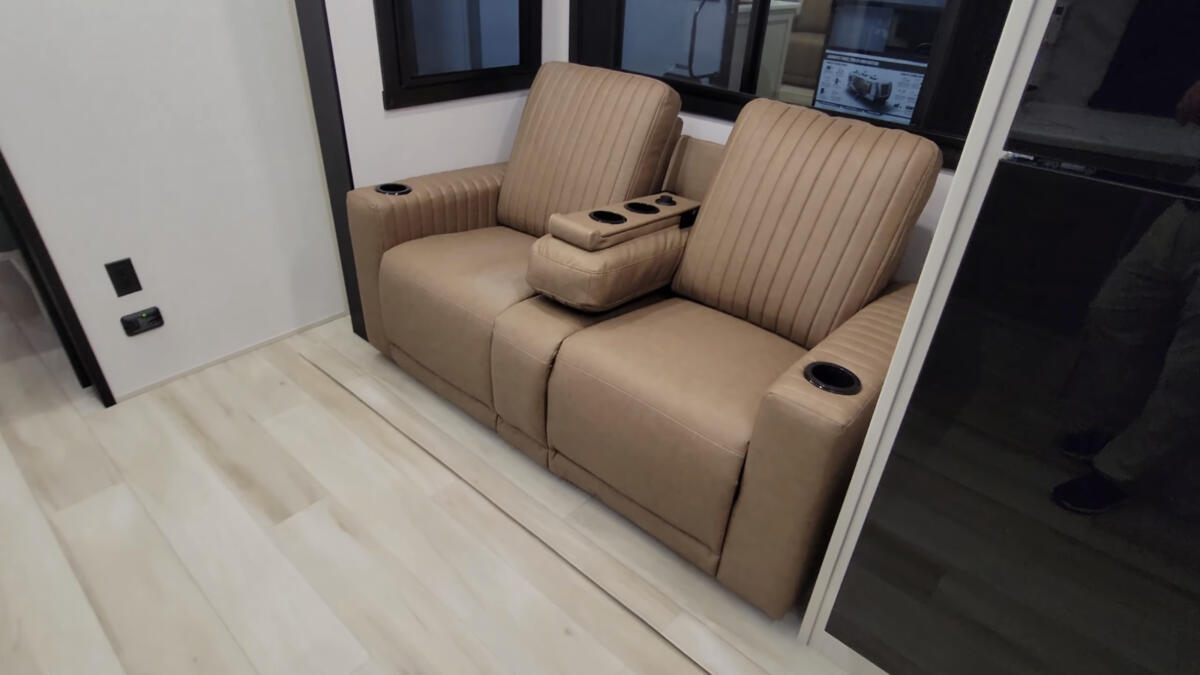
The only seating here is a theater seat/couch, which is really for two normally sized rear ends, but three skinny rear ends could occupy this as well. 

Bedroom

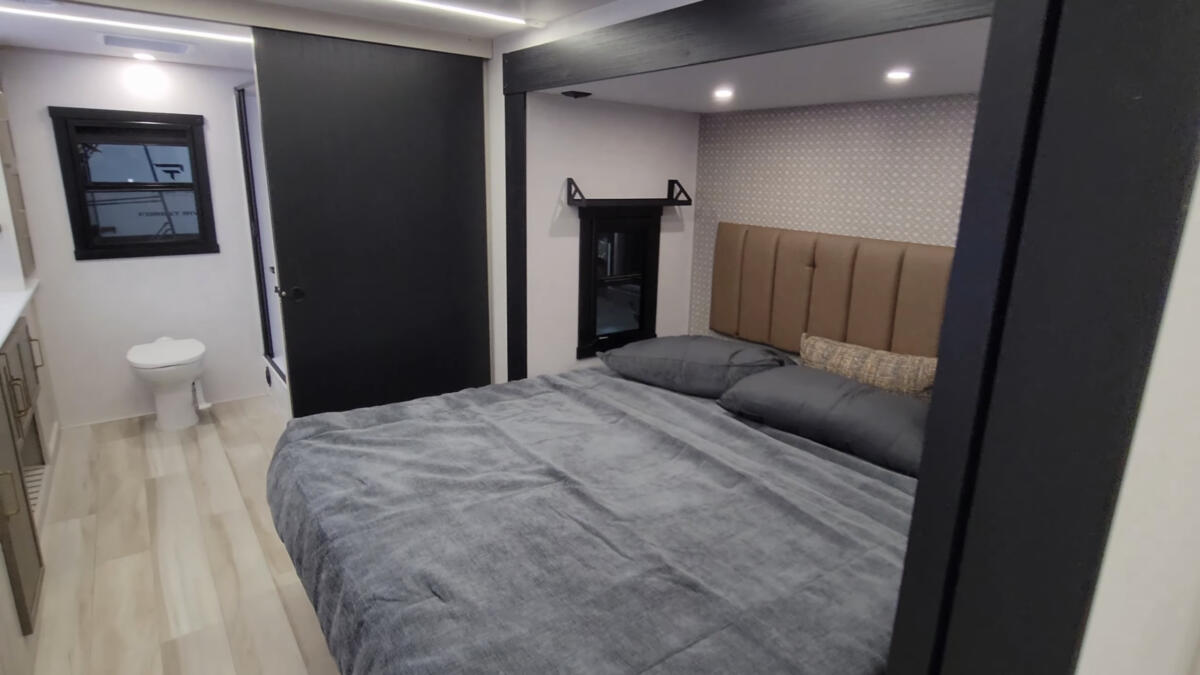
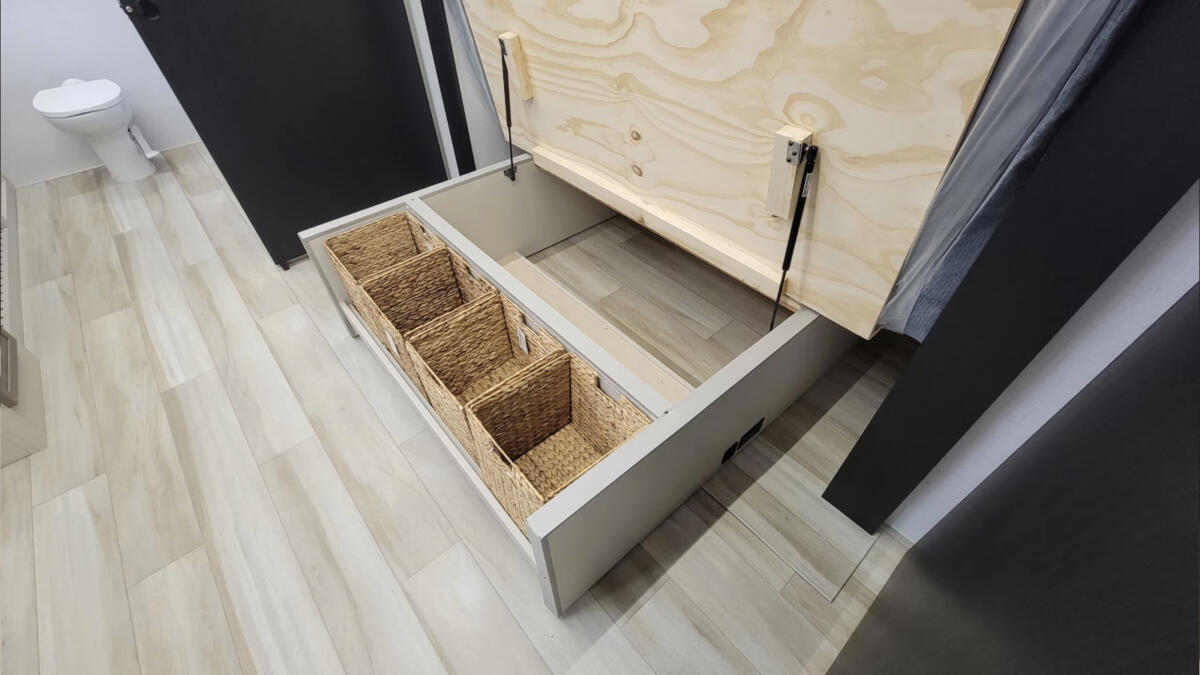
Something I like about Salem/Wildwood is the fact that they have a lot of spaces where they’ve included portable baskets or totes, and that’s true here, too. Under the bed are several wicker totes, which makes loading/unloading a bit easier. 

The bed tilts up to reveal storage, which is pretty typical—but you can access that storage from outside or in. The bed measures 72” x 80”. There are also shelves on either side of the bed, which could be good for the electronic toys you’re using to read RVtravel.com at night or, perhaps, a CPAP or something. There is an outlet above one of these shelves, but not both. 

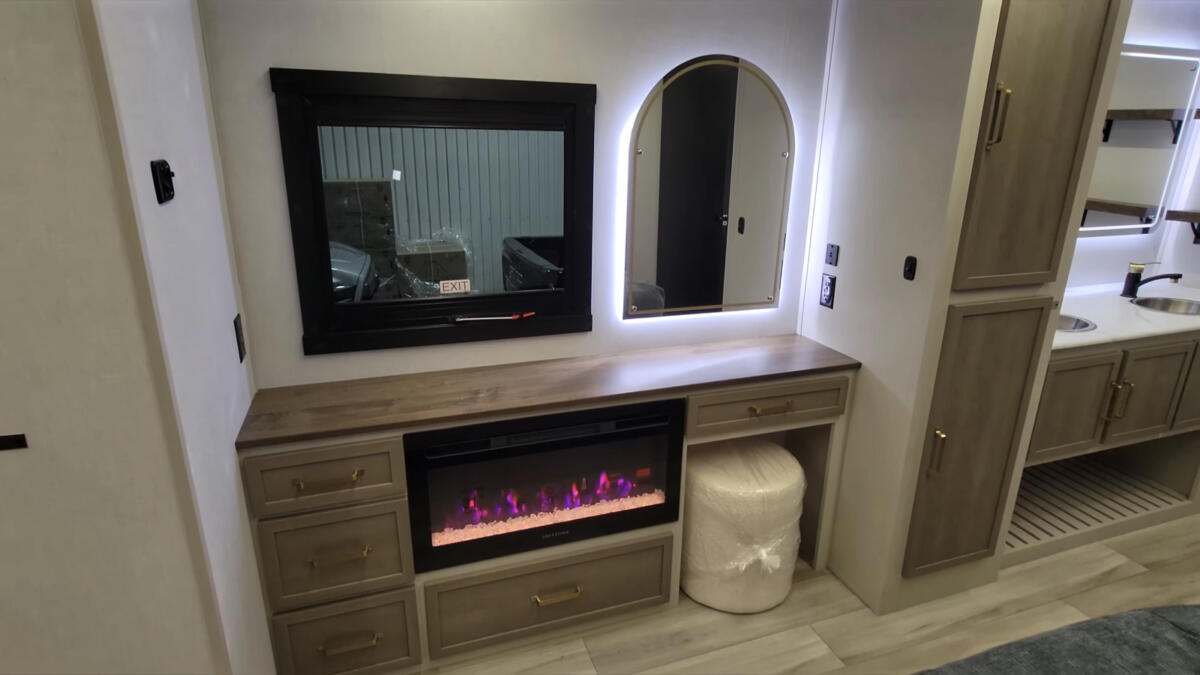
There’s also an electric fireplace over on the road side. There’s also a large table with a round ottoman and a mirror, which reminds me of the makeup table that my aunt had when I was a kid. I haven’t seen something like this, and it gives off midcentury modern vibes, especially with that round ottoman. 

Bathroom

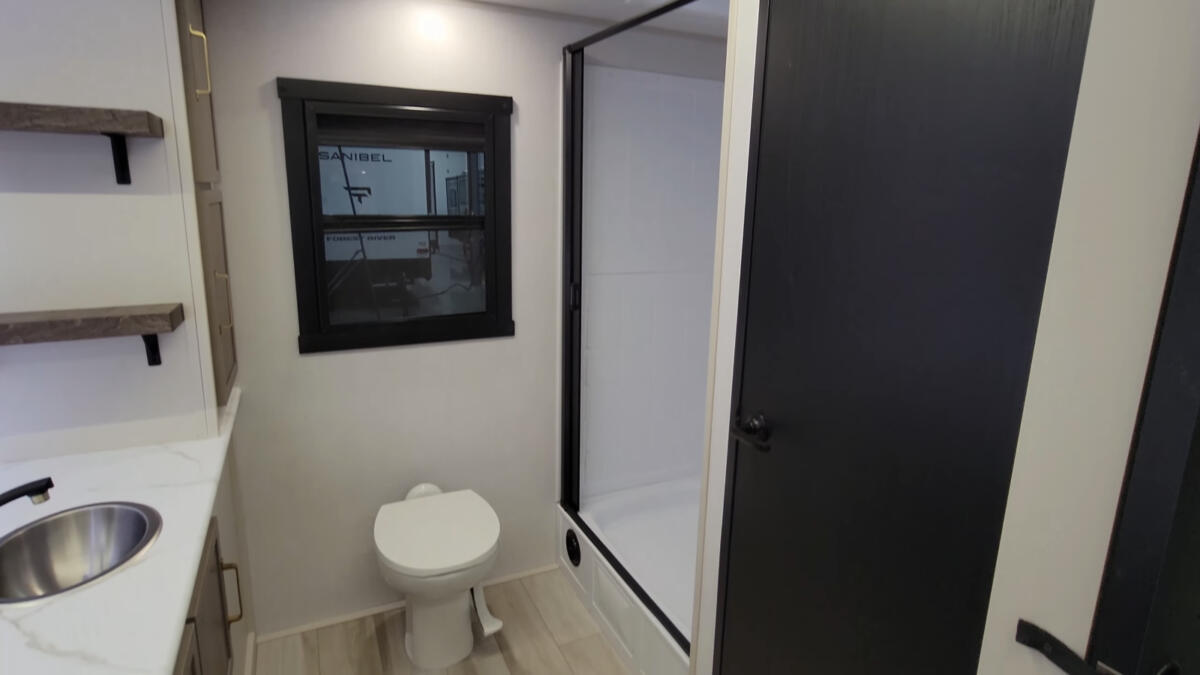
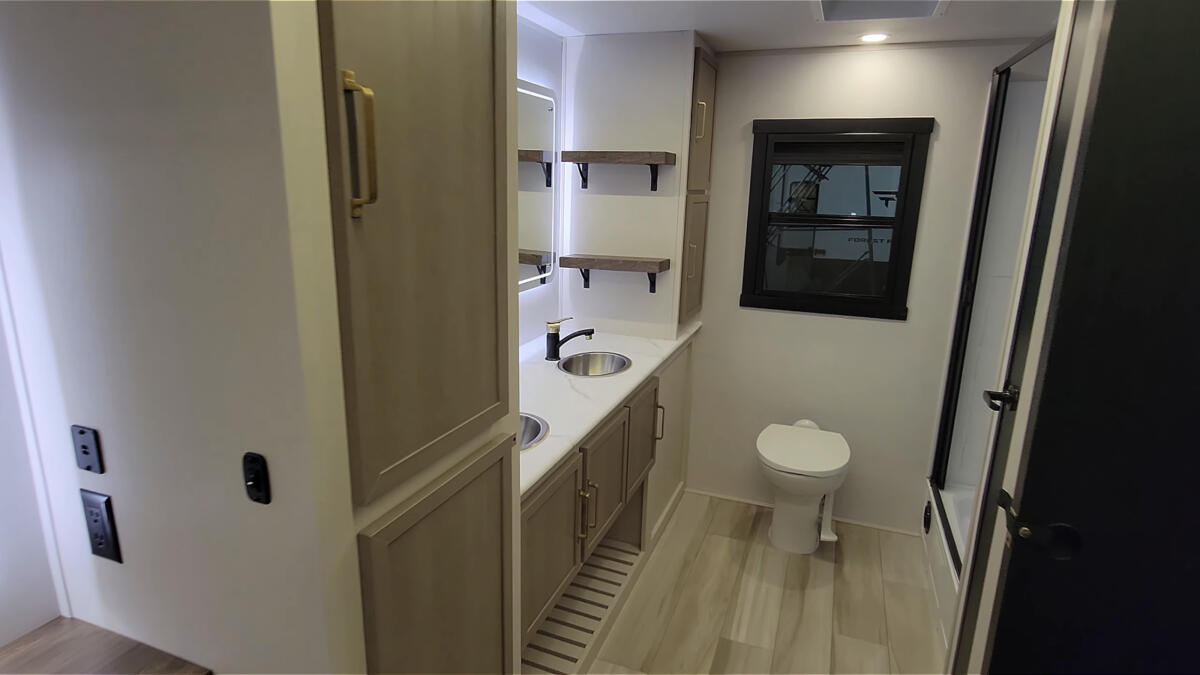
The bathroom in this trailer is absolutely huge, and the two sinks in the bathroom tell that story well. The two sinks also give off midcentury modern vibes to me, but this would allow a teeth-brushing competition. 

There are open shelves next to the sinks as well as storage adjacent to them and below. Farther down is another space for more of those totes.

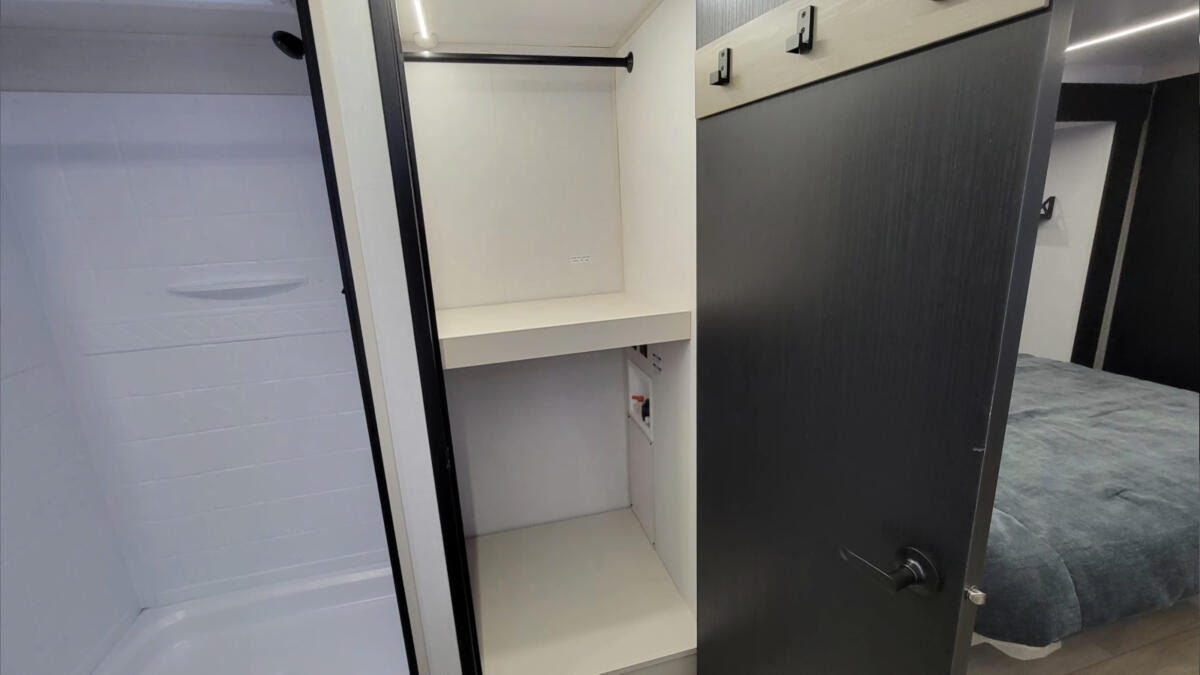
Across from the sink is a shower with a Nautilus-style retracting shower door, and next to that is a big closet. That closet has hookups for a washer and dryer, further telling the story of this being at a seasonal site. 

Boondocking and travel access in the Salem Hemisphere 261FKRB

If boondocking is your thing, there may be better choices than this. There are no solar panels that come with the trailer, although most people who have larger solar systems on their RVs have put them on in the aftermarket.

This also uses a tankless water heater. That isn’t my favorite, but it is common. I have an article about why tankless water heaters aren’t my favorite here.

Know that with the slides closed, you would have to crawl over the bed to get to the bathroom in the back. It’s not recommended that you occupy the slide rooms when they’re closed. So, if mid-trip potty breaks are important, that’s another consideration.

The kitchen slide mostly blocks access to the refrigerator. Again, if there’s a skinny traveler with you, they might be able to get to the fridge.

Final thoughts on the Salem Hemisphere 261FKRB

There is a lot to like about this trailer, and that is even more true as a seasonal unit. The roof material and those windows are definitely premium features. 

I believe that the lack of standard solar panels isn’t a problem because, if this is going to a seasonal site, you’re going to have full hookups. Having paid for a solar system that you’re not using doesn’t make sense. 

Outside storage isn’t a strong suit of this trailer. However, there is a bar-sized refrigerator in a cabinet at the back of this trailer. If storage is a higher priority than cold cucumber salad, then that fridge can get donated to charity, and now you have another outside compartment. 

MORE RV REVIEWS LIKE THIS:

RVT1256

Easy, no-sew DIY curtain ideas for your RV’s windows

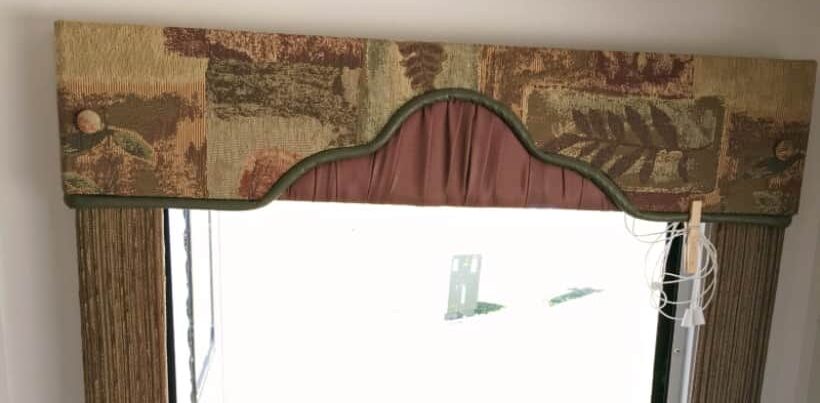
If you’ve spent any time inside your RV staring at bulky, dated window valances, you’re not alone. They’re one of the most commonly disliked design features in RVs.

The good news is you don’t have to live with them. Whether you want to soften the look, brighten your space, or go full modern minimal, your windows are one of the easiest places to start.

No sew

Even better, you don’t need to be a seamstress to transform your RV windows. There are creative, no-sew ways to refresh your RV windows and give your space a personality that actually feels like you.

So, if sewing isn’t your thing, don’t worry. These ideas are approachable, affordable, and completely customizable.

Pillowcase problem-solver

One of the simplest tricks is using pillowcases and thumb tacks. Fold a pillowcase (or a piece of fabric) to the size of your valance. Secure it discreetly along the sides, top, and underside with thumb tacks. This creates a clean, tailored look without permanent changes. It’s also easy to swap out seasonally or match to coordinate with your bed linens for a cohesive look in your RV bedroom.

Runner to the rescue

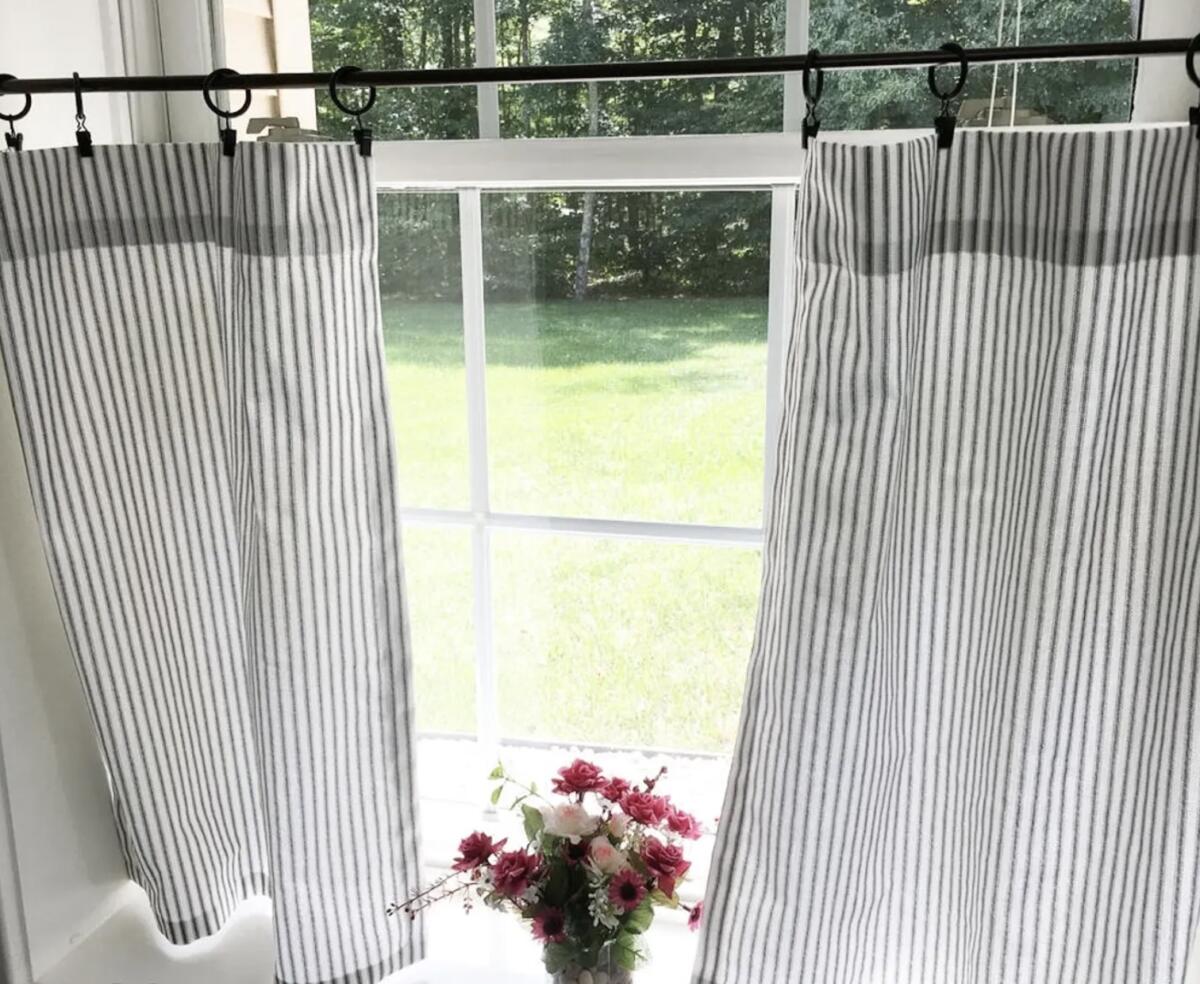
Another creative option is to remove the valance* (see how below). Replace the valance with a decorative table runner. Once the valance is down, use a lightweight wooden dowel as a curtain rod. You can choose to paint or stain the dowel. Then attach it to the wall. (Command hooks work well.)

Clip the runner to the dowel using curtain clips. This gives you a relaxed style, and you can rotate runners throughout the year for a fresh look without committing to one design.

Screenshot
Photo credit: HomeandHome, Etsy

Captured with film

If you want something even more minimal, consider skipping fabric altogether. Instead, apply removable window film directly to the glass. I like this option for the RV bathroom. It provides privacy yet still allows natural light and no worries about musty-smelling fabric in this high-humidity area. Bonus! Window clings are easy to remove later without damage. They come in all different styles and designs.

Gotcha covered

A fourth option is to use peel-and-stick wallpaper or adhesive fabric to wrap a flat wooden valance. First, clean the surface. Then just measure, cut, and smooth into place. You’ll find a huge variety of colors and patterns here.

Paint RV window valances (yes, even fabric!)

If you don’t mind keeping the valance structure but hate the color or fabric, painting is a great solution. The approach depends on what your valance is made of.

For fabric-covered valances, start by removing and cleaning them thoroughly. Dirt and oils can prevent paint from adhering properly. A light coat of primer helps create a smooth base and improves durability. Then apply multiple thin coats of fabric-safe paint or spray paint, allowing drying time between coats for the best finish.

Here’s a step-by-step process from All About Tidy.

For wooden valances, the process is similar but with a few extra prep steps. Lightly sand the surface to help the paint stick, wipe away dust, and apply a primer suited for wood. After that, use a high-quality paint in your desired finish. Thin, even coats will prevent drips and give a more professional look.

In both cases, patience is key. Rushing the drying process can lead to uneven coverage or tacky surfaces, especially in humid environments.

How to remove RV valances

Before trying many of these ideas, you’ll need to take the RV window valance down. Fortunately, the process is straightforward and doesn’t require special tools.

Most valances are attached with screws hidden inside the top or side panels. In many cases, you’ll need to remove blinds first to access those screws. Once located, simply unscrew the brackets and lift the valance free.

Take your time and keep track of all hardware. You may need it later. For some applications, you can reuse the screws. If you end up replacing screws, be sure to buy the exact length of the originals (or shorter) so you don’t accidentally penetrate the outside shell of your rig.

Here’s a helpful video and a step-by-step tutorial with photos.

What a difference

Window treatments take up a surprising amount of visual space in an RV. Bulky window coverings can make interiors feel smaller and darker. Lighter, simpler alternatives open things up and let in more natural light.

Many RVers who remove or update their valances notice their space feels more modern and less cramped almost instantly. It’s one of those upgrades that delivers a big impact without a big budget.

Your RV should feel like home. Giving your windows a little attention is a small project that can completely transform your living space on the road.

Do you like your current window valances? Have you ever swapped them out for something else? Tell me in the comments below.

RELATED

RVT1256

To tell or not to tell: Would you tell other RVers about the ‘perfect’ campground?

After RVing for years, you stumble upon the perfect RV campground. Do you tell other RVers about your find? Or do you keep information about the campground all to yourself?

Perfection!

Picture this: You pull into a wonderfully large, well-maintained site. A picnic table and fire ring welcome you. The site fee is considerably less expensive than other campgrounds, and this one has much better amenities along with heart-stopping views.

Better still, the manager has obvious pride in the camp because everything is in tip-top condition. The grounds are pristine. After just one day in this RVer’s dream camp, you discover that everyone is super helpful and kind.

It took years to find, but you’ve done it! You’ve found the perfect campground. So, do you tell other RVers about your discovery? Or do you keep this little gem quietly to yourself?

Sharing is caring

The case for saying “yes” is simple: Good camping tips save other RVers time, stress, money, and guesswork. Sharing a location can help others learn about a place, understand what to expect, and enjoy a great experience.

Telling others about a beautiful campsite can be a friendly gesture. Not only will other RVers share your joy, but the campground is also rewarded with continuous customers—a well-deserved reward for their dedication and effort.

Keep it under wraps!

The case for saying “no” is just as strong. Sharing the information about your perfect campground may well have negative consequences. More RVers means more traffic to a spot that was special because it was quiet. An influx of RVers may mean more wear on the amenities, more noise, and less solitude.

Poll question

When you find the perfect campsite, would you tell other RVers about it?

Please vote in our poll. Then explain your vote in the comments below.

MORE POLLS YOU MIGHT LIKE:

RVT1256

Mississippi’s forgotten tropical paradise

5

Most people think “beach trip” means Florida or California, but Mississippi’s Gulf Coast offers soft sand, calm water, and hometown southern hospitality.

Mississippi Sound’s barrier islands keep waves mellow and the atmosphere laid back. Read on to see why RVers love Mississippi’s beaches.

Front Beach

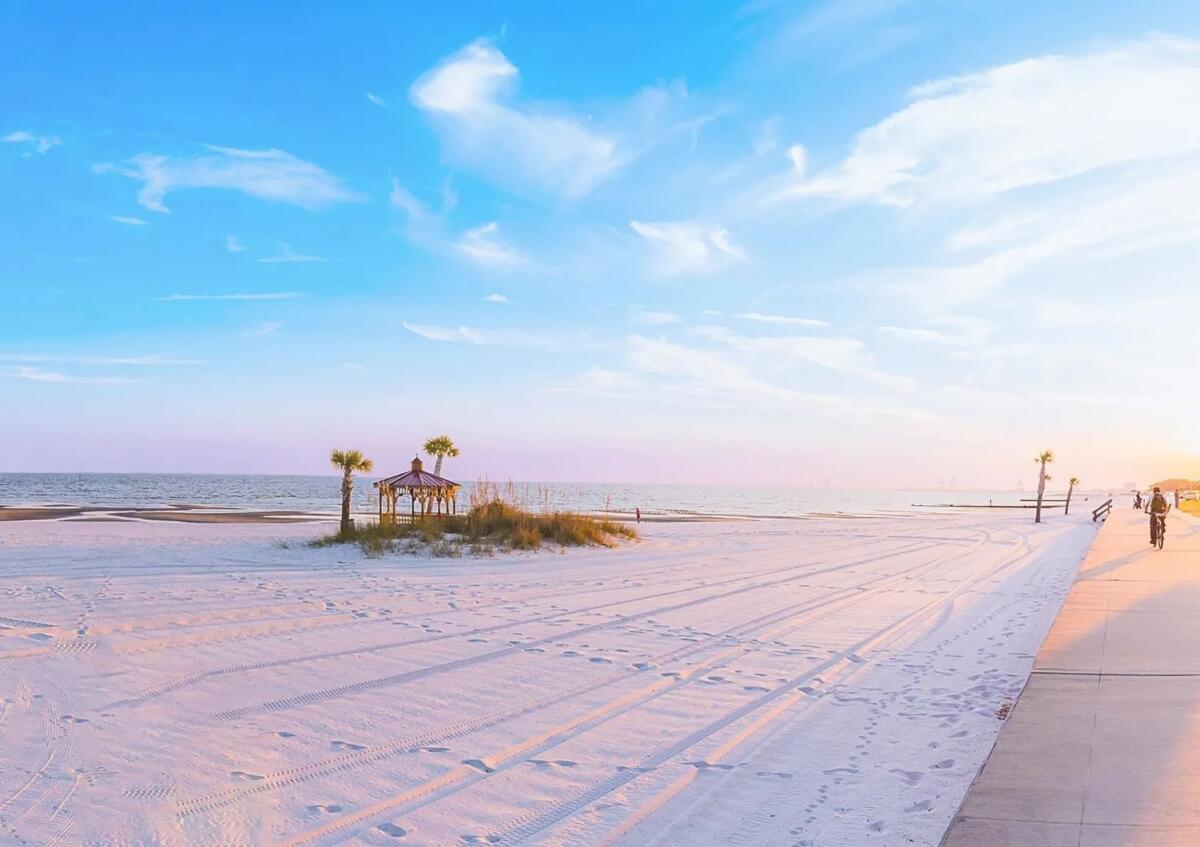
Ocean Springs MS beach Image: TigerDroppings.com
Photo credit: TigerDroppings.com

Front Beach in Ocean Springs is a picture-perfect, low-key shoreline. It offers visitors calm, shallow water thanks to the islands offshore. Ocean Springs is the kind of place that’s great for wading, photographing wide panoramas of the Mississippi Sound, and watching pastel sunsets. Here, RVers can swap loud, bustling, touristy crowds for fishing piers and a relaxed local vibe.

Ocean Springs is an artsy town. You can stroll through galleries, linger at coffee shops, and take a charter boat or ferry out to the barrier islands. Hiking and biking opportunities are also available. The William M. Colmer Visitor Center for the Gulf Islands National Seashore is also within easy reach.

Where to park your rig

Here are two nearby campgrounds that welcome RVers:

Davis Bayou Campground. This National Park Service campground sits in the Davis Bayou area. It has paved sites with water and electric hookups, showers, a dump station, and boating/fishing access. Because it’s inside Gulf Islands National Seashore, it’s one of the most convenient, natural-feeling options near Front Beach. Reservations and site details are handled through the park’s pages.

Biloxi Bay RV Resort & Marina. Check out this large, full-amenity RV resort. Visitors enjoy its pool, marina access, a pavilion, and social programming. It’s an easy drive across the bay into Ocean Springs.

Bay St. Louis Beach

Unnamed 1
Photo credit: Alexis W., Google Photos

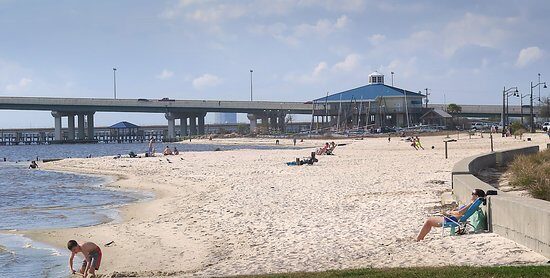
Bay St. Louis offers a gentler, small-town beach experience. You’ll discover wide, shallow shores, calm water, and plenty of room for a long sunset stroll. The sand isn’t usually crowded, and the town’s Old Town area, with antique shops, murals, and casual seafood, makes for a full day of relaxing fun in the sun. (Bonus for dog owners: Dogs are welcome on the beach [leashed], in many restaurant patios, and in the town’s parks, too.)

Pop into Old Town Bay St. Louis for galleries and coffee, rent a bike or golf cart to explore the shoreline, or plan a fishing charter from the bay. Seasonal festivals, live music, and public art make this a fun stop for RVers.

Where to park your rig

Check out these two RV campgrounds nearby:

Lake LaCroix RV Resort is a family-friendly lakefront RV resort. It advertises full hookups, pool, and shared spaces, and is a short drive from downtown Bay St. Louis. It’s a comfortable, modern option if you want a lakeside, quiet night while staying close to the beach and town.

Legends of the Bayou RV Park. This small, intimate park with roughly two dozen sites is situated on Edwards Bayou. RVers will enjoy full hookups, clean restrooms/showers, and a bayou setting. It’s a good choice for anglers and people who prefer a quieter campground a few minutes from the main beach areas.

Pascagoula Beach Park

Sunset
Photo credit: Sadarius Lewis, Google Photos

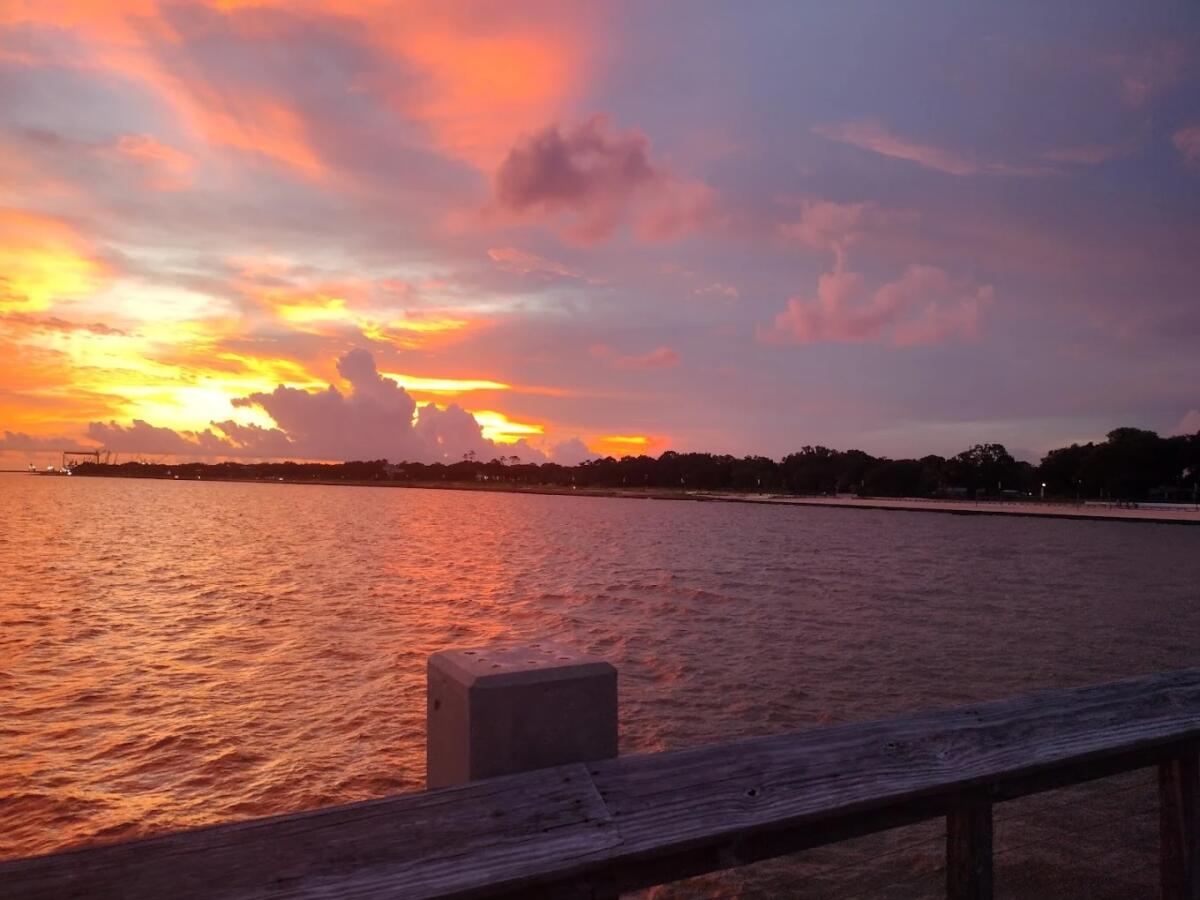
Pascagoula’s Beach Park is a spacious 14-acre waterfront park. This family-friendly beach includes a long fishing pier, playgrounds, pavilions, grills, restrooms, and even a seasonal splash pad.

The pier is great for anglers and casual walkers. Nearby, you can explore local seafood spots, historical sites, and natural areas along the Pascagoula River and barrier-island access points. The area is also known for birding and low-key coastal recreation.

Where to park your rig

Here are two RV parks near the beach to consider:

Sioux Bayou Landing RV Resort is located in Gautier, just a few miles west of Pascagoula. The park is proud of its waterfront RV sites on the Pascagoula River and the opportunities for kayaking and fishing. It’s a convenient base for visiting the beach, picnicking, and relaxing in a low-key waterfront setting.

Orange Grove RV Park is a family-owned park in Moss Point. It welcomes RVers with full hookups, laundry, a dog area, and easy access off Hwy 90. It’s a practical choice if you want straightforward RV services within a short drive to Pascagoula’s waterfront.

You should go!

Mississippi’s coast provides a beautiful, low-stress destination on the Gulf Coast. Short drives between beaches and towns, plenty of full-hookup RV camp choices, and fewer crowds than the big-name beach states make this a perfect destination. Add great local seafood, museums, and ferry trips to barrier islands, and you’ve got a fun itinerary with a generous heaping of Southern hospitality. Make plans to visit today.

You can learn more about all the Mississippi Gulf beaches here.

RELATED

RVT1256

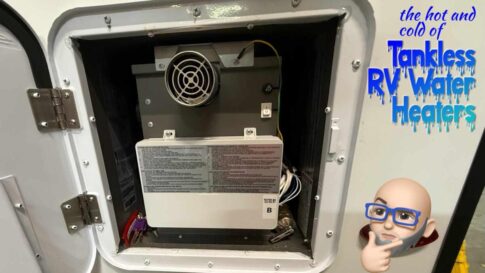
The hot and cold of tankless RV water heaters

Why are you seeing tankless water heaters suddenly being included in so many RVs? A few years ago, these were luxury items, and now they’re everywhere. Is the RV industry becoming more generous with what they’re offering? Have you stopped laughing at that question yet? 

The simple imported tankless water heaters are much less expensive than the traditional gas-electric tank-type water heaters. They are almost universally gas-fired appliances only, so the RV companies don’t have to run 120VAC power to the water heater if they have a tankless model. With copper being so expensive, this is another savings. 

So what’s the appeal of tankless water heaters? 

The idea behind these is that the water heater isn’t heating the water until you call for hot water. Another benefit is that, as long as you have water and propane, you have hot water. That sounds incredible—endless hot water—and they actually deliver on that.

Another big reason you’re seeing these more and more in RVs is that they’re inexpensive relative to the six-gallon tank-type water heater. There’s no doubt that, in bulk, these things are far less expensive than the traditional gas and electric tank-type water heater. Also, the RV companies share that you can have endless hot water with one, which is mostly true. 

I am guessing that a lot of RVers are used to the large 40-plus-gallon water heaters in their homes and quickly run out of hot water in their RVs. Or, some RVers have multiple family members who camp with them, and six gallons just doesn’t cut it when there are multiple showers wanted. 

Funny thing, when we replaced the water heater in our home, the plumber only stocked 40-gallon or more water heaters, and ordering something smaller was actually more expensive than just going with a 40-gallon water heater. Oh, well. Seems like a big waste of propane to me. 

One of the best features of tankless water heaters is that there is typically a control panel that enables you to set the temperature that the water heater is intended to deliver. While traditional gas-electric water heaters basically deliver to 140°F, you can set most tankless water heaters to deliver water at a temperature that is much more comfortable. 

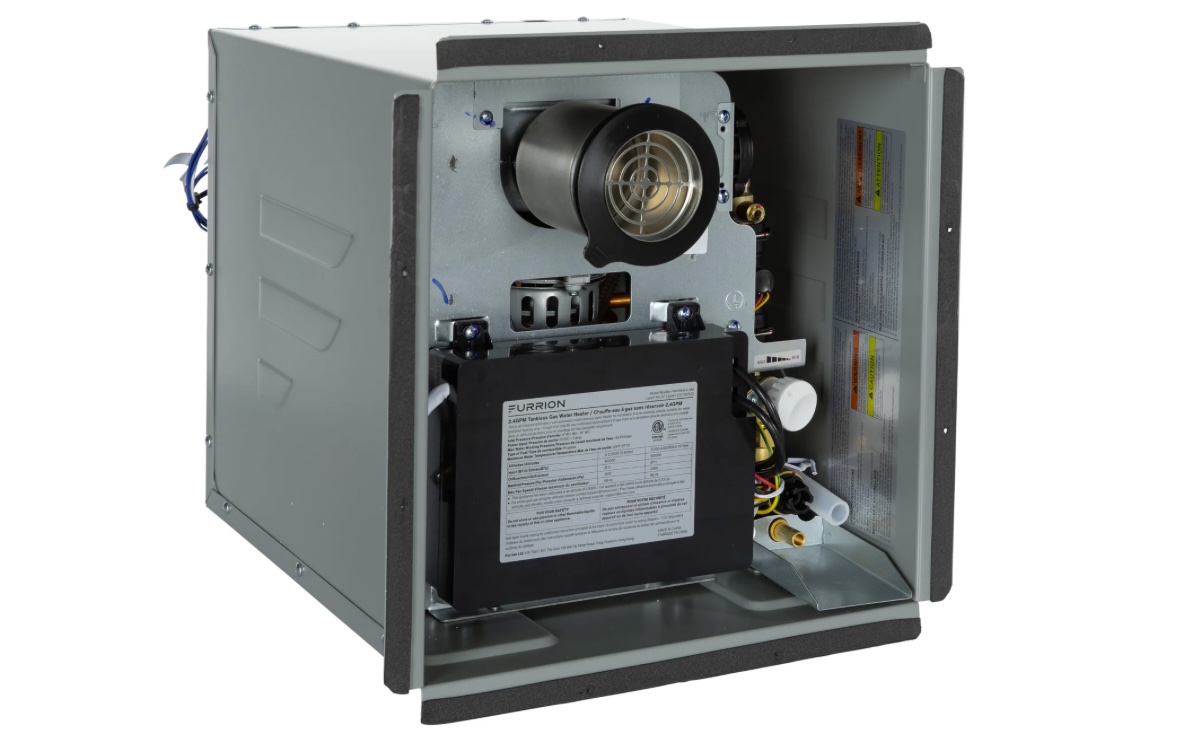
Furrion Tankless RV water heaterHot water 101

A regular old tank-type water heater has a system that measures the water temperature inside the tank and turns on the heating system when it sees that water is below a specified temperature. In most cases, the temperature inside the tank is set to about 140°F, which is really hot. You wouldn’t want to only run the hot tap at that temperature. 

And that’s a huge disadvantage if you have very young campers who may turn on a hot faucet and actually injure themselves with 140° water. This can make the hot tap actually dangerous, and I remember warning people about this when I was selling RVs. 

The whole idea with that high of a temperature is that you’re intended to mix in cold water, which makes the hot water last longer. You wouldn’t take a 140° shower, so if you mix in about half cold water, then that hot water will go further. 

These tank-type heaters also recover relatively quickly because they only have to heat six gallons of water, although some RVs have ten- and even 12-gallon tank-type water heaters. 

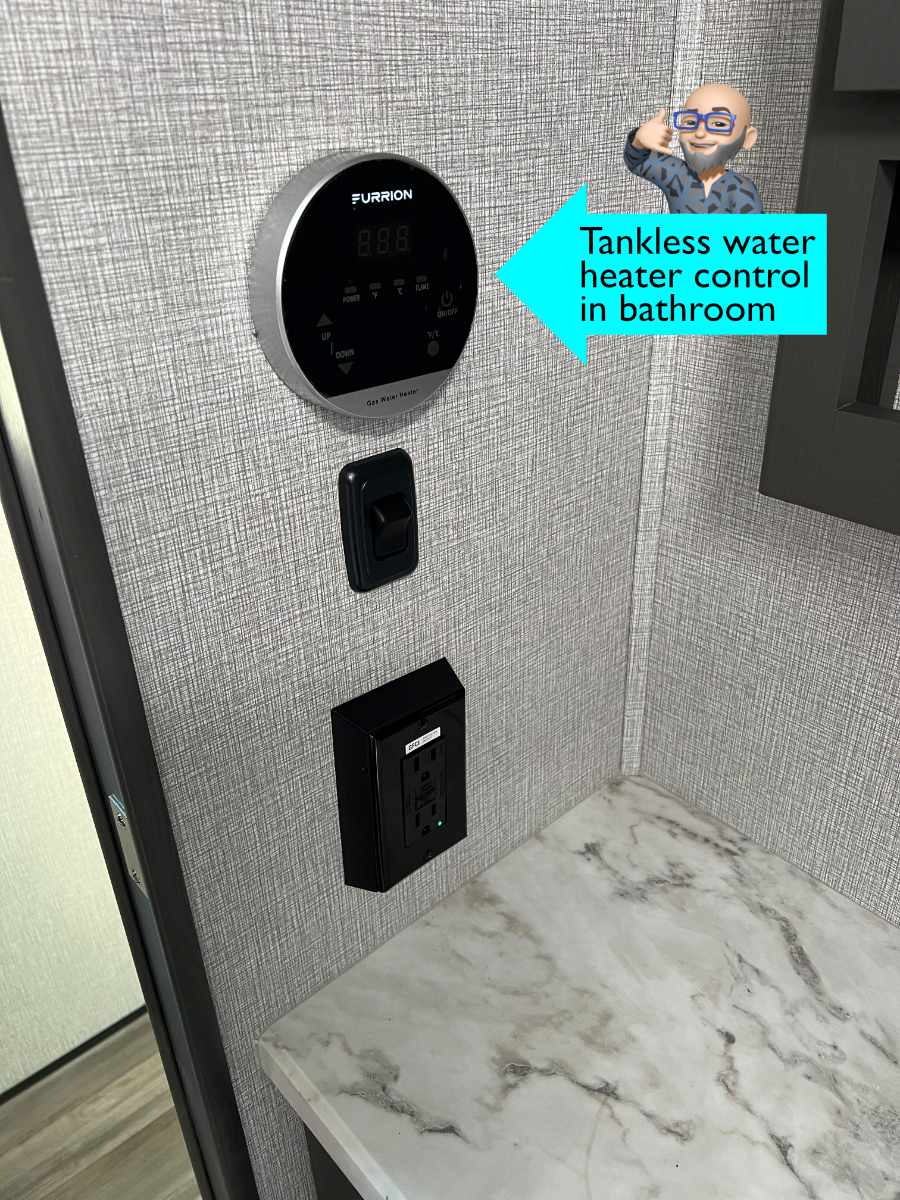
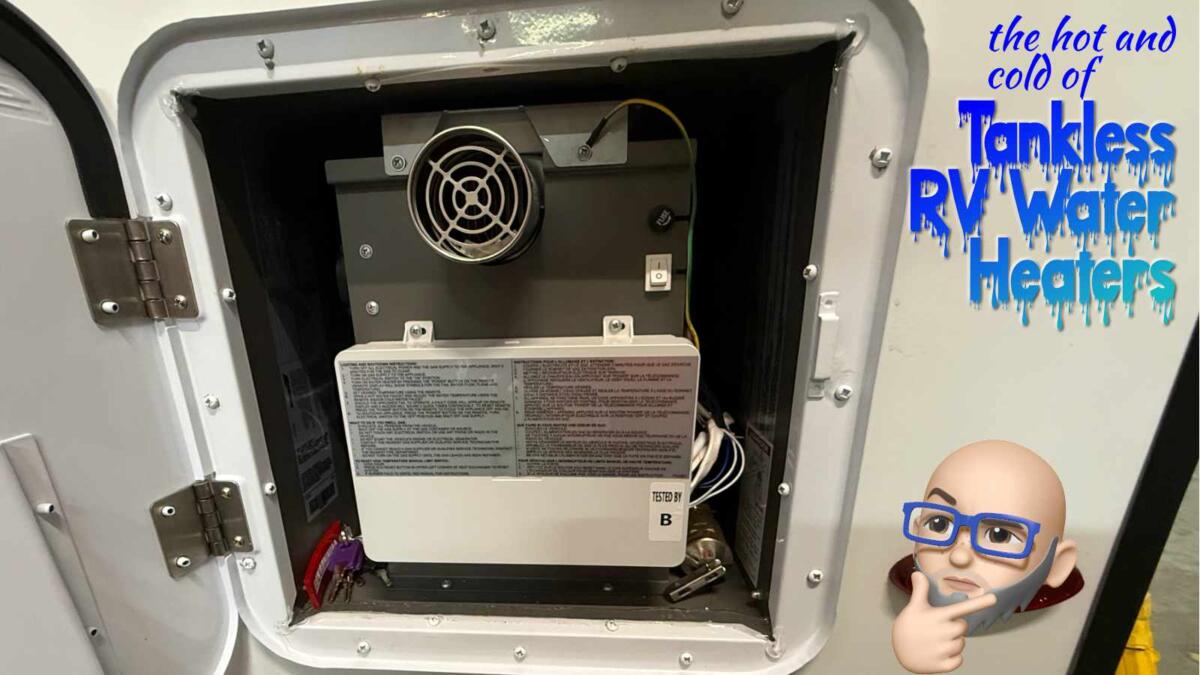
The controls for the tankless water heater are in the bathroom, where you’d want them.

How a tankless water heater works

A tankless heater has a built-in flow meter that lets the water heater know that hot water is being demanded. When you open a hot tap, let’s say at the kitchen sink, the water heater sees that demand and fires up the propane burner to heat the water as it’s coming through. 

Heating water this quickly takes quite a bit of energy, so while it’s actually functioning to heat the water, it’s going through a fair amount of propane. But the idea is that it’s only using said propane when it’s heating the water, which isn’t all that frequent in the grander scheme of things. 

For example, a tankless water heater can easily consume the propane needed to generate a rating of 60,000 BTU. A typical propane/electric water heater is only rated for 10,000 BTU. 

This is why you won’t likely see an electric tankless water heater in an RV any time soon. It takes a lot of energy to change water temperature on demand—typically more than even a 50-amp connection can deliver. A typical bottle of propane has about 431,800 BTUs of energy in it. That’s also very roughly the equivalent of 1,000 100-amp-hour batteries. Liquid propane is very energy-dense. 

Thinking about that flow meter, it also has to see enough demand that it recognizes that you’re after some hot water, so that it kicks on the propane burner to accommodate your wishes. That brings us to the next section: tips. 

Tankless water heater tips

If you have a traditional water heater in your RV or one at home, the common practice is to mix some cold water with the hot to achieve the desired temperature. Makes sense, right? It’s what we’ve been doing for a long time. 

But tankless water heaters are different. One of the many advantages of these is that you can set the temperature that the water heater delivers. Since a tankless water heater needs a certain amount of demand and can deliver water at the temperature you want, the idea is that you set the temperature of the water to what you want to use without ever touching the cold tap. 

Another thing to note is that, like so many things in the RV space, there are vast differences in the quality from one brand to the next. One of the best tankless water heaters is the Truma AquaGo, but there are plenty of import-sourced water heaters showing up in RVs that are of lesser quality. 

One of the things the Truma has is a small tank of hot water, so you’re not waiting for the water heater to cycle on. That is especially annoying if you’re just using hot water in short bursts, such as when washing your hands. 

And, as with so many things, if there is demand, someone out there is going to start making better tankless solutions, which is happening already. I’ve often said that the RV industry is very open to making changes to make customers happy, so shop around—there are choices. 

Downsides of tankless water heaters

Like anything that’s cheaper, it may seem like a great idea at first, and will work out for some RVers. But you may also find that the lower cost means a less outstanding experience. 

One of the bigger drawbacks of tankless water heaters is that they only operate on propane, and they draw a lot of propane when operating. But if you’re at a seasonal site with electrical power, you’re not using that power to heat water, so you’ll have to have propane available. 

That also means that, when the temperatures drop, your RV is also going to demand propane for the furnace, another high-draw appliance, and possibly a stove, as well. The combination of appliances looking to draw propane at a time when less is available due to colder temperatures can mean the appliances just shut down. You can absolutely overdraw your propane system. 

Some tankless water heaters don’t work at higher elevations

Also know that anything with an ignition system uses a balance of fuel and oxygen to achieve a flame. The higher you go in elevation, such as up into the mountains, the less available oxygen you have in the atmosphere. So, some tankless water heaters simply don’t work at elevations of 4,500′ or greater. Propane water heaters can be troublesome here in Albuquerque, where I call home, since we’re at 5,300 feet of elevation. 

Yep, you could say I’ve got my head in the clouds, and the air is thin up here, which may explain some of what I write about… Lack of oxygen to the brain. 

Yes, you can re-jet them to operate at that elevation. But if you’re only visiting, this is a lot of work when a simple propane/electric water heater would have operated just fine on electric power. 

Oh, and speaking of simple. A tankless water heater has a bunch of components in it that are more complicated, including that aforementioned flow-measuring system. The more complicated things are, the more there is to go wrong. 

Tankless water heaters are also not so great with short bursts of demand, such as Navy showers or hand washing or even dish washing. They have to cycle up every time you turn on the hot tap and then cycle back off. 

This also means that you’re likely using more water to just get the darned water heater to cooperate. So, tankless water heaters are less than ideal if you enjoy boondocking. 

What can you do

There are still RV companies using tank-style water heaters, although there are fewer doing so just because of the cost. If your RV did not come with a tank-style water heater, it’s not that simple to replace the water heater because you’ll need to run a 120VAC line to the water heater to operate the electric side. 

But you can also let your voice be heard. If you did buy an RV with a tankless water heater and you don’t like it, let the RV manufacturer know. But, if you do like it, also let them know. The RV industry is very responsive to well-voiced customer feedback, so they may change if customers demand that change. 

(Click to enlarge.)

Lastly, know that the device I’ve been going on about is a water heater, not a hot water heater. If you already had hot water, you wouldn’t need a water heater. 

RELATED

RVT1256

Dry-rotted floors in RVs and what it would take to fix them

By Dustin Simpson
Our RV repair shop received the following email from John W. regarding his RV’s dry-rotted floor:

Hello,
We have a Riverside Retro 186R with an area of rot in the subfloor. I know you guys are busy, but you come highly recommended and I would appreciate an estimate for repairs. I can bring the RV to you for an estimate if needed. I’ve included a photo, the rot is in the area marked by green tape.
Thank You, John

Dry-rotted floor

Well, John and others, join me as I sit down with my Service Manager, Zach. In this video, we share our initial thoughts on how extensive the water damage may be in the dry-rotted floor and what it would take to fix it.

This is good information to remember in case this happens to you and your RV. Water damage is common, so if it happens, know how to take care of it before it gets worse!


More from Dustin

Join us on YouTube. Read more of Dustin’s articles here.

RELATED

RVT1256