Sometimes the smallest items make the biggest difference. Check out these three gadget helpers that can make RV life easier and help keep you more organized.
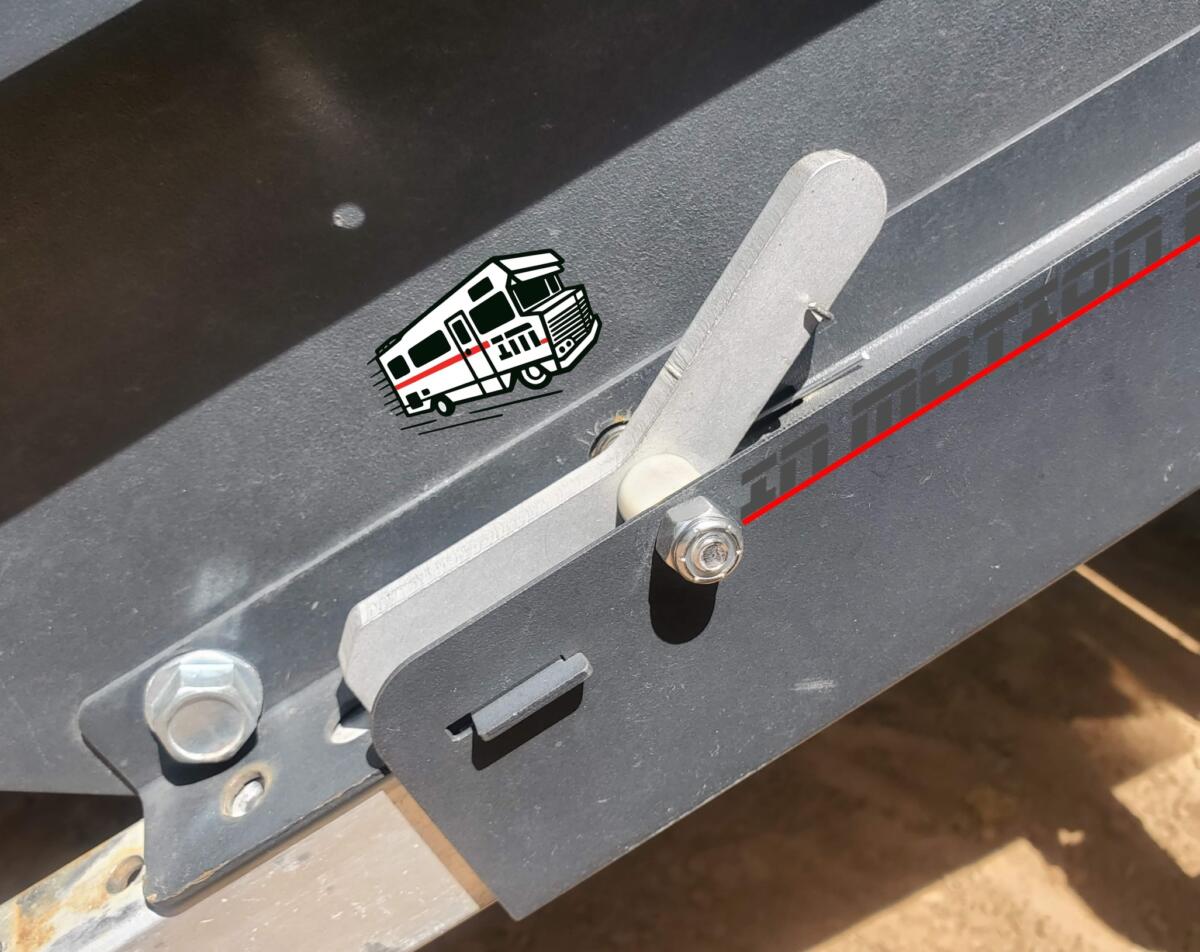
Step Lever pins
Most modern towables use Lippert’s Solid Step or similar solid-step systems. That’s because they’re more stable than the old folding steps. If you’ve ever had to adjust these steps because of uneven ground, you may find those adjustments don’t always come easily.
Here’s good news: Aftermarket Step Lever pins replace the factory pins with a beefier, easier-to-grab lever pin. The Step Lever lets you line up the adjustable-leg holes and lock the foot length much faster and easier, too.
This helpful gadget comes as a matched pair and includes the hardware and hex key you need for installation.
Quick tip:
For step hardware, make sure any replacement pins or levers are compatible with your specific Solid Step model. You can email to confirm compatibility here: sales@inmotionrv.com
Gap filler
It happened again on our recent trip. The key fob slipped out of my pocket and into the hidden and mysterious region known as the seat gap. At first, I couldn’t even see the fob. Then, once I spotted it, I couldn’t reach it! After multiple tries and humiliating acrobatic poses, I finally dislodged the fob. I needed a quick fix! The seat gap filler solved the problem.
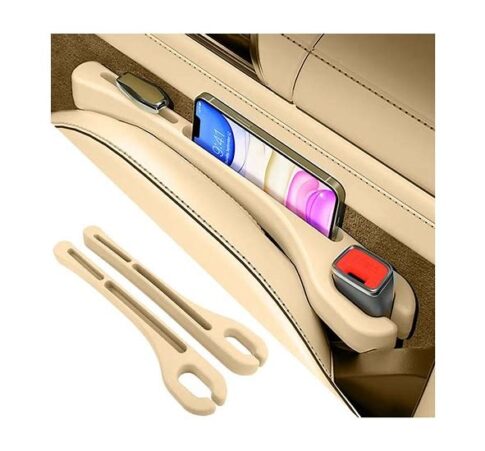
If you’ve dropped your cell phone down the gap between the driver’s seat and console, you understand my frustration. A seat-gap filler is a slim wedge or pocket that plugs the space between the seat and the center console. Some versions add a phone holder so small items stay put and are easy to reach.
I chose this one, but you can find many different configurations on Amazon. It comes in a two-pack and is an inexpensive option sold through multiple retailers. Check listings for dimensions and relax knowing this gadget will prevent items from falling into the abyss.
Quick tip:
Measure the gap in your seats. Not all fillers fit every car or RV seat, and deep center consoles can defeat some fillers. Check to ensure that your seatbelts, hand brake, or other controls function with the filler in place. Look for washable materials if you snack while traveling.
Back-of-seat organizer
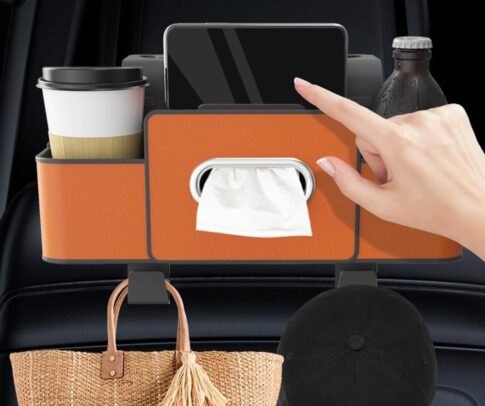
A slim, multi-pocket organizer that hangs off the back of the front seats is one of the simplest space multipliers in a vehicle. Most models are multifunctional and combine pockets, tablet holders, cup/container spaces, and more.
Look for an organizer that best fits the way you travel. Take time to look through the numerous Amazon listings and product pages. Compare capacity and features to find the organizer that most closely matches your needs.
Quick tip:
Choose organizers that fasten securely on your seatbacks. Wipeable fabrics are best. If you want a tray for meals, confirm the tray weight rating and whether it locks in place. If you travel with little children, pick models with reinforced seams and extra pockets for drinks and wipes.
A quick checklist
For any of the three gadgets introduced here, use this checklist:
Carefully measure the space
Read a few hands-on reviews and watch short videos if available
Pick washable/wipeable materials.
How about you?
Do you have a clever and helpful gadget that makes RVing easier? Use the comments to tell about it.
Your RV’s suspension system plays a critical role in safety, handling, and tire life. Suspension hangers, shackles, bolts, and bushings carry the full load of your RV while traveling, and when these components wear or fail, the results can be costly—and dangerous.
At California RV Specialists, we routinely see preventable damage caused by worn suspension components that went unnoticed. A proper inspection can help identify problems early and avoid breakdowns, frame damage, tire failures, or loss of control while towing.
Safe inspection setup
Before any suspension inspection begins, the RV should be positioned on level ground with wheels securely chocked. If the RV is lifted, a proper jack must be used, and the frame must be supported with approved jack stands. A jack alone should never be trusted to support the weight of the RV.
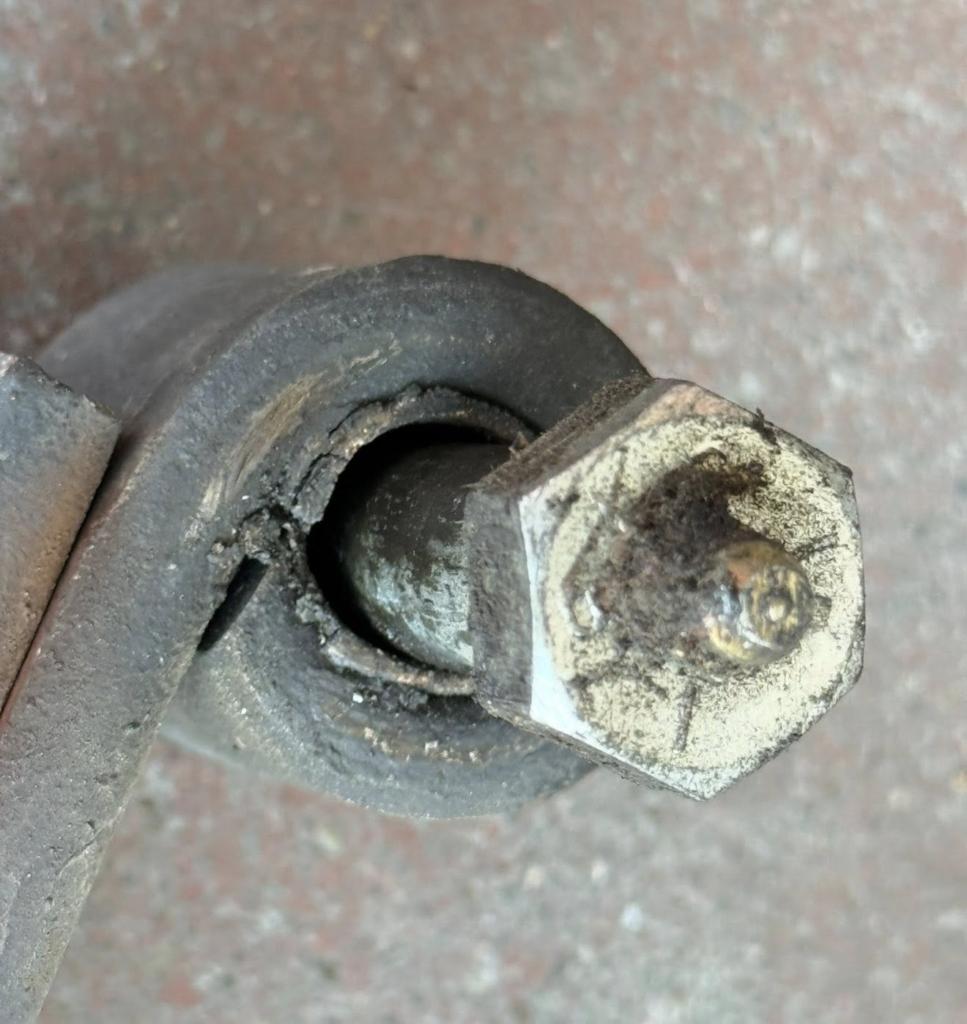
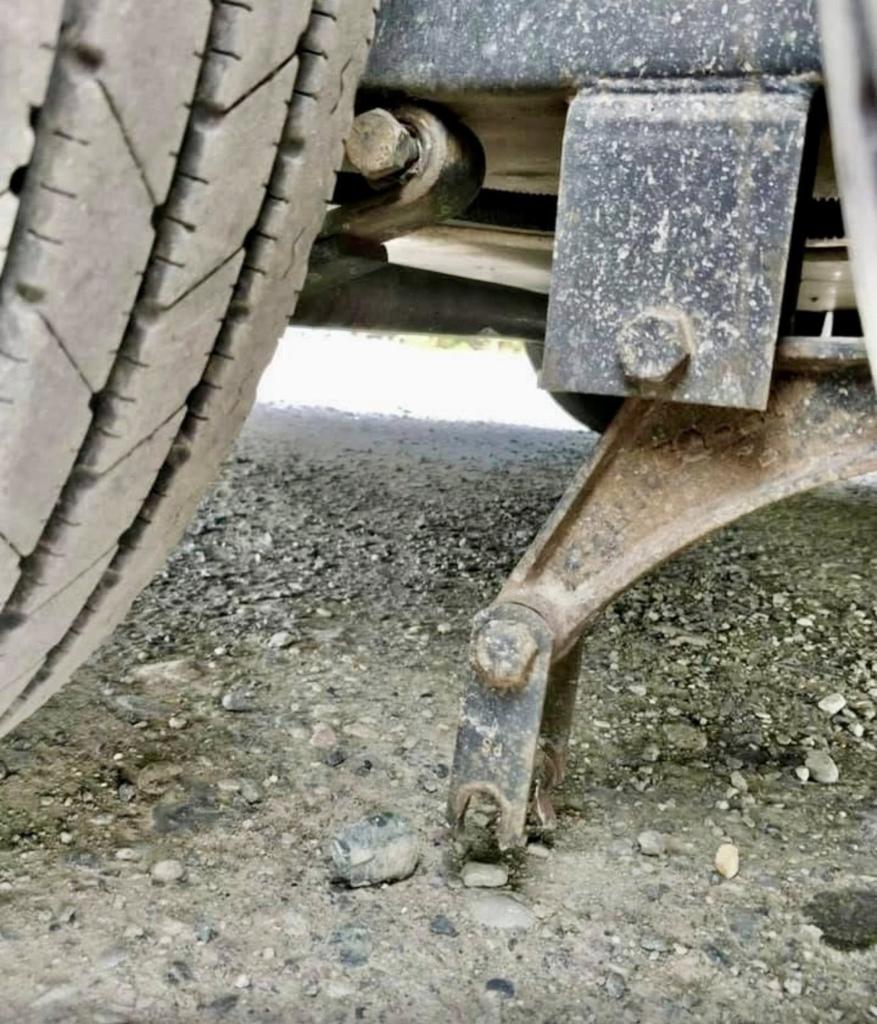
Broken leaf spring bolt
Visual inspection
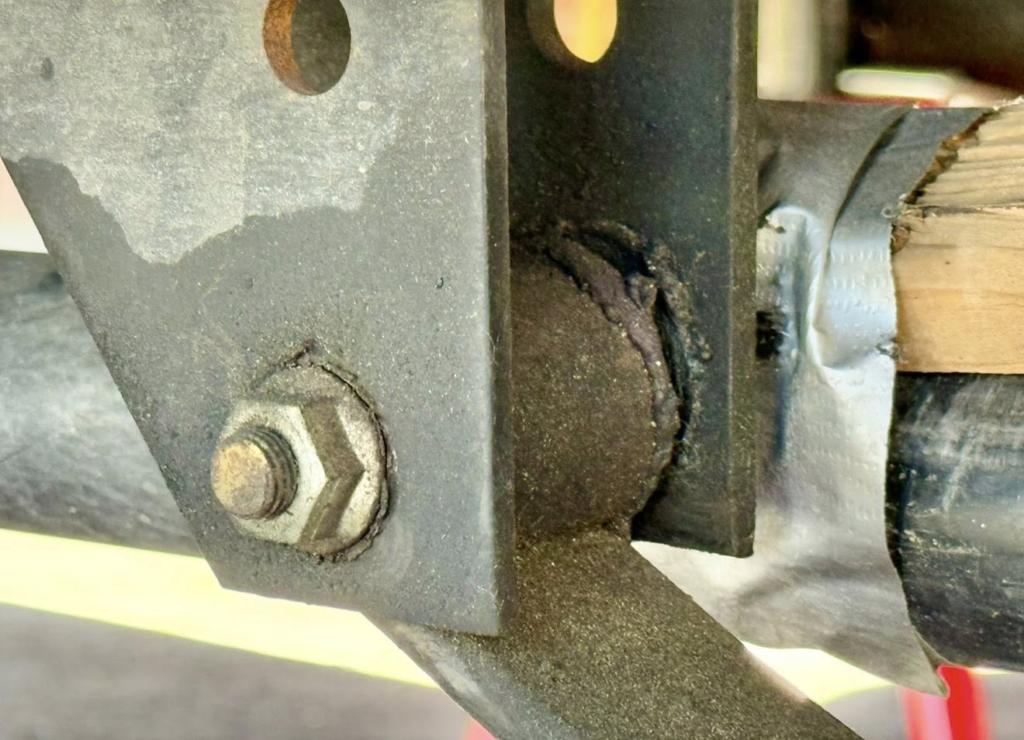
Each suspension hanger welded to the frame should be carefully examined for signs of cracking, broken welds, or deformation. Elongated or distorted bolt holes are a warning sign of excessive movement and wear.
Shackle plates should be straight and properly aligned. Bent or angled shackle plates often indicate worn bushings or improper suspension geometry.
Bolts should be inspected for signs of grease leakage, dry operation, rust, or metal wear. On units equipped with wet bolts, grease should be present and not dry or contaminated.
Broken off leaf spring hanger bolt
Physical movement check
Using a pry bar, gentle pressure can be applied between the spring eye and hanger or equalizer to check for excessive play. Some pivot movement is normal, but noticeable clunking or excess movement typically indicates worn bushings or hardware that requires attention.
Signs of movement
Bolt and bushing condition
Shackle bolts that are dry, rusted, or non-greaseable tend to wear rapidly and should be monitored closely. Greasable wet bolts should be serviced until fresh grease exits the bushing area.
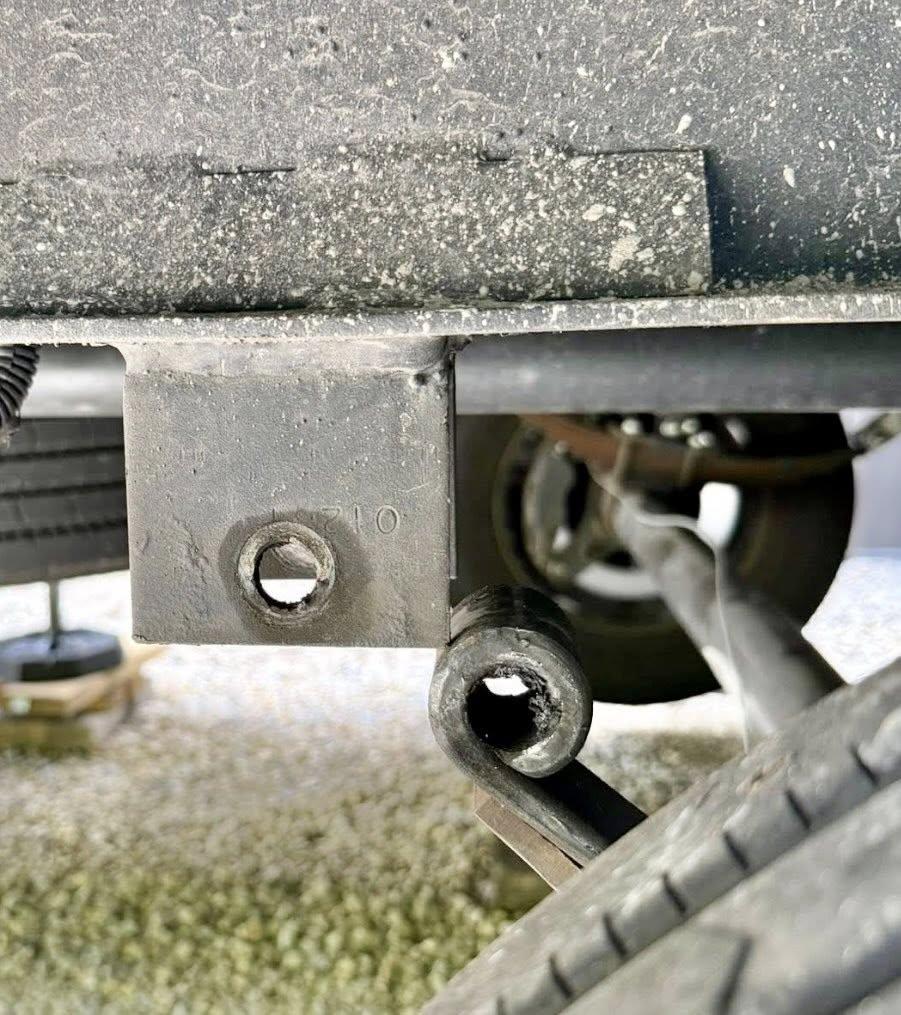
Bushings inside the spring eyes and equalizers should be inspected based on their material type. Nylon bushings often show cracking, missing material, or oval-shaped wear when failing. Bronze bushings should be checked for grooves, looseness, or visible damage.
Worn shackle bushing and damaged leaf spring eye
Tire wear and ride symptoms
Suspension wear often shows up in the tires before a failure occurs. Uneven tire wear, scalloping, or excessive inside or outside wear may indicate suspension movement or misalignment.
While towing, listen for clunking, banging, or popping noises coming from underneath the RV. These are strong indicators of worn shackles, bushings, or hanger issues that should be inspected immediately.
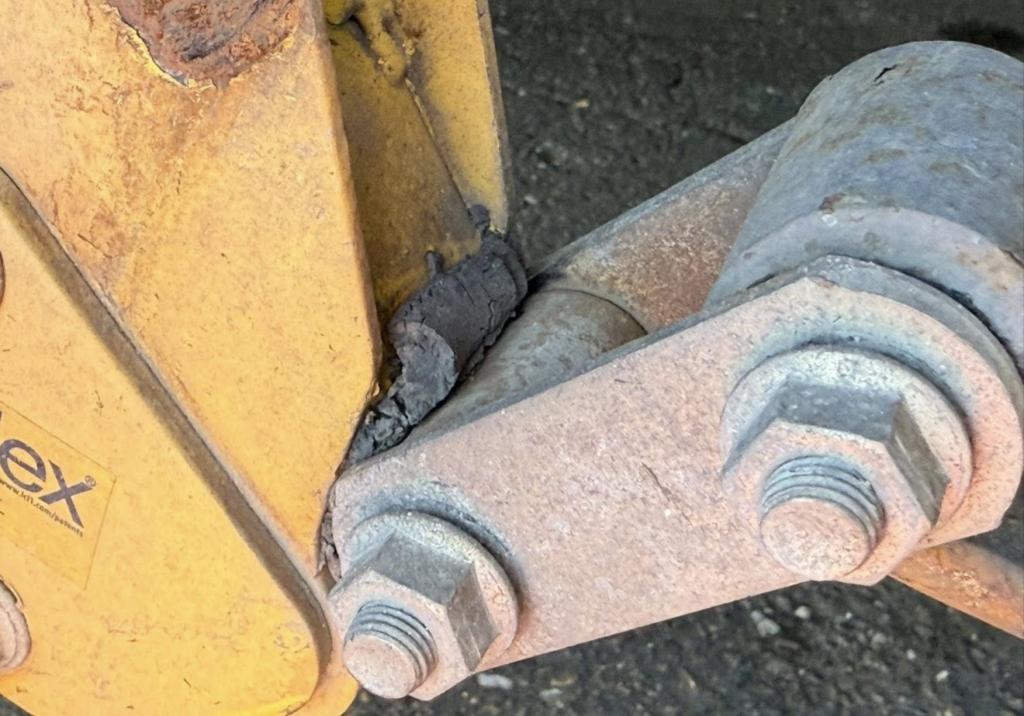
Damaged rubber bushing and loose shackle links
Recommended inspection and service intervals
Suspension inspections should be performed every six months or approximately every 5,000 to 6,000 miles.
Nylon bushings typically require replacement between 7,500 and 15,000 miles, or sooner if wear is evident. Bronze bushings used with wet bolts should be inspected at the same intervals and replaced as needed. These often last 20,000 to 40,000 miles or more with proper maintenance.
Wet bolts should be greased every 3,000 to 5,000 miles, or at least twice per travel season to prevent premature wear.
Why suspension inspections matter
Failing to inspect and maintain your RV suspension system can result in severe damage, tire blowouts, loss of control, or injury to you and others on the road. Suspension failures frequently lead to ruined trips and expensive emergency repairs that could have been avoided with routine inspections.
A properly maintained suspension system ensures safer towing, longer tire life, improved ride quality, and peace of mind every time you travel.
How do you get great answers to your RV questions on social media? Something that I’ve seen frequently is questions that only leave questions and can’t produce good answers. Something I’ve written numerous times is that the more you know about your RV, the better your overall RV experience is going to be.
So this week’s column is for all of you who have an RV, which, I believe, might be a few of you. Some of you may be dreamers, and some may have already hung up the keys, though.
I would imagine that those of you reading this span the gamut of experience within the RV space. But something that lots of folks enjoy doing is being helpful. I think there’s some human gene that forces us to answer a question we see asked on social media. It seems we can’t help ourselves.
Questions about water heaters on social media. (Click to enlarge.)
But answers are like rear ends—we all have them, and some of them stink. In fact, some of the answers I’ve seen on social media could produce downright dangerous results.
How to get the best answers
So the point of all this is: If you are new to the RV space and have a question, the more detail you can provide in that question, the better the results are going to be.
For example, there was a question today about low water flow from the water heater. But no mention of the type of water heater or even the type of RV. Just a water heater.
Having more information might be very helpful. It would almost certainly help to answer the question, but I wonder if the original poster (OP) even knew what kind of water heater they had?
The answer to this question might well be that their winterization valves aren’t completely turned for use—but there are so many other possibilities.
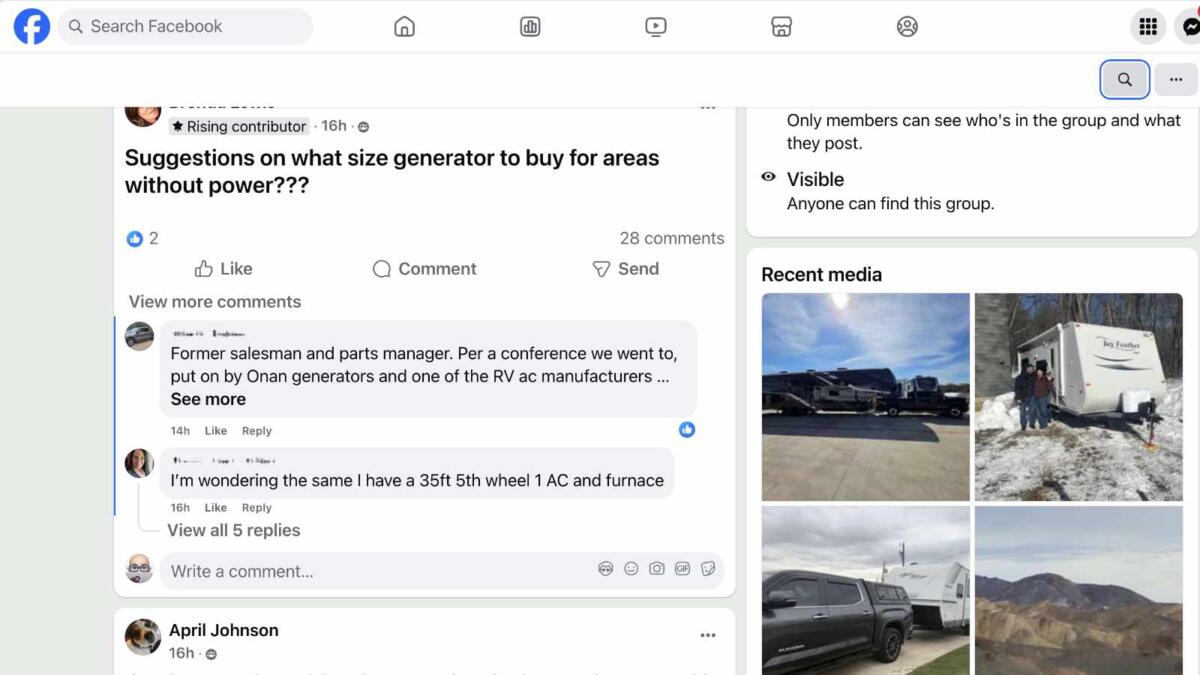
The other question that lit a fire under my keyboard was about generators. This time of year, there are lots of those questions, and many of them ask how big a generator they need to run their RV.
How big a generator do I need? (Click to enlarge.)
No mention of the RV. No mention of the number of A/C units (which is often the determining factor) or other things that would actually help answer the question correctly.
The bottom line is that you’re much more likely to get a great answer with a question that provides sufficient details to make it possible to answer. But here’s another little tip.
Search function on social media
Did you know that social media has a search function?
So, let’s say you have a question about your water heater or about winterization or just whatever. You can actually use the search function on social media and potentially find that your question was already asked and answered multiple times.
In all the Facebook groups I run, we actually insist that someone use the search function first so that it’s not the same question over and over and over again. I have annoyed more than a few members by insisting that they use the search feature.
By finding your answer and, potentially, adding to the answers already there, you push that question right up to the top, where others can see it, as well. It helps everybody, but especially the moderators who have to see the same questions over and over again.
We love to be helpful
As humans, we love to be helpful and resourceful and look like we know what we’re talking about, and I can help you with this, too.
But here’s a way to look brilliant and be really helpful at the same time. For free, no less. Did you know the resource you’re enjoying right now also has a whole section for beginners? No, seriously!
We have an entire beginners’ section here at RVtravel.com. And you don’t even have to be a newbie to take advantage of this!
However, let’s say you see a question asked on social media. Like that water heater question, for example.
You can just come here, do a search on the top search bar, and we’ve covered it. Well. So you can go back and share that post and look like you’re the Einstein of the RV line. For example, this post about troubleshooting a water heater may answer those water heater questions, or at least help the new RVer learn more.
Now you’re sharing verified information that real RVers and editors have verified.
And let me share one more thing: All this AI nonsense online means websites are literally scraping sites like RVtravel.com and every other site I work for and trying to guess what the real answer is. Sometimes it works. Sometimes it fails. And those failures can cause expensive mistakes and even injuries.
Plus, I know that traffic on websites like this one and my own has been hurt by people thinking that AI is providing the best answer. So, by sharing stories from here, you’re also helping keep this resource alive.
So, now you’re helping others, helping yourself, probably becoming better looking, and definitely doing a good thing.
Seriously, though, we appreciate the shares a lot. And so will the people you help.
BTW, did you know that when you search for something there’s a trick to get the good old fashioned search results and skip the AI results at the top? Yep. In the Google search bar, for example, type what you’re searching for then type ” -ai” (space hyphen ai), and it will skip the AI search results. Try it. You might like it!
By Cheri Sicard
Have you ever considered buying an RV lot to park your RV on and live in when you’re not on the road?
The team from Nomadic RV Living produced an invaluable video as a comprehensive resource of the things you need to examine and consider before making a major purchase like this.
The video focuses on purchasing an RV lot in an established RV park as opposed to developing your own RV lot. However, some of the information will also be applicable if you do decide to purchase raw land for your RV.
There are so many things to consider when looking for land or a lot for your RV. Some may seem like common sense, but some you might not have ever thought about before.
The video aims to help you make wise choices and avoid mistakes.
The most important points you MUST consider when buying an RV lot
• HOA dues: Are they annual or monthly, and what exactly do they include or do not include? They might include things like water, electric, sewer, Wi-Fi, etc., but you need to be clear on this up front in order to avoid unpleasant surprises.
• Special assessments: You will want to know if any upcoming special assessments are planned. These are those special high-ticket repair items or upgrades that periodically appear in a homeowner’s association. If there are, you can use this as a negotiation tool in the purchase of your property.
• Financial assessment of the association: You should examine this to make sure you are buying into a sound investment on solid ground. The association should have financial reserves. If the association is broke, you can expect the dues to go up to help compensate.
• Water: Where is it coming from, what’s its quality, and who pays for it? Is the site already plumbed?
• Sewer: Is there one, what type, and, again, who pays for it?
• Electric: Does the site have 30 amp, 50 amp, both, or none? Who pays for electric, and how, is important to determine in advance.
• Property taxes: You need to know how much of a property tax burden you will be taking on in order to make an informed financial decision. Are any back taxes owed on the lot? The county assessor can let you know.
• Insurance: The video discusses various scenarios you might encounter and suggests the best way to keep yourself protected.
Secondary considerations when buying an RV lot
Beyond those important points, there are some other elements the video says you should consider before buying an RV lot. Some of these points may or may not be important to you personally, but it is always good to be informed. These include:
• Condition of the lot and park
• Is the community gated?
• Does the community allow you to live there full time? If not, what are the parameters of when you can and cannot use the lot?
• Are you allowed to rent your lot and, if so, under what terms?
• How many structures can you put on your lot and how big can they be?
• Can you have more than one RV on your lot?
• How long can guests stay and under what terms?
• What are the community amenities?
• Can you put a washer and dryer on your property in your shed?
• Are there any RV type or age restrictions?
• What additional rules and regulations are there?
• How close are needed services? How far are you willing to drive daily, or weekly, for those services?
• Are there any negative elements around the community, such as a landfill or an airport flight path?
• Seasonality and environmental factors can affect how much you use your lot; investigate accordingly.
These are the big points, but be sure to watch the video for more details and examples of various scenarios the team has encountered while trying to buy their own RV lot. Doing so can save you a lot of aggravation and money!
And, last but not least, the video advises to always, always, ALWAYS physically inspect your lot in person before putting down any money. Pictures on the internet can be deceiving. That’s excellent advice!
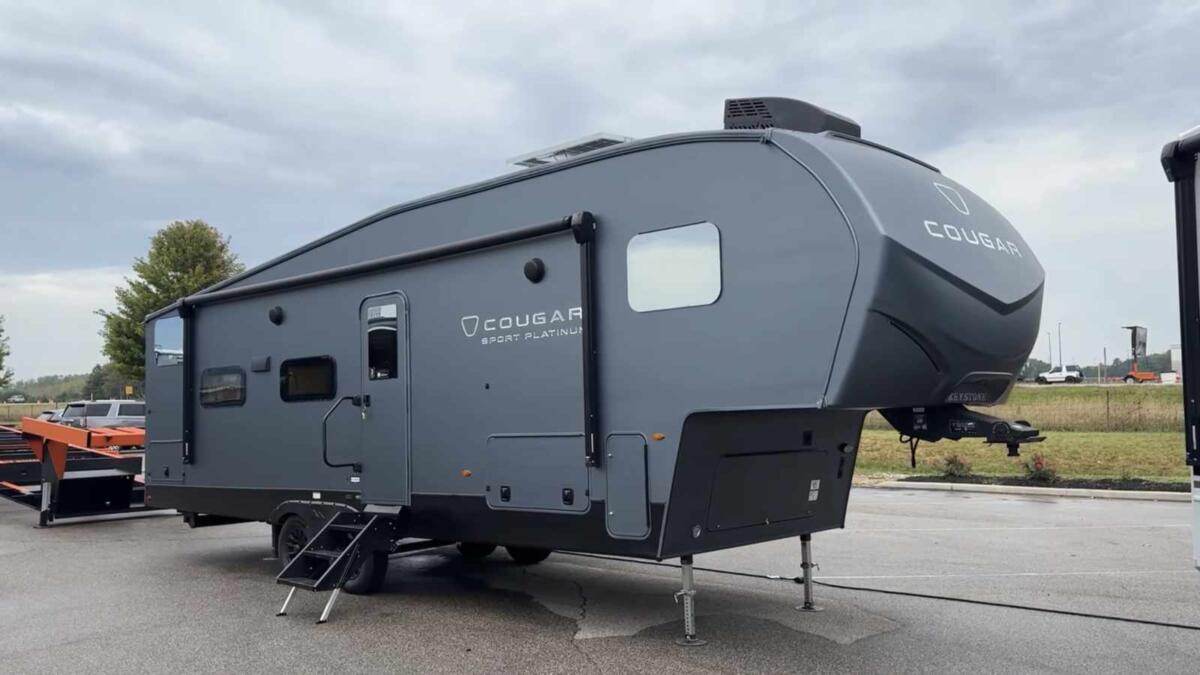
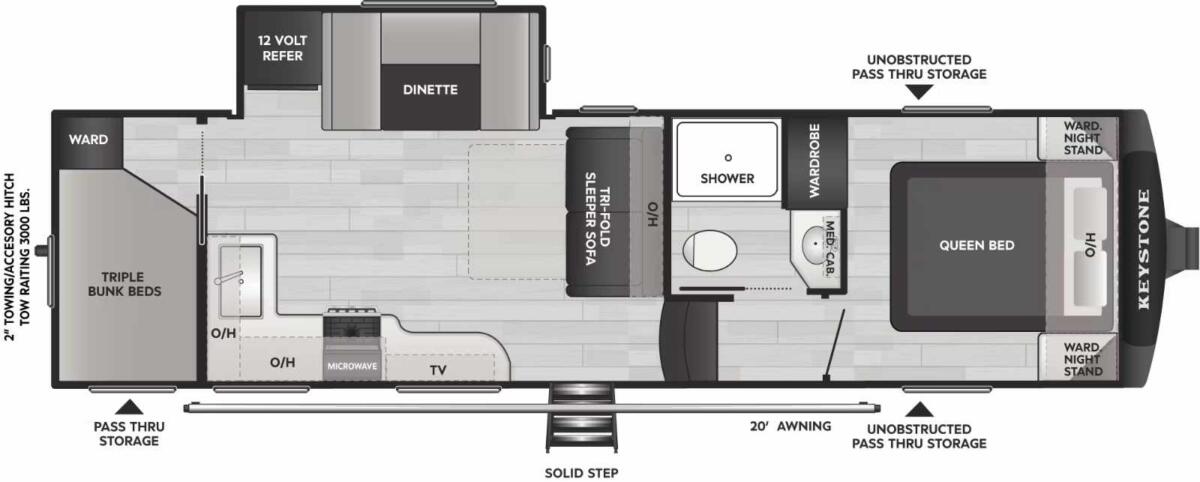
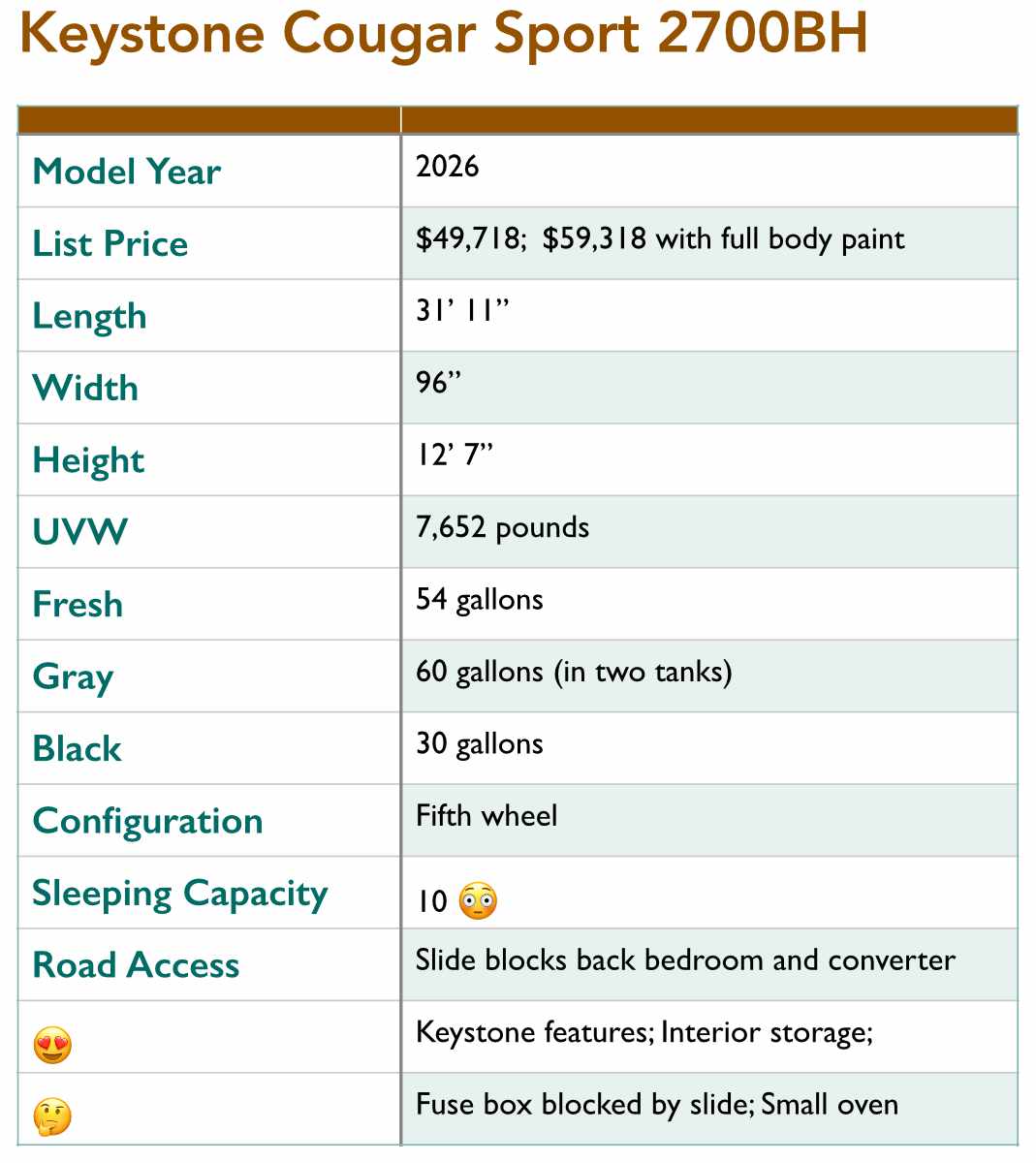
Today’s RV review is of the 2026 Keystone Cougar Sport 2700BH. What we’re looking at is one of the more affordable fifth wheel offerings in Keystone’s Cougar line. It has a triple-decker bunk in the back that is capable of sleeping six.
Each of the rear bunks is a double-over-double, so you could also make a nice space for one adult on each of the three levels, and they’d have a decently large space to dream about RVs and RV reviews. Or whatever.
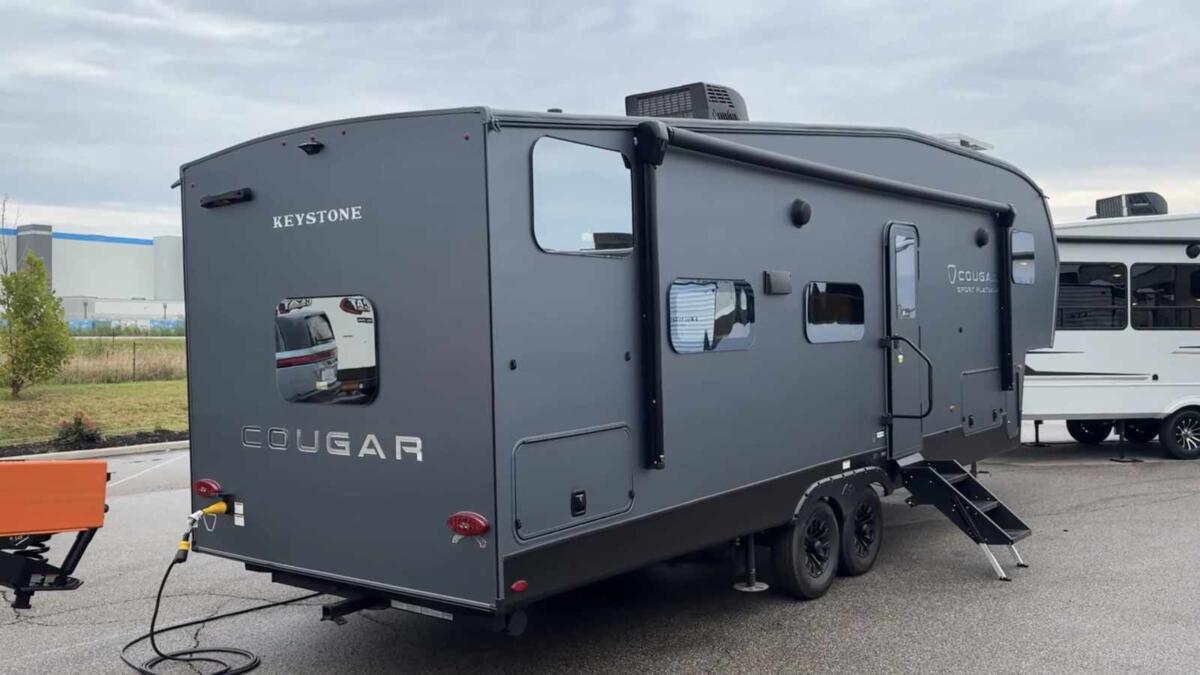
This trailer has a lot to offer at a really fair price, with a couple of exceptions and a couple of fails on Keystone’s part. However, they’re not ones that are super major. This is also available either in a traditional RV finish with the usual exterior look or a full body paint that’s a matte gray called Shadow Gray that I absolutely love. Maybe because I look at RVs all day, or maybe this is just really impressive. However, it should be, as the price tag on this appearance package is almost $10,000. But paint’s expensive nowadays.
Keystone’s Cougar line extends to travel trailers and fifth wheels. In the fifth wheel world, there’s the Sport, Half Ton (don’t get me started), and the Premium lines.
Start at the road with the Keystone Cougar Sport 2700BH
Being one of the more affordable offerings in Keystone’s Cougar fifth wheel world, this rides on an imported brand of tire. However, they did include an anti-lock braking system that also incorporates some sway mitigation and the ability to track the trailer’s mileage.
There are also two holding tank connections and, come on guys, they’re both under the slide room with manual valves. I don’t know about you, but I’m no gymnast. So seeing my flabtastic self squeeze under a slide and, hopefully, avoid making a bad dump decision isn’t how most families want to spend their getaways.
The slide mechanism in this rig is a cable slide, and I know some of you don’t like these. I don’t really have an issue with them, but you do need to stay on top of the cable tension and all will be fine.
The walls in these trailers are completely human-made components with human-made substrates in the laminate, along with fiberglass exterior panels and aluminum studs. That’s also similar to how the floor is made, so none of these structural elements is really susceptible to normal water damage. Nice.
I do like how Keystone consistently wires their trailers. Also, there are a number of other things their Innovation Lab has done to make things easier or better.
Keystone Cougar Sport 2700BH - 2026
1 of 10
Floor plan of the Keystone Cougar Sport 2700BH
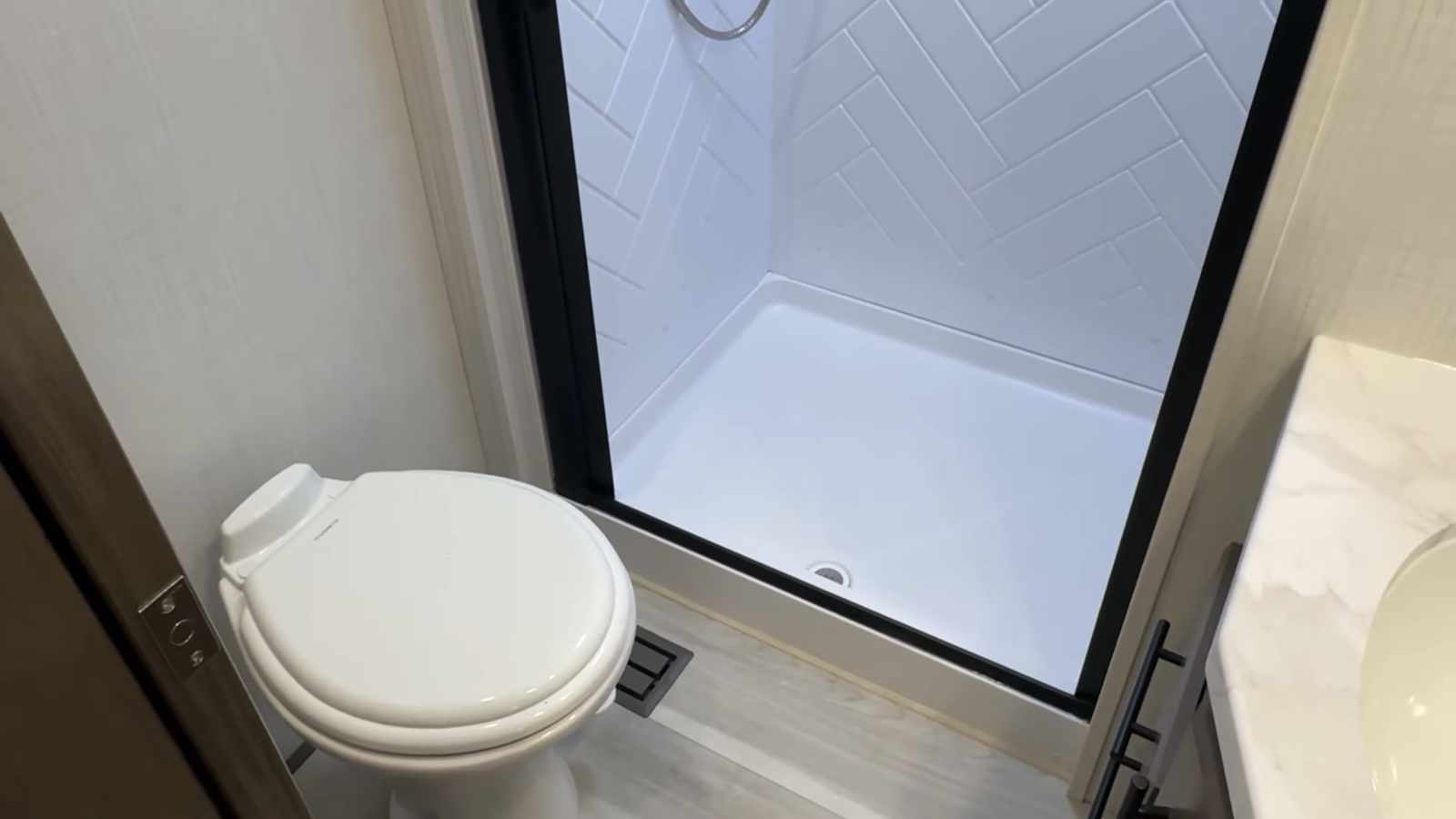
A decent bathroom in the Keystone Cougar Sport 2700BH
A matte full body paint option offers a dramatic appearance on the Keystone Cougar Sport 2700BH
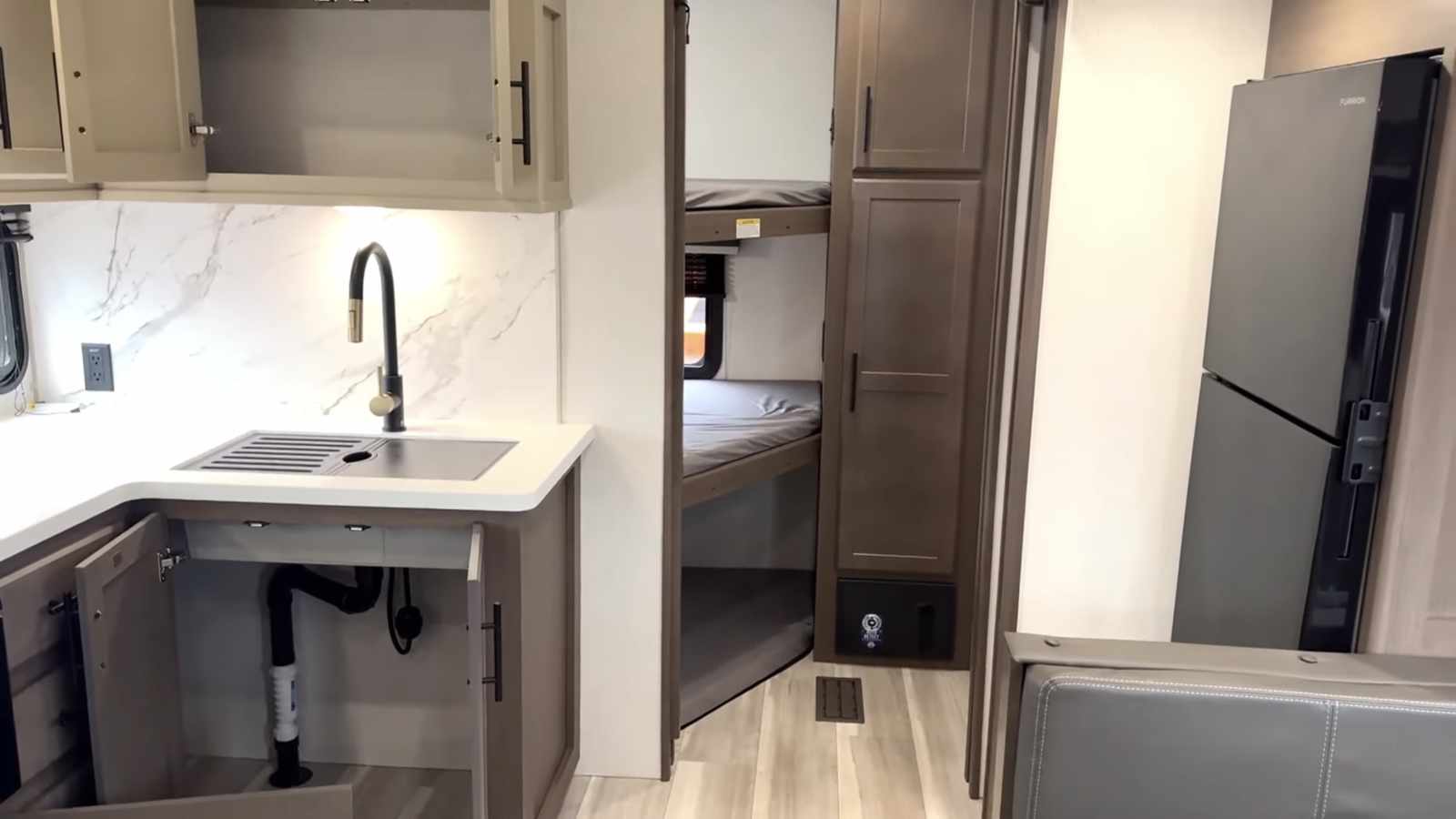
A triple double-over-double bunk offers plenty of sleeping space in the Keystone Cougar Sport 2700BH
Good bedroom storage plus an optional second A/C unit in the Keystone Cougar 2700BH
Good interior space, but that fuse box is blocked by the slide
Lots of kitchen counter space, but a 17" oven is a bummer
Storage is a strong point with good seating and counter space
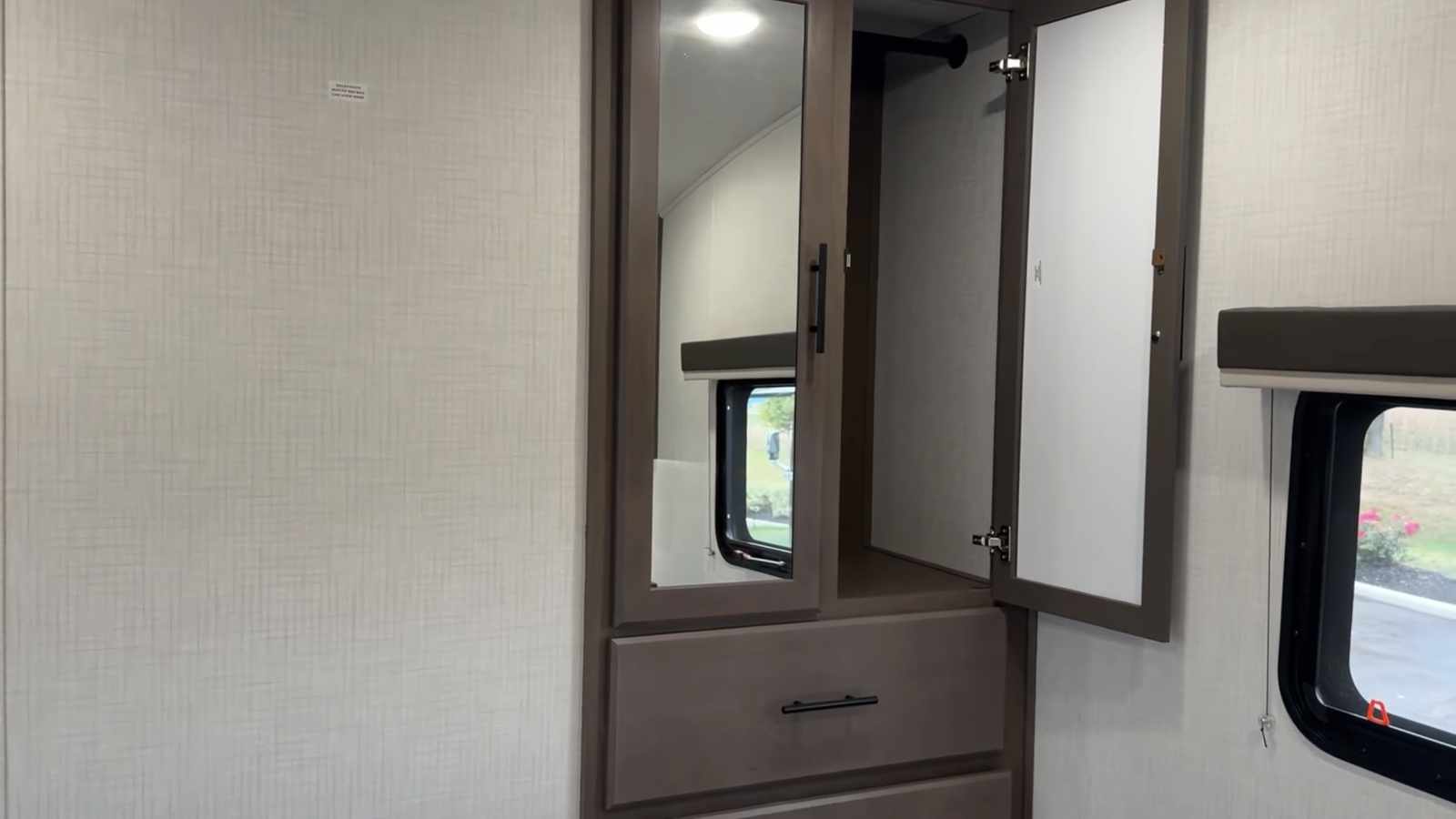
A closet and drawers add storage space in the upper bedroom of the Keystone Cougar Sport 2700BH
Step inside the Keystone Cougar Sport 2700BH
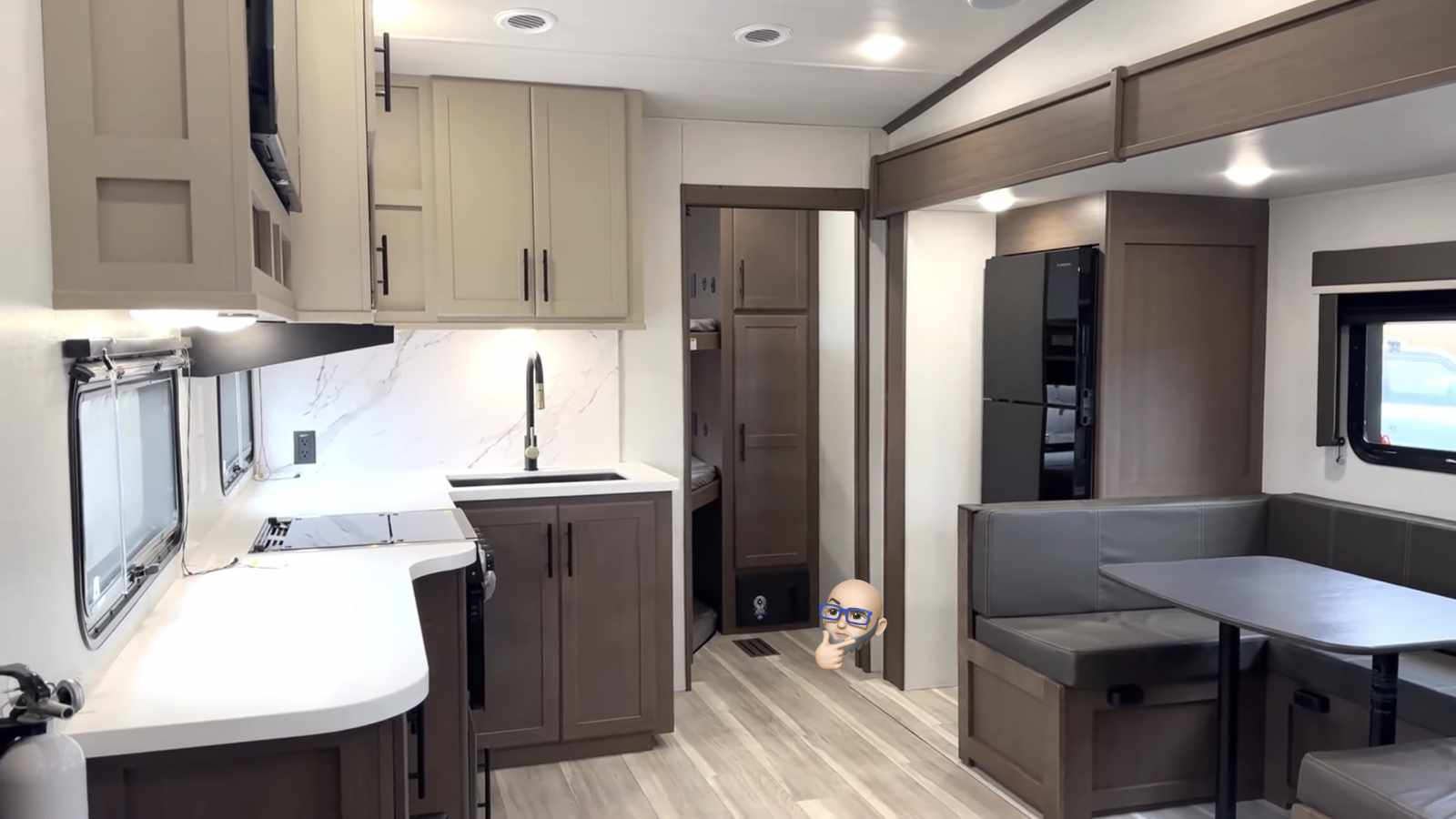
Whether you get the Shadow Gray exterior or not, the interior is the same—and that’s not a bad thing. There’s a very long countertop on the camp side of this trailer with a lot of drawers and cabinets. Storage is definitely a strong suit, as it should be if you’re able to sleep 10 people.
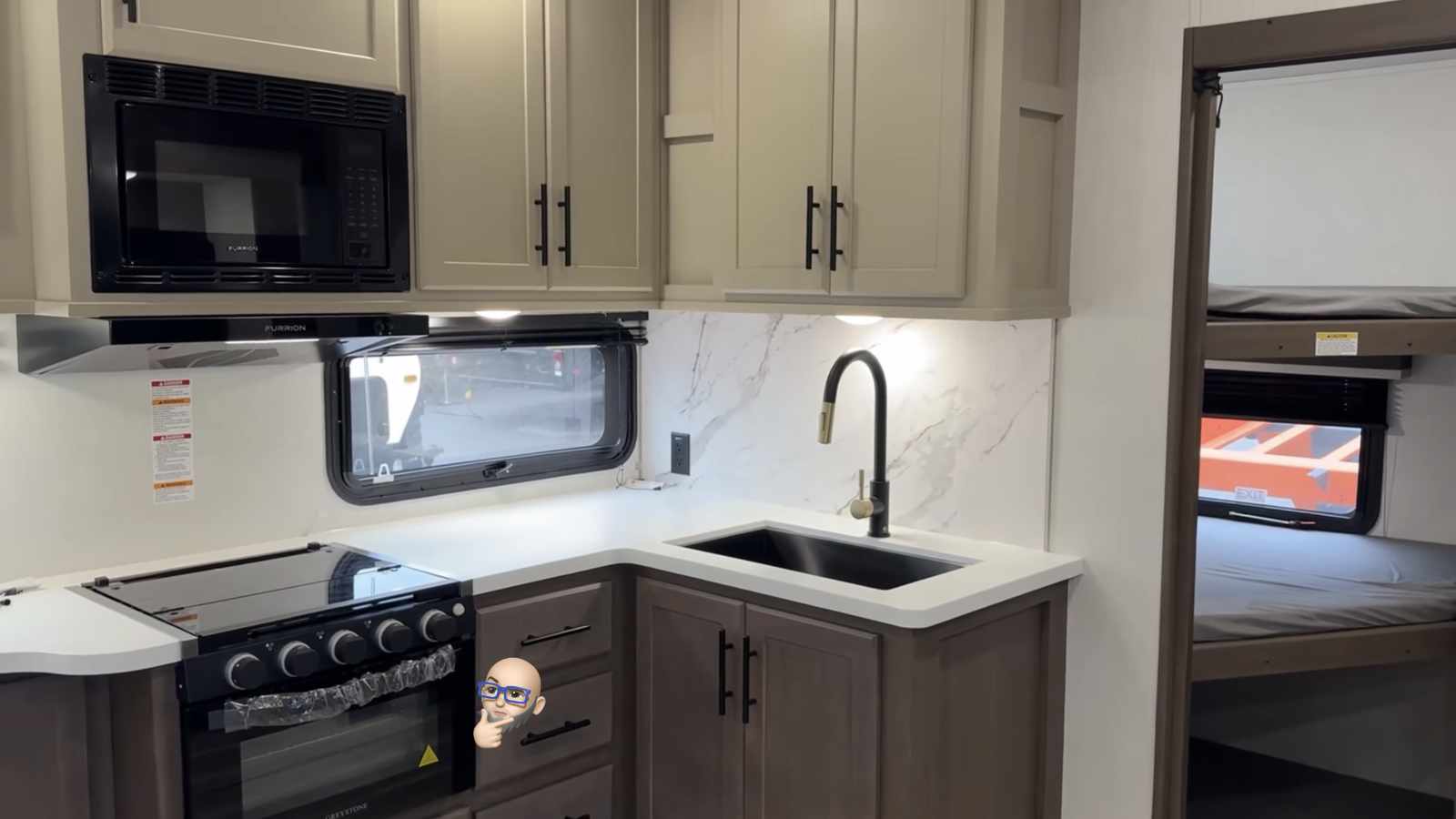
The big flaw in this kitchen is that there’s a minuscule 17” (vertical) propane oven under the three-burner propane stove. This makes no sense normally, and even less if you’re accommodating the entire Brady Bunch. Well, Alice wouldn’t have a place to sleep, but all the kids and parents would.
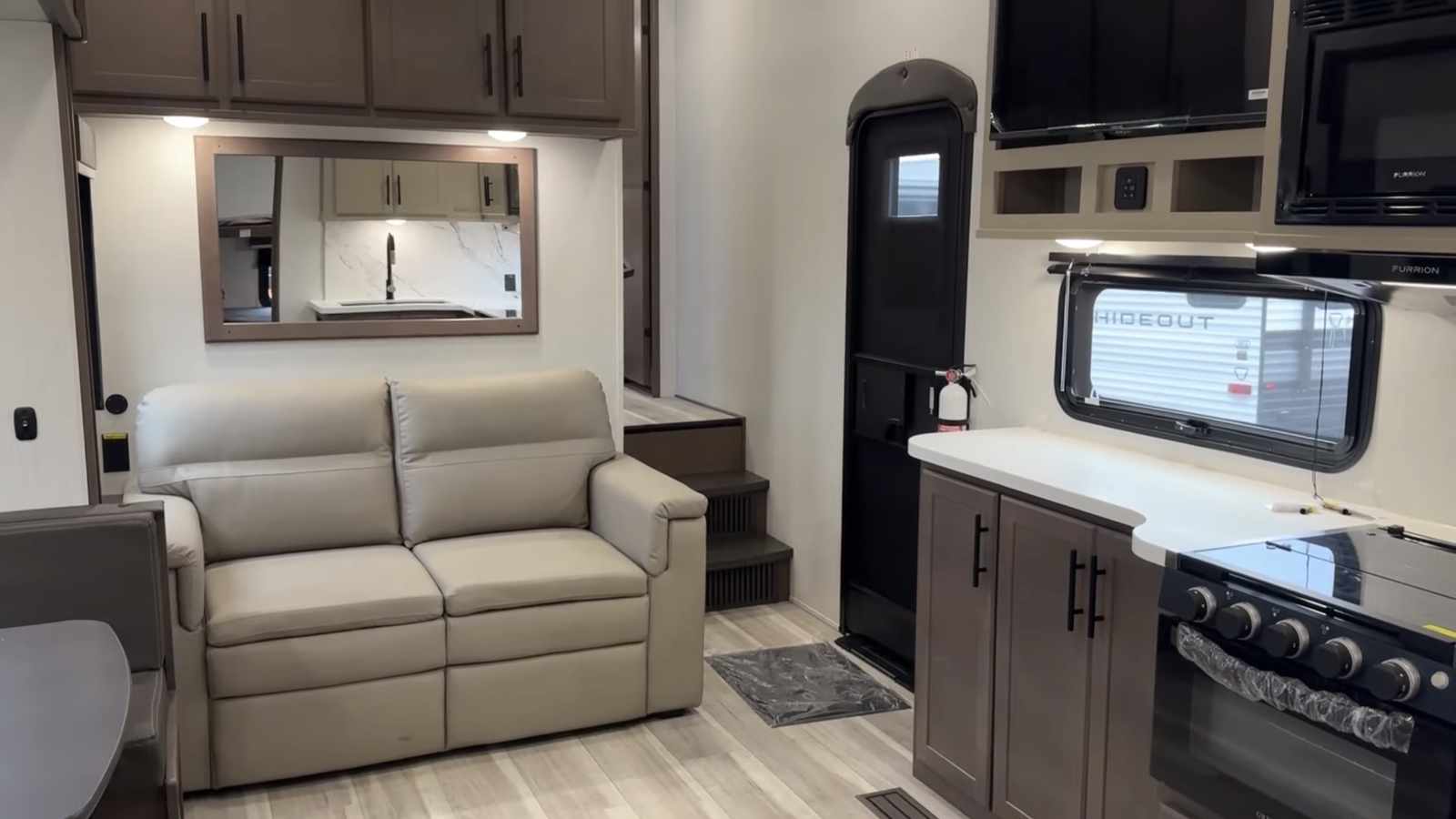
Otherwise, there’s also a U-shaped dinette and a couch. Of course, both of these can transform into beds.Wait, maybe Alice could come along after all…
The big news is the double-over-double bunks in the back that are three levels. One is essentially a cushion on the floor and then two additional bunks above that. Naturally, you could use the space that is the lowest bunk for storage, depending on how many of the bunch want to camp with you.
There’s also more storage in the back with the option for two hanging closets. However, I could see putting some sort of storage organizer whatsamathingy in there and just making this into shelves.
Fuse box in bunk room
I criticized that small oven already, but one of the biggest head scratchers is that the fuse box is back here in the bunk room. Depending on how old your travelers are, this could be an overwhelming temptation as there’s that nifty door that the wee ones can kick open.
Bonus on this? When you close the slide, that closes off this fuse box altogether, which is absolutely dumb. If you pop a fuse on that slide room and the slide is closed, you are simply out of luck. How is it some dork in an RV can figure this out, but nobody at Keystone cares enough to move it to a better place?
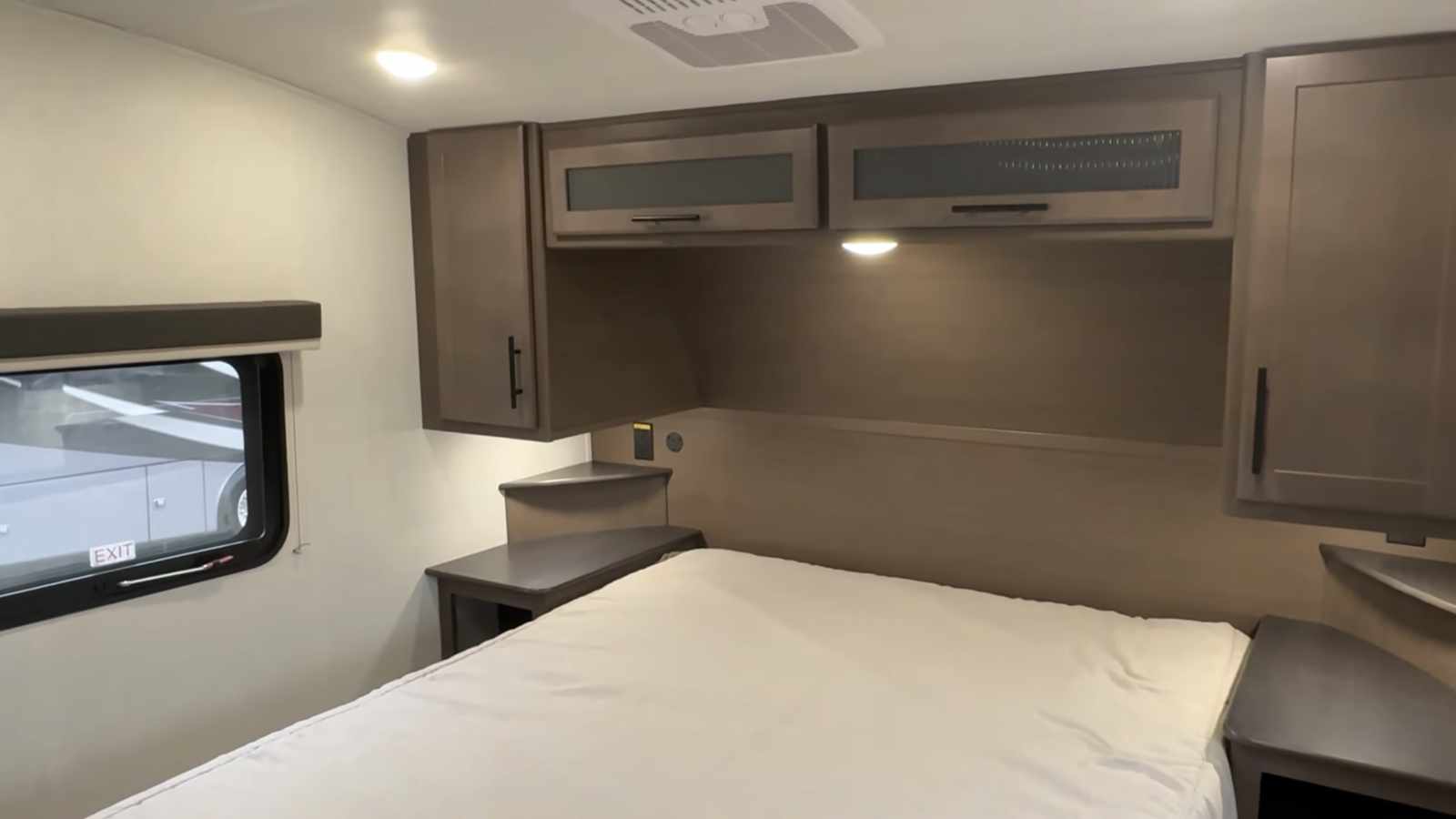
The upstairs bedroom features an RV king-sized bed with good storage above and on the sides. There’s also a closet and some drawers at the foot of the bed. So, again, storage isn’t a challenge here.
The bathroom is fine, other than 10 campers are going to have to have some sort of lottery system. But if you have that many people in your camping circle, I’m sure you’ve already figured out the bathroom schedule. Plus, there’s always the camp outhouse.
Boondocking and travel access in the Keystone Cougar Sport 2700BH
I mentioned that the slide room blocks the fuse box, and it also closes off the rear bedroom. But the kitchen and bathroom are still fully usable, so this is well-suited for mid-journey stops.
Keystone was at the forefront of factory solar installations, and I like the way they’ve handled that on here. It’s solar-prepped, but there are also two factory optional solar systems. Not everybody needs a solar system, but it’s nice that Keystone has made a decent system available for those who do.
Keystone Cougar Sport 2700BH specifications
Final thoughts on the Keystone Cougar Sport 2700BH
Overall, I like this rig. The interior has a nice, spacious feel with good counterspace and storage galore. The price of these is pretty affordable. There are good features, including build components and decisions, throughout—for the most part.
But then there’s that fuse box blocked by the slide and placed in a room that is intended to be occupied by kids. I was a kid once, and flashing lights and secret compartments, especially ones that turned off power, would be absolutely overwhelming to me. And it would go downhill from there. There absolutely has to be a better place to put this, although, quite honestly, I can’t imagine a worse place for it.
It’s a shame, because the rest of this RV is really nicely designed and equipped and, for the money, really offers a lot.
My thanks to Josh from Bish’s RV for the video and photos in this article.
*****
An honest look at RVs from RV industry insider Tony Barthel, where you learn the good, the bad and the intriguing about RVs, including travel trailers, fifth wheels, Class A, Class C and Class B RVs, as well as some interesting class-breaking RVs. You can find more reviews online at StressLessCamping.com.
I occasionally see posts from people complaining that their TPMS does not always provide a reading from the tires. While there are a number of possible reasons, I believe the most likely is that the signal from one or more sensors is not “phoning home” to the monitor on your dash.
Assuming that your system has not been damaged and worked when originally installed, I think the most likely cause is that the small “coin battery” in the screw-on sensor on one or more wheels is simply not putting out enough power to get the signal to your monitor.
The fix
Simply install a “repeater” that rebroadcasts the signal from the sensors to the monitor.
Not all TPM systems include a repeater when new. In my opinion, this is the fault of the TPMS company and or salesperson.
Every TPMS can benefit from having a powered “repeater” that rebroadcasts the weak signal from the sensors at the wheels to the monitor.
Repeaters are powered by the RV 12V system, which can increase the weak signal from the 3V “coin battery” screwed on the valve stem to a powerhouse broadcasting system pushing out a signal powered by the RV 12V system.
This extra power will get the signal across the entire length of your 45′ RV and through the steel, aluminum, and wood frames, wheel wells and flooring. It can also extend the life of the coin battery even after it has lost its maximum power from when new.
If you are considering installing a TPMS, be sure to get one that includes a repeater. You can install the repeater toward the rear and only need to provide a connection to the RV 12V DC system.
If you purchased a system and it did not include a repeater, shame on the salesperson or system manufacturer for not including a repeater when you made the purchase. Contact a seller of the system you have and get and install a repeater. They are smaller than a pack of cigarettes, so can be placed almost anywhere in your RV.
By Cheri Sicard
Every winter millions of RVers descend on Quartzsite, Arizona, just over the California border, to boondock and attend the annual RV show there. In the video below, join Jamie and Linda from Roaming with Rosie, who wanted to venture out while snowbirding in Quartzsite, so they put together a video compilation of the best day trips from Quartzsite.
If you would like to explore beyond the tiny Arizona town, give the video a watch and plan to branch out your Quartzsite experience. All of the trips can be accomplished while keeping your base camp in Quartzsite, although you may decide to stay longer once you see what’s offered. Jamie and Linda will show you where else you can camp with your same LTVA (Long Term Visitor Area) pass or other areas where you can camp near Quartzsite completely free.
Roaming with Rosie’s top day trips from Quartzsite picks
#1 KOFA National Wildlife Refuge/Palm Canyon: Twenty miles south of Quartzsite on U.S. Route 95, this refuge encompasses more than 665,000 acres and was established back in 1939 for the protection of the area’s magnificent bighorn sheep. You’ll also be treated to sightings of the rare California Fan Palm that thrive in some of the hottest temperatures in the Sonoran desert. Watch the video for highlights and hiking info. You can camp for free here for up to 14 days.
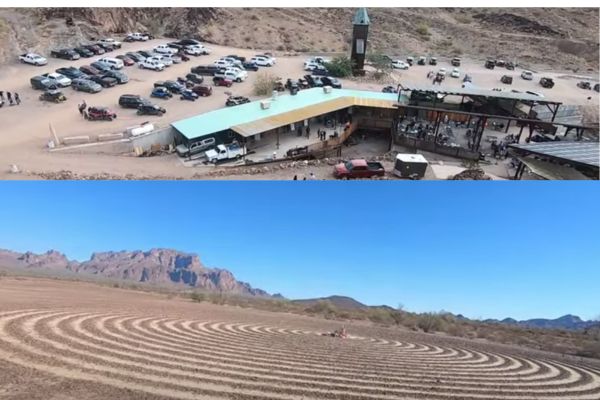
#2 Mystery Spiral Labyrinth: Nobody knows quite how or where this mysterious labyrinth on the national refuge property got there—it just appeared sometime between March and September of 2010. It also seems that someone is maintaining this perfect 60-foot-in-diameter spiral in the desert sand. It’s quite hard to find but the video shares all.
#3 U.S. Army Yuma Proving Ground: It’s also one of the largest testing grounds for military weapons in the world. A lot of stuff gets blown up here. There is a museum that is only open to U.S. and Canadian citizens who pass a background check.
#4 Colorado River and BLM Imperial Dam Recreation Areas: On the California side of the Colorado River, this area contains two different reservoirs with boat launches which, of course, means water sports like boating, fishing, and swimming. Camping is allowed here, too. The long-term visitor permits you purchased in Quartzsite work here, too!
#5 Hidden Shores Resort: If you prefer the resort experience to boondocking, this huge Yuma, AZ, Colorado River resort and RV park might prove a good choice. Lots of amenities are included.
#6 Parker Dam, Parker, Arizona: Just 35 miles from “the Q,” Parker, Arizona, is where you’ll find services like restaurants, shops, and a hospital. Be sure to watch the video to learn the history of the beautiful but controversial Parker Dam, the world’s deepest dam at 323 feet tall, although 73% of the dam is underwater. The dam is what creates the 43-mile-long Lake Havasu.
#7 Colorado River Casino Camping: This fun casino offers camping along the Colorado River, plus all the usual casino amenities. The first night is free, the second night $5, and the 3rd night is $10. You’ll also find a full-service RV park right next door.
#8 Off-Road Trip to the Nellie E Saloon aka Desert Bar: If you go to Quartzsite, this bar in the middle of nowhere in the desert is apparently something that just must be experienced. While you don’t necessarily need 4-wheel drive to get here, a high-clearance vehicle is definitely recommended. The place was hopping with lots of people, music, dancing, and merriment. Come hungry, as two different restaurants serve out here. Be aware, they are only open on Saturdays and Sundays from October through April, from noon until sundown.
Do you have other day trips from Quartzsite you would recommend? Be sure to drop them in the comments below.
Watch the video
Please click here to watch this video on YouTube (playback on other websites has been disabled by the video owner.) Also, please note that the video is from three years ago, so some of the above info may be outdated.
What’s better than helpful tips? Helpful tips from actual RVers! Here is the “second edition” of an article I wrote last summer.
Thanks to RVers who not only solved problems with their rigs but also took the time to share their tips with the rest of us!
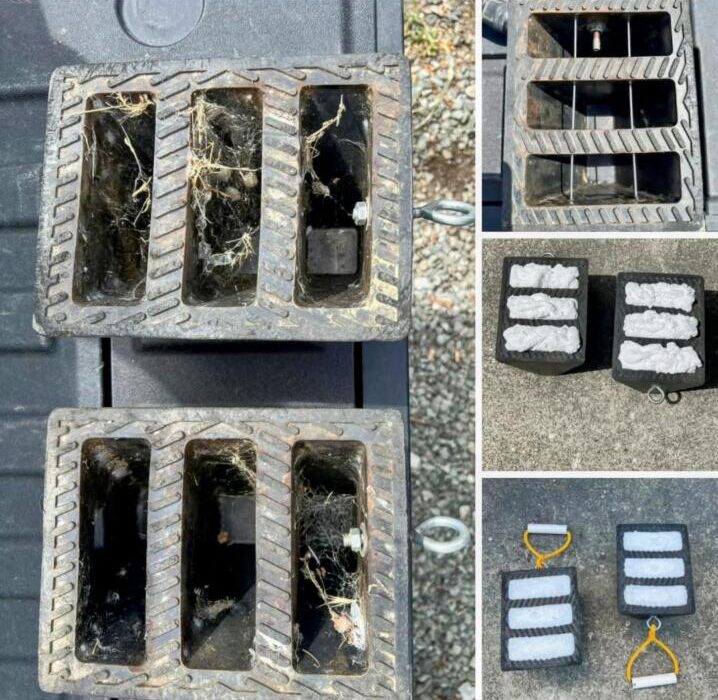
No more spiders!
Photo credit: Tim Anderson
Tim Anderson was tired of finding so many spiders nesting inside his RV wheel chocks. He solved the problem with a can of high-density spray foam insulation. To complete his DIY wheel chock project, he also added some handles! Smart thinking!
Mosquitoes blown away
Photo credit: Gianpaolo Paoli
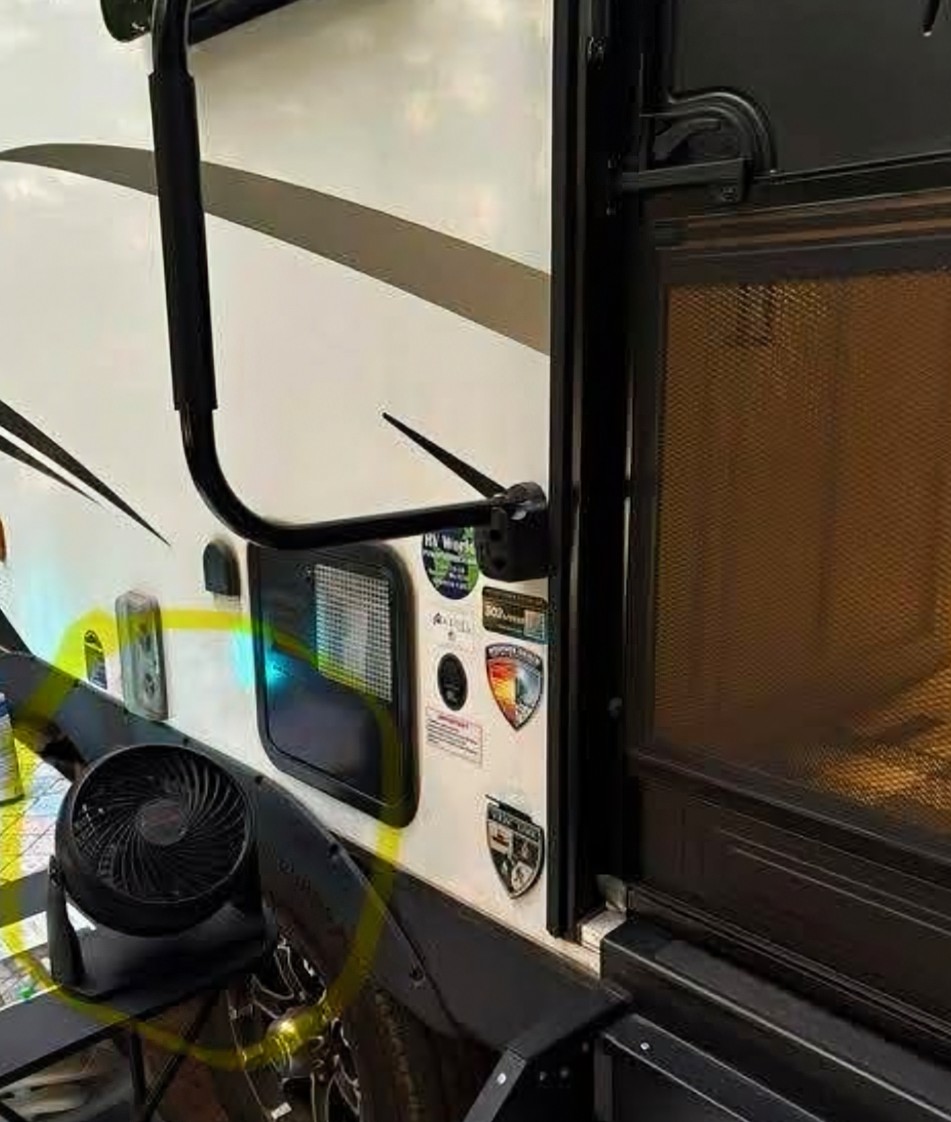
Gianpaolo Paoli posted this simple but very effective tip on Facebook. Place a small fan outside of your RV door. (See yellow circled area.) The air movement will keep mosquitoes away because they are notoriously weak fliers. This has prevented the pesky bugs from getting inside the RV! Gianpaolo said this took him six years to figure out. Ha!
DIY clothes dryer
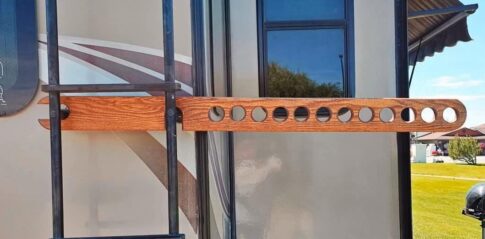
A clever craftsman constructed this wooden hanger for drying clothes from a wall-mounted fishing pole rack. It easily fastens (and unfastens) on his RV’s ladder. On wash day, T-shirts are placed on hangers that hang from the holes. You could also use clothes clips to fasten socks and more to the hangers for drying. Bonus: The drying rack stores easily and takes up practically no space!
Stick it to bugs!
Lauren (an RV neighbor on a recent trip) provided this tip: Tired of so many bugs entering her RV via the electrical and water cords, she applied some Gorilla Tape to each hose. Beginning at the point where the cord(s) touch the ground, she applied the tape backwards (sticky side out) all the way to the RV connection. Lauren’s result could keep an entomologist busy for days!
Handle it
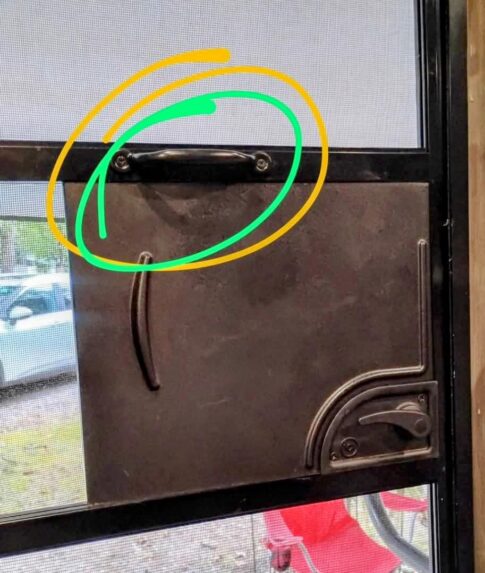
Handle that RV entry door! A clever RVer used screws to fasten a metal handle to his RV’s entry door. It’s so much easier to close the door now that I’ll wager even a child camper could manage it.
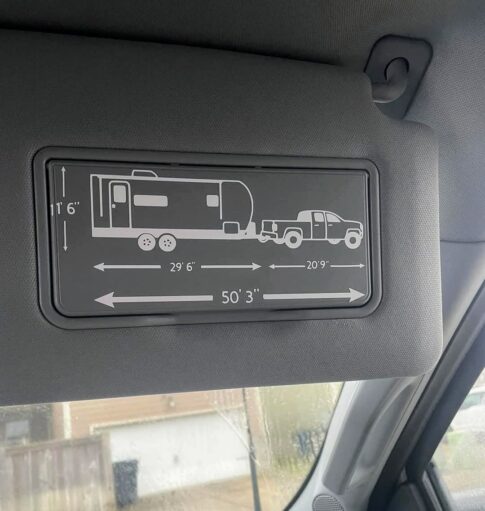
A clever gal used her Cricut machine to record their RV’s dimensions on clear, self-stick vinyl. Then the sticker was placed on their sun visor where it’s easily referenced!
This is a stick-up (idea)
Photo credit: Amelia Sara
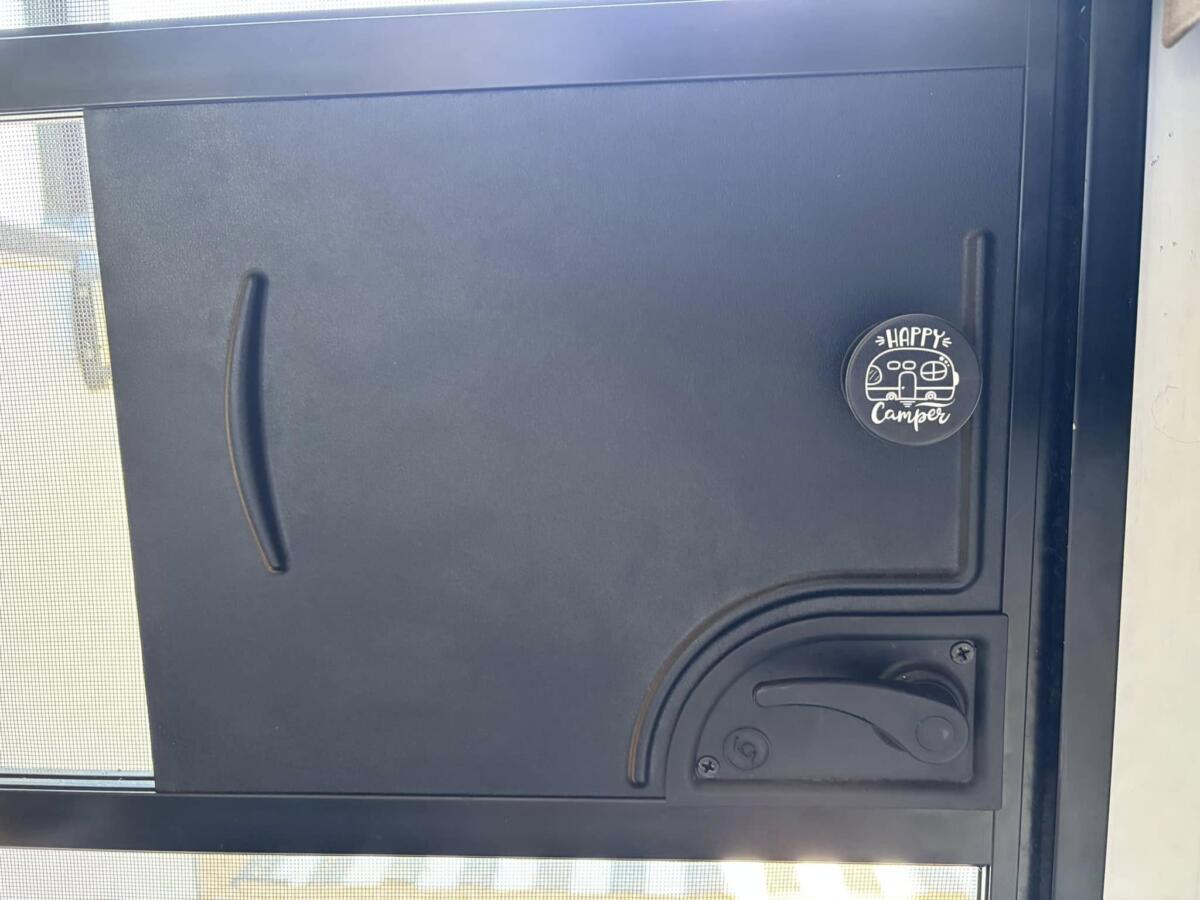
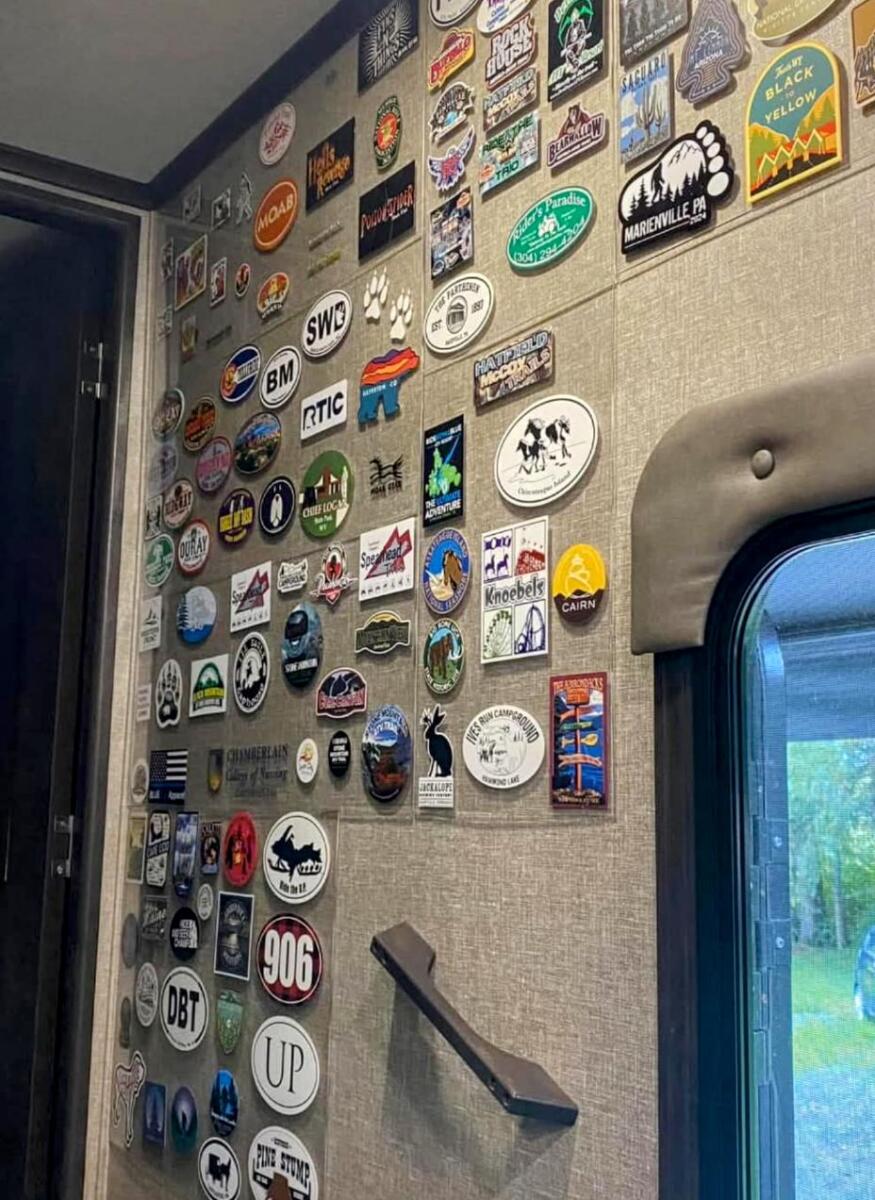
We’ve all collected souvenirs from places we’ve visited. Rather than stuff these memory-inducing items inside a drawer, check out this idea from Amelia Sara! Stickers were applied to plexiglass first. Then, Command hanging strips were used to fasten the plexiglass to the wall. The souvenirs provide happy memories flashbacks, do not impede movement as you walk by, and keep your RV junk drawer happy! Note: Do not use excess pressure on the plexiglass. It can crack! Closely follow the hanging strip directions for best results.
Your turn
Here’s your chance! Do you have an RV tip to share? Use the comments to do so. Then watch for your tip in an upcoming newsletter! Thank you!
By Russ and Tiña De Maris Everyone’s heard the story of the man driving his motorhome down that long, lonesome highway. Feeling the pull of a “call of nature,” the story goes, he sets the cruise control, climbs out from behind the wheel, and heads off for the bathroom. (Chuck wrote about about a similar situation here.)
It’s a silly tale, but one that does have a bit of a moral to it. Besides “Don’t drink too much coffee before you hit the road,” there’s the corollary: There are times when you should not use cruise control.
One of those times may not be what you think: in the rain. No, we are not spreading some kind of goofball Internet rumor here. Really. When the rain comes down, so should your speed control. Here are the whys and wherefores.
Why using cruise control in the rain is dangerous
First, there’s what they call “Florida Ice.” Picture yourself cruising along the Interstate, almost lulled by the days of fine weather you’ve been enjoying. But then, here comes that killjoy rainstorm that blows through, wetting up the roadway for the first time in maybe months. During those months of fine weather, the roadway has been accumulating a fine layer of oil and grease from passing vehicles. The rain hits that layer, the layer lifts, and you have an instant slip-and-slide setup. We’ll come to the business of cruise control in a second.
Here’s the second rain scenario: the heavy rainfall. If you’ve driven in the Desert Southwest during the hot summer season, you’ve probably met up with our pal, monsoon rain. This isn’t just a nice “put a little damp on.” This is a full-fledged gully-washing gusher that not only makes visibility drop in a hurry, it also puts a thick layer of water on the roadway.
“Too much water”
Now, in either scenario—oil mixed with water or just plain old “too much water”—comes the driving scare called hydroplaning. With too much water, your tires simply can’t squeeze the water out of the treads quickly enough. With oil mixed with water, the friction coefficient that makes the tires grip the road flies out the window.
In any case, the result is an easy loss-of-control where your rig can start spinning out and heading in directions you DO NOT want to go—like for the ditch or, worse, for that loaded gasoline tanker.
Dealing with a spinout or hydroplaning means backing off the gas, staying off the brake, turning into the skid, praying hard, and maybe changing your undergarments when the danger is past. BUT if the cruise control is switched on and your rig hits one of these perilous conditions, it ain’t smart enough to know the expression “Back off the gas!” Cruise control wants you to maintain that set speed, come Hades or high water, and in the case of hydroplaning, you’ve already got the high water.
Shutting off cruise control
How do you shut off the cruise control? The immediate reaction is to hit the brake—which, if done too hard, will only contribute to the problem. If you’re smart enough to hold yourself back and hit the cruise control “off” switch, you answered correctly. But by the time you can react and hit it, you may well be mixing paint with a semi-truck.
So, says the National Highway Traffic Safety Administration, when you see the threat of rain, just shut the cruise control off until you’re “in the clear.”
By Nanci Dixon (Note: This was originally published on RVtravel.com on February 10, 2024. Some numbers have been updated. But be sure to read to the bottom for the hilarious [uncensored 🫣] update from Joe as of February 12, 2025.) Update: As of February 2026, Joe and Helen are still writing love letters to each other every day!
This good-news story is about how longtime RVtravel.com readers Joe and Helen Hesketh, from Bellevue, WA, saved their marriage with tenacity, commitment and more than 36,000 love letters. As they celebrate 72 years together (72nd wedding anniversary coming up this June), they share a very special tale of finding love again.
Joe and Helen met when Joe was still in high school. He had no car, so when he finished with work, he would step out of the grocery store, put up a thumb and hitch a ride home. One special day, it was Helen who picked him up. What Joe didn’t know until 20 years later is that Helen was waiting around the corner, hoping to be the first one to offer Joe a ride that day. As they say, the rest is history… but not quite.
Joe and Helen Hesketh. Courtesy of the Hesketh family
It was to be “happily married ever after,” but with the rigors of eight kids and Joe always working, Helen was anything but happy. She was ready to call it quits, but asked a reluctant Joe to try a Marriage Encounter Retreat.
Joe and Helen Hesketh. Courtesy Hesketh family
It was there that a change happened—a momentous change. A long, enduring change for both of them. They were asked to write a letter to each other and then read it to each other. It was that seemingly simple exercise that brought the change they and their marriage needed. As Joe says, that weekend he “fell in love again.”
Joe Hesketh. Photo credit KOMO News
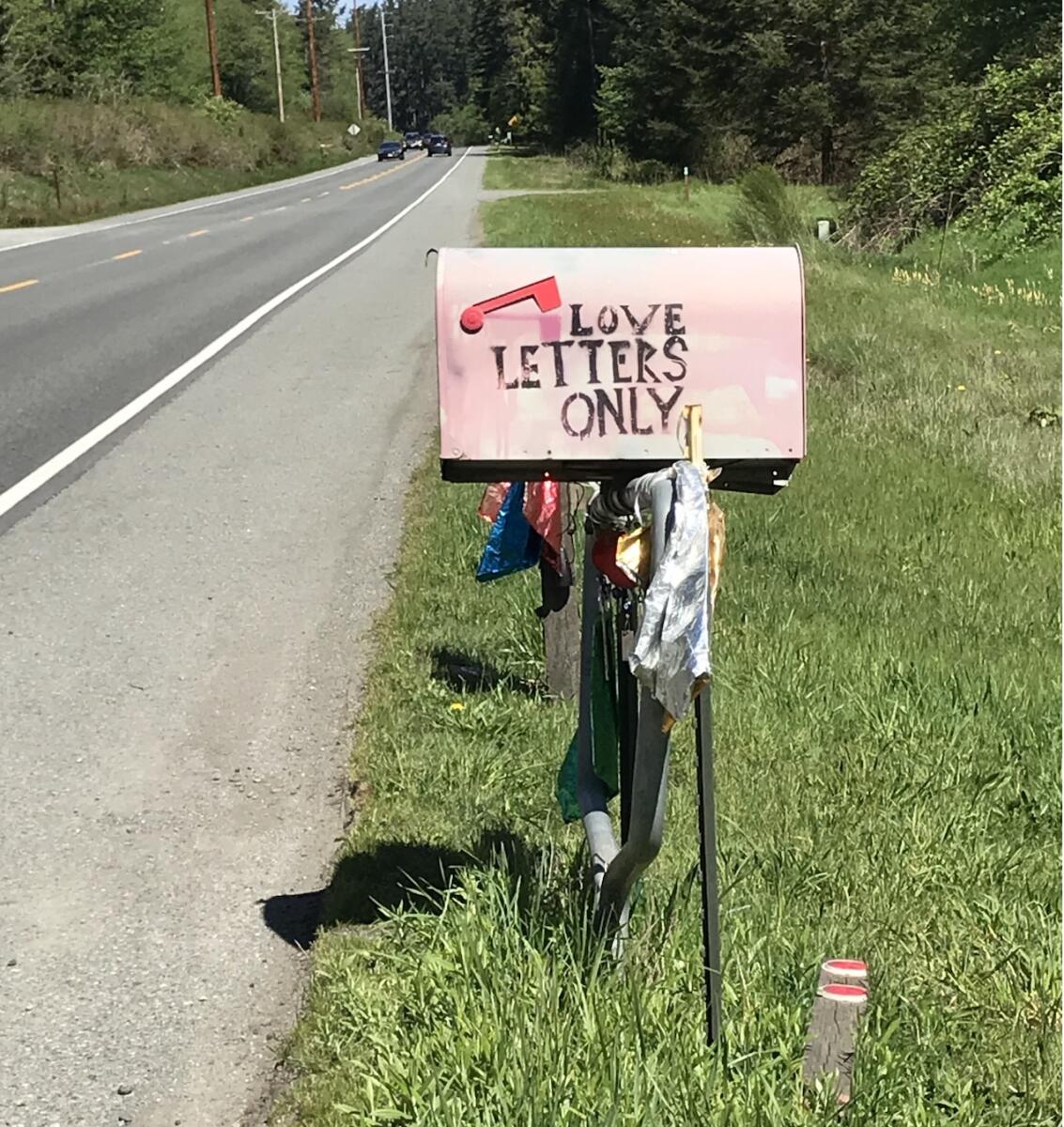
Since that moment more than 50 years ago, they write each other a letter every day. They write of the specialness that each other has, of the everyday events of their lives, and of their deep, enduring love for each other.
Photo credit KOMO News
Theirs is a story of 72 years of marriage and 52 years of love letters—more than 37 of them carefully saved in boxes and boxes of spiral notebooks. All are a testament to not giving up, staying the course and filling each and every day with love.
Here’s a more recent picture of these lovebirds:
Joe and Helen Hesketh
Oh, and they have 8 kids, 35 grandkids, and 43 great-grandchildren with two more on the way! And Joe and Helen are both 93 (in Feb. 2026), BTW.
*****
(From original post in 2024) Hi, Joe and Helen. Surprise! When I emailed you last week to say that I saw your interview with Eric Johnson (Eric’s Heroes) on KOMO News online, you said you didn’t want to tell (i.e., bother) me about it because it didn’t mention RVing.🤔 And now look where you are! You two are just so darned adorable! (In addition to being an inspiration.) Take care. 🤗 —Diane
***** From Diane (Feb. 12, 2025):
I contacted Joe by email a couple of days ago to get some updated info before we reran this heartwarming love story. We emailed back and forth a couple of times, and then Joe sent me an email the morning of Feb. 12 and asked me to phone him if I was free. I immediately called him and he answered the phone with: “What took you so long?!”
We had a nice chat, but after we hung up I realized I had forgotten to ask him if he and Helen still write letters to each other every day, at least when one or the other wasn’t in the hospital for various medical issues. I emailed that question to him, and here is Joe’s (uncensored) response, which he sent me by email late Wed. night:
Briefly, we write every day. Some letters have been written in emergency rooms when in the hospital. We bring our notebooks. Some have been written on paper menus in restaurants. Most of the time it’s a one-page letter written on a subject of our choice about God, sex, possessions, death, etc., and we focus on how we feel about the subject, and we learn a lot.
One time we decided to have sex before we wrote our letters. When we woke up the next morning, I, Joe, said we did not write our letters last night, and Helen said we did not have sex either. So we had two letters to write that day – one in the morning and the other in the evening.
40 years ago, Joe was in the hospital awaiting a quadruple heart surgery. We wrote and shared our letters before Helen went home. That evening I wrote Helen a 4-page letter telling her how much I loved her and that if I should not make it through the surgery that she should find someone else to marry, etc. Then I wrote 3 pages of how to empty the RV holding tanks.
Fortunately, my operation was a success and she never had to use those pages.
The day after my surgery I scribbled in my letter thanking God that I was still alive. Joe & Helen
America’s Original RV Newsletter. Since 2001 Issue 1248 Please help support our hard work with a donation of your choice and receive our ad-free edition as a thank you.
Remember: You don’t need to receive an email alert from us to read our newsletters. Just click any time of day directly to RVtravel.com. The latest issues will be right there for you.
Today’s thought
“Love recognizes no barriers. It jumps hurdles, leaps fences, penetrates walls to arrive at its destination full of hope.” —Maya Angelou
Need an excuse to celebrate? Today is Valentine’s Day, of course! But if you’re not in the mood to celebrate Valentine’s Day, maybe you can celebrate National Ferris Wheel Day instead? Hmmm…
On this day in history: 1876 – Alexander Graham Bell applies for a patent for the telephone, as does Elisha Gray, who some historians believe developed a telephone prototype before Bell. Bell won a patent battle.
Featured news
A popular free RV boondocking area at Nevada’s Lake Mead has reopened after an 18-month closure due to years of accumulated trash, long-term encampments, and environmental damage. Officials cleared debris, improved access, and restored the site to safer conditions. Here’s the story.
A leadership change at Tiffin raises questions for luxury RV buyers. When you buy a high-end motorhome, you’re not only buying a vehicle but a reputation. So when there’s a change at the top, it catches people’s attention. That’s what is happening now at Tiffin Motorhomes. where Leigh Tiffin has stepped aside as president. Continue reading.
Truck weigh station changes could benefit RVers. If you’ve spent any time on interstates out West, you already know the drill. The sign flashes “All trucks must enter,” semis line up, and RVers roll past on the bypass lane without a second thought. But weigh stations may be changing, which could make highway travel a little smoother for everyone.
A recent poll of the readers of RVtravel.com challenges common perceptions about RV build quality. RVs often get a bad rap when it comes to their quality. In the poll, which drew more than 1,200 responses, roughly three-quarters of the respondents were happy with their RV’s construction. Read more.
Quartzsite’s secret weapon? It’s affordable, unconventional, and proud of it. When Travel + Leisure named Quartzsite, Arizona, the nation’s top snowbird destination, longtime winter regulars probably smiled and shrugged. “Of course it did.” Quartzsite didn’t win because it’s polished or picturesque. It won because it’s inexpensive, wide open, and happily odd. Snowbirds are deciding that matters more than palm-lined boulevards and amenities. Continue reading.
Alliance RV has been a towables company since day one. Now it’s stepping into motorhomes. The Elkhart builder is making its move by buying a Class B van specialist instead of starting from scratch. Learn more.
An Oregon man’s crime spree took a bizarre turn when deputies say he crashed a stolen SUV into a power pole in Redmond—knocking out electricity—then later broke into a nearby property and fell asleep inside a parked motorhome. If this sounds like the setup to a joke, well… it’s not.
A sudden Fourth of July flash flood on Texas’s Guadalupe River destroyed Blue Oak RV Park near Kerrville, Texas, sweeping away RVs and killing several people. Owners Lorena Guillén and Bob Canales rushed through rising waters to warn campers, helping many escape. The park—their primary livelihood—was wiped out, and rebuilding still remains uncertain.
A Texas-based pet microchip registry called Save This Life unexpectedly stopped operating this week. Subsequently, the company was removed from the American Animal Hospital Association’s lookup tool. This means scans of affected microchips will still show the chip number, but the owner contact information that used to be linked to that number may no longer be accessible through that registry. Here’s what you need to do.
PLUS! Some biiiiiiig recalls below—don’t miss them!
Beyond the headlines with Tony Barthel
RV news analysis of the week
I’m so grateful for all the kind words about this take on the RV news of the week when I announced this new column last week. Apparently, some of you may believe that I know something, or are just dazzled by my beard. I don’t know. But, seriously, thank you. This week, we’re going to look at some of the interesting goings on in the RV space, and there have been some interesting goings on for sure. So first, let’s head to Alabama.
Don’t take a break on your brakes! Bad news: Your brakes fail while driving down a steep grade. It could be your brake fluid is moisture-contaminated! Get this brake-fluid tester for less than $10 that warns of this problem. Dip it into your rig’s brake fluid and you’ll see where you stand. Be safe! Learn more or order.
By Gail Marsh
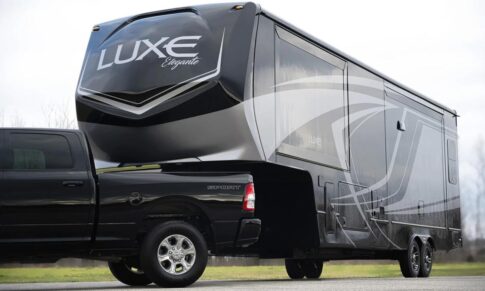
The 2027 Luxe Elegante 33EFS is a compact, full-time fifth wheel RV designed for RVers who want residential comfort and four-season capability in a towable package. After seeing this RV in person at the Florida RV SuperShow, I’ve concluded while it’s small on length, it’s large on comfort, premium finishes and cost. Check it out.
News briefs
Admission to U.S. National Parks sites is free Monday, President’s Day. The next free admission opportunity is Memorial Day, May 25.
Gas prices are up slightly ahead of the Presidents Day holiday weekend. The national average for a gallon of regular is up a couple of cents from last week to $2.94. Current prices remain below what they were this time last year, when the average was $3.14.
Yosemite National Park is expecting thousands of visitors for its annual viewing of Horsetail Falls, which occurs briefly each February when the setting sun illuminates the waterfall on El Capitan with a fire-like glow. The projected viewing period is now through Feb. 26. NPS photo.
Reservations for the 2026 camping season at Saskatchewan Provincial Parks will begin on April 13 for seasonal campsites and April 14 to 17 for nightly, Camp-Easy yurts, and group campsites. Reservations launch each day at 7 a.m. CST.
… Speaking of Saskatchewan, you can fish for free in any of its provincial parks today through Monday. No license is required. If ice-fishing, be aware of ice thickness.
Kunes Auto & RV Group has acquired new dealerships: the Twin Cities metro area and Chicago’s prestigious North Shore. In Minnesota, the company acquired two dealerships, now named Kunes Apple Valley and Kunes Valley GMC in Hastings. In Illinois, the company acquired Kunes Lakes Chevrolet in Lake Bluff.
The National Park Service has launched a special resource study of the Los Angeles coastline—from Will Rogers State Beach to Torrance Beach—to assess whether parts of the area should become a new unit of the National Park System.
The Wisconsin Department of Natural Resources (DNR) is inviting patrons at more than 120 state libraries to check out free day passes to state parks, forests and recreation areas.
Oregon lawmakers met this week in Salem to discuss proposed legislation that would hike the state’s lodging tax at places like campgrounds, hotels and Airbnbs from 1.5% to 2.75%.
Full-size pickup trucks remained as popular as ever in January, with the average transaction price for a new one exceeding $70,000 for the fifth consecutive month.
Changes are coming at two North Dakota state parks. Pembina Gorge State Park is getting a new campground with 50 RV sites and Rough Rider State Park is doubling its campsites. Both projects should wrap in late spring or early summer.
A hospitality company has proposed a seasonal staff “work camp” near West Glacier, Montana, that could include dorms, cabins and RV camping. If approved, it may help businesses house workers but could increase development, traffic and demand for campsites near Glacier National Park.
The National Park Service is looking for campground hosts for 2026 in Washington state. Dozens of host positions are currently open, offering RVers the chance to camp for free in exchange for light volunteer duties. Info here.
Spotted! Er, striped? A couple traveling on a Reno, Nevada, road was forced to stop by an unusual traffic hazard: an escaped zebra. The zebra, named Ziggy, had indeed escaped and was on the loose for about 10-15 minutes before being safely returned home.
Maryland Park Service will launch a new reservations system on Feb. 24 that will provide visitors a faster, more intuitive way to reserve campsites and other amenities at 37 Maryland state parks. It will introduce text message notifications and a simplified checkout. Read more.
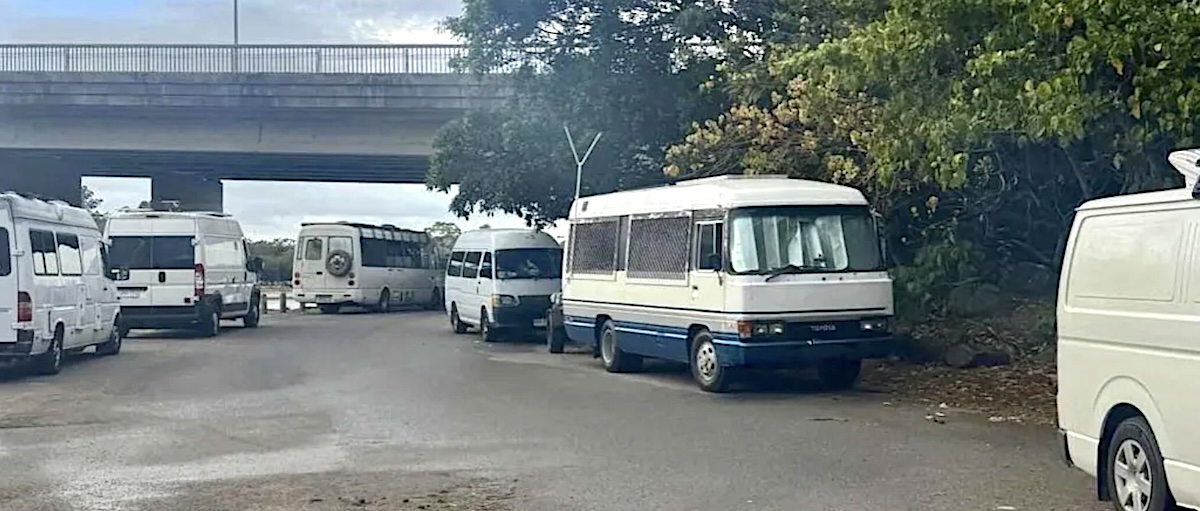
ILLEGAL CAMPING DOWN UNDER. This photo of a car park on Australia’s Gold Coast has renewed concerns about illegal camping. Locals say vans at Currumbin Creek have been parked there for months. The situation reflects a broader nationwide problem tied to tourism, rising caravan park costs, and Australia’s ongoing housing crisis, with high property prices and low rental availability pushing some people to live in vehicles. Sound familiar?
Ford reported weaker-than-expected fourth-quarter results Tuesday due to higher tariff costs and lower vehicle production tied to a supplier outage. The company posted an $11.1 billion loss on $45.9 billion in revenue, down 5% from a year earlier. Tariffs added about $2 billion in 2025 costs, while fires at an aluminum plant also hurt production.
Colorado Springs City Council has approved expanded recreation at Rosemont Reservoir State Wildlife Area on Pikes Peak, to be managed by Colorado Parks and Wildlife. The plans include a new campground. The area could be up and running for campers by July.
According to the Washington State Department of Transportation (WSDOT), as of February 10, U.S. 2 Tumwater Canyon (mileposts 90-99) near Leavenworth has reopened to normal traffic. The Tumwater Canyon section had been closed since mid-December due to washouts. All sections of U.S. 2 that were closed are now open.
A new AAA/Bread Financial survey finds 61% of Americans plan to travel in 2026, with 76% of the trips tied to milestone events like birthdays, weddings, anniversaries and reunions. Younger travelers are leading the trend.
The U.S. House of Representatives has advanced a bill that would roll back President Donald Trump’s tariffs on Canada, a signal of growing willingness among Republicans to break with his administration. Wednesday’s vote saw several Republicans cross party lines to vote with Democrats.
Oregon State Parks welcomed an estimated 51.46 million day-use visits in 2025, a slight decrease from the record-breaking 53.85 million visits in 2024. Overnight campers logged 2.6 million nightly stays in 2025, down from 2.83 million in 2024.
Zion National Park’s shuttle service begins on Saturday, March 7. Shuttles will run from March 7 to November 28, then briefly from December 26 to January 2.
California officials are expected this week to declare that the state’s mountain lions are threatened under the state’s endangered species law. Their populations have become so beleaguered in part because of the highways built in their habitat.
Alaska State Parks is looking for camp hosts for Rosehip Campground, Twin Bears Camp, Olnes Pond and Harding Lake Campground. Receive a monthly $500 subsistence payment. RV required.
The U.S. Army Corps of Engineers will waive day-use fees at its more than 2,800 USACE-operated recreation areas nationwide in observance of Presidents Day, February 16. The waiver does not apply to camping and camping-related services.
Death Valley National Park has reopened the Salt Creek Boardwalk, three-and-a-half years after it was destroyed by flooding. This wheelchair-accessible trail provides easy access to view small Salt Creek Pupfish.
BET YOU DIDN’T KNOW: Those iconic little candy hearts emblazoned with Valentine’s Day messages so popular these days were created to make lozenges for sore throats.
RV and RV-related recalls
Chrysler is recalling certain 2024-2026 Jeep Wagoneer S, 2025-2026 Ram 1500 Pickup, Ram 2500 Pickup, Ram 3500 Pickup, Ram 3500 Cab Chassis, Ram 4500 Cab Chassis, Ram 5500 Cab Chassis, and 2026 Jeep Cherokee vehicles. The trailer lights may fail to illuminate and the trailer brakes may fail. More.
Stellantis has issued an immediate recall of certain vehicles in its lineup, including Chrysler, Dodge, Jeep, and Ram. Defective air bag inflators made by Takata have been the subject of the largest and most complex recall in recent memory. If you own one of the 225,000 affected older vehicles with an unrepaired air bag, this is not a “wait-and-see” situation. It’s critical for safety. Learn more.
Ember Recreational Vehicles is recalling certain 2026 E-Series and Overland Series travel trailers. Incorrect Unloaded Vehicle Weight and Cargo Carrying Capacity (CCC) information may be listed on the Federal Certification Label. Ember will mail free corrected labels. Info? 1-844-732-4204.
Ford is recalling certain 2023-2024 Transit vans. The engine crossmember may not be secured properly, which can cause the engine to shift, leading to power loss or brake failure. Learn more.
BUMPER SNICKER: “Our emergency fund is duct tape.”
Tiny, portable air purifier is RV-sized
If your RV sometimes smells like last night’s dinner, this compact air purifier is a quiet hero. Its HEPA filter traps dust, pollen, smoke, pet dander and odors, runs whisper-quiet in sleep mode, and easily fits a bedside table. With simple touch controls and USB-C power, it helps keep the air fresh wherever you are. Check it out.
Reader poll Will you do anything today to celebrate Valentine’s Day?
In 1415, Charles, the Duke of Orléans, was imprisoned in the Tower of London at just 21 years old. While there, he wrote a heartfelt letter to his wife, including a poem that referred to her as his “Valentine.” The opening line, “My very gentle Valentine,” is often considered the first recorded Valentine in history.
Laugh of the week
? MYSTERY PRODUCT OF THE DAY ? Yes, this one is inspired by Valentine’s Day, but we think—no, we know!—all couples will enjoy this. Put a little pizazz back in your relationship. This will be fun!
Saturday sillies
Mystery town
In yesterday’s RV Daily Tips Newsletter, we showed you an aerial view of an American city as seen from Google Maps. We asked you to name it and tell us why it’s unusual. The answer: It’s Barr Nunn, Wyo., which was constructed around the runways of Wardwell Field, Casper’s original airport. Look closely and easily spot the runways and taxiways, now lined with homes.
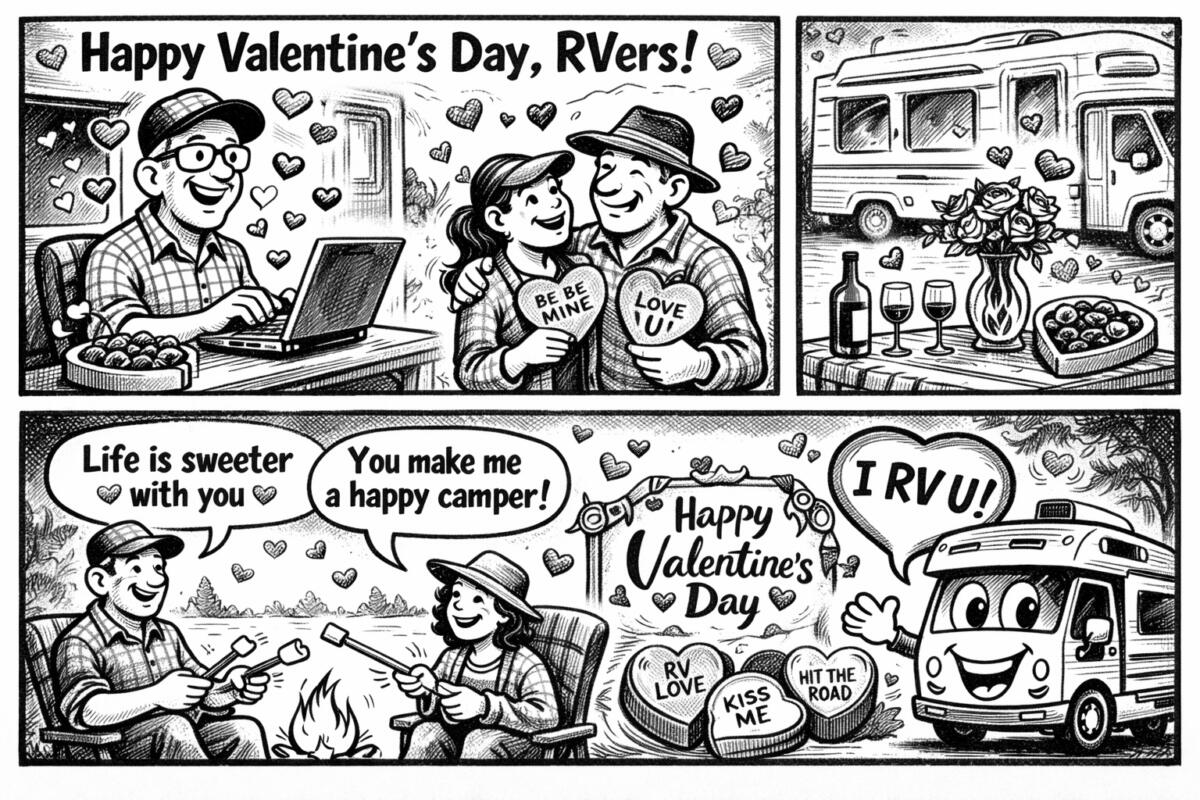
Happy Valentine’s Day! Photo credit: Gail Meyring
The perfect scam Author Entangled in Recovery Scam After a Crypto-Dating Scam
Josh loves being a novelist, but working from home gets lonely. So he tries a dating site where he connects with Hannah. After a while, she tells Josh about her cryptocurrency investments and encourages him to invest. After putting in more than $100,000 he tries to make a withdrawal, but it’s a no-go, and Hannah disappears.
Today in history
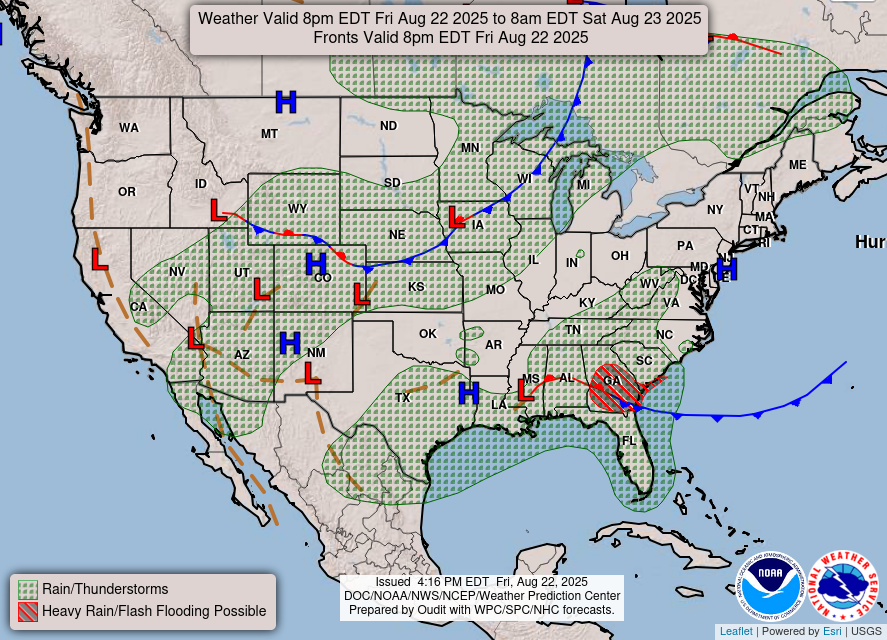
Today’s weather forecast across the nation THIS MAP UPDATES TWICE A DAY
A recent poll of the readers of RVtravel.com challenges common perceptions about RV build quality.
RVs often get a bad rap when it comes to their quality. Online forums, campground chatter, and even some industry watchdog reports frequently highlight problems—everything from cosmetic flaws to serious structural issues. We’ve sung this tune ourselves on this website. But a recent RVtravel.com reader poll suggests the reality may be more nuanced than the reputation.
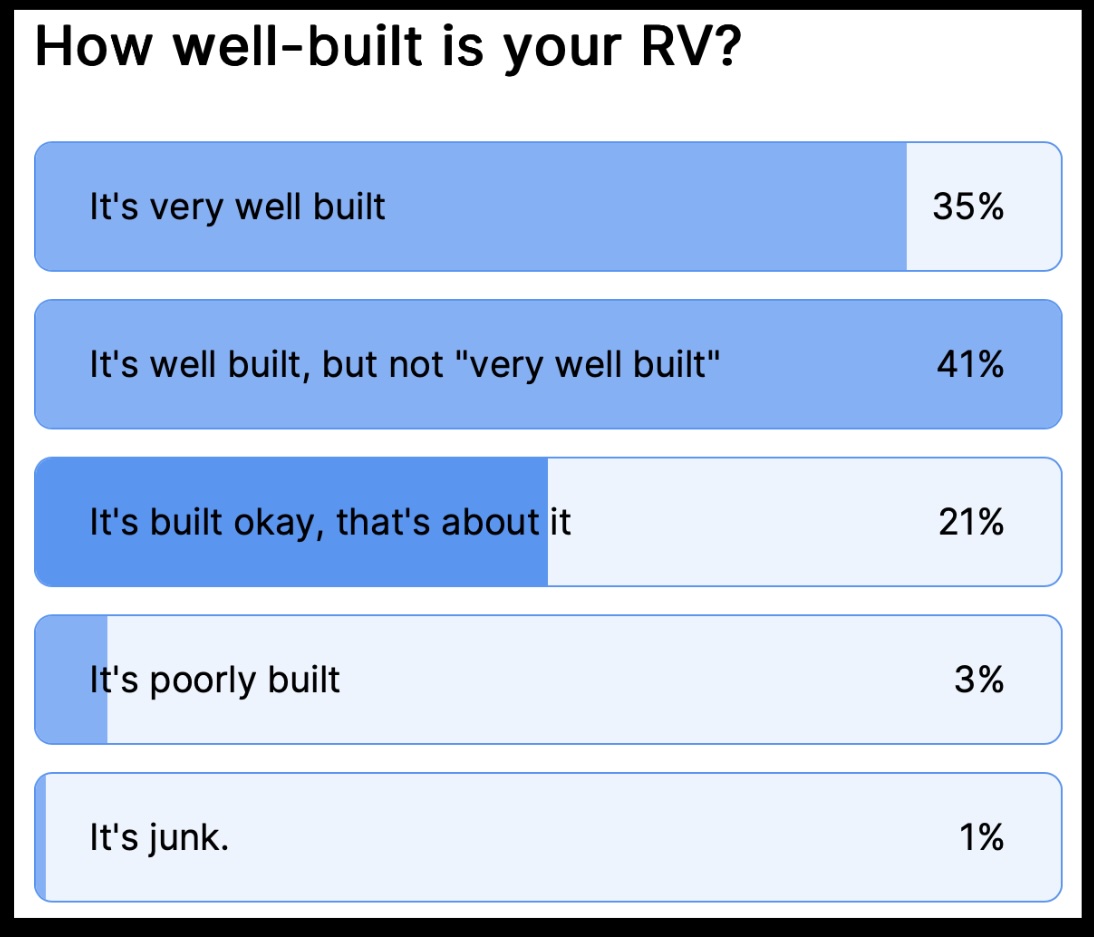
In the poll, which drew more than 1,200 responses, readers were asked a simple question: How well built is your RV? The answers paint a surprisingly positive picture.
A solid 35% of respondents said their RV is “very well built.” Another 41% reported their RV is “well built, but not ‘very well’ built.” That means roughly three-quarters of respondents believe their RV is built at least well, a notable contrast to the often-heard narrative that most RVs are poorly constructed.
Meanwhile, 21% described their RV as “built okay,” suggesting acceptable quality but perhaps not exceptional craftsmanship. Only a small minority expressed serious dissatisfaction: 3% said their RV is poorly built, and just 1% labeled theirs outright “junk.”
Most RVers are satisfied with the quality of their RVs, according to the readers of RVtravel.com
Reputation vs. reality
The RV industry has long struggled with quality perception. Unlike automobiles, RVs are typically built in relatively small volumes and often by hand, which can lead to inconsistencies. Warranty complaints and social media horror stories can amplify negative impressions, sometimes making problems seem more widespread than they actually are.
But this poll suggests many owners are reasonably satisfied with their rigs—especially those who understand that RVs are complex, rolling homes subject to constant vibration, weather exposure, and varied road conditions.
Expectations matter
One possible explanation for the relatively positive responses is that experienced RVers often know that minor fixes, adjustments, and maintenance are part of the lifestyle. Many view their RV less like a car and more like a small house that moves—something that requires periodic tinkering.
An RVtravel.com reader named Roy commented: “I think how anyone answers will be influenced by expectations. I hear people complain that they don’t build them like they used to. That’s true. We never used to have slides, double pane windows, tile floors, automatic steps, dishwashers, washer/dryers, residential refrigerators, etc. The more comforts and conveniences you add, the more things that can go wrong.”
Additionally, buyers who research brands, inspect units carefully, and maintain them well may naturally experience fewer problems.
Not perfect—but not terrible either
The poll doesn’t suggest RV construction is flawless. About one in four respondents rated their RV as merely “okay” or worse. That’s still a meaningful portion and reflects ongoing industry challenges with consistency, supplier quality, and production speed.
However, the data also indicates the situation may not be as dire as the loudest critics claim. Most owners report decent or better build quality—hardly the disaster sometimes portrayed.
A useful reality check
Polls like this don’t replace formal reliability studies, but they do offer valuable insight from real owners living with their RVs day to day. And in this case, the takeaway is encouraging: While quality concerns exist, a majority of RVtravel.com readers appear satisfied with how their RVs are built.
That’s good news for both current owners and prospective buyers who may worry that purchasing an RV automatically means buying trouble. As always, careful shopping, realistic expectations, and good maintenance remain key—but the sky may not be falling after all.
Read questions and responses of more than 1,000 other polls conducted by RVtravel.com.
We use cookies to ensure that we give you the best experience on our website. By continuing to use our site, you consent to accepting cookies. We NEVER have or will sell reader's data. For more info, please see our privacy policy page.