By now, you know today, Saturday, is Valentine’s Day. A day to celebrate love! And no, it doesn’t just have to be romantic love. Hey, make your dog a special dinner tonight—that counts, too! Call your friend (if they’re a lady friend, they’re your “galentine”!), and if you’re alone, FaceTime or Zoom with a family member or friend while you eat dinner. That way you’re “having dinner” with someone.
Love comes in many forms, and today is a great excuse to show appreciation for the people (or pets!) who make life brighter.
Maybe that means baking heart-shaped cookies for your grandkids, leaving a sweet note for a neighbor, or just treating yourself to a cozy night with a favorite movie and a box of chocolates. Even the smallest gestures can make someone’s day—maybe even your own.
And let’s not forget about the RVers out there celebrating on the road! Are you parked in a scenic spot, sharing a meal under the stars? Did you stop by a local bakery to grab a festive treat?
Some campgrounds even host Valentine’s events—if you’re at one, we’d love to hear about it!
Will you do something today to celebrate? If so, are you going out to celebrate or are you staying in to celebrate? Are you not sure yet? Not celebrating? If you are doing something special, please leave a comment below the poll and tell us what it is. We want to know. We love love!
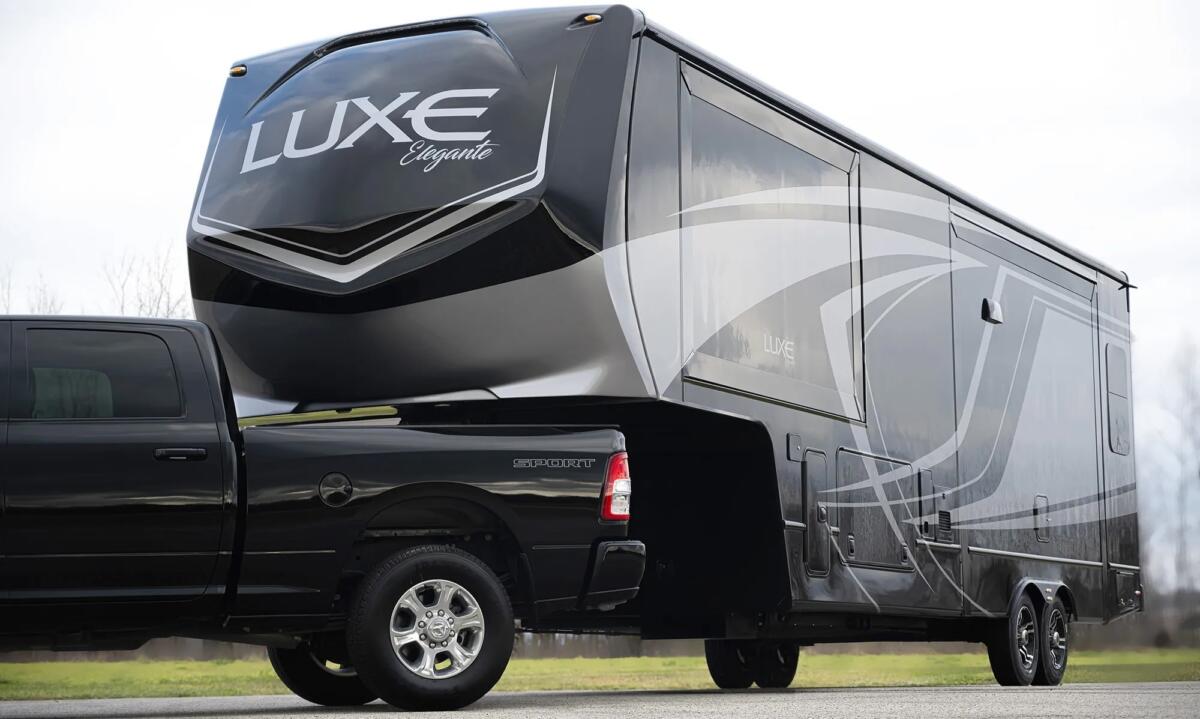
Yes, you read the title correctly. I’m skipping forward to a 2027 RV for today’s review. The 2027 Luxe Elegante 33EFS is a compact, full-time fifth wheel RV. The Elegante is aimed at people who want residential comfort and four-season capability in a towable package.
After seeing this RV in person at the recent Florida RV SuperShow, I think it’s safe to say this fifth wheel may be small on length but large on comfort, premium finishes, and (gulp!) cost.
Note: Luxe invites its customers to choose from a list of options when designing their Elegante 33EFS.
Behind the walls
The Elegante is built to be a true four-season coach. It has multi-layer laminated sidewalls using gelcoat fiberglass, Azdel composite, welded aluminum cage framing, and high-density closed-cell foam fill. That gives you three-inch walls for much better insulation for temps and sound.
Luxe emphasizes insulated slide-out walls and an enclosed, heated underbelly so the coach handles cold snaps better than typical RVs in this class. The 33EFS expands with three slide-outs to give living and dining areas nice space when parked at the campground.
Key specs
• GVWR: 18,500 lbs.
• Estimated UVW (unloaded vehicle weight): 14,500 lbs.
• Estimated hitch weight: 2,900 lbs.
• Length (pin to rear cap): 33’11”
• Height: 13’1″
• Fresh water capacity: 75 gallons
• Grey water capacity: 80 gallons (two tanks total)
• Black water capacity: 40 gallons
• Number of slide-outs: 3
• Price (MSRP on a featured build): $276,632
Interior and living space
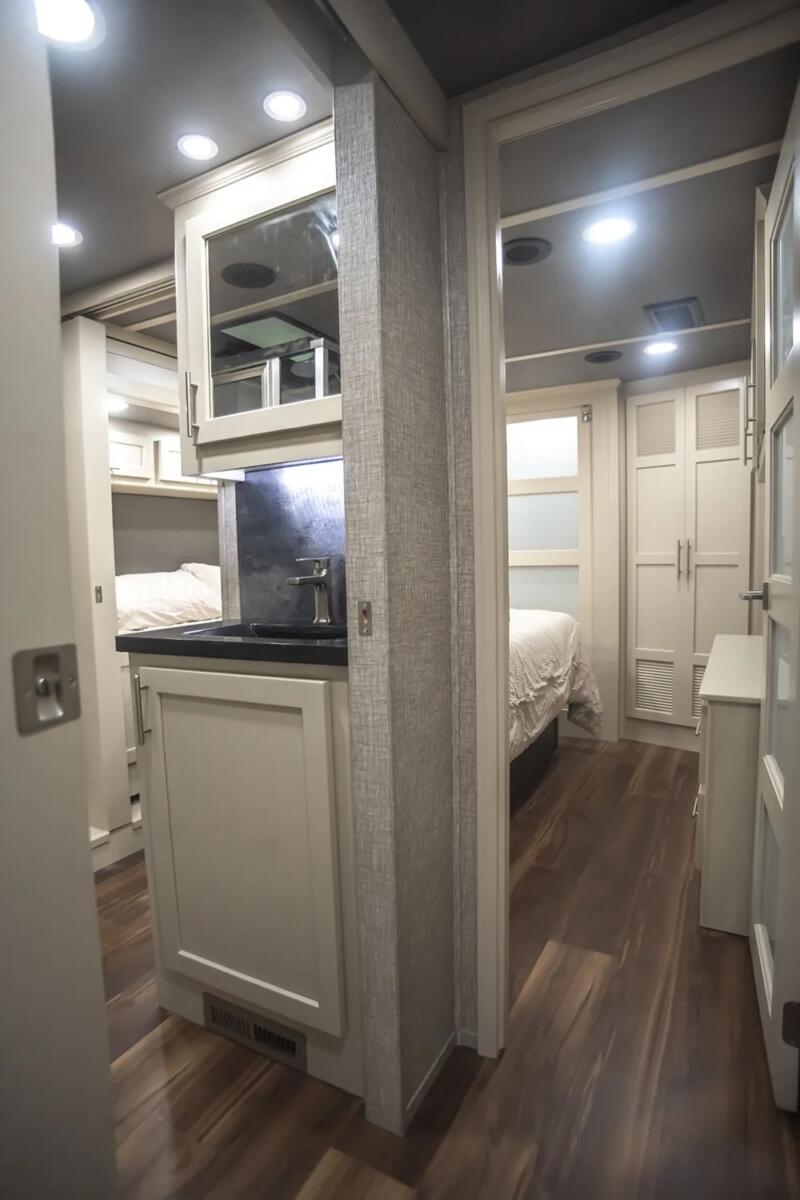
When stepping inside the 2027 Luxe Elegante 33EFS, my first thought was “residential.” The ceiling feels higher than you’d expect from a 34-foot pin-to-cap length. Luxe’s hardwood cabinetry, dovetailed drawers, and tight trim work give the interior a serious, built-in custom look that you won’t see in many other RVs of this size.
Kitchen
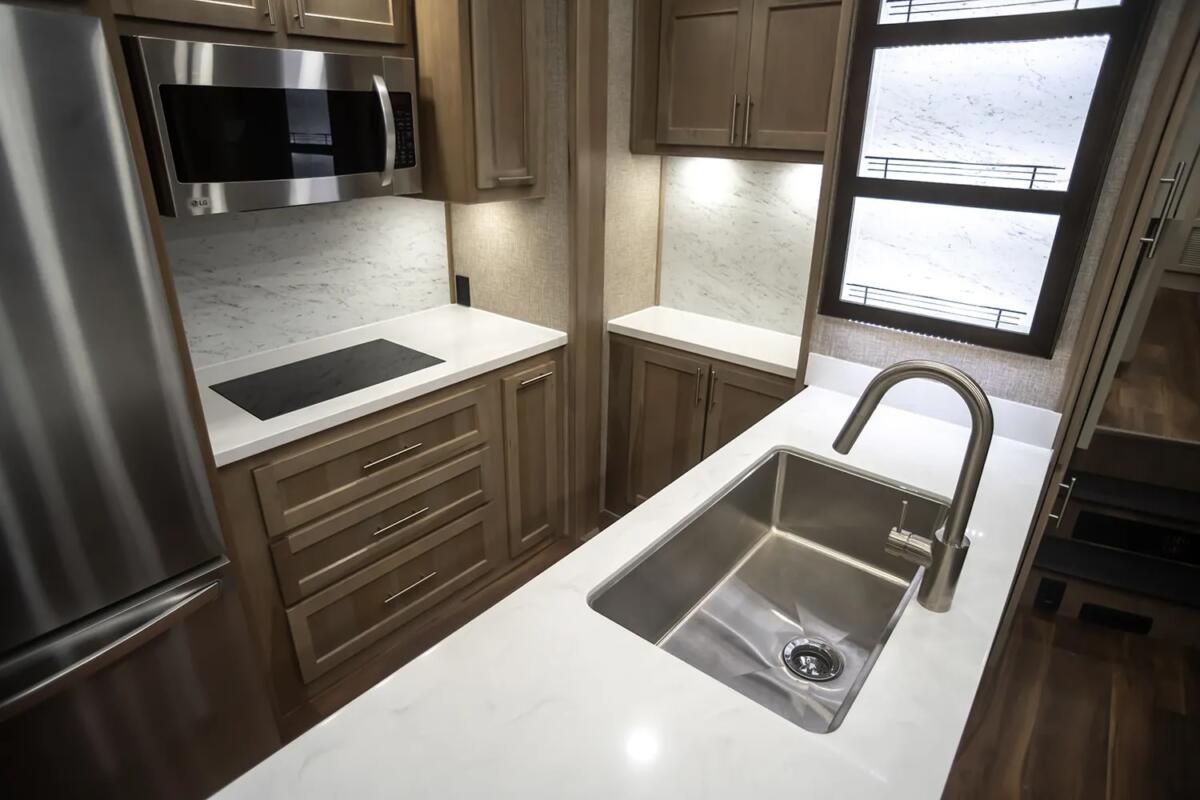
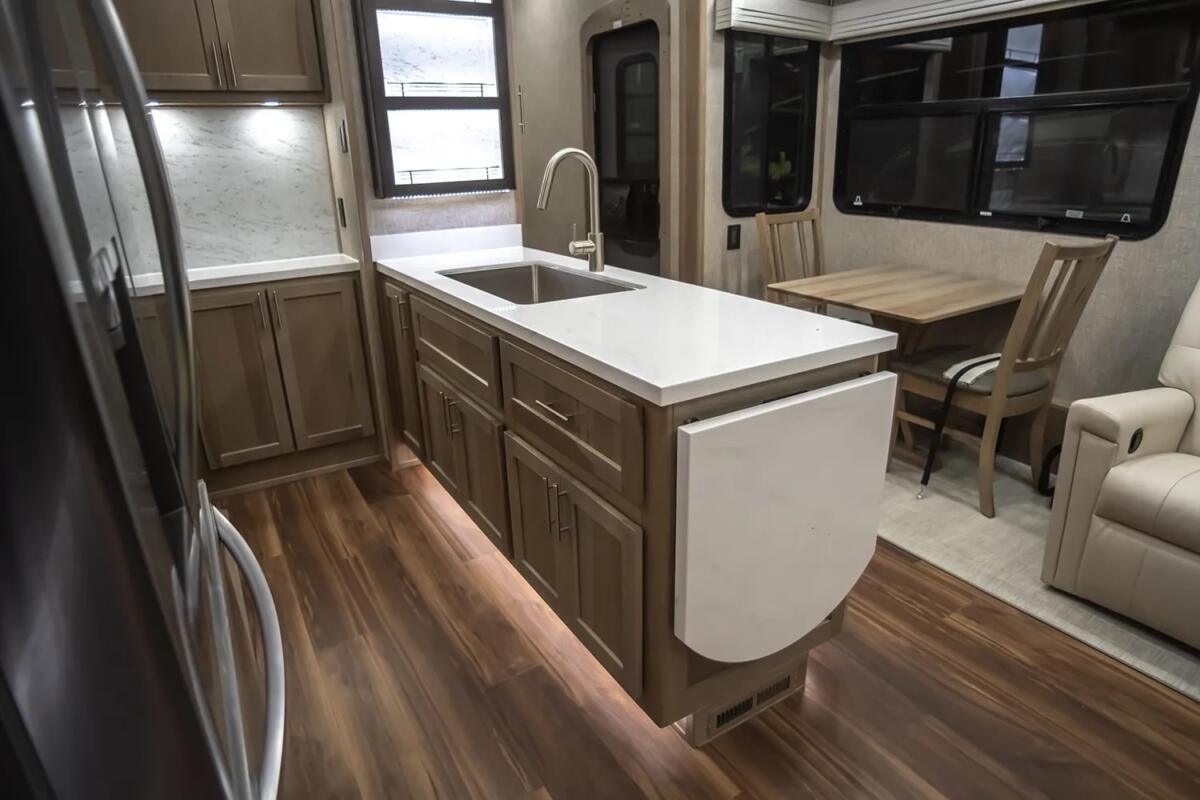
Countertop space is surprisingly generous for this length. It features a full-height pullout pantry option and a composite single-bowl sink. The standard (or commonly chosen) kitchen upgrades include a residential oven option, decent counter depth for prep, and practical drawer organization.
Storage cabinetry is real hardwood with heavy-duty drawer construction, so the kitchen feels built to last.
Living room
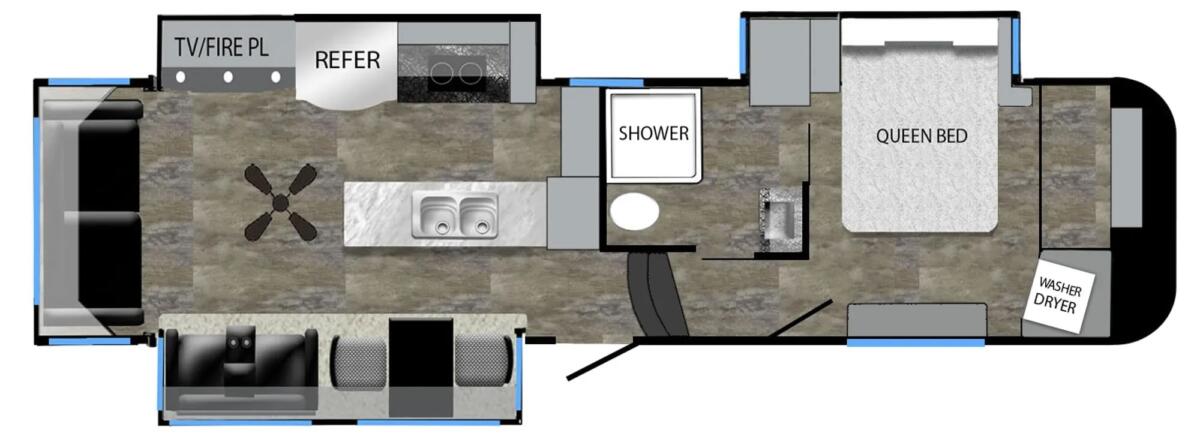
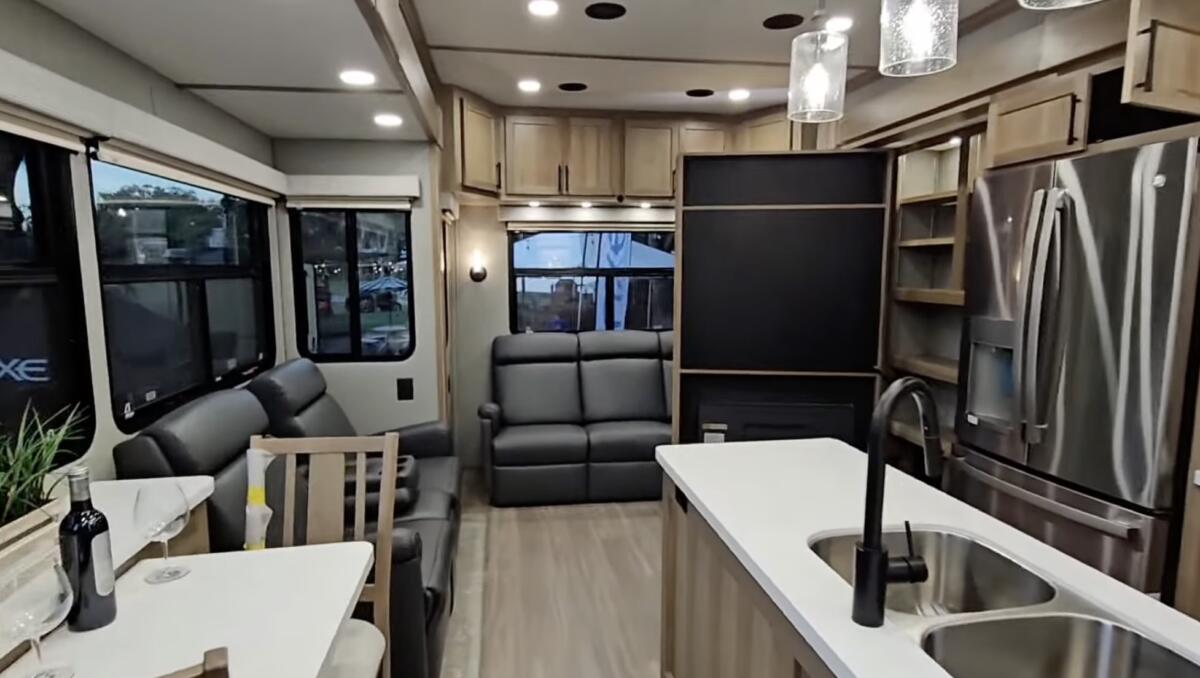
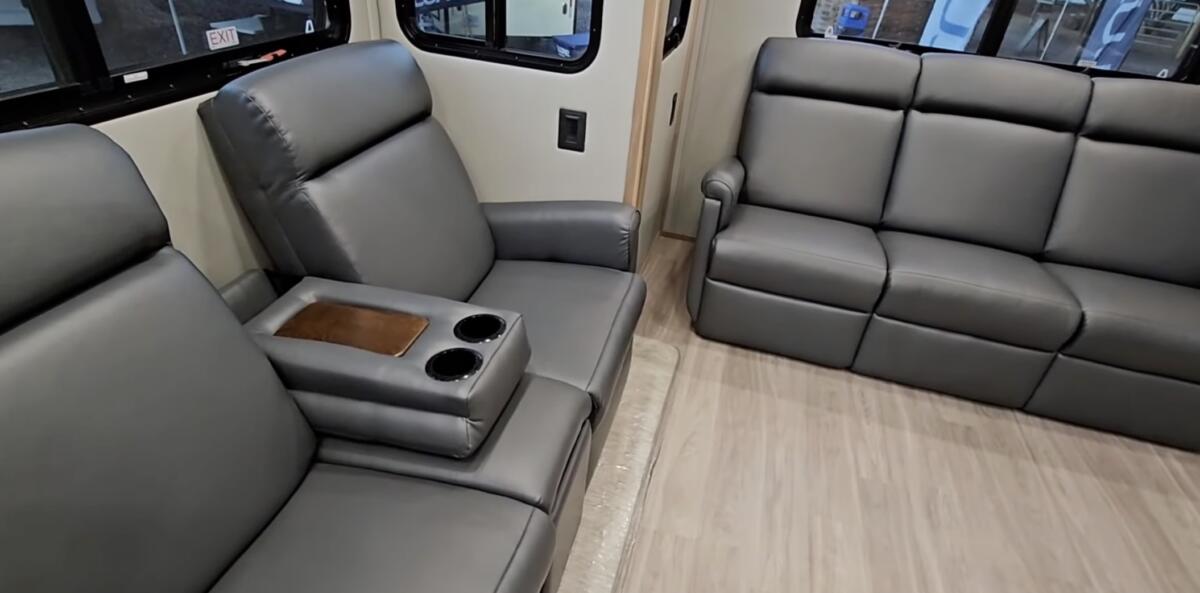
The living area stretches wide when the slides are extended. Theater seating faces an entertainment center with a fireplace. I do wish designers would have eliminated the carpeted slide beneath the recliners and dining space. Visual room and easy cleaning (with vinyl) would be my preference.
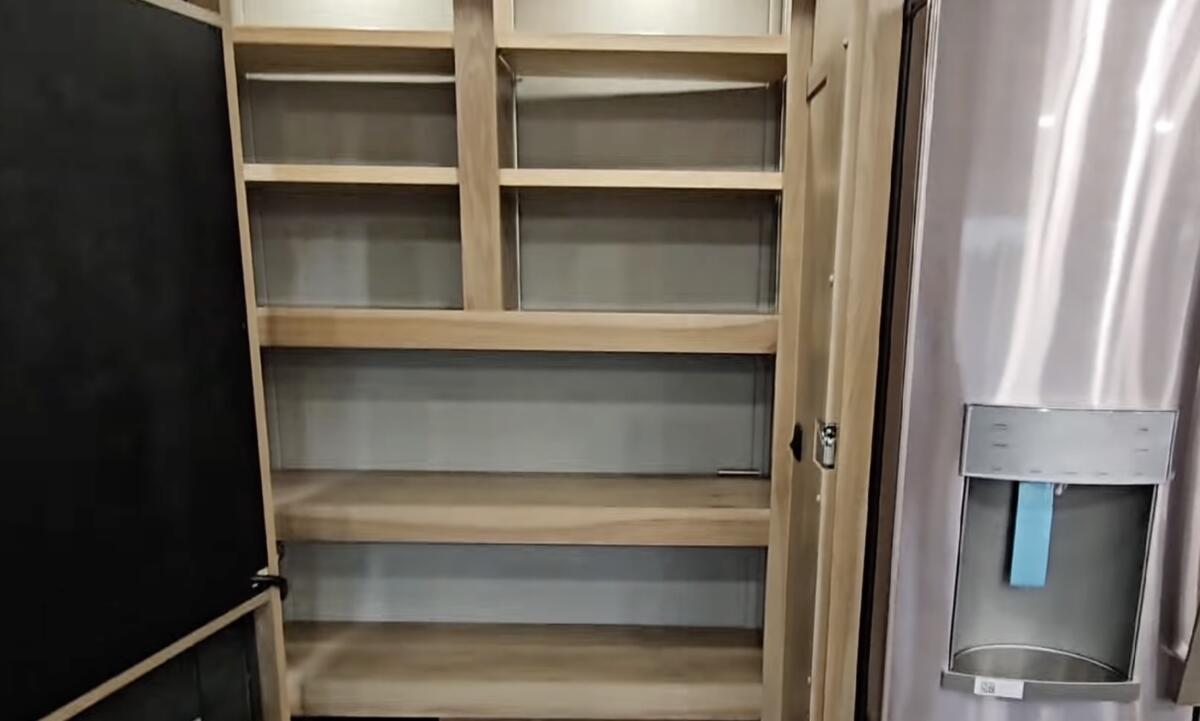
Luxe placed a hidden storage area behind the TV. I’m not always a fan of these. However, this RV has deep shelves that could store quite a bit. In addition, there is a solid wall behind the TV to ensure the pantry contents ride securely when the RV is moving down the road.
The seating and sight lines make it a comfortable spot for streaming or entertaining guests. The large, double-paned windows provide a good view outside and allow lots of natural light into the RV.
The 2027 Luxe Elegante 33EFS’s option list also includes a ceiling fan, hardwood trim, and Lambright furniture options.
Bath
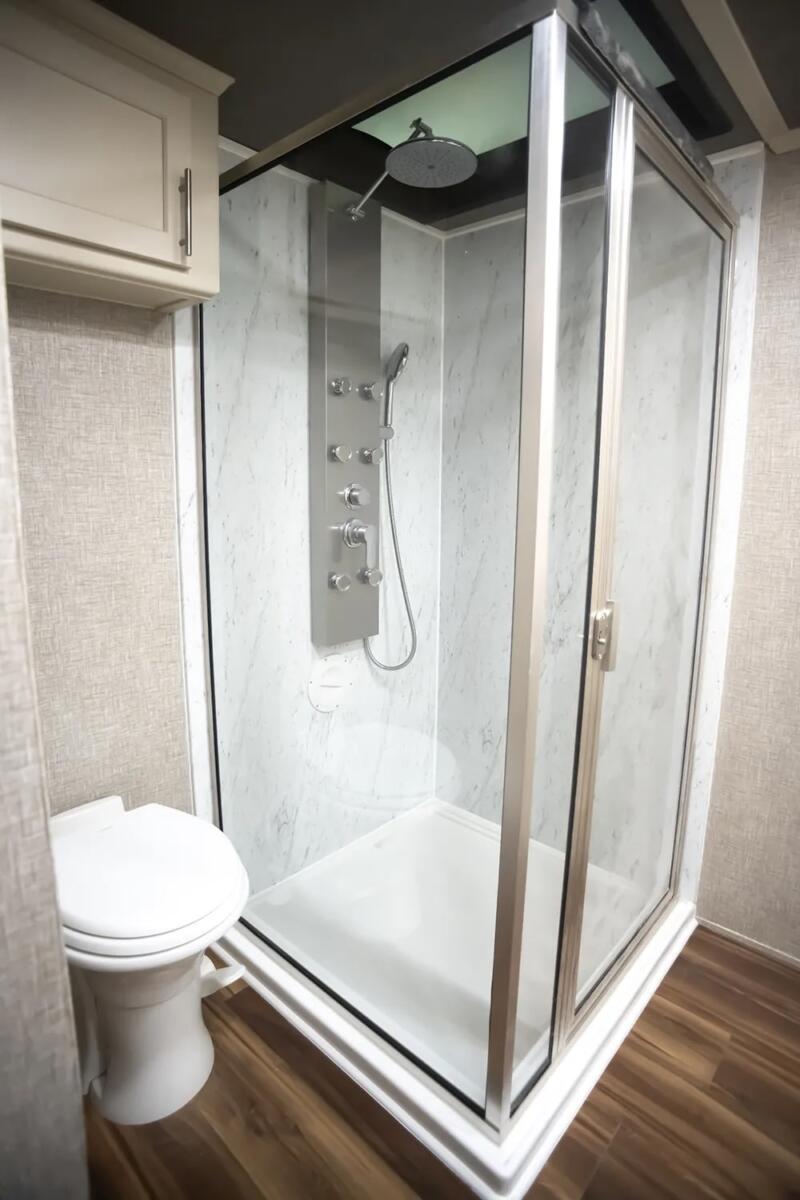
The big shower has a glass enclosure, and there seems to be plenty of room to change clothes and comfortably use the commode. It looks like a small house bathroom, doesn’t it?
Luxe includes good options such as macerator toilets, on-demand water heating and flip-up counter space touches, as well.
The bath’s dual-entry layout is not something we’d need, but, instead, I would like to see space for towel racks or hooks.
The solid flooring and finishes in the 2027 Luxe Elegante 33EFS match the rest of the coach, providing a cohesive feel.
Bedroom
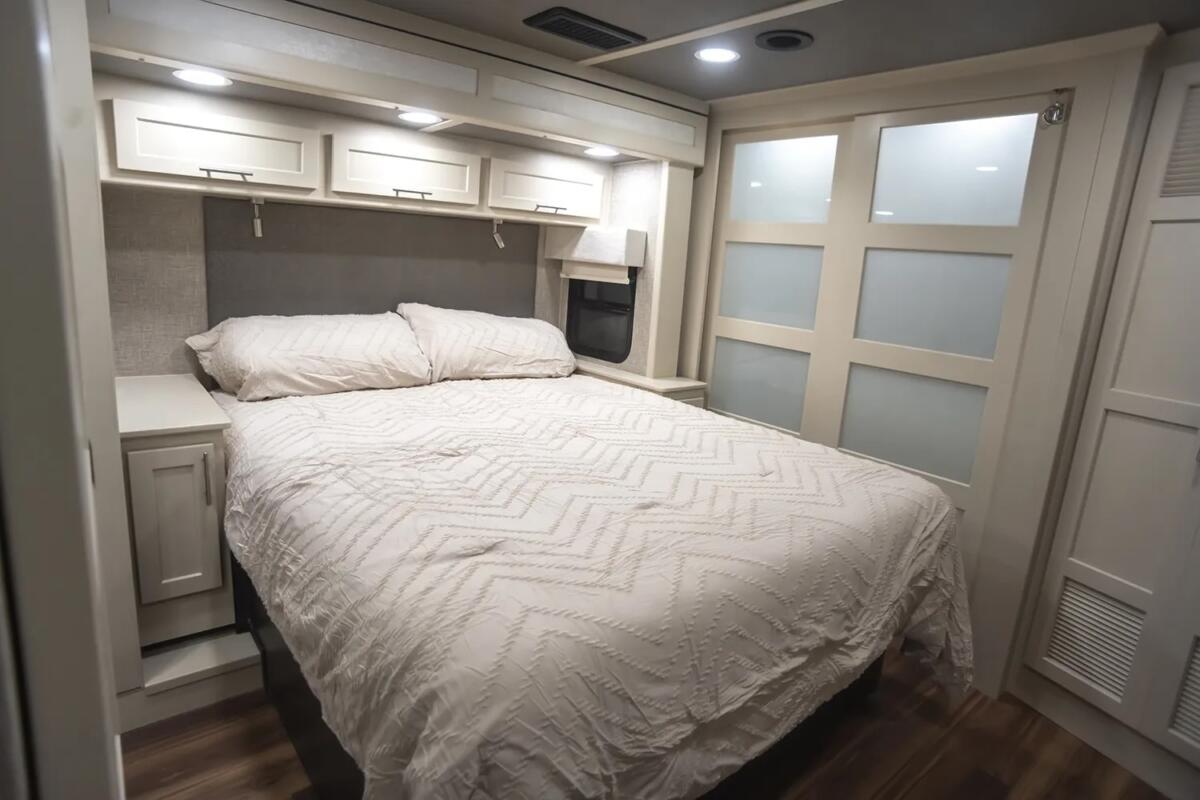
The front bedroom offers room for a queen- or king-size bed. You’ll find large closet space under the front cap and washer/dryer prep, as well. Additional storage is incorporated at the foot of the bed.
Elegante’s layout emphasizes comfort and control, with system panels and HVAC zoning within easy reach.
Note: If you plan long stretches of boondocking, pay attention to available battery/inverter and generator prep options.
Overall take
The 2027 Luxe Elegante 33EFS is a compact but serious full-time fifth wheel that trades the “midsize” convenience of a shorter coach for true Luxe construction and residential details.
If you value build quality and insulation over extra floor length, the Elegante may be the RV for you. Its high-end materials, smart storage, and three slide-outs to expand the living footprint will make RVing enjoyable and comfortable. Best of all, the 2027 Luxe Elegante 33EFS can be towed without a dually truck.
Take a video walk-through here.
What features do you like/dislike in the 2027 Luxe Elegante 33EFS? Share your thoughts in the comments below.
I’m so grateful for all the kind words about this take on the RV news of the week when I announced this new column last week. Apparently, some of you may believe that I know something, or are just dazzled by my beard. I don’t know. But, seriously, thank you.
This week, we’re going to look at some of the interesting goings on in the RV space, and there have been some interesting goings on for sure. So first, let’s head to Alabama.
A Tiffin Class A motorhome outside the company’s Red Bay service center, a place many owners associate with hands-on support and problem-solving.
Changes at Tiffin
Have you ever had a favorite restaurant and it was remarkably successful, but the owners were tired and sold off the operation? Nothing will change with the new owners, they say. Nothing will change with the new owners, the new owners also say. And then there’s a new menu, and they don’t make your favorite dessert any longer, and, well, it’s not the same.
You may have read Russ and Tiña’s article that there was a big leadership change at Tiffin motorhomes. It started a while back when THOR acquired the Red Bay, Alabama, brand that was known for its quality and customer care under family ownership.
Sure, that makes sense, to build all of the same kind of rig in the same factory, but I am getting shades of that restaurant changing after the ownership changes.
And now Leigh Tiffin is leaving? None of these are great signs for a company that worked so hard to polish its reputation that it was worth it for THOR to write them a big check. Although I had also heard that THOR realizes the workforce in Indiana is close to being tapped out, and having a whole different crew a few states away is another reason to own Tiffin.
I’m actually heading to Red Bay in April (can’t wait!), so I’ll potentially know more then. Obviously, I will keep you all in the loop.
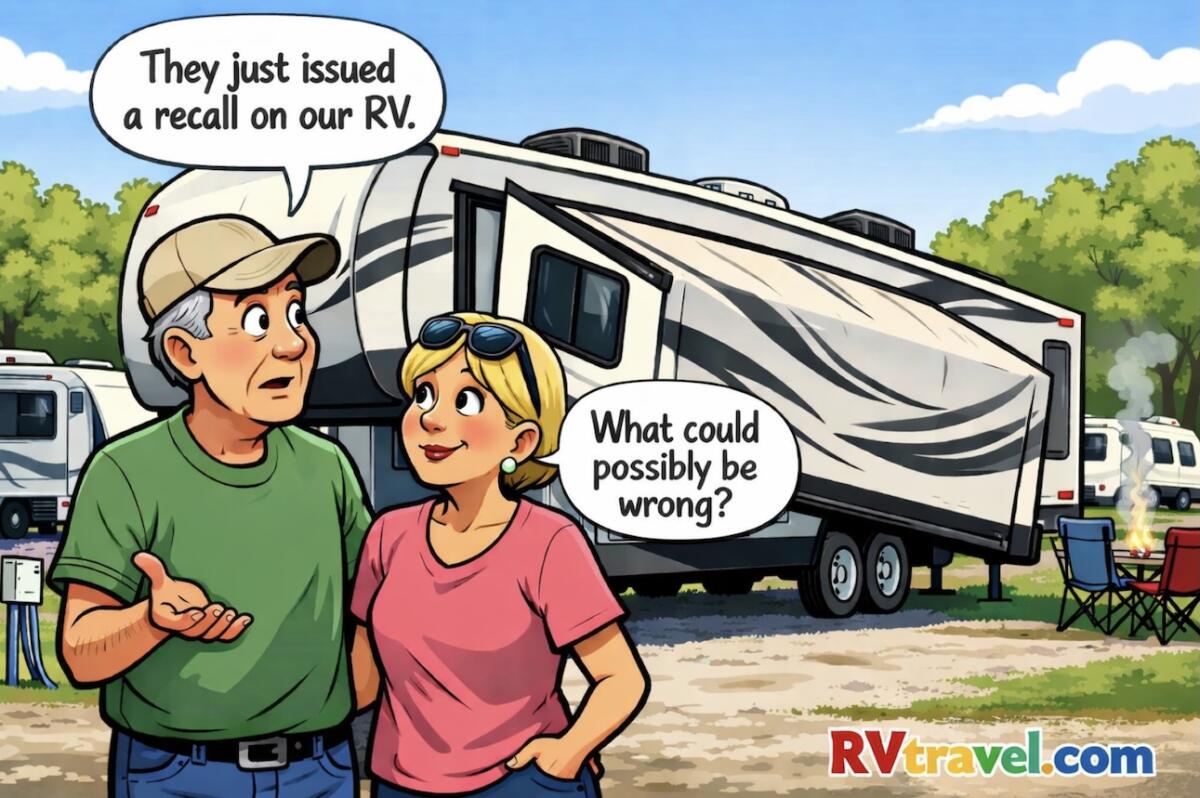
You may share this cartoon on your website, blog or social media with our compliments. The musings from Tanner Woods’ creative mind appear every Sunday in this newsletter. Laughter is good.
So do these recalls point to a lack of quality? Why are you seeing so doggone many recalls lately?
First of all, the Chrysler recall. A control module. If you’ve looked at a modern vehicle, there are so darned many subsystems and computer systems, it’s just nuts. I installed a brake control module in my Ram 1500 a few years ago and, after simply installing a plug-and-play device, I had to go in and modify the truck’s settings using an OBD-II tool. If memory serves, there were multiple nested menus I had to go through to set various parameters in the truck’s system.
So all these technological bits and pieces are often created by subcontractors whose systems have to work with other systems and so on and so forth. The more complicated vehicles become, the more likely these recalls are going to be. Oops, Johnny’s software doesn’t work with Jimmy’s software as expected.
The number of permutations and variations a car company (do any of them even make cars anymore?) has to test is crazy and the “fun” that can be had with software not agreeing with other software is also. Well. Fun?
The good thing about recalls is that it shows that the company is aware of an issue and is working to resolve it. The big, big recall with airbags, however, that occurred a few years ago was truly concerning, and I don’t believe it ever got completely resolved.
At any rate, you can stay tuned to RVtravel.com for the latest recalls. In many cases, they’re nothing to be overly concerned about, although the one with the towing module would get my attention right away.
So would the one in Grand Design’s motorized units, where the seat base may have been improperly torqued. The company removes the seats as part of the conversion process from bare cab and chassis to finished motorhome, and someone didn’t get the memo on whatever the torque specs were for screwing those seats back into place.
Something I heard when I was writing a syndicated auto column was this: Decision makers at a car company were bemoaning some of the people who were interested in working for that company. His take was that someone who was good with software was more likely to want to work in Silicon Valley than under the old-school thinking of a car company.
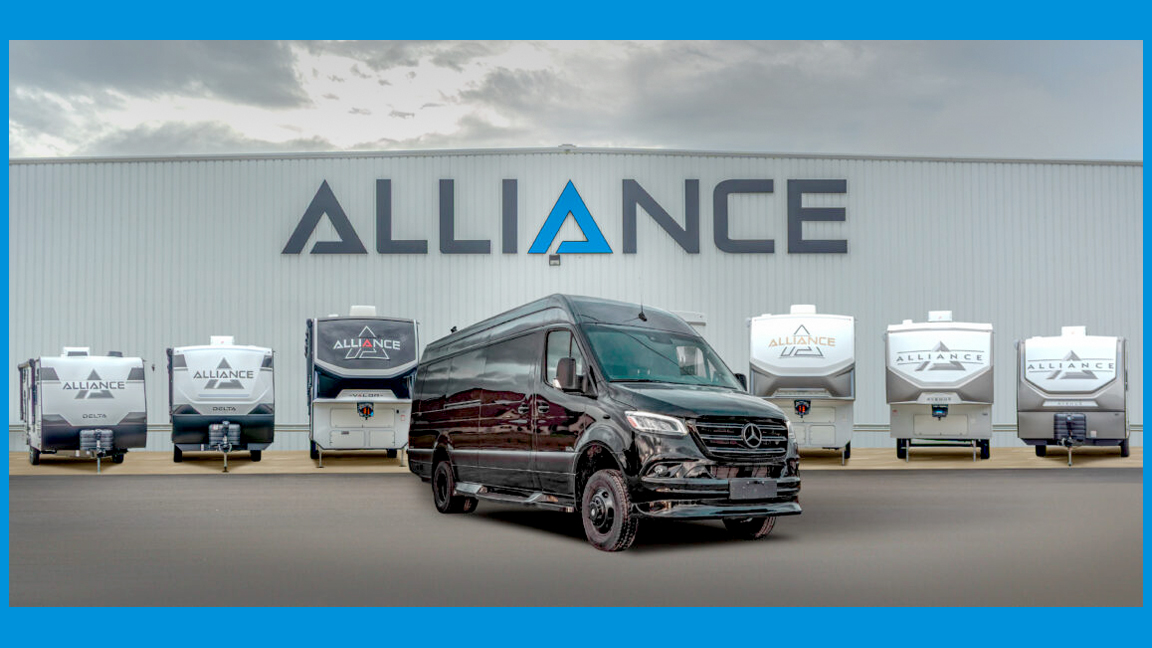
Alliance buys Midwest Automotive Designs
Two years ago, Grand Design only made towable RVs. Then the company came out with a whole series of motorized rigs and, quite frankly, they made a huge impact on the market. I’ve been critical of a lot of their thinking in the towable markets, but I think their motorized rigs are typically best in class.
Mike Hums and his crew are truly top-notch, understand the market, understand how to make a difference, and have been given the freedom to do so. I am impressed.
So it only makes sense that Alliance wants to get into the motorhome business, too. Rather than start from scratch, it was just easier to bring Midwest Automotive Designs into the fold.
The team at Alliance is pretty sharp, and their marketing is outstanding (nod to you, Joe Mehl!), so this seems like a solid idea. Maybe their website will even deliver all the pages for which there are menus. Maybe they’ll think of a better name for the motorized rigs, too.
Weigh stations
One last thing. Russ and Tiña wrote an article about how weigh stations that don’t require trucks to pull in could be a benefit to RVers simply because the trucks didn’t have to slow down and pull into the “chicken coop.” But here’s my opinion, and you know opinions are like hind ends. We all have ‘em, and many of ‘em stink.
I’d like to see RVs be required to be weighed, as well. In my opinion, I’ve seen so many dangerous situations and RV builders advertising even fifth wheels as “half-ton” models. Poppycock!
So I think one of the greatest safety advances in the RV space could be RVs being required to be weighed at truck scales. You might never see another Subaru or Jeep towing a trailer ever again, which wouldn’t be a bad thing, and half the half-ton trucks would be disqualified from their towing duties.
Maybe dealers and RV manufacturers would finally learn it’s not the amount a vehicle can pull, it’s what it can carry after you calculate in all that junk in your trunk.
A Texas-based pet microchip registry called Save This Life unexpectedly stopped operating this week. Subsequently, the company was removed from the American Animal Hospital Association’s lookup tool.
This means scans of affected microchips will still show the chip number, but the owner contact information that used to be linked to that number may no longer be accessible through that registry.
Save This Life had been a widely used registration service with millions of pets registered. Many owners, vets, and rescues learned about the problem only after the database became unreachable. That gap in communication left shelters and clinics finding microchipped animals whose registry information no longer identified an owner.
The microchips still work
The good news is that the physical microchips themselves aren’t “dead.” A scanner will still read the chip’s identifier. However, the problem is the registry link. That’s the online record that says “This chip number belongs to Jane Smith, 555-555-5555.” It’s what shelters and vets rely on to reunite a lost pet with its owner. Because the company’s database went offline, vet clinics and shelters couldn’t retrieve owner details for affected chip numbers.
Veterinarians and animal welfare groups are urging owners to confirm registration status and transfer records where needed.
Pet owners are advised to get their pet scanned the next time they visit a vet, clinic, or animal shelter (even if traveling away from your home base). Ask for the chip number and the company name that shows up on the lookup. If it’s registered to Save This Life, treat that as an urgent “re-register” situation. You don’t need to re-implant a chip. Instead, move the existing chip number into a current, active registry. That way your contact information will be reachable nationwide. The American Animal Hospital Association’s microchip lookup tool can help identify which company a chip is (or was) registered with.
If your pet was affected, re-register with a reputable provider as soon as possible. Several established registries and microchip services are offering help. Re-registering links that existing chip number to a registry people and shelters actually use.
Tips for RVers with pets
Keep a travel file for each pet. While you’re on the road, keep a printed copy (and a photo) of the chip number, the microchip company listed on initial paperwork, vaccination/medical records, and a recent photo of your pet.
Store these documents in your RV’s glovebox or a dedicated pet folder. That way if you’re separated from your pet while traveling, the paperwork speeds up the reunion process at any shelter or clinic you encounter.
What to do
Visit a nearby shelter or vet to ask staff to scan your pet’s chip. See if they can find the AAHA lookup for the chip number. If it returns a defunct registry, ask them to assist you in registering the chip with an active provider on the spot.
Many clinics and rescues are proactively contacting owners whose records show the old registry. If you’re traveling through multiple states, make sure your updated registry entry includes a local contact plus your primary phone/email and a national contact method (cell or a friend/family member back home).
Re-chip?
The best move is to transfer the existing chip’s number into a working registry. Re-implanting creates unnecessary medical intervention and a duplicate identifier. Transferring the registration preserves the functioning identifier and restores the owner info. Vets and registries can guide you through transferring ownership and contact details without surgery.
Why did this happen?
Public records and reporting indicate the company’s Texas business registration became inactive for reasons tied to administrative or tax forfeiture. The company’s phone lines and email were unreachable when vets and industry groups tried to contact them.
The American Animal Hospital Association removed the company from its lookup tool after repeated failed searches.
Be proactive
Make a regular habit of checking your pets’ microchip registration any time you visit a clinic. If you depend on a national registry, verify contact details are current and consider adding a secondary contact.
When you change phone numbers, email addresses, or travel plans for longer stretches, update the registry right away. Owners who travel a lot (like RVers) should think of their pet’s microchip record the same way they think of roadside service or insurance. It’s best to confirm it’s in service before you depart.
Does the Save This Life microchip shutdown affect you and your pet? Tell us using the comments below.
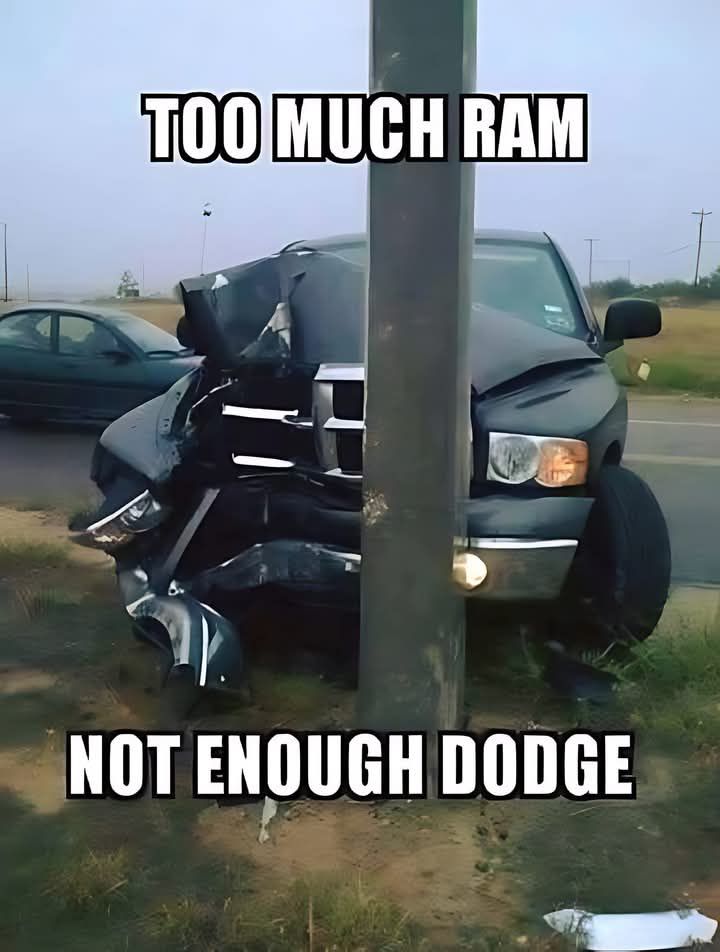
Stellantis has issued an immediate recall of certain vehicles in its lineup, including Chrysler, Dodge, Jeep, and Ram.
Defective air bag inflators made by Takata have been the subject of the largest and most complex recall in recent memory. If you own one of the 225,000 affected older vehicles with an unrepaired air bag, this is not a “wait-and-see” situation. It’s critical for safety.
Why the recall
The problem is with the airbag inflator. It’s the metal canister that contains the propellant that deploys the air bag. Over time, and especially after long exposure to heat and humidity, the propellant can degrade, and the inflator can rupture when the bag deploys.
When that happens, the inflator can explode and send metal fragments into the cabin. It has caused fatal and horrific injuries in the past. The safety agency warns that even minor crashes can trigger a dangerous inflator rupture.
Why is this popping up again?
A lot of vehicles were fixed years ago, but not all. The recall program was phased because replacement parts couldn’t be produced and installed for tens of millions of affected cars all at once. The regulator set “priority groups” so the highest-risk vehicles (age, inflator type, and time spent in hot/humid areas) were repaired first.
Over the years, many owners had repairs done, others sold or exported their cars, and some simply never responded to notices. That left a remaining pool of vehicles that are now considered high enough risk that the automaker and the agency are calling for immediate action. In some cases, a formal “do not drive” advisory has been issued until the fix is completed. In short, many of the defective airbags were fixed, but enough remain unrepaired that the recall has been reopened.
When people say the recall was “reordered” or reprioritized, they mean the regulator and manufacturers adjusted which VINs get top scheduling based on updated risk data and repair progress. That’s why you’ll see lists and priority group changes. The program shifts focus to the unrepaired vehicles that pose the highest current risk. This allows available replacement parts and dealer capacity to direct efforts where they matter most. This is not a new defect being discovered. It’s an administrative/technical move to finish the job safely and faster.
Affected vehicles
The public notice covers roughly 225,000 unrepaired vehicles across certain model years and names (older Ram pickups, Durango, Dakota, Magnum, Charger, Challenger, Chrysler 300, Aspen, Jeep Wrangler, and certain Mitsubishi models).
If you want the exact model years and VIN scope for your vehicle, use the official VIN lookup. The list varies by inflator type and recall number.
Practical steps
Check your VIN at the regulator’s recall lookup. Use your 17-character VIN from the windshield. If the lookup says your vehicle has an open Takata recall, don’t drive it if the notice or dealer says, “Do not drive.”
Call the manufacturer’s recall hotline (833-585-0144) to schedule the free repair. The automaker will replace the inflator at no cost.
If you’re away from home (on the road with an RV), ask the dealer about alternate transportation or towing options. Dealers will often help arrange a tow, so the vehicle can get to the repair safely.
If the recalled vehicle is a tow vehicle for your RV, make alternate plans for towing. Put a note on your RV paperwork so you remember to follow up later if scheduling is delayed.
Official contact and repair information
Use the regulator’s VIN lookup to confirm. If your vehicle is included in this recent advisory, call 833-585-0144 to speak with a customer care agent. They can connect you with a local dealer for the free recall repair. If you prefer, contact your local authorized dealer directly and mention the Takata inflator recall. Dealers will perform the remedy at no charge.
What to tell your dealer or tow company
Give them your VIN and tell them the vehicle is under the Takata inflator recall. Explain that the vehicle has a “do not drive” advisory (if that’s what the lookup or notice says). Ask whether the dealer will supply a tow or loaner, or whether they have a courtesy vehicle while they replace the inflator. If you’re in a remote area, plan for towing to the nearest authorized dealer. Don’t attempt to drive a vehicle that’s been flagged as unsafe to drive.
Recall history
The entire Takata recall program has stretched over many years because of the scale of the problem and part availability. Regulators and manufacturers set deadlines and priority groups to protect the worst at-risk vehicles first. The recent “Do not drive” action is a push to finish what began years ago. They intend to bring those last unrepaired cars in for the free fix and close the book on this hazard. If you ever had the work done, check your service records. If not, treat the advisory as urgent.
Final note for RVers
If that truck, SUV, or car is part of your towing setup, don’t put your family or your rig’s safety at risk. Treat the recall like a mandatory maintenance item. Verify your VIN, call the number above, and get the free repair scheduled.
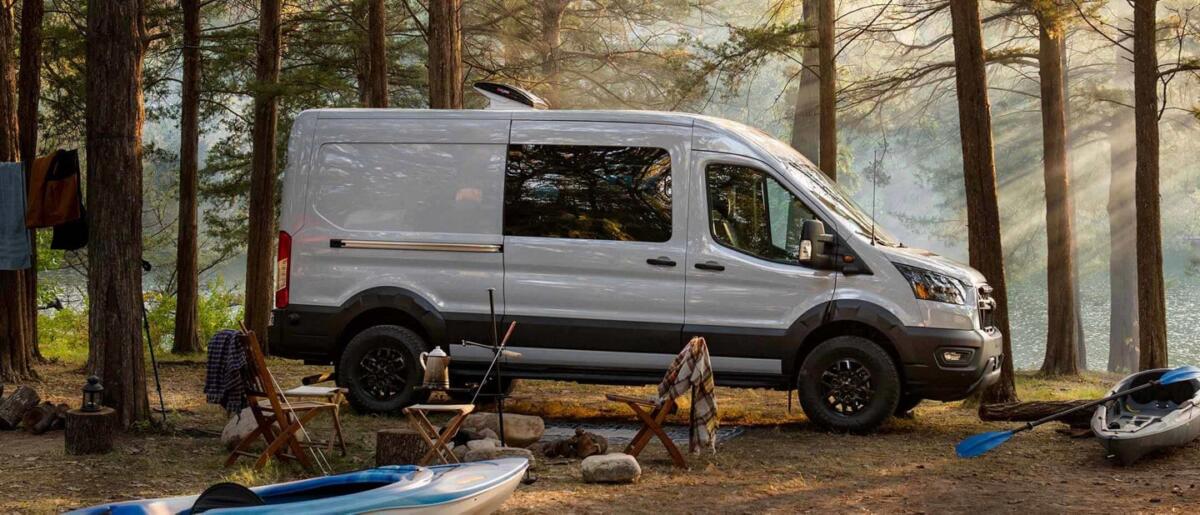
If you RV in a Ford Transit (especially a Trail model with a body lift) pay attention. Ford has issued a safety recall for some 2023–2024 Transit vans after discovering the engine crossmember fasteners on some vehicles may have been installed without washers.
That small hardware omission can let the joint lose clamp load over time. This would allow the engine to shift and possibly cause a loss of drive power. It may also damage other systems, including brakes.
Which vehicles are included
The recall covers select 2023 and 2024 Ford Transit vans equipped with the Transit Trail equipment package. These vehicles were produced between March 15, 2022, and January 30, 2024. Ford reported 1,403 potentially involved vehicles in the U.S. The recall is recorded with NHTSA as Campaign No. 26V061000 and internally at Ford as 26S04.
If your van is a Transit Trail built in that date window, it’s within the Ford recall.
Cause and effect
During the fitting of the Trail’s body-lift hardware, a vehicle modifier used substitute bolts that may not have included washers. Testing by Ford’s engineering teams confirmed assemblies without washers could lose clamp load. This would allow the engine crossmember joint to slip. If that joint fails, the engine can move from its intended position. This can produce a loss of power or damage other systems. (Brakes were specifically called out as one possible system affected.)
Owners might notice a clunking noise over bumps, on startup, or during heavy acceleration/deceleration before anything more serious happens. Ford says it is not aware of any crashes or injuries related to this issue so far.
What dealers will do
The remedy is straightforward. Dealers will replace the engine crossmember fasteners with the correct fasteners that include washers at no cost to owners. If your van is affected, a dealer visit should be quick. Techs will replace bolts/fasteners with the correct washers and hardware.
Immediate safety steps for RVers
If you hear the warning clunking described above, or if you suspect the hardware was modified on your van, err on the side of caution. Avoid driving the vehicle long distances until a dealer inspects it. Follow any specific consumer advisory Ford or NHTSA issues.
How to check
Find your VIN: It’s the 17-character number on the lower-left of the windshield, the driver-side doorjamb label, your registration, or insurance card.
Use NHTSA’s recall lookup page and enter your VIN or license plate and state to see open recalls for that exact vehicle.
You can also check Ford’s recall/owner support recall lookup at Ford’s support site (search by VIN there, too). Or call Ford Customer Service at (800) 392-3673 to ask directly.
If your vehicle’s VIN is included, schedule the free dealer repair.
America’s Original RV Newsletter. Since 2001
Issue 2840 • New issue every weekday If you find this newsletter helpful, please considersupporting our staff’s work in producing it with a donation of your choice.
Today’s thought
“The question is not what you look at, but what you see.” ―Henry David Thoreau
Need an excuse to celebrate? Today is National Tortellini Day! Sound good? Here are some tortellini recipes.
On this day in history:1914 – Copyright: The American Society of Composers, Authors, and Publishers (ASCAP) was founded in New York City. The purpose of this organization was, and remains, to protect the copyright and performance rights of the works of its members: composers, songwriters, lyricists, and music publishers.
Tip of the day Tips to maximize storage: Think outside the box (RV)
RV review
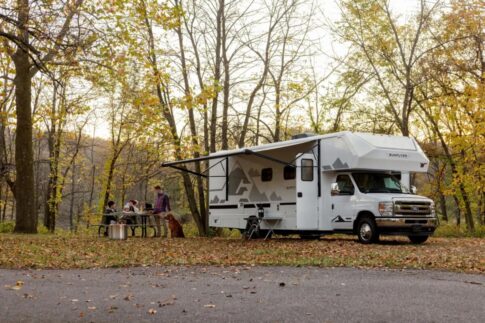
A smart, spacious Class C: The 2026 Winnebago Sunflyer 26FE
By Gail Marsh
If you’re a traveler who wants a Class C motorhome that feels open and ready for road life, the 2026 Winnebago Sunflyer 26FE deserves a hard look. I was able to see this coach as it debuted at the recent Florida RV SuperShow and was favorably impressed. Check it out.
In the RV shop with Dustin Duraflex Gator sewer hose kits product review
At California RV Specialists, we understand how important it is for RV owners to have dependable, high-quality sanitation equipment. That’s why we’re proud to highlight Gator Sewer Hose Kits by Duraflex Sanitation Products. These are what we recommend in our shop, and here’s why…
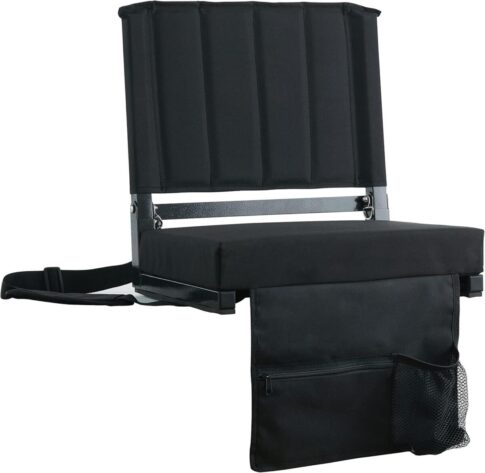
Turn a hard picnic bench into a comfortable seat with a back
This cushioned stadium seat is a game-changer for campground picnic tables, park benches, and bleachers. With thick padding and solid back support, it takes the pressure off stiff backs and sore hips—especially helpful for seniors who still want to linger at the table, watch grandkids play, or enjoy a long picnic without discomfort. Lightweight, easy to carry, and stable, it’s a simple way to make outdoor seating a lot more comfortable.
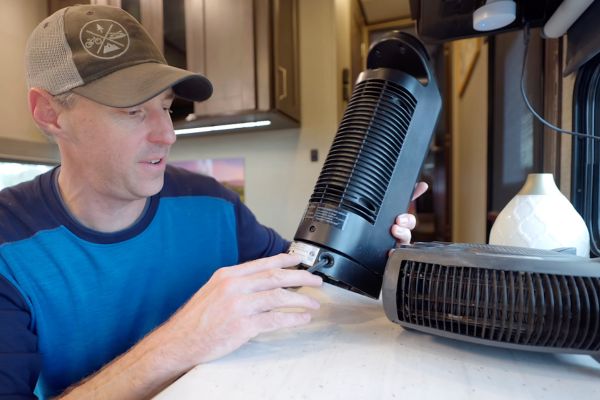
Article and video How to safely use electric heat in an RV
Electric heat in an RV can feel like either the simplest thing ever or a fast track to melted plugs and a fire. Jared Gillis from All About RVs lands in the middle. Electric heaters can be used safely, but only if the RV’s wiring, outlets, and heater load are treated like the weak links they can be. Continue reading to learn more.
Where is it?
Featured article Why we had to prove a reader wrong about RVing
By Nanci Dixon
Howard B. sent this email and asked that we please prove him wrong: “I have been planning for my retirement in a couple of years, but as I have been reading, RVing appears to be on the downslide. Bummer, as I planned on buying a Super C Newmar and traveling around the country with wifey. All I read about is how bad RVing is now, and how difficult it is to RV across the country. I am now in a quandary as to what I will do. It does not look promising at all. Prove me wrong, PLEASE.” Well, Howard, let me be the one to prove you wrong!
How RVers can celebrate Valentine’s Day
Wondering how you and your RVing Valentine can celebrate Valentine’s Day tomorrow? Here are some suggestions for you. From visiting the “Valentine” capitols of the U.S, to choosing new trip destinations together, to having a little fun on the internet, these are a few ways to do something together tomorrow.
GOOD IDEA: Keep a paper list of emergency contacts and info. Phones die, power goes out, signals disappear, but paper still works.
Ask Dave Is a battery tender necessary when RV is not being used?
Fix roof leaks and extend your RV roof another 18-20 years with the ONLY liquid butyl rubber in the world
RV Roof Magic’s unique solvent-based drying process allows for a chemical bond not found in other RV sealants. That is why it never needs a primer and only one coat. We offer a 10-year warranty. Apply RV Roof Magic to all roofs except silicone and PVC. Over 30 years of history of success. Visit our site for our monthly special!
Reader poll Have you performed any volunteer work in the last 12 months?
Seems like there are just too many things to take in the shower. Shampoo, conditioner, liquid body lotions, notions and potions. Where do you put it all when you trek off to the campground shower, or even in your own rig if space is at a premium? Here’s one possibility, a portable shower lanyard. Hangs around your neck or the showerhead. Teeny bottles have pre-printed labels to help ID what’s inside, and special thick-layered caps prevent goop leakage. You can buy a 4-pack here.
U.S. National Parks by size
This list of largest to smallest national parks by size (measured by acres) might surprise you. We would’ve guessed some of these would’ve been higher on the list!
? MYSTERY PRODUCT OF THE DAY ? Not only is this a conversation starter, “Is that a ___ in your ___?!”, but it’s also just SO entirely cool we know you’re going to want it! Heck, we want it! Heck, we might buy it!
Trivia
In addition to today being National Tortellini Day, it’s also National Cheddar Day! The day was created by the Tillamook County (OR) Creamery in 2019 to celebrate its 110th birthday. Cheddar cheese hails from the city of Cheddar in Somerset, South England. It accounts for more than a third of all the cheese sold in the United States. BTW, the Tillamook Maker’s Reserve 2014 Extra Sharp White Cheddar was named the best cheddar in the world at the 2024 World Cheese Awards. Yep. It’s that yummy!
Did you know you can visit the Tillamook Creamery? Get your fix of cheese, ice cream and more, and take a free self-guided tour of the plant. (We love this place!)Here’s the website to learn more.
For Lovers Only
TO: Babycakes FROM: Hubby “Where have the years gone? We have just celebrated our 49th anniversary, and I am looking forward to our three-week trip, with our trailer, to warmer climates starting next week. I am hoping for many more years to come with you, my love. Happy Valentine’s.”
TO: Patty, my Wife-ish FROM: Your Husband-ish “Forty-nine years ago, we were first married. We were too young and foolish to fully realize what we had, so we divorced and lived separate lives. Here we are, 75 years old. As a 7-year full-time RVer soon passing through your town last September, I contacted you for a dinner to catch up on our divided lives. Neither of us could have imagined picking up where we left off and re-finding this wonderful love of ours. I am so anticipating sharing this final quarter of our lives together.”
Readers’ pet of the day
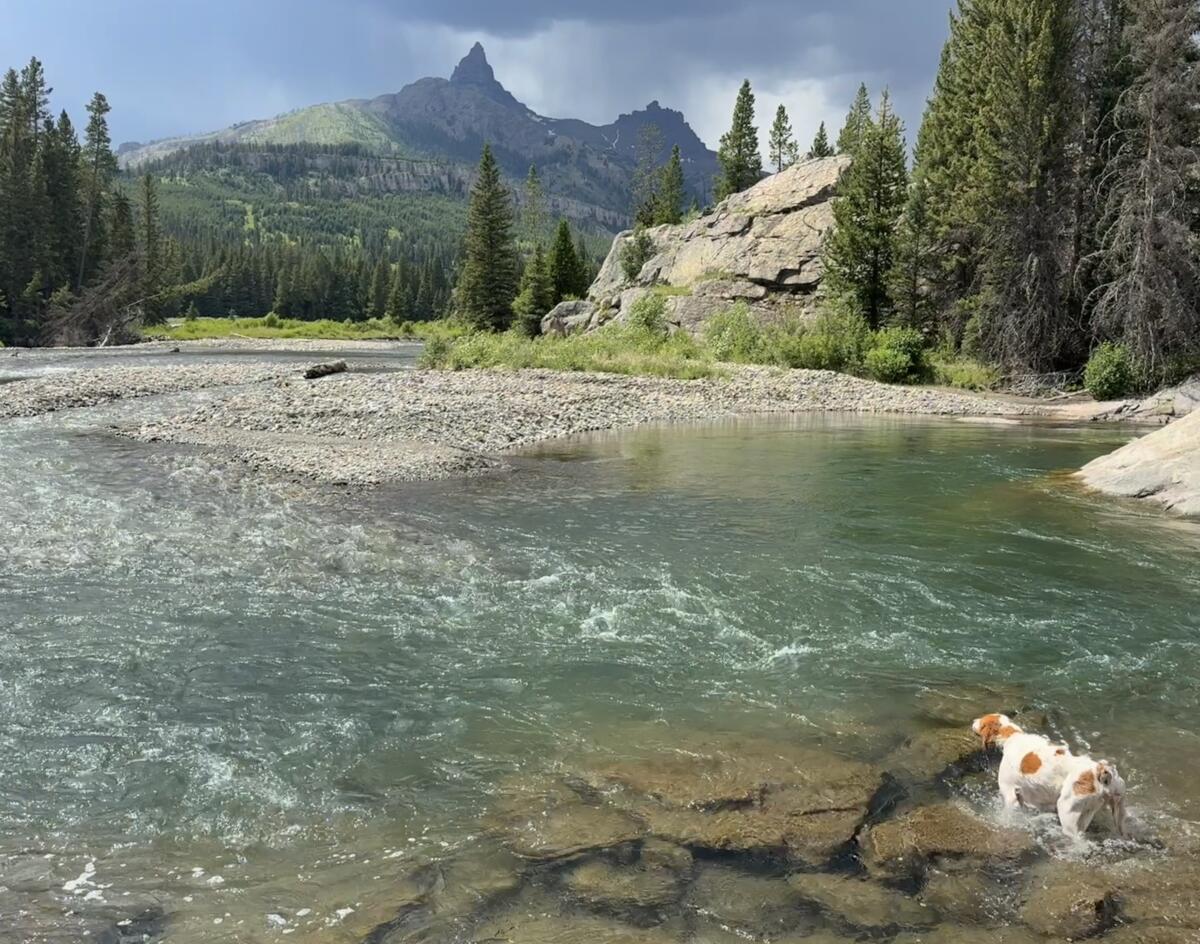
“Donny (Brittany Spaniel, age 6) loves the outdoors, but he also loves to cuddle on the bed with us. He’s enjoyed our trips around the country (on our third one now) and experiencing new dog parks.” —Becky Blunden
Send us a photo of your pet with a short description. No blurry photos and please do not submit your photo more than once. Thanks!
If you shop at Amazon.com we’d appreciate you using this link. We get an itty bitty commission if you buy something, but they add up and help us pay our bills (most importantly our hard-working writers!).
Dear Dave,
Should I put battery tenders on my RV batteries when i am not using it? —Roger, 2024 Thor motorhome
Dear Roger,
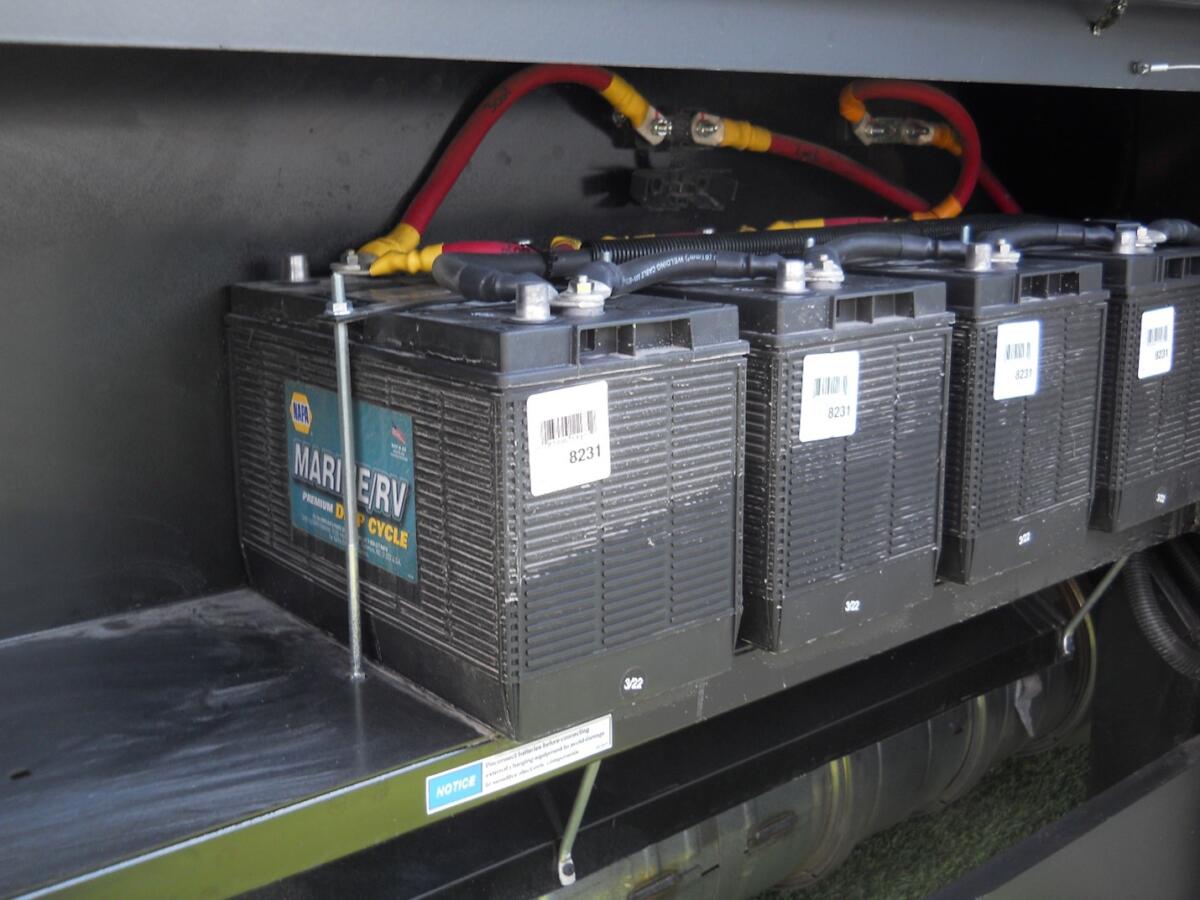
Battery care during storage depends on the type of batteries installed and whether 120-volt power is available. Since your RV is only a couple of years old, it likely still has the original batteries for both the house system and engine starting.
Flooded lead acid batteries
If your RV is equipped with flooded lead acid (FLA) house batteries, they must be kept charged to prevent freezing and sulfation. FLA batteries naturally discharge over several weeks, and that process happens more quickly when there is a constant parasitic draw, such as from an LP leak detector.
Although your model likely has a battery disconnect switch, LP leak detectors are often wired directly and will continue to draw power, potentially draining the batteries within a couple of weeks.
NAPA batteries
A fully charged FLA battery (100% state of charge) has a freezing point of approximately -90° F, while a fully discharged battery (0% state of charge) can freeze at +32° F. It’s also important to note that for an FLA battery, 0% state of charge corresponds to roughly 11.5 volts.
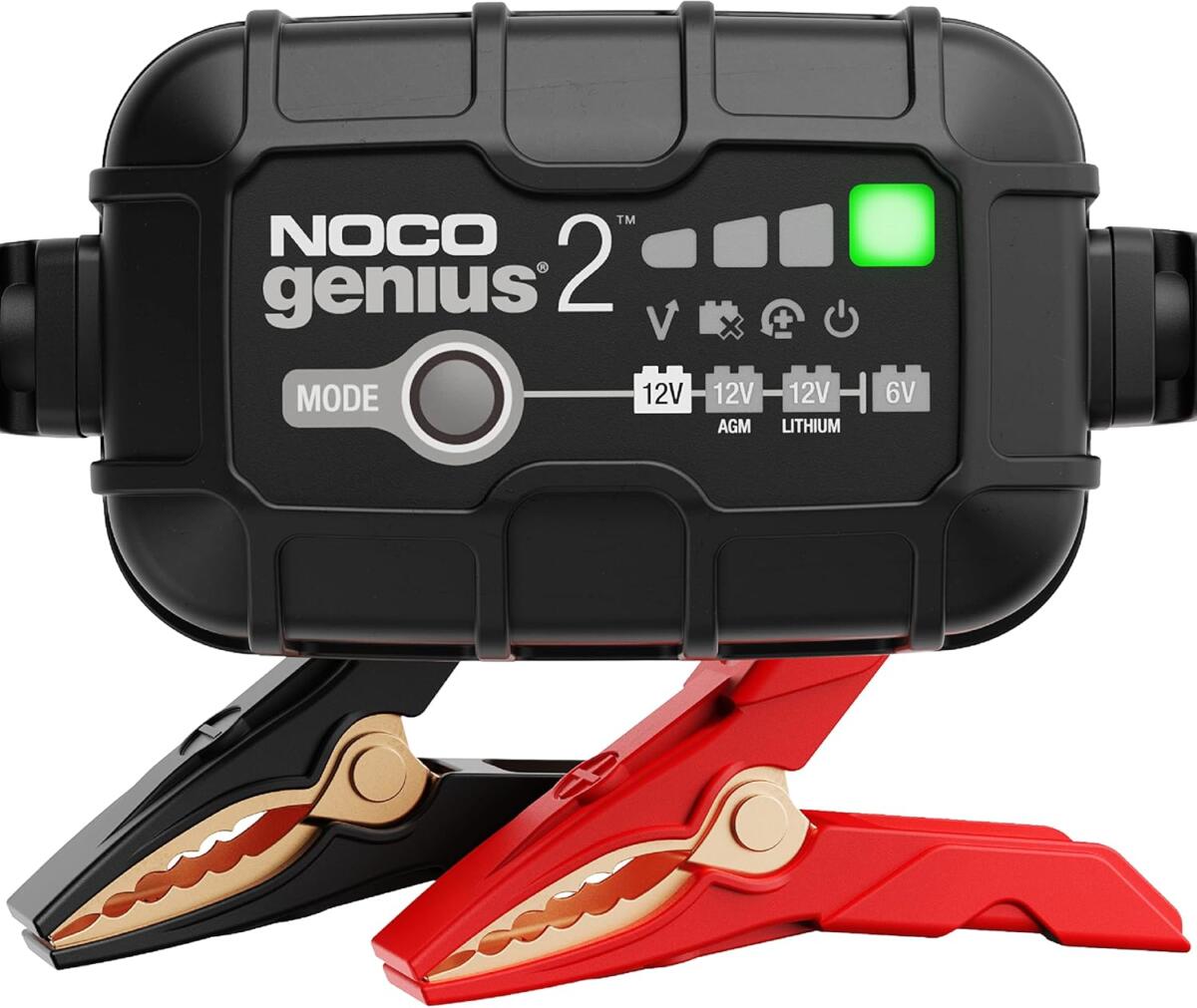
For these reasons, using a small battery maintainer or conditioning charger is strongly recommended. In addition to protecting against freezing, repeated deep discharges can cause sulfation, which significantly shortens battery life. A maintainer helps prevent this, but it does require a 120-volt power source. You can find this one on Amazon here.
NOCO battery charger
If your storage facility does not provide AC power, you have two alternatives: Use a solar charging panel (provided the RV has direct sunlight for at least five hours per day), or remove the batteries and store them in your garage connected to a maintainer.
If your RV uses lithium iron phosphate (LiFePO₄) batteries, storage is much simpler. Disconnect the negative battery cables to eliminate any parasitic draw and leave the batteries in place. Lithium batteries can retain more than 80% state of charge for six months or longer and are not susceptible to freezing damage.
Engine starting battery
The engine starting battery also requires consideration. This battery is typically a maintenance-free model but still experiences parasitic draw from the engine computer and systems such as radio presets.
Without some form of maintenance charging, it can discharge quickly. I’ve seen this firsthand: My father encountered this issue every spring because he did not have access to 120-volt power.
Each year, his vehicle battery would be dead, requiring a jumpstart followed by a reset process for the engine computer. That process involved idling for about 10 minutes, driving at low speed for several minutes, and then highway driving to restore proper shifting and engine response. The radio presets also had to be reprogrammed—fortunately, his listening preferences were fairly simple.
Maintaining the engine battery can be more challenging because the RV’s converter/charger, when connected to shore power, typically does not charge the engine battery. If you have access to a 120-volt outlet, the best solution is to plug a small trickle charger into one of the RV’s interior outlets and connect it to the engine battery.
If AC power is not available, a dedicated solar charging panel is the next best option. Removing the engine battery and charging it in your garage is generally not ideal, as disconnecting it will erase vehicle presets and computer memory.
By Gail Marsh
RV living is all about creativity and maximizing every square inch. The outside of your RV offers untapped potential for storage, organization, and convenience. Here are some clever tips to maximize storage by thinking outside the box (er, RV).
Important: Some organizational items mentioned will need to be removed for travel days.
Command hooks
Use weatherproof command-type hooks to hang items like wet swimsuits, towels, or lightweight camping gear. Attach these hooks near the RV door or under the awning to create an easy drying station without taking up precious interior space.
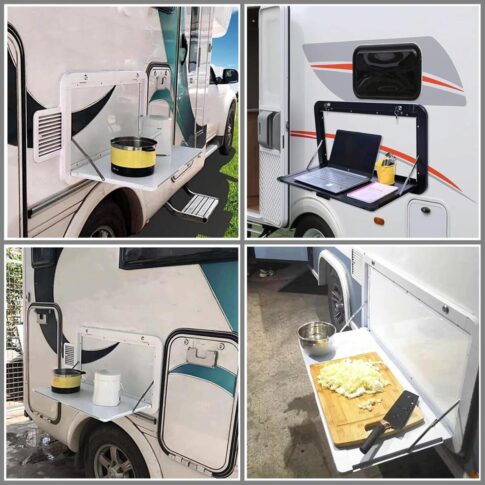
Wall-mount table
Attach a folding table like this one to the exterior wall of your RV for an instant outdoor workstation or dining area. Choose a lightweight, weather-resistant table that can easily fold away when not in use.
Bumper storage rack
Make use of your RV bumper by attaching a storage rack. These racks are ideal for carrying larger items like coolers, bikes, or storage containers.
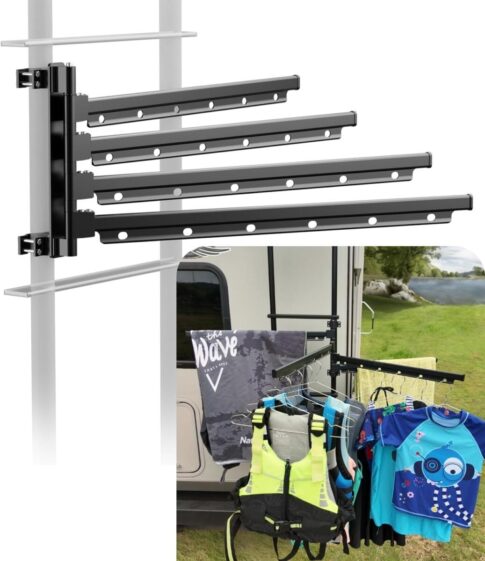
Clothesline or rack
Install a clothes rack on the ladder of your RV like this. It’s perfect for drying towels, swimsuits, or even light laundry during extended stays. Or check out a variety of clothesline configurations here.
Magnetic accessories
For RVs with metal exteriors, magnetic organizers can hold small items like tools, flashlights, or grilling utensils. This keeps essentials within arm’s reach while freeing up interior storage.
Or use a strong magnetic hook to hold a caddy like the one pictured above. The caddy can hold essential items like bug spray, sunscreen, fire starters, and first aid supplies. Storing these items outside your RV will keep them handy as well as prevent numerous trips in and out of your rig—keeping it cooler/warmer inside.
Ladder storage
RV ladders can double as storage for items like folding chairs, small tables, and more. Secure these items with bungee cords or specialized straps to secure them in place while traveling.
Conclusion
Your RV’s exterior is a blank canvas for functionality and creativity. With a mix of organizational tools and outdoor living products, you can make your RV feel like a well-equipped home on wheels. Whether you’re drying clothes, storing gear, or creating an outdoor hangout space, these ideas help you embrace the joys of RV living.
By Cheri Sicard
Electric heat in an RV can feel like either the simplest thing ever or a fast track to melted plugs and a fire.
Jared Gillis from All About RVs lands in the middle. Electric heaters can be used safely, but only if the RV’s wiring, outlets, and heater load are treated like the weak links they can be.
In the video at the end of this post, Jared shares how to do it with practical checks and small upgrades that he has used for years to keep electric heat useful and keep the risk low.
Start with the most important step: Know the RV’s circuits
Many RVs weren’t built with a 1,500-watt space heater in mind. In Jared’s RV, most usable outlets are tied to one main circuit, plus a separate circuit for GFCI receptacles. Plugging a couple of heaters into “random” outlets can overload that single circuit fast.
A simple way to map an RV’s outlets is to shut off one breaker at a time and test which outlets go dead:
Turn off the breaker labeled for receptacles (if labeled).
Use an outlet tester or small plug-in device to check which outlets still work.
Repeat until it’s clear which outlets share each breaker.
Once that’s known, it’s easier to plan where a heater can run without stacking other loads on the same line.
Add a dedicated heater outlet (and avoid shared loads)
Jared solved the overload problem with a straightforward mod. He added a breaker in the panel and installed an outlet right next to the electrical panel. That kept wiring runs short and made the setup predictable.
A dedicated outlet means the heater isn’t competing with a microwave, coffee maker, or battery charger on the same circuit.
Many factory RV outlets are built to be cheap and compact. The wire connection is often a press-in style, not the screw-terminal connection found on many residential outlets. Less contact area can mean more resistance, and resistance creates heat.
Jared tested an RV outlet against a residential outlet. With a heater load, the RV outlet didn’t go above 87 degrees inside, and the face was barely warm. The residential outlet showed similar temps. Even so, for long-term confidence, he still prefers residential-style outlets and has been swapping them in, including behind the RV fireplace (which is basically a built-in space heater and often on its own circuit).
Know what the heater actually draws, not just the label
Two heaters can both claim 1,500 watts and still pull different amounts of power. One unit Jared referenced had a stamp around 1,221 watts.
To check real usage, he recommends using a Kill A Watt-style meter briefly to measure watts on high and low. That number matters because a 15-amp circuit tops out at 1,800 watts, and for continuous use (3 hours or more), staying near 80 percent is the safer target: 1,440 watts. Pushing past that for long stretches can heat connections, cool down, then heat again, and that cycle can lead to a failed outlet, a tripped breaker, or worse.
Extra exterior power inlets can help, but they add maintenance
Some RVers add a separate power inlet so a heater can run from a 15- or 20-amp pedestal outlet, separate from the RV’s main shore cord. Jared sees the upside for 30-amp rigs that hit their limit quickly. On a 50-amp setup, it can be unnecessary.
The tradeoff is another outdoor connection to inspect. Winter weather adds moisture, condensation, and corrosion risk. He suggests checking for heat at plugs and inlets, keeping contacts clean (he mentions DeoxIT), and avoiding loose connections. If upgrading the connection point, RV SmartPlug is one option he calls out.
Heater types he trusts when away from the RV
When Jared isn’t in the RV, he limits electric heat to two options:
Heat pumps (when temps stay mild): A heat pump can work well above about 32 degrees.
Xtreme Heaters for the underbelly niche: Jared uses Xtreme Heatersmounted in the RV’s underbelly to help prevent a specific freeze issue near the kitchen sink when temperatures drop into single digits. It also helped the RV feel less cold through the floor.
He doesn’t treat it as a way to “winterize with electric,” and he notes they’re expensive. The features that made it feel like the right tool for that job include:
Mil-spec rating for humidity, vibration, and extreme temperatures
IP68 waterproofing (can be temporarily submerged)
PTC self-limiting heating element to reduce overheat risk
Engine-compartment rating (flammable fumes)
Built-in thermostat
Mountable design
The bigger strategy, electric heat plus the furnace
Jared still runs the RV furnace because it helps protect plumbing in freezing temperatures. Electric heat is used as a helper, stretching propane so fill-ups happen less often. In some parks, it can feel close to free since electric is included, but the key is still managing the load safely.
For comfort in serious cold, he also found skirting made a big difference, especially for longer stays.
Final thoughts
Electric heat in an RV can be safe, but it shouldn’t be treated like a plug-and-forget appliance. The setup that works long-term is simple: Know the circuits, avoid weak outlet connections, measure heater draw, and stay under the continuous-load limits. Add in regular checks of cords and exterior plugs, especially in wet winter weather, and the risk drops fast.
For anyone trying to stay warmer while using less propane, a careful electric heat plan is a solid place to start.
By Gail Marsh
Wondering how you and your RVing Valentine can celebrate Valentine’s Day tomorrow? Here are some suggestions for you.
Lovely spaces and places
Did you know that many places in the United States and Canada are aptly named for Valentine’s Day? It’s true! Cuddle up with your loved one to research these “lovely” places. Maybe one or more will fit into your upcoming RV travel plans.
Consider the places named Valentine. There’s one in Arizona, Nebraska, Indiana, Arkansas, Texas, New Jersey, Virginia, and South Carolina.
Love also has its place in Loveland, Colorado (the Sweetheart City); Loveland, Ohio (Sweetheart of Ohio); and Loveland, Iowa (with several great eateries). Large or small, each Loveland is unique and worthy of a visit.
As you search and research these lovely places, you’ll also discover places named Romance, Romeo, Mount Juliet, Heartwell, Lovelady, Cupid, and Arrow! Amazing, right? Is there a way to include some of these places in an upcoming RV trip?
Joint ventures
Each RVer will begin with paper and pencil. Without talking, secretly list three places you’d like to visit this year in your RV. You can decide to be specific (Boston, Key Largo, Mt. Hood) or more general (desert, Gulf Coast, Great Lakes region).
Compare lists. If any places match, begin to plan your trip together. If none of your listed choices match, see if you can plan an RV route that will include at least one place from each of your lists.
Themed travel
Allow two minutes for each RVer to name his/her top interests (e.g., history, art, shopping). Together Google: U.S. places to visit with (name of interest.) You may be surprised at what you discover!
Choose one or more top interests for each traveler and then begin to plan your itinerary.
Hobby travel
Along the same lines as themed travel is hobby travel. Talk about your favorite hobbies or skills you’d like to research. For example, if one RVer enjoys quilting (or would like to learn more about it), Google “quilting museums” or “quilting exhibits.”
If the two of you enjoy vastly different hobbies, see if there are ways to incorporate RV trips that may satisfy both of you.
Work to demonstrate a genuine interest in your travel buddy’s hobby. Who knows? Maybe it will become YOUR hobby, too.
Experiment with AI
If you haven’t used one yet, take a look at the many RV trip planners available. See which one you like best and practice until you both feel comfortable using one (or more). Just Google: free RV trip planner.
Even if you currently use a trip planner app, check out other offerings. AI is evolving so fast, and many new companies are joining the list of RV route planners.
The best part…
Let each RVing partner complete the sentence: The best part of RVing with you is… You may want to take five minutes to jot down your thoughts. Then come together to tell each other what you most enjoy about traveling together.
Valentine vacation?
Is there a romantic place you’ve always wanted to visit? (Where you first met? Wedding location?) Talk together about it. Plan to travel there in your RV, with special stops all along the way. Special stops might include eating at a great restaurant, visiting a quirky tourist trap together, or touring a small town’s downtown area.
How about you?
How do you celebrate Valentine’s Day with your RVing partner? Tell us in the comments below.
Over the last year, did you spend any of your time helping out and volunteering somewhere, formally or informally?
For today’s poll, we’re curious: Have you performed any volunteer work in the last 12 months?
For some of you, volunteering is a regular part of life. You might help out regularly at a food bank, walk dogs at the local animal shelter, support a local charity, lend a hand at a campground, or volunteer through an organization you care deeply about. Giving time can feel rewarding in ways that are hard to measure and many RVers say it’s one of the best ways to connect with a community, even briefly, while on the road.
Others would like to volunteer more but haven’t been able to this past year. Health, travel schedules, caregiving responsibilities, or simply the pace of life can make it difficult to commit. We know life is busy.
Then there are those who support causes in different ways. Maybe you donate instead of volunteering in person, help neighbors informally, or step in when someone needs a hand without labeling it as “volunteer work.”
So what about you? In the last 12 months, have you volunteered your time in any way? Go ahead and vote in today’s poll—and if you feel like sharing what you’ve done, we’d love to hear about it. Thank you!
LIKE TAKING POLLS? So do we! Did you know we’ve run more than 5,000 polls on our website over the years? Check ’em out! Have fun!
We use cookies to ensure that we give you the best experience on our website. By continuing to use our site, you consent to accepting cookies. We NEVER have or will sell reader's data. For more info, please see our privacy policy page.