Think back. Try to remember your very first RVing experience. Where did you camp? How did you decide on your route? What activities did you enjoy? As I think back over the years, I just have to smile—and marvel at all of the changes, too.
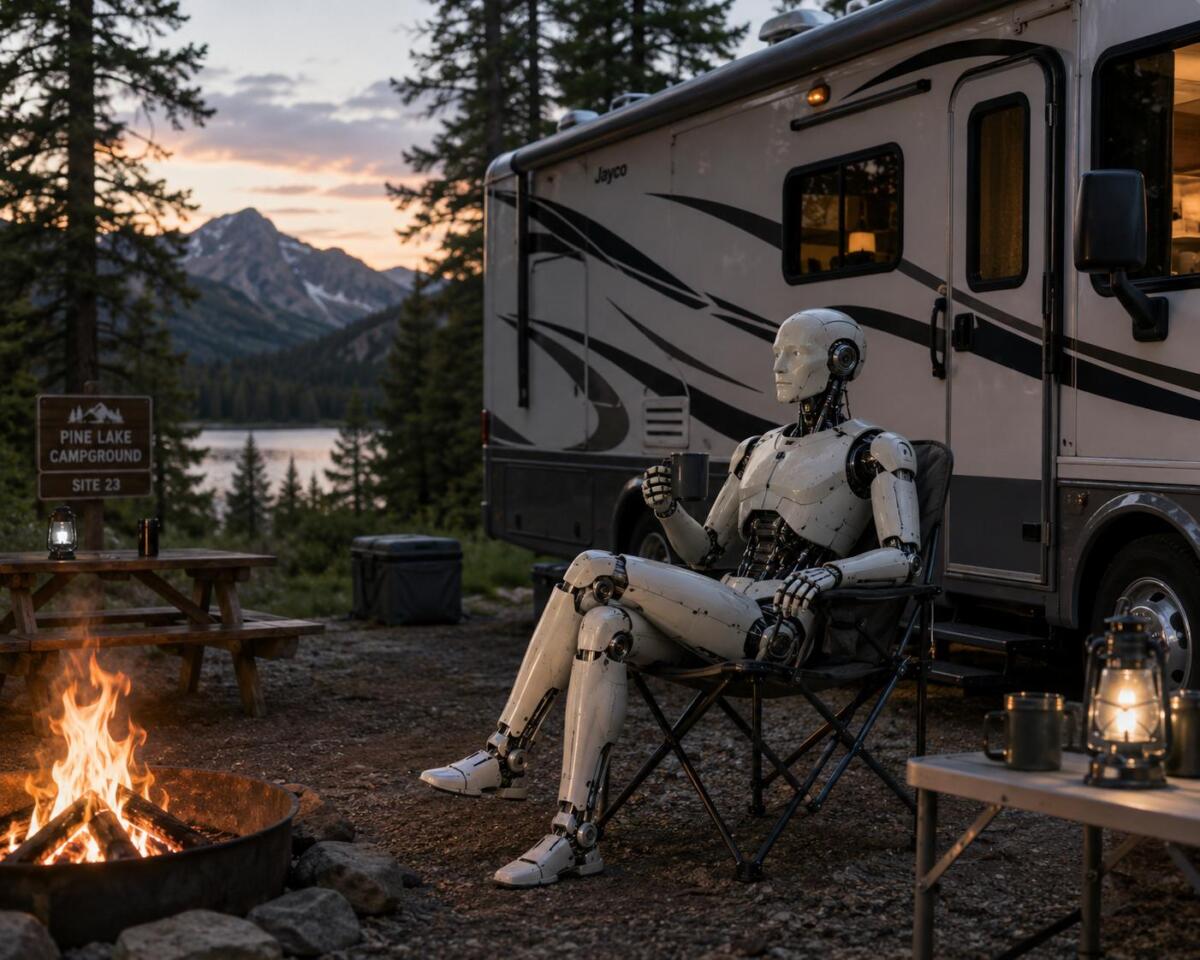
RVing has changed a lot, and the biggest shift may be how much technology is now woven into our RV trips from start to finish. Is technology a good thing or bad? We’ll get to the poll in a moment. First, let’s give a quick rundown of the technology impacting RVing today.
Booking and check-in tech changes
Today’s campers can book and manage stays through a variety of apps like Recreation.gov. You can use Google Earth to virtually “see” your campsite before you arrive. Some campgrounds even offer online instructions and QR-code check-in when you get to the campground. What a difference from pre-tech days!
Navigation
“Getting there” has also become easier with today’s technology. RVers use smartphone-based GPS tools along with built-in vehicle navigation. In other words, getting there is no longer limited to a Trip-Tik or impossible-to-refold highway map.
Newer trucks and drivable RVs continue to bundle more driver confidence and safety technology into the driving experience like lane departure, rearview cameras, and more. That’s been a major change, as well.
Tech assist upon arrival
Many travel trailers now come with power tongue jacks that make hitching and unhitching easier. There’s also auto-leveling, power stabilizing jacks, and motorized awnings that simplify setup.
Inside today’s RV
The RV industry is openly leaning into smart systems. Winnebago, for example, highlights smart connected coach features through Winnebago Connect. This includes control of power, lighting, climate, and tank levels—all from a touchscreen or mobile app. The same system also includes maintenance reminders, push notifications, and remote control of lights, locks, and other systems.
Winnebago is not alone. Other manufacturers also incorporate similar technology and continue to search for new ways to insert technology into the RVing experience.
Comfort tech
Comfort tech has moved well beyond the cockpit and into the coach itself. You need not look far to find powered reclining seats, smart TVs with Bluetooth audio integration, and premium sound.
Add in features like on-demand tankless water heaters and washer/dryer capabilities, and it is easy to see why many RVers now expect the comforts of home rather than “roughing it” for a weekend.
Family tech
Technology has also impacted everyone in the family. Kids zoom around campgrounds on electric scooters, teens drive golf carts, and, at night, families gather around to watch a movie on their RV’s outdoor television.
Pet tech, too!
Then there’s pet-friendly tech. For example, Winnebago Connect includes a Pet Minder function that helps maintain the right interior temperature for pets. There are also third-party tech RV pet monitors (like Waggle, for example) designed to send alerts about heat, humidity, and power loss so owners can react quickly.
For a lot of RVers, that peace of mind is part of what makes today’s RVing much less stressful than in the past.
Not everyone loves technology
Of course, not every RVer loves every gadget. More tech can mean more convenience, but it can also mean more systems to learn and more things to troubleshoot. It can also mean more time staring at a screen when some people would rather just watch the sunset.
Poll
RV technology can make travel easier, safer, and more comfortable. However, it can also change the feel of the RV experience in ways some campers appreciate more than others.
So, where do you stand? Answer the poll and then leave a comment.
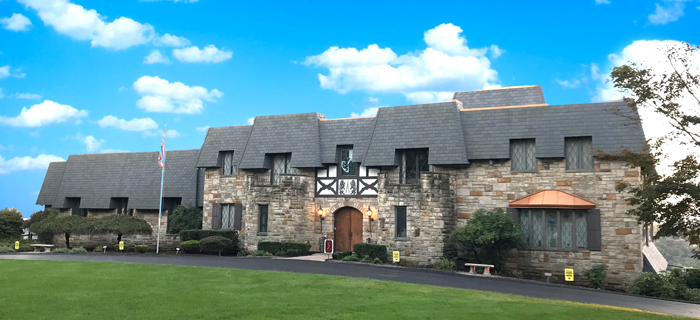
If you like eccentric houses, antique music machines, and hidden passageways that make you feel like you’ve wandered into a storybook, you’ll love the Bayernhof Museum.
This unusual museum is located at 225 St. Charles Place in the Pittsburgh/O’Hara area of Pennsylvania. It’s the former Bavarian-style mansion of collector Charles B. “Chuck” Brown III. His massive 19,000-square-foot home was built to house Brown’s huge collection of self-playing instruments and unique architecture.
Who was Charles Boyd Brown III?
The genius behind the Bayernhof Music Museum began with the eccentric millionaire, Charles B. Brown III. Brown made his fortune as founder and CEO of Gas Light Manufacturing. He never married but wanted his name to live on in perpetuity through his oddly wonderful mansion.
Charles B. Brown III named his property Bayernhof to honor his German heritage. Bayernhof translates as “Bavaria Courtyard.” He designed each room with its own theme based on “Mad Ludwig’s” castles in Germany.
The eccentric Brown oversaw construction of Bayernhof beginning in 1976. The quirky mansion was completed in 1982 with an estimated total building cost of $4 million dollars. (Today, the estate is valued at nearly $20 million.)
While Brown wanted his mansion to become a museum eventually, he understood that hidden passageways, strange building materials, and a massive size would not draw the public’s interest. So, he began to collect musical instruments, music boxes, organs, and more, with the intent that visitors would be interested in his musical collection.
Touring Bayernhof allows visitors a brief glimpse into the mind of a true eccentric. Brown delighted in the unexpected and his mansion’s hidden features and secret rooms are just the beginning. Brown displayed his unusual character in his day-to-day life. He loved hosting friends and was known for telling outrageous stories. At the time of his death, Brown owned 283 identical blue Brooks Brothers shirts—all hanging in his closet at Bayernhof. Eccentric? No doubt!
What to expect
When you visit Bayernhof, expect the unexpected. The entire visit feels like a guided, theatrical production. The curator brings many of the instruments to life, so you hear music as you walk through themed rooms, bars, and even a waterfall area.
Photo credit: Bayernhof Museum
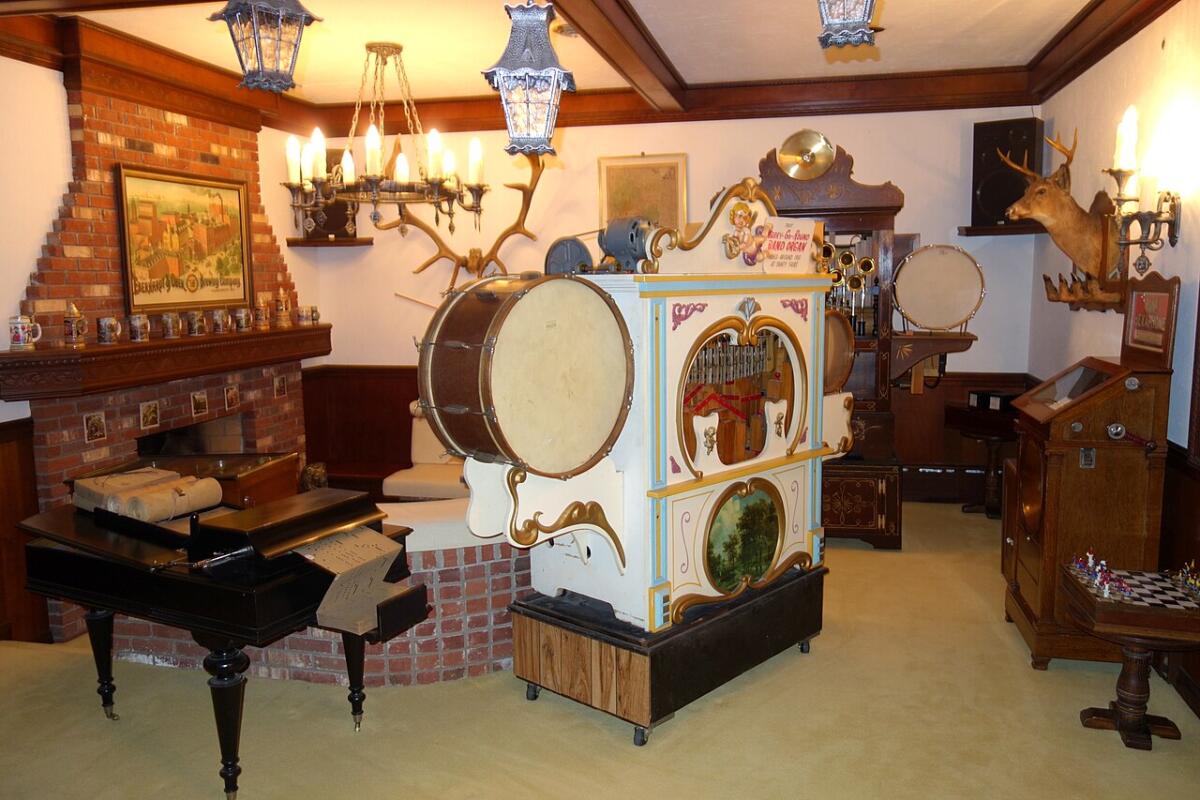
Expect more than a hundred working automatic instruments that include player pianos, orchestrions, nickelodeons, mechanical violins, huge Wurlitzer organs and band organs, and elaborate music boxes.
You will also see lots of oddball décor, secret passageways, and anecdotes about Brown’s eccentric life. Many pieces are more than a century old, and most musical objects remain in playable condition.
Highlights
The Bayernhof Music Museum has so many, many weird and wonderful rooms to see (and instruments to hear) that it’s impossible to name all of them. Here are just three standouts:
Photo credit: Bayernhof Museum
The indoor pool/grotto room is an unexpected, dramatic centerpiece. It’s the central area from which you’ll discover several of the museum’s themed rooms and photo ops.
The large orchestrion/Wurlitzer band organ set is made of several impressive machines that actually fill entire rooms. Visitors delight in hearing the multiple instruments playing loudly and joyfully all at once. This isn’t something you’ll experience at most other museums.
The music box and automatic-violin collection is delicate, intricate, and often surprising. Some devices play multiple violins; others animate tiny figurines while music plays. These antiques reveal the clever engineering of long-gone craftsmen.
Tours, timing, cost, and more
Tours are strictly guided and by appointment only. The museum limits groups to keep the experience intimate (12 people max), and children must be at least 12 years old.
Typical tour start times are in the morning and mid-afternoon (approximately 10:00 a.m. and 2:00 p.m.). They run roughly two and a half hours, so plan that into your day.
Admission is a modest $10 per person, and you must call ahead to reserve your spot: 412-782-4231. Arrive about 15 minutes before your scheduled start.
Other nearby sights
While in the area, consider these other popular spots to visit.
The Andy Warhol Museum. Home to the largest single-artist collection of Warhol work, this stop is great for art lovers.
Carnegie Museum of Natural History. This stop is excellent for folks who enjoy natural history (e.g., fossils, minerals, and science exhibits).
Three nearby RV campgrounds
If you want to park the rig and stay in the area for a night or two, these popular, highly reviewed options are within reasonable driving distance of the Bayernhof:
Mountain Top Campground. Located about 25–35 minutes from downtown Pittsburgh depending on traffic, this campground offers full hookups and seasonal amenities with great views.
The Blue Canoe RV Resort. This riverfront campground on the Great Allegheny Passage is popular with cyclists and families. The camp’s amenities and scenic access make it an easy choice for a longer stay.
Pine Cove Beach Club and RV Resort. A family-friendly RV resort with a large swimming complex and on-site recreation, this campground is highly recommended by RVers passing through the region.
You should go!
The Bayernhof is one of those rare roadside curiosities that’s both a museum and an experience. You get firsthand storytelling from an enthusiastic curator, working historic instruments you can actually hear, and an eccentric house chock full of surprises.
It’s the kind of quirky, memorable stop that turns a routine road trip day into a story you’re sure to share around the campfire.
Have you visited this area of Pennsylvania while RVing? Tell us about it in the comments below.
By Nanci Dixon
We store a lot of our cleaning supplies, spray lubricants, fluids, etc., in a large plastic container in one of the storage bays of our motorhome. Before, every time I wanted to get one of these products, I was lifting each bottle or can out of the bin to read the label. It was frustrating and time-consuming!
One day I had the idea to label the tops with a marker, or if the tops were too dark for a marker, a piece of tape. Now, I spend hardly any time at all hunting for the product I need!
I also labeled what they are for on the sides of the can—somehow I can never quite remember which RV part that T-9 can is for versus T-3.
It only took a few minutes to label everything, but it has made a surprisingly big difference. If you keep a lot of maintenance and cleaning products in your RV, this simple trick can save time, reduce frustration, and make routine tasks just a little bit easier.
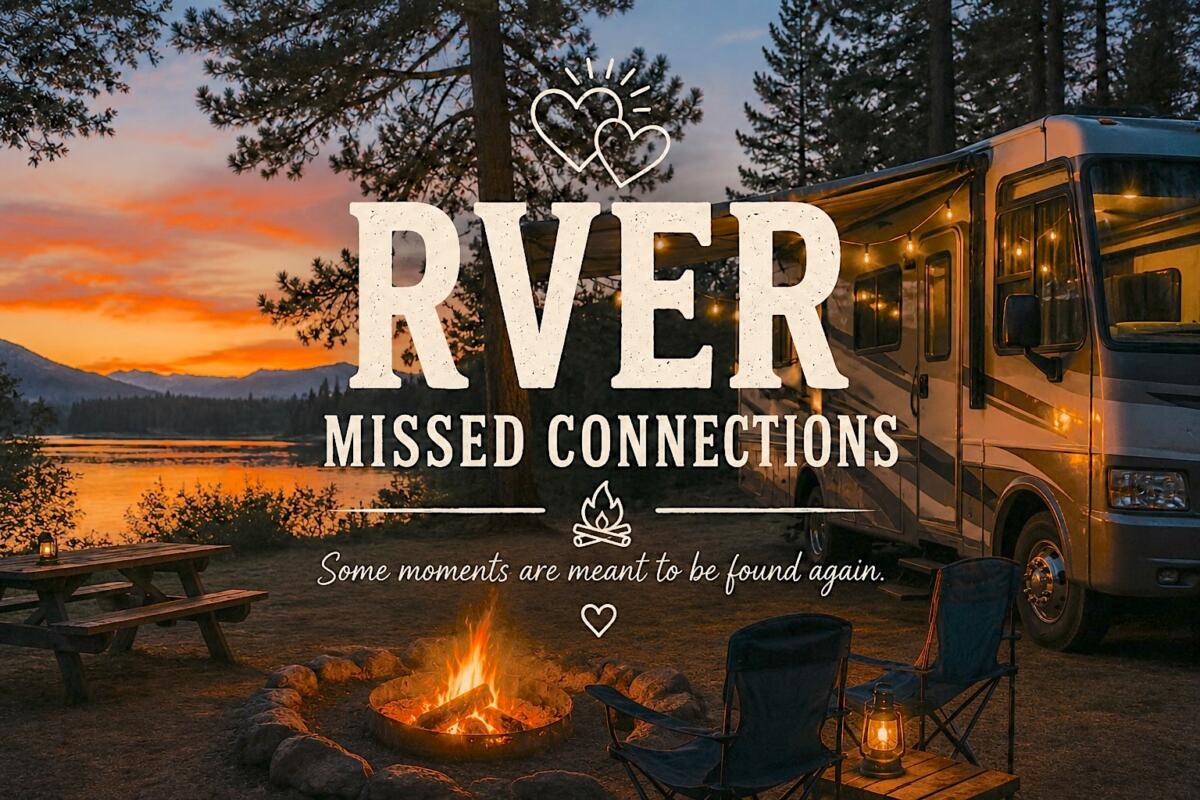
Missed Connections are personal messages posted in a paper or online by someone who had a brief encounter with a stranger and wishes they had spoken up, exchanged contact information, or met again. The posts typically describe where the encounter happened, what the person looked like, and what made the moment memorable, in hopes that the other person will see the message and respond.
For example: “You and I locked eyes at the campground picnic last week. You: tall, brown hair, red sunglasses, and blue flip-flops. Me: Hawaiian shirt, khaki shorts, tan sandals. I was too shy to come up and say hi, but would love to see you at the next picnic. Hot dog or hamburger?”
Or, “I met you at xxxx campground on May 14th around 6 pm. You were outside with your husband, and our dogs said hello before we started chatting. You told me about the mobile tech that fixed your RV when you were traveling to Arizona, but I forgot to write his name down, and I’ve been trying to remember ever since! Help!”
The concept dates back to newspaper personal ads in the late 20th century, but it became especially popular in the early 2000s through the Craigslist Missed Connections section. People used it to reconnect with strangers they saw on trains, in coffee shops, at campgrounds, concerts, airports, and other public places. At its peak, thousands of posts were made daily, turning missed opportunities into a unique form of modern-day romance and storytelling.
Today, while social media has made it easier to find people directly, missed connections remain a nostalgic reminder of chance encounters and the enduring hope that a brief moment with a stranger might lead to something more.
Do you have a “missed connection”?
Tell us about it! You can keep it anonymous, if you like. Just write “Anonymous” as your name, but make sure you leave specific enough details so that the person will know it’s for them and from you. Where were you? What day? Time? Wearing?
RVtravel.com has more than one million readers each month, and we’re all RVers! Chances are we could bring you together!
Not just for romance!
Remember, it doesn’t have to be romantic. It could be someone using a new gadget that you really wished you had asked what it was, it could be for that person you’d love to be friends with, or it could’ve been that somebody gave you a recommendation that you forgot to write down…
It’s me! How do I connect with them?
If you see a missed connection about yourself, send us an email at editor(at)rvtravel.com, and we’ll make sure to connect you to your person!
By Dustin Simpson
In this article and video, we’ll introduce you to the RV cheater vent, a clever and easy solution that can save you time and money on plumbing repairs in your RV. Learn why this simple fix can help you avoid complicated and costly repairs, and how you can DIY to keep your RV’s plumbing system running smoothly.
What is an RV cheater vent?
An RV cheater vent is a small, low-cost device that helps improve the drainage and ventilation of your RV’s plumbing system. It acts as an alternative to traditional venting systems, preventing issues such as clogs, slow drainage, and foul odors inside your RV. If you’re experiencing plumbing problems in your RV, a cheater vent might just be the solution you need!
How does it work?
Plumbing ventilation
Your RV’s plumbing system needs proper ventilation to ensure that waste drains quickly and smoothly. The cheater vent works by allowing air to flow into the drainage pipes, which helps the water and waste move through the system without restriction.
Preventing backflow and clogs
When plumbing pipes are not properly vented, water may back up, causing slow drainage and clogs. The cheater vent solves this issue by ensuring there’s a continuous airflow, preventing airlocks that could result in backflow or standing water.
Eliminating odors
Poorly ventilated plumbing can also lead to foul odors in your RV. The cheater vent helps minimize these odors by improving airflow and promoting the efficient movement of air and waste gases.
Why use a cheater vent?
Avoid complex repairs
Plumbing repairs in RVs can often be expensive and complicated, especially when they involve venting systems. The cheater vent offers a quick and easy fix for common plumbing issues without the need for expensive repairs or complicated installations.
Cost-effective solution
Compared to traditional plumbing repairs, the cheater vent is an affordable option. It helps you save money on professional repairs while keeping your RV’s plumbing system functioning properly.
DIY friendly
Installing a cheater vent is simple and can be done by most RV owners. It doesn’t require professional help, making it a great DIY project that can be completed in a short amount of time.
Prevent future problems
By installing a cheater vent, you’re actively preventing common plumbing problems such as backups, slow drainage, and the buildup of unpleasant odors. It’s a proactive step that ensures your RV’s plumbing system stays in good working condition.
How to install an RV cheater vent
Locate the drain line
Identify the location where the cheater vent will be installed. It typically goes on the drainage pipe near your RV’s bathroom, kitchen, or waste tanks.
Choose the right size
Make sure you select a cheater vent that fits your plumbing system. These vents come in different sizes, so check your pipe diameter before purchasing.
Installation process
The vent usually attaches to the existing drain pipe with a clamp or screw-on mechanism. Simply align the vent with the pipe, secure it in place, and make sure it’s airtight to avoid leaks.
Test the system
After installation, run water through the plumbing to make sure the vent is working properly. Check for any leaks or slow drainage to confirm everything is functioning smoothly.
When should you consider installing a cheater vent?
Slow drainage: If you notice that water is draining slowly from sinks, showers, or toilets, a cheater vent may improve the airflow and speed up the drainage process.
Foul odors: If you’re experiencing unpleasant smells from your plumbing, it’s a sign that your vents may not be working properly. Installing a cheater vent can help alleviate this issue.
Clogs and blockages: If your RV plumbing system is prone to frequent clogs, this will help ensure proper air circulation and prevent future blockages.
Leaky vents: If the existing plumbing vent is cracked or damaged, a cheater vent offers an easy replacement option.
Final thoughts
An RV cheater vent is a simple, cost-effective, and DIY-friendly solution to improve your RV’s plumbing system. Whether you’re dealing with slow drainage, clogs, or foul odors, this little device can help prevent complex and costly plumbing repairs. It’s a must-have for any RV owner looking to maintain their plumbing system efficiently.
Don’t forget to subscribe for more expert advice, tips, and tricks on keeping your RV in top condition! Protect your RV and make plumbing repairs easier with the cheater vent!
One of the best things about RV ownership is making your rig feel like home.
Perhaps you’ve purchased an older motorhome that needs updating, inherited a travel trailer with outdated décor, or simply grown tired of looking at the same cabinets and furniture every day. Renovating an RV interior can make life on the road more enjoyable.
Typical changes
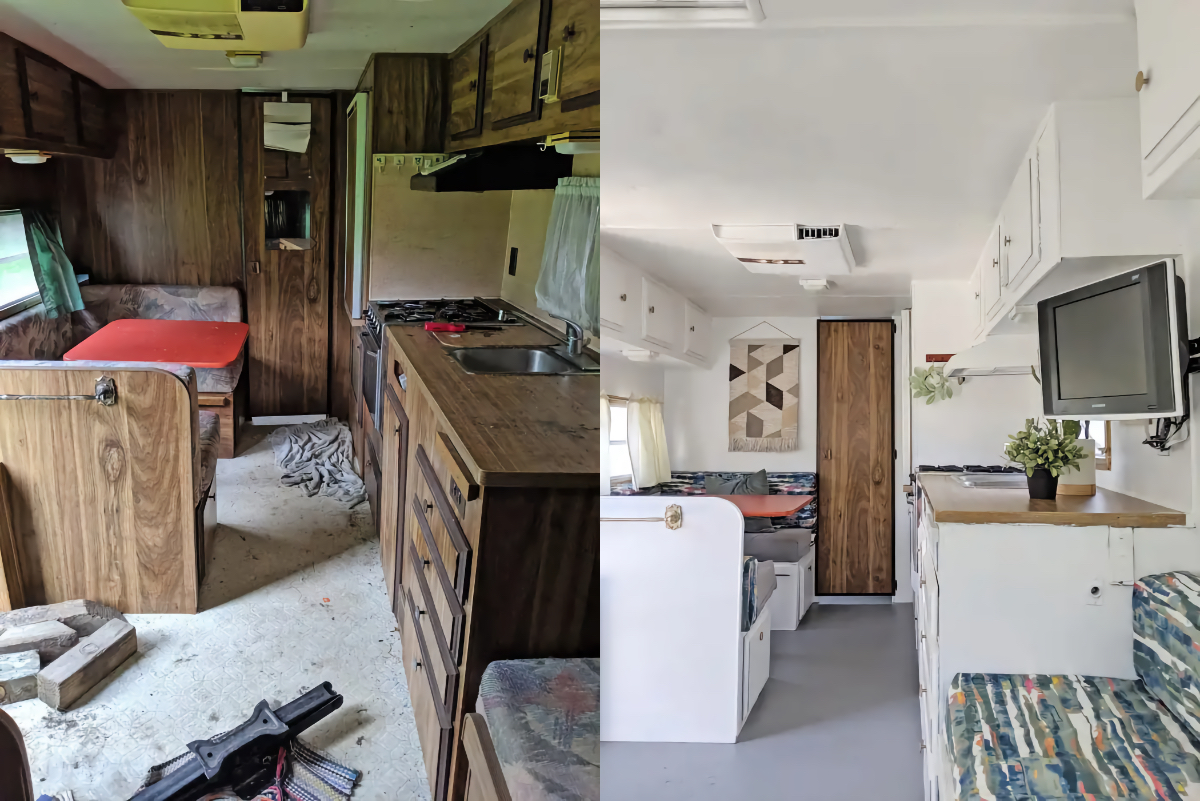
Many RVers redecorate to brighten their RV’s dark interiors. RVers often remove factory window coverings or paint dark cabinets a brighter color. Or they might replace dark carpeting with laminate.
Other RVers want to make changes that will improve functionality. This is often done by creating more storage or removing furniture (like a banquette) to make the space work better for the way they like to camp.
Still other rig owners simply want to personalize their space. RV manufacturers design for the masses. They strive to appeal to the widest audience in order to sell the most inventory. That results in basic, generic interiors that make one RV look pretty much like all of the others. You can personalize your RV with simple touches like colorful throw pillows or bigger changes such as replacing bunk beds with a desk.
Finding ideas
Pinterest remains one of the most popular places to find RV renovation ideas. Searches such as “modern RV makeover,” “RV farmhouse décor,” “small RV kitchen renovation,” or “boho camper interior” can generate thousands of examples.
YouTube is another excellent resource. Many RV owners document complete renovations from start to finish, allowing viewers to see what worked, what didn’t, and how much projects actually cost.
RV forums and owner groups often highlight real-world renovations. Communities dedicated to specific RV brands frequently contain before-and-after photos, material recommendations, and DIY tutorials.
Instagram can provide inspiration through hashtags such as #rvrenovation, #rvlife, #campermakeover, and #tinyhomeonwheels.
Home improvement websites and magazines are also useful because many residential decorating ideas translate surprisingly well to RV living. Small-space organization techniques, multifunctional furniture, and color palettes often work equally well in motorhomes and travel trailers.
Another overlooked source is campground walk-through videos. Many RV influencers offer interior tours that reveal practical decorating ideas specifically designed for life on the road.
Challenging
While changing your RV’s interior can be exciting, it can also feel daunting. How can you know whether your ideas will actually look good once they’re installed? Don’t despair! There are many places that can help you “see” what your idea will really look like once you’re done.
Free tools and resources for painting
Paint manufacturers often offer free online color visualizers that allow users to experiment with cabinet and wall colors. Like PPG Paints, Behr, and Sherwin-Williams.
Free tools and resources for flooring
Many flooring manufacturers provide room visualizer tools that let homeowners upload photos and preview various flooring products. Here are two examples: FlooringAmerica and MSI.
AI programs
Artificial Intelligence (AI) will also transfer your ideas into viewable results. Instead of guessing how white cabinets, new flooring, or a farmhouse-style interior might look, AI design tools can generate realistic visualizations. By using these tools, you can see your complete RV remodeling ideas before you start spending money on paint, furniture, or materials.
Several AI room visualization tools offer limited free trials or complimentary design generations. That makes them useful for brainstorming before committing to a renovation budget. Here are a few to consider: HomeDesignsAI, VisualizeAI, RoomsGPT, and homevisualizer.ai.
You can, of course, also use ChatGPT for free by uploading your photo and entering a prompt (more on that below).
Some examples:
Before
After (using ChatGPT)
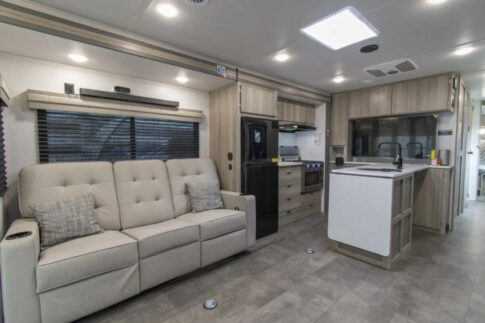
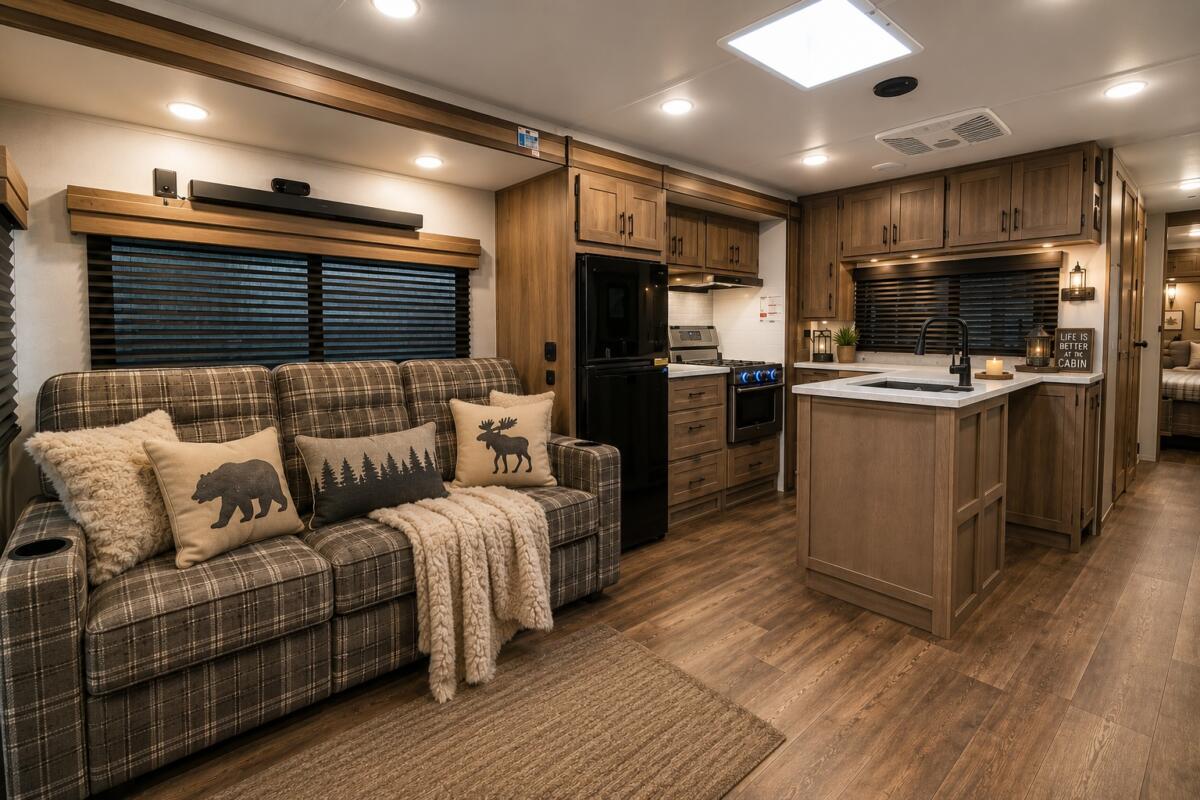
Before
After (after using ChatGPT)
Tips and hints for using AI design tools
The process for using visualization tools is surprisingly simple and can often be completed in just a few minutes.
Lighting
Choose the area you want to redesign. Turn on all RV interior lights and open blinds and curtains. Good lighting is important because AI tools generally produce better results when working with bright, high-quality images. Try to capture as much of the room as possible in a single shot.
Prompts
When using a visualization tool, prompts are especially important. Be as specific as you can. You might enter prompts such as:
“Paint cabinets white.”
“Replace carpet with luxury vinyl plank flooring.”
“Create a modern farmhouse interior.”
“Add coastal décor.”
“Keep existing furniture but update colors.”
Keep at it
While redesigned concepts can often be created in less than 30 seconds, you may choose to experiment with multiple styles and ideas. If you travel with a partner, be sure to get their input, as well. Together, you can compare multiple styles side by side and determine which ideas are worth pursuing. One of the biggest advantages of AI design tools is the ability to experiment without spending money.
A guide
AI-generated images should be viewed as inspiration rather than specific construction plans. Remember that AI can make mistakes! However, AI design tools can help you make more informed decisions about paint colors, flooring, furniture placement, cabinet finishes, and décor before purchasing supplies.
Worth a try
Visualization tools excel at helping RVers visualize possibilities. They quickly show how a dark interior might look with lighter cabinetry, or whether a rustic design theme works better than a contemporary one.
For RV owners who struggle to picture finished projects, visualization tools that use AI can remove much of the uncertainty from the planning process. While it won’t swing a hammer or install flooring, it can help narrow down choices and potentially save money by preventing costly decorating mistakes.
If you’ve been dreaming about transforming your RV but aren’t sure where to begin, AI visualization tools may provide the inspiration and confidence needed to start your next makeover project.
Have you renovated or redesigned your RV’s interior? Tell us in the comments.
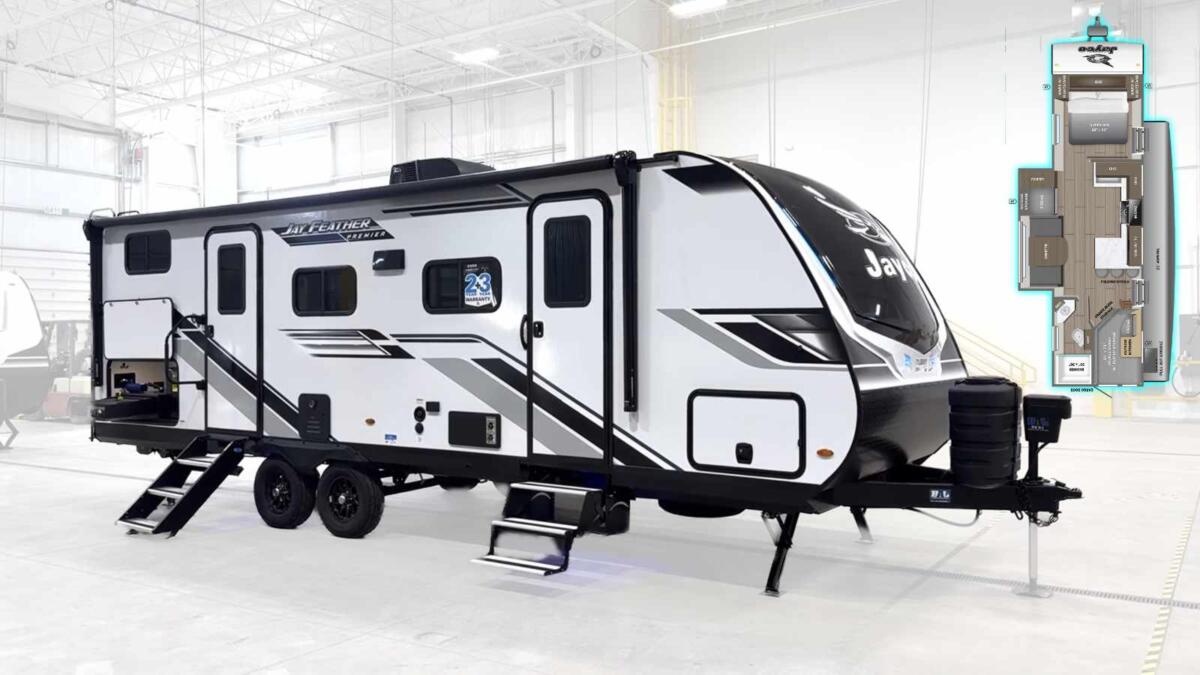
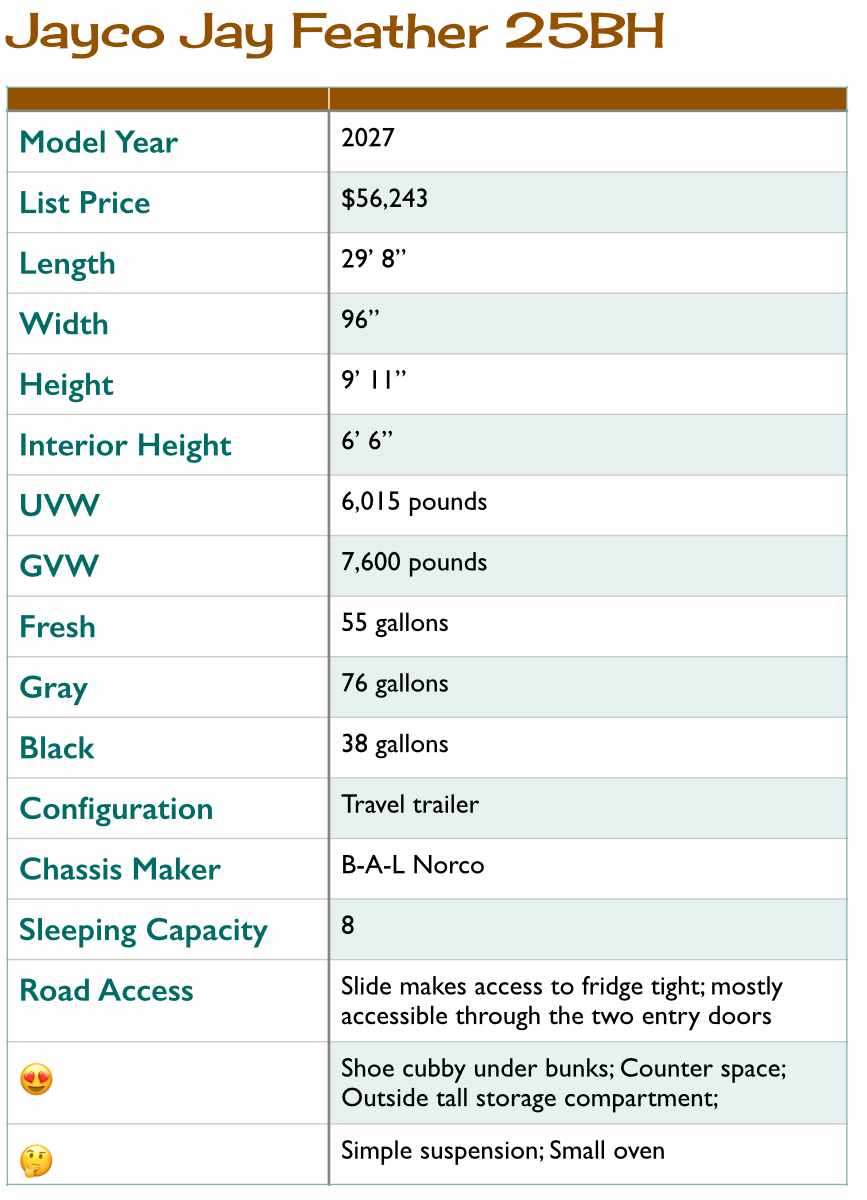
Today’s RV review is of the 2027 Jayco Jay Feather 25BH. For those of you in the advanced class, you’ll know right away this is a bunkhouse trailer by the “BH” designation. Grab a star and move to the front of the class! While this rig fits the bill of a mid-sized bunkhouse with the ability to sleep eight people, it also does so slightly differently.
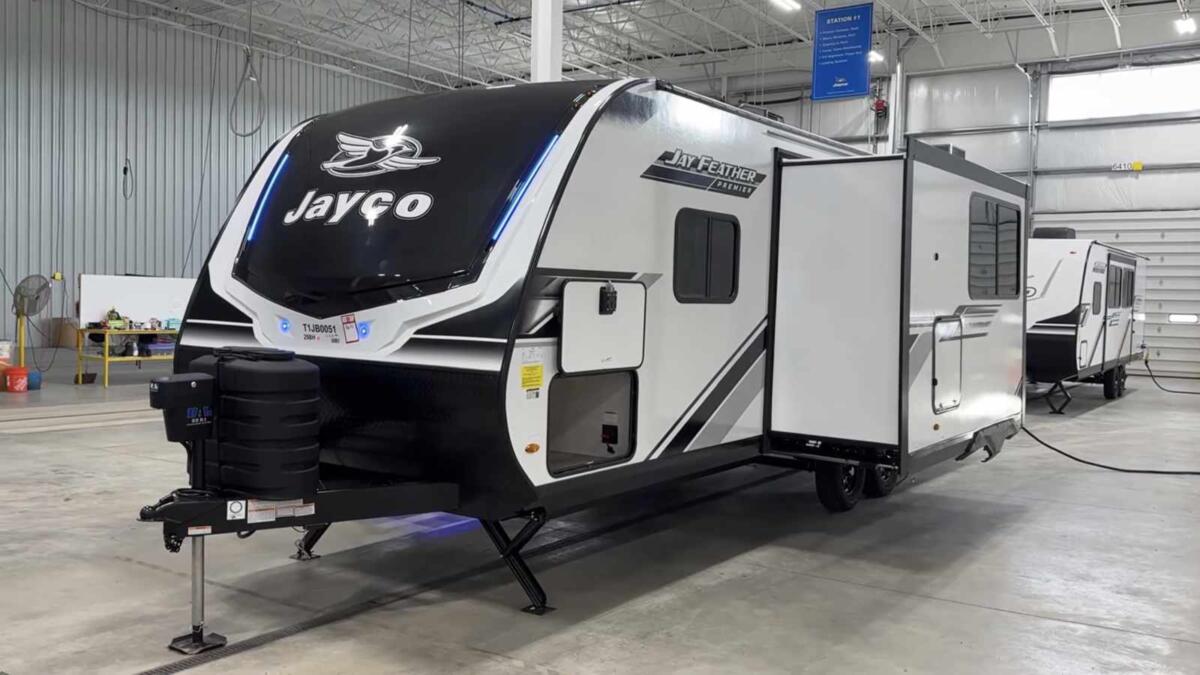
The Jay Feather line is available in standard or Premier models, with the one that we’re looking at here being the Premier, which adds some $2,243 to the bottom line. This package has two high-performance vent fans and a fancier nose cap, but I hope there’s more than just that for two grand and change.
How the Jayco Jay Feather 25BH is built
I got to tour Jayco a couple of years ago and was pretty happy with what I saw. The company had just finished building another pre-delivery inspection facility on their property in Elkhart, which means that every Jayco product that leaves the plant gets a full inspection. That’s not typical.
The walls of this trailer are vacuum laminated and utilize a man-made substrate, which is my preferred type of wall construction in this type of trailer.
As to where the rubber meets the road, this rides on Goodyear Endurance tires—my favorite for towables. I can see that this rides on a simple leaf spring suspension. In one of Jayco’s videos about the product, it mentioned that tire pressure monitoring (TPMS) comes standard, but right on the options list on Jayco’s website, TPMS is listed as a $270 option.
Something the company’s video also stated was that all these units are subjected to climate testing and rated to be usable with outside temperatures between 0°-100°F where the interior is maintained between 68°-72°F. Not bad.
Part of that is an enclosed and heated underbelly, but Jayco even goes to the lengths of putting a metallic backing on the roller shades inside.
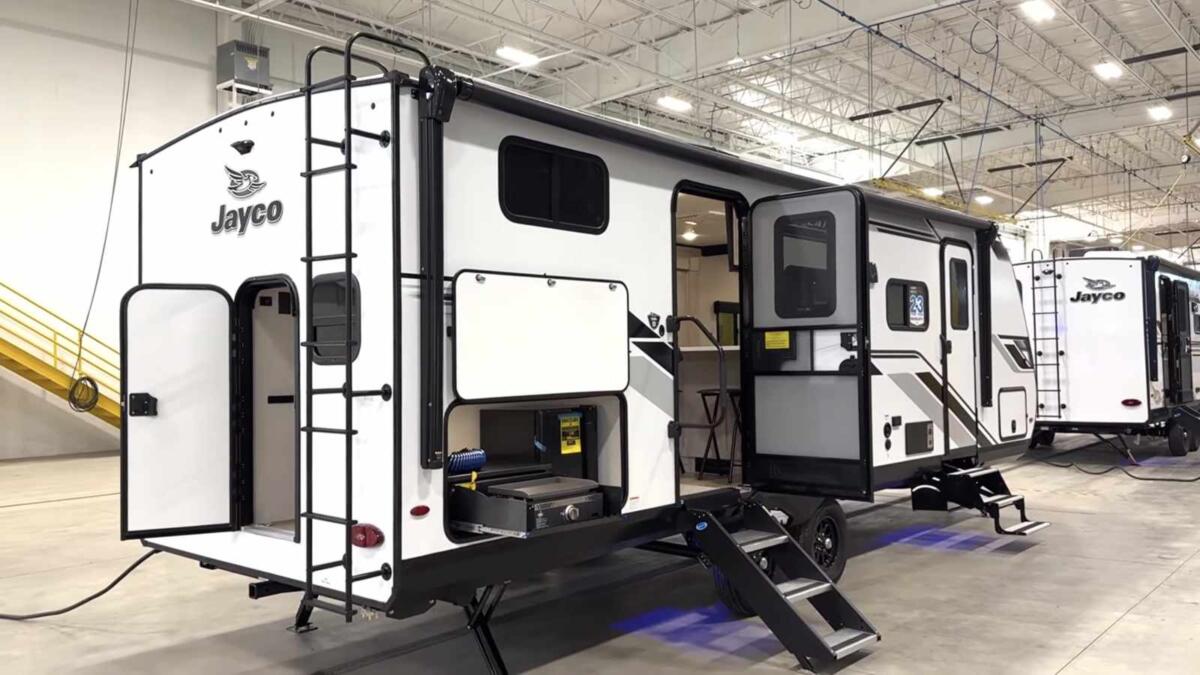
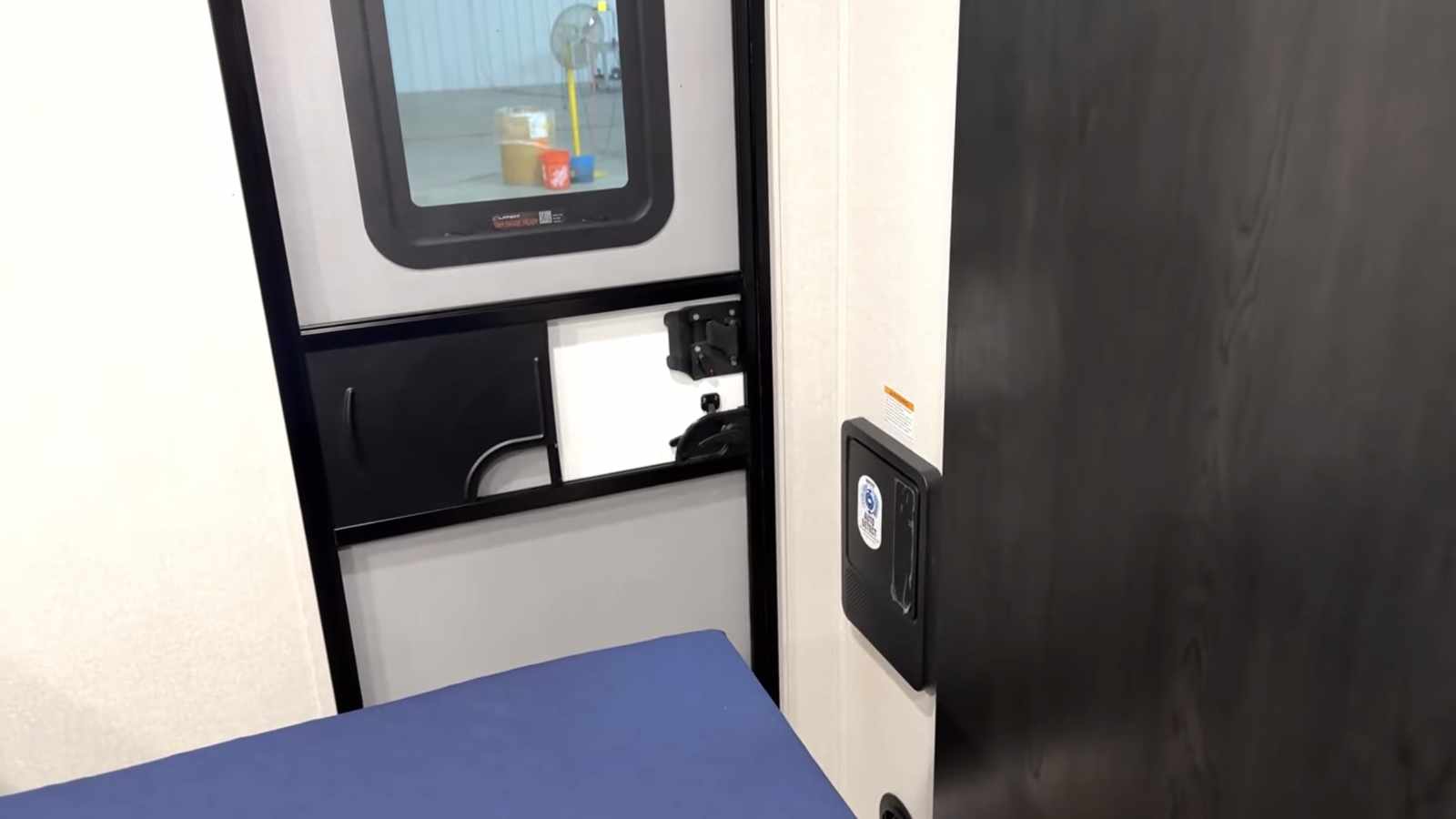
I do like that there are two entrances to this RV. Jayco has the good sense to provide solid steps on one entrance and traditional fold-out steps on the back entrance. You could argue that the rear entrance is the one people will use most, as that’s the way into the main living space. But if you didn’t think those steps were stable enough, Lippert makes a step stabilizer.
Jayco Jay Feather 25BH - 2027
1 of 18
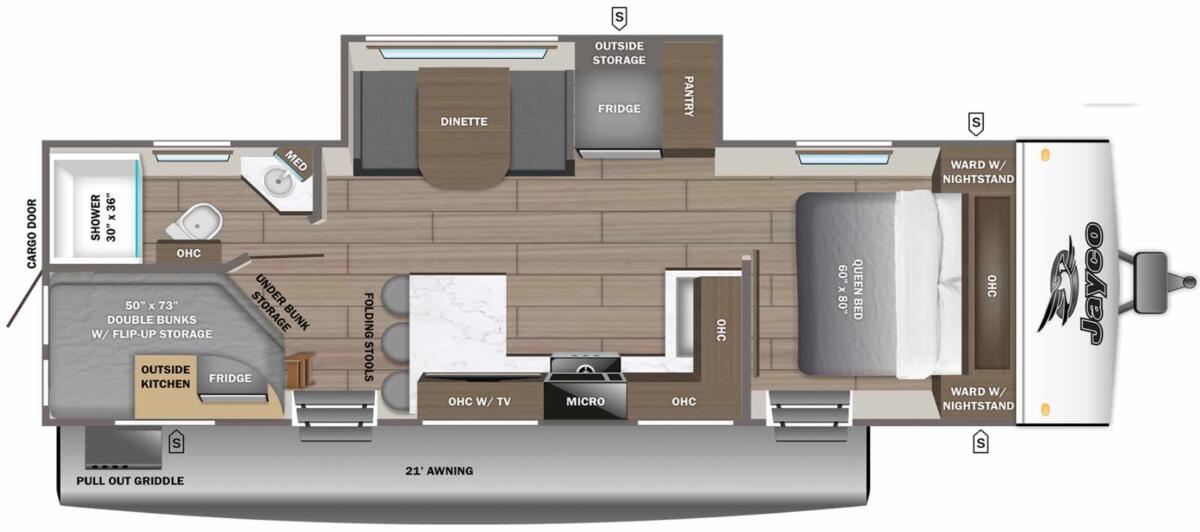
Jayco Jay Feather 25BH floor plan
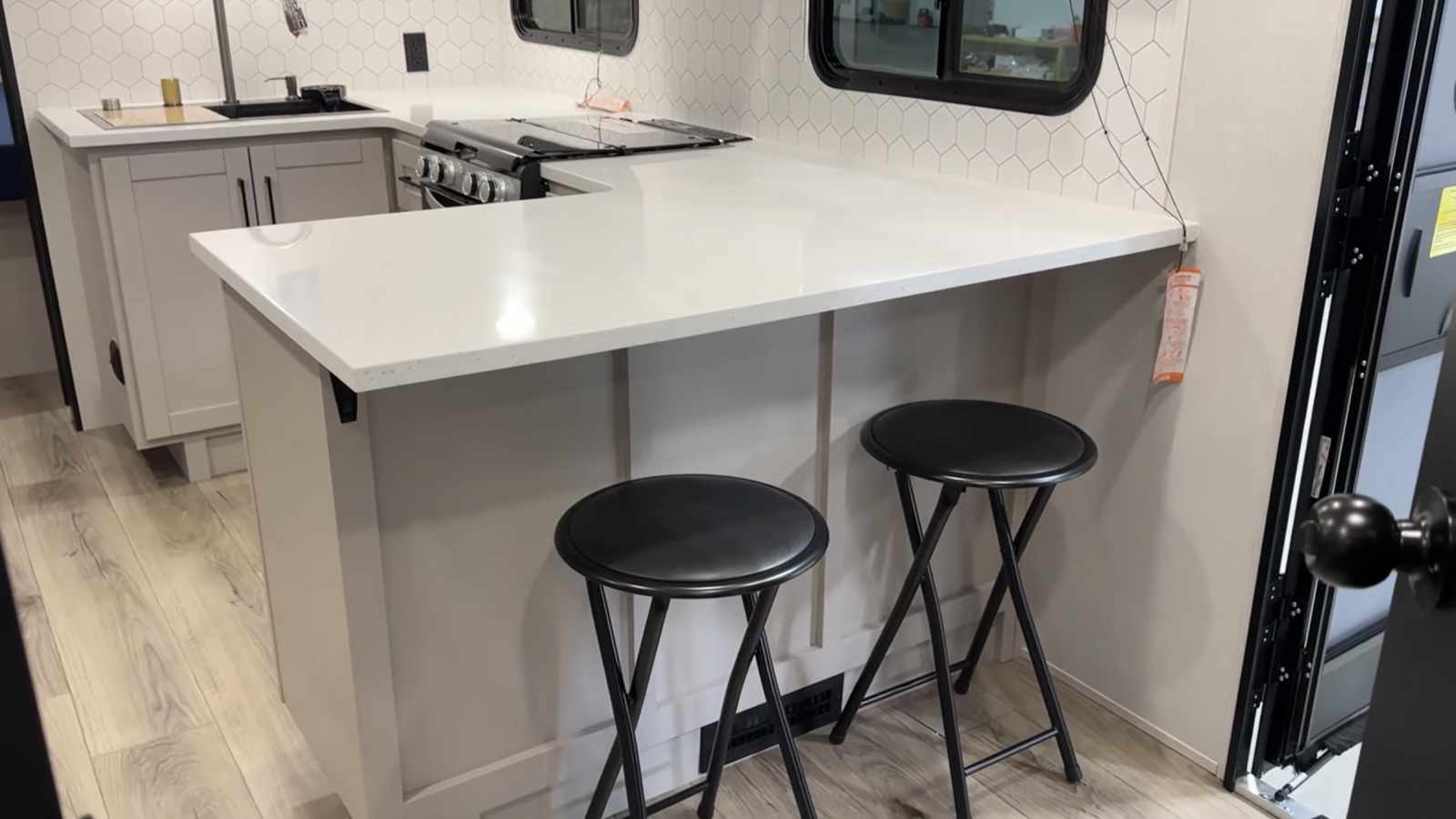
A breakfast bar provides additional seating in the Jayco Jay Feather 25BH
A cargo door provides access to the rear space of the Jayco Jay Feather 25BH
A fancier nose cap in the Premier version of the Jayco Jay Feather 25BH
A good sized pantry with a power outlet in the Jayco Jay Feather 25BH
A kitchen with plenty of counter space in the Jayco Jay Feather 25BH
A true queen-sized bed and sliding bedside tables in the Jayco Jay Feather 25BH
A usable bathroom in the Jayco Jay Feather 25BH
An outside kitchen is a surprise feature of the Jayco Jay Feather 25BH
Cargo area in the bunks of the Jayco Jay Feather 25BH
Decent storage in the front pass-through of the Jayco Jay Feather 25BH
Plenty of storage beneath the breakfast bar of the Jayco Jay Feather 25BH
The dining table is free-standing in the Jayco Jay Feather 25BH
The fuses are in the bedroom of the Jayco Jay Feather 25BH
What’s inside the Jayco Jay Feather 25BH
Stepping in on those fold-out steps, you’ll be greeted by a nifty breakfast bar whose surface is part of a really substantial countertop.
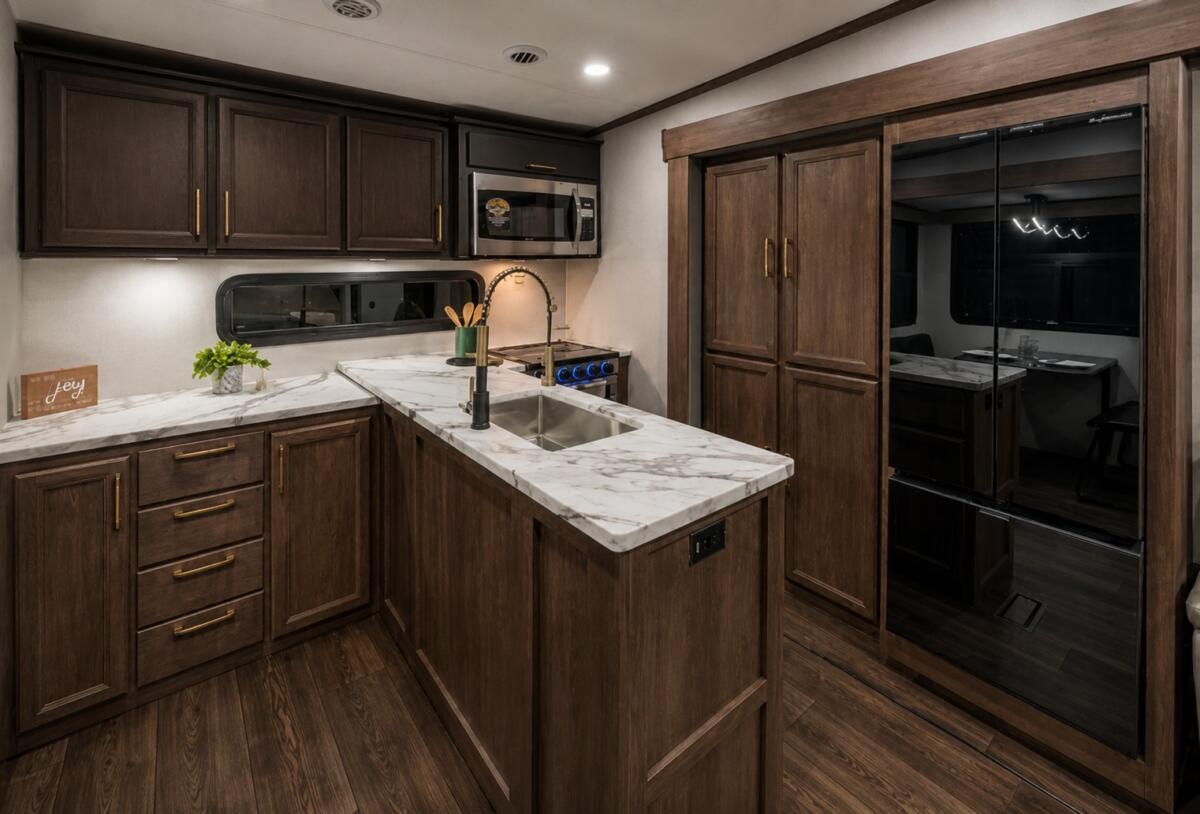
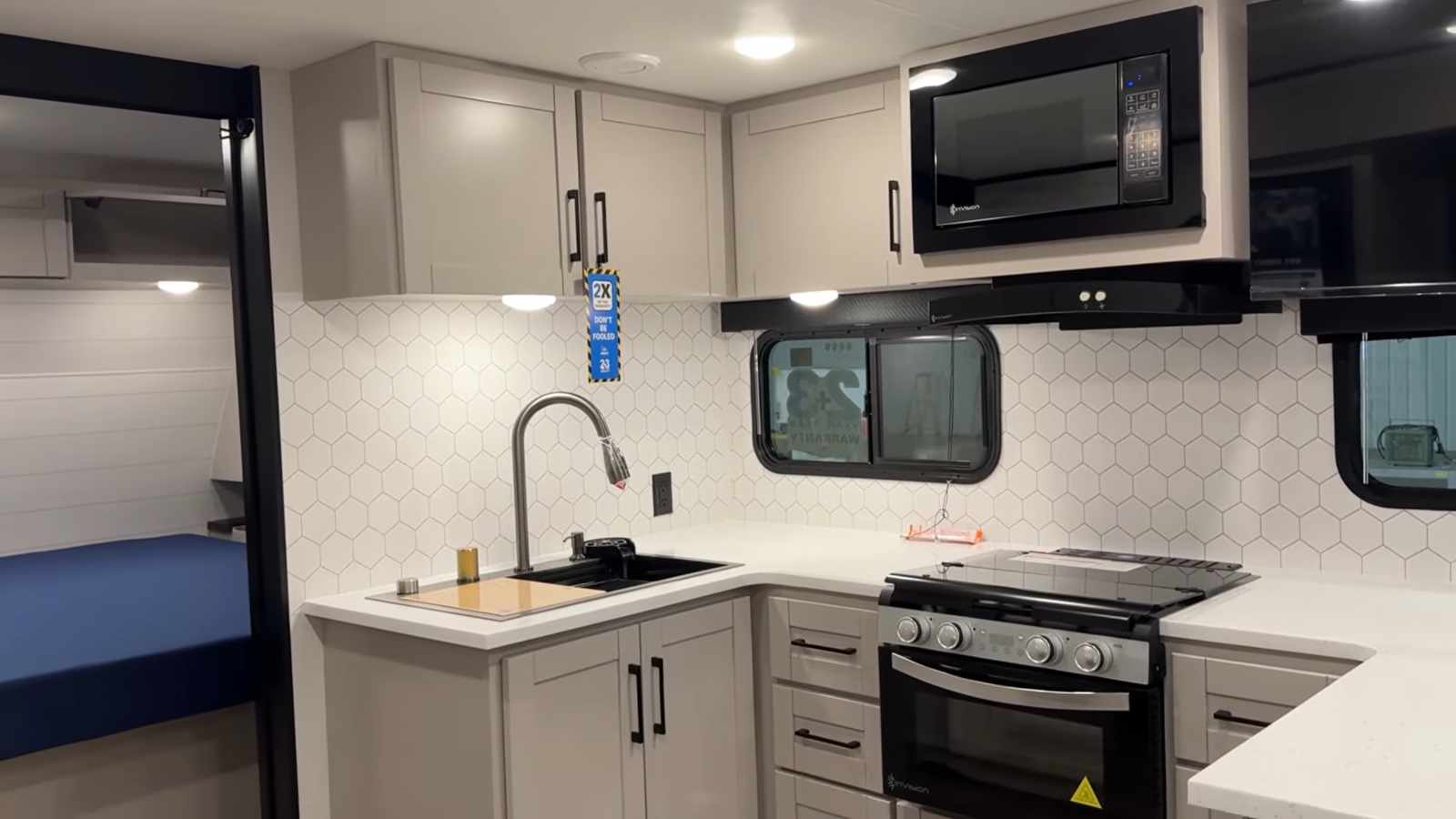
Continuing down the countertop is the kitchen with the countertop forming a U-shaped affair with the three-burner propane stove and, darn it, a 17” RV oven taking center stage. Toward the bulkhead wall is a large sink. Of course, there’s a microwave above the stove.
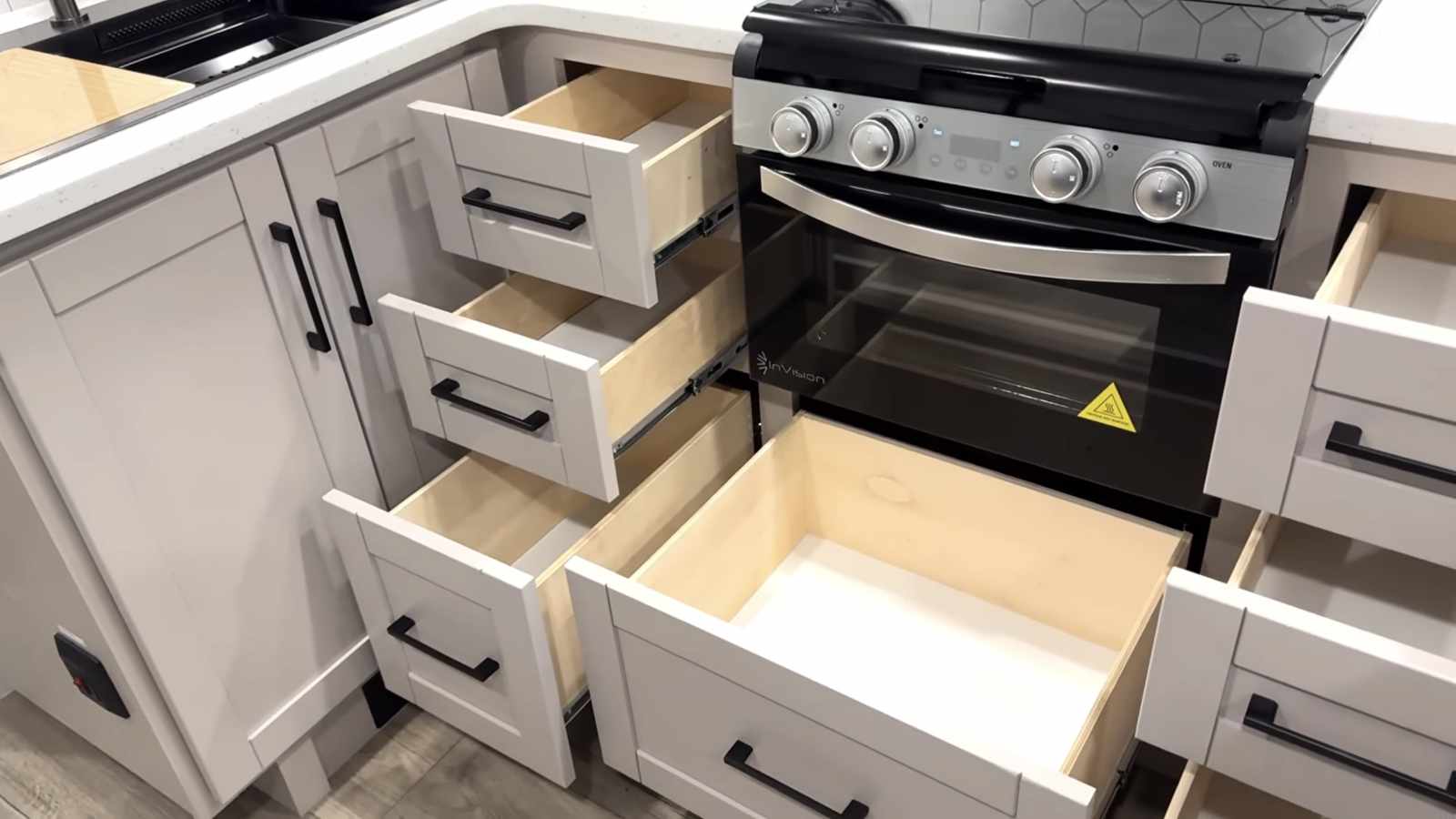
Overhead cabinets here are quite plentiful, and there are also a decent number of drawers.
I could see some fancy RV chefs pretending to conduct their way into a great meal here with the countertops being a ring around them. Or maybe I’m just cuckoo.
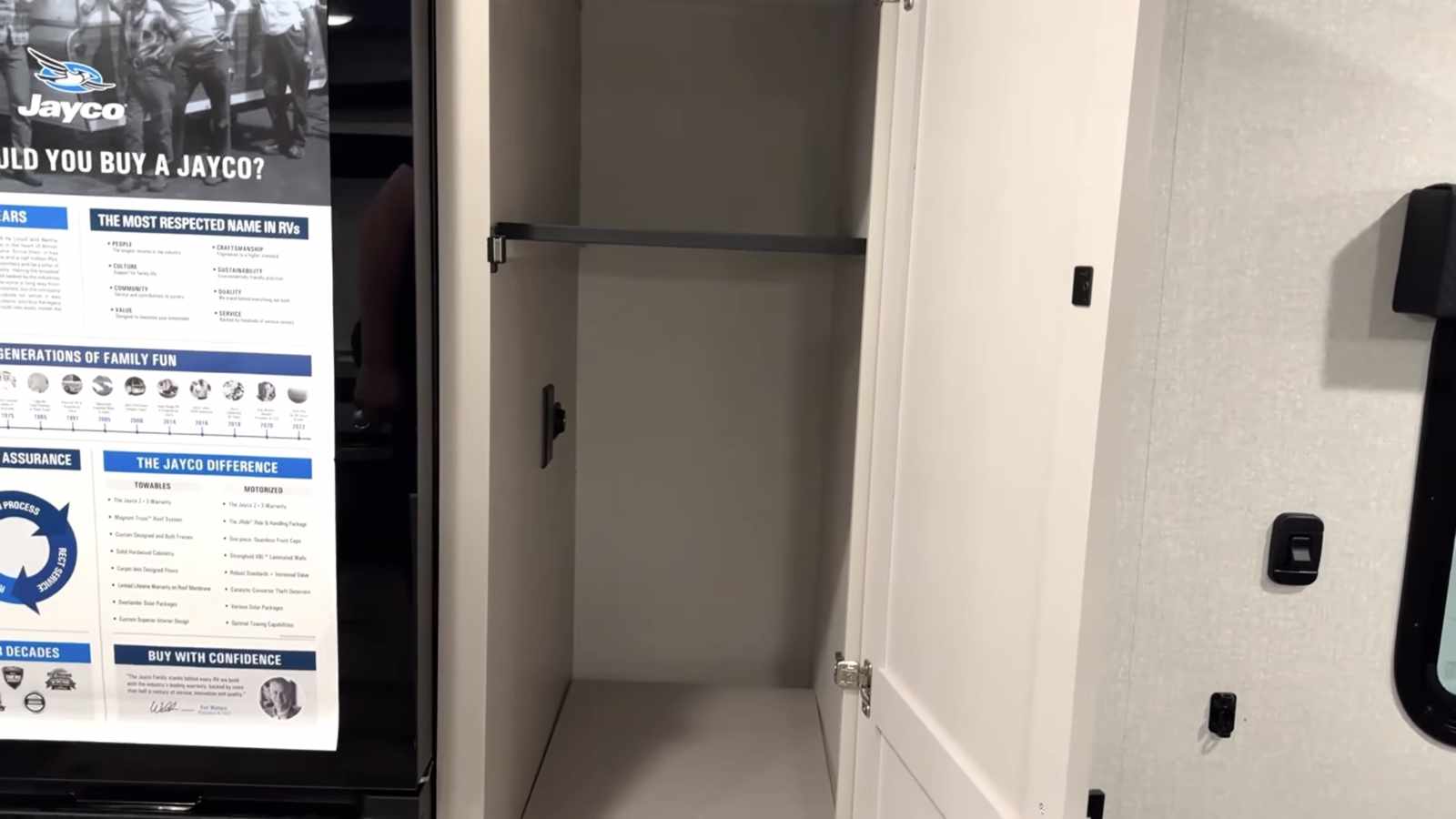
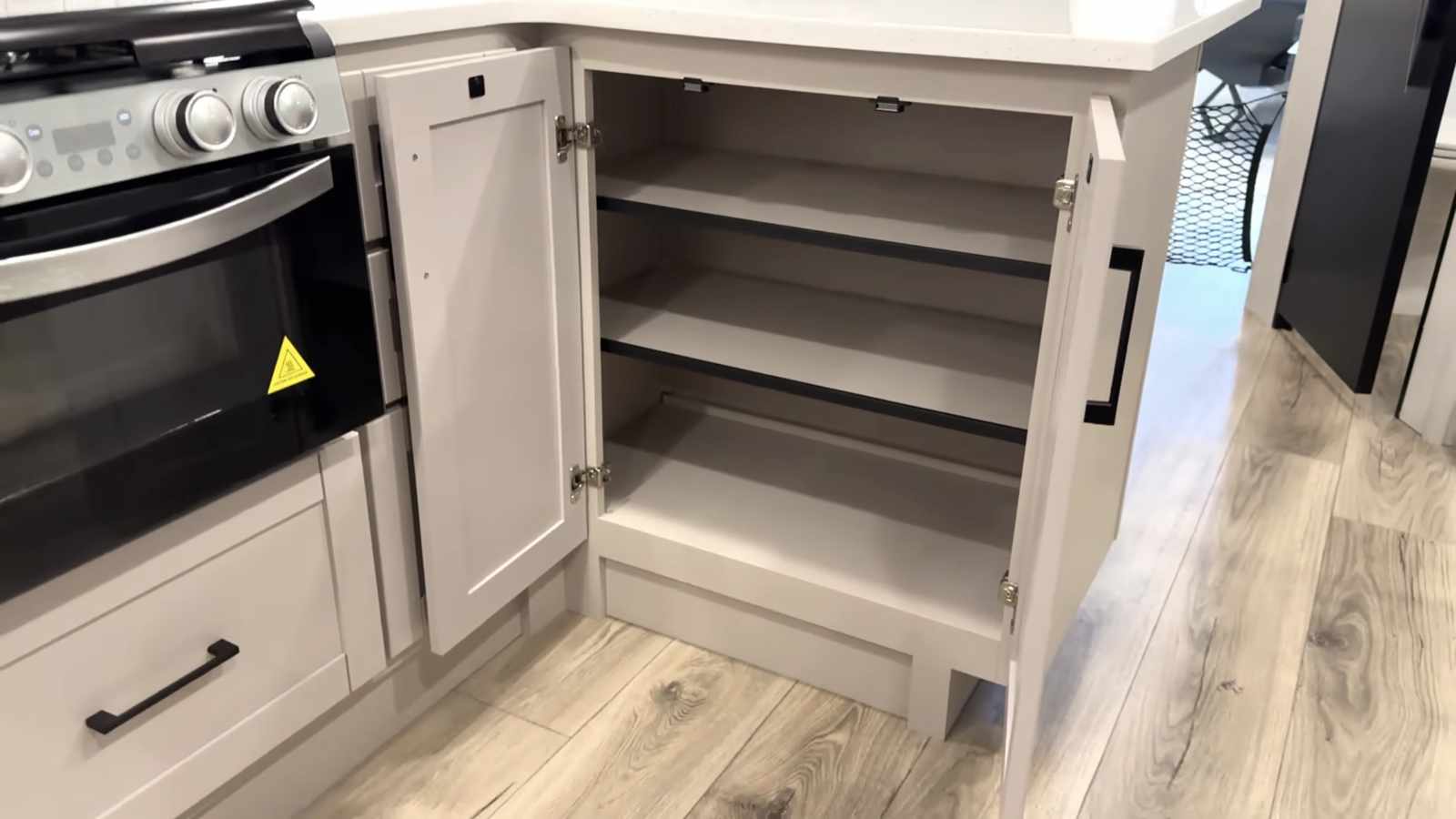
Across from this is the typical RV 12-volt fridge and, next to that, a rather substantial pantry or closet. I like that Jayco has placed a 120-volt AC power outlet inside this closet, so you could charge a vacuum or something like that.
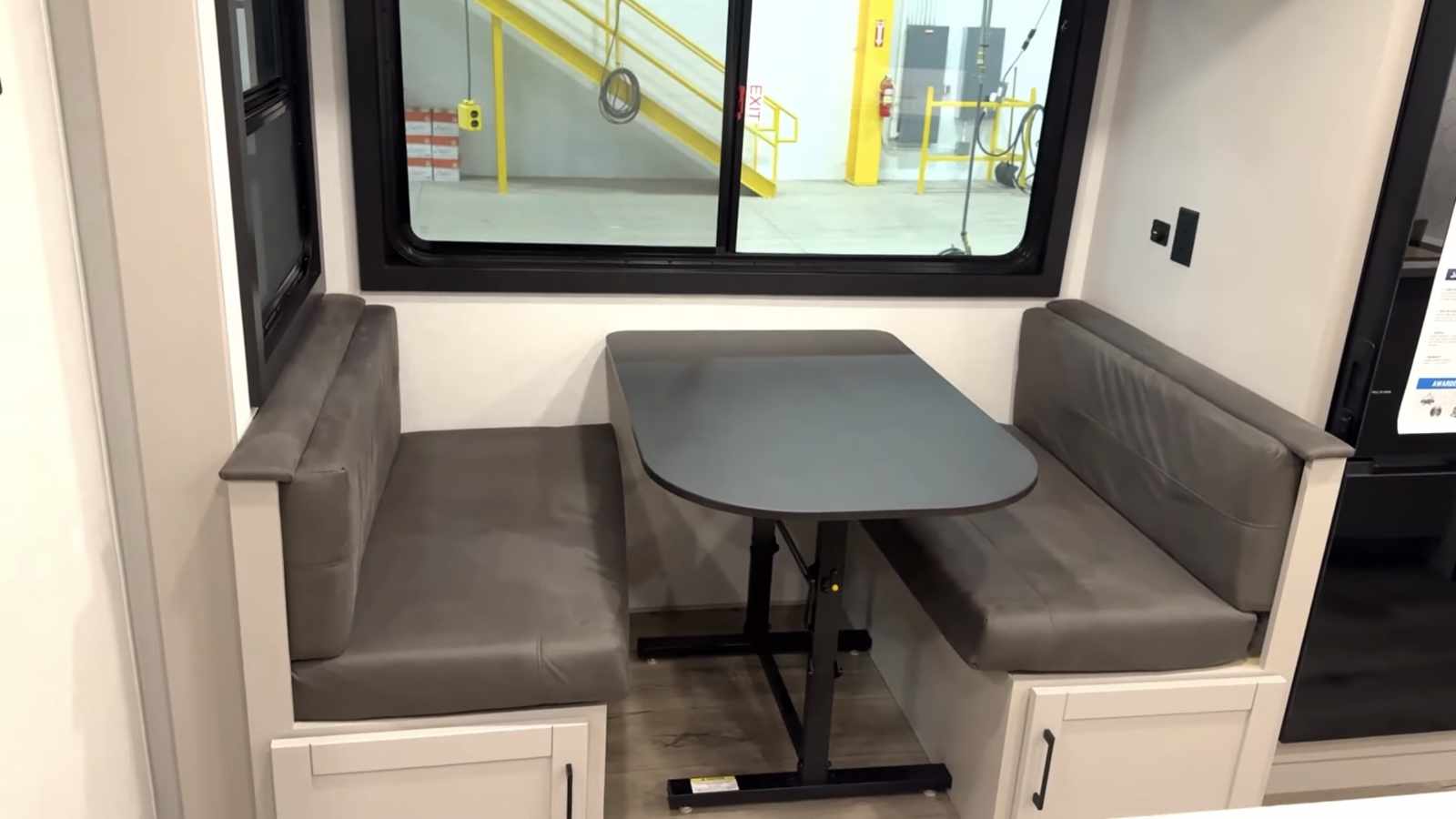
The aforementioned breakfast bar seats three with that many bar-height stools included. There’s also a four-place dinette on the road side in the slide room sharing the space with the fridge and pantry.
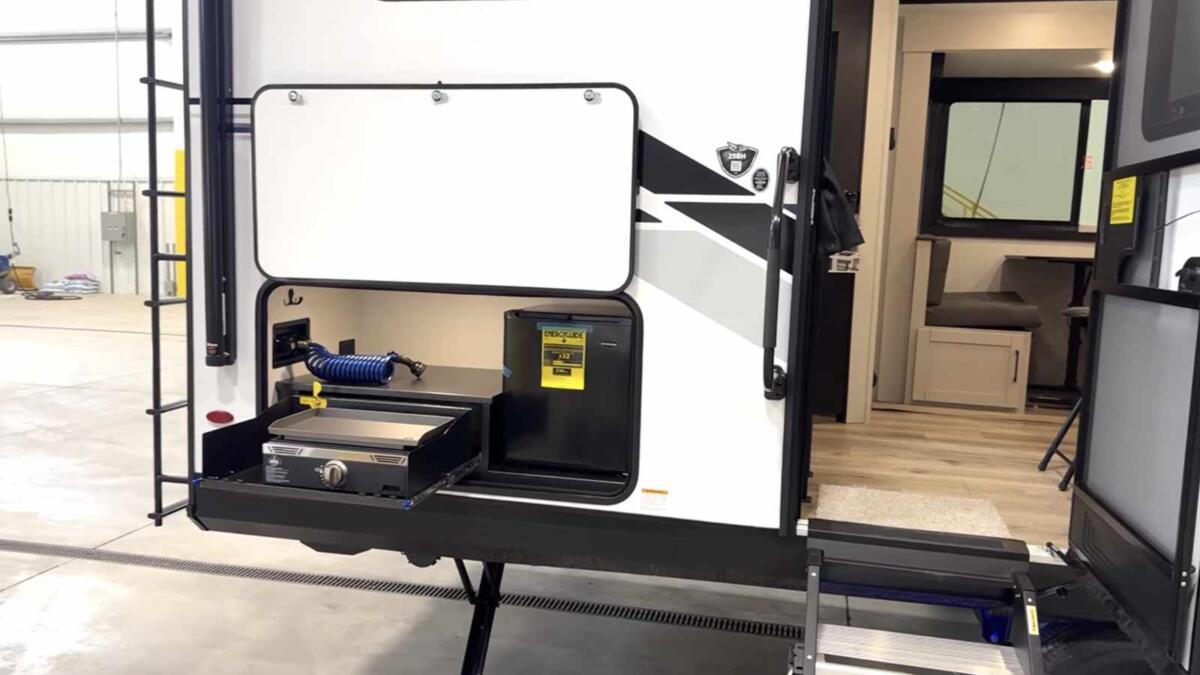
This is one of the few remaining trailers that still has an outside kitchen. These used to be so popular until the RV industry realized most people already have a Blackstone. But this does have a flat-top griddle and a tiny bar-sized fridge outside, along with a spray port and water hose.
Sleeping in the Jayco Jay Feather 25BH
The bedroom in this RV is where one of the two entry doors leads, with there being a passage from the main living space to the bedroom, of course.
The standard bed in here is a true queen-sized bed measuring 60” x 80,” but Jayco offers the option of a king-sized bed instead.
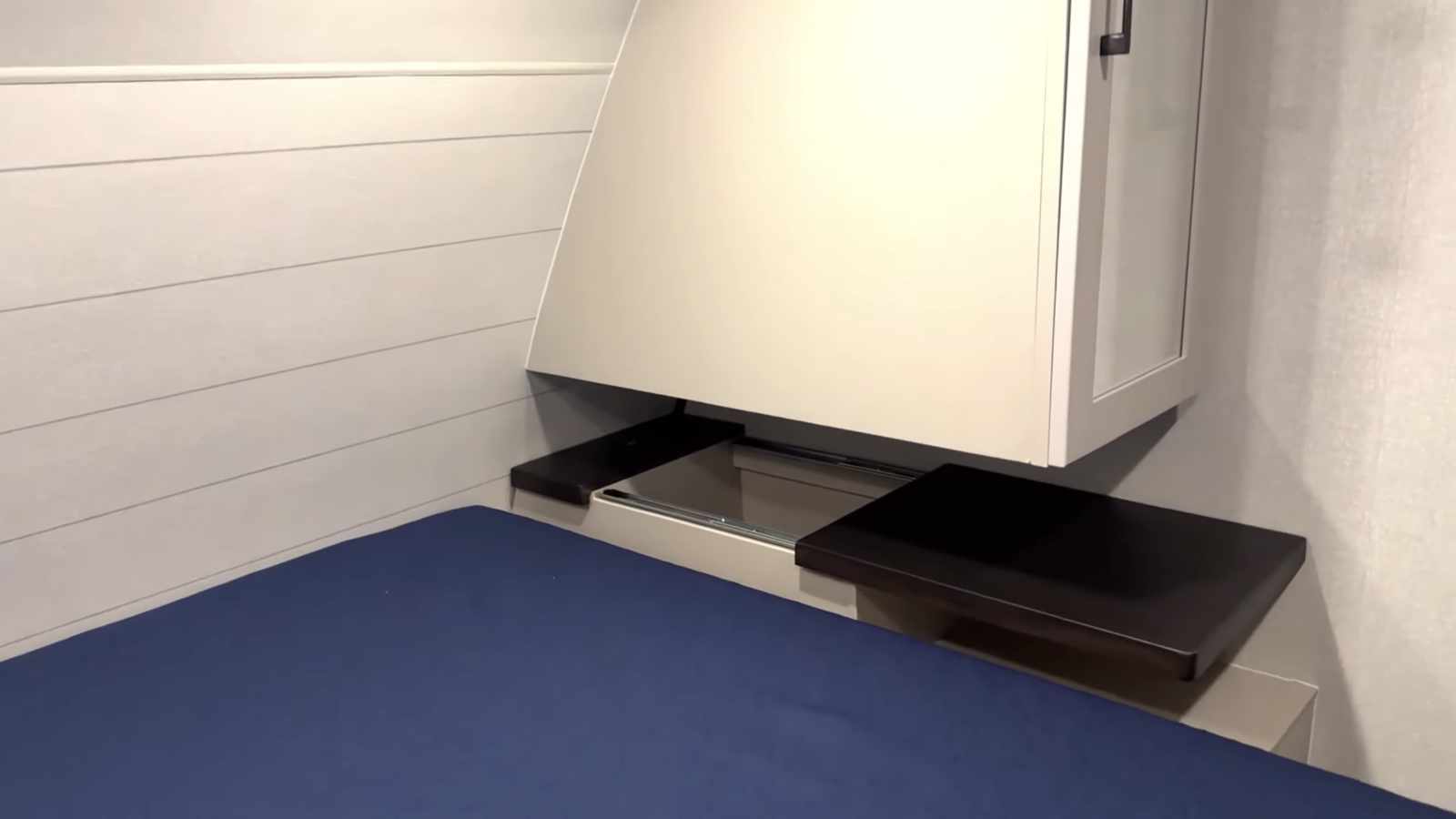
I would imagine that the larger bed would hamper the closets and nightstand on either side of the bed. On the subject of those nightstands, they have a nifty feature where the tops of them slide open to reveal some space for your stuff. Wouldn’t George Carlin be proud?
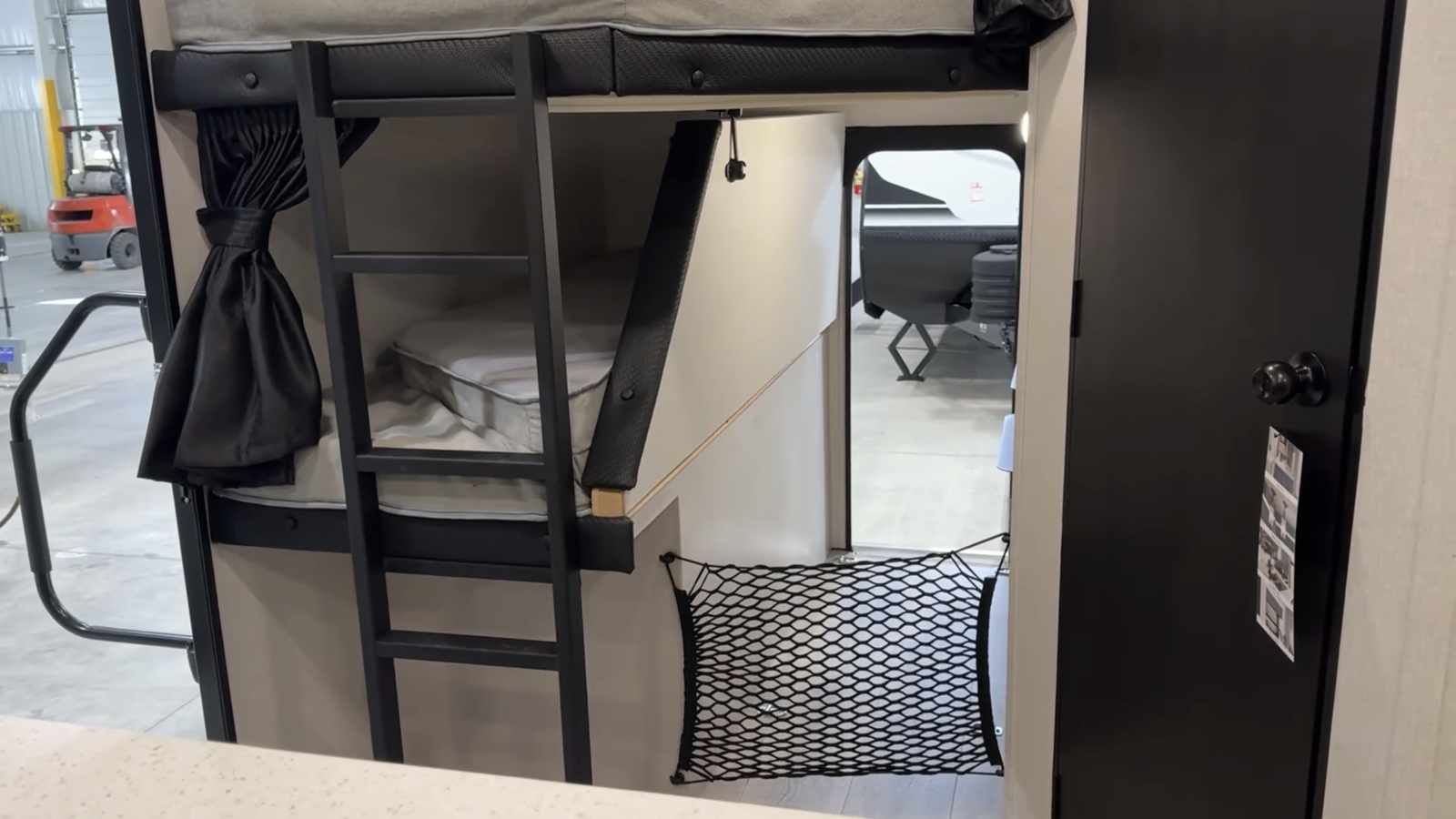
The opposite end of this RV is where the bunks from the whole BH situation reside. Those bunks measure 50” x 73”—certainly respectable. There is also an individual curtain for the upper and lower bunks, which is nice.
Someone at Jayco was really thinking with this arrangement because the ladder is about a foot offset from the base of the lower bunk, making the perfect place for shoes.
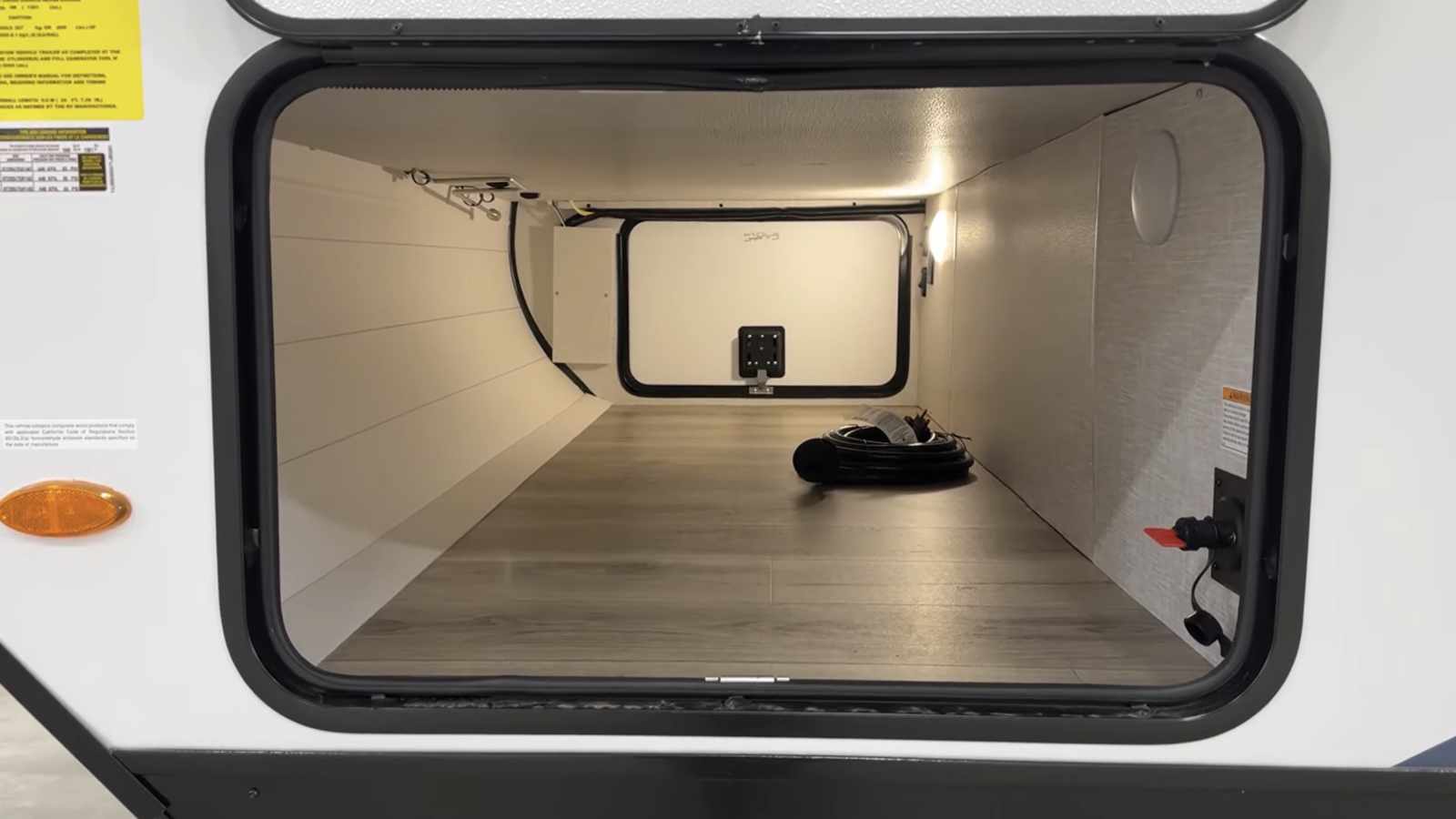
The lower bunk is hinged down the center with the base able to flip up so that there’s a rather sizable storage bay next to it. This compartment is accessible from inside the trailer, but there’s also a half-height entry door at the rear of the trailer to get to it.
Bathroom in the Jayco Jay Feather 25BH
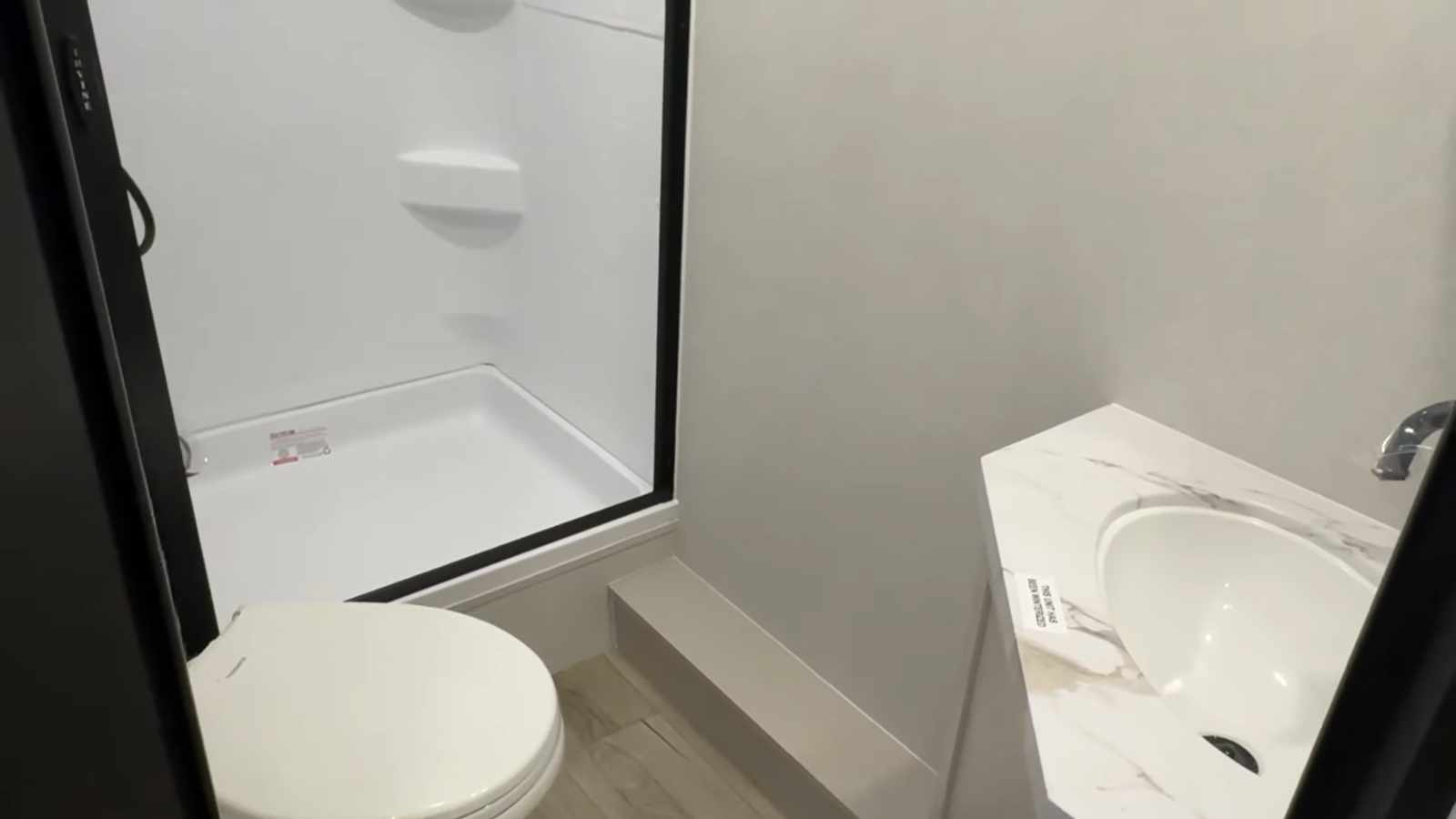
The bathroom in here is about what you’d expect in a mid-sized bunkhouse model. It takes up half the width of the trailer with those bunks taking up the other half, sort of. There’s a porcelain foot flush toilet and a decently large 30” x 36” shower enclosure.
The ceiling height in this trailer is just 6’ 6,” which is about average. That means many travelers are going to really appreciate that skylight overhead!
Boondocking and travel access in the Jayco Jay Feather 25BH
By virtue of having two entry doors, the trailer is mostly accessible with the slide in. However, do know that almost all travel trailer makers urge you not to utilize the space in the slide when it’s retracted. That means don’t use the dinette as a sleeping area, capisce?
If you’re agile, you can squeeze by that nice big counter to get to the fridge, but that’s not something that I’ll be doing anytime soon.
Since there are those two entry doors, you can fully access the front bedroom through the front door and the rest of the trailer, with the understanding that you have to be svelte to get to the fridge, through the back door.
Jayco does offer one or two solar panels as options, and the holding tanks are reasonably large.
Final thoughts on the Jayco Jay Feather 25BH
Something I really liked was that Jayco put the fuse box in the bedroom of this RV. That means it’s out of the temptation of youthful travelers, although it would be no help with spouses of mischievous travelers.
Outside the trailer is an unusual taller compartment that is, essentially, the space behind the refrigerator. For all of you who bemoan the 12-volt fridges, an outside compartment like this wouldn’t have been possible with an old-fashioned gas absorption fridge. This space is good for taller items like fishing poles or beach umbrellas or those trombones that your children wanted to take up.
I like the way Jayco designed the floor plan on this trailer. But if I were a buyer, I would want to be absolutely sure that that tire pressure monitor was installed. And, on that note, there are also now competitors that include things like anti-lock brakes, better tire and suspension packages, and some other features, albeit for more money. But I think that’s money well spent.
I like this floor plan, but I really wish Jayco’s Premier package was more than just some fans and decor. I hope more people read these reviews and demand things like better suspensions and actual tire pressure monitors and something other than a 17” oven, but I suspect that’s not the case.
My thanks to Josh from Bish’s RV for the video and photos in this article.
More about these RV reviews
These RV reviews are written based on information provided by the manufacturers along with our writer’s own research. They are based on information from a single unit and may not reflect your actual experience. Shop your RV and dealership carefully before making a buying decision. They are intended only as a brief overview of the vehicle, not a comprehensive critique, which would require a thorough inspection and/or test drive.
Tony comes to RVtravel.com having worked at an RV dealership and been a lifelong RV enthusiast. He also has written the syndicated Curbside column about cars.
You can also check out Tony and Peggy’s RV podcast.
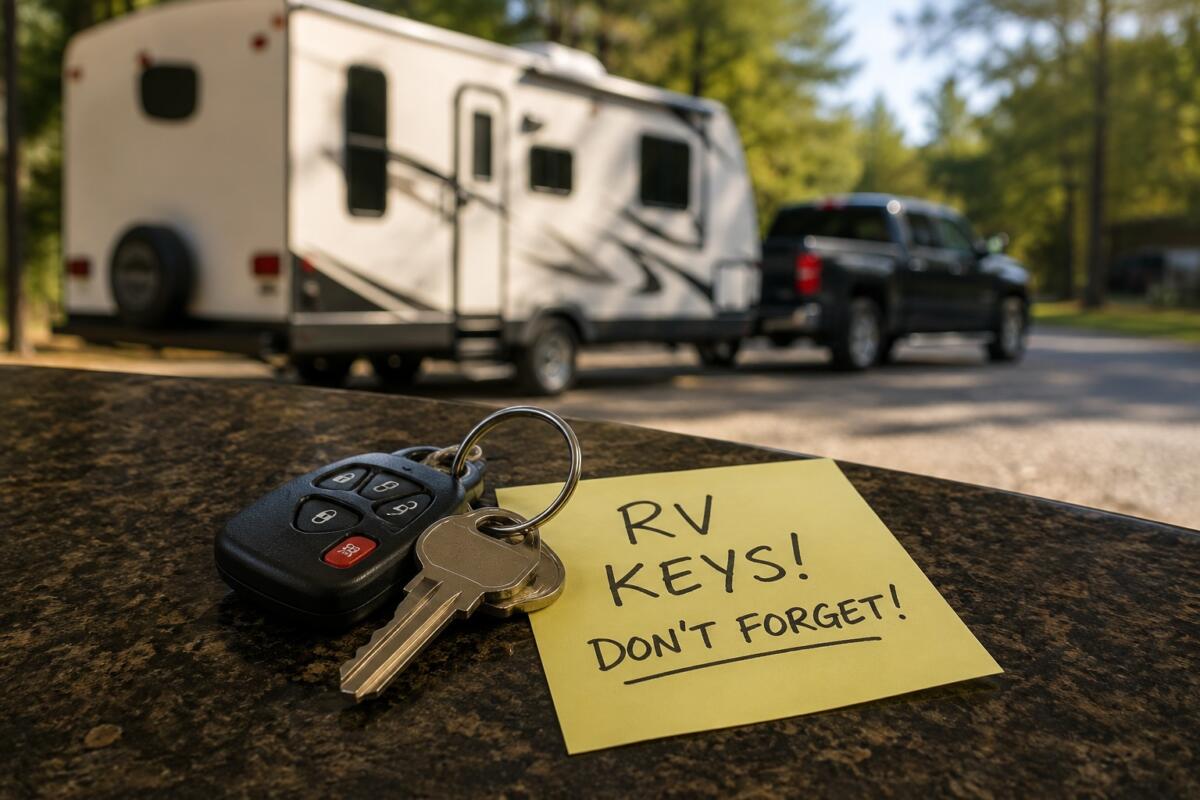
While reading through some recent comments, we noticed a trend: forgotten trailer keys at home. Yikes.
It’s an easy mistake to make. You’re focused on packing clothes, stocking the fridge, hooking up the trailer, checking tire pressures, and making sure the dog made it into the truck. Then you arrive at your campsite, reach for the keys… and realize they’re sitting on the kitchen counter several hundred miles away.
Some RVers catch the mistake before they’ve gone too far, like reader Roy D., who said, “One time we forgot the keys to the camper, but fortunately we hadn’t gone that far away. From that time on we kept a set of camper keys in the tow vehicle all the time.”
Others aren’t quite so lucky. Phil R. wrote, “We drove 250 miles to our destination and found I’d left the RV keys at home. Had to call a locksmith on a Saturday!! Not cheap.”
And sometimes, as Tim learned, forgotten keys can create more problems than simply getting into the RV. “We packed up and hitched up the day before departure. Upon arrival at our destination, we discovered that we forgot the RV keys. A friend helped us break into the trailer without damage so the weekend was saved. We couldn’t even unhitch because a padlock was on the coupler.”
If you’ve ever left your trailer keys behind, you know that sinking, gut-wrenching feeling. The good news is that a forgotten key doesn’t have to ruin your trip. Depending on your situation, there are several ways to get back into your RV and salvage your camping plans.
Option 1: Have someone overnight the keys
If a family member, neighbor, or friend can get into your house, they can send the keys via overnight delivery to your campground or a nearby shipping store. It’s not ideal, but it’s often the simplest solution.
Option 2: Use a spare key
Many RVers keep a spare:
In the tow vehicle
In a magnetic lock box
With a trusted family member
Hidden somewhere on the RV (though that’s less secure)
If you have one, now’s the time to remember where you put it. And, if you don’t have one, maybe the comments above will inspire you to make one and keep it in your tow vehicle.
Option 3: Call a locksmith
A locksmith may be able to open the RV and, in some cases, make a new key from the lock. RV entry locks are often simpler than automotive locks. If you’re at a campground, ask the office if they know a local locksmith familiar with RVs.
Option 4: Check for common RV keys
A surprising number of RV baggage compartment locks use common “CH751” keys. If your problem is getting into a storage compartment rather than the main entry door, another RVer nearby may have a key that works.
Option 5: Contact the lock manufacturer
If you know the brand of your lock and can access the lock code, the manufacturer may be able to provide replacement keys. This won’t help immediately, but it’s worth pursuing if you’re on a longer trip.
Option 6: Enter through another unlocked access point
Sometimes a window, rear door, garage door, or pass-through compartment was accidentally left unlocked. It’s worth checking before you panic.
Option 7: Replace the lock
If you’re near an RV dealer or hardware store, replacing the entry lock may be faster and cheaper than multiple locksmith visits, especially if you’re far from home.
What not to do
Don’t force the door open. RV doors and frames are surprisingly easy to damage and surprisingly expensive to repair.
Additionally, do not break a window unless it’s a genuine emergency involving a person or pet.
What to do… now!
Hide a spare key somewhere secure or carry one in your tow vehicle.
Give a spare to a travel companion, a family member or friend who could ship it overnight in case of an emergency.
Upgrade to a keyless RV lock.
Being locked out of an RV is usually inconvenient rather than catastrophic. A locksmith, spare key, or overnight shipment can almost always get you back inside without damaging the trailer.
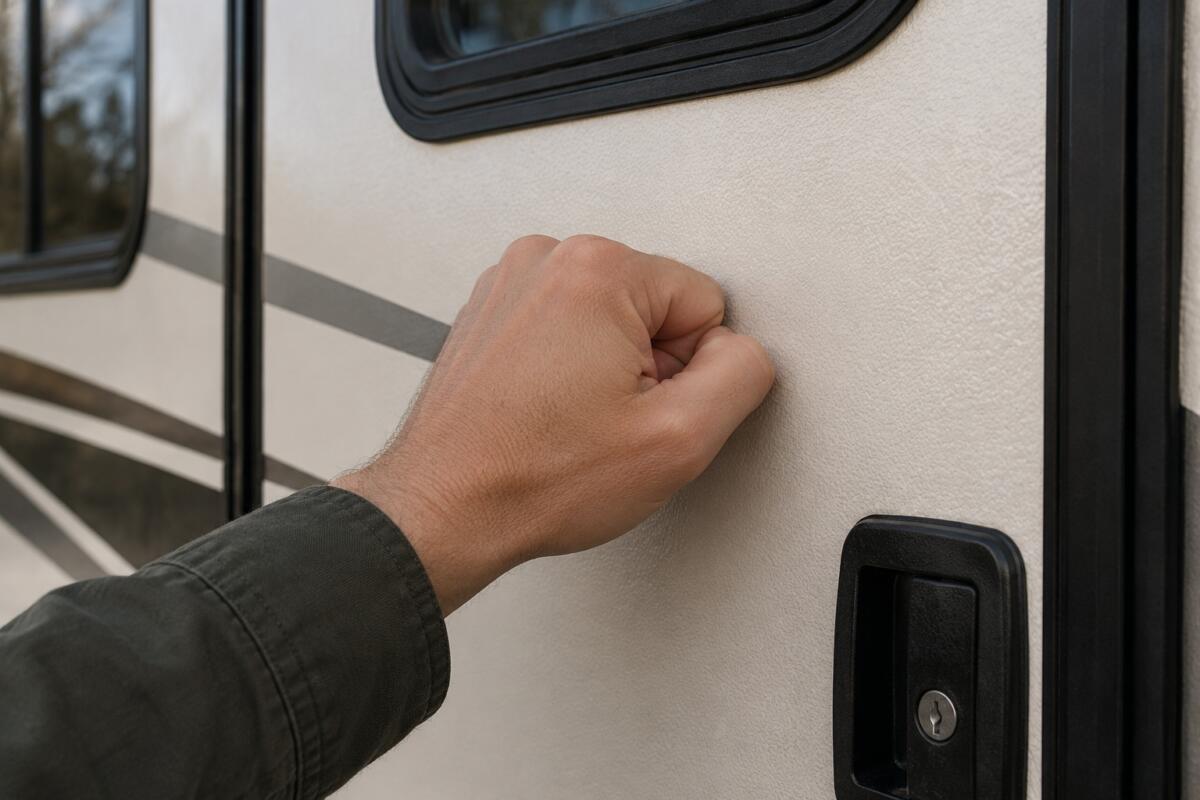
Have you heard about this unwritten RV rule? It doesn’t come up very often. However, you should know and follow this unwritten rule: (Almost) never knock on an RV door.
Folks new to RVing may not realize that knocking on another person’s RV door is almost always considered taboo. Let’s take a closer look at this unwritten rule and the reasoning behind it.
Knock it off!
Many RVers see an unexpected knock as a privacy issue. They do not appreciate or want surprise visits, especially from people they don’t know.
This concern is amplified in an RV (as opposed to a stix-n-brix house). Just think about it for a minute. An RV is a very compact space. You’ve got your kitchen, eating, living, and sometimes bedroom all sharing the same tiny square footage. When your RV entry door is opened, other campers can see most of your interior space—in some RV floorplans the bathroom is even visible!
No one wants their entire life “exposed” to passers-by. Privacy and anonymity are highly prized by many RVers. After all, many of us go camping for the serenity and peacefulness it offers. Privacy is a big part of that serenity. It’s not that RVers are unfriendly folks. Not at all! We just like the opportunity to choose when we are sociable.
Knock yourself out
The unwritten rule “Never knock on an RVer’s door” does come with a few exclusions. Here they are:
Emergency situations supersede this rule. If you notice water flowing from the bottom of an RVer’s rig, for example, you should make the owners aware of it. Same goes for other potential emergency situations that may cause physical harm, danger to pets/children, or harm to the RV itself. (You’d want someone to notify you in emergency cases like this, right?)
If you’re camping with others you know well, and they’re expecting you, it’s OK to knock on their RV door. However, if shades are drawn and the solid door is closed, it may be best to call ahead rather than knock.
Knock like this
If you must knock on an RVer’s entry door, most RVers I’ve talked with agree that you should do it like this: Knock on the door and then step back off the steps to the ground and far enough away so you cannot see into their rig. Doing this preserves the RVer’s privacy. (And you won’t fall back off the steps when the door opens.)
A better way
Perhaps a better way to meet an RV neighbor is to catch them outside. RVers I’ve spoken with say they would rather be approached while sitting in a lawn chair, coming and going, or otherwise out in the open. Daylight hours are the better time for a conversation than an unexpected door knock.
RV life is still one of the friendliest kinds of travel out there. A wave, a smile, or a quick chat when both of you are already outside keeps a campground neighborly. Knocking on an RVer’s door? Not so much.
Did you know about this unwritten RV rule? Would you mind if someone knocked on your door unexpectedly? Would you ever knock on your neighbor’s door, or would you wait until you saw them outside to talk?
I recently saw a picture on an RV blog of a failed tire on a dolly. This is my reply as to the probable cause:
Sorry to hear about your tire failure.
I do see that you were using a TPMS. That is a good sign, but I suspect that the reason for the tire failure was simply tire age and long-term exposure to the heat of the sun.
The evidence I see for that conclusion is the significant amount of bare steel. This suggests a breakdown of the rubber/steel bond. This takes a long time at an elevated temperature. I’ll bet you do not cover the tires on the dolly whenever you park it, so the tire is exposed to the full heat of the sun.
Need for annual “real inspection” of tires
I have several posts on tire age and the need for an annual “real inspection” that is more than just looking at the tires. I just finished a detailed post on RVtravel.com about what I consider a detailed and meaningful tire inspection. Your dolly tires probably “died” from old age. You can read the post HERE. Be sure to follow the links to gain knowledge on how you can do a better job of “Tire Inspection”.
As a Tire Design and Forensic Engineer with 50 years of experience, I can tell you that the evidence I see in your pictures indicates a failure of adhesion between the steel belts and the rubber in the belt area. I have been able to duplicate this condition a couple times in the laboratory.
If you read the “material list” information on the tire sidewall, I am confident that you will not see any material listed as a layer or “ply” between the steel belts and the tread.
Regarding the effect of the sun’s heat on tires, there are a number of posts on this topic on my blog www.RVTireSafety.net.
I hope that the posts on tire life on these two blogs provide a better understanding of tire life.
America’s Original RV Newsletter. Since 2001 Issue 1264 We are honored to be named the best RV newsletter by Google, Bing, Yahoo and ChatGPT!
Today’s thought
“We have created characters and animated them in the dimension of depth, revealing through them to our perturbed world that the things we have in common far outnumber and outweigh those that divide us.” —Walt Disney
Need an excuse to celebrate? Today is National Trails Day! It’s also National Black Bear Day, but try not to run into a black bear on a trail, okay??
On this day in history: 1944 – World War II: Commencement of Operation Overlord: The Allied invasion of Normandy begins with the execution of Operation Neptune—commonly referred to as D-Day—the largest seaborne invasion in history. Nearly 160,000 Allied troops cross the English Channel. By the end of the day, the Allies have landed on five invasion beaches and are pushing inland.
Featured news
YouTuber Will Prowse sued by Battle Born Battery/Dragonfly Energy
We reported on December 18, 2025, that YouTuber Will Prowse shared a video entitled “Battleborn 12V Battery: Major Safety Issue,” with a featured image of the word “Dangerous” in large letters on the hero (top) image. In that video, Prowse cuts open a battery. Well, it turns out the story runs deeper, as Battle Born® parent company Dragonfly® Energy posted that they have filed a trade libel lawsuit against Will Prowse. Here’s why.
What causes most RV fires? Here’s what firefighters say
A fire that destroyed an RV being used as a residence recently drew firefighters to the scene and left investigators working to determine what caused the blaze. Officials have not identified the source of that fire, but the incident raises a question many RVers ask when they pass a burned rig on the shoulder of the highway: What causes most RV fires?
Persian Gulf oil disruptions could keep fuel prices high
A major shipping route that carries much of the world’s oil may never return to normal, a development that could affect fuel prices after the current Middle East conflict ends. Oil tanker traffic through the Strait of Hormuz may recover only partially even if hostilities ease. Before the conflict, roughly one-fifth of the world’s oil moved through the strait. Today, tanker traffic remains far below normal levels. Learn more.
Why RVs can be road-rage targets on busy highways
A new study from ConsumerAffairs ranking the states with the worst road rage may put numbers to the problem. The study ranked states using factors such as aggressive-driving fatalities, speeding violations and gun-related traffic incidents. For RVers, however, the more interesting question is not which state ranks highest. It’s why RVs seem to attract so much impatience in the first place.
The Forest Service’s new app is helpful. So, why do RVers still need Recreation.gov?
The U.S. Forest Service has launched a new mobile app designed to make recreation planning easier. After spending some time with it, we found plenty to like. But we wouldn’t call it a one-stop solution. After downloading the new app, many RVers will still find themselves opening Recreation.gov whenever it’s time to reserve a campsite. Here’s why.
Prime Day RV deals: Here’s the RV gear worth watching now Amazon Prime Day RV deals are still a few weeks away, but RVers who wait until the sale starts may already be behind. If you’ve been thinking about a new power station, tire pressure monitor, Starlink accessory or some other RV gadget, now is the time to start watching prices.
Campground vandalism is costing RVers more than they may realize
Most RVers have seen it. A campground restroom closed for repairs. A picnic table covered in graffiti. A sign peppered with bullet holes. A fire ring damaged beyond use. It’s easy to assume those things happen because public land agencies don’t have enough money to keep up with maintenance. Sometimes that’s true. But a recent vandalism case at a Wyoming campground highlights another reason some campground improvements never happen.
Diesel prices just posted a big drop
Diesel RV owners haven’t had much reason to smile at the pump lately. After months of rising fuel costs, however, some welcome news finally arrived this week. The national average price of diesel fell 17.3 cents per gallon during the week ending June 1. That marks the third consecutive weekly decline and one of the largest week-to-week drops seen in months.
What kills most people in national parks? Often the mistakes RVers see every summer
Ask someone what the biggest danger in a national park is and they’ll probably mention bears, mountain lions or some other wilderness threat. But the numbers tell a different story. A recent analysis highlighted by Outside looked at fatalities across America’s national parks and recreation areas. It found… Continue reading.
Safety for roadside workers and stranded motorists in spotlight this month
A deadly Interstate 95 bus crash in Virginia has renewed attention on a hazard RVers face every day: reacting safely to changing traffic conditions at highway speeds. With larger vehicles and longer stopping distances, RVers can be especially vulnerable. The tragedy serves as an important reminder about a simple driving habit that could save lives.
Beyond the headlines with Tony Barthel
Lippert retires, RVers’ economic impact, deaths in NPS
Jason Lippert, the longtime CEO of Lippert Components, is stepping down after 32 years with the company, marking the end of an era for one of the RV industry’s most influential leaders. In this week’s roundup, Tony also looks at surprising RV fire statistics, a new report showing the RV industry’s massive $159 billion economic impact, and a study revealing where national park visitors are most likely to get into trouble. Read on for the stories making headlines across the RV world.
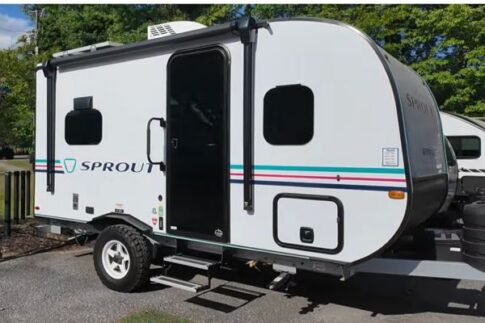
RV review 2026 Keystone Sprout 13RKS—the Class B of travel trailers
The 2026 Keystone Sprout 13RKS packs a lot into a small footprint. Keystone calls the Sprout the “Class B of travel trailers,” and the reason starts outside. This is the smallest Sprout, with a 13′ box, 17’4″ overall length, and 2,950-pound dry weight. Many SUVs should be able to handle it. Inside, the 7′-wide body uses space well. Check it out.
News briefs
Oh, what beautiful eyes you have!
Keep an eye out for nasty flesh-eating screwworms. U.S. Customs and Border Protection officials are warning travelers along the U.S.-Mexico border to keep an eye out for the New World Screwworm, an invasive pest that can infect livestock, wildlife, pets and, in rare cases, humans. The flesh-eating pest has been detected within 55 miles of the U.S.-Mexico border, prompting increased efforts to prevent it from spreading into the United States. Learn more, including the update on June 5.
Click on photo to enlarge.
Memorial Day weekend marked the unofficial start of summer travel, and leaders from Nevada and Arizona came together at Hoover Dam to help launch the Road to America250. The patriotic display features dramatic red, white, and blue illumination and a massive American flag suspended across the dam. The display (weather permitting) will be activated every evening through July 4.
AAA reports the national average for a gallon of regular gasoline is down 18 cents since last week, to $4.24, the second straight week of decline. But uncertainty lingers over when the Strait of Hormuz will fully reopen and resume traffic. That unknown means oil prices will likely not decrease dramatically as summertime gasoline demand starts.
The Trump administration is redirecting at least $90 million in national park entry-fee revenue to projects in Washington, D.C., including a $1.6 million Fourth of July fireworks show and $76 million in fountain repairs. The move comes as the capital prepares for celebrations marking America’s 250th anniversary.
For three summers, RVers heading to Lake Tahoe had to cross D.L. Bliss State Park off their camping wish list. Now the campground is finally open again. But good luck getting a reservation…
Speaking of reopenings… For the first time since last year’s Dragon Bravo Fire, RVers are once again able to camp on the Grand Canyon’s North Rim. The North Rim Campground reopened June 1, giving visitors their first opportunity to spend the night inside the park since the fire destroyed the historic Grand Canyon Lodge and damaged large portions of the North Rim. Details here.
The Summer 2026 edition of RV RoadSigns, the quarterly forecast prepared for the RV Industry Association, shows wholesale shipments in 2026 of between 300,00 to 328,100 units. The median forecast of 314,000 units would be down from 342,200 last year.
An Illinois family says a routine walk at a state park turned into a tick nightmare when dozens of ticks crawled onto them, their dog, and even made it into their home. Park officials warn tick activity is expected to be especially high this season. Make sure you are using tick repellentout there (and for your dogs, too)!
One of the year’s best stargazing events returns to Bryce Canyon National Park on June 11 to 13, when the annual Bryce Canyon Astronomy Festival transforms the park into a giant outdoor classroom focused on the wonders of the night sky. Here are the details.
Beginning June 22, Lipan Point and Lipan Point Road on Desert View Drive (Highway 64) in Grand Canyon National Park will close until about December 23 for rehabilitation and maintenance work of the overlook.
Tulsa, Oklahoma, set a new Guinness World Record last Saturday after 3,596 classic vehicles participated in the Route 66 Capital Cruise. The previous record for the largest parade of classic vehicles was set in Puerto Rico in 2017 with 2,491 vehicles.
A hiker suffered a broken arm after a surprise encounter with a grizzly bear on Glacier National Park’s Grinnell Glacier Trail. Park officials said the bear charged after the two unexpectedly crossed paths near loud rushing water. The trail has been temporarily closed.
Speaking of animal attacks… An 8-year-old boy was hospitalized after a beaver attacked him last month while he was fishing at a lake in Mahwah, New Jersey. Authorities said the beaver charged from the water and bit the boy on the thigh before a bystander drove it away. The animal reportedly approached or attacked other visitors earlier. Animal control officers later captured the animal, which had rabies. Beaver attacks on people are rare.
A Michigan man’s road-trip tradition turned into a life-changing surprise when a scratch-off lottery ticket he bought before hitting the road won him $2 million. The 27-year-old says he always buys a ticket to scratch during long drives, and this time, he discovered he’d uncovered the winning combination. At first he thought he’d won $10,000, but after finding one more word, he realized the prize was actually $2 million. “I cried like a baby,” he told lottery officials.
JUST FOR FUN: Uber’s latest Lost & Found Index revealed that passengers left behind some truly strange items over the past year, including dentures with only two teeth, a live fish, a mannequin, an ankle monitor, a package of live butterflies, and even a mini fridge. Despite the odd discoveries, the most commonly forgotten items were much more familiar: phones, wallets, luggage, keys, headphones, clothing, passports, glasses, jewelry, and laptops.
🔥 Hottest this weekend: The Arizona desert will be America’s furnace this weekend, with Phoenix, Yuma, and Lake Havasu City baking in temperatures around 102–106°F as an early-season heat wave grips the Southwest. If you’re RVing there, expect blazing afternoons, warm nights, and plenty of demand for air conditioning.
🥶 Coldest this weekend: While much of the country warms up, the higher elevations of the northern Rockies are expected to be among the coldest places in the Lower 48. Areas around West Yellowstone, Montana, and the mountains of Wyoming and Idaho could see overnight temperatures dip into the 20s and 30s.
? MYSTERY PRODUCT OF THE DAY ? Okay, well, we never, ever, EVER thought we’d be calling one of these things cute but… it’s so cute! Cleaning the RV would make you smile. Yes, really!
Stupid tourist question
Asked to rangers at Yellowstone National Park, Wyoming “Where do you keep the animals at night?” This is one of the most frequently repeated questions of Yellowstone rangers. Visitors assumed wildlife was put away after hours.
Tanner Toons With Tanner Woods
You may share this Tanner Toon, unaltered, on your website, blog or social media with our compliments. The musings from Tanner Woods’ creative mind appear in this newsletter every Saturday and Sunday and in many RV Daily Tips newsletters through the week. Sign up for our RV Daily Tips Newsletter so you don’t miss them.
FREE OVERNIGHT PARKING: Many Cabela’s locations offer free overnight RV parking, though it is not a corporate policy. Because parking rules are often dictated by city ordinances or individual store managers, you must call ahead to the specific location to confirm. Have you ever stayed overnight at a Cabela’s?
RV and RV-related recalls
Forest River is recalling certain 2024-2025 Wildwood and Salem travel trailers. The fireplace outlet may have incorrect wiring. The wire may not make adequate contact into the self-contained receptacle, increasing the risk of a high amperage draw over loose connections, resulting in the increased risk of a fire. Learn more.
Jayco is recalling certain 2026 Entegra Qwest SE, Condor, Jayco Granite Ridge, and Melbourne RVs. The taillight warning light may incorrectly illuminate on the instrument panel display when the taillights are functioning correctly. Recall number: 9903657. Info: (800) 283-8267.
Ember RV is recalling certain 2026-2027 Touring Edition travel trailers equipped with certain CURT Touring Coil Suspension systems. The shock bolts may have been incorrectly tightened. Info: (844) 732-4204.
Grand Design is recalling certain 2025-2026 Reflection fifth wheel trailers equipped with certain CURT Touring Coil Suspension systems. The shock bolts may have been incorrectly tightened. Recall number: 910062. Info: (574) 825-9679.
Reader poll Have you ever encountered a bear while hiking or camping?
Word has it that MGM Resorts will close its remaining three casino buffets in Las Vegas by the second quarter of 2027. That leaves only four casino buffets left in town: Bacchanal Buffet at Caesars Palace, Circus Buffet at Circus Circus, Signature Seafood Buffet at Resorts World, and The Buffet at Wynn.
Laugh of the week
Top scams RVers should watch for right now
Summer travel is in full swing, and scammers are targeting people who are booking trips, driving long distances, and spending time outdoors. Here are three scams to watch for this week:
Fake toll-payment texts: These continue to spread nationwide. The text claims you owe a small unpaid toll fee and includes a link to pay immediately. The goal is to steal your credit card and personal information.
Campground booking imposters: Scammers are responding to campground inquiries on social media and posing as campground staff. They offer to “help” complete your reservation and collect deposits through payment apps.
National park and attraction ticket scams: With peak travel season underway, scammers are advertising discounted passes and tickets online. Some are counterfeit, while others simply don’t exist, leaving travelers turned away at the gate.
Miss The Perfect Scam? Listen to the most recent episode here.
Tank Blaster to the rescue—It really works!
Nanci Dixon writes, “Our gray water tank sensors had started reading 67% or 100% almost constantly, even after dumping. Not wanting to risk a backflow of gray water into our shower, we had started pulling the handle to dump the gray water way too often. Thetford’s Tank Blaster to the rescue!” Continue reading her review. (Hint: she loves it!)
Today in history
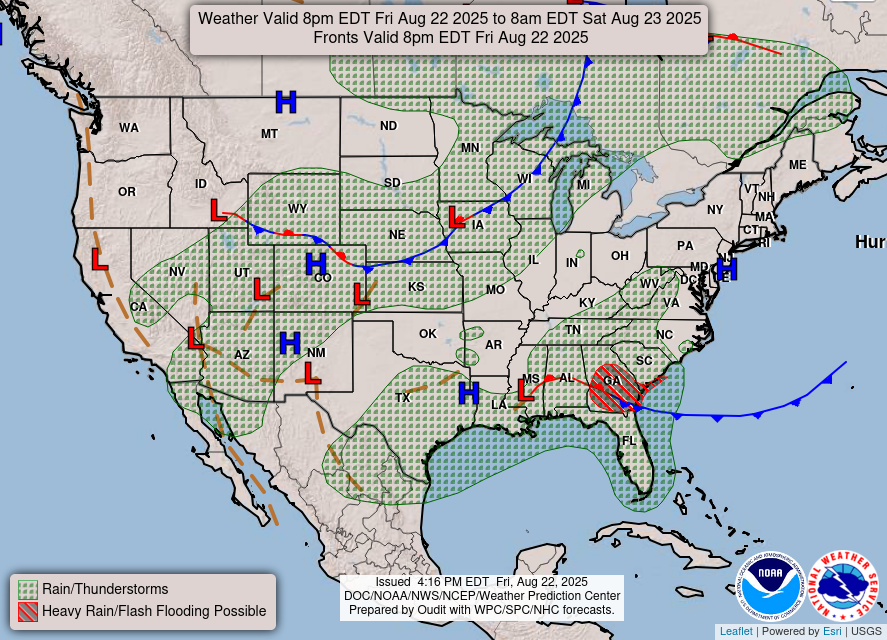
Today’s weather forecast across the nation THIS MAP UPDATES TWICE A DAY
REMEMBER:You do not need to receive an email alert from us to read our newsletters. Just visit our homepage, www.rvtravel.com, at any time of day, and the latest issues and articles will be there.
I was very surprised to find out that the CEO of LCI Industries, known to you and me as Lippert, has announced that he will be retiring. Jason Lippert is stepping down from the company that bears his last name after 32 years in the business. In his place, the Board of Directors has appointed Independent Director Johnny Sirpilla to serve as interim Chief Executive Officer effective immediately.
“We want to thank Jason for his leadership and his deep commitment to LCI Industries over many decades. Under his leadership, LCI Industries grew from a company with $125M in annual revenue to a company with annual revenue in excess of $4B. His contributions have helped shape this great company and will be important drivers of our future growth,” read a statement from the Board.
“It has been the privilege of my career to lead this company and the extraordinary people who make it what it is,” said Jason Lippert. “The Lippert family has been and will continue to be an important part of LCI Industries’ story and a supporter of its continued success. LCI Industries is a stronger business today than when I took the helm, and I am proud of what we have built together. At this important moment in the Company’s journey, this is the right time for this change, and I look forward to working with—and cheering on—our team members and leaders as they take LCI Industries into its next chapter.”
I know that a lot of people might harbor some feelings for the company that wouldn’t make a good Yelp review, but Lippert will build whatever the customer ultimately demands. If you want a gold-plated frame that weighs 10 tons, they’ll build it. But I have often written that more customers demand low price and minimal specifications based on their buying patterns, and any good manager will build what the customer demands.
I went to Lippert headquarters when I did the video about their Chill Cube, and Jason Lippert saw me from his upstairs office and made it a point to come down and share some of the history of the Chill Cube. I have also had him as a guest on my podcast.
I have also seen that Lippert tends to work to empower team members and give them a voice in the processes and procedures. While any big company has issues, I think the policies under Jason Lippert really do create a positive work environment for the most part, which does result in better products.
So, I am sad and surprised to see him go.
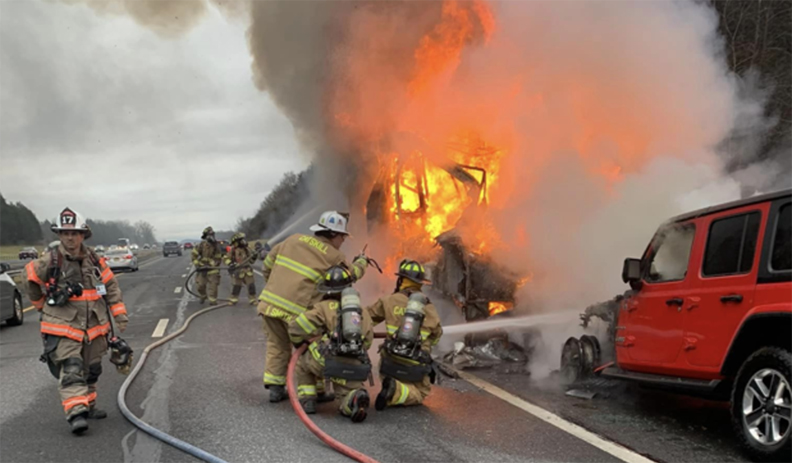
A burning RV quickly becomes a major emergency for firefighters. Federal data shows the most common origin point of an RV fire isn’t the kitchen—it’s the engine, wheel and running-gear area. Photo: Catskill Fire Company
I also reported recently that tire pressure monitoring systems (TPMS) are going to be a standard feature on towables moving forward. I hope these TPMS systems incorporate temperature as well as tire pressure. Again, I stated that one of the big reasons my wife and I chose the brand of RV that we did is that it has a banded tire pressure monitoring system that incorporates temperature readings.
I keep going back to the fact that we have a choice as buyers. The more we show the RV industry that we value quality, safety, and the inclusion of features that will make a difference, the sooner those things will become the norm.
The study revealed that the RV industry has an overall annual economic impact on the U.S. economy of $159 billion, supporting 643,238 jobs, and paying more than $46.4 billion in wages.
The $159 billion total annual RV industry economic impact includes:
$70 billion generated by RV manufacturers and suppliers
$50 billion by RV campgrounds and related travel
$38 billion by RV sales and service activities
In addition to the economic impact, the RV industry pays $19.6 billion in federal, state, and local taxes.
A few RV folks are in Washington, D.C., reminding elected officials of the importance of the RV industry to the overall economy and, you know, twisting arms and kissing babies and all of that.
In a social media post, the RVIA recounted a day in D.C. with:
Passionate RV Industry Association members and partners took to Capitol Hill, holding 142 meetings with federal legislators and decision-makers. Together, we championed the RV sector’s vital economic role and advocated for three key priorities:
Fairness and certainty for American businesses and manufacturers
Protecting consumers: No tax on car loan interest
Reauthorizing the Legacy Restoration Fund to preserve our public lands
To their credit, I will say the RV industry does tend to favor products made in America when there’s a choice. I recently got to tour Airxcel’s Coleman-Mach A/C factory where many of the A/C units that we have are made. It was a rather impressive experience. I love these factory tours, and some, like the Coleman-Mach experience, are rather impressive.
I have also toured a Lippert chassis factory, which I was also impressed by. But, then again, I’ve also been to places that make me understand why you’re having issues with your RV. As always, shop carefully.
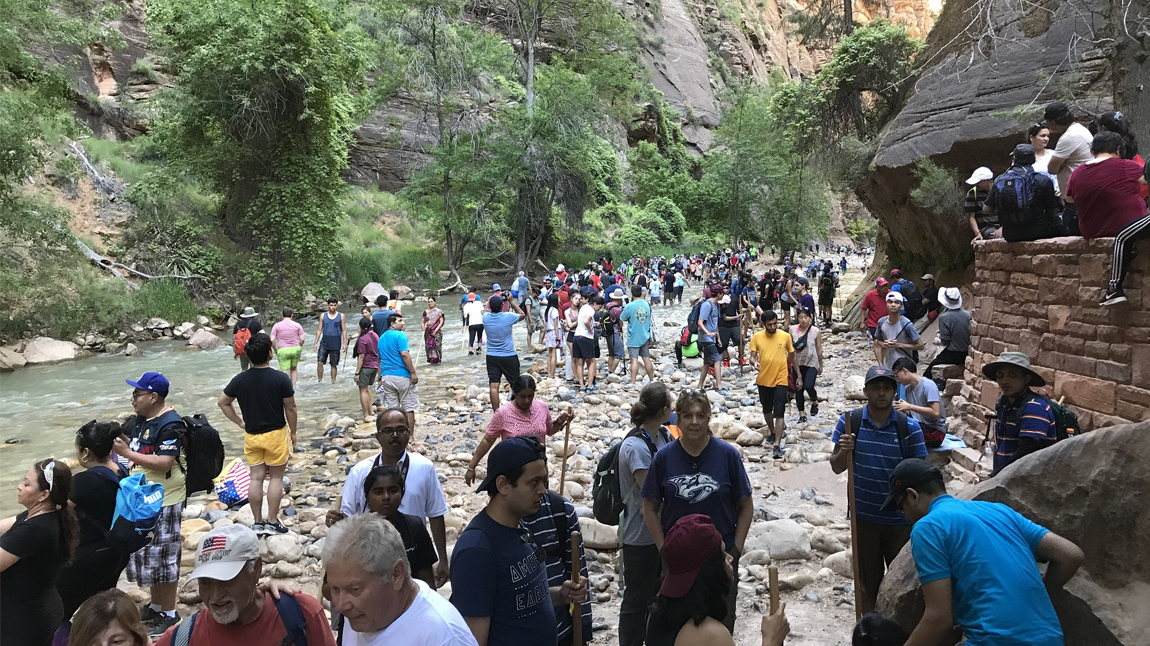
Visitors crowd a popular section of Zion National Park. As spring travel season ramps up, a caution. Some RVers hoping to avoid peak-season congestion are finding that even the traditional “shoulder season” is getting busier. Photo: NPS
Dying to visit national parks
A recent study revealed that the number of deaths in national parks has gone down, with 198 taking their vacation to the great beyond in 2025 compared to 374 during 2021. You know, when COVID shut down much of the services, and people ran wild.
In a study reported on the website OutsideOnline.com, it was shown that most of us are pretty safe from meeting our maker during a fun day in the park. But, if you’re a young man, you’re less likely to be safe.
If you’re surprised by this, I’ll bake you a cake or something.
“Men are more likely to take risks and also make up a higher proportion of those engaged in high-risk activities such as solo backpacking or off-trail climbing, according to Dan Whitten, a search-and-rescue expert. Now retired, Whitten spent 26 years leading search and rescue operations in California’s rugged San Bernardino Mountains.”
There was no telling if many of the deaths happened immediately following someone saying, “Hey, you guys, watch this,” or the ever-popular, “Hold my beer.”
“In my experience coordinating rescue operations, I’ve seen that men seem to inherently think they can do certain things that may traditionally fall into ‘masculine’ roles,” Whitten said. “Some people think that because they’re male, they have some advantage in the wilderness. That’s just not true.”
The NPS sites with the most deaths, in order, are:
Lake Mead National Recreation Area: 11 deaths
Natchez Trace Scenic Byway: 11 deaths
Great Smoky Mountains National Park: nine deaths
Blue Ridge Parkway: nine deaths
Yosemite National Park: nine deaths
2026-06-05 Lippert retires – RVs move America – deaths in NPS
Final thoughts
Apparently a lot of you have been enjoying this weekly look at the news that affects us RVers, so I decided to create a more distinctive hero (top) image for the stories. I do enjoy fiddling around in photo editing software, so this is what I’ve come up with as a theme.
I appreciate all of you and your comments, which I truly look forward to reading. I hope this summer takes you on some great adventures, with the precaution to discourage you from uttering the phrase, “Hold my beer and watch this.” Although that temptation will also be something I’ll work to avoid.
We use cookies to ensure that we give you the best experience on our website. By continuing to use our site, you consent to accepting cookies. We NEVER have or will sell reader's data. For more info, please see our privacy policy page.