Dear Dave,
My RV’s two 6-volt house batteries are dead and I was wondering if I could take the 12-volt battery out of my Jeep that I am going to store for a while and use it instead. Will it have enough power to operate the slides and the hydraulic stabilizers? The battery is only 9 months old and used on my 2002 Jeep Wrangler 4.0 TJ. Thanks. —Harry, 35-ft. 2000 Fleetwood Pace Arrow MH
Dear Harry,
Technically, yes, you can use the automotive 12-volt battery in your RV’s house system to replace the dead 6-volt batteries as they were connected in series, positive to negative, to create a 12-volt battery “bank.” However, your current batteries are “deep cycle,” meaning they are designed to be drawn down to 50% state of charge (SOC) and recharged repeatedly, which is the deep cycle.
Current batteries
The current batteries are designed to provide constant voltage for a long period of time, sometimes days, and are rated in amp hours (Ah) for how long they can provide 25 amps of power. Fleetwood has always been a fan of the 6-volt batteries and used them for years as they typically have more Ah ratings and provide more cycles. Since your rig is a 2000, I would assume your batteries are not original.
6-volt batteries
Automotive batteries
Automotive batteries are rating in cold cranking amps (CCA) and designed to provide a high amp power for 30 seconds to turn over an engine for starting purposes. They are not designed to provide power for a long period of time and do not liked to be drained and recharged or “cycled.” They will go dead fairly quickly if used in this application.
However, it depends on how you will be using your rig, meaning dry camping or being plugged into shoreline power. If you are dry camping and need to drain the battery and periodically recharge it, the automotive battery will not last long. However, if you are going to be plugged into shoreline power, the converter/charger of your rig will provide voltage to the battery and ultimately to the 12-volt system, depending on the type of charger you have.
If it is a typical converter/charger, it will provide a constant 13.2 volts, which will power everything and not do much damage to the automotive battery. If you have a converter that is designed to condition or desulfate the battery, like the older Progressive Dynamics models, it might provide a higher voltage charge in the range of 13.8 volts for eight hours. That might not be good for your automotive battery. If you have an inverter/charger like the green Freedom 2000 in the above photo, it could have a multi-stage charge that is also not a good charging profile.
Also, if you are going to be plugged in most of the time, you can leave the dead 6-volt batteries in the system and have the converter/charger provide constant power. However, it will sense the low SOC and run at a higher voltage—which could eventually ruin the converter.
Variables to consider
There are several variables to consider. I think either way you will need a new battery somewhere in the equation. If you use the automotive battery, most likely you will need a new one when you bring the Jeep out of storage. Or you buy a new 12-volt deep cycle battery for the rig up front and size it to the Ah you need for dry camping.
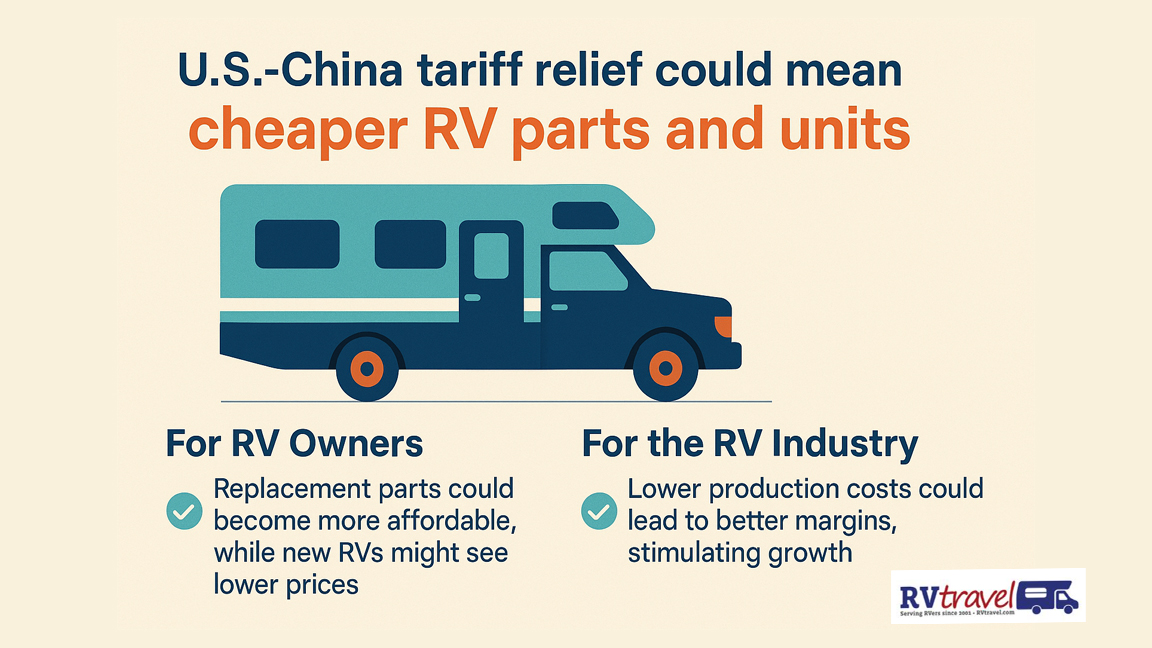
The U.S. and China announced a deal on May 12 to ease tensions in their ongoing trade war. Both countries will roll back most of their recent tariffs and enter a 90-day truce to allow more talks. RVers have had concerns about how tariffs might affect them. What might this China tariff truce mean for RVers, and the RV industry? Here’s a brief look at possible RV relief and what the news has meant for America today.
China tariff truce—Could be good for RV owners
RV owners needing replacement parts (especially electronics, appliances, or fixtures often made or sourced from China) may see slightly lower prices or better availability at service centers.
Looking to buy solar panels, generators, or tech upgrades? Many of these are imported, and the China tariff truce could see a decrease in price, encouraging upgrades or customization.
U.S. retailers for RV parts and accessories have been concerned how the tariff trade war could affect supply chains. Access to a broader range of imported accessories and parts may boost choices for RV owners looking to maintain or modify their vehicles. The COVID-19 era supply chain issues may not foreshadow RV parts accessibility.
RV industry may benefit from China tariff truce
Many RV components—like electronics, steel, aluminum, and textiles—are sourced from or include materials from China. A reduction in tariffs could lower costs for manufacturers, potentially improving profit margins or slowing price increases on new units.
As for individual RVers, supply chain stability is good for manufacturers. Eased trade tensions may reduce delays or shortages in parts and materials, helping RV manufacturers maintain production schedules and inventory levels more efficiently.
Tariff relief could spell more competitive pricing, as well. If tariff reductions lower input costs, manufacturers might pass on some savings to consumers, making new RVs slightly more affordable. This could be especially helpful in a market currently struggling with sales declines.
So, how did the news affect the country?
Markets reacted quickly to the news. U.S. stock futures rose more than 2%, oil prices climbed, and global markets followed with gains. Economists called it a major step toward avoiding further damage to the global economy. A rise in oil prices may not be what RVers want to hear.
U.S. Trade Representative Jamieson Greer said the U.S. will cut its tariffs on Chinese goods from 145% to 30%, and China will reduce its tariffs on U.S. goods to 10%. China’s Commerce Ministry confirmed that 91% of tariffs will be canceled, with another 24% paused for the 90-day period.
Related relief, too—But caution remains
China also agreed to suspend some of the countermeasures it had put in place, including restrictions on U.S. companies and export controls on rare earth minerals used in high-tech and defense industries.
Still, experts warned that the 90-day truce offers no guarantee of a permanent solution. Businesses and trade groups urged both sides to keep negotiating and avoid more disruptions.
The U.S.-China trade war has had global consequences, as tariffs between the two largest economies affected over $660 billion in trade. The Trump administration has defended its tariffs, including a 20% tax on Chinese goods tied to concerns over fentanyl trafficking.
While investors welcomed the China tariff truce as a sign of progress, many remain cautious about what happens next.
If lower fuel costs lure you into a Memorial Day weekend RV trip, look out! Lots of other folks have the same thought. AAA says the next big holiday weekend will be a record breaker. Memorial Day weekend traffic may be something that will be hard to forget.
1.4 million more travelers in Memorial Day weekend traffic
In a news release, AAA projects 45.1 million people will travel at least 50 miles from home over the Memorial Day holiday period from Thursday, May 22, to Monday, May 26. This year’s domestic travel forecast is an increase of 1.4 million travelers compared to last year and sets a new Memorial Day weekend record. The previous record was set back in 2005 with 44 million people. Despite concerns over rising prices, many Americans say they’re taking advantage of the long holiday weekend to spend time with loved ones, even if the trips are closer to home.
“Memorial Day weekend getaways don’t have to be extravagant and costly,” said Stacey Barber, Vice President of AAA Travel. “While some travelers embark on dream vacations and fly hundreds of miles across the country, many families just pack up the car and drive to the beach or take a road trip to visit friends. Long holiday weekends are ideal for travel because many people have an extra day off work and students are off from school.”
Crowded roadways
AAA projects 39.4 million people will travel by car over Memorial Day weekend. That’s an additional one million travelers compared to last year. Driving is the preferred mode of transportation during holiday travel periods, with 87% of Memorial Day travelers choosing to take road trips.
This year, drivers have the benefit of cheaper gas prices. Last Memorial Day, the national average for a gallon of regular was $3.59. This spring—thanks to lower crude oil prices—gasoline prices haven’t seen typical seasonal spikes. With the unofficial start of summer kicking off the busy driving season, demand is expected to rise, and pump prices may creep up along with it. Gas prices typically peak in the summer and start coming down when schools go back in session in the fall.
Prices down at pump, but more ways to save
Even with gas prices lower than last Memorial Day weekend, drivers are looking to save at the pump.
Start by peeking at current prices on the AAA fuel site and use the AAA gas cost calculator to get an idea of how much your road trip will cost.
Once you hit the road, keep in mind the gas stations right off the interstate are usually the most expensive. If you’re looking to save money, drive a little bit farther down the road for cheaper gas. AAA members receive stackable discounts on gas through the Fuel Rewards® program at participating Shell stations.
After you fill up, avoid speeding. Fuel economy peaks around 50 mph on most cars, then drops off as speeds increase. Reducing highway speeds by 5 to 10 mph can increase fuel economy by as much as 14%.
Memorial Day weekend traffic—When?
The Memorial Day holiday travel period is defined as the five-day period from Thursday, May 22, to Monday, May 26. The five-day holiday length is consistent with previous holiday periods dating back to 2000.
Bob Dylan famously sang, “I ain’t sayin’ you treated me unkind. You could have done better but I don’t mind. You just kinda wasted my precious time. But don’t think twice, it’s all right.” RV dealers may be hearing those lyrics as their lots fill up, but the buyers are staying away. RV sales plunged across the board.
America’s once-roaring love affair with RVs is clearly cooling. New data from Statistical Surveys Inc. shows that retail registrations in March 2025 fell more than 13% from the previous year, continuing a steady decline that began in 2023. Despite the drop in demand, manufacturers are still pumping out units, raising questions about oversupply in a shrinking market.
RV sales plunged—down 13% in March
There were 28,997 retail registrations in the third month of this year, which is 4,427 fewer units—a 13.2% decrease—versus the 33,424 for the same period in 2024. For comparison, the RV Industry Association (RVIA) reported that there were 37,348 RV shipments in March 2025. Put another way, RV dealers sold 25% fewer rigs in March than they bought from manufacturers. Maybe dealers know something that we don’t know—or they could be heading for serious trouble.
For the first quarter of 2025 there have been 70,406 retail registrations, an 8.7% decrease compared to the 77,136 registrations for the same period last year. For comparison, there were 97,848 wholesale shipments in the first three months of 2025. Over the quarter, that means dealers bought more than a third more rigs than they sold. How did these figures break out across the various kinds of rigs?
RV sales plunged among towables
• Travel trailers – 18,655 retail registrations in March 2025 (versus 21,063 in March 2024; an 11.4% year-over-year decrease). Market share leaders: Forest River Inc. (40.8%), THOR Industries Inc. (39.7%), Grand Design RV Co. (7.2%).
• Fifth wheels – 4,566 (5,439; -16.1%). Market share leaders: THOR (37.4%), Forest River (28.0%), Grand Design (16.3%).
• Camping trailers – 300 (472; -36.4%). Market share leaders: Forest River (55.7%), Aliner (24.0%), Purple Line LLC (7.0%).
• Park models – 198 (228; -13.2%). Market share leaders: Champion Homes (25.3%), Cavco Industries (23.7%), Platinum Cottages (11.6%).
Motorhomes—The wheels fall off sales
• Class A – 608 (761; -20.1%). Market share leaders: THOR (46.1%), Forest River (21.9%), Newmar Corp. (14%).
• Class C – 1,564 (1,956; -20%). Market share leaders: THOR (54.3%), Forest River (22.7%), Winnebago Motorized (8.9%).
• Class B – 668 (883; -24.3%). Market share leaders: THOR (41.3%), Winnebago Motorized (25.4%), Forest River (10.9%).
Perhaps the only “light at the end of the tunnel” is the decrease in interest rates that reduce dealers’ flooring costs—at least compared to rates in 2024. Or that light might actually be an oncoming train.
Here’s what’s new at KOA for the 2025 season: four exciting additions—two entirely new campground builds, one rebranded gem, and an existing site refreshed under new ownership.
From the Black Hills of South Dakota to the shores of Lake Ontario, these campgrounds bring KOA’s signature comforts to regions both iconic and off-the-beaten-path.
Hill City/Needles Highway KOA Holiday (South Dakota)
Just minutes from Mount Rushmore and Crazy Horse Memorial is the brand-new Hill City/Needles Highway KOA Holiday. This campground is KOA franchisee Walt Hodgson’s second park in the region. The new camp opened May 1, 2025.
Nestled along the famous Needles Highway, every full-hookup RV site features a private KOA Patio®. Deluxe cabins and premium tent sites promise comfort for non-RVers under soaring pines. Explore Custer State Park by day, then unwind by the pool or around the community fire ring by evening—KOA-style hospitality at its best.
In Mount Pleasant, Utah, real-estate investor Brent Crosby has taken the helm of the Manti-La Sal KOA Holiday. He hopes to bring fresh energy to the park and has a personal stake in this location because it’s the area where his grandmother grew up.
Located at the gateway to the Arapeen Trail System and Manti-La Sal National Forest, this existing KOA campground offers year-round stays in RV sites, cabins and tent sites amid 350+ miles of ATV/UTV trails. With new management comes renewed focus on community events, upgraded bathhouses and expanded family activities.
This brand-new riverside retreat is just 12 miles from Zion’s entrance in Virgin, Utah. Zion National Park KOA Holiday is KOA’s first ground-up build in the canyon country. Owners Noah and Sydni Ferber have more than 50 years of family RV experience.
The Ferber family is excited to share the new KOA’s extra-wide 35-foot RV sites, deluxe cabins, and tent areas along the Virgin River. They hope to provide a perfect place for couples, families, and solo explorers. Hike, kayak or star-gaze by campfire, then recharge in KOA’s new pool, bathhouse and dog park.
Formerly Sterling Creek Campground, this family-owned site reopened May 9 for service through Oct 13, 2025. The campground is now known as Sterling/Lake Ontario KOA Holiday and has been renovated by Sherstin Lauman and April Lewis.
Only minutes from Fair Haven and Lake Ontario’s shoreline, the rebranded park blends local charm with KOA amenities—KOA Patios®, deluxe cabins, pirate-ship playground and themed weekend fun. Future plans include lakeside walking trails, expanded cabin offerings and more family-friendly events.
These park additions matter to RVers like you and me. Here’s why:
• Diverse landscapes: From desert red rocks to forested peaks and Great Lakes shores, KOA’s 2025 openings cover the full spectrum of American terrain.
• Modern amenities: Expanded RV sites with patios, deluxe cabins with full baths, dog-friendly KampK9 areas, pools and upgraded bathhouses ensure comfort at every stop.
• Local immersion: Each campground partners with its community—whether it’s Hill City’s historic train rides, Manti-La Sal’s ATV trails, Zion’s slot canyons or New York’s wine trails.
Pack your gear and mark your calendar—these four new KOA destinations are ready to make your 2025 RV travels unforgettable.
“Others have seen what is and asked why. I have seen what could be and asked why not. ” ―Pablo Picasso
Need an excuse to celebrate? Today is National Odometer Day! How exciting! 🙄
On this day in history: 1941 – Konrad Zuse presents the Z3, the world’s first working programmable, fully automatic computer, in Berlin.
Tip of the day What the letters and numbers mean in RV model designations
By Tony Barthel
What do RV model designations mean? What exactly is a 1905S, 212RBE or a 22MLSWE? Or take the Flagstaff Micro Lite 25DK, for example. What does DK mean, and is it 25 feet long? Do these numbers have any meaning or are they completely nonsense? We have the answers.
Here is a guide to some of the more commonly used abbreviations in RV model designations. Know that RV companies may not be consistent about these designations. Sometimes an RV will have a feature and not have that noted in the model description. If you’re confused, well, me too. Read on.
Ask Dave RV furnace lights on second attempt with flames shooting out exhaust
Dear Dave,
I am having problems with my Suburban furnace. Just before we closed our travel trailer up for winter storage, it started igniting late. In other words, it would start the fan, click to ignite, but not ignite. It would then try again and ignite with a boom and flame shooting out the exhaust outside of the trailer…. Read the rest of Tom’s question and Dave’s advice.
In the RV shop with Dustin How to keep hydraulic leveling jacks and slide-outs working
Here is general information about why it’s important to maintain your hydraulic leveling jacks. If you have hydraulic leveling jacks or a slide-out system, you want to periodically check the hydraulic fluid level in your reservoir. Here’s why.
Article and video Three of the best, most versatile RV care products and how to use them
By Cheri Sicard
Want to keep your RV looking its best for years to come? It’s possible without spending a fortune on dozens of different products. Our host from RV with Tito DIY has learned what works and what doesn’t. In this article and video, he shares the top three essential RV care products that have stood the test of time.
By Gail Marsh
A few nights ago at our Florida campground, folks around the campfire shared some of their most recent “beefs” or annoyances they’ve experienced. I’m not talking about barbeque here. These beefs were complaints that I had not heard before. While they may not be new to you, when these RVers shared these new beefs, I was genuinely surprised!
Rust and/or corrosion affecting parts of your RV? This will help!
CorrosionX stops rust and corrosion with a unique coating that sticks to metal like a magnet to resist displacement by friction or pressure and lubricates under extreme loads and high temperatures—perfect for RVs. It penetrates faster and further to break free rusted nuts, bolts and fittings within minutes, and it’s safe on electronics and won’t interfere with circuits. Learn more or order.
Reader poll If you suddenly became filthy rich, would you buy a new high-end RV?
Gray water tanks that accept water from the sink and shower need little maintenance but will occasionally need a deodorizer (use the same one you use for the black water tank). Enzyme waste digesters can be used for the gray tank and have the added benefit of keeping the p-traps clear under the sink and shower. —From Trailers & Fifth Wheels Made Easy
Website of the day
Certified Dark-Sky Parks
This list of certified dark-sky parks is brought to you by the National Parks Conservation Association. (Lots of other great stuff on this site too!) Happy stargazing!
? MYSTERY PRODUCT OF THE DAY ? Oh, come on! It’s ONLY six pounds… That won’t put your rig overweight, will it? And, hey, if it does and you get stranded, well, you definitely won’t go hungry!!
Trivia
The popular TV show “American Idol” is considered responsible for teaching Americans how to text message. When the show first aired in 2002, “American Idol” featured audience participation by call-in voting. If they wanted to vote for a contestant to win, they’d call the “American Idol” phone number and input that contestant’s individual number code. In the second season of the show, they introduced text message voting, provided you had AT&T (a sponsor) cell service, that is. “American Idol” was largely responsible for getting Americans to learn how to text back then in 2003, with more than 7.5 million text messages sent in to the show in just two seasons alone.
Readers’ pets of the day
“Rocco (4 months) is a Neapolitan Mastiff, and Shelby (3 years) is an English Mastiff. This was Rocco’s first RV trip, and he did great! They both love the recliners and enjoy adventuring together!” —Apryll Groelinger
Send us a photo of your pet with a short description. No blurry photos and please do not submit your photo more than once. Thanks!
If you shop at Amazon.com we’d appreciate you using this link. We get an itty bitty commission if you buy something, but they add up and help us pay our bills (most importantly our hard-working writers!).
Dear Dave,
I am having problems with my Suburban furnace. Just before we closed our travel trailer up for winter storage, it started igniting late. In other words, it would start the fan, click to ignite, but not ignite. It would then try again and ignite with a boom and flame shooting out the exhaust outside of the trailer.
I have not tried anything yet and do not want to try starting it again until I determine the cause. I am an autobody technician and have some aptitude with tools that may be needed.
Any light you can shed on common issues or causes and solutions would be greatly appreciated. —Tom, 2007 Springdale 252RL with a Suburban furnace
Dear Tom,
If you have flames shooting out the exhaust, I recommend you take it to a certified technician immediately.
However, if this occurs while you are dry camping, try plugging the unit into a 120-volt source and try it again. When you are plugged in, the converter/charger will provide a constant 13.2 volts. If it works, your house batteries are getting weak.
Furnace burner
How the furnace works
When the thermostat is set to a desired temperature, it creates a closed circuit sending 12-volt power to the module board when it calls for heat. The module board then starts the fan to move air from the outside vent through the combustion chamber, purging it out the exhaust port. This is designed to last for 15 seconds.
It also draws in ambient interior air through the cold air return passing over the burner assembly and past the sail switch, which rises with the appropriate air flow. This sends 12-volt power to the module board, indicating proper air flow. If the sail switch does not raise due to low airflow after 30 seconds, the control module will go into shutdown mode and turn the blower off.
If the sail switch raises and creates a closed circuit, the gas valve opens and the electronic ignition sparks at the ignitor, or piezo, attempting to light for 7 seconds. The module board will verify flame through the spark wire and electrode, so it is essential it is positioned properly. If a flame is not sensed within 7 seconds, a 15-second purge cycle will begin followed by a second try for flame. After three attempts, the module will go into shutdown mode and the blower will run for another 3 minutes.
Possible causes of non-ignition
So, if it does not light on the first or second attempt, it could be obstruction in the combustion air intake or restriction in the burner assembly. It could also be the electrode probe is greater than 1/8” from the top of the burner. That would mean the spark is not getting to the burner at full strength. In that case, a buildup of LP could happen, causing the burst you are experiencing. All these require removing the burner chamber, access door and manifold—which should be done by a qualified technician.
By Tony Barthel
What do RV model designations mean? What exactly is a 1905S, 212RBE or a 22MLSWE? Or take the Flagstaff Micro Lite 25DK, for example. What does DK mean, and is it 25 feet long? Do these numbers have any meaning or are they completely nonsense? We have the answers.
The model numbers used by RV companies have no standards and there is no universally translatable measure to carry from one brand to the next. In fact, there are sister brands with almost completely different designations for exactly the same RV.
And, there are RVs that have the same model designation but are built in different plants and have rather different features, equipment, or dimensions. But let’s start with the numbers.
What do the numbers mean?
Starting with the numbers, you can see almost every RV has a numerical designation. Unfortunately, there is no standard for this.
Sometimes this number is just a model number. For example, the r•pod 201 and 202 are the exact same length, but one has no slide room and a very different layout from the other, which does have a slide. Further, both of these trailers are 25 feet in length.
Even more confusing, the Flagstaff Micro Lite 22TBS and the Rockwood Mini Lite 2204S are the exact same trailer, but one is branded a Flagstaff and the other is sold by Rockwood dealers. The only differences are the model numbers and the stickers. Period.
While the numbers in the model designation don’t specifically spell out the length of the RV, you can sort of guess the length of the RV by using the model numbers.
For example, the aforementioned r•pods are about 20 feet in length for the body. The Rockwood is about 22 feet in length for the body. Then, on all travel trailers, you have to add the tongue.
And some are reflective of a dimension but it can be the interior length of the body or the exterior length. Again, no standards. And no guarantees that the number has any relevance to the overall size of what you’re getting.
Here’s a bit more proof of that: Grand Design’s Reflection line of fifth wheels has both the 31MB and the 311BS, and both are within just a few inches over 36 feet long.
No matter which brand you look at you’ll find this: The model number is more a very loose guess as to the overall length and also simply that—a model number.
What about the letters?
The letters that follow the numbers actually do have some meaning. But this, too, is not consistent from brand to brand. And there is almost no standard.
Almost.
There are a couple of letters almost everybody uses and those are BH. In almost every case where an RV features bunks they have the letters “BH” somewhere in the model designation for “bunkhouse”. This is probably the closest thing you can get to a standard.
But there is a bit of logic in the letters, too
There is some logic in the letters. For example, Keystone’s Bullet 212RBSWE features a Rear Bath (RB), has a slide (S) and is the Western Edition (WE). Not as in cowboys and such. But Keystone, like many other manufacturers, has plants in Indiana as well as on the West Coast. In the case of Keystone, their plant in Pendleton, Oregon, will earn the RV the WE designation.
In fact, they offer both the 212RBS and 212RBSWE. The reason for this is that the West Coast is a huge RV market and it just makes sense to have an assembly line out West. This significantly reduces shipping costs, which can be thousands of dollars, especially as shipping costs rise.
Of course, shipping costs for RV parts also factor in. So the equation and the Western Editions are sometimes more money than the non-WE models. But then, sometimes they’re less expensive.
Since a lot of what we buy nowadays is made in China [when this was written], and Chinese goods are shipped to the West Coast, it would seem that Western editions would be cheaper. But they’re often not. What happens is that parts are shipped to Indiana and then back out to the West Coast. I’m not in charge of the logistics, but it’s how things are done.
No, it doesn’t make sense to me either. And it adds to the costs a lot of West Coast buyers are paying.
The Keystone Passport 219BH travel trailer—a Swiss army knife indeed.
Glossary of RV model numbers
Still, here is a guide to some of the more commonly used abbreviations in RV model designations. Know that RV companies may not be consistent about these designations. Sometimes an RV will have a feature and not have that noted in the model description. If you’re confused, you’re probably getting the gist of this. It almost has no rhyme or reason.
BH or B – Bunkhouse
Bunkhouses refer to RVs that have a set of bunk beds. These RVs are typically designed to sleep a larger number of people with bunks or other sleeping arrangements that can accommodate them.
CK – Central Kitchen
Used for RV floor plans with a kitchen in the middle of the RV, usually open to the living area.
DS – Dual Suite
These larger RVs have two bedrooms, often with their own bathrooms.
FK – Front Kitchen
Front kitchen travel trailers and fifth wheels have kitchens in the front of the RV. These floor plans generally have a mid-living room and a rear bedroom.
FL – Front Living
FL refers to a front living room RV. In fifth wheels the kitchen it typically in the center of the RV with the living room over the king pin.
K or KB – King Bed
Simply indicates the RV contains a king bed. Some RV models, like Keystone’s Cougar, all have king beds, so the use of this designation is usually for brands where this is not a common feature.
K – Kitchen
K can also be used as standard for kitchen in some unique RV models. For example, Keystone Avalanche has a “GK” model, which stands for grand kitchen.
Other models use “OK” to indicate that the RV has an outdoor kitchen.
LT – Loft
Models labeled as LT have a sleeping loft in the RV.
MB – Mid-Bunk
A mid-bunk RV floorplan has a bunkroom in the center of the RV between the living area and the main bedroom.
MD – Mid-Den
Mid-den floorplans generally have a separate room in the middle of the RV. This den often has fold-down or pull-out beds, so it can double as a kid’s bedroom.
ML – Mid-Living
Mid-living floorplans have the living area in the center of the RV.
O – Office
In newer RV models, an O may stand for office. For example, the Keystone Montana 3941FO has a front office. However, the Keystone Outback 296URK does, as well, but there’s no “O” in that.
RB – Rear Bath
Indicates that there is a bathroom in the back of the RV.
RK – Rear Kitchen
Just like it sounds, rear-kitchen RVs are layouts with the kitchen in the back.
RL – Rear Living – may also have RD (Rear Den) or RE (Rear Entertainment) designation
The main living space is at the back of the RV.
RS – Rear Sofa
There’s a sofa in the back which may be part of a larger rear living space.
S – Slide Room
An “S” added to the end of a model number usually indicates that the RV has a slide room, although very few RVs don’t have slides lately.
TB – Twin Bed
Some RVs have the choice of a single queen-sized bed or a twin bed with the TB indicating the Twin Bed choice.
Q or QB – Queen Bed
This simply indicates the RV contains a queen bed. FQ usually stands for Front Queen while RQ stands for Rear Queen.
WE – Western Edition
Many RV companies have a Western production line (typically in Oregon) with the WE indicating that the model was produced on the West Coast. Sometimes these are identical to the Indiana-produced models; other times there can be differences.
In summary
Decoding the model numbers of RVs is sort of like the weather. While you can use all the science you want, sometimes it just doesn’t make any sense whatsoever. Other times it’s sort of close and, on rare occasions, the numbers make perfect sense.
So, you can use the numbers and letters to get some idea of what RV you’re dealing with, but the names make as much sense as calling a car a Cougar or a Clipper. What’s in a name? Only a good time, essentially.
“‘This is motherhood for you,’ said my own mother. ‘Going through life with your heart outside your body.'”—Jennifer Weiner
The future of the RV industry: Bracing for what’s to come
By Cheri Sicard
The RV industry is experiencing significant shifts, from Heartland RV’s production shutdown to rising uncertainty over tariffs and pricing. Josh the RV Nerd from Bish’s RV breaks down these changes, including how RV brands may merge and streamline production, and the potential impact on jobs and product options. With prices expected to rise and the industry facing tougher times ahead, Josh’s latest update offers a crucial look at what RVers can expect in the near future. Here are all the details on these developments.
Burned by the plug: A wake-up call on shore power safety
By Russ & Tiña De Maris
A conscientious RVer had a scary situation. His 30-amp RV was plugged into a 30-amp-rated outlet. The pedestal circuit breaker never tripped but, suddenly, his son reported the shore power plug was smoking! Not only was it smoking, but the plug was in a meltdown crisis! What happened to this RVing family has happened to other RVers. So what gives?
How to make sure thieves won’t steal your RV
By Gail Marsh
Occasionally, in our Saturday newsletter, we list stolen RVs (and only the ones we’re made aware of—we’re sure there are dozens, maybe hundreds, more). We’re hopeful that someone out there will spot a missing rig and call the authorities. A reader reached out and asked us to offer some tips about securing our RVs so that our rigs won’t end up on the “Stolen RV” column. So, let’s take a look…
UPDATE: Changes coming to our commenting system
We’re making some upgrades to how comments work on RVtravel.com. Starting this evening, Sunday, May 11, we’ll be switching to a new commenting system that’s faster, smarter, and more enjoyable to use. Our current software just isn’t cutting it anymore, so it’s time for a fresh start. The new system will include everything you already like, plus some great new features we think you’ll enjoy. Learn more.
Today’s RV review is of the Flagstaff E-Pro E19DBH. I looked into this RV because so many of you have asked about no-slide, high-quality travel trailers. Well, here is an example of one. When Flagstaff introduced the E-Pro line, what they did is simply make a small camper that was built to the standards of their larger campers. Continue reading.
A letter about my mother, Ruthie, on Mother’s Day
By Chuck Woodbury
I lost my mother 17 years ago, on July 5, 2008. It seems like yesterday. I think of her nearly every day. I miss her terribly. She was a happy, happy person. That was her nature. I tell the story sometimes about driving her from Northern California after my father died to live with me in Seattle. Continue reading.
Secure what’s on those corner shower shelves!
Don’t worry about moving your soap, shampoo or conditioner next time you drive down the road. Instead, easily install one of these stainless steel corner storage bars and keep everything in place—nothing will fall out ever again! These bars come in a one- or two-pack and can be adjusted to fit any shelf. They’re specifically made for RVs, which makes them even better! Learn more about them here or order them here.
RANDOM RV THOUGHT:It’s a good idea to carry an extra length of water hose and a heavy-duty extension cord for those rare instances when hookups may be too far to reach otherwise. A 30- or 50-amp-rated cord is normally best.
Letter to the Editor: How RV salesmen will charge you double the price for an RV
For one reader, Stacey H., buying an RV turned into a frustrating encounter with high-pressure sales tactics and sticker shock. After years of enjoying their 2006 Coachmen Freelander, she and her husband began casually shopping for a smaller travel trailer that would better suit their camping needs. Armed with research and a clear floor plan in mind, they visited a few dealerships expecting straightforward pricing and honest conversations. But that is NOT what they got.
Help the National Park Service by volunteering your time
By Gail Marsh
If you love exploring our national parks, you’ve undoubtedly heard about funding pauses and hiring freezes. These issues are raising major concerns about park maintenance and visitor services. A reader recently contacted me to say, “Something HAS to be done about the growing national debt. It’s only when the cuts directly affect YOU that folks complain! We’re all in this together.” Continue reading and see what you can do to help.
Why Mother’s Day founder later regretted doing it
By Gail Marsh
It’s a day dedicated to moms everywhere. Cards. Flowers. Candy. Family time. What’s not to like? Why did Anna Jarvis, the founder of modern-day Mother’s Day, grow to despise the holiday that she helped create? It certainly didn’t start out that way. Learn more.
What’s on your bucket list?
Even if you don’t have an official bucket list, there are probably at least a few things you’d really like to do, see, or accomplish in your lifetime, right? Maybe you’ve always wanted to visit Antarctica or hike the Pacific Crest Trail. Maybe there’s a campground you’ve always dreamed of staying at. Maybe you’d like to visit every National Park in America… You get the point. Tell us what’s on your bucket list here. We can’t wait to see what you say.
Reader poll Would you say you “visited a state” if you simply drove through it without stopping, or with minimal stopping?
By Dave Helgeson
Do you camp often in public campgrounds? Do you find the maximum length restrictions listed in campground directories unreliable? Do you wish there was a way to visit the campground to determine the length and width of the campsite before you drive the RV there? Well, there is a way!
Amazing Google Earth feature allows you to accurately measure campsites, parking spaces, more
Above, Dave explained an easy way to use Google Earth to measure a campsite before arriving—making sure your RV, car, toys, etc., will fit. Well, here’s an updated tip from reader Terry K., who wrote in with an additional tip that measures anything for your RV using Google Earth. Check it out.
Using Google Maps’ little-known features
By Gail Marsh
For RVers, Google Maps isn’t just about directions—it’s a toolkit that can help you plan routes, discover new pit stops, and even visualize campgrounds before you arrive. Here are some little-known features to enhance your road trips.
How to choose a cool campsite in the hot summer
By Nanci Dixon
If you think there’s no way to get cool in hot weather, think again. I’ll show you a quick, easy way to make sure your RV stays cool at the next campsite using Google Earth. Here’s how.
How to win We’ll select a winner at random out of all entries we receive today by 7 p.m. Pacific time. You can only enter once and after we notify you by email that you won, you have 24 hours to respond.
Travel destinations Take an RV mini trip to Seligman, Arizona, for the best of Route 66
By Nanci Dixon
A couple of weeks ago, we took an RV mini vacation to Seligman, Arizona, the longest remaining stretch of Route 66. Although it is sometimes heralded as the “birthplace of historic Route 66,” it is really one of the longest intact stretches of the original Route 66. The main street has old-time cafes, motels, and an abundance of gift shops. Continue reading.
?? MYSTERY PRODUCT OF THE DAY ?? If you had this you’d wake up to your partner making you bacon every morning! Now doesn’t that smell, er, sound nice?
Highlights from this week’s RV Daily Tips Newsletter
YOU DO KNOW… that you’d be a much smarter RVer if you signed up for our RV Daily Tips newsletter, right? On average, our readers report they’ve quadrupled their knowledge about RVs and RVing after reading it for just two weeks! Okay, we made that up, but we’re pretty sure it’s true! Sign up here.
In the RV shop with Dustin Concerns during RV LP safety inspection, and best LP safety gadget
Join me as I discuss some concerns I have during an RV LP safety inspection. In it, we are looking at a 2021 Alliance fifth wheel, and what I found and what I would do differently. Plus, I’ll share the best LP safety gadget you should have. Click here.
RV tire safety 877,000 vehicles recalled. Why? And why you need to have tires’ full DOT serial number
By Roger Marble I saw mention of an 877,000 truck recall recently and the follow-up question of how could that happen? While this post is not about that vehicle recall, I can relate to having a large number of items being recalled. That is based on my personal experience when I initiated a recall of some 8,000 tires after my inspection of two tires. Just because there were 877,000 vehicles recalled does not mean there were that many vehicles made with some defect. Now, “the rest of the story.”
Must have: Affordable, simple solution for low voltage protection
Klein Tool’s RT250 is an electrical receptacle tester that tests the wiring conditions at an electrical outlet. Its LCD displays the voltage and identifies wiring faults. You could use an adapter to “step down” from the 30-amp outlet (or maybe two to come down from 50-amp outlets), testing the circuit before you plug in your shore power cord. Continue reading and make sure you have one of these!
GOOD NEWS: In addition to today being Mother’s Day, it’s also National Eat What You Want Day!
Readers’ pet of the day
“My Basenji, Mandi, would often climb higher for a better view. It was her idea to climb this downed dead tree in Yellowstone National Park, Wyoming, for a better view of her surroundings. She loved to travel, and we logged 120,000 miles together in her little van motorhome, with me as the chauffeur! She crossed the Rainbow Bridge in 2021 and I miss her dearly!” —Sylvia Jordan
Want to see your pet in this newsletter? Please send us a photo of your pet with a short description. No blurry photos and please do not submit your photo more than once.
Trivia
After just two weeks of wear, a pair of jeans will have grown a 1,000-strong colony of bacteria on the front of them, about 1,500–2,000 on the back, and 10,000 on the crotch. If that doesn’t send you straight to the laundry room…
Sunday funny
A poodle and a collie are walking down the street when the poodle suddenly unloads on his friend. “My life is a mess,” he says. “My owner is mean, my girlfriend’s having an affair with a German shepherd, and I’m as nervous as a cat.” “Why don’t you go see a psychiatrist,” suggests the collie. “I can’t,” says the poodle. “I’m not allowed on the couch.”
FINISHED READING THIS NEWSLETTER?
Move on to the next best thing: Our Great RV Accessories Newsletter! A brand-new issue was just published. Read it here.
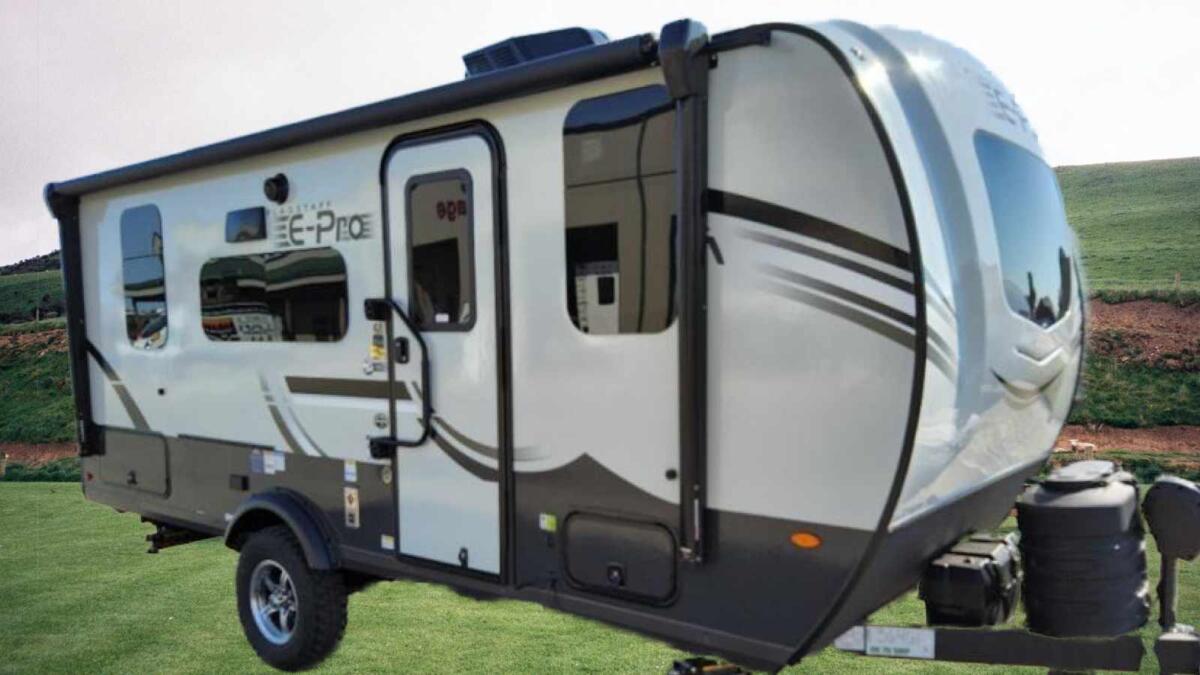
Today’s RV review is of the Flagstaff E-Pro E19DBH. I looked into this RV because so many of you have asked about no-slide, high-quality travel trailers. Here is an example of one. If you don’t know, I like vintage RVs quite a bit and have gone to many vintage RV events and even owned some vintage RVs myself.
The relevance of this is that vintage trailers don’t have slides and really are creative with storage and sleeping solutions, whereas modern trailers seem to rely on slides and prioritize watching TV. Sheesh.
What is the Flagstaff E-Pro?
Typically, when you get the smaller members of any product family, what you get are the least well-made of any product family. There are so many examples of the compact version of anything being the least-well-made or the least-well-thought-through. Like Cadillac and the Cimarron, for example. Ew.
But when Flagstaff introduced the E-Pro line, what they did was simply make a small camper that was built to the standards of their larger campers. These little versions still have the things that make Flagstaff products so class-leading in so many ways. Like what, you ask?
Walls are still laminated by Flagstaff in-house using man-made waterproof substrate inside and out. These still have the frameless, low-maintenance windows. They are still suspended with torsion axle suspensions.
Tires are fitted with a tire pressure monitoring system. In other words, these aren’t the cheaper version of a Flagstaff or Flagstaff product—they’re just smaller. So what did customers think?
It didn’t take long before Flagstaff had to build another production facility for these. Yes, they were that popular.
There are other things I like about these, including the torsion axle suspension, the fully vacuum-laminated side walls and roof. There are little things like slam latch doors with magnetic hold-backs, it still comes with a ladder, and there is the tire pressure monitor system mentioned above.
I also like that these are now using the Lippert Quick Drop™ stabilizers—I feel that they’re more stable and more convenient.
Flagstaff ePro E19DBH - 2025
1 of 9
The ShowerMi$er is a very useful tool for boondocking to help save water
Sleeping in the Flagstaff E-Pro E19DBH
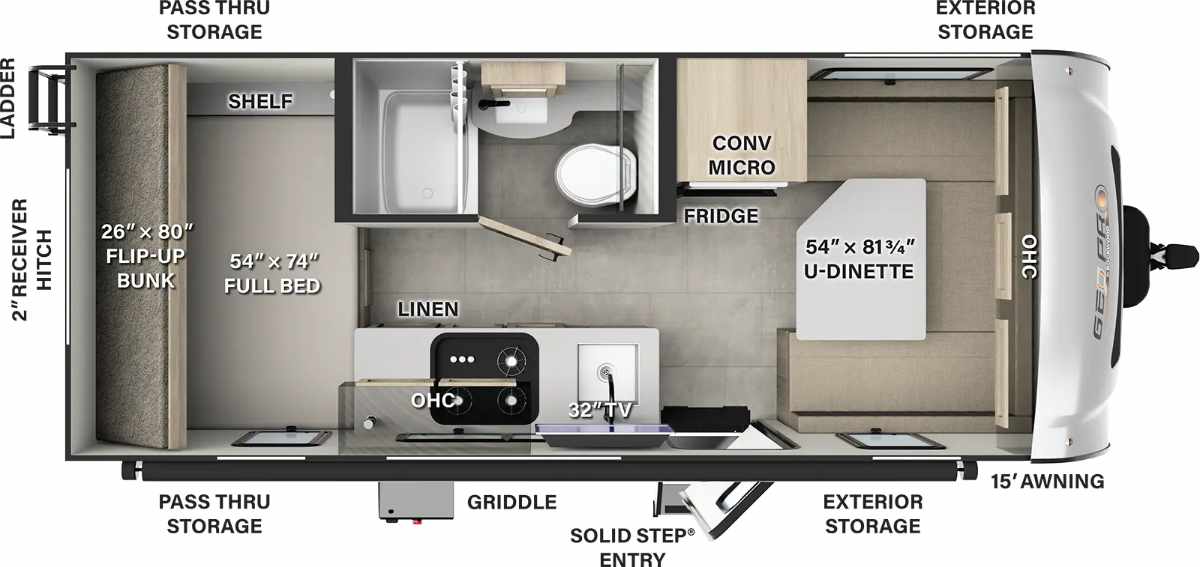
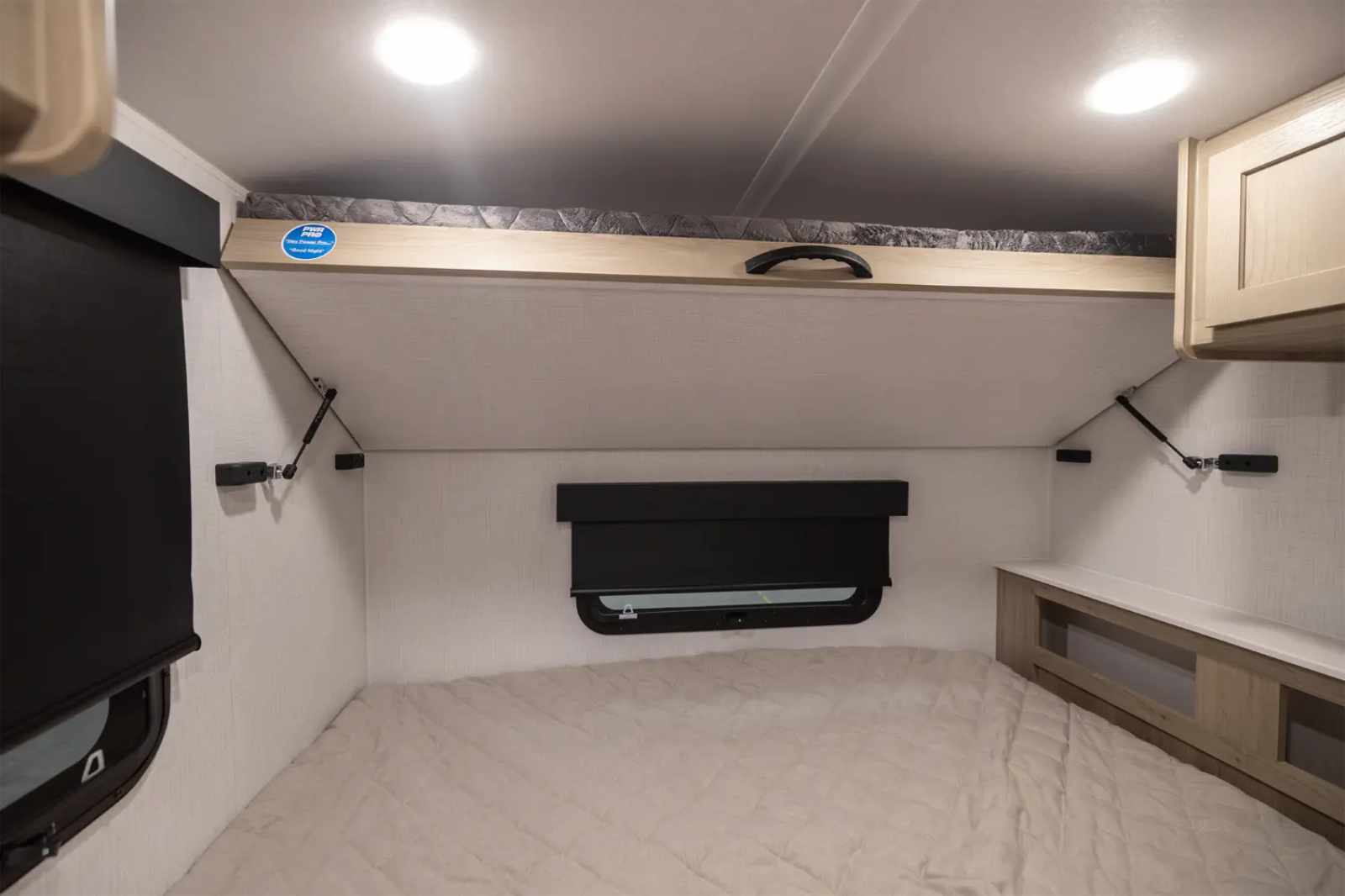
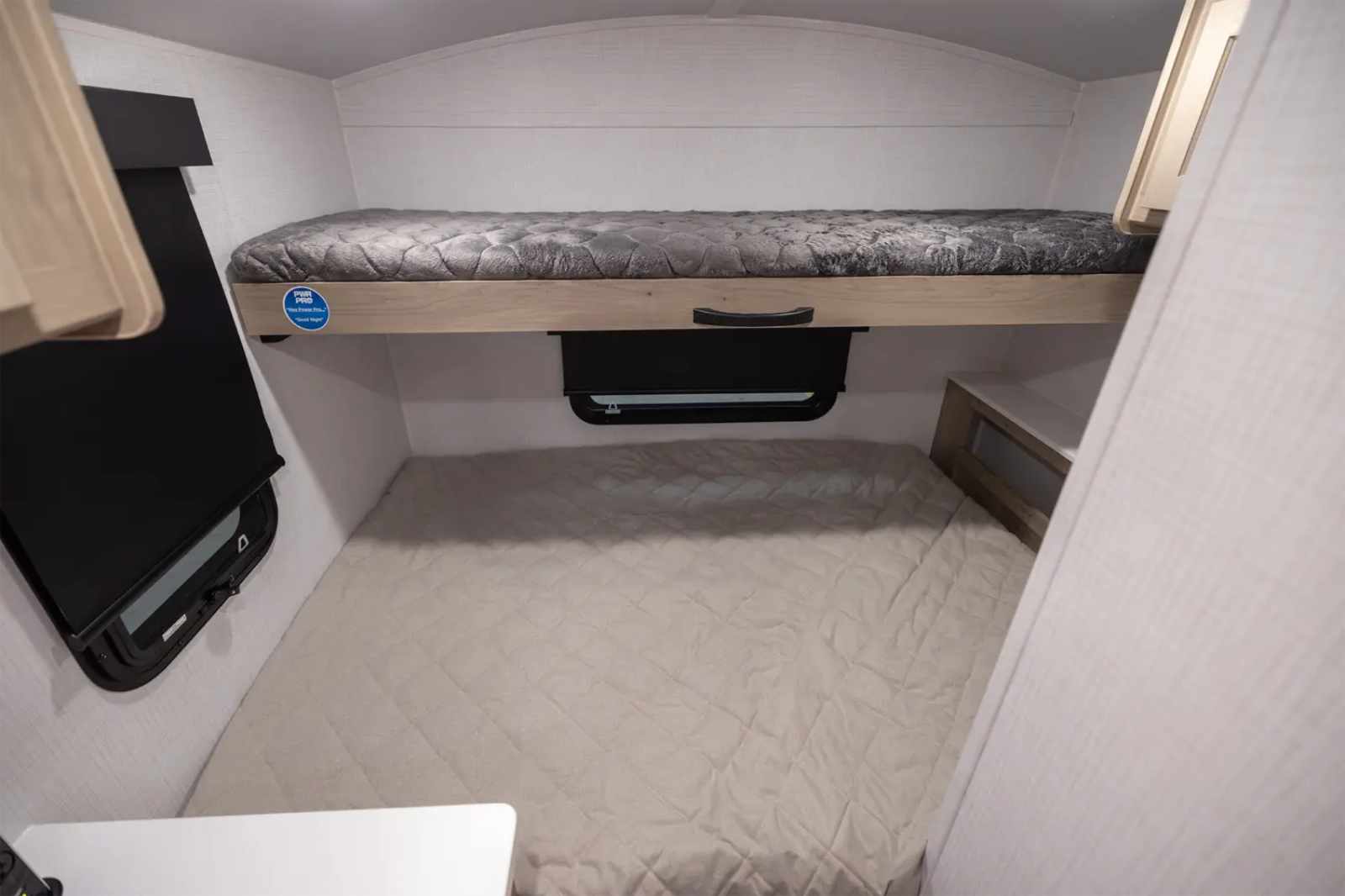
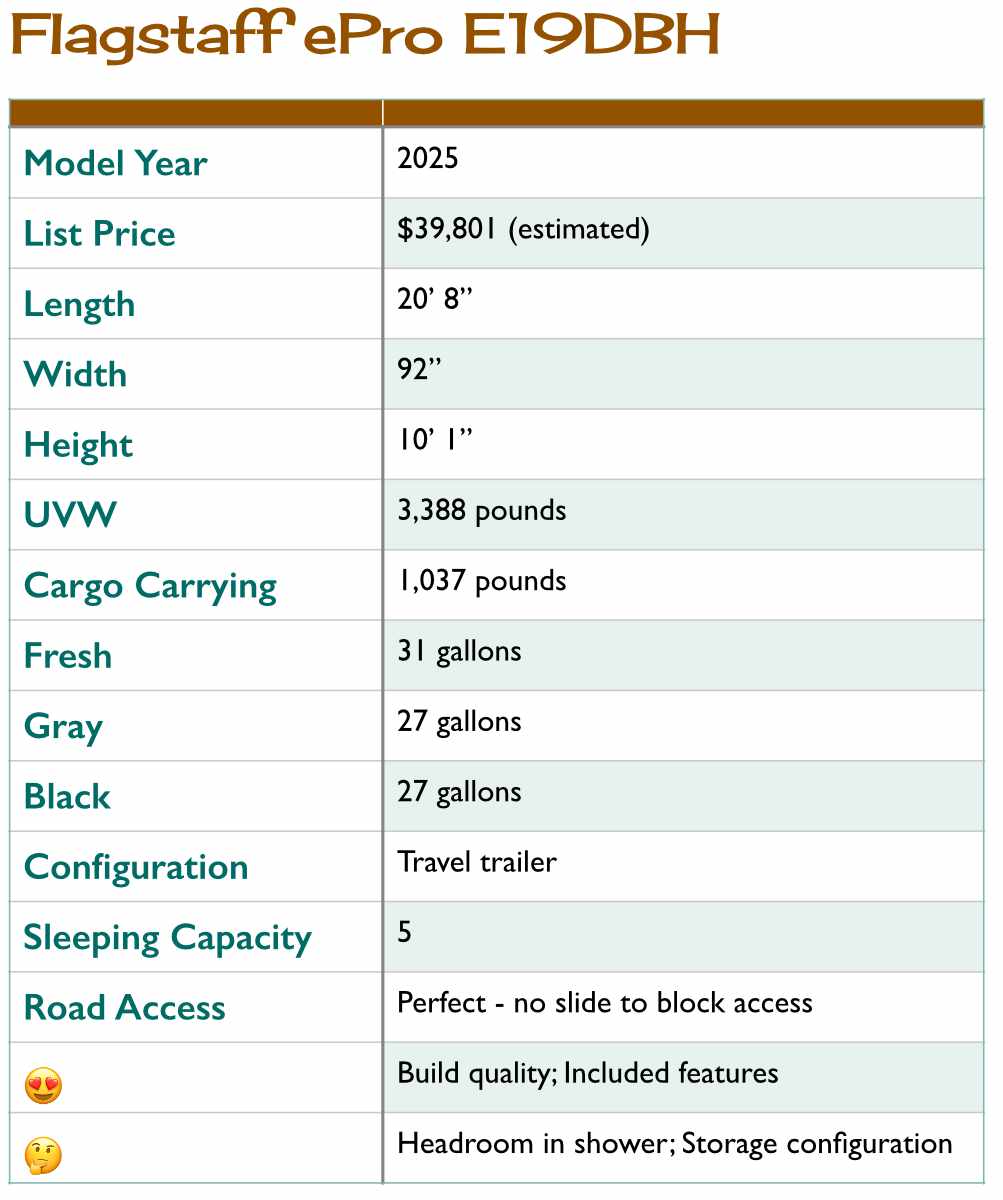
What makes this more like a vintage trailer is how the beds are arranged. At the back of the camper is an east-west permanent bed measuring 54” X 74”. Yep, it’s a shortie queen, but this is a narrow-body trailer.
Now I know, for some of you, that just took this out of the running. I dig that—I’m the same. But if I were younger, crawling over my partner in the night wouldn’t be such a feat.
Well, what might happen is we conduct monkeyshines that ultimately result in more of the bed being occupied. 😳 😍 😜
Above that is a drop-down bunk measuring 26” x 80”. It’s wider because there’s no headboard shelf up there. You could leave this bunk down for storage or flip it up. I would imagine if you’re a family with a very young child, this could be a great place for them— close-by but not in your actual bed (unless they roll over and dive bomb you in the middle of the night!).
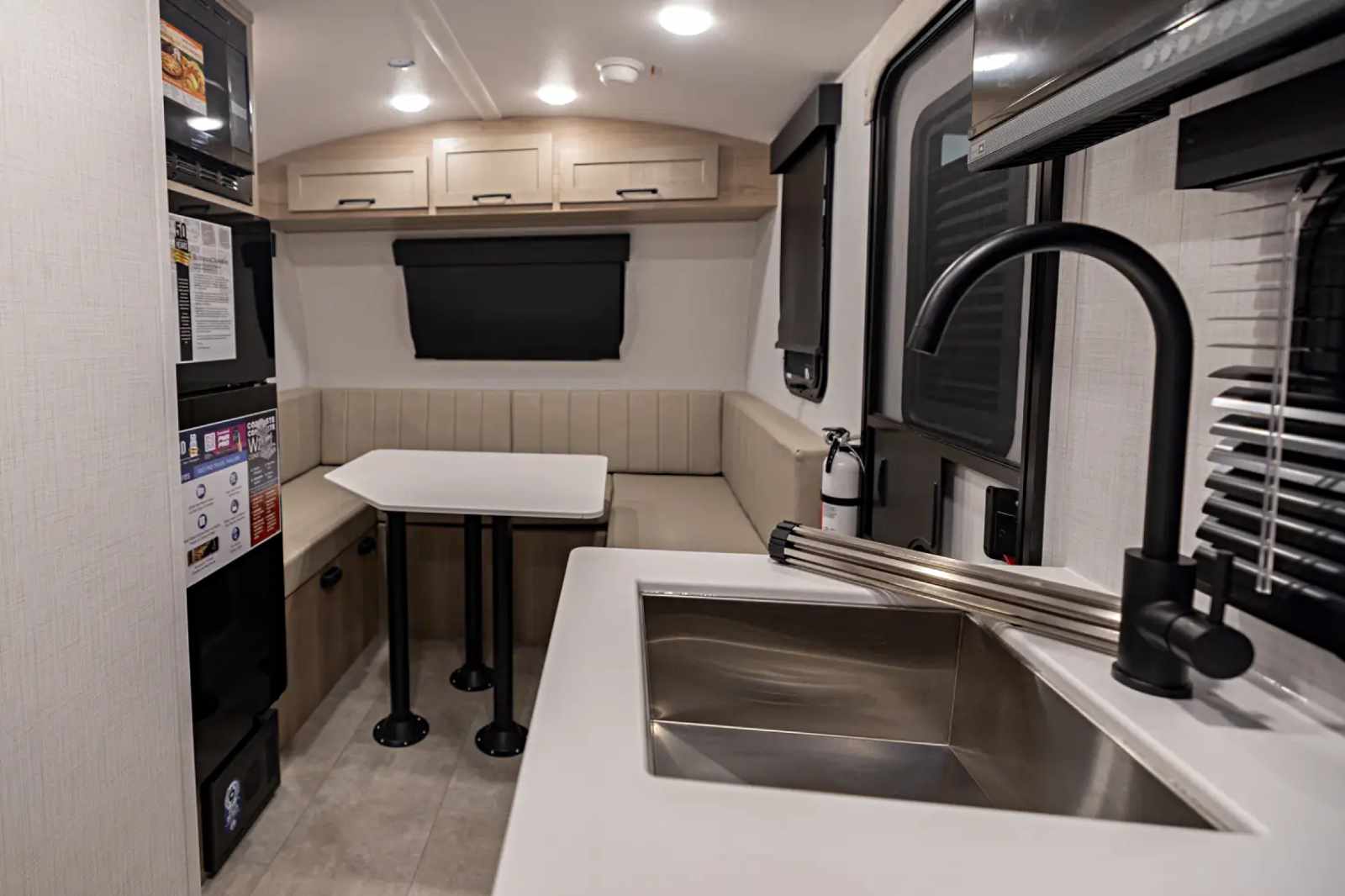
If you have even more people to accommodate, the front of the trailer has a larger U-shaped dinette measuring 54” X 81 3/4” when folded down into bed position. So you could sleep five and, if some of those campers are of the more diminutive junior variety, then they’ll be just fine.
As usual, making this work, I would absolutely utilize the RVSuperbag.
Kitchen in the Flagstaff E-Pro E19DBH
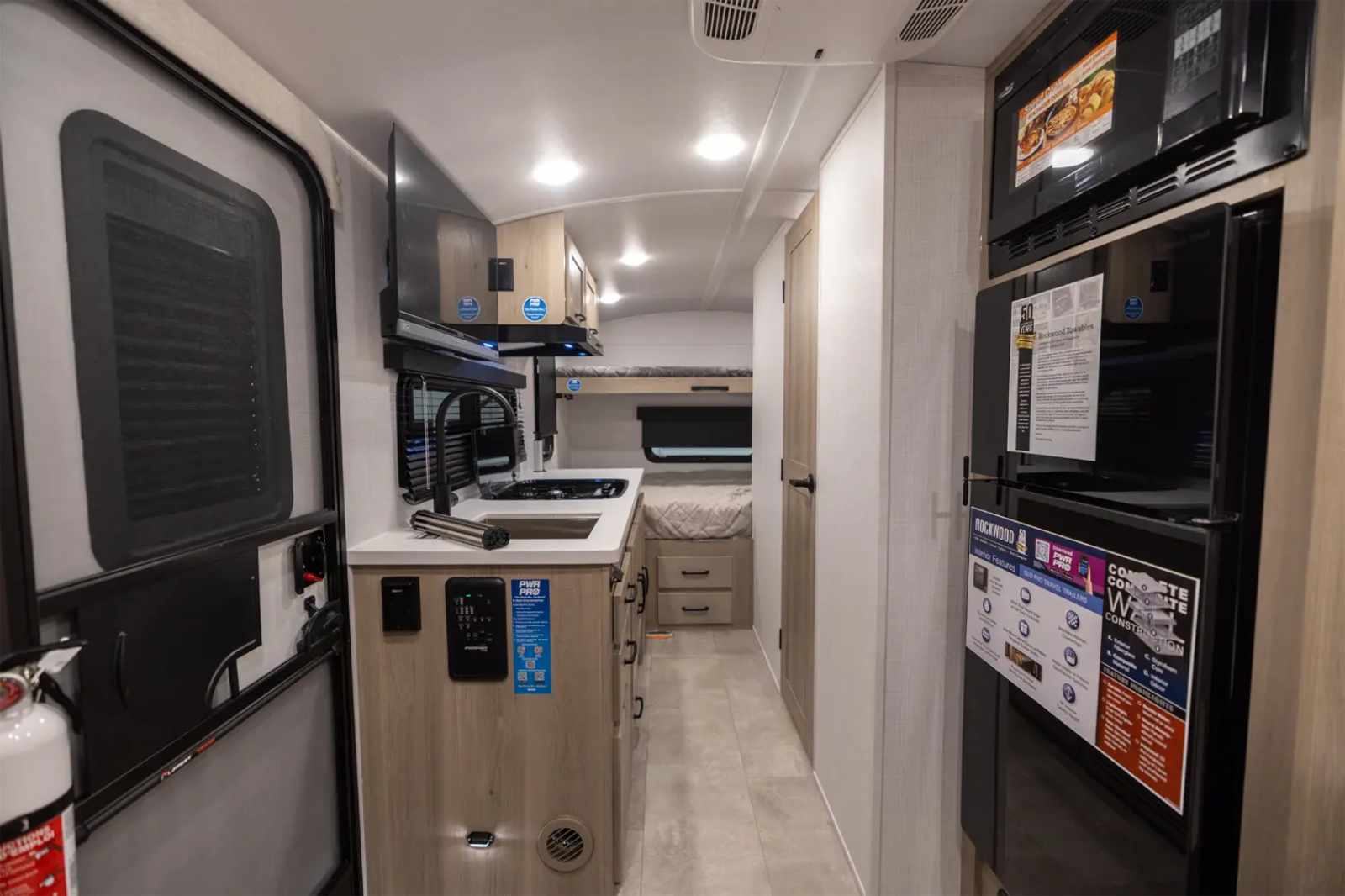
The kitchen in the Flagstaff E-Pro E19DBH is a smaller unit over on the camp side with a three-burner propane stovetop and a convection/air fryer/microwave. This works, especially given the smaller size of this trailer.
There is also a single-bowl square sink and a 12-volt fridge, of course.
You could add the flat-top propane griddle to the kitchen equation, which is an included accessory and hangs on a rail on the outside of the trailer. There’s also a metal table that slots into this railing. I have this on my trailer and use the heck out of it, but I’ve stopped hanging it on the railing because I use the flat-top to make bacon, which is, of course, messy. And delicious.
Living space in the Flagstaff E-Pro E19DBH
With a trailer that’s this short, there’s not a huge amount of room for living and kitchen space, but it’s not bad. There is a U-shaped dinette at the front, and this is a floor plan where the windshield actually makes sense. Know that any structural thing in the interior of a Flagstaff is built of welded aluminum, which is highly unusual in the RV world and a very nice touch.
It’s lighter and stronger.
The table in this RV uses three pole mounts, so it’s pretty sturdy. And while my usual song is to hope for a free-standing table, I don’t think you could pull that off with a table of this size. It is a wee bit smaller just owing to the narrower body of this trailer. There is a notch on one side of the table so someone can slide in a bit more easily.
There is a 12-volt TV on a swivel arm, so you could sit in the front dinette and watch TV. But it folds up against the wall so you don’t have to. That also means that the interior isn’t compromised so that the TV is a main focus.
Boondocking and travel access
As mentioned, I chose this rig because it has no slide. I think many of us would like to see greater availability of RVs without slide rooms. Of course, that means interior space is a bit higher, but you don’t have the weight and complexity of half the wall moving.
One of the features I use a lot on my own trailer is called the Showermi$er. Essentially, it allows you to divert the water going to the shower back into the fresh water tank while you’re waiting for it to get hot at the shower.
This prevents a lot of the water from just getting wasted in this process, which is a good thing.
This model also comes with a 200-watt solar panel on the roof along with an 1,800-watt inverter. But you can opt for a second 200-watt panel, which should be enough to compensate for the fridge and have some left over.
I also like that the 32” TV in this is a 12-volt model, so no inverter is necessary. It incorporates a Bluetooth speaker function so you can play your favorite podcasts, or whatever.
Can you hear me now?
One of the new features for 2025 is a voice-activated control system. This system allows you to use voice control to operate some of the systems in the RV, such as turning on and dimming lighting, turning on and off some of the features in the RV, and that sort of thing.
If you have a similar system in your house, as I do, you’ll learn some new words that aren’t good to use when in polite company. At least that’s been my experience. I guess you can turn lights on and off from bed or that sort of thing, but… well… I’m not sold.
My thoughts
My first new trailer was about this same size, and we camped for five years in it and just loved it. Until I totaled it. Oops.
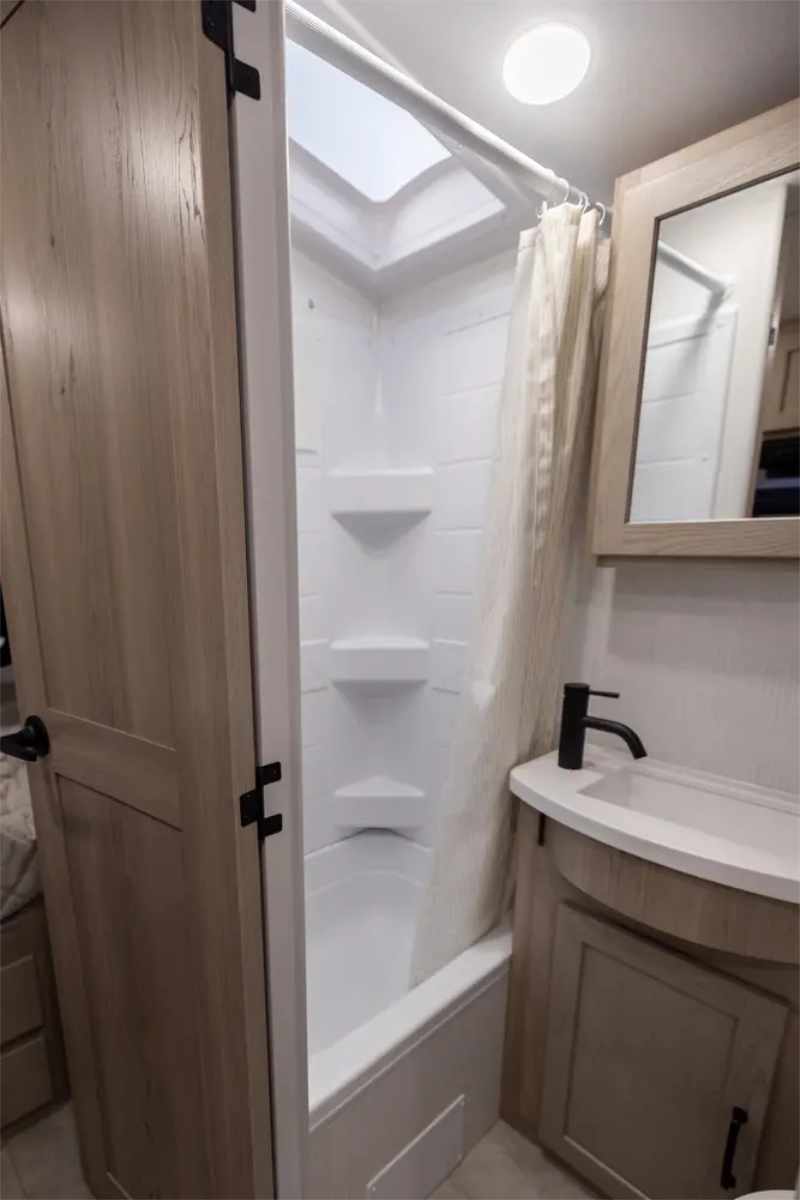
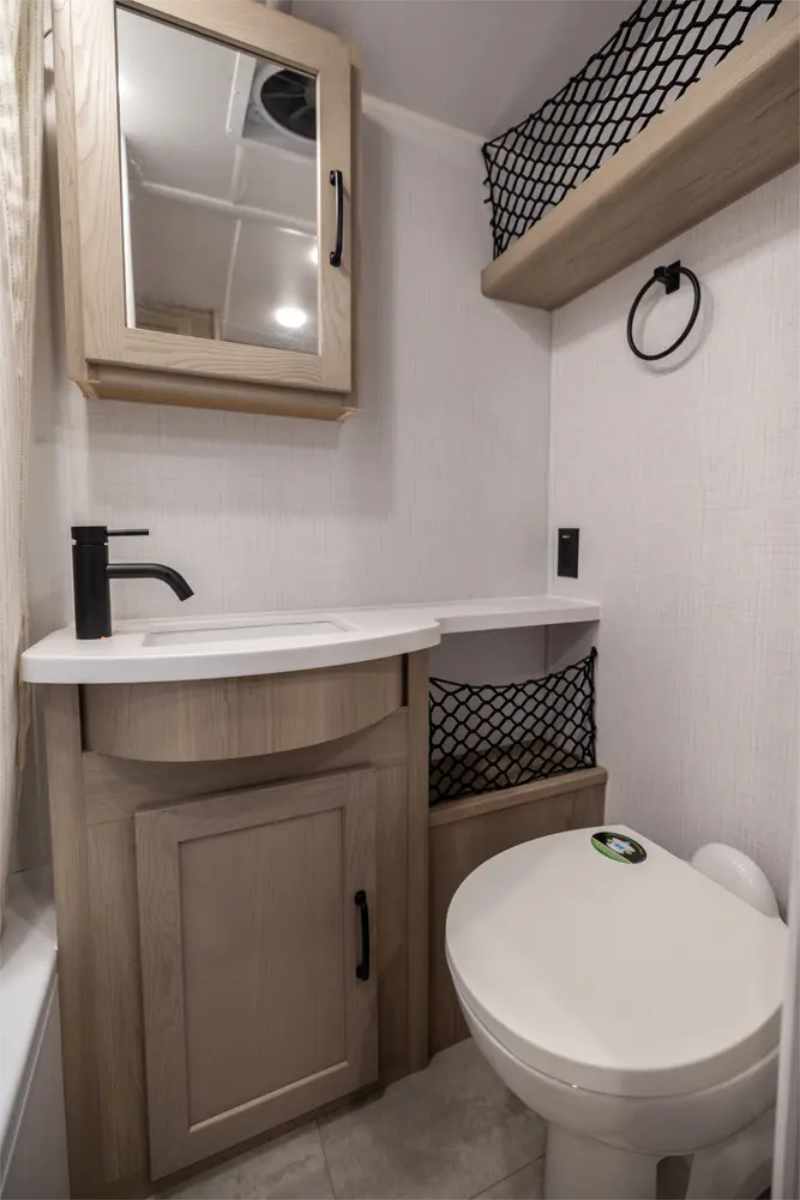
Lastly, if you’re a taller traveler, I would try out the shower enclosure before making a final decision. It’s definitely a low bridge situation.
Another thing: There is no provision for hanging storage, and while there is decent on-board storage in this RV, some of it has to be accessed by lifting the bed. Meh.
It’s good to see things like the high-performance vent fan, vacuum-laminated walls and so many of the other Flagstaff core features that have found their way even into these models.
Know, too, that the Rockwood Geo Pro G19DBH is the exact same trailer. So if your local dealership doesn’t handle the Flagstaff brand but does carry Rockwood, there ya’ go.
Overall, you can probably tell that I like this trailer in the context of a smaller model that can sleep a family. I can see why Flagstaff had to increase its production capacity specifically to accommodate demand for the Geo Pro line. While nothing’s perfect, this is a nifty small trailer with the ability to accommodate five or more with good build quality and materials.
My thanks to Josh from Bish’s RV for the video and photos in this article.
More about these RV reviews
These RV reviews are written based on information provided by the manufacturers along with our writer’s own research. They are based on information from a single unit and may not reflect your actual experience. Shop your RV and dealership carefully before making a buying decision. They are intended only as a brief overview of the vehicle, not a comprehensive critique, which would require a thorough inspection and/or test drive.
Tony comes to RVtravel.com having worked at an RV dealership and been a lifelong RV enthusiast. He also has written the syndicated Curbside column about cars.
You can also check out Tony and Peggy’s RV podcast.
By Gail Marsh
Occasionally, in our Saturday newsletter, we list stolen RVs (and only the ones we’re made aware of—we’re sure there are dozens, maybe hundreds, more). We’re hopeful that someone out there will spot a missing rig and call the authorities. A reader reached out and asked us to offer some tips about securing our RVs so that our rigs won’t end up on the “Stolen RV” column. So, let’s take a look…
Low-hanging fruit
Thieves will most often take the path of least resistance. If one travel trailer sits completely unsecured while the trailer next to it has several deterrents to hooking up and driving off, thieves will most likely opt to take the unsecured rig.
The longer it takes for the thieves to break in or hook up your RV, the greater the chances they’ll be caught. Many professional thieves can make off with an unsecured fifth wheel RV in less than one minute. They simply hook their own truck to your RV and off they go. If you have one, two, or several theft deterrents in place, thieves will look for an easier/quicker rig to take.
Visible deterrents
Here are some things you can do to deter theft. Thieves will see the measures you’ve taken and hopefully move on to an easier target. Remember! One deterrent is good, but more is better.
• Leave the leveling jacks down and lock the outside bay that houses the control levers. This means a would-be thief will need to break into your rig’s basement to access controls, and then retract the jacks to drive off with your trailer. It takes valuable time to do this. Even if you can access your leveling jacks from the exterior of your rig, it will still take time for a thief to raise the jacks and drive away.
• Use wheel stabilizers or chocks between your rig’s tires like these. Secure the stabilizers with a lock. Yes, a well-prepared thief can probably cut through the lock, but it will take time. This precious time opens the opportunity for other campers to notice and alert authorities.
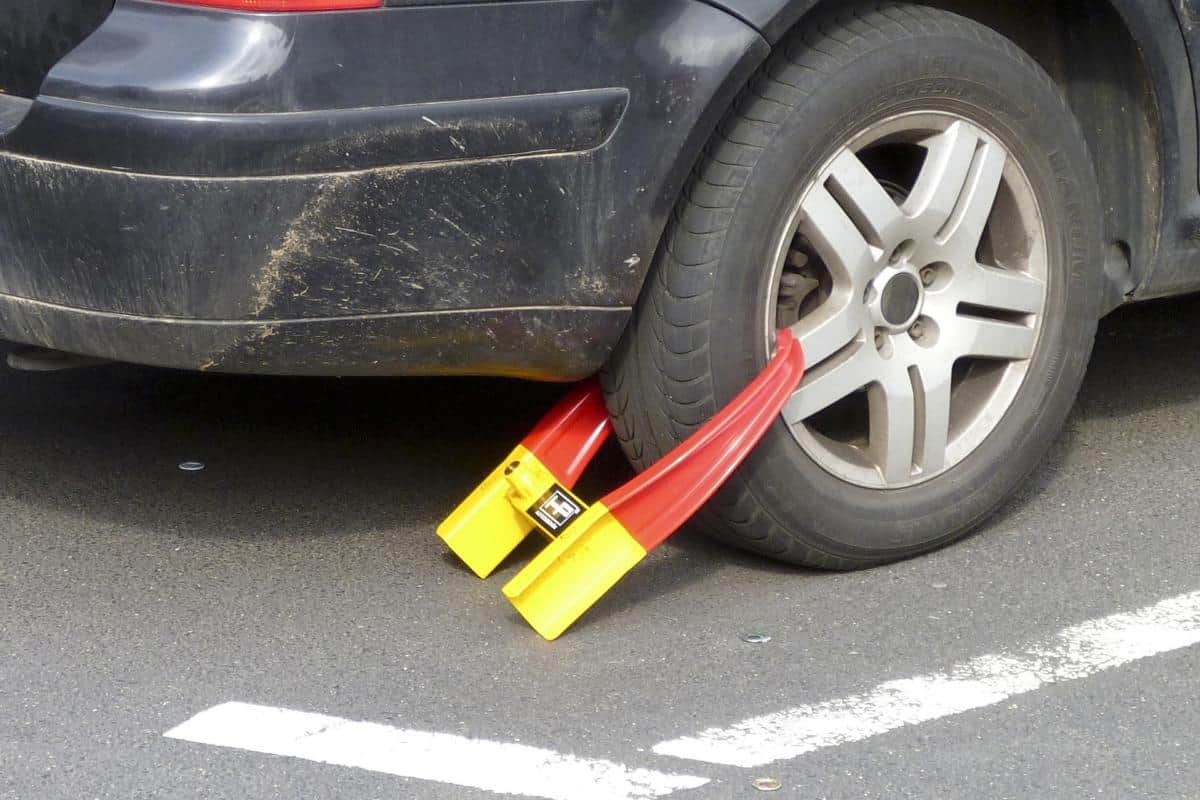
• Wheel boot locks (like patrol officers sometimes use to render a vehicle immobile) can also deter an RV thief. These are usually made of thick steel and are difficult to dislodge. Here’s a good one to use.
• Fasten a lock bar on your motorhome’s steering wheel.
• Install an entry touch keypad like this top-rated one for keyless entry into your RV. Do not share the code!
Invisible deterrents to RV theft
Would-be thieves won’t be able to see the following precautions, but these preventive actions are still very effective.
• Install a home security system in your RV. Many security packages feature cameras, motion sensors, glass breakage monitoring, and more. If your system comes with a security badge, be sure to post it where thieves will see it. Maybe they’ll move on to a different RV if they know you’re watching them remotely.
• Ask your mechanic to install a hidden switch that will disable your rig’s ignition.
• Change the locks on your basement storage compartments. An experienced thief may pick the lock, but at least s/he won’t simply use a “master key” to get inside! (It’s estimated that as many as 90% of all RV storage compartment keys are identical.)
• Put a loud-sounding alarm on your RV door(s). If thieves break in, everyone in the park will hear it! This one requires no tools for installation.
• Consider placing some unique identification on your RV roof. Thieves won’t see it, but a highway patrol helicopter will.
• Install a vehicle tracking device. If thieves snatch your rig, at least it can be tracked by authorities and hopefully returned to you.
Common-sense prevention of stolen RVs
There are several additional actions you can take to prevent thieves from stealing your rig or its contents. Many of these actions are simple, basic precautions.
• Lock all entry doors when you’re away from your camper.
• Pull blinds down if you plan to be away for a while. This will keep valuables out of sight. (Note: Only pack the items you really use. Leave other valuables safe at home.) If you’re a full-time RVer, consider purchasing a safe to store your valuables. Hide the safe behind a closet wall panel or other hidden location.
• Secure outside property like bicycles, grills, and chairs—especially during the overnight hours. Simply putting things in the RV basement and locking the compartment will help keep things safe.
• It pays to be sociable. Get to know your RV neighbors and ask them to notify you if they see anything suspicious in and around your rig. Offer to do the same for them.
• If possible, park in a well-lit camping spot. If you’re afraid of potential theft, keep outside lights on as a nighttime deterrent.
• Use a dowel rod to secure sliding windows that you prefer to keep open. Lock emergency exit windows when you’re away from your RV.
• Leave the TV or radio on while you’re away from your rig. Potential thieves may think someone’s inside. The same goes for interior lights when you’re away at night. Keep the lights on!
• Use sites like RV Life Campgrounds to check out any campground before booking your stay. If you feel unsafe in your RV park, make plans to leave, if at all possible.
Can you add to our safety list? How do you secure your RV?
Okay, RVers, listen up. Say you’ve been staying just outside Boston, Massachusetts, and you’re on your way up to stay a few days near Acadia National Park in Maine. To get there, you have to drive through New Hampshire (though only for a short bit, in this example). You drive through without stopping. (Next time, stop in Portsmouth—it’s a great little town!) Does New Hampshire count on your “been there” list? Or do you not count it because you just quickly drove through?
When you’re logging your travels, what makes a state “count”? Is it enough to roll across the border and fill up your gas tank? Do you need to camp overnight? Eat a meal? Visit an attraction? Everyone seems to have a slightly different rule for how they tally up where they’ve been, and those personal criteria can make for some fun debates.
For some RVers, crossing the state line is enough—the wheels touched down, the GPS confirmed it, and the state gets added to the list. Others set stricter guidelines: they have to spend at least one night, take a photo, or explore something local. There’s no official rulebook, which means your “visited states” map is really your own version of the story.
Some even keep two lists—one for states they’ve driven through, and one for places where they’ve truly explored. That way, there’s no guilt about coloring in a state on the map, but also a reason to go back later and spend more time. However you do it, the goal is the same: to get out there, see more, and enjoy the ride.
When you’re driving cross-country on I-90 and you pass directly through Chicago, Illinois, but keep going, do you say you’ve been to Illinois?
Tell us in today’s poll, please. And feel free to leave a comment and explain your answer. Thanks!
We use cookies to ensure that we give you the best experience on our website. By continuing to use our site, you consent to accepting cookies. We NEVER have or will sell reader's data. For more info, please see our privacy policy page.