Home Blog Page 10

I find most campground water is horrible. Can I travel with a full fresh water tank?

Dear Dave,
I have come to the conclusion that most RV campgrounds have very poor water quality. It is either very hard or even contaminated, leaving me scrambling for a good water source. Is it OK to fill up at home before leaving and travel with a full fresh water tank? —Glen, 2024 Jayco JAY FLIGHT SLX 210QB

Dear Glen,
This is has become a popular topic of discussion lately, as water quality at the campground source has become increasingly worse, for some reason. Most campgrounds are located in remote areas far from the municipal services of a town, especially a water treatment plant. They must use water from a well and rely on the underground source, which is almost always hard water.
Water Faucet
Water faucet

How water is treated in a municipal water system

In a municipal water system, the treatment plant will draw water from the main well and treat it for coagulation, flocculation, sedimentation, filtration, and disinfection. The first step is to add chemicals like salt or aluminum to get dirt and other small particles to bind together and be removed. The water is then gently mixed to form “flocs,” which are larger, heavier particles that float to the bottom. These are then separated and removed during the sedimentation process.

Then the clear water is sent through several filters with different pore sizes that remove parasites, bacteria, and viruses. Extremely fine filters remove dissolved particles such as dust, while charcoal is used to remove tastes or smells.

The last step is often disinfection, which can be done in several ways, including ultraviolet exposure or using chemicals such as chlorine, which are all designed to kill any remaining germs or viruses. Some municipal treatment plants add fluoride and adjust for pH, as well.

Well water

Well water can contain sediments like sand and clay, germs, chemicals, and toxins. And since it is hard water, it will have calcium and lime, which can build up in your fresh water system and clog the pipes.

This all sounds pretty horrible. However, campgrounds that provide “potable water,” or drinking water, must adhere to the Safe Drinking Water Act (SDWA), which is a federal law dictating national standards for drinking water quality.

The Environmental Protection Agency (EPA) sets the national baseline. Individual states enforce the rules and may have additional regulations. Campgrounds are required to have water tested by a certified, licensed inspector and post results annually.

However, these regulations do not cover water hardness or pH, and, as mentioned, are only conducted annually. Most RVer don’t use the campground source for drinking water. Rather, they bring bottled water and use the campground source for the toilet, shower, and other non-drinking functions.

Good idea to test and filter the campground water

I personally like to test the water before hooking up to the campground source using this test kit available on Amazon here.

Water Test Kit Rvdt 2919
Water Test Kit


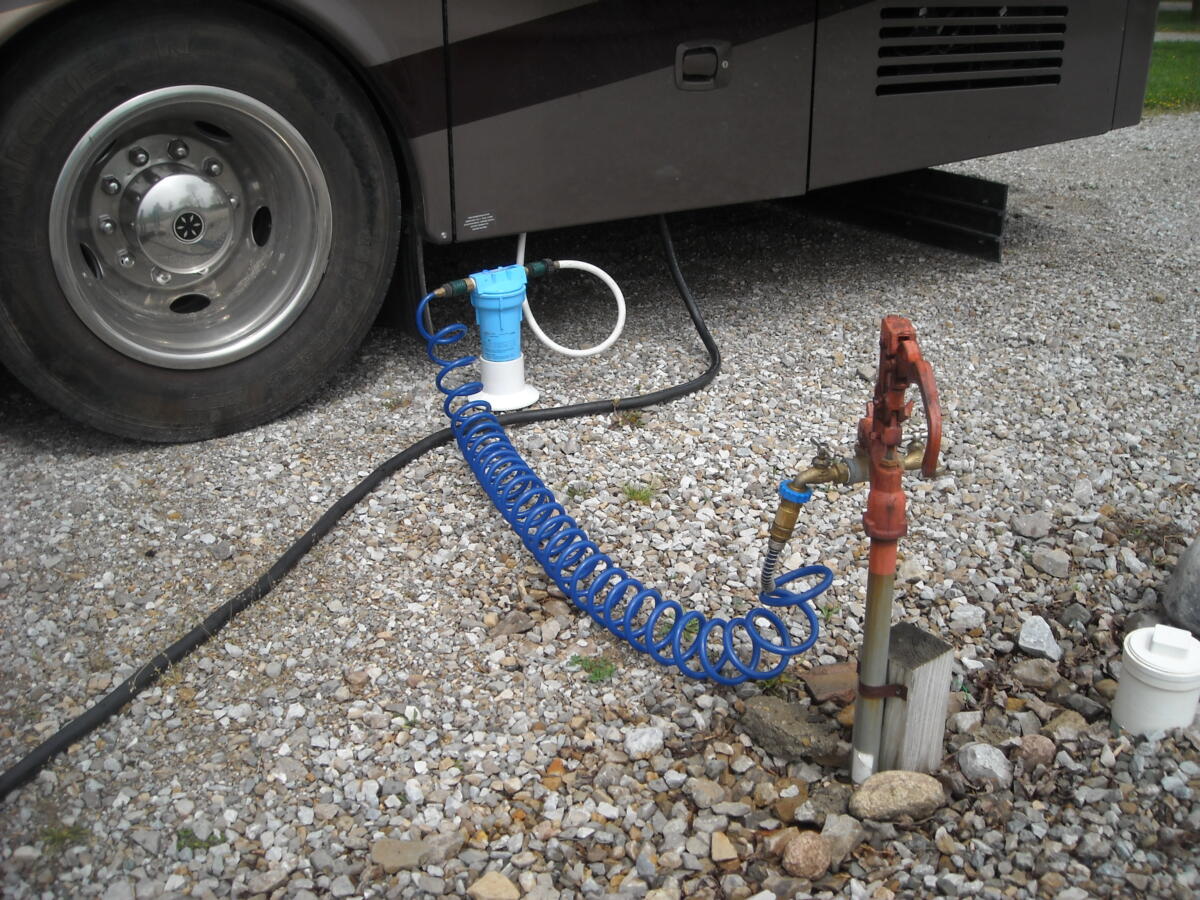
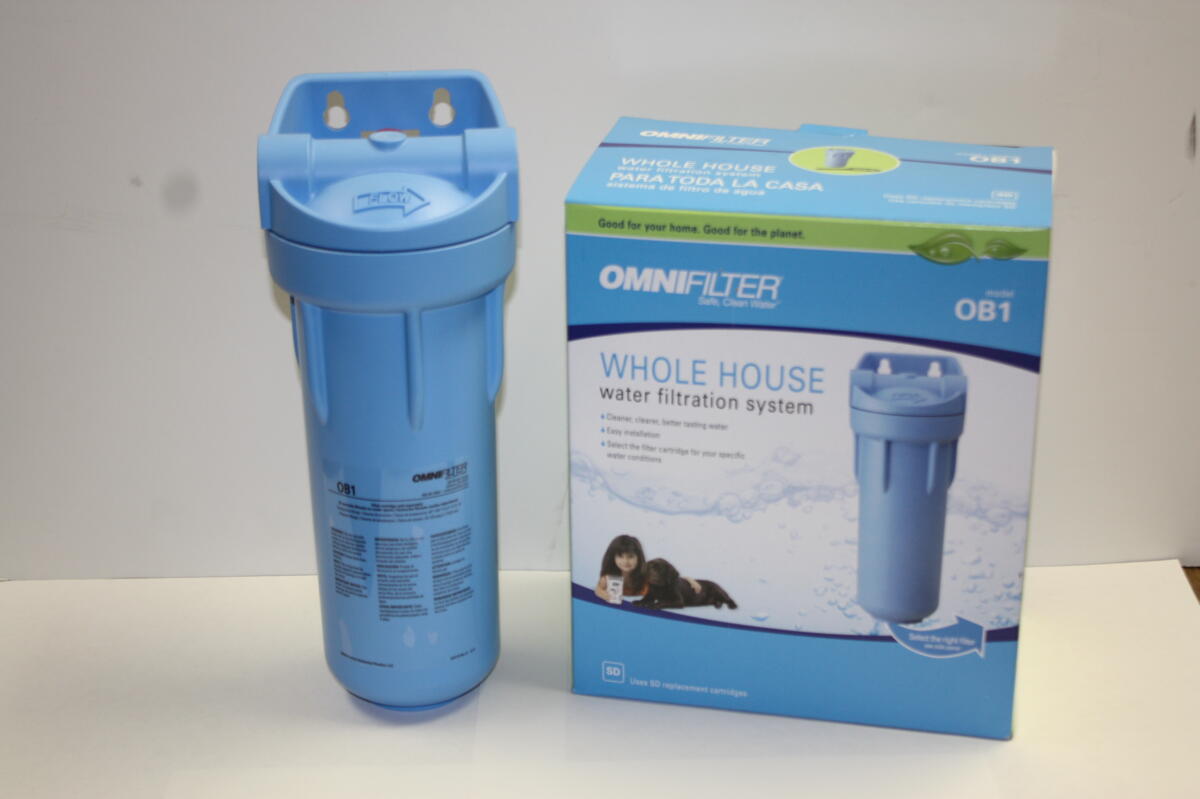
It is also a good idea to use a filter that will clear calcium, lime, and sediment from clogging pipes and faucets. I like the model that has a replaceable filter, as most campgrounds in my area have very hard water and just a couple trips require a new filter. They can be replaced with an inexpensive model found on amazon here.
Water filter
Water filter

Back to your question, should you travel with a full fresh water tank fill from home.

Pros

You know the water is high quality that has been treated by your local municipality and may also have fluoride and be pH balanced.

You can fill the tank with soft water from your system for better showering, washing hands, and especially if you have an onboard washing machine. Some RVers use the campground source with a filter and portable water softener.
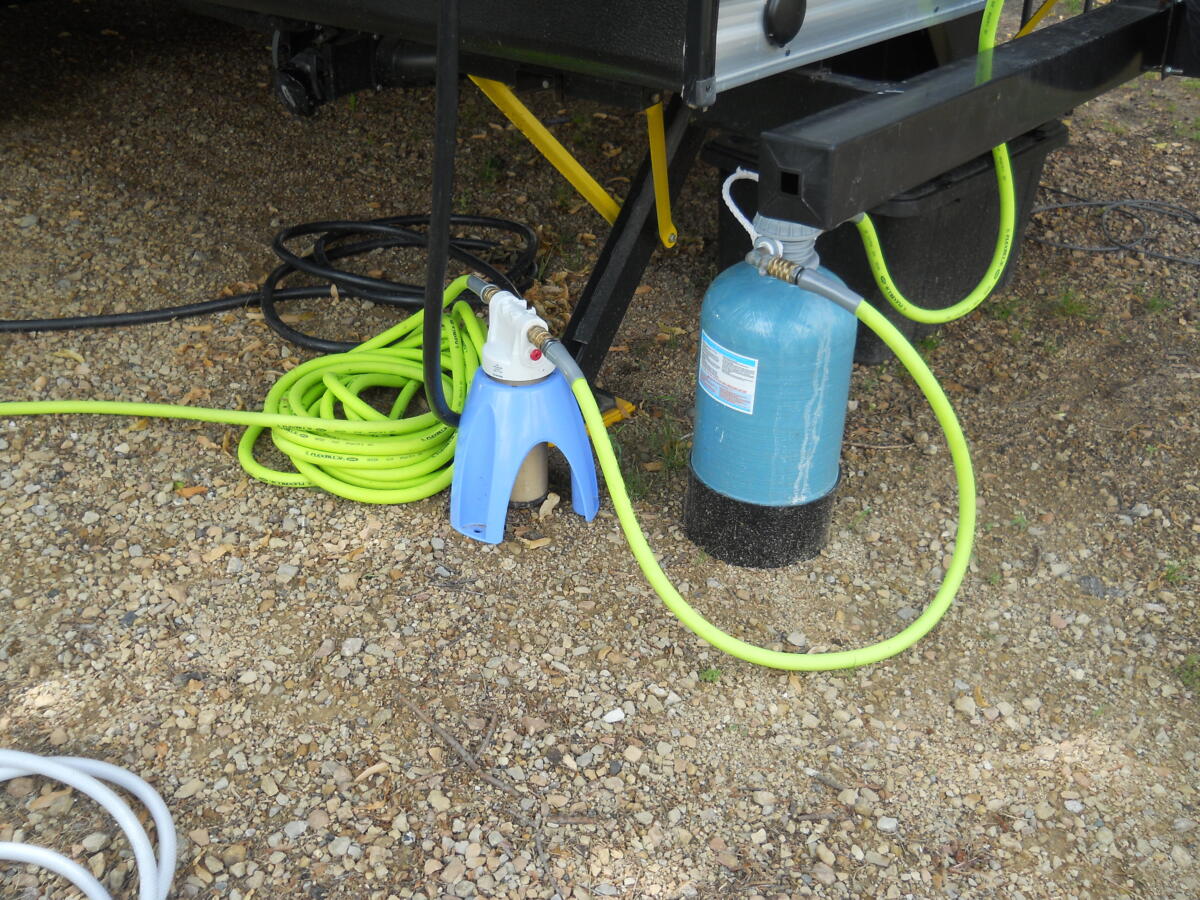
Water Softener
Water softener

You have water readily available if you are going to dry camp or boondock with no access for potable water.

Cons

Water weighs 8.34 lbs. per gallon. According to the specifications, your water tank has a capacity of 52 gallons. That means you are adding 433 lbs. of sloshing weight to your cargo carrying capacity.

Even quality water sitting in a plastic tank can get a bad taste and even go bad over time. Don’t let the water sit too long before using it.

Plan your trip

I typically take enough water in the fresh water tank to use the toilet a few times before getting to my destination, and then use the campground source. The more people traveling with me, the more water I bring.

Clearsource
Clearsource

For the ultimate water purification, I use the Clearsource filtration system, which you can find on Amazon here.


 You might also enjoy these posts from Dave 

DAVE HAS ANSWERED MORE THAN 1,000 readers’ maintenance and repair questions. Read a directory here. There is so much to learn!


Dave Solberg is a leading expert in the RV industry and the author of the “RV Handbook.”

HAVE A QUESTION FOR DAVE?

Send your inquiries to him using the form below.

Name
Drag & Drop Files, Choose Files to Upload

RVDT2919

Blowing in the wind: Truckers’ tips for safe driving

15

By Nanci Dixon
Several interstates are notorious for wind, particularly in the spring and fall. I-40, I-10, and I-8 have all sidelined us at one time or another. I-40 near Winslow and Flagstaff, Arizona, periodically reports that semi-trucks have literally blown over in the wind along the interstate. So if trucks have a hard time in a windstorm, what about RVs? What do the truckers do to stay safe while the wind blows?

Truck trailers are measured in “sail” area, the area that can catch the wind. A 53-foot tractor-trailer has about 500 square feet of area that can be pushed, create thrust or be disrupted by high winds, similar to having a sail. RVs have “sail” too – just, thankfully, less.

The tips below are ones that long-haul truckers know about driving during a windstorm, but they are also very useful for RVers.

1. Know how your rig performs in the wind. The “sail” area can cause an RV to move out of its lane and out of control. There are after-market parts that can improve handling for RVs in the wind.

2. Reduce speed in the wind. Don’t let the vehicles behind you force you to drive at unsafe speeds.

3. Check existing wind speeds before setting out. There are several apps available to check the forecast and existing winds. Windy, WindAlert, and Windfinder are all good apps that we use consistently. Check out both the prevailing wind and gust speed. The gusts are the ones that can unexpectedly cause an accident.

4. Check out the weather reports. A wind advisory or a red flag warning are both indications of windy weather. Arizona weather reporters tend to say “breezy,” when in Minnesota they would say it is “windy.” If we hear “windy” in Arizona, Oklahoma, or Texas, we take in the chairs and tables, fasten down the patio rugs and stay in place. Winds have been so strong at times we have had to pull in the slides.

5. Keep both hands on the wheel and avoid distractions. A sudden gust of wind during a windstorm can jerk the wheel out of your hands. Avoid distractions. Rubber-necking, reaching for something, even turning on the radio can be enough to lose attention on the road conditions.

6. Watch the signs on the road. They are there for a reason. Wind socks, gusty winds ahead, dust storm area are all signs to be cautious. Bridges and open mountain ridges are all the more prone to gusts that can cause loss of control.

7. Watch the road, too. Flags flying straight out, grass laying horizontal and trees moving back and forth not only give an indication of the amount of wind but also the direction.

8. Pull over and stop when wind speeds are too high to drive safely. Find a campsite or spot to wait it out. We once spent four days in Oklahoma waiting out gale winds.

For a trucker, when it is determined that an accident is due to high winds, that trucker or company could be charged with negligence. Truckers have dispatchers that do the route planning for them. RVers are on their own determining the safest routes, particularly when high winds are expected. Don’t let an accident happen to you.

And as the old Irish blessing goes, “May the wind be always at your back.”

RELATED

RVDT2919

Master carpenter builds incredible skoolie conversion from scraps

By Cheri Sicard
In the video below, we meet Brad Nott, a master carpenter who used the scraps in his shop and leftover parts to build an incredible skoolie conversion. This vehicle might have started life as a 1985 Crown school bus, but I am sure nobody back then envisioned what it would one day become.

A Cummins 855 Big Cam “pancake” engine powers the bus, then and now. The previous owner of the bus had done some body work, so the exterior was in decent condition when Brad got it—except that it had no windows!

Brad added a LOT of great features to his skoolie conversion, including:

  • A 14-inch roof raise
  • 2600 watts of rooftop solar
  • A rooftop “solar maintenance platform”
  • A diesel heater
  • Plumbing
  • A massive electrical system
  • Starlink satellite internet
  • 6-camera security system
  • Two air conditioners
  • Reverse osmosis water filter system
  • Heated floors

skoolie conversion interiorThe interior showcases Brad’s superior craftsmanship. I love the way he incorporated favorite items from his sticks-and-bricks home into his home on the road. He and his wife have enough room to take the entire family along, including their two kids and their spouses and five grandkids.
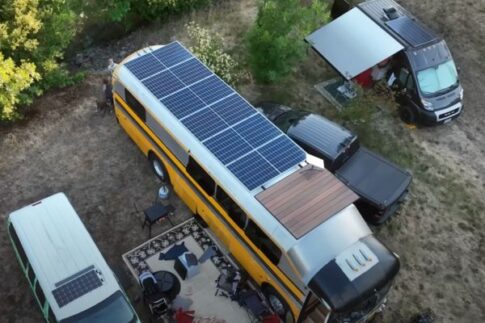
With so much solar, there is no need for propane in the rig.

skoolie conversion rooftop solar arrayThe kitchen puts many sticks-and-bricks homes to shame. I wish I had a kitchen like this!

The stylish bathroom features a faux-wood-framed shower with a cobblestone floor and a composting toilet.

The back bedroom provides a calming private sanctuary space.

What do you think of Brad’s skoolie conversion? Leave your thoughts in the comments below.

MORE LIKE THIS:

RVDT2919

Do one or more of your pets sleep in bed with you at night?

23

Many pet owners allow their pets to sleep in bed with them at night. Come on, you know it’s hard to turn down that begging face!

Is sleeping with your pets a good thing? A bad thing? Is it healthy? If you missed the article on this topic from the RV Pet Vet, Karel Carnohan, DVM, from a few years ago, read it here. In it, she explains the benefits and risks of sleeping with a pet.

For many people, the companionship and comfort of having a furry friend nearby helps them sleep more soundly. A warm ball of fluff curled up by your feet (or, let’s be honest, taking over half the bed) can be a source of emotional support and reduce nighttime anxiety.


ARE YOU ON FACEBOOK? Check out RVtravel.com’s group RVing With Dogs. More than 96,000 members.


Dogs, especially, may provide a sense of security, alerting owners to unusual sounds or movements. On the flip side, pets that shift positions frequently, snore, or decide 3 a.m. is the perfect time for a grooming session can interrupt your rest more than they help it.

Allergies are another consideration. Even if you’re not allergic to your pet, dander, pollen, and dust they bring into the bed can trigger symptoms. There’s also the issue of space—especially in an RV bed, which might already be more compact than what you’re used to at home. Still, many pet lovers willingly sacrifice legroom and sleep quality just to have their companions close.

If you let more than one pet sleep with you, please leave a comment after you vote and tell us how many. We’re curious. (Do you blame us?) Thanks!

MORE POLLS YOU MIGHT LIKE:


21 brilliant uses for Dawn dish soap in your RV

Dawn dish soap (the original blue formula) does a great job cleaning dishes, silverware, and cookware. In addition to cleaning dishes, there are many unusual uses for Dawn detergent while you’re RVing, too. Discover all the ways to use Dawn dish soap (besides washing dishes) here.

RVDT2919

Campground vandalism is costing RVers more than they may realize

Most RVers have seen it.

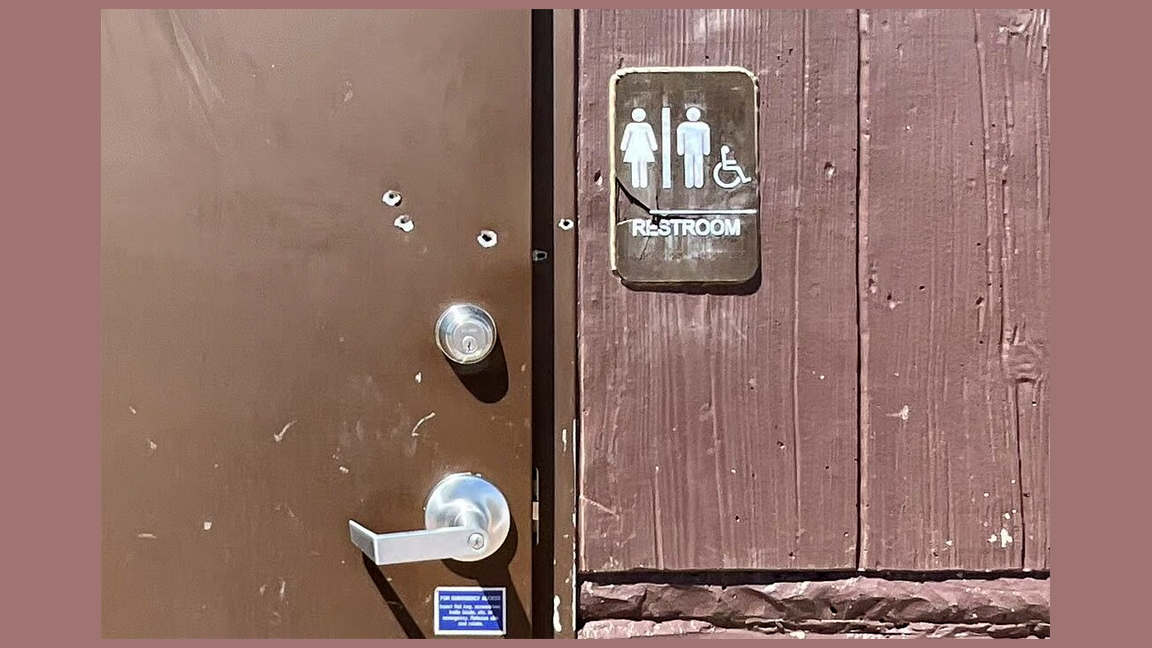
A campground restroom closed for repairs. A picnic table covered in graffiti. A sign peppered with bullet holes. A fire ring damaged beyond use.

It’s easy to assume those things happen because public land agencies don’t have enough money to keep up with maintenance. Sometimes that’s true. But a recent vandalism case at a Wyoming campground highlights another reason some campground improvements never happen.

The Bureau of Land Management is investigating damage to a vault toilet at Continental Divide Campground near Rawlins, Wyoming. Someone fired multiple rounds into the restroom, causing an estimated $5,550 in damage.

The repair bill is significant. But the bigger story may be what that money could have paid for instead.

Campground upgrades get pushed aside

The damage isn’t limited to what’s broken. Campers also lose the improvements that money could have funded.

According to the BLM, money and staff time spent repairing vandalism can’t be used for other projects.

That means the cost of vandalism doesn’t stop at the damaged restroom.

It may mean a campground road waits longer for grading. A worn picnic table stays in service another season. A sign replacement gets postponed. A campground improvement moves to next year’s wish list instead of this year’s work schedule.

Most RVers have experienced the results. You pull into a campground and find a restroom closed. A campsite fixture looks like it should have been replaced years ago. A road is rougher than it ought to be.

Sometimes those delays happen because agencies have limited budgets. Sometimes they happen because crews have spent time fixing damage that never should have occurred.

The damage isn’t limited to what’s broken. Campers also lose the improvements that money could have funded.

The costs add up faster than many campers realize.

The Wyoming incident is hardly unique

Land managers across the West routinely deal with vandalized signs, damaged gates, graffiti, destroyed campground fixtures and shot-up facilities. In some cases, repair costs reach tens of thousands of dollars.

Those bills don’t arrive in a vacuum. The money has to come from somewhere.

While one damaged toilet may not seem like a major issue, repeated incidents can force agencies to spend substantial amounts of time and money simply restoring facilities to the condition they were already in before the damage occurred.

That’s frustrating for campground managers.

It’s also frustrating for campers who wonder why certain repairs or improvements never seem to move very quickly.

A safety issue, not just a maintenance issue

The Wyoming case also carried a more serious concern.

BLM officials noted that someone could have been inside the vault toilet when the shots were fired.

That detail turns the incident from simple property damage into something much more troubling.

Campgrounds are places where families expect to relax, hike, fish, ride bikes and enjoy the outdoors. Most visitors never think twice about walking into a restroom or using a campground facility.

Incidents like this serve as a reminder that reckless behavior on public lands affects more than property.

Why this matters to RVers

Most RVers take pride in public campgrounds.

Whether it’s a BLM campground, a Forest Service campground, a state park or a national park campground, these places depend on a combination of funding, maintenance and responsible visitors.

The vast majority of campers do their part. They pick up after themselves, respect facilities and leave campsites in good condition for the next visitor.

Unfortunately, it only takes a few people to create expensive problems for everyone else.

What RVers can do

Most campers will never shoot up a restroom or carve their name into a picnic table. But experienced RVers can still play a role in protecting the campgrounds they enjoy.

If you spot fresh vandalism, report it to campground staff or the managing agency. A damaged sign or restroom may seem obvious, but land managers sometimes don’t learn about problems until visitors report them.

If you witness vandalism in progress, avoid confrontation and contact authorities when it’s safe to do so.

And when facilities are damaged, resist the temptation to assume campground managers simply aren’t doing their jobs. In many cases, maintenance crews are spending time and money fixing problems created by a small number of visitors.

For RVers who rely on public campgrounds, protecting those facilities ultimately helps preserve the camping experience for everyone else.

When RVers encounter a closed restroom, a damaged facility or a campground improvement that seems long overdue, the reason may not always be a lack of money. Sometimes the available money has already been spent repairing damage that never should have happened in the first place.

And in Wyoming, one vandalized restroom just became the latest example.

SOME PRIOR CASES OF PUBLIC LANDS VANDALISM

RVT1264b

How many animals do you see?

12

How many animals did you see besides the elephant? There are a total of 13.

After you finish your search, how many animals did you see? What does your count mean?

  • Spotting three animals or less: If you can only see two or three creatures, you might be someone who tends to overlook details in your life. Your focus might be on the big picture, sometimes at the expense of the subtleties.
  • Finding four to seven: This range indicates a balanced perspective—observant yet sometimes fleeting in your attention to the minutiae.
  • Identifying more than eight: If see eight or more, you have talent for spotting hidden details which suggests a natural curiosity and meticulousness. You have an eye for what others might miss.
  • If you see all 13, then you did better than our editors: we only identified 11. Click the image below to enlarge see all the animals. 
How Many Animals Rvt 1265
Click the image to enlarge.

Please leave a comment, and read those of others.

YouTuber Will Prowse sued by Battle Born Battery/Dragonfly Energy

26

We reported on December 18, 2025, that YouTuber Will Prowse shared a video entitled “Battleborn 12V Battery: Major Safety Issue,” with a featured image of the word “Dangerous” in large letters on the hero (top) image. In that video, Prowse cuts open a battery sent to him by a follower. 

That opened the door for a number of other complaints and comments by viewers in addition to several follow-up videos by Prowse and other content creators. 

Well, it turns out the story runs deeper, as Battle Born® parent company Dragonfly® Energy posted that they have filed a trade libel lawsuit against William Errol Prowse IV, known online as Will Prowse, and Prowse Publications LLC, in the Second Judicial District Court of the State of Nevada.

The blog post on Dragonfly Energy’s website states that, “The action seeks to protect the Company and its customers and partners, and the factual record surrounding Battle Born Batteries after Prowse’s sustained online campaign of allegedly false and misleading statements distributed through monetized online content. According to the complaint, Prowse presented his content as technical analysis while omitting critical context, misrepresenting product design and altering the batteries before testing them by removing structural components and running already-damaged units out of spec, producing a materially inaccurate portrayal of Battle Born Batteries’ real-world safety and performance.”

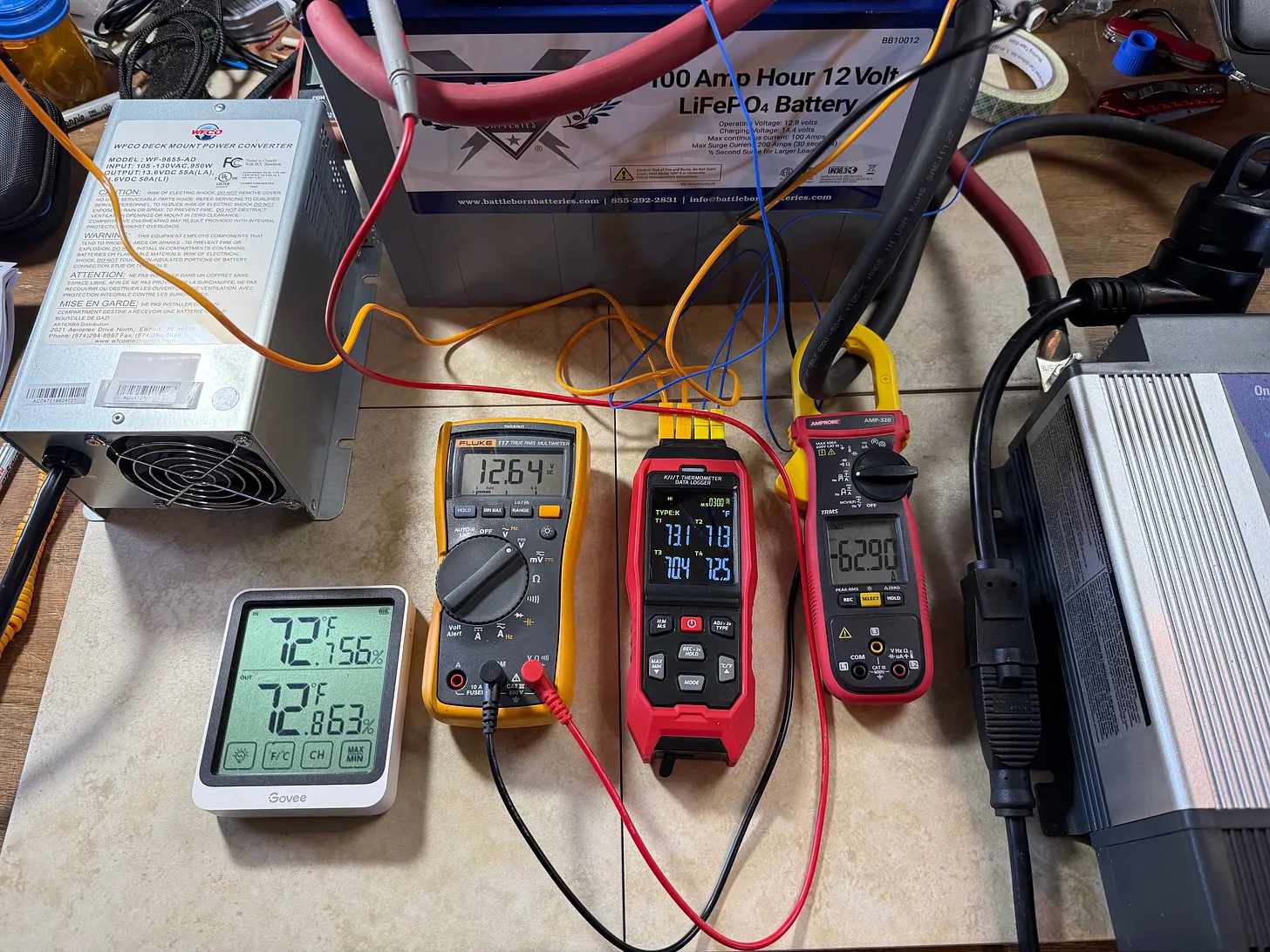
Electricity expert testing Battle Born battery

RV electricity expert and former RVTravel.com contributor Mike Sokol has been testing a Battle Born battery and is detailing it on his RVelectricity blog. 

His tests have shown no issues with the single unit he has been extensively testing. His testing includes both power charging and consumption as well as temperature measurements. 

Sokol is also planning to test two used Battle Born batteries. He is awaiting a shaker table that will shake the battery while it is being evaluated to attempt to recreate the circumstances a battery could face in an RV installation. 

Company that uses Battle Born issues hasn’t had issues with them outside of the norm

Another RV industry decision-maker, whom we spoke with whose company uses Battle Born batteries and other products from Dragonfly Energy, stated that their warranty experience with the product didn’t indicate that there were any issues outside of the norm. 

Another post on Battle Born Battery’s website specifically addressed some of the claims made by Prowse. 

In that post, the company disputes Prowse’s claim that he had no financial relationship with Battle Born, yet the company responded that he was paid more than $200,000 in affiliate commissions and advertising payments. 

The post stated, “His affiliate account with Battle Born was deactivated in October 2025. The first video in this series appeared six weeks later. The videos at issue direct viewers to a competitor storefront where he earns affiliate commissions on competing products.”

As always, we will follow the story as it unfolds. It has certainly gotten more and more interesting as details evolve. 


Further reading: RV gadgets and gizmos
The best kind of wedgie: Andersen RV levelers

By Tony Barthel
Automatic leveling systems have come a long way, and some travel trailers have seven-point automatic leveling systems. However, you can save many thousands of dollars and simplify your RV experience with a set of leveling wedges instead. I like to write about products I’ve found that I use regularly on the road, and these Andersen levelers are one of those products.

RVT1264b

What causes most RV fires? Here’s what firefighters say

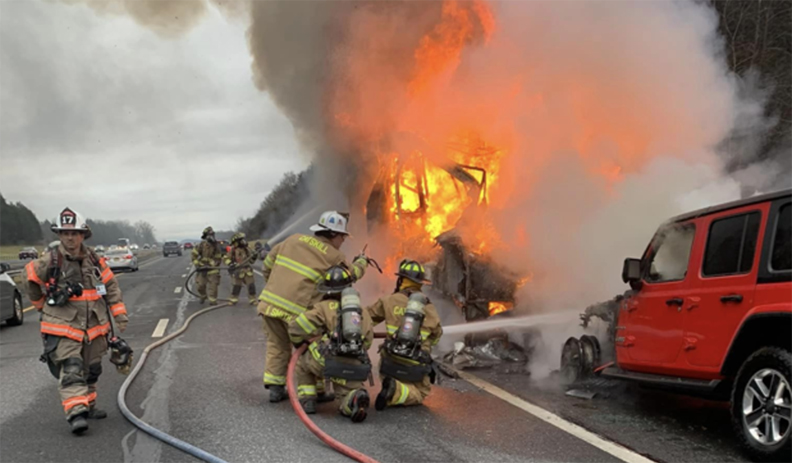
A fire that destroyed an RV being used as a residence in Pasco, Washington, recently drew firefighters to the scene and left investigators working to determine what caused the blaze. Officials have not identified the source of that fire, but the incident raises a question many RVers ask when they pass a burned rig on the shoulder of the highway: What causes most RV fires?

Many RV owners assume the biggest danger comes from the stove, furnace or propane system. Those hazards certainly exist. But federal fire data paints a different picture.

The U.S. Fire Administration’s most recent RV fire snapshot, based on 2018-2020 data, found an average of about 4,200 RV fires per year in the United States. Those fires result in an average of 15 deaths, 125 injuries and more than $60 million in property losses annually.

Perhaps the biggest surprise is where many of those fires start.

The biggest danger may be under the rig

Most RVers have seen a burned trailer or motorhome along the highway and wondered what happened. In many cases, the trouble started where nobody was looking.

According to the U.S. Fire Administration, the most common area of origin for RV fires is the engine, running gear and wheel area, accounting for 26.2% of reported RV fires. By comparison, cooking areas account for 7.7%. In fact, cooking ranks fourth among the listed areas of origin.

That means wheel bearings, brakes, tires, fuel leaks and engine-compartment problems deserve at least as much attention as the galley.

A wheel bearing running low on lubrication can generate tremendous heat. A brake that fails to release completely can do the same. Tire failures can damage nearby components and create ignition sources. In motorhomes, leaking fuel or oil can quickly turn a mechanical problem into a fire.

Many experienced RVers already make a habit of walking around their rig at fuel stops and rest breaks. That simple routine can reveal hot hubs, unusual odors, smoke, fluid leaks or other warning signs before they become a roadside emergency.

“Most RVers worry about the stove. Federal fire data says the most common fire origin is the engine, wheel and running-gear area.”

Electrical problems remain a major concern

Today’s RVs carry far more electrical equipment than many rigs did even a decade ago.

Lithium battery systems, inverters, solar arrays, residential refrigerators, multiple televisions and a growing collection of personal electronics all place demands on the electrical system.

The U.S. Fire Administration reports that equipment or heat-source failures account for nearly 15% of RV fires.

One common trouble spot is the shore-power connection. A loose plug, worn pedestal outlet or damaged power cord can generate significant heat long before a breaker trips.

Experts recommend checking cords and plugs regularly for discoloration, melting, cracking or other signs of overheating. Repeatedly tripping breakers deserve investigation, not simply another reset.

Cooking and heating still start fires

Cooking remains a major cause of fires across the country, and RVs are no exception.

A forgotten pan, grease flare-up or brief distraction can become serious quickly in a compact RV kitchen.

Heating equipment also deserves attention. Space heaters, furnaces and propane appliances require proper maintenance and adequate clearance. During cold weather, many RVers rely heavily on supplemental heaters, sometimes pushing equipment beyond its intended use.

The U.S. Fire Administration advises RV owners not to overload electrical outlets, to stay in the cooking area while preparing food, and to have their RV inspected regularly by a trained technician.

Small spaces leave little room for error

One reason RV fires can become devastating so quickly is simple: Everything sits close together.

An RV packs wiring, propane systems, fuel, furniture, insulation and personal belongings into a relatively small space. Once a fire gains momentum, occupants may have only moments to react.

The U.S. Fire Administration recommends maintaining smoke alarms, carbon monoxide detectors and fire extinguishers, keeping exits clear and practicing an escape plan with everyone who travels in the RV.

Interestingly, federal data shows that unintentional actions account for more than one-third of RV fires. Another 14.7% stem from equipment or heat-source failures.

That suggests many fires begin not with dramatic explosions or catastrophic failures, but with smaller problems that go unnoticed until it is too late.

The Pasco fire serves as a reminder that investigators don’t always immediately know what started a blaze. Sometimes the cause remains uncertain. But firefighters and federal fire data consistently point to the same trouble spots.

Many of the leading causes involve maintenance, equipment condition or everyday operating practices. A hot wheel hub, a damaged power cord, a neglected appliance or a suspicious odor may not seem like much at first. Catching them early could save a rig—and perhaps much more.

Sources:
Apple Valley News Now (Pasco RV fire)

U.S. Fire Administration, Data Snapshot: Recreational Vehicle Fires (2018-2020)
U.S. Fire Administration, Recreational Vehicle Fire Safety

RELATED

RVT1264b

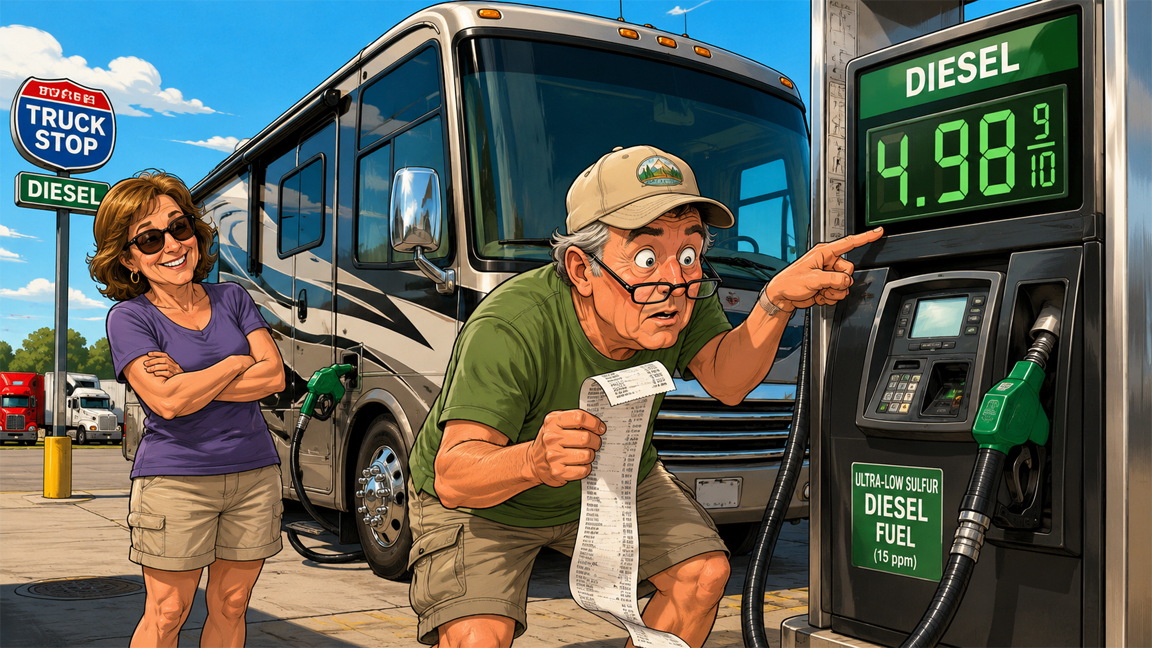
Diesel prices just posted a big drop. Will RVers finally catch a break?

Diesel RV owners haven’t had much reason to smile at the pump lately. After months of rising fuel costs, however, some welcome news finally arrived this week.

The national average price of diesel fell 17.3 cents per gallon during the week ending June 1. That marks the third consecutive weekly decline and one of the largest week-to-week drops seen in months. The national average now stands at $5.35 per gallon, down from $5.52 the previous week.

The question many RVers are asking is simple: Is this the beginning of real relief, or just a brief pause before prices climb again?

Diesel prices take a welcome turn

The declines were widespread. Some parts of the country saw diesel prices fall by more than 20 cents per gallon in a single week, with the Midwest posting the largest drop. Other regions also saw significant decreases as diesel retreated from the highs many RVers have been watching all spring.

For a diesel motorhome carrying a 100-gallon fuel tank, a 17-cent-per-gallon decline translates to about $17 less for a fill-up than it would have cost just one week earlier.

That’s not enough to fund a campground stay, but it beats watching the total rise every time you pull up to the pump.

“That’s not enough to fund a campground stay, but it beats watching the total rise every time you pull up to the pump.”

Diesel remains expensive

Before anyone starts celebrating, there’s an important reality check.

Even after the recent decline, diesel remains far more expensive than it was a year ago. The national average still sits nearly $1.90 per gallon above the same week in 2025.

Regional differences also remain dramatic.

According to recent fuel-price data, California continues to lead the nation at about $7.05 per gallon. The broader West Coast averages around $6.40. Meanwhile, the Gulf Coast sits below $5.00 per gallon, at roughly $4.90.

In practical terms, a 100-gallon fill-up in California can cost $200 more than the same fill-up along the Gulf Coast.

That kind of difference can easily affect route planning, travel budgets and how far some RVers decide to roam this summer.

Why prices are falling

Fuel analysts say lower oil prices are giving diesel some room to fall after weeks of sharp increases.

The decline has been large enough that trucking industry observers described diesel prices as “plunging” after months of steady upward pressure.

That doesn’t mean prices are guaranteed to keep falling. Earlier this year, supply concerns and shipping disruptions pushed diesel prices to record or near-record levels in many states. Energy markets remain sensitive to global events, particularly anything that affects oil production or transportation.

In other words, today’s good news could still be followed by tomorrow’s surprise.

What it means for RVers

For RV travelers planning summer trips, the recent decline is certainly better than another increase.

A diesel motorhome averaging 8 mpg on a 2,000-mile trip will burn roughly 250 gallons of fuel. A 17-cent-per-gallon reduction saves about $43 compared with fuel costs one week earlier.

That won’t completely transform a travel budget. But every little bit helps when campground fees, groceries and other travel costs continue to rise.

Nobody knows what fuel prices will do next month. But after a spring of watching diesel climb, most RV owners will gladly take a few weeks of movement in the other direction.

For now, diesel RV owners can enjoy something they haven’t seen much of lately: fuel prices heading down instead of up.

RELATED

RVT1264b

Recall: Trailers’ electric fireplaces may catch fire

1

Forest River is recalling certain 2024-2025 Wildwood and Salem travel trailers. The fireplace outlet may have incorrect wiring.

The wire may not make adequate contact into the self-contained receptacle, increasing the risk of a high amperage draw over loose connections, resulting in the increased risk of a fire.

In researching a possible problem, Forest River discovered it had used the incorrect wire for an outlet used on certain models.

A warning sign of a problem with the fireplace would be noticing the smell of smoke when using the fireplace. That would be normal in a wood-burning fireplace, but not with an electronic version in an RV.

As many as 2,249 RVs may be affected by the recall, which was issued May 29.

Remedy

Dealers will replace the wiring and outlet, free of charge. Owner notification letter are expected to be mailed July 8. Owners may contact Forest River customer service at (503) 831-5410.


Quick tip
Easy fix for sticky sliding windows

Ever had a sliding window “stick” when trying to open or close it? Frames can contract in cooler weather, making things tight. Reader Fred C. says his fix is lubricating the window tracks with a simple “puff” of white graphite powder. Why the white? “It doesn’t make a mess like the black stuff!” says Fred – the “smoother operator.” Thanks, Fred!


RELATED

RVT1264b

RV Daily Tips. Wednesday, June 3, 2026

America’s Original RV Newsletter. Since 2001
Issue 2918 • New issue every weekday
This free edition is made possible by 6% of our readers who support RV Travel with a voluntary subscription. Advertising helps, but that alone is not sufficient.


Today’s thought

“Half the lies they tell about me aren’t true.” —Yogi Berra


Need an excuse to celebrate? Today is National Egg Day!

On this day in history: 1889 – The first long-distance electric power transmission line in the United States is completed, running 14 miles (23 km) between a generator at Willamette Falls and downtown Portland, Oregon.


Tip of the day
11 egg-cellent tips for RVers who love eggs

By Gail Marsh
I’m not a big fan of chickens. An ill-mannered rooster chased and pecked my ankles when I was 6, but I still love eggs! Here are some egg-cellent tips for RVers. (Since today is National Egg Day, we had to share!)


2026 Sienna Lite SA140VFD travel trailerRV review
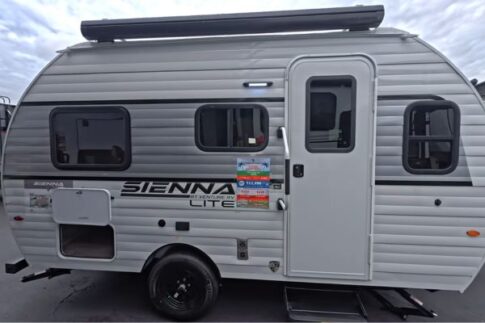
2026 Venture RV Sienna Lite SA140VFD travel trailer—Smart, low-price basics

How much camper does $13,999 buy at a major RV show? It buys a compact Venture RV Sienna Lite SA140VFD with a dry bath, a usable kitchen, and enough storage to feel more practical than its price suggests. The review came from the 2026 Florida RV SuperShow, where the trailer was listed at a show price of $13,999, down from an MSRP of $22,017. The price was event-specific, but it still showed what an entry-level trailer can look like when the goal is simple, affordable camping.


In the RV shop with Dustin
Using a water heater tank rinser is the key to maintaining your RV’s water heater

In the past, Dave Solberg and I met weekly for a livestream called Talkin’ RV Tech. We not only answered technical questions, but we also shared what we like to call “cool tools.” These are tools and gadgets that we actually use! We also believe they will be helpful to you. This captures one of our shares, the Camco water heater tank rinser.


ChafestickNo more painful chafing
Long travel days, summer heat, and hours behind the wheel can make skin irritation miserable—but this little stick helps stop chafing before it starts. Toss it in your RV, purse, or glove box for quick relief anywhere skin rubs, from thighs to waistbands, bra straps, to sore feet in walking shoes. Learn more or order.


Article and video
How to camp in cities without drawing attention

Thinking about urban camping? A lot of people believe that to camp in a city, you need a “stealth camper” to avoid unwanted attention. But is that really the case? It might not be. Here, the team from We’re the Russos explores why you might not need a stealth camper for urban stealth camping adventures.


Featured article
Does RV size, age, REALLY matter? 

By Lucinda Belden
We know size does matter when it comes to what campgrounds we want to get into. Or, if we want to boondock or stay in national and state parks. But have you had someone say to you, “How can you live or camp in an RV that small?” … We have no idea why the RVers around us have picked their RV. It might help each of us to stand back and not make snap judgments on other RVers’ rig choices. Here are some thoughts that should run through your mind when you start to question someone else’s RV choice.


WEDNESDAY WISDOM: You don’t have to see everything to have a wonderful trip. Slow down and enjoy what’s right in front of you.


Ask Dave
Does Airstream have a frame flex issue like some Grand Design RVs?

Read Dave’s answer.


Reader poll
How many miles are on your motorhome or tow vehicle?

Respond here.


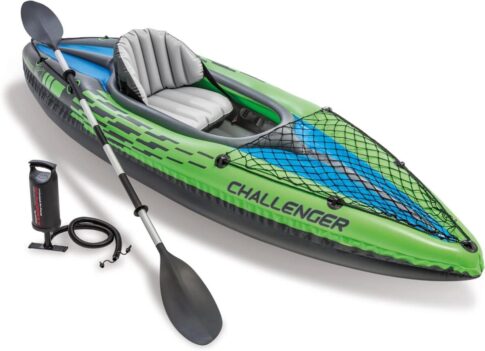
KayakOwn a kayak without taking up space! These inflatable kayaks are incredible, people love them, and they’re affordable! They are perfect for RVers, as they don’t weigh a lot or take up much space. Here’s a single and here’s a double.


Quick tip
Easy fix for sticky sliding windows

Ever had a sliding window “stick” when trying to open or close it? Frames can contract in cooler weather, making things tight. Reader Fred C. says his fix is lubricating the window tracks with a simple “puff” of white graphite powder. Why the white? “It doesn’t make a mess like the black stuff!” says Fred – the “smoother operator.” Thanks, Fred!


On this day last year…


Website of the day

SunsetWx
Gail Marsh mentioned this website a while back, and we gotta say, it’s pretty cool! If you want to see how intense the sunset or sunrise will be in your location, or at what time it will occur, this is the website.


? MYSTERY PRODUCT OF THE DAY ?
Get yourself an *almost* free vacation to Hawaii with this! Grab a chair, a towel, some sunscreen, a book, and you’ll be all set…


Trivia

A single blink of a Formula One racer’s eyes may be closed for 65 feet in competition, which is probably why drivers do it selectively. Unlike normal humans who blink randomly, these racers, researchers say, close their eyelids during the same parts of each lap. Data from eye trackers on helmets showed that racers avoid blinking while changing speed or rounding corners; they save blinking for straight stretches.


Readers’ pet of the day

Img 0664 F23902aef92343a7f89481b957e8d7c8“Zippy (Breed: Not sure. Just know he’s a dog. Age 11.) got dumped at 9 months with a broken rear leg. We have spent many dollars to save that leg. He runs around like a puppy. He is our guard dog when we leave the motorhome; burglars laugh so hard they leave.” —Don Capellani

HELP! WE’RE RUNNING LOW ON PET PHOTOS! Send us a photo of your pet with a short description. No blurry photos, and please do not submit your photo more than once. Thanks!

RVing with Dogs group on Facebook. You’ll love it.


Leave here with a laugh


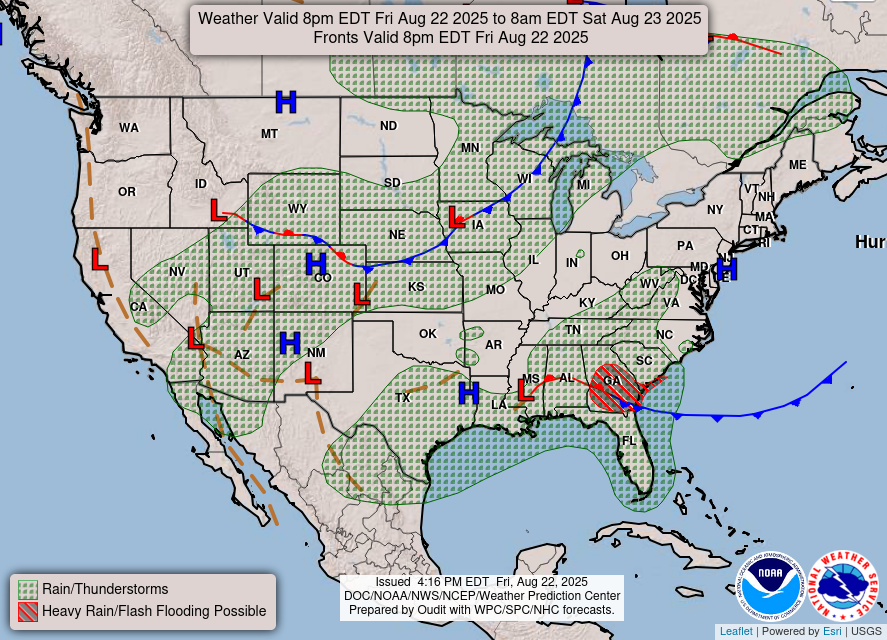
Today’s weather forecast across the nation
THIS MAP UPDATES TWICE A DAY

Visit Current National Radar Weather Map


Did you miss the latest RV Travel Newsletter? If so, read it here.
Oh, and if you missed the Latest News for RVers, make sure to catch up here.


If you shop at Amazon.com we’d appreciate you using this link. We get an itty bitty commission if you buy something, but they add up and help us pay our bills (most importantly our hard-working writers!). 


RVtravel.com All-Star Staff

Click here for information about our staff and how to contact us.

WHY WE ASK FOR DONATIONS INSTEAD OF SELLING SUBSCRIPTIONS.

Our policy on using artificial intelligence.

Does Airstream have a frame flex issue like some Grand Design RVs?

Dear Dave,
My Airstream has been diagnosed with having the dreaded body/frame separation. Repairs will be interesting. Is this a manufacturing issue, or caused by rough roads and/or something I have done? —Donald, 2020 Airstream International

Dear Donald,
I had not heard of this situation on Airstream trailers before. However, I don’t have a service center that works on dozens of units every week, so I did some research.

Frame flex does happen to other RV brands

In the Airstream forums it seems this is something that is not a crisis, but does happen. They call it front end separation (FES) or rear end separation (RES). It is caused by flex similar to the frame flex situation that Grand Design and Lippert have had.

Airstream manufactures a frame or chassis and shell that is considered a monocoque design. We also utilized it at Winnebago years ago. Rather than having a heavy, rigid frame, the shell and frame are integrated to flex together.

One particular forum had a post by an Airstream owner that had a 28′ 2016 International with the FES issue. You can read about it here.

Airstream
Airstream

It seems the front body shell sheared the rivets and disconnected from the frame. He took it into Can Am RV and got a real lesson in design, flex, and what might have cause this issue. The post went on to say that frame flex is caused by road conditions, which Dustin, at California RV Specialists, had indicated in several articles on the Grand Design issue (see links below).

It also stated that Airstream chose the Dexter softer axle suspension to lessen the stress and that proper tire pressure is also important.

Another cause of damaged trailer

One other piece of information was the equalizing/sway control hitch created a solid connection that was part of what damaged the trailer. All the vibration and swaying from the tow vehicle and the road was transferred to the solid connection of the hitch and therefore to the tongue and front of the body. This excess stress was more than the rivets could handle and they sheared off. Some good news is that it can be fixed and reinforced. I assume yours can, as well.

As for the hitch, the tech at Can Am RV recommended an Eaz-Lift, which is softer and the stress is absorbed by the bars. He also recommended 10-12 psi in the air bags and 80 psi in the rear tires. I would recommend weighing the rig and verifying recommended pressure in the tires by the weight and consult the tire manufacturer’s tire chart, which you can get at www.rvsafety.com.

One of the commenters on the post had a similar situation. A technician told him that the front storage compartment had four frame ribs extending from the top. However, two did not go all the way to the floor and the L bracket did not provide enough support.

More recommendations from commenters

Several comments also recommended not going over 50% front axle load restoration (FALR) on your equalizing hitch. So, there are several “tweaks” that can help with reducing the stress applied to the front body.

Therefore, I do think it is a weak design by Airstream. But it is not a catastrophe, as many rigs are subjected to harsh conditions such as deep egress in and out of filling stations, rough campground roads, off-roading, highway heaves, and overloading conditions. It was not something you necessarily did wrong. You just need to know more about the dynamics of all the items discussed and figure out what works in your situation.


 More frame flex posts 

DAVE HAS ANSWERED MORE THAN 1,000 readers’ maintenance and repair questions. Read a directory here. There is so much to learn!


Dave Solberg is a leading expert in the RV industry and the author of the “RV Handbook.”

HAVE A QUESTION FOR DAVE?

Send your inquiries to him using the form below.

Name
Drag & Drop Files, Choose Files to Upload

RVDT2918