Home Blog Page 22

Big Ford Bronco recall—roof pieces may crack and become loose, detach

1

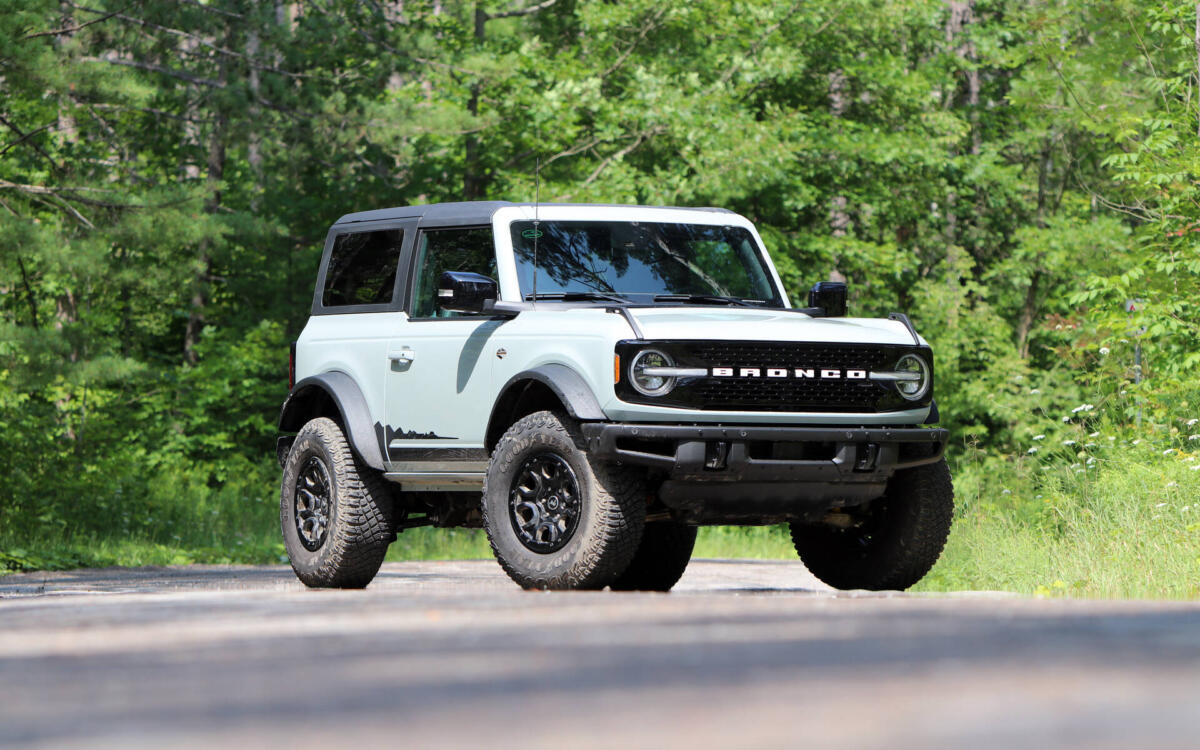
If you own a Ford Bronco, this is one recall worth checking right away. Ford has recalled 16,200 model year 2021-2022 Broncos equipped with Molded-In-Color hard tops.

Recall reason

Ford is recalling the Broncos because the roof’s outer skin may crack or delaminate. Owners should be aware that the problem is not just cosmetic. NHTSA says the roof pieces can become a road hazard if they come loose. This raises crash risk for other drivers, too, because in severe cases, sections of the top can detach while driving.

Owners may notice cracking, delamination, or extra wind noise before the roof gets worse.

Ford said the problem was caused by flaws in the supplier’s manufacturing process that may have weakened the roof panels.

Affected vehicles

According to documents filed with the National Highway Traffic Safety Administration, the recall affects 16,200 model year 2021 and 2022 Ford Broncos equipped with molded-in-color hard tops.

Here is what the NHTSA says:

Affected vehicles are equipped with 3-door and 5-door Molded-In-Color (MIC) hard tops that may exhibit delamination or cracking in the exterior skin of the roof panel that may progress to detachment of sections of the outer layer while driving. This concern affects MIC hard tops on vehicles built between September 23, 2020, and January 13, 2022, for 3-door body styles, and between September 23, 2020, and October 22, 2021, for 5-door body styles.

Why it matters

For RVers, this recall matters because many RV enthusiasts tow a Bronco to be used for campsite runs, trail access, and around-town travel while they are on the road.

What to do

The safest move is to check your VIN as soon as possible on NHTSA’s recall lookup or Ford’s recall page. That’s because these vehicles are not listed in VIN order, and the recall can affect some Broncos while leaving others untouched.

Ford’s filing says owners can also call Ford at 1-866-436-7332. You can also ask a Ford or Lincoln dealer to check the OASIS database for applicability.

NHTSA notes that VINs were planned to be searchable starting May 12, 2026, with interim owner letters beginning May 27, 2026, and remedy letters scheduled for November 5, 2026.

Free fix

If your Bronco is included, the repair is free. Ford says dealers will inspect the hard top and replace any roof that shows cracking or delamination. The replacement part will be built using updated manufacturing processes to address the earlier issue.

NHTSA’s recall filing also lists consumer advisories to not drive and to park outside. If you see visible roof damage, it’s smart to treat the situation cautiously until a dealer checks it.

Act now!

For RVers who own Broncos and who are getting ready to head out in an RV, the bottom line is simple. Do the VIN check now. Do not wait for the mailer and schedule the dealer visit as soon as Ford confirms your Bronco is part of the recall.

Even though Ford had not reported accidents or injuries tied to this defect as of the filing, a roof panel that can crack or separate is not something to ignore before a long trip. Ford’s number for this recall is 26S32.

MORE RECENT FORD RECALLS

RVT1263b

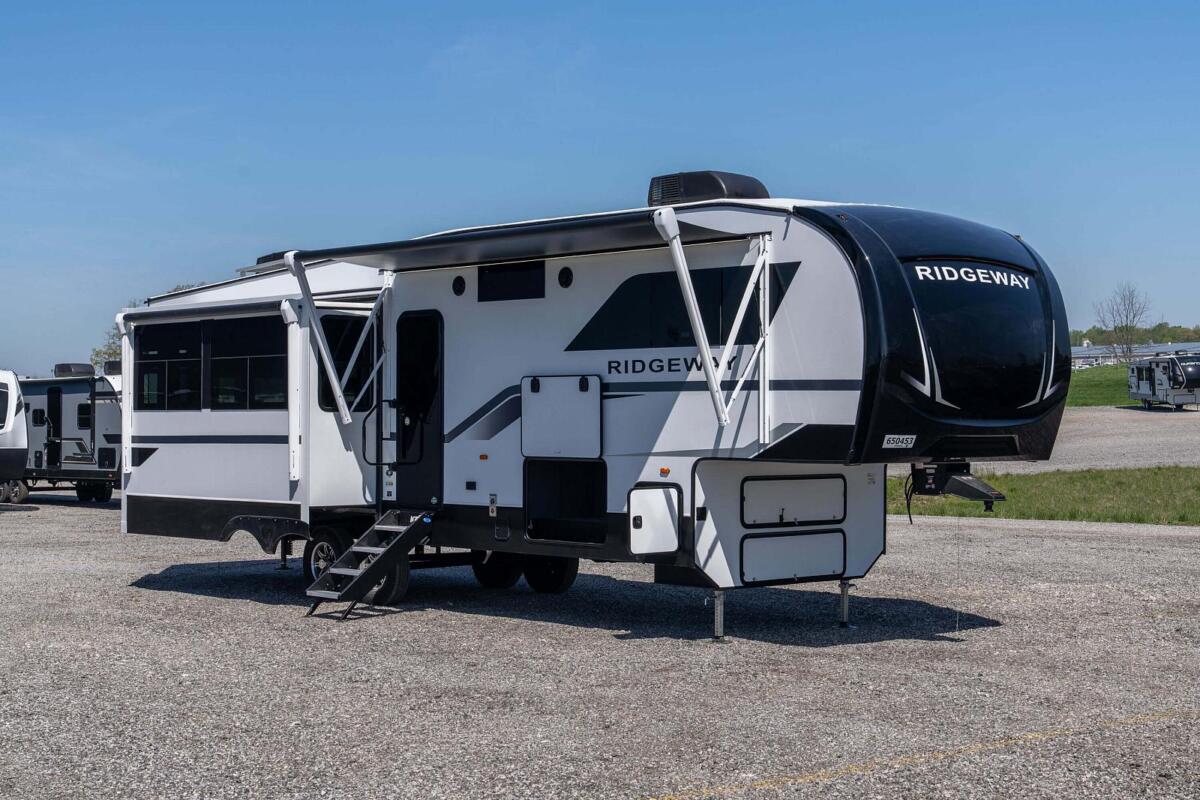
2026 KZ Ridgeway 32ML fifth wheel: A couples-friendly layout

Home vibes. That’s what immediately came to my mind upon entering the 2026 KZ RV Ridgeway 32ML fifth wheel RV. This RV has plenty of space for couples and offers down-home comfort at every turn.

Behind the walls

KZ RV builds the Ridgeway on a steel powder-coated I-beam chassis. It features 5-sided aluminum framing, laminated Azdel, and composite sidewalls. You’ll also find a heated and enclosed insulated underbelly, and Dicor Tufflex™ PVC roofing.

The Ridgeway also offers RVers frameless windows, 4-point auto leveling, and solar prep. The 32ML should appeal to buyers who want an upgraded fifth wheel feel right from the factory.

Key specs

  • UVW: 10,260 lbs.
  • Dry hitch weight: 1,850 lbs.
  • Dry axle weight: 8,410 lbs.
  • CCC: 2,735 lbs.
  • GVWR: 12,995 lbs.
  • Exterior height with A/C: 12’11”
  • Exterior width: 96″
  • Exterior length: 35’4″
  • Refrigerator: 12 cu. ft.
  • Water heater: on-demand tankless
  • Fresh water capacity: 76 gal.
  • Gray water capacity: 50 gal.
  • Waste water capacity: 50 gal.
  • LP gas capacity: 60 lbs.
  • Furnace: 35,000 BTUs
  • Axle size: 6,000 lbs.
  • Tire size: 16″
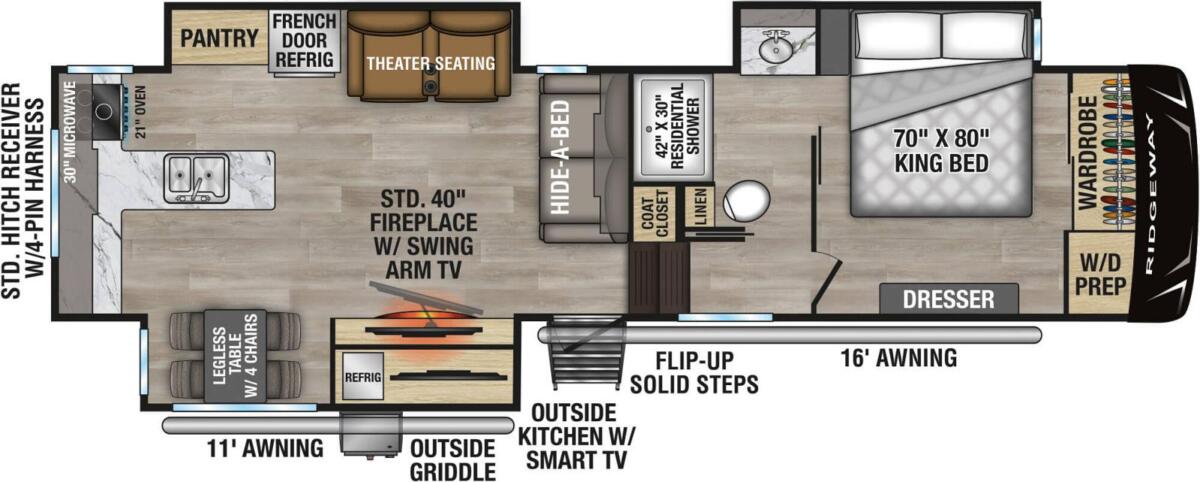
  • Awning: 16’/11′
  • Price: MSRP is listed at $101,330, but advertised for sale as low as $67,495

Interior and living space

Ridgeway 32ML fifth wheel image: Ridgeway website

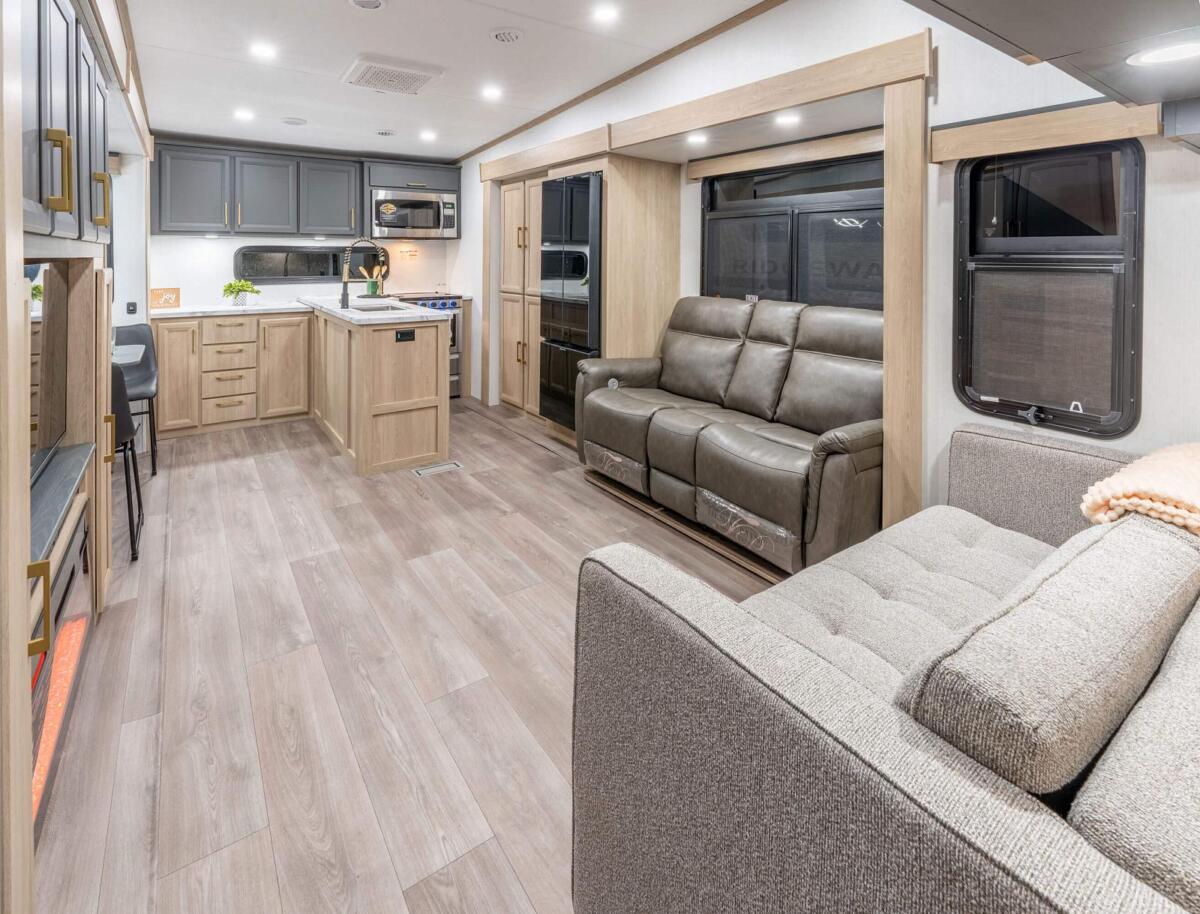
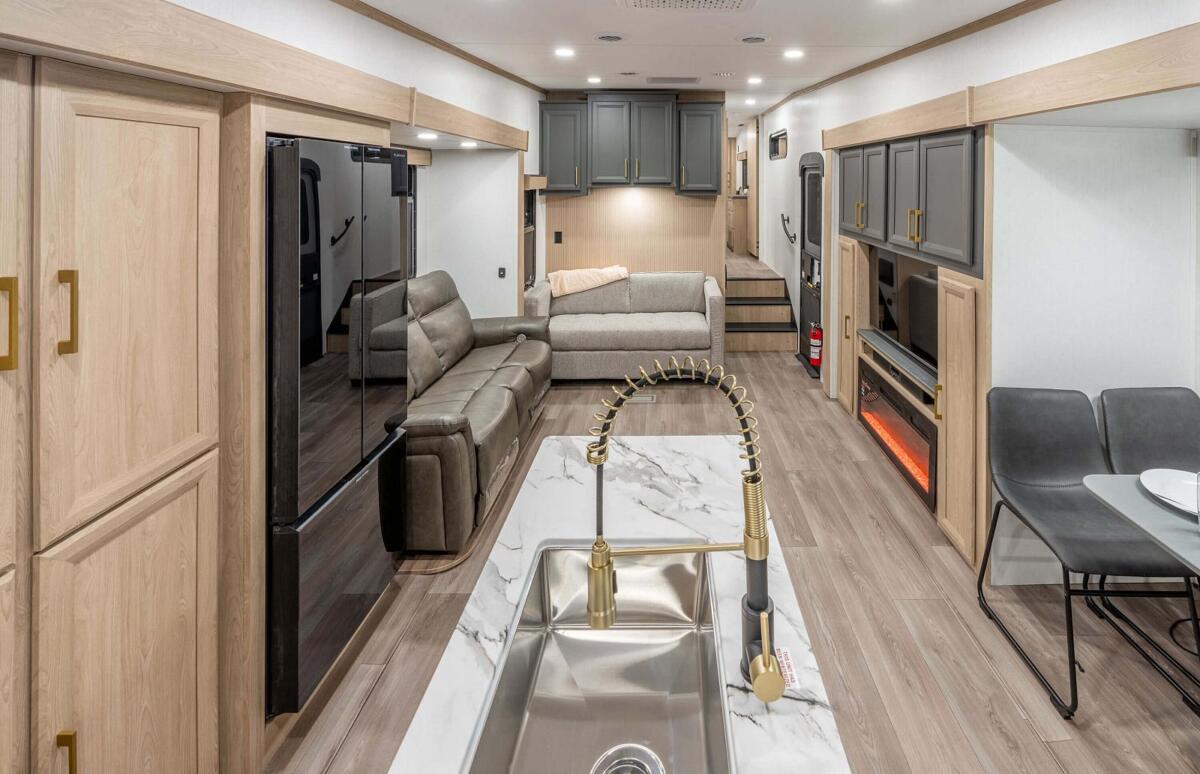
The 32ML’s three slides really open up the interior of this RV. The layout gives you an easy sightline through the coach, and the light wood tones help brighten up the interior.

Ridgeway 32ML fifth wheel image: Ridgeway website

Clean finishes give the 32ML a more residential than rustic mood. It is the kind of interior that I’d feel happy with for a weekend or a long seasonal stay.

Kitchen

Ridgeway 32ML fifth wheel image: Ridgeway website

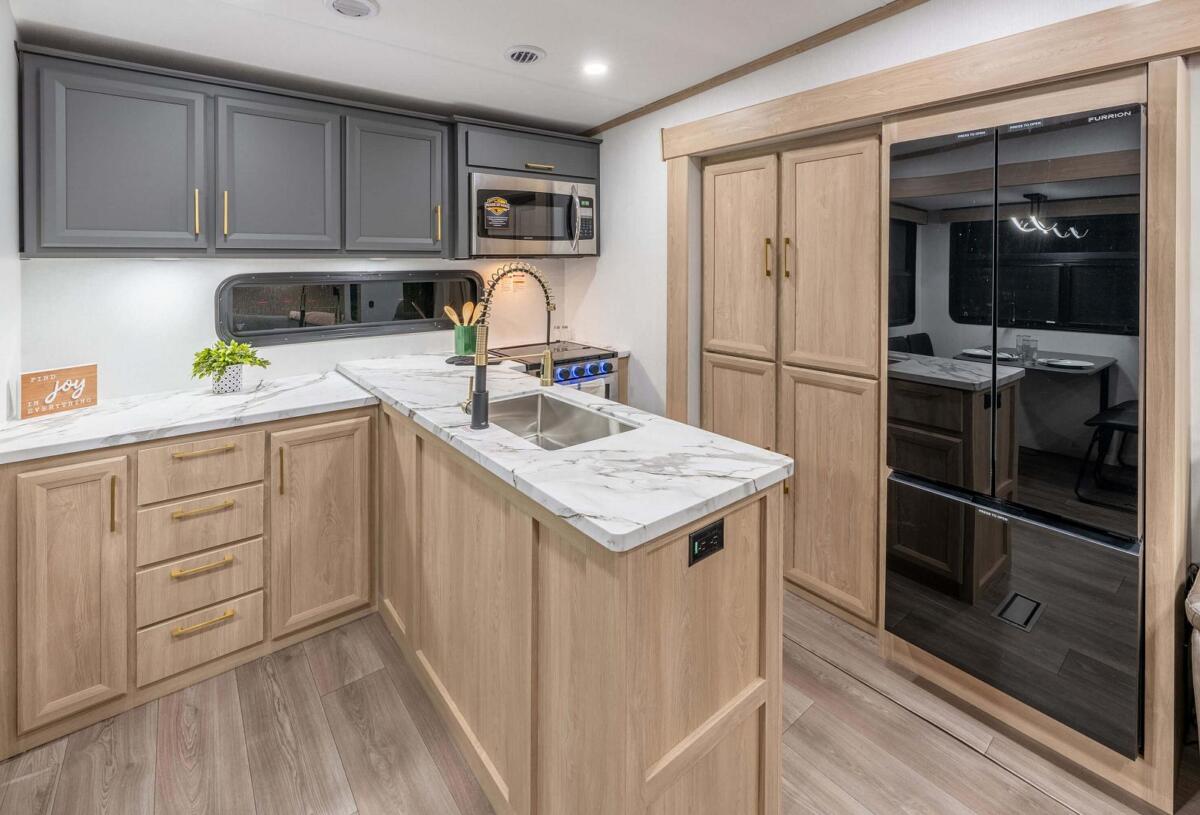
The 32ML kitchen is positioned at the rear of the RV and includes a peninsula with seamless countertops. I appreciate all of the prep space, but can’t help wondering if an island rather than a peninsula would have been a better design choice.

You’ll also see a deep undermount sink, a 21-inch oven, a 30-inch microwave, and a 12-cubic-foot refrigerator. There is plenty of pantry space and drawers for kitchen and cooking items.

Dovetail construction in the drawer boxes, hidden hinges, and a residential-style faucet all help the space feel more like an apartment kitchen than a typical camper galley.

I like two-tone cabinets—just not a mix of wood tone and gray as featured in the Ridgeway 32ML. I would have preferred either all gray or all wood tone rather than a mix of these two color choices.

Living/dining areas

Ridgeway 32ML fifth wheel image: Ridgeway website

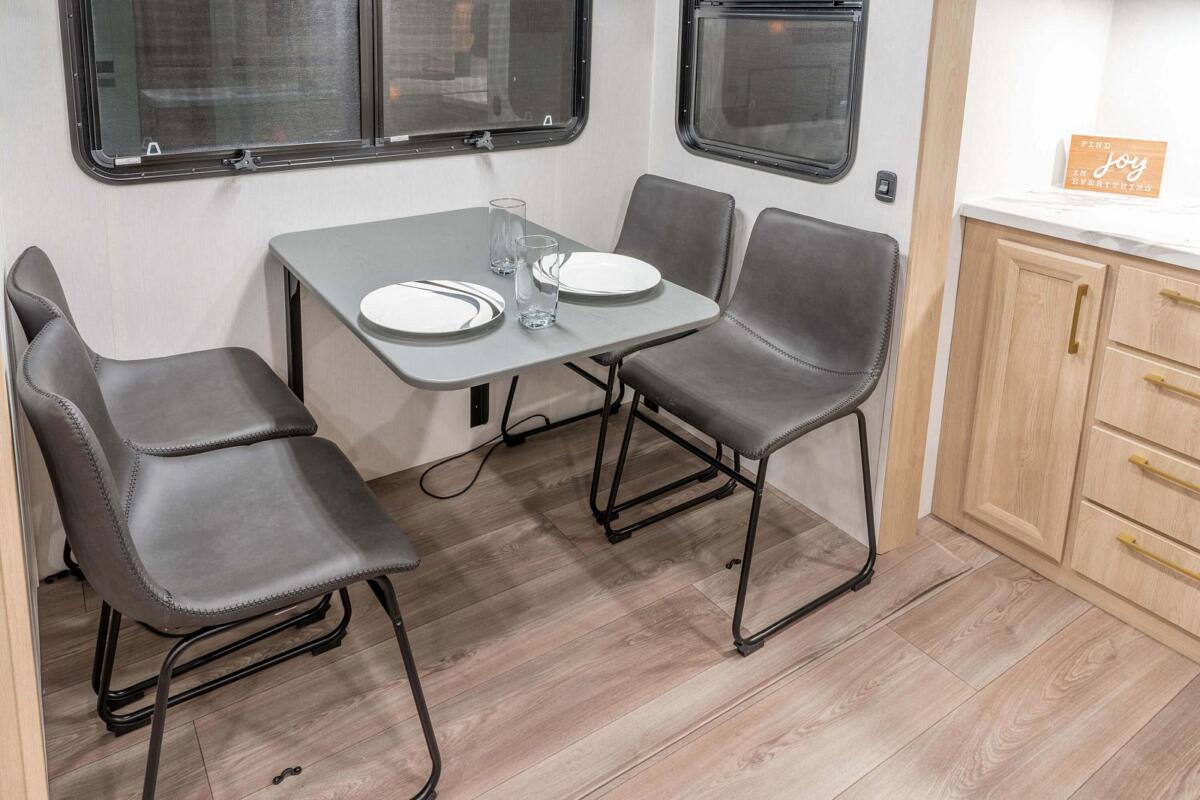
The dining area features a wall-mounted table (no center support legs or annoying angle braces), which makes for comfortable dining. Instead of a banquette, there are four chairs. I like this because the chairs can be moved to the living area for additional seating when needed. I’m not a big fan of the light fixture over the table, but it could be replaced with something more to my taste.

Ridgeway 32ML fifth wheel image: Ridgeway website

The living area is built for relaxation. Theater seating is positioned across from the entertainment wall, which includes the TV, fireplace, and sound bar. There’s also a sofa and overhead cabinets for extra storage, which I like. The large windows help the living spaces feel bright and roomy.

Bath

Ridgeway 32ML fifth wheel image: Ridgeway website

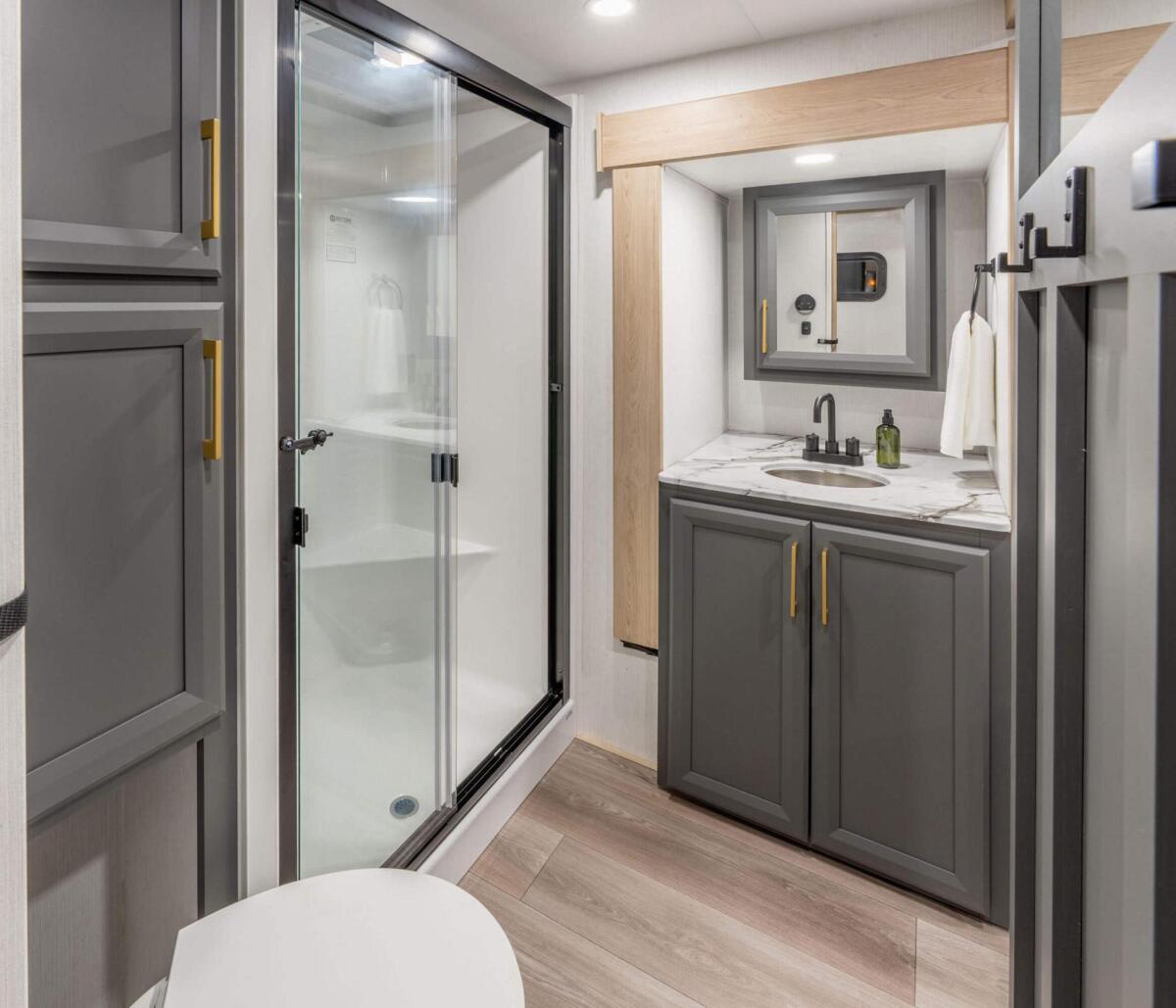
The Ridgeway 32ML bathroom features a large shower with an integrated bench. The sink vanity has plenty of counter space, and there’s also a medicine cabinet and separate cabinet storage for towels. I like that there are towel hooks, though I would prefer towel rods instead. Also, I’m not a fan of the double-entry doors to the bathroom. But that’s just me.

Bedroom

Ridgeway 32ML fifth wheel image: Ridgeway website

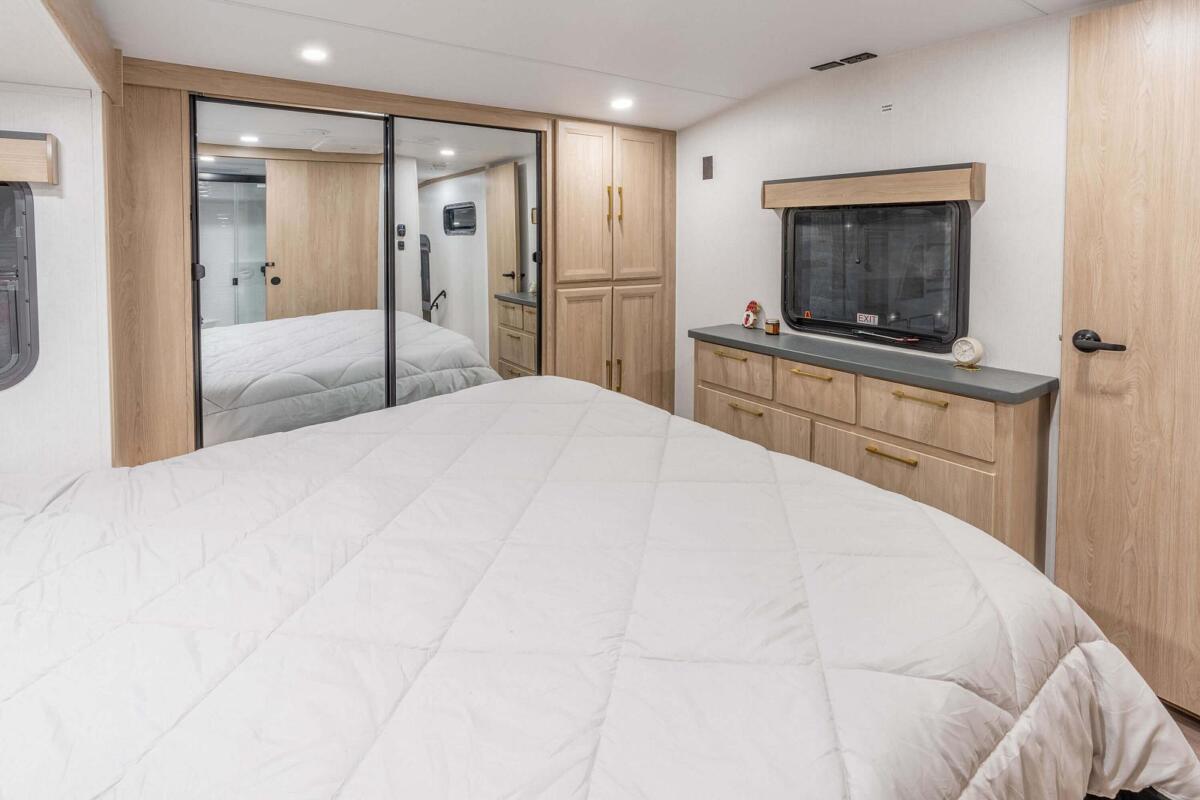
Up front, the bedroom offers a 70″ x 80″ king bed, with a nightstand on one side. There’s easy access to both sides of the bed, but I wish they’d opted for a queen bed to allow for nightstands on both sides.

There’s plenty of wardrobe and closet storage for a longer stay, and also prep for a washer/dryer, as well. I love all the drawer space and the large egress window. However, accessing the window seems a bit problematic because it’s positioned above the dresser.

Overall take

The 2026 KZ RV Ridgeway 32ML is a strong fit for RVers who want a fifth wheel that feels upscale, comfortable, and practical without going to a massive family bunkhouse. The rear kitchen, generous living area, and solid construction package make it a fifth wheel to consider if you’re in the market to purchase a new rig.

Take a short video walkthrough here and then share your thoughts using the comments below.

Learn more about it on KZ’s website here.

RELATED

RVDT2915

$67 million in National Park visitor fees redirected to Trump’s D.C. projects

RVers who buy national park entrance passes or pay gate fees often assume that money stays close to the parks they visit. A new report from The New York Times says that’s only partly true—and some of those dollars are now helping fund major restoration projects in Washington, D.C.

According to the report, the National Park Service is using at least $67 million in park entrance fee revenue to help pay for projects in the nation’s capital. That includes repairs to ornamental fountains and work on the Lincoln Memorial Reflecting Pool ahead of America’s 250th anniversary celebrations.

That may surprise RVers who have watched campground roads crumble, bathrooms close for repairs, dump stations fail or reservation pressure increase at heavily used parks.

Still, the situation is more complicated than it may first sound.

Why some fee money leaves the parks where it was collected

Under federal law, at least 80% of entrance fee revenue collected at a park must stay at that park. The remaining portion can legally be used elsewhere in the park system, including sites that do not charge entrance fees at all.

That means the spending itself is not illegal or outside long-established rules. The debate centers more on priorities—especially at a time when the park system still faces a massive maintenance backlog involving roads, sewer systems, visitor facilities and aging infrastructure.

For RVers, that backlog is not abstract.

What RVers may notice when maintenance gets delayed

Even when parks are crowded and entrance fees keep rising, those dollars do not always stay local.

Anyone who has bounced through pothole-riddled campground loops, dealt with closed restrooms or found reservation systems strained during peak season has already seen the effects of deferred maintenance. Parks such as Zion National Park have publicly struggled with infrastructure needs, including sewer system concerns and heavy visitation pressure.

The New York Times analysis found that more than three-quarters of recreation-fee spending between December 2025 and March 2026 went toward projects in Washington, D.C. That appears to be a much larger share than in recent years.

Critics argue that park visitors expect fee dollars to support practical needs at the parks themselves. Supporters of the D.C. projects counter that the National Mall, memorials and related sites are also part of the national park system and receive enormous public use.

For RVers, the bigger issue may not be politics at all. It may simply be transparency.

Why the debate is about priorities as much as politics

Many travelers probably don’t realize that the National Park Service can redirect a portion of entrance fee revenue to other parks instead of spending all of it at the park that collected the money. The current discussion is shining a brighter light on how that system works.

It also arrives during a period when many RVers already feel squeezed by higher campground costs, reservation restrictions, and growing entrance fees at some parks. That can make questions about where the fee money goes feel more personal than political.

Summer travelers will still face crowded parks and rising entrance fees, but the National Park Service will not spend all of those dollars at the parks where visitors paid them.

MORE ON NATIONAL PARKS

RVT1263b

This fifth wheel hitch bent badly—and somehow stayed together for 300 miles

If this showed up in your truck bed after a travel day, your stomach would probably hit the floor.

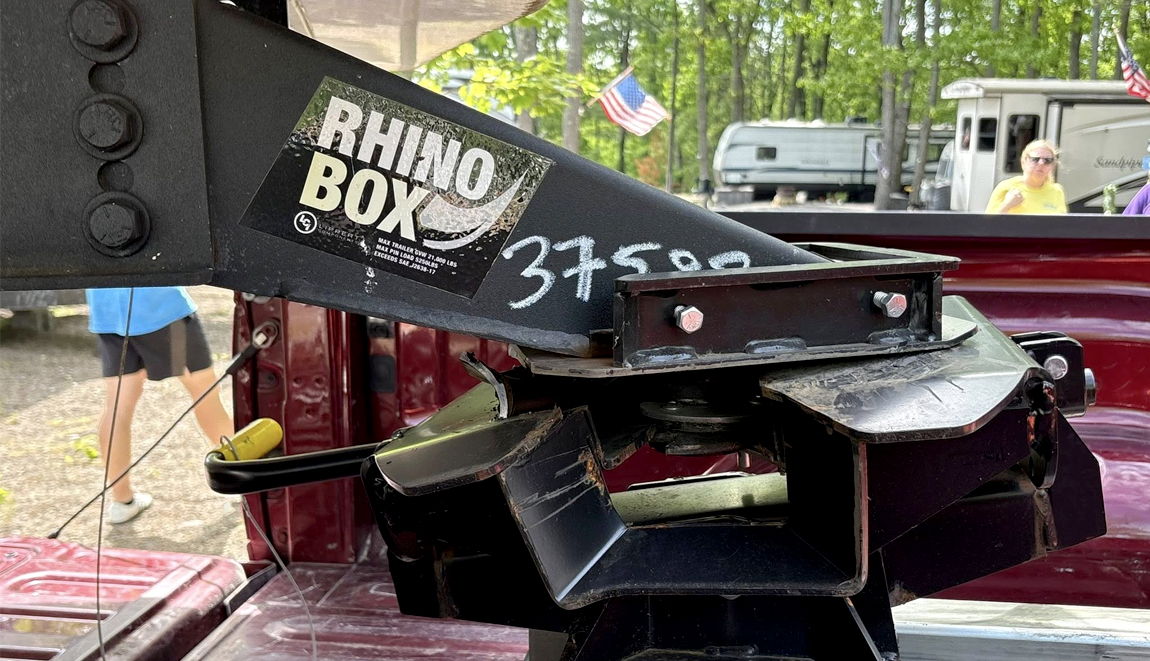
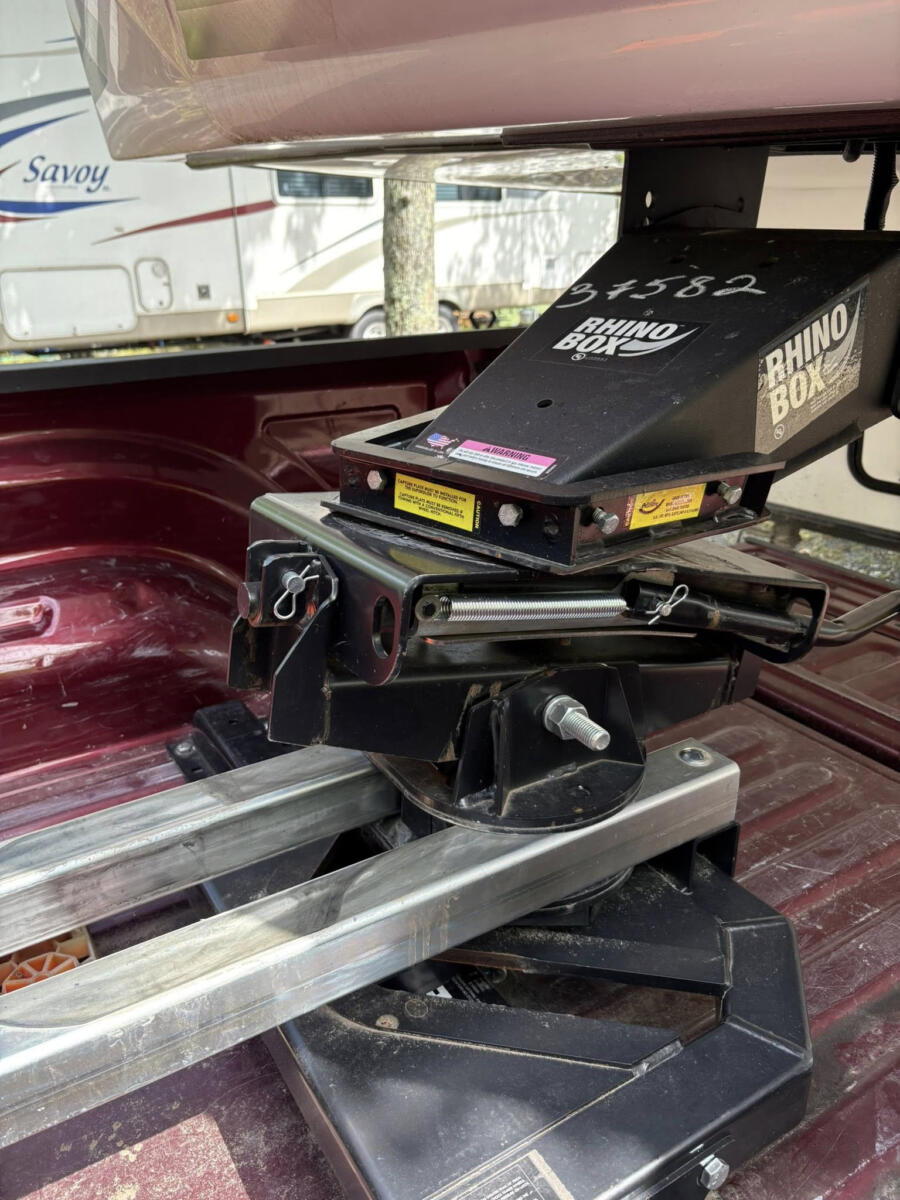
A fifth wheel owner recently posted photos showing a fifth wheel hitch failure so severe it is hard to believe the setup stayed together for another 300 miles. The owner said they discovered the damage only after the trip was over

“I’m not sure how this happened, but I’m glad it stayed on for the 300 miles it did,” the owner wrote. “Anyone else ever have this happen?”

The owner said they had used the same truck, hitch and fifth wheel setup for about four years without trouble before this trip. But this time, the route included rough highways, bumps and construction zones.

And whatever happened here, something clearly went very wrong.

What appears to have failed

Another view of the damaged fifth wheel hitch assembly shows the upper rotating structure visibly twisted and no longer sitting square on the hitch base. Ken Rob on Facebook. (Click to enlarge.)

You don’t have to be a hitch expert to see that something in this setup bent badly when it absolutely should not have.

The photos appear to show major distortion around the rotating turret area of a Sidewinder-style pin box setup. Metal plates that should sit flat now appear twisted upward and warped around the pivot assembly.

Even more surprising, the hitch apparently stayed together the entire time the RV was being towed.

At least from the photos, the rails and lower hitch structure in the truck bed still appear mostly intact. The damage seems concentrated higher up in the rotating portion of the assembly.

At this point, nobody online really seems to know exactly what failed first.

The owner later updated the post to say an RV technician would inspect the hitch and determine whether any warranty coverage might apply.

Why rough roads may have mattered

The owner mentioned the trip included rough pavement, bumps and highway construction.

That doesn’t necessarily mean the roads caused the problem. Still, anyone who has dragged a heavy fifth wheel through miles of rough pavement and construction zones knows how violently those conditions can jolt a hitch assembly.

Repeated shock loads, heavy pin weights and years of towing stress can all take a toll on hitch components and may contribute to a fifth wheel hitch failure over time.

If there was already fatigue, cracking or wear developing somewhere in the assembly, a rough stretch of highway may simply have been the moment things finally gave way.

What RVers may want to inspect before the next trip

Most fifth wheel owners are pretty good about checking the obvious things before heading out. They look at hitch jaws, rails, safety pins and visible hardware.

But many probably spend less time examining the rotating turret area itself for signs of movement, stress or distortion.

For RVers looking at these photos and wondering what they should watch for on their own setup, obvious warning signs could include unusual clunking sounds, shifting gaps between metal plates, fresh rust around welds, or hitch components that no longer appear to sit square.

And, in this case, the owner may have gotten extremely lucky.

Because looking at these photos, it’s hard not to wonder what might have happened if the remaining metal had finally given way at highway speed.

Sometimes the scariest RV problems are the ones that stay hidden until the trip is over.

RELATED

RVT1263b

RV Daily Tips. Thursday, May 28, 2026

America’s Original RV Newsletter. Since 2001
Issue 2914 • New issue every weekday


Today’s thought

“The only way to have a friend is to be one.” —Ralph Waldo Emerson


Need an excuse to celebrate? Today is National Hamburger Day! [Check out the freebie below.]

On this day in history: 1892—The Sierra Club is formed by John Muir and others in San Francisco for the conservation of nature.


Tip of the day
All about RV convection ovens: When and when not to use

By Cheri Sicard
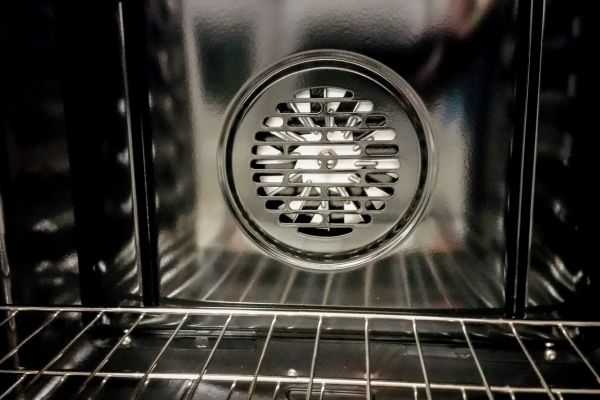
A lot of new RVs come equipped with RV convection ovens. But what does that convection fan do? When should you use it? Are there times it would be better to leave off the convection option? The video here from Helen Rennie will answer all. Helen illustrates some key differences in the way convection ovens cook as opposed to conventional ovens. Here’s what she found.


Article and video
RVing in the rain: How to add waterproof outdoor space to your camp

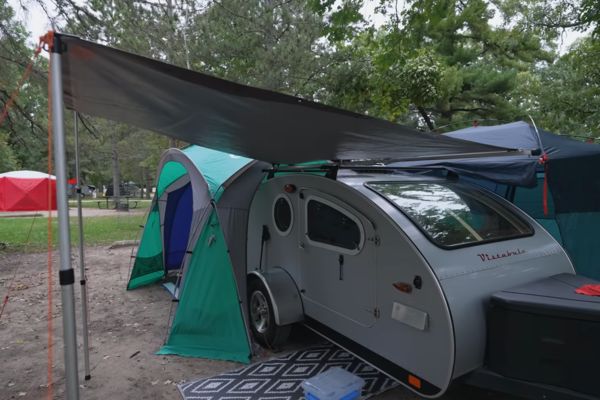
A tiny trailer feels cozy until a storm parks over camp at 2 p.m. Then every square foot matters. When RVing in the rain, the right awning, shelter, or side room can turn a tiny camper into a much easier place to live in bad weather. In the video at the end of this post, the team from Playing with Sticks shares rainy day RVing tips.


CRC Electrical QDSpray protects your RV’s most important electrical connection
Corroded plugs cause big problems and this simple electrical cleaner helps stop them before they start. A quick spray on your 7-pin connector clears moisture, grime, and buildup, helping keep your lights, brakes, and charging systems working as they should. It dries fast, leaves no residue, and takes about 10 seconds to use. Read Dave’s recommendation here, or learn more or order on Amazon.


Featured article
Worth a visit: A house made out of newspaper!

By Gail Marsh
My husband and I have worked on several volunteer building projects since our retirement a few years ago. We’ve mostly worked with typical building materials, so I’ll admit, I was fascinated when I learned that there is a house made from—wait for it—newspapers! Wouldn’t you love to see this? Well, you can! You can tour The Paper House, and it’s truly one of a kind!


RANDOM RV THOUGHT: It’s amazing how many people suddenly become weather experts when camping.


Trusted by Full-Time RVers
Americas Mailbox offers secure mail forwarding, scanning, and residency services tailored to life on the road, plus tax savings. Learn more.


Ask Dave
Oil has been in the ground for millions of years. Why do I need to change it regularly?

Read Dave’s answer.


Reader poll
Will your next RV trip in the USA be to a destination east or west of the Mississippi River?

Respond here.


Quick tip
Braking distance while towing?

How much does the typical 3500-pound trailer affect braking distances? Obviously, the added weight of any trailer will affect braking distances. Pinpointing exact distances depends on factors like if the trailer is equipped with brakes and the tongue weight. The best way to be safe is to avoid emergencies in the first place by allowing as much space as possible between you and vehicles ahead of you: double the standard “two-second rule” and double the space between you and the vehicle ahead. And the heavier the load, the more space you should allow.


DO YOU HAVE A PORTABLE JUMP STARTER FOR YOUR CAR AND RV? You need one! It’s a must-have item and could save you big bucks and money! Here’s the best one.


Website of the day

WorkingCouples.com
WorkingCouples.com is an active website with many quality job offerings, all aimed at couples. The work is varied—there are jobs for caregiver, apartment manager, “houseparent couple,” ranch hand, building manager, campground host… and the list goes on. Search for jobs by location or type. WorkingCouples.com bills itself as “the single largest resource of jobs-for-two anywhere.”


And the survey says…

We’ve polled RVtravel.com readers more than 5,000 times in recent years. Here are a few things we’ve learned about them:

• 3 percent own a boat with self-contained living facilities.
• 63 percent have turned away from an RV park upon arrival because its appearance looked junky and/or unappealing.
• 34 percent say they always stop and go out of their way to visit offbeat roadside attractions.

Recent poll: Have you ever had mice, rats, or other critters get into your RV?


Trivia

A chipmunk can stuff its cheek pouches with an amount of food nearly equal to its own body volume. In one trip, it may carry 8–10 peanuts (in shells), several acorns, or dozens of seeds. Its expandable cheek pouches stretch back toward the shoulders, letting it haul multiple ounces at once—an impressive load for such a tiny animal.


Readers’ pet of the day

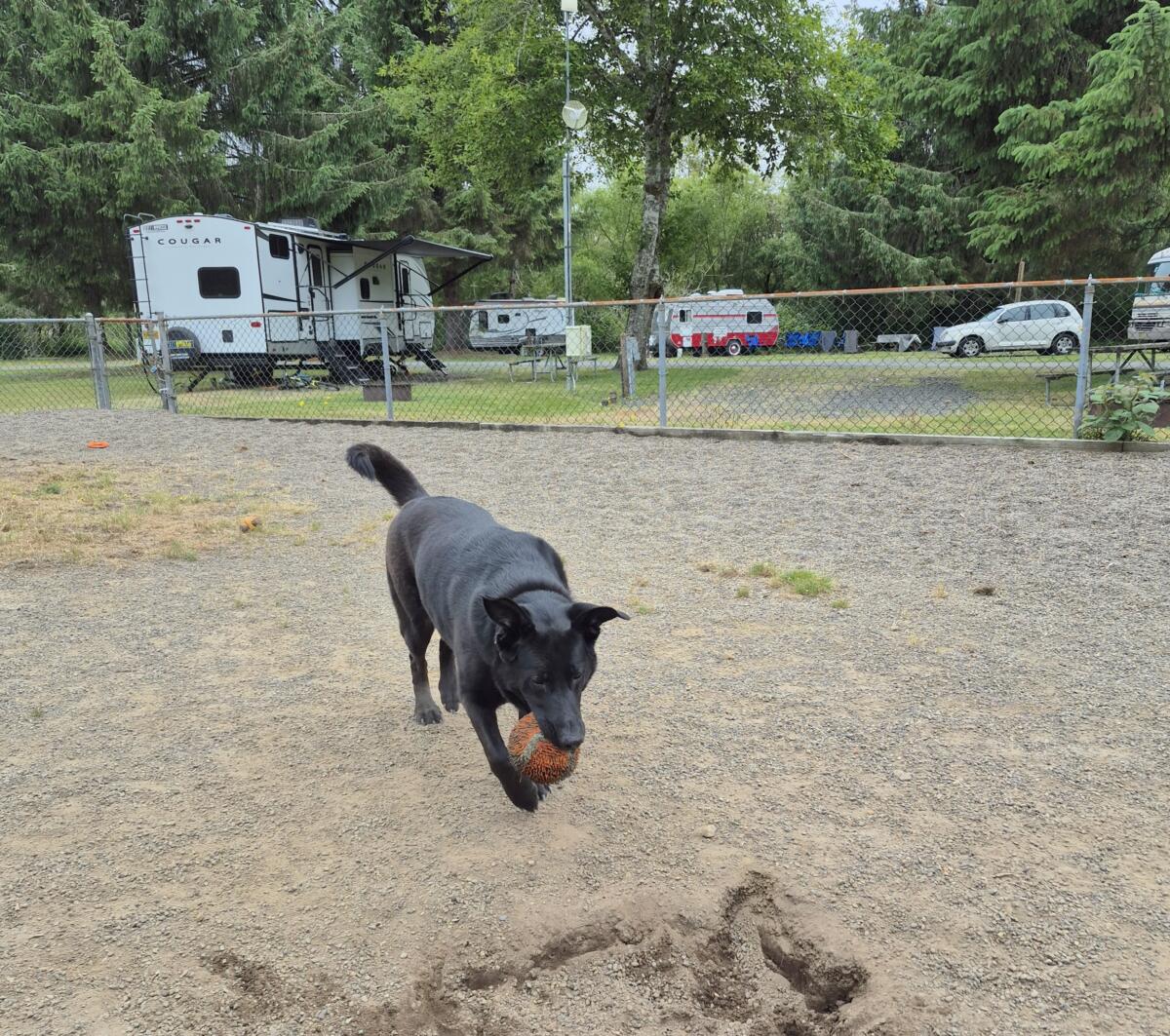
20250624 143149 1341935a56929a1d3a6d787aec0f3102“Lily (German Shepherd/Lab mix, age 6) is a rescue and really enjoys camping. She knows strangers, whether human or animal. She loves to play ball and would do it all day if we didn’t wear out first.” —Deborah Kirkman

Send us a photo of your pet with a short description. No blurry photos, and please do not submit your photo more than once. Thanks!

Pet Food and all pet products at Amazon
RVing with Dogs group on Facebook. You’ll love it.


FREE IS GOOD! In celebration of National Hamburger Day today, May 28, wear or show ANY American Flag item (hat, shirt, pin, etc.) and score a FREE Double Steakburger at Steak ‘n Shake. Valid in-store only. Limit 1 per person.


? MYSTERY PRODUCT OF THE DAY ?
This is PERFECT for RVers! Leave your valuables in plain sight and nobody will ever know! How? Well, you’ll see!


Leave here with a laugh


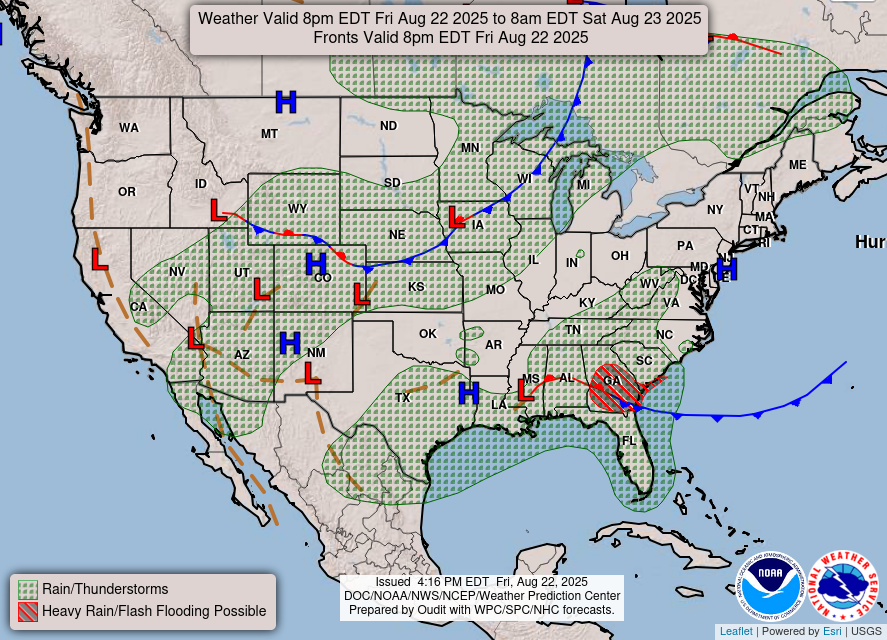
Today’s weather forecast across the nation
THIS MAP UPDATES TWICE A DAY

Visit Current National Radar Weather Map


Did you miss the latest RV Travel Newsletter? If so, read it here.
Oh, and if you missed the Latest News for RVers, make sure to catch up here.


RVtravel.com All-Star Staff

Click here for information about our staff and how to contact us.

WHY WE ASK FOR DONATIONS INSTEAD OF SELLING SUBSCRIPTIONS.

Our policy on using artificial intelligence.

Oil has been in the ground for millions of years. Why do I need to change it regularly?

Dear Dave,
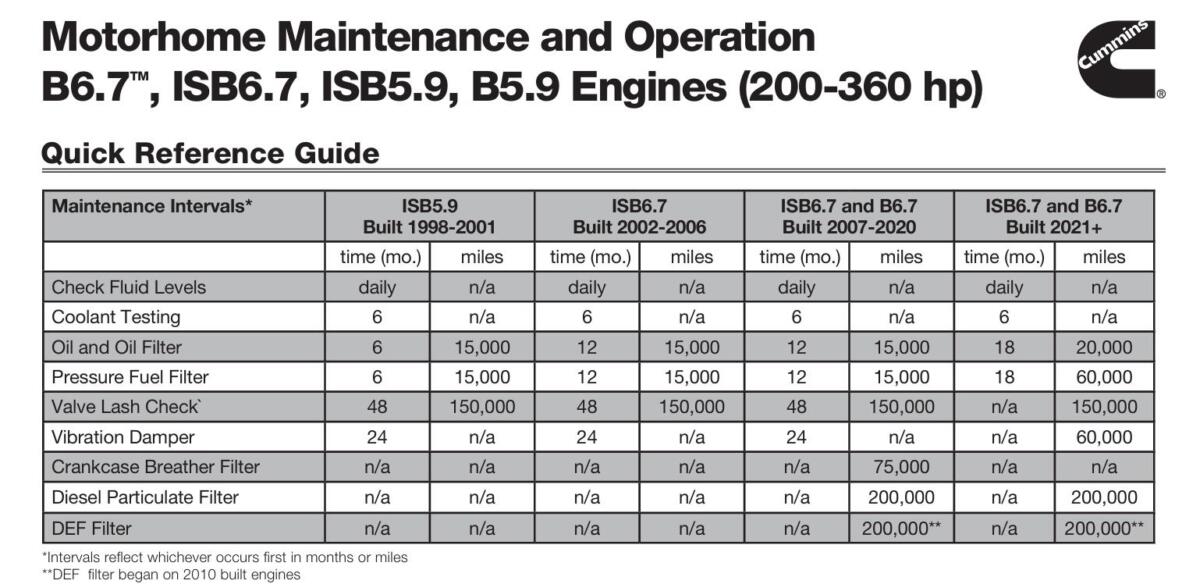
I have always heard that oil should be changed once a year because it will degrade just sitting there. I have also read that people who have their oil analyzed report no degradation because of time. Cummins recommends 18 months for my L9. Does oil actually degrade because of time? Or is the recommendation because of contamination? —John, 2023 Renegade Verona

Dear John,
That has been the million dollar question for years. It seems everyone has a different opinion of when the oil should be changed in your vehicles.

Recommendations for oil changes

I worked at a gas station in high school and college, and we actually washed windows, checked tire pressure, and checked the oil. Originally, I thought it was just customer service. But then I found out that was how we generated service work—by pointing out improper tread wear or low pressure, worn out fan belts, and dirty oil. We changed oil and slapped on a sticker that showed another oil change was needed in 3,000 miles or 3 months.

We had a few customers challenge the recommended intervals, stating that the oil had been in the ground for millions of years, so why does it need to be changed so often? Because we did not make much money pumping gas. The real money was in the service bay!

The timing of your question is ironic as I just read an article posted in Popular Mechanics about this very thing. Yes, I still read Popular Mechanics, although it’s now the digital version. You can read the article here.

Testing oil

The article was written by Ezra Dyer and Stef Schrader. The interesting item was that the oil left in a Troy-Bilt lawn mower with a Honda engine for 10 years was sent to a test lab for analysis. It was still in good condition! The test lab was Blackstone, and for $40 you can get your oil tested. The 10-year- old oil was dirty, but tested normal for an engine with approximately 65 hours of wear and tear. You can get your oil tested by Blackstone Laboratories here.

Blackstone’s standard test includes a Spectral Exam for wear metals, antifreeze, silicone, and additives. It also tests for Flashpoint, Viscosity, and Contamination.

I would not recommend running your oil for 10 years, or even 5 years. But I do think it is a good idea to at least change it once a year. I have gone more than 10,000 miles on my 2002 Chevy Silverado and put 175,000 miles on it before the catalytic converter plugged up and blew out the intake manifold gasket. It had nothing to do with the oil breaking down and not protecting the engine.

Why changing oil once a year is a good idea

I do think that once a year is a good idea, since you can’t control the condensation or moisture that can accumulate in the oil. It is more severe the less you drive or run the engine, since there is little heat to burn off any moisture.

In my newer 2016 Chevy Silverado, I have a local garage change the oil and use synthetic. Even though they put a sticker on the windshield recommending 3,000 miles, I still stretch it to about 5,000 or more. I pull the sticker off so they don’t see if I let it get more than that.

Follow owner’s manual for recommendations or risk losing the warranty

Again, I am not recommending you follow my oil change interval, but rather check your owner’s manual for recommendations. One thing that will be affected is your warranty, if you cannot document the recommended oil change intervals. Your Cummins engine most likely has a 100,000-mile or 10-year warranty. It is void if you don’t have documentation on proper maintenance.

As for your Cummins recommendation of 18 months, I believe that is what they feel is a safe interval as there are many variables when it comes to engine wear. Those include temperature, humidity/condensation, and how hard you work the engine with weight and driving conditions.

Every engine will wear differently and manufacturers are going to err on the safe side. The only way you know for sure is to get the oil tested, and most of us are not going to do that.

Here is what Cummins recommends for maintenance on their engines.

Cummins Maintenance
Cummins maintenance. (Click to enlarge.)

 You might also enjoy these posts from Dave 

DAVE HAS ANSWERED MORE THAN 1,000 readers’ maintenance and repair questions. Read a directory here. There is so much to learn!


Dave Solberg is a leading expert in the RV industry and the author of the “RV Handbook.”

HAVE A QUESTION FOR DAVE?

Send your inquiries to him using the form below.

Name
Drag & Drop Files, Choose Files to Upload

RVDT2914

All about RV convection ovens: When and when not to use

By Cheri Sicard
A lot of new RVs come equipped with RV convection ovens. But what does that convection fan do? When should you use it? Are there times it would be better to leave off the convection option? The video below from Helen Rennie will answer all.

Helen begins the video with what she calls the “Wonder Bread Test,” to illustrate some key differences in the way RV convection ovens (or any convection ovens, for that matter) cook as opposed to conventional ovens. Here’s what she found:

• In a 400 degree F oven without convection, it took 20 minutes to show any color on the bread.

• With convection, it only took 13 minutes.

Helen says there is a misconception that convection cooking cooks more evenly. However, this is not necessarily so, and if you watch her Wonder Bread experiment in the video, she proves it. In reality, the convection fan creates a current of air that will favor some parts of your oven more than others. Therefore, when using convection, you will still want to rotate pans in the oven for even baking.

Food cooks differently with convection. For instance, in the Wonder Bread experiment, the toast browned quicker on the convection setting, but this was the top of the toast. Without convection, Helen says most foods brown from the bottom. With convection, it’s faster because both sides brown at the same time.

So you might think, great, I will cook everything on the convection setting. Not so fast!

Helen says there are instances when convection cooking can be detrimental to the finished dish. For instance, pizza is a food that will end up with burnt cheese on top by the time the bottom is properly browned. The same with baking pies in a convection oven. The top will be burnt by the time the bottom is properly baked.

The common wisdom says that if you are using convection in these instances, you should lower your oven temperature by 25 degrees. While Helen says that makes sense, it nonetheless won’t necessarily produce the same results as a traditional oven. In instances like pizza and pies, you want to have a lot of heat on the bottom but slow down the overall cook time by not using the convection fan.

RV convection ovens for finishing techniques

Helen says there are instances where it is beneficial to use the convection setting during the last part of cooking to brown the top of a dish once you already know the bottom is nicely browned.

At the end of the day, Helen says it boils down to this:

If you don’t have enough browning on the top of a dish, turn on the convection fan. If you have too much browning on the top of a dish, turn it off.

RELATED

RVDT2914

RVing in the rain: How to add waterproof outdoor space to your camp

By Cheri Sicard
A tiny trailer feels cozy until a storm parks over camp at 2 p.m. Then every square foot matters. When Rving in the rain, the right awning, shelter, or side room can turn a tiny camper into a much easier place to live in bad weather.

In the video at the end of this post, the team from Playing with Sticks shares rainy day RVing tips.

This collection of camp setups shows how various RV owners create dry entry points, covered galleys, bug-free hangout space, and a little privacy without giving up the small-trailer lifestyle.

Why modular shelters matter so much

Tiny campers work best when part of camp life moves outside. Rain changes that fast, so extra shelter becomes more than a nice add-on. It creates room to cook, change clothes, sit out a storm, and keep wet gear out of the cabin.

That is why modular setups stood out in this campground. Owners could angle an awning around trees, point a shelter sideways when the site was tight, or cover one side for entry and the rear for cooking. A trailer with coverage on both sides almost always had a dry place to step out, no matter how it was parked.

Three-part setups and fast shelters

One of the smartest examples came from David’s three-part system. Over the galley, he used a Coleman Mountain View shelter, which packs smaller than many instant pop-ups but takes more effort to pitch. For quick rain cover at the door, he clipped a simple 6×8 tarp to a telescoping aluminum roof-rack extension and supported it with tarp poles. For privacy, he added the Kelty Backroads shelter, a favorite because it packs small and works well as a changing room.

Other campers leaned toward instant shelters. A five-sided Clam Outdoors shelter with side panels cut the wind and held more warmth, which made breezy weather easier to handle. A Timber Ridge instant shelter added a front awning, so campers could move from trailer cover into an enclosed space without stepping into the rain.

The small tricks that make RVing in the rain work

The best tip had nothing to do with buying more gear. One owner twisted the side-entry awning so the support poles were not level. That slight angle created runoff, stopped water from pooling, and kept rain from draining back toward the trailer.

A flat awning can sag fast in heavy rain. A small twist gives water somewhere to go.

Hard ground needed another fix. On gravel sites, lag bolts and fender washers held better than standard stakes. A 6-inch lag bolt worked in gravel, while a 10-inch version gave more hold in grass.

Roof-mounted rooms, solo-friendly shelters, and airy screen houses

Some setups pushed the idea even further. An ARB vehicle awning rolled out from the roof rack and could pair with a 48-square-foot awning room. Another camp joined a Kammok Crosswing awning to a dual-room shower tent, creating a dry path into a changing room.

For solo campers, ease mattered most. The Dometic GO Compact Camp Shelter stood out because one person could set it up without much upper-body strength, and removable walls let it fit over a galley. A lightweight screen house also earned praise for strong airflow, fast drying, and no floor, which made it easy to place over a picnic table and easier to keep clean.

Final thoughts

These camps proved that a tiny trailer does not have to feel tiny in bad weather. A smart shelter setup adds dry space, privacy, airflow, and a better place to wait out a storm.

The most useful part was not one brand or one perfect product. It was the way each owner matched the shelter to real camp problems, rain at the door, wind at the chair, bugs at dinner, and the daily challenge of living small.

RELATED

RVDT2914

Will your next RV trip in the USA be to a destination east or west of the Mississippi River?

25

Where are you headed next with your RV? Maybe “Down Maine” for some lobster or to the South for some fresh catfish? Or maybe you’re headed out West to explore Utah’s gorgeous Red Rock Country or search for a wild jackalope in Wyoming.

Or are you headed up to the Northwest, to visit North Cascades National Park, maybe hike up the side of magnificent Mount Rainier, or visit the country’s only temperate rain forest in Olympic National Park (it gets 144 inches of rain a year on average)? You have never seen moss like you’ll see there!

Or are you simply driving up the highway a bit to your favorite forest service or state park campground?

So, the question is: When you head out on your next RV trip, where will you likely go?

Curious minds want to know. Remember, the poll could take a few moments to load if you’re on a slow internet connection. So stand by there, partner!

Oh, and if you want to tell us where you’re going on your next RV trip, we’d love to hear!

LIKE TAKING POLLS? So do we! Did you know we’ve run more than 5,000 polls on our website over the years? Check ’em out! Have fun!

RVDT2914

Spring encounters turn dangerous as wildlife moms protect young

2

Spring is a beautiful time to RV, hike, and wander. However, it’s also birthing season for big game animals. So, watch out, RVers!

Elk

The National Park Service says cow elk are especially protective when their calves are young. These protective mommas can run people down, kick, or violently trample folks who venture too close.

In Yellowstone, the Park Service says cow elk are just as dangerous as bulls when guarding calves. It warns visitors to stay back and turn around if an elk comes too close. Rocky Mountain National Park also notes that elk calves are born in late May or early June, and cows are extremely protective at that time.

Deer

Deer deserve the same caution. The Park Service explains that female deer often leave fawns hidden in grass or underbrush, which helps keep the young out of sight. That means a baby deer beside a trail is not usually abandoned, even if no mother is visible. NPS guidance also says deer mothers may become aggressive or stay away longer if people crowd the area, which can put the fawn at risk.

My husband and I recently stumbled upon a mule deer in a local park, and she was NOT happy to see us!

Pay attention!

For RVers, the safest plan is simple. Learn and follow these safety rules:

Read and follow the signs. Many parks post warning signs to remind hikers about potential dangers during spring birthing times. Some park trails may even close in order to protect animals and hikers. Do not attempt to circumvent closed trails. Obey all signs and postings.

Stay alert on designated trails. Spring is an especially dangerous time for RVers who enjoy hiking. It’s too easy to round a bend and unexpectedly come face to face with a protective cow or bull elk. (Been there. Done that. Lived to tell the tale. It was a very scary experience!)

Give wildlife space. The Park Service says to avoid approaching any wild animal. Rocky Mountain National Park advises that elk should be kept at least 75 feet away. Yellowstone also uses a 25-yard distance for elk and says to back away if an animal changes its behavior because of your presence. The common-sense takeaway is that if an animal notices you, you are probably already too close.

Learn from others’ mistakes

Colorado Parks and Wildlife reported several elk incidents in early June 2024. This prompted closing the playground indefinitely. Parts of the Lake Estes Loop trail were also closed, with warning signs posted in the area. News reports at the time described multiple people, including children, being injured by cow elk during calving season.

Don’t be the next headline!

If you are hiking near an RV park, trailhead, town path, or campground in elk or deer country, keep your head up and your pace calm. Watch for hidden calves in tall grass, and slow down near corners and brushy areas. Keep pets close and never try to get a better photo by moving in on a mother animal.

The Park Service reminds all of us that wildlife is unpredictable. This includes elk, moose, and mule deer that may defend their young without warning. A few extra seconds of caution is a small price to pay for a safe trip and a peaceful encounter with the wild.

Have you ever encountered a protective deer or elk during birthing season? Tell us about it in the comments below.

RELATED

RVT1263b

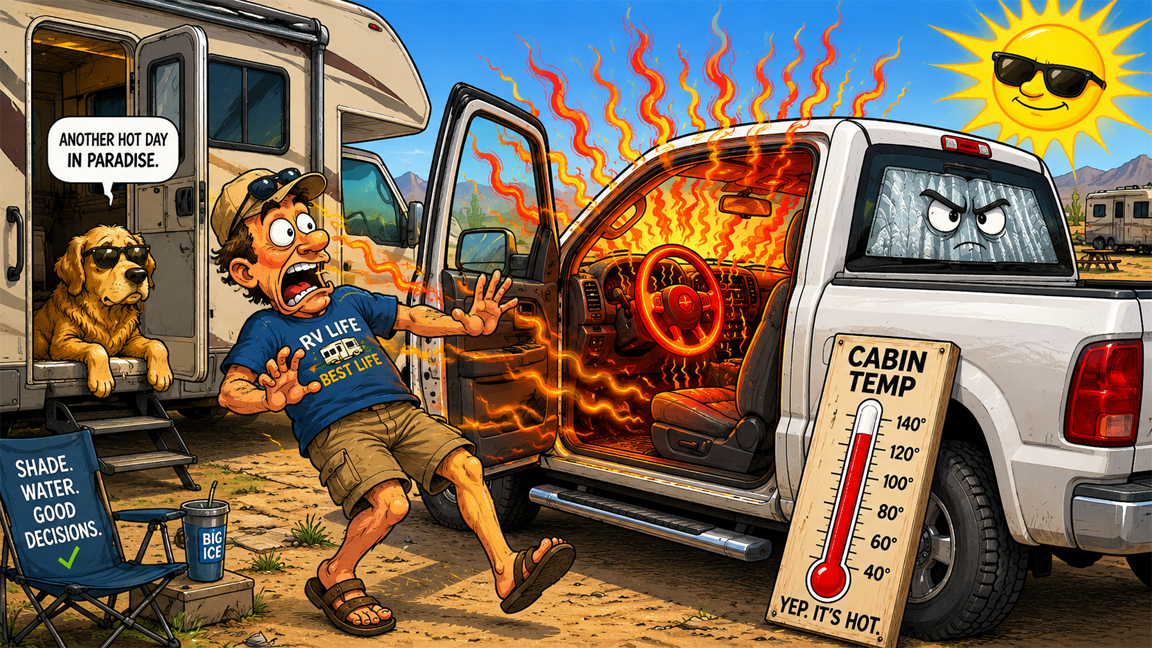
Your tow vehicle may be hotter than your RV. Here’s how to cool it faster

Sometimes the hottest part of an RV trip isn’t the RV at all. RVers looking for ways to cool a tow vehicle faster during summer travel know how quickly a truck cab can turn into an oven. The same can be said for that toad car.

A recent article from Southern Living looked at ways drivers can cool down a scorching-hot vehicle faster in summer. While the piece focused mostly on everyday cars, RVers may understand the problem better than just about anybody.

Fuel stop. Grocery run. Campground office. Scenic overlook. Every stop during summer travel can mean climbing back into a vehicle that’s been sitting in the sun slowly turning into an oven.

And in places like Arizona, Nevada, west Texas and parts of inland California, it doesn’t take long.

Anyone who’s grabbed a super-heated steering wheel or accidentally brushed a bare leg against a sunbaked seat already knows how miserable that can get. Large windshields on heavy-duty pickups and motorhomes only add to the greenhouse effect.

A lot of us jump in, slam the doors, crank the A/C to Max and hope for the best. Problem is, all that trapped oven-hot air is still sitting inside the cab.

The Southern Living article points to something many longtime desert travelers already practice: Get the hottest air out first.

That can mean opening doors for a few seconds before getting in, rolling the windows down briefly once you start moving, or running outside-air mode at first before eventually switching over to recirculate.

The idea is simple. If the inside air already feels like a blast furnace, the A/C system has to fight all that trapped heat before things start getting comfortable again.

Why RVers notice this more

RVers may deal with this problem more often than most travelers simply because they stop more often.

Tow vehicles sit in direct sunlight during campground check-ins, fuel stops, restaurant breaks and sightseeing detours. Then everybody piles back in and expects instant relief.

For folks towing travel trailers or fifth wheels, the truck cab may stay occupied for hours at a stretch during summer travel days. If the cooling system takes forever to catch up after every stop, driver fatigue can creep in pretty quickly.

Motorhome owners get their own version of the problem. Big Class A windshields can turn the cockpit into a solar collector while parked. And older dash air systems sometimes struggle to cool all that glass and interior space after sitting in full sun.

That’s one reason experienced RVers often become almost religious about windshield shades.

Little things that can help

Nobody’s claiming a few tricks will magically turn a truck cab into a meat locker during a 108-degree afternoon in Quartzsite or Needles. But small habits really can make a difference over a long summer travel day.

Among the ideas RVers commonly swear by:

  • Put up reflective windshield shades whenever possible.
  • Crack windows slightly where safe and practical.
  • Vent the hottest air out before switching to recirculate mode.
  • Toss a towel over the steering wheel when parked.
  • Cover leather or vinyl seats sitting in direct sun.
  • Drive briefly with windows partly down before sealing the cab up tight.
  • Keep electronics, medications and heat-sensitive gear out of the vehicle whenever possible.

And, of course, never leave pets inside a parked vehicle during hot weather, even for a short stop.

The funny part is that many RVers spend a lot of time worrying about keeping the RV cool, while the real blast furnace is often parked right outside the door.

RELATED

RVT1263b

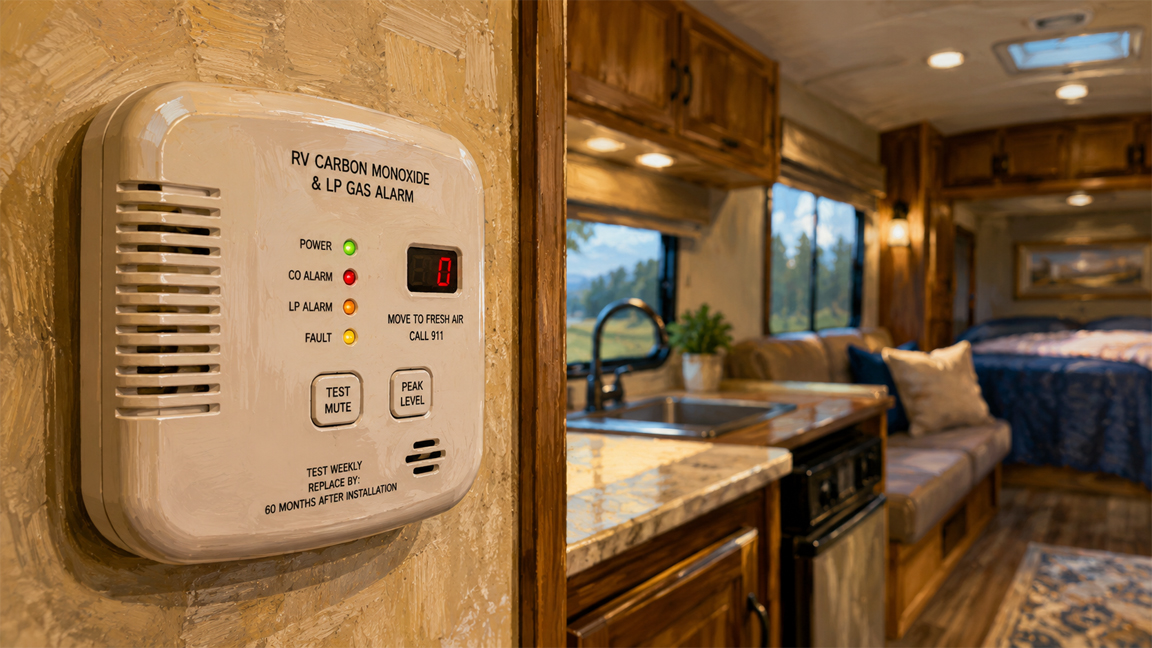
RV carbon monoxide alarms are changing. Here’s what RVers should check

A new line of RV carbon monoxide and propane alarms announced this week may sound like just another product rollout. But behind it is a bigger story that could matter to a lot of RV owners—especially those with older rigs.

Recreation Safety Products recently introduced new RV safety alarms built to updated UL standards, according to a report from RVBusiness. And one of the more important changes involves something many RVers probably never think about until there is a problem: What happens to the detector if the RV loses power?

A surprising number of RV carbon monoxide alarms depend entirely on the RV’s 12-volt system. Turn off the battery disconnect, blow a fuse, run the batteries down too far or lose wiring power, and the detector itself may stop working.

A lot of RVers assume those alarms are always on. It ain’t necessarily so.

The newer standards are designed to address that problem by requiring backup power capability so the alarm can keep working if the main RV power system goes down.

That may not sound dramatic, but carbon monoxide is one of those dangers RVers cannot see or smell. When there is a problem, the detector is often the only warning you get.

A hidden weak spot in some RV alarm systems

While serious carbon monoxide incidents are relatively uncommon, the situations that can create them are not. Portable generators, a blocked exhaust pipe, running an onboard generator for air conditioning, or even a neighboring RV generator in a crowded campground can potentially create dangerous conditions.

The timing of these new standards also shines a light on another issue many RV owners overlook: RV safety detectors don’t last forever.

In fact, many carbon monoxide and propane alarms are designed with an expected life of around five years. After that, the sensors themselves can become less reliable, even if the unit still lights up and appears to work normally.

That means the original detector in a 2019 or 2020 RV may already be nearing the end of its intended life.

And because these things usually just sit quietly on the wall for years, it’s easy to forget they even exist.

Many RV detectors quietly age out

Unlike residential detectors, RV units also deal with vibration, dust, heat, cold, humidity and constantly changing electrical conditions. RV-specific detectors are designed for that environment, which is one reason RV replacement units are often different from the plug-in alarms people buy for a house.

A few things worth checking before your next trip

For RVers wondering whether it might be time to inspect or replace a detector, there are a few simple things worth checking.

Start with the date on the alarm itself. Many detectors have either a manufacture date or replacement date printed somewhere on the unit.

Next, test it. If the detector chirps randomly, refuses to test properly or just acts odd, it may be trying to tell you something.

It’s also worth checking what happens when the RV battery disconnect is turned off. In some rigs, that may disable the detector completely.

You should also confirm whether they have a combination propane/carbon monoxide alarm or separate units. Older RVs sometimes had propane-only detectors, while others used two separate alarms.

Placement matters, too. Most manufacturers recommend installing carbon monoxide alarms near sleeping areas where they are most likely to wake occupants if something goes wrong overnight.

None of this means every RVer needs to rush out and buy a new detector tomorrow morning. But these updated standards are a good reminder that safety equipment quietly ages in the background.

A carbon monoxide detector is easy to ignore because most of the time it just sits there silently on the wall.

But when you actually need it, you really need it.

RELATED

RVT1263b