By Dave Solberg
Dear Dave,
I do not understand how to manage the solar system on my new 5th wheel. When I purchased this unit the dealer told me the solar system would operate the entire coach except some A/C for a day. I don’t believe this, but more importantly I don’t understand how to operate the system. There are two fairly large solar panels on the roof. They look like about 2′ x 4′ but I cannot get on the roof to measure them. Since none of my previous RV’s had solar systems, I don’t know what I should do to make sure the system is working correctly—how to check it, what to check, etc. Thank you. —Ray, 2024 Durango Gold 391RK
Dear Ray,
Your dealer did a poor job (I’m being kind) with the orientation of your solar panel charging system with the general statement, “the solar system would operate the entire coach except some A/C for a day.” I hear this description or, better yet, question often from both dealers and potential owners asking what the solar system will run.
How a solar charging system works
Technically, the solar panels don’t actually “run” anything, they merely capture energy for the house batteries to store and provide 12-volt power. The size doesn’t matter as they are rated in watts and new technology has provided smaller panels with higher watt capacity for more charging power.
Go Power! has a great library of how a solar charging system works on their site here.
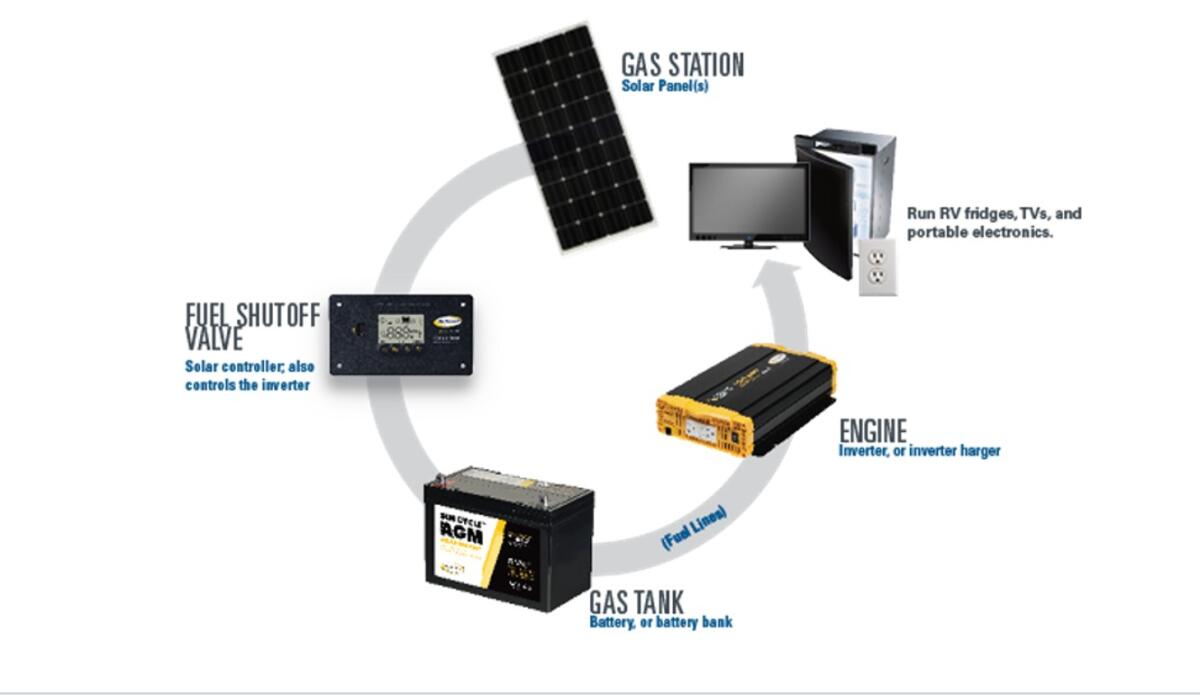
The solar panels on top of your rig are made of crystals that convert the energy of the sun to 12-volt power used to charge your house battery or batteries. In this analogy they are referred to as the gas station that provides fuel.
Solar charge controller
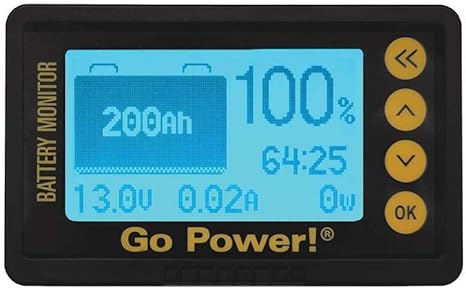
Typically a solar charging system will have a solar charge controller that regulates the charge depending on the State of Charge (SOC) of the battery bank. This prevents overcharging and the display will indicate battery voltage, charging current, and battery SOC. This is where you will be able to tell what is happening with your solar charging system and battery bank.
If your system does not have a complete display of these features, I would recommend getting this one from Go Power! on Amazon here.
The battery bank is the “fuel tank” in the system and designed to simply store 12-volt power. 12-volt components include interior lights, roof vents, the water pump, and any appliance that runs on LP, especially the furnace.
Calculate energy needs
It is important to calculate your energy needs. That can be difficult as it is hard to determine how long the lights will be on, how often the furnace turns on and off, as well as the refrigerator. Go Power! has a very detailed chart called the Solar Calculator that at least gets you thinking about energy management. You can download a copy of the Solar Sizing Chart in their RV Solar Resource Guide here.

Another variable to the usage is what 120-volt components are powered by an inverter. This takes 12-volt power from the battery bank and provides 120-volt power to outlets for components such as a TV and in some cases residential refrigerators.
What is powered by inverter
It is important to verify what components are powered by the inverter for proper energy management. A simple way to test this is to make sure the rig is unplugged from any shoreline power and no generator is providing power, then test which components are working. Your refrigerator could be a 12-volt compressor-driven one. It could be working either directly on 12-volt power or being supplied with 120-volt power through the inverter. Shutting off the inverter will verify which power mode it is running on.
Then there are the roof air conditioners, which run on 120-volt power and generally draw too much power to run through an inverter. However, as I often state, I never say never when it comes to RVs!
Keystone has a system called SolarFlex™ which starts with a very large battery bank, large inverter and roof air conditioners with a start-up thermistor installed similar to SoftStartRV™, which we have featured on RVtravel.com before and which is highly recommended by Chuck Woodbury. This system can run the roof air conditioners for about 2 hours. But, as I stated, most other brands do not have this feature.
It is important to understand how the system works and what your energy needs are. Another good exercise is to do a dry run in your driveway or somewhere close to your home so you can monitor the charge you are getting, SOC of the batteries, and how long you can dry camp on the battery bank that you have.
You might also enjoy these from Dave
- What can I power with one solar panel and one battery?
- OK to eliminate RV house battery and hook solar panels to shoreline power?
- When using RV solar panel, should I turn off inverter when plugged into shore power?
- Can I connect my “solar batteries” to use for the RV’s house battery?
- Shouldn’t my solar panel keep RV battery charged during storage?
Dave Solberg is a leading expert in the RV industry and the author of the “RV Handbook.”
Read more from Dave here.
HAVE A QUESTION FOR DAVE?
Send your inquiries to him using the form below.
RVDT2903









 The folks way up northeast in Newfoundland enjoy watching icebergs float past their coastal communities. Karen Smith took this photo on May 6th near the small town of Cupids and posted it to