Home Blog Page 45

Boondocking—Yes, you can do it no matter your setup

One of the most popular RV presentations my wife, Peggy, and I give is called “Don’t Be Spooked by Boondocking.” We’ve given that presentation to RV groups of all sizes, and it is one we have at the ready. We love speaking to RV groups and gatherings, by the way. 

Here, on RVtravel.com, we have reported a lot on how crowded some campgrounds are getting, and it’s true. Like many things, they’re also becoming increasingly expensive. Also, being in a place where you could hand a cup of sugar from your window to your neighbor’s really doesn’t appeal to me much. Boondocking is less challenging than many people assume, so let’s start at the beginning for you beginners. 

What is boondocking

For the purposes of this article, I’m going to refer to boondocking as camping without hookups. That simple. Like everything, there are a million permutations of the term, and people get all passionate about their particular version. If you care, define it how you like. 

I’m also going to lump overlanding into the same category, and now some of you have really flipped your lids. Sorry, not sorry. We’re all camping without hookups in this story, okay? Cool. 

Boondocking for beginners

First of all, whatever RV you have is already likely to be quite capable of spending time without hookups. Yup, even if you have zero solar whatsoever, you can likely spend at least one night, and often several, without ever having to hook into the planet. 

In fact, I know plenty of people who don’t even own a generator, shocker of all shockers, and still enjoy camping off the grid. 

Depending on your understanding of your RV’s systems, the first thing you might want to do is go find your favorite campground with hookups and then go camp there. And don’t hook anything up! No, seriously. 

By doing this, you’re now seeing how far you can push the systems in your RV. What works? What doesn’t work and why? 

Those systems that don’t work—can you live without them? Obviously, living without A/C in the south in summer isn’t likely to happen. So some of what you can do may be very weather-dependent unless you want to change systems in your RV. 

I’ve found there are plenty of off-grid alternatives to many of the things we take for granted that offer equivalent or even superior results. For example, instead of Keurig coffee, we use an Aeropress and heat the water with the stove that’s in our RV. There are plenty of alternatives out there, but the idea is to first see how well your RV works without hookups—and how well you work without hookups!

Once you’ve seen how far you can push the RV, you can either seek alternatives to the challenges you’ve uncovered or research how to overcome those challenges, like with the coffee example. 

Why boondocking

If you’re happy with the campground experience, then maybe boondocking isn’t for you. But what I can share is that I have had the most incredible experiences while camping without hookups. 

As a train guy, I’ve stayed at more than a few tourist train yards and gotten to play with trains while most of the other visitors had gone home. I have stayed at wineries, breweries, in historic places, and more. These adventures are so much more memorable to me than staying in a campground. 

Recently, as we meandered up Route 66 from Santa Monica, we got to stay at the famous Roy’s in Amboy, and the caretaker even let us into the historic Googie hotel lobby, not something most people get to do. 

We stayed in a desert mining town with some incredible mining equipment surrounding us, which was still functional. 

Of course, like so many RVers, we’ve stayed for weeks on end in the desert in Quartzsite, and do so every year. Why? It’s free, and there’s no snow. And now, so many of my RVing friends are there, too, so it’s a remarkable experience with friends. Did I mention the whole “free” part? 

However, don’t get caught up in the “free” thing—lots of times you might stay for just one night without hookups at a place like Cracker Barrel, and then you’ve got a dinner and a breakfast to enjoy if that’s your thing. That puts the cost on par with a campground, but you do get that breakfast and/or dinner. It’s all about priorities. 

We’ve also chosen the boondocking option (no hookups) when attending FRVA/FMCA rallies, which cuts our costs. 

Another thing to know is that there are opportunities to stay at festivals surrounded by things you might appreciate, like certain styles of music, renaissance fairs, hobby-specific events, and more. Many times, if you ask at larger festivals and tell them you can camp off the grid in your RV, it’s surprising the doors that open. 

Tools and tips

Unless your RV is truly unusual, you have holding tanks and a water pump aboard. How long those tanks will last depends on your use of them. That’s another reason for testing all this with hookups available before you go without. 

But you may also find that you need a medical appliance for sleeping, for example, and that gadget requires power. The obvious solution is to figure out how to power the outlets in your RV. But what if you could just plug into a portable power station instead? There are lots of reasons to have one of these, and now you’ve added another. 

You don’t necessarily have to have an elaborate solar array for boondocking. If you find you like off-grid camping, perhaps just some good portable solar panels are sufficient to keep your RV’s battery topped off. 

If you find that the battery is the issue, what is causing the greatest drain? In our case, our ancient Starlink Gen 2 dish is literally the biggest draw in our RV. The second is the 12VDC refrigerator. 

Well, really, the air conditioner is, but this is beyond basic. Running an A/C on battery power as we can is entirely possible, but you have to have one heck of a solar/lithium system to do so. That’s not what I’m advocating here. 

I think RV dealers installing anything but lithium batteries on modern RVs are doing us a huge disservice. So, it might be time to upgrade if your dealership saddled you with old-fashioned batteries anyway. 

If water is a big issue, there are also lots of ways to minimize water use, including plenty of really great tips right here on RVtravel.com. In fact, I’ve linked a bunch of great articles about off-grid camping below. 

I’m a huge proponent of Harvest Hosts, as well. They often have some incredible places that are unique experiences, like bison ranches, drive-in movie theaters, alpaca farms, and so many others. 

Be a good boondocker

If you do choose to give boondocking a try, whether that’s right around the corner or in some far-flung place, know that some agencies and individuals are becoming frustrated with boondockers and are taking away privileges. 

So, let me advise that wherever you choose to camp, leave the place as clean, or cleaner, than when you arrived. Take your trash and don’t create a fire pit if there isn’t one already there. 

Be cognizant of light and noise pollution if you have neighbors. And don’t dump tanks—even gray tanks—in boondocking spots. Gallons and gallons of water suddenly inundating a place can be damaging to that place. 

I’m sure nobody reading RVtravel.com needs that last paragraph, but I hope you share this on social media and among your friends. 

And, perhaps, I’ll see you in some great spot off the beaten path, because now you’re not spooked by boondocking!

Great resources

One of the great things about the huge legacy of content here at RVtravel.com is that you can find all sorts of resources hidden in plain sight in the search function. Do a search for a term in the blue search bar at the top of any page on the website—we’ve almost always covered it in depth, and that coverage is real intelligence, not that artificial kind. 

Here are a few links to articles, but there’s so much more. I also created an RV boondocking resource as well. 

RVT1258

Can RVers buy in bulk? While in an RV? Really?

6

By Gail Marsh
We know that buying in bulk can save money. With the ongoing inflation, saving money is on almost everyone’s mind. But how do RVers buy in bulk? We barely have enough space for the few things we pick up at a convenience store. Where would we ever put a giant package of paper towels? Or a family-size pack of chicken breasts? I’m all about saving money, but is buying in bulk even an option while living in an RV?

The answer is yes! And here’s how to do it successfully!
Buying bulk products as an RVer

Nonperishable bulk goods

Shoe organizer. A shoe organizer like this one can be hung inside a closet or on the back of a door. You can store extra rolls of paper towels or toilet paper inside the “cubbies.” They’re easily accessible and out of the way.

Back of door shelves. These handy shelves can be hung on the back of a door or wall. (Be sure to screw into studs!) Use it to hold extra toiletries like shampoos, soap, and more.
Rolling shelf. When searching for extra storage, be sure to look down. A rolling shelf like this might just rest on the floor of your pantry or closet until you need to access the things inside.

Top it off. This handy organizer, or others like it, will hold extra TP, cleaning supplies, and a host of other goods. You can position it over your toilet or washer/dryer combo, as pictured.

Sink top storage. While this is sold as a dish drying rack, it might serve many additional uses, as well. You can store extra dish soap, hand sanitizer, and cleaning supplies up and out of your way. Or store your dishes in it and use the cleared cupboard space for other items.

Under the bed. Many RVs feature under-the-bed storage spaces. Large bulk items can be stored here. Or you may want to use boxes to keep smaller, similar items together (e.g., laundry supplies, napkins, bars of soap).

Magazine holders. Use containers like these to store extra packages of aluminum foil, wax paper, and more. These bins are pretty enough to be out in the open. And they hide what’s inside fairly well, too.

RV basement. If you have room in the storage areas under your RV, you can store non-perishables there until they’re needed. We’ve also used the back of our pickup for storage. The truck bed cover is fairly waterproof. We put paper towels inside sealable plastic totes.

Perishable bulk foods

Stack ‘em up. Get bins like these that can stack (or nest together when your supply wanes). Store fruit, vegetables, or other foods that need not be refrigerated inside. Note: Always look for square or rectangular containers. You can fit more of this shape than round ones in the same area. See-through containers are also helpful because you can know at a quick glance when you’re running low on something.

In the fridge. Containers like these will optimize the space inside your RV refrigerator. You can stack them up and still see what’s inside each one.

Space saver sets. Sets like this one will take up much less space in your pantry than the original packaging does. Sure, you’ll need to empty the foods into the containers, but food will last longer, you can store more in the same amount of space, and the clear plastic allows you to see what’s inside each bin.

Make and freeze. Many times, before shopping for bulk food, I’ll check out recipes. When I get the bulk food home, I’ll try and make up my chosen recipes and freeze the meals for use later. If you have freezer space, this may also be an option for you. Note: When possible, I freeze soups and stews inside freezer bags. They take up less space than large casserole dishes or Tupperware.

Collapsible storage. When purchasing food storage containers, look for ones that will collapse when not in use. You’ll save lots of space with containers like these, both while in use and when stored.

Reusable plastic bags. I like to use bags like these. When I come home from the bulk food store, I’ll take the time to cut apart broccoli, for example, and then separate it into individual meal servings. (Since I’m only cooking for Hubby and me, I know how much we’ll eat at one sitting.) The individual servings take up less space in our fridge, and I know at a glance what veggies we have. It’s also nice to grab a prepared bag of veggies to take along as a snack for a day out.

Other options for RVers buying in bulk

Shop together. When camping with friends, we’ll sometimes visit Costco (or Sam’s Club) together. Then the families split up the supplies as well as the bill. You can also check local Facebook groups in the area you’re in—many people post on Facebook and find others to share Costco packs with.

Share with others. When the local food bank was low on supplies, Hubby donated items that we were not able to store in our RV.

Are you an RVer who buys in bulk? Can you share additional storage tips with us? Please leave a comment below.

RELATED

RVT1258

A cheap slideout trick that can keep leaves and debris out of your RV

Slideouts make an RV feel bigger, but they also create one more place for leaves, pine needles, dust, and other campground debris to collect. If you retract the room without checking the top first, all that mess can wind up where you do not want it—inside your rig.

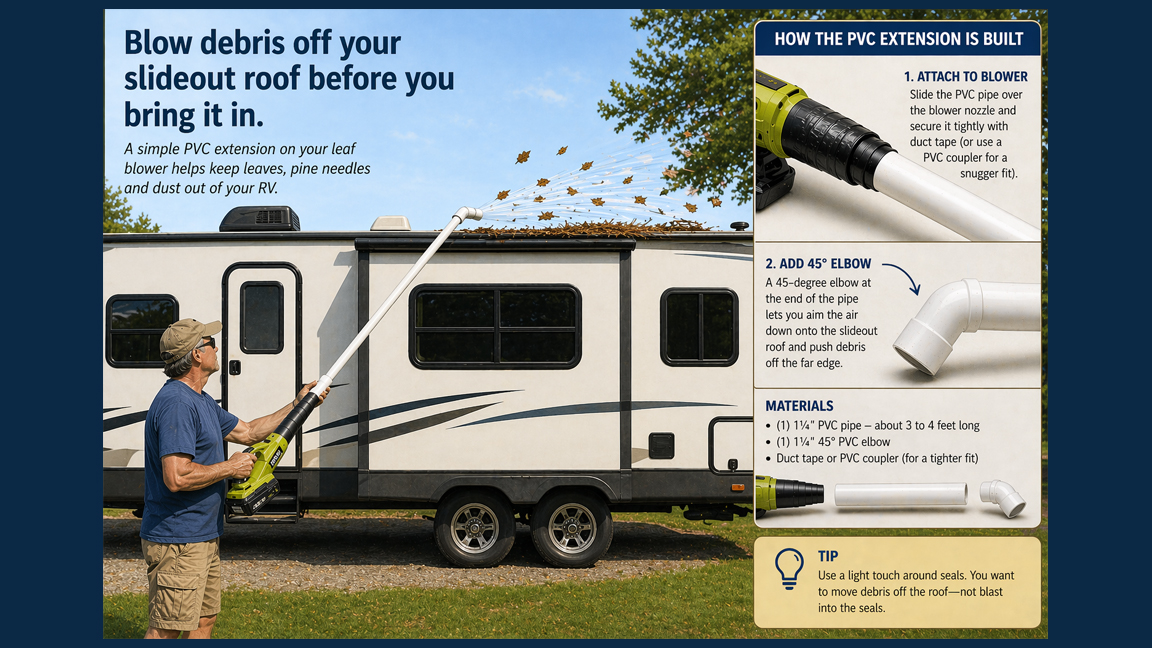
Years ago, Jim Twamley shared a simple fix on RVtravel.com: Instead of climbing up and wrestling with a brush, he used a leaf blower and a homemade extension to clear off the top of the slide before pulling it in. It was a practical idea then, and it still is now.

Why this matters more than some RVers think

A little debris on top of a slide may not look like much from the ground. But when that room comes in, leaves and grit can get dragged into seals, dumped along the inside edge, or leave you with extra cleanup after you are parked for the night.

That was the problem Twamley described in the original piece. After parking under trees, his first fifth wheel’s slideout collected debris on top, and some of it ended up inside when the slide retracted.

The expensive fix and the cheap one

One answer is a slide topper, sometimes called a slideout awning. Twamley noted that these short awnings deploy automatically when the slide goes out and help keep debris off the roof of the room. He also pointed out that RV dealers can install them, and handy owners may tackle the job themselves.

But toppers cost money, and they are not perfect. A much cheaper approach is to simply blow the junk off before you bring the slide in.

That is where the leaf blower trick earns its keep.

A leaf blower can do more than clean the campsite

A few inexpensive parts, and a gentle touch can make a big difference. Click to enlarge. AI-generated image.

Twamley’s version used a leaf blower with a homemade extension built from PVC pipe and a threaded elbow, taped to the blower nozzle. The goal was simple: Reach the slide roof—and even parts of the RV roof—without climbing a ladder or getting up on top.

That same tool can do double duty around camp. Blow off the mat. Clear the patio area. Clean out the truck bed. Then, before departure, use it to sweep the top of the slide.

That is the kind of multi-use gadget most RVers can appreciate.

A few modern-day cautions

This is still a smart idea, but we’d update it a bit for today.

Use a light touch around slide seals. You want to move debris off the roof, not blast directly into rubber seals or force grit where it can cause wear. Watch for loose branches, acorns, or anything heavier that may need to be removed by hand first.

If you are in a crowded RV park, be mindful of where that dust storm is headed. Your neighbor does not want your campsite delivered to his patio rug… or on top of his slideout!

A small cordless blower may be the sweet spot for many RVers now. It is easier to grab, easier to store, and you do not have to fool with an extension cord.

The bottom line for RVers

Jim Twamley’s 2007 tip still holds up because it solves a real problem with a simple tool many RVers already own. If you do not want to pay for slide toppers—or you already have them and still get debris around the edges—a blower can be a handy part of your departure routine.

It is not fancy. But it may help keep one more pile of leaves, dust, and campground grit out of your living room.

RELATED

RVT1258

Visit the nation’s only fake national park

5

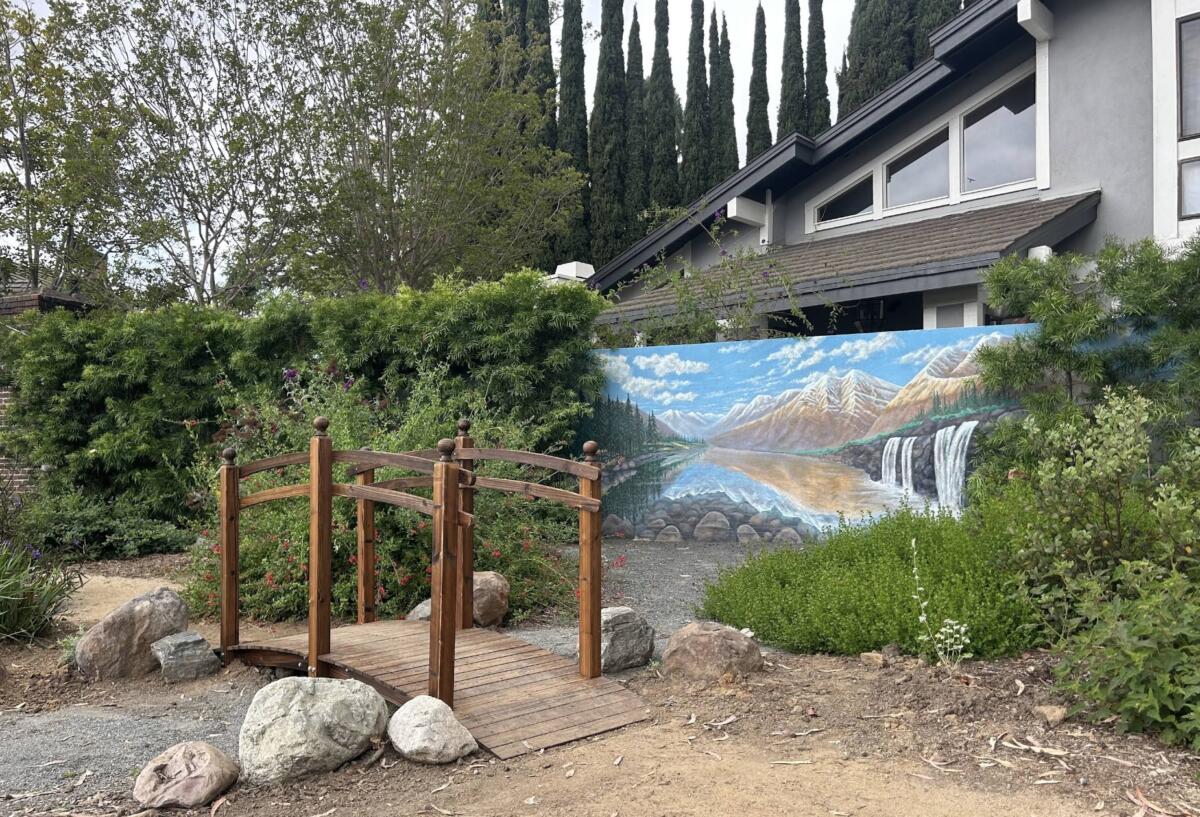
California has many wonderful national parks, but did you know that California is home to the only fake national park in the country? It’s true! Bixby Knolls “National Park” is located at the corner of Roosevelt Road and Long Beach Boulevard in Long Beach, CA.

This fake national park opened in 2021. The site covers just 0.05 acres and was created during the pandemic. Read on to learn more.

Real vs. fake

To be clear, the National Park Service says actual national parks and related units are part of a federally managed system, established through Congress and the NPS.

Bixby Knolls (fake) National Park strives to look and feel like a real national park. However, it’s clearly a whimsical spoof of the actual parks it mimics. Locals insist that’s what gives Bixby Knolls its charm.

Park history

Blair Cohn is the executive director of Bixby Knolls Business Improvement Association. He’s also the force behind this fake national park.

Years ago, Cohn reportedly noticed a small, insignificant sign someone (perhaps a child) posted in their Portland backyard. The sign claimed that the yard was a national park. The image and idea stayed with Cohn.

Then the pandemic hit. Local businesses and the Bixby Knolls Business Improvement Association suddenly faced a very precarious and uncertain future. Cohn suggested the park as a way to get people outside and provide a humorous distraction from the dreadful pandemic. Local folks positively responded to the Association’s effort, and word about the park began to spread.

Today, the fake national park is visited by more than just the locals. It continues to bring smiles to its visitors, too.

What you’ll see

According to LAist, the mini-park packs in a surprising amount of whimsy. The fake national park includes native plants, a trail that takes only 12 seconds to walk, fairy decorations, Bigfoot prints, and other hidden details.

Screenshot
Photo credit: Alana Salas, Google Photos

Today’s purpose

With the pandemic in our rearview mirror, the Bixby Knolls Business Improvement Association continues to keep the fake national park going. Today, its mission is to promote local businesses and improve the district. It’s become a neighborhood project with a healthy dose of satire and humor.

Bixby Knolls (fake) National Park offers a quick photo op and bragging rights for RVers. Just think! After visiting, you can boast that you saw the only fake national park in our country!


DID YOU KNOW? You can make your own custom national park sign? It’s true, and it’s fun! See what we’re talking about here.


Stay nearby

In reality, Long Beach can work well as an RV base. The city’s Golden Shore RV Resort offers 77 full-hookup spaces. The official Long Beach parks page says guests can use free Long Beach Transit service right outside the park to reach places like the Convention and Entertainment Center, Shoreline Village, Pine Avenue, and the Queen Mary.

Neighborhood tenacity

Bixby Knolls “National Park” shows how creative local projects can turn an empty lot into a memorable stop. In a neighborhood known for community events and business promotion, the fake national park gives Long Beach another reason for travelers to slow down, look around, and discover the unexpected.

Have you visited Bixby Knolls (fake) National Park? Tell us in the comments below.

RELATED

RVT1258

How to make yummy campfire Dutch oven nachos

0

By Cheri Sicard
Join Amanda Outside in the video at the bottom of this post as she uses a cast iron Dutch oven and a campfire to make some yummy nachos your entire crowd is going to LOVE!

This is a super-easy recipe to use to try your hand at campfire Dutch oven cooking. You will need:

  • Tortilla chips
  • Shredded cheese: cheddar, jack, or a Mexican blend is good
  • 1 can of black beans
  • 1 can of black olives
  • 1 jar of tomato salsa
  • 1 tomato
  • 1 avocado
  • Sour cream
  • Whatever other toppings you like, e.g., cooked ground beef or chicken, green chiles, corn, etc.

You will also need a cast iron Dutch oven and lid, a lid lifter, some metal tongs, and, of course, a knife and a cutting board.

Putting it all together

Amanda says that good nachos are all about layering, so watch the video to see how she puts it together.

  1. Start with a layer of tortilla chips in the bottom.
  2. Follow with a sprinkling of cheese.
  3. Top with a layer of black beans.
  4. Follow with olives and any other ingredients you have added.
  5. Repeat this layering three more times.

Put the lid on the Dutch oven with the vent closed (if it has one) and put it in the coals. Watch the video as Amanda shows you how to arrange the fire and how to cook with some of the hot coals on top of the Dutch oven.

While the cheese melts and the nachos cook, prepare the fresh toppings like chopped fresh tomato and avocado. (I would make guacamole.)

After about 15 minutes, the cheese was melted. Amanda removed the Dutch oven from the fire, added the fresh toppings, and the Dutch oven nachos were ready to enjoy. YUM!

Here’s the larger 12-inch Dutch oven she uses, and here’s a smaller 10-inch one. 

RELATED

RVT1258

What do YOU do when a fellow RVer breaks campground rules?

13

RV camping works best when everybody acts like a good neighbor. Sadly, that doesn’t always happen.

Common troublemakers include barking dogs, loud music, talking loudly after quiet hours, and unsupervised kids. Then there are generators humming late, people cutting through occupied sites, and speeding through the campground.

What’s the best thing to do when a neighboring camper breaks the rules? Well, you have choices.

First things first

The first move is usually the calmest one. Take a look at the campground rules for yourself. Does the camp specifically call out the behavior in question? Remember that each campground formulates its own rules for maintaining a safe and enjoyable stay. Don’t assume that you know the rules. Check first to make sure.

Breathe. If you’re upset or frustrated, you may not be able to respond to the issue in a helpful way. Ask yourself, “Is this really worth addressing?”

Public health guidance on conflict says it helps to separate the behavior from the person. Also, cool off before speaking and focus on solving the problem instead of “winning” the argument. This approach fits campground life well, because most problems are really about noise, safety, or shared space rather than a personal feud.

If the situation feels safe and the behavior is minor, a friendly face-to-face conversation often works best. Keep it short, specific, and respectful. Mention the exact issue, point to the rule if needed, and avoid a lecture.

A calm tone matters because campground etiquette sources repeatedly stress courtesy, quiet hours, leashes, cleanup, and respectful noise levels. In other words, ask for the behavior you want to see instead of turning the moment into a showdown.

When the neighbor ignores you, gets rude, or the problem feels unsafe, remove yourself from the situation. Ask for help from campground staff. Campground personnel and park volunteers are commonly assigned to explain rules, monitor compliance, handle site questions, and take corrective action for minor violations.

Many private campgrounds also state plainly that rule-breaking can lead to warnings or eviction, which is why the office or camp host should be part of the solution when polite asking does not work.

Be kind

For RVers, the best rule of thumb is simple: Start with courtesy, move to a direct request if it feels safe, and escalate to staff if the issue continues. That keeps the campground peaceful, protects your own comfort, and gives the park a fair chance to enforce its policies.

Note: If the behavior is unsafe or illegal, alert authorities immediately. 

Your turn

MORE POLLS YOU MIGHT LIKE:

RVT1258

Yes, RVing really does make your brain stronger

0

Say what?! It’s true. Exploring new places and trying new things can improve your mental well-being, strengthen your brain, and help you feel more fulfilled in everyday life.

RVing fits that criteria! It can build brain strength. Who knew?

Breaking routine

Science shows that stepping outside your routine is one of the healthiest things you can do. According to Psychology Today, doing something new “wakes up” the brain. It promotes flexible thinking and can even trigger dopamine release, which improves mood and motivation.

When you pull into a campground you’ve never visited or explore a new trail, your brain is actively engaging with unfamiliar surroundings, which keeps it sharp and responsive.

Simple things work

Trying something new doesn’t have to be extreme. It can be as simple as sampling a regional dish, visiting a local museum, or chatting with residents about the area’s history.

Research by Carnegie Mellon University shows that new experiences help break routine, increase creativity, and encourage personal growth by exposing us to different perspectives. For RVers, this kind of growth comes naturally with every stop along the journey.

Think about it: Time goes by much more slowly when you’re in a new place or doing something new, right?

Mental health

There’s also a strong connection between learning and overall mental well-being. NHS Inform explains that learning new things can boost confidence, provide a sense of purpose, and improve feelings of satisfaction and optimism.

Traveling in an RV creates endless opportunities for learning without feeling forced. You might dive into local history at a landmark, discover geology in a national park, or even pick up practical skills like navigating unfamiliar terrain or adapting to different environments. All the while, your brain benefits!

Flex

Another major benefit of new experiences is how they help you stay mentally flexible and emotionally resilient. Studies show that stepping outside your comfort zone can reduce stress, improve mindfulness, and increase happiness.

RV travel naturally encourages this mindset. Every new destination brings small challenges and discoveries that build confidence and adaptability over time.

Curiosity

One of the greatest advantages of RV living is how it fuels curiosity. When you arrive somewhere new, it’s only natural to wonder what’s nearby. That curiosity leads to exploration, and exploration leads to growth. Over time, these experiences can help you become more open-minded and better equipped to handle change.

What about revisiting?

Of course, there’s nothing wrong with revisiting your favorite campgrounds. Familiar places offer comfort and a sense of home on the road. The key is balance. Mixing in new destinations alongside your tried-and-true spots keeps your travels fresh while still giving you that sense of familiarity. Even in places you’ve visited before, there’s often something new waiting to be discovered.

Grow and learn

RV living is more than just travel. It’s an ongoing opportunity to grow, learn, and experience life in a deeper way. Whether you’re exploring a new region, learning about different cultures, or simply trying something outside your usual routine, each experience adds value to your journey.

In the end, the road offers more than miles. It offers perspective, connection, and personal growth. So, as you plan your next trip, consider going somewhere new or trying something different along the way. Your mind, your mood, and your overall well-being will benefit from it.

RELATED

RVT1258

What you need to do to protect the exterior body of your RV

By Dustin Simpson
Maintaining the exterior body of your RV is essential to keep it looking good and protect it from the elements. Here are some tips for RV exterior body maintenance:

Regular washing: Wash the RV’s exterior regularly, especially after trips or when it gets dirty. Use a soft brush or sponge, mild soap, and water. Avoid using harsh chemicals or abrasive cleaning materials, as they can damage the RV’s finish.

Rinse thoroughly: After washing, make sure to rinse the RV thoroughly to remove all soap residue. Leftover soap can cause streaks and damage the paint over time.

Waxing: Apply quality automotive wax to the RV’s exterior at least once or twice a year. Waxing helps protect the paint from UV rays, road grime, and other contaminants.

Inspect seals and caulking: Regularly inspect all seals and caulking around windows, doors, roof vents, and seams. Repair any cracks or gaps to prevent water leaks, which can lead to costly water damage.

Roof maintenance: Clean and inspect the roof periodically to remove dirt, debris, and tree sap. Check for any signs of damage or leaks and repair them promptly.

Roof maintenance

Tire care: Keep the RV tires properly inflated and check for signs of wear or damage regularly. Rotate the tires as recommended by the manufacturer to ensure even wear.

Wheel maintenance: Clean the wheels and hubcaps regularly to prevent brake dust and grime buildup, which can be corrosive.

Awning care: If your RV has an awning, clean it regularly using mild soap and water. Allow it to dry completely before retracting it to prevent mold and mildew growth.

Bug removal: After a trip, promptly remove any bug splatters from the RV’s front and windshield using a bug remover or a mixture of water and baking soda.

Avoid harsh elements: Whenever possible, park your RV in a covered area to protect it from harsh weather conditions such as extreme heat, hail, or heavy rain.

Gutter cleaning: Clean the gutters regularly to ensure they are free from debris, which can lead to water pooling and potential damage.

Proper storage: If you’re storing your RV for an extended period, choose a location that offers protection from the elements. Consider using an RV cover to shield it from UV rays and weather.

Inspect for damage: Regularly inspect the exterior for any signs of damage, such as dents, scratches, or cracks. Address any issues promptly to prevent further damage.

RV covers: Consider using an RV cover when the vehicle is not in use for an extended period. A well-fitted cover can protect the exterior from dirt, UV rays, and other elements.

By following these maintenance tips, you can help prolong the life of your RV’s exterior and ensure it remains in good condition for many years of enjoyment.

Warning to those who use the truck washes

Double-check the type of soap truck washes use. In some cases, it is too strong and will cause the roof and body sealants to dry out and crack.

Check the soap you use

Make sure that you’re not using household soap with lemon, lime, citrus, or bug and tar removers in them.

The products I use to wash and wax RVs:

Make sure you check out our website, California RV Specialists, and their YouTube channel for more helpful information, and see our published articles on RVtravel.com and other social media pages.

RVT1258

Ludington, MI: The perfect RV base for beaches, history, and more

2

Ludington, Michigan, is a great Midwest destination. It sits right on Lake Michigan and has the kind of lakefront setup we love.

You’ll find easy beach access, a walkable downtown, and plenty of outdoor scenery close by.

History

The story of Ludington starts long before the modern town took shape. The earliest known residents were Native Americans, with the Ottawa tribe settling near Pere Marquette Lake.

Burr Caswell and his family arrived in 1847 as the first permanent white settlers. The area grew around lumbering, shipping, and harbor improvements. The city was chartered in 1873, and it was named for James Ludington, the businessman whose money and lumber interests helped develop the area.

Beach

Ludington’s Stearns Park Beach is the city’s largest beach. It has 2,500 feet of sandy shoreline, free parking, mini golf, shuffleboard, and the North Breakwater Light at the end of the pier.

Stearnsbeach
Photo credit: Clint Stephenson, Google Photos

Downtown Ludington is close enough to the water that you can easily pair a beach day with dinner, shopping, or a farmers market stop on Fridays during the warm season.

Watching the S.S. Badger ferry come and go is part of the local rhythm, and it is one of the best ways to appreciate how much the harbor still influences the town.

State park

Outdoor lovers usually end up spending most of their time at Ludington State Park and Hamlin Lake. The park gives RVers and day-trippers a mix of Lake Michigan shoreline, inland water, and trail time. Visitors will discover 18 miles of marked trails and the popular Canoe Pathway on Hamlin Lake.

Hamlin Lake itself is more than 12 miles long and about 5,000 acres in size. Hamlin Lake’s calm water is a nice contrast to Lake Michigan when the big lake is too rough for a swim.

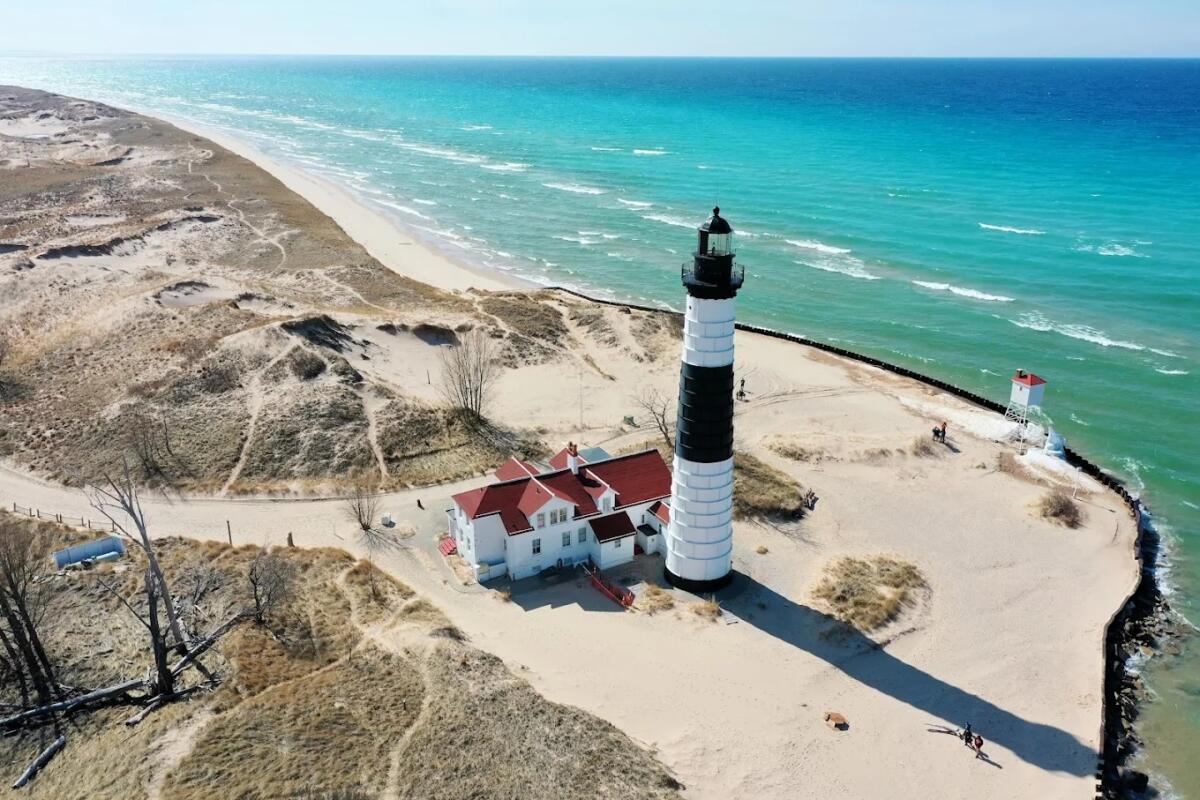
Big Sable Point Lighthouse is another can’t-miss stop. This iconic lighthouse stands 112 feet tall and adds a classic Lake Michigan landmark to your visit.

Lighthouse
Photo credit: Jeremy-Williams Aerial, Google Photos

Historical places

History buffs have plenty to explore beyond the shoreline. Historic White Pine Village recreates small-town Mason County life with more than 30 buildings spread across 13 acres, including the Burr Caswell Home that served as the county’s first courthouse.

The Port of Ludington Maritime Museum adds a deeper look at the area’s lake history with exhibits on lighthouses, shipwrecks, Coast Guard service, car ferries, and the lumber era. It’s all featured in the former U.S. Coast Guard Station near the water.

Places to stay

  • Ludington State Park offers four campgrounds with modern and primitive sites. There is electric service at the main campground for campers who want a state-park setting without giving up convenience.
  • Vacation Station RV Resort sits on W US 10 in Ludington and offers pull-through RV sites with full hookups, 50/30/20-amp power, concrete pads, Wi-Fi, cable hookups, pools, hot tubs, and a dog park.
  • Ludington East/Pere Marquette River KOA Holiday is a few minutes from the shoreline and downtown area, with full-hookup RV sites, select KOA Patio® sites, a pool, and spaces up to 120 feet.

You should go!

For RVers who want a place that feels both easy and memorable, Ludington checks a lot of boxes. You get Lake Michigan views, a real downtown area, a strong local history, and enough nearby natural scenery to fill several days without driving far.

Have you visited the Ludington area in your RV? Tell us about it using the comments below.

MORE IN MICHIGAN AND MIDWEST TRAVEL:

RVT1258

Why your RV keeps breaking—and what repair techs say most owners get wrong

If you’ve spent any time around RVers, you’ve heard it or said it yourself: “These things just aren’t built like they used to be.”

There’s truth in that. But talk to the folks who actually crawl under, climb on, and fix RVs every day, and you’ll hear something a little different. Many of the most common RV repair problems don’t start with a catastrophic failure. They start small. They start quietly. And they often start with things owners didn’t know—or didn’t think mattered.

That’s the takeaway from a recent industry guest column appearing in RVBusiness that tries to explain what’s really going wrong out there. Strip away the insider language, and what you’re left with is a message RVers may not love, but probably need to hear.

The problems techs keep seeing

Mobile repair techs, who increasingly get called when dealers aren’t available, see the same patterns over and over:

  • Leveling issues that lead to slide problems.
  • Battery systems run down or damaged from neglect.
  • Roof maintenance skipped until a leak shows up inside.
  • Overloaded rigs stressing frames, axles, and components.

None of those failures happens overnight. They build. And that’s the part that surprises a lot of owners. Even though the failure can feel sudden, the cause usually isn’t.

Where things break down for owners

A big part of the disconnect comes down to expectations.

Many buyers walk onto a dealer lot expecting something closer to a house: solid, forgiving, and able to handle a bit of neglect. But an RV is closer to a rolling earthquake. It flexes, vibrates, twists, and bakes in the sun. Even sitting still, materials expand and contract, seals dry out, and systems drift out of adjustment.

That means maintenance isn’t optional; it’s survival.

The industry piece makes the case that too many owners leave the lot without a clear understanding of what their rig needs and what happens if they skip it. When something finally fails, it feels like poor build quality. Sometimes it is. But often it’s deferred maintenance catching up all at once.

Most RV problems don’t start big—they start ignored.

Why the repair system feels broken

If you’ve tried to get service lately, you already know this part.

Dealer backlogs can stretch for weeks, too often into months. Communication can be spotty. And when something breaks on the road, waiting that long often isn’t an option.

That’s one reason mobile RV repair has taken off. Independent techs are stepping in to handle everything from electrical issues to slide adjustments right at your campsite. They’re not replacing dealers, but they’re filling a gap that’s gotten hard to ignore.

The downside? Not every job can be done mobile. Major structural work, warranty repairs, and parts-dependent fixes still send you back into the dealership queue.

What RVers can do to stay ahead of it

This is where the rubber meets the road.

Most of the issues techs see fall into a handful of preventable categories. Staying ahead of RV repair problems doesn’t mean becoming a full-time mechanic, but it does mean paying attention to the basics.

  • Level your rig carefully every time. Slides and doors depend on it.
  • Keep batteries maintained and monitored, not just “working.”
  • Inspect your roof regularly—even when nothing looks wrong.
  • Watch your weight. RVs don’t tolerate overload the way trucks do.

A few minutes of prevention is a lot easier than dealing with a soaked ceiling, a dead electrical system, or a slide that won’t move when it’s time to leave.

The bigger takeaway

It’s easy to blame the RV when something breaks. And sometimes, that blame is justified.

But the folks doing the repairs see a different pattern. Many failures don’t come out of nowhere. They build slowly, quietly, and predictably—until they finally demand attention.

Understanding that may not make breakdowns any less frustrating. But it can make them a lot less frequent.

And for most RVers, that’s the goal.

RELATED

RVT1258

RV review: 2026 inTech Black Wing 826-X—Built how I’d build an RV

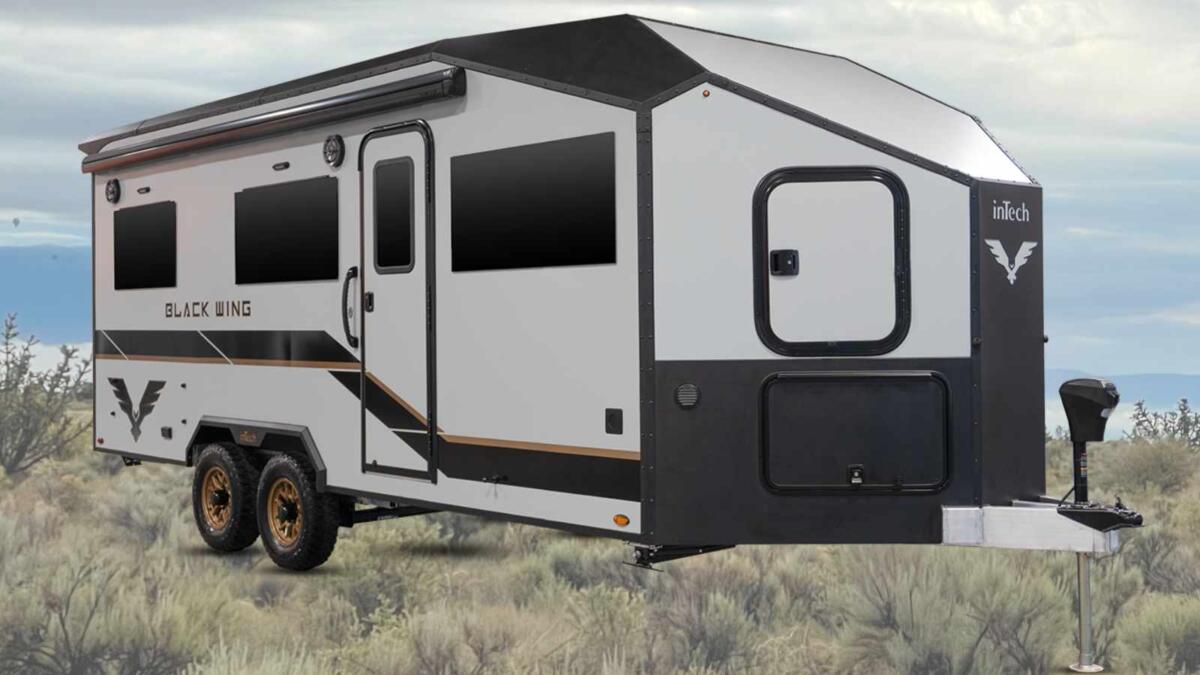
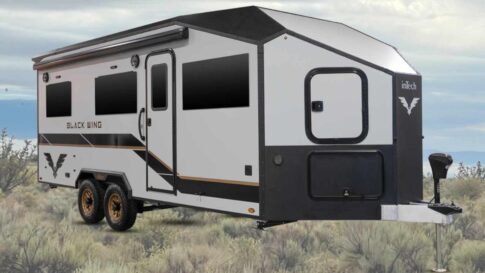
Today’s RV review is of the 2027 inTech Black Wing 826-X toy hauler. This is a no-slide wide-body toy hauler built by inTech, a company that definitely builds things very differently than is the norm in the RV space. 

Like many toy haulers, this one clearly prioritizes hauling and supporting side-by-sides or other motorized vehicles. But what really stands out to me is how closely it resembles something I’ve often imagined building myself—a custom trailer based on a cargo hauler. Of all the production models I’ve seen, this might be the closest to that vision.

Hmm, perhaps my wife, who also serves as my adult supervisor and keeps me from making extraordinarily stupid decisions, might actually be okay with this rig. I’ll show her this review!

How the inTech Black Wing 826-X toy hauler is built

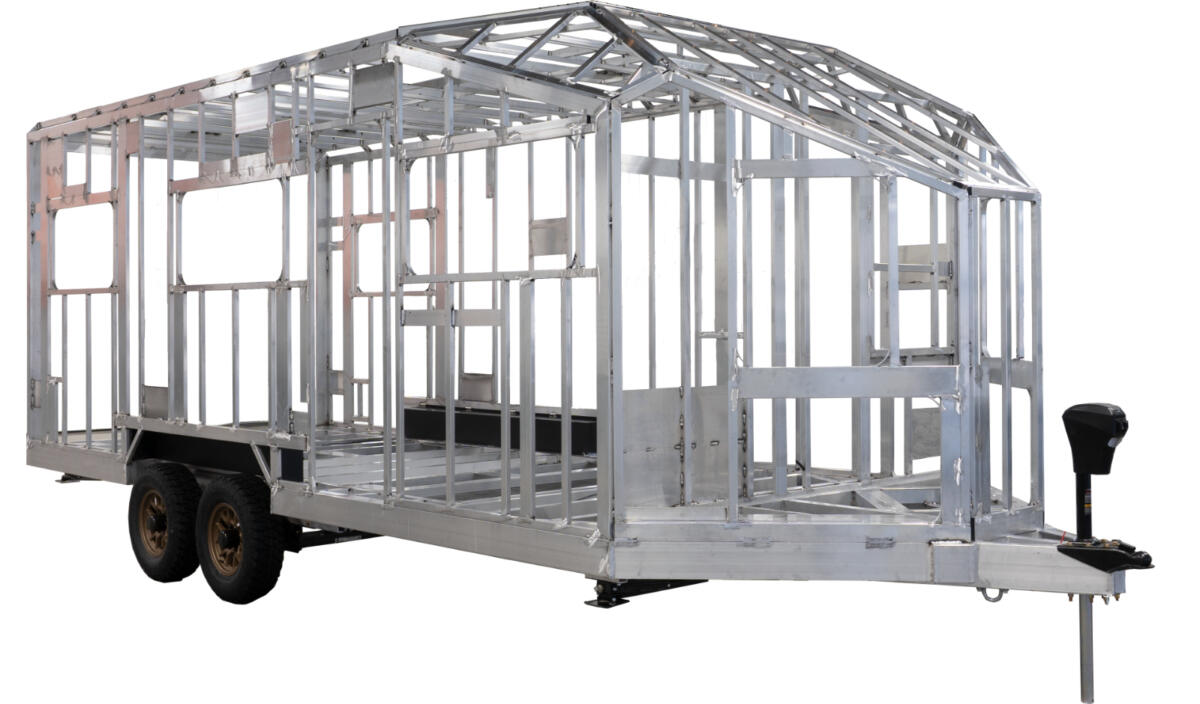
While most towable RVs start with a steel frame, typically provided by an outside firm like Lippert or BAL (Norco), inTech builds its own structure in-house. I call it a structure because the frame itself is an all-aluminum heavy-duty frame, but then they also weld a full aluminum frame together to form one very strong build. 

This aluminum cage includes the roof structure, so there is quite literally no structural wood in this trailer whatsoever. Even the floor is an anodized aluminum sheet. 

To that, all the interior and exterior finished walls are attached, as well as all the other RV bits that turn this into a camper. 

The suspension on these is a torsion axle design, so each wheel operates semi-independently. I really like torsion axle suspensions. 

Quite honestly, I can’t imagine a better way to build a trailer than this. 

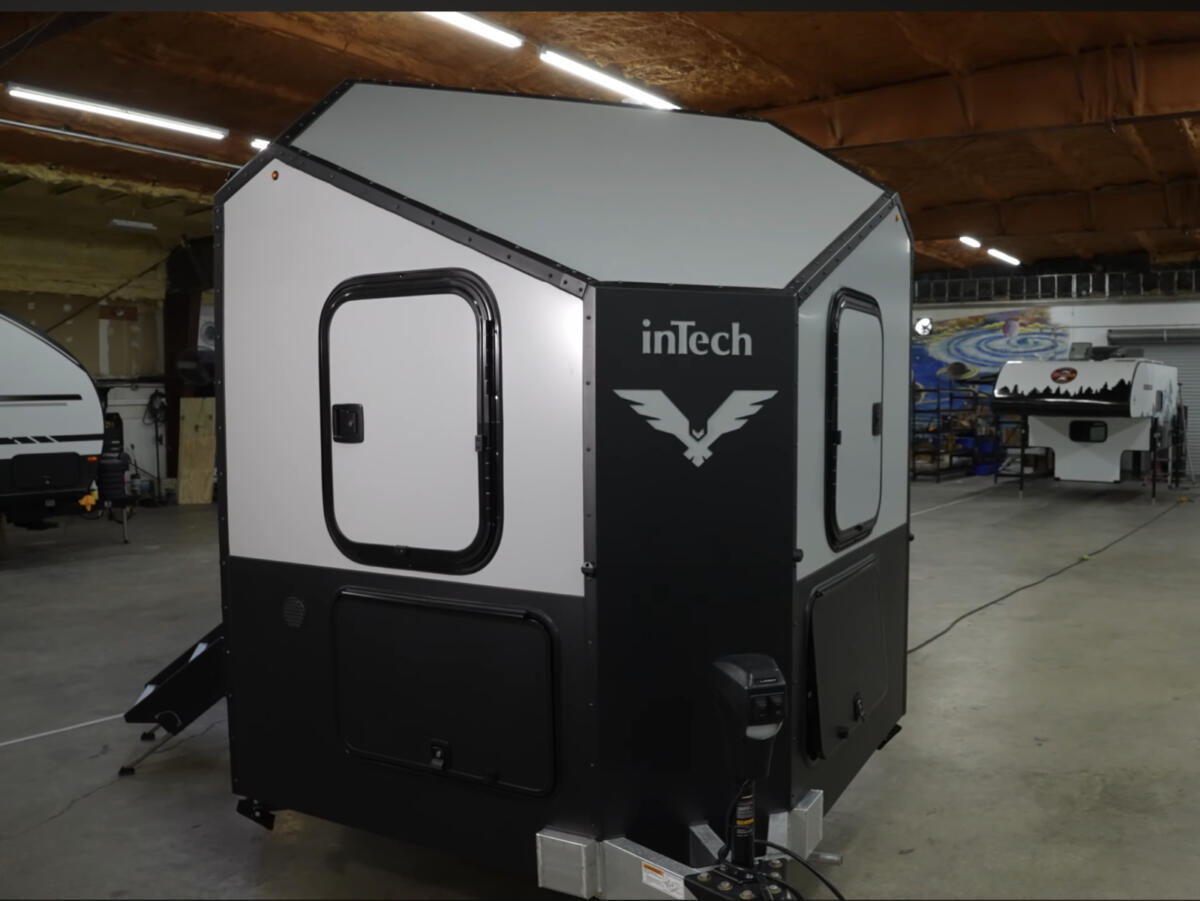
Interestingly, the trailer’s shape is a bit different, with a pointed front that should help improve aerodynamics—something most towables struggle with.

Inside that nose are two levels. The upper level is a full pass-through storage area lined with aluminum walls and accessible from both sides. Below it, the camp side houses two 20-pound propane tanks in an enclosed compartment. The road side includes a space designed for an optional 4,500-watt gasoline generator. If you skip the generator, that space becomes additional storage.

That upper pass-through is especially generous—more so than in many toy haulers. Those typically prioritize large rear garage space but sacrifice pass-through storage up front.

There is also a smaller compartment that can arguably be used for your 30-amp electrical cord. They also provide a plastic tube under the trailer for your sewer hose. 

I also like the windows inTech is using, which are the frameless tilt-out windows whose structure includes both light and bug shades. 

What’s inside the inTech Black Wing 826-X toy hauler

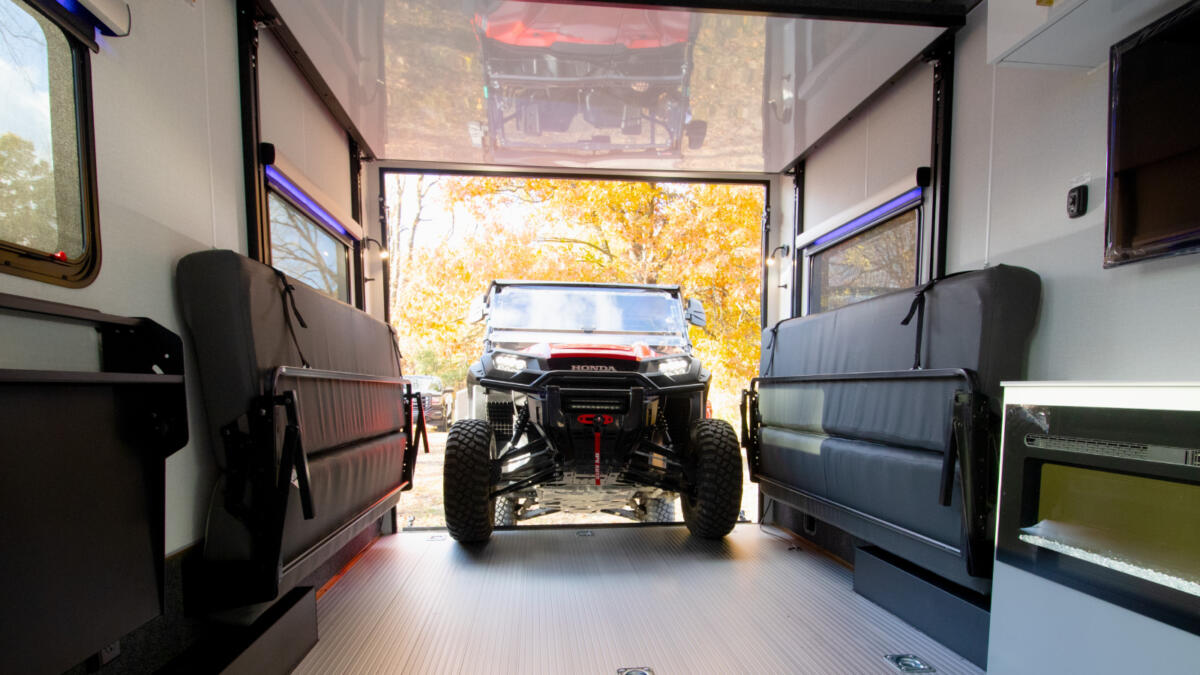
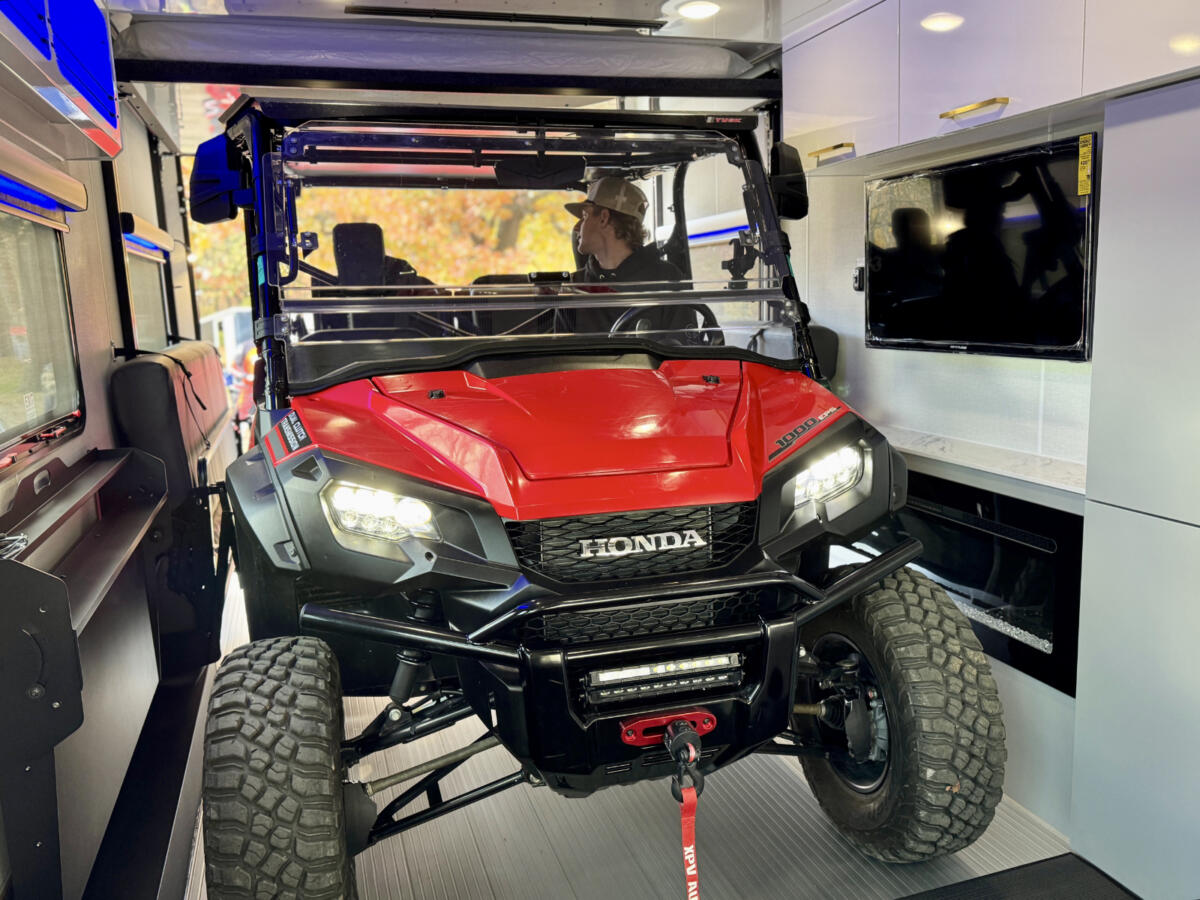
The business of hauling toys in an RV means that the interior of this is prioritized for that purpose with six tie-downs directly into the frame, each capable of 5,000 pounds. (You can’t haul 30,000 pounds in here—that’s just a measure of how well each will keep your moving vehicles from actually moving.) 

I had mentioned that the floor in this is a sheet of anodized aluminum, but inTech puts down a segmented mat to make the interior cozier. This mat is pretty durable and quite cleanable—it’s that marine-grade stuff that many RVers are going to. 

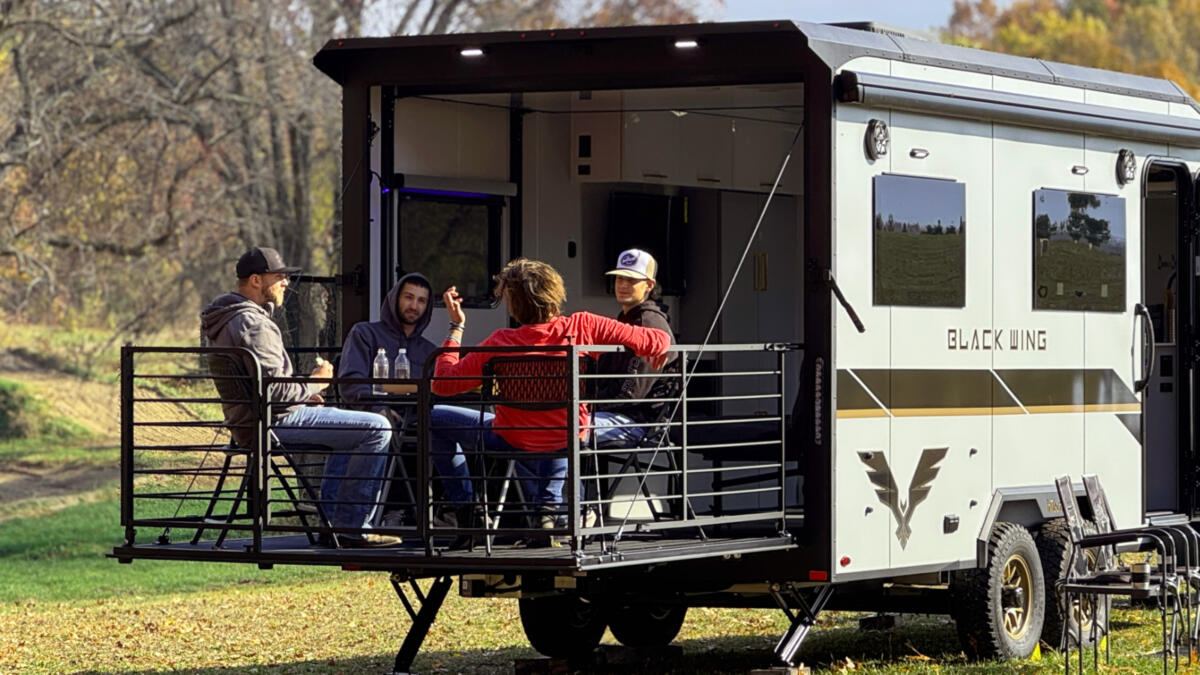
There is a ramp to drive/ride your toys into the back. You can opt to have a folding fence around the perimeter of the ramp when it’s deployed in patio deck position. The fence inTech uses they build themselves. 

Sleeping in the inTech Black Wing 826-X

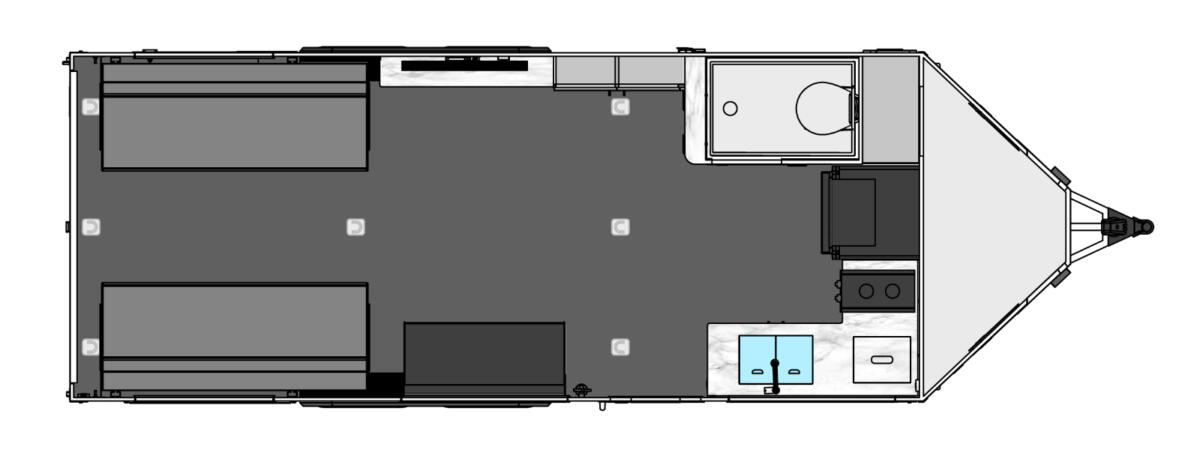
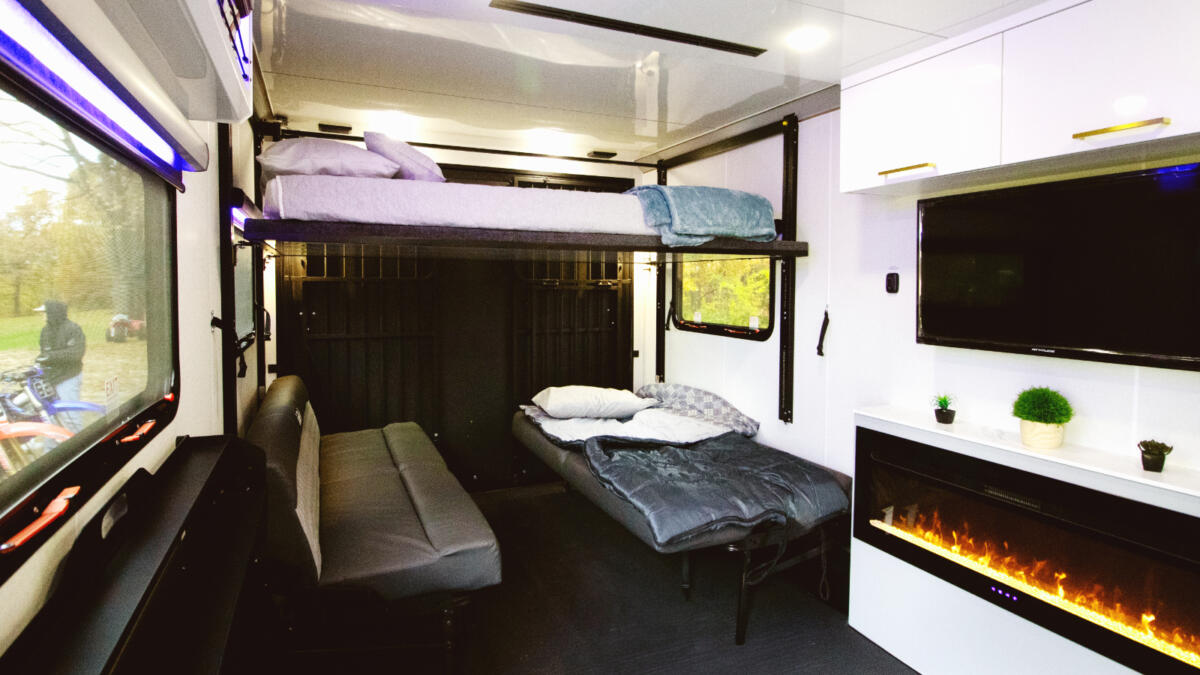
On the interior, there are opposing couches at the very back, which can fold down to become two 40” x 76” long beds or fold up against the walls when you want to bring in those toys. 

There’s another bed on a lift, called a HappiJac®, that measures 60” x 80”. This one stays higher above the floor even when deployed, so it comes with a ladder to get into it. You should remember that you’re up there if you have to make a midnight run to the potty. Apparently, a lot of owners just use the fold-down couch beds, although they don’t look that comfortable. 

I have mentioned the RVSuperbag before, and this would be another case where that just makes sense to serve as your bedding. You’d have one each for the lower beds and then one larger one for the upper bed. 

Interestingly, the way inTech has done the ceiling in this rig is to have a dropped section at the front and then a raised section so that the bed can lift higher to accommodate toys. (There’s no A/C ducting above the upper bed when it’s lifted to the ceiling.)

When I was selling RVs, we had a fair number of taller customers. Toy haulers were always something we suggested because the ceilings tended to be higher on these. 

Living/dining in the inTech Black Wing 826-X

The only seating space provided is those opposing couches, but you could bring a folding table and really seat six people. This would be a good thing for game night. 

There’s also an interesting folding metal table that slots into a space on the camp side of this trailer. That table can be mounted inside or taken and mounted outside. 

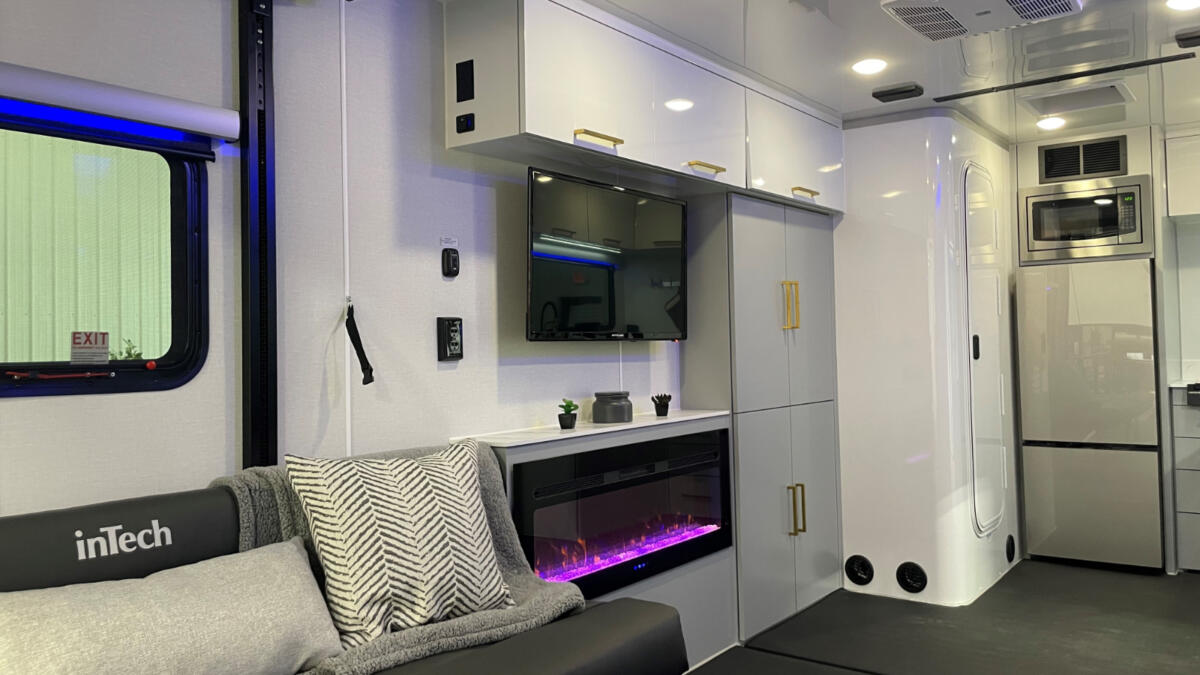
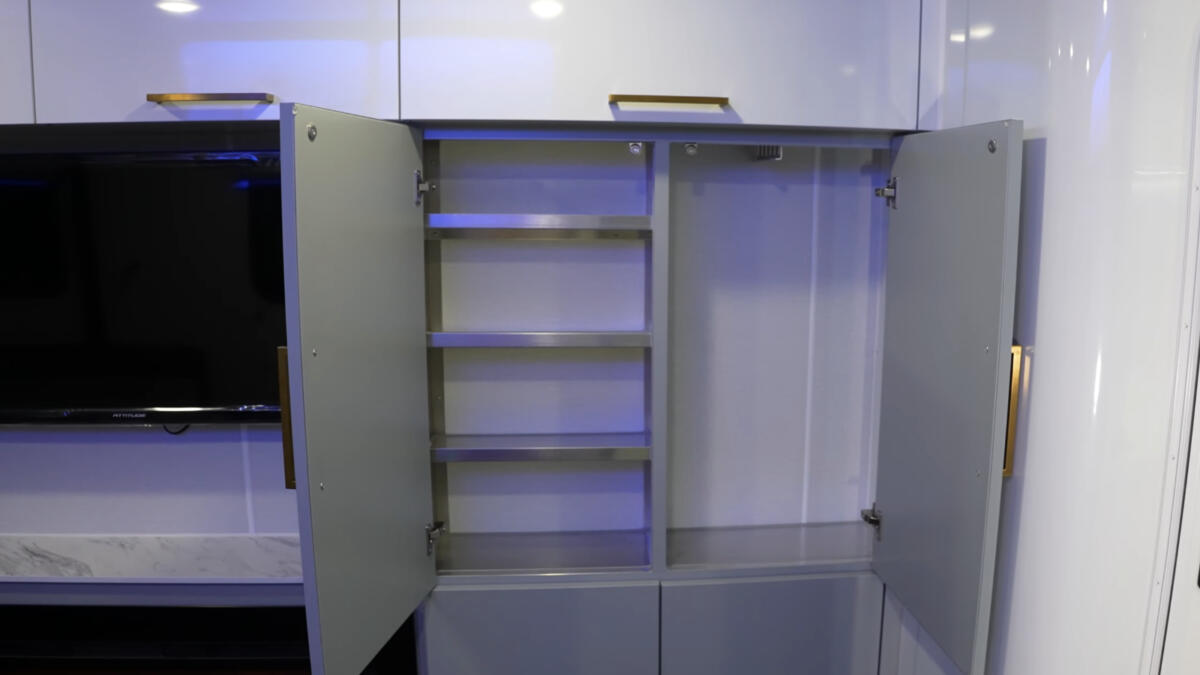
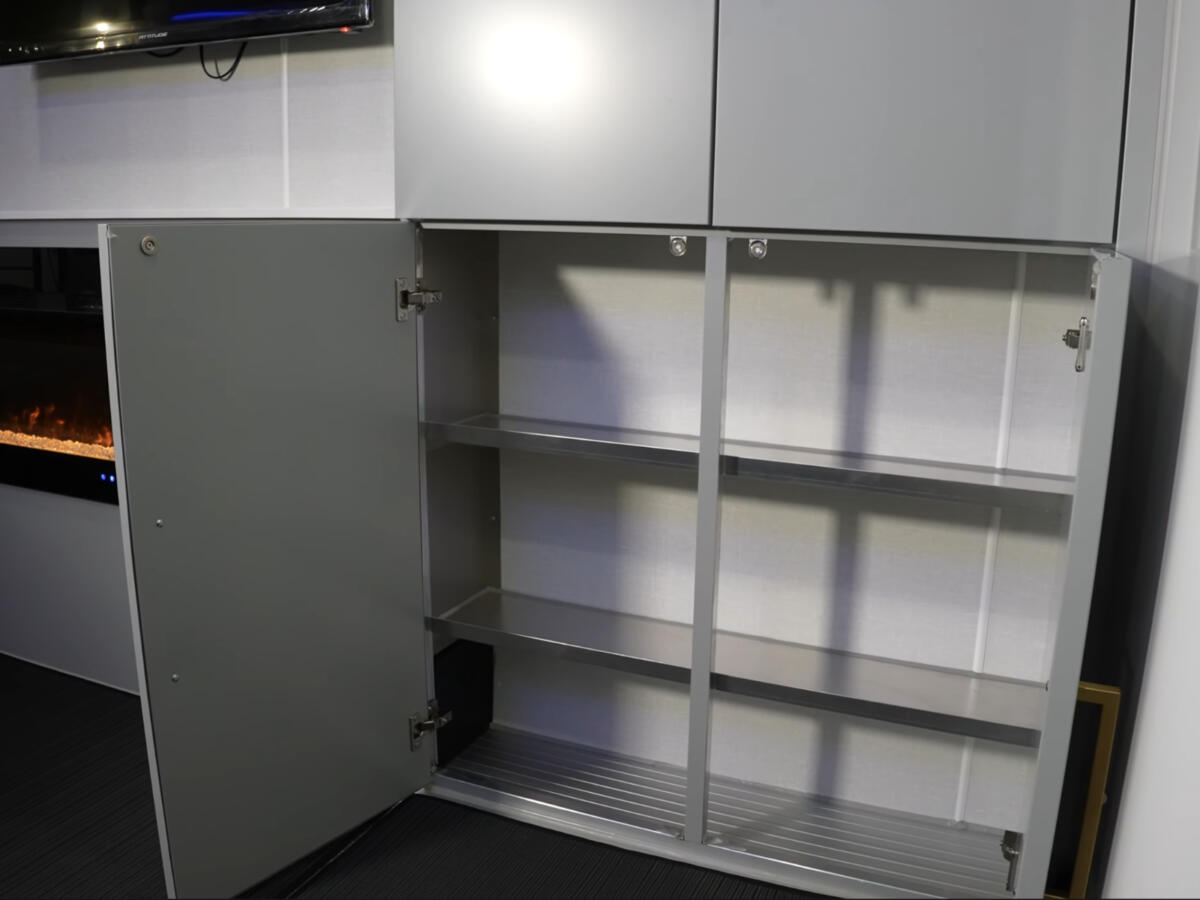
Opposite the table is an electric fireplace and a 40” 12-volt TV. Surrounding that are several cabinets, so storage space in here isn’t bad at all—not typical for a toy hauler. 

If you wanted a super comfortable spot to sit and watch TV, you could always pack one of those zero-gravity camp chairs or whatever you like best. The one I have seems to be as comfortable as any home furniture. It’s pretty great. 

Kitchen in the inTech Black Wing 826-X

I can see this kitchen being one of the several polarizing features in this trailer. It’s not a bad kitchen at all, though. 

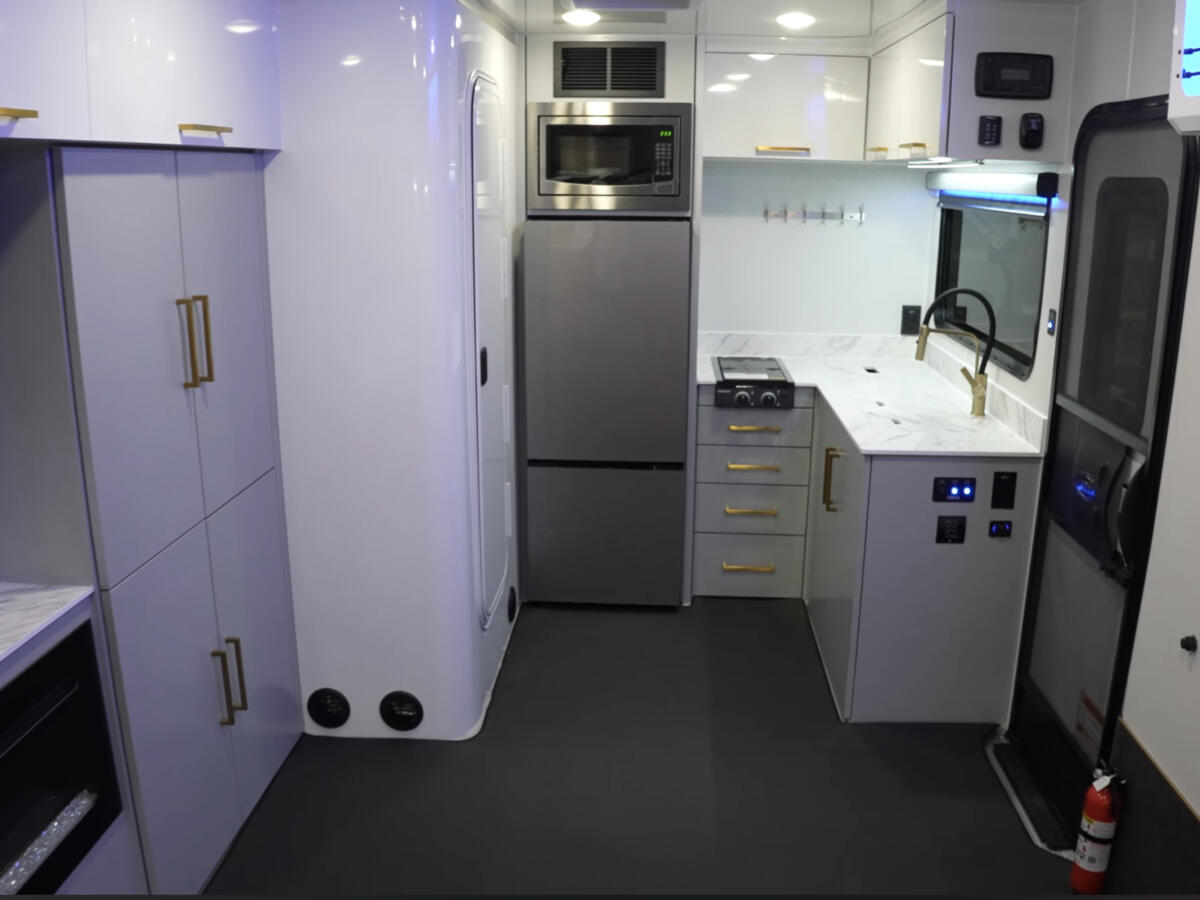
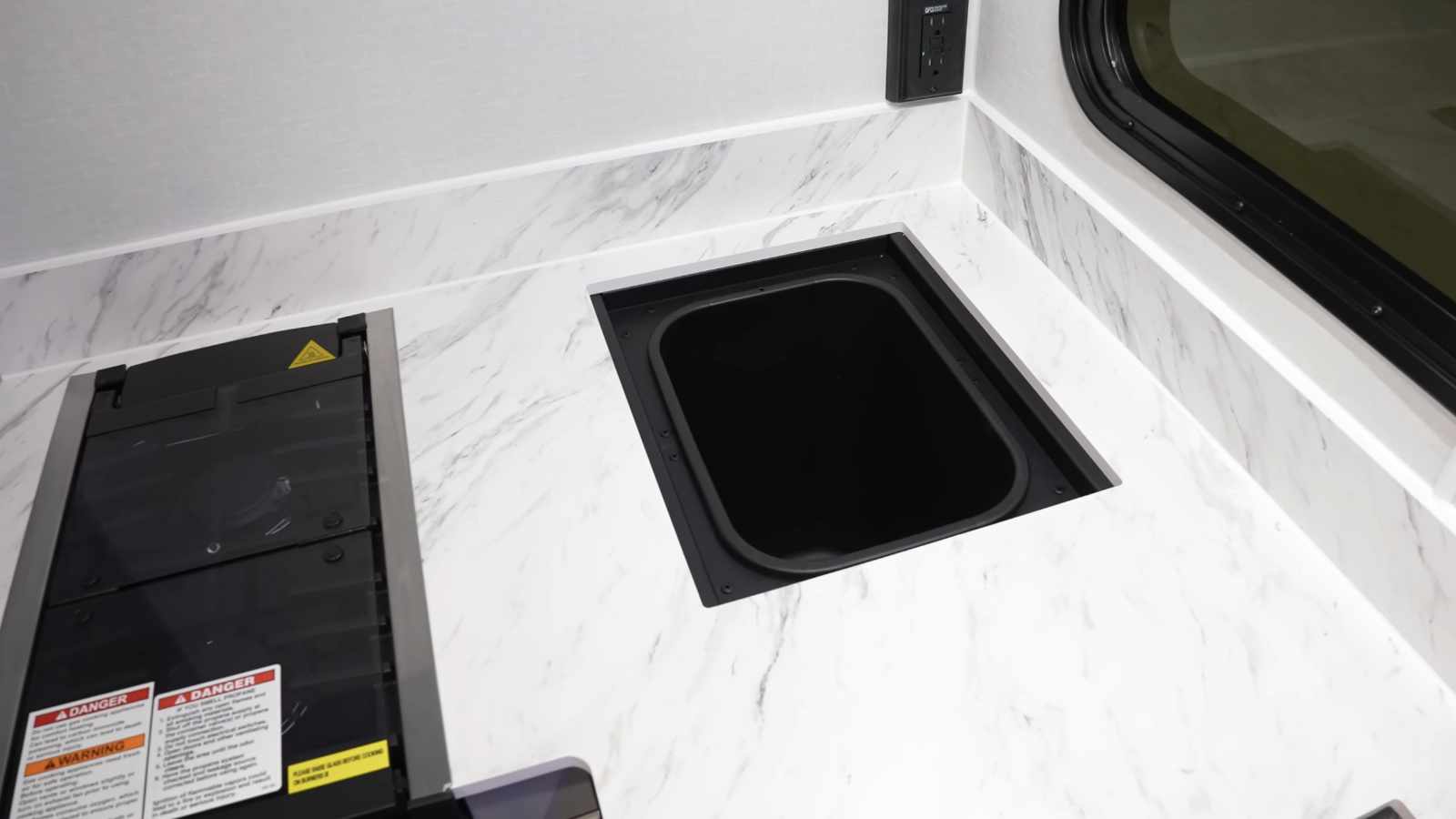
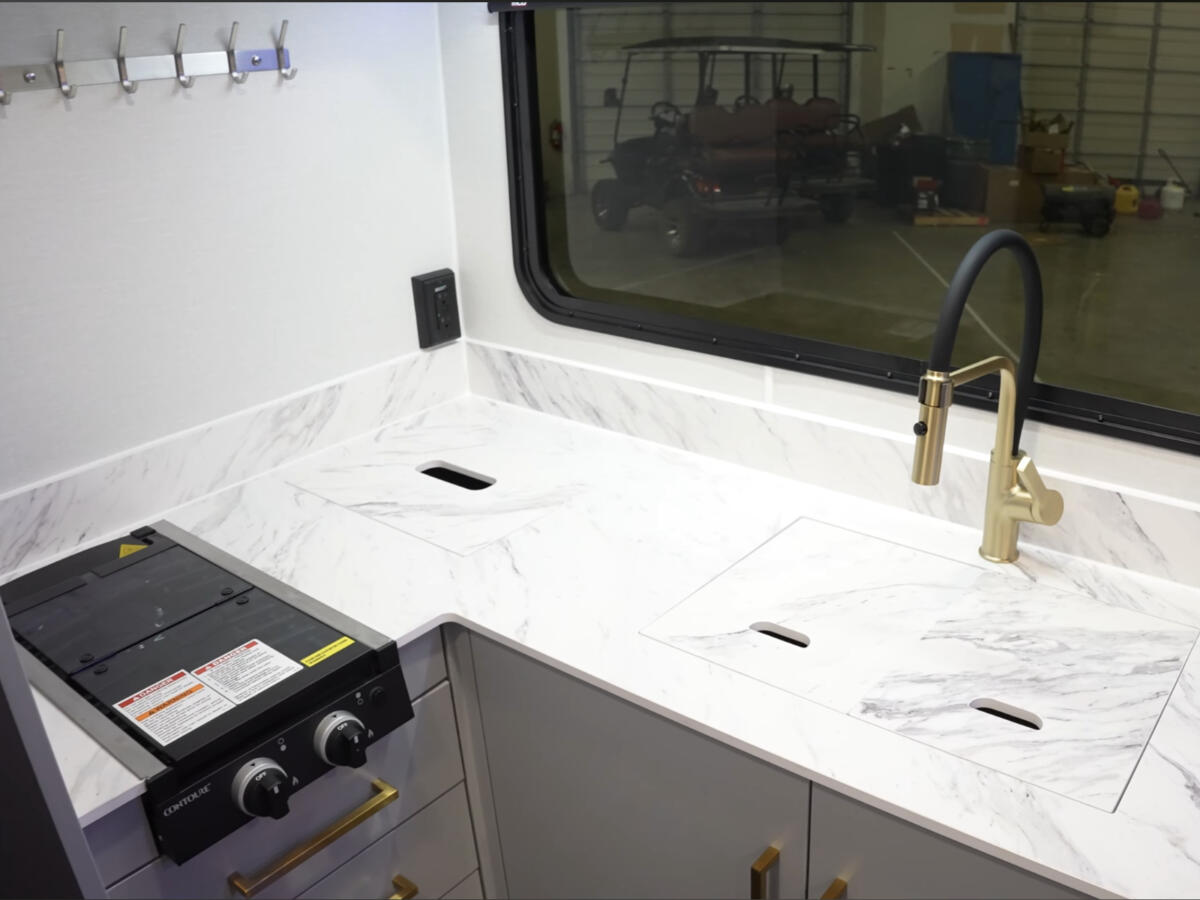
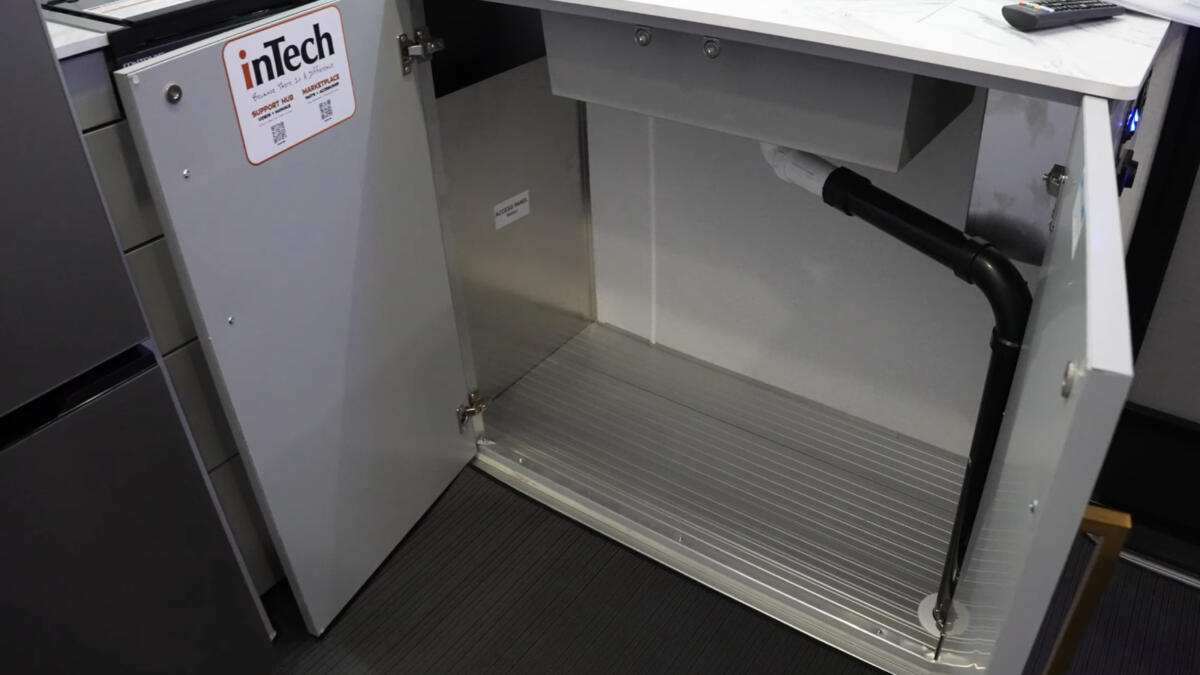
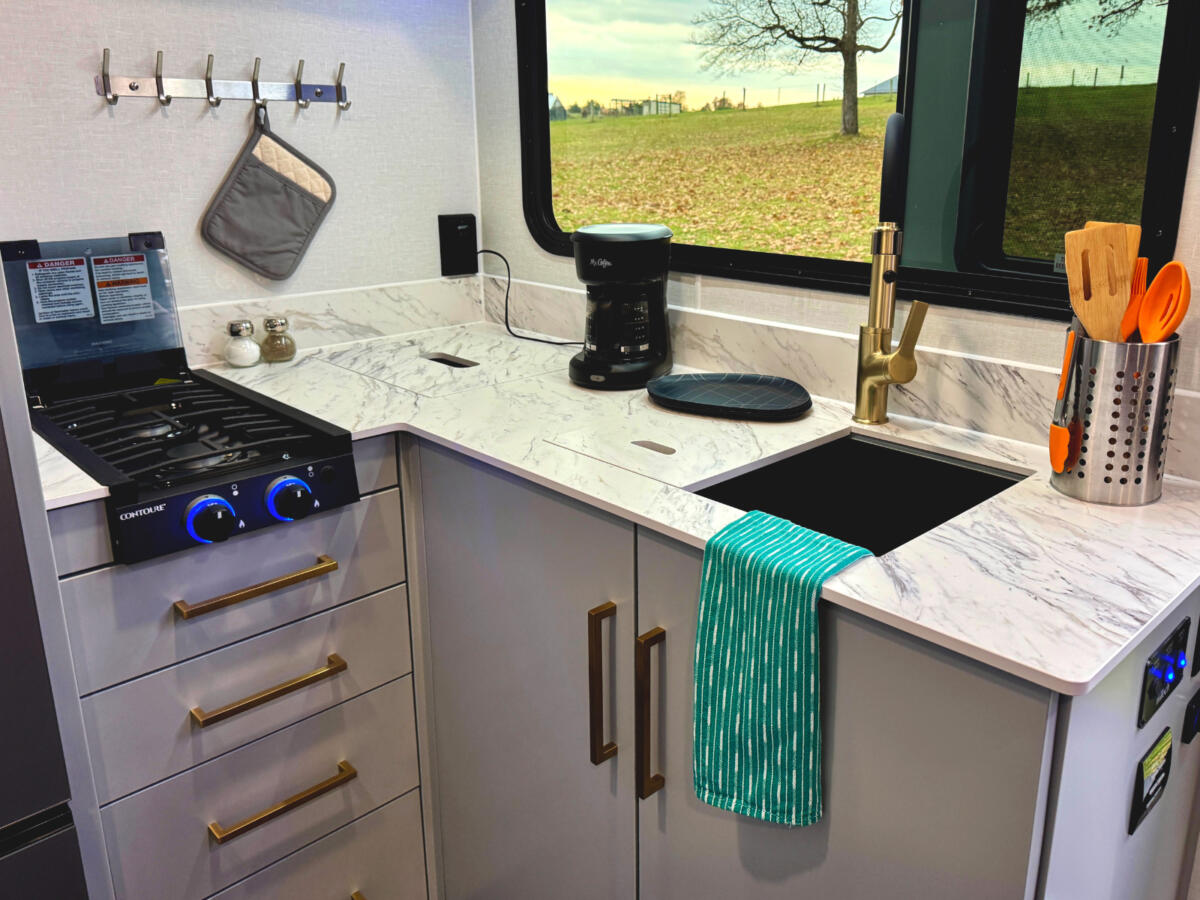
There is an L-shaped counter at the front of the trailer with three overhead compartments for storage. The countertop is a faux marble solid material. There are three cut-outs in the surface—two over the sink and a third over a trash can. Under the sink is also a large storage space, and the floor is more of that anodized aluminum, so no worries about putting stuff in here that’s hot or wet. 

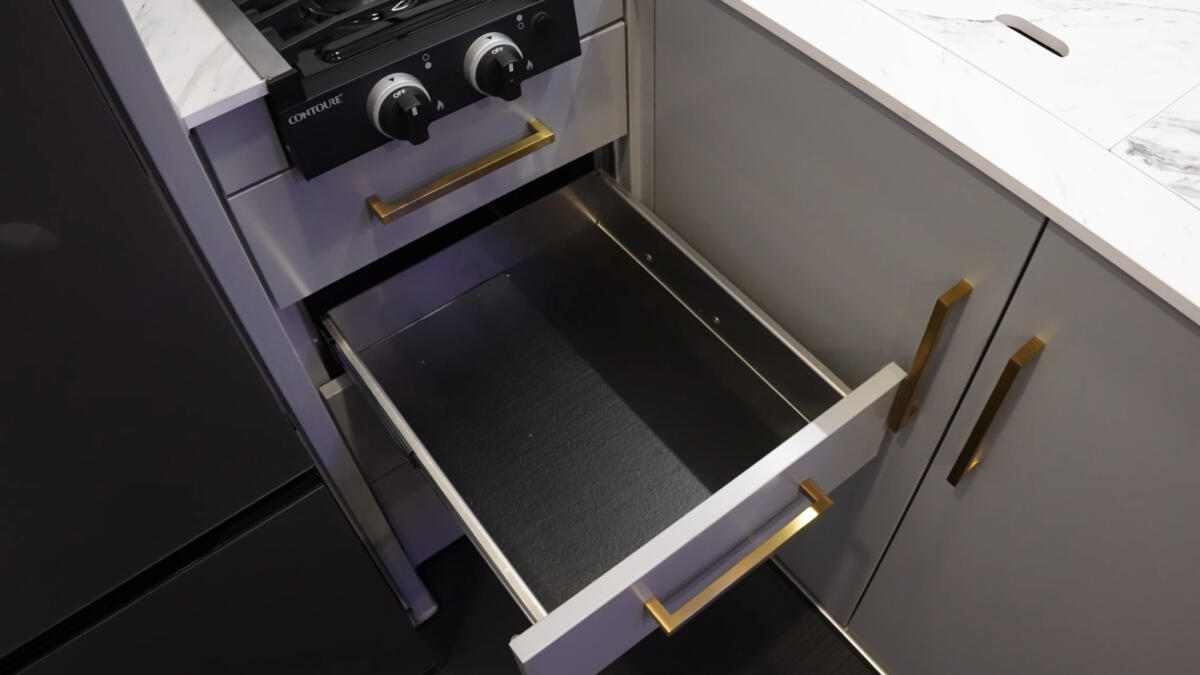
There are also four drawers under the two-burner propane cook top. Those drawers are all metal, as is much of the rest of the structure of this trailer. This thing is built to last. 

There’s also the obligatory 12-volt refrigerator plus a microwave. However, unlike many RVs with two-burner stovetops and no oven, this microwave is just a microwave as opposed to being one of those convection air fryer rigs. Bummer. 

Bathroom in the inTech Black Wing 826-X

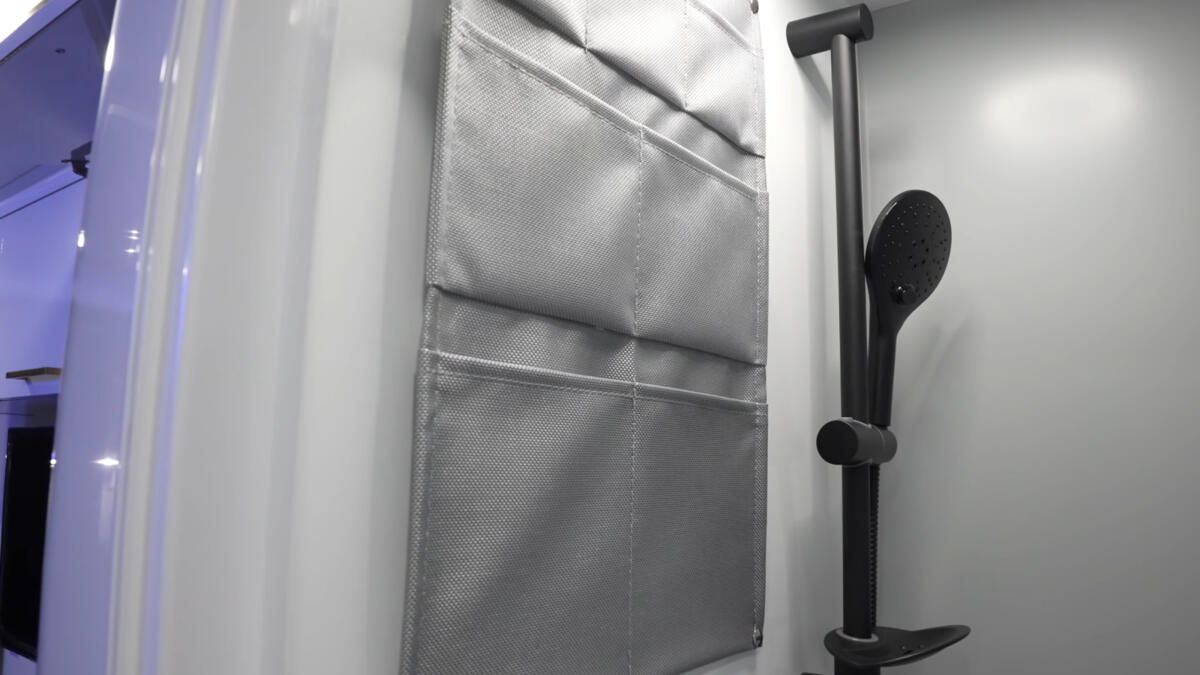
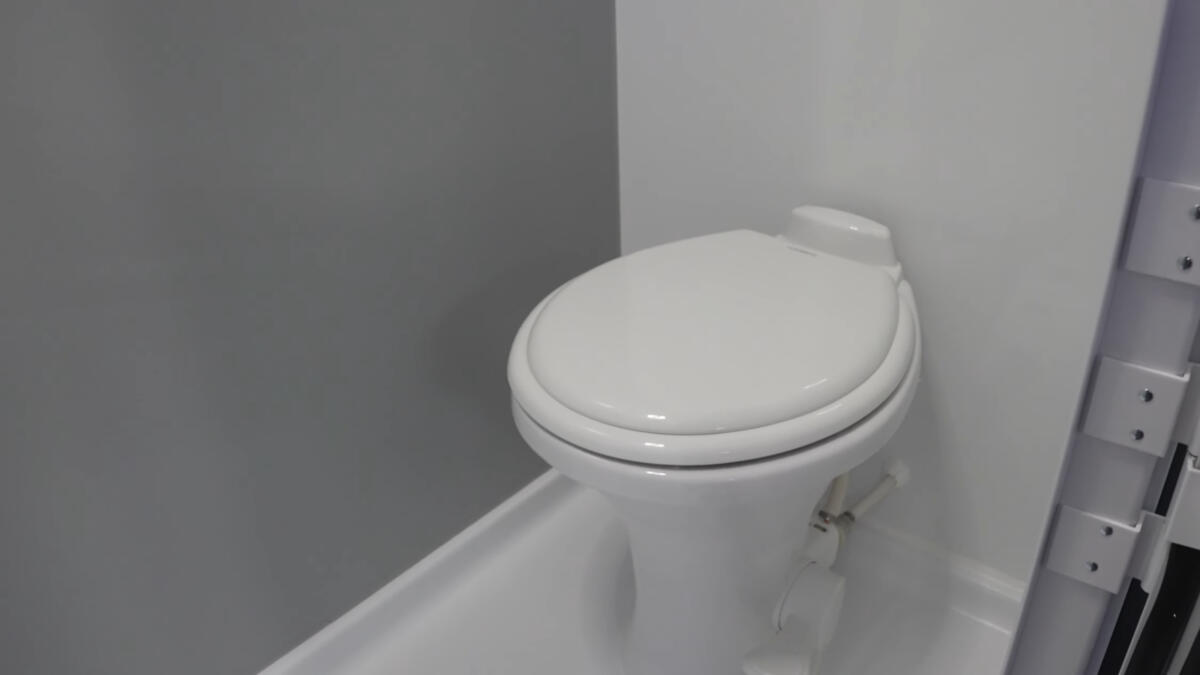
I don’t know why I saved this for last, but it’s going to be a deal breaker for a lot of the people who read this because it’s a wet bath. I will say, inTech does a good job with their wet bathrooms because the whole interior can get wet without being ruined. 

A lot of RVs with wet baths still have wooden walls, which seems silly to me. But I understand ya’ gotta cut corners where ya’ can. Bleh. This is all human-made materials. Even the door is an exterior-style gasketed door, so you can splash to your heart’s content in here. 

Oh, the toilet paper is contained in a plastic enclosure, so no worries on that front. 

Boondocking and travel access in the inTech Black Wing 826-X

This trailer has no slides, which is another reason I absolutely love it. So, that also means everything’s fully accessible, even for a travel stop, depending on what you load into the back of the trailer.

The fresh water tank in this is 90 gallons—Wow.

This can be fitted with a gasoline-fired generator. There is an on-board 40-gallon fuel tank. It powers the generator but also can be used to fuel up any toys one might bring along for the ride.

Solar is an option, and there’s also a port on the side for portable solar panels. The optional solar packages can include a 2,000-watt inverter.

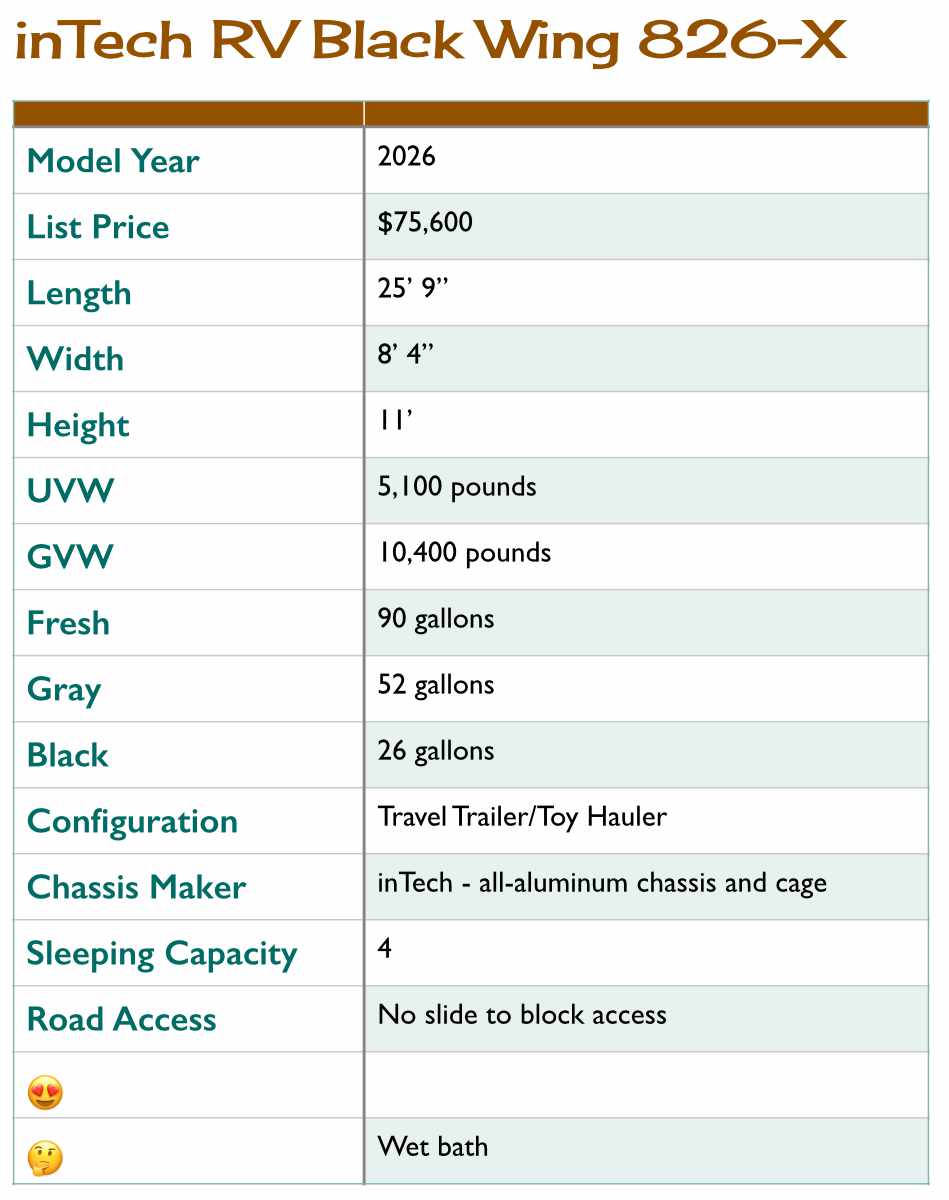
inTech RV Black Wing 826-X specifications

Final thoughts on the inTech Black Wing 826-X

One of the things about inTech interiors is that they do have an austere feel to them. However, this can be easily overcome with stick-on wallpaper, including removable wallpaper from a company like Spoonflower. You could go with rustic cabin look, walls, or whatever. 

I also know there are a number of aspects of this trailer that are likely going to lose favor with more fancy folk—the wet bath, a HappiJac bed, things like that. But then that’s why there are 31 flavors at the ice cream store—something for everyone. 

The combination of the build quality, easy cleaning, durable structure, lack of a slide room, metal cabinetry, more aerodynamic shape, and a number of other things makes me very, very interested in this design. It would solve my mental issues of wanting to build a cargo trailer without having to actually build something terrible. 

I’m more the Tim Taylor from Home Improvement, not Al Borland. 

Of course, I love your feedback and look forward to what you think of this rig. 

RELATED

RVT1258