Home Blog

RV Daily Tips. Monday, June 15, 2026

America’s Original RV Newsletter. Since 2001
Issue 2926 • New issue every weekday


Today’s thought

“A journey is a person in itself; no two are alike. And all plans, safeguards, policing, and coercion are fruitless. We find that after years of struggle that we do not take a trip; a trip takes us.” John Steinbeck


Need an excuse to celebrate? Today is Nature Photography Day!

On this day in history: 1919 – John Alcock and Arthur Brown complete the first nonstop transatlantic flight when they reach Clifden, County Galway, Ireland.


Tip of the day
Sagging, loose cables are a silent threat to your RV’s slide-outs

By Andrew Herrick
Sagging cables are a harbinger of bad things to come. If you roll the dice on your cable-driven RV slide-out, you might get lucky, or you might hear a BOOM!… and now your slide-out won’t move.

Cable-driven slide-out systems are a popular choice for new RV installations. They are lightweight, modular, and easy to install. The BAL® Accu-Slide™ system is the most well-known. It is sold in two configurations: regular and Double Back. Continue reading.
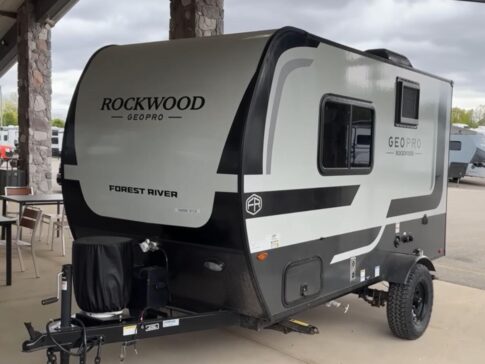

Rockwood Geo Pro 11LE travel trailersRV review
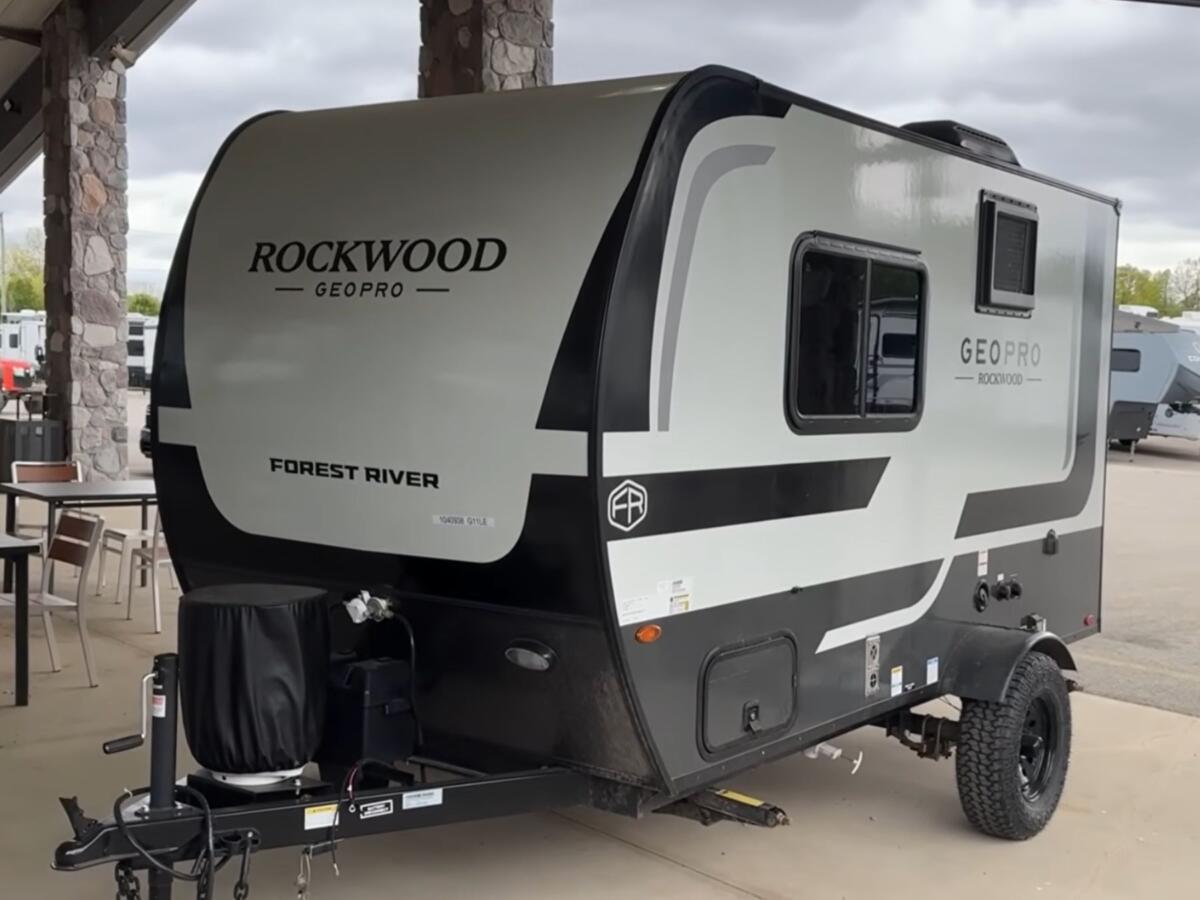
2026 Rockwood Geo Pro G11LE—Simple, small, strange

The 2026 Rockwood Geo Pro G11LE is one of those campers that makes more sense after a closer look. It is a tiny, light trailer that keeps Rockwood’s better build methods while cutting the floorplan down to the basics. That makes it a fit for solo campers, couples, and maybe a small family that wants easy weekend trips, not full-time living. The layout is odd, yet it squeezes in more use than the size suggests. See what you think.


In the RV shop with Dustin
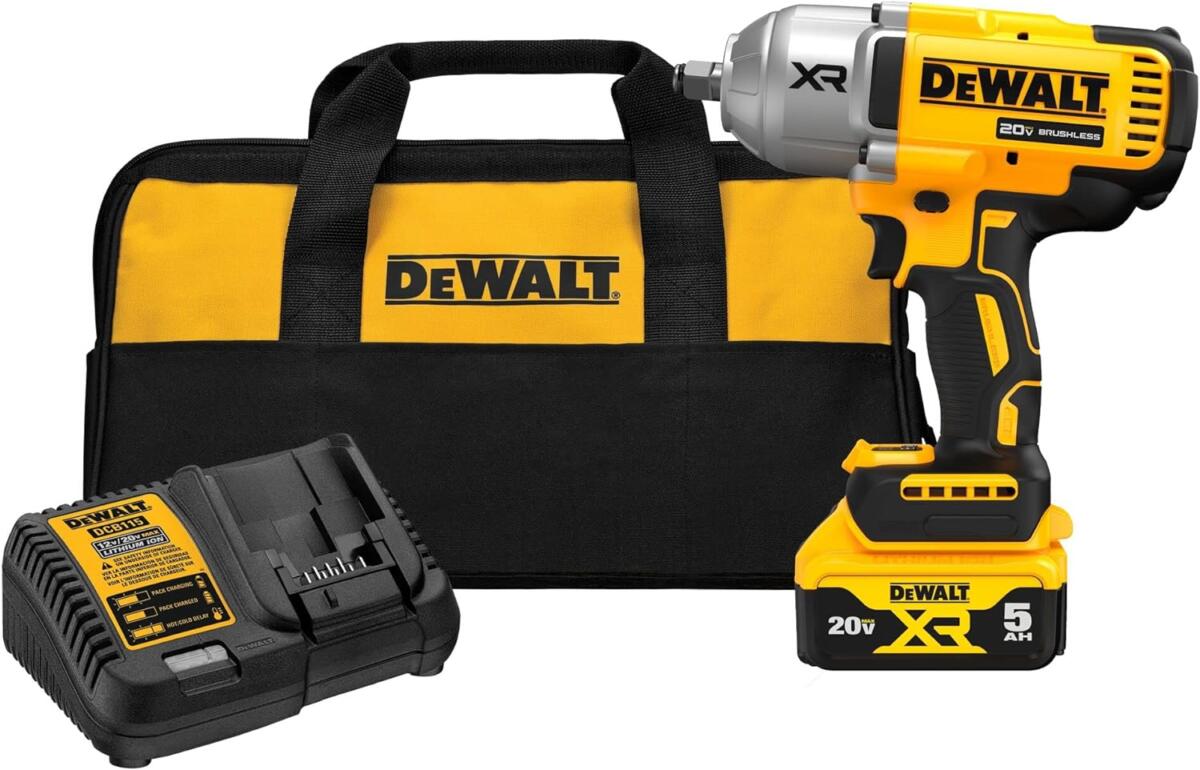
Cool Tools: Use the DeWalt Impact Wrench for daily RV tasks

Join me as I share what we like to call “Cool RV Tools.” These are tools and gadgets that we actually use in the RV industry! We also believe they will be helpful to you when you need to make repairs while out on the road. Previously, I showed you the DeWalt 20 Volt Max Cordless Grease Gun, and today, I’m introducing the DeWalt 20V MAX XR 1/2 in. High Torque Impact Wrench—the powerhouse tool for your daily tasks!
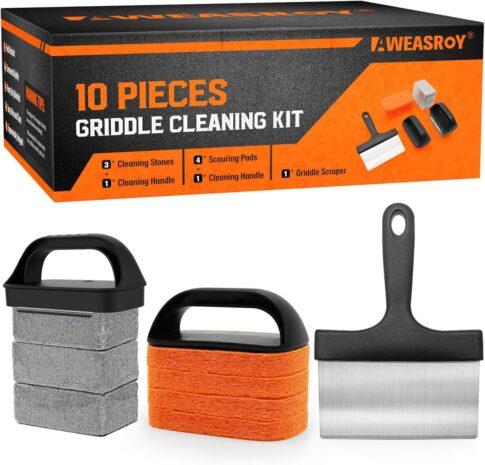

GriddlekitKeep your Blackstone/griddle good-as-new
This griddle cleaning kit helps RVers keep their flat-top griddles in great shape trip after trip. With scrapers, scouring pads, and a pumice grill stone, it quickly removes grease, burnt bits, and buildup without scratching the surface. Clean before and after cooking, and your griddle will last longer. Learn more about cleaning your Blackstone in Gail’s article here, or buy this griddle kit here.


Article and video
RV inspector recommends the best older motorhome brands

High-quality vintage motorhomes aren’t just full of memories—they’re built tough and made to last for years. From solid frames to clever layouts, choosing the right one is about striking a balance between endurance and comfort. With guidance from years of RV inspections and living on the road, certified RV inspector Deb of Deb’s RV Services curated the list in this video that spotlights the 11 RV brands and models that keep rolling mile after mile. (If you don’t want to watch the video, I write about them all in the article, too.)


The latest news for RVers

To read more recent news, click here.


Featured article
7 joyful road trip songs to start your journey

By Cheri Sicard
Welcome to Road Trip Playlists! I will try to mix it up with songs you probably already know and love along with others you may have never heard of. I came up with the idea after having a lifetime of friends come to me for music recommendations. My business partner has even called me the “DJ of his life.” For this road trip playlist, I wanted to focus on joyful songs to get your trip started. Listen here.


RANDOM RV THOUGHT: You know you’re an RVer when a trip to the hardware store for one $3 part somehow turns into a $97 receipt, a new flashlight, a storage bin, two bungee cords, and a gadget you can’t quite explain—but are absolutely convinced you’ll need someday.


Ask Dave
Why does RV water pump run all the time when connected to city water?

Dave helps Matt troubleshoot the possible cause.
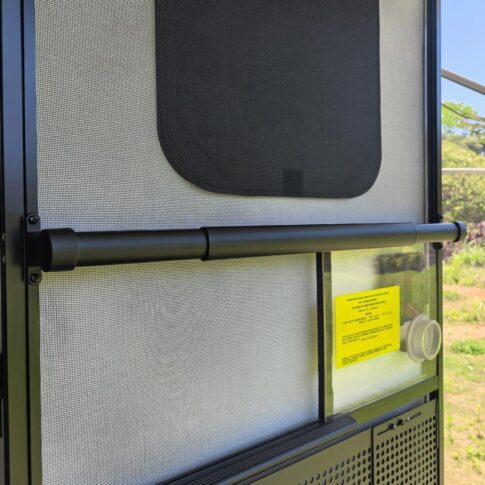

ScreendoorbarReinforce your RV’s screen door in seconds
Give your RV screen door a little extra love. This lightweight aluminum grab bar reinforces and protects your door, helps prevent everyday damage, and adds a comfortable, secure grip. Fully pre-assembled and adjustable to fit most RVs, it installs fast and makes every in-and-out smoother and safer. Learn more or order.


Reader poll
What size bed do you have in your RV?

Respond here.


Quick tip
Bugged by mosquitoes? Try this

We haven’t been able to independently verify this one, but some say using LED lamps and flashlights attract fewer of the little bloodsuckers. Let us know in the comments if you’ve noticed this.


Website of the day

10 Best Places To Go Snorkeling in the U.S.
Let’s make this the year you try something new, shall we? Snorkeling is a fun, beautiful place to start. This list gives you the best states to snorkel in, and the best places to go snorkeling in each of those states.


Monday Motivation

Screenshot


Trivia

Thinking about attending all 11 World Cup events? If so, your field-to-field trip would take you across more than 15,000 miles on up to 20 different interstates. Alas, that would be difficult as some events occur on the same day. A complete road trip would thus require time travel.


? MYSTERY PRODUCT OF THE DAY ?
This made us smile. It’s something we all do, and it’s the best part about being an RVer, isn’t it?


Readers’ pet of the day

Img 20260602 Bucky E47cf91c0ca18d5bd4b2ac85b016ff2f“We rescued Bucky (Tuxedo, age 2) from our local shelter when he was just 6 weeks old. He fit in the cup holder on our first road trip. He has practically grown up in our travel trailer. He loves being outside on a leash and taking golf cart rides. He’s just an ‘All American Cat’, or he says… ‘Merica!'” —Perry Morris

Send us a photo of your pet with a short description. No blurry photos and please do not submit your photo more than once. Thanks!


Leave here with a laugh


Today’s weather forecast across the nation
THIS MAP UPDATES TWICE A DAY
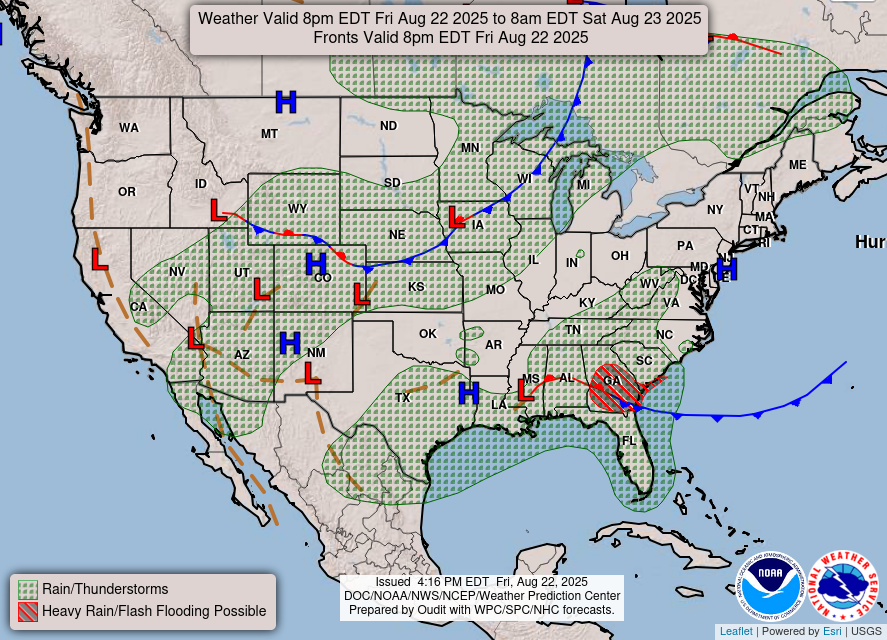
Visit Current National Radar Weather Map


Did you miss the latest RV Travel Newsletter? If so, read it here.
Oh, and if you missed the Latest News for RVers, make sure to catch up here.


If you shop at Amazon.com we’d appreciate you using this link. We get an itty bitty commission if you buy something, but they add up and help us pay our bills (most importantly our hard-working writers!). 


RVtravel.com All-Star Staff

Click here for information about our staff and how to contact us.

WHY WE ASK FOR DONATIONS INSTEAD OF SELLING SUBSCRIPTIONS.

Our policy on using artificial intelligence.

Why does RV water pump run all the time when connected to city water?

Dear Dave, 
The RV water pump stays on when hooked up to city water even when the switch is off. Also, the pump “hums” when the unit is shut down. It’s not as loud when the pump is actually pumping water through the system—there’s just a hum. The only way to shut it off is by pulling the fuse. I’ve tried pulling the fuse and waiting a few minutes then putting the fuse back in. The pump shuts off, but in a few minutes the hum starts again. Thanks for any help. —Matt, 2007 Newmar Dutch Star 4304

Dear Matt,
If the water pump stays on when hooked to city water, it typically means your water pump check valve is defective or stuck, allowing the pressurized water from the city source to backflow through the pump into the fresh water tank. This would reduce pressure in the line at the pump and it would sense that it needs to run to provide on demand pressure.

The “gremlin” in this situation is, why does it run with the switch off? That should mean there is no 12-volt power going to the pump. Pulling the fuse removes the gremlin. Therefore, it could be one of two things: Either your switch is defective and not shutting off power, or, more likely, is there is another switch somewhere that is on?

Typically your rig will have three water pump switches: one at the monitor panel, one in the bathroom, and one outside in the service center so you can turn the pump on in each of those locations. If any of these switches are in the on or closed position, 12-volt power will go to the pump and make it run when it detects a pressure drop.

water pump
Water pump

Troubleshooting tips

Make sure all the switches are in the off position. If the pump still runs, you most likely have a defective switch. Start with one switch and remove one of the lead wires. If the pump still runs, replace the wire and go to the next switch, remove the wire, and do the same for the third.

Does the water pump work as designed when not connected to a pressurized city water source?

I believe the hum you are hearing when the unit is shut down most likely is water backflowing through the pump and the blade spinning.

I would suggest removing the water pump and replacing the backflow valve and the filter.


 You might also enjoy these posts from Dave 

DAVE HAS ANSWERED MORE THAN 1,000 readers’ maintenance and repair questions. Read a directory here. There is so much to learn!


Dave Solberg is a leading expert in the RV industry and the author of the “RV Handbook.”

HAVE A QUESTION FOR DAVE?

Send your inquiries to him using the form below.

Name
Drag & Drop Files, Choose Files to Upload

RVDT2926

Sagging, loose cables are a silent threat to your RV’s slide-outs

By Andrew Herrick
Sagging cables are a harbinger of bad things to come. If you roll the dice on your cable-driven RV slide-out, you might get lucky, or you might hear a BOOM!… and now your slide-out won’t move.

A quick handshake with BAL® Accu-Slide cable-driven slide-outs

Cable-driven slide-out systems are a popular choice for new RV installations. They are lightweight, modular, and easy to install. The BAL® Accu-Slide™ system is the most well-known. It is sold in two configurations: regular and Double Back.

It’s difficult to verbally explain the Accu-Slide system. (How can cables “push” a room, after all?) BAL has published several free videos demonstrating the mechanical magic. I recommend you watch those videos first if you want to understand the ins and outs (no pun intended) of this system.

That’s the part of the Accu-Slide system you can’t see!

In short, there are eight cables—four inside, four outside—that alternately pull the room in or out depending on the 12V motor’s polarity. It’s a give-and-take system, where the slack on one cable set is taken up by another. The motor, gearbox, cables, and pulleys are hidden behind the fascia trim surrounding your slide-out room.

What causes slide-out cables to break?

Anyway, that’s enough background information. Here’s why sagging cables are so dangerous:

In an Accu-Slide system, two sets of cables attached to adjuster brackets physically pass by each other as the room moves in and out. There’s not much room to pass (imagine two tractor-trailers on a country two-lane highway), so both cable brackets must stay in their lane.

You can see how this adjuster bracket is beginning to skew into the lane of the other bracket!

As one set of cables becomes too tight or too loose, the cable bracket will begin to skew or rotate sideways. Eventually, that cable bracket will “drift” into the lane of the other cable bracket. The two brackets collide as the room moves in or out, and SNAP!—a cable breaks, or BOOM!—the bracket pops. The room either won’t close completely or won’t move at all. Dave Solberg has addressed several of these repair questions here.

Replacing broken Accu-Slide cables isn’t a one-beer job

Fixing a cable-driven slide-out is not an easy task for a newbie. You’ll need to blindly fish a new cable through two pulleys, crimp a new cable and ferrule (circular ring) in place (requires a special tool), and re-tighten all the cables to achieve a proper seal (and to avoid the same problem in the future!). You may need to support the slide-out room with a jack or jockey the room into position. You may need to remove the motor or replace the gearbox, depending on the damage.

It’s not a forgiving system. If you put the wrong chain link on the gearbox sprocket or orient a cable bracket the wrong way, you’ll be right back where you started. Plus, just accessing the mechanical organs usually requires a full dissection of the slide-out room fascia and trim!

How loose is too loose? You want snug, but not guitar-string tight: 1/2″ of play in both up and down directions.

Is your RV slide cable loose? Thankfully, you don’t need to be Thomas Edison to check the calibration of your slide-out room. With the room fully extended or retracted, just check each cable. Each cable should be snug, but not guitar-string tight. Grasp it with your thumb and forefinger and gently push up and down. Each should easily move up and down 1/2” in each direction, or 1” total. If any cable is too tight or too loose, all the cables need to be adjusted.

If you’re not mechanically minded, the cable adjustment will require an RV technician who knows the Accu-Slide system—but better to pay $200 for an adjustment than $1,000 for a system rebuild!

More by Andrew, The RV Engineer:

RVDT2926

RV inspector recommends the best older motorhome brands

By Cheri Sicard
High-quality vintage motorhomes aren’t just full of memories—they’re built tough and made to last for years. From solid frames to clever layouts, choosing the right one is about striking a balance between endurance and comfort.

With guidance from years of RV inspections and living on the road, certified RV inspector Deb of Deb’s RV Services curated the list in the video near the bottom of this page that spotlights the 11 RV brands and models that keep rolling mile after mile. (Yes, I know the video claims 10 best older motorhome brands, but since Deb’s list includes an honorable mention, that makes it 11.)

What sets the best older motorhome brands apart?

A few key details separate reliable motorhomes from the rest:

• Sturdy chassis (Ford E450, Workhorse, etc.)

• Durable build materials (aluminum, fiberglass)

• Thoughtful water and waste tank sizes for boondocking

• Proper insulation for comfort and longevity

• Fewer slide-outs translate to less hassle over time

Regular maintenance and a thorough inspection before buying any used motorhome are essential for getting the most out of any rig.

OK… on to Deb’s list.

Best older motorhome brands

#1 Lazy Daze: Sturdy and simple

Built on an E450 chassis with a gas engine, Lazy Daze motorhomes are known for:

• Aluminum body and roof for lasting strength

• No slide-outs, so there’s less to fix or leak

• Spacious freshwater tanks and easy driving

• 26½ ft., on average, making them park-friendly

• Ideal for three seasons, but not for harsh winters

While lacking modern room-expanding slides, their durability and simplicity have won many loyal fans.

#2 Chinook: Compact, yet tough

Chinooks, sometimes called “baby Lazy Daze,” sit on a Ford or Chevy chassis with a fiberglass shell. Their compact size fits into typical parking spots and makes city drives less stressful. Chinooks lack slides (which means fewer potential repairs), but their smaller tanks can shorten boondocking trips.

They aren’t all-weather, but hold up well with mild insulation. Compared to Lazy Daze, Chinooks are more nimble, but those needing lots of water storage may want to look elsewhere.

#3 Born Free: Safe, solid construction

Born Free Class C motorhomes stand out due to their built-in roll bar—a unique safety feature in case of a collision. They’re built on a Ford E450 chassis, and models may or may not offer slide-outs.

Born Free units boast slightly better insulation for moderate climates, awarding them a spot as well-rounded and secure. The best years run from 1999 to 2010.

The built-in roll bar for added crash protection is a rare feature in this RV class.

#4 Coach House Platinum B+: Comfort with slides

Coach House Platinum B+ motorhomes (E450 chassis) often have a single slide-out for extra space. These slides can leak or misalign, so buyers need to check for any past issues carefully. Coach House Platinum features well-insulated, one-piece fiberglass construction and smaller tanks. Those who boondock should account for limited storage and water.

Slide-out inspection checklist:

  1. Check for prior water leaks or stains around the slide.
  2. Test the slide operation several times.
  3. Inspect slide seals for cracks or wear.
  4. Look for misalignment or uneven movement.
  5. Ask for maintenance records.

#5 Safari Trek: Compact Class A

The Safari Trek is a well-built, smaller Class A motorhome with a gas engine. Its standout feature is the “electro bed” that lowers from the ceiling. When it works, it frees up space during the day, but finding replacement parts can be a pain if it breaks. Some models offer a slide, but most do not. It’s suited for moderate climates, not harsh winters.

Electro bed system

Pros: Maximizes floor space, innovative sleeping arrangement

Cons: Repairs can be tricky due to scarce replacement parts

#6 Bigfoot: All-season champ with smart storage

Bigfoot Class C models, built on a Ford E450 chassis, are prized for four-season insulation and ample interior storage—enough for bikes and larger gear inside the cargo hold.

While some units offer slides, many owners prefer slide-free versions for less maintenance. They’re hard to find and tend to cost more, but their reputation for quality is high.

#7 Phoenix Cruiser: Attractive interiors, flexible layouts

Phoenix Cruiser B+ RVs turn heads with their seamless fiberglass roofs, all-wood floors, and cabinetry. Models often have slide-outs and decent three-season insulation. Their compact design and flexible layouts mean they’re welcome in most national parks and easier to maneuver.

#8 Fleetwood Tioga: The trusted workhorse

Fleetwood Tioga Class C models are best known for solid construction and reliability, often serving as rentals in their heyday. Built on a Ford E450 chassis, most lack slides. Their strong frame and interior toughness put them on the shortlist for anyone wanting simplicity and longevity.

Pros:

• Dependable build, made to handle heavy use

• Fewer moving parts, easier upkeep

Cons:

• Outdated styling in some models

• Somewhat basic amenities

#9 Dynamax Isata: Four-season strength and variety

Dynamax Isata B+ coaches come with engine choices—Ford, Dodge, or Freightliner. They’re recognized for excellent insulation, four-season capabilities, and high-end systems. Downsides include smaller tanks and higher resale prices.

#10 Monaco Dynasty: Full luxury in a classic package

The Monaco Dynasty is a luxury Class A diesel pusher, built on the Roadmaster chassis. These coaches feature dual-pane windows, first-rate insulation, quality cabinetry, and spacious layouts ready for every season. Pre-2009 models retain the best build quality, before Monaco’s ownership change.

Honorable mention: Toyota Sunrader for off-grid adventures

Toyota Sunraders stand out with high clearance and a compact, all-fiberglass body. They’re rare, prized for getting into off-road and tight spaces, but have small tanks that limit extended remote camping. Perfect for weekend getaways or adventurous trips off the beaten path.

RELATED

RVDT2926

What size bed do you have in your RV?

11

The topic of RV beds or mattresses is always a hot topic among RVers. In one RV Service Centers and Repairs report, one reader claimed they thought their RV mattress had been made at a granite quarry—that’s how uncomfortable it was.

While comfort is one thing, size is another major factor when it comes to RV beds. Some RVers are lucky enough to have a residential-size king, while others make do with an RV short queen or even a full-size mattress.

Then there are those with unique setups—split twins, convertible sofas, or Murphy beds that fold down at night and disappear by day. The variety of sleeping arrangements in RVs is almost as wide-ranging as the rigs themselves.

But, anyway, we’re not here today to talk about how comfortable or uncomfortable your RV bed is (but, of course, feel free to leave those thoughts in the comments if you wish). We want to know what size your RV bed is. If you have more than one bed in your RV, we want to know what size your main bed is, or the bed you sleep in the most.

If, for some reason, you sleep on your RV’s dinette bed, tell us about that one! If your main RV “bedroom” has two twins, tell us that! If you sleep in your Class C’s overhead “queen” bed and not the main bed in the back, answer for that.

As always, thanks for voting.

RELATED

RVT2926

Cool Tools: Use the DeWalt Impact Wrench for daily RV tasks

By Dustin Simpson
Join me as I share what we like to call “Cool RV Tools.” These are tools and gadgets that we actually use in the RV industry! We also believe they will be helpful to you when you need to make repairs while out on the road.

Picture by California RV Specialists during wheel bearing pack service.

Previously, I showed you the DeWalt 20 Volt Max Cordless Grease Gun, and today, I’m introducing the DeWalt 20V MAX XR 1/2 in. High Torque Impact Wrench—the powerhouse tool for your daily tasks!

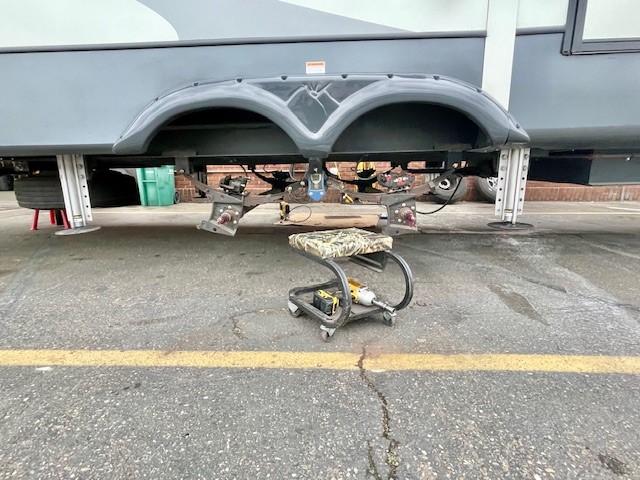
Picture by California RV Specialists of DeWalt impact wrench underneath RV tech stool.

Our team relies on this cordless impact wrench day in and day out, especially during critical tasks like removing tires during wheel bearing packs, conducting suspension repairs, and installing hitches or pin boxes.

Picture by California RV Specialists close up of DeWalt Impact Wrench used by RV techs.

DeWalt Impact Wrench built to tackle toughest jobs

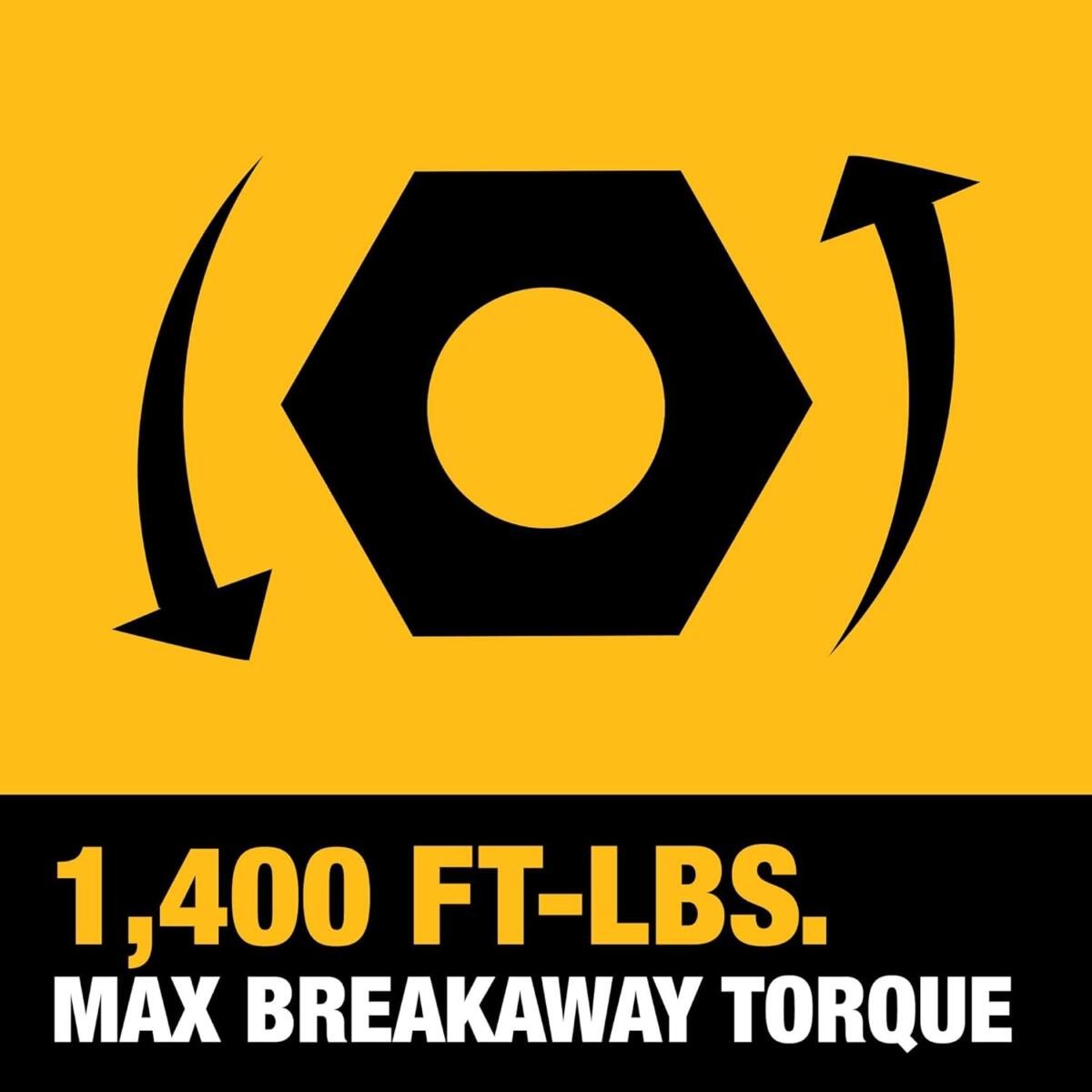
With an impressive 1030 ft-lbs. of max fastening torque and 1400 ft-lbs. of max breakaway torque, this impact wrench is built to tackle even the toughest jobs. From large-sized pipe flanges to wheel lugs, concrete anchor bolt setting, and more heavy-duty applications, this tool delivers unmatched power and performance.

Featuring PRECISION WRENCH™ mode, it helps prevent overtightening in forward and run-off in reverse, providing you with additional control over your work. The updated 4-mode push button switch allows for easy transition between speeds, ensuring efficiency and precision in every task.

Say goodbye to struggling with hard-stuck nuts and bolts. The DeWalt High Torque Impact Wrench makes quick work of even the most stubborn fasteners.

Picture provided by Amazon.

Whether you’re a DIY enthusiast or a professional in an RV repair shop, this tool is a must-have for your toolkit. Experience the convenience, power, and reliability of the DeWalt Impact Wrench for all your RV maintenance needs.

Upgrade your toolkit today and enjoy the ease and efficiency it brings to your workflow! Find them for sale on Amazon here.

More from Dustin

Make sure you check out my website, California RV Specialists, and our YouTube channel for more helpful information, and see our published articles on RVtravel.com and other social media pages.

MORE “COOL TOOLS”

RVDT2926

2026 Rockwood Geo Pro G11LE—Simple, small, strange

The 2026 Forest River Rockwood Geo Pro G11LE is one of those campers that makes more sense after a closer look. It is a tiny, light trailer that keeps Rockwood’s better build methods while cutting the floorplan down to the basics. That makes it a fit for solo campers, couples, and maybe a small family that wants easy weekend trips, not full-time living. The layout is odd, yet it squeezes in more use than the size suggests.

Josh the RV Nerd at Bish’s RV gives us a tour in the video at the end of this post.

What makes the Rockwood Geo Pro G11LE different

The G11LE spins off the older Geo Pro 12-series idea of a “bed in a box” camper. It still feels simple, but the taller body changes a lot.

There is enough interior height for a lounge feel, even if taller adults still need to duck a bit. That extra wall height also allows for a real 9-foot awning.

Rockwood did not cut out its normal build basics. The sidewalls use Azdel, the frame is welded aluminum, and the floor is non-laminated to avoid soft spots.

Josh points out a quick clue for shoppers: When the black door trim sticks out past the wall, it usually means a 1.5-inch laminated wall.

The small interior is more flexible than expected

Inside, the main seating area is a big lounge dinette that drops into a large lower bed. Two small bunks ride above the sidewalls, and the rear bunk carries a 300-pound rating. The space under the bunks is plain plywood, but it can still hold duffel bags or simple DIY storage accessories.

The sleeper setup uses separate bed boards, not the tabletop. The boards fold out over the dinette base, then the cushions fill in the center. It is a quirky system, but it creates one big bed while keeping the side bunks open.

Ceiling height looks close to 6 feet, the standard LE vent fan is small, and the wall-mounted A/C is a stronger 8,000 BTU unit.

Exterior features add some real camping value

Outside, the G11LE keeps a few surprises. There is a front pass-through compartment, front stabilizer jacks, slam-latch baggage doors, a full fiberglass roof, side solar prep for a suitcase panel, and backup camera prep.

The rear camp kitchenette houses the trailer’s sink, a 12-volt fridge, storage below, and a gas grill quick-connect nearby. That fridge is a better fit than the 110-only units seen on some small campers.

On the downside, there is no indoor kitchen and no bathroom. This is also a fair-weather trailer because it has no enclosed belly and no tank heaters.

Specs

  • Hitch weight: 210 lb.
  • Empty weight: 1,728 lb.
  • GVWR: 2,695 lb.
  • Cargo capacity: 967 lb.
  • Length: 14’11”
  • Height: 8’7″
  • Width: 7’4″
  • Fresh water: 18 gal.
  • Gray water: 6 gal.
  • Black tank: None
  • Price ranges from approx. $13,000 to approx. $20,000

That low weight opens the door for many SUVs and midsize trucks, though tow ratings still matter.

Final thoughts

The Geo Pro G11LE is a goofy little camper, but it gives campers a basic, light trailer with better construction, useful sleeping options, and a few rare extras for the size.

Its limits are clear, but for fair-weather trips, it makes far more sense than its odd little shape suggests.

Learn more about the Rockwood Geo Pro G11LE here.

RELATED

RVDT2926

Ouch! Reader charged more than $400 on Virginia Express Lanes

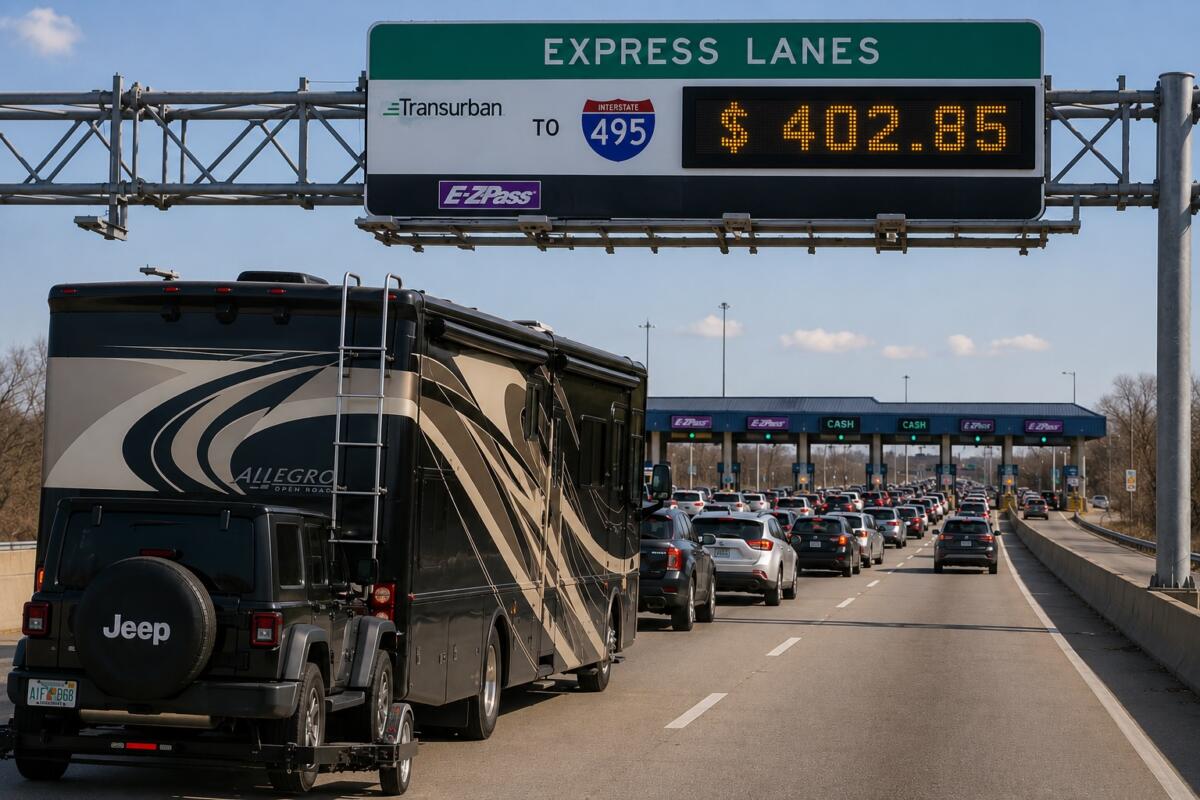
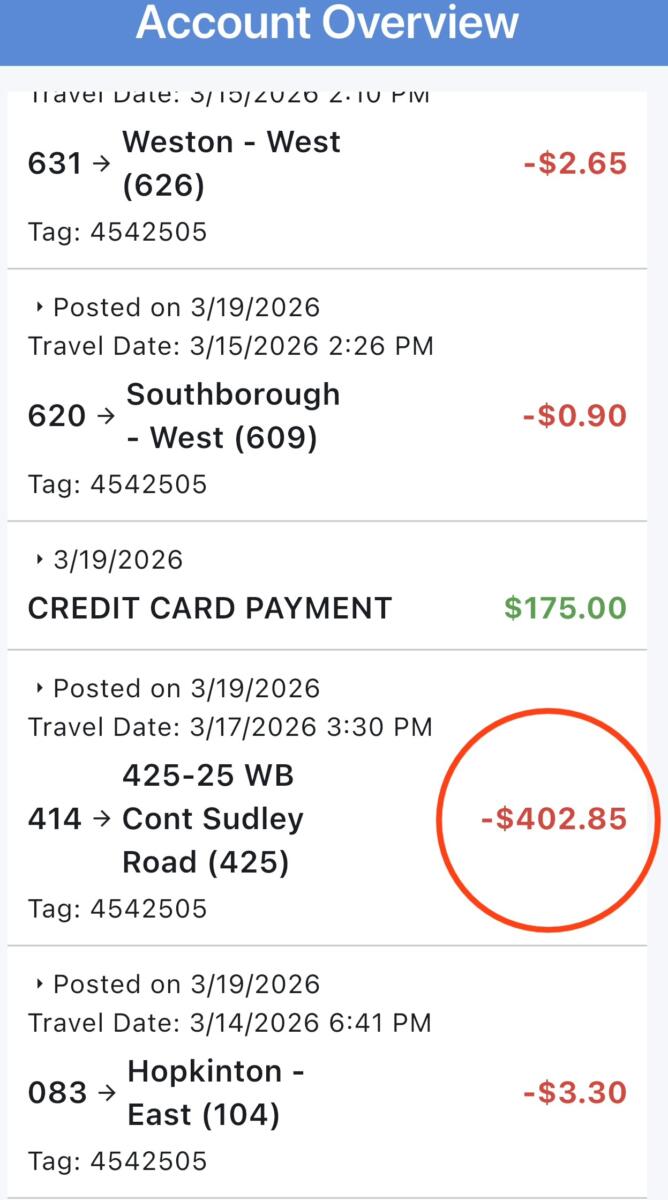
Reader Nicole Jones recently learned an expensive lesson the hard way. After taking Virginia’s Express Lanes during rush hour, she was stunned to receive a toll bill for $402.85.

We received this photo and note from Nicole:

“My goodness, someone needs to know that they should NOT pull their RV on the Express Lanes in VIRGINIA during rush hour. Apparently they charge 5x the rate depending on the size, length, height, and axles. Ouch!!!”

Img 5902 D47d8a073356ac88086e763af0159468

Virginia’s Express Lanes

As it turns out, Virginia’s Express Lanes can be especially costly for RVers. The lanes use dynamic pricing, meaning tolls rise as traffic gets heavier. What many RV owners don’t realize is that larger vehicles pay significantly more. Vehicles taller than 7 feet or longer than 23 feet are charged three times the posted toll, and vehicles that are both taller than 7 feet and longer than 23 feet pay five times the posted toll. During peak rush-hour congestion, those multipliers can turn an already-high toll into a jaw-dropping bill.

More expensive toll roads in the U.S.

Virginia isn’t the only place where RVers need to watch their wallets. The Pennsylvania Turnpike remains one of the most expensive toll roads in America and is frequently ranked as the nation’s costliest major toll highway. Tolls increase with vehicle size and axle count, meaning large motorhomes and truck-trailer combinations can pay far more than passenger vehicles. Pennsylvania also raised toll rates again in 2026.

Other toll hotspots for RVers include the New York Thruway, New Jersey Turnpike, Port Authority bridges and tunnels around New York City, and several toll roads in Florida. In many cases, the difference between a two-axle car and a multi-axle RV combination can be dramatic.

Avoid expensive tolls

How can you avoid a surprise like Nicole’s? Before traveling, check your route for toll roads and express lanes. Most GPS apps allow you to avoid tolls altogether. If you do use toll roads, carry an E-ZPass® or compatible transponder whenever possible, since toll-by-plate rates are often much higher. And if you’re driving a large motorhome or towing a trailer, think twice before entering dynamically priced express lanes during rush hour—those “fast lanes” can become very expensive in a hurry.

What about you?

What’s the most expensive toll you’ve ever paid? Please leave a comment and share the price and your experiences.

RELATED

RVT1265b

Would you pay $70 for a familiar RV site—or try a $27 alternative?

We are on the road again! Settling down after day one of travel, with the RV parked, hooked up, and just relaxing. No ongoing fixer-upper house chores to do—just figure out the route and where to stay.

It did take three full days of getting the RV ready and hauling way too much stuff out to it, though. There was a moment I wished for two suitcases, a small cooler, and a hotel instead of cleaning and packing up the RV.

It has been about nine months since we have traveled, and I was in for my second rude awakening when calling a KOA Journey RV park to check availability. The first rude awakening was filling our motorhome with diesel at more than $5.79 a gallon.

We have stayed at this particular KOA several times before, so I knew what to expect. They determined that they had a pull-through site for one night and it was “only” $70! $70 for a cramped, tight, dusty gravel site in the middle of the desert next to the interstate and train tracks!

I thought I had heard wrong and had to ask, “Did you say seven zero?” “Yup”, she said. I replied, “Thank you. I am going to call around a little more.” She said she understood.

Muuuuuch better!

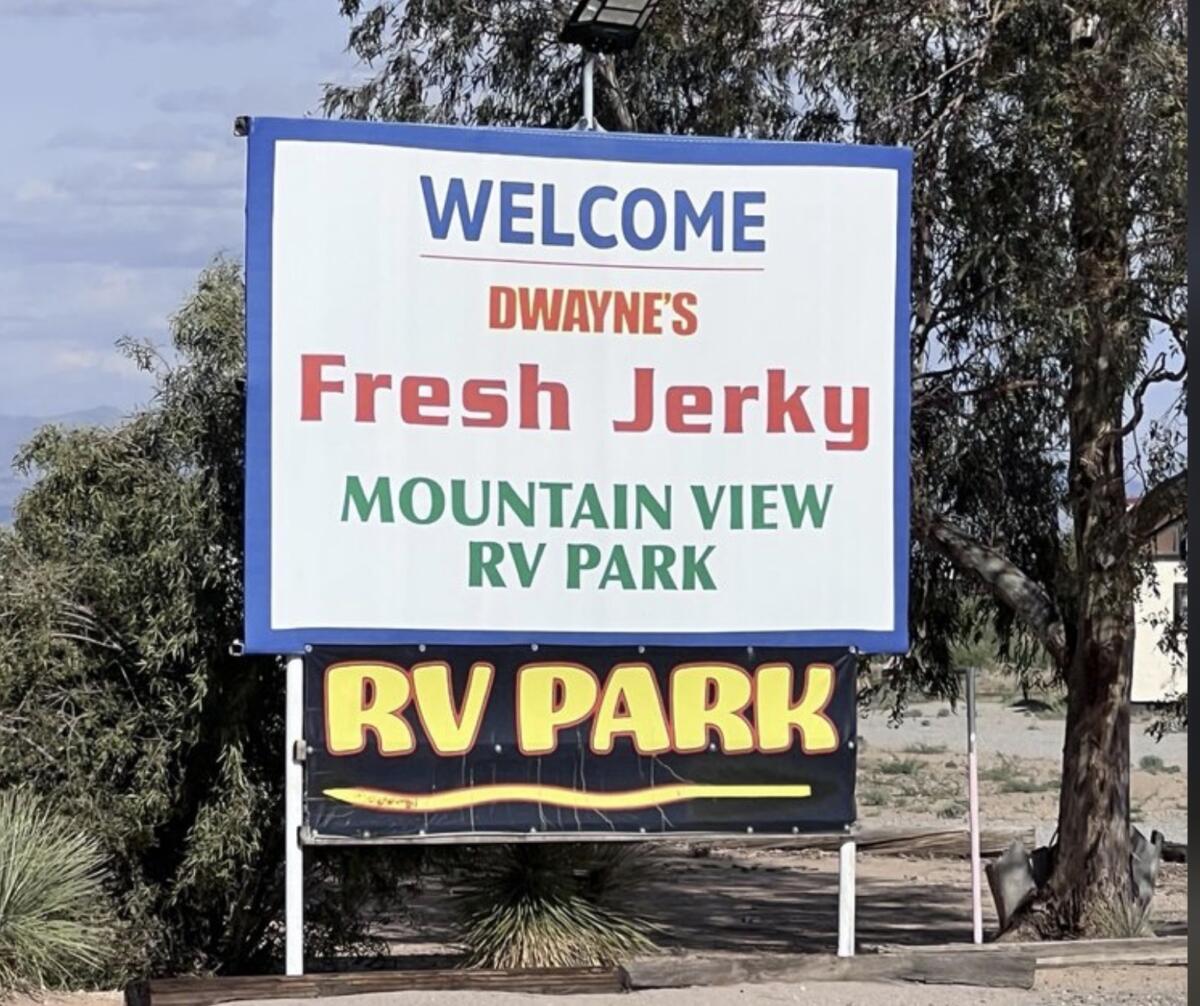
Next call was to an RV park about 20-some miles up the road. Plenty of room, full-hookups, pull-through, and when I asked the price? $27. No name brand, no guarantees on what $27 would actually be like, but mostly okay reviews and $43 less. And they sold beef jerky. Dozens of signs mentioned that on the way.

They said to stop at the store when we arrived, and they’d have one of their 34 pull-through, FHU sites for us. Granted, no big yellow signs or yellow A-frame office, but a gas station, a little store, and lots of empty pull-through sites. It is miserably hot in Arizona right now, so that explains the open sites.

Not only did Dwayne’s Mountain View RV Park sell beef jerky, but they also had alligator, camel, shark, and buffalo jerky! Bowie, AZ, is located in pecan and pistachio country, so there was a multitude of different pistachio flavors to choose from and taste. Lots of raw, shelled, and in-the-shell pecans, too. And, yes, my purchases did raise the daily rate a bit.

Best of all, according to my husband, was that they had Penny’s homemade pecan pie. I am a pecan pie critic and had never tasted any to rival mine. I will have to admit, though, I think Penny’s may have been even a little better

Sometimes stepping out of the tried, true, and comfortable can be a really good thing.

Contact info

Dwayne’s Mountain View RV Park. 1120 West Business Loop 10, Bowie, AZ 85605—Mountain Time Zone. RV park website and beef jerky website.

What about you?

What would you have done? Would you have paid a little more to stay in a familiar place where you knew what to expect? Or would you wander a little farther down the road to a more affordable option, trusting that the online reviews were recent and accurate?

Please leave a comment below and tell us.

WHILE YOU’RE IN ARIZONA…

RVT1265

RV mods: Nitrogen for your tires? Good or bad?

By Russ and Tiña De Maris
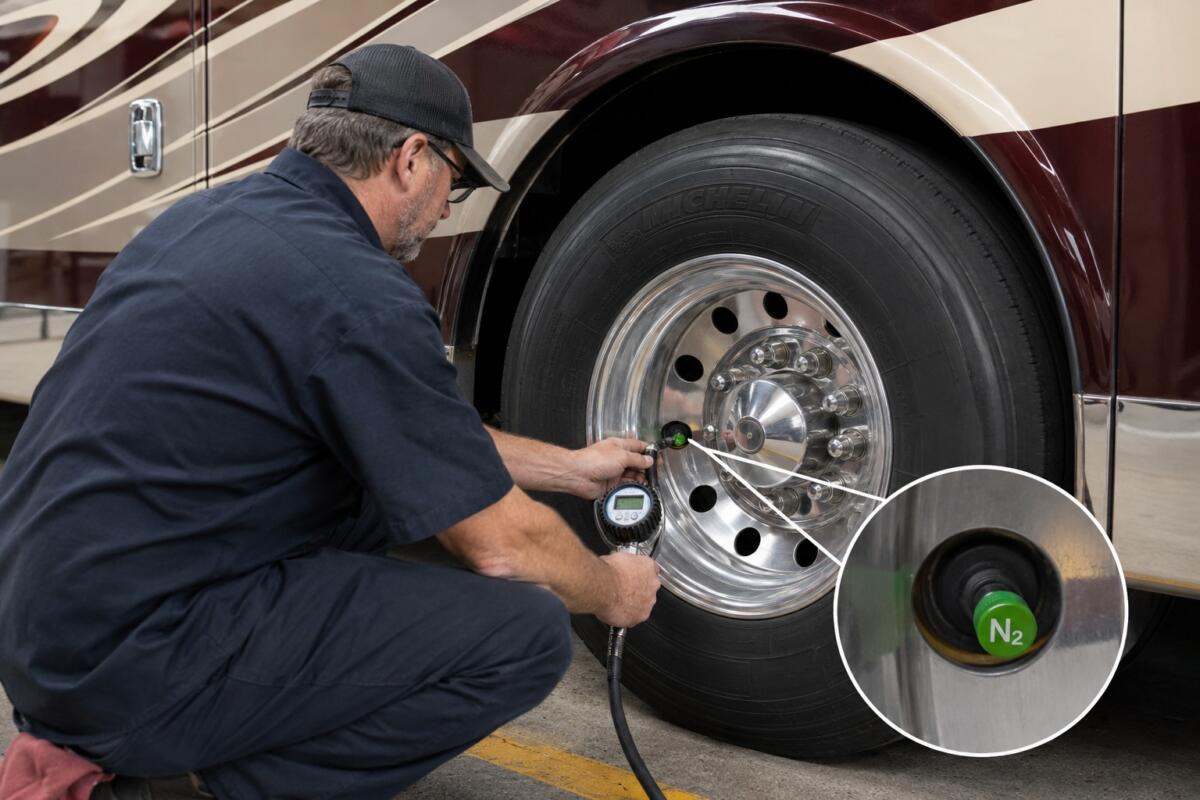
If you remember high school chemistry, you may remember our friend nitrogen, the gas that makes up about 78 percent of Earth’s atmosphere. While ordinary compressed air has been used for decades to inflate tires, the trend in recent years has been to use nitrogen in applications where tires experience high stress—think race cars, commercial trucks, aircraft, and even some RVs.

Why nitrogen? While the size difference between nitrogen and oxygen molecules is actually quite small, nitrogen does tend to migrate through tire rubber more slowly than the mix of gases found in regular air. Nitrogen-filled tires also contain very little moisture, which can help maintain more consistent tire pressures as temperatures fluctuate. In theory, that means tires may lose pressure more slowly and run slightly cooler over time.

Sounds like nitrogen inflation is a no-brainer? Maybe not. One concern is that RV owners might develop a false sense of security and become less diligent about checking tire pressures and inspecting their tires. Regardless of what fills the tire, regular pressure checks and visual inspections remain among the most important tire maintenance tasks.

Causes of tire pressure loss

Tire permeation isn’t the only cause of pressure loss. Tire maker Michelin notes that leaks can also occur at the tire-to-wheel interface, valve stem, valve core, or wheel itself. As Michelin explains, these other potential leak points prevent any guarantee of significantly better pressure retention simply by switching to nitrogen. For that reason, Michelin does not specifically recommend nitrogen inflation for most consumer vehicles, although it acknowledges benefits in specialized applications where minimizing heat buildup is critical.

Advantages of nitrogen are modest

For RVers, the real-world advantages of nitrogen are often modest. If you’re already checking your tire pressures before travel days and monitoring them with a tire pressure monitoring system (TPMS), you’ll likely see little practical difference compared to properly inflated air-filled tires. Proper inflation, avoiding overloading, and replacing aging tires on schedule have a far greater impact on tire safety and longevity than the choice between nitrogen and air.

Economics also come into play. A nitrogen tire fill can cost anywhere from a few dollars to more than $10 per tire, depending on the provider. If you’re traveling and find yourself with a low tire where nitrogen isn’t available, don’t hesitate to add ordinary compressed air. Most tire manufacturers agree that maintaining proper inflation is far more important than preserving a pure nitrogen fill. In fact, many RV tire experts recommend simply topping off as needed and continuing to monitor tire pressures normally.

The air we breathe is almost 80 percent nitrogen

One final point worth remembering: The air we breathe is already nearly 80 percent nitrogen. So even tires filled with ordinary compressed air contain mostly nitrogen to begin with. Whether you choose nitrogen or regular air, keeping your RV tires properly inflated and regularly inspected remains the key to safe travels.

RELATED

RVT1265

5 cringe-worthy things you never want to experience in your RV

While I was looking for images of Wacky RVs, I saw these RV accidents, and they made me cringe! These are just five things of many that you never want to happen to your RV. They are listed in order of how loud I said “Oh, no!” when I saw the images.

My heart goes out to anyone who has experienced these or other RV accidents while traveling or parking.

And, no, these images are not AI!

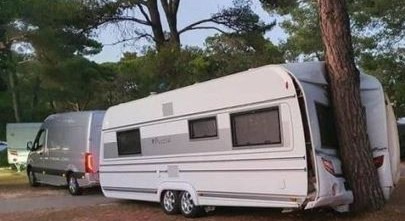
Backing-up boo-boo

tree vs RV

While I have not witnessed something like this, we did have a close call one time in North Carolina. We were assigned a camp spot that was just impossible to back into with the trailer, so we moved. That night, a tree fell right where our heads would have been. And it hit a fence that was three feet from the heads of people sleeping in a tent. That still haunts me after all these years. Someone was watching out for us all!

U-turn… more like U-don’t-turn!

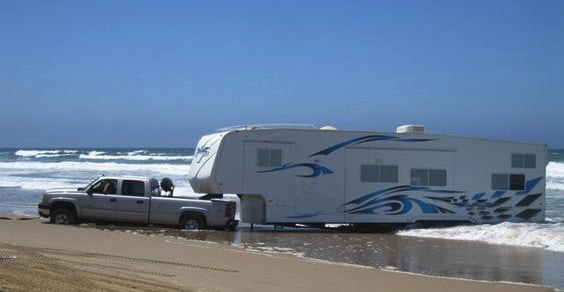
beach front parking

Someone needs to get a tide table! Can you hear the screaming? Don’t know the back story, but it doesn’t look like they were camped there, just turning around. Tough lesson to learn. We don’t even like to park near the beach because of salt damage to the vehicles.

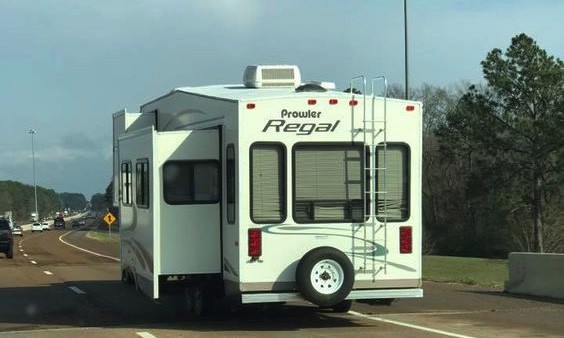
A very dangerous lane hog!

slider open

I always wondered what you would do if the slider would not go in. But both of them? “It’s okay, Honey. We only live two hours away. We can make it!”

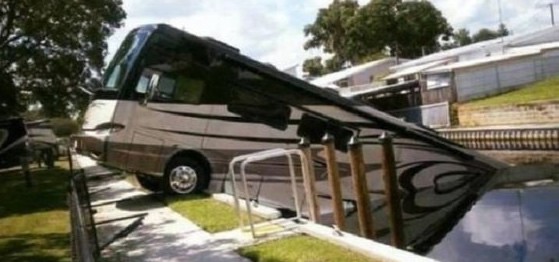
It’s a hot day – take a dip?

rv in the pool

Nothing quite like taking a dip! This one must have really given the neighbors something to talk about…

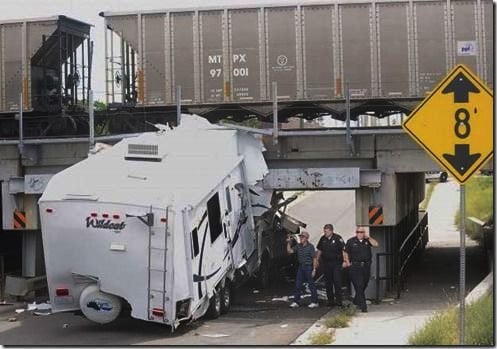
An eight-foot ouch

low clearance RV

Saved the biggest “Oh, no!” for last. The driver here was okay, but the fifth wheel is history. Looks like this section of road needs a drawbridge, or at least a bigger sign. I’ve never seen a bridge that low, but we have driven through some passages that were just a little wider than our rig.

RELATED

RVT1265