Home Blog Page 37

Hard water can slowly damage your RV, but here’s what helps

Hard water problems in an RV often start small. One campground stop, you barely notice it. A few months later, the shower head sputters, the faucets develop a chalky crust, and the water heater does not seem to work quite like it used to. Many RVers blame low water pressure or aging plumbing when hard water buildup may actually be the cause.

For RVers who spend time in the Southwest, parts of Texas, Florida, or other mineral-heavy water regions, hard water is practically part of the camping experience. The minerals themselves are not usually dangerous to drink. But, over time, they can create annoying—and sometimes expensive—problems inside an RV.

The old vinegar trick still helps. But today’s RVs often have more appliances, more plumbing fixtures, and, in some cases, tankless water heaters that deserve a little extra caution.

What hard water actually does inside an RV

Hard water contains higher levels of dissolved minerals, mainly calcium and magnesium. When water evaporates or heats up, those minerals stay behind. Little by little, they form scale deposits.

hard water RV problemsAt first, it may just look like cloudy spots around the sink. Then the shower flow weakens. Faucet aerators clog. Coffee makers slow down. Water heaters lose efficiency. Some RVers even notice soap becomes harder to rinse away.

Inside an RV, the effects can build faster than many owners expect because the plumbing system is compact and water heaters cycle frequently.

And unlike a sticks-and-bricks house, RV plumbing parts are often smaller, lighter-duty, and more vulnerable to buildup.

Vinegar still works for many problems

White vinegar remains one of the cheapest and safest ways to dissolve mineral scale in many RV situations.

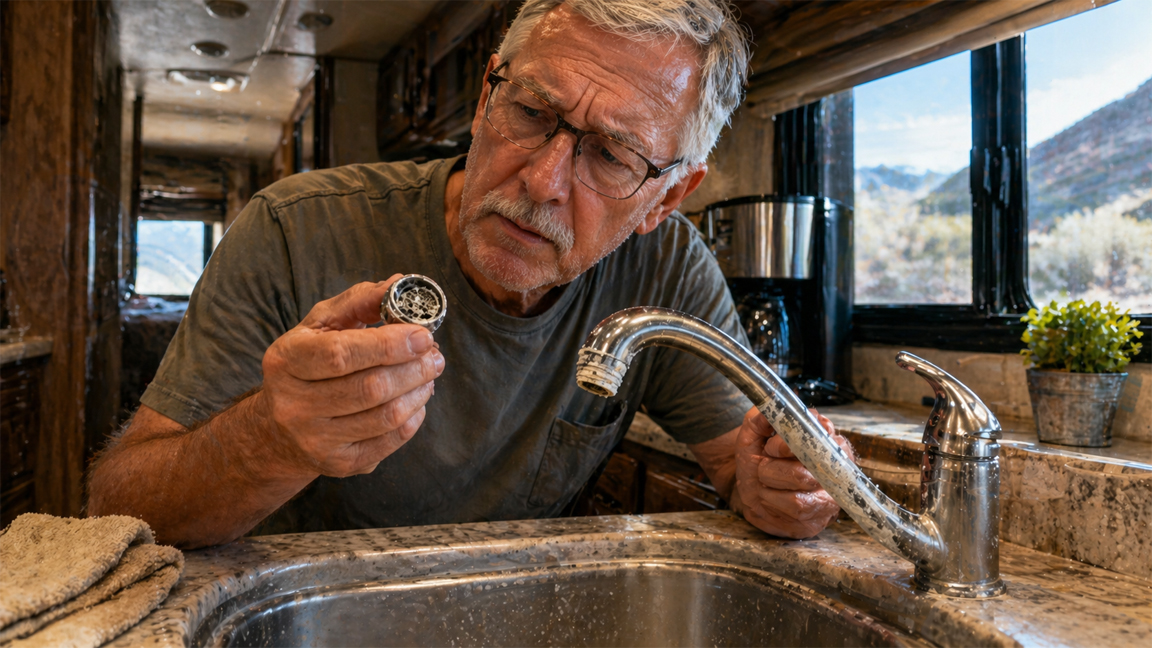
Many RVers soak faucet aerators or shower heads overnight in vinegar to break up crusty deposits. Often, water flow improves dramatically afterward.

For stubborn sink spots or mineral rings around fixtures, vinegar can also help dissolve buildup without using harsh abrasives that may scratch surfaces.

Some RV owners also use vinegar solutions to descale certain water heaters and coffee makers. But this is where newer RVs change the equation.

Don’t assume vinegar is safe everywhere

Modern RVs often include tankless water heaters, residential-style appliances, washing machines, ice makers, and more complicated plumbing systems than older rigs had.

That means owners should not automatically pour vinegar through every appliance without checking the manufacturer’s instructions first.

Some systems require specific descaling procedures. Others may use seals, coatings, or components that can be damaged by improper cleaning methods.

Tankless water heaters, especially, may need periodic flushing or descaling procedures that differ from older tank-style RV heaters.

If an appliance is still under warranty, using the wrong cleaner may create problems later if a repair claim arises.

Signs that hard water may already be affecting your RV

A few common clues include:

  • Weak shower or faucet flow
  • White crust around fixtures
  • Cloudy sink or shower surfaces
  • Water spots that seem impossible to wipe away
  • Water heater performance changes
  • Soap that does not rinse cleanly
  • Coffee makers or ice makers slowing down

In many cases, RVers assume these are simply “normal aging” issues when mineral buildup is actually the cause.

Prevention may matter more than cleanup

Once scale builds heavily inside plumbing or appliances, cleaning becomes harder.

That is why many experienced RVers use inline water filters, portable softeners, or periodic descaling maintenance to stay ahead of the problem.

Even simple habits can help:

  • Wipe down sinks and shower walls.
  • Remove and clean faucet aerators periodically.
  • Flush water heaters as recommended.
  • Avoid letting mineral deposits sit for months.
  • Check campground water quality reports when possible.

Many RVers eventually discover that ordinary inline water filters improve taste and odor but do little to stop hard-water scale. Preventing mineral buildup usually requires a true water softener system designed to remove calcium and magnesium before they enter the RV.

For RVers who stay seasonally in hard-water regions, prevention can save both frustration and repair costs. That’s because by the time hard water damage becomes obvious, the minerals may have been building inside the RV for a very long time.

RELATED

Wacky, weird UFO sites to visit in the U.S.

3

As of November 2024, the Pentagon has analyzed 1,652 reports of Unidentified Aerial Phenomena (UAPs). Of those, 757 were recorded between May 2023 and June 2024, with 21 still classified as unexplained. Even if you’re not a UFO enthusiast, this is certainly intriguing. It reminds me of the fascinating places you can visit and learn more about UFOs right here in the USA.

What is a UFO?

Unidentified flying objects (UFOs) are not new. The first alleged UFO sighting in the United States dates back to the 1890s! Since that time, there have been many, many reported sightings from Washington to Maine and New Mexico to Indiana, with places in between, as well.

A Gallup poll taken in 2021 found that four out of ten Americans believe that UFOs are alien spacecraft from other planets. Recent sentiment seems to indicate that the number is rising—especially given the latest news. No matter what your position may be, there are UFO sighting locations throughout the USA. Here are just two places to consider adding to your next RV trip.

Roswell, New Mexico

Roswell UFO site
Photo credit: Jimmy Emerson, DVM, Flickr

Home of the International UFO Museum and Research Center, Roswell, NM, is probably the best-known UFO site in the United States. Located near the White Sands Missile Range, this is the area where, in 1947, a UFO supposedly crash landed in a rancher’s field. The rancher, W.W. “Mack” Brazel, found metal debris near an inexplicable giant trench, spanning hundreds of feet. Since that time, other UFO sightings have also been reported in the area.

Roswell’s International UFO Museum and Research Center features artifacts, models, information about current research and, of course, a very out-of-this-world gift shop.

San Luis Valley, Colorado

Many curious sightings have been reported within the Great Sand Dunes National Park near Mosca, Colorado. In 2019, hunters claimed they saw two oversized figures near Ute Mountain, south of the Colorado border. The figures appeared to be hooded, with large heads. The men also reported seeing a 50- to 60-foot-tall tent or structure. How strange!

A newcomer to the area constructed the UFO Watchtower in nearby Hooper, Colorado. This kitschy attraction originally poked fun at the UFO phenomena, but its designer, Judy Messoline, has since witnessed strange sightings herself. Today, the Watchtower welcomes both believers in UFOs and scoffers, as well. Watch a video about it here—you’ll enjoy it.

Extraterrestrial Highway, Nevada

Nevada’s famous Extraterrestrial Highway—officially known as State Route 375—cuts through a remote stretch of desert that has become legendary among UFO enthusiasts. The road earned its nickname thanks to its proximity to Area 51, the highly secretive military installation long associated with conspiracy theories and alleged alien encounters. With vast, empty skies and almost no light pollution, it’s easy to see why travelers feel like they’ve stepped into another world.

Driving the highway is less about what you’ll see and more about the experience. Along the route, you’ll find quirky stops like the Little A’Le’Inn in the tiny town of Rachel, where visitors swap stories, snap photos with alien-themed signs, and keep an eye on the skies.

Whether you’re a skeptic or a believer, the Extraterrestrial Highway offers a fun, offbeat detour for road trippers looking for something a little out of this world.

Cheri Sicard detailed her experience on this highway in this article and tells you everything you need to know about traveling it and camping on/near it.

How about you?

Do you believe that UFOs are from outer space? Come on, we want to know! Leave a comment below. And if you’ve ever seen a UFO, please tell us about it, too.

RELATED

RVT1259

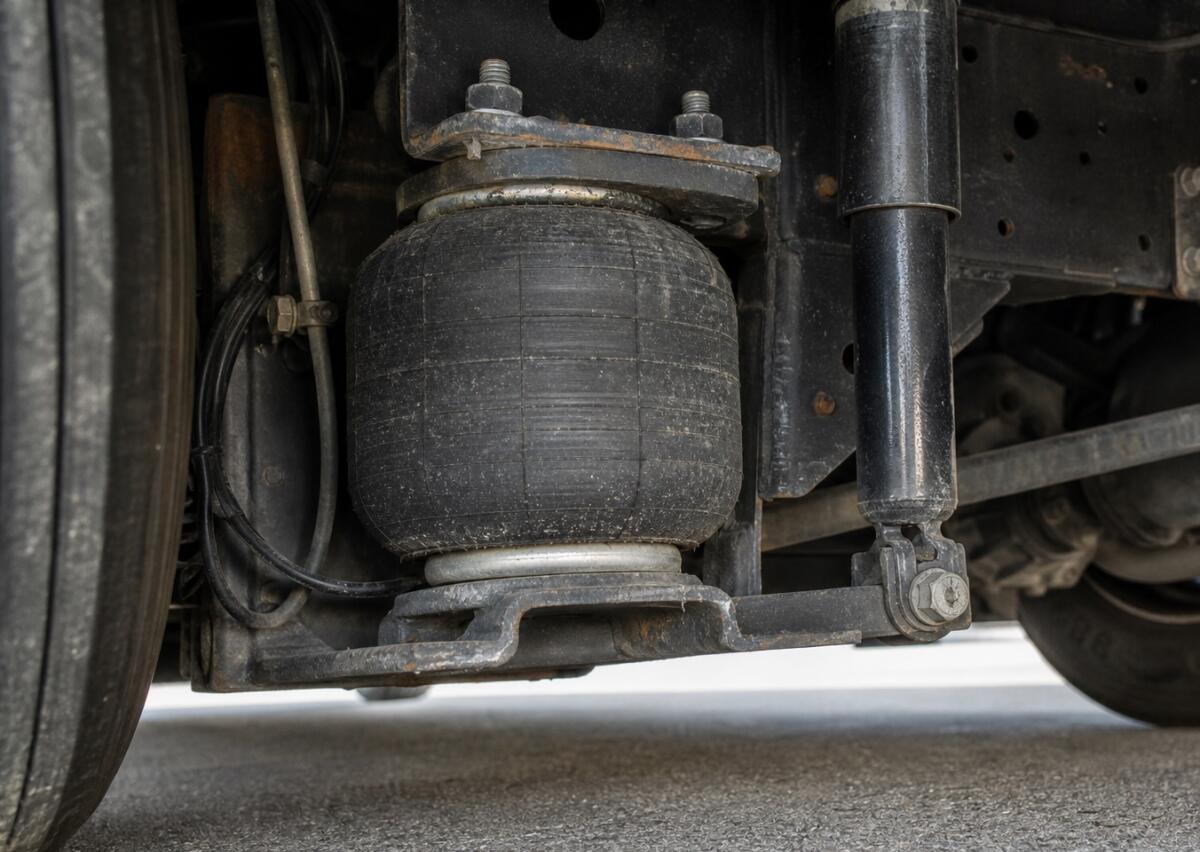
RV air suspension (airbag) systems don’t last forever. Check yours before it’s too late

If you have a diesel pusher, a higher-end Class A, or even a Class C with air-assist suspension, part of what makes your ride smooth is something you almost never see: your air ride system.

And that’s exactly the problem. It’s out of sight, so it’s easy to ignore until something feels off. By then, you may already be dealing with worn components, air leaks, or a suspension system that’s no longer doing its job safely.

What your air suspension actually does

Your air ride system isn’t just about comfort. It plays a big role in how your RV handles, how it carries weight, and how it sits on the road.

It helps:

• Support the weight of your coach
• Maintain proper ride height
• Improve ride quality and stability
• On some rigs, it may also help with leveling when parked, though many RVs rely on hydraulic jacks for that.

One key thing to understand: ride height matters. Suspension manufacturers stress that these systems are designed to operate at a specific height. If your RV is riding too low or unevenly, it’s not just uncomfortable, but it can also affect handling and put extra stress on other components.

Why air springs don’t last forever

Air springs (airbags) are made of rubber—just like your tires. And just like tires, they age whether you’re driving or not.

Over time, they can:

• Dry out
• Crack
• Wear from rubbing or debris
• Weaken internally

Eventually, they fail.

If you’ve got a coach that’s 10+ years old and you’ve never looked closely at the airbags, now is the time.

What to check (or have checked)

A proper inspection goes beyond just glancing at the airbags. The whole system matters. You—or better yet, a qualified shop—should be looking at:

• Airbags (for cracks, wear, or exposed cords)
• Air lines and fittings
• Height control valves
• Shock absorbers
• Mounting brackets and hardware
• Any signs of rubbing, corrosion, or leaks

Warning signs you shouldn’t ignore

Your RV will usually give you clues when something isn’t right. Pay attention if you notice:

• One side of the coach sitting lower than the other
• The RV not reaching normal ride height
• A harsher, rougher ride than usual
• The compressor running more often than it used to
• A hissing sound (air leak)
• The coach slowly settling when parked
• Visible cracks or wear on the airbags
• If you ever see fabric cord showing through the rubber, treat that like you would a tire showing cords: it needs to be replaced immediately.

A critical safety warning

This is not something to take lightly.

Never go under your RV unless it is properly supported with heavy-duty, correctly rated stands or blocking placed at the frame. Not leveling jacks. Not the air suspension. Not “it should be fine for a minute.”

Air systems can lose pressure without warning. If that happens while you’re underneath, the coach can drop. People have been seriously injured or killed this way.

If you’re not 100% sure how to safely support your RV, don’t go under it. Period.

Should you replace airbags yourself?

Some experienced RVers will consider doing this job themselves. But this isn’t a simple swap.

You’re dealing with:

• A very heavy vehicle that must be safely lifted and supported
• Pressurized air systems
• Potentially rusted or seized hardware
• Tight working spaces
• The need to properly reassemble and check for leaks

And here’s another thing: Replacing the airbag might not be the only issue. Lines, valves, and fittings often need attention too. For most people, this is a job better left to a qualified truck or motorhome chassis shop.

Parts and replacement in 2026

If you do need replacement airbags, don’t guess.

Air springs may look similar, but small differences matter—mounting plates, height, fittings, and load ratings all have to match your suspension.

Replacement airbags and related components can usually be found through your RV or chassis manufacturer, as well as parts suppliers that specialize in Class A motorhomes and commercial trucks. There are also plenty of online retailers offering these parts. Wherever you shop, make sure you’re using the exact part number. Always verify by:

• Part number
• Chassis model
• Or VIN

There can still be wide price differences depending on where you shop, but accuracy matters more than saving a few dollars on the wrong part.

The bottom line

If your RV doesn’t sit right, doesn’t ride right, or just feels “off,” don’t ignore it. It’s an important part of what keeps your RV stable and safe on the road. And when it starts to fail, it usually gives you warning signs first.

The key is paying attention before those warnings turn into a much bigger and potentially dangerous problem.

RVT1259

The art of cowboy communication; the Western spirit lives on

1

By Gail Marsh
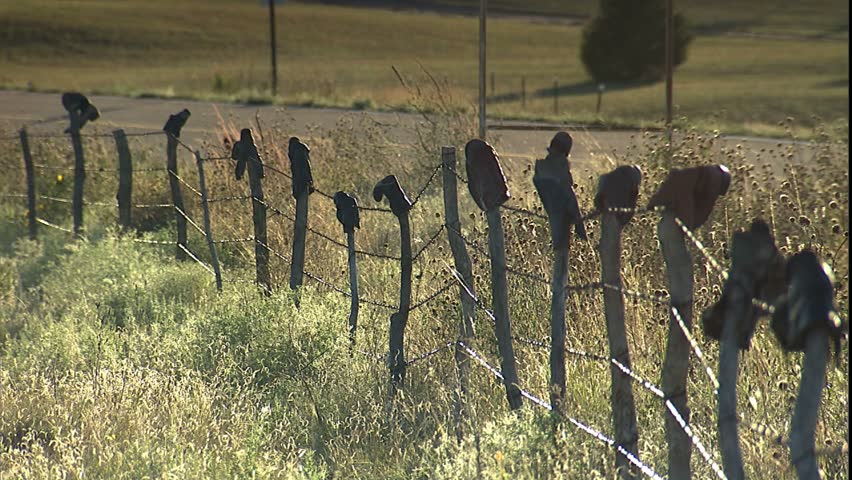
I love learning about regional traditions as we travel around the country in our RV. Recently, I saw a boot hanging upside down over a fencepost in Nebraska. When we stopped for lunch at the local mom-and-pop eatery, I asked about the boot on the fencepost. I discovered that this tradition has deep roots in the past and several different explanations in the present.

Early cowboys

Before the age of telephones, automobiles, and other modern conveniences, cowboys used a boot on their fencepost to communicate. Here’s how: If the cowboy was working in the south pasture, he’d position an old cowboy boot upside down on the fencepost with the toe of the boot pointing south, toward the pasture. If it were dinnertime, and the cowboy was at home eating his meal, he’d turn the boot so that the toe pointed toward the house. Why? So that anyone needing to speak with the cowboy would know where to find him.

Today’s many explanations

Now we have different and perhaps better ways to communicate, so why do boots still show up on fenceposts? Here are a few of the explanations we were told as we RVed through Nebraska, Oklahoma, Texas, and more. (I’ve even seen photos of this tradition in Canada!)

Marking property. During the land rush in Oklahoma, folks set up posts to mark their property lines. Often, because of disputes, cowboys and ranchers would set their boots on the posts as a clear signal of ownership.

Memorializing a companion. In the past, when a ranch hand was hired on, he became like one of the family. He lived on the property, often shared meals with the rancher’s family, and worked side by side with his boss, day after day, year after year. If the ranch hand died or moved on, often his boots were placed on the fenceposts as a memorial. It served as a visual reminder of the loss of a dear friend and coworker. (One older Texan explained it this way: “The sole of the boot pointed to the sky. It was a comfort to the family to know that their friend’s soul also reached heaven.”)

Memorializing a companion (part 2). Just as I described above, when a rancher or cowboy’s horse died or was sold and taken away, a cowboy boot over the fencepost memorialized the favorite animal.

Fencepost protection. This explanation makes good practical sense. Fenceposts were often made of wood, and they would rot as rain and snow penetrated the post. To prevent this from happening, worn out boots were placed on top of the posts, protecting them from the harsh elements.

Dry boots. A rancher’s hardscrabble life often meant sheer punishment for his boots. The boots tramped over damp grass, slogged through mud, and enabled the cowboy to clean out his horse stalls. An easy way to dry the boots was to place them upside down on the fenceposts. I imagine their wives were happy not to have that fragrant smell inside their home, too.

Good will. Yet another explanation for the fencepost boot tradition is the desire to help the less fortunate. When a rancher decided it was time for a new pair of boots, he’d set his old ones on the fenceposts near the road. That way, those in need would find and take the boots for themselves.

When in Rome, er, Texas… It seems as if today’s ranchers like the sentimental thoughts behind the boot tradition and continue the practice as decoration. That’s why you’ll still see cowboy boots adorning the top of fenceposts in many of the places you RV. It makes for an interesting conversation, don’t you think?

RELATED

RVT1259

What do you look for FIRST when choosing an RV park?

Every RVer seems to shop for a campground a little differently. Some people go straight to the nightly rate. Some want the best hookups and easiest site access, and others will not book until they have read a stack of reviews.

RV LIFE says millions of RVers use campground reviews to decide where they will camp next, while Campendium’s review pages highlight information like price, amenities, pad type, and stay details that help people compare parks quickly.

The 2026 KOA camping and outdoor hospitality report says what matters most to folks polled this year is campground security. This is followed by clean and well-maintained facilities. These may include restrooms, campsites, and recreation (e.g., pools, jump pads, trails).

The RV Industry Association (RVIA) has also noted that campground availability and amenities are key factors in keeping RVers coming back. It noted that full-service hookups are one of the top priorities for RV campers.

Your turn

So, when you are choosing an RV park, what is your first priority? Is it price, because you want the best value for an overnight stop or a longer stay? Is it amenities, because you want full hookups, laundry, Wi-Fi, a pool, or easy in-and-out site options like pull-throughs and back-ins?

Maybe your first filter is whether the park works for your travel crew. Families may care most about playgrounds, open spaces, and kid-friendly activities. Pet owners often check rules and pet areas before anything else.

For a growing number of RVers, security is becoming part of the decision-making process when choosing a campground. Well-lit parks, gated access, visible management, and a general sense of safety can influence whether someone feels comfortable staying overnight or for an extended visit.

Then there are reviews, which have become the modern version of campground word-of-mouth. That kind of firsthand feedback can be the difference between booking with confidence and rolling the dice.

What do you look for first when choosing an RV campground: price, amenities, pet- or child-friendly features, site details like gravel pads or shade, reviews, security, or something else entirely? The interesting part is that there is no wrong answer, because the “best” RV park is usually the one that fits the way you actually travel.

Please answer the poll question and then add a comment to explain further. You can select up to two options in this poll.

MORE POLLS YOU MIGHT LIKE:

RVT1259

Exploring the abandoned Indiana State Sanatorium

By Cheri Sicard
Some abandoned places stay off-limits behind locked gates and no-trespassing signs. That is why this stop at Indiana State Sanatorium felt so different. For Mona of the This Van Life of Mine channel, who had always wanted to tour old hospitals, schools, mansions, and sanatoriums, this was the day that dream finally happened.

While staying with her friend DK at a campground near Raccoon Lake in Rockdale, Indiana, Mona spotted a sign on the way into town. A quick search revealed that the now-abandoned Indiana State Sanatorium was open to the public for a fee.

After seeing the sign, Mona and her friend DK stopped by the office and spoke with Sam, who shared background on the property and what had happened there over the years. That was enough to lock in the plan. By the next day, they were ready for a self-guided tour, and the excitement was real. Mona even picked up a T-shirt as proof that this long-held wish had finally come true.

A quick look at Indiana State Sanatorium’s history

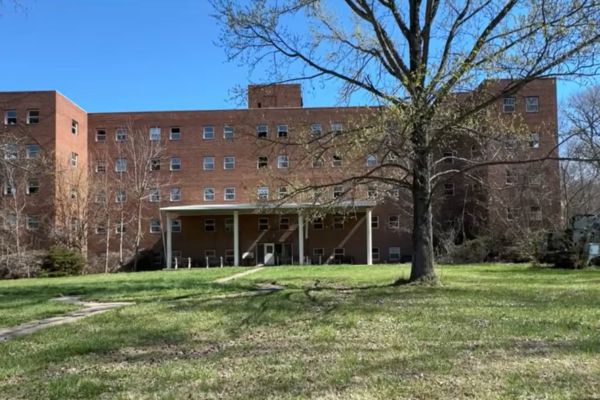
Indiana State Sanatorium opened in 1908 as a tuberculosis hospital for the state and stayed in that role until 1968. It was built as a self-sufficient campus, so both patients and staff lived on-site.

In 1978, the property reopened as the Lee Alan Bryant Center, which included a nursing home and psychiatric hospital. Then the state shut it down in 2011. Since 2021, the site has reopened for photography, urban exploration, and paranormal investigations, while restoration work continues. Current tour details and booking info are available through the Indiana State Sanatorium website.

Inside the original sanatorium

Indiana State Sanatorium interior

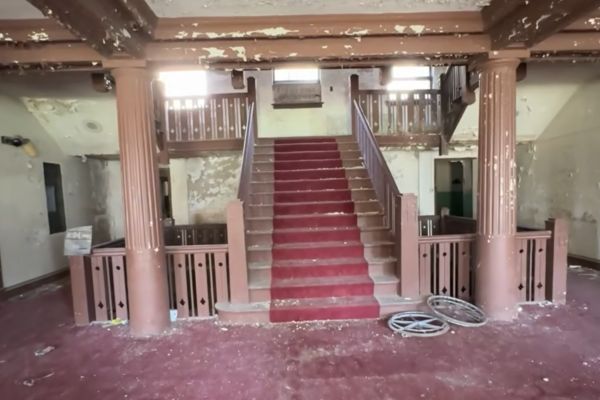
The first big moment came fast. Mona walked up the stairs, stepped inside, and saw the red-carpet grand staircase. Even in decay, it still hinted at how beautiful the building once was.

For $25, visitors can do a self-tour, and it easily fills a full day. Mona and DK lost track of each other almost at once because the place is so large. They kept meeting back up, comparing notes on rooms, staircases, and details the other had missed. After lunch, the staff let them back in so they could keep going.

Adams Hall, the nursing home, and what was left behind

Later, Mona moved on to Adams Hall. Built in 1954, it first housed staff. During the Lee Alan Bryant years, it became the psychiatric ward. The first and second floors were co-ed, the third floor was for women, the fourth for men, and the fifth for violent men.

The rooms there felt smaller, likely because the building began as staff housing.

In the nursing home section, the halls widened, and the rooms got larger. Bathrooms were shared across the hall, and some rooms had no windows at all, which made them dark even during the day.

One detail stuck with Mona more than anything else: a spring/summer week one menu still hanging on the wall. That kind of leftover everyday object made the place feel less like a haunted attraction and more like a life interrupted.

History mattered more than ghost stories

Mona made her personal view clear: She does not believe in ghosts or the paranormal. So the visit did not feel scary to her. Instead, she saw history, old systems of care, and the remains of lives left behind when the property closed in 2011.

That approach shaped the whole tour. Even with flashlight tours, paranormal interest, and the tunnel still ahead, the strongest part of the visit was the human story in the rooms, halls, and objects that remained.

Indiana State Sanatorium gave Mona something rare, a legal way to walk through a place she had wanted to experience for years. What stayed with her was not fear, but the scale of the property and the traces of people who once lived and worked there. For this stop in van life, history was more than a backdrop. It was the whole reason the place felt unforgettable.

RELATED

RVT1259

RVer baffled by chipping paint on her RV

By Dustin Simpson
The question below was posted in one of my many Facebook groups. This one was in Keystone RV – In The RV Shop, where we have more than 10,000 members. Members post problems, and the group members and I try to help each other out with problems, concerns, products, and upgrades.

One group member, Lizzie, asked this question:

“What is causing the chip pops and the touch-ups to repop? It goes on one side from the top to the bottom, the back right side, and above the storage covers. None around windows or doors. 2014 Keystone RV 29RE Diamond Edition.”

Paint chipping on RV
It is the result of a small amount of moisture getting into your compartment door wall. This happens all the time and can be prevented by protecting the unit with sealants.

Chipping on RV

My reply:

Lizzie, first let me say that I’m sorry this happened. What is happening to your trailer is called osmosis blistering. It is the result of a small amount of moisture getting into your wall. The moisture wicks its way out through the wood sheeting and slightly porous fiberglass by osmosis until it reaches the impermeable layer of the foam insulation. The moisture reactivates the glue and causes gassing to happen, which causes the bubbles and chips to occur.

Body reseal benefits

Caulking your RV will help protect it and create a watertight seal to protect your unit from outdoor elements. Applying caulk around the trim and windows helps ensure that no outside elements get inside through the window frame or other gaps.

When there is no caulk, dirt and dust enter the RV more freely. If moisture from condensation, rain, or snow, or by washing your unit, gets into the RV, it can damage the structure or cause dangerous mold and mildew. Water and mildew stains can appear in the carpet and on the walls. However, in most cases, it doesn’t show up right away, causing unnoticed dry rot to occur.

Caulking around certain joints creates a watertight seal that prevents water from outside from seeping into the cracks and crevices of your RV. If water gets in, it can cause a lot of damage that can be extremely costly to repair and even total your unit. Make sure to reseal your unit to prevent further damage.

DIY product links:

Our Facebook groups

These Facebook groups were created to help educate owners about parts, problems, repairs, fixes, and upgrades on RV units. We will be sharing videos that include WHAT’S IN THE SHOP? and SHOP TALK episodes with information on accessories and products that we use and install on the units from the shop.

We try and help as time allows to answer questions and problems. We encourage others to share their experience so we can build a resource page to help everyone.

Please follow us on YouTube, and see our published articles on RVtravel.com and other social media pages.

Please feel free to share your stories, problems, and upgrades with us so we can build a resource page to help others.

Thank you,
Dustin

RELATED

RVT1259

Health: Allergy season is underway. Don’t wait for symptoms

3

Spring allergy season is arriving earlier in many parts of the country, catching plenty of travelers off guard. Experts say the best defense is to start preparing before symptoms hit, not after.

“Seasonal allergies are very common and can significantly affect daily life,” said Leslie Baker, Pharm.D., BCGP, director of geriatric pharmacy services at the Sanford Center for Aging at the University of Nevada, Reno. “I generally recommend starting routine allergy medications two weeks before your symptoms usually begin.”

For RVers, that begins with knowing your triggers and checking daily pollen forecasts before starting your daily activities. On high-pollen days, limit time outdoors, keep RV windows closed, and rely on air conditioning to keep allergens out.

Simple habits can make a big difference. Shower before bed to wash off pollen, change clothes after being outside, and clean regularly—especially bedding, floors and surfaces where allergens collect.

Safe and effective medications

If you decide medication is necessary, take it before it is needed to prevent severe symptoms rather than treating them later. Safe and effective OTC medications include:

Steroid nasal sprays: Popular brands include Flonase, Nasonex, Nasacort and Rhinocort. These sprays are acceptable for regular, daily use.

Oral antihistamines: Popular brands like Allegra, Claritin or Zyrtec are safe for daily, long-term use and cause only minimal drowsiness.

Antihistamine eye drops: If itchy eyes are the common symptom, antihistamine eye drops can help, including Zaditor, Alaway and Pataday. These provide fast relief, but they should not be used long-term without consulting a doctor. Prolonged use can lead to rebound effects, making irritation and redness worse.

Saline nasal sprays: Moisturizing your nasal passages can flush out allergens like pollen, dust and pet dander. These can be purchased at any pharmacy and are safe for all-day use.

If you are congested and decide to reach for a decongestant nasal spray like Afrin, do not exceed three days of use. Maintaining use after the third day can lead to rebound congestion, where nasal passages become inflamed and dependent on the spray. Follow the instructions, and if congestion returns, you can begin using it again after 10 days.

Considerations for older adults

For older adults, especially, avoid Benadryl and products containing chlorpheniramine. These OTC allergy medications cause drowsiness. As people age, that issue can be compounded, leading to “a hangover effect,” cognitive impairment and even falls. Additionally, it can contribute to constipation, difficulty emptying your bladder and dry mouth. Instead, choose safer options listed above.

If you have high blood pressure, it is best to avoid decongestants or products that are labeled “D” as they can raise blood pressure and heart rate. Check packaging carefully as antihistamines can be hidden in OTC sleep aids and multi-symptom cold medicine.

“When in doubt, speak to a pharmacist,” said Baker.

MORE RVER HEALTH:

RVT1259

Reader says you’ve been shopping for gas all wrong, shares money-saving tip

32

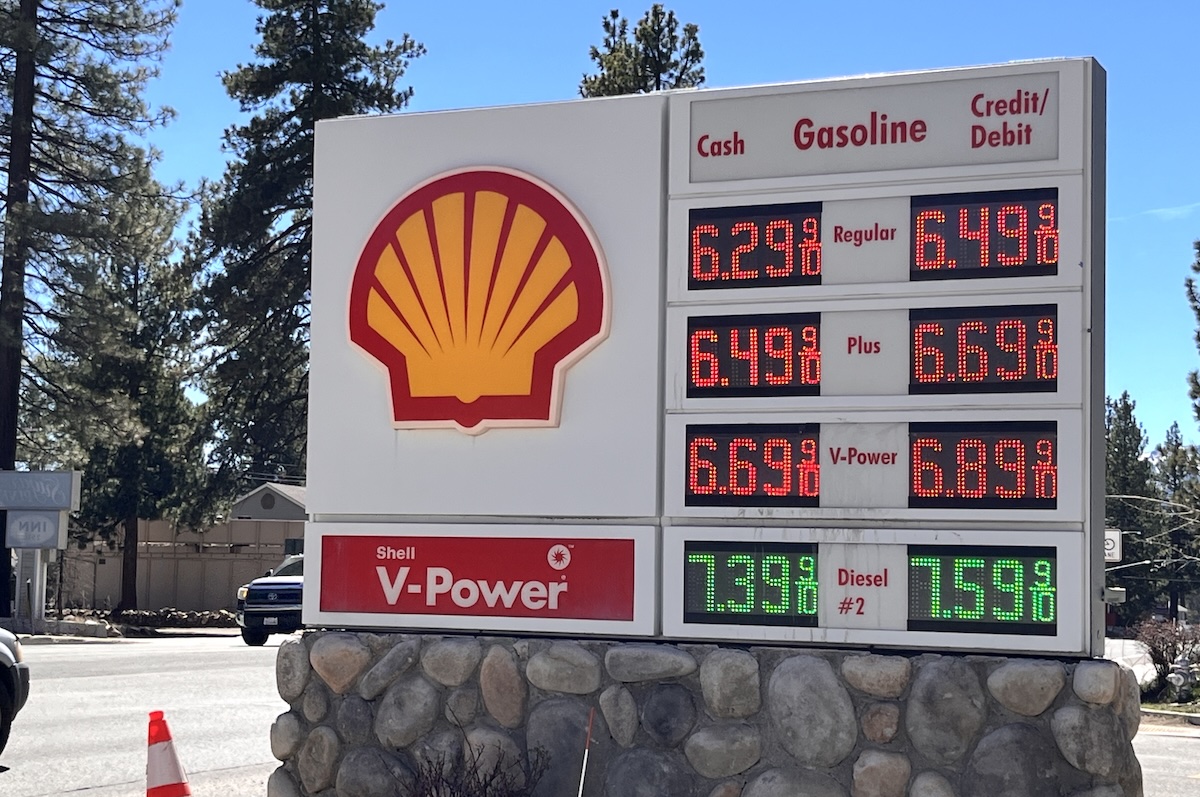
Earlier this week, reader Karen M. sent us this letter. Right now, we (and we know you, too) are doing everything we can to save money on gas, so we thought this would be a much-appreciated note. Thank you, Karen!

Hello. We’ve been reading RVtravel.com for a long time, and first want to thank you for all you do! We have learned so much from you.

I wanted to share something that’s made a noticeable difference in how I travel and something I think your other readers would appreciate. After a lot of miles and more fuel stops than I can count, I realized I’d been approaching getting gas all wrong.

Like many of us, I used to wait until I was down to about a quarter tank before thinking seriously about fuel. Then I’d pull off at the next convenient station that looked big enough to handle my rig. It worked… but I started noticing how inconsistent prices were—sometimes dramatically so—even within the same stretch of highway!

The turning point came on a trip through Nevada and eastern California. Instead of stopping when I needed fuel, I planned ahead and gave myself a 150–200-mile “fuel window.” The night before, I checked prices along my route and picked a couple of good options, plus a backup. That one change saved me close to $40 on a single fill-up, and, more importantly, it changed how I think about fueling altogether.

What I’ve learned is that fuel pricing often comes down to timing and being more flexible. Stations right off major interstates (especially in remote areas) know travelers are low on options, and they price accordingly. But just a short distance before or after those spots, prices can drop quite a bit. If you wait until you’re running low, you lose the ability to choose, and you’ll usually pay more because of it.

Now I start thinking about fuel when I hit about half a tank. I don’t lock myself into one stop, but I always have a “best option,” a backup, and a last resort in mind. It’s made my trips smoother, less stressful, and noticeably less expensive over time.

It may sound like a minor detail, but for those of us who spend a lot of time on the road, it adds up. Thought I’d pass it along in case it helps someone else the way it helped me.

Again, thanks for everything! —Karen M.

RELATED

RVT1259

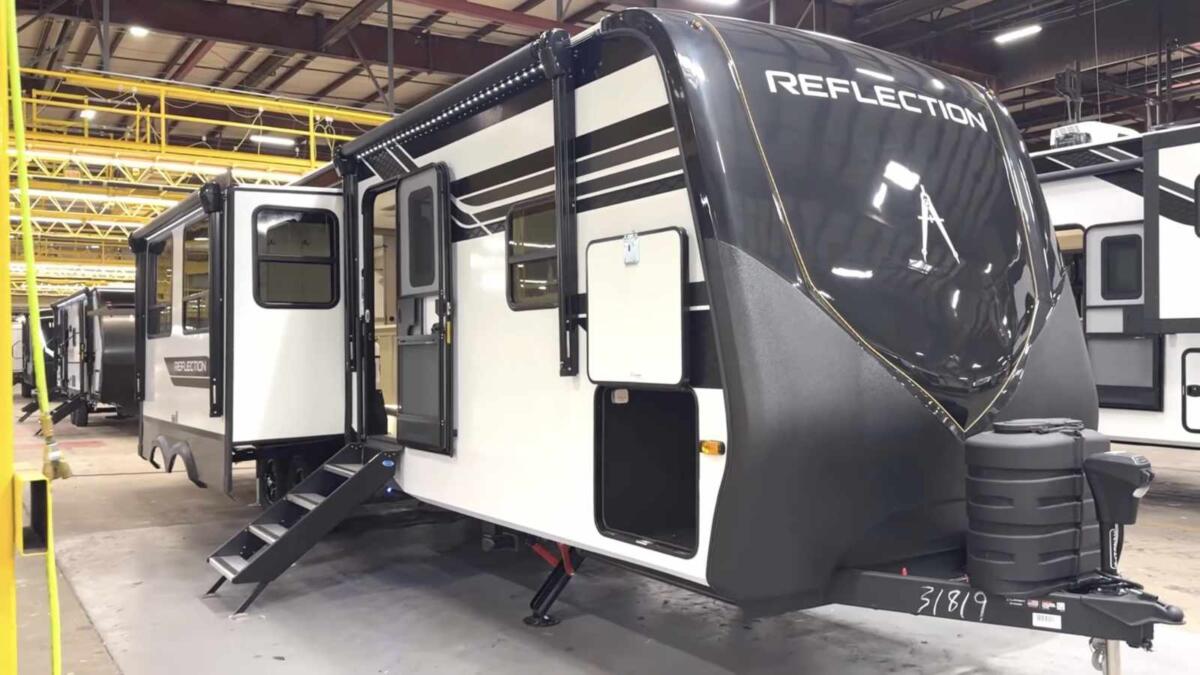
RV review: 2026 Grand Design Reflection 342BHTS—hmmm…

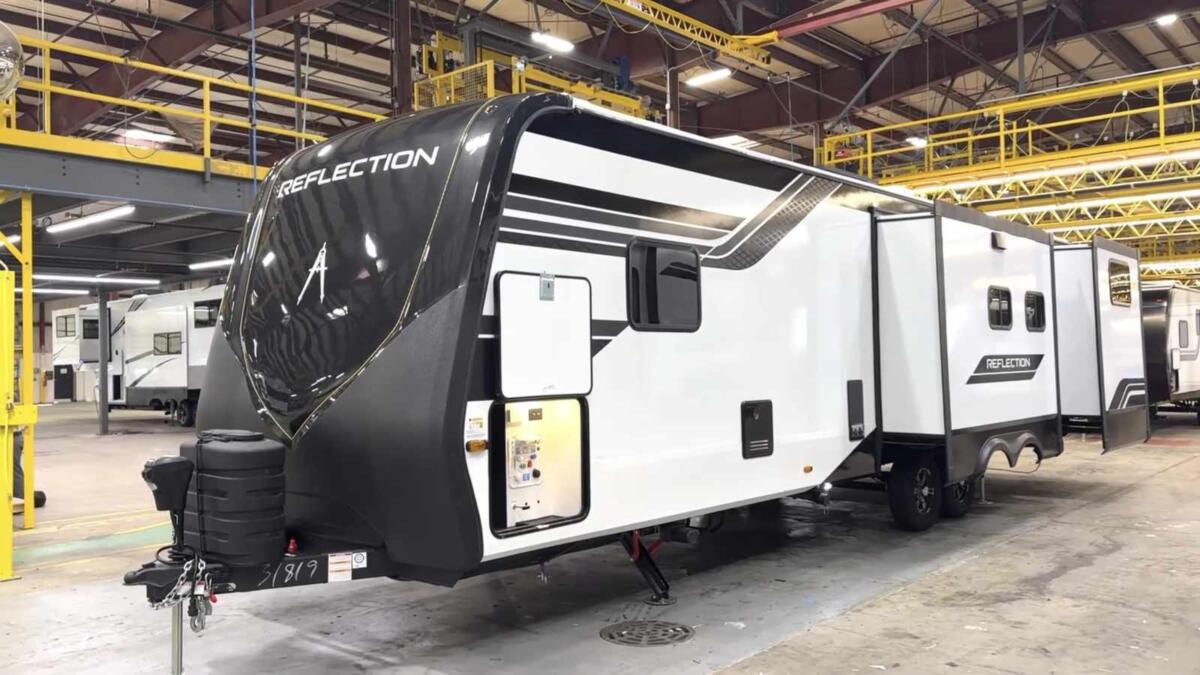
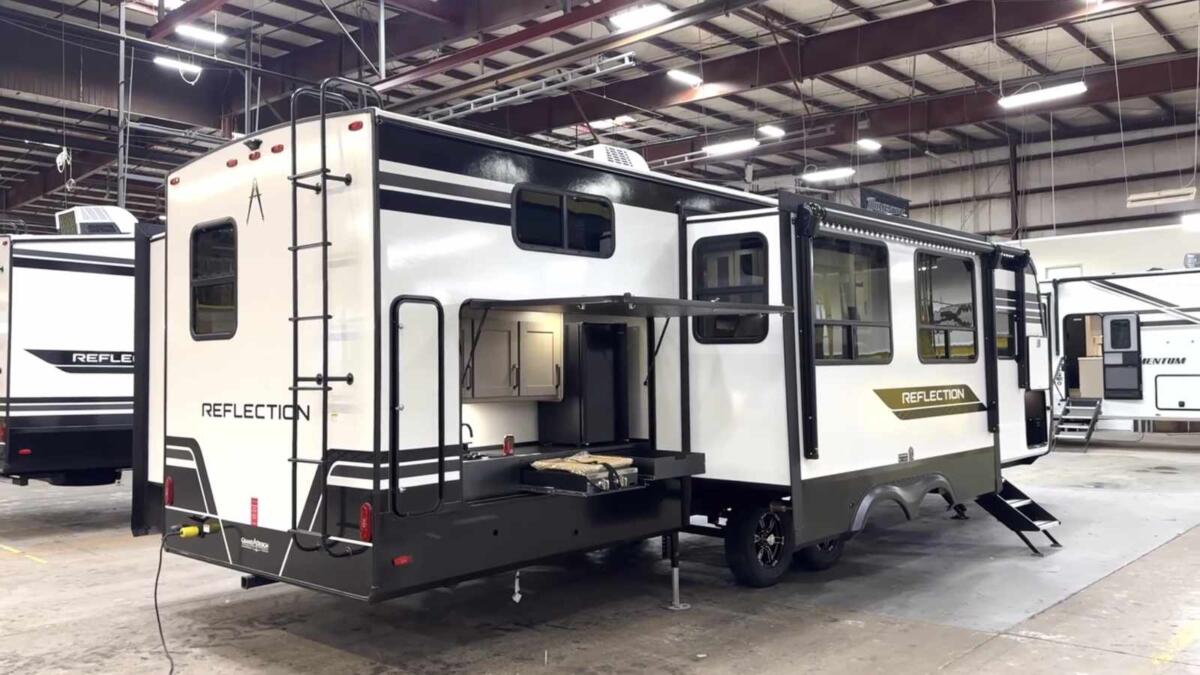
Today’s RV review is of the 2026 Grand Design Reflection 342BHTS. I specifically sought out this unit after reading Russ and Tiña De Maris’ article about the “worry-free” features in new Grand Design offerings. However, this doesn’t have that. 

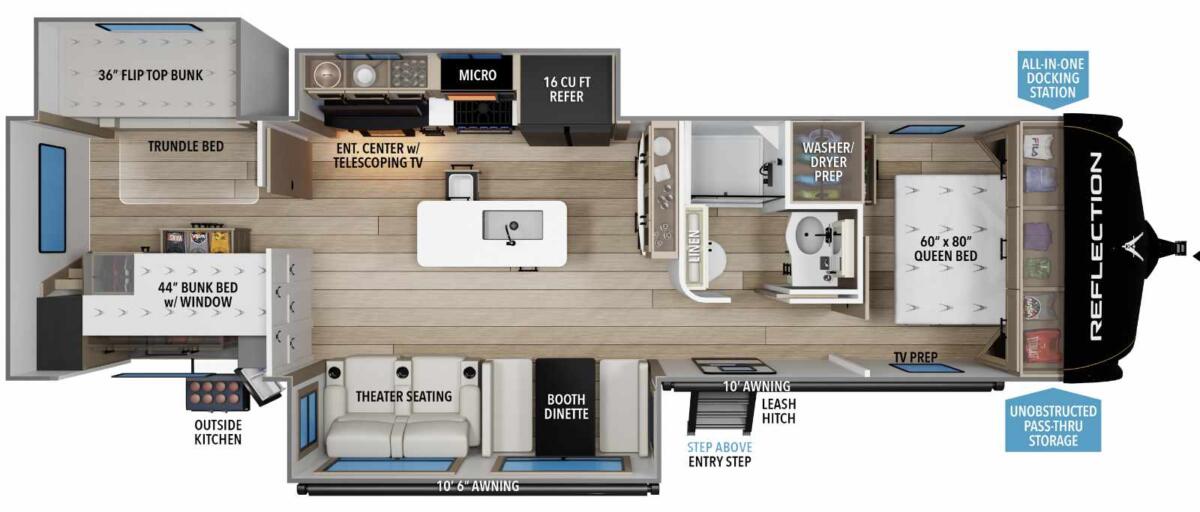
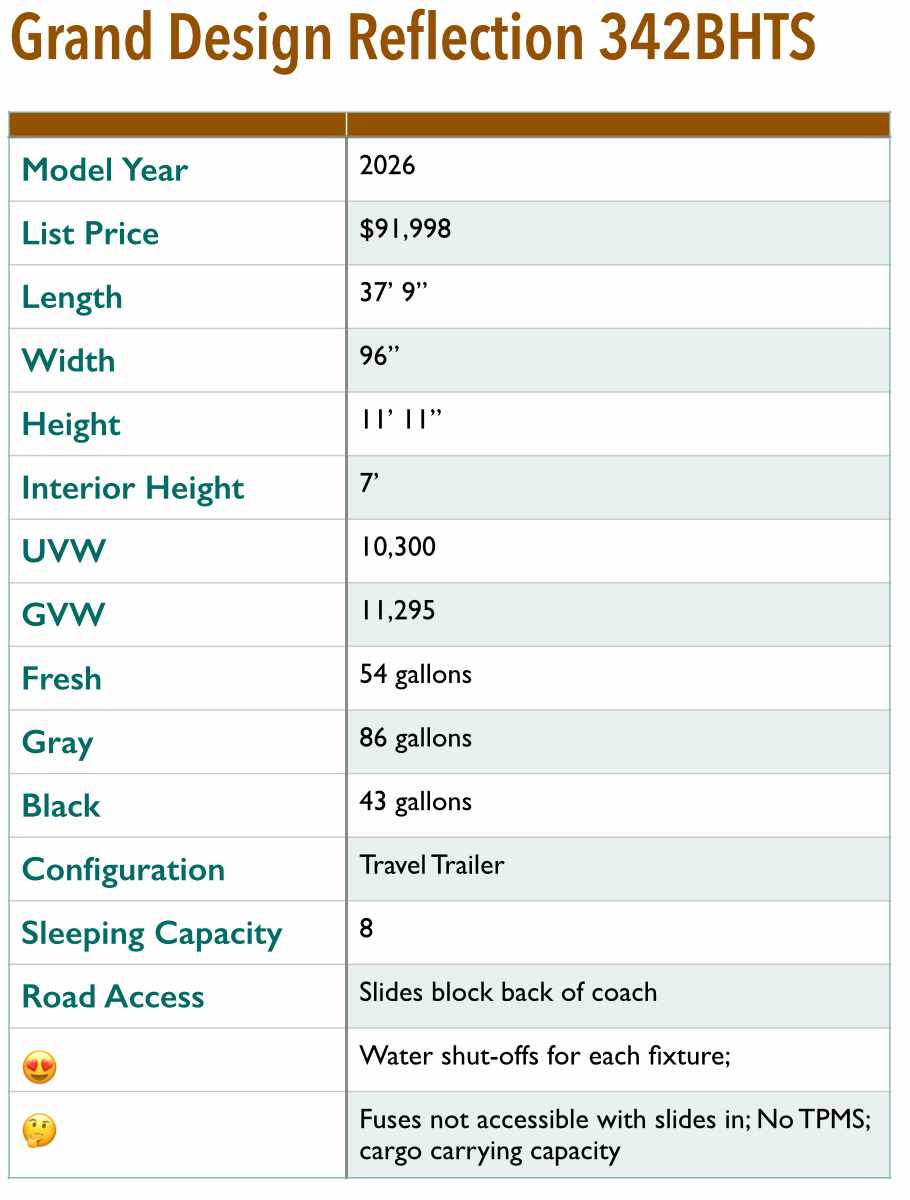
What we do have is a very large travel trailer that has a higher-than-average interior ceiling at 7’ and a separate rear space that can be a bedroom or just a place to retreat. That would be handy if you and your spouse have a disagreement or someone was a sore loser in Monopoly. 

This has one feature that, to me, is quite troubling and a few things that are head-scratchers. What are those? Let’s dive into it. 

How the Grand Design Reflection 342BHTS is built

After reading Russ and Tiña’s article, I got all excited about improvements to Grand Design products, but what I looked at is one of their more mainstream lines, the Reflection. Apparently, the new roof structure and the improvements to the suspensions aren’t found here, which is unfortunate. Perhaps it’s coming in the future. Let’s hope so. 

What we have is a very, very large travel trailer and one that Grand Design does a good job insulating. The company states that this trailer is usable from 0°F–100°F. How the company accomplished this includes insulation, but the underbelly is also heated and enclosed with a radiant foil barrier. 

I do like that Grand Design has moved to Goodyear Endurance tires. However, they’re still not offering a tire pressure monitoring system as standard and, to me, this is a huge safety challenge. But they did include anti-lock braking, which I think is a big plus. 

The suspension on this is a simple leaf spring arrangement, but with a CRE 3000 suspension dampener package. I suspect a trailer this large might end up spending most of its time at a seasonal site, which makes sense. 

Wall construction

Another thing that surprises me about Grand Design products, including the more premium units like this one, is that they’re still using lauan in the wall lamination. So many of their competition have moved to man-made substrates like Azdel. When I questioned Grand Design about this, they said, “Isn’t it better to just keep the water out?” Well, that’s the goal. But if the water gets in, and it often does in RVs, now you’re doubly hosed as lauan gets heavily damaged by water. 

I do like that Grand Design has placed a shut-off at each major fixture for the plumbing, so a leaky faucet isn’t going to end your getaway. 

This is a 50-amp RV, and there are two air conditioners standard here.

Fuse box blocked

The lack of a TPMS is one thing—but I want to point out that the fuse box for this is blocked by the slide room when that’s closed. Now, this does have a rack-and-pinion slide system, which is the easiest to override, in my opinion. But how do these kinds of goofs get by designers? Imagine blowing a fuse, and now you have to figure out what to do about that while the slide’s blocking it. 

Honestly, the lack of a TPMS and this fuse box thing would have me shopping elsewhere. But that’s why I want to share these details in these reviews. Hopefully, you’re making a checklist for your next RV shopping adventure. 

Oh, and one more thing. The cargo carrying capacity on this trailer is about 1,000 pounds, which seems like a lot until you think that you can sleep up to eight people in this trailer. That means they’re bringing all their stuff, in theory. And, if you carry the allotted 54 gallons of water, now almost half your cargo carrying capacity is already gone. 

Inside the Grand Design Reflection 342BHTS

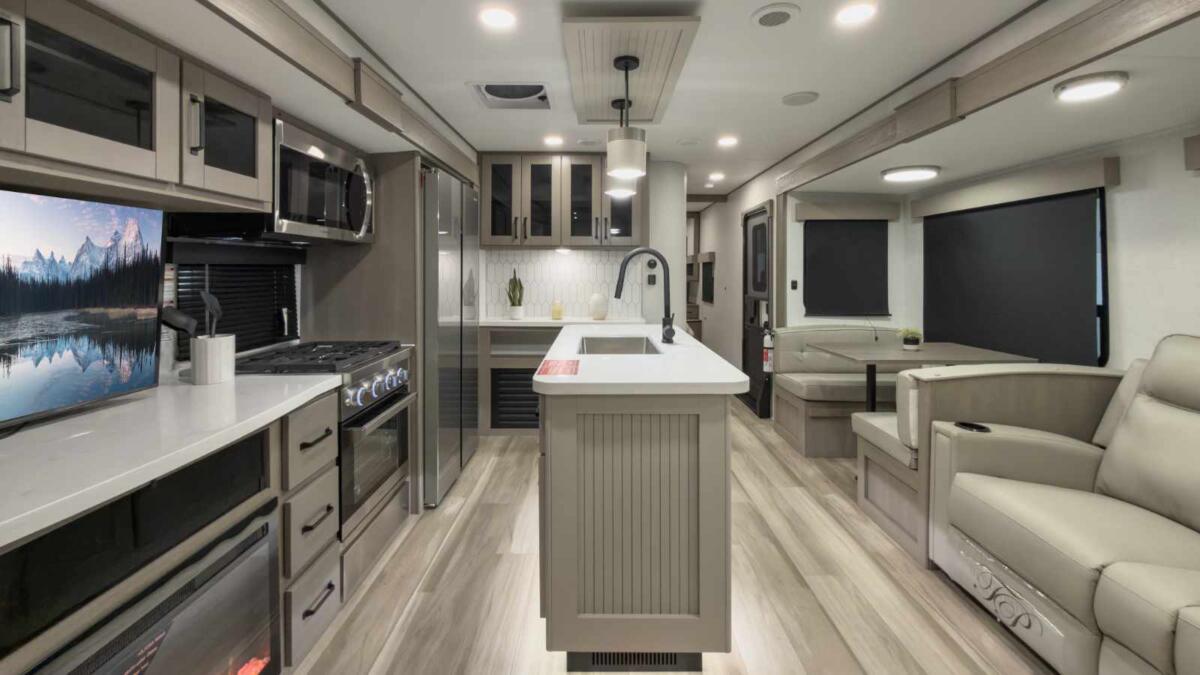
This is a nice space, and the higher-than-average ceiling of this rig, along with the opposing slides, really make it feel more open. 

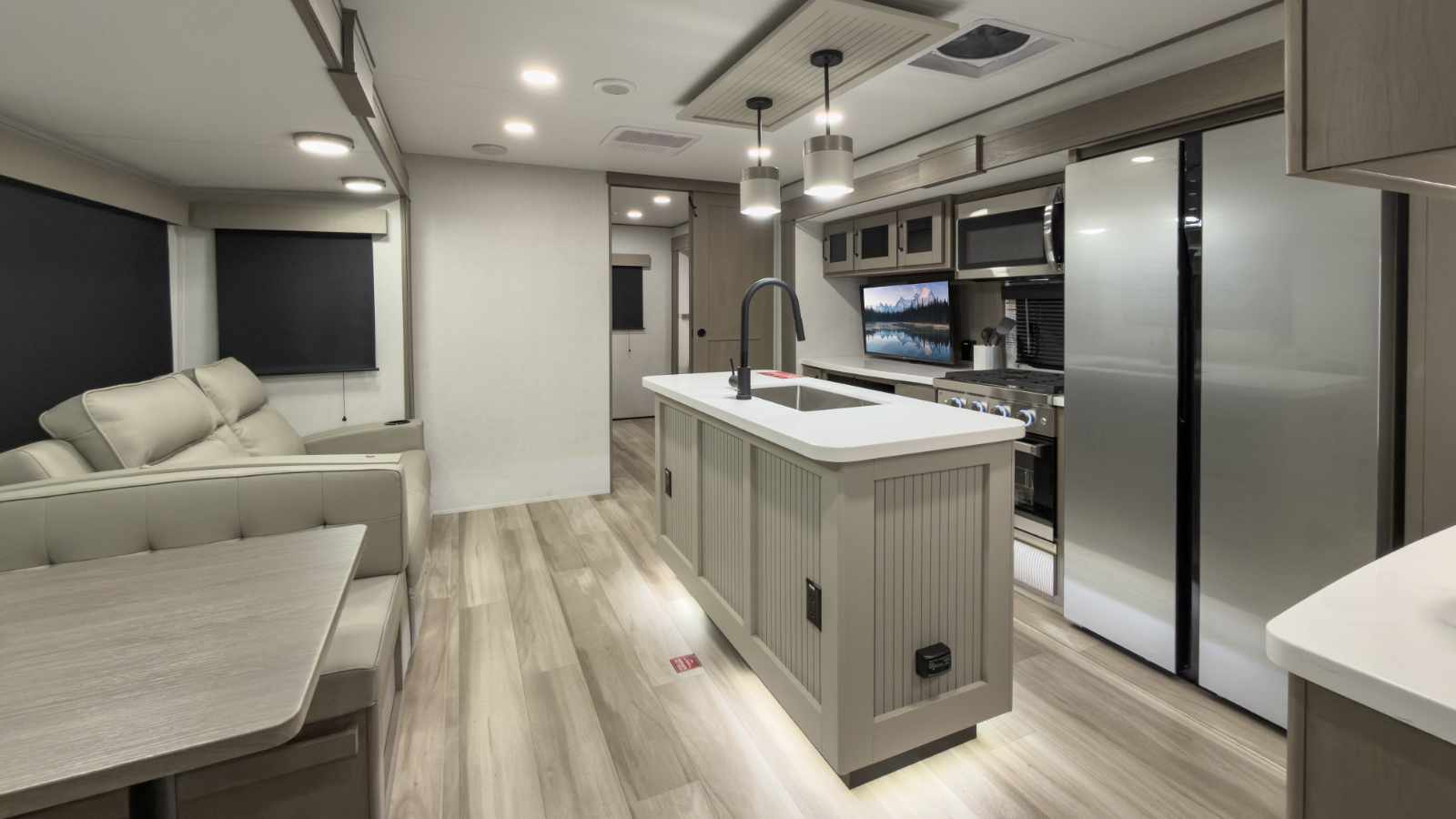
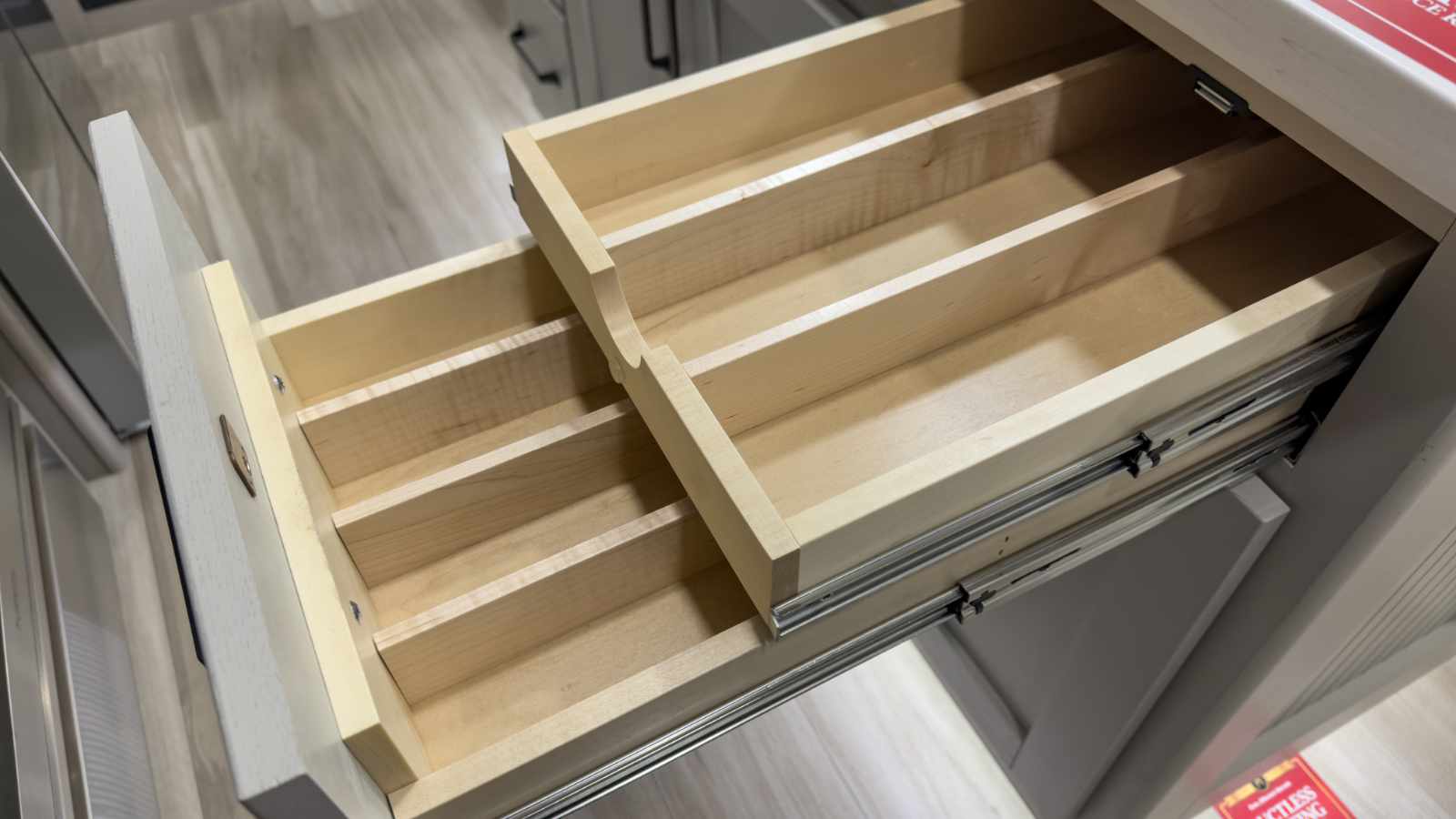
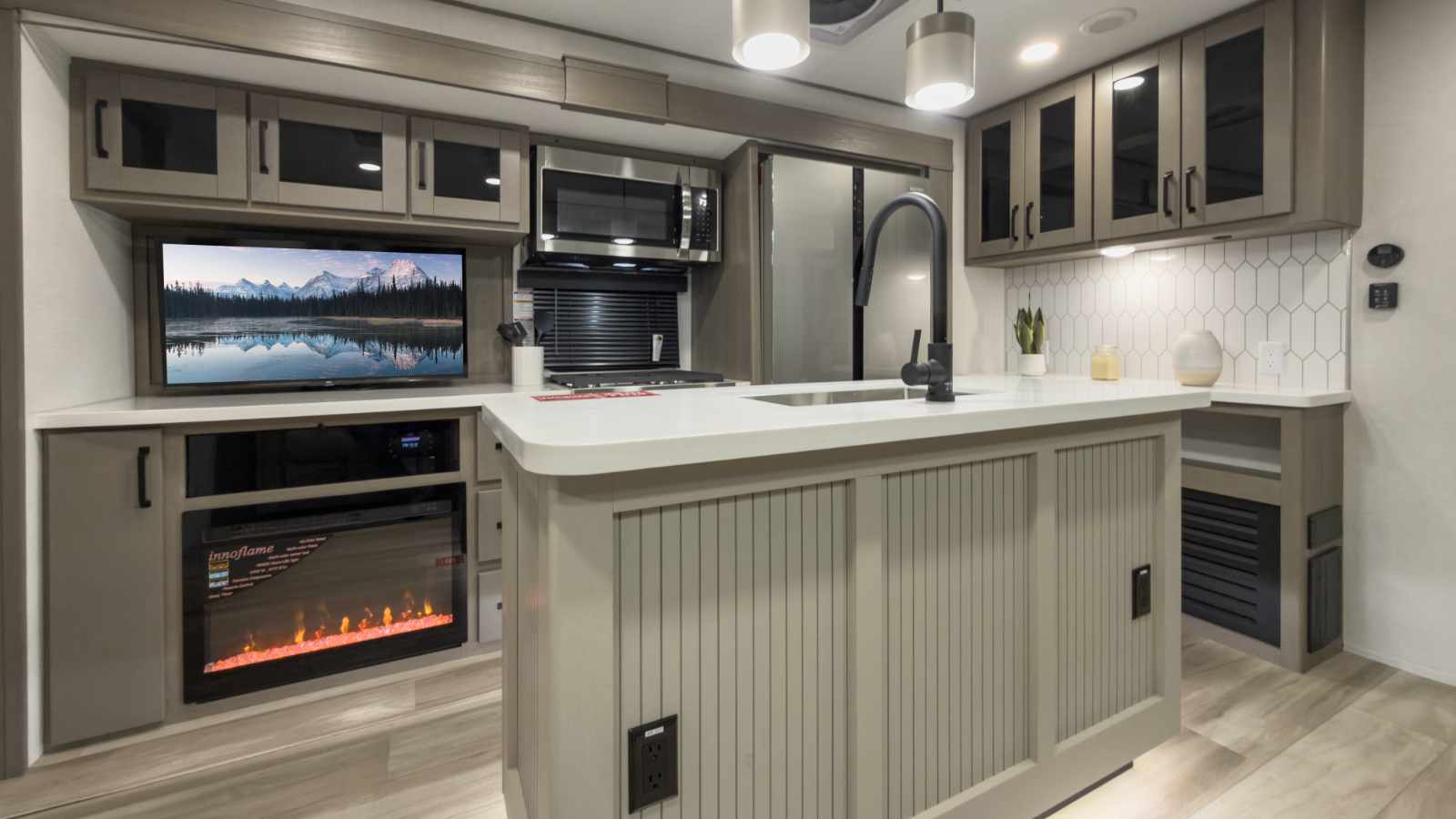
In the kitchen is an island with some good storage built into it. There’s even a pair of pet dishes in a drawer at the base of the island. The stove, microwave, and fridge are all good-sized and reflect a premium feel in RV appliances. 

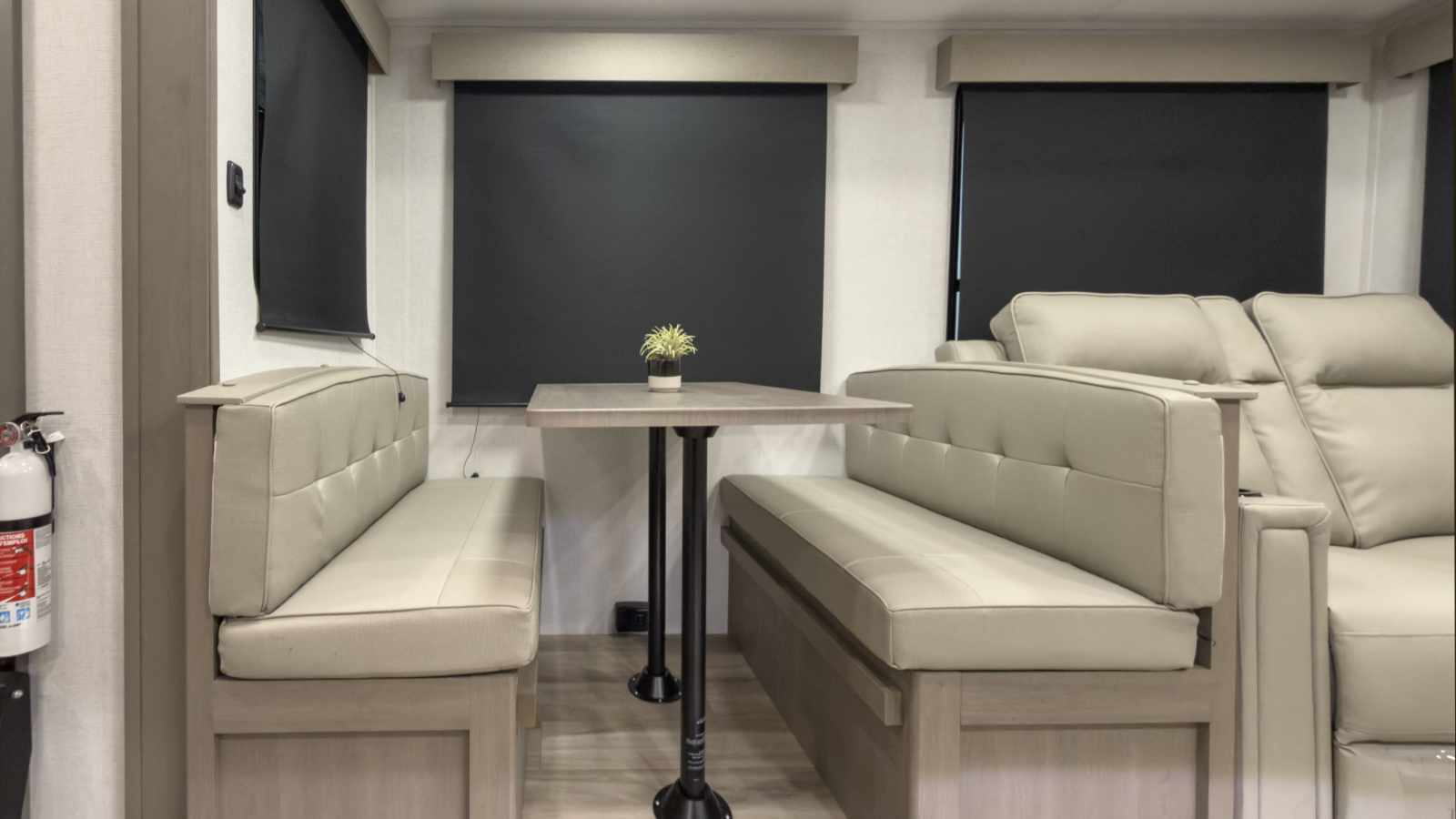
There is a four-place dinette and a couch here, with that couch featuring a center armrest so it serves almost like a theater seat. That makes sense since it’s across the aisle from an electric fireplace and a TV on a televator. 

The bulkhead storage at the front of this space is outfitted with a power outlet and a provision for those who use Starlink. Many of the RV builders have really adopted Elon Musk’s internet from space system, and that’s a good thing. 

Sleeping in the Grand Design Reflection 342BHTS

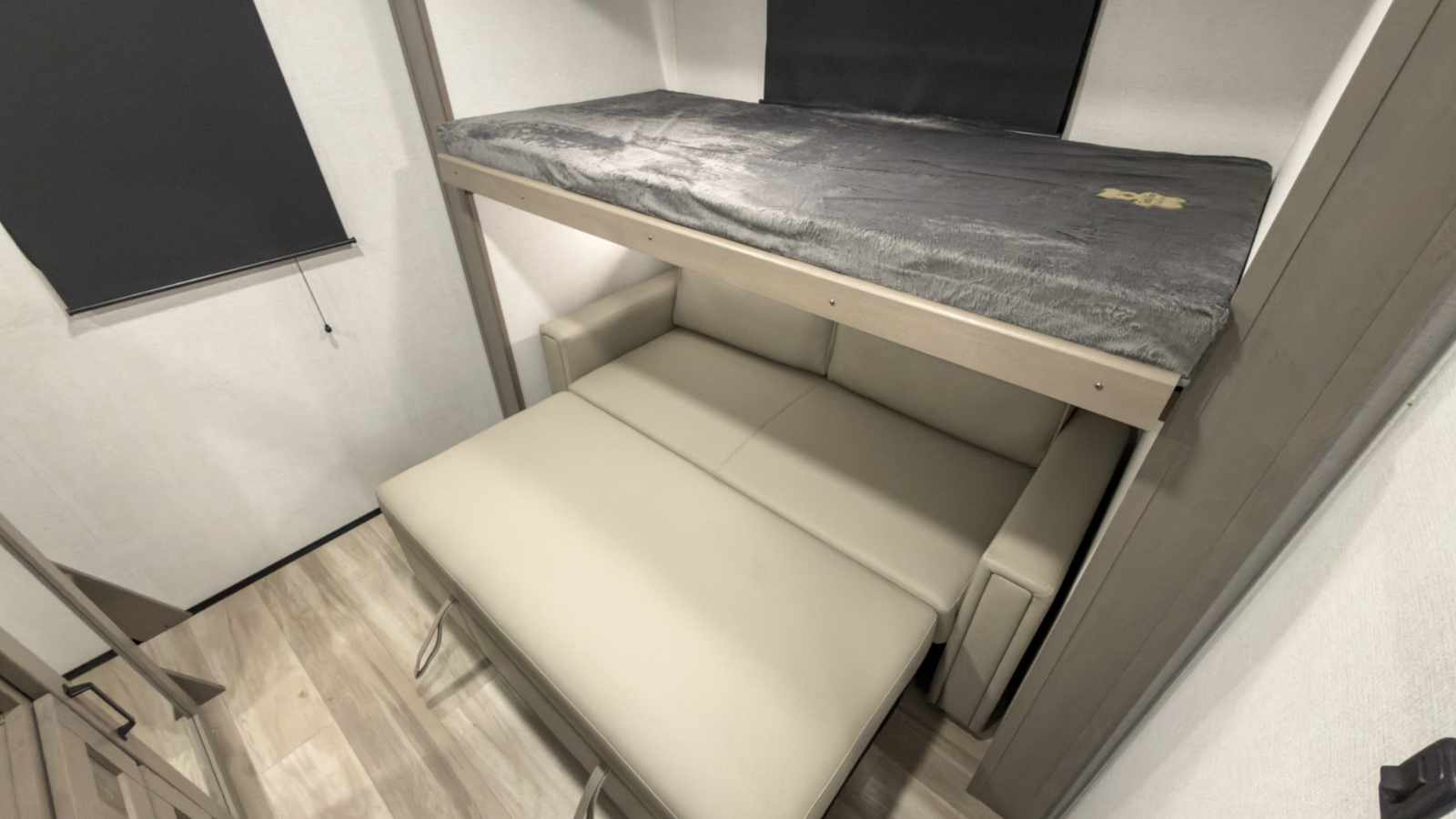
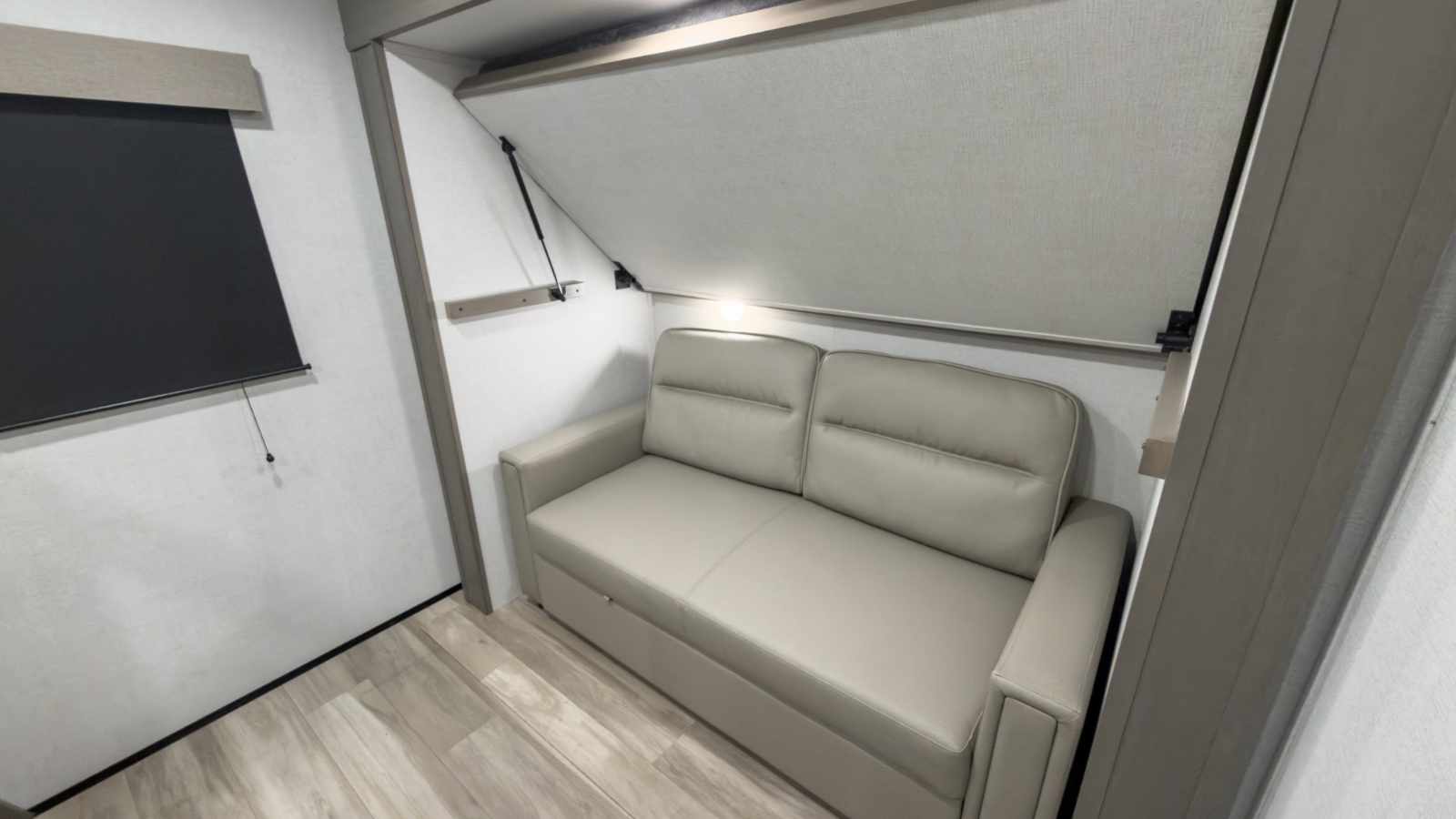
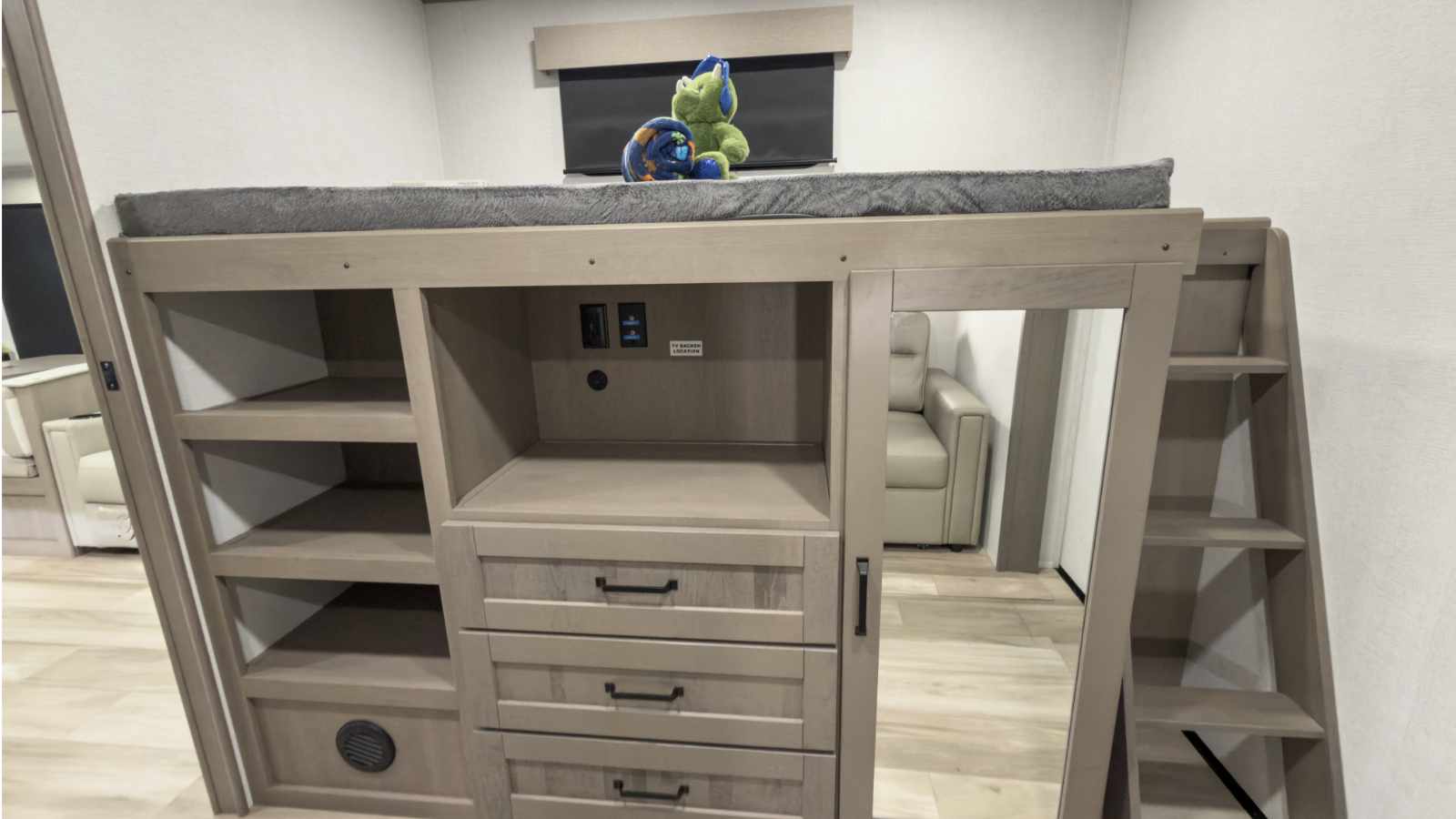
There is a room at the very back of this RV that has a two-person hide-a-bed. This could be a nice getaway room if you don’t have the need for sleeping more people. Above the couch is a swing-up bunk, and across the space are drawers and a provision for a TV. 

Above the drawers is a larger bunk space. Again, if you aren’t needing more sleeping space, this could be storage. Just keep in mind the poor cargo carrying capacity of this trailer. 

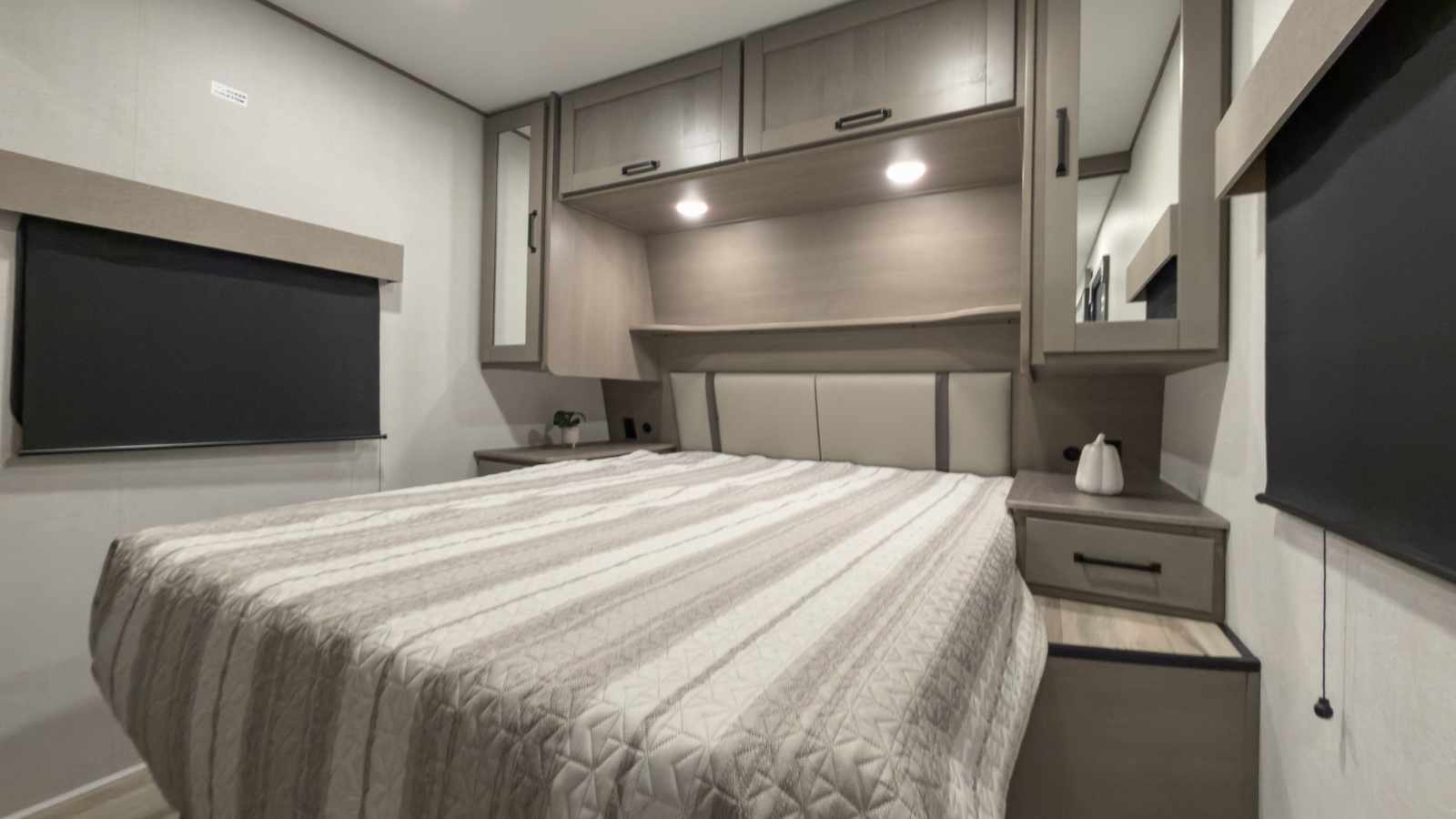
Up front, there’s a bedroom that features a proper queen-sized bed with storage on either side as well as below the bed. 

There’s also a closet in the front bedroom that could either be used for more storage, or you could add a stacking washer and dryer to this space. Oh, know that even a combo washer/dryer unit will set you back almost 200 pounds. Now you see why I keep harping on this reality. 

Final thoughts on the Grand Design Reflection 342BHTS

There’s a lot to like about this trailer, but the downsides are significant enough that I would shop elsewhere. For example, Alliance has a similar floor plan in the Delta 321BH that has twice the cargo carrying capacity, uses Azdel in the wall build, and costs almost $10,000 less. Rockwood’s Ultra Lite 2918BH also uses man-made substrates, has a torsion axle suspension, a vacuum-laminated roof build, and comes with tire pressure monitoring. 

This just shows that there are always choices in the RV space, especially when there are some pretty glaring deficiencies in a model that other RV companies gladly avoid. And that’s why I keep writing these reviews—hopefully, shoppers and RV decision makers will see this and keep moving forward. 

My thanks to Josh from Bish’s RV for the video and photos in this article.

More about these RV reviews

These RV reviews are written based on information provided by the manufacturers along with our writer’s own research. They are based on information from a single unit and may not reflect your actual experience. Shop your RV and dealership carefully before making a buying decision. They are intended only as a brief overview of the vehicle, not a comprehensive critique, which would require a thorough inspection and/or test drive.

Tony comes to RVtravel.com having worked at an RV dealership and been a lifelong RV enthusiast. He also has written the syndicated Curbside column about cars. 

You can also check out Tony and Peggy’s RV podcast.

MORE RV REVIEWS LIKE THIS:

RVT1259

The real ‘mother’ of the Mother Road

1

There’s a particular kind of magic that keeps people turning off the highway and following the old, sun-faded pavement.

That magic has a name: U.S. Route 66. It’s the road Americans call the Mother Road.

You’ve undoubtedly heard of the Mother Road, and the fact that 2026 is its big Centennial Celebration. But did you know the Mother Road actually has a “mother”? Read on to learn all about her.

But first…

The phrase “Mother Road” jumped into the public’s imagination after novelist John Steinbeck used it in his book The Grapes of Wrath. Steinbeck’s book vividly captured the highway’s role as a lifeline for migrating families during the Dust Bowl era.

That image (and name) stuck. For many years, Route 66 symbolized America’s spirit of travel, welcoming small towns and the unique charm found along its roadsides.

Enter “mom”

One of the people who helped turn those Americana ideas into real-life legend was Lucille Hamons. For nearly 60 years, she ran a combined service station, diner, and motel out of a two-story station near Hydro, Oklahoma.

Locals and travelers alike loved Lucille. She happily helped stranded drivers, served cold drinks, and kept the place welcoming when traffic and fortunes were low. Ms. Hamons’ warmth earned her a local nickname you’ll still see in many stories about Route 66: “Mother of the Mother Road.”

Provine service station

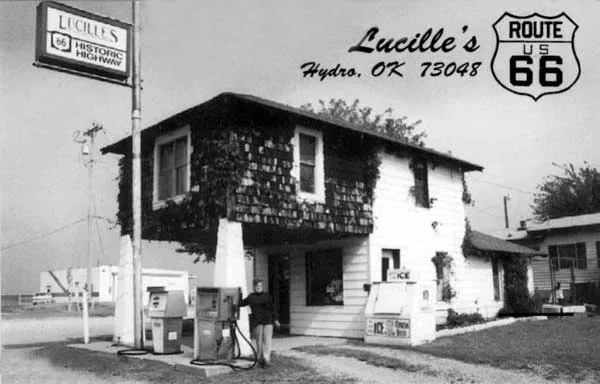
The building that anchored Lucille’s story is the Provine Service Station. It’s a small, two-story gas station built in 1929 and later run by the Hamons. Although you can no longer pump gas here, the pumps and building remain, a memorable representation of the Craftsman style of architecture prominent at the time.

Provine Service Station on Route 66 Image: lucillesroadhouse.com
Photo credit: Lucille’s

The Provine Service Station is listed on the National Register of Historic Places and is one of the tangible reminders of our pre-interstate travel culture.

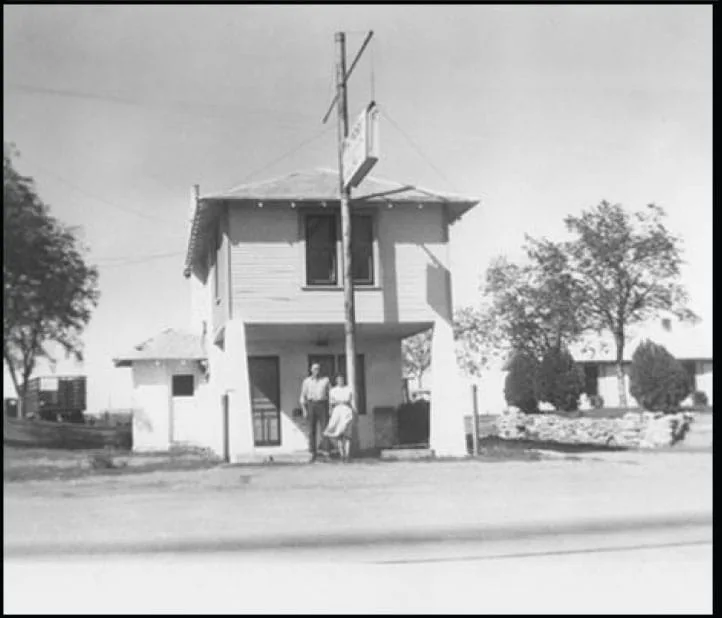
Lucille lived on the upper floor of the station with her husband and three children. Yes, she lived right above the fuel pumps with a clear view of the neon sign that greeted so many cross-country travelers.

Lucille was well known in nearby communities. Her friendly hospitality and willingness to help others made an impression on Highway 66 travelers, as well. They enjoyed stopping by for her ice-cold drinks and great eats, and loved how she treated everyone like family.

Lucille Hamons the "mother" of the Mother Road hwy 66 Image: lucillesroadhouse.com
Photo credit: Lucille’s

Lucille ran her service station, hotel, and diner for more than 59 years! She was inducted into the Oklahoma Route 66 Hall of Fame in 1999. Lucille Hamons died in August 2000.

Rick Koke, a Route 66 enthusiast, restored and maintains the service station today. He also keeps the friendly hospitality of the beloved highway alive as he manages Lucille’s Hotel and Lucille’s Restaurant in Weatherford and Clinton, Oklahoma.

Centennial

Route 66 turns 100 in 2026. Communities along the old road are planning celebrations with festivals, exhibits, and special events.

These celebrations are a perfect excuse to plan an RV stop that’s about more than a photo op. It’s a chance to experience living history, meet local stewards of the road, and support small businesses that keep this slice of Americana alive.

If you’re mapping a Mother Road trip, make room in your itinerary for small towns like Hydro and Weatherford, OK, where history is compact and easy to explore. And do not miss the Provine service station, where the “mother” of the Mother Road delivered service with a smile!

RV campgrounds nearby

Planning a visit to this area? Here are three campgrounds near Lucille Hamons’ service station to consider:

Atchley’s Route 66 RV Park (Clinton, OK). This small campground offers easy access off I-40, full hookups for RVs, basic laundry and restroom facilities. It’s convenient for a quick overnight stop while touring west Oklahoma Route 66 sights.

Territory Route 66 RV Park & Campgrounds (Hinton, OK). This campground literally sits on Old Route 66. It features level pull-through sites, both 30- and 50-amp hookups, Wi-Fi, coin showers and laundry, plus a friendly small-park atmosphere that fits the Route 66 vibe.

Water-Zoo Campground (Clinton, OK). This campground is tied to an indoor waterpark. It offers concrete pull-thru pads, 20/30/50-amp service options, and package deals that include park admission. (It’s great if you’re traveling with kids.)

You should go!

The Provine Service Station and Lucille Hammons’ story make the Mother Road feel human. Stopping during the centennial allows you to be part of the station’s preservation, meet local keepers of the road’s memory, and snap photos that tell real stories about Highway 66.

If you love vintage signage, good pie, and roadside personality, plan to visit this stop along the Mother Road.

Have you explored this section of Route 66? Tell us about it using the comments below.

Driving America’s first coast-to-coast road: the Lincoln Highway

RELATED

RVT1259

Senior RVing: Why I am not giving up RV life at 74

At 74, John of the Gone with John channel’s biggest fear about RV life isn’t a breakdown, bad weather, or money. It’s the day he might be told he’s done, and has to give up the road for good. That thought sits behind the whole message he shares in the video at the end of this post.

Perhaps you feel the same way. I know these thoughts have crossed my mind from time to time. For John, full-time RV living for seniors isn’t only about travel. It’s about staying part of life for as long as he can.

The fear that matters most: When the body says stop

John says he still feels young and full of energy. Still, he knows there may come a day when his body says no. That’s the part that hits hardest.

A house might be safe. Assisted living might be practical. A nursing home might be the only option at some point. But he can’t ignore how strange that feels to him. He doesn’t want his world to shrink into four walls that don’t feel like home.

For many RVers, the usual fears are clear enough: repairs, storms, fuel costs, and money. John’s fear is different. He worries more about losing the ability to live on his own terms.

Why John wants his last chapter outdoors

John doesn’t want to fade out of his own life. He wants to stay in it. As long as he can wake up outside and see something real in front of him, he feels there is still life to live. For him, the best parts aren’t postcard moments. They’re simple and physical. The smell of the desert after rain matters. So does the stillness of early morning when the light hits the mountains, and everything goes quiet.

That, to John, is what it means to live all the way to the end.

The lesson he took from assisted living

A few years ago, while visiting a friend in assisted living, John met a man who kept walking every day and swam when he could get a ride to a fitness center. When John asked why, the man said he was getting ready to leave. He meant he wanted to be ready if he ever got the chance to go back out on his own.

That line stayed with him. So did the man’s view of daily life there. Meals came, then a return to the room, then the same routine again. It felt like waiting.

John knew that feeling because he had lived a version of it before. Back when he was in a house, life looked fine on paper. He had food, shelter, and no major stress. Yet the days blurred together, and nothing changed. Over time, that sameness made him feel like he was slipping out of his own life.

Why RV life still works for John

On the road, life keeps asking something of him. Things break, so he fixes them. Weather changes, so he adjusts. Plans fall apart, so he solves the next problem and keeps moving. That constant change keeps his mind active. It also keeps him connected. He doesn’t feel like he’s watching life from the side. He feels like he’s in it.

John knows he won’t do this forever. Still, he won’t let that future decide how he lives now. He plans to keep moving every couple of weeks and take the hassles that come with RV life over sitting still and feeling his world close in.

The hardest part of aging isn’t always pain or cost. Sometimes it’s the risk of falling into a routine that feels like waiting. For now, he has made his choice. He is staying on the road, staying active, and staying present.

RELATED

RVT1259