Home Blog Page 70

Cold water has rotten egg smell in one RV sink. Why?

Dear Dave, 
The cold water line in the front bathroom sink smells like rotten eggs, and it only takes 12 hours to smell that way. None of the other lines in the RV do this. We are full-timers and have been in the rig since it was new. —Phil, 2018 Heartland Cyclone 4151

Dear Phil,
According to the floorplan I found online, your Cyclone has the side slide bed in the front 5th wheel overhead with the bathroom at the front. The bathroom has the toilet and sink on the driver side and the shower on the curb side.

2018 Heartland Cyclone

The puzzler here is the cold water line would come off the city fill or water pump and go through the water heater. A “T” would split the line to all the other sinks, shower, and toilet. So, why is it just the front bathroom cold water?

Some questions about cold water smell

You state that it takes only 12 hours for it to smell. Have you tried sanitizing the system and that is when it takes 12 hours, or just empty the tanks? Does it smell on both city water and fresh water tank?

Since the lines are most likely PEX material and with crimp connections, it is a closed system. There would not be anything coming from a compartment or holding tank. So it has to be that the water in that line is getting what I call “skunky”—which is typically caused by algae or bacteria.

What to do about cold water that has rotten egg smell

I would start by putting bleach in the fresh water tank and filling it up with water. The Centers For Disease Control (CDC) recommends 1/3 cup for every gallon of water, which I feel is a little strong. I have used 1/2 cup for every 30 gallons, which seems to work well.

The challenge is getting the bleach in the tank. If you have a gravity fill, you can pour the appropriate amount of bleach into a gallon jug to dilute it initially. Then use a funnel to get it into the tank, and then use a hose to fill the rest of the tank.

Gravity Fill
Gravity fill

Some units have a valve at the city water connection that diverts the pressurized water either to the city water lines, or to the fresh water tank to fill it. When I was at Winnebago, we had a few years that units had no gravity fill, just the switch. So it was a challenge getting bleach or even antifreeze into the tank. A classic example of designers and engineers that don’t actually use the units!

Fresh Water Fill Valve
Fresh water fill valve

In this case, you need to use a funnel to fill the end of the fresh water hose before attaching it, then connect it to the city fill. It should get the appropriate amount in the tank.

Next steps to get rid of smell

I suggest driving the unit around a little to mix up the water and bleach, then turn on the pump and open one faucet at a time until you get the smell of bleach. Do this to all faucets, shower head, toilet, toilet spray head, and exterior shower. Then let it sit overnight or at least 12 hours, and then drain the tank by running all the faucets.

Some suggest just putting a partial amount of water and bleach in the fresh water tank rather than filling it up. However, you could have algae and bacteria on the upper portion, and I believe in getting it all.

If the smell comes back after that, I would suggest replacing the water line going to that sink as it might be decomposing. You should be able to access it from the underside compartments.


 You might also enjoy these from Dave 


Dave Solberg is a leading expert in the RV industry and the author of the “RV Handbook.”

Read more from Dave here

HAVE A QUESTION FOR DAVE?

Send your inquiries to him using the form below.

Name
Drag & Drop Files, Choose Files to Upload

RVDT2858

Don’t like guns? Alternatives for self-protection

10

By Mike Sherman
Do you want to feel protected while camping, but you shun guns? There are alternatives that will help you in the event you find yourself under assault, either by an animal or a human being acting like an animal.

Non-lethal weapons have, of course, been around since the beginning of time. Some might think a rock or a baseball bat is a non-lethal weapon, but the law recognizes them as deadly weapons. If you rely on a baseball bat for personal protection, keep in mind that its use requires you to be up close and personal with your attacker.

But what about a defensive spray? They can save your life with a 15-foot separation between you and the offender. Continue reading about the benefits of pepper spray.

Differences between animal (dog or bear) spray and human pepper spray

If you want to stay safe from both animals and humans while jogging or camping, you probably don’t want to carry two different types of spray (animal spray and human pepper spray). So, the natural question is whether you can use one spray to cover all possible scenarios.

The fact is, animal spray is typically not as strong as human pepper spray. This is because, quite simply, it doesn’t need to be. Dogs and other animals have much more sensitive senses of sight and smell, so it takes much less OC (oleoresin capsicum, the active ingredient in pepper spray) to affect them and keep you safe.

Dog spray (like Mace Brand Muzzle Pepper Spray) is most often less than half of the industry standard put into human defense spray. The industry standard for human pepper spray is about 2 million SHU (Scoville Heat Units).

What type should I carry?

If you only want to carry one type of spray, it’s advised to carry human pepper spray and have protection against both animals and humans.

Pepper spray is not lethal and will not cause long-term injuries to people or animals. It will only temporarily disable the attacking animal or human. Human pepper spray can still get an instant response in animals and the range is still adequate enough for you to stay safe (between 8 and 16 feet).

Each spray wears off in 30 minutes to 2 hours, and it’s legal in all states (with a few still having restrictions on its use).

Of course, it should be noted that human pepper spray might not be as effective on larger animals like bears. Bear spray might be a better choice if you’re an avid camper or hiker in locations where you’re more likely to encounter an angry bear than a human attacker.

Both bear spray and pepper spray contain the same active ingredient, OC (oleoresin capsicum). It can cause temporary blindness, nausea, burning sensations, inability to breathe temporarily and other bothersome symptoms.

However, the big difference in bear spray and human pepper spray is that bear spray has to pass tests done by the Environmental Protection Agency to ensure it’s humane. In terms of strength, bear spray has about 2% CRC (Capsaicin and Related Capsaicinoids) and human spray only has about 1.33% CRC. Bear spray typically can shoot farther than human pepper spray and also often has a wider effect area.

Stay protected at all times

The main point is to keep yourself protected at all times, no matter where you are. Think about your lifestyle and what types of dangers you might encounter on a regular day. If you don’t ever camp or hike, chances are you need human pepper spray. It can help you fight off human or smaller animal attacks (dogs, cats, raccoons, opossum). It’s an ideal choice for joggers or for those who need protection as they walk in parking lots.

However, if you are in the woods a lot and need protection against bears, it might be wise to carry bear spray alone or carry it along with human pepper spray. It could possibly be illegal to use bear spray on a human, should you be attacked by a human while hiking in the woods, as it’s not intended for human use.

But, keep in mind, if you’re being attacked you must react to keep yourself safe. So, if all you have is bear spray, be sure to use it! It will disable a human just the same, if not more effectively.

There are some restrictions in a few states. You can view the legal information and a wealth of product information at Pepper-Spray-Store.com.

Be alert and stay safe out there.

Mike Sherman is a retired street cop and investigator with 30+ years of RV experience as a traveler, camp host and all-around advocate for the joys of living on the road. His articles are for general discussion purposes only – you should always consult your local authorities or legal counsel for specific answers if necessary. 

RELATED

RVTDT2858

How to prevent RV theft and keep your RV secure

1

By Cheri Sicard
In the video below, we join Joshua from RV Gear & Far for some useful tips on how to prevent RV theft and ways to keep your RV secure whether it is on the road, at your house, while out boondocking, or in an RV storage facility.

Kudos to Joshua for putting in the disclaimer that with enough determination, any RV can be stolen. But by implementing his advice you can significantly reduce your chances of that happening. Why would a thief want to work harder when it is to his or her benefit to commit the crime as quickly as possible? The goal of this video is to make stealing your RV so frustrating for a thief that they will look elsewhere.

Joshua’s tips to prevent RV theft

#1 Keep an insurance policy: Joshua says keeping your insurance up to date, even when not using the RV, can provide peace of mind that should the worst ever happen, it won’t be a catastrophic loss for you.

#2 Assess and secure your storage area: No matter where you are leaving the RV, Joshua talks about the importance of assessing it from a security standpoint. In the video, he gives you things to look for and consider.

#3 Hitch pin locks for towable RVs: Watch the video as Joshua goes into various options and their merits. Keeping a lock around your safety chains can also prevent someone from towing your RV by the chains and dealing with coupler locks later.

#4 X Chocks: If you have a triple-axle trailer, Joshua says that X Chocks not only provide great stabilization, but they are a theft deterrent, too.

#5 Consider locking lug nuts: These make it harder to get the tires off the RV. You can also chain the wheels to the suspension or to the frame and the wheel just can’t be taken off.

#7 A wheel boot: Similar to what parking enforcement uses, these are also effective, although they can be big and bulky.

#8 Keep the jacks down: A thief would have to take the time to raise them or risk damaging the RV if driving with them down.

#9 Chain your RV to something solid: In the video, Joshua uses a large tree as an example.

#10 Pin the RV in: Use a spot surrounded by other vehicles.

#11 Remove batteries when storing: If a thief wants to steal the RV, they will have to do everything manually, like hitching up and raising stabilizers.

#12 Disconnect the tongue jack fuse when the RV is in storage: Joshua shows you where and how in the video.

#13 Remove spark plugs: If you have a drivable RV, Joshua suggests removing one or more spark plugs or having a mechanic install an automatic kill switch.

#14 Remove the handle on manual tongue jacks: This makes it nearly impossible to raise or lower the tongue jack.

#15 Locks: Of course, lock all your doors. However, many RV locks are keyed alike, so installing good-quality after-market locks is a good idea.

#16 Secure generators, propane tanks, or other external devices: The video gives details of how.

#17 Security cameras: Prices have come down on these and there are even many Wi-Fi options.

#18 Document anything unique about your RV: Should it ever be stolen, this will assist in getting it back. Adding your name and contact to an inconspicuous place such as under a cabinet is a good idea. The idea is to be able to tell a law enforcement officer what to look for and where in order to identify your RV, should it ever be stolen.

#19 Appearances: Anything on your RV that makes it unusual will make it more conspicuous and therefore less desirable to a thief.

#20 Remove license plates while in storage: This makes it more conspicuous and therefore less desirable for thieves as they will have to drive without plates.

#21 Cover the RV: As you can’t drive with the RV covered, this will take a potential thief more time.

#22 GPS trackers: Small, inexpensive GPS trackers can help locate your RV quickly, should it ever be stolen.

Do you have additional tips for how to prevent RV theft and keep your RV secure? Be sure to share them in the comments below.

RELATED

RVDT2858

Do you like pickles?

20

Pickles, you either love them or you hate them! Or, maybe not! Maybe you like them, but you don’t LOVE them, and maybe you think they’re just okay.

For many RVers, pickles are the perfect snack to keep in the fridge for a road trip. They’re portable, easy to pack, and can be enjoyed in a variety of ways—whether on a sandwich, alongside a hot dog, or just on their own. Plus, they last a long time, making them an ideal pantry staple when you’re on the move.

You can even find pickles in all kinds of flavors and varieties, from classic dill to spicy or even sweet bread and butter pickles, ensuring there’s something for everyone’s taste.

Some RVers even swear by pickles for their health benefits. Pickles, especially those fermented and made with vinegar, can help with digestion due to their probiotic content.

They’re also a low-calorie snack, which is perfect when you’re craving something crunchy but don’t want to break your diet. Of course, if you’re watching your sodium intake, there are low-salt versions out there, as well, so everyone can enjoy them without guilt.

Then there’s the process of making pickles. Have you ever tried pickling your own vegetables while on the road? It’s a fun and rewarding activity for RVers who love to get creative with their food. You can experiment with different herbs and spices to craft your own unique pickle recipe. It’s a great way to pass the time at a campsite, and the result is a batch of homemade pickles that can be enjoyed for weeks to come.

After you vote in today’s poll, feel free to leave a comment and tell us about your pickle preferences. Are you a kosher dill kinda gal? Or are you a bread and butter pickle kinda guy?

MORE POLLS LIKE THIS:

##RVDT2858

How to protect your hardwood/vinyl flooring from your RV slide-out

By Dustin Simpson
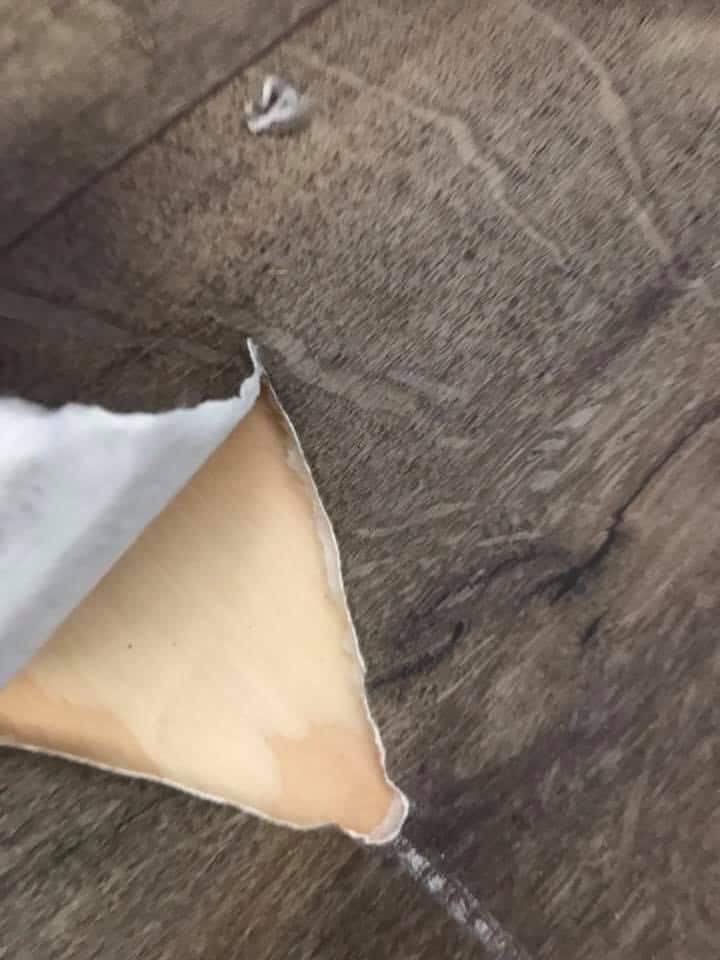
A popular concern I receive at my RV repair shop is protecting hardwood or vinyl flooring when the RV slide-out extends or retracts. Whether your unit is brand-new or it’s several years old, floor damage can be disheartening because you are either left with an expensive repair or a battle wound that you learn to live with.

An easy way of protecting your hardwood or vinyl flooring from your slide-out would be to use Slide-Out Sleds made by AP Products. These sleds will prevent damage or scratching on your hardwood or vinyl flooring whenever you open and close your slide-out.

These sleds are made with durable PVC coating with a rubber foam backing to help prevent them from sliding out of place. They have eyelets on either end of both floor protectors that can be used for hanging when not in use. They measure 47″ long X 7″ wide X 1/2″ thick.

You’ll want to install a sled on either side of the RV slide-out. If you have a large slide and/or a slide with heavier objects inside, you may want to consider installing additional sleds to prevent additional areas where the slide may get hung up.

Please see this video for more information:

More from Dustin

Read more of Dustin’s articles here.

Dustin owns and operates California RV Specialists, an independent RV repair shop located in Lodi, CA. He thrives on sharing his knowledge and enthusiasm of RV repair and maintenance with his team, customers, and virtual friends.

Be sure to check out his YouTube channel where he shares what’s going on in the shop and the product offerings in the store. Dustin is also very active on Facebook. Join his group, RV Repairs and Tips – What’s in the shop!

RELATED

RVDT2858

2026 Airstream Globetrotter 30RB—European-style in an Airstream

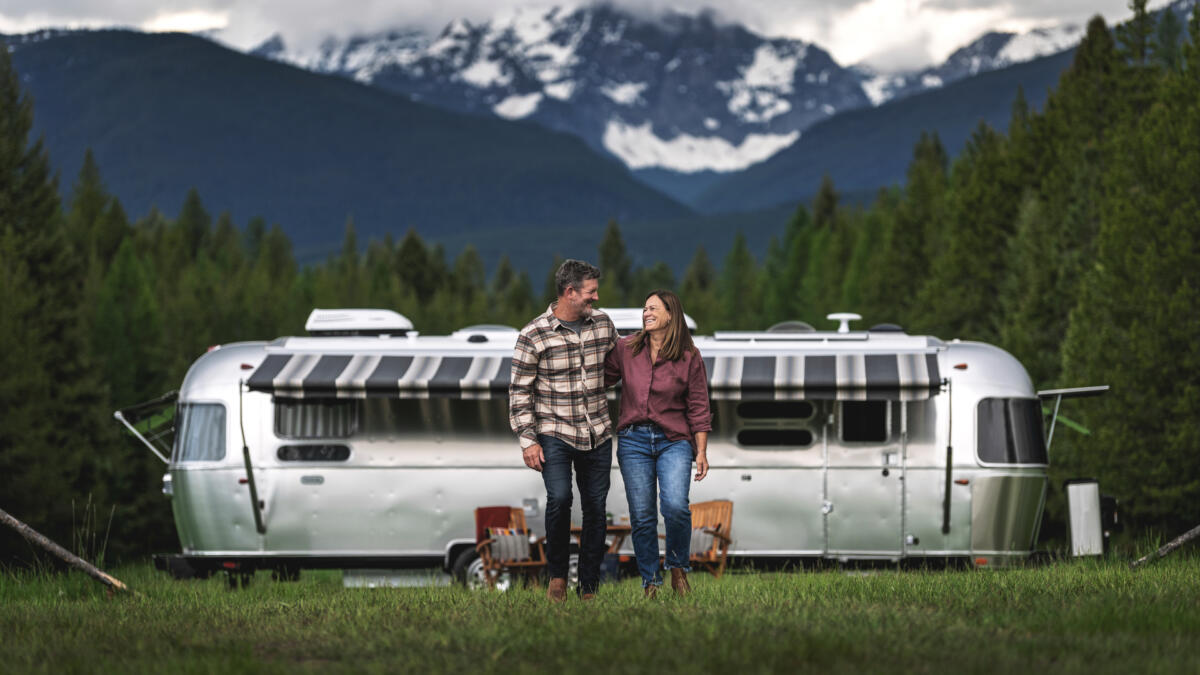
The 2026 Airstream Globetrotter 30RB brings a clean, European-inspired look to Airstream’s classic aluminum trailer body.

In the video at the end of this post, Patrick Botticelli at Colonial Airstream shows the rear bedroom twin layout (also offered with a queen) of the Airstream Globetrotter 30RB. It’s a big, bright floor plan with strong storage, modern power features, and a long list of comfort upgrades that feel practical, not fussy.

The Airstream Globetrotter 30RB measures 31’2″ long (ball to bumper), 8’5.5″ inches wide, and 9’7″ tall to the top of the air conditioner. Inside, it offers a full 8′ interior width and a 6’7″ ceiling height. So, it doesn’t feel tight when moving from the lounge to the bedroom.

Airstream builds the shell with an aluminum body and aluminum ribs. It also uses a composite subfloor, insulation below that, and an enclosed underbelly with heated tanks. That matters when temperatures dip, especially with the 30,000 BTU propane furnace running to protect the plumbing.

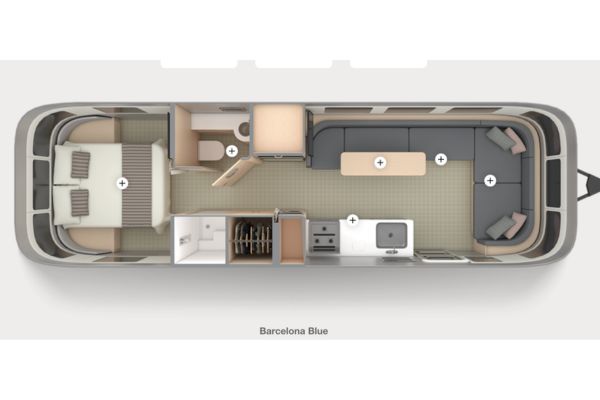
The Globetrotter line comes in a 25′ front bedroom (twin or queen), a 27′ front bedroom (twin or queen), and a 30′ rear bedroom design. Four décor options are offered: Dublin Slate with dark walnut (shown), Copenhagen Cream with dark walnut, Barcelona Blue with natural elm, and London Gray with natural elm.

Specs

Here are the key numbers Patrick called out during the tour:

Spec Number
GVWR 8,800 lbs.
Dry weight 6,925 lbs.
Cargo capacity 1,875 lbs.
Hitch weight 950 lbs.
Fresh water 53 gal.
Gray tank 36 gal.
Black tank 36 gal.

Underneath, the Airstream Globetrotter rides on Dexter rubber torsion axles with shocks on each wheel. It also runs 225/75R15 Load Range E Goodyear Endurance tires, plus a full-size spare on a steel wheel.

Exterior

Outside, the Zip Dee power awning tucks into a metal shroud when closed. The fabric is Sunbrella, and the built-in LED light strip can dim for a softer glow at night. The awning can also tilt forward or back for rain runoff.

The entry setup includes a double aluminum step that folds up flush for travel, a grab handle, screen door guards, a double lock, and a door catch.

For 2026, the standard wireless backup camera can also be used as a security camera once the monitor is brought inside.

Storage is a strong point on the twin model. Patrick notes three rear trunk compartments on the twin layout (one on the queen). These exterior compartments are insulated, weather-sealed, lockable, and lit, and they include rubber mats.

A few exterior utility highlights include hot and cold outdoor shower connections, city water hookup with a built-in pressure regulator, black tank flush, and propane quick disconnects for an outside grill.

Interior

2026 Airstream Globetrotter 30RB with Queen bed option

Inside, the front lounge is designed for a crowd. Patrick jokes that it can seat 12 comfortably, and more if people squeeze in. The Dublin Slate upholstery and dark walnut cabinetry give it a warm, modern feel, while the many windows keep it bright.

The front seating converts for sleeping. The dinette and cushion setup creates a 38-by-81-inch bed, and the layout supports sleeping up to six people total.

Tech and comfort features include a Fusion stereo, four speakers plus a subwoofer, a 12-volt smart TV on a swivel, Ethernet connectivity, and inverter-backed outlets (a 200-watt inverter is standard). New-for-2026 ceiling duct outlets are designed to look cleaner while improving airflow.

Globe1 Globe2

Kitchen, bath, and the rear twin bedroom

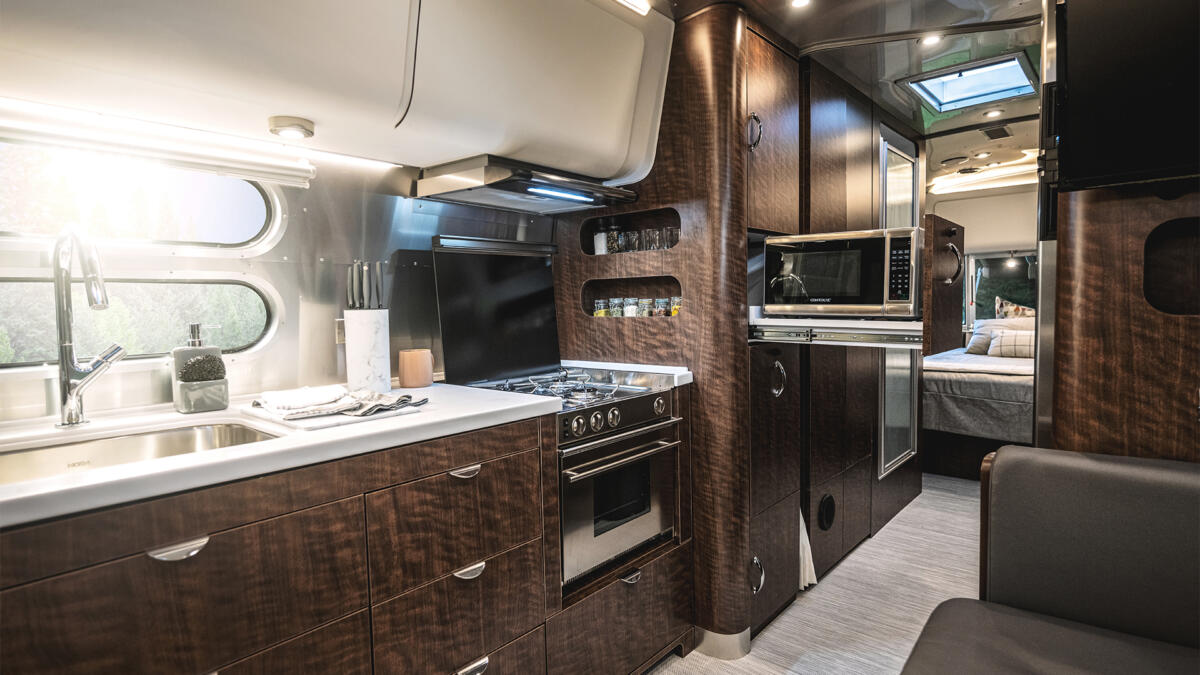
The galley centers on a solid surface counter, a deep stainless sink with a pullout sprayer, and sink covers that snap into place for travel. Cooking comes from a three-burner GE Profile gas cooktop with an oven below. The microwave is often upgraded to a convection unit that adds settings like air fry, and it changes pantry space depending on the configuration. Cold storage comes from a 9.7-cubic-foot refrigerator with a freezer.

In the hallway, Airstream builds in service access panels for easier maintenance and winterizing. Power also gets a 2026 upgrade with a 60-amp battery charger. Up front, the trailer carries two 100Ah lithium iron phosphate batteries with heat. Roof solar is 300 watts (a factory option that Patrick says everyone gets on these builds).

The bathroom uses a fiberglass shower from floor to ceiling, a glass door, a skylight with shade, and a porcelain toilet. The bathroom sink drains to the black tank, which Patrick prefers for toothpaste and shaving water.

In back, the twin beds are full 80″ long and 34″ wide, and the twin layout opens the walkway for a more spacious feel. Each side gets its own outlet, USB, and reading light, plus generous storage and a rear TV on a swivel. If ordered with a queen, it measures 60″ x 75″ (a short queen, common in RVs).

Final thoughts

The 2026 Airstream Globetrotter 30RB combines Airstream’s aluminum build with modern materials and a bright, comfortable layout. It also carries Airstream’s Certified Green Emerald rating, and Patrick notes that Airstream trailers tend to avoid the harsh off-gassing found in many new RVs.

This unit has an MSRP of $166,950.

Learn more about the Airstream Globetrotter line of travel trailers here.

MORE AIRSTREAM RV REVIEWS:

RVDT2858

Buc-ee’s files a lawsuit… against a moose

16

What do you get if you cross a moose with a beaver? A lawsuit, that’s what!

Buc-ee’s recently filed a federal lawsuit against a rival convenience store logo it says looks too much like the beaver mascot. What is it? A moose!

Buc-ee’s

If you’re an RVer who plans fuel-and-snack runs around the country, you’ve probably heard the name Buc-ee’s. This popular brand’s smiling beaver is everywhere, including on T-shirts, hats, and giant travel center signs.

Beyond the massive number of fueling pumps outside, Buc-ee’s offers travelers a huge inside convenience store that carries travel snacks and everything else you can imagine. Oh, and Buc-ee’s claim to fame? Spotlessly clean restrooms!

A moose?

The defendant is an Ohio-based convenience chain, Mickey’s, that recently rebranded. Buc-ee’s complaint focuses less on the species of animal and more on how the two logos are put together.

Mickey's Mart logo sued by Buc-ee's Image: the independent

The claim points to similarities in posture, facial expression, the animals facing the same direction, and the use of strong, simple color fields. These are elements Buc-ee’s says create a similar overall impression that could mislead consumers into thinking the businesses are connected or endorsed by one another.

Design commentators have made the same observation: Branding is about composition and impression as much as literal subject matter.

What is Buc-ee’s seeking?

In its filing, Buc-ee’s asks the court to stop the other chain from using the disputed logo, to cancel or bar trademarks that Buc-ee’s says are too close, and to recover fees and damages. The complaint includes requests to have infringing materials destroyed and to award attorney costs to Buc-ee’s.

Not its first lawsuit

Buc-ee’s has a history of defending its iconic beaver mascot. Over the past couple of years, the chain has challenged several businesses it says traded on its look and name. One included a clothing company accused of selling beaver-themed apparel that altered the mascot, and a small Missouri café/play area called Barc-ee’s that ultimately closed after legal pressure.

The company frames these actions as protecting decades of brand-building. Critics say the suits can be heavy-handed when smaller operators use playful knockoffs on the beaver theme. Either way, those past cases show Buc-ee’s is willing to aggressively press its trademark claims.

Have you ever stopped at a Buc-ee’s while RVing? Tell us about it in the comments below.

RELATED

RVT1252b

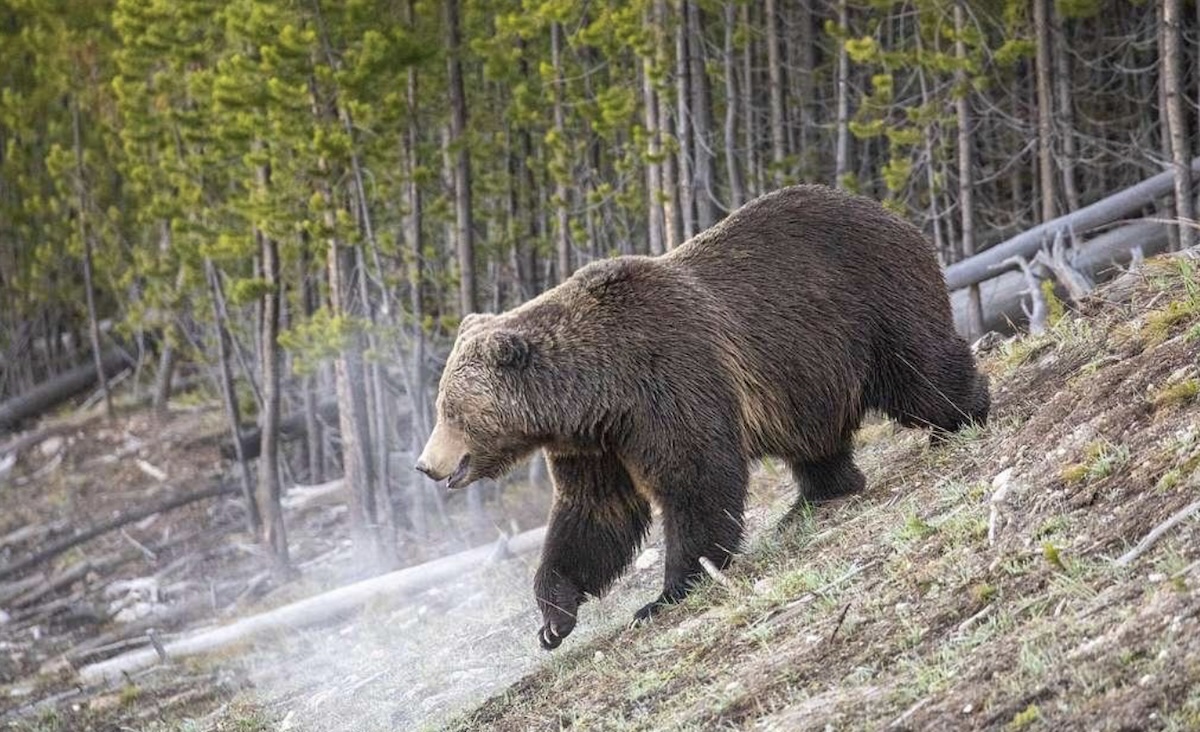
Grizzly bears are waking up and hungry. Watch out

1

Biologists at Yellowstone National Park have spotted their first grizzly bear of the season. It was in the backcountry, but the bear and others will soon show up throughout the park and on nearby lands, including in tourist areas. And the last thing a tourist should aspire to is a “meaningful” relationship with one of these furry, hungry giants.

This early riser from hibernation of the 2026 season was observed in the backcountry scavenging on a bull bison carcass. The first reported grizzly bear sighting of 2025 occurred on March 14. In 2024, it occurred on March 3, and in 2022 and 2023, March 7.

When bears emerge from hibernation, they look for food and often feed on elk and bison that died over the winter. Bears may react aggressively to encounters with people when feeding on carcasses. Male grizzlies come out of hibernation in early March. Females with cubs emerge in April and early May.

All of Yellowstone is grizzly and black bear country: from the deepest backcountry to the boardwalks and parking lots around Old Faithful.

Protect yourself and bears

• Prepare for a bear encounter by carrying bear spray, knowing how to use it and making sure it’s accessible.
• Stay alert.
• Hike or ski in groups of three or more, stay on maintained trails and make noise.
• Avoid hiking at dusk, dawn or at night.
• Do not run if you encounter a bear. It can run faster than you can.
• Stay 100 yards away (the length of a football field) from black and grizzly bears. Approaching bears within 100 yards is prohibited and for good reason: it helps keep you from getting eaten. Use binoculars, a telescope or telephoto lens to get a closer look.
• Store food, garbage, barbecue grills and other attractants in hard-sided vehicles or bear-proof food storage boxes.
• Report bear sightings and encounters to a park ranger immediately.

RELATED

RVT1252b

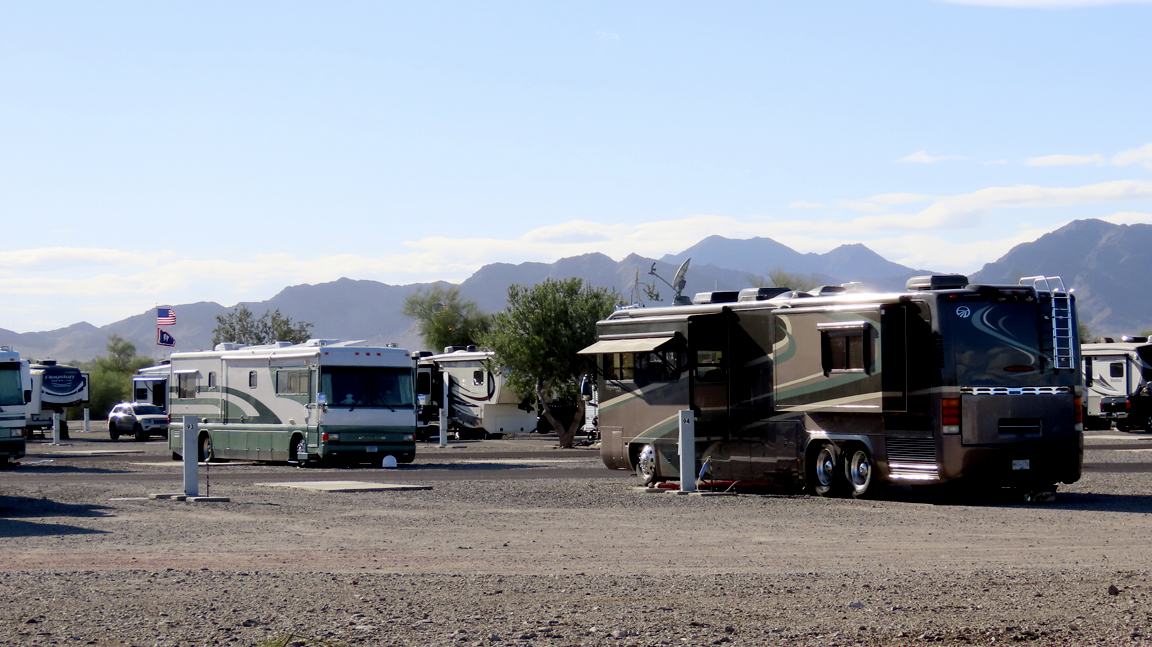
Will campsites fill up this summer? Early bookings offer a clue

Every spring RVers ask the same question: “Are campgrounds going to be impossible to book again this year?” Early data on campground reservations for 2026 suggest the answer may be no—at least not more than last year.

Several campground companies say bookings so far are running close to where they were at this point in 2025. Prices look similar, too. In other words, the coming camping season may look pretty familiar.

That doesn’t mean popular parks won’t fill early. But the numbers so far suggest RVers may not see the same kind of reservation frenzy that showed up during the pandemic camping boom.

Of course, if you’re trying to book a beachfront site in July—or anything near a national park—you probably already know those spots can disappear fast. Early reservations still matter in the most popular destinations.

So, how full are campgrounds right now?

One snapshot comes from Campspot, an online reservation platform used by many parks across the U.S. and Canada.

Looking at bookings between May 1 and September 1—the heart of camping season—occupancy so far sits at 30.1% in the U.S. Last year at this time it was 30.2%.

That’s basically the same.

Canada is also tracking close to last year. Reservations are slightly lower so far, but nightly rates have crept up a bit. Of course, it’s still early. Many RVers don’t start locking in summer trips until spring.

Campgrounds say demand still looks healthy

Large campground operators are generally optimistic about the coming season.

The big kahuna, Kampgrounds of America (KOA), which has more than 500 parks across North America, says advance reservations are pacing close to last year overall.

Translation: Camping demand still looks solid.

Other campground management companies say the same thing. Some are even seeing bookings running ahead of last year at this point.

Upgraded parks are drawing attention

One thing campground operators keep mentioning is the pull of amenities.

Parks that recently added new sites, upgraded bathhouses, or expanded resort-style features are seeing stronger booking growth.

That fits a trend RVers have probably noticed themselves. Many newer parks are leaning hard into extras—things like dog parks, fishing ponds, fire pit gathering areas, and upgraded full-hookup sites.

Travelers looking for those kinds of features appear willing to book early and sometimes pay a bit more.

Premium sites vs. budget sites

Another split operators are seeing involves price. Higher-end RV sites and resort-style parks continue to book well. But plenty of travelers are still looking for more basic, lower-cost options.

That isn’t surprising. Compared with flights, hotels, and rental cars, camping is still one of the cheaper ways to take a vacation. For many families, that value factor keeps RV travel attractive even when the broader economy feels uncertain.

Longer stays are filling some parks

Campgrounds also say seasonal and monthly camping remains strong.

When more guests stay for weeks or months at a time, it can quietly reduce the number of short-stay sites available for travelers just passing through. That’s one reason some parks feel “full” even when reservation numbers overall look stable.

At the same time, campground operators say short-stay RV travel has become a little less predictable than it used to be. That sometimes means busy weekends fill early—but midweek openings can still pop up closer to travel dates.

Some regions are stronger than others

Not every part of the country is seeing the same booking patterns.

Operators say the Midwest and Northeast are showing solid demand, while parts of the Sunbelt—especially Texas—have been a bit softer so far.

In Canada, campground operators say more travelers may stay closer to home this year rather than crossing into the United States.

What about fuel prices?

One wildcard for the 2026 camping season is fuel.

With tensions in the Middle East pushing oil prices sky high, some travelers may rethink long road trips. Historically, though, higher fuel prices don’t usually stop people from camping. Instead, they change how people travel. Campers may take shorter trips or stay closer to home, rather than canceling vacations entirely.

What RVers might see this summer

If early trends hold, the 2026 camping season may look a lot like last year. Popular parks, waterfront sites, and resort-style campgrounds will likely continue to fill early. But overall demand appears steady rather than exploding.

For RVers, that could mean a more predictable reservation season—still competitive in popular destinations, but not quite the scramble many travelers experienced during the pandemic boom.

In other words, camping demand still looks strong. It just may be settling back into something RVers recognize—a fairly normal reservation season.

RELATED

RVT1252b

Starlink shuts down cheap internet workaround used by RVers

Starlink in-motion internet has become a popular way for RVers to stay connected while traveling through areas with weak or nonexistent cell coverage. For a while, some travelers discovered a surprisingly cheap way to keep that connection alive while driving—and it only cost about $5 a month.

That workaround now appears to be gone.

Recent reports indicate that Starlink has disabled in-motion use for its $5 Standby plan, a low-cost option originally meant to keep a dish active while a customer temporarily paused regular service. The move closes a loophole some RVers and vanlifers had quietly been using to stay connected on travel days without paying for a full mobile plan.

What the $5 Standby plan was meant to do

Starlink’s Standby option was designed as a simple way to keep equipment registered to an account while not paying the full monthly subscription.

For about $5 per month, users could keep their dish active at a greatly reduced connection speed—roughly 500 kilobits per second.

That speed isn’t enough for streaming or video calls. But it’s more than enough for:

  • navigation apps
  • messaging
  • email
  • light browsing

In other words, just enough connectivity to stay in touch while traveling.

The workaround travelers discovered

Some traveling users discovered that even at that slow speed, Starlink still worked well enough while the vehicle was moving.

That made the Standby plan a handy workaround. Instead of paying for a full roaming subscription, users could:

  • pause their service
  • leave the system in standby
  • still have limited internet access while driving

For RVers crossing areas with weak or nonexistent cell service, that small connection could be surprisingly useful.

But Starlink appears to have taken notice.

What changed

Users now report that when the system detects movement while on the Standby plan, the connection may shut down with a message indicating service is disabled while moving.

In practical terms, that means the $5 option can still keep your hardware active—but not while the vehicle is in motion.

To maintain connectivity while traveling, users must now switch to one of Starlink’s standard mobile plans.

What this means for RVers

For most RVers, this change won’t affect campground use. Starlink will still work normally when the dish is stationary.

The difference shows up on travel days. Anyone hoping to keep Starlink in-motion internet working while driving will now need a plan designed for mobile use, typically one of Starlink’s Roam plans. Those cost significantly more than the Standby option.

In other words, the ultra-cheap “keep it alive for the drive” trick appears to be finished.

A small group will feel this most

We’re not sure how many RVers used Starlink while moving in the first place. We’d love to hear in the comments on that. But a growing number of travelers—especially vanlifers and users of the smaller Starlink Mini hardware—had begun experimenting with low-speed connectivity on the road.

For them, the Standby workaround offered a clever way to stay online without paying for a full mobile subscription.

Now, that option seems to have disappeared.

The bigger picture

Starlink has been steadily refining its service tiers as the satellite network grows and demand increases. Adjusting what different plans allow—especially when it comes to mobility—is one way the company manages network capacity.

For RVers, it’s also a reminder of how quickly satellite internet policies can evolve.

A workaround that works today might disappear tomorrow.

And for RVers who rely on Starlink to stay connected while on the road, that means keeping a close eye on the fine print.

RELATED

RVT1252b

RV Daily Tips. Tuesday, March 10, 2026

America’s Original RV Newsletter. Since 2001
Issue 2857 • New issue every weekday
If you find this newsletter helpful, please consider supporting our staff’s work in producing it with a donation of your choice.


Today’s thought

“People have a way of becoming what you encourage them to be—not what you nag them to be.” —S.N. Parker


Need an excuse to celebrate? Today is National Pack Your Lunch Day!

On this day in history: 1876 – The first successful test of a telephone is made by Alexander Graham Bell.


Tip of the day
Upgrade your RV living space with modular furniture

By Gail Marsh
If you’re an RVer who wants to breathe new life into your living area, you may want to consider modular furniture.

Modular furniture isn’t just stylish—it’s a smart solution for the unique challenges of RV living. Consider the benefits of modular RV furniture and see why a modular sectional can be a game-changer for RVers.


Article and video
Texas RV resort with heated lazy river—Just $599 a month

Paying less than many campgrounds charge for a single week and getting a heated lazy river sounds like one of those too-good-to-be-true deals. That’s exactly why the Why Wait crew parked at Seagrass RV Resort on the Texas coast for a long winter stay. Check this amazing place out!


Featured article
Do idyllic campsites exist? Yes, and they’re not hard to find

By Dave Helgeson (veteran boondocker)
Past RVtravel.com articles question whether the idyllic campsites pictured in RV industry ads really exist. Publisher Chuck Woodbury suggests they are staged where you aren’t allowed to camp. Others I see are photoshopped, often quite poorly, in a scenic location. … What is missing from the above definitions [of idyllic campsites]? The words RV park, campground, or Walmart. Therefore, it only stands to reason if you want to find idyllic campsites, like those pictured in the ads, you may want to look outside the confines of a traditional RV park or campground. Learn how to easily find them here.


Fireproof bag🔥 Reader favorite
Fire-resistant bag keeps valuables safe!

This silicone-coated fire-resistant bag will save your money, documents, jewelry, passport and other valuables from a fire. Its two layers of supreme fire-retardant fiberglass material make it resist fire and heat up to 2000℉. It’s waterproof, too, so when the hoses arrive, your valuables won’t be harmed. Learn more or order.


REMEMBER: You don’t need to receive an email alert from us to read our newsletters. Just visit our homepage, www.RVtravel.com, at any time of day, and the latest issues and all recently published articles will be right there for you.


Ask Dave
What caused crack in RV’s fiberglass sidewall? How to fix it?

Read Dave’s answer here.


Reader poll
What would you fear stumbling upon most in the wild—a bear, rattlesnake, or alligator?

Respond here.


Quick tip
Easy ways to stretch your gas mileage

Gas prices are headed up again, and maybe that’s a challenge to your pocketbook. Well, here are a few easy ways to stretch your RV dollars with practically no work and at no additional expense. First, slow down. Don’t go 65 on the highway—slow down to 60 or, better yet, 55. Make sure your tires are properly inflated: You’ll roll easier so your engine won’t need to work as hard. At intersections, go soft on the gas pedal as you get up to speed. Even doing these simple things will save you money by improving your mileage.


HA HA: On a septic tank truck: Yesterday’s Meals on Wheels


Website of the day

5 one-tank roadtrips from New Orleans, Louisiana
Visiting beautiful New Orleans? Check out this list from Roadtrippers for easy one-tank drives you can do from the city.


? MYSTERY PRODUCT OF THE DAY ?
We’re not quite sure what this man is doing with his hands (preparing for a quick draw? Seriously, what a strange photo…), but this gadget could really be useful for some of you…


And the survey says…

We’ve polled RVtravel.com readers close to 5,000 times in recent years. Here are a few things we’ve learned about them:

• 20 percent say they or someone they know has been charged extra for kids at a campground.
• 17 percent carry a portable automatic ice maker with them on their RV travels.
• 80 percent have not spent a night at a rest area in their RV within the last year.

TAKE A GUESS: RVtravel.com readers say this is their preferred amount of time to stay at a campsite: A) One night, B) A few days, C) A week, or D) Two weeks? Find out here.


Don’t miss these recent stories:


Trivia

Cleopatra was fluent in nine languages, including Egyptian, making her the only pharaoh in the 300-year Ptolemaic dynasty able to speak it. (Most other Ptolemaic leaders spoke Greek.) Cleopatra was a highly intelligent ruler. In addition to using her persuasive powers for political gain, she wrote books, favored rare manuscripts, and hunted.


Readers’ pets of the day

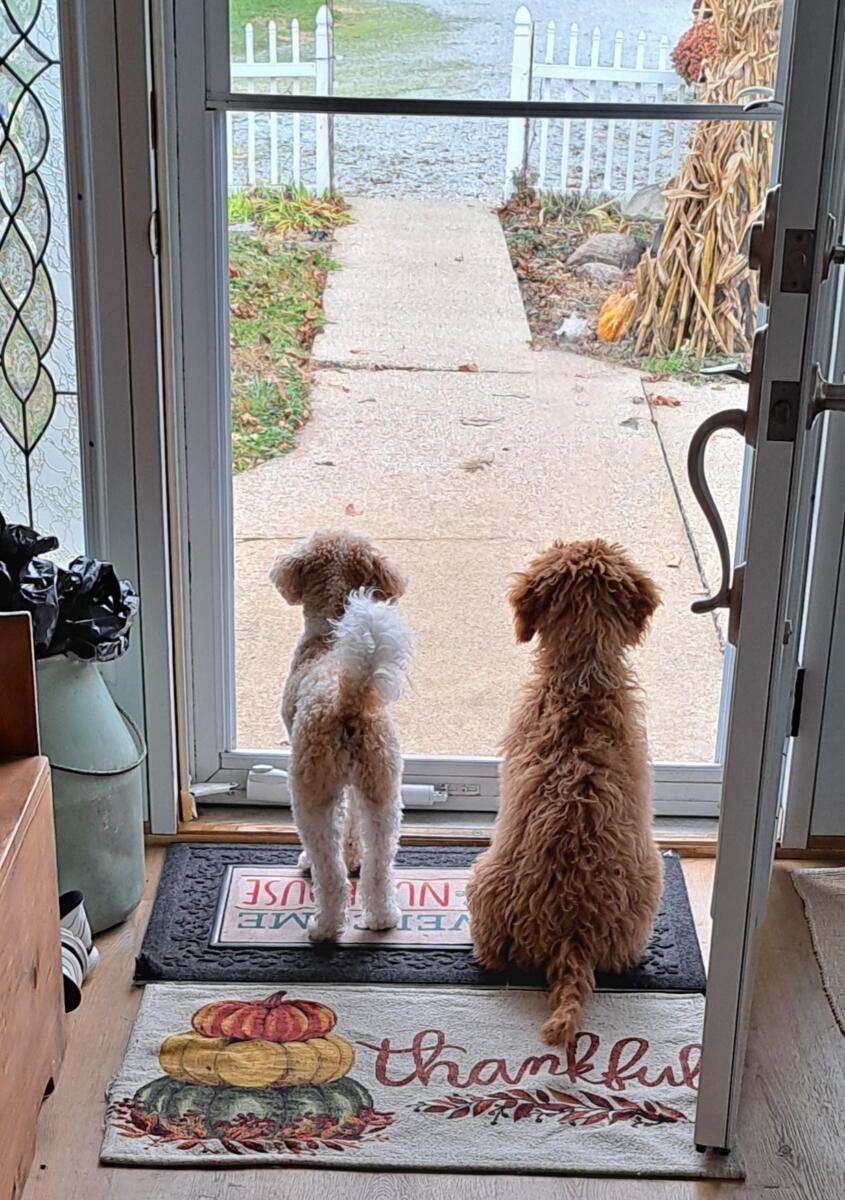
20251121 144052 E95dd30b5fa5906a0d02245527f0ab2e“Scout and Journey (mini poodle and mini goldendoodle, ages 2 and 8 months). ‘Don’t worry, she will be home soon…'” —Michael Keck

Send us a photo of your pet with a short description. We publish one each weekday in RV Daily Tips and in our Sunday RV Travel newsletter. No blurry photos, please! Please do not submit your photo more than once. Thanks!

RVtravel.com’s favorite doggie treat: Sam’s Yams® nothin’-but-sweet potato treats. Archie (Chuck and Gail’s dog) approved!


FREE IS GOOD! Free movies and TV (with ads) on YouTube.


Leave here with a laugh

A young Montana cowboy was walking a pretty girl home from the Saturday night barn dance. He was falling in love, and it was a beautiful, romantic evening. “Edna, I bet you’ve been out with a lot of worse-looking fellows than me,” he said, bashfully. Edna didn’t answer. He tried again. “I said, I bet you’ve been out with a lot of uglier fellows than me.”

“Would you keep quiet,” Edna said. “I’m trying to think!”


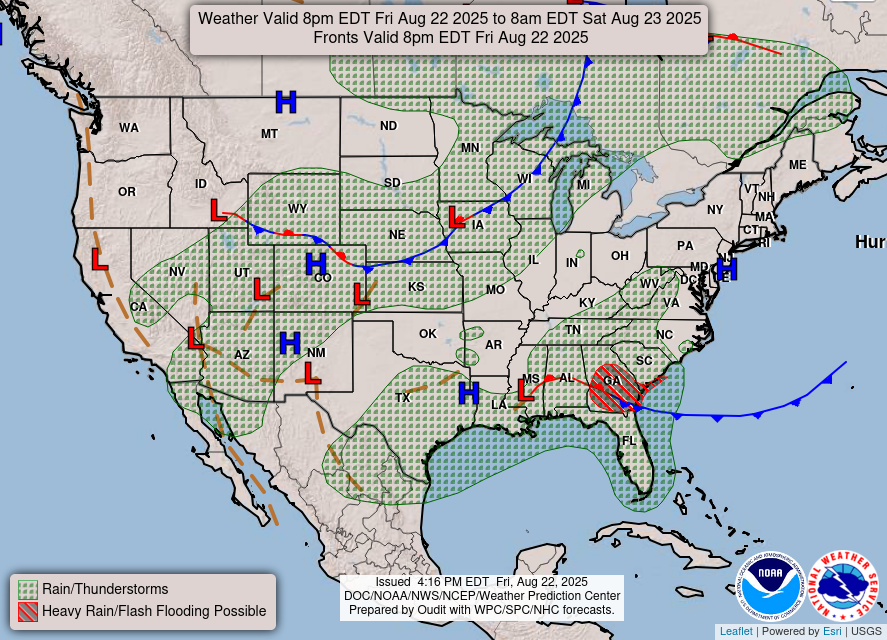
Today’s weather forecast across the nation
THIS MAP UPDATES TWICE A DAY

Visit Current National Radar Weather Map


Did you miss the latest RV Travel Newsletter? If so, read it here.
Oh, and if you missed the Latest News for RVers, make sure to catch up here.


If you shop at Amazon.com we’d appreciate you using this link. We get an itty bitty commission if you buy something, but they add up and help us pay our bills (most importantly our hard-working writers!). 


RVtravel.com All-Star Team

Click here for information about our staff and how to contact us.

WHY WE ASK FOR DONATIONS INSTEAD OF SELLING SUBSCRIPTIONS.

Our policy on using artificial intelligence.

What caused crack in RV’s fiberglass sidewall? How to fix it?

Dear Dave,
My RV has a small crack in the fiberglass exterior body, down low near the door. What would be the best sealant to patch it? Thank you very much. —Steven, 2013 Tiffin Allegro RED

Dear Steven,
Your Tiffin is a Rear Engine Diesel (RED) model. The exterior skin is a Filon reinforced fiberglass panel sandwich design.

Typically, a crack is caused by a twisting or flexing of the sidewall. It could have started due to a sharp edge of the door cutout.

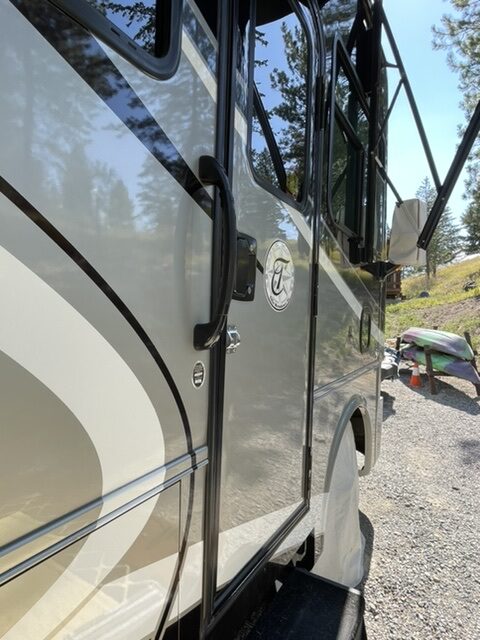
Tiffin Door
Tiffin door

Instead of just sealing it, I would suggest doing a fiberglass repair to keep it from spreading further with more flexing.

If the crack is fairly small, you can drill a hole at each end to stop it from spreading. Then repair it with fiberglass by sanding the crack with 120 grit sandpaper and fill the crack with a two-part fiberglass resin repair kit.

If the crack is substantial, Filon recommends the following procedure:

Repairing cracks, air voids, or major impact damage

1. Using a cutting tool such as a die grinder, cut a rectangular or square area around the damaged area.

2. Cut down through the gel-coat and the laminate. Do not cut through the lauan plywood backer. Remove the gel-coat/laminate layer from the plywood backer by using a putty knife to pry it off.

3. Use the die grinder to taper off the edge of the gel-coat/laminate around the perimeter of the cut out area. Taper it back about 1/2” at a 45-degree angle.

4. Be sure that all of the laminate is removed from the surface of the lauan plywood. Lightly score the face of the lauan plywood with the edge of the die grinder to promote a better bond between the lauan plywood and the new fiberglass that will be applied. Clean debris from the repair area.

5. Using 1½ oz. fiberglass mat cloth, cut the mat to the size of the repair area (including the ½” of taper around the outside edge of the repair area). Use three layers of 1½ oz. mat.

6. Catalyze the polyester resin as directed by the manufacturer. Holding the first layer of mat on the repair area, begin brushing the polyester resin onto the fiberglass mat until the mat is completely saturated. Continue adding layers of mat in the same manner.

7. Once all three layers of mat are saturated, use a small roller to roll out any air bubbles.

8. Allow the polyester resin to reach peak curing temperature and begin cooling down. Once the resin is no longer tacky, begin sanding the fiberglass repair area using 40 grit sandpaper. Sand off the excess polyester resin and fiberglass.

9. Switch to 80 grit sandpaper, continue sanding until repair area is flat. Be careful not to sand a depression into the surface of the repair area.

10. Use 220 grit sandpaper to do the final repair sanding. Sand an area about 3” to 4” around the repair. Wipe the repair area with clean acetone to remove any dust.

11. Mask off the area around the repair.

12. Spray gel-coat onto the repair surface. Spray enough gel-coat to allow for an approximate 20% shrink.

13. Allow at least four hours for the gel-coat to cure. For best results, allow to cure overnight.

14. Wipe the cured gel-coat surface with clean acetone before sanding.

15. Begin the initial sanding with 220 grit sandpaper.

16. Begin the final sanding with 400 grit sandpaper.

17. Buff with a clean buffer pad using buffing compound to remove any fine sandpaper scratches.

18. Begin final buffing by using a clean buffer pad using a 50/50 combination of buffing/glazing compound to buff gel-coat to the gloss level around the repair.


 You might also enjoy these posts from Dave 

DAVE HAS ANSWERED MORE THAN 1,000 readers’ maintenance and repair questions. Read a directory here. There is so much to learn!


Dave Solberg is a leading expert in the RV industry and the author of the “RV Handbook.”

HAVE A QUESTION FOR DAVE?

Send your inquiries to him using the form below.

Name
Drag & Drop Files, Choose Files to Upload

RVDT2857