Whoops! We messed up! To read today’s RV Daily Tips, October 13th, CLICK HERE.
This newsletter is for intelligent, open-minded RVers. If you comment on an article, do it with respect for others. If not, you will be denied posting privileges.
Issue 1443
Welcome to another edition of RV Travel’s Daily Tips newsletter. Here you’ll find helpful RV-related and living tips from the pros, travel advice, a handy website of the day, tips on our favorite RVing-related products and, of course, a good laugh. Thanks for joining us. We appreciate you. Please tell your friends about us.
“Don’t say you don’t have enough time. You have exactly the same number of hours per day that were given to Helen Keller, Pasteur, Michelangelo, Mother Teresa, Leonardo da Vinci, Thomas Jefferson, and Albert Einstein.” ― H. Jackson Brown Jr.
Need an excuse to celebrate? Today is National Noodle Day!
On this day in history: 1884 – The Naval War College of the United States is founded in Rhode Island.
Tip of the Day
Can your “other half” handle the rig? They should know how
By Bob Difley Though becoming more balanced among couples, more men still drive their RVs than women. If you are the female half of a couple, imagine if you were out in the boonies and the driver were to become ill.
You would have to learn how to drive the rig quickly – and at a most difficult time while under extreme stress. Don’t wait for that moment to happen. Start learning to drive the rig now, and then share the everyday driving to stay in practice. Read more.
Do you think your RV may be a lemon? If you bought a new RV and you’ve taken it back to the dealer or manufacturer for numerous repairs and it’s STILL not fixed, you may, in fact, have a lemon RV. Discussions among RVers about the quality of RV construction generally lead to the same conclusion: Manufacturers are sending many substandard units out their doors these days. Why? Learn more.
How many miles will you travel with your RV through the end of 2020?
If you know, or can take a guess, tell us here.
Did you miss the newest issue of our recalls newsletter? There are 32 RVs or other RV-related vehicles on the list. Is yours here?
Quick Tip
Bed sheet too big for your RV mattress? Here’s a tip to make it fit
If you find your sheets are a bit bigger than your mattress, buy a set of suspenders you’d use to hold up your pants. Buy the type that has clasps on the ends, not the button attaching type. Undo the stitching where they would cross on your back so you end up with two separate pieces. Criss-cross them under your mattress – it helps to have two people do this – and attach to opposite sides of your bottom sheet. Double up the material where you attach the clasps and there’s less chance it will damage the material. Thanks to George Bliss (and his suspenders!)
Website of the day
Is the website down for everyone or just me?
Frustrated because a website won’t load? This site tells you if the website you’re trying to load won’t work for everyone, or just you/your computer. Helpful for those times you want to throw the computer out the window!
And the Survey Says…
We’ve polled RVtravel.com readers more than 1,500 times in recent years. Here are a few things we’ve learned about them:
• If they had to pick a location for a vacation home, the largest percentage of voters, 47 percent, would pick a mountain cabin
• 28 percent spend between 4-6 hours outside every day
• 4 percent use the pool at the RV park every day
For 100 years maps have shown an island that doesn’t exist. Sandy Island, a landmass about the size of Manhattan in the Pacific Ocean, has been on maps for 100 years. Explorer James Cook discovered the island in 1774 and it began appearing on maps in 1908. It wasn’t until 2012 that Australian scientists wanted to visit and research the island, that they discovered it wasn’t there.
*How many species of living things are there on Earth? We told you yesterday, and the number will make you feel pretty darn small!
Readers’ Pet of the Day
“Here are my two rescue girls. Haley, the dark one, is deaf and her blonde friend is Ruby, who is diabetic and blind. They love going to the Puma Pit (our 5th wheel) for the summer.” —Susan Hoffman Losinger
Send us a photo of your pet with a short description. We publish one each weekday in RV Daily Tips and in our Saturday RV Travel newsletter.
Stay free on private property across America Boondockers Welcome is a great alternative to expensive, crowded RV parks or even Walmart parking lots. With a membership, you can stay for free at more than 1,000 private property locations across America. And, wow, will you meet some great people! Learn more or sign up.
Leave here with a laugh
What’s the difference between the bird flu and the swine flu?
One requires tweetment and the other requires oinkment.
This newsletter is brought to you Monday through Friday by RVtravel.com and is funded primarily through voluntary subscription contributions from our readers. Thank you! IF YOU APPRECIATE THIS NEWSLETTER and others from RVtravel.com, will you please consider pledging your support? Learn more or contribute.
Publisher: Chuck Woodbury. Editor: Emily Woodbury. Senior editor: Diane McGovern. Social media and special projects director: Jessica Sarvis. Financial affairs director: Gail Meyring. IT wrangler: Kim Christiansen.
This website utilizes some advertising services. As an Amazon Associate, we earn from qualifying purchases. Regardless of this potential revenue, unless stated otherwise, we only recommend products or services we believe provide value to our readers.
Everything in this newsletter is true to the best of our knowledge. But we occasionally get something wrong. We’re just human! So don’t go spending $10,000 on something we said was good simply because we said so, or fixing something according to what we suggested (check with your own technician first). Maybe we made a mistake. Tips and/or comments in this newsletter are those of the authors and may not reflect the views of RVtravel.com or this newsletter.
Mail us at 9792 Edmonds Way, #265, Edmonds, WA 98020.
We know it’s been a weird year for traveling, but hopefully you’ve found safe ways to get on the road. Do you have any trips planned for the rest of 2020? How many miles will you travel with your RV during the remaining three months of this year?
With the holidays quickly approaching, we’re betting some of you will be on the road soon enough. How far will you travel?
Please tell us in the poll below. Leave a comment too if you’re comfortable sharing your upcoming trips. We’d love to hear where you’re headed!
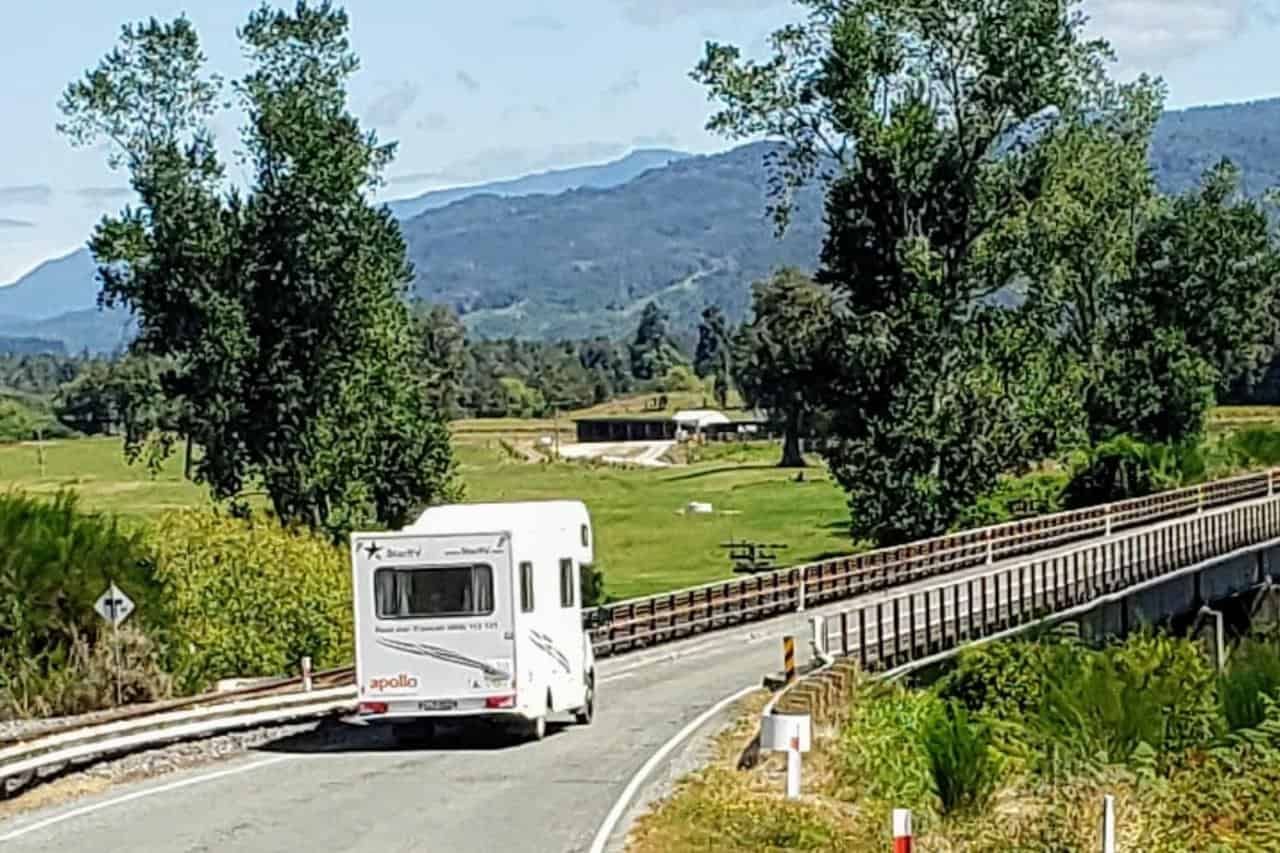
By Bob Difley Though becoming more balanced among couples, more men still drive their RVs than women. If you are the female half of a couple, imagine if you were out in the boonies and the driver were to become ill.
You would have to learn how to drive the rig quickly – and at a most difficult time while under extreme stress. Don’t wait for that moment to happen. Start learning to drive the rig now, and then share the everyday driving to stay in practice.
Don’t limit yourself to just learning how to drive
There are other things the regular “pilot” does to get the rig ready to travel. Do you know how to disconnect the power and water systems? Raise the automatic levelers? Hitch up the rig?
All these are important aspects of getting under way with your RV. You and your other half should draw up a checklist together, and thoroughly practice “how-to-dos” before the need arises.
696×181
If you are the male driver, start giving your other half driving time – along with constructive and helpful assistance, and encouragement. If you can’t provide the support and the temperament to make it work, hire a driving instructor. Do it.
You can find Bob Difley’s RVing e-books on Amazon Kindle.
Rosie the Riveter appeared courtesy of Wikimedia Commons and is a public domain image.
This newsletter is for intelligent, open-minded RVers. If you comment on an article, do it with respect for others. If not, you will be denied posting privileges.
Issue 1442
Welcome to another edition of RV Travel’s Daily Tips newsletter. Here you’ll find helpful RV-related and living tips from the pros, travel advice, a handy website of the day, tips on our favorite RVing-related products and, of course, a good laugh. Thanks for joining us. We appreciate you. Please tell your friends about us.
“Learn to accept. It doesn’t mean putting up with it, it means simply not wasting energy on situations you can’t change by paddling backwards against the peace of your day.” —Dalai Lama
Need an excuse to celebrate? Today is National Do Something Nice Day!
On this day in history: 1970 – The Public Broadcasting Service (PBS) is founded.
Did you see the news?Click here to read the latest issue of the Sunday News for RVers.
Tip of the Day
Dumping RV tanks: Where do you go when you gotta go?
By Russ and Tiña De Maris When we take on the RV lifestyle, we also put on some new “hats” for the roles we assume. What kind of hat does a “sanitary engineer” wear? I dunno — the only part of my uniform in that role is a pair of good, thick rubber gloves.
Getting out the sewage becomes our “problem,” and that can really BE a problem if we’re not sure of where to “get rid of the goods.” When set up in an RV park, it’s not a problem — but on the road or when boondocking, it gets a bit more complicated. Here are some possible places to dump your tanks. Continue reading.
RV Electricity – This week’s J.A.M. (Just Ask Mike) Session:
Dogbone adapter confusion cleared up – Part 2
In my last JAM Session I posted a simple question about how dogbone adapters are named. (Yes, that’s me with a dogbone in my mouth.) This survey was done because I often get a lot of confusing questions about these most basic of adapters in my various Facebook groups and RV forums that I watch. While there are lots of electrical questions to consider, the most basic one is what do we call an adapter that connects an RV with a 50-amp plug to a pedestal with a 30-amp outlet? Continue reading.
• Join Mike’s Facebook group, RV Electricity.
• Read more of Mike’s articles here.
Tools for a safe and cheery campfire
Just about everyone loves a campfire. There’s even a word in Swahili that means “dreaming the fire,” it’s such a compelling experience. Greg Illes gives you lots of tips for the perfect, and safe, campfire. He also explains why the most important fireside tool is a shovel – but it may not be for what you think. Learn more.
Reader poll
When you “camp” at Walmart, do you ask the store for permission? Tell us here, please.
Fire Extinguishing Aerosol, Two-pack The First Alert Tundra Fire Extinguishing Aerosol Spray is easier to use and discharges 4 times longer than traditional fire extinguishers. With an aerosol nozzle and portable size, it’s suited for the kitchen, car, garage, boat or RV. The formula wipes away with a damp cloth & is biodegradable. Learn more or order.
Quick Tip
Getting your trailer out of a tight spot
Got your trailer backed into a tight spot and can’t get it out? Block the trailer tires, unhitch your tow vehicle. Now bring the tow vehicle back in at a different angle of approach, hitch up, and try ‘er again.
Website of the day
Zocdoc
Zocdoc is a great website to bookmark. If you’re in a new place and need a doctor (for anything) simply type in what you need, your zip code and your insurance, and the website will match you up with a doctor nearby. Click on an appointment time, schedule your appointment and fill out paperwork, all right there! Couldn’t be easier.
Popular articles you may have missed at RVtravel.com
Think humans are kings and queens of planet Earth? Think again! We are just one of the estimated 8.7 million species that live together on Earth. Makes you feel small, doesn’t it? There are over 7.8 million species of animals alone!
This is a must-have for state park campers!
This recently published book, “50 States: 500 State Parks,” is a must-have for all state park campers and explorers. The beautiful book takes you on a journey through America’s best state parks. Whether you’re looking for stunning vistas, rare wildlife, a dose of history or an enjoyable hike, state parks offer an array of experiences. Learn more or order.
Readers’ Pet of the Day
“Our seven traveling companions. They are the best travelers – always in a bunch while we are on the road.” —Dave Matthews
Send us a photo of your pet with a short description. We publish one each weekday in RV Daily Tips and in our Saturday RV Travel newsletter.
This newsletter is brought to you Monday through Friday by RVtravel.com and is funded primarily through voluntary subscription contributions from our readers. Thank you! IF YOU APPRECIATE THIS NEWSLETTER and others from RVtravel.com, will you please consider pledging your support? Learn more or contribute.
Publisher: Chuck Woodbury. Editor: Emily Woodbury. Senior editor: Diane McGovern. Social media and special projects director: Jessica Sarvis. Financial affairs director: Gail Meyring. IT wrangler: Kim Christiansen.
This website utilizes some advertising services. As an Amazon Associate, we earn from qualifying purchases. Regardless of this potential revenue, unless stated otherwise, we only recommend products or services we believe provide value to our readers.
Everything in this newsletter is true to the best of our knowledge. But we occasionally get something wrong. We’re just human! So don’t go spending $10,000 on something we said was good simply because we said so, or fixing something according to what we suggested (check with your own technician first). Maybe we made a mistake. Tips and/or comments in this newsletter are those of the authors and may not reflect the views of RVtravel.com or this newsletter.
Mail us at 9792 Edmonds Way, #265, Edmonds, WA 98020.
You’re supposed to ask a manager or employee if you can camp at Walmart overnight in their parking lot, but many people don’t, and it’s not always enforced.
If you ever stay overnight in a Walmart parking lot, do you usually ask for permission to stay, or do you just stay without asking? Your answer may be different under different circumstances, like if you see a bunch of other RVers parked there for the night too, but answer the poll below just generally speaking.
Recently, Walmart has changed its tune about overnight camping, so it might be a good idea to ask if you’re allowed to stay or not.
Welcome to my J.A.M. (Just Ask Mike) Session, a weekly column where I answer your basic electrical questions. If you’re a newbie who’s never plugged in a shore power cord (or ask – what’s a shore power cord?), or wonder why your daughter’s hair dryer keeps tripping the circuit breaker, this column is for you. Send your questions to Mike Sokol at mike (at) noshockzone.org with the subject line – JAM.
Dear Readers,
In my last JAM Session I posted a simple question about how dogbone adapters are named. (Yes, that’s me with a dogbone in my mouth.) This survey was done because I often get a lot of confusing questions about these most basic of adapters in my various Facebook groups and RV forums that I watch. Reread Part 1 of this JAM Session HERE.
The answer is not 42!
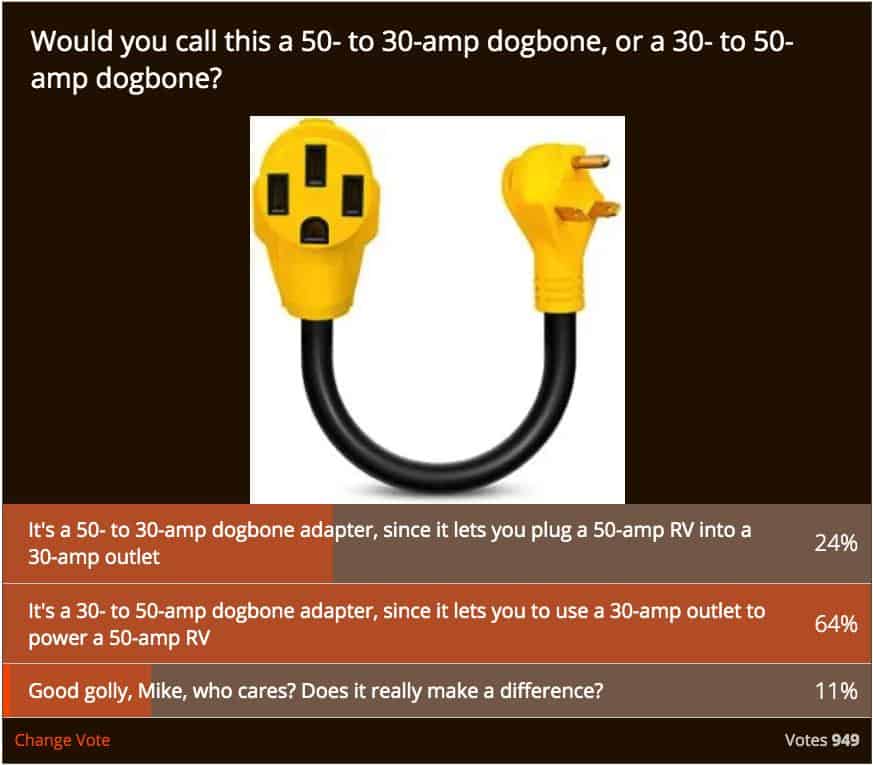
While there are lots of electrical questions to consider, the most basic one is what do we call an adapter that connects an RV with a 50-amp plug to a pedestal with a 30-amp outlet? Do we say it’s a 50- to 30-amp adapter because it lets you connect a 50-amp RV to a 30-amp pedestal? Or do we say it’s a 30- to 50-amp adapter because you can use a 30-amp pedestal outlet to power a 50-amp RV? What is the answer (and it’s not 42, like in the Hitchhikers Guide to the Galaxy)?
There are at least two ways to define this connector, such as a 30-amp male to 50-amp female adapter, etc. – but I’m looking for the simplest way to describe it. So last week I took a poll of what you would call this most basic power adapter. And here is what you all voted for.
Drum roll, please…
While 11% of you voted that I was being silly, 24% said it should be called a 50- to 30-amp adapter, while 64% called it a 30- to 50-amp adapter.
In fact, these numbers seem to correlate with my own experience where perhaps 25% of the time I get a confusing question because someone is asking about a 50- to 30-amp adapter when they really mean a 30- to 50-amp adapter. For a deep dive into how dogbone adapters power your RV, please read all about it HERE.
Which way is correct?
So which way is right? Well, I always state the pedestal outlet amperage first, followed by the RV shore power amperage. So this specific dogbone adapter shown in the survey would be called a 30- to 50-amp adapter. More specifically I would call the adapter in the survey a 30-amp male (plug) to 50-amp female receptacle, or 30P-50R, for 30-amp Plug to 50-amp Receptacle.
Is it a 15-amp or 20-amp adapter?
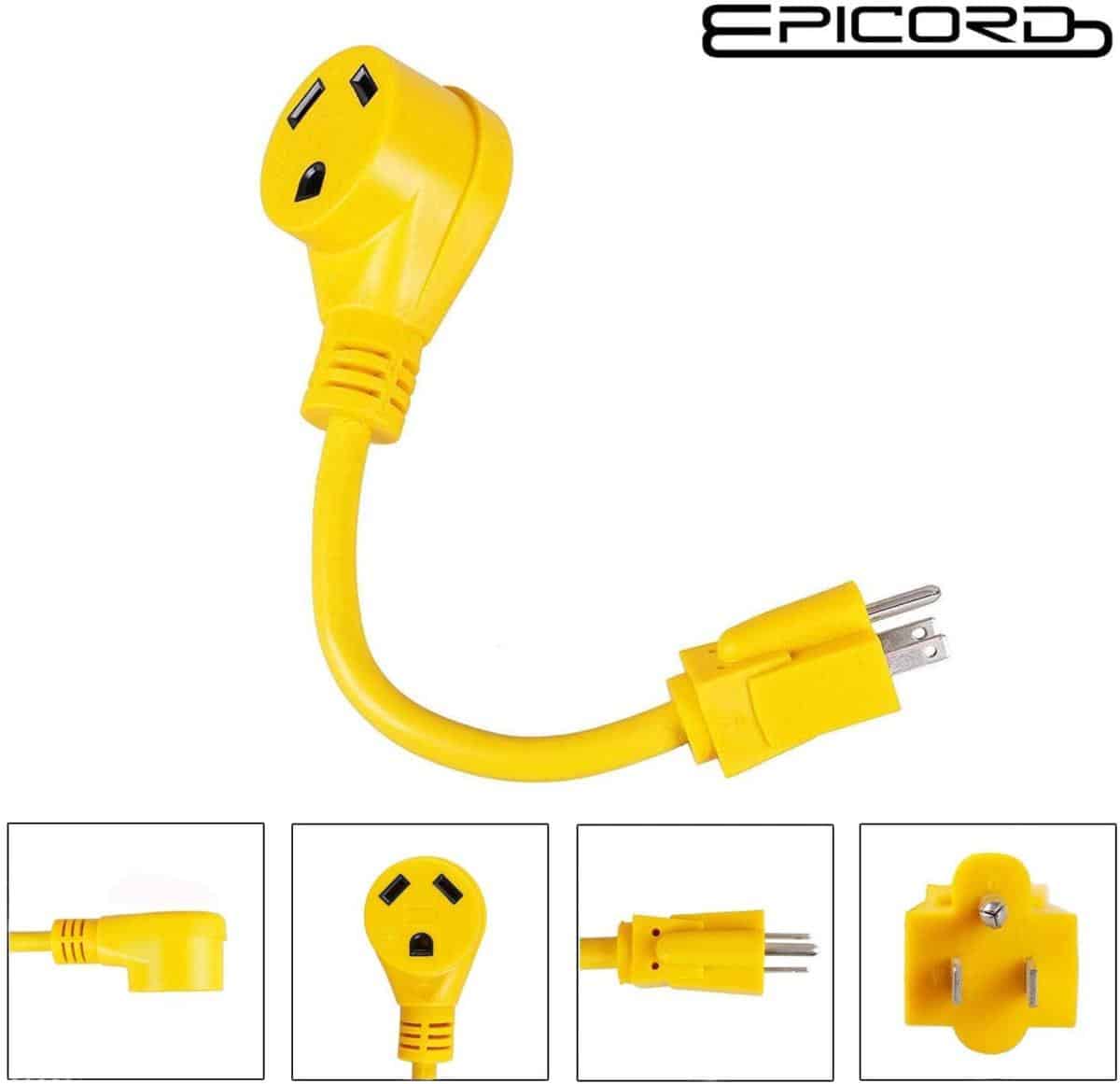
For just a little more confusion, please note that a 15- to 30-amp or 15- to 50-amp dogbone adapter is actually a 20-amp to 30-amp adapter. What???? Yes, there’s really no current carrying difference between the 15-amp and 20-amp versions of the NEMA (Edison) plug. It’s just a coding thing where one of the blades is rotated by 90 degrees to keep you from inserting a 20-amp plug into an outlet with a 15-amp circuit breaker.
In this example there’s a NEMA 5-15P plug, but it’s connected to a 12-gauge wire feeding a 30-amp outlet. So it’s actually capable of carrying 20 amperes of current safely. Hey, this is how the history of electricity in the U.S. evolved, so don’t shoot the messenger.
But wait, there’s more…
Here’s what an actual NEMA 5-20 plug looks like with the one blade rotated by 90 degrees. While it’s indeed rated for 20 amperes of current, that’s only totally true if it’s connected with 12-gauge wiring. And it will only be able to supply full current if it’s connected to an outlet powered by a 20-amp circuit breaker and 12-gauge wiring.
Even more…
In addition, note that nearly all Edison outlets at campgrounds have the 20-amp (sideways blade) outlet configuration, and they are required to be GFCI protected. Yet all (or at least all that I’ve seen) 15- or 20-amp dogbone adapters use the 15-amp blade orientation, but have 12-gauge wiring which is actually rated to 20 amperes of current.
So in this case, a 15-amp dogbone adapter with 12-gauge wire plugged into a 20-amp GFCI outlet is actually rated for 20 amperes of current. However, an extension cord with a NEMA 5-15 plug using 14-gauge wire is still only rated for 15 amperes of current. Make sense?
More of my experiments
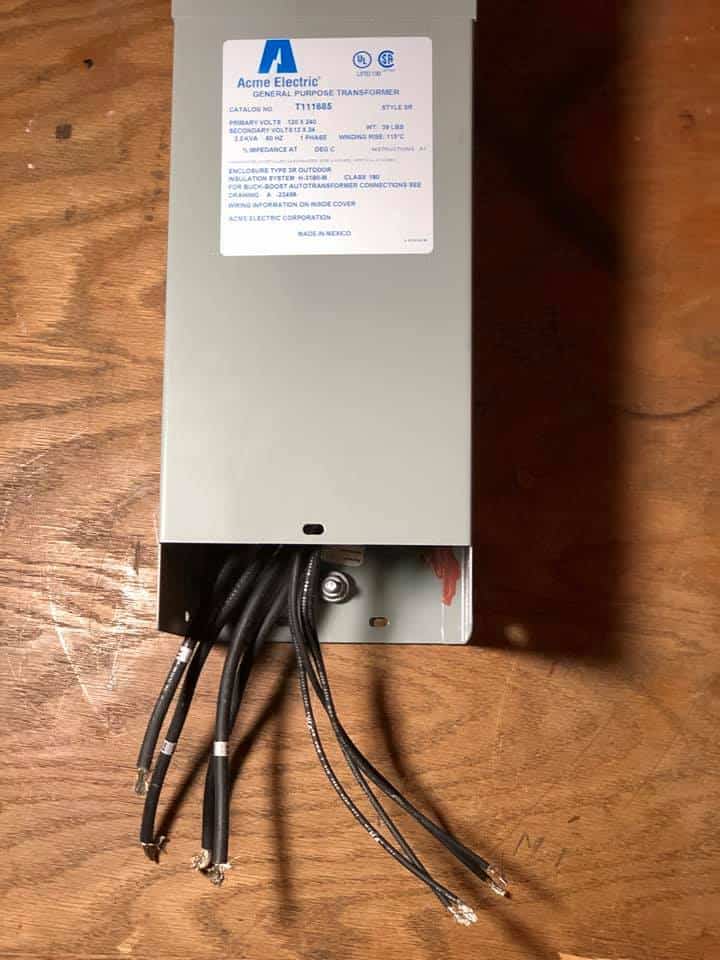
As a side note, my engineering colleagues at Hubbell/Acme just shipped me a 2 kVA 120-volt to 12-volt buck/boost transformer, which has an output current rating of 166 amperes at 12 volts AC. That’s right: When powered by my 3kVA VARIAC, I can now send anywhere from 0 to 166 amperes of current through most any wire or connector on my test bench. Wires don’t really care about voltage (that’s the job of insulation), so I can save a lot on my home electric bill (90% in fact) by stepping the voltage down by a factor of 10 which steps the amperage up by 10 times. Cool trick, eh?
So I’ll soon be setting up a series of video demonstrations that show what happens when you overload an extension cord, power strip, or shore power connector with too much current. I’ve done a few casual demonstrations in the past, but now I have much more refined test gear including FLIR cameras and thermocouples in addition to infrared thermometers.
No, I won’t leave this over-current experiment running unattended. Yes, I will have a fire extinguisher at the ready. No, my wife has no idea what I’m doing back in my lab. But don’t worry, I’ll be very safe with this. I’ve seen too many electrical fires in the wild to be complacent. But when I state that I’m testing something to destruction, that’s exactly what I mean.
OK, everyone. Remember that electricity is a useful and powerful force, so we all need to pay attention to safety precautions while using it.
Let’s play safe out there….
Mike Sokol is an electrical and professional sound expert with 50+ years in the industry. His excellent bookRV Electrical Safety is available at Amazon.com. For more info on Mike’s qualifications as an electrical expert, click here. Join Mike’s popular and informative Facebook group.
And you don’t want to miss Mike’s webcasts on his YouTube channel.
For information on how to support RVelectricity and No~Shock~Zone articles, seminars and videos, please click the I Like Mike Campaign
By Russ and Tiña De Maris When we take on the RV lifestyle, we also put on some new “hats” for the roles we assume, including dumping RV tanks. What kind of hat does a “sanitary engineer” wear? I dunno — the only part of my uniform in that role is a pair of good, thick rubber gloves.
Getting out the sewage becomes our “problem,” and that can really BE a problem if we’re not sure of where to “get rid of the goods.” When set up in an RV park, it’s not a problem — but on the road or when boondocking, it gets a bit more complicated. Here are some possible places to dump your tanks:
Highway rest areas: Although some have been removed due to budget and abuse problems, many state rest stops still offer free dumping stations.
City, county, state, national and federal parks: Some are free, some charge a fee. Others are free only if you camp, or for a fee otherwise.
Local government sewage treatment plants: Look up the local government online, call the main number and ask for the treatment plant.
Truck stops: We point in particular to those catering to RVers, like Flying J. The “J” has instituted an electronically controlled dump station, meaning you pay to convince the electronics to let you lighten your load. With a Flying J RV customer loyalty card the price is $5 to dump, or $10 without. We’ve found some Love’s Travel Stops have free RV dump stations — they’re a little harder to find.
RV parts stores and RV dealers: Some offer dumping services, usually for a small fee.
Gas stations: Keep your eyes open: Some have a dump station on the premises.
Don’t think you can sneak off the road and off-load your tanks. The “Midnight Dumper” only messes up the local environment, causes image problems for RVers, and when caught will pay a stiff fine and earn an embarrassing arrest record.
Brought to you as a public service by RVtravel.com. Support comes from our sponsors, advertisers and the contributions of readers, who believe that an educated RVer is a safe, happy RVer.
Read back issues of this newsletter and many other articles by Mike Sokol on RVtravel.com. Warning: There is a lot to learn here.
Welcome …
By Mike Sokol
Welcome to my latest RVelectricity newsletter. Lots of new things happening in my lab, as well as some of my latest videos about all things electrical as they relate to recreational vehicles.
First of all, I’ll be presenting Part 4 of my CarGenerator™ Boondocking series, this time covering the basics of just how many solar panels you might need to run a residential refrigerator compared to a 12-volt DC compressor fridge. (It’s a fairly reasonable number for the 12-volt Danfoss refrigerator, but perhaps too many for a residential refrigerator.) How many solar panels would be needed to run your rooftop air conditioner overnight (way too many). And what recharging alternatives you have for days when the “sun don’t shine.”
Speaking of 12-volt refrigerators, Dometic just sent me one of their 10-cubic-foot 12-volt DC refrigerators for review. Of course I fired it up to see how cold it would get – which was pretty impressive. And I’ll begin testing total battery wattage usage in another week or so as part of my solar boondocking experiments. Read about my first look at the DMC4101 below.
I don’t have a full report competed on my Hughes Autoformer experiments just yet, but I do have some preliminary data I can share with you – and it’s not what I expected! In addition, I’m including a basic primer on just what an autotransformer is compared to a standard transformer, and how they work to boost or cut voltage for industrial power. Read below for my first results, and a little background on what autotransformers actually do and why they’re currently banned in campgrounds by the NEC. I’m not sure what my complete study will show just yet, but whatever it is may make an impact on the RV industry and campground power.
Finally, read this month’s Road Signs about a memorable Halloween when I built a UFO with blinking lights and a loudspeaker, then flew it down the main street of Hagerstown, MD, after dark in the fog. I’m pretty sure the statute of limitations has run out on that prank. Or so I hope….
Let’s play safe out there…
P.S. And just a quick note that this newsletter is made possible by the voluntary pledges of the readers of RVtravel.com. We could not bring this to you without their support. If you deem what we provide to you here and at RVtravel.com to be of special value and would like to be a part of our effort, please consider pledging a voluntary subscription. More information is here. We will include you in special emails, articles and videos exclusively for our supporters.
If you haven’t yet, be sure to join
my new Facebook group, RVelectricity.
(More than 10,400 members and counting.)
Hughes Autoformer testing
My Hughes Autoformer testing has begun. Here are details on how much additional current an air conditioner draws as the voltage goes below 100 volts. Hint: Everything You Know Is Wrong!
Since this is a rather complicated answer to what appears to be a simple question about Hughes Autoformers (and autotransformers in general), the results of my study will be presented in pieces over the next several weeks as I gather more information that’s been peer reviewed.
Note that while Hughes has sent me a demo unit at my request, they neither offered nor have I asked for any compensation for this study. That way it can be 100% unbiased. Hughes has also agreed to accept the results of my study, which will be sent to the NEC board for review.
Here’s Part 1, where I show how much extra current an air conditioner draws as the voltage is reduced. Read more HERE.
Email me at mike (at) noshockzone.org with your questions.
Industry Updates
Dometic 12-volt DC refrigerator testing
Back in 2020 BC (Before COVID) I made a few acquaintances in the Dometic refrigeration division, and they promised to send me a 10-cubic-foot 12-volt DC compressor refrigerator as part of my study on refrigerator power consumption. I had almost given up on a test unit, when I received a call from my local trucking company about delivery. True to their word, a DMC4101 refrigerator has arrived for review.
I’ll begin a full review of its operation and power consumption in a few weeks, but for grins I simply loaded up the freezer with a 50% mix of frozen and room temperature meats and veggies, put a few 6-packs of warm beer in the fridge, set it to 5 Snowflakes of cold (yes, that’s the max cooling setting), and connected it to a 12 volt battery. Yes, it got very cold very quickly. Continue reading.
Survey Question
Feel free to leave a comment below. (And it may take a moment for the poll to load.)
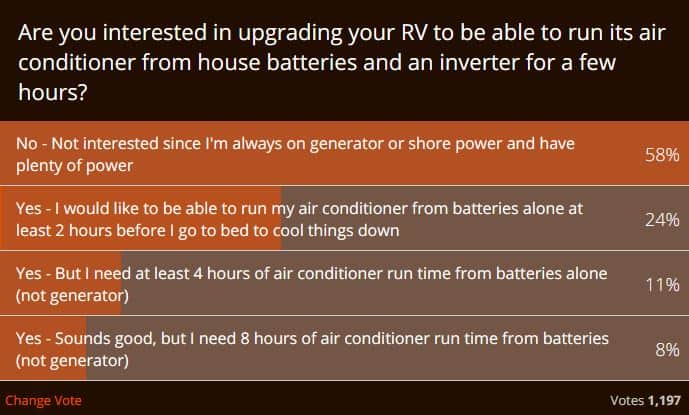
Last month’s survey results:
While some 58% of you answering the poll weren’t interested in running your RV air conditioner from batteries, there’s a solid 32% (1/3) of you who are interested in how to make this work. Yes, it’s expensive and complicated right now. But as the price of Lithium (and who knows what other chemistry) batteries continues to come down due to manufacturing scale, and air conditioners become less power-hungry, there will be a point where it’s commonplace in an RV. So I’ll continue my experiments with solar, battery and hybrid inverter operation of rooftop air conditioners. If any other manufacturers want to confer with me on this, please let me know.
Tools and Other Devices
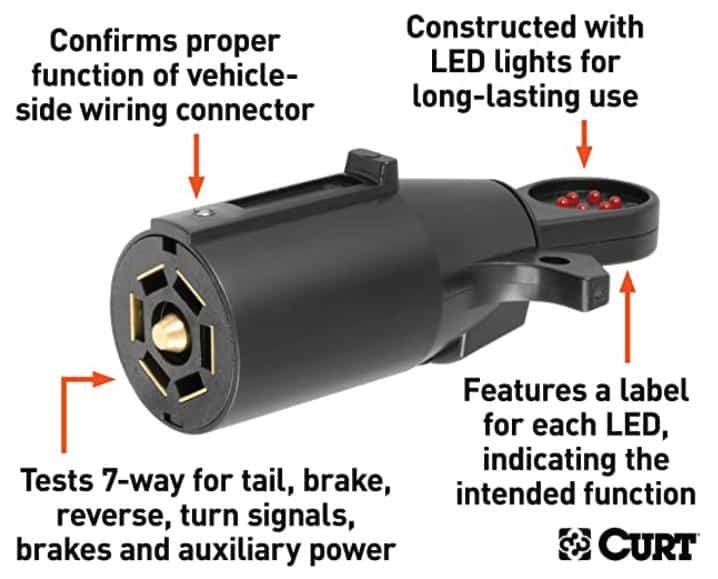
Trailer connector testers
I have a number of questions this week from readers about how to test their 7-way trailer plug. While it’s certainly possible (and sometimes absolutely necessary) to use a digital voltmeter, one of these indicator plugs is a handy way to begin testing. This one also labels each LED for the intended function.
Oh, by the way. I once found out the hard way that the original Sprinter vans had the backup light wired to the trailer brake connection. So when you put it in reverse, the trailer brakes locked while you were trying to back up. This gadget would help you figure that out in a hurry.
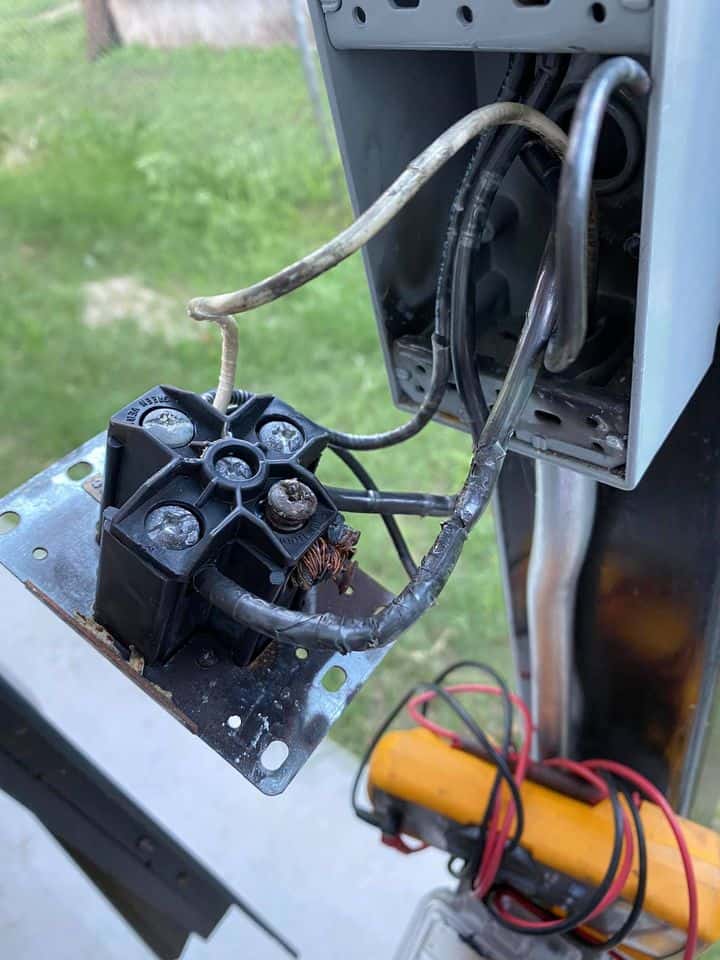
Q: I was called to troubleshoot because the RV wasn’t working properly. Ummm… Yea… Just so many things wrong in one little spot. Where do I begin? —Miguel Salinas
A: It’s hard to tell, but it looks like the outlet was fed #6 wires then smaller wires tapped off and went out to feed another circuit?!? Definitely a safety issue. The drywall screw reinforces the fact that this is a hack job by someone that just doesn’t give a sxxt about code. —Tim Beaulieu
A: This is a total disaster that needs new wiring run, not just taped up splices. I’m sure there was no inspector looking at this or they would have had a major conniption fit. Just one more reason I want to begin teaching campground maintenance crew classes about pedestal maintenance and safety. —Mike Sokol
Email me at mike (at) noshockzone.org with your questions.
The best book on RV electricity, hands down! RV Travel contributor Mike Sokol is America’s leading expert on RV electricity. Mike has taken his 50+ years of experience to write this book about RV electricity that nearly anyone can understand. Covers the basics of Voltage, Amperage, Wattage and Grounding, with additional chapters on RV Hot-Skin testing, GFCI operation, portable generator hookups and troubleshooting RV electrical systems. This should be essential reading for all RVers. Learn more or order.
Boondocking Power Requirements – Part 4 of 4
Integrating solar panels into your boondocking plan
While you could just move to a cabin in the woods and live totally without electric power like humanity did 100 years ago, few of us want to give up our current lifestyles. So if you want to camp without shore power from a campground pedestal or run a generator all day, there are some special technologies needed if we want to maintain our electrically charged lifestyle while off the grid. Enter the solar panel – which is the topic of Part 4 of this series. Included is an interesting write-up from Jonathan Schloo, from CarGenerator. Read more HERE.
Camco Store at Amazon.com There isn’t much you need for your RV that Camco doesn’t have. If you think we’re kidding, then click through to the Camco store on Amazon where you’ll find some of their best-selling products — all for your RV or for you to make your RVing better.Click here and you’ll feel like a kid in a candy store.
Road Signs
Is it a UFO or an MFO (Mike’s Flying Object)?
As we are preparing for Halloween this year, I’m reminded of that one special Halloween in my early 20s when I went trick-or-treating for drinks at my friends’ houses. Don’t worry, I was walking … not driving. I had dressed up in a chrome jumpsuit from my glam-band days, put on a multi-colored wig, and built a set of frames for my eyeglasses out of LEDs that alternated between red and green spinning lights.
Yes, this was 1976 so these types of electronics had to be designed and built from scratch. But I wasn’t done yet, as I had also bought a weather balloon, a tank of helium, and lots more LED lights. Yes, I built my own UFO for late-night pranking. Read more.
Thanks for reading. Let’s play safe out there….
Mike Sokol is an electrical and professional sound expert with 50+ years in the industry. His excellent bookRV Electrical Safety is available at Amazon.com. For more info on Mike’s qualifications as an electrical expert, click here.
For information on how to support RVelectricity and No~Shock~Zone articles, seminars and videos, please click the I Like Mike Campaign.
Everything in this newsletter is true to the best of our knowledge. But we may occasionally get something wrong. So always double check with your own technician, electrician or other professional first before undertaking projects that could involve danger if not done properly.Tips and/or comments in this newsletter are those of the authors and may not reflect the views of RVtravel.com..
Mail us at 9792 Edmonds Way, #265, Edmonds, WA 98020.
This website utilizes some advertising services. Sometimes we are paid if you click one of those links and purchase a product or service. Regardless of this potential revenue, unless stated otherwise, we only recommend products or services we believe provide value to our readers. Amazon and the Amazon logo are trademarks of Amazon.com, Inc. RVtravel.com is a participant in the Amazon Services LLC Associates Program, an affiliate advertising program designed to provide a means for sites to earn advertising fees by advertising and linking to Amazon.com.
RVtravel.com includes links to other websites. We cannot control the content and/or privacy policies of those sites. Please be aware when you leave this newsletter or any other section of RVtravel.com to read the privacy statements of any of those websites that collect personally identifiable information. Our own privacy policy applies only to RVtravel.com and its affiliated blogs and websites.
This newsletter is copyright 2020 by RVtravel.com.
My Hughes Autoformer testing has begun. Here are details on how much additional current an air conditioner draws as the voltage goes below 100 volts. Hint: Everything You Know Is Wrong!
Since this is a rather complicated answer to what appears to be a simple question about Hughes Autoformers (and autotransformers in general), the results of my study will be presented in pieces over the next several weeks as I gather more information that’s been peer reviewed.
Note that while Hughes has sent me a demo unit at my request, they neither offered nor have I asked for any compensation for this study. That way it can be 100% unbiased. Hughes has also agreed to accept the results of my study, which will be sent to the NEC board for review.
Here’s Part 1, where I show how much extra current an air conditioner draws as the voltage is reduced.
But before I show you the data I’ve gathered so far we all need an understanding of the theory of operation. So here’s your primer on the how this is supposed to work.
While resistive loads behave predictably as the voltage goes up and down, air conditioners (and all inductive motors) are not that simple. To understand what’s happening we need a quick look at an ohm’s and watt’s law chart. For a resistive load like an electric water heater element, there’s a predicable relationship between voltage and power.
Since watts of power is equal to the voltage squared divided by resistance, as the voltage drops so will the power. So an electric heater element rated for, say, 1,200 watts at 120 volts will be reduced to 1/4 power at 1/2 voltage. So at 60 volts it will only produce 300 watts (1/4) of power. There’s nothing to cause it to try to draw more amperage as the voltage goes down. We’ll revisit this concept below.
Not so with inductive motors. You’re probably aware that they have something called a start winding and capacitor, along with a rating for LRA (Locked Rotor Amperage). What this means is that when the motor starts up it tries to draw a lot more amperage (maybe 400% to 800%) of running amperage, which we call Inrush Current. The reduction in amperage as the motor comes up to speed is due to something called Back EMF (Back Electromotive Force).
Basically, the motor itself acts like its own generator that’s 180 degrees out of phase with the incoming current. That reduces the amperage draw when the motor is up to speed with no load. When you load the motor, the slip angle increases, which draws more current. Reduce the voltage to below its design rating and it draws even more current.
Air conditioners and refrigerators
So air conditioner (and refrigerator) compressor motors act differently than our basic water heating element (which is just a big resistor). This is what leads to the infamous extra current (and overheating) of an air conditioner’s compressor as voltage is reduced. The question is just how much and how fast does the current increase as the campground voltage decreases?
Enter the Autoformer
The Hughes Autoformer is basically an automatic low-voltage/high-current transformer connected in autotransformer mode via a relay and sensing circuit. So when the campground voltage gets below the set threshold, it performs a 10% voltage boost.
But what’s the cost?
Now, this 10% voltage boost comes at a cost of a 10% increase in current from the campground pedestal. But the real question should be: Is the extra 10% voltage provided by the Hughes Autoformer enough to offset the increased current draw from the pedestal due to the air conditioner’s extra current draw from running it at a low voltage? Hughes makes the claim that it does indeed reduce the air conditioner current enough to make up for its own 10% input amperage increase. That’s the subject of this entire test.
What about other loads?
Well, the electric element in your water heater will indeed draw more current from the pedestal when the Hughes Autoformer kicks into boost mode. That’s a given, which follows Ohm’s and Watt’s laws exactly. It’s basically just a big resistor that responds to voltage changes without any crazy Back EMF generator action.
And you can’t damage a water heater element because there are no moving parts. As I noted in my explanation above, even if you drop the incoming voltage to 60 volts, it will happily keep producing 1/4 of it’s rated wattage forever.
However, there are some weird power factor effects from PWM (Pulse Width Modulated) power supplies in RV converters and battery chargers which are largely self-regulating as the campground voltage goes up and down. when the incoming AC voltage is higher the Pulse Width Modulator produces a pulse with less duty cycle. But when the AC voltage is lower, it automatically increases the duty cycle of the current pulse. That’s why PWM power supplies will tend to draw just enough extra current to make up for any reduced AC voltage. And they don’t need an Autoformer in the circuit at all to output the correct voltage. But they are indeed part of the campground current balance equation.
The big picture
So what does this mix of load types (resistive, inductive and PWM) mean to campsite amperage with or without voltage correction from the Hughes Autoformer? To know for sure, I’m building a test system one piece at a time and adding them together to see how the entire system works. Maybe Hughes is correct and their Autoformer is beneficial in reducing overall current in campgrounds with low voltage due to increased air conditioner current. And maybe the NEC is correct that any autotransformer (or Autoformer) creates an extra amperage load on the campground’s electrical system, increasing the stress on an already overstressed electrical grid. Who’s right and who’s wrong? I honestly don’t know for sure yet.
Here are the numbers….
Here are the numbers I’ve found so far showing how much extra current an RV air conditioner draws as the voltage is reduced. Next week I’ll put the Autoformer in the circuit and do a comparative voltage sweep. That’s going to set the direction of the next experiment where I add in a PWM (Pulse Width Modulated) battery charger to see how it reacts with and without the Hughes Autoformer connected.
The setup
This is the preliminary data showing my proof of concept test bed with what I used for the experiment. Note that the Hughes Autoformer is NOT in the circuit for this test.
3kVA (3,000 Watt) VARIAC
Dometic Penguin II 15kBTU air conditioner
SoftStartRV™ starter
Southwire 14090T Tru-RMS digital voltmeter
Southwire 25015T Tru-RMS clamp ammeter
These are the amperage measurements with only the fan running at the following voltage steps:
120 volts = 3.78 amps
115 volts = 3.71 amps
110 volts = 3.84 amps
105 volts = 3.97 amps
100 volts = 4.12 amps
95 volts = 4.22 amps
90 volts = 4.53 amps
This works just as I predicted, with a 10% increase in amperage when the voltage was reduced from 120 volts down to 100 volts. But this next set of measurements blew my mind. These are volt/amp readings with the compressor running. Note that this is the total combined current of the air conditioner fan and compressor, not just the compressor amperage.
Here’s the amperage measurements with the compressor running at the following voltage steps:
120 volts = 12.06 amps
115 volts = 11.15 amps
110 volts = 10.86 amps
105 volts = 10.90 amps
100 volts = 10.93 amps
95 volts = compressor shut down
What the Heck!!! Even though all my EE books and urban myths say that air conditioner compressors will draw more amperage as the voltage goes down to 100 volts, that’s the opposite of what I’m seeing with this first test. While it’s drawing just over 12 amperes at 120 volts, when I run the VARIAC down to 100 volts, the current DECREASES to 10.93 amperes instead of INCREASING! That’s a 10% DECREASE in current when the voltage is reduced from 120 volts down to 100 volts.
Note that the compressor would drop out and refuse to run when I sent the air conditioner voltage down to 95 volts. Now that’s understandable, as Dometic may have some sort of low-voltage shutoff to protect itself.
Am I right or am I wrong?
So did I measure this incorrectly?I don’t think I made any mistakes, but I’ll double-check my work. Heck, I’m gonna triple-check my work with entirely different meters this week. I used high-end Southwire meters for this, but I have access to some top-shelf Fluke meters. Time to step up my game.
Is there some magic infused by the SoftStartRV™ controller?Definitely Not! Maybe it will help with starting the compressor at lower voltages, but it’s out of the circuit once the compressor is running. So there’s no magic there…
Has Dometic installed some sort of automatic current reduction circuit in the compressor?Nothing in their literature hints at that, but I’ve already sent these numbers to my engineering contact at Dometic for peer review.
Are all the text books wrong about induction motors having increased current draw at low voltage?I’m pretty sure not, since this engineering knowledge goes back 100 years; but perhaps it’s not as much of an effect as we’ve all assumed. Or maybe there’s another variable at play due to this being a compressor load. I just don’t know.
Much more on this drama next week, as I create alternate tests and try to qualify what’s happening. I LOVE it when measurements are unexpected. That’s true science.
So hold your breath until next week. But in the meantime, let’s play safe out there….
Mike Sokol is an electrical and professional sound expert with 50+ years in the industry. His excellent bookRV Electrical Safety is available at Amazon.com. For more info on Mike’s qualifications as an electrical expert, click here.
For information on how to support RVelectricity and No~Shock~Zone articles, seminars and videos, please click the I Like Mike Campaign.
Learn about RV camping, RV travel, RV news and much more. This newsletter, now in its 20th year of continuous publication, is funded primarily through advertising and voluntary subscription contributions from our readers.
If you shop at Amazon, please visit through our affiliate site (we get a little commission that way – and you don’t pay any extra). Thank you!
Sunday, October 4, 2020 Non-Members (advertising supported) edition
[activecampaign form=38]
Big changes coming to Walmart stores. Will RVers be affected?
By Russ and Tiña De Maris We’re not sure that Sam Walton would recognize the store that he spawned as “Walmart Discount City” back in 1962. While there have been a lot of changes since then, Walmart’s new design decidedly makes Sam’s original stores look somehow quaint. Haven’t seen one yet? It won’t be long before you do: Walmart’s new design is based on the digital age, and there’ll be 200 of them by the end of January. Give it another year, and the big corporation says it’ll have 1,000. Learn more about these upcoming upgrades.
Comprehensive list of RV-related recalls for September
The list of latest recalls on RVs and other vehicles and/or products of interest to RVers has been released by the U.S. National Highway Transportation Safety Administration. The list includes models from Forest River, Grand Design, Gulf Stream, Jayco, Keystone, Newmar, Thor, Tiffin and others – plus other vehicles and equipment commonly used by RVers. Is your RV or other vehicle on the list? Find out here.
Ford is recalling hundreds of thousands of 2020 Ford F-150, F-250, F-350, F-450 and F-550 trucks. The trucks are commonly used to tow fifth wheel and travel trailers, and are used for truck campers. Other vehicles involved in the recall include Ford Explorer, Mustang, Transit, Expedition, Escape, Ranger and Edge, and Lincoln Nautilus and Corsair vehicles. Learn more.
A great resource for RVing advice: Join our Facebook group RV Advice. Moderated by the editors of RVtravel.com
Escapees RV Club raising member dues
The Escapees RV Club is raising its dues from $39.95 a year to $49.95 a year beginning November 1. “Since 1978 we have worked hard to be a total support network for RVers,” the club explained Wednesday to the media and members. “Escapees RV Club membership dues have remained at a very low $39.95 for many years. For us to continue to offer the quality of service that Escapees RV club is known for we need to make a small increase in the dues – our first since 2015 – from $39.95 to $49.95.” Read more.
That was the RV week that was
September 27 – October 3, 2020
RV sales scams just keep on rolling. Now Wisconsin officials are warning residents to not take the bait with the latest round of the “send the money and we’ll ship it right out” con game. In this case, several different rigs were posted on Facebook Marketplace. “Sellers” told buyers to post their money through a third party and, not surprisingly, after the money is paid the “seller” vanishes, along with the supposed RV. Badger Staters who’ve had the guts to ‘fess up to being conned have lost more than $115,000.
East Palestine Fire Dept.
Is titanium strong? That depends. The owner of a Titanium fifth-wheel found out the hard way that his rig wasn’t strong enough to withstand impact with a low-hanging bridge. On September 25, a man towing his fifth wheel in Unity Township, Ohio, passed one sign warning about the 10’ 1” clearance ahead. A similar sign was posted on the railroad underpass. The results were spectacular, with an apparent “total out” result. In addition to paying his deductible, the RV’s owner also gets to pay a traffic fine.
Sunny Bodeen’s Facebook page via St. George News
After months of being cooped up by coronavirus concerns, people are finally getting outside. Officials at Utah’s Zion National Park say some of them are visiting the park – and not all of them have an affinity for the beauty of the park. Results? “I have seen more graffiti than I have ever seen before. It’s all over, and we’re trying to get ahead of it.” This from the park’s chief ranger, Daniel Fagergren. The graffiti is littering Kayenta Trail, the Narrows hike, and on the West Rim/Angels Landing Trail. Rangers think much is from folks who’ve never visited the park before. Adding to the problem, a breakout of cyanobacteria bloom in the Virgin River. Exposure to the bacteria can lead to nausea, vomiting, diarrhea, and mild liver enzyme elevations. Officials are reluctant to send rangers up the canyon where they might be exposed to the bloom; with less supervision, the greater the incidence of graffiti.
rin Ailworth on twitter.com
While campfires can be fun, not everyone appreciates the smoke, and sometimes the unwelcome bit of ash fall associated with the practice. Imagine the folks living in California’s Bay Area. Reports – backed up with photos – show ash chunks the size of footballs coming down in their neighborhoods. No, it’s nothing to do with errant campfire builders, but evidently a byproduct of the Glass Fire, the wildfire that, as of Thursday, was pushing nearly 50,000 acres of burn area. One woman, spotting a piece of ash on the road near her home, initially thought someone had lost their hairpiece. Only if they were flipping out over the ash fall, ma’am.
Coursons: Leak Memory Church via wsfa.com. Accident scene: Alabama Department of Transportation
Last May we reported on the motorhome rollover deaths of two Alabama businesspeople, Leland and Stephanie Courson. The Coursons were traveling north on Alabama’s Interstate 65 when Leland attempted a lane-change. Their Tiffin Allegro rolled over, and both were killed when the motorhome’s roof crushed in on them. Now their estate is suing Tiffin, Daimler Trucks North America, LLC, and Freightliner Custom Chassis Corporation, alleging that the rig had known defects in manufacturing and design. Tiffin declined to comment, citing the pending litigation. The estate is represented by the Beasley Allen law firm of Montgomery, Alabama.
Vehicles of the Imagination
From the mind of Steven M. Johnson
COPYRIGHT 2020 by Steven M. Johnson
The MicroMove. The sleeping loft is tiny by any standard, with space for a mattress and a sleeping bag. But these affordable units include a rooftop solar panel. They are very popular, especially with men who are behind in their child support payments.
Don’t let winter keep you in the dark! This 6-pack of tiny, battery-powered LED “Button Lamps” is just what you need for your RV’s closets and storage spaces. The tiny lamp is ultra-bright and has all the power of a normal-sized lamp. Backed with a strong adhesive, these little lamps will stick to any surface. They’re waterproof and good to have in case of an emergency. Learn more or order.
Early this year, officials of the Ontario government shut down medical payments for residents traveling out-of-country. The rationale: Administrative costs of paying the bills was just too much, “and provided little value to taxpayers.” For whatever reason, it cost the provincial government nearly $3 million to pay $9 million in claims, so they simply told snowbirds, “Shoulder it yourself.” The Canadian Snowbird Association was up in arms and filed suit against the government. The Superior Court of Justice agrees, and says the provincial government was out of line. The court concluded that Canada could withhold monies normally given to the province, and ordered Ontario to reinstate the program. No word on whether an appeal will be made or not.
Cape Disappointment. Washington State Parks & Recreation
What’s your favorite state park for RV camping? That’s the question USA Today wants answered. The outfit is allowing readers to vote once a day for their favorite, up until the closing on October 12. Earlier this week, the Top Five standing ranked: 1. Custer State Park – Custer, South Dakota. 2. Huntington Beach State Park – Murrells Inlet, South Carolina. 3. Vogel State Park – Blairsville, Georgia. 4. Wilderness State Park – Carp Lake, Michigan 5. Cape Disappointment State Park – Ilwaco, Washington. Find out more here.
A U.S. District Court decision in Montana could spell major repercussions for the U.S. Bureau of Land Management (BLM). The court ruled this week that William Perry Pendley, appointed as the agency’s director more than a year ago, has served unlawfully, as the U.S. Senate never approved his assignment. Additionally, the court ruled that “any ‘function or duty’” performed by Pendley must now be set aside. That could include tossing out resource management plans on how BLM lands are developed or used, including the reduction in size of the Bears Ears and Grand Staircase Escalante national monuments in Utah.
Leslie Yager via greenwhichfreepress.com
“No man’s life, liberty or property are safe while the Legislature is in session.” So penned Gideon J. Tucker back in 1866. But for RVers in Greenwich, Connecticut, the feelings might be the same. Last week, one of the town’s first selectmen, Fred Camillo, said he’d “received reports of incidents across town, and that some residents want to ban RVs on private property,” according to the local paper. “I don’t know if we want to go that far,” he said. “But I think personally they take away from the aesthetics of a neighborhood. But I want to put it on everyone’s radar – whether we want to do something about RVs parked on roads in residential areas.” Others on the board appeared to agree, and it looks like RVs could become a target of future legislation in the coastal community.
Bakersfield.com
After driving recklessly through Delano, California, mashing up a police car, and running on a flat tire, a woman piloting a Class C motorhome taught it a new trick: Roll over. Police said the “chase” started on the afternoon of September 23, when police tried to pull over the motorhome inside city limits. The unidentified woman behind the wheel ignored lights and sirens. She kept going – at a slow speed – even after she hit a pursuing police car. No injuries to law enforcement, but owwies for the car. From there, the motorhome acquired a flat tire, and headed north on Highway 99. Still no burst of speed, but eventually the rig rolled over. The driver exited – and into the arms of law enforcement officers.
Oops!
This was posted on our Facebook group RV Crashes and Disasters. Don’t think this doesn’t happen very often. Just recently, we asked the readers of RVtravel.com if they had ever seriously damaged their RV while backing up. We were surprised at the results.
Device keeps fresh water tank clean Tony Barthel writes, “The RV Inline Sanitizer is the simplest of solutions. It’s essentially a reservoir in which you put bleach and then use a source hose and a delivery hose to fill your fresh water tank. The sanitizer effectively adds the bleach as you fill the tank. It is truly that simple.” Read more about this nifty device here.
HAVE YOU SEEN THIS STOLEN RV?
Brazen thieves are sought by relentlessly searching Canadian Mounties. The transgressors targeted a Tag teardrop trailer, terrifyingly in broad daylight. This silver teardrop was last known to be parked behind the Penticton Convention Center in Penticton, B.C., on September 25. The bad actor snagged the diminutive RV sometime between noon and 6:00 p.m. If you saw it happen, or know where the ripped-off RV may be, contact the RCMP. 250-492-4300.
If campgrounds are full, stay free in peace An alternative to RV parks: Stay free at farms, wineries and other scenic and peaceful locations with Harvest Hosts. Save 15% on membership. Learn more.
Pickup truck news
According to our recent survey, about 80 percent of RVtravel.com readers own at least one pickup truck. Recognizing that, we’ll provide the latest news highlights about the vehicles here each week.
Ford showcases towing dominance in 2021 truck lineup
Lightweight trucks already reign in the automotive industry. But increased interest in RVs has further boosted competition among truck makers. Bigger towing and payload capacities are an integral part of the rivalry among top sellers, and Ford has taken a sizable lead for 2021. The new Ford F-150 is available in six engine configurations. Learn more.
New Ford F-150 EV: Bigger, faster truck – far less cost
The anticipated debut of the Ford F-150 EV (battery-electric) pickup truck is still about two years away. But the manufacturer believes it will cost about half as much to operate as its current gas-powered stablemates. The new version of the country’s best-selling vehicle will also be the most powerful Ford truck ever made. Continue reading.
Don’t tow a car behind your RV. “Subscribe” to a car instead
One potential inconvenience for RVers is determining if they’re going to need another vehicle while traveling. Not all cars are towable, and towable models and makes have different methods. But if you need a vehicle at your RVing destination, there’s an increasingly popular, more convenient and possibly less expensive alternative to towing a car or renting a vehicle: car subscriptions. Read more.
Camco Plastic Water Pressure Regulator prevents damage to RV water hoses and pumps.Click.
Reader poll
Would you pay an additional $10 a night for an extra wide RV site?
Roadtrek Inc., a Class B motorhome manufacturer based in Canada, is launching three new models as part of its 2021 product offerings, according to a press release from the company. Read more.
FMCA, the Family Motor Coach Association, is currently migrating to a new internal database. So for now, the club is not able to process any transactions or update any member records. The website will still be available, along with FMCA representatives on the phone to answer questions. The system is expected to be up and running normally by mid-month.
In its latest forecast, issued in late September, the RV Industry Association reported it expects to ship 424,400 vehicles this year, which would represent a 4.5% increase over 2019. The current sales boom is expected to continue into 2021.
Sequoia National Park in Central California reopened on Thursday, October 1, though Sequoia National Forest is still closed. Potwisha and Lodgepole campgrounds are now open, but by reservation only.
Many RV, camper van, and travel trailer makers have started catering their road travel builds to accommodate the rising popularity of digital nomads and “work from anywhere” crowd amid the pandemic. This rise in sales amid an unprecedented time, combined with an increasing number of permanent and long-term remote workers, has put a spotlight on the digital nomad community.
The organization that operates the Worcester, Mass., RV & Camping Show announced Thursday it has cancelled its 2021 event due to uncertainties surrounding the coronavirus.
Campground and RV Park News
Developments at RV parks and campgrounds across the USA
Janet Groene reports each week on developments at RV parks and campgrounds across the USA and Canada. There’s a lot of good information here that you can use to plan your travels. Read the current installment of “Campground Chatter” here.
This is a necessity for your slides! If you’ve heard a cracking or popping sound when extending your slide outs, it means your seals are sticking and/or drying out! Using a seal conditioner about every 8-12 weeks is recommended to avoid drying and cracking. Once they begin to wear and show damage, they are no longer working to their fullest capacity. We recommend using Thetford Premium RV Slide Out Rubber Seal Conditioner– it works like a charm.
Here are the latest U.S. average prices per gallon of gasoline and diesel fuel as of September 28, 2020: Regular unleaded gasoline: $2.17 [Calif.: $3.07]
Change from week before: No change; Change from year before: Down 47 cents. Diesel: $2.39 [Calif.: $3.24]
Change from week before: Down 1 cent; Change from year before: Down 67 cents.
You can’t call yourself a fan of RVtravel.com if you’re not signed up for our RV Daily Tips newsletter! The Daily Tips newsletter has it all: quick tips, popular articles, polls, a website of the day, clubs and useful organizations, trivia, a pet of the day, a joke, and so much more! You don’t want to miss out! Sign up here.
Upcoming RV shows
Most if not all RV shows for the remainder of the year are cancelled. We will restart our show directory feature as shows begin again. In the meantime, most of the shows scheduled for 2021 (earliest beginning Dec. 31, 2020, in South Carolina) are still on as of October 1, 2020. See the schedule here.
Need a step up? Car or truck roof too hard to reach? Designed to fit over almost any tire, the TireStep allows you to reach three important areas of your truck or SUV: the engine compartment, the roof, and the bed. For fifth wheel owners, the TireStep may be the helper you’ve been wanting for a long time and just didn’t know it. Reaching over the truck bed using the TireStep is not a problem while hitching or unhitching your rig. Learn more here.
Free and bargain camping
From OvernightRVparking.com
Click here to view this week’s free and bargain camping spots.
Brain teaser answer:
Beauty. This is a play on “Beauty is in the eye of the beholder.” In this instance, you are the “bee-holder” so beauty is what’s in your eye.
Sunday funny
A soldier came up to me and asked me what today’s date is. I told him it’s October 4th. He said 10-4.
RV Travel staff
Editor and Publisher: Chuck Woodbury.Managing editor: Diane McGovern. Senior editors: Emily Woodbury, Russ and Tiña De Maris.
This website utilizes some advertising services. As an Amazon Associate we earn from qualifying purchases. Regardless of this potential revenue, unless stated otherwise, we only recommend products or services we believe provide value to our readers.
Everything in this newsletter is true to the best of our knowledge. But we occasionally get something wrong. We’re just human! So don’t go spending $10,000 on something we said was good simply because we said so, or fixing something according to what we suggested (check with your own technician first). Maybe we made a mistake. Tips and/or comments in this newsletter are those of the authors and may not reflect the views of RVtravel.com or this newsletter.
By Mike Sokol – RVelectricity and the No~Shock~Zone
Brought to you by CarGenerator.com
Integrating solar panels into your boondocking plan
While you could just move to a cabin in the woods and live totally without electric power like humanity did 100 years ago, few of us want to give up our current lifestyles. So if you want to camp without shore power from a campground pedestal or run a generator all day, there are some special technologies needed if we want to maintain our electrically charged lifestyle while off the grid. Enter the solar panel – which is the topic of Part 4 of this series.
Now, this is just a primer on solar panel theory, not an installation series. But it’s important that you know just what’s possible with a given number of panels. But as they say in the car business: “Your mileage may vary.”
What about watts and watt-hours?
Okay, even if you’ve been following some of my other articles about the differences between power and energy, now’s a good time for a quick review. A watt is simply a measure of power. There are lots of ways to produce a watt of power, but in the electrical world it’s simply 1 ampere of current flow with 1 volt of potential. Since 1 amp x 1 volt = 1 watt, even I can do that math in my head. If we have 1 ampere of current flow at 12 volts, then we can see that 1 x 12 = 12 watts. Up that to 10 amperes of current at 12 volts and now we have 10 amps x 12 volts = 120 watts.
But what about time?
Good question. You’ll notice there’s no time in our simple watt equation above, so if we want to know how much energy is expended we need to include just how long this wattage is occurring. Back to our example: If we have something producing 120 watts of power for 1 hour, then that’s 120 watt-hrs. Up to to 10 hours and now we multiply 120 watts x 10 hrs = 1,200 watt-hrs. Pretty simple, right?
What does this have to do with solar panels?
Well, the reason we need to understand this is to calculate just how much energy we can get from a 100-watt solar panel. While you might think it’s as simple as multiplying 100 watts times 10 hours in the day (1,000 watt-hrs), it’s not that simple. That’s because the 100-watt rating for a solar panel is only on a bright day with the sun directly overhead. And that only happens for a short period of time each day. Throw in the angle of the sun for the season, plus cloudy skies some of the time, and you’re lucky to get 300 watt-hrs of energy per day from each 100-watt solar panel. Maybe a little more energy on hot/sunny days; and certainly less on cloudy overcast days. But 300 watt-hrs is a good place to start.
Battery refill
Okay, let’s see how many solar panels you might need to fully recharge a 100-amp-hr lithium battery which can be safely discharged down to 0% of capacity. We’re going to ignore flooded cell and AGM batteries for this exercise because you don’t want to discharge them below 50% of capacity.
Since it’s a nominal 12-volt system we just multiply 12 volts x 100 amp-hrs and get 1,200 watt-hrs of stored energy. Let’s run the numbers for a Lithium battery. That suggests that we could pull 100 watts of power from this battery for 12 hours, or 1,200 watts of power for 1 hour. Of course, these are just rough numbers because your actual numbers will vary due to voltage drops and losses during high-amperage situations. But the basic theory is on target.
So how many solar panels does that take?
Now that we have everything in watt-hrs it’s pretty simple to divide 1,200 watt-hrs of battery capacity by 300 watt-hrs of energy per 100-watt solar panel and see that you’ll need at least four 100-watt solar panels to recharge a single 100-amp-hr Lithium battery. Just do this: 1,200 watt-hrs / 300 watt-hrs = 4 panels.
If you want to fully recharge a pair of lithium batteries with a total energy storage of 2,400 watt-hrs, then you’ll need perhaps 8 solar panels of 100 watts each. Now, it really doesn’t matter if you wire these in series or parallel or series/parallel for these calculations. If you have a proper PWM (Pulse Width Modulated) solar charge controller, then watts-out is going to become watts-in, because energy is energy.
How much energy do I need to boondock?
Well, that the $64,000 question, isn’t it? Now that we know it will take around 400 watts of solar panels to recharge a single 100-watt-hr Lithium battery, we just need to know how many batteries are needed to “run what we brung.” As you may remember from my Vitrifrigo/Danfoss/Briter experiment in the spring, a 12-volt DC compressor refrigerator would run for around 36 hrs. on a single 100-amp-hr Lithium battery.
So in 24 hours it would use about 70% of the energy capacity of that battery, leaving 30% in the tank. That suggests that if the only thing you wanted to run was a single 12-volt DC refrigerator, you could likely get by with 300 watts of solar panels (3 panels of 100 watts each). However, you should go with at least 400 watts of solar panels (4 panels of 100 watts each) if you want to run anything else at all (like a CPAP machine and some lights).
Can I run my air conditioner from solar panels?
Well, in my Hybrid Inverter experiment last week I found that a single 100-watt-hr Lithium battery would run an air conditioner for maybe 1 hr. (depending on compressor duty cycle due to ambient temperature). With that we can calculate that it would take 2 batteries to run it for 2 hours in the evening to cool down your RV bedroom, and that would require maybe 800 watts (8 solar panels of 100 watts each), just for this 2 hours of coolness.
Stone cold crazy…
If you want to go crazy and be able to run your air conditioner all night long (8 hours), it would take around 32 solar panels of 100 watts each to produce 300 watt-hrs x 32 panels = 9,600 watt-hrs of energy. Yikes! That’s a lotta solar panels!
While nobody will likely be building an RV with 3,200 watts of solar panels on the roof anytime soon, if we scale our expectations back a bit we can combine a few technologies to get additional power without having to build a solar farm.
More power!
No matter what you do, in order to run any 120-volt appliance in your RV while boondocking you’ll need an inverter. And to get maximum flexibility it should be a Hybrid inverter that will allow you to intermix the DC power from batteries with the AC power from a smaller power source.
One solution I’ve seen is using a 3,000-watt hybrid inverter that can run your RV air conditioner for maybe an hour or two on battery power alone. But a small 1,000-watt inverter generator could be used to supplement maybe 400 to 600 watts of rooftop solar panels.
CarGenerator™ as solar panel backup
Another possible solution for non-air conditioning boondocking is to bring along a CarGenerator™ inverter which will allow you to do emergency recharging of your RV batteries when the “sun don’t shine.” Of course, if you already have a 2,000-watt inverter generator that’s a great solution as well. But if you only need supplemental recharging power occasionally, don’t want to store, maintain and lug around a generator along with its gasoline container, then CarGenerator could be a great backup solution.
Extra credit
If you think that CarGenerator might be a possible backup power solution for your solar/boondocking adventures, please read this extra write-up from Jonathan Schloo, the owner of CarGenerator, and sponsor of this boondocking series.
Take it away, Jonathan…
1000 WATTS OF POWER ANYTIME BUT WITHOUT SOLAR
How about having 1000 watts of solar power available day or night, rain or shine, but without the installation expense, weight, or hassle or worrying if the sun is shining.
Our tow vehicle provides the equivalent power of ONE THOUSAND, 1000 watts of solar panels on demand at the push of a button anytime day or night, rain or shine. I can use that power to recharge my trailer batteries, or power up devices in my Airstream trailer, make coffee, recharge my laptop, watch TV and more. It costs me 1/4 gallon of diesel fuel per hour.
Wanted to share a very simple way you can measure and calculate just how much power you can safely pull from your vehicle at idle, for recharging your trailer batteries or powering up your Airstream shore power cord using an inverter, or even powering your house during a blackout.
Manufacturers spend big engineering dollars to make sure the vehicle can fully support all accessories from the alternator. My approach is to simply switch off all those accessories and pull that power out and convert it to usable AC power for your trailer or home backup power. The measurement method below determines, conservatively, exactly how much power.
If you’re a little bit handy and you can find where your alternator wire is, here’s what I did.
Buy a DC Clamp meter capable of 200 amps DC or more. Search Amazon for: Meterk Digital Clamp Multimeter 4000 for example.
1. Place the jaws around the alternator cable and let the vehicle run for 5 or 10 minutes and everything settles down, battery is fully recharged from the starting motor, etc.
2. Check amps readout. In my case with a GL350 Diesel SUV, it shows 25 amps for basic engine overhead, with no accessories switched on.
3. Switch on all the accessories your vehicle has, including cabin fan on highest AC setting, window defroster, all heated seats, full running headlights, radio, etc.
4. Check amps readout. In my case, it shows 110 amps. Subtracting these numbers shows that all my accessories total around 85 amps. So if I switch them all off, I can very safely pull out those 85 amps x 13.5v equals 1147 watts.
5. The alternator doesn’t care if it’s powering a cabin fan and headlights or powering a DC inverter. The pure sine wave inverter I use is 90% efficient so I can safely pull out 1,032 watts of power when the vehicle is parked and not using accessories.
This is roughly equivalent to having ONE THOUSAND watts of solar panels on your Airstream roof in perfect sunlight. But it works anytime day or night rain or shine.
There you go…. a safe, easy, simple way to determine how much power, at minimum, you can pull from your vehicle. This is a fairly conservative approach. In fact you could pull more power by high-idling, which many trucks support, or you could install dual 220-amp alternators so they can pull easily 200+ amps at idle.
For more info on the SL-2000 Hybrid Inverter click HERE
For more info on the SL-3000 Hybrid Inverter click HERE
Brought to you by CarGenerator.com
Read Part 1 of this series HERE, Part 2 HERE, and Part 3 HERE.
[Editor: You can find the Meterk Digital Clamp Multimeter 4000 which Jonathon mentions above on Amazon.]
Let’s play safe out there….
Mike Sokol is an electrical and professional sound expert with 50+ years in the industry. His excellent bookRV Electrical Safety is available at Amazon.com. For more info on Mike’s qualifications as an electrical expert, click here.
For information on how to support RVelectricity and No~Shock~Zone articles, seminars and videos, please click the I Like Mike Campaign.
By Mike Sokol
As we are preparing for Halloween this year, I’m reminded of that one special Halloween in my early 20s when I went trick-or-treating for drinks at my friends’ houses. Don’t worry, I was walking … not driving. I had dressed up in a chrome jumpsuit from my glam-band days, put on a multi-colored wig, and built a set of frames for my eyeglasses out of LEDs that alternated between red and green spinning lights.
Yes, this was 1976 so these types of electronics had to be designed and built from scratch. But I wasn’t done yet, as I had also bought a weather balloon, a tank of helium, and lots more LED lights. Yes, I built my own UFO for late-night pranking.
The first part of this prank was pretty easy. Yes, I still had my silver jumpsuit from my ’70s band, Draco, including silver gloves – custom-made, of course, for a bit thinner version of my current self. And the LED glass frames were pretty easy. I did a little breadboarding (construction base for prototyping of electronics) with a 555 oscillator and rings of double-element (new at that time) red/green LEDs that would change color at whatever rate I wanted, depending on a little potentiometer. So I could crank up the speed of my LED eyes to show my interest or displeasure.
I even went to a local club’s Halloween costume night for some fun, and won a few free drinks. With that success, I took to the streets the following night in my silver jumpsuit and went trick-or-treating for drinks with my friends, who somehow knew it was me. (Really, how did they know that?)
However, the flying alien spaceship was another level of crazy. I found a source that sold meteorological weather balloons, so I bought one 3 feet in diameter along with a tank of helium to fill it. Then I built a red/green LED ring around it with a cap of fishing line to hold the LEDs in place. I then wired every third light onto circuit A, B or C, and built a more complicated driver that would do an A, B, C chase sequence. Finally, I hung a small speaker from a radio on the bottom of the balloon and ran the wires down the tether. I used a portable cassette player to play back a prerecorded tape of spaceship noises along with my voice saying a robot version of “People of Earth… there is no escape… surrender.” Now I was ready for action.
Once it got dark out and the fog rolled in, I just walked down the street in the silver jumpsuit with my UFO balloon 20 ft. in the air (yes, I knew to watch out for overhead power lines), turned on my LED lighting sequencer and started the “People of Earth” tape playing. Sitting a few dozen feet from the sidewalk in the middle of people’s front yards it looked spectacular and sure got a lot of attention.
There were a few screeching tires (but thankfully no crashes). And one house let the dogs out, but they didn’t want to attack an alien in a silver space suit. One of my friends lived in a 3rd floor apartment, so I was able to thread the balloon up the stairwell until it was right in front of his door before I turned on the lights and sound.
All in all, a lot of fun. I got to use some cool technology, picked up a lot of free drinks, and scared a few people. Hey, it was Halloween in 1976 and practically anything was okay back then.
Of course I wouldn’t do a stunt like this nowadays unless I could use a real spaceship with an anti-gravity drive. But I still don’t have one of those … or do I????
Happy Halloween, and let’s play safe out there….
Mike Sokol is an electrical and professional sound expert with 50+ years in the industry. His excellent bookRV Electrical Safety is available at Amazon.com. For more info on Mike’s qualifications as an electrical expert, click here.
For information on how to support RVelectricity and No~Shock~Zone articles, seminars and videos, please click the I Like Mike Campaign.
We use cookies to ensure that we give you the best experience on our website. By continuing to use our site, you consent to accepting cookies. We NEVER have or will sell reader's data. For more info, please see our privacy policy page.



 You would have to learn how to drive the rig quickly – and at a most difficult time while under extreme stress. Don’t wait for that moment to happen. Start learning to drive the rig now, and then share the everyday driving to stay in practice.







 Local government sewage treatment plants: Look up the local government online, call the main number and ask for the treatment plant.








 Mike’s Video Quick Tips



 By Russ and Tiña De Maris
 The list of latest recalls on RVs and other vehicles and/or products of interest to RVers has been released by the U.S. National Highway Transportation Safety Administration. The list includes models from Forest River, Grand Design, Gulf Stream, Jayco, Keystone, Newmar, Thor, Tiffin and others – plus other vehicles and equipment commonly used by RVers. Is your RV or other vehicle on the list?
 That was the RV week that was


 Oops!
Oops! Tony Barthel writes, “The RV Inline Sanitizer is the simplest of solutions. It’s essentially a reservoir in which you put bleach and then use a source hose and a delivery hose to fill your fresh water tank. The sanitizer effectively adds the bleach as you fill the tank. It is truly that simple.”
 Roadtrek Inc., a Class B motorhome manufacturer based in Canada, is launching three new models as part of its 2021 product offerings, according to a press release from the company.
  If you’ve heard a cracking or popping sound when extending your slide outs, it means your seals are sticking and/or drying out! Using a seal conditioner about every 8-12 weeks is recommended to avoid drying and cracking. Once they begin to wear and show damage, they are no longer working to their fullest capacity. We recommend using
  Car or truck roof too hard to reach? Designed to fit over almost any tire, the TireStep allows you to reach three important areas of your truck or SUV: the engine compartment, the roof, and the bed. For fifth wheel owners, the TireStep may be the helper you’ve been wanting for a long time and just didn’t know it. Reaching over the truck bed using the TireStep is not a problem while hitching or unhitching your rig.


